Vladimir Putin’s 17 years in power: the scorecard
By Alex Krainer | The Naked Hedgie | June 7, 2017
Mr. Putin can’t seem to get a break in the western media. I watched his recent interview with CBS’s Megyn Kelly with her tiresome, boring questions like, “did Russia interfere in our election,” “did your ambassador meet with Trump’s election officials,” “isn’t it true that you’re a corrupt murderous thug,” etc. Only in response to Kelly’s last question did Mr. Putin get to name a handful of his achievements in Russia. But someone ought to better prepare his talking points on this score. The below excerpt from my upcoming book summarizes how Russia has changed during the 17 years since Mr. Putin has been at helm.
On 26th July 2014 British magazine “The Economist” published an article titled “A web of lies,” opening with the following two sentences: “In 1991, when Soviet Communism collapsed, it seemed as if the Russian people might at last have the chance to become citizens of a normal Western democracy. Vladimir Putin’s disastrous contribution to Russia’s history has been to set his country on a different path.” Well, we have already seen how Russia fared in the 1990s after Soviet communism collapsed. For some reason, the bright minds at The Economist thought this path was so promising, it was a real shame – a disaster, no less – that Vladimir Putin took Russia on a different one. Let’s take a closer look, shall we, at Mr. Putin’s “disastrous contribution.”
To start with, Putin played the pivotal role in keeping the country from disintegrating. When he came to power, Russia’s regional governors were writing their own laws, disregarded presidential instructions and were not even returning their republics’ tax receipts to the Federation’s purse. Mikhail Gorbachev stated that Putin “saved Russia from the beginning of a collapse. A lot of the regions did not recognize our constitution.” [1] But this historical feat was only the starting point of the subsequent renaissance of the nation. Its economy returned to growth and became more vibrant and diverse than it had been perhaps since the reforms of Pyotr Stolypin of the early 1900s.
Economic reforms
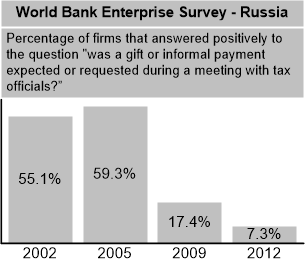
In 2000, Russia was one of the most corrupt countries in the world. Without instituting draconian purges Putin took on the oligarchs and steadily curtailed their power, gradually returning Russia to the rule of law. By 2016 his government reduced corruption to about the same level as that of the United States. That was the empirical result of the annual study on corruption published in 2016 by Ernst & Young.[2] The global auditing consultancy asked respondents around the world whether in their experience, corruption is widespread in the business sector. Their survey, which was conducted in 2014, indicated that only 34% of their Russian respondents thought so, the same proportion as in the United States, and below the world average of 39%. Things have probably improved further since then as Vladimir Putin stepped up a high-profile anti-corruption campaign that led to investigations and prosecution of a number of high level politicians around Russia. Even highly ranked members of Putin’s own political party were not spared.[3] The unmistakable message of such campaigns was that corruption would not be tolerated and that it would be aggressively investigated and prosecuted. Some of the best evidence that Putin’s various anti-corruption measures have had effect can be found in World Bank’s Enterprise Surveys which ask businessmen the question, “was a gift or informal payment expected or requested during a meeting with tax officials?” In 2005, nearly 60% of respondents answered affirmatively. By 2009 this number was 17.4% and by 2012 it had dropped to only 7.3%.
Putin’s government also made impressive advances in making it easier for entrepreneurs and small businesses to set up shop, raise capital and operate in Russia. According to World Bank’s annual “Doing Business” report, which ranks 190 world economies on a set of attributes such as the ease of starting a business, obtaining construction permits, obtaining electricity, raising credit, and enforcing contracts. On all the metrics combined, Russia managed to climb from 124th place in the world in 2012 to 40th in 2017.[4] Thus, within only five years, Russia had vaulted an impressive 84 positions in World Bank’s ranking. This was not a random achievement but the result of President Putin’s explicit 2012 directive that by 2018 Russia should be among the top 20 nations in the world for ease of doing business.
One of the strategically important sectors where Russia has made striking progress is its agricultural industry. After the disastrous 1990s when she found herself dependent on food imports, Russia again became self-sufficient in food production and a net food exporter. By 2014, Russian exports of agricultural products reached nearly $20 billion, almost a full third of her revenues from oil and gas exports. Not only is Russia now producing abundant food for its own needs, the government is explicitly favoring production of healthy foods, a strategy which includes a ban on the cultivation of genetically modified (GMO) crops, introduced by the State Duma in February of 2014. According to official Russian statistics, the share of GMO foods sold in Russia declined from 12% in 2004 to just 0.1% by 2014.
These and many other constructive reforms have had a very substantial impact on Russia’s economic aggregates as the following examples show:
- Between 1999 and 2013, Russia’s gross domestic product (GDP) leaped nearly 12-fold from $1,330 per capita to more than $15,560 in 2013, outpacing even China’s remarkable economic growth.
- Russia reduced its debt as a percentage of GDP by over 90%, from 144% in 1998 to less than 14% in 2015!
- Gross national income per capita rose from $1,710 in 2000 to $14,810 in 2013.
- Unemployment fell from 13% in 1999 to below 5% in 2014. Among the working population (those aged 15-64), 69% have a paid job (74% of men).
- Only 0.2% of Russians work very long hours, compared to 13% OECD average
- Poverty rate fell from 40% in the 1990s to 12.5% in 2013 – better than U.S. or German poverty rates (15.6% and 15.7%, respectively)
- Average monthly income rose from around 1,500 rubles in 1999 to nearly 30,000 rubles in 2013.
- Average monthly pensions rose from less than 500 rubles to 10,000 rubles.
Social and demographic improvements
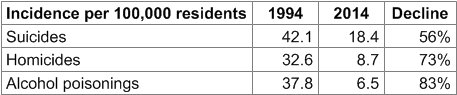
Putin’s economic reforms included also a more equitable distribution of wealth. As hopelessness faded and standard of living improved, Russian society started to heal: suicides, homicides, and alcohol poisonings declined dramatically. Over the twenty-year period between 1994 and 2014, suicides declined by 56%, homicide rate by 73%, and alcohol poisonings by 83%!
The chart below shows the evolution of these improvements over time:
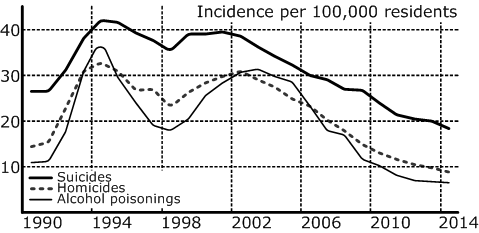
As we can see, these misery statistics rapidly deteriorated with the introduction of shock therapy in 1992, but the trend sharply reversed soon after Putin took charge. By 2014, these figures reached their lowest values since even before 1992. Along with these improvements, the nation’s demographic trends also experienced a dramatic turnaround. Russian life expectancy, which sunk to an average of barely 64 years (57 for men), rose steadily from the early 2000s to reach almost 72 in 2016, the highest it has ever been in Russia’s history.
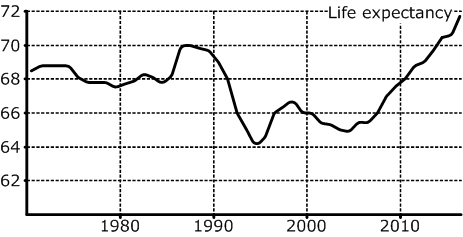
Looking at the way life expectancy in Russia changed over time, we see again that it had collapsed in the early 1990s but the trend turned around sharply under Vladimir Putin’s leadership of the country. Similarly fertility rate, which dropped to 1.16 babies per woman in 1999, increased by almost 50% to 1.7 babies by 2012, comparing favorably to European Union’s average of 1.55 babies per woman of childbearing age. Abortions declined 88% from a harrowing 250% of live births in 1993 to 31% in 2013.

Not only are Russians living longer than ever before and enjoying much better quality of life, they also feel freer and happier. In 2014, Gallup Analytics reported that 65% of Russians, more than ever before, answered “Yes” when asked, “are you satisfied … with your freedom to choose what you do with your life?” Meanwhile, Russia’s happiness index rose more than tenfold, from 6 in 1992 to 70 in 2015. Happiness index, compiled by VCIOM[5] adds the proportion of the respondents reporting that they feel decidedly happy or generally happy and deducts those that report feeling generally unhappy or decidedly unhappy.
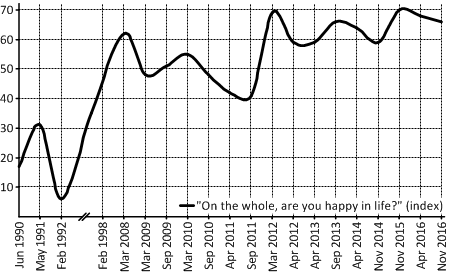
The next chart further corroborates the idea that under Putin’s leadership, Russia has been developing as a sane and prosperous society, not only for the benefit of a narrow ruling class and at everyone else’s expense, but for the vast majority of ordinary Russians.

By 2014, the great majority of Russians felt satisfied with their lives and believed that things in Russia were moving in the right direction. These figures only tapered off after the 2014 western-sponsored coup in Ukraine and the subsequent economic sanctions imposed on Russia. At the same time, the price of oil – still one of Russia’s largest export – collapsed from over $100 per barrel to under $40. Economic sanctions and the oil price collapse triggered a significant crisis in Russia’s economy. However, in spite of the continuing sanctions regime imposed on the country, its economy started improving again in 2016, thanks to its diverse industrial base that includes a developed commercial and consumer automotive industry, advanced aircraft and helicopter construction based largely on domestic technologies, world’s leading aerospace industry building satellites and top class rocket engines, and advanced industries in pharmaceutical, food processing, optical device, machine tools, tractors, software and numerous other branches. Indeed, Russia is far from being just the “Nigeria with missiles,” or a “gas station with an army,” as many western leaders like to characterize it.
Insofar as a population’s sentiment is a valid measure of its leadership’s performance, Russia’s development under Vladimir Putin stands in sharp contrast with the weak performance of most other developed nations, including those that most vehemently criticize Russia and its president. According to polls conducted by Ipsos Public Affairs in 25 different countries in November 2016 and published by the World Economic Forum, almost two thirds of the people in the world believed that their countries were moving in the wrong direction. The leading western nations scored just as badly, while some among them did flat out dismally.
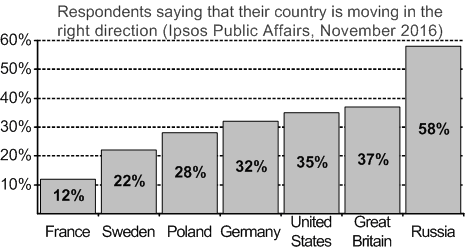
Evidently, Russians feel much better about the way their nation is shaping up than do constituents of many western nations[6] whose sanctimonious leaders like to lecture their Russian counterparts about prosperity, freedom, democracy and other exalted values they purport to cherish.[7] It may thus only surprise the most credulous consumers of western propaganda that a high proportion of Russian people trust Vladimir Putin and approve his job performance. In the early 2017, Putin’s job approval stood between 80% and 90% and has averaged 74% over the eleven years from 2006. During this period, no western leader has come even close to measuring up with Vladimir Putin.

Over the years, I’ve heard depressingly many intellectuals attempt to dismiss Putin’s achievements and Russian people’s contentment as the product of Russian government propaganda. Putin the autocrat, you see, keeps such tight control over the media that he can deceive his people into believing that things in the country are much better than they really are. But the idea that government propaganda can influence public opinion in this way is just silly. If the majority of people thought their lives were miserable, state propaganda could not persuade them that everything is great. On the contrary, most people would conclude that the media is deceiving them and might feel even less positive about things as a result.[8] It is sillier still to think that western intellectuals should have a better appreciation of what it is like to live in Russia than the Russian people themselves. Rather than buying the truth from their media, such intellectuals would do well to take a trip and visit Russia, speak to ordinary people there, and reach their own conclusions. My own travels in Russia, as well as reports from other visitors largely agree with the positive picture that emerges from the statistics we’ve just examined.
Notes:
[1] (Gorbachev: Putin saved Russia from disintegration 2014)
[2] (Stulb 2016)
[3] Some of the names arrested in 2016 surprised even the Russian public as they included such high caliber individual as the Mayor of Vladivostok, Igor Pushkarev; Governor of the Kirov region, Nikita Belykh; Governor of the Sakhalin region, Alexander Khoroshavin, Deputy Minister of Culture Grigory Pirumov and Minister for Economic Development, Aleksey Ulyukaev.
[4] (Romer 2016)
[5] ВЦИОМ – Russian Center for Research on Public Opinion
[6] A different, Associated Press – GfK poll in July of 2016 uncovered an even darker public sentiment in the United States: “A stunning 79 percent of Americans now believe the country is heading in the wrong direction, a 15-point spike in the past year…” (J. Pace 2016)
[7] VCIOM’s figures for November 2016 are somewhat higher than those of Ipsos (62% vs. 58%).
[8] This, for instance, was the situation in the late 1990s when only 5 to 10 percent of Russians thought that the country was heading in the right direction in spite of the ruling elite’s nearly total control of the media.

No comments yet.
Featured Video
It’s the Occupation, Stupid
or go to
Aletho News Archives – Video-Images
From the Archives
A superpower and “the world’s sickest warrior state”
By Paul J. Balles | March 8, 2010
Living through five or six major wars has hardened me to what I thought were the extremes of inhuman cruelty and brutality.
Two things made those extremes almost bearable: the brutality always revealed – at least according to the media coverage – the viciousness of the enemy. It was therefore quite understandable when our “brave men and women” pulverized the enemy.
Films of Japanese torturing captive Americans somehow justified holding Japanese Americans in internment camps during World War II; and only a small percentage of Americans found the bombing of Hiroshima and Nagasaki unreasonably vengeful at best, at worst, depraved.
The media giants in America portrayed the North Koreans as barbaric beasts with their captives, quite unlike their southern counterpoints – our allies during the Korean War. No one ever felt the need to explain how the South Koreans were a civilized breed while the North Koreans were absolute savages, at least according to the official line.
In Vietnam, our warriors justifiably (or so the media made us believe) dropped napalm on the North Vietnamese who had the gall to hide in villages and tunnels to ravage our invaders. At least it was accepted practice until some rogue photojournalist filmed a young girl screaming down a Vietnamese road in flames. … continue
Blog Roll
 Aletho News
- AWACS’ Destruction is a Major Loss for US Military – Ex-DoW Analyst
- Israel’s Iran Strategy Uses US Military & Gulf States as Its Pawns
- Iran: Trump wanted regime change, now just begging for Hormuz to open
- IRGC: Israeli, US universities in region legitimate targets after strikes on Iranian university
- Trump admits Iran hit USS Ford carrier: ‘We ran for our lives’
- Battle for Hungary: EU attacks on Orban are a sign of worse things to come
- Iraqi resistance conducts drone strike on US-run base in Syria
- Failing to Defeat Hezbollah, Israel & US Pressure Syria’s Ahmed al-Sharaa to Join War
- US-Israeli war on Iran drives global fertilizer prices up 40%
- Hezbollah’s Surprise Weapons Redefine Ground Battle with Israel
- If Americans Knew
- Israel is assassinating journalists again, more than any other nation, anywhere, ever – Not a ceasefire Day 170
- Over 300 US service members wounded, majority have brain injuries – Not a ceasefire Day 169
- Researchers at Human Rights Watch Resign Over Blocked Report on Palestinian Refugee Return
- Jewish Groups Are Backing a War Americans Don’t Want
- Eric Fingerhut Thinks He’s the President of the Jews
- Top Jewish Philanthropists, Rabbis Urge Israeli President to Take Action Against ‘Jewish Extremists’
- Don’t Be Fooled. Zionist Leaders Have Always Wanted to Control Southern Lebanon
- Israel’s widespread use of torture is a core element of its genocide against the Palestinian people
- In Israel’s War on Iran, Many Middle East US Bases Rendered “All But Uninhabitable”
- ‘Burn the lawn’: Israel pursues ‘Rafah model’ in southern Lebanon
- No Tricks Zone
- German Science Blog Accuses PIK Climate Institute Of Hallucinating Climate Tipping Points
- Devastating Assessment Of Comirnaty Vaccine By Former Senior Pfizer Europe Toxicologist
- New Study: CO2 Is ‘Effectively Negligible’ As An Explanatory Climate Change Factor Since 2000
- Former Pfizer Toxicologist Dr. Helmut Sterz Tells Bundestag Hearing Pfizer Vaccine Should Have Never Been Approved
- Energy Expert: Germany’s Nuclear Phaseout Was A “500 Billion Euro Mistake”
- New Research: South Australia’s Mid-Holocene Sea Surface Temperatures Were 4°C Warmer Than Today
- Storing Green Energy To Last Germany 10 Days Would Require A 60-Million Tonne Battery
- New Studies: UK Sea Levels Were 4 Meters Higher Than Today During The Mid-Holocene
- Destructive Green New Deal: German Energy And Metal Group Warns Of Drastic Crisis
- New Study Documents A 20-Year Pause In Arctic Sea Ice Decline – Driven By Internal Variability
 Aletho News
Leave a comment