Under US-backed militants’ rule, Raqqah can’t be called liberated: Syria
Press TV – October 24, 2017
A Syrian minister says no land is considered liberated in the country unless national army forces regain control of it and raise the Syrian flag atop its buildings.
“We do not consider any city liberated until the Syrian Arab army enters it and lifts the Syrian flag over it. This applies to any point of the Syrian map,” Information Minister Mohammad Ramez Tardjaman told Russia’s Sputnik news agency in an interview published on Monday.
Earlier this month, the so-called Syria Democratic Forces (SDF), a US-backed coalition of mainly Kurdish militants, captured the city of Raqqah from the Daesh terror group following a military operation, which was launched in July without the central government’s approval.
US President Donald Trump, whose country has been leading a bombing campaign in Syria since 2014, claimed that the city’s “liberation” was a result of the purported changes that he had brought to the US military’s strategy.
Tardjaman described the withdrawal of Daesh from its former Syrian base as a “positive event,” but emphasized that the city was not yet liberated.
“Regardless of whether Daesh is there or some other faction or organization,” the Syrian army needs to enter and retake control of Raqqah in order for the city to be called free.
He also denounced any unauthorized “local compromises, truces, and establishment of de-escalation areas” by forces controlling Raqqah.
“The Syrian administration will never bow down to compromises that violate Syria’s national unity and sovereignty,” he asserted.
Some, he said, wrongfully assumed that such arrangements, which do not have Damascus’ approval, could lead to “federalism, confederalism, or autonomy.”
He also lambasted “factitious demarcations, such as ‘east Euphrates and west Euphrates,’ which the US and its allies have been promoting.”
The Syrian government does not accord any importance to these terms and delineations, and will never recognize them, the minister stated.
He was apparently reacting to an October 20 statement by the SDF, in which it announced the “liberation” of Raqqah and said the city will be part of a system of “federal government” in the country’s north.
The Syrian military has not so far engaged the SDF, which has reportedly shelled the positions of government troops on several occasions in recent weeks.
Hashd Commander: US Must Prepare to Leave Iraq after ISIL Defeat
Al-Manar | October 24, 2017
Leader of paramilitary force in Iraq, Assaeb Ahl Al-Haqq hit back at US Secretary of State remarks on Hashd Shaabi volunteer forces, saying Washington must prepare to withdraw its forces from the country following the defeat of ISIL Takfiri group.
Tweeting on his account on social media, Sheikh Qaiss Al-Khazali said: “To US Secretary we say: Your forces have to prepare to leave our country, Iraq, right after the pretext of ISIL presence is over.”
Al-Khazali was responding to Rex Tillerson, who on Monday called on Hashd fighters in Iraq to “go home” as the fight against the ISIL terrorist group was ending.
Assaeb Ahl Al-Haqq is one of the Hashd factions. The volunteer forces have a crucial role in defeating the Takfiri terrorists in Iraq.
Al-Khazali remarks come after Hadi Al-Ameri, leader of the Badr Organization, said that Tillerson is ‘persona non grata’, calling on Iraqi Prime Minister Haider Al-Abadi not to receive him.
Russian Embassy Slams US for Denying Access to Diplomatic Archives
Sputnik – October 24, 2017
The Embassy of the Russian Federation in the United States slammed the US officials on Monday for packing and transferring the diplomatic archives from the closed Consulate General in San Francisco without the oversight of the Russian diplomats.
“By taking these actions, the United States has once again violated the key provisions of the Vienna Convention on Consular Relations and the bilateral consular convention,” the Russian Embassy said in a statement on Monday.
The Embassy stressed that all consular archives and documents should not be dishonored regardless of the circumstances and irrespective of their location.
Washington has transferred the archive to the Embassy on October 23, but did not permit Russian diplomats to enter the building and pack the documents.
Moscow perceived this step as disregard to the international law and Russian diplomatic mission, which enables Moscow to take retaliatory measures, the Embassy noted.
“Washington’s disregard of the international law, our diplomatic and consular facilities and property enables the Russian government to prepare similar actions against US missions in Russia based on the principle of reciprocity,” the Embassy said on Monday.
According to the US officials, the decision to close the Russian missions came as a response to Russia deciding in July to reduce the number of US diplomatic staff in the country to 455 people, which is the same number as that of the Russian diplomatic personnel in the United States.
After Russian diplomats left the diplomatic compounds, US security agents entered the premises to conduct searches. Moscow condemned the actions as a violation of international law, including the Vienna Conventions on Diplomatic and Consular Relations.
SEE ALSO:
Russian Embassy Issues Footage of US Intrusion in Diplomatic Facility (VIDEO)
Russia-China Tandem Changes the World
By Gilbert Doctorow | Consortium News | October 23, 2017
Much of what Western “experts” assert about Russia – especially its supposed economic and political fragility and its allegedly unsustainable partnership with China – is wrong, resulting not only from the limited knowledge of the real situation on the ground but from a prejudicial mindset that does not want to get at the facts, i.e. from wishful thinking.
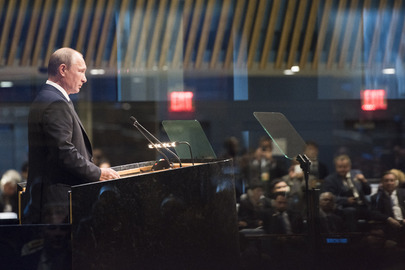
Russian President Vladimir Putin (UN Photo)
Russia may not be experiencing dynamic growth, but over the past two years it has survived a crisis of circumstance in depressed oil prices and economic warfare against it by the West that would have felled less competently managed governments enjoying less robust popularity than is the case in Vladimir Putin’s Russia. Moreover, as stagnant as Russia’s GNP has been, the numbers have been on a par with Western Europe’s very slow growth.
Meanwhile, Russian agriculture is booming, with the 2017 grain harvest the best in 100 years despite very adverse climatic conditions from early spring. In parallel, domestically produced farm machinery has been going from strength to strength. Other major Industrial sectors like civil aircraft production have revived with the launch of new and credible models for both domestic and export markets.
Major infrastructure projects representing phenomenal engineering feats like the bridge across the Kerch straits to Crimea are proceeding on schedule to successful termination in the full glare of regular television broadcasts. So where is this decrepit Russia that our Western commentators describe daily?
The chief reason for the many wrongheaded observations is not so hard to discover. The ongoing rampant conformism in American and Western thinking about Russia has taken control not only of our journalists and commentators but also of our academic specialists who serve up to their students and to the general public what is expected and demanded: proof of the viciousness of the “Putin regime” and celebration of the brave souls in Russia who go up against this regime, such as the blogger-turned-politician Alexander Navalny or Russia’s own Paris Hilton, the socialite-turned-political-activist Ksenia Sochak.
Although vast amounts of information are available about Russia in open sources, meaning the Russian press and commercial as well as state television, these are largely ignored. The sour grapes Russian opposition personalities who have settled in the United States are instead given the microphone to sound off about their former homeland. Meanwhile, anyone taking care to read, hear and analyze the words of Vladimir Putin becomes in these circles a “stooge.” All of this limits greatly the accuracy and usefulness of what passes for expertise about Russia.
In short, the field of Russia studies suffers, as it also did during the heyday of the Cold War, from a narrow ideological perspective and from the failure to put information about Russia in some factually anchored framework of how Russia fits in a comparative international setting.
Just what this means was brought into perspective last week by a rare moment of erudition regarding Russia when professor emeritus of the London School of Economics Dominic Lieven delivered a lecture in Sochi at the latest Valdai Club annual meeting summarizing his take on the Russian Revolution of 1917.
Lieven, arguably the greatest living historian of imperial Russia, is one of the very rare birds who brought to his Russian studies a profound knowledge of the rest of the world and in particular of the other imperial powers of the Nineteenth Century with which Russia was competing. This knowledge takes in both hard and soft power, meaning on the one hand, military and diplomatic prowess and, on the other, the intellectual processes which are used to justify imperial domination and constitute a world view if not a full-fledged ideology.
Self-blinded ‘Experts’
By contrast, today’s international relations “experts” lack the in-depth knowledge of Russia to say something serious and valuable for policy formulation. The whole field of area studies has atrophied in the United States over the past 20 years, with actual knowledge of history, languages, cultures being largely scuttled in favor of numerical skills that will provide sure employment in banks and NGOs upon graduation. The diplomas have been systematically depreciated.
The result of the foregoing is that there are very few academics who can put the emerging Russian-Chinese alliance into a comparative context. And those who do exist are systematically excluded from establishment publications and roundtable public discussions in the United States for not being sufficiently hostile to Russia.
If that were not the case, one could look at the Russian-Chinese partnership as it compares firstly with the American-Chinese partnership created by Richard Nixon and Henry Kissinger, which is now being replaced by the emerging Russian-Chinese relationship. Kissinger was fully capable of doing this when he wrote his book On China in 2011, but Kissinger chose to ignore the Russian-Chinese partnership though its existence was perfectly clear when he was writing his text. Perhaps he did not want to face the reality of how his legacy from the 1970s had been squandered.
What we find in Kissinger’s description of his accomplishments in the 1970s is that the American-Chinese partnership was all done at arm’s length. There was no alliance properly speaking, no treaty, in keeping with China’s firm commitment not to accept entanglement in mutual obligations with other powers. The relationship was two sovereign states conferring regularly on international developments of mutual interest and pursuing policies that in practice proceeded in parallel to influence global affairs in a coherent manner.
This bare minimum of a relationship was overtaken and surpassed by Russia and China some time ago. The relationship has moved on to ever larger joint investments in major infrastructure projects having great importance to both parties, none more so than the gas pipelines that will bring very large volumes of Siberian gas to Chinese markets in a deal valued at $400 billion.
Meanwhile, in parallel, Russia has displaced Saudi Arabia as China’s biggest supplier of crude oil, and trading is now being done in yuan rather than petrodollars. There is also a good deal of joint investment in high technology civilian and military projects. And there are joint military exercises in areas ever farther from the home bases of both countries.
I think it is helpful to look at this partnership as resembling the French-German partnership that steered the creation and development of what is now the European Union. From the very beginning, Germany was the stronger partner economically with France’s economy experiencing relative stagnation. Indeed, one might well have wondered why the two countries remained in this partnership as nominal equals.
The answer was never hard to find: with its historical burden from the Nazi epoch, Germany was, and to this day remains, incapable of taking responsibility in its own name for the European Union. The French served as the smokescreen for German power. Since the 1990s, that role has largely been transferred to the E.U. central bodies in Brussels, where key decision-making positions are in fact appointed by Berlin. Yet, France remains an important junior partner in the German-driven process.
The Russian-Chinese Tandem
One may say much the same about the Russian-Chinese tandem. Russia is essential to China because of Moscow’s long experience managing global relations going back to the period of the Cold War and because of its willingness and ability today to stand up directly to the American hegemon, whereas China, with its heavy dependence on its vast exports to the U.S., cannot do so without endangering vital interests. Moreover, since the Western establishment sees China as the long-term challenge to its supremacy, it is best for Beijing to exercise its influence through another power, which today is Russia.
Of course, in light of the E.U.’s Brexit troubles and Trump’s abandonment of world leadership, it is undeniably possible that China will step out of the shadows and seek to assume direction of global governance. But that would be problematic. China faces major domestic challenges including the transition of its economy from being led by exports to relying more on domestic consumption. That will absorb the attention of its political leadership for some time.
Kissinger, who has been an adviser to Trump, whispers in Trump’s ear about the importance of separating Russia from China, but Kissinger’s limited and outdated knowledge of Russia has caused him to underestimate the powerful motives behind the Russian-Chinese relationship. America’s less gifted and informed pundits are even more clueless.
For one thing, given the sustained hostility directed at Russia from the West in general and from Washington in particular, it is inconceivable that Putin would be wooed away from Beijing by some flirtatious “come hither” gestures from the Trump administration even if that were politically possible for Trump to do. One of Putin’s outstanding features is his loyalty to his friends and his principles as well as to his nation’s interests.
As Putin revealed during his address and Q&A at the Valdai Club gathering this past week, he now bears a deep distrust of the West in light of its having taken crude advantage of Russia’s weakness in the 1990s and by its expansion of NATO to Russian borders and other threatening actions. Whatever hopes Putin once may have held for warmer relations with the West, those hopes have been dashed over the past several years.
Putting personalities aside, Russian foreign policy has a commonality that is rare to see on the world stage: actions first, diplomatic charters later. Russia’s political relations with China come on top of massive mutual investments that have taken many years to agree on and execute.
In the same way, Russia is proceeding with Japan to work towards a formal peace treaty by first putting in place massive trade and investment projects. It is entirely foreseeable that the first step to the treaty will be the start of construction in 2018 of a railway bridge in the Far East linking the Russian island of Sakhalin with the mainland. The general contractor and engineering team is also in place: Arkady Rotenberg and his SGM Group. That bridge is the prerequisite for Japan and Russia signing a $50 billion deal to build a railway bridge linking Sakhalin and Hokkaido. This bridge will draw the attention of the whole region to Russian-Japanese cooperation. It could be the foundation for a durable and not merely paper peace treaty resolving the territorial dispute over the Kurile Islands.
Lost Opportunities
In light of these realities, it is puerile to speak of detaching Russia from China with the promise of normalized relations with the West. The opportunity to do that existed in the 1990s, when President Boris Yeltsin and his “Mr. Yes” Foreign Minister Andrei Kozyrev did everything possible to win U.S. agreement to Russian accession to NATO immediately following accession by Poland. To no avail.
Then again early in Putin’s presidency, the Russians made a determined effort to win admission to the Western alliance. Again to no avail. Russia was excluded, and measures were taken to contain it, to place it in a small box as just another European regional power.
Finally, following the confrontation with the United States and Europe over their backing of the 2014 coup in Ukraine, followed by the Russian annexation/merger with Crimea, and Russian support for the insurgency in Ukraine’s Donbas region, Russia openly was cast as the enemy. It was compelled to mobilize all of its friendships internationally to stay afloat. No state was more helpful in this regard than China. Such moments are not forgotten or betrayed.
The Kremlin understands full well that the West has nothing substantial to offer Russia as long as the U.S. elites insist on maintaining global hegemony at all costs. The only thing that could get the Kremlin’s attention would be consultations to revise the security architecture of Europe with a view to bringing Russia in from the cold. This was the proposal of then President Dmitry Medvedev in 2010, but his initiative was met by stony silence from the West. Bringing in Russia would mean according it influence proportionate to its military weight, and that is something NATO has opposed tooth and nail to this day.
It is for this reason, the failure to seek solutions to the big issue of Russia’s place in overall security, that the re-set initiative under Barack Obama failed. It is for this reason that Henry Kissinger’s advice to Donald Trump at the start of his presidency to offer relief from sanctions in return for progress on disarmament rather than implementation of the Minsk accords regarding the Ukraine crisis also failed, with Vladimir Putin giving a firm “nyet.”
Implicit in the few American “carrots” being extended to Russia these days is its acceptance of the anti-Russian regime in Ukraine and its authority over the heavily ethnic Russian areas of the Donbas and Crimea, concessions that would be politically devastating to Putin inside Russia. Yet, that “normalization” would still leave the much milder but still nasty “human rights” sanctions that the U.S. imposed in 2012 through the Magnitsky Act, driven by what the Kremlin regards as false propaganda surrounding the criminal case and death of accountant Sergei Magnitsky.
The sting of the Magnitsky Act was to discredit Russia and prepare the way for it being designated a pariah state. It came amidst an already longstanding campaign of demonization of the Russian president in the U.S. media. In fact, to begin to find a halfway normal period of bilateral relations, you would have to go back to before George W. Bush’s invasion of Iraq, which Russia denounced along with Germany and France. The latter two powers got a tap on the wrist from Washington. For Russia, it was the start of a period of reckoning for its uncooperativeness with American global domination.
Demonizing Russia
As for Europe and Russia, the question is very similar. To find mention of a strategic relationship, firstly from the German Foreign Ministry, you have to go back to before 2012. And what constituted normality then? At the time, renewal of the E.U.-Russia cooperation agreement was already being held up for years, nominally over a difference of views on the provisions of E.U. law governing gas deliveries through Russian-owned pipelines. Behind this difference was the total opposition of the Baltic States and Poland to anything resembling normal relations with Russia, for which they received full encouragement from the U.S.
The rallying cry was to put a stop to Russia’s status as “monopoly supplier” to Europe as regards gas, but also oil. Of course, no monopoly ever existed, nor does it exist today, but determined geopolitical actors never let such details stand in the way of policy formulation.
This hostility also played out in the contest of wills between the E.U. and Russia over introduction of a visa-free regime for travel by their respective citizens. Here the opposition of Germany’s Angela Merkel, justified by her vicious characterization of Russia as a mafia state, doomed the visa-free regime and by the same token doomed normal relations.
All of this unfinished business has to be addressed and put right for there to be any possibility of the U.S. and the E.U. ending their hostility toward Russia and for the Kremlin to regain any trust toward the West. Even then, however, Russia would not surrender its valued relationship with China.
In my view, the de facto Russian-Chinese alliance matches the de jure US-West European alliance. The net result of both is the partition of the world into two camps. We now have, in effect, a bipolar world that broadly resembles that of the Cold War, though still in a formative stage since many countries have not signed on definitively to one side or another.
Of course, more-or-less neutral states were also a feature of the Cold War, creating what was called the group of Nonaligned Nations, led back then by India and Yugoslavia. Yugoslavia no longer exists, but India has continued its tradition of let both poles court it, trying to eke out the greatest benefit to itself.
To be sure, a great many political scientists in the U.S., in Europe and in Russia as well, insist that we already have a multipolar world, saying that power is too diffuse in the world today, especially considering the rise of non-state actors after 1991. But the reality is that very few states or non-states can project power outside their own region. Only the two big blocs can do that.
The theoreticians defending multipolarity speak of a return to the balance of power of the Nineteenth Century, invoking the Congress of Vienna as a possible model for today’s world governance. This is an approach that Henry Kissinger laid out in 1994 in his book Diplomacy.
Within Russia, this concept has found support in some influential think tanks and is most notably associated with Sergei Karaganov, head of the Council of Foreign and Defense Policy. Nonetheless, I maintain that everyday realities of power will decide this question. And is there anything inherently wrong with this de facto bipolar world, assuming the tensions can be managed and a major war averted?
In my view, two large blocs are more likely to keep global order because the scope of activities by proxies can be reined in – as often happened during the Cold War – by big powers not wanting their various clients to disrupt a functioning world order. The tails are less likely to wag the dog.
Moreover, as regards the Russia-China strategic partnership or alliance, Western observers should take comfort and not take alarm. The rise of China is a given whatever the constellation of great powers may wish. The close embrace of Russia and China also can serve as a moderating influence on China, given Russia’s greater experience in world leadership.
For all of the above positive and negative reasons, the Russia-China relationship should be viewed with equanimity in Western capitals.
Gilbert Doctorow is an independent political analyst based in Brussels. His latest book, Does the United States Have a Future? was just published.
US Targets Russian Nord Stream-2 Gas Project: Déjà Vu Story
By Peter KORZUN | Strategic Culture Foundation | 23.10.2017
The US Countering Iran’s Destabilizing Activities Act of 2017 contains a separate section called the Countering Russian Influence in Europe and Eurasia Act (“CRIEEA”). CRIEEA authorizes – and at times requires – the President to impose significant new sanctions on the Russian energy, financial, and defense sectors, imperiling the completion of the Russian Nord Stream 2 gas pipeline. It also hits European businesses involved in the project. The legislation can impact a potentially large number of European companies doing legitimate business under EU measures with Russian entities in the railways, financial, shipping or mining sectors, among others. Now the US punitive measures could include the pipelines crossing the territory of Ukraine, as well as pipeline projects in the Caspian region and the development of the Zohr gas field off the coast of Egypt. The law negatively affected the US relationship with European allies.
Russian President Vladimir Putin believes that the world is witnessing an increasing number of examples of politics crudely interfering with economic, market relations. In his address to the final plenary session of the 14th annual meeting of the Valdai Discussion Club on October 19, Putin said “Some do not even conceal that they are using political pretexts to promote their strictly commercial interests. For instance, the recent package of sanctions adopted by the US Congress is openly aimed at ousting Russia from European energy markets and compelling Europe to buy more expensive US-produced LNG although the scale of its production is still too small.”
The US is striving to control the EU decision-making process. According to Washington’s logic, building a pipeline to reduce costs and raise reliability and efficiency proves that Russia is politically motivated, unlike the US with its new law adopted to pave the way for American LNG exports to Europe using coercive measures! The US staunch allies ready to cede economic profits for Washington’s friendship – Poland, the Baltic States, and, since recently, Denmark – are mobilized to hinder Nord Stream-2. Not an EU member, but a member of Energy Community, Ukraine also goes to any length to obstruct the project.
Poland tried to reverse the EU decision through courts but to no avail. In July, a court in Duesseldorf, Germany, lifted restrictions on Russian gas company Gazprom’s access to the German Opal gas pipeline, online documentation by the court showed, echoing a ruling on July 21 by the European Union General Court.
Defying the US pressure, the EU exempted OPAL gas pipeline (delivering gas from Russian Nord Stream to Europe) from the Third Energy Package after 6 years of debates. The decision opened the way for Russian plans to expand Nord Stream’s capacity and bypass both Ukraine and Poland as a gas transit route. The Western companies have immediate interests in Nord Stream 2, which is a joint venture between Gazprom (50% share) and five of the largest European energy companies: E.ON, OMV, Shell, BASF/Wintershall and Engie (each 10% share).
Actually, this is a déjà vu story. Washington has a long history of meddling into European energy policy. The Yamal and Nord Stream 2 gas projects present several striking similarities. In 1980-81, the Yamal pipeline (Urengoy-Pomary-Uzhgorod) project was presented to be negotiated between the Soviet Union (Soyuzgazexport) and Western Europeans (Ruhrgas and Gaz de France). Back then, West Germany’s Chancellor Helmut Schmidt was willing to preserve the achievements of Willy Brandt’s Ostpolitik. The USSR and West Germany concluded an agreement on the deal in November 1981.
The joint project was fiercely fought by President Ronald Reagan. He saw Yamal through a geopolitical lens and considered it one of the Soviet Union’s significant tools aimed at spreading Moscow’s influence over the Europeans, and in particularly over NATO. The US launched a coordinated diplomatic offensive aimed at convincing European allies to abandon their participation in the Yamal project. It offered to supply West Germany with energy in the form of coal, but his proposal was turned down as not viable economically.
Those were the days of great tensions between the West and the East marked by NATO’s deployment of intermediate range ground-based missiles in Italy, the UK, West Germany, the Netherlands and Belgium. In 1979, the USSR launched an operation in Afghanistan.
The US insisted the Yamal project threatened NATO security just like nowadays Nord Stream-2 does amid the Russia-West divisions over Ukraine and a host of other issues. President Reagan used the geopolitical tensions as a pretext to deprive the Soviet Union of profits. With Germany refusing to bow, the US administration used the Polish crisis in 1980-1981 to impose sanctions banning sales of equipment to the USSR.
In December, 1981, President Reagan banned all the gas and oil equipment and technology exports produced in the United States to the Soviet Union. In June, 1982, the US administration announced the extension of the sanctions on all foreign companies exporting equipment involving American technologies. The US sanctions drove a wedge between the United States and its Western European allies, as the latter refused to follow the lead. The landmark deal went through to be joined by France, Austria and Italy. West German, French, Italian and British companies won multi-million contracts for pipes and various equipment orders. The America embargo was lifted in 1982. In 1984, the Yamal pipeline became operational to benefit all.
Today, the US uses Ukraine instead of Poland but the goal and the methods to achieve it remain the same.
If Germany had not had the advantage of stable gas supplies from Russia, it would not have become the locomotive driving the European economy and the EU leader defining the decision making process. Other European countries have also gained a lot. Today, the demand for Russian gas keeps on growing to make Moscow increase supplies via the pipeline going through Ukraine and Nord Stream. Europe badly needs the stable supplies, if it wants to achieve economic progress. To protect its vital interests it has to defy the United States. The history appears to repeat itself.
US Cannot Shoot Down DPRK Missiles: Global Defense Experts
Sputnik – 24.09.2017
The US State Department stated on Friday that the country’s military defense networks will shoot down a North Korean ballistic missile if it flies over the island territory of Guam, but experts in the field have claimed that the Pentagon is flat-out wrong.
In stating that the US will destroy a Pyongyang ballistic missile carrying a nuclear warhead in mid-air, the Pentagon is not only misleading the public and its own government, it is outright lying, according to military experts with deep knowledge of missile-defense technology.
“No, we won’t,” counter military experts to claims by the Pentagon that the US may launch and intercept any missiles launched by the People’s Democratic Republic of Korea (DPRK).
The United States will have a hard time trying to shoot down DPRK nuclear missiles, a point of view shared by Joe Cirincione, president of Ploughshares Fund, a global security foundation specializing in nuclear weapons, and Kingston Reif, director of Disarmament and Threat Reduction policy at the nonpartisan Arms Control Association.
According to both experts, the United States touts its layered missile defense systems, even though almost none are capable of intercepting an ICBM.
When Pyongyang shot a missile over Japan, it flew high enough that no US system would be able to reach it, Cirincione wrote in a report for Defense One.
“The key word here is ‘over.’ Like way over,” Cirincione wrote. “Like 770 kilometers (475 miles) over Japan at the apogee of its flight path. Neither Japan nor the United States could have intercepted the missile. None of the theater ballistic missile defense weapons in existence can reach that high.”
The US missile defense consists of three layers, including the Patriot, THAAD and the Aegis systems. For the sake of simplicity, their ranges can be memorized as 12, 125 and 1350 miles, respectively (thanks to the Business Insider for a nice chart).
However, all three are designed to take down a missile at its final, terminal, stage, while it is falling from the sky toward its target. Despite that the US has reportedly poured some $320 billion into missile defense systems over the last several decades, none of the systems is capable of reaching an ICBM (or even an intermediate-range ballistic missile (IRBM)) in its middle or post-launch stage.
Well, they will take down an ICBM in the terminal stage, right? Wrong, the experts say. While the much-advertised Aegis system, for example, has displayed stellar results in test fires against short-range and medium-range targets, these results must be taken with a heavy dose of salt, according to Reif and Cirincione.
“Only one of those tests has been against an IRBM class target similar to the North’s HS-12,” Reif told Fox News.
“THAAD, Patriot and especially Aegis, have done fairly well in tests, but these have been tests designed for success, simplified, carefully staged and using mostly short-range targets,” Cirincione stated.
According to Cirincione, currently the United States has a “50-50 chance” of hitting a missile similar to North Korea’s Hwasong-14 while the missile is in flight. And those results are only possible if the DPRK used zero countermeasures, such as decoys (some as simple as a balloon), electronic jammers and chaff.
There is also a little-discussed issue with naval-based Aegis launchers. Despite their flexibility compared to fixed ground-based systems, the ships need to be at precisely the right place at the right time to be capable to intercept a launch, experts say.
Trying to use missiles from Aegis ships “would be a highly demanding task and entail a significant amount of guesswork, as the ships would have to be in the right place at the right time to stop a test at sea,” Reif said, cited by Defense One.
There is a US system that is supposed to be the ultimate solution to the ICBM threat — well, at least sort of — called “Ground-Based Midcourse Defense,” or GMD, according to the experts. This system, which has already cost the US some $40 billion, is claimed to be able to shoot down ICBMS at their highest point, at ranges up to 3,500 miles.
According to the experts, “claimed to be able” does not equal “guaranteed to work.”
“The only system designed to defend the US homeland, known as the [GMD], has suffered from numerous technical and engineering problems, and testing in controlled conditions has not demonstrated that it can provide a reliable defense against even a small number of unsophisticated ICBMs,” Reif said.
“The success rate of the GMD systems in flight intercept tests has been dismal,” Cirincione quoted Philip Coyle, former director of operational testing for the Pentagon, as saying.
Cirincione also quotes the former head of the Missile Defense Agency, retired Lt. Gen. Trey Obering, saying that the chances of successfully hitting an ICBM with a GMD are “as good as coin toss.”
Top US officials, including President Donald Trump and his defense minister General Jim Mattis, claim that the Pentagon has the situation under control and can deal with any nuclear threat, giving US citizens a false feeling of safety. Neither the US mainland, Japan or South Korea are in any way protected by US missile defense technology from a DPRK nuclear strike.
Thomas Karako, senior fellow and director of the Missile Defense Project at the Center for Strategic and International Studies, said in an interview with Fox News that “North Korea has hundreds of missiles, [and] the THAAD battery is not there to defend the entire peninsula. […] This is not about having a perfect shield and sitting there and playing catch.”
According to Karko, THAAD has been deployed in South Korea not to provide protection for the 25 million population of the country, but to “buy time for a military counterstrike.”
The top US brass, repeating words of confidence over and over again, may trick themselves into believing their own words, according to Reif.
“Misplaced overconfidence in missile defense could prompt US leaders to think that we can escalate in response to North Korean provocations without having to worry about a potential North Korean nuclear response,” Reif warned.
“This would greatly increase the risk of conflict on the Korean Peninsula,” he added.
Report: 16 Palestinian Children Arrested, Beaten, and Confined to Cage By Israeli Soldiers
By Richard Edmondson | Fig Trees and Vineyards | October 22, 2017
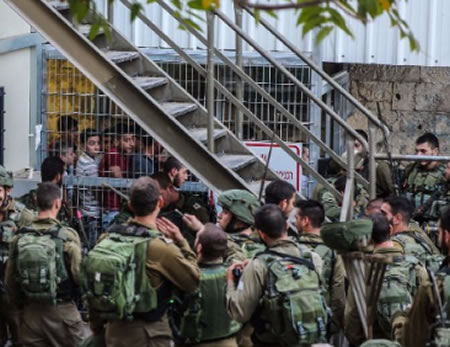
“On October 13th, 2017, 16 children and 2 adults were ambushed and arrested by the Israeli soldiers from the Givati Brigade. The 18 arrested were initially detained in a cage in checkpoint 56, cable-tied, kicked, and hit. 2 were released, whilst the remaining 16 were transferred to an Israeli police station where they were subjected to further physical and psychological violence. All 16 were eventually released without charge, but not before threats were made to their families and the safety of their homes.”
The above is reported by Christian Peacemaker Teams, which maintains a team of international observers in the occupied West Bank…
The seizing of the children took place in the West Bank city of Hebron. The report goes on to describe arrests of minors as “a consistent reality of the occupation and tactic of the Israeli occupation forces,” and it also cites a report from a human rights organization showing that 130 children were arrested in August of 2017 alone.

One of those detained in the October 13 roundup was 12-year-old Abdullah Dwaik. That’s Abdullah in the brown sweater being led away in the photo above. You can also see him in the video below giving an account of what took place after he was taken into custody. Following the initial arrest, he and the others were transported to a military base where they were handcuffed and blindfolded.
I’m not sure exactly where Abdullah’s grandparents live–I’m not familiar with the place name–but Bab Al Zawyeh, the place he calls “home,” is a neighborhood in central Hebron.
I also do not know who the “Ofer the settler” Abdullah refers to (and who he says hit one of the boys) is, though possibly he’s the man profiled in the following video…
In any event, the Christian Peacemakers report goes on to make some additional crucial points:
- Children should never be blindfolded, hooded or painfully restrained;
- Children should never be subjected to violent, threatening or coercive conduct;
- Children must be able to consult with a lawyer prior to interrogation;
- Children should have a parent or guardian present prior to and during their interrogation;
- Children should not be arrested at night;
- Children should be properly informed of their right to silence;
- All interrogations should be audio-visually recorded;
- No child should be transferred out of the West Bank in violation of the Fourth Geneva Convention.
Israel has violated all of these principles.
And this is the country so loved by Dickinson, Texas that its officials deny hurricane relief assistance to people based upon whether or not they support a boycott of it.

Mayor and city council members of Dickinson, Texas
US Mercenaries, Iraqi Highways and the Mystery of the Never-Ending ISIS Hordes
By Ulson Gunnar – New Eastern Outlook – 22.10.2017
While the US and European media provided little explanation as to how militants from the self-titled Islamic State (IS) managed to appear, expand and then fight for years against the combined military power of Iraq, Syria, Iran and Russia, it was abundantly clear to many analysts that the IS organization was not only receiving state sponsorship, but it was receiving reinforcements, weapons and supplies from far beyond Syria’s and Iraq’s borders.
Maps of the conflict stretching over the last several years show clear corridors used to reinforce IS positions, leading primarily from Turkey’s southern border and to a lesser extent, from Jordan’s borders.
However, another possible vector may be desert highways in Iraq’s western Anbar province where US military contractors are allegedly to “provide security” as well as build gas stations and rest areas. These highways contributed to the current conflict and still serve as a hotbed for state sponsored terrorism. Whether these US-controlled and improved highways pose a significant threat for a reorganized effort by the US and its regional allies to divide and destroy Iraq and Syria seems all but inevitable.
US Mercenaries “Guarding” Iraqi Highways
Al Monitor in an April 2017 article titled, “How Iraq is planning to secure key border road,” would claim:
Due to the imminent threats to the road, which is one of Iraq’s vital economic lines as it connects Basra in the south to Jordan in the west, Iraq commissioned an American company to secure and rebuild the road. The contract also included reconstructing bridges, 36 of which are destroyed.
The article would elaborate, stating:
A security source from the Iraqi intelligence service told Al-Monitor, “The American company will only secure the two roads reaching Terbil from Basra and Baghdad and will build gas stations and rest areas, in addition to building bridges and cordoning off the roads with barbed wires, as per distances that would be determined later.”
Al Monitor would claim that Iraq’s popular mobilization units found themselves unable to oppose the move made by the central government in Baghdad. It would also note that Iraq’s Hezbollah Brigades claimed, in opposition to the plan, that:
The road connecting Iraq and Jordan is a strategic gateway allowing the US and forces seeking to control it to tighten their grip on Anbar and the potential Sunni region as per a US-Gulf plan.
One could imagine future potential scenarios including these rebuilt roads, complete with gas stations and rest areas, leading from Jordan and Saudi Arabia and providing an efficient route for future wars waged either directly or by proxy against Iraq. The infiltration of fighters and supplies, for example, would be greatly expedited should the US and its partners decide to shift their efforts along this new axis.
Beyond this more obvious threat comes the fact that US-Jordanian-Saudi influence would be greatly enhanced with stronger logistical lines leading into Iraq’s western regions.
How the US Might Use its New Highways
The Islamic State’s de facto invasion of Syria and Iraq was a more massive and dramatic replay of an earlier surge of foreign militants into the region, following the 2003 US invasion of Iraq.
It would be America’s own Combating Terrorism Center at the West Point United States Military Academy in two reports published in 2007 and 2008 (.pdf) respectively that would describe in detail the networks some of Washington’s closest regional allies used to flood post-war Iraq with foreign fighters.
While these fighters indeed attacked US soldiers, what they also did was disrupt a relatively unified resistance movement before plunging Sunni and Shia’a militias into a deadly and costly “civil war.”
Fighters, weapons and cash infiltrated into Iraq from a network that fed fighters from across the Middle East and North Africa (MENA) region first into Turkey, through Syria via the help of many of the senior leadership of anti-government militant groups now fighting Damascus, and then into Iraq primarily where IS has been based and where the remnants of its militancy remains.
During the more recent conflict, these same networks were utilized successfully until Russia’s intervention in 2015 when these terrorist “ratlines” came under fire by Russian warplanes. The cause and effect of attacking these terrorist ratlines was visible on conflict maps, causing an almost immediate shrinking of IS-occupied territory and a corresponding atrophy of IS fighting capacity.
The Jordanian-Iraqi and Saudi-Iraqi border crossings and the highways running through them represent an alternative means to reorient Washington’s proxy conflict either now or in the near future.
US Already Planning to Weaponize the Project
Raising further alarm bells should be the New York Times’ May 2017 article, “U.S. Sees a Vital Iraqi Toll Road, but Iran Sees a Threat,” which helps frame the very sort of conflict US policymakers are seeking with this move and the reaction it has already provoked among America’s primary targets in the region, particularly Iran.
The article would claim:
As part of an American effort to promote economic development in Iraq and secure influence in the country after the fight against the Islamic State subsides, the American government has helped broker a deal between Iraq and Olive Group, a private security company, to establish and secure the country’s first toll highway.
This being Iraq, though, the project has quickly been caught up in geopolitics, sectarianism and tensions between the United States and Iran, which seems determined to sabotage the highway project as an unacceptable projection of American influence right on its doorstep.
The New York Times also helps prepare a narrative so that any attack on American contractors along the highway could easily be blamed on militias linked to Iran, or even on Iran itself. The article states:
Already, Iraqi militia leaders linked to Iran, whose statements are seen as reflective of the views of Tehran, have pledged to resume attacks against American forces if the Trump administration decides to leave troops behind to train the Iraqi military and mount counterterrorism missions, as appears likely. And the militia leaders have specifically singled out the highway project for criticism.
The New York Times ultimately admits that the US is attempting to control the highway specifically to continue its increasingly dangerous proxy war against Tehran. The article also admits that the highways will be entirely controlled by US contractors, including the collection of tolls of which only a portion would be handed over to the Iraqi government. The article also claims other highways, including one leading directly from Saudi Arabia, are being considered.
In essence, these would be terrorist ratlines directly controlled by the United States, leading directly out of the very epicenter of state sponsored terrorism in the region, Saudi Arabia, other Persian Gulf states and to a lesser but still significant extent, Jordan.
They would be terrorist ratlines difficult for Iraq’s central government or its allies to attack without providing a much welcomed pretext for Washington to directly retaliate against the faction of its choosing.
While the New York Times and US politicians and businessmen involved in the highway deal attempt to portray it as a means of providing peace, stability and economic prosperity for Iraq, a quick audit of US policy in the Middle East should ground those lofty promises in a much more frightening reality.
The scope of this project is nothing short of both a US occupation and a US-administered “safe zone” in which militant groups backed by the US and its regional partners can safely be harbored, and from which they can strike out against Iraq and its neighbors with the full protection of US military force.
Some US policymakers may feel that their failing proxy war against Syria involved a cart-before-the-horse policy in which the creation of US-administered and protected safe zones turned out to be more difficult to implement than initially anticipated, and that in the future, such zones should be created before another round of proxy-hostilities.
No matter what, the US presence and the more-than-certain intentions that underpin it will ensure not peace, stability or prosperity, but another decade of division and strife both in Iraq and beyond. Confounding this project, and those like it, and replacing them with actual projects to fulfill the promises of progress the US is merely hiding behind, will be key to truly moving Iraq and the region forward.
No, The US Didn’t ‘Stand By’ Indonesian Genocide—It Actively Participated
Jim Naureckas | FAIR | October 18, 2017

New York Times headline, 10/18/17.
There’s a story in the New York Times today (1/18/17) headlined:
US Stood By as Indonesia Killed a Half-Million People, Papers Show
“Standing by,” however, is not what the United States did during the Indonesian genocide of 1965–66; rather, it actively supported the massacres, which were applauded at the time by the New York Times.
Indonesia in 1965 was run by President Sukarno, an anti-colonial nationalist who had irritated Washington with friendly ties to the Indonesian Communist Party, known as the PKI. When an abortive coup attempt was dubiously blamed on the PKI, this was seen by both the Indonesian military and the US as an opportunity.
“Events of the past few days have put PKI and pro-Communist elements very much on defensive and they may embolden army at long last to act effectively against Communists,” the US embassy in Jakarta told the State Department in a now-declassified telegram (10/5/65). While advising the US to “avoid overt involvement as power struggle unfolds,” US Ambassador Marshall Green urged the government to
covertly, however, indicate clearly to key people in army such as Nasution and Suharto our desire to be of assistance where we can, while at same time conveying to them our assumption that we should avoid appearance of involvement or interference in any way.
Notably, the embassy identified propaganda as a key role for the US to play:
Spread the story of PKI‘s guilt, treachery and brutality (this priority effort is perhaps most needed immediate assistance we can give army if we can find way to do it without identifying it as solely or largely US effort).
The Indonesian military used the coup attempt to justify an ongoing series of massacres, targeting not only PKI members but also the ethnic Chinese community that was their primary base. As the scope of the bloodbath became clear, the US cheered on the killing, with Ambassador Green (10/20/65) writing that the Indonesian army had been “working hard at destroying PKI and I, for one, have increasing respect for its determination and organization in carrying out this crucial assignment.”

A WaPo headline (12/2/15) frames US involvement as more active.
The Washington Post (12/2/15), marking the 50th anniversary of the genocide, ran a piece by historian Kai Thaler that summarized the active role the US played in supporting the mass killing:
[Secretary of State Dean] Rusk affirmed US support for the “elimination of the PKI.” US officials also provided detailed lists of thousands of PKI members for the military and anti-communist civilians, with American officials reportedly checking off who had been killed or arrested.
Amid reports of massacres throughout the country, in late October, Rusk and U.S. national security officials made plans to unconditionally provide weapons and communications equipment to the Indonesian military, while new US aid was organized in December for the civilian anti-communist coalition and the military. By February 1966, Green stated approvingly that “the Communists…have been decimated by wholesale massacre.”
Compare that to the New York Times‘ account, by Southeast Asia bureau chief Hannah Beech, which puts the US in an altogether more passive light:
It was an anti-Communist blood bath of at least half a million Indonesians. And American officials watched it happen without raising any public objections, at times even applauding the forces behind the killing, according to newly declassified State Department files that show diplomats meticulously documenting the purge in 1965–66….
When a group of hard-line generals blamed Communist Party operatives for a failed coup attempt in 1965, with China accused as a mastermind, Washington did little to challenge that narrative.
The United States government largely stayed silent as the death toll mounted at the hands of the Indonesian Army, paramilitaries and religious mobs.
It was not that “Washington did little to challenge that narrative” being used to justify hundreds of thousands of murders; rather, spreading that narrative was seen by the US ambassador as “perhaps most needed immediate assistance we can give army.”
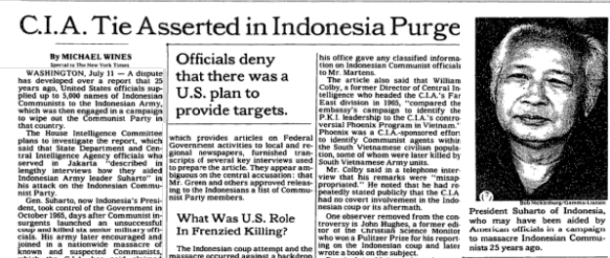
The New York Times (7/12/90) went out of its way to cast doubt on evidence of US participation in the mass murders.
This is not the first time that the New York Times has downplayed US culpability in the Indonesian bloodbath. When Kathy Kadane of States News Service (Washington Post, 5/21/90) broke the story that the US embassy had provided lists of PKI members to the Indonesian military at the height of the murders, the Times‘ Michael Wines (7/12/90) wrote an unusual attempt to discredit the story:
A dispute has developed over a report that 25 years ago, United States officials supplied up to 5,000 names of Indonesian Communists to the Indonesian Army…. The dispute has focused on whether the decision to turn over the names was that of an individual American Embassy officer, or was coordinated with the Central Intelligence Agency and approved by senior embassy officers.

The NYT’ most cheerleading coverage
came from future editor Max Frankel (e.g., 10/11/65).
As FAIR noted at the time (Extra!, 7–8/90), the Times‘ reluctance to admit that the US had actively participated in the Indonesian genocide may have been related to its enthusiasm for the genocide as it was happening:
While some of its coverage did invoke the horror of the massive killing (as early as 1/16/66), in general the Times’ commentary and analysis viewed the destruction of the Communist party quite favorably. “A Gleam of Light in Asia” was the headline of a James Reston column (6/19/66). “Almost everyone is pleased by the changes now being wrought,” C.L. Sulzberger commented (4/8/66). The Times itself editorialized (4/5/66) that the Indonesian military was “rightly playing its part with utmost caution.”
But perhaps the most enthusiastic of all the Times’ writers was Max Frankel, then Washington correspondent, now executive editor. “US Is Heartened by Red Setback in Indonesia Coup,” one Frankel dispatch was tagged (10/11/65). “The Johnson administration believes that a dramatic new opportunity has developed both for anti-Communist Indonesians and for United States policies” in Indonesia, Frankel wrote. “Officials… believe the army will cripple and perhaps destroy the Communists as a significant political force.”
After the scale of the massacre began to be apparent, Frankel was even more enthusiastic. Under the headline “Elated US Officials Looking to New Aid to Jakarta’s Economy” (3/13/66), Frankel reported that
the Johnson administration found it difficult today to hide its delight with the news from Indonesia…. After a long period of patient diplomacy designed to help the army triumph over the Communists, and months of prudent silence… officials were elated to find their expectations being realized.
Frankel went on to describe the leader of the massacre, Gen. Suharto, as “an efficient and effective military commander.”
To acknowledge that the US has looked upon mass murder as a positive project worth supporting is risky when the Times itself saw that same mass murder as worthy of support.
It’s not that the Times‘ piece today is wholly uncritical; it even admits, in a backhanded fashion, that the US did more than “stand by” during the massacres:
In 2015, Senator Tom Udall of New Mexico reintroduced a resolution in the Senate calling for Indonesia to face up to its traumatic history. He also held the United States to account for its “military and financial support” there, which included providing lists of possible leftist sympathizers to the Indonesian government and, as one cable released Tuesday showed, pushing to bury foreign news coverage of the killings.
But this information, appearing two-thirds of the way through the article, does not overcome the message in the headline and much of the text that the US sinned by omission, not commission. Framing Washington as a passive onlooker rather than active participant not only lessens the government’s (and the New York Times‘) culpability; it also tells readers that if the US is to be faulted, it’s to be blamed for not doing enough. That’s a handy attitude to cultivate for the next time you want to sell a “humanitarian” war.
You can send a message to the New York Times at letters@nytimes.com
Featured Video
Marandi: Threat of Seizing Kharg Island & the Use of Nuclear Weapons
or go to
Aletho News Archives – Video-Images
Frlom the Archives
Provoking a Path to Persia
The Saban Center’s prescient paper on war with Iran
By Maidhc Ó Cathail | October 20, 2011
In June 2009, the Saban Center for Middle East Policy published “Which Path to Persia?—Options for a New American Strategy toward Iran.” Writing in a tone strikingly reminiscent of the Project for a New American Century’s infamous pre-9/11 paper “Rebuilding America’s Defenses,” the six co-authors noted that, “It seems highly unlikely that the United States would mount an invasion without any provocation or other buildup.” For a think tank specifically established by media mogul Haim Saban to protect Israel, this could prove to be a formidable obstacle impeding their desired march—of U.S. troops—to Tehran.
“In fact, if the United States were to decide that to garner greater international support, galvanize U.S. domestic support, and/or provide a legal justification for an invasion, it would be best to wait for an Iranian provocation, then the time frame for an invasion might stretch out indefinitely,” Saban’s think-tankers ruefully observed.
“With only one real exception, since the 1978 revolution, the Islamic Republic has never willingly provoked an American military response, although it certainly has taken actions that could have done so if Washington had been looking for a fight. Thus it is not impossible that Tehran might take some action that would justify an American invasion. And it is certainly the case that if Washington sought such a provocation, it could take actions that might make it more likely that Tehran would do so (although being too obvious about this could nullify the provocation). However, since it would be up to Iran to make the provocative move, which Iran has been wary of doing most times in the past, the United States would never know for sure when it would get the requisite Iranian provocation. In fact, it might never come at all.”
Seemingly undeterred by Iran’s frustrating unwillingness to provide the requisite provocation, the analysts continued to examine this option… continue
Blog Roll
 Aletho News
- Ukrainian Embassy in Beirut sheltering top Mossad agent
- Palestinian family displaced after settlers violently attack them in Humsa, Jordan Valley
- The EU never learns – except for the wrong lessons
- Iran attacks on UAE leaves RSF militia high and dry
- Hosting Washington’s war: Bahrain faces the consequences
- The US fell for its own Iran propaganda
- Seyed M. Marandi: Threat of Seizing Kharg Island & the Use of Nuclear Weapons
- Is there even an off ramp?
- Michael von der Schulenburg: Europe’s Self-Defeating Iran War Policy
- Sorry, The New Republic, Climate Change Isn’t Causing Somali Migration. Blame Civil Strife and Poverty.
- If Americans Knew
- ‘Of Course’: IDF Drops Case Against Soldiers Accused of Raping Palestinian Prisoner
- Don’t Fall for the Regime Change Talk. Israel Is ‘Mowing the Lawn’ in Iran
- Will Israel and the US wreck the Gulf States along with Iran?
- US so far burned through ‘years’ of munitions in Iran war: Report
- How the Israeli Tail Wags the American Dog
- Outdated intel likely led to deadly U.S. strike on Iranian elementary school, sources say
- Pentagon insider says high U.S official Douglas Feith reported to Netanyahu
- In fond memory of Walid Khalidi, the historian of Palestine
- 6 more Americans killed, as Israel ‘mows the lawn’ in Iran – Not a ceasefire Day 154
- Are we on the precipice of World War III?
- No Tricks Zone
- New Studies: UK Sea Levels Were 4 Meters Higher Than Today During The Mid-Holocene
- Destructive Green New Deal: German Energy And Metal Group Warns Of Drastic Crisis
- New Study Documents A 20-Year Pause In Arctic Sea Ice Decline – Driven By Internal Variability
- Wake-up Call: Survey Shows Majority Of Germans Now Favor Postponing Climate Targets!
- Televised! Leading German Political Candidate Tells Schoolchildren CO2 Makes Sun Hotter!
- New Study: A Century Warming Of 1.1°C Is ‘Commonplace’ And ‘Not Unusual’ During This Interglacial
- New Study: ‘Internal Noise’ And Volcanic Forcing Can Trigger 10-15°C Warming Within Decades
- Glaciers Worldwide Are Suddendly Surging, Experts Blame Warming!
- Surprising Discovery: Sahara Is Greening…Billions Of Trees Where Once Thought To Be Barren
- New Research Reaffirms Clouds, Aerosols, And Surface Solar Radiation Are ‘Driving The Climate System’
 Aletho News