Media Boosts Obvious Saudi Front Group as Neutral ‘Think Tank’

By Adam Johnson | FAIR | March 28, 2018

Washington Post, 5/31/17
The Arabia Foundation appeared in spring 2016, seemingly out of nowhere, as a Saudi-focused think tank with “ties to Riyadh,” but vaguely independent of the regime. Or at least independent enough so that media wouldn’t represent it as an extension of the kingdom. But the past few weeks have clearly shown it to be little more than a PR outlet for de facto Saudi ruler Mohammed bin Salman and his sprawling, opaque business interests.
After multiple requests by FAIR for its donors, the Arabia Foundation refused to give any, other than its founder, Saudi investment banker Ali Shihabi. It insists it doesn’t take money from “the Saudi government,” but instead is backed by unnamed private Saudi citizens.
The distinction between private citizens and the “government” in the hereditary monarchy of Saudi Arabia is notoriously blurry, but one connection is worth noting: The registered agent and legal counsel of the Arabia Foundation, Eric L. Lewis, represented the Saudi government and related “charities” in the lawsuit brought by families of 9/11 victims over the Saudi royal family’s role in the September 11 attacks. The website of Lewis’ law firm, Lewis, Baach, Kaufmann and Middlemiss, boasts it has “extensive experience representing and advising foreign sovereigns, including the governments of Saudi Arabia, Kuwait and Egypt.”
The New York Times (11/30/18) has described the group as “close to the Saudi government,” while the Washington Post’s Ishaan Tharoor (11/6/17) noted it had “close ties to the kingdom.” That doesn’t stop the Post opinion section from running multiple op-eds from Arabia Foundation figures (5/31/17, 12/20/17, 1/4/18, 1/22/18). In most press appearances, the group is simply identified as “a Washington-based think tank.” Absent documented evidence of who exactly funds the group, why should media not assume—based on its connections to the government and cartoonishly pro–bin Salman line—that the Arabia Foundation is a front group for the government?
In repeated interviews (BBC World News, 3/20/18; Morning Joe, 3/20/18; CNN, 3/19/18) last week, Shihabi, the head of the nominally independent group, spun for war crimes, human rights abuses and a whole host of morally dubious activities carried out by the increasingly despotic Saudi ruler. The Arabia Foundation’s ties to the Saudi government are never noted or even vaguely referenced in these interviews.
On MSNBC’s Morning Joe, after saying the “crown prince” has engaged in a “massive corruption crackdown” (a wholly PR frame discredited earlier this month by the New York Times, 3/11/18), host Mika Brzezinksi teed up Shihabi to comment on Saudi Arabia. The softball interview that followed hit all of the regime’s central premises without question: as well as “cracking down on corruption,” bin Salman is “modernizing Saudi Arabia” and “taking on the religious establishment.”
No one on the panel brought up Saudi Arabia’s ongoing war crimes in Yemen—consistent with MSNBC’s network-wide virtual blackout on one of the world’s worst humanitarian crises (FAIR.org, 3/20/18). The Council on Foreign Relations’ Richard Haas made one opaque reference to Saudi “war with Yemen,” but didn’t note the thousands killed or up to one million infected with cholera; the US-backed war was was simply dismissed as a “strategic overreach.” The New York Times’ Elisabeth Bumiller, another panelist, did get in a question about torture, which Ali Shihabi dismissed as having “no evidence” despite Bumiller speaking with several doctors who witnessed it.
Reliable Saudi stenographer David Iglesias who, as FAIR (4/28/17) noted last year, has been running the same reformist press release for the royal family for 15 years, continued his unique brand of faux criticism, insisting that the Saudi prince was too “bold”—the political commentary equivalent of answering “I work too hard” when asked on a job interview what your biggest flaw is.
Shihabi claimed without irony that what Saudi Arabia needed was “autocracy to affect change,” and a “benevolent autocrat.” His evidence that the masses approved of bin Salman’s “bold, needed” leadership was approved of by the masses? That there has been “no bloodshed, there’s been no demonstration, no domestic strife.” Of course, the last time there were anti-government demonstrations, in 2011, the Saudi military opened fire on protesters, and snuffed out resistance with torture and extrajudicial killings. In 2017, when one Shia town resisted the regime, Riyadh flattened an entire neighborhood. This could perhaps be why the general population isn’t quick to take to the streets, but the Arabia Foundation insist it’s an implicit admission the crown prince is loved and popular.
The CNN and BBC interviews, likewise, didn’t note the Arabia Foundation’s obvious ties to the Saudi regime.
Forbes keeps running “op-eds” by Arabia Foundation fellow Ellen Wald that amount to little more than press releases for Saudi investment opportunities (e.g., 12/11/17, 2/1/18, 3/13/18). Another pundit on the Arabia Foundation’s payroll, Bernard Haykel, writes fawning profiles of bin Salman in the Washington Post (1/22/18) without disclosing he’s a founding director of the organization—instead listing his more benign academic credentials.
The Arabia Foundation is so satisfied with the media’s presentation of its messaging that it routinely tweets out articles it’s featured in and TV appearances it’s had, knowing its messaging is syncing up nicely with bin Salman’s PR tour to the United States. “Yemen is a tragedy. Wars are a tragedy. Saudi is aware of that and is going out of its way to try to address humanitarian issues there,” boasted one tweet, quoting Shihabi’s interview with the BBC.
By contrast, this obtuse inability to connect dots is absent when discussing think tanks “close to” the Syrian government. Never is the Assad-connected British Syrian Society set up as a neutral arbiter of affairs of the Syrian conflict. It is met with disdain, painted as “little more than a Syrian regime propaganda exercise” (Guardian, 10/26/17), the “mouthpiece in the West” (Middle East Eye, 10/19/17) for a war crime–committing tyrant. Those who associate with it, including academics, journalists and British members of parliament, are publicly shamed for participating in a “regime PR exercise” (Independent, 10/29/16). Yet somehow the “Saudi-connected” Arabia Foundation, which cheers on a “benevolent autocrat” as he rains bombs on Yemen and uses hunger as a weapon of war, receives no such moral banishment. Instead, it is dressed up as just another respectable think tank.
The fact that the Arabia Foundation is a thinly veiled PR firm for the Saudi government matters. The average reader or viewer would take Shihabi and his network of mercenary “fellows” less seriously if they were presented as spokespeople for a repressive government rather than quasi-academics from a impressive-sounding “foundation.”
With all the hysteria surrounding RT and foreign influence on the American public, one might think such an obvious racket would give editors and TV producers pause. But the same rules don’t apply to American allies. Their propaganda is treated not like a sinister “influence operation,” but like a respectable group of academics calling balls and strikes on international affairs.
AP’s slanted report on Gaza Return March, corrected and annotated
The Associated Press’s news story on the upcoming Great Return March echoes Israeli talking points…
By Kathryn Shihadah | If Americans Knew | March 30, 2018
The Associated Press, a (usually) trusted name in global news, has been unmasked for its pro-Israel bias, and the ruse continues.
Today’s exhibit is of particular significance, as the people of Gaza are about to embark on a large-scale nonviolent protest. True to form, AP has cranked out a Hamas-bashing, Israel-congratulating piece that fails to provide the accurate information its readers deserve. The report largely replicates Israel’s public relations strategy.
Below are excerpts from the AP article with commentary that will fill in some of the gaps and clear up some misrepresentations. Truth matters.
AP: Gaza’s embattled Hamas rulers are imploring people to march along the border with Israel in the coming weeks in a risky gambit meant to shore up their shaky rule, but with potentially deadly consequences.
Many Americans fail to recognize what is going on in Gaza for precisely this reason: nearly every word of this paragraph is problematic. Hamas has not imposed some kind of tyrannical regime over Gaza; their “rule” is shaky in that Israel has such a chokehold on the territory that the people are starving to death. There is little governing going on.
Grassroots movements have been in the making for years – decades, even – because Palestinians don’t need to be told they should resist the occupation. Many can see their original homes in what is now Israel or the location of their villages from the fence imprisoning them. They remember every day; they pray to God to bring them back home. Their people are being slowly, systematically eradicated.
The “gambit” is indeed “risky” – because Gazans will be nonviolently protesting while in the crosshairs of Israeli snipers, and the “potentially deadly consequences” of the initiative will almost certainly involve unarmed Palestinians dying.
Israel has essentially promised this outcome: Major General Yoav Mordechai vowed, “We intend to do everything to prevent violent demonstrations and terror demonstrations.” While Palestinians have made it clear that they will not so much as throw rocks, Israel has 100 sharpshooters at the ready, drones lined up to drop tear gas canisters, and thousands of troops armed to the teeth.
AP: But the first-of-its-kind protest also comes at a low point for the Islamic militant group and the 2 million residents of Gaza, where conditions have deteriorated since Hamas seized control of the territory from the internationally-backed Palestinian Authority in 2007.
Conditions have indeed deteriorated, but this statement is misleading: Hamas was voted into office by the people of Gaza, and Israel collectively punished them for this by imposing a blockade. Combine that with multiple “wars” against the essentially unarmed population with thousands killed and tens of thousands left homeless. “Conditions have deteriorated” is an understatement.
AP: Beginning Friday, Hamas hopes it can mobilize large crowds to set up tent camps near the border. It plans a series of demonstrations culminating with a march to the border fence on May 15, the anniversary of Israel’s establishment, known to Palestinians as “the Nakba,” or catastrophe.
Let’s take a minute to unpack the phrase that tried to sneak past. “The Nakba” is not just an Arabic name for the anniversary of Israel’s birth: it is the name for the forced exile of 75% of their population and the loss of 78% of their land. This catastrophe occurred in 1948, and tens of thousands of Palestinians who live in Gaza today are among those refugees.
AP: The group aims to mobilize hundreds of thousands of people for the effort, though it hasn’t been able to get such turnouts at past rallies. Nonetheless, a jittery Israel is closely watching and vowing a tough response if the border is breached.
Israel lives in a constant state of jitter, but why? Because the stones in Palestinians’ hands are so dangerous? Because the rockets are so deadly? (See here) Or because if Palestinian voices are heard, Israel will be exposed?
AP: An Israeli-Egyptian blockade, along with three wars with Israel and a series of sanctions by Palestinian President Mahmoud Abbas, have left Gaza’s economy in tatters. Unemployment is well over 40 percent, tap water is undrinkable and Gazans receive just a few hours of electricity a day.
Israel is the occupying power over Gaza. The occupation is now in its 6th decade, and the blockade in its 11th year. Israel has an obligation as occupier to maintain the lives and wellbeing of the occupied. Egypt and Abbas are minor players in this situation.
AP: “Hamas has realized it’s besieged from three sides; Israel, Egypt and the Palestinian Authority,” said Mkhaimar Abusada, political science professor at Gaza’s al-Azhar University. “It feels the crisis is suffocating.”
All Gazans are suffocating, not just Hamas. That is why this movement is happening right now. This is not some ploy by a terrorist organization to make trouble for Israel. It is the organic response of Palestinians who can endure no more, who must resist.
AP: [Mkhaimar Abusada] said that for Hamas, the protests can divert attention from their domestic woes while avoiding renewed war with Israel. “They think busying Israel with this issue may put it under pressure,” he said.
What the people actually think is that perhaps this time, the world will pay attention and finally realize that the level of cruelty and injustice being perpetrated on Palestinians is a huge, ongoing crime against humanity. The hope is not to “busy Israel” but to seek the rights that have been promised them by international law: the right to self-determination, the right to return to the land from which they were exiled, the right to be heard and to receive justice.
AP: A combination of social pressure and curiosity in a territory with few options for recreation could help attract people.
This statement shows an inexcusable level of ignorance: it assumes that Palestinians are content with a never-ending, illegal occupation and blockade; that they would not be inclined to march in resistance against their oppressor; and above all that people attending the protest would come for recreational purposes.
AP: Israel opposes any large-scale return of refugees, saying it would destroy the country’s Jewish character.
It’s hard to decide how to respond to this statement. Yes, having refugees pour into one’s country can be upsetting to one’s culture. The Palestinians were willing to take in Jews in the early 20th century, at a high social cost. The thanks they got for this gesture was to be themselves made refugees. Of course Israel opposes the return of non-Jews. But return they must, according to international law and consensus.
AP: Israeli Cabinet Minister Yoav Galant said, “Hamas is in distress. They are using in a cruel and cynical way their own population in order to hurt them and to hurt Israel.”
Israel has massive military might, and Israel and AP both know it. With one of the most advanced armies in the world, $10 million a day in military aid coming from the US, at least 100 nuclear weapons, and a military that is armed to the teeth, this march is not going to “hurt” Israel in any reasonable sense of the word. The only real pain the state can anticipate is the fear of being found out.
AP: “We will try to use the minimum force that is needed in order to avoid Palestinians wounded and casualties. But the red line is very clear. They stay on the Gazan side and we stay in Israel.”
Only time will tell what “minimum force” looks like, but in a nation where children can be imprisoned for years if they are suspected of throwing a stone, chances are Palestinians will die.
Most Western media, if they cover this event at all, will publish inaccurate, biased accounts that will make the Palestinians out to be the aggressors. They will completely fail to ground the story in the context of illegal occupation and blockade, not to mention dispossession and forced exile. Israel will come out looking like it acted in self-defense, and the injustice will continue unchecked as it has for lo these many years.
Kathryn Shihadah is a staff writer for If Americans Knew.
7 Palestinians killed, dozens injured as Israel suppresses massive protest in Gaza

Ma’an – March 30, 2018
GAZA CITY – Six Palestinians have been killed by Israeli forces and dozens more injured since early Friday morning, as thousands of Gazans took to the borders with Israel as part of “The Great March of Return” taking place across the besieged coastal enclave to mark the 42nd Land Day.
In 1976, Israeli police shot and killed six Palestinian citizens of Israel as they were protesting the Israeli government’s expropriation of thousands of dunums of Palestinian land. Since then, Palestinians have commemorated March 30 as Land Day with mass protests across the occupied West Bank and East Jerusalem, Gaza, and inside Israel.
A Palestinian farmer was killed around dawn and another was injured as Israeli forces targeted the southern Gazan district of Khan Younis with mortar shells.
Spokesperson of the Gaza Ministry of Health, Ashraf al-Qidra, identified the slain farmer as Omar Sammour, 31, adding that another Palestinian, whose identity remained unknown, was injured during the shelling.
Israeli media reported that Sammour and the other man with him were targeted for approaching the border fence with Israel in a “suspicious manner,” though local sources reported that Sammour was simply gathering crops from his land to sell later in the day.
On Friday afternoon, medical sources confirmed to Ma’an that two more Palestinians were killed during the protest along the border.
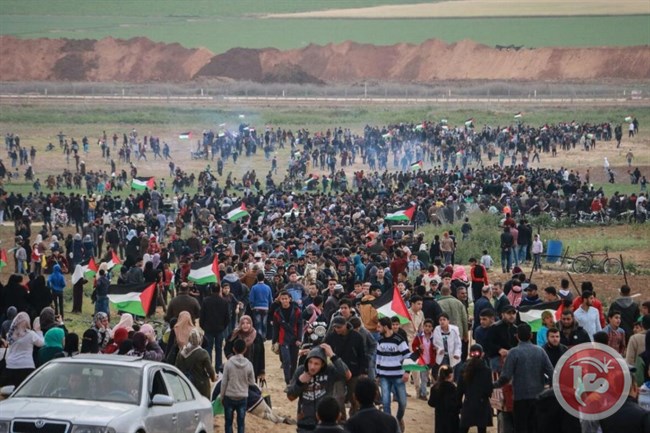
One of the slain Palestinians was identified as Amin Mahmoud Muhammar from Rafah in southern Gaza. His age remained unknown.
The other slain Palestinian was identified as Muhammad Kamal al-Najjar, 25, from eastern Jabaliya in northern Gaza.
Around 2:20 p.m. medical sources told Ma’an that a fourth Palestinian had been killed. He was identified as Muhammad Abu Omar, 19.
Fifteen minutes later, the Gaza Ministry of Health confirmed that a fifth Palestinian had been killed. He was identified as 16-year-old Ahmad Ibrahim Odeh from the northern Gaza Strip.
Around 3:15p.m. the ministry reported that Jihad Freineh, 33, from Gaza City was killed.
Minutes later, the ministry reported that the seventh Palestinian had been killed by Israeli forces. He was identified as Mahmoud Saadi Rahmi, from Gaza City.
Leading up to the march, the Israeli army released a statement saying it had declared the border area along Gaza a “closed military zone,” meaning that any Palestinian who got close to the border fence could risk getting shot.
The Israeli army released statements on Twitter describing the protests as “violent riots.”
“17,000 Palestinians are rioting in 5 locations along the Gaza Strip security fence. The rioters are rolling burning tires and hurling firebombs & rocks at the security fence & IDF troops, who are responding w riot dispersal means and firing towards main instigators,” the statement said.
Despite the Israeli army’s claims, Palestinian activists and leaders in the Gaza Strip have maintained that the “March of Return” was organized as a massive non-violent, weeks-long protest advocating for the return of Palestinian refugees to their original homelands in historic Palestine, now present day Israel.
Leading up to Friday, the first official day of the march — which will continue until the 70th anniversary of the Nakba, or catastrophe, in May — Palestinians set up tents along the border with Gaza, where protesters plan to stay until the Nakba anniversary.
Ismail Haniyeh, head of the Hamas politburo, gave a speech at the March of Return, saying it “demonstrates that there are no alternatives to Palestine and the right of return (for the Palestinian people),” praising the people who left their homes to attend the march.
When speaking about the goal of the march, Haniyeh said it constitutes “the beginning of a return (of the Palestinian people) to the entirety of the land of Palestine.”
“We will not give up and we will not bargain with the Zionist entity over even a small piece of the land of Palestine,” Haniyeh continued, stressing that the Palestinians will reject any deal proposed by the Trump administration.
“Our people went out today to make it clear that we will not give up Jerusalem and that there is no alternative to Palestine and the right of return. We will not accept the right of return staying only a slogan.”
Featured Video
America Racing to Strategic Defeat in Iran
or go to
Aletho News Archives – Video-Images
From the Archives
Should Europeans ‘Thank’ the Americans for Destroying Nord Stream?
By Robert Bridge | Strategic Culture Foundation | September 29, 2022
With an investigation continuing into the destruction of the Nord Stream gas pipeline that provided energy supplies to Europe from Russia, there appears to be just one prime suspect, and that should surprise nobody.
Following the sabotage of the Nord Stream 1 and 2 gas pipelines, former Polish Foreign Minister Radoslaw Sikorski already seemed to know the identity of the perpetrator when he tweeted out: “Thank you, USA.”
At first glance, it seemed that Sikorski was speaking sarcastically, berating Washington for carrying out an attack that will have severe repercussions for the people of Europe. After all, how could anyone see any good coming from the termination of Europe’s primary source of gas reserves with winter just around the corner? It was Sikorski’s homeland of Poland, after all, that urged its citizens to collect firewood in the face of dwindling gas reserves.
In fact, the Polish diplomat was speaking one-hundred percent literally… continue
Blog Roll
 Aletho News
- UK’s New Pandemic Plan Would Turn Big Tech Into a Mass Location Tracking Network
- Growing insecurity, soaring prices fuel protests in north as regime bans evacuation: Sources
- Iran denies responsibility for ‘depraved’ attack on Kuwait desalination plant
- Bring The Troops Back. End This War Now!
- Can we please stop calling Israel the ‘only democracy in the Middle East’ now?
- US should start removing its troops from Germany, proposes AfD co-leader Chrupalla
- Iran Red Crescent: 600 educational centers attacked in US-Israeli ‘war crimes’
- Russian Oil Tanker Arrives in Cuba Amid U.S. Blockade
- America Racing to Strategic Defeat in Iran: Lt Col Daniel Davis
- FTC Warns Visa, Mastercard, PayPal, Stripe Over Political Debanking
- If Americans Knew
- As Iran targets US military bases, will they be relocated to Israel? Not a ceasefire Day 171
- Will Trump Go Kamikaze?
- Is the University of Florida Shutting Down College Republicans over Israel Criticism?
- Jewish extremist arrested over alleged plot to firebomb Palestinian activist Nerdeen Kiswani’s home
- More than half of Palestinian child detainees have no charges
- The More Murderous Israel Gets, The More We Hear About “Antisemitism”
- Land Day and the Palestinian struggle after 30 months of genocide
- The Iran War Is About Palestine
- Israeli soldiers echo settler ideology, talk of revenge after targeting Palestinians and detaining CNN crew in the West Bank
- Israeli Policies Threaten Future of Christian Schools in Jerusalem
- No Tricks Zone
- New Study Finds Warming Saves Lives…Cold Temperatures 12 Times More Deadly Than Excess Heat
- German Science Blog Accuses PIK Climate Institute Of Hallucinating Climate Tipping Points
- Devastating Assessment Of Comirnaty Vaccine By Former Senior Pfizer Europe Toxicologist
- New Study: CO2 Is ‘Effectively Negligible’ As An Explanatory Climate Change Factor Since 2000
- Former Pfizer Toxicologist Dr. Helmut Sterz Tells Bundestag Hearing Pfizer Vaccine Should Have Never Been Approved
- Energy Expert: Germany’s Nuclear Phaseout Was A “500 Billion Euro Mistake”
- New Research: South Australia’s Mid-Holocene Sea Surface Temperatures Were 4°C Warmer Than Today
- Storing Green Energy To Last Germany 10 Days Would Require A 60-Million Tonne Battery
- New Studies: UK Sea Levels Were 4 Meters Higher Than Today During The Mid-Holocene
- Destructive Green New Deal: German Energy And Metal Group Warns Of Drastic Crisis
 Aletho News