SWEDHR Board of Directors ref. misattributed statements on White Helmets and alleged gas attacks in Syria
Professor Emeritus, med. dr. Marcello Ferrada de Noli, chairman; Professor Emeritus, med. dr. Anders Romelsjö, vice-chairman; Chief physician, med. dr. Alberto Gutiérrez Mardones; Chief physician Ove Johansson, MD; Chief physician, specialist Dr Lena Oske, MD; Specialist Dr Leif Elinder, MD; Specialist Dr Martin Gelin, Dental Surgeon. On behalf of SWEDHR Board of Directors.

I
SWEDHR have performed several analyses around reports on alleged chemical attacks in Syria, which mostly have been originated from claims by the White Helmets and associates. In the main, our conclusions were that the alleged evidence appear clinically and epidemiological flawed. For instance, in regard to the Khan Shaykhun incident, as put forward in a document by the SWEDHR chair recently published by the United Nations Security Council. [1] We have also asked for independent, non-biased investigations done by meritorious scientists, instead of politically appointed investigators. In spite that was all we have centrally said on the ‘gas attacks’ issue, we have been unjustifiably attacked by some mainstream media in Sweden, led by Dagens Nyheter, [2] and elsewhere by Der Spiegel, [3] Le Figaro, [4] etc., and in social media –including deleterious references to our organization by Mr Kenneth Roth, [5] president of Human Rights Watch.
However, in recent weeks, the United States Defence Secretary, General (Ret.) Jim Mattis, announced in a press conference that they do not possess evidence of a sarin attack in Syria. [6] Days after, the French Defence Minister, Ms Florence Perly, declared that France has not confirmed evidence of chlorine attacks in Syria attributed to the government forces. [7] Both statements bring unequivocal support, and further credibility, to the conclusions on the very same issues we achieved at SWEDHR, published in April, May and November 2017, respectively (See Notes & References).
Concomitantly, our firm stance about the probe-issue regarding allegations on gas attacks in Syria, by no means contradicts our equally solid stance of considering the eventual perpetration of such attacks a hideous war crime. Neither our demand for a beyond-doubt evidence regarding the alleged responsibility of the Syrian government represents a per-default political endorsement. SWEDHR is by definition opposed to the notion of war. [8] Unlike HRW, we have not advocated for the bombing of Syrians, [9] or for a No-Fly Zone, such as the White Helmets and associates do [10] – which in practical terms would only enable the intensification of belligerent input from jihadists fighting for an Islamic State in Syria. [11] We have instead repeatedly advocated for a prompt settlement of the Syrian conflict via negotiations. We view the Sochi peace talks as positive and crucial in those regards, and we concur with UN Special Envoy Staffan de Mistura, that the progress made in Sochi may be also seen as contributing to the Geneva process. [12]
SWEDHR stances are absolutely independent, [13] we are not bounded to any political or financial interest; we do not receive any support, financial or otherwise, from any government, company or institution –as is the case of ‘stream human rights organizations’ such as Human Rights Watch or Amnesty. We demand respect for SWEDHR authentically independent commitment, and we will held in the future zero tolerance to libelous accusations in the mainstream media and social media which would contend otherwise. To this end, we are working for establishing the means for eventual legal actions.
As an example, the organization Reporters Without Borders, RSF, called the cancellation of the Swiss Press Club conference on the White Helmets of November 2017, referring SWEDHR as an “organization that, according with our information, acts as a tool of Russian propaganda.” [14] We openly challenged RSF to either publish the evidence for such an allegation they made in a public letter, or otherwise “to shame”. [15] RSF did not reply.
II
SWEDHR doctors analyzed in March-April 2017 video material posted by the organization White Helmets on alleged life-saving procedures of infants [16] [17]. The conclusions of these analyses or whereabouts of its authors have unfortunately been distorted, as in the case of an article in Codastory.com propagated by Kennet Roth, [5] or a publication by Veterans Today, which we have already refuted. [18]
In recent weeks further misquotes of the SWEDHR doctors’ conclusions on the above-mentioned videos recirculated in social media. This quote, wrongly attributed to SWEDHR says, “Quote: The implication is that the White Helmets may have actually killed children and/or were using already-dead children ‘as propaganda props’.” Which is something SWEDHR doctors never have affirmed.
Instead, the conclusion by the SWEDHR doctors was:
“Lifesaving procedures on the children showed in the White Helmets videos were found to be fake, and ultimately performed on dead children… Which is not the same than affirming that the personnel seen in the videos caused the dead of the infant. In forensic terms, the actual cause of death, as well as the mode and the issue of intent, refer to different items than those treated in our analysis.” [17]
We would like to detail our stance on the White Helmets issue, in order to avoid further misuse or misreading of our investigations:
Even if we have contributed to expose fake life-rescuing episodes as shown in materials posted by the White Helmets themselves, our criticism differs from other authors or news platforms. As the SWEDHR chairman conveyed expressly on behalf of this board of directors at the Swiss Press Club conference of November 2017:
“The point for us has not been to demonise the individual participation of some well-minded volunteers deploying natural solidarity with civilians, which in a given moment are –tragically as in all wars– victims of a collateral damage. Neither is the case to criticise the humanitarian rescue-activity per se, in those cases in which that activity has been real. Instead, our analyses on the White Helmets materials aim to focus on two mayor issues pertaining the White Helmets as institution: a) The geopolitical significance of the White Helmets as an international construction in the propaganda war, and b) The using of this organization as a main source of information by UN investigative commissions.” [20]
We mean that although we do not deny that its individual ranks may have occasionally performed rescue maneuvers, we consider the organization White Helmets as mainly a political organization, with self-declared political aims, and with a war-propaganda purpose which coincides with the geopolitical interests of the powers that finance its operations. We find highly demonstrative that the White Helmets operate solely in territories in the main under the governance of militant jihadists formations, fighting for replace a secular government for a Sharia fundamentalist rule. [11] Which makes even more incomprehensible the support given to this organization by democratic, secular European countries such as Sweden. [21]
We hope the above clarifications will help to a more objective analysis about SWEDHR participation in this principal human rights debate, done in the context of a war which have costed nearly half million lives, and further risks a tragic geopolitical enhancing.
Notes and References
- “To justify #Syria inaction, top US general trots out age-old ethnic animosities line. Heard that B4? Bosnia. Rwanda.”
- “Top general suggests US is more interested in a geopolitical partner in #Syria than saving civilians from slaughter. “
- “It took chemical attack to convince Obama/Kerry that Assad isn’t interested in negotiated solution!? No more excuses.”
- “If the appalling slaughter in #Syria won’t get Obama to act, maybe ridicule will:””
- “If Obama decides to strike #Syria, will he settle for symbolism or do something that will help protect civilians?”
Iraq +15: Accumulated Evil of the Whole
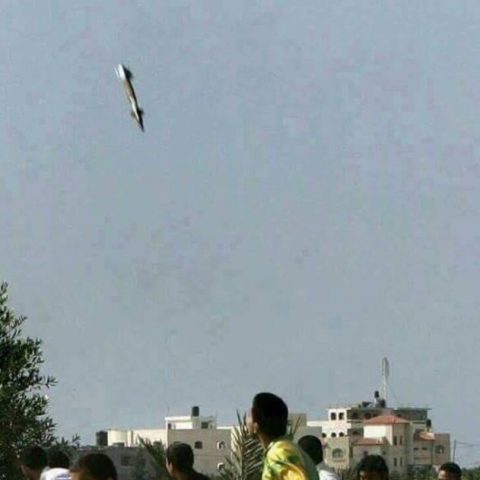
By Nat Parry | Consortium News | March 19, 2018
Robert Jackson, the Chief United States Prosecutor at the Nuremberg Trials of Nazi war criminals, once denounced aggressive war as “the greatest menace of our time.” With much of Europe laying in smoldering ruin, he said in 1945 that “to initiate a war of aggression … is not only an international crime: it is the supreme international crime differing only from other war crimes in that it contains within itself the accumulated evil of whole.”
When it comes to the U.S. invasion of Iraq 15 years ago today, the accumulated evil of the whole is difficult to fully comprehend. Estimates of the war’s costs vary, but commonly cited figures put the financial cost for U.S. taxpayers at upwards of a trillion dollars, the cost in Iraqi lives in the hundreds of thousands, and U.S. soldier deaths at nearly 5,000. Another 100,000 Americans have been wounded and four million Iraqis driven from their homes as refugees.
As staggering as those numbers may be, they don’t come close to describing the true cost of the war, or the magnitude of the crime that was committed by launching it on March 19-20, 2003. Besides the cost in blood and treasure, the cost to basic principles of international justice, long-term geopolitical stability, and the impacts on the U.S. political system are equally profound.
Lessons Learned and Forgotten
Although for a time, it seemed that the lessons of the war were widely understood and had tangible effects on American politics – with Democrats, for example, taking control of Congress in the midterm elections of 2006 based primarily on growing antiwar sentiment around the country and Barack Obama defeating Hillary Clinton in the 2008 primaries based largely on the two candidates’ opposing views on the Iraq War – the political establishment has, since then, effectively swept these lessons under the rug.
One of those lessons, of course, was that proclamations of the intelligence community should be treated with huge grain of salt. In the build-up to war with Iraq a decade and a half ago, there were those who pushed back on the politicized and “cherry-picked” intelligence that the Bush administration was using to convince the American people of the need to go to war, but for the most part, the media and political establishment parroted these claims without showing the due diligence of independently confirming the claims or even applying basic principles of logic.
For example, even as United Nations weapons inspectors, led by Swedish diplomat Hans Blix, were coming up empty-handed when acting on tips from the U.S. intelligence community, few within the mainstream media were willing to draw the logical conclusion that the intelligence was wrong (or that the Bush administration was lying). Instead, they assumed that the UN inspectors were simply incompetent or that Saddam Hussein was just really good at hiding his weapons of mass destruction.
Yet, despite being misled so thoroughly back in 2002 and 2003, today Americans show the same credulousness to the intelligence community when it claims that “Russia hacked the 2016 election,” without offering proof. Liberals, in particular, have hitched their wagons to the investigation being led by Special Counsel Robert Mueller, who is widely hailed as a paragon of virtue, while the truth is, as FBI Director during the Bush administration, he was a key enabler of the WMD narrative used to launch an illegal war.
Mueller testified to Congress that “Iraq has moved to the top of my list” of threats to the domestic security of the United States. “As we previously briefed this Committee,” Mueller said on February 11, 2003, “Iraq’s WMD program poses a clear threat to our national security.” He warned that Baghdad might provide WMDs to al-Qaeda to carry out a catastrophic attack in the United States.
Mueller drew criticism at the time, including from FBI whistleblower Coleen Rowley, for conflating Iraq and al-Qaeda, with demands that the FBI produce whatever evidence it had on this supposed connection.
Today, of course, Mueller is celebrated by Democrats as the best hope for bringing down the presidency of Donald Trump. George W. Bush has also enjoyed a revival of his image thanks largely to his public criticisms of Trump, with a majority of Democrats now viewing the 43rd president favorably. Many Democrats have also embraced aggressive war – often couched in the rhetoric of “humanitarian interventionism” – as their preferred option to deal with foreign policy challenges such as the Syrian conflict.
When the Democratic Party chose Clinton as its nominee in 2016, it appeared that Democrats had also embraced her willingness to use military force to achieve “regime change” in countries that are seen as a threat to U.S. interests – whether Iraq, Iran or Syria.
As a senator from New York during the build-up for military action against Iraq, Clinton not only voted to authorize the U.S. invasion, but fervently supported the war – which she backed with or without UN Security Council authorization. Her speech on the floor of the Senate on Oct. 10, 2002 arguing for military action promoted the same falsehoods that were being used by the Bush administration to build support for the war, claiming for example that Saddam Hussein had “given aid, comfort, and sanctuary to terrorists, including al-Qaeda members.”
“If left unchecked,” she said, “Saddam Hussein will continue to increase his capacity to wage biological and chemical warfare, and will keep trying to develop nuclear weapons. Should he succeed in that endeavor, he could alter the political and security landscape of the Middle East, which as we know all too well affects American security.”
Clinton maintained support for the war even as it became obvious that Iraq in fact had no weapons of mass destruction – the primary casus belli for the war – only cooling her enthusiasm in 2006 when it became clear that the Democratic base had turned decisively against the war and her hawkish position endangered her chances for the 2008 presidential nomination. But eight years later, the Democrats had apparently moved on, and her support for the war was no longer considered a disqualification for the presidency.
One of the lessons that should be recalled today, especially as the U.S. gears up today for possible confrontations with countries including North Korea and Russia, is how easy it was in 2002-2003 for the Bush administration to convince Americans that they were under threat from the regime of Saddam Hussein some 7,000 miles away. The claims about Iraq’s WMDs were untrue, with many saying so in real time – including by the newly formed group Veteran Intelligence Professionals for Sanity, which was regularly issuing memoranda to the president and to the American people debunking the falsehoods that were being promoted by the U.S. intelligence community.
But even if the claims about Iraq’s alleged stockpiles were true, there was still no reason to assume that Saddam Hussein was on the verge of launching a surprise attack against the United States. Indeed, while Americans were all but convinced that Iraq threatened their safety and security, it was actually the U.S. government that was threatening Iraqis.
Far from posing an imminent threat to the United States, in 2003, Iraq was a country that had already been devastated by a U.S.-led war a decade earlier and crippling economic sanctions that caused the deaths of 1.5 million Iraqis (leading to the resignation of two UN humanitarian coordinators who called the sanctions genocidal).
Threats and Bluster
Although the invasion didn’t officially begin until March 20, 2003 (still the 19th in Washington), the United States had been explicitly threatening to attack the country as early as January 2003, with the Pentagon publicizing plans for a so-called “shock and awe” bombing campaign.
“If the Pentagon sticks to its current war plan,” CBS News reported on January 24, “one day in March the Air Force and Navy will launch between 300 and 400 cruise missiles at targets in Iraq. … [T]his is more than the number that were launched during the entire 40 days of the first Gulf War. On the second day, the plan calls for launching another 300 to 400 cruise missiles.”
A Pentagon official warned: “There will not be a safe place in Baghdad.”
These public threats appeared to be a form of intimidation and psychological warfare, and were almost certainly in violation of the UN Charter, which states: “All Members shall refrain in their international relations from the threat or use of force against the territorial integrity or political independence of any state, or in any other manner inconsistent with the Purposes of the United Nations.”
The Pentagon’s vaunted “shock and awe” attack began with limited bombing on March 19-20, as U.S. forces unsuccessfully attempted to kill Hussein. Attacks continued against a small number of targets until March 21, when the main bombing campaign began. U.S.-led forces launched approximately 1,700 air sorties, with 504 using cruise missiles.
During the invasion, the U.S. also dropped some 10,800 cluster bombs on Iraq despite claiming that only a fraction of that number had been used.
“The Pentagon presented a misleading picture during the war of the extent to which cluster weapons were being used and of the civilian casualties they were causing,” reported USA Today in late 2003. Despite claims that only 1,500 cluster weapons had been used resulting in just one civilian casualty, “in fact, the United States used 10,782 cluster weapons,” including many that were fired into urban areas from late March to early April 2003.
The cluster bombs killed hundreds of Iraqi civilians and left behind thousands of unexploded bomblets that continued to kill and injure civilians weeks after the fighting stopped.
(Because of the indiscriminate effect of these weapons, their use is banned by the international Convention on Cluster Munitions, which the United States has refused to sign.)
Attempting to kill Hussein, Bush ordered the bombing of an Iraqi residential restaurant on April 7. A single B-1B bomber dropped four precision-guided 2,000-pound bombs. The four bunker-penetrating bombs destroyed the target building, the al Saa restaurant block and several surrounding structures, leaving a 60-foot crater and unknown casualties.
Diners, including children, were ripped apart by the bombs. One mother found her daughter’s torso and then her severed head. U.S. intelligence later confirmed that Hussein wasn’t there.
Resistance and Torture
It was evident within weeks of the initial invasion that the Bush administration had misjudged the critical question of whether Iraqis would fight. They put up stiffer than expected resistance even in southern Iraqi cities such as Umm Qasr, Basra and Nasiriya where Hussein’s support was considered weak, and soon after the fall of the regime on April 9, when the Bush administration decided to disband the Iraqi army, it helped spark an anti-U.S. insurgency led by many former Iraqi military figures.
Despite Bush’s triumphant May 1 landing on an aircraft carrier and his speech in front of a giant “Mission Accomplished” banner, it looked as though the collapse of the Baathist government had been just the first stage in what would become a long-running war of attrition. After the Iraqi conventional forces had been disbanded, the U.S. military began to notice in May 2003 a steadily increasing flurry of attacks on U.S. occupiers in various regions of the so-called “Sunni Triangle.”
These included groups of insurgents firing assault rifles and rocket-propelled grenades at U.S. occupation troops, as well as increasing use of improvised explosive devices on U.S. convoys.
Possibly anticipating a long, drawn-out occupation and counter-insurgency campaign, in a March 2003 memorandum Bush administration lawyers devised legal doctrines to justify certain torture techniques, offering legal rationales “that could render specific conduct, otherwise criminal, not unlawful.”
They argued that the president or anyone acting on the president’s orders were not bound by U.S. laws or international treaties prohibiting torture, asserting that the need for “obtaining intelligence vital to the protection of untold thousands of American citizens” superseded any obligations the administration had under domestic or international law.
“In order to respect the President’s inherent constitutional authority to manage a military campaign,” the memo stated, U.S. prohibitions against torture “must be construed as inapplicable to interrogations undertaken pursuant to his Commander-in-Chief authority.”
Over the course of the next year, disclosures emerged that torture had been used extensively in Iraq for “intelligence gathering.” Investigative journalist Seymour Hersh disclosed in The New Yorker in May 2004 that a 53-page classified Army report written by Gen. Antonio Taguba concluded that Abu Ghraib prison’s military police were urged on by intelligence officers seeking to break down the Iraqis before interrogation.
“Numerous incidents of sadistic, blatant and wanton criminal abuses were inflicted on several detainees,” wrote Taguba.
These actions, authorized at the highest levels, constituted serious breaches of international and domestic law, including the Convention Against Torture, the Geneva Convention relative to the treatment of Prisoners of War, as well as the U.S. War Crimes Act and the Torture Statute.
They also may have played a role in the rise of the ISIS terror group, the origins of which were subsequently traced to an American prison in Iraq dubbed Camp Bucca. This camp was the site of rampant abuse of prisoners, one of whom, Abu Bakr al-Baghdadi, later became the leader of ISIS. Al-Baghdadi spent four years as a prisoner at Bucca, where he started recruiting others to his cause.
America’s Weapons of Mass Destruction
Besides torture and the use of cluster bombs, the crimes against the Iraqi people over the years included wholesale massacres, long-term poisoning and the destruction of cities.
There was the 2004 assault on Fallujah in which white phosphorus – banned under international law – was used against civilians. There was the 2005 Haditha massacre, in which 24 unarmed civilians were systematically murdered by U.S. marines. There was the 2007 “Collateral Murder” massacre revealed by WikiLeaks in 2010, depicting the indiscriminate killing of more than a dozen civilians in the Iraqi suburb of New Baghdad – including two Reuters news staff.
There is also the tragic legacy of cancer and birth defects caused by the U.S. military’s extensive use of depleted uranium and white phosphorus. In Fallujah the use of depleted uranium led to birth defects in infants 14 times higher than in the Japanese cities targeted by U.S. atomic bombs at close of World War II, Hiroshima and Nagasaki. Noting the birth defects in Fallujah, Al Jazeera journalist Dahr Jamail told Democracy Now! in 2013:
“And going on to Fallujah, because I wrote about this a year ago, and then I returned to the city again this trip, we are seeing an absolute crisis of congenital malformations of newborn. … I mean, these are extremely hard to look at. They’re extremely hard to bear witness to. But it’s something that we all need to pay attention to, because of the amount of depleted uranium used by the U.S. military during both of their brutal attacks on the city of 2004, as well as other toxic munitions like white phosphorus, among other things.”
A report sent to the UN General Assembly by Dr. Nawal Majeed Al-Sammarai, Iraq’s Minister of Women’s Affairs, stated that in September 2009, Fallujah General Hospital had 170 babies born, 75 percent of whom were deformed. A quarter of them died within their first week of life.
The military’s use of depleted uranium also caused a sharp increase in Leukemia and birth defects in the city of Najaf, which saw one of the most severe military actions during the 2003 invasion, with cancer becoming more common than the flu according to local doctors.
By the end of the war, a number of Iraq’s major cities, including Fallujah, Ramadi, and Mosul, had been reduced to rubble and by 2014, a former CIA director conceded that the nation of Iraq had basically been destroyed.
“I think Iraq has pretty much ceased to exist,” said Michael Hayden, noting that it was fragmented into multiple parts which he didn’t see “getting back together.” In other words, the United States, using its own extensive arsenal of actual weapons of mass destruction, had completely destroyed a sovereign nation.
Predictable Consequences
The effects of these policies included the predictable growth of Islamic extremism, with a National Intelligence Estimate – representing the consensus view of the 16 spy services inside the U.S. government – warning in 2006 that a whole new generation of Islamic radicalism was being spawned by the U.S. occupation of Iraq. According to one American intelligence official, the consensus was that “the Iraq war has made the overall terrorism problem worse.”
The assessment noted that several underlying factors were “fueling the spread of the jihadist movement,” including “entrenched grievances, such as corruption, injustice, and fear of Western domination, leading to anger, humiliation, and a sense of powerlessness,” and “pervasive anti-U.S. sentiment among most Muslims all of which jihadists exploit.”
But rather than leading to substantive changes or reversals in U.S. policies, the strategy agreed upon in Washington seemed to be to double down on the failed policies that had given rise to radical jihadist groups. In fact, instead of withdrawing from Iraq, the U.S. decided to send a surge of 20,000 troops in 2007. This is despite the fact that public opinion was decidedly against the war.
A Newsweek poll in early 2007 found that 68 percent of Americans opposed the surge, and in another poll conducted just after Bush’s 2007 State of the Union Address, 64 percent said Congress was not being assertive enough in challenging the Bush administration over its conduct of the war.
An estimated half-million people marched on Washington on Jan. 27, 2007, with messages for the newly sworn in 110th Congress to “Stand up to Bush,” urging Congress to cut the war funding with the slogan, “Not one more dollar, not one more death.” A growing combativeness was also on display in the antiwar movement with this demonstration marked by hundreds of protesters breaking through police lines and charging Capitol Hill.
Although there were additional large-scale protests a couple months later to mark the sixth anniversary of the invasion, including a march on the Pentagon led by Iraq War veterans, over the next year the antiwar movement’s activities steadily declined. While fatigue might explain some of the waning support for mass mobilizations, much of the decline can also surely be explained by the rise of Barack Obama’s candidacy. Millions of people channeled their energies into his campaign, including many motivated by a hope that he represented real change from the Bush years.
One of Obama’s advantages over Clinton in the Democratic primary was that he had been an early opponent of the Iraq War while she had been one of its most vocal supporters. This led many American voters to believe in 2008 that they had elected someone who might rein in some of the U.S. military adventurism and quickly end U.S. involvement in Iraq. But this wasn’t to be the case. The combat mission dragged on well into President Obama’s first term.
War, War and More War
After its well-publicized failures in Iraq, the U.S. turned its attention to Libya, overthrowing the government of Muammar Gaddafi in 2011 utilizing armed militias implicated in war crimes and backed with NATO air power. Following Gaddafi’s ouster, his caches of weapons ended up being shuttled to rebels in Syria, fueling the civil war[sic] there. The Obama administration also took a keen interest in destabilizing the Syrian government and to do so began providing arms that often fell into the hands of extremists.
The CIA trained and armed so-called “moderate” rebel units in Syria, only to watch these groups switch sides by joining forces with Islamist brigades such as ISIS and Al Qaeda’s affiliate the Nusra Front. Others surrendered to Sunni extremist groups with the U.S.-provided weapons presumably ending up in the arsenals of jihadists or sometimes just quit or went missing altogether.
Beyond Syria and Libya, Obama also expanded U.S. military engagements in countries including Yemen, Somalia, Pakistan, and sent a surge of troops to Afghanistan in 2009. And despite belatedly withdrawing U.S. forces from Iraq, with the last U.S. troops finally leaving on December 18, 2011, Obama also presided over a major increase in the use of drone strikes and conventional air wars.
In his first term, Obama dropped 20,000 bombs and missiles, a number that shot up to over 100,000 bombs and missiles dropped in his second term. In 2016, the final year of Obama’s presidency, the U.S. dropped nearly three bombs every hour, 24 hours a day.
Obama also had the distinction of becoming the fourth U.S. president in a row to bomb the nation of Iraq. Under criticism for allowing the rise of ISIS in the country, Obama decided to reverse his earlier decision to disengage with Iraq, and in 2014 started bombing the country again. Addressing the American people on Sept. 10, 2014, President Obama said that “ISIL poses a threat to the people of Iraq and Syria, and the broader Middle East including American citizens, personnel and facilities.”
“If left unchecked,” he continued, “these terrorists could pose a growing threat beyond that region, including to the United States. While we have not yet detected specific plotting against our homeland, ISIL leaders have threatened America and our allies.”
Of course, this is precisely the result that many voices of caution had warned about back in 2002 and 2003, when millions of Americans were taking to the streets in protest of the looming invasion of Iraq. And, to be clear, it wasn’t just the antiwar left urging restraint – establishment figures and paleoconservatives were also voicing concern.
Retired Gen. Anthony Zinni, for example, who served as a Middle East envoy for George W. Bush, warned in October 2002 that by invading Iraq, “we are about to do something that will ignite a fuse in this region that we will rue the day we ever started.” Brent Scowcroft, national security adviser in the first Bush administration, said a strike on Iraq “could unleash an Armageddon in the Middle East.”
No matter, Bush was a gut player who had made up his mind, so those warnings were brushed aside and the invasion proceeded.
Campaign 2016
When presidential candidate Donald Trump began slamming Bush for the Iraq War during the Republican primary campaign in 2015 and 2016, calling the decision to invade Iraq a “big fat mistake,” he not only won over some of the antiwar libertarian vote, but also helped solidify his image as a political outsider who “tells it like it is.”
And after Hillary Clinton emerged as the Democratic nominee, with her track record as an enthusiastic backer of virtually all U.S. interventions and an advocate of deeper involvement in countries such as Syria, voters could have been forgiven for getting the impression that the Republican Party was now the antiwar party and the Democrats were the hawks.
As the late Robert Parry observed in June 2016, “Amid the celebrations about picking the first woman as a major party’s presumptive nominee, Democrats appear to have given little thought to the fact that they have abandoned a near half-century standing as the party more skeptical about the use of military force. Clinton is an unabashed war hawk who has shown no inclination to rethink her pro-war attitudes.”
The antiwar faction within the Democratic Party was further marginalized during the Democratic National Convention when chants of “No More War” broke out during former Defense Secretary Leon Panetta’s speech. The Democratic establishment responded with chants of “USA!” to drown out the voices for peace and they even turned the lights out on the antiwar section of the crowd. The message was clear: there is no room for the antiwar movement inside the Democratic Party.
While there were numerous factors that played a role in Trump’s stunning victory over Clinton in November 2016, it is no stretch of the imagination to speculate that one of those factors was lingering antiwar sentiment from the Iraq debacle and other engagements of the U.S. military. Many of those fed up with U.S. military adventurism may have fallen for Trump’s quasi-anti-interventionist rhetoric while others may have opted to vote for an alternative party such as the Libertarians or the Greens, both of which took strong stances against U.S. interventionism.
But despite Trump’s occasional statements questioning the wisdom of committing the military to far-off lands such as Iraq or Afghanistan, he was also an advocate for war crimes such as “taking out [the] families” of suspected terrorists. He urged that the U.S. stop being “politically correct” in its waging of war.
So, ultimately, Americans were confronted with choosing between an unreconstructed regime-changing neoconservative Democratic hawk, and a reluctant interventionist who nevertheless wanted to teach terrorists a lesson by killing their children. Although ultimately the neocon won the popular vote, the war crimes advocate carried the Electoral College.

Nawar al-Awlaki, 8, killed by US drone 1/29/17
Following the election it turned out that Trump was a man of his word when it came to killing children. In one of his first military actions as president, Trump ordered an attack on a village in Yemen on Jan. 29, 2017, which claimed the lives of as many as 23 civilians, including a newborn baby and an eight-year-old girl, Nawar al-Awlaki.
Nawar was the daughter of the al-Qaeda propagandist and American citizen Anwar al-Awlaki, who was killed in a September 2011 U.S. drone strike in Yemen.
Normalized Aggression
2017, Trump’s first year in office, turned out to be the deadliest year for civilians in Iraq and Syria since U.S. airstrikes began on the two countries in 2014. The U.S. killed between 3,923 and 6,102 civilians during the year, according to a tally by the monitoring group Airwars. “Non-combatant deaths from Coalition air and artillery strikes rose by more than 200 per cent compared to 2016,” Airwars noted.
While this spike in civilian deaths did make some headlines, including in the Washington Post, for the most part, the thousands of innocents killed by U.S. airstrikes are dismissed as “collateral damage.” The ongoing carnage is considered perfectly normal, barely even eliciting a comment from the pundit class.
This is arguably one of the most enduring legacies of the 2003 invasion of Iraq – an act of military aggression that was based on false pretenses, which brushed aside warnings of caution, and blatantly violated international law. With no one in the media or the Bush administration ever held accountable for promoting this war or for launching it, what we have seen is the normalization of military aggression to a level that would have been unimaginable 20 years ago.
Indeed, I remember well the bombing of Iraq that took place in 1998 as part of Bill Clinton’s Operation Desert Fox. Although this was a very limited bombing campaign, lasting only four days, there were sizable protests in opposition to the military action. I joined a picket of a couple hundred people in front of the White House holding a hand-made sign reading “IMPEACH HIM FOR WAR CRIMES” – a reference to the fact that Congress was at the time impeaching him for lying about a blowjob.
Compare that to what we see today – or, more accurately what we don’t see today – in regards to antiwar advocacy. Despite the fact that the U.S. is now engaged in at least seven military conflicts, there is little in the way of peace activism or even much of a national debate over the wisdom, legality or morality of waging war. Few even raise objections to its significant financial cost to U.S. taxpayers, for example the fact that one day of spending on these wars amounts to about $200 million.
Fifteen years ago, one of the arguments of the antiwar movement was that the war on terror was morphing into a perpetual war without boundaries, without rules, and without any end game. The U.S., in other words, was in danger of finding itself in a state of endless war.
We are now clearly embroiled in that endless war, which is a reality that even Senate war hawk Lindsey Graham acknowledged last year when four U.S. troops were killed in Niger. Claiming that he didn’t know that the U.S. had a military presence in Niger, Graham – who chairs the Senate Subcommittee on State, Foreign Operations, and Related Programs – stated that “this is an endless war without boundaries, no limitation on time or geography.”
Although it wasn’t clear whether he was lamenting or celebrating this endless and borderless war, his words should be taken as a warning of where the U.S. stands on this 15th anniversary of the U.S. invasion of Iraq – in a war without end, without boundaries, without limits on time or geography.
Statement of Four: West Wages Multi-Front, Multi-Domain Campaign Against Russia
By Peter KORZUN | Strategic Culture Foundation | 19.03.2018
Contain Russia in all spheres, squeeze it out everywhere you can, and ramp up pressure to make it kneel. It’s not a big thing to find a pretext to justify the orchestrated campaign launched by the West to put the relations with Moscow on confrontational footing. It stubbornly keeps on reviving the Cold War. This is a holistic policy with some actions hitting media headlines to focus world public attention on, while some moves are camouflaged and kept out of spotlight.
With so many doubts expressed about Moscow’s complicity in the Salisbury spy poisoning, the leaders of the UK, the US, Germany and France – the big four – made an unprecedented joint statement putting the blame on Russia. They did not find it necessary to wait for investigation results to say Moscow had violated international law and threatened their security. The statement says Russia did not cooperate with Britain. It does not mention the fact that Moscow was ready to meet London halfway but received no requests in line with the provisions of the Chemical Weapons Convention. The only thing Russia can be blamed for is its policy of refusing to communicate in the language of ultimatums.
Everything has suddenly become clear. Russia’s guilt is evident despite the fact that nothing new has been revealed since French President Macron’s spokesman warned the UK on March 14 against “fantasy politics”. The Organization for the Prohibition of Chemical Weapon had not investigated the case but the verdict was handed down. UK PM Theresa May was quite happy about the statement as it showed that the allies “are standing alongside us”.
On March 15, the US introduced new sanctions against Russia to punish it for alleged election meddling and cyberattacks. The announcement came together with the statement of the Big Four. As usual, the move is the result of allegations and claims not based on solid proof and established facts. Senate Minority Leader Chuck Schumer believes it’s still “not enough”. He demands that President Trump introduce more sanctions and publicly denounce Russian President Putin. It’s just the first step, chimed in Senator Mark Warner of the Senate Intelligence Committee. He wondered why it had taken so long.
That’s what is in the spotlight. Now, about the creeping offensive kept out of spotlight to be waged almost clandestinely. Few media have reported about the decision of the Polish government just announced by Defence Minister Mariusz Błaszczak to move “some of the army units” stationed in the west of the country to its eastern borders. The country’s military command system would be reformed because Russia is “unpredictable.”
Meanwhile, Romania is preparing to stage a “maidan” in Moldova to gobble it up. If the plan goes through, this post-Soviet country will become part of NATO and the EU, unleashing a chain reaction in the region considered a sphere of Russia’s influence. A coup is slated for March 24. Extremist groups are expected to capture the parliament building. Moldovan President Igor Dodon had predicted that the attempts to forcibly unify Moldova and Romania would lead to a civil war. The scenario events will most certainly spur separatist sentiments in Transnistria. No doubt, Russia will be blamed for “nefarious activities”, especially if it raises its voice in support of Moldovans’ right to decide their own fate without outside interference.
On March 14, the US announced a diplomatic offensive to squeeze Russia out from the Balkans. Wess Mitchell, Assistant Secretary of State for European and Eurasian Affairs, urged the nations of the region to resolve their disputes with the help of the West. He mentioned the possible expansion of the EU. Mr. Mitchell did not say so openly but there is little doubt it was an attempt to lure Belgrade away from Russia. Serbia is a country of special concern for the US military brass.
NATO has recently accused Moscow of interfering in the internal affairs of the Balkan countries, including information warfare. EU leaders wasted no time to express their concern over Russia’s policy in the region as Theresa May was ringing alarm bells over the Salisbury poisoning case. They are ready to engage Moscow in “information war”.
Making Russia responsible for the situation in Syria’s Eastern Ghouta is another direction of attack. Provocations are being planned to blame the Russia-backed Syria’s government for the use of CW.
The Salisbury poisoning, false flag chemical attacks in Ghouta, “battle for the Balkans”, provocations being prepared in Moldova, Estonia, Estonia, Latvia and Poland abruptly stepping up their fight against the Nord Stream-2 gas project in the Baltic Sea, as well as a lot of other things, are parts of a broader picture. The West is attacking Russia on all fronts and in all domains. There are no clear rules of the road. The pressure will be gradually being ratcheted up till Moscow bows and kneels.
As history teaches, this outcome is unlikely. But the policy may backfire to undermine the Western unity, which is extremely fragile. The West faces multiple threats and challenges; its very foundation is in jeopardy. These are the days when it needs partners more than artificially created enemies adding to the plethora of grave problems it is trying hard to tackle. Today it is wasting resources and effort on waging the well-orchestrated campaign against Moscow instead of coming up with constructive policy of ensuring its security and cohesion.
Portonblimp Down – A Tale By Boris Johnson
By Craig Murray | March 19, 2018
“Comrade Putin, we have successfully stockpiled novichoks in secret for ten years, and kept them hidden from the OPCW inspectors. We have also trained our agents in secret novichok assassination techniques. The programme has cost hundreds of millions of dollars, but now we are ready. Naturally, the first time we use it we will expose our secret and suffer massive international blowback. So who should be our first target? The head of a foreign intelligence agency? A leading jihadist rebel in Syria? A key nuclear scientist? Even a Head of State?”
“No, Tovarich. There is this old retired guy I know living in Salisbury. We released him from jail years ago…”
WARNING If you harbour any doubts at all about the plausibility of Mr Johnson’s story, you are a crazed conspiracy theorist and a traitor. Plus you will never, ever get employed in the BBC or corporate media.
Triggering War. A Manufactured “Catalytic Event” Which Will Initiate An All Out War? Are We Going to Let this Happen Again?
By Prof. Graeme McQueen | Global Research | March 18, 2018
As we watch Western governments testing their opponents – today Iran, the next day the DPRK, and then Russia and China – we hold our breaths. We are waiting with a sense of dread for the occurrence of a catalytic event that will initiate war. Now is the time to reflect on such catalytic events, to understand them, to prepare for them.
The assassination of Archduke Ferdinand on June 28, 1914 in Sarajevo led to the outbreak of World War I. The Gulf of Tonkin incidents on August 2 and August 4, 1964 enabled what we call the Vietnam War.
Both events were war triggers. A “war trigger”, as I am using the term, is an event that facilitates an outbreak or expansion of hot war–that phase of the war system in which active killing takes place.
War triggers can lead affected populations to cast aside their critical faculties and their willingness to dissent from government narratives. They can also disable moral values and ideological commitments. At the outbreak of World War I the peace movement, the women’s movement and the socialist movement were all shattered.
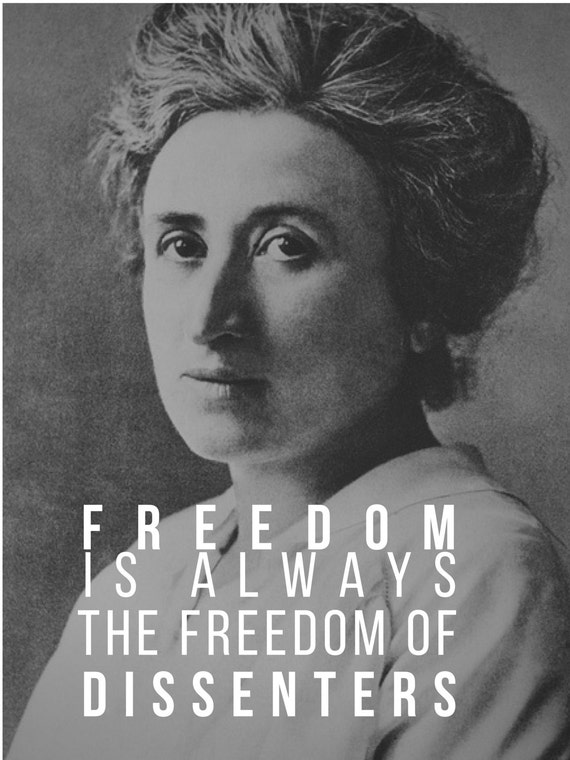
While there is debate among scholars today about the extent of the frenzy in Europe as World War I began, it is difficult to dismiss sophisticated eyewitnesses such as Rosa Luxemburg (image on the right), who referred to what she saw as:
“mad delirium”; “patriotic street demonstrations”; “singing throngs”; “the coffee shops with their patriotic songs”; “the violent mobs, ready to denounce, ready to persecute women, ready to whip themselves into a delirious frenzy over every wild rumour”; “the atmosphere of ritual murder”. (Luxemburg, 261)
What Luxemburg described was a subjective state produced by a successful war trigger, in which a population becomes extremely lethal as it readies itself to rush at its foe while simultaneously battering anyone in its own ranks that dares to dissent.
Luxemburg herself dared to dissent. This led to two and a half years in a German prison cell. During this time she wrote the Junius Pamphlet, criticizing Europe’s socialist leaders for having been captured by the spirit of war, and pointing to the consequences of their folly:
“the cannon fodder that was loaded upon the trains in August and September is rotting on the battlefields of Belgium and the Vosges… Cities are turned into shambles, whole countries into deserts, villages into cemeteries, whole nations into beggars, churches into stables; popular rights, treaties, alliances, the holiest words and the highest authorities have been torn into scraps”. (Luxemburg, 261-2)
Luxemburg’s anger had a solid basis in what has become known as “the August madness” that struck Europe. For example, on August 3, 1914, when the war had just begun, the following call went out to university students from the most senior officials in the Bavarian universities:
“Students! The muses are silent. The issue is battle, the battle forced on us for German culture, which is threatened by the barbarians from the East, and for German values, which the enemy in the West envies us. And so the furor teutonicus bursts into flame once again. The enthusiasm of the wars of liberation flares, and the holy war begins”. (Keegan, 358)
In response to this hysterical appeal, the German university students volunteered in large numbers. Untrained, they were thrown into battle. In the space of three weeks 36,000 of them were killed.
Germany was not unique, of course, in its vulnerability. Randolph Bourne, in an unfinished essay generally known as “War is the Health of the State”, described what he saw somewhat later in the United States as that country flipped from anti-war to pro-war and joined in the global disaster. He observed that once the executive branch had made the decision to go to war the entire population suddenly changed its mind. “The moment war is declared… the mass of the people, through some spiritual alchemy, become convinced that they have willed and executed the deed themselves.”
Therefore, the people, “with the exception of a few malcontents, proceed to allow themselves to be regimented, coerced, deranged in all the environments of their lives, and turned into a solid manufactory of destruction.”
It is true that war madness of the kind that accompanied WWI has been less common in the years since then, partly because that war turned out to be an unprecedented catastrophe. But I believe it is entirely wrong to think that in today’s era of high technology and digitalized war the arousing of the spirit of war in a population is no longer sought or needed. A highly influential analysis of American Vietnam War strategy, carried out by one Col. Harry Summers, concluded some years ago that a chief cause of the US downfall was the failure of leaders to arouse their population’s emotions. The American people, said Summers, had been forced to fight that war “in cold blood”, which they found intolerable. In fact, this failure to arouse the war spirit was taken by many US analysts to have led to the “Vietnam syndrome” – a reluctance to intervene in the affairs of other countries militarily. This was a timidity unsuitable, they felt, for an imperial power.
One of the purposes of the September 11, 2001 operation, in my view, was precisely to change that situation – to arouse intense feelings of unity, aggression and support for government in order to banish once and for all the Vietnam Syndrome and to launch with great energy the new global conflict formation (the “War on Terror”) so that the 21st century, with the military leading the way, would become another American Century.
Still, war triggers are not all the same, and we need to create categories. We can distinguish three broad types: accidental war triggers, managed war triggers and manufactured war triggers.
An accidental war trigger is an event that triggers hot war in the absence of intention. The pressure of events, random clashes, the everyday quest to satisfy physical needs – all these may, in the absence of warlike intent, produce a war trigger. After the event occurs it may lead, again without conscious plotting, directly to a hot and violent conflict between contending parties.
No doubt many war triggers throughout history fit the category of accidental war trigger. However, the more I have studied recent human wars the less ready I have become to promote the triggering events as accidental.

Years ago when I gave talks on war triggers I used to give the assassination of Archduke Ferdinand as an example of an accidental war trigger. True, I understood that the assassin of the Archduke did not act alone: Gavrilo Princip, the young Serbian nationalist, was certainly not a “lone wolf”; he was one of several armed men stationed along the route of the Archduke’s carriage, and although he was committed to this plan it is also pretty clear that he was deliberately used by a group with high-level connections to carry out the assassination. But I felt that the planners were unlikely to have sought the large-scale conflagration they ended up getting, and I was impressed by the variety of elements in the “Balkan cauldron” that seemed to defy rational planning. Likewise, I was impressed by the numerous systemic factors operative in the wake of this event that led to a major war, ranging from a flourishing arms industry, through genuinely deluded ruling classes and entangling state alliances, to systems such as railways that gave an advantage to the first party to mobilize. All in all, I felt that non-deliberate factors outweighed deliberate factors, so I called this an accidental war trigger.
Recent reading, however, has made me less confident of this position. Especially since encountering Docherty and McGregor’s book, Hidden History: the Secret Origins of the First World War, I am inclined to reclassify the World War I war trigger as a managed trigger.
A managed war trigger is one in which a party of influence consciously acts to increase the chances of hot war, either by deliberately creating conditions where a war trigger is likely to arise, or by seizing an event after the fact and shaping it into a war trigger.
If World War I’s war trigger must be moved from accidental to managed, this increases the number of cases in this already well-stuffed category. The Pearl Harbor attack that caused the US entry into World War II was certainly managed. The factors that would increase the chances of the Japanese attack on Pearl Harbor, thereby overcoming the US population’s resistance to entering this war, were studied and made part of a deliberate program. The Japanese advance on Pearl Harbor was consciously allowed to proceed. The declaration of war on Japan was the immediate fruit of this managed attack.
The Gulf of Tonkin incident also falls into this category. This was no accidental dustup in the Gulf of Tonkin. US leaders had created a systematic program of naval raids on the coast of North Vietnam (the DESOTO raids) intended to stimulate responses. While there is still debate about the degree to which this incident was planned, I am on the side of those who see it as highly deliberate provocation by US leaders, constructed and used to create hot war. The North Vietnamese response to the intrusion of the Maddox and the Turner Joy was remarkably mild, but it was magnified and distorted by US Cold Warriors so that it could be portrayed as “communist aggression” that required violent response.
The success of these last two managed war triggers can be seen in the record of voting in the US Congress. On December 8, 1941 there was only one vote in Congress against the declaration of war on Japan. On August 7, 1964 the House voted unanimously in favour of the Gulf of Tonkin Resolution, while in the Senate the vote was 88-2.
These voting statistics are sobering. The readiness of the group mind to revert to a pre-rational state—to take aggressive action with dire consequences without seeking any serious confirmation of the facts of the matter—puts humanity in a state of profound risk.
A manufactured war trigger carries the manipulation of populations even further. Here, deliberateness is extreme: it is not simply a matter of increasing the chances that this or that incident will occur, or making a mountain out of a molehill after the event. Here, those desirous of war write the script, choreograph the action, plan the output, and carry out, or subcontract, the actual event. Typically, they will also prepare to demonize and marginalize anyone who dares to challenge the narrative they present to the world.
The War on Terror is a master class in manufactured and managed war triggers. My own studies have concentrated on the two-part operation of the fall of 2001 – the September 11 airplane incidents and the immediately following anthrax letter attacks. These were manufactured war triggers, and they were successful in winning the support of both the US population and its representatives for foreign wars and restrictions on domestic civil rights.
A Washington Post-ABC poll initiated on the evening of 9/11 reportedly found that:
“nearly nine in 10 people supported taking military action against the groups or nations responsible for yesterday’s attacks even if it led to war. Two in three were willing to surrender ‘some of the liberties we have in this country’ to crack down on terrorism”. (MacQueen, 36)
Meanwhile, on September 11, cowed members of Congress fled for their lives on receiving information that a plane was headed toward the Capitol. That evening they assembled on the Capitol steps to sing God Bless America and to begin what was, in effect, their complete capitulation to those who had manufactured this war trigger.
On September 14, 2001 the Authorization for Use of Military Force was passed with a vote of 98-0 in the Senate and 422-1 in the House.
By late October members of Congress had begun to recover somewhat, and the USA Patriot Act, restricting domestic civil rights, met more opposition in the House than had the rush to war, passing by a vote of 357-66. Its fate in Senate, however, was more typical of such cases: 98 to 1.
These outcomes in Congress demonstrate the remarkable success, in the short term, of the manufactured war triggers of the fall of 2001. The effects of such operations, however, are temporary, so the perpetrators have had no choice but to continue managing and manufacturing war triggers to maintain the fraudulent War on Terror. The FBI (and parallel federal police agencies in other Western countries) busily entrap and recruit young people as fodder for the War on Terror, while in other cases False Flag attacks are carried out using wholesale invention. These initiatives have had a mixed success. For example, the official account of the Boston Marathon bombing is widely accepted despite its contradictions and absurdities; but the story of the Syrian chemical weapons attack of 2013 failed to accomplish its apparent aim of greatly expanded direct US military involvement in Syria. Likewise, sceptics of the recent claim of Russian “novichok” use in the UK are already vocal.
We would do well to remember that the on-going production of managed and manufactured war triggers takes great resources and cannot forever remain leak-proof. It carries serious risks for war planners. The successful and definitive exposure of even one of these frauds before the people of the world could affect the balance of power overnight.
Our task is clear. We must mobilize both our investigative resources and our communication resources to nullify the efforts of those who specialize in the construction and encouragement of war triggers and who wish to keep the war system robust. We lost over 100 million people to war in the 20th century. Are we really going to let this happen again?
*
Graeme MacQueen is a former Director of the Centre for Peace Studies at McMaster University, a member of the 9/11 Consensus Panel, and a past co-editor of the Journal of 9/11 Studies.
Professor McQueen is a frequent contributor to Global Research.
Sources
The Junius Pamphlet: The Crisis in the German Social Democracy, in Rosa Luxemburg Speaks, edited by Mary-Alice Waters. New York: Pathfinder Press, 1970.
John Keegan, A History of Warfare. New York: Alfred Knopf, 1993.
Randolph Bourne, “The State (‘War is the Health of the State’)”, 1918.
Col. Harry Summers, On Strategy: A Critical Analysis of the Vietnam War. Presidio Press, 1982.
Gerry Docherty and Jim MacGregor, Hidden History: The Secret Origins of the First World War. Edinburgh: Mainstream Publishing, 2013
Robert B. Stinnett, Day of Deceit: The Truth about FDR and Pearl Harbor. New York: Touchstone, 2001.
Graeme MacQueen, The 2001 Anthrax Deception: The Case for a Domestic Conspiracy. Atlanta: Clarity Press, 2014.
Copyright © Prof. Graeme McQueen, Global Research, 2018
Boris Johnson Issues Completely New Story on “Russian Novichoks”
By Craig Murray | March 18, 2018
Boris Johnson has attempted to renew the faltering case for blaming Russia ahead of the investigation into the Skripal attack, by issuing a fundamentally new story that completely changes – and very radically strengthens – the government line on what it knows. You can see the long Foreign and Commonwealth Office Statement here.
This is the sensational new claim which all the propaganda sheets are running with:
The Foreign Secretary revealed this morning that we have information indicating that within the last decade, Russia has investigated ways of delivering nerve agents likely for assassination. And part of this programme has involved producing and stockpiling quantities of novichok. This is a violation of the Chemical Weapons Convention.
This is an astonishing claim and requires close investigation. If this information comes from MI5 or MI6, there is a process of inter-departmental clearance that has to be gone through before it can be put in the public domain – even by a Minister – which is known as “Action-on”. I have been through the process personally many times when working as head of the FCO Section of the Embargo Surveillance Centre, monitoring Iraqi arms acquisitions. It is not, unless actually at war, a Saturday night process – it would have had to have been done on Friday.
So why is this essential information being released not to Parliament on Friday, but on Andrew Marr’s sofa early on a Sunday morning, backed up with a Sunday morning official statement? This is very unusual. Furthermore, it is absolutely incompatible with what I was told last week by FCO sources – they did not know this information, and one of them certainly would have if it was based on MI6 or GCHQ reporting.
I can see only two possible explanations. One – and the most likely – depends on looking yet again extremely carefully at what the statement says. It says “we have information indicating that within the last decade”. It does not say how long we have held that information. And “within the last decade” can mean any period of time between a second and ten years ago. Very tellingly it says “within the last decade”, it does not say “for the last decade”.
“Within the last decade” is in fact the exact same semantic trick as “sale price – up to 50% off”. That can mean no more than 0.1% off and its only actual meaning is “never better than half price”.
The most likely explanation of this sentence is therefore that they have – since last week when they didn’t know this – just been given this alleged information. And not from a regular ally with whom we have an intelligence sharing agreement. It could have come from another state, or from a private source of dodgy intelligence – Orbis, for example.
The FCO are again deliberately twisting words to convey the impression that we have known for a decade, whereas in fact the statement does not say this at all.
There is a second possible explanation. MI6 officers in the field get intelligence from agents who, by and large, they pay for it. In my experience of seeing thousands of MI6 intelligence reports, a fair proportion of this “Humint” is unreliable. Graham Greene, a former MI6 officer, was writing a true picture in the brilliant “our Man in Havana”, which I cannot strongly recommend enough to you.
The intelligence received arrives in Vauxhall Cross and there is a filter. A country desk officer will assess the intelligence and see if it is worth issuing as a Report; they judge accuracy against how good access the source has and how trustworthy they are deemed to be, and whether the content squares with known facts. If passed, the intelligence then becomes a Report and is given a serial number. This is not a very good filter, because it still lets through a lot of rubbish, but it does eliminate the complete dregs. One possible source of new information that has suddenly changed the government’s state of knowledge this weekend is a search of these dregs for anything that can be cobbled together. As I have written in Murder in Samarkand, it was the deliberate removal of filters which twisted the Iraqi WMD intelligence.
In short, we should be extremely sceptical of this sudden new information that Boris Johnson has produced out of a hat. If the UK was in possession of intelligence about a secret Russian chemical weapons programme, it was not under a legal obligation to tell Andrew Marr, but it was under a legal obligation to tell the OPCW. Not only did the UK fail to do that, the UK Ambassador Sir Geoffrey Adams was last year fulsomely congratulating the OPCW on the completion of the destruction of Russia’s chemical weapons stocks, without a single hint or reservation entered that Russia may have undeclared or secret stocks.
On the Andrew Marr programme, Boris Johnson appeared to say for the first time that the nerve agent in Salisbury was actually made in Russia. But this is a major divergence from the published FCO statement, which very markedly does not say this. Boris Johnson was therefore almost certainly reverting to his reflex lying. In fact the FCO statement gives an extremely strong hint the FCO is not at all confident it was made in Russia and is seeking to widen its bases. Look at this paragraph:
Russia is the official successor state to the USSR. As such, Russia legally took responsibility for ensuring the CWC applies to all former Soviet Chemical Weapons stocks and facilities.
It does not need me to point out, that if Porton Down had identified the nerve agent as made in Russia, the FCO would not have added that paragraph. Plainly they cannot say it was made in Russia.
The Soviet Chemical Weapons programme was based in Nukus in Uzbekistan. It was the Americans who dismantled and studied it and destroyed and removed the equipment. I visited it as Ambassador to Uzbekistan shortly after they had finished – I recall it as desolate, tiled and very cold, nothing to look at really. The above paragraph seeks to hold the Russians responsible for anything that came out of Nukus, when it was the Americans who actually took it.
UK will either have to offer facts on ‘Russian traces’ in Skripal poisoning or apologize – Kremlin
RT | March 19, 2018
The UK will either back up its claims of Moscow’s involvement in the poisoning of ex-double agent Sergei Skripal and his daughter, or it will have to apologize, the Kremlin spokesman has said.
Foreign Secretary Boris Johnson said on Monday that Russia is wrong to deny responsibility for the nerve agent poisoning of Skripal. “The Russian denial is increasingly absurd,” Johnson told reporters in Brussels. “This is a classic Russian strategy… they’re not fooling anybody anymore,” he added.
Peskov pulled no punches in fighting back, accusing the UK of “incomprehensible, unreasonable slander” against Moscow.
“Sooner or later, it will have to account for these baseless allegations, either by backing them up with evidence or by offering its apologies,” the Russian president’s spokesman said.
Last Monday, British Prime Minister Theresa May confronted Moscow with an ultimatum to reveal the details of the alleged Skripal plot. After her demand was rejected, the UK announced sanctions on Moscow, which included expelling 23 diplomats, limiting diplomatic ties and freezing Russian state assets in the UK.
In response, the Russian Foreign Ministry said on Saturday that 23 UK diplomats must leave Russia and that the British Council will be shut in retaliation for “provocative actions and groundless accusations” over the poisoning of Skripal and his daughter Yulia.
On Monday, the UK is set to hand samples of the nerve agent used in Skripal’s poisoning to a UN watchdog, the Organization for the Prohibition of Chemical Weapons (OPCW).
Johnson accused Russia on Sunday of creating and storing the so-called ‘Novichok’ nerve agent, which London says was used in the attack on Skripal. The UK official claimed that the UK has “evidence… collected over the past 10 years” that Moscow has been developing nerve agents “for the purpose of committing murder.”
Russian Foreign Ministry spokeswoman Maria Zakharova dismissed the allegation that the substance, thought to be a Soviet-era invention, was a Russian “project.” She said that in post-Soviet times, countries such as the UK, Slovakia, the Czech Republic, Sweden, and even the US studied the substance with keen interest and could have been the origin for the toxin used in the incident with Skripal and his daughter.
McCabe: A War on (or in) the FBI?
By Coleen Rowley | Consortium News | March 18, 2018
The explanation from Andrew McCabe that he was fired merely due to his staunch support of his former boss and mentor, FBI Director James Comey, and the “Russiagate” investigation, does not pass the smell test.
Similar to the one that mainstream corporate media is spinning, McCabe’s explanation almost totally ignores the fact that it was the relatively independent Department of Justice (DOJ) Inspector General (IG) and the FBI’s own Office of Professional Responsibility (OPR internal affairs) who recommended firing McCabe for his “lack of candor” on (the totally unrelated issue of) granting improper press access to the Wall Street Journal during ongoing FBI investigations of the Clinton Foundation and Clinton’s emails.
While the exact specifics of McCabe’s “lack of candor” – which McCabe denies – haven’t been released by the IG, it’s my own personal opinion that such official briefing of the press should not necessarily be a fireable offense as long as it’s justified to correct faulty media reporting and was not covertly done for improper political reasons. But technically, firing for “lack of candor” has long been the FBI’s “bright line” policy, ever since former FBI Director Louis Freeh tried to “clean up” the FBI in the mid-1990s when so many agents, including Special Agents in Charge, were caught lying about sex affairs, improper government credit card charges and drunk driving incidents – some amounting to reckless homicides.
But of course Freeh was rather hypocritical as he was himself involved in several instances of “lack of candor” including appointing his friend, Larry Potts, as Deputy Director. This, despite the fact that Potts had covered up his own role in substituting “rules of engagement” for the FBI’s “deadly force policy” during the Ruby Ridge standoff with (the arguably unconstitutional) “rules” directing the shooting on sight of any armed male.
The cover-up of Potts’ mishandling of Ruby Ridge came to light during the criminal investigations and prosecution of the FBI sniper who had subsequently shot and killed Randy Weaver’s wife while aiming at someone else. When Pott’s role was revealed, Freeh had to censure and demote his Deputy Director; but even then Potts wasn’t actually fired.
So it may well be that “lack of candor” sets too high a standard that no one, not even the angels, let alone FBI agents and their managing officials can live up to. Attorney General Jeff Sessions’ lofty statement that the FBI’s integrity is its brand, may be nice, wishful thinking but like other self-promoting speeches going back to J. Edgar Hoover, it has never rung true based on the hundreds of unethical actions I witnessed or was made aware of.
A number of OPR officials themselves were always getting caught in various unethical, deceitful (and sometimes even illegal) actions, including their long systemic practice of employing “double standards” in recommending disciplinary actions, i.e. top ranking officials received light discipline while lower ranking agents got far more severe punishments for similar wrongdoing. In 2001, some of the FBI’s internal affairs supervisors became whistleblowers and testified to the Senate Judiciary Committee about the FBI’s disciplinary “double standards.” Although some remedies were eventually put into place, the IG also had to investigate some retaliatory fall-out.
In any event, McCabe’s calling his firing a “war on the FBI” doesn’t make sense considering it was the FBI’s own internal affairs office that recommended he be fired. (Note that DOJ IG Michael Horowitz was appointed by President Obama in 2012 and the FBI’s OPR is run by a career official originally appointed to that position in 2004 by then FBI Director Robert Mueller.)
Perhaps it would be more apt if McCabe had called it a war inside the FBI (and in Washington as a whole). Could the obvious chaos – some would say “bloodbath” – at all levels of government also be part of the “blowback” from 16 years of waging “perpetual war” (and from attendant war crimes and the internal corruption by which all empires rot)? As author Viet Thanh Nguyen noted about the 2016 election: “That sickness is imperialism… America is an imperial country, and its decay might now be showing. Empires rot from the inside even as emperors blame the barbarians.” Remember how wars have a way of migrating home.
Don’t forget that McCabe’s mentor, James Comey, as Assistant Attorney General had signed off on the Bush-Cheney Administration’s torture tactics. Special Counsel Robert Mueller (said to be “joined at the hip” with Comey) dutifully looked the other way, as then FBI Director, when the CIA’s torture program was instituted, allowing the atrocities to continue. It should also be recalled that Mueller helped the Bush-Cheney Administration to lie us into the Iraq War.
In early January, 2017 CIA Director John Brennan, FBI Director James Comey, NSA Director Michael Rogers and National Director of Intelligence James Clapper briefed President Obama and President-elect Trump on their “Intelligence Community Assessment” by which their agencies’ “hand-picked analysts” accused Russia of meddling in the election and which also included former MI6 spy Chris Steele’s “salacious dossier” accusing Trump’s campaign of colluding with the Russians.
By prior plan, the three other intelligence directors left Comey alone in the room with Trump for Comey to confront the President-elect with the damning summary of Steele’s dossier (which Comey admitted was not verified) and, as icing on the cake, also warning Trump that these accusations would probably appear soon in the media.
Forgetful Democrat Party loyalists also should be reminded that John Brennan was termed the drone assassination and “kill list” czar (before being named CIA Director). As CIA Director, Brennan was hellbent on covering up and promoting CIA torture.
James Clapper, also not known for candor in having previously misled Congress about the NSA’s massive spying on Americans, has even been reported to be the source of the leak to CNN about the Obama intelligence directors’ January briefing that focused on the Steele dossier. It sure looks like there is plenty “lack of candor” to go around! And plenty for these officials to continue covering up. But as Cicero observed hundreds of years ago, “the law falls silent in time of war.” At very least everyone should be wary of partisan media spin since all of these war crimes and other deceitful, illegal actions made possible by the wars are fully bipartisan.
The real problem that most of the mainstream media don’t want to even mention is how unprecedented it was to have both Presidential campaigns under serious criminal investigation in the weeks before the 2016 election! In all fairness, even if these now-fired FBI Directors were trying to do the right thing – which would not be in line with their rather sordid track records – it wouldn’t really be possible to walk that political mine field without a faux pas one way or the other. Seen in that light, it’s possible to even sympathize a little with any FBI Director when the public corruption at the highest levels in Washington DC has become so bad (and fully bipartisan), that it’s hard to know where to start.
Coleen Rowley is a retired FBI special agent, division legal counsel and law enforcement ethics instructor who testified in connection with the 9-11 Joint Intelligence Committee’s Inquiry, the Senate Judiciary Committee investigation and Department of Justice Inspector General’s investigation, exposing some of the FBI’s pre-9/11 failures, was named one of TIME magazine’s “Persons of the Year” in 2002.
‘Dictator’ Putin wins ‘fraud-tainted’ vote: Western media sticks to narrative on Russian election
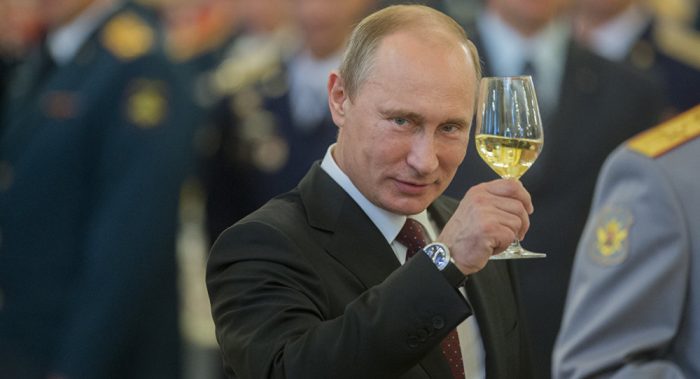
RT | March 18, 2018
From Soviet comparisons to accusations of authoritarianism, mainstream coverage of Russia’s presidential election has barely changed since 2004, though mentions of the UK spy poisoning scandal did add a fresh layer of insinuation.
As Putin was thanking his supporters for a landslide victory from the stage in Red Square, Western outlets rolled out long, pre-written news stories, liberally mixing reporting and opinion.
“The vote was tainted by widespread reports of ballot-box stuffing and forced voting, but the complaints will likely do little to undermine Putin,” wrote AP’s lead report. “The Russian leader’s popularity remains high despite his suppression of dissent and reproach from the West over Russia’s increasingly aggressive stance in world affairs and alleged interference in the 2016 U.S. election.”
The Washington Post called Sunday’s vote an “elaborate presidential-election-day spectacle” that sought “to legitimize the election,” which “critics described as a charade,” by boosting the turnout as “a lack of suspense or popular opposition candidates threatened to keep people home.”
Calling the election a “hollow exercise,” the New York Times reached for the most predictable of parallels.
“Gone were the Soviet days when there was just one name on the ballot and the winner habitually harvested 99 percent of the vote. The spirit was similar, however, with pictures of Mr. Putin and his campaign slogan, ‘Strong president, strong Russia,’ blanketing the country,” it wrote.
In its top report. CNN said that Putin “seeks tighter grip on power,” while also reminding its readers that “he is already the country’s longest-serving leader since the Soviet dictator Joseph Stalin” (which is not actually true – that would be Leonid Brezhnev). CNN added that Putin is “banking on confrontation with international players this election.”
Rupert Murdoch’s News Corp Australia didn’t even bother with such nuances, calling Putin a straight-up “dictator,” though the article was later amended to merely describe the vote as “inevitable.”
For the Guardian, “paradoxically, the first order of business now… is for Putin to set up an escape plan.”
“Kremlin politics have become a bloodsport,” wrote Andrew Roth, the Guardian’s correspondent for Moscow. “With a shrinking economy [also untrue] and elites manoeuvring before a possible succession battle, the knives are out.”
This year, the usual analysis was also sprinkled with allegations that a Moscow agent poisoned Sergei Skripal with the toxin “Novichok, a gruesome calling card” to provoke a British response, according to the Guardian.
“A row with London can do Putin no harm, especially among voters who share his uncompromising nationalist worldview and his smouldering sense of victimhood,” an article in the Guardian said this week.
“The diplomatic crisis this poisoning case has caused may help him get more people into polling booths,” echoed Australia’s ABC.
Jane Mayer, the New Yorker, and the Art of the Big Russia Lie
David Remnick’s New Yorker, where Masha Gessen is always welcome, is Exhibit A in the Jewish media’s relentless lying about and demonizing of Russia, Putin, and Russiagate.
By Philip Giraldi | Russia Insider | March 15, 2018
The latest salvo in the Russiagate saga is a 15,000 word New Yorker article entitled “Christopher Steele the man behind the Trump dossier: how the ex-spy tried to warn the world about Trump’s ties to Russia” by veteran journalist Jane Mayer. The premise of the piece is clear from the tediously long title, namely that the Steele dossier, which implicated Donald Trump and his associates in a number of high crimes and misdemeanors, is basically accurate in exposing an existential threat posed to our nation by Russia. How does it come to that conclusion? By citing sources that it does not identify whose credibility is alleged to be unimpeachable as well as by including testimony from Steele friends and supporters.
In other words, the Mayer piece is an elaboration of the same “trust me” narrative that has driven the hounding of Russia and Trump from day one. Inevitably, the Trump haters both from the left and the right have jumped on the Mayer piece as confirmation of their own presumptions regarding what has allegedly occurred, when, in reality, Trump might just be more right than wrong when he claims that he has been the victim of a conspiracy by the Establishment to discredit and remove him.
Mayer is a progressive and a long-time critic of Donald Trump. She has written a book denouncing “the Koch brothers’ deep influence on American politics” and co-authored another book with Jill Abramson, formerly Executive Editor of the New York Times. Abramson reportedly carries a small plastic replica of Barack Obama in her purse which she can take out “to take comfort” whenever she is confronted by Donald Trump’s America. Mayer’s New Yorker bio-blurb describes her as a journalist who covers national security, together with politics and culture.
The problem with the type of neo-journalism as practiced by Mayer is that it first comes to a conclusion and then selects the necessary “facts” to support that narrative. When the government does that sort of thing to support, one might suggest, a war against Iraq or even hypothetically speaking Iran, it is called cherry picking. After the facts have been cherry picked they are “stovepiped” up to the policy maker, avoiding along the way any analysts who might demur regarding the product’s veracity. In journalistic terms, the equivalent would perhaps be sending the garbage up directly to a friendly editor, avoiding any fact check.
Mayer tries to take the high road by asserting that the Republicans are “trying to take down the intelligence community.” It is an odd assertion coming from her as she has written a book called “The Dark Side: The Inside Story of How the War on Terror Turned into a War on American Ideals,” a development which was pretty much implemented by the intelligence community working hand-in-hand with Congress and the White House. But she is not the first liberal who has now become a friend of CIA, the FBI and the NSA as a response to the greater threat allegedly posed by Donald Trump.A Steele friend describes the man as a virtual Second Coming of Jesus, for whom “fairness, integrity and truth… trump any ideology.” Former head of MI-6 and Steele boss Sir John Dearlove, who once reported how the intelligence on Iraq had been “sexed-up” and “fixed around the policy” to make the false case for war, describes Steele as “superb.” Other commentary from former American CIA officers is similar in nature. Former CIA Deputy Director John McLaughlin, who himself was involved in lying to support America’s journey into Iraq, similarly sees Steele as honest and credible in his claims, while a former CIA Station Chief in Moscow is called upon to cast aspersions on the “Russian character” that impels them to engage in lies and deception.
My review of the Mayer rebuttal of criticism of Steele revealed a number of instances where she comes to certain conclusions without presenting any real supporting evidence or accepts “proof” that is essentially hearsay because it supports her overall narrative. She asserts that Russia and WikiLeaks were working together on the release of the Democratic National Committee/Hillary Clinton emails without providing any substantiation whatsoever. She surely came to that judgement based on something she was told, but by whom and when?
Another major blooper in the Mayer story relates to how one unnamed “senior Russian official” reported that the Kremlin had blocked the appointment of Mitt Romney, a noted critic of Russia, as secretary of state. How exactly that was implemented is not clear from the Steele reporting and there has been no other independent confirmation of the allegation, but Mayer finds it credible, asserting that “subsequent events could be said to support it.” What events? one might ask, though the national media did not hesitate and instead reported Mayer’s assertion as if it were itself a credible source in a forty-eight hour news cycle frenzy relating to Romney and Trump.
Steele’s work history also raises some questions. He served in Moscow as a first tour officer for MI-6 under diplomatic cover from 1990 to 1993. Russia was in tumult and Mayer describes how “Boris Yeltsin gained ultimate power, and a moment of democratic promise faded as the KGB -now called the FSB-reasserted its influence, oligarchs snapped up state assets, and nationalist political forces began to emerge.” Not to go into too much detail, but Mayer’s description of Russia at that time is dead wrong. Yeltsin was a drunkard and a tool of American and European intervention and manipulation. He was no agent of “democratic promise” and only grew more corrupt as his time in office continued into the completely manipulated election of 1996, when the IMF and U.S. conspired to get him reelected so the looting, a.k.a. “democratization,” could go on. Mayer goes on to depict in negative terms a “shadowy” former “KGB operative” Vladimir Putin who emerged from the chaos.
Mayer also cites a Steele report of April 2016, a “secret investigation [that] involved a survey of Russian interference in the politics of four members of the European Union,” but she neither produces the report itself or the sources used to put it together. The report allegedly concluded that the “Kremlin’s long-term aim …was to boost extremist groups and politicians at the expense of Europe’s liberal democracies. The more immediate goal was to destroy the E.U…” The precis provided by Mayer is a bit of fantasy, it would seem, and is perhaps a reflection of an unhealthy obsession on the part of Steele, if he actually came to that conclusion. As it stands it is hearsay, possibly provided by Steele himself or a friend to Mayer to defend his reputation.Mayer also reports and calls potentially treasonous Steele’s claims that “Kremlin and Trump were politically colluding in the 2016 campaign…’to sow discord and disunity both with the U.S.’ and within the transatlantic alliance.” And also, “[Trump] and his top associates had repeatedly accepted intelligence from the Kremlin on Hillary Clinton and other political rivals.” As Robert Mueller apparently has not developed any information to support such wild claims, it would be interesting to know why Jane Mayer considers them to be credible.
Sweeping judgements by Mayer also include “[Steele’s] allegation that the Kremlin favored Trump in 2016 and was offering his campaign dirt on Hillary has been borne out. So has his claim that the Kremlin and WikiLeaks were working together…” As noted above, the WikiLeaks/Kremlin allegations have not been demonstrated, nor have the claims about Kremlin provision of information to discredit Hillary, who was doing a find job at the time discrediting herself.
The account of Donald Trump performing “perverted sexual acts” in a Moscow hotel is likewise a good example of what is wrong with the article. Four sources are cited as providing details of what took place, but it is conceded that none of them was actually a witness to it. It would be necessary to learn who the sources were beyond vague descriptions, what their actual access to the information was and what their motives were for coming forward might be. One was allegedly a “top-level Russian intelligence officer,” but the others were hotel employees and a Trump associate who had arranged for the travel.
Finally, from an ex-intelligence officer point of view I have some questions about Steele’s sources in Russia. Who are they? If they were MI-6 sources he would not be able to touch them once he left the service and would face severe sanctions under the Official Secrets Act should he even try to do so. There are in addition claims in the Mayer story that Steele did not pay his sources because it would encourage them to fabricate, an argument that could also be made about Steele who was being paid to produce dirt on Trump. So what was the quid pro quo? Intelligence agents work for money, particularly when dealing with a private security firm, and Steele’s claim, if he truly made it, that he has sources that gave him closely held, highly sensitive information in exchange for an occasional lunch in Mayfair rings hollow.
Jane Mayer’s account of the Steele dossier seems to accept quite a lot on faith. It would be interesting to know the extent to which Steele himself or his proxies were the source of much of what she has written. Until we know more about the actual Russian sources and also about Mayer’s own contacts interviewed for the article, her “man behind the Trump dossier” will continue to be something of a mystery and the entire Russiagate saga assumption that Moscow interfered in the 2016 U.S. election must be regarded as still to be demonstrated.
Philip M. Giraldi, Ph.D., is Executive Director of the Council for the National Interest, a 501(c)3 tax deductible educational foundation that seeks a more interests-based U.S. foreign policy in the Middle East. Website is http://www.councilforthenationalinterest.org, address is P.O. Box 2157, Purcellville VA 20134 and its email is inform@cnionline.org.
Boris Johnson Attempt to Refute My Sources on Porton Down the Most Hilarious Fail
By Craig Murray | March 18, 2018
The Foreign and Commonwealth Office (FCO) has issued a statement to refute my report from well-placed FCO sources that the British government continually re-uses the phrase “of a type developed by Russia” because its own scientists refused government pressure to say the nerve agent was made by Russia, and as getting even agreement to “of a type developed by” was bloody, the government has to stick to precisely that rather odd choice of phrase.
This is the official British Government statement:
“We have no idea what Mr Murray is referring to. The Prime Minister told MP’s on Monday that world leading experts at Porton Down had positively identified this chemical agent. It is clear that it is a military grade nerve agent of a type developed by Russia. None of that is in any doubt”.
Which is perhaps the most hilarious fail in the history of refutation.
The BBC sprung that statement on me during a live interview on Radio 5 last night. They also sprung on me a statement by the Israeli Embassy and were attempting to lead me into accusing Israel of the attack. But even the BBC interviewer, Stephen Nolan, was flummoxed by the rubbish he had been given from the FCO. Here is an extract from that part of the interview:
Stephen Nolan: The Foreign and Commonwealth Office have said to us tonight: “We have no idea what Mr Murray is referring to. The Prime Minister told MP’s on Monday that world leading experts at Porton Down had positively identified this chemical agent. It is clear that it is a military grade nerve agent of a type developed by Russia. None of that is in any doubt”. Well, you’ve already covered that Craig and you are zoning in on the fact that they are saying “developed by Russia”, they are unable to say whether it’s made – well they are not saying whether it was actually manufactured in Russia or the source of it or whether it was from Russia, right?”
Craig Murray Yes, exactly. No-one doubts that the Russians had the idea of making these things first, and worked on developing the idea. It has always been doubted up till now that they really succeeded. The Iranians succeeded under OPCW supervision some time ago and the chemical formulae were published to the whole world twenty years ago. So many states could have done it. The “of a type developed by Russia” thing means nothing, undoubtedly.
You can hear the whole interview here beginning about 5 minutes in.
Featured Video
Trita Parsi: Israel Set a Trap for Total War in the Region
or go to
Aletho News Archives – Video-Images
From the Archive
Zionism’s Violent Legacy
By Donald Neff | Washington Report On Middle East Affairs | January 1996
On January 4, 1948, Jewish terrorists drove a truck loaded with explosives into the center of the all Arab city of Jaffa and detonated it, killing 26 and wounding around 100 Palestinian men, women and children.[1] The attack was the work of the Irgun Zvai Leumi – the “National Military Organization,” also known by the Hebrew letters Etzel – the largest Jewish terrorist group in Palestine. The Irgun was headed by Revisionist Zionist Menachem Begin and had been killing and maiming Arabs, Britons and even Jews for the previous ten years in its efforts to establish a Jewish state.
This terror campaign meant that at the core of Revisionist Zionism there existed a philosophical embrace of violence. … continue
Blog Roll
 Aletho News
- Trita Parsi: Israel Set a Trap for Total War in the Region
- Trump’s Iran war is on an Israeli leash
- Saudi oil boss issues global supply warning
- Riyadh Says Its Oil System Is Intact. The Numbers Say Otherwise.
- Trump and Netanyahu Want to “Finish the Job” on Iran
- US ‘one-sided dictation’ not Iran’s beliefs makes rational talks impossible: Baghaei
- Iran’s Next Strike May Not Explode. It Could Shut You Down /Col Doug Macgregor
- Iran: US political targets legitimate if assassinations return
- Iraq shuts key border crossing with Iran under US pressure: Report
- Undersea Internet cables could be targeted in retaliation for attacks on Iran: IRGC deputy chief
- If Americans Knew
- The Israel Lobby’s Changing Fortunes
- AIPAC has become such a political liability that it’s shifting to a more “nimble” approach to buying politicians
- At least 160 Israeli settler attacks in 2 weeks
- Will Gaza’s Ancient Christian Community Disappear Forever?
- Israel’s vision of regional security rests on keeping Arab states weak
- Heidi Levine recounts how Palestinian youths helped save her in settler attack
- DAILY UPDATE: Latest essential news on Palestine, Israel, & region
- Trump’s Intensifying Sabotage of the ICC, for Israel’s Sake
- Israeli military detain US and UK volunteers in West Bank including Democratic NY politician Brad Lander
- Americans at National Conservatism Conference held in Israel this year criticize Israel
- No Tricks Zone
- E-Cars Reduce CO2 Emissions By Only 41% Compared To Internal Combustion Engine Vehicles
- Predictions Made By Renowned Climate Professor Over Past Decades Have Been Proven To Be Poor
- New Study Suggests Large Regions Of The Pacific Ocean Have Been Cooling For The Last 80 Years
- Germany’s Green Energy Debacle: High Energy Costs Force Kahla Porzellan to Close After 182 Years!
- New Study: 50 Years Of The Most Aggressive ‘Net Zero’ Policies Can Only Affect The Global Climate By 0.03°C
- US September “Heat” Was No Record…Many Records Set Decades Ago
- Latest European Green Energy Debacle; Portugal’s Largest Flagship Solar Park Insolvent!
- Green Energy Debacle: German Expert Professor Fritz Vahrenholt Warns Of Severe Economic And Social Consequences
- Two More Paleo Reconstructions Affirm Meters-Higher Sea Levels Across Ireland, Brazil 7000-6000 Years Ago
- New Study: Earth And Venus Surface Warmth Largely Explained By Convection And Lapse Rate, Not CO2 Or Radiation

