Paraguay to move its embassy in Israel to Occupied Jerusalem
Palestine Information Center – April 29, 2018
OCCUPIED JERUSALEM – Israel Hayom newspaper on Sunday said that the Paraguayan president Horacio Cartes has pledged to transfer his country’s embassy from Tel Aviv to Jerusalem.
Cartes said that he would like the move to take place before he leaves office in June.
Cartes said during a ceremony held in the Paraguayan capital of Asunción to mark the 70th anniversary of the establishment of Israel that his decision stems from both political and personal commitment.
Paraguay is the fourth country to decide to move its embassy to Occupied Jerusalem joining the Czech Republic, Guatemala and Honduras who followed the lead of the US.
Both the US and Guatemala have decided to transfer their embassies to Jerusalem in mid-May, while Honduras and the Czech Republic have not set a date yet.
On 6th December 2017 the US president Donald Trump recognized Jerusalem as Israel’s capital and announced his intention to move the US embassy from Tel Aviv to the holy city stirring worldwide condemnation.
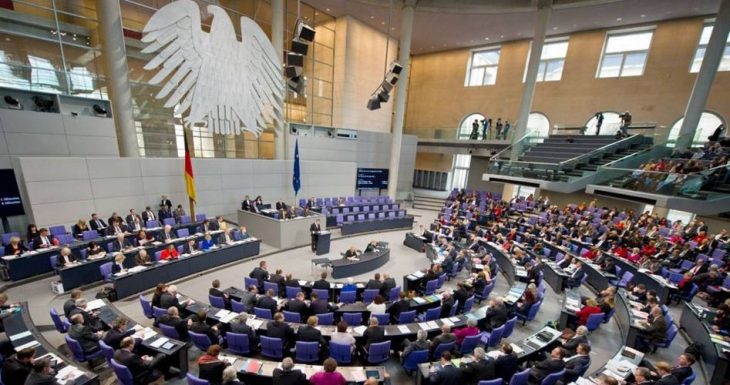
Hamas condemns Bundestag’s support for ‘Israel’ to be a Jewish state
Palestine Information Center – April 29, 2018
GAZA – Hamas strongly condemned the German Bundestag’s call for the German government to support recognizing the Israeli occupation as a Jewish state over the land of historic Palestine.
In a statement on Sunday, Hamas said “At the time the Palestinians expected a strong support from the Federal Republic of Germany on the 70th anniversary of the Nakba, the Bundestag did not mention the seven-decade long aggression of the Israeli occupation on our people, and it did not denounce the Israeli racist and fascist policies”.
Today, the Israeli occupation as an occupying power, continues usurping Palestinian land in favor of illegal settlements, arrests thousands without trial, many of them are children, women and patients, Judaizes Jerusalem and forcefully deports Jerusalemites from their homes and imposes an unjust siege on more than two million Palestinians in Gaza.
The siege on Gaza is considered by all international institutions and international laws as a collective punishment that amounts to a crime against humanity.
You, the Bundestag, described the Israeli occupation as a “state that embraces western European values.” Do these values accept, for example, the killing of dozens and wounding of thousands of peaceful demonstrators, most of them children, who demand their right to a decent life and return to their homes?
This decision destabilizes the region and the world, as well as it gives the occupation a green light to continue its aggression against our people, violation of international law and encourages the displacement of the rest of our people.
Hamas is wondering whether accepting a Jewish state is in line with the democratic values on which Germany was founded after WWII, which basically do not consider differences between citizens on the basis of race, color or religion.
Therefore, we demand that the Bundestag cancel this decision and take positions that achieve justice for our people after decades of suffering, which Europe, and foremost Germany, is a major cause of it.
Chomsky Among “Progressives” Calling for US Military Involvement in Syria
By Whitney Webb | Mint Press News | April 26, 2018
On Monday, the New York Review of Books published an open letter and petition aimed at securing Western support for putting pressure on Turkey to end its occupation of Afrin, opposing further Turkish incursions into Syria, and backing autonomy for Rojava — the region of Northern Syria that has functioned autonomously since 2012 after its administration was taken over by U.S-allied Kurdish factions. Authored by the Emergency Committee for Rojava, it has since been signed by well-known progressive figures such as Noam Chomsky and Judith Butler in its bid to organize efforts for the fulfillment of the group’s demands.
Those demands are entirely focused on U.S. government policy. The petition asks the government to “impose economic and political sanctions on Turkey’s leadership, . . . embargo sales and delivery of weapons from NATO countries to Turkey, . . . insist upon Rojava’s representation in Syrian peace negotiations,” and – most paradoxically of all — “continue military support for the SDF [Syrian Democratic Forces],” the Kurdish-majority group that has acted as a U.S. proxy and has been accused of ethnic cleansing in its bid to construct a Kurdish ethnostate in Northern Syria.
The group’s first three demands are reasonable, in the sense of seeking to punish Turkey for its illegal invasion of Syrian territory. However, they are also rather fanciful, in the sense that the U.S. government is highly unlikely to stop weapons sales or to sanction Turkey, which it needs to court in order to prevent Ankara from pivoting towards Russia. Indeed, the U.S. — by refusing to support the Kurds during the battle for Afrin – made it clear that its “alliance” with Syrian Kurds is opportunistic and very much secondary to the U.S.’ relationship with Turkey.
The third demand is equally unlikely to come about, as Turkey has previously called the involvement of Syrian Kurds in peace talks unacceptable and has essentially issued an “it’s either us or them” ultimatum. In addition, past attempts to invite the Kurds to participate in the peace talks have been rejected by Western nations, including the United States, in order to please Turkey.
More recently, Kurds themselves refused to attend peace talks earlier this year over the Turkish occupation of Afrin in light of the lack of international response to that event. However, even prior to the occupation of Afrin, Syrian Kurds had declared they were “not bound” by any decisions made during Syrian peace talks, thereby weakening the peace process.
Yet, beyond the impractical nature of the petition’s first three demands, the final demand – that the U.S. continue military support for the Syrian Democratic Forces – is by far the most unusual, in the sense that well-known progressive figures, in signing this petition, are asking for the continued U.S. occupation of Syria and for increased military and financial support for the U.S. proxy forces, the SDF.
While most progressive figures, likely including those who signed the petition, would never publicly call for extending a U.S.-led military occupation, this petition shows that the war propaganda in Syria – particularly as it relates to the Kurds – has been highly effective in subverting the progressive anti-war left as it relates to the Syrian conflict.
Indeed, the Kurds in Syria have long been romanticized by Western media for having built “the world’s most progressive democracy” and for being trailblazers for gender equality and gay rights. While the Kurds have incorporated some progressive policies, the realities on the ground are more nuanced. Furthermore, the U.S.’ “support” for Rojava, which the petition seeks to extend, is hardly helping progressive or even Kurdish causes.
Distinguishing the Kurds and the SDF
Since the rise of Daesh (ISIS) in the Syrian conflict, Western media has placed the Kurds on a pedestal and has long treated them as the only “effective” fighters against the terrorist group. However, praising the local Kurdish militias for their fighting prowess has since given way to praising the Syrian Democratic Forces (SDF), even though the two could not be more different.
While the SDF does boast a significant portion of Kurds among its ranks, it is not expressly Kurdish and is an umbrella group of several militias. Though this itself is not concerning, the identities of many of its Arab fighters do give cause for concern. For instance, one of the groups operating under the SDF’s banner is the Deir Ezzor Military Council (DMC) — a group whose fighters were former members of Daesh and al-Nusra (Syria’s Al-Qaeda affiliate), who were “retrained” by U.S. forces in Northern Syria after surrendering to the SDF and U.S.-backed forces in Raqqa. In addition, tribes that were formerly allied with Daesh have joined forces with the SDF over the past year.

The loosely-knit coalition of Syrian rebel groups, including Kurdish factions, known as the Syrian Democratic Forces (SDF), are armed, trained and backed by the U.S. (SDF Photo)
In addition to hosting former members of Daesh and other terror organizations among its ranks, the SDF also regularly collaborates with Daesh in Northeastern Syria in targeting Syrian and Russian forces. Though the Kurds and Daesh are ostensible “enemies,” they have been shown to move amongst each other like allies, and Kurds have even worked alongside Daesh in coordination with U.S. special forces. Perhaps, then, it is little surprise that the SDF allowed Daesh terrorists to leave Raqqa peacefully last June as they took the city.
This collaboration with groups like Daesh, which the SDF has been praised in the West for fighting, has led to major defections of Kurds from the SDF — including SDF’s former spokesman Talal Silo, who accused the group of making secret deals with terrorists.
Along with their troubling ties and collaboration with Daesh, the SDF have participated in war crimes in Syria, in tandem with U.S. forces, and have been accused of ethnic cleansing in order to justify the establishment of a Kurdish ethnostate in Arab-majority areas of Northern Syria.
For instance, in the battle for Raqqa, the SDF — along with the U.S.-led coalition — committed war crimes, such as using chemical weapons and cutting off water supplies to Raqqa, which is still without water nearly a year after its “liberation.” The SDF also played a key role in the operation that left, by some estimates, as many as 8,000 dead and 160,000 more driven from their homes. The operation also left 80 percent of the city completely uninhabitable, and as many as 6,000 bodies are still believed to be buried in the rubble six months after the joint U.S-led coalition/SDF operation concluded.
Some journalists, such as Andrew Korybko, asserted that Raqqa’s civilian population was directly targeted because it was highly unlikely that any Arab, or non-Kurd for that matter, living in Arab-majority Raqqa would freely choose to live in a “Kurdish-dominated statelet” as a second-class citizen instead of choosing to have equal standing within the Syrian Arab Republic. In other words, the operation was, in part, targeting civilians who could resist Raqqa’s annexation by the U.S.-backed Kurds instead of Daesh forces, who were allowed to escape and were later re-assimilated into the SDF. The UN, however, has claimed that the SDF’s removal of Arab populations from Raqqa was done out of “military necessity” and thus did not constitute “ethnic cleansing.”
Have progressives thought through what they’re asking for?
Aside from the SDF, asking the U.S. to maintain its support of the group also means asking the U.S. to continue its illegal occupation of Syria. As MintPress has previously reported, the U.S.’ occupation of Syria is aimed at partitioning the country and preventing Syria’s Northeast from again coming under the control of the Syrian government.
Though partition has also been a goal of some U.S.-allied Kurdish nationalists, who have sought to use the division of Syria as a launching pad for an independent “Kurdistan,” the U.S. in recent months has made it clear that the partition of Northeastern Syria will not benefit the Kurds as much as Wahhabi Sunnis whose ideology is virtually indistinguishable from that of Daesh.
Early last week, the Wall Street Journal reported that Trump’s new National Security Advisor John Bolton was working with U.S.-allied Middle Eastern nations to form an “Islamic coalition” that would replace the U.S. troops currently present in Northeastern Syria with an army composed of soldiers from nations like Saudi Arabia, Qatar and Egypt. This coalition would be a permanent military “stabilizing force” in the region.
In addition to pushing for foreign Arab soldiers to police Rojava, the Trump administration has also sought Saudi commitment to funding the reconstruction of the region. Saudi Arabia — known for its deplorable treatment of religious and ethnic minorities, and funding terror groups like Daesh — and its Gulf allies are highly unlikely to support the Kurds’ nationalist aims as well as their “progressive” direct democracy and promotion of gender equality and gay rights. Indeed, Saudi Arabia is the complete opposite of the Western progressive view of the Kurds, as it is a dictatorial monarchy well known for its repression of women and minorities and execution of members of the LGBT community. However, it is also the country that the U.S. is seeking to give the leading role in governing the area of Syria it currently occupies.
In effect, by asking for the continuation of U.S. military presence in Syria in order to aid the SDF, the Emergency Committee for Rojava is actually undermining the “progressive” Kurds they seek to support — and aiding yet another U.S. government attempt at nation-building, which is likely to result in a Wahhabist enclave that would differ little from a Daesh-led “caliphate.”
The Emergency Committee for Rojava’s efforts come amid major attempts aimed at defending and extending the U.S.’ illegal involvement in Syria. However, this petition is aimed at Western progressives, the group that has historically opposed illegal U.S. military occupations and wars in the past. Given how it has enticed well-known members of the progressive community, the petition shows that the push for Western “humanitarian” intervention in Syria is stronger than ever.
The West Closes its Ears to Douma Testimony
By Jonathan Cook | Dissident Voice | April 28, 2018
The response from the US, UK and France to a briefing on Thursday at the Organisation for the Prohibition of Chemical Weapons (OPCW) in the Hague was perverse, to say the least. Russia had brought 17 witnesses from Douma who stated that there had been no chemical weapons attack there earlier this month – the pretext for an illegal air strike on Syria by the three western states.
The witnesses, a mix of victims and the doctors who treated them, told accounts that confirmed a report provided last week from Douma by British reporter Robert Fisk – a report, it should be noted, that has been almost entirely blanked by the western media. According to the testimony provided at the OPCW, the victims shown in a video from the site of the alleged attack were actually suffering from the effects of inhaling dust after a bombing raid, not gas.
The first strange thing to note is that the US, UK and France boycotted the meeting, denouncing Russia for producing the witnesses and calling the event an “obscene masquerade” and “theatre”. It suggests that this trio, behaving like the proverbial three monkeys, think the testimony will disappear if they simply ignore it. They have no interest in hearing from witnesses unless they confirm the western narrative used to justify the air strikes on Syria.
Testimony from witnesses is surely a crucial part of determining what actually happened. The US, UK and France are surely obligated to listen to the witnesses first, and then seek to discredit the testimony afterwards if they think it implausible or coerced. The evidence cannot be tested and rebutted if it is not even considered.
The second is that the media are echoing this misplaced scorn for evidence. They too seem to have prejudged whether the witnesses are credible before listening to what they have to say (similar to their treatment of Fisk). Tellingly, the Guardian described these witnesses as “supposed witnesses”, not a formulation that suggests any degree of impartiality in its coverage.
Notice that when the Guardian refers to witnesses who support the UK-UK-French line, often those living under the rule of violent jihadist groups, the paper does not designate them “supposed witnesses” or assume their testimony is coerced. Why for the Guardian are some witnesses only professing to be witnesses, while others really are witnesses. The answer appears to depend on whether the testimony accords with the official western narrative. There is a word for that, and it is not “journalism”.
The third and biggest problem, however, is that neither the trio of western states nor the western media are actually contesting the claim that these “supposed witnesses” were present in Douma, and that some of them were shown in the video. Rather, the line taken by the Guardian and others is that: “The veracity [of] the statements by the Russian-selected witnesses at The Hague will be challenged, since their ability to speak truthfully is limited.”
So the question is not whether they were there, but whether they are being coerced into telling a story that undermines the official western narrative, as well as the dubious rationale for attacking Syria.
But that leaves us with another difficulty. No one, for example, appears to be doubting that Hassan Diab, a boy who testified at the hearing, is also the boy shown in the video who was supposedly gassed with a nerve agent three weeks ago. How then do we explain that he is now looking a picture of health? It is not as though the US, UK and French governments and the western media have had no time to investigate his case. He and his father have been saying for at least a week on Russian TV that there was no chemical attack.
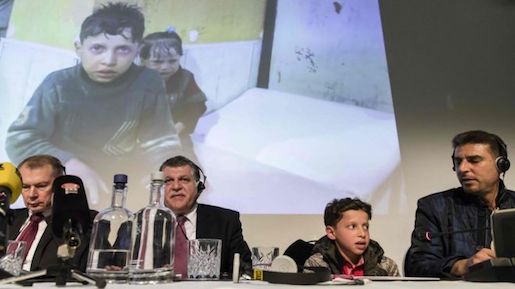
Instead, we are getting yet more revisions to a story that was originally presented as so cut-and-dried that it justified an act of military aggression by the US, UK and France against Syria, without authorisation from the UN Security Council – in short, a war crime of the highest order.
It is worth noting the BBC’s brief account. It has suggested that Diab was there, and that he is the boy shown in the video, but that he was not a victim of a gas attack. It implies that there were two kinds of victims shown in the video taken in Douma: those who were victims of a chemical attack, and those next to them who were victims of dust inhalation.
That requires a great deal of back-peddling on the original narrative.
It is conceivable, I suppose, that there was a chemical attack on that neighbourhood of Douma, in which people like Diab assumed they had been gassed when, in fact, that they had not been, and that others close by were actually gassed. It is also conceivable that the effects of dust inhalation and gassing were so similar that the White Helmets staff mistakenly filmed the “wrong victims”, highlighting those like Diab who had not been gassed. And it is also conceivable, I guess, that Diab and his family now feel the need to lie under Russian pressure about there not being a gas attack, even though their account would, according to this revised narrative, actually accord with their experience of what happened.
But even if each of these scenarios is conceivable on its own, how plausible are they when taken together. Those of us who have preferred to avoid a rush to judgment until there was actual evidence of a chemical weapons attack have been invariably dismissed as “conspiracy theorists”. But who is really proposing the more fanciful conspiracy here: those wanting evidence, or those creating an elaborate series of revisions to maintain the credibility of their original story?
If there is one thing certain in all of this, it is that the video produced as cast-iron evidence of a chemical weapons attack has turned out to be nothing of the sort.
What if Trump dumps the Iran deal?
By M K Bhadrakumar | Indian Punchline | April 28, 2018
The last big European effort to dissuade US President Donald Trump from abandoning the 2015 Iran nuclear pact ended without success Friday with the ‘working visit’ by German Chancellor Angela Merkel to the White House. Earlier in the week, French President Emmanuel Macron also tried his hand. Perhaps, all that remains is a phone call from British PM Theresa May to Trump.
Macron and Merkel met with no success. Macron floated an ingenious idea of linking the Syrian conflict, Iran’s ballistic missile program, Iran’s regional policies and the nuclear deal and negotiating a new package deal. But Trump didn’t sound enthusiastic. He’d rather tear up the Iran deal and move on. Macron estimated finally that Trump would act for “domestic reasons.” Mike Pompeo, the newly appointed secretary of state, also said Friday that the US is unlikely to remain in the deal.
At the joint press conference with Merkel at the White House on Friday, Trump was rhetorical and took a hard line. Merkel, while conceding that the 2015 pact might not have been a perfect deal, flagged that it was a “first step” that significantly slowed down Iran’s nuclear program and left scope for improvement – “one piece of the mosaic, one building block, if you like, on which we can build up this structure.”
Indeed, the remarks by Macron and Merkel vaguely hint at their acceptance that the 2015 pact needs to be re-negotiated. If so, they have caved in to Trump’s bullying. On the other hand, what they said does not reflect the common European Union position. The EU has never discussed the idea of a new Iran deal. The vast majority of EU countries seem perfectly pleased with the implementation of the 2015 deal and see no reason to reopen the agreement that was painstakingly negotiated. Any shift in the EU stance will need unanimity of opinion, which is highly unlikely to favor a re-negotiation of the 2015 deal.
The big question is what Iran’s reaction is likely to be to Trump’s decision to leave the nuclear deal. The Iranian Foreign Minister Mohammad Javad Zarif spoke on this in a conversation with Robin Wright at the New Yorker magazine. This is what Wright wrote:
- Tehran has three broad choices if Trump opts out, according to Zarif. In the first, Iran could withdraw from the deal, terminate compliance, and resume—even increase—its uranium enrichment… “America never should have feared Iran producing a nuclear bomb,” Zarif said. “But we will pursue vigorously our nuclear enrichment.”
- Iran’s second option exploits a dispute mechanism in the deal, which allows any party to file a formal complaint with a commission established to adjudicate violations. Iran has filed eleven complaints—to Federica Mogherini, the E.U.’s foreign-policy chief, who heads the commission—citing U.S. violations on three different counts, Zarif said. The process allows forty-five days for resolution. “The objective of the process is to bring the United States into compliance,” Zarif said.
- Iran’s third option is the most drastic: the country could decide to walk away from the Treaty on the Non-Proliferation of Nuclear Weapons, or N.P.T… In Tehran, debate is still intense about which option Iran should choose. “Iran is not a monolith,” Zarif said.
The growing impression is that the 2015 deal cannot be saved. But then, there is a flip side to it. One, Trump has shown that his strident rhetoric need not necessarily be followed by corresponding action. The North Korean example is in front of us. Two, Washington never really implemented the Iran deal. So, what difference does it make if Trump pulls out?
In the downstream, the US options are very limited. More US sanctions? Well, Iran has lived with US sanctions for four decades. Regime change? Just forget it. Military attack? Simply suicidal. Then, there are the ground realities. Iran is well entrenched in the so-called northern tier of the Middle East (Iraq, Syria and Lebanon) where the Shi’ite predominance is a geopolitical reality. Above all, there are other players in that region also who don’t like the US presence.
Importantly, Russia and China will never cooperate with Trump on the Iran file. The only significant variable, if at all, could be Europe’s implementation of the deal, which is of course crucial for Tehran. This was how Wright concluded: “I asked Zarif if there was a prospect, if the deal dies, that Iran would negotiate again with the United States. “Diplomacy never dies,” he told me. “But it doesn’t mean that there is only one avenue for diplomacy, and that is the United States.” Whatever Iran’s final decision, he said, it “won’t be very pleasant to the United States. That I can say. That’s a consensus.” Read Wright’s piece here.
US family sues Pyongyang for torturing son to death despite lack of evidence
RT | April 27, 2018
The parents of Otto Warmbier have sued North Korea on the day the key peninsular summit, accusing the nation of torturing their son to death. Earlier medical reports said no signs of torture were found during autopsy.
Otto Warmbier was arrested during a tourist trip to North Korea in December 2015 and detained in prison. His health deteriorated while in custody, and he was released home in a coma, before dying days later. Cindy and Fred Warmbier filed a civil suit at Washington District Court on Thursday, alleging that their son was tortured and killed by the North Korean government.
“North Korea, which is a rogue regime, took Otto hostage for its own wrongful ends, and brutally tortured and murdered him,” they said in the suit, which was filed on the same day that North and South Korea held a key diplomatic summit in the demilitarized zone, seeking to defuse tension and pave the way to a peaceful accord.
In the lawsuit, the Warmbiers allege that their son was targeted on the basis of a false accusation in retaliation for the US government’s decision to impose additional sanctions on North Korea, which was announced at the time. They say Otto was forced to make a false confession, over which he was sentenced to a lengthy prison term. The suit alleges that the young man was subjected to torture, which resulted in his ultimate death. It asks for unquantified damages as well as punitive fines.
Last year, a coroner disputed the claims by the Warmbier family that their son was tortured by the North Koreans. The post-mortem report contradicted a claim that the family made in a Fox and Friends interview that “someone had taken a pair of pliers and rearranged his bottom teeth.”
“There was no evidence of trauma to the teeth,” the coroner, Dr Lakshmi Kode Sammarco, told reporters after the interview. “We were surprised at that statement.”
She said the team that did the most-mortem looked hard for any evidence of torture, but could not find anything definitive. The team didn’t do a full autopsy on Otto’s body at the request from the family.
Warmbier’s alleged crime in North Korea was attempting to steal a propaganda banner from a locked room as a trophy. While this may seem as a petty crime for a foreigner, under North Korea’s law it is a serious offense – the same way that insulting the king is in Thailand, for example.
He was one of around a dozen US citizens arrested in North Korea for various crimes. The punishment for others varied a lot, from deportation in the case of Sandra Suh, who was accused of using her status as an aid worker to produce anti-Pyongyang propaganda; to lengthy imprisonment for Pastor Kenneth Bae, who spent over two years behind bars for violating a ban on preaching before being released in 2014. The imprisonment of Canadian Pastor Hyeon Soo Lim for similar activities was even longer, lasting over three years, but he too was released despite being sentenced to life. The record shows that Pyongyang is not in the habit of kidnapping and torturing to death foreign tourists and prefers to release them to score points on the diplomatic front.
Two tweets to break democracy? Incredible claim in House report on ‘Russian meddling’
By Nebojsa Malic | RT | April 28, 2018
Though the House Intelligence Committee report exonerated President Donald Trump of ‘collusion’ with Russia, it still accused Moscow, and RT specifically, of meddling in the 2016 US presidential election.
The report released on Friday says the committee “found no evidence that the Trump campaign colluded, coordinated, or conspired with the Russian government,” but it accepted the US intelligence community’s claims from the January 2017 report that said Russia used ‘active measures’ to meddle in the elections.
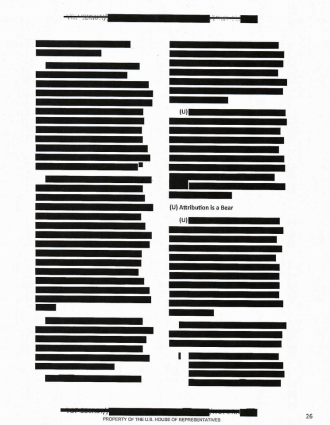 How did that happen? That’s classified. Much of Chapter two, suggestively titled ‘Russia attacks the United States,’ was entirely redacted at the request of the US intelligence community, according to Rep. Mike Conaway (R-Texas). The few tidbits that the public was allowed to see defined spear phishing and credential harvesting and admitted that “attribution is a bear.”
The report then goes full tinfoil hat, claiming that WikiLeaks is a Russian intelligence outlet and accusing RT of serving some dark agenda of the Kremlin. According to the US spy community, RT produces content which appeals to “skeptics of both the mainstream media and the establishment.” Points for honesty on that, Langley, that is literally what “Question More” means.
During the election campaign, the report says (see page 32), RT engaged in “wide-ranging” attacks on Hillary Clinton, “including the insinuation that the Clinton family were criminals,” and “used advertising to promote material leaked by Russian intelligence.” To illustrate this point, the committee offered screenshots of two promoted RT tweets.
You read right. Two tweets. Which, if the screenshots can be trusted, got but a handful of retweets and even fewer replies.
“We spent $30 for two tweets, and those two tweets destroyed their democracy,” RT’s editor-in-chief Margarita Simonyan quipped on Twitter, summarizing the report. “And we criticized both Hillary and Trump, but Hillary more often. And that’s offensive.”
Understandable bewilderment aside, let’s look at the two stories in question. The first one was a five-point listicle about affairs, such as Whitewater, Travelgate, Benghazi and Hillary’s emails – all of which have been reported on by the mainstream US media. In each instance, the Clintons were not charged. Did the headline read a bit like Fox News? Sure. Was it also true? Yes.
The second promoted tweet was on a Sunday before the election, reporting about the 33rd batch of emails from Clinton campaign chair John Podesta’s personal account, which were being released by WikiLeaks. And no, RT did not get advance warning on any of the drops, despite some serious tinfoil-ruffling by various US media and Clinton campaign officials. We just watched out for them very hard, because that’s journalism.
That particular batch of emails contained no bombshells, though. One message accused Chelsea Clinton of using her parents’ foundation funds for her wedding. Another included Hillary’s aide Philippe Reines urging staff not to joke about the private server emails, “because email retention = Benghazi.”
Then there was a 2008 message addressed to Podesta, David Brock of Media Matters and Tom Matzzie of MoveOn.org, saying that Arianna Huffington was “enthusiastic” about Progressive Media USA, but that it would be more useful if HuffPo would “echo our message without any perceived conflicts.”
Yet Congress would have you believe that RT promoting these two stories to the tune of $30 (and getting very little for the money) somehow broke American democracy.
To get away from that sort of heat, ahead of facing the committee in October 2017, Twitter announced that it would “off-board” all RT advertising. The company neglected to mention it was Twitter that pitched an election-related advertising campaign to RT, or that RT declined the offer.
Oops.
Withdrawing US troops from S. Korea may be discussed with allies & North – Mattis
RT | April 28, 2018
The withdrawal of some 28,000 US troops stationed in South Korea may be on the table in future negotiations between the US and North Korea, US Defense Secretary James Mattis said on the heels of a landmark inter-Korean summit.
Asked if US forces will remain in South Korea provided Seoul and Pyongyang replace their 1953 truce with a formal peace treaty, Mattis indicated that the continued US military presence in South Korea may become a part of the bargain with the North.
“Well, that’s part of the issues that we’ll be discussing in the negotiations with our allies first and, of course, with North Korea,” he said, speaking alongside Polish Defense Minister Mariusz Blaszczak at the Pentagon on Friday.
Mattis then appeared to take a step back, saying that “for now, we have to go along with the process… and not try to make preconditions or presumptions about how it’s going to go.”
Responding to the question of whether he trusts North Korea’s assertions of a new-found aim for peace and denuclearization, Mattis noted that “we are optimistic right now that there’s opportunity that we have never enjoyed since 1950 [the beginning of the Korean war],” but added that he doesn’t have “a crystal ball” to foretell where the current rapprochement leads.
The statement comes in the wake of Friday’s historic meeting between North Korea’s leader Kim Jong-un and South Korean President Moon Jae-in, where they signed a declaration reiterating their commitment to the complete denuclearization of the whole peninsula and expressed hope that they can seal a peace accord by the end of the year through multi-party negotiations involving Washington and, possibly, Beijing.
Pyongyang previously indicated that it would only be ready to disarm if its safety is guaranteed and saber-rattling by the US, which has held numerous drills with South Korea at the North Korean border over the years, stops.
While it is the first official acknowledgment by Washington that its large garrison stationed in South Korea may become a concession to Pyongyang, US President Donald Trump reportedly touted the idea during a fundraiser in March. At the time, Trump linked the prospect of the US troops withdrawal to economic issues.
“We have a very big trade deficit with them [South Korea], and we protect them. We lose money on trade, and we lose money on the military. We have right now 32,000 soldiers on the border between North and South Korea. Let’s see what happens,” he said, The Washington Post reported, citing an audio recording of the meeting.
The US president, who is expected to hold his own summit with the North Korean leader in May or June, offered cautious praise of the talks, noting on Twitter that “good things are happening, but only time will tell.”
READ MORE:
Peace breaks out on the Korean peninsula despite – not because of – Washington hawks
Featured Video
It’s the Occupation, Stupid
or go to
Aletho News Archives – Video-Images
From the Archives
A superpower and “the world’s sickest warrior state”
By Paul J. Balles | March 8, 2010
Living through five or six major wars has hardened me to what I thought were the extremes of inhuman cruelty and brutality.
Two things made those extremes almost bearable: the brutality always revealed – at least according to the media coverage – the viciousness of the enemy. It was therefore quite understandable when our “brave men and women” pulverized the enemy.
Films of Japanese torturing captive Americans somehow justified holding Japanese Americans in internment camps during World War II; and only a small percentage of Americans found the bombing of Hiroshima and Nagasaki unreasonably vengeful at best, at worst, depraved.
The media giants in America portrayed the North Koreans as barbaric beasts with their captives, quite unlike their southern counterpoints – our allies during the Korean War. No one ever felt the need to explain how the South Koreans were a civilized breed while the North Koreans were absolute savages, at least according to the official line.
In Vietnam, our warriors justifiably (or so the media made us believe) dropped napalm on the North Vietnamese who had the gall to hide in villages and tunnels to ravage our invaders. At least it was accepted practice until some rogue photojournalist filmed a young girl screaming down a Vietnamese road in flames. … continue
Blog Roll
 Aletho News
- Pro-Palestinian French member of European Parliament denied entry to Canada
- Pakistan to Host US-Iran Talks
- How Indonesia’s tilt toward the US left it stranded in the Strait of Hormuz
- US has no choice but to retreat from Iranian borders: Top commander
- Iran Retaliation Strikes Chemical Plant Near Dimona
- AWACS’ Destruction is a Major Loss for US Military – Ex-DoW Analyst
- Israel’s Iran Strategy Uses US Military & Gulf States as Its Pawns
- Iran: Trump wanted regime change, now just begging for Hormuz to open
- IRGC: Israeli, US universities in region legitimate targets after strikes on Iranian university
- Trump admits Iran hit USS Ford carrier: ‘We ran for our lives’
- If Americans Knew
- Israeli police block Catholic cardinal from entering Church of the Holy Sepulchre on Palm Sunday
- Israel is assassinating journalists again, more than any other nation, anywhere, ever – Not a ceasefire Day 170
- Over 300 US service members wounded, majority have brain injuries – Not a ceasefire Day 169
- Researchers at Human Rights Watch Resign Over Blocked Report on Palestinian Refugee Return
- Jewish Groups Are Backing a War Americans Don’t Want
- Eric Fingerhut Thinks He’s the President of the Jews
- Top Jewish Philanthropists, Rabbis Urge Israeli President to Take Action Against ‘Jewish Extremists’
- Don’t Be Fooled. Zionist Leaders Have Always Wanted to Control Southern Lebanon
- Israel’s widespread use of torture is a core element of its genocide against the Palestinian people
- In Israel’s War on Iran, Many Middle East US Bases Rendered “All But Uninhabitable”
- No Tricks Zone
- German Science Blog Accuses PIK Climate Institute Of Hallucinating Climate Tipping Points
- Devastating Assessment Of Comirnaty Vaccine By Former Senior Pfizer Europe Toxicologist
- New Study: CO2 Is ‘Effectively Negligible’ As An Explanatory Climate Change Factor Since 2000
- Former Pfizer Toxicologist Dr. Helmut Sterz Tells Bundestag Hearing Pfizer Vaccine Should Have Never Been Approved
- Energy Expert: Germany’s Nuclear Phaseout Was A “500 Billion Euro Mistake”
- New Research: South Australia’s Mid-Holocene Sea Surface Temperatures Were 4°C Warmer Than Today
- Storing Green Energy To Last Germany 10 Days Would Require A 60-Million Tonne Battery
- New Studies: UK Sea Levels Were 4 Meters Higher Than Today During The Mid-Holocene
- Destructive Green New Deal: German Energy And Metal Group Warns Of Drastic Crisis
- New Study Documents A 20-Year Pause In Arctic Sea Ice Decline – Driven By Internal Variability
 Aletho News