Israeli forces detain Dean of Student Affairs of Bethlehem University
Ma’an – April 24, 2018
 BETHLEHEM – Israeli army forces on Tuesday detained the Dean of Student Affairs at Bethlehem University, according to a statement from the Palestinian Prisoners’ Society (PPS).
PPS reported that the dean, Mahmoud Hammad, was detained. The circumstances surrounding his detention remain unknown.
The group added in a statement that Israeli forces also detained Muhammad Samer Sirhan, 14, from occupied East Jerusalem.
Israeli search and arrest operations are a near-nightly occurrence in the occupied West Bank and East Jerusalem.
According to UN documentation, between March 27th and April 9th, Israeli forces carried out 159 raids.
Palestinian prisoners rights group Addameer reported that as of March, there were 6,050 Palestinians being held as political prisoners in Israeli jails.
Dear World, The United States Is Just Not That Into You
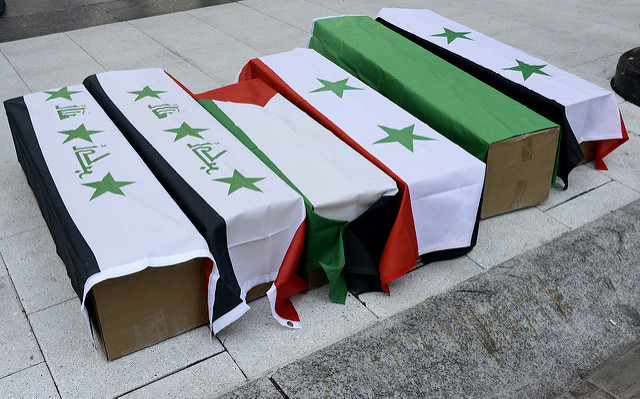
By David Swanson | American Herald Tribune | April 24, 2018
In the United States, politicians talk about the legality of war without ever mentioning that it is illegal, that there are laws that every other nation is supposed to obey. There’s no articulation of a double standard. Other nations are just not mentioned at all.
From outside the United States, the U.S. government looks like an endless war machine. And in fact about 60% of the funding that the U.S. Congress oversees goes to militarism. But it’s hard to find a candidate for U.S. Congress who even admits that the rest of the world exists, has any foreign policy whatsoever, has any list of wars they would end or escalate, has any list of wars they are even aware are happening, or has any basic outline of what they think the federal budget should look like. The “progressive” candidate whom people tell me I should support in my district is no exception. I ask her for her positions and she doesn’t answer. I ask peace “activists” who are campaigning for her rather than trying to end any wars what her foreign policy is, and they have no idea and no interest in knowing.
My kid’s school teaches him that the U.S. Civil War was the deadliest war in U.S. history, exactly as if Filipinos, Vietnamese, Iraqis, and many other people don’t exist at all. When I point out this error, people in the United States generally think it a silly quirk to act as if human beings exist outside U.S. borders. The same war is used as an argument for more wars on the basis of the moronic claim that you cannot end slavery without a war. The fact that other places did so is only relevant to weirdoes who are indulging in the pretense that other places exist.
This is the U.S. attitude toward you, dear world. It’s not hatred or animosity. Its annoyance that you exist and intent pursuit of the ability to act as if you don’t. What does the U.S. public think of your country? The U.S. public cannot find your country on a map, name the continent it is in, or distinguish between it and the names of ingredients in stuff the U.S. public eats. The United States is just not that into you.
Israel, UK engaged in secret arms deals: Report
Press TV – April 24, 2018
A recent report has revealed that the United Kingdom has licensed the sale of arms to Israel worth $445 million since the 2014 war in occupied Palestinian territories.
The Middle East Eye online news service reported on Tuesday that figures compiled by the Campaign Against Arms Trade (CAAT) indicate that the arms included components for drones, combat aircraft and helicopters along with spare parts for sniper rifles.
The report has raised fresh concerns that the weapons made by Britain are being used by the Israeli military in the occupied West Bank, amid fears that components in sniper rifles used to kill scores of Palestinian civilians in recent weeks could have been made in the UK.
New Department for International Trade figures show that Arms export licenses to Israel increased to £216 million or $300 million at current exchange rates, last year from £20 million ($28 million) in the wake of the Gaza war.
They include a major £183 million ($255 million ) license covering “technology for military radars.” Ministers have also approved the sale for export of grenades, bombs, missiles, armored vehicles, assault rifles, small arms ammunition, sniper rifles and components for sniper rifles, arguing that Israel has a right to defend itself from military assault and “terrorist attacks.”
“The appalling scenes we have seen over recent weeks are yet another stark reminder of the repression and abuse that Palestinians are living under every day. The response to protests hasn’t just been heavy handed, it has been a massacre,” Andrew Smith, a spokesman for CAAT said.
“By continuing to arm Israeli forces the UK isn’t just making itself complicit in future attacks, it is sending a message of support for the collective punishment that has been inflicted,” Smith added.
In March another report revealed that the United Kingdom is using secretive licenses to hide the scale of its arms exports to countries with dire human rights records in the Middle East.
Saudi Arabia is by far the largest buyer of UK arms under the opaque open licensing system.
In February, the online news portal revealed an increase of 75 percent in the use of approvals for arms exports, including vital parts for warplanes used in the Saudi aggression on Yemen.
Media suspiciously quiet on US & UK-backed Saudi atrocities in Yemen
By Danielle Ryan | RT | April 24, 2018
On Sunday night, the Saudi-led coalition in Yemen hit a wedding party in Hajja province, killing up to 50 people. Strangely, no one in the Western media is calling for sanctions or regime change in Riyadh.
In fact, it seems they’re not that concerned at all. This is despite the fact that Saudi Arabia has been repeatedly accused of indiscriminate bombing in Yemen during a military campaign which has brought 8 million civilians to the brink of famine.
By early evening on Monday, BBC News was displaying not one, not two, but five stories about the birth of Prince William and Kate Middleton’s new baby boy. At the time of checking, there was no story at all about Yemen featured on the BBC’s front page.
Cynical minds might suspect this is because the British government is party to the slaughter in Yemen through its selling of massive amounts of weapons to the Saudi government. In the BBC’s piece on the attack, hidden seven stories down on the World News page, there was no mention at all of this relationship between London and Riyadh.
The Guardian and the Independent gave more prominence to the Yemen story than the BBC, both displaying reports on the front pages of their websites – but the levels of outrage were seriously muted in comparison with the reaction to alleged attacks on civilians by the Syrian government.
Journalists in the United States seem to be suffering from the same kind of selective outrage. A CNN story on the deaths in Yemen initially did not mention the words ‘Saudi Arabia’ until the seventh paragraph. The story was later updated to include news of the death of top Houthi leader Saleh al-Sammad, while the news about the deaths of up to 50 people at the wedding was knocked down to the fourth paragraph. This strange reluctance to be harsh on Riyadh or to give the Yemen war the prominence it deserves in the media, is clearly an effort to downplay atrocities which won’t play as well in front of a Western audience. It’s harder to play the role of the outraged anchor when you have to explain that the US signed an arms deal worth $110 billion with Saudi Arabia last year – a deal which included $7 billion worth of “precision weapons” from Raytheon and Boeing.
Perhaps if the White Helmets had shown up with a video camera and accusations of chemical weapons use, the story would have gotten more traction. Alas, it appears a gentler kind of bomb was used to kill the civilian victims. Reading the Western reports on Yemen, you get the sense that it is being reported out of duty, only to be buried somewhere and forgotten about the next day.
In a joint communiqué issued following a visit by Saudi Crown Prince Mohammed bin Salman to Britain, the UK government wrote that it welcomed Riyadh’s “continuing commitment” to ensuring that its military campaign in Yemen “is conducted in accordance with international humanitarian law.”
It remains to be seen whether UK Prime Minister Theresa May and the British press corps will issue a tough rebuke to Saudi Arabia following the most recent atrocity. Op-ed pieces about how the Saudi regime ‘must go’ are surely in the works as we speak.
Scarier Than John Bolton?
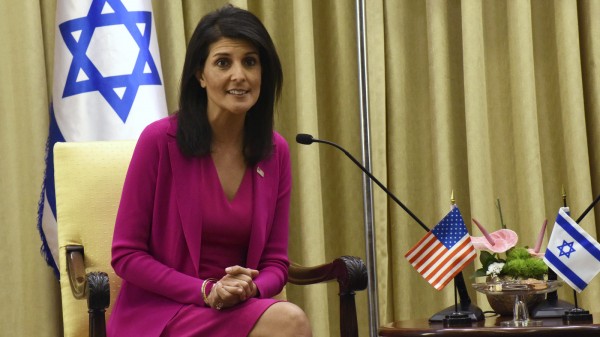
Think of Nikki Haley for President!
By Philip Giraldi • Unz Review • April 24, 2018
The musical chairs playing out among the senior officials that make up the President Donald Trump White House team would be amusing to watch but for the genuine damage that it is doing to the United States. The lack of any coherence in policy means that the State Department now has diplomats that do not believe in diplomacy and environment agency heads that do not believe in protecting the environment. It also means that well-funded and disciplined lobbies and pressure groups are having a field day, befuddling ignorant administrators with their “fact sheets” and successfully promoting policies that benefit no one but themselves.
In the Trumpean world of all-the-time-stupid, there is, however, one individual who stands out for her complete inability to perceive anything beyond threats of unrelenting violence combined with adherence to policies that have already proven to be catastrophic. That person is our own Ambassador to the United Nations Nikki Haley, who surfaced in the news lately after she unilaterally and evidently prematurely announced sanctions on Russia. When the White House suggested that she might have been “confused” she responded that “With all due respect, I don’t get confused.” This ignited a firestorm among the Trump haters, lauding Haley as a strong and self-confident woman for standing up to the White House male bullies while also suggesting that the hapless Administration had not bothered to inform one of its senior diplomats of a policy change. It also produced a flurry of Haley for higher office tweets based on what was described as her “brilliant riposte” to the president.
One over-the-top bit of effusion from a former Haley aide even suggested that her “deft rebuttal” emphasizes her qualities, enthusing that “What distinguishes her from the star-struck sycophants in the White House is that she understands the intersection of strong leadership and public service, where great things happen” and placing her on what is being promoted as the short list of future presidential candidates.
For sure, neocon barking dog Bill Kristol has for years been promoting Haley for president, a sign that something is up as he was previously the one who “discovered” Sarah Palin. Indeed, the similarities between the two women are readily observable. Neither is very cerebral or much given to make any attempt to understand an adversary’s point of view; both are reflexively aggressive and dismissive when dealing with foreigners and domestic critics; both are passionately anti-Russian and pro-Israeli. And Kristol is not alone in his advocacy. Haley regularly receives praise from Senators like South Carolina’s Lindsey Graham and from the Murdoch media as well as in the opinion pages of National Review and The Weekly Standard.
The greater problem right now is that Nikki Haley is America’s face to the international community, even more than the Secretary of State. She has used her bully pulpit to do just that, i.e. bully, and she is ugly America personified, having apparently decided that something called American Exceptionalism gives her license to say and do whatever she wants at the United Nations. In her mind, the United States can do what it wants globally because it has a God-given right to do so, a viewpoint that doesn’t go down well with many countries that believe that they have a legal and moral right to be left alone and remain exempt from America’s all too frequent military interventions.
Nikki Haley sees things differently, however. During her 15 months at the United Nations she has been instrumental in cutting funding for programs that she disapproves of and has repeatedly threatened military action against countries that disagree with U.S. policies. Most recently, in the wake of the U.S. cruise missile attack against Syria, she announced that the action was potentially only the first step. She declared that Washington was “locked and loaded,” prepared to exercise more lethal military options if Syria and its Russian and Iranian supporters did not cease and desist from the use of chemical weapons. Ironically, the cruise missile attack was carried out even though the White House had no clue as to what had actually happened and it now turns out that the entire story, spread by the terrorist groups in Syria and their mouthpieces, has begun to unravel. Will Nikki Haley apologize? I would suspect that if she doesn’t do confusion she doesn’t do apologies either.
Haley, who had no foreign policy experience of any kind prior to assuming office, relies on a gaggle of neoconservative foreign-policy “experts” to help shape her public utterances, which are often not cleared with the State Department, where she is at least nominally employed. Her speechwriter is Jessica Gavora, who is the wife of the leading neoconservative journalist Jonah Goldberg. Unfortunately, being a neocon mouthpiece makes her particularly dangerous as she is holding a position where she can do bad things. She has been shooting from the lip since she assumed office with only minimal vetting by the Trump Administration, and, as in the recent imbroglio over her “confusion,” it is never quite clear whether she is speaking for herself or for the White House.
Haley has her own foreign policy. She has declared that Russia “is not, will not be our friend” and has lately described the Russians as having their hands covered with the blood of Syrian children. From the start of her time at the U.N., Haley has made it clear that she is neoconservatism personified and she has done nothing since to change that impression. In December 2017 she warned the U.N. that she was “taking names” and threatened retaliation against any country that was so “disrespectful” as to dare to vote against Washington’s disastrous recognition of Jerusalem as Israel’s capital, which she also helped to bring about.
As governor of South Carolina, Haley first became identified as an unquestioning supporter of Israel through her signing of a bill punishing supporters of the nonviolent pro-Palestinian Boycott, Divestment and Sanctions (BDS) movement, the first legislation of its kind on a state level. Immediately upon taking office at the United Nations she complained that “nowhere has the U.N.’s failure been more consistent and more outrageous than in its bias against our close ally Israel” and vowed that the “days of Israel bashing are over.” On a recent visit to Israel, she was feted and honored by Israeli Prime Minister Benjamin Netanyahu. She was also greeted by rounds of applause and cheering when she spoke at the annual meeting of the American Israel Public Affairs Committee (AIPAC) in March, saying “When I come to AIPAC I am with friends.”
Nikki Haley’s embrace of Israeli points of view is unrelenting and serves no American interest. If she were a recruited agent of influence for the Israeli Mossad she could not be more cooperative than she apparently is voluntarily. In February 2017, she blocked the appointment of former Palestinian Prime Minister Salam Fayyad to a diplomatic position at the United Nations because he is a Palestinian. In a congressional hearing she was asked about the decision: “Is it this administration’s position that support for Israel and support for the appointment of a well-qualified individual of Palestinian nationality to an appointment at the U.N. are mutually exclusive?” Haley responded yes, that the administration is “supporting Israel” by blocking every Palestinian.
Haley is particularly highly critical of both Syria and Iran, reflecting the Israeli bias. She has repeatedly said that regime change in Damascus is a Trump administration priority, even when the White House was saying something different. She has elaborated on an Administration warning that it had “identified potential preparations for another chemical weapons attack by the Assad regime” by tweeting “… further attacks will be blamed on Assad but also on Russia and Iran who support him killing his own people.”
At various U.N. meetings, though Haley has repeatedly and uncritically complained of institutional bias towards Israel, she has never addressed the issue that Israel’s treatment of the Palestinians might in part be responsible for the criticism leveled against it. Her description of Israel as a “close ally” is hyperbolic and she tends to be oblivious to actual American interests in the region when Israel is involved. She has never challenged the Israeli occupation of the West Bank as well as the recent large expansion of settlements, which are at least nominally opposed by the State Department and White House. Nor has she spoken up about the more recent shooting of three thousand unarmed Gazan demonstrators by Israeli Army sharpshooters, which is a war crime.
Haley’s hardline on Syria reflects the Israeli bias, and her consistent hostility to Russia is a neoconservative position. Earlier, on April 12, 2017 after Russia blocked a draft U.N. resolution intended to condemn the alleged Khan Shaykhun chemical attack, which subsequently turned out to be a false flag, Haley said, “We need to see Russia choose to side with the civilized world over an Assad government that brutally terrorizes its own people.”
Haley sees Iran as the instigator of much of the unrest in the Middle East, again reflecting the Israeli and neocon viewpoints. She claimed on April 20, 2017 during her first session as president of the U.N. Security Council, that Iran and Hezbollah had “conducted terrorist acts” for decades within the Middle East, ignoring the more serious terrorism support engaged in by U.S. regional allies Saudi Arabia and Qatar. She stated in June 2017 that the Security Council’s praise of the Iran Nuclear Agreement honored a state that has engaged in “illicit missile launches,” “support for terrorist groups,” and “arms smuggling,” while “stok[ing] regional conflicts and mak[ing] them harder to solve.” All are perspectives that might easily be challenged.
So, Nikki Haley very much comes across as the neoconservatives’ dream ambassador to the United Nations–full of aggression, a staunch supporter of Israel, and assertive of Washington’s preemptive right to set standards for the rest of the world. And there is every reason to believe that she would nurture the same views if she were to become the neocon dream president. Bearing the flag for American Exceptionalism does not necessarily make her very good for the rest of us, who will have to bear the burdens and risks implicit in her imperial hubris, but, as the neoconservatives never feel compelled to admit that they were wrong, one suspects that Haley’s assertion that she does not do confusion is only the beginning if she succeeds in her apparent quest for the highest office in the land. Worse than John Bolton? Absolutely.
Philip M. Giraldi, Ph.D., is Executive Director of the Council for the National Interest, a 501(c)3 tax deductible educational foundation that seeks a more interests-based U.S. foreign policy in the Middle East. Website is http://www.councilforthenationalinterest.org, address is P.O. Box 2157, Purcellville VA 20134 and its email is inform@cnionline.org.
A Furtive Glance at the US’s Ongoing War Preparations Against Russia
By Arkady SAVITSKY | Strategic Culture Foundation | 24.04.2018
While the world’s attention is riveted on Syria, the US is significantly boosting its forces in Europe. And these are not just divisions streaming in to take part in some exercises that will leave once those are over. This is a serious buildup to create a potentially offensive posture. The beefing up of the US forces is taking place amid preparations for a Russia-US summit. That’s a rather peculiar background for the event, to put it mildly!
The 4th Combat Aviation Brigade and the 4th Infantry Division will deploy to Europe as part of its Operation Atlantic Resolve. Based in Germany, the forces will participate in multiple exercises, most of which will be held very near the Russian border in Poland, Hungary, Romania, and the Baltic States. The Army is considering deploying an entire division in a Reforger type of exercise, with troops coming over to use the pre-positioned hardware. Those forces could potentially see a surge, with a division-level deployment in late 2018 or 2019.
The plans include the creation of a rear-area operations command to be hosted by Germany. Another command is planned that will ensure mobility in the North Atlantic shipping lanes. A “military Schengen” to allow easy movement across borders is under consideration. NATO is rotating four battalion-size, combat-ready, air-power-supported battle groups throughout Poland — which is hosting 800 American troops — and the Baltic States.
In February, the US Army held the largest artillery exercise in Europe since the Cold War. The event was dubbed Dynamic Front 18 and involved seven rocket-launching systems, 94 artillery pieces, including eight German Panzerhaubitze 2000 armored howitzers, 14 British L118 light guns, and 18 US M777 155 mm howitzers.
The US military command is weighing the option of keeping the USS Harry S. Truman carrier strike group in the Mediterranean, the European command’s area of responsibility, instead of deploying it to the Middle East, which is under the control of Central Command. The group left Norfolk on April 11. This move would be intended to “check Russia,” freeing other American naval assets to carry out missions in the Baltic and the Black Sea. Defense Secretary Jim Mattis told the House Armed Services Committee on April 12 that he was studying the possibility of shaking up his department’s employment of carrier groups. The rotational deployments have been increased from the traditional six to ten months. A large number of US ships are concentrated in the vicinity of Syria.
Poland will host Anakonda 2018, the largest ever NATO military exercise, the scale of which is truly exceptional this year. It will involve about 100,000 troops, 5,000 vehicles, 150 aircraft, and 45 warships. The event was much smaller two years ago. The scenario is based on the premise of a surprise attack against Russia. Obviously this huge force will be assembled for offensive, not defensive operations. One hundred thousand troops, just imagine! This is the most flagrant violation of the NATO-Russia Founding Act, signed between NATO and Russia in 1997, which contains a passage about NATO refraining from the “stationing of substantial combat forces.”
Meanwhile, around 3,600 American soldiers have landed in Jordan. They are participating in the two-week US-Jordanian exercise, Eager Lion, which kicked off on April 15. The training event is a drill for AV-8B Harriers, MV-22 Ospreys, and attack helicopters. It follows the US, UK, and French air strikes on Syria. The situation in southern Syria is fraught with conflict, which might easily pull in US and Russian armed forces.
In his remarks about a possible Russia-US summit, Russian Foreign Minister Sergei Lavrov stated that he is confident Russian and American military leaders will prevent an armed conflict. US officials have said many times they are ready to do anything to keep hostilities from erupting. Well, that’s what they say, but actions speak louder than words. Forces are amassing that are poised for attack. The US deployments cannot be seen as anything other than war preparations that are already well underway, and Moscow has to be doubly vigilant.
The two nations’ leaders will have a host of urgent issues to discuss, but moving to tame the heightened tensions would be a step in the right direction. Some things could be done without delay, reviving some existing agreements that have been undeservedly forgotten for instance, such as the 1989 Prevention of Dangerous Military Activities Agreement or the Incidents at Sea (INCSEA) agreement of 1972. The INCSEA stood both parties in good stead, preventing a military clash between the Soviet and US navies during the 1973 Yom Kippur War. It can do so again in the same region.
Provocative military deployments in Europe are hardly the way to create a propitious environment for a summit. Nor do they enhance the security of the United States. But they are taking place, poisoning the atmosphere and creating a big problem.
US struggling to handle excess plutonium
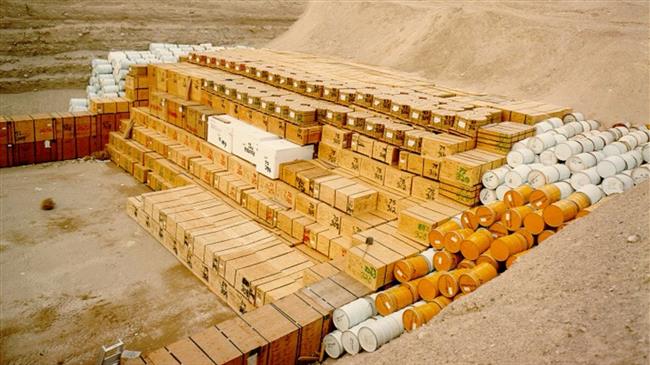
The Nevada Radioactive Waste Dump (File photo)
Press TV – April 24, 2018
The United States is struggling to handle the excessive amounts of plutonium generated at the cores of its many retired nuclear reactors, according to a new report, raising fears that it might end up in the wrong hands.
Today, there are some 54 metric tons of surplus plutonium stored in nuclear facilities the US Department of Energy operates around the country, according to Reuters.
In Pantex, a plant located near Amarillo, Texas, the surplus plutonium has long exceeded the 20,000 cores, also known as “pits,” that regulations allow such facilities to store in their temporary storage facility.
That means a mishap in the process, which is mostly done manually by contract workers, can trigger massive nuclear explosions.
While in the past the US simply used the leftover plutonium to produce more nuclear munitions, it is now obliged under a 2010 treaty with Russia to keep its arsenal under 1,550 warheads.
Moscow and Washington have also agreed in a separate agreement to render unusable for weapons 34 metric tons of plutonium.
This helps the two sides to keep the deadly material out of reach for terrorists and prevent nuclear proliferation. According to experts, terrorists would only need 11 pounds (5 kg) or less plutonium to make a bomb.
According to data by the US Energy Department, collectively the two countries have 68 metric tons of plutonium designated for destruction, enough to make 17,000 nuclear weapons.
US President Donald Trump’s desire to dismantle older warheads and refill them with more lethal nuclear payloads is another factor that has put American nuclear authorities under immense pressure to get rid of the country’s plutonium stockpile and make room for more.
Then there’s the problem of burying the material, a long and complex process that involves digging repositories and making them impenetrable to make sure the plutonium remains out of reach as it slowly passes its radioactive half-life of 24,000 years.
This is while Washington has not even started to take necessary measures to acquire additional space for burying plutonium more than 2,000 feet (610 meters) below ground, the depth considered safe.
“We are in a much more dangerous situation today than we were in the Cold War,” William Potter, director of the James Martin Center for Nonproliferation Studies at the Middlebury Institute of International Studies, told Reuters.
US, EU States Agree on Conditions to Preserve Iranian Nuclear Deal – Reports
Sputnik – 24.04.2018
The United States, Germany, France and the United Kingdom have agreed on the conditions under which Washington will remain committed to the Iran nuclear deal, also known as the Joint Comprehensive Plan of Action (JCPOA), media reported Tuesday.
Under the new agreements, the European and US sides decided that they needed to threaten Iran with new sanctions because of its missile tests and regional policy, but the JCPOA itself would not be altered, according to the Sueddeutsche Zeitung newspaper.
The media also noted citing diplomatic sources that the negotiations had not finished yet.
Trump has repeatedly criticized the JCPOA – negotiated by the previous US President Barack Obama’s administration – as being perhaps the worst deal in US history and threatened to withdraw Washington from the deal if it was not amended.
On July 14, 2015, the European Union, Iran and the P5+1 group of countries — Russia, China, France, the United Kingdom, the United States and Germany — signed the JCPOA to ensure the peaceful nature of Iran’s nuclear program. Under this agreement, Iran pledged to not seek to develop or acquire nuclear weapons in exchange for the lifting of sanctions imposed against Iran.
‘Another Russophobic Campaign’ Adds to UK Government’s New ‘Project Fear’
Sputnik – April 23, 2018
A new cross-party group that reportedly will help defend Britain from Russia set up by UK lawmakers “may lead to a further deterioration” of bilateral relationships between the two countries, the Russian diplomats in London revealed with regret.
In its statement, the Russian embassy in London responded to the creation of the new Russia Coordination Group in the UK Parliament, pointing to its anti-Russian basis.
“Instead of looking for ways to restore the Russo-British relationship or at least keeping channels of communications open, Parliament is letting itself to be drawn into another Russophobic campaign launched by the Conservative government,” the embassy said.
The decision to set up the group was made following the initiative by Tom Tugendhat MP, Chair of the Foreign Affairs Committee. The MPs are meant to coordinate “Committee work relating to the scrutiny of Russian-related activity.”
According to Mr. Tugendhat, it is essential that “we understand the extent of Putin’s activity” and “Parliament is well-placed to do this.”
The initiative adds to the list of statements on Russia by the representatives of the UK government, such as the recent remark by the British Foreign Minister Boris Johnson, who said in a televised statement:
“You have to take every possible precaution, and when you look at what Russia has done, not just in this country, in Salisbury, attacks on TV stations, on the democratic processes, on critical national infrastructure — of course we have to be very, very cautious indeed.”
During a press conference on April 20, Russian ambassador to the UK Alexander Yakovenko said that presenting allegations of cybersecurity threats posed by Russia in the UK publicly and without any proof is “reckless, provocative and unfounded policy.”
“Our bilateral relations have reached a new low after the British government accused Russia of poisoning Sergei and Yulia Skripal. Political contacts have been frozen by the British side. Russia is threatened by a new wave of sanctions. Alleged “Cyber threats from Russia” have again been exploited for political purposes,” the embassy said in response to the establishment of The Russia Co-ordination Group.
The effort by British politicians to keep tabs on Russia and the “growing threat” it poses via the new inter-committee group won’t help changing tense relations between the two nations — quite to the contrary, the embassy added. That is despite many Brits actually opposing the government’s policy on Russia.
Ties between Moscow and Britain have been strained, following the poisoning of the former Russian intelligence officer Sergey Skripal and his daughter Yulia in the English city of Salisbury. London was quick to accuse Moscow of being behind the poisoning with the use of the A234 nerve agent. Russia has refuted all allegations and pointed at the complete lack of evidence provided to support such claims.
See Also:
British Government May Be Preparing Public for Cyberattack on Russia – Ambassador
Palestinians file complaint to UN over Israel violation of anti-racism convention
MEMO | April 23, 2018
Palestinians have filed a complaint to the UN against Israel for numerous violations including breaches of its obligations under international anti-racism treaty.
The move, which is likely to trigger a lengthy and high-profile investigation by world bodies monitoring racism and discrimination, was handed to the UN by the Palestinian ambassador to the international organisation, Ibrahim Khraishi, to the body that monitors the implementation of the UN convention against racism.
In the 350 page document seen by the Guardian, which accuses Israel of establishing an apartheid regime, Palestinians say that Israel is implementing policies that have “the common aim of displacing and replacing the Palestinian people for the purpose of maintaining a colonial occupation”.
Palestinians list a number of Israeli violations in the occupied territories and accuse Israel of seeking to maintain “a Jewish demographic majority in the entirety of historic Palestine”.
“Not only is the purpose of the settlement regime discriminatory in itself, it is further maintained by a system of discriminatory measures, severely depriving Palestinians of their fundamental rights,” the report says.
The complaint sent to the UN is over violations of the 1979 UN Convention on the Elimination of All Forms of Racial Discrimination. Israel has ratified the convention and Palestinians, who were granted UN observer status in 2014, filed the complaint which is believed to be the first interstate complaint filed under the treaty.
The convention is monitored by the Committee on the Elimination of Racial Discrimination, a body of 18 independent experts that is now tasked with assessing the complaint. Israel will now be required to submit written explanations within three months, including any remedies it has taken. The committee could then move to investigate the claims.
According to Ammar Hijazi, from the Palestinian ministry of foreign affairs, the complaint “does not reach the level of a court order.” Hijazi added that the finding that Israel had breached the treaty would oblige other signatories to the convention, which include the US, to “ensure that such practices are not continued”, reported the Guardian.
In their list of complaints Palestinians say that they are severely limited in their freedom of movement compared to Israeli settlers and are subject to “confiscation and seizure” of their land, including home demolitions.
In addition to the violations relating to the right to equal treatment under the law, Palestinians claim that Israel is in breach of article 3 of the convention, which prohibits racial segregation and apartheid. “It is clear that Israel’s acts are part of a widespread and oppressive regime that is institutionalised and systematic; that accords separate and unequal treatment to Palestinians,” the summary says, calling for the dismantling of all existing Israeli settlements.
Featured Video
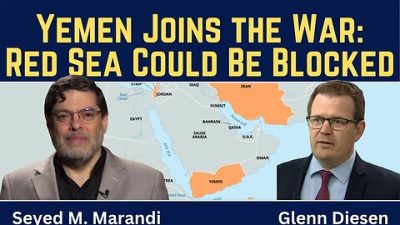
Yemen joins the war – Red Sea could be blocked next – Saudi regime at risk
or go to
Aletho News Archives – Video-Images
From the Archives
A superpower and “the world’s sickest warrior state”
By Paul J. Balles | March 8, 2010
Living through five or six major wars has hardened me to what I thought were the extremes of inhuman cruelty and brutality.
Two things made those extremes almost bearable: the brutality always revealed – at least according to the media coverage – the viciousness of the enemy. It was therefore quite understandable when our “brave men and women” pulverized the enemy.
Films of Japanese torturing captive Americans somehow justified holding Japanese Americans in internment camps during World War II; and only a small percentage of Americans found the bombing of Hiroshima and Nagasaki unreasonably vengeful at best, at worst, depraved.
The media giants in America portrayed the North Koreans as barbaric beasts with their captives, quite unlike their southern counterpoints – our allies during the Korean War. No one ever felt the need to explain how the South Koreans were a civilized breed while the North Koreans were absolute savages, at least according to the official line.
In Vietnam, our warriors justifiably (or so the media made us believe) dropped napalm on the North Vietnamese who had the gall to hide in villages and tunnels to ravage our invaders. At least it was accepted practice until some rogue photojournalist filmed a young girl screaming down a Vietnamese road in flames. … continue
Blog Roll
 Aletho News
- Russian tanker approaches Cuba despite US oil blockade
- Marandi: Yemen joins the war – Red Sea could be blocked next – Saudi regime at risk
- Pro-Palestinian French member of European Parliament denied entry to Canada
- Pakistan to Host US-Iran Talks
- How Indonesia’s tilt toward the US left it stranded in the Strait of Hormuz
- US has no choice but to retreat from Iranian borders: Top commander
- Iran Retaliation Strikes Chemical Plant Near Dimona
- AWACS’ Destruction is a Major Loss for US Military – Ex-DoW Analyst
- Israel’s Iran Strategy Uses US Military & Gulf States as Its Pawns
- Iran: Trump wanted regime change, now just begging for Hormuz to open
- If Americans Knew
- Israeli police block Catholic cardinal from entering Church of the Holy Sepulchre on Palm Sunday
- Israel is assassinating journalists again, more than any other nation, anywhere, ever – Not a ceasefire Day 170
- Over 300 US service members wounded, majority have brain injuries – Not a ceasefire Day 169
- Researchers at Human Rights Watch Resign Over Blocked Report on Palestinian Refugee Return
- Jewish Groups Are Backing a War Americans Don’t Want
- Eric Fingerhut Thinks He’s the President of the Jews
- Top Jewish Philanthropists, Rabbis Urge Israeli President to Take Action Against ‘Jewish Extremists’
- Don’t Be Fooled. Zionist Leaders Have Always Wanted to Control Southern Lebanon
- Israel’s widespread use of torture is a core element of its genocide against the Palestinian people
- In Israel’s War on Iran, Many Middle East US Bases Rendered “All But Uninhabitable”
- No Tricks Zone
- New Study Finds Warming Saves Lives…Cold Temperatures 12 Times More Deadly Than Excess Heat
- German Science Blog Accuses PIK Climate Institute Of Hallucinating Climate Tipping Points
- Devastating Assessment Of Comirnaty Vaccine By Former Senior Pfizer Europe Toxicologist
- New Study: CO2 Is ‘Effectively Negligible’ As An Explanatory Climate Change Factor Since 2000
- Former Pfizer Toxicologist Dr. Helmut Sterz Tells Bundestag Hearing Pfizer Vaccine Should Have Never Been Approved
- Energy Expert: Germany’s Nuclear Phaseout Was A “500 Billion Euro Mistake”
- New Research: South Australia’s Mid-Holocene Sea Surface Temperatures Were 4°C Warmer Than Today
- Storing Green Energy To Last Germany 10 Days Would Require A 60-Million Tonne Battery
- New Studies: UK Sea Levels Were 4 Meters Higher Than Today During The Mid-Holocene
- Destructive Green New Deal: German Energy And Metal Group Warns Of Drastic Crisis
 Aletho News