North Korea raps Israel’s “brutal massacres” in Gaza
Palestine Information Center – May 26, 2018
North Korea has condemned Israel’s use of violence against unarmed Palestinian protesters in Gaza, describing what happened with them as “brutal massacres.”
Kim Yong-nam, head of the Presidium of the Supreme People’s Assembly of North Korea, sent a message of sympathy to Palestinian Authority president Mahmoud Abbas, with the state-run Rodong Sinmun newspaper calling Israel’s actions as a “bloody suppression”.
The newspaper said that Yong-nam in the message expressed deep condolences to the victims and their families.
“He vehemently denounced Israel for its brutal massacres and indiscriminate use of force against peaceful demonstrators demanding their legitimate rights.”
He affirmed North Korea’s unwavering support for and solidarity with the just cause of the Palestinian people and their struggle to build an independent state with east Jerusalem as its capital and obtain their inalienable legitimate rights.
North Korea backs Palestine in its dispute with Israel, an occupying power financed and supported by the US regime.
When North Korea was largely propped up by the Soviet Union during the Cold War, it regularly sent aid and weapons to Palestine.
During the 2014 Gaza War, North Korea also condemned Israel.
The country’s foreign ministry then strongly denounced “Israel’s brutal killings of many defenseless Palestinians through indiscriminate military attacks on peaceable residential areas in Palestine.”
“They are unpardonable crimes against humanity” the ministry said.
Syrian Kurds rally to demand Turkey withdrawal
Press TV – May 26, 2018
Hundreds have demonstrated in Syria’s northeastern city of Qamishli, in response to a call by Kurdish authorities for global protests against Turkey’s military presence in the flashpoint Afrin region.
Turkish forces and allied Syrian militants seized the northwest region of Afrin from Kurdish forces in March, after a two-month military offensive that prompted tens of thousands of people to flee.
Since then, thousands of people displaced from other parts of Syria — notably the Eastern Ghouta suburb of Damascus — have been resettled in the emptied city.
Syria’s Kurds, who have built up their own autonomous administrations in the chaos of the country’s seven-year war, say that amounts to demographic change.
On Saturday, men and women marched through the Kurdish-controlled city of Qamishli to protest Turkey’s military presence.
They waved the yellow, green, and red flag that represents Kurdish part of Syria, as well as signs that read: “No to Turkish occupation.”
Ghassan Juli, a 38-year-old resident of Qamishli, described the Afrin developments as a “disaster.”
“Our people were forced out, and fighters from other areas were brought to live there,” he said.
Her head wrapped in a shawl that matched the Kurdish flag, Bahia Hassan said Afrin’s original residents were afraid to return because of fears of abduction or worse.
“Enough killing, enough kidnapping our boys! Enough killing women and children. We won’t accept this,” said the 45-year-old.
Syria’s Kurds control swathes of the country’s north, and many of those who fled to Afrin escaped into nearby Kurdish-held territory.
Around 135,000 stayed in Afrin, more than a third of them in the urban center that shares the same name, according to the United Nations.
Since war broke out in 2011, half of Syria’s population has been displaced, including more than five million outside the country and another six million internally.
South Korean President Moons Bolton
By Ray McGovern | Consortium News | May 26, 2018
Thanks no doubt to his bellicose national security adviser John Bolton, President Donald Trump has now lost control of the movement toward peace between the two Koreas. Trump has put himself in a corner; he must now either reject — or, better, fire — Bolton, or face the prospect of wide war in the Far East, including the Chinese, with whom a mutual defense treaty with North Korea is still on the books.
The visuals of the surprise meeting late yesterday (local time) between the top leaders of South Korea and North
Korea pretty much tell the story. South Korea’s President Moon Jae-in drove into the North Korean side of the demilitarized zone (DMZ), and Seoul quickly released a one-minute video of what, by all appearances, was an extremely warm encounter with Kim Jung-un. It amounted to a smiling, thumbing of two noses at Bolton and the rest of the “crazies” who follow his advice, such as Vice President Mike Pence who echoed Bolton’s insane evocation of the “Libya model” for North Korea, which caused Pyongyang to go ballistic. Their angry response was the reason Trump cited for cancelling the June 12 summit with Kim.
But Trump almost immediately afterward began to waffle. At their meeting on Friday the two Korean leaders made it clear their main purpose was to make “the successful holding of the North Korea-U.S. Summit” happen. Moon is expected to announce the outcome of his talks with Kim Sunday morning (Korean time).
Why is Trump Waffling?
One cannot rule out the possibility that Secretary of State Mike Pompeo has some cojones beneath his girth. He has a personal, as well as a diplomatic stake in whether or not Bolton succeeds in wrecking the summit. (Trump, after all, deputized Pompeo, while he was still CIA director, to set it up.) It’s also possible some non-crazy advisers are warning Trump about Bolton’s next “March of Folly.” Other advisers may be appealing to Trump’s legendary vanity by dangling the prospect that he may blow his only shot at a Nobel Peace Prize.
The two Korean leaders have made abundantly clear their determination to continue on the path of reconciliation despite the artificial divide created by the U.S. 70 years ago. Now, a lot depends on the unpredictable Trump. If enough people talk sense to him and help him see the dangerous consequences of letting himself be led by Bolton, peace on the Korean peninsula may be within reach.
It is no longer a fantasy to suggest that the DMZ could evaporate just as unexpectedly and quickly as that other artifact of the Cold War did — the Berlin Wall almost four decades ago.
Ray McGovern works with Tell the Word, a publishing arm of the ecumenical Church of the Savior in inner-city Washington, D.C.. A Fordham alumnus, he spent 27 years as a CIA analyst, from the Kennedy administration to the first Bush administration. He holds a certificate in theological studies from Georgetown and is a graduate of Harvard Business School’s Advanced Management Program.
US warns of ‘firm’ response ahead of Syria’s anti-terror operation in Dara’a
Press TV – May 26, 2018
The US has threatened Syria with “firm and appropriate measures” as the Syrian army reportedly prepares to retake a strategic province on the border with Jordan and the Israeli-occupied Golan Heights.
In a statement released on Friday, US State Department spokeswoman Heather Nauert expressed concerns about the upcoming operation in southwestern Dara’a province, claiming that it falls within a de-escalation zone in Syria.
“As a guarantor of this de-escalation area with Russia and Jordan, the United States will take firm and appropriate measures in response to Assad regime violations,” she said.
The warning came two days after the so-called Syrian Observatory for Human Rights (SOHR) reported that the Syrian troops were moving into Dara’a after liberating all remaining militant-held areas near the capital, Damascus.
On Friday, Syrian state-run media reported that government aircraft had dropped leaflets in terrorist-controlled areas of Dara’a, urging foreign-backed militants to disarm.
One of the leaflets declares “the arrival of the Syrian Arab army’s soldiers,” according to SOHR, which is sympathetic to foreign-backed militants.
The UK-based monitor also said the Syrian government had sent reinforcements to Dara’a following the completion of operations near Damascus.
“These forces are now stationed on the edges of Dara’a province,” SOHR head Rami Abdel Rahman said. “The goal is a broad offensive, should the rebels reject a negotiated pullout as was the case in Eastern Ghouta.”
The recapture of Dara’a is highly important because it borders the occupied Golan Heights which Israel has used to treat wounded militants for years.
The territory’s return to the Syrian government control would cut the much-reported collaboration between Israel and militants and deal a blow to Tel Aviv’s plans to annex the Golan Heights.
Syrian army advances are also upsetting to US plans in the Arab country where it has deployed about 2,000 troops to carve out a statelet in the country’s north with the help of Kurdish militants.
With Syria’s military gains gathering momentum, the US has stepped up its attacks on army positions under numerous pretexts.
On Thursday, Syrian state media reported that the US struck Syrian army positions in eastern Syria, but the US military denied knowledge of it.
“Some of our military sites between Albu Kamal and Humeima were exposed at dawn today to aggression launched by US coalition jets,” state news agency SANA reported, citing a military source.
SANA said the strikes came within 24 hours of a Daesh attack on Syrian army positions in the same region, where the Takfiri terrorists are fighting government forces to the west of the Euphrates.
The Syrian army managed to retake the Eastern Ghouta region, on the outskirts of the capital Damascus, late in March.
On Monday, the General Command of the Syrian Army and Armed Forces said complete security had been restored to Damascus and its countryside after al-Hajar al-Aswad district and al-Yarmouk camp were totally purged of Daesh terrorists.
Featured Video
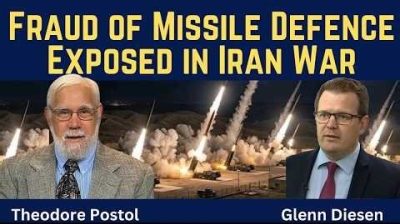
Ted Postol: Fraud of Missile Defence Exposed in Iran War
or go to
Aletho News Archives – Video-Images
Frlom the Archives
Containing the United States
By Edward S. Herman | Z Magazine | September 2016
“Containing the United States” is, of course, a ridiculous and self-contradictory idea in the U.S. and Western ideological and propaganda system. We all know that the United States had to “contain” the Soviet Union from 1945 to 1991, and since then has had the task of containing Russia and China. Only they threaten, bully, aggress and worry countries like Poland and Vietnam. Obama has had to reassure them both of our steadfast stand against Russian and Chinese military attacks. NATO has, of course, expanded greatly over the past several decades, despite the deaths of the Soviet Union and Warsaw Pact, but only to contain the renewed Russian — and Iranian, Libyan, Syrian and other — military threats; and we have “pivoted” to Asia, supported Japanese rearmament, bolstered our own forces in that area and jousted with the Chinese in their coastal waters solely to contain China. Earlier we had been obliged to contain North Vietnam, or was it the Soviet Union in Vietnam? Or China? Or “communism”? Or maybe all of them? Or none of them, but just needing an excuse to enlarge power?
The parallel propaganda has taken many forms. One is accepting as a premise that the United States only acts defensively and has no internal forces and interests that drive it to enlarge its sphere of control. I noted in an earlier article how Paul Krugman claims that internal Russian problems may well be the explanation of Russian “aggression,” but how at the same time it never occurs to him that the huge U.S. transnational corporate interests and “defense” establishment, and the pro-Israel lobby’s activities, might possibly make for an expansionist dynamic here.2 This reflects the standard establishment perspective that we are good and only react to evil. This was the view sustaining and justifying the invasion and occupation of Iraq from 2003. That attack was taken here as not evil but a response to evil, even if involving lies and mistakes, hence not describable as “aggression.” … continue
Blog Roll
 Aletho News
- When Tel Aviv decides, Washington fights
- Top official: Iran ready for a long war with US, no more diplomacy
- How Iran’s Toxic Rain Reveals US-Israel Discord
- Trump Admits He Is Destroying Iran For Israel
- Iran’s latest move in the GCC countries was a stroke of genius
- Blackmail and death threats, Zelensky embarrasses the EU, but there’s no condemnation
- Israel threatens to kill Iran’s new leadership
- Possible Scenarios for the Middle East
- The Horizon of the War. “Italy is being Dragged Into the War against Iran”
- A Second Vietnam War? Hanoi Waits and Prepares
- If Americans Knew
- Corporate Media Go All Out To Support The US-Israeli War On Iran
- US-Israel war on Iran is creating a steady growing number of amputees
- Israel planned this war on Iran for 40 years. Everything else is a smoke screen
- The wrong question about the war in Iran
- ‘Your Tax Dollars Being Used to Raise Your Gas Prices’: US-Israel Bomb Major Iranian Oil Depots
- ‘Bogus Evidence’: Former Nuclear Watchdog Head Debunks US Justification for Iran War
- EXPLAINER – Dimona: What to know about Israel’s nuclear site
- Fires and toxic air in Iran (thanks, Israel) – Not a ceasefire Day 150
- At Israel’s hands, Iran is burning, Lebanon and Gaza are crumbling – Not a ceasefire Day 149
- Israel is using the ‘Gaza doctrine’ in Lebanon and Iran
- No Tricks Zone
- Wake-up Call: Survey Shows Majority Of Germans Now Favor Postponing Climate Targets!
- Televised! Leading German Political Candidate Tells Schoolchildren CO2 Makes Sun Hotter!
- New Study: A Century Warming Of 1.1°C Is ‘Commonplace’ And ‘Not Unusual’ During This Interglacial
- New Study: ‘Internal Noise’ And Volcanic Forcing Can Trigger 10-15°C Warming Within Decades
- Glaciers Worldwide Are Suddendly Surging, Experts Blame Warming!
- Surprising Discovery: Sahara Is Greening…Billions Of Trees Where Once Thought To Be Barren
- New Research Reaffirms Clouds, Aerosols, And Surface Solar Radiation Are ‘Driving The Climate System’
- Germany: Electric Car Catches Fire At Charging Station, Sets Off Local “Inferno”, Widespread Damage
- New Study: Canada’s New Brunswick Was 1°C Warmer Than Today During The Medieval Warm Period
- Coal Power Back In Trend As Globe Tries To Keep Pace With Growing Demand For Power
 Aletho News