US considers further financial cuts to international bodies to silence Palestinians
By Ramona Wadi | MEMO | May 24, 2018
Under US President Donald Trump, international organisations have become targets for repression and vehicles by which Israeli oppression is maintained. Following the financial restrictions it imposed upon the United Nations Relief and Works Agency (UNRWA) last year, Washington has now set its sights on cuts in funding to another three organisations. The move follows the statement by UN Special Coordinator for the Middle East Nickolay Mladenov that Palestine has submitted applications to join the UN Conference on Trade and Development (UNCTAD), the UN Industrial Development Organisation (UNIDO) and the Organisation for the Prohibition of Chemical Weapons (OPCW).
Reports by various media, including Press TV and the Times of Israel, quote an unnamed US official saying that, “It has been the consistent position of the United States that efforts by the Palestinians to join international organisations are premature and counterproductive.” Since Trump’s election, the US-Israeli alliance has shed its veneer of restraint in terms of how much visible support should be flaunted internationally.
Financial dependence aside, it is clear that the US aims to leave Palestine with mere spectator status across the international community. It goes without saying that access to international organisations does not translate automatically into prominence for the Palestinians.
America’s move, therefore, is not only a punitive measure targeting and thus threatening the international organisations but also a means of increasing ways to deter Palestinians from pursuing their options in the international community. Nevertheless, whether or not Palestinians will utilise the international platform is still a contentious issue. Speaking about Palestinian accession to international organisations is still presented mainly from an angle that legitimises Israel’s purported anger, as in the case of the International Criminal Court (ICC). To eclipse Palestinian rights by Israel’s anger is a recipe for oblivion.
The same tactic was used when UNRWA faced an existential threat due to the US decision to slash funding. While UNRWA attempted to illustrate how such a decision would exacerbate the existing limitations on its work in support of Palestinian refugees, it was done from an organisational perspective, shifting the Palestinians in the process to a secondary and less visible position.
If international organisations worked independently of a political agenda, Palestine might have a chance to further its cause and development. UNCTAD has a special unit – the Assistance to the Palestinian People Unit (APPU) — which has the mandate to monitor the socio-economic impact of Israel’s military occupation. However, like other organisations, the Palestine issue is restricted to reports that state the obvious. UNCTAD’s April 2018 report, for example, said that Palestinians have been denied the human right to development; its conclusions and recommendations, like those of other organisations, are based upon legislation that Israel routinely and blatantly ignores.
The past seven decades have provided enough proof of the futility of the international community’s safeguarding of Palestinian rights; it is now ridiculed as the subject of mere rhetoric. It is more likely, therefore, that Trump, in coordination with Israel, is sending a message to Palestinians that their presence on international platforms will be hindered and obscured at all costs. One way to do this is to shift attention from Palestinians onto the organisations that might be affected.
This exposes the static structure of such international organisations which, due to their dependence upon financial aid from oppressive powers, prioritise their existence rather than use their position to safeguard Palestinian rights. If one thing is to be taken from the manipulation of financial aid and international institutions for political purposes, it is how the debate generated will also contribute towards marginalising and silencing Palestinians.
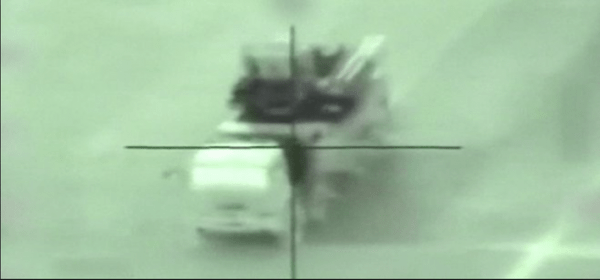
“Skirmishes” – Israel’s Syria Blitz
Media Lens | May 23, 2018
A key ‘mainstream’ media theme in covering the Israeli army’s repeated massacres of unarmed, non-violent Palestinian civilians protesting Israel’s military occupation in Gaza – killing journalists, a paramedic, the elderly and children – has been the description of these crimes as ‘clashes’.
This has been a clear attempt to obfuscate the fact that while two groups of people are involved, only one group is being killed and wounded.
To the casual reader – and many readers do not venture beyond the headlines – a ‘clash’ suggests that both sides are armed, with both suffering casualties. One would not, for example, describe a firing squad as a ‘clash’. There was no ‘clash’ in New York on September 11, 2001, and so on.
Following Israel’s massive blitz on more than 100 targets in Syria on May 10, ‘mainstream’ coverage offered similarly questionable frameworks of understanding.
A Guardian headline read:
Israel retaliates after Iran “fires 20 rockets” at army in occupied Golan Heights (Our emphasis)
For moral, legal and public relations reasons, the issue of which side started a conflict is obviously crucial. If the public recognises that the case for war is unjustified, immoral or illegal – that a country has chosen to launch a war of aggression – they will likely oppose it, sometimes in the millions, as happened in 2002 and 2003 in relation to the Iraq war. It is thus highly significant that the Guardian described Israel as retaliating.
The BBC reported of Israel’s attacks:
They came after 20 rockets were fired at Israeli military positions in the occupied Golan Heights. (Our emphasis)
Reuters took the same line as the Guardian and BBC:
Iran targets Israeli bases across Syrian frontier, Israel pounds Syria
Iranian forces in Syria launched a rocket attack on Israeli forces in the Golan Heights early on Thursday, Israel said, prompting one of the heaviest Israeli barrages in Syria since the conflict there began in 2011. (Our emphasis)
The New York Times also reported:
It was a furious response to what Israel called an Iranian rocket attack launched from Syrian territory just hours earlier. (Our emphasis)
And yet, the report buried a challenge to its own claim that Israel had retaliated in the second half of the piece:
Iran’s rocket attack against Israel came after what appeared to have been an Israeli missile strike against a village in the Syrian Golan Heights late on Wednesday. (Our emphasis)
According to the BBC (see below), the Israeli missile strike had targeted an Iranian drone facility killing several Iranians.
So, actually, it might be said that Iran was retaliating to Israeli attacks – a more reasonable interpretation, given recent history also described by the New York Times:
Israel has conducted scores of strikes on Iran and its allies inside Syria, rarely acknowledging them publicly.
Nevertheless, the corporate media theme has been that Israel retaliated, part of a long-term trend in media coverage. In a 2002 report, Bad News From Israel, The Glasgow University Media Group commented:
On the news, Israeli actions tended to be explained and contextualised – they were often shown as merely “responding” to what had been done to them by Palestinians (in the 2001 samples they were six times as likely to be presented as “retaliating” or in some way responding than were the Palestinians).
Was Iran Skirmishing?
But was Iran even involved at all? The opening, highlighted sentence in a front-page BBC piece by diplomatic editor Jonathan Marcus left the reader in no doubt:
These are the first skirmishes in a potential war between Israel and Iran that promises a fearful level of destruction – even by the standards of the modern Middle East.
So this was a ‘skirmish’, a clash involving Israel and Iran – they were both involved in the combat. And yet, in the second half of the article, Marcus wrote:
The alleged Iranian attack last night – I say alleged because at this stage there is no confirmation from Iranian sources as to the precise authors of the attack – involved a single and relatively short-range system, what appears to have been a multiple-barrelled rocket launcher.
How can the Iranian attack be merely ‘alleged’ half-way down the article but a bald fact in the highlighted opening sentence?
In fact, not only has there been ‘no confirmation’, there has been outright Iranian rejection of the claims. Abolfazl Hassan-Baygi, deputy head of the Iranian parliament’s national security committee, commented:
Iran has nothing to do with the missiles that struck the enemy entity yesterday.
Associated Press (AP ) reported Iranian Foreign Ministry spokesman Bahram Ghasemi commenting that Israel’s attacks were based on ‘fabricated and baseless excuses’, and were a breach of the national sovereignty and territorial integrity of Syria.
AP quoted a senior Lebanese politician and close ally of Syria and Iran, Parliament Speaker Nabih Berri, as saying: ‘this time the Syrian retaliation was in the Israeli-occupied Golan Heights but next time it will be in Israel proper. (Our emphasis)
Later in his BBC piece, Marcus wrote:
The immediate tensions stem from an Israeli air strike on what they claimed was an Iranian drone facility at the so-called T-4 air base, near Palmyra, on 9 April, which reportedly killed several Iranian military advisers.
This again challenged the idea that Israel had ‘retaliated’, but again it was not given the kind of prominence that could challenge Israel’s version of events.
So the ‘skirmishes’ may actually have consisted of Israel first attacking an Iranian drone facility killing Iranian personnel, and then launching a massive attack against Iranian positions across Syria, without Iran responding at all. And yet Marcus wrote:
It is a conflict that needs to be averted and the time to do it is now. However Israel and Iran remain on a collision course.
Despite the uncertainty on whether Iran had attacked, Marcus concluded:
Iran’s strategic intent is clear… it is unlikely to be dissuaded from its efforts.
He added:
Israel has drawn its red lines and it is clearly not going to back down either.
Obama also famously drew his ‘red line’ in Syria in 2012, threatening a massive attack in the event of Syrian government use of chemical weapons. But for Marcus, Israel’s actual launch of a massive attack merely constituted the drawing of ‘red lines’.
And again, ignoring his own doubts about what had happened, the required warmongering ‘balance’ was favoured:
For the immediate future, the pattern of strike, attempted riposte, and counter-strike is likely to continue.
If it had started at all! Marcus concluded his article with three ominous lines identifying another threat alongside the danger of Israel drawing more ‘red lines’ with more massive attacks:
One clear danger is that Iran may seek to exact its revenge outside the Middle East.
Pro-Iranian factions have in the past attacked Israeli tourists abroad or Jewish organisations, notably in Latin America.
A successful terrorist attack of this kind would inevitably alter the picture, pushing Israel and Iran to the brink of a full-scale war.
The word ‘terrorist’ thus made its first appearance in the last line of Marcus’s piece, in reference to a hypothetical Iranian atrocity.
The idea that Israel might already have committed terrorist atrocities in Syria by launching unprovoked attacks, by illegal bombings committed completely outside of international law, is unthinkable.
AUMF 2018 and the “forever war” in the Middle East
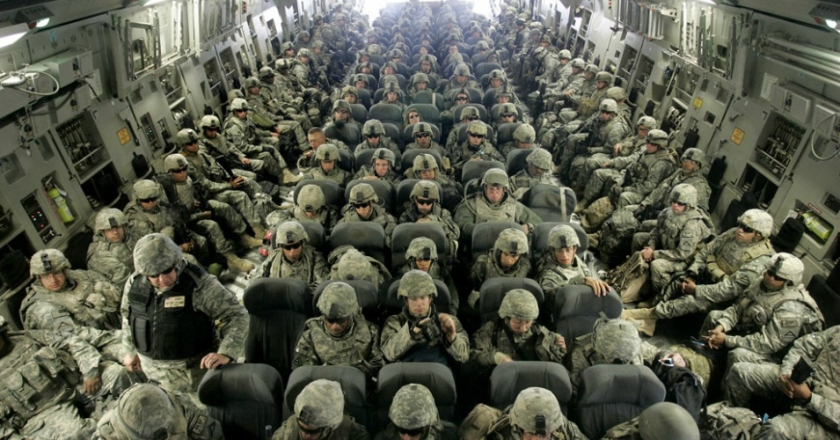
“War is not meant to be won, it is meant to be continuous.”
By Renee Parsons | OffGuardian | May 24, 2018
The Senate Foreign Relations Committee held a hearing on May 16th regarding the authorization of a new Authority for the Use of Military Force 2018 (AUMF). Despite a current lack of unanimity on the committee, the draft authorization (SJ Res 59) has been brought forward as a working document despite the lack of successful back-room negotiations in recent weeks. The hearing was conducted with no quorum present, the lack of which denied the sponsors an easy vote of approval.
The AUMF 2018 would replace AUMF’s 2001 and 2002 which proponents suggest would remove the onerous Constitutional responsibility from a self-proclaimed over-burdened Congress from voting to approve every single separate act of war. While final approval of the AUMF 2018 represents a “Forever Vote,” product of a low vibration consciousness, the ACLU, which should be leading a vigorous national campaign against the proposal, appears absent from the debate.
Approval of a one-size-fits-all AUMF will greatly facilitate the Pentagon’s long held desire to ‘take out’ seven countries in five years – although somewhat behind the original timeline, military conflict is ongoing throughout the Middle East and will allow dramatic escalation in each of those countries without meaningful accountability or Constitutional Congressional oversight.
Since the Congress has already exhibited a penchant for an inability to govern, why have a Foreign Relations Committee at all if their single, most essential Constitutional reason for existence of whether to take the country to war is eliminated?
When the draft AUMF 2018 was introduced by Sen. Bob Corker (R-Tenn) retiring Chair of the Committee in mid-April, he suggested that a strong vote in the Committee would translate into strong support on the Senate floor. After all, even members of the Senate are sensitive to not publicly dismembering their own Constitutional prerogative on a close vote.
Sen. Rand Paul (R-SC) and Sen. Jeff Merkley (D-Or) had both previously announced their opposition to AUMF and both spoke at the hearing against the proposal. Sen. Paul opened with a spirited assault on the AUMF as “flipping the Constitution on its head” eliminating the majority vote in favor of a two-thirds vote required to override Presidential action while allowing the unfettered expansion of war throughout the Middle East.
Since the 2001 AUMF, the status quo has reigned with every President initiating war with the assumption that they had the authority to ‘stretch’ the AUMF to fit current circumstances. Paul argued that by codifying Presidential authority as the 2018 version would do, an opportunity for legal challenges to Presidential authority would be removed. Unrestrained war without the pesky need for Congressional participation is, of course, exactly what the pro-war Republicrats who control the Senate and their MIC benefactors are hoping for. As an example of how a new AUMF might function, Paul said he had not yet figured out ‘why we are chasing a herdsman in Mali?”
Sen. Tim Kaine (D-Va) avid co sponsor of the proposal and HRC’s running mate in 2016, declared that “Congress needs to send a message to our troops, one of them is one of my kids, that the missions they are fighting and dying for, against non-state terrorist groups, has the support of Congress.” Kaine did not explain how codifying the legality of all future undeclared wars will somehow improve the morale of American troops.
One of the two hearing witnesses was Rita Siemion, Adjunct Professor of Law, Human Rights First, George Washington University who provided effective testimony which attracted Kaine to focus his laser on her.
Kaine: Do you support the need for continuing US military action against Taliban, Isis and al Qaeda?
Siemion: I think the use of military force is something that the president should be coming to Congress…
Kaine [interrupts]: Well, can I just say… we are currently engaged in military action against al Qaeda, Isis and the Taliban, do you support need for that action or don’t you?
Siemion: I think that hard questions need to be asked of the administration about what are we achieving by use of military force over the long term….”
Kaine [interrupts again]: So you are not prepared to say today whether you do or do not support the action that our troops are currently engaged in against ISIA, al Qaeda and the Taliban?
Siemion: I think that there are currently real questions that need to be answered about the efficacy of using military force…
Kaine: Let me ask a second question then. I think from your testimony that you would agree, separating this resolution, that the 2001 authorization should be rewritten/or replaced? Do I understand that to be your testimony?
Siemion: I agree that the status quo is incredibly problematic.
Kaine: So then let me be more specific…. do you think it should it be repealed with no replacement or rewritten and then replaced?
Siemion: I think if Congress agrees that use of military force is required and appropriate and it is demonstrated it can be effective for addressing particular terrorist threats, then Congress should authorize military force against those particular groups.
Kaine: I understand that. Obviously if somebody does not think we should be using military force against alQaeda, Isis or the Taliban, then they should vote no on this… they should not vote for an authorization. That’s a good reason to vote no if you do not support the military action that our troops are currently engaged in against al Qaeda, Isis and the Taliban.
In addition to his attempt to make Siemion look unpatriotic, if Kaine’s goal was to intimidate Sen. Merkley who was next to address the panel, he failed.
Merkley focused on legal contradictions and broad interpretations within the AUMF providing the President with a new legal foundation to decide or interpret particular sections that otherwise would be the purview of Congress. Merkley further cited that “the bottom line, what we have before us, codifies the existing situation, gives fresh authority for what has been done since 2001 and I fundamentally believe that delegation was not intended in 2001 and is not appropriate now.” He referred to the Federalist Papers on “how they decided to give that war making power to Congress, that it should not be in the hands of one single person; it is too big an issue, the lives of our soldiers, our sons and daughters, is too big an issue to open that door and I believe they were exactly right. There is a fundamental reason behind that and it is still relevant today.”
At conclusion of the hearing, Sen. Robert Menendez (D-NJ) the committee’s ranking member directly addressed Kaine in that he:
… reject as a false choice that voting against this, when it comes time for that if this is what the final product is, that voting against this proposal is a vote against our troops in the field. No. I reject the proposition that it’s either this or you are not with our troops. That’s ridiculous.”
Kaine replied to:
… clarify and the transcript would show this, I think, that I certainly did not suggest that if you vote against the AUMF, you are against the troops who are currently fighting. I did not suggest that. I did suggest if you are against military action, that is good reason to oppose our proposal. I was engaging in questions of the witness to see if she agreed we should be engaged in military action against these groups. She would not offer an opinion upon that.”
With Secretary of State Pompeo scheduled to testify before Foreign Relations on Thursday, May 24th to clarify the Trump administration’s position on AUMF proposal, a Committee mark up can be expected soon thereafter.
If qui bono is applied here and since the new AUMF would presumably focus on ‘terrorists’ and sovereign nations throughout the Middle East, Israel would appear to be the beneficiary of the dismantling of Congress’ Constitutional obligations. Therefore, it is instructive that fourteen out of twenty one Foreign Relations members were identified by the Center for Responsive Politics on their Top Twenty list of recipients of Pro-Israel PACs or individuals who donated over $200.
- Menendez (D-NJ) 2012/2016: $623,508
- Rubio (R-Fl) 2016: $468,307
- Booker (D-NJ) 2014: $434,126
- Cardin (D-Md) 2012/2018: $415,993
- Portman (R-Oh) 2016: $235,280
- Johnson (R-Wis) 2016: $231,814
- Shaheen (D-NH) 2014: $203,149
- Kaine (D-Va) 2018: $167,878
- Coons (D-De) 2014: $133,300
- Udall (D-NM) 2016: $110,379
- Barasso (R-Wy) 2018: $105,400
- Corker (R-Tenn) 2012: $102,950
- Markey (D-Mass) 2014: $100,450
- Murphy (D-Ct) 2018: $65,221
Either the remaining seven Committee members did not receive sufficient Pro-Israel PAC money to qualify for the Top Twenty list or they received no Pro-Israel PAC money.
Renee Parsons has been a member of the ACLU’s Florida State Board of Directors and president of the ACLU Treasure Coast Chapter. She has been an elected public official in Colorado, an environmental lobbyist for Friends of the Earth and a staff member of the US House of Representatives in Washington DC. She can be found on Twitter @reneedove31
Iran: Morocco’s false claims aim to please third parties
Press TV – May 24, 2018
Iran has hit out at Morocco for accusing Tehran of interference in the African country’s affairs, saying the “false claims” are aimed at pleasing certain third parties.
Morocco has close ties with Saudi Arabia which has accused Iran of meddling in Arab affairs, with Moroccan Foreign Minister Nasser Bourita repeating those claims in a recent interview with Fox News.
“The Moroccan foreign minister knows himself well that the unjust charges he is making are utterly wrong, false and based on delusions and fictions written by those who resort to such provocations only in line with their illegitimate interests,” Iran’s Foreign Ministry spokesman Bahram Qassemi said on Thursday.
Bourita first made the accusations against Iran early this month as he announced Morocco’s decision to sever diplomatic ties with the Islamic Republic over what he called Tehran’s support for the Polisario Front.
The Polisario is a guerrilla movement fighting for independence for the Sahrawi people in Western Sahara which is claimed by Morocco after colonial Spain left the territory.
In his interview with Fox News aired on Wednesday, Bourita claimed that Hezbollah members had met with senior Polisario military leaders recently and that the Iranian embassy in Algeria was used to fund the Polisario.
“The Moroccan authorities’ insistence on repeating their false claims for cutting diplomatic ties with Iran and repeatedly raising baseless allegations against our country is merely a bid to please certain third parties,” Qassemi said.
Bourita also claimed that Iran was in part trying to destabilize the area due to Morocco’s good relations with the US and Europe.
Earlier this month, he had said that Iran and Hezbollah were supporting Polisario by training and arming its fighters, via the Iranian embassy in Algeria.
Algeria, Iran and Hezbollah were all quick to reject the claims as baseless back then.
Iranian Foreign Ministry said there was no cooperation between Tehran’s diplomatic mission in Algiers and the Algeria-backed movement.
Hezbollah also blamed the US, Israel and Saudi Arabia for the diplomatic tensions, saying Rabat had cut ties with Tehran under pressure from the trio.
In turn, Algeria summoned Morocco’s ambassador to protest the “unfounded” claims.
Rabat annexed Western Sahara, a former Spanish colony, in 1975, and has since been in conflict with Polisario, which demands a referendum on self-determination and independence.
The movement, which aims to end Morocco’s presence in the Saharan region, recently said they sought to set up a “capital” in the region, prompting Rabat to caution it would respond with force.
Missile that downed MH17 came from Russian military, unit of origin pinpointed – intl investigators
RT | May 24, 2018
A Dutch-led probe says the missile that hit flight MH17 over Ukraine came from a unit in western Russia. Claims about its Russian origin were made by activist group Bellingcat earlier, but it was seriously questioned back then.
The international team investigating the 2014 tragedy, in which Malaysia Airlines flight MH17 crashed in eastern Ukraine, reiterated the claim that it was a Buk missile, but now claims it also pinpointed the exact unit responsible.
The Dutch-led Joint Investigation Team (JIT) “has come to the conclusion that the BUK-TELAR that shot down MH17 came from 53rd Anti-aircraft Missile Brigade based in Kursk in Russia,” the head of the crime squad of the Dutch National Police, Wilbert Paulissen, told reporters on Thursday.
The findings also claim that the missile carrier came from Russia and was returned to the country. However, the investigators have apparently failed to move any further than British online investigative activist group Bellingcat, which presented their report nearly one year ago and made the same allegations.
“We realize that the investigation collective Bellingcat has already concluded the same and published it,” Paulissen said, noting that his team carried out a separate, “independent” probe.
The conclusions were announced even though the probe is still unfinished and currently in its “last phase,” and there is still much to be done, according to JIT members. Two questions still remain unanswered – who was responsible for shooting down the plane, and why did it happen? Moreover, further evidence to back up the “revelations” is currently not available to the public.
In 2016, the Dutch-led group said it suspected around 100 people could be linked to the alleged transportation of the Buk missile system to eastern Ukraine and the missile launch. Nearly two years of investigation made their role clearer, according to Thursday’s update, but the number of people involved was narrowed down to dozens, Dutch Chief Prosecutor Fred Westerbeke said.
While the latest JIT statement hardly presents anything new, earlier Bellingcat reports were refuted by ‘Anti-Bellingcat’ activists. Russian bloggers, journalists, aviation experts, and volunteers united in a group to highlight significant flaws and inaccuracies in the Bellingcat version of the tragedy.
For example, there is the repeated claim that a Buk missile system was transported through the Russian-Ukrainian border to the place the missile was allegedly fired and then returned. The Bellingcat report used pictures and data from open sources, showing the Buk system on both sides of the border and claiming it was the same. However, the one spotted in Russia was of different modification, the activists noted, pointing out that it contains a “step” on the left side of the system.
The British group’s claims that there were no Ukrainian Buk missile systems in the conflict-zone were also debunked by their Russian peers. They provided various screen shots of Ukrainian media reports picturing the systems belonging to the Ukrainian Army in the same area.
Last month, Russian Foreign Minister Sergey Lavrov stressed that Russia provided uncut radar-location data “that cannot be faked or changed” and “clearly” shows the missile did not come from the direction the investigators claimed. However, all data on the tragedy provided by Moscow was only selectively accepted by the multinational team of investigators, Lavrov said at a joint news conference with his Dutch counterpart, Stef Blok in Moscow.
Former UK Ambassador Craig Murray unconvinced by Yulia Skripal interview: ‘Duress cannot be ruled out’
By Craig Murray | May 24, 2018
I was happy to see Yulia alive and looking reasonably well yesterday, if understandably stressed. Notably, and in sharp contrast to Litvinenko, she leveled no accusations at Russia or anybody else for her poisoning. In Russian she spoke quite naturally. Of the Russian Embassy she said very simply “I am not ready, I do not want their help”. Strangely this is again translated in the Reuters subtitles by the strangulated officialese of “I do not wish to avail myself of their services”, as originally stated in the unnatural Metropolitan Police statement issued on her behalf weeks ago.
“I do not wish to avail myself of their services” is simply not a translation of what she says in Russian and totally misses the “I am not ready” opening phrase of that sentence. My conclusion is that Yulia’s statement was written by a British official and then translated to Russian for her to speak, rather than the other way round. Also that rather than translate what she said in Russian themselves for the subtitles, Reuters have subtitled using a British government script they have been given.
It would of course have been much more convincing had Sergei also been present. Duress cannot be ruled out when he is held by the British authorities. I remain extremely suspicious that, at the very first chance she got in hospital, Yulia managed to get hold of a telephone (we don’t know how, it was not her own and she has not had access to one since) and phone her cousin Viktoria, yet since then the Skripals have made no attempt to contact their family in Russia. That includes no contact to Sergei’s aged mum, Yulia’s grandmother, who Viktoria cares for. Sergei normally calles his mother – who is 89 – regularly. This lack of contact is a worrying sign that the Skripals may be prevented from free communication to the outside world. Yulia’s controlled and scripted performance makes that more rather than less likely.
It is to me particularly concerning that Yulia does not seem to have social media access. The security services have the ability to give her internet risk free through impenetrable VPN. But they appear not to have done that.
We know a little more about the Salisbury attack now:
Nobody – not Porton Down, not the OPCW – has been able to state that the nerve agent found was of Russian manufacture, a fact which the MSM continues to disgracefully fudge with “developed in Russia” phrasing. As is now well known and was reported by Iran in scientific literature, Iran synthesised five novichoks recently. More importantly, the German spying agency BND obtained novichok in the 1990s and it was studied and synthesised in several NATO countries, almost certainly including the UK and USA.
In 1998, chemical formulae for novichok were introduced into the United States NIST National Institute of Standards and Technologies Mass Spectrometry Library database by U.S. Army Edgewood Chemical and Biological Defense Command, but the entry was later deleted. In 2009 Hillary Clinton instructed US diplomats to feign ignorance of novichoks, as revealed by the last paragraph of this Wikileaks released diplomatic cable.
Most telling was the Sky News interview with the head of Porton Down. Interviewer Paul Kelso repeatedly pressed Aitkenhead directly on whether the novichok could have come from Porton Down. Aitkenhead replies “There is no way, anything like that could… leave these four walls. We deal with a number of toxic substances in the work that we do, we’ve got the highest levels of security and controls”. Asked again twice, he each time says the security is so tight “the substance” could not have come from Porton Down. What Aitkenhead does NOT say is “of course it could not have come from here, we have never made it”. Indeed Aitkenhead’s repeated assertion that the security would never have let it out, is tantamount to an admission Porton Down does produce novichok.
If somebody asked you whether the lion that savaged somebody came from your garden, would you reply “Don’t be stupid, I don’t have a lion in my garden” or would you say, repeatedly, “Of course not, I have a very strong lion cage?”. Here you can see Mr Aitkenhead explain repeatedly he has a big lion cage, from 2’25” in.
So the question of where the nerve agent was made remains unresolved. The MSM has continually attempted to lie about this and affirm that all novichok is Russian made. The worst of corporate and state journalism in the UK was exposed when they took the OPCW’s report that it confirmed the findings of Porton Down and presented that as confirming the Johnson/May assertion that it was Russia, whereas the findings of Porton Down were actually – as the Aitkenhead interview stated categorically – that they could not say where it was made.
The other relatively new development is the knowledge that Skripal had not retired but was active for MI6 on gigs briefing overseas intelligence agencies about Russia. This did not increase his threat to Russia, as he told everything he knows a decade ago. But it could provide an element of annoyance that would indeed increase Russian official desire to punish him further.
But the fact he was still very much active has a far greater significance. The government slapped a D(SMA) notice on the identity of Pablo Miller, Skripal’s former MI6 handler who lives close by in Salisbury and who worked for Christopher Steele’s Orbis Intelligence at the time that Orbis produced the extremely unreliable dossier on Trump/Russia. The fact that Skripal had not retired but was still briefing on Russia, to me raises to a near certainty the likelihood that Skripal worked with Miller on the Trump dossier.
I have to say that, as a former Ambassador in the former Soviet Union trained in intelligence analysis and familiar with MI6 intelligence out of Moscow, I agree with every word of this professional dissection of the Orbis Trump dossier by Paul Roderick Gregory, irrespective of Gregory’s politics. In particular this paragraph, which Gregory wrote more than a year before the Salisbury attack, certainly applies to much of the dossier.
I have picked out just a few excerpts from the Orbis report. It was written, in my opinion, not by an ex British intelligence officer but by a Russian trained in the KGB tradition. It is full of names, dates, meetings, quarrels, and events that are hearsay (one an overheard conversation). It is a collection of “this important person” said this to “another important person.” There is no record; no informant is identified by name or by more than a generic title. The report appears to fail the veracity test in the one instance of a purported meeting in which names, dates, and location are provided. Some of the stories are so bizarre (the Rosneft bribe) that they fail the laugh test. Yet, there appears to be a desire on the part of some media and Trump opponents on both sides of the aisle to picture the Orbis report as genuine but unverifiable.
The Russian ex-intelligence officer who we know was in extremely close contact with Orbis at the time the report was written, was Sergei Skripal.
The Orbis report is mince. Skripal knew it was mince and how it was written. Skripal has a history of selling secrets to the highest bidder. The Trump camp has a lot of money. My opinion is that as the Mueller investigation stutters towards ignominious failure, Skripal became a loose end that Orbis/MI6/CIA/Clinton (take your pick) wanted tied off. That seems to me at least as likely as a Russian state assassination. To say Russia is the only possible suspect is nonsense.
The Incompetence Factor
The contradiction between the claim that the nerve agent was so pure it could only be manufactured by a state agent, and yet that it failed because it was administered in an amateur and incompetent fashion, does not bother the mainstream media. Boris Johnson claimed that the UK had evidence that Russia had a ten year programme of stockpiling secret novichok and he had a copy of a Russian assassination manual specifying administration by doorknob. Yet we are asked to believe that the Russians failed to notice that administration by doorknob does not actually work, especially in the rain. How two people both touched the doorknob in closing the door is also unexplained, as is how one policeman became poisoned by the doorknob but numerous others did not.
The explanations by establishment stooges of how this “ten times more powerful than VX” nerve agent only works very slowly, but then very quickly, if it touches the skin, and still does not actually kill you, have struck me as simply desperate. They make May’s ringing claims of a weapon of mass destruction being used on British soil appear somewhat unjustified. Weapon of Upset Tummy does not sound quite so exciting.
To paint a doorknob with something that, if it touches you, can kill you requires great care and much protective gear. That no strangely dressed individual has been identified by the investigation – which seems to be getting nowhere in identifying the culprit – is the key fact here. None of us know who did this. The finger-pointing at Russia by corporate and state interests seeking to stoke the Cold War is disgusting.
Iraqi voters undermine Trump’s Iran strategy
Muqtadar al-Sadr and Hadi al-Amiri, both anti-American, finished first and second in elections held on the day Trump scrapped the Iran nuclear deal
By M.K. Bhadrakumar | Asia Times | May 24, 2018
In an ironic twist, May 12, which was the deadline for US President Donald Trump’s decision on the Iran nuclear deal, also happened to be the day the Iraqi parliamentary elections took place.
Yet no one seemed to take note of the symbolism. In the event, the Iraqi election results seriously hinder Trump’s agenda of rolling back the Iranian presence in the northern tier of the Middle East comprising Iraq, Syria and Lebanon.
Of these three countries, Iraq is arguably the most crucial theatre of contestation between the United States and Iran. The fate of the Iranian presence and Iranian capacity to influence the politics of the entire Shi’ite arc will be critically dependent on its standing and influence in Baghdad. The stakes have never been as high as they are today.
To be sure, the Iraqi election results that were formally announced on Sunday constitute a stunning setback for Trump’s containment strategy against Iran. Washington had bet heavily on the alliance led by Prime Minister Heidar al-Abadi to win, but it has been relegated to third place, winning only 42 seats in the 329-member parliament.
Anti-American tilt
Worse still, two staunchly anti-American alliances – led by Muqtadar al-Sadr and Hadi al-Amiri – secured first and second places respectively.
Coalition making will be a long drawn out process, but what is clear is that the next government in Baghdad will have a pronounced anti-American tilt and the probability is high that it could evict US troops and contractors totaling 100,000 in Iraq.
While Amiri leads the powerful Iran-aligned militia groups known as the Popular Mobilization Force, Sadr’s surge is really bad news for the Americans. Sadr’s Mahdi Army has the blood of hundreds of Americans and Brits on its hands.
In the expert opinion of the Washington-based think tank Brookings Institution: “His (Sadr’s) victory has turned America’s Iraq policy upside down, and Washington now faces a severe political crisis in a country where it has invested substantial blood and treasure … His movement gave rise to many of the Shiite militia groups that committed atrocities against Americans and that today dominate Iraq – as well as the front lines of the war in Syria, where they have fought US forces. These groups have been pivotal to securing the Assad regime’s survival as well as enhancing Iran’s influence in the region.”
In the coming weeks and months, Tehran will play a key role in the negotiations for the formation of the next government in Baghdad. During earlier such moments, Tehran and Washington had tacitly agreed on compromise candidates – prime ministers Abadi and Nouri al-Maliki respectively – but the scope for such accommodation is non-existent today.
Western analysts make much out of Sadr’s nationalistic outlook to give it an anti-Iranian tweak, but that betrays wishful thinking. Sadr is indeed a mercurial personality and tends to lean toward “red Shi’ism” in his outlook on Iraq’s political economy. His alliance partners are communists and secularists.
The Iran-Sadr connection
But significantly, he met Amiri on Monday and said later in a statement: “The process of government formation must be a national decision and importantly, must include the participation of all the winning blocs.”
Again, much has been made out of Sadr’s visit to Saudi Arabia last year and his meeting with Crown Prince Mohammed bin Salman, but in reality, the warming relationship between Baghdad and the Persian Gulf states – Saudi Arabia, the UAE and Qatar – runs only skin deep.
On the other hand, Iranians and Sadr’s family go back a long way. Sadr lived in Tehran in exile for many years. Meanwhile, reports say Tehran is bringing on board the two main Iraqi Kurdish parties – KDP and the PUK – who feel aggrieved that the US connived with Abadi’s crackdown in Kirkuk last October, to align with Amiri.
All in all, Tehran can afford to weigh the pros and cons of many options open to it.
It is entirely conceivable that Tehran might even choose to settle for another government led by Abadi as the figurehead of a staunchly pro-Iranian power structure. Ever since the regime change in Baghdad following the US invasion in 2003, Tehran has made sustained and intense efforts to cultivate wide-ranging political partnerships with Iraqi groups across the religious, ethnic and political spectrum.
It is preposterous to fantasize that Baghdad is about to move out of Iranian orbit.
The bottom line is that a new coalition government in Baghdad over which Iran enjoys political leverage may well set a timetable for the withdrawal of American troops. The Trump administration must prepare for such an eventuality since it has left Tehran in no doubt that continued US military presence in Iraq poses an existential threat of “regime change.” Trust Tehran to pull out all the stops – short of directly targeting US troops – to undermine the American influence in Iraq.
On the other hand, a well-grounded military footing in Iraq is an absolute pre-requisite for the Pentagon to conduct its operations at the present scale in northeastern Syria, given the imponderables in Turkey’s continued cooperation. In these circumstances, it is hard to see how Trump is going to realize his dream to get Iranians to vacate from Iraq or Syria.
Blaming the Victims of Israel’s Gaza Massacre
By Gregory Shupak | FAIR | May 17, 2018
Israel massacred 60 Palestinians on Monday, including seven children, bringing to 101 the total number of Palestinians Israel has killed since Palestinians began the Great March on March 30. In that period, Israel has killed 11 Palestinian children, two journalists, one person on crutches and three persons with disabilities.
Monday’s casualties included 1,861 wounded, bringing total injuries inflicted by Israel to 6,938 people, including 3,615 with live fire. Israel is using bullets designed to expand inside the body, causing maximum, often permanent damage: “The injuries sustained by patients will leave most with serious, long-term physical disabilities,” says Médecins Sans Frontières (Ha’aretz, 4/22/18).
On the 70th anniversary of Israel’s so-called “declaration of independence,” the United States opened its new embassy in Jerusalem—a city Israel claims as its own, despite what international law says on the matter—and Palestinians undertook unarmed protests in reaction to the move and as part of the Great Return March. Although to this point, the only Israeli casualty during the entire cycle of demonstrations has been one “lightly wounded” soldier, considerable space in coverage of the massacres is devoted to blaming Palestinians for their own slaughter.

NBC (5/14/18) mentions “what Palestinians refer to as their ‘right of return’”; actually, it’s what international law calls it, based on the Universal Declaration of Human Rights
Two of the first three paragraphs in an NBC report (5/14/18) provided Israel’s rationalizations for its killing spree. The second sentence in the article says that the Israeli military
accused Hamas of “leading a terrorist operation under the cover of masses of people,” adding that “firebombs and explosive devices” as well as rocks were being thrown towards the barrier.
A Washington Post article (5/14/18) devoted two of its first four sentences to telling readers that Palestinians are responsible for being murdered by Israel. Palestinian “organizers urged demonstrators to burst through the fence, telling them Israeli soldiers were fleeing their positions, even as they were reinforcing them,” read one sentence. “At the barrier, young men threw stones and tried to launch kites carrying flames in hopes of burning crops on the other side,” stated the next one, as though stones and burning kites released by a besieged people is violence remotely equivalent to subjecting people to a military siege and mowing them down.
The New York Times (5/14/18) said that “a mass attempt by Palestinians to cross the border fence separating Israel from Gaza turned violent, as Israeli soldiers responded with rifle fire,” painting Israel’s rampage as a reaction to a Palestinian provocation. Like FAIR (2/21/18) has previously said of the word “retaliation,” “response” functions as a justification of Israeli butchery: To characterize Israeli violence as a “response” is to wrongly imply that Palestinian actions warranted Israel unleashing its firing squads.
A Yahoo headline (5/14/18) described “Violent Protests in Gaza Ahead of US Embassy Inauguration in Jerusalem,” a flatly incorrect description in that it attributes the violence to Palestinian demonstrators rather than to Israel. The BBC (5/15/18) did the same with a segment called “Gaza Braced for Further Violent Protests.”

In Bloomberg‘s account (5/14/18), the fence seemed to be the real victim.
One Bloomberg article (5/14/18) by Saud Abu Ramadan and Amy Teibel had the same problem, referring to “a protest marred by violence,” while another one (5/14/18) attributed only to Ramadan is headlined “Hamas Targets Fence as Gaza Bloodshed Clouds Embassy Move,” as though the fence were Monday’s most tragic casualty. Ascribing this phantom violence to Palestinians provides Israel an alibi: Many readers will likely conclude that Israel’s lethal violence is reasonable if it is cast as a way of coping with “violent protests.”
The second paragraph of the Bloomberg article solely written by Ramadan says that
Gaza protesters, egged on by loudspeakers and transported in buses, streamed to the border, where some threw rocks, burned tires, and flew kites and balloons outfitted with firebombs into Israeli territory.
This author—like the rest in the “Palestinians were asking for it” chorus—failed to note that Israel’s fence runs deep into Palestinian territory and creates a 300-meter “buffer zone” between Palestinians and Israeli forces, which makes it highly unlikely that the kites and balloons of the colonized will have an effect on their drone-operating, rifle-wielding colonizers, let alone on people further afield in Israeli-held territory.
The New York Times editorial board (5/14/18) wrote as though Palestinians are barbarians against whom Israel has no choice but to unleash terror:
Led too long by men who were corrupt or violent or both, the Palestinians have failed and failed again to make their own best efforts toward peace. Even now, Gazans are undermining their own cause by resorting to violence, rather than keeping their protests strictly peaceful.
The board claimed that “Israel has every right to defend its borders, including the boundary with Gaza,” incorrectly suggesting that Palestinians were aggressors rather than on the receiving end of 100 years of settler-colonialism.
Moreover, like the Times and Bloomberg articles discussed above, the editorial attempts to legitimize Israel’s deadly violence by saying that it is defending a border that Palestinians are attempting to breach, but there is no border between Gaza and Israel. There is, as Maureen Murphy of Electronic Intifada (4/6/18) pointed out, “an armistice line between an occupying power and the population living under its military rule” that Palestinians are trying to cross in order to exercise their right to return to their land.

The Washington Post (5/15/18) condemned the “cruel, cynical tactic” of trying to exercise the internationally guaranteed right of return.
A Washington Post editorial (5/15/18) called the Palestinians hunted by Israel “nominal civilians.” Apart from being a logical impossibility (one either is or isn’t a civilian), the phrase illuminates how too much of media think about Palestinians: They are inherently threatening, intrinsically killable, always suspect, never innocent, permanently guilty of existing.
A Business Insider piece (5/14/18) by columnist Daniella Greenbaum described “Palestinian protesters who ramped up their activities along the Gaza strip and, as a result, were targeted by the Israeli army with increasing intensity.” Greenbaum’s use of the phrase “as a result” implies that it was inevitable and perhaps just that Palestinians’ “ramped up activities” led to Israel mowing down a population it occupies, 70 percent of whom are refugees Israel refuses to allow to return to their homes.
Greenbaum then climbs into the intellectual and moral gutter, claiming that
absent from the commentary that children have unfortunately been among the injured and dead are questions about how they ended up at the border. On that question, it is important to recognize and acknowledge the extent to which Palestinians have glorified violence and martyrdom — and the extent to which the terrorist organization Hamas has organized the “protests.”
In her view, dozens of Palestinians died because they are primitive savages who take pleasure in sacrificing their own children, not because Israel maintains the right to gun down refugees in the name of maintaining an ethnostate.
In a rare instance of a resident of Gaza allowed to participate directly in the media conversation, Fadi Abu Shammalah wrote an op-ed for the New York Times (4/27/18) that offered an explanation of why Palestinians are putting their lives on the line to march. Life for the people of Gaza, including for his three young sons, has been “one tragedy after another: waves of mass displacement, life in squalid refugee camps, a captured economy, restricted access to fishing waters, a strangling siege and three wars in the past nine years. ” Recalling the concern for his safety expressed by his seven-year-old child, Shammalah concludes:
If Ali asks me why I’m returning to the Great Return March despite the danger, I will tell him this: I love my life. But more than that, I love you, Karam and Adam. If risking my life means you and your brothers will have a chance to thrive, to have a future with dignity, to live in peace with all your neighbors, in your free country, then this is a risk I must take.
Palestinians have a right to liberate themselves that extends to the right to the use of armed struggle, yet as Shammalah wrote, the Great Return March signifies a “nearly unanimous acceptance of peaceful methods to call for our rights and insist on our humanity.” Nevertheless, based on media coverage, readers could be forgiven for concluding that it was Palestinians, not Israel, who carried out what Doctors Without Borders called “unacceptable and inhuman” violence.
“Al Awda” (The Return) Boarded & Searched by German Coast Guard en route to Kiel
Freedom Flotilla Coalition – May 23, 2018
Just before noon local time, the Freedom Flotilla vessel Al Awda (The Return) was boarded by the German Coast Guard, at the orders of the German Ministry of Interior.
They collected all the passports on board, wrote down everyone’s personal data, searched the vessel thoroughly, asked for detailed information about ports of call along the way to Gaza, and inquired about the whereabouts of the Swedish sailing boats traveling with us in parallel.
The Scandinavian crew on this ship are all veterans of earlier Freedom Flotillas and attested that they have previously been harassed by other Coast Guards from European countries.
Of course, our vessel is in international waters and we are doing nothing illegal – and this is by no means standard procedure.
The massive German Coast Guard ship had been tailing Al Awda all morning, and finally sent a rubber dinghy with a crew of four to check it out.
We are within an hour-and-a-half of Kiel, having arrived early, and are moving slowly so that the sailboats can catch up with us and we can all arrive in unison at Kiel harbour.
Reporting from the high seas off the coast of northern Germany.
Barbarians at the gate? End of democracy? Most hysterical establishment takes on new Italian govt
By Igor Ogorodnev | RT | May 23, 2018
Mainstream political analysts have unleashed their doom-laden predictions about the impact of Italy’s Five Star-Lega coalition, though their hostility is tempered by new-found concern for the “desperate,” misguided electorate.
‘The Weimar Republic’
“It may be too late. The spiral of populism is: unhappy voters; irresponsible promises, bad outcomes; even unhappier voters; still more irresponsible promises; and worse outcomes. The story is not over. It may have just begun,” writes Martin Wolf in the Financial Times.
The FT has been one of the most apprehensive publications since Silvio Berlusconi stepped aside to allow the two upstart parties to form a coalition. An article last week went under the headline “Rome opens gates to modern barbarians” – presumably the majority of the Italian electorate, who voted for the two biggest parties in March – while another FT column on Monday said that the election paved the way “to liberal democracy’s demise,” and invoked the mistakes of the Weimar Republic before the ascent of Adolf Hitler.
For many centrist observers, the two parties are a devilish blend of retrograde baseness and cynical online savvy, a prototype of political activity that won’t just be in charge of Italy until the next election (feasibly just months away), but will somehow poison the well of modern politics.
“These parties are incoherent, angry, unrealistic and often anti-science; they are also clever users of information technology. The Northern League and the Five Star Movement represent every powerful emotion, resentment, suspicion and anxiety that can be mobilized and weaponized by modern political parties. Above all, they reflect the disillusionment with politics — the disillusionment with everything — that inevitably sets in when populism fails,” writes Anne Applebaum in the Washington Post, who connects their rise with supposedly Trump-like failures of Berlusconi’s previous terms.
Applebaum is merely continuing the view expressed by New York Times pundit David Brooks, who suggested back around the time of the election that the decline of established centrist parties will lead to “political groups that are crazier than anything you could have imagined before.”
“Once the norms of acceptable behavior are violated and once the institutions of government are weakened, it is very hard to re-establish them. Instead, you get this cycle of ever more extreme behavior, as politicians compete to be the most radical outsider,” wrote Brooks, notably without asking once why the first-world Italian society would want to be governed en-masse by these supposed lunatics. It would also be curious to detangle the assemblage of loaded terms – what is “acceptable” or “extreme” or “weakened” in Brooks’ understanding?
‘Can’t be trusted to run the country’
As witnessed previously following Brexit and Donald Trump’s election, Italy’s government seems to have turned political analysts, often of a nominally center-left persuasion, into avid market watchers, nay, defenders, with particular concern over the fate of the eurozone (Paul Mason in the New Statesman described the prospect of an EU-Rome stand-off as “bloodcurdling”).
“Brussels is allowed to be concerned, because the populists set to take over the EU’s third-largest economy could rattle the euro zone with irresponsible financial policies,” an opinion piece in Deutsche Welle said. “To bail out an economy as large as Italy’s in a way that is similar to what happened in Greece would be practically impossible.”
“Another reason to beware is the parties’ programmes,” proclaims the Economist, which two sentences earlier said the parties “can’t be trusted” to run Italy. “Their visceral Euroscepticism threatens the integrity of the euro zone. The Five-Star Movement has only recently stepped back from pledging to hold a referendum on leaving the single currency.”
Indeed, why would anyone question, not to mention ask the public, whether the euro has been a success? While a new economic crisis in Europe would have seismic consequences for Italy first of all, this sort of analysis entirely misses the point of the coalition’s manifesto (they were not elected to save the euro!) and turns them, a symptom of the continent’s troubles, into its cause.
The Economist, and other publications, whose offices are located in other countries, have also enjoyed the luxury of lecturing Italy, which has borne the brunt of recent illegal immigration (over 600,000 are still in the country) into Europe on its election of anti-migrant parties.
“The League goes well beyond reasonable concern over refugees, advocating xenophobic and unworkable deportation policies,” on one of the issues where perspective seems to make all the difference – migration was the biggest worry for Italians polled before the vote, and the inability to control it was likely the primary reason for the decimation of the ruling center-left.
Will there be a better time to deploy Game of Thrones parallel?
Of course, other than accusations of fascism, made somewhat difficult by the thoroughly un-Mussolini-like two months of patient coalition-building – it’s hardly been the March on Rome – the other powerful and trump card remains Russia.
“This single-minded dedication to improving ties with Moscow as a panacea for all that ails the world is in line with the close links both parties are known to have cultivated with the Kremlin,” Haaretz insinuates of the new government’s desire to drop sanctions against Moscow.
And undoubtedly, what the Economist calls “excessive Russophilia” is liable to cause deleterious and sinister effects – there is only one step from liking Putin, to actually becoming Putin.
“Populists like Salvini understand that – as Petyr Baelish puts it in Game of Thrones – ‘chaos is a ladder,'” writes Mason in his New Statesman piece. “Salvini is a fan of Putin and Le Pen, and knows that the route to power for authoritarian right-wing nationalists is through the drama of increasingly chaotic situations.”
So to summarize: Italy is on course to destroy the euro, bankrupt itself, but bounce back by turning into a dictatorship, ushering in a new age of authoritarianism across Europe. Not even Italy’s new leaders themselves could conjure up such power fantasies, as they doze off during the fifth hour of a Brussels finance ministers’ meeting.
READ MORE:
Ditching Russia sanctions is part of draft coalition deal with Lega Nord – M5S to RT
Featured Video

No Threat Can Force Iran’s Surrender /Trita Parsi & Lt Cl Daniel Davis
or go to
Aletho News Archives – Video-Images
From the Archives
What is the Israeli Lobby in Australia Doing in Interfaith Dialogue?
By Ali Kazak | Dissident Voice | October 11, 2015
For years Israel and its lobby around the world have been trying to normalise their relations with Arabs and Muslims without solving the Palestine Question.
One of the methods they resorted to in the last few years is using human rights and community organizations such as interfaith dialogue and Multiculturalism to achieve this objective and to: isolate the Palestinians, marginalise the Palestine question, end Israel’s isolation, and prevent criticism of Israel, knowing that these organisations will be the first to stand against Israel’s violations, racial and religious discrimination.
The group responsible for this task in Australia is The Australia/Israel & Jewish Affairs Council (AIJAC); its Director of International & Community Affairs, Jeremy Jones is in charge of lobbying religious community organizations, specifically Muslims and Christians. Consequently he convened the Faith Communities for Reconciliation, founding participant in the Australian Partnership of Religious Organisations and the Australian National Dialogue of Christians, Muslims & Jews.
AIJAC is a private political propaganda group. It is recognised as the main Israeli lobby in Australia. It coordinates its activities and works intimately with the Israeli embassy in Canberra and different institutions in Israel. It is privately funded by some Jewish businessmen. It monitors closely Australian politicians, the media, ethnic and religious groups, (especially Arabs and Muslims), unions and academics on their stands towards Israel and the Palestine question. … continue
Blog Roll
 Aletho News
- Theodore Postol: Iran’s Missiles & Drones Were Underestimated
- Iran To Target Military Industrial-Tech Complex That Facilitated Gaza Genocide
- Collapsing Empire: The Resistance Disarms ‘Israel’
- Suicide Should Not Be a Government Service
- Rethinking America’s greatest threat: Iran vs. Israel-Firsters
- Iran accuses adversaries of false flags to strain Turkey ties
- Poland rules out sending Patriot missiles to US/Israel amid war on Iran
- Tehran approves new Hormuz plan with major restrictions
- No Threat Can Force Iran’s Surrender /Trita Parsi & Lt Cl Daniel Davis
- UK’s New Pandemic Plan Would Turn Big Tech Into a Mass Location Tracking Network
- If Americans Knew
- Ann Coulter Rips Into Fox News for Iran War Coverage, Compares to False Rigged 2020 Election Reporting
- Joe Kent Urges Americans To Call White House and Congress To Object To Sending Troops Into Iran
- DNC Resolution to Reject AIPAC Funding Puts Democratic Leaders in the Hot Seat
- Swedish foundation to build 400 schools as over 650,000 Gaza children remain without education for 2 years
- Israeli army admits photshopping image of slain Lebanese journalist
- This is how Israel is systematically killing health workers under the cover of war in Lebanon
- Carrying life under fire: Israeli invasion of Lebanon leaves pregnant women facing deadly risks
- Champagne all around for the new death penalty (for Palestinians) law – Not a ceasefire Day 172
- Why are Palestinian books struggling to be seen on Amazon?
- The Line Between Affinity and Conspiracy
- No Tricks Zone
- New Study Finds Warming Saves Lives…Cold Temperatures 12 Times More Deadly Than Excess Heat
- German Science Blog Accuses PIK Climate Institute Of Hallucinating Climate Tipping Points
- Devastating Assessment Of Comirnaty Vaccine By Former Senior Pfizer Europe Toxicologist
- New Study: CO2 Is ‘Effectively Negligible’ As An Explanatory Climate Change Factor Since 2000
- Former Pfizer Toxicologist Dr. Helmut Sterz Tells Bundestag Hearing Pfizer Vaccine Should Have Never Been Approved
- Energy Expert: Germany’s Nuclear Phaseout Was A “500 Billion Euro Mistake”
- New Research: South Australia’s Mid-Holocene Sea Surface Temperatures Were 4°C Warmer Than Today
- Storing Green Energy To Last Germany 10 Days Would Require A 60-Million Tonne Battery
- New Studies: UK Sea Levels Were 4 Meters Higher Than Today During The Mid-Holocene
- Destructive Green New Deal: German Energy And Metal Group Warns Of Drastic Crisis
 Aletho News