Pompeo Claims Iran Conducts Assassinations in Europe, Bewilders Experts
Sputnik – 23.05.2018
Speaking on May 21 at the Heritage Foundation in Washington, DC, Pompeo said some pretty strange things in his speech, “A New Iran Strategy.”
“Today, the Iranian Quds Force conducts covert assassination operations in the heart of Europe,” he said nonchalantly, between calling out Iran’s Taliban support in Afghanistan, support for Yemen’s Houthis and the holding of US citizens hostage.
He never elaborated on that passage.
These are some strange accusations, considering that for the last two decades, there have been no assassinations in Europe linked to Tehran in any way. As the Guardian points out, the last people whose violent death was in any way connected to Iran were Shapour Bakhtiar, the former Persian prime minister under the Shah, who was assassinated in France in 1991, and four Iranian Kurdish dissidents who were shot in Berlin the next year.
There was also a bombing of a bus with Israeli tourists in Bulgaria in 2012, but it was Hezbollah, the Lebanese militia, that was blamed for the incident. The former president of Argentina, Cristina Kirchner, was ordered late last year to stand trial for allegedly helping cover up Iran’s alleged role in the 1994 Jewish center bombing that killed 85 people in the country. That connection has never been proven.
What were you talking about, Mr. Pompeo?
As per the Guardian, other journalists were also pretty puzzled by the statements and turned to Heather Nauert, the department’s spokesperson, for comments. That didn’t help.
“He has information and access to information that I do not,” she said during a press briefing on May 22. “I am not able to comment on that in particular but I can tell the secretary has assured me that there is a basis for that point in his speech and he stands firmly behind that.”
US diplomats specializing in Iran were equally surprised by Pompeo’s allegations.
The claim was also questioned by Iraj Mesdaghi, a Sweden-based Iranian political activist who was jailed in Iran for a decade between 1981 and 1991.
“There is no evidence to back the claim that currently they are carrying out such operations in Europe,” he said pointing out that the shooting of Kurdish dissidents in Berlin was never blamed on Quds Force or the Iranian Revolutionary Guards Corps (IRGC) in general.
There was one case worth pointing out, though: last year, Ahmad Mola Nissi, an Iranian dissident, was killed in the Hague. He was a leader of an Iranian separatist group, whose armed wing was responsible for several attacks in Iran.
But, according to the Guardian, the Dutch investigation has not publicly blamed the IRGC. If that is what Pompeo was talking about, then he just disclosed previously classified information.
“There is no public evidence to weigh these claims and European officials have been silent,” says Shashank Joshi, a senior research fellow at the Royal United Services Institute in London.
According to Mesdaghi, Tehran gave up on the idea of assassinating people after a 1997 court case on the Berlin shooting made it clear the EU would not tolerate the practice.
“It would be very unusual for Iran to have carried out his killing, given the relationship they have with Europe now and the fact that Nissi was not influential, nor important enough,” he said.
Russia Says US Demands Unacceptable for Iran, Vows to Help Maintain JCPOA
Al-Manar | May 23, 2018
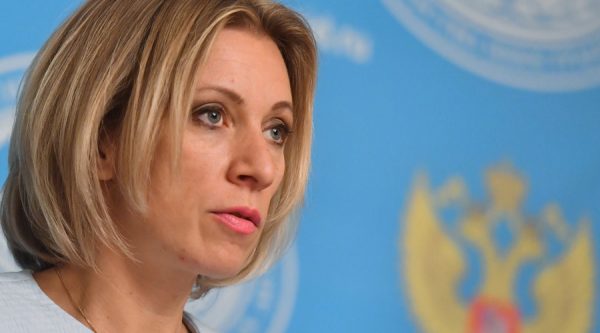
The Russian Foreign Ministry spokeswoman says new US demands from Iran are totally unacceptable, vowing that Moscow will continue to work towards maintaining the Iran nuclear deal, officially known as the Joint Comprehensive Plan of Action (JCPOA).
“We are concerned about the fact that the anti-Iranian campaign is on the rise in Washington. It seems that the United States has made a final decision to use the tactics of ultimatums and threats in respect to Iran. It contradicts the spirit of the JCPOA and does not fall within the normal inter-state relations,” Russian Foreign Ministry spokeswoman Maria Zakharova told a briefing on Wednesday.
“Not only did the US administration withdraw from the agreement in violation of international norms, it is putting forward demands that are a priori unacceptable for Tehran,” she added.
In his first major foreign policy address since moving to the State Department from the CIA, Secretary of State Mike Pompeo said Washington would increase the financial pressure on Iran by imposing the “strongest sanctions in history” on the Islamic Republic if Tehran refused to change the course of its foreign and domestic policy.
Pompeo also outlined 12 US tough demands for Iran, including halting its uranium enrichment and closing its heavy water reactor, for any “new deal” with Tehran.
The Russian spokesperson said that while the US pulled out of the JCPOA, “other participants in the deal are determined to maintain the agreement, adding, “We will continue working to that end. The important thing is that Tehran also abides by its obligations, as confirmed by the IAEA (International Atomic Energy Agency).”
Zakharova said the fate of the Iran deal would be decoded at a new meeting of the Joint Commission monitoring the implementation of the agreement in Vienna on May 25, which will not include the US for the first time.
The Russian official also once again expressed Moscow’s opposition to unilateral sanctions.
BP halts work on gas field over US sanctions on Iran
Press TV – May 23, 2018
British oil company BP says it has halted work on a gas field which it co-owns with National Iranian Oil Company (NIOC) in the North Sea, citing US plans to reimpose sanctions on the Islamic Republic.
NIOC owns 50% of the Rhum field northeast of Aberdeen and BP holds the other half, which it plans to sell to UK-listed producer Serica Energy.
“BP has decided to defer some planned work on the Rhum gas field in the North Sea while we seek clarity on the potential impact on the field of recent US government decisions regarding Iran,” the company said in a statement on Tuesday.
Current operations at Rhum such as provisions of goods, services and support by “certain US persons” are carried out under a US license which is due to expire at the end of September.
Serica said it expected those operations to be affected by US sanctions, “in particular, the new sanctions regime announced by the US government on 8 May.”
The company is looking to secure a waiver from renewed US sanctions against Iran in order for production at the key offshore field to continue, Serica said Tuesday.
It is also working closely with BP and NIOC to evaluate the potential impact of the sanctions on production at Rhum which accounts for around 4% of UK gas output of around 38.1 billion cubic meters.
Rhum was discovered in 1977 by a joint venture between the Iranian Oil Company UK Ltd and BP which has a long history of operation in Iran.
BP started life as the Anglo-Persian Oil Company in 1908 before parting ways with Iran and becoming British Petroleum.
The company shut down Rhum in 2010 even before the West began imposing intensified sanctions on Iran a year later. It resumed production in 2014 after securing an exemption.
The new shutdown is set to further disappoint Iran which has been seeking concrete guarantees on receiving economic benefits of the nuclear deal, only to be given verbal pledges by the European governments instead.
Germany said on Tuesday there was only so much it could do, making it clear that Europe could not entirely shield companies from US sanctions.
“We will help where we can, but there is no way of completely averting the consequences of this unilateral withdrawal,” Economy Minister Peter Altmaier told a newspaper.
His statements were echoed by Luxembourg’s Foreign Minister Jean Asselborn who said there were limits to the European Union’s powers to persuade its larger firms to stay in Iran in the face of threatened US sanctions.
“We know there are hardly any larger companies in Europe that do not also trade with the United States. The pressure on European companies from the US is quite large,” he told reporters in Brussels. “We are in the situation that we’re in.”
OMV committed to Iran project
Nevertheless, Austrian energy group OMV said it has not halted its planned energy projects in Iran.
An Iranian official said earlier this month that OMV, Russia’s Lukoil and China National Petroleum Company (CNPC) had announced interest in the exploration blocks which include both known, highly-potential blocks and new ones.
OMV’s upstream chief Johann Pleininger said on Tuesday the group was monitoring political developments in the United States and the European Union very closely.
“The project has not come to a standstill, it is continuing,” Pleininger was quoted as saying, adding that “no investments have been made yet.”
OMV signed a memorandum of understanding in May 2016 to carry out projects in four blocks in the Zagros sedimentary area.
Pullout of Iranian Forces, Hezbollah Units From Syria Out of Question – Damascus
Sputnik | May 23, 2018
The withdrawal of Iranian forces and units of the Lebanese movement Hezbollah from Syria is not on the discussion agenda, Syrian Deputy Foreign Minister Faisal Mikdad told Sputnik.
“This topic is not even on the agenda of discussion, since it concerns the sovereignty of Syria. We cannot let anyone even raise this issue. Those who ask for something like that — and this is definitely not our Russian friends — are considering the possibility of intervention in all parts of Syria, including the support of terrorists in Syria and elsewhere in the region,” Mikdad said.
According to the Syrian diplomat, Damascus “highly appreciates” the help of friendly forces from Russia and advisers from Iran and Hezbollah in the struggle against terrorists.
The statements by the United States about its intention to withdraw troops from Syria and replace them with Arab forces are aimed at drawing the Arab countries in direct conflict with Damascus, Mikdad said.
“The main goal of such statements is to pump the money out of the Arab countries. This will force them to pay more to the US treasury, which may be empty. As well as drawing the Arab states in direct conflict, as far as I can guess — with the Syrian government, and this is a dangerous situation,” Mikdad said.
According to Mikdad, Washington will ultimately not withdraw its troops.
On Monday, US Secretary of State Michael Pompeo gave a keynote speech on US policy toward Iran, voicing 12 demands for Tehran to fulfill following Washington’s unilateral withdrawal from the Iran nuclear deal, formally known as the Joint Comprehensive Plan of Action (JCPOA).
The commander of the Islamic Revolutionary Guard Corps (IRGC) has slammed the address made by US Secretary of State Mike Pompeo.
Iranian President Hassan Rouhani said that the world cannot accept that Washington makes unilateral decisions for all nations.
On May 8, Trump withdrew the United States from the Iran nuclear deal and Treasury immediately began to reimpose all sanctions against Tehran. The JCPOA — signed by Iran, the P5+1 and the European Union in 2015 — requires that Tehran allow inspections to ensure the peaceful nature of its nuclear program in exchange for sanctions relief.
US-Led Coalition Deliberately Destroyed Oil Wells in Syria
The US-led coalition has been conducting airstrikes in the Arab Republic since 2014 without either a UN mandate or the Syrian government’s consent.
The international coalition led by the United States has deliberately bombed oil wells in Syria, so that the government would not be able to use them, Mikdad said.
“They made it necessary to spend tens of millions of dollars to resume work at these [oil] fields,” Mikdad added.
The US-led coalition, which has been carrying out airstrikes in Syria since 2014 without Damascus’ or UN’s approval, has yet to comment on the statement.
The United States continues its support for terrorists in Syria by financing and supplying them with arms, Faisal Mekdad said.
“I believe that the oxygen for terrorist groups comes from the United States,” Mekdad said.
The Syrian minister noted that Damascus had heard “many times since the start of the crisis in 2011” the US statements on the reduction or termination of its support to the opposition in Syria.
“Meanwhile, [militant] groups are being provided with additional funding and arms,” Mekdad stressed.
According to the minister, after the liberation of Eastern Ghouta and the town of Hajar Aswad from terrorists, the Syrian army discovered large stocks of arms, recently delivered from Western countries and the United States.
“The United States must stop supporting terrorists and respect Syria’s sovereignty and choice of the Syrian people,” the diplomat underlined.
A military-diplomatic source earlier told Sputnik that militants from the Nusra Front terrorist group, banned in Russia, and the Free Syrian Army (FSA) were expanding the controlled territories in southern Syria to create an autonomy under the patronage of the United States. On April 19, Russian Foreign Ministry’s spokeswoman Maria Zakharova said that Moscow also had this information.
The CBS TV channel reported on May 18, citing US President Donald Trump administration officials, that the administration had withdrawn all assistance from northwestern Syria, where anti-Syrian government forces and Turkey are operating. According to the broadcaster, tens of millions of dollars will be cut from previous efforts, backed by the United States, to “strengthen and stabilize the local society.”
Constitutional Commission
Syrian authorities have not finalized a list of candidates for participation in the committee on Syria’s constitution in Geneva, however there are a lot of specialists and experts, who could represent Damascus in the body, Syrian Faisal Mekdad stated.
On Thursday, Russian President Vladimir Putin held talks with his Syrian counterpart Bashar Assad. The Russian leader said that Moscow welcomed and would support the decision of Assad to send his representatives to the Constitutional Commission in Geneva.
“It is too early to speak about [candidates], but there are many people, who are able to represent Syria and the Syrian government in these talks. We have many experts… in this sphere, who could participate in these talks,” Mekdad said.
The diplomat added that the constitutional amendments were the Syrian domestic issue and foreigners should not interfere in this process.
“There are several issues that are needed to be revised and we are ready to reconsider them,” the deputy foreign minister said, adding that it was necessary to understand, which “positive options” could be added to the constitution.
The settlement process for the Syrian conflict, which broke out in 2011, has been discussed on a number of international platforms, such as those in Geneva and Astana and the Syrian National Dialogue Congress in Russia’s Sochi. The main result of the Sochi congress was the creation of the Constitutional Commission that would work in Geneva and focus on amending Syria’s existing constitution.
Anti-semitism: Israel’s get-out-of-jail-free card
By Jonathan Cook | Dissident Voice | May 22, 2018
The silencing of critics of Israel using anti-semitism as the pretext is far from restricted to the current wave of attacks on Jeremy Corbyn and his Labour party. It is now used to intimidate anyone who steps out of line on Israel. Once we raged against the conflation of anti-semitism and anti-Zionism. We have so lost that battle that it is now standard operating procedure for Israel’s apologists to conflate anti-semitism with simple criticisms of the current ultra-nationalist Israeli government.
Here is an illustration of our defeat, reported in the Israeli daily Haaretz. It concerns what would in other circumstances be a fairly standard satirical cartoon: this one published by the German newspaper Süddeutsche Zeitung about Israel winning the Eurovision song contest last week. Israeli prime minister Benjamin Netanyahu is shown on stage dressed as Israel’s winning singer, Netta, and proclaiming “Next year in Jerusalem!”.

After the usual outcry, the cartoonist, Dieter Hanitzsch, was sacked. No Charlie Hebdo-style concerns about free speech on this occasion, it seems.
As has become familiar in these cases, Wolfgang Krach, editor-in-chief of the Süddeutsche Zeitung, seemed unsure himself whether the cartoon was actually anti-semitic. But presumably he thought it better to fire the cartoonist just to be on the safe side. Let’s hope Hanitzsch can take Krach and his newspaper to the cleaners at a labour tribunal.
One critic, Jonas Mueller-Töwe, who sounds like Germany’s version of Jonathan Freedland, has claimed that “a Jewish star” – that would be Israel’s emblem of the Star of David – on a rocket held by Netanyahu suggests that “behind every war, Jewish interests are hiding”. Instead we could simply trust our eyes, which provide a different meaning: that Israel, a highly militarised state, won the Eurovision song contest at the same time as it was devastating Gaza – again – and will now be able to use its hosting of a popular cultural event in Jerusalem next year to whitewash its war crimes.
Before we get too exercised about the significance of every detail, we should remember that political cartoons, by their very nature, need to use symbols as shorthand for more complex ideas. We demand the impossible from a cartoonist if we expect them to offer us political satire while denying them the possibility of using symbols.
So what is anti-semitic about the cartoon? It’s not about Jews, it’s about the Israeli prime minister and his war agenda. And Netanyahu’s purportedly “oversized nose, ears and lips” are surely well within the normal bounds of a caricature. Do we really want to impose a unique demand on cartoonists when dealing with Israel’s leaders of drawing anatomically precise images?
The problem here, as with the anti-semitism “crisis” debate about the Labour party, is that it is totally divorced from any sense of proportion or reality. The question we ought to be asking in a case like this is: what kind of satirical cartoon lambasting Israel could ever satisfy the criteria being demanded by the current anti-semitism watchdogs?
And in consequence, what cartoonist is going to dare to deploy their satirical skills against Israel when the response is invariably going to lead to their being accused of anti-semitism and possibly losing their career and their reputation?
That is precisely what weaponising anti-semitism means. It hands Israel a get-out-of-jail-free card. It intimidates opinion formers – journalists, cartoonists, comedians, politicians, civil society leaders, human rights activists – by making the issue of Israel so toxic that none dare touch it. One need only look to the BBC to see the result: a mix of anaemic fence-sitting and outright censorship when covering Israel.
As Archbishop Desmond Tutu famously reminded us: “If you are neutral in situations of injustice, you have chosen the side of the oppressor.” A submission to those who abuse anti-semitism to make Israel unassailable entails terrifying consequences for the Palestinians. It requires that, after decades of betraying them, we in the west once again turn a blind to their suffering. And, as was highlighted last week in Israel’s slaughter of Gaza’s unarmed protesters, it clears the path to a future in which Israel can and will commit ever graver outrages against the Palestinians.
Ex-Spy Skripal’s Mother Asks UK on Russian TV to Let Her Talk to Son
Sputnik – 22.05.2018
A frail elderly lady who presented herself as the mother of a former Russian intelligence officer, who was allegedly poisoned in England in March, made a public appeal requesting to be allowed to talk to her son.
A 90-year-old woman, who identified herself as the mother of Sergei Skripal, made an appearance on Russian state television, pleading that the British authorities let her speak with her son via phone – something that she effectively still hasn’t been allowed to do.
“I haven’t seen my son for 14 years. I want to meet him, to hug my son tightly. I’m ninety years old, I pose no threat to anyone. Please, let me make at least one phone call to my son,” she said.
The woman added that she simply couldn’t comprehend why her son wasn’t allowed to contact her.
“Why won’t they let him call me? Why? For what reason? When he was at home, we talked with each other [by phone] every week, but now we can’t for some reason. Please, grant him permission so that he and I could talk.”
She also asked the British authorities to allow Viktoria Skripal, Sergei’s niece, to visit him.
“I cry every day as I wait for a message from my son,” the elderly lady said, sobbing.
Despite the claim, there have been no official comments from the UK authorities or media reports confirming that Skripal’s mother previously asked London to talk with her son on the phone.
On May 18 the British National Health Service announced that Sergei Skripal has been discharged from Salisbury District Hospital.
The exact whereabouts and the fate of Sergei and Yulia, who were released from hospital on April 11, are currently unknown.
Sergei Skripal, a former Russian intelligence officer currently living in Britain, and his daughter Yulia were allegedly poisoned in Salisbury on March 4.
A week later, London blamed Moscow for the attack, which the British authorities claimed was carried out using a military-grade nerve agent called A-234 Novichok.
Moscow denied the allegations and proposed a joint investigation, which the UK refused.
Egypt demolished 3,600 Sinai buildings in three months: Report
MEMO | May 22, 2018
The Egyptian army has “vastly expanded” the destruction of homes, commercial buildings and farms in Egypt’s North Sinai region since 9 February 2018, a report by Human Rights Watch (HRW) said today.
Since 2014 the Egyptian government has pursued plans to create a buffer zone along its border with Gaza on the pretext that fighters and weapons are being smuggled through the tunnels that connect the peninsula to the Strip.
Activists have said this war on terror is better described as a war on civilians. Between July 2013 and August 2015 the Egyptian Army demolished at least 3,250 buildings to this effect, according to HRW.
In late 2017 authorities resumed demolitions with the view to creating another buffer zone around Al-Arish airport following a missile attack on an air base and military helicopter. On 9 February 2018 the Egyptian military intensified this military campaign with the launch of “Operation Sinai” which they said would rid the region of terrorism once and for all.
Under this operation demolitions have escalated. By analysing a time series of satellite imagery HRW has revealed that the military destroyed at least 3,ooo homes – the largest number since the 2014 campaign began – in just two months. Homes of alleged terrorists, activists and their relatives in North Sinai’s largest city Al-Arish have also been set on fire and then demolished.
There has been no judicial oversight of the demolitions and the government has cut electricity and water of the houses they are evicting to force people to leave.
According to the report residents were given between 24-48 hours warning to evict, no assistance for moving to temporary housing, no process to appeal compensation decisions or for destruction of or damage to farmland.
Middle East Director at HRW Sarah Leah Whitson said: “Turning people’s homes into rubble is part of the same self-defeating security plan that has restricted food and movement to inflict pain on Sinai residents.”
The Egyptian army claims it is protecting people from militants, but it’s absurd to think that destroying homes and displacing lifelong residents would make them safer.
The demolitions and forced evictions have exacerbated an already dire humanitarian situation in North Sinai, according to HRW, which has calculated that 420,000 residents in North Sinai have been in urgent need of humanitarian assistance since “Operation Sinai” began. With the destruction of farms entire extended families have lost their livelihoods.
Because it is illegal to enter Sinai without a permit, the lack of journalists and human rights workers there means there is an information blackout on the atrocities committed.
Israeli Parliament Reportedly Considers Promoting Kurdish State
Sputnik – May 22, 2018
 Israeli MPs have reportedly discussed a bill that outlines the means by which Israel may help Kurds build their state in Syria, Iraq and Turkey, which would support Tel Aviv. According to one of Israel’s radio stations, the bill had been submitted to the Knesset by two Israeli right-wing parties, namely Likud and Yisrael Beiteinu. The radio quoted Yoav Kish as saying that given the Kurdish minority living in the aforementioned countries, which are generally hostile to Israel, the proposed move would play into the hands of the Israeli state.
“There is a reason that Israel was the first to publicly congratulate moves toward Kurdish independence in northern Iraq,” Kish added.
Back in 2017, Israel became the only country to support the Kurdish plebiscite which endorsed the Kurds’ secession from Iraq – a development that was vigorously criticized around the world.
Back then, Israeli Prime Minister Benjamin Netanyahu claimed that Tel Aviv backed what he called “legitimate efforts of the Kurdish people to attain a state of its own.” Alongside political backing, Israel was reportedly a major buyer of Kurdistan’s oil and the top investor in the region in 2017.
The Iraqi Kurdistan independence referendum that took place on September 25 triggered changes in the region. More than 90 percent of the voters who took part in the plebiscite backed the independence from Baghdad. Iraqi authorities declared the referendum illegal, while Turkey and Iran vehemently criticized the plebiscite and threatened to impose tough sanctions on Iraqi Kurdistan’s capital Erbil.
Read more:
Tensions Rising Between Syrian Army, Kurds Amid Creation of US Bases – Reports
A New Flotilla Steams Towards Gaza
By Elizabeth Murray | Consortium News | May 22, 2018
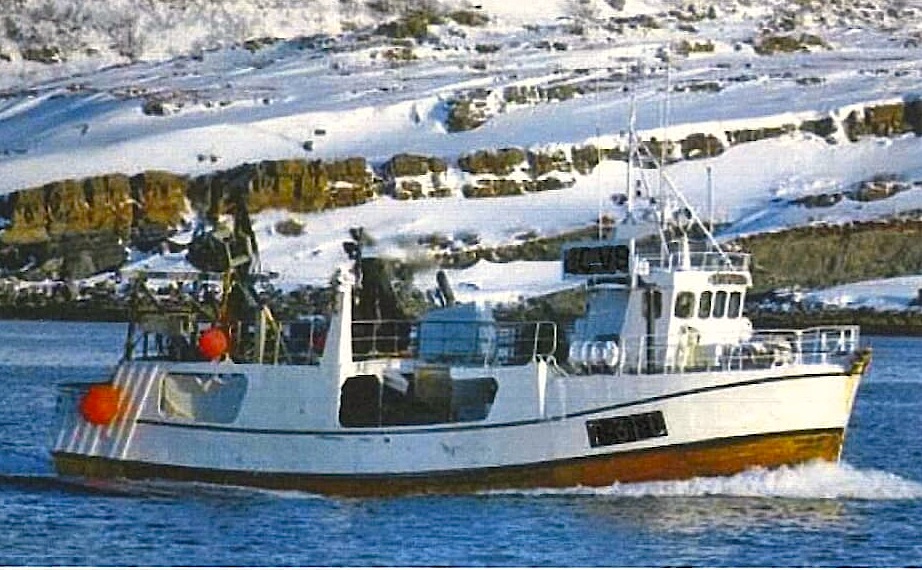
Al Awda (The Return): Sailing to Gaza
“Islands Bruegge,” an idyllic harbor park that stretches along the east bank of Copenhagen, was alive with a celebratory crowd on Monday as three ships were about to steam towards Gaza. The 2018 Freedom Flotilla—two ships from Sweden and one from Norway — will call at ports in Germany, Holland, Belgium, France, Spain, Portugal and Italy before traveling through the Mediterranean Sea to its final destination: Gaza harbor.
Volunteer boat guides explained the history and mission of the Gaza Flotilla movement, which has organized a number of journeys to demonstrate solidarity with the people of Gaza and break the illegal economic siege. An independent U.N. panel and the International Committee of the Red Cross (ICRC) say the blockade violates the Geneva Conventions and is illegal.
Israel dragged the last Israeli settlers from Gaza and withdrew the Israeli Defense Force in 2005. When the Palestinian Authority lost a 2006 election in Gaza to Hamas, Israel imposed the illegal blockade. A considerable number of young Danish people learned about Gaza for the first time and walked away with new political awareness of the injustices suffered by Gaza’s children, who are denied the same carefree life enjoyed by Danish children.
I feel proud and privileged to join a group of international passengers aboard the Norwegian ship “Al Awda,” (“The Return” in Arabic) as we prepared to embark on the first leg of our journey. Along our route we hope to raise awareness and educate people about the plight of Palestinians, especially in Gaza, who are denied the basic freedoms and human rights the rest of us take for granted.
Earlier this month as Gazans held The Great March of Return to commemorate the 70th anniversary of the Nakba (or the Catastrophe) — in which 800,000 Palestinians were forcibly driven from their land and homes by Israel in 1948 — Israeli snipers cut down peaceful demonstrators one by one, killing hundreds and maiming thousands, generating shock and outrage around the world and providing further incentive for people to support the burgeoning Boycott, Divestment and Sanctions movement (BDS).
Targeting Athletes
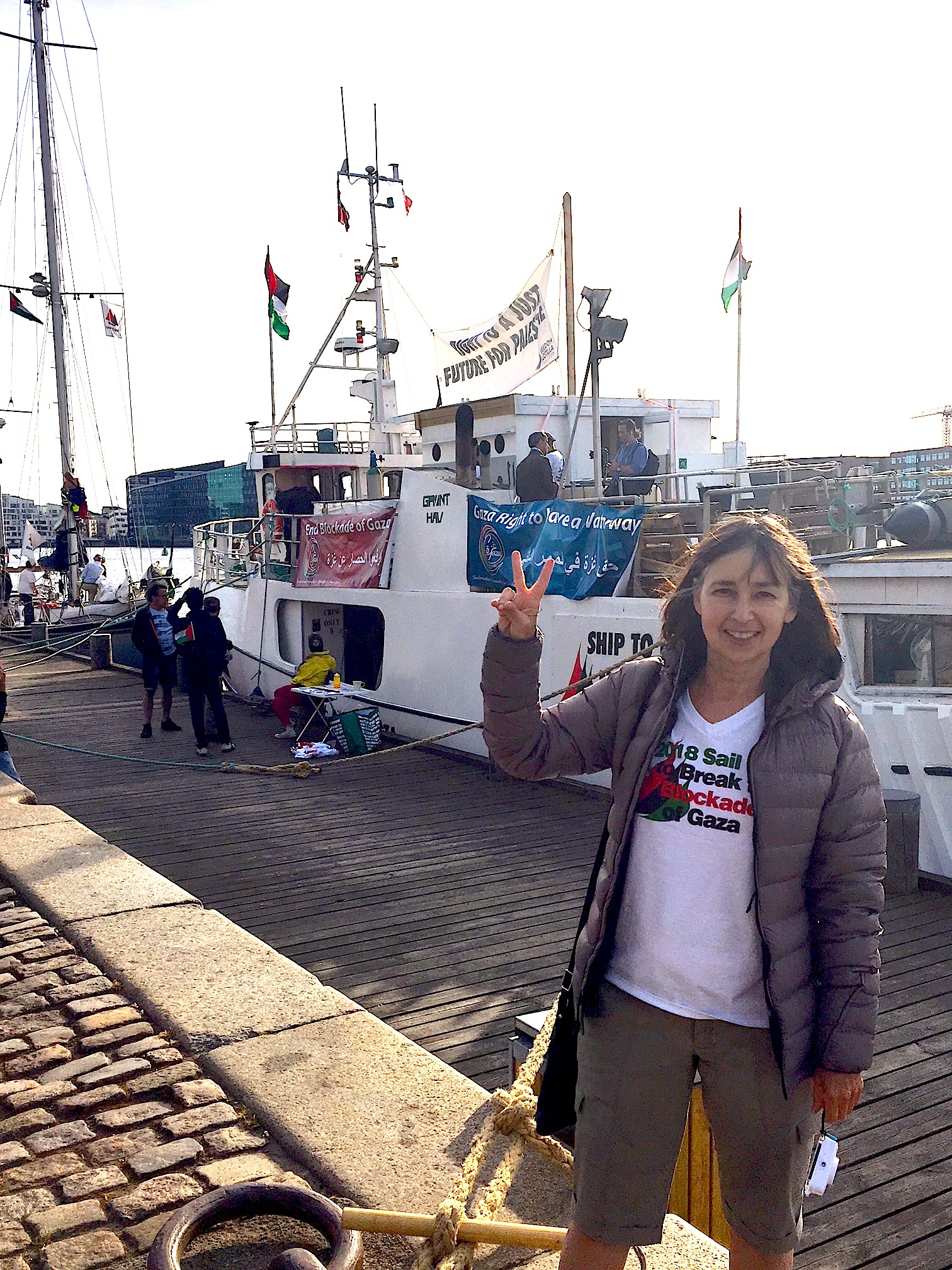
Elizabeth Murray: Boarding her boat to Gaza
Israel seems to have reserved a special brand of sadism for Gaza’s athletes — several promising young cyclists and soccer players have become amputees, since Israel refused to allow them to leave Gaza to obtain the necessary medical attention that would have saved their legs. Reports of such heinous acts — documented widely in social media posts by those on the ground in Gaza — have served to further isolate Israel internationally and alienate peace-loving people around the world, who deplore the moral depravity of its government.
Reaching the harbor of Gaza (which means “jewel” in Arabic) should be as simple and straightforward as entering any harbor in Germany, France or Spain. But instead, Israel has denied Gazans use of their own harbor for commerce, trade and travel, and has bombed it on numerous occasions, along with their electric power plants and sewage systems, making life miserable for the local population and rendering 97 percent of the drinking water toxic.
As the Freedom Flotilla embarks on its peace odyssey, it is our hope to bring a light of hope and solidarity to the people of Gaza, who deserve the peaceful, dignified and joyful existence that is their right.
Elizabeth Murray served as Deputy National Intelligence Officer for the Near East in the National Intelligence Council before retiring after a 27-year career in the U.S. government, where she specialized in Middle Eastern political and media analysis. She is a member of Veteran Intelligence Professionals for Sanity (VIPS).
Featured Video
No Threat Can Force Iran’s Surrender /Trita Parsi & Lt Cl Daniel Davis
or go to
Aletho News Archives – Video-Images
From the Archives
What is the Israeli Lobby in Australia Doing in Interfaith Dialogue?
By Ali Kazak | Dissident Voice | October 11, 2015
For years Israel and its lobby around the world have been trying to normalise their relations with Arabs and Muslims without solving the Palestine Question.
One of the methods they resorted to in the last few years is using human rights and community organizations such as interfaith dialogue and Multiculturalism to achieve this objective and to: isolate the Palestinians, marginalise the Palestine question, end Israel’s isolation, and prevent criticism of Israel, knowing that these organisations will be the first to stand against Israel’s violations, racial and religious discrimination.
The group responsible for this task in Australia is The Australia/Israel & Jewish Affairs Council (AIJAC); its Director of International & Community Affairs, Jeremy Jones is in charge of lobbying religious community organizations, specifically Muslims and Christians. Consequently he convened the Faith Communities for Reconciliation, founding participant in the Australian Partnership of Religious Organisations and the Australian National Dialogue of Christians, Muslims & Jews.
AIJAC is a private political propaganda group. It is recognised as the main Israeli lobby in Australia. It coordinates its activities and works intimately with the Israeli embassy in Canberra and different institutions in Israel. It is privately funded by some Jewish businessmen. It monitors closely Australian politicians, the media, ethnic and religious groups, (especially Arabs and Muslims), unions and academics on their stands towards Israel and the Palestine question. … continue
Blog Roll
 Aletho News
- ‘Economic terrorism’: Steel facilities hit again in US-Israeli strike
- ‘War Crime’: Iran condemns attacks on Arak, Ardakan nuclear sites
- Two-thirds of Americans want quick end to Iran war even if goals unmet
- Trump to Give “Important Update on Iran” Wednesday in Prime-Time Speech
- Theodore Postol: Iran’s Missiles & Drones Were Underestimated
- Iran To Target Military Industrial-Tech Complex That Facilitated Gaza Genocide
- Collapsing Empire: The Resistance Disarms ‘Israel’
- Suicide Should Not Be a Government Service
- Rethinking America’s greatest threat: Iran vs. Israel-Firsters
- Iran accuses adversaries of false flags to strain Turkey ties
- If Americans Knew
- Ann Coulter Rips Into Fox News for Iran War Coverage
- Joe Kent Urges Americans To Call White House and Congress To Object To Sending Troops Into Iran
- DNC Resolution to Reject AIPAC Funding Puts Democratic Leaders in the Hot Seat
- Swedish foundation to build 400 schools as over 650,000 Gaza children remain without education for 2 years
- Israeli army admits photshopping image of slain Lebanese journalist
- This is how Israel is systematically killing health workers under the cover of war in Lebanon
- Carrying life under fire: Israeli invasion of Lebanon leaves pregnant women facing deadly risks
- Champagne all around for the new death penalty (for Palestinians) law – Not a ceasefire Day 172
- Why are Palestinian books struggling to be seen on Amazon?
- The Line Between Affinity and Conspiracy
- No Tricks Zone
- New Study Finds Warming Saves Lives…Cold Temperatures 12 Times More Deadly Than Excess Heat
- German Science Blog Accuses PIK Climate Institute Of Hallucinating Climate Tipping Points
- Devastating Assessment Of Comirnaty Vaccine By Former Senior Pfizer Europe Toxicologist
- New Study: CO2 Is ‘Effectively Negligible’ As An Explanatory Climate Change Factor Since 2000
- Former Pfizer Toxicologist Dr. Helmut Sterz Tells Bundestag Hearing Pfizer Vaccine Should Have Never Been Approved
- Energy Expert: Germany’s Nuclear Phaseout Was A “500 Billion Euro Mistake”
- New Research: South Australia’s Mid-Holocene Sea Surface Temperatures Were 4°C Warmer Than Today
- Storing Green Energy To Last Germany 10 Days Would Require A 60-Million Tonne Battery
- New Studies: UK Sea Levels Were 4 Meters Higher Than Today During The Mid-Holocene
- Destructive Green New Deal: German Energy And Metal Group Warns Of Drastic Crisis
 Aletho News