Hezbollah Accuses Int’l Organizations of Intimidating Syrian Refugees in Lebanon
Sputnik – 29.06.2018
BEIRUT – International organizations and some Lebanese actors have been intimidating Syrian refugees and asylum seekers displaced by war and who want to return to their country from Lebanon, Hassan Nasrallah, the leader of the Lebanese Shiite Hezbollah movement, said on Friday.
“According to our data, there are some international organizations, and certain local parties, which intimidate the refugees and provoke concerns about the return,” Nasrallah told the Al-Manar broadcaster.
The Hezbollah leader called for action to ensure a safe and comfortable return to Syria of those willing to go back to their homeland.
The Lebanese movement would take its own measures to help the refugees until the Lebanese and Syrian authorities establish cooperation in this area, Nasrallah added. Hezbollah has set up a special mechanism for these activities, and plans to open special centers where the refugees can call, and civil committees for interaction with the refugees, according to the group’s leader.
Since the beginning of the Syrian military conflict in 2011, millions of Syrians have fled the country to other states, including neighboring Lebanon. The situation around Syrian asylum seekers and refugees in Lebanon has recently exacerbated in a wake of the authorities’ claims that the UN Refugee Agency UNHCR had been discouraging those displaced by the Syrian war from returning to their home country.
Lavrov on trading Snowden for sanctions relief: Russia sees US exile as ‘master of his own destiny’
RT | June 29, 2018
Russia has never mulled handing over NSA whistleblower Edward Snowden to the US in exchange for easing sanctions, Russian FM Sergey Lavrov has told the BBC, when asked if this could form part of a deal with President Donald Trump.
“I have never discussed Edward Snowden with [Donald Trump’s] administration,” Lavrov told Channel 4’s Cathy Newman. He added that President Vladimir Putin had addressed the issue years ago, however.
“When he was asked the question, he said this is for Edward Snowden to decide. We respect his rights, as an individual. That is why we were not in a position to expel him against his will, because he found himself in Russia even without a US passport, which was discontinued as he was flying from Hong Kong,” Lavrov recalled.
Snowden, the man behind the biggest exposure in years of the US electronic surveillance apparatus, got stranded in Russia when Washington withdrew his passport as he was travelling via Moscow from Hong Kong. The Russian government eventually granted him political asylum. Snowden is facing prosecution in the US for leaking classified documents to a number of media outlets.
The Channel 4 correspondent suggested during the interview that Russia may try to bargain Snowden for the lifting of US sanctions, during the upcoming meeting between Putin and Trump.
“I do not know why people would start asking this particular question in relation to the summit. Edward Snowden is the master of his own destiny,” Lavrov reiterated.
Labour Friends of Israel: Palestine refugees’ right to return is ‘extreme and illegitimate’
MEMO | June 29, 2018
Westminster-based lobby group Labour Friends of Israel (LFI) has described the Palestinian refugees’ right of return as “extreme and illegitimate”, in a letter to Labour leader Jeremy Corbyn this week.
LFI’s letter came in response to remarks made by the Leader of the opposition on 25 June, during a recent visit to Jordan. In a Twitter post, Corbyn wrote:
“In Jordan, I went to Baqa’a, one of the largest Palestinian refugee camps. We must work for a real two state settlement to the Israel-Palestine conflict, which ends the occupation and siege of Gaza and makes the Palestinian right to return a reality.”
In the period 1947-1949, hundreds of thousands of Palestinians were expelled from or fled their homes as Zionist militias and the Israeli army destroyed hundreds of villages in what became Israel. Refugees attempting to return were killed, and Israel passed laws to expropriate their properties.
Corbyn’s expression of support for the Palestinian refugees’ internationally-recognised rights, prompted anger and concern from British pro-Israel groups, including LFI.
In a letter from LFI chair MP Joan Ryan, the pro-Israel group describes the Palestinians’ right to return (which is referred to in scare quotes) as “highly contentious”, and at odds with Israel’s insistence on retaining its Jewish majority of citizens.
Ryan added: “I do not believe that it does anything to encourage the compromises and concessions a future negotiated settlement will involve for foreign politicians to appear to endorse the most extreme and illegitimate demands of either side.”
The LFI chair concluded by urging Corbyn to “immediately clarify” what he understands by a right to return, and to only use “language… [that] helps to advance, not hinder, the cause of peace, reconciliation and coexistence between Israelis and Palestinians.”
A spokesperson for the Labour party said: “These rights are inalienable and guaranteed by UN Resolution 194 of 11 December 1948. How the right of return is implemented is a matter for the negotiations between the Israelis and Palestinians.”
Israeli occupation forces deliver ‘humanitarian aid’ to Syria
Al-Manar | June 29, 2018
Israeli occupation forces delivered about 60 tons of ‘humanitarian aid’ to the Syrian Golan Heights on Thursday night, in a new and this time clear attempt to support terrorists based in the country’s south who have been engaged in fierce battle with the Syrian government troops.
Israeli daily Yedioth Ahronoth reported a ‘special operation’ took place overnight Thursday in which “some 300 tents, 13 tons of food, 15 tons of baby food, three pallets of medical equipment and medicine and some 30 tons of clothes and shoes were transferred into Syria from four different spots on the border.”
As the occupation military delivered the aid, it made it clear it will not allow fleeing Syrians to enter occupied territories, the Israeli daily quoted a statement issued by occupation army.
IOF “was monitoring the events in southwest Syria and was prepared for a variety of different scenarios, including sending further humanitarian aid,” Ynet quoted occupation army spokesman as saying.
The Zionist occupation regime has repeatedly offered different forms of support to militants fighting the Syrian government. The Syrian army has repeatedly seized Israel-made weapons in areas controlled by terrorists.
Times Headline: Fears Over Prospect of Peace
OffGuardian | June 29, 2018
 OffGuardian was founded on the idea that the media should be held to account, corrected, fact-checked and interpreted. A lot of the time that’s a job that needs to be done.
But sometimes it’s not. Sometimes you just let them talk and their own words condemn them.
This is one of those times.
The Times is scare-mongering about peace.
Nothing more need be said.
Blair and Brown Governments Gory with Torture
By Craig Murray | June 29, 2018
Even I was taken aback by the sheer scale of British active involvement in extraordinary rendition revealed by yesterday’s report of the parliamentary Intelligence and Security Committee. Dominic Grieve and the committee deserve congratulations for their honesty, integrity and above all persistence. It is plain from the report that 10 Downing Street did everything possible to handicap the work of the committee. Most crucially they were allowed only to interview extremely senior civil servants and not allowed to interview those actively engaged in the torture and rendition programme.
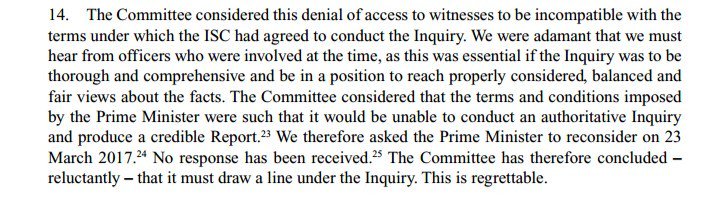
Theresa May specifically and deliberately ruled out the Committee from questioning any official who might be placed at risk of criminal proceedings – see para 11 of the report. The determination of the government to protect those who were complicit in torture tells us much more about their future intentions than any fake apology.
In fact it is impossible to read paras 9 to 14 without being astonished at the sheer audacity of Theresa May’s attempts to obstruct the inquiry. They were allowed to interview only 4 out of 23 requested witnesses, and those were not allowed “to talk about the specifics of the operations in which they were involved nor fill in any gaps in the timeline”. If the UK had a genuinely free media, this executive obstruction of the Inquiry would be the lead story. Instead it is not mentioned in any corporate or state media, despite the committee report containing a firm protest:
It is worth reflecting that the Tory government has acted time and time again to protect New Labour’s Tony Blair, David Miliband, Jack Straw and Gordon Brown from any punishment for their complicity in torture, and indeed to limit the information on it available to the public. The truth is that the Tories and New Labour (which includes the vast majority of current Labour MPs) are all a part of the same elite interest group, and when under pressure they stick together as a class against the people.
Despite being hamstrung by government, the Committee managed through exhaustive research of classified documents to pull together evidence of British involvement in extraordinary rendition and mistreatment of detainees on a massive scale. The Committee found 596 individual documented incidents of the security services obtaining “intelligence” from detainee interrogations involving torture or severe mistreatment, ranging from 2 incidents of direct involvement, “13 to 15” of actually being in the room, through those where the US or other authorities admitted to the torture, to those where the detainee told the officer they had been tortured. They found three instances where the UK had paid for rendition flights.
My own evidence to the Committee focused on the over-arching policy framework, and specifically the fact that Jack Straw and Richard Dearlove had agreed a deliberate and considered policy of obtaining intelligence through torture. The report includes disappointingly little of my evidence, as the Committee has taken a very narrow view of its remit to oversee the intelligence agencies. This is the only part of my evidence included:
130. This was not unique to the Agencies. Their sponsoring Departments appear to have adopted the same approach. We heard evidence from a former FCO official, Craig Murray, who suggested that “there was a deliberate policy of not committing the discussion on receipt of intelligence through torture to paper in the Foreign Office”.
In July 2004, when he was Ambassador to Tashkent, he raised concerns about the use of Uzbek intelligence derived from torture in a formal exchange of telegrams with the FCO. Mr Murray drew our attention to FCO documents from the same time, which we have seen, one of which referred to “meetings to look at conditions of receipt of intelligence as a general issue”. He told us that the meetings “specifically discuss[ed] the receipt of intelligence under torture from Uzbekistan” and “were absolutely key to the formation of policy on extraordinary rendition and intelligence”.
Mr Murray told us that, when he had given evidence to the Foreign Affairs Select Committee about this, they sought the documents from the FCO which replied that the “meetings were informal meetings and were not minuted ”. He went on to say:
“the idea that you have regular meetings convened at director level, convened by the Director of Security and Intelligence, where you are discussing the receipt of intelligence from torture, and you do not minute those meetings is an impossibility, unless an actual decision or instruction not to minute the meetings has been given.… Were it not for me and my bloody-mindedness, … you would never know those meetings had happened. Nobody would ever know those meetings had happened.”131. We note that we have not seen the minutes of these meetings either: this causes us great concern. Policy discussions on such an important issue should have been minuted. We support
Mr Murray’s own conclusion that were it not for his actions these matters may never have come to light.
Jack Straw to this day denies knowledge and involvement and famously told Parliament that the whole story about rendition and torture was a “conspiracy theory”.
Unless we all start to believe in conspiracy theories and that the officials are lying, that I am lying, that behind this there is some kind of secret state which is in league with some dark forces in the United States, and also let me say, we believe that Secretary Rice is lying, there simply is no truth in the claims that the United Kingdom has been involved in rendition full stop, because we have not been, and so what on earth a judicial inquiry would start to do I have no idea. I do not think it would be justified.”
In fact I strongly recommend you to read the whole Hansard transcript, from Q21 to Q51, in which Jack Straw carries out the most sustained bravura performance of lying to parliament in modern history. The ISC report makes plain he was repeatedly involved in direct authorisations of rendition operations, while denying to parliament the very existence of such operations.
For over a decade now the British government, be it Red Tory or Blue Tory, has been refusing calls for a proper public inquiry into its collusion with torture. The ISC report was meant to stand in place of such an Inquiry, but all it has done is reveal that there is a huge amount of complicity in torture, much more than we had realised, which the ISC itself states it was precluded from properly investigating because of government restrictions on its operations. It also concluded in a separate report on current issues, that it is unable to state categorically that these practices have stopped.
The Blair and Brown governments were deeply immersed in torture, a practice that increased hatred of the UK in the Muslim world and thus increased the threat of terrorism. Their ministers repeatedly lied about it, including to parliament. The British state has since repeatedly acted to ensure impunity for those involved, from Blair and Straw down to individual security service officers, who are not to be held responsible for their criminal complicity. This impunity of agents of the state is a complete guarantee that these evil practices will continue.
European Union extends economic sanctions against Russia
RT | June 29, 2018
EU leaders have extended economic penalties against Russia for six months until the end of January. The decision prolongs the ban on doing business with Russian banking and financial institutions and new energy projects.
“We had a very short discussion on Russia, Ukraine and the Minsk Agreements that led to a political decision to extend the sanctions for another six months,” an unnamed source in the EU Council told journalists in Brussels.
The decision came at the bloc’s summit and is expected to be confirmed in the coming days. According to the source, the move was triggered by French President Emmanuel Macron and German Chancellor Angela Merkel, who reportedly urged the leaders to prolong sanctions against Moscow due to the current state of implementation of the Minsk peace accord on Ukraine.
“It was said that there are no changes, so sanctions are prolonged, the sanctions regime remains unchanged,” the source added.
Meanwhile, Italian Prime Minister Giuseppe Conte said that the renewal of the punitive measures against Russia should not be automatic. Italy has repeatedly voiced concerns over the sanctions, saying they were having a huge negative impact on Italian firms’ exports to Russia.
“We will reaffirm the principle that there should be nothing automatic about the renewal of sanctions,” the official told parliament. “We need to be very careful about this. Sanctions should be a means and not constitute an end.”
The penalties were initially introduced in 2014 over Moscow’s alleged involvement in the Ukraine crisis and its reunification with Crimea. Sanctions target Russia’s financial, energy and defense sectors, along with some government officials, businessmen and public figures.
The Kremlin responded by imposing an embargo on agricultural produce, food and raw materials on countries that imposed sanctions on Russia. Since then both sides have repeatedly broadened and extended the restrictive measures.
The Putin-Trump Helsinki Summit Can Produce Practical Results
By Arkady SAVITSKY | Strategic Culture Foundation | 29.06.2018
A Russian-US summit will take place on July 16 in Helsinki. No breathtaking breakthroughs are looming. This event will be quite different from Richard Nixon’s historic visit to the USSR in 1972, when three major security agreements were signed. There is a wide gap between what the leaders want to achieve and what they can really do, other than exchange pleasantries, make a few jokes, slap each other’s shoulders, and shake hands for the cameras. But despite all the deep divisions on many issues, the tensions that are running high, the negative attitude of the US Congress toward Moscow, and the other factors that cloud that relationship, the planned summit could produce concrete and tangible results, contrary to what is generally believed.
If history is any guide, dividing the agenda into “baskets” makes sense. It made the 1975 Helsinki Act possible. One basket should include problems that are of fundamental importance but with solutions that still look fairly distant. Another one could hold the problems for which some success could be achieved right now or in the near future. The third one should be left for miscellaneous issues that require some discussion. Some of those might pop up randomly.
The first basket could include the New START, the INF Treaty, Russia-NATO relations, the problems related to the 50th anniversary of the Non-Proliferation Treaty on July 1, and also other arms-control issues that need to be addressed to prevent backsliding toward an unfettered race and dangerous confrontation. There are some areas where agreement can be reached, but ratification is normally a very complicated and time-consuming procedure. We need to remember the positive experience of the Presidential Nuclear Initiatives (PNIs) and make practical use of it. Progress on arms control is critical for the overall improvement of the bilateral relationship. It is not normal to have a situation in which the major agreements appear to have one foot in the grave and this needs to be changed. If a dialog on arms control were revived, one could say the meeting had been a big step forward.
The time is right for the parties to begin talks on easing the tensions that have been ramped up by the US ballistic missile defense plans in Europe. Mutually-agreed verification measures could be prepared for consideration by experts, if the leaders told them to sit at the round table and start working. A dialog on cybersecurity could be launched at the level of working groups. The presidents could exchange opinions about ways to gradually end the sanctions war.
The second basket should include the revival of the Incidents at Sea Agreement (INCSEA) and the Agreement on the Prevention of Dangerous Military Activities. Those two accords that seem to be somewhat forgotten nowadays have proven their effectiveness and constitute a legal basis that can be built upon. The presidents could confirm the validity of those historic agreements and pledge compliance with them, in order to avoid the sparks that can start big fires — a scenario that must be avoided at any cost.
The parties could pledge to remain faithful to the 1997 NATO-Russia Founding Act, especially the provision that keeps the parties from deploying substantial forces in the proximity of each other’s borders. The US could agree to suspend those activities in Europe that are viewed by Moscow as provocations and preparatory steps for a military intervention. In return, Russia could abstain from deploying some weapons systems that could hit American assets on the US continent. The presidents could agree to become more transparent when preparing for military exercises. They could also limit their scope. Some confidence-building measures could be agreed on within the bilateral format, which could be added to the Vienna Document.
Obviously, the agenda will include Syria. This is an issue that needs to be discussed very candidly behind closed doors. It’s important to understand what goals each side is trying to achieve and see if the existing divergences could be narrowed. The presidents could agree not to take steps to do anything that would aggravate the situation in Ukraine. If no agreement about what to do next seems imminent, the problem could be set aside for the time being.
The leaders could agree to revitalize their bilateral contacts at various levels, including between working groups, NGOs, experts, scholars, lawmakers, businesses, etc. Two-way contacts are vital for moving forward, especially if they touch on arms control or other security-related issues. The number of diplomats stationed in each country, which fell after the wave of expulsions, could be increased, making embassy and consular services more efficient, and steps to move in this direction could also be approved at the meeting.
The third basket could include a preliminary exchange of views on potential bilateral cooperation in Libya and an exploration of ways to spur bilateral economic and cultural projects. Launching negotiations on avoiding a military standoff in the Arctic could help create a much better environment. This problem may not seem as urgent as some other security issues, but a better understanding of each other’s intentions would promote overall progress in the relationship. The prospects for joint space programs should also be studied.
Vladimir Putin and Donald Trump have a good basis, such as their personal chemistry, to build on. There are no magic wands they could wave to make the fundamental problems that divide the two countries disappear, but they can turn the tide and start making step-by-step progress here and there. As a result, the two nations would be involved in dialog rather than confrontation.
New York Times exposes its own hypocrisy with juvenile cartoon of Trump & Putin as gay lovers

© The New York Times
By Danielle Ryan | RT |
A recent cartoon produced by the New York Times depicts Donald Trump and Vladimir Putin as gay lovers. It was clearly intended to be hilariously funny while also making a salient political point. In reality, it does neither.
The cartoon is part two of a three-part series called ‘Trump Bites’ from critically-acclaimed animator Bill Plympton. Let me explain the contents of the minute-long video to save you from having to watch it yourself.
It begins with a cartoon Trump standing in front of a mirror altering his bow tie while a portrait of a topless Putin hangs on the wall behind him. Audio of the real Trump confirming that he does have “a relationship” with Putin begins to play and the doorbell of Trump’s cartoon house rings.
The visitor is none other than a muscly, topless (again) Putin. Trump’s cartoon heart begins to beat out of his chest and he hands it over to the macho Russian as a gift. Audio of the real Trump claiming Putin has done a “brilliant and amazing” job plays over the scene.
Now Donald and Vlad are sitting in a car together. The Russian is in the driving seat. Witty political metaphor? Check! Cartoon Trump leans over and places his tiny hand on top of Putin’s excessively large hand. Overdone dig at the size of Trump’s hands? Check!
Suddenly, the car morphs into a unicorn (stay with me) and the star-crossed lovers are riding on its back through a pink sky filled with butterflies, hearts and rainbows. Putin turns around to kiss Trump and we get a close-up of tongues swirling.
Back in his bedroom after his date with the Russian, cartoon Trump is seen with a gun in hand shooting at his TV screen — an obvious reference to his distaste for “fake news” and the like. Roll credits.
Describing the cartoon on its website, the Times explains that it “plays out in a teenager’s bedroom, where the fantasies of this forbidden romance come to life.” But, in case it wasn’t already clear, the end result isn’t funny. It doesn’t do a particularly good job of making any political point, either — unless you’re counting the reinforcement of a tired, boring and unproven narrative of “collusion” and “bromance” between Trump and his Russian counterpart.
What it does do, very well in fact, is highlight the hypocrisy of the New York Times. Despite its socially liberal credentials, the paper of record has seen fit to use gay stereotypes to malign political figures it does not like. The very fact that the men are portrayed as gay is what is supposed to make the cartoon so funny.
Unsurprisingly, gay people on Twitter were quick to point out that mocking people — even fake versions of real people — for being gay isn’t actually very funny at all. Journalist Glenn Greenwald (who happens to be gay himself) called out the Times for “using one disgusting gay stereotype after the next” in an attempt to make a political point. “Homophobia for progressive messaging is still bigotry,” he wrote on Twitter. He’s right. Another gay Twitter user hit out at the Times for its “vulgar” and “homophobic” negative stereotyping, while others blasted the paper for the tone-deaf decision to publish the “gay-bashing” cartoon during Pride Month, of all times.
The Times’ decision to produce the ‘lol they’re gay’ cartoon seems particularly odd, given how oh-so-concerned they pretend to be with the plight of gay people in Russia. Then again, much of the Western concern over gay rights in Russia is and always has been insincere; a political tool that Western nations use to hammer Russia with while ignoring the far, far worse treatment that gay people are subjected to in countries like Saudi Arabia — a religious dictatorship which is hailed by US political leaders for its progressiveness if it makes even the mildest step towards modernity.
Recall the stunt pulled by the Paddy Power bookmakers during the World Cup. The company proudly announced that it would donate €10,000 to gay rights charities every time Russia scored a goal. The irony of announcing this charitable endeavor during a match against a country (Saudi Arabia) where being gay (MAY BE PUNISHED) by death was apparently entirely lost on them.
Anyway, back to the Times. Even if we forgive the newspaper for its foray into homophobic stereotyping to malign public figures, there’s still the fact that the cartoon is boring and stale and one would struggle to justify classing it as political satire.
There is nothing particularly cutting edge about it. It’s a simple rehash of a tired narrative — just with some homophobia thrown in for laughs. The cartoon series bills itself as satire — but satire is supposed to be original, biting, thought-provoking, clever. This fails on every count.
Danielle Ryan is an Irish freelance journalist. Having lived and worked in the US, Germany and Russia, she is currently based in Budapest, Hungary. Her work has been featured by Salon, The Nation, Rethinking Russia, Russia Direct, teleSUR, The BRICS Post and others. Follow her on Twitter @DanielleRyanJ, check out her Facebook page, or visit her website: danielle-ryan.com
CARLA ORTIZ explains Syria to OAN
HANDS OFF SYRIA | June 25, 2018
Bolivian-American movie star Carla Ortiz explains terrorism in Syria (including the White Helmets and its western sponsors) to Pearson Sharp of One American News. 22 June 2018
Featured Video
American Military Failure in Afghanistan
or go to
Aletho News Archives – Video-Images
Frlom the Archives
Iran War: United States Military Versus Israel Firsters
By James Petras | November 27, 2007
Why must Jewish organizations be and be seen as the loudest drum-beaters of all? Why can we not bring ourselves to say that military intervention is not on the table at all? Why not stash it under the table, out of sight and mount instead a diplomatic assault? – Leonard Fein, Forward
Introduction
As the White House and Congress escalate their economic sanctions and military threats against Iran, top military commanders and Pentagon officials have launched a counter-offensive, opposing a new Middle East War. While some commentators and journalists, like Chris Hedges (Truthdig, November 13, 2007), privy to this high stakes inter-elite conflict, attribute this to a White House cabal led by Vice President Cheney, a more stringent and accurate assessment puts the Zionist Power Configuration (ZPC) in the center of the Iran war debate.
There is a great deal riding in this conflict – the future of the American empire as well as the balance of power in the Middle East. Equally important is the future of the US military and our already heavily constrained democratic freedoms. The outcome of the continuous and deepening confrontation between top US military officials and the Israel Firsters over US foreign policy in the Middle East has raised fundamental questions over self-determination, colonization, civilian primacy and military political intervention, empire or republic. These and related issues are far from being of academic interest only; they concern the future of the United States. … continue
Blog Roll
 Aletho News
- Hezbollah Returns: It Didn’t Start a War, It Is Ending One
- EU states seek ‘talks’ with Iran for access to Strait of Hormuz: Report
- Trump on Hormuz: “Others must take care of it” after US falters
- Who Is closer to collapse?
- A War that Backfired: Why the US-Israeli Campaign Is Strengthening Iran
- How Zionist Control Is Hurting US Interests
- Iran warns it may target US missile launch sites in UAE cities
- American Military Failure in Afghanistan
- Friendly Skies of Georgia: Are Israeli-Linked Drones Launching False Flags from Georgian Territory?
- The Three Big Lies about Mammography Screening
- If Americans Knew
- No let-up in attacks on Gaza as Israel takes on Iran, Lebanon – Not a ceasefire Day 155
- ‘Of Course’: IDF Drops Case Against Soldiers Accused of Raping Palestinian Prisoner
- Don’t Fall for the Regime Change Talk. Israel Is ‘Mowing the Lawn’ in Iran
- Will Israel and the US wreck the Gulf States along with Iran?
- US so far burned through ‘years’ of munitions in Iran war: Report
- How the Israeli Tail Wags the American Dog
- Outdated intel likely led to deadly U.S. strike on Iranian elementary school, sources say
- Pentagon insider says high U.S official Douglas Feith reported to Netanyahu
- In fond memory of Walid Khalidi, the historian of Palestine
- 6 more Americans killed, as Israel ‘mows the lawn’ in Iran – Not a ceasefire Day 154
- No Tricks Zone
- Storing Green Energy To Last Germany 10 Days Would Require A 60-Million Tonne Battery
- New Studies: UK Sea Levels Were 4 Meters Higher Than Today During The Mid-Holocene
- Destructive Green New Deal: German Energy And Metal Group Warns Of Drastic Crisis
- New Study Documents A 20-Year Pause In Arctic Sea Ice Decline – Driven By Internal Variability
- Wake-up Call: Survey Shows Majority Of Germans Now Favor Postponing Climate Targets!
- Televised! Leading German Political Candidate Tells Schoolchildren CO2 Makes Sun Hotter!
- New Study: A Century Warming Of 1.1°C Is ‘Commonplace’ And ‘Not Unusual’ During This Interglacial
- New Study: ‘Internal Noise’ And Volcanic Forcing Can Trigger 10-15°C Warming Within Decades
- Glaciers Worldwide Are Suddendly Surging, Experts Blame Warming!
- Surprising Discovery: Sahara Is Greening…Billions Of Trees Where Once Thought To Be Barren
 Aletho News