Not just the Elgin Marbles: Britain’s colonial legacy lives long in UK museums
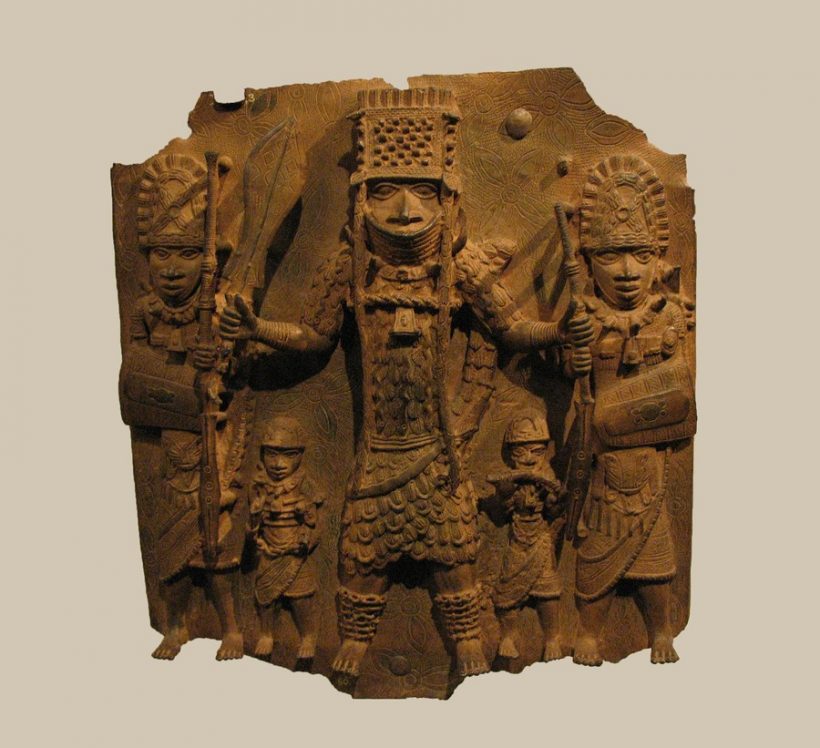
Benin bronzes. © Global Look Press
RT | June 4, 2018
After Jeremy Corbyn promised to return the Elgin Marbles to Greece upon becoming PM on the basis that they were “looted” from the country, RT looks at other rare artifacts taken by colonial Britain that now reside in UK museums.
“As with anything stolen or taken from occupied or colonial possession – including artifacts looted from other countries in the past – we should be engaged in constructive talks with the Greek government about returning the sculptures,” Corbyn said in an interview with a Greek newspaper.
If Corbyn were to become PM, here are some of the other artifacts that might be returned to their country of origin.
Benin artefacts
The British Museum boasts the second-biggest collection of Benin’s art after the Ethnological Museum in Berlin.
The Kingdom of Benin – now part of Nigeria – was stripped of its bronzes during what became known as Britain’s “punitive expedition,” a mission conducted against the natives after they defied imperial rule by imposing customs duties.
BBC Civilizations presenter David Olusoga, originally from Nigeria, said the UK has a “moral imperative” to return the art.
On the Benin looting, he said: “It’s just such a stark case of theft.”
He added during the Hay Festival this year: “A friend of mine, a TV producer, once came up with a brilliant solution: he said we should have a special version of Supermarket Sweep, where every country is given a huge shopping trolley and two minutes in the British Museum. Maybe he’s right, maybe that’s the way forward.”
Ethiopian treasures
Dozens of institutions up and down the country, including the Victoria and Albert Museum in London, are home to hundreds of northeast Africa’s finest treasures.
Beautiful and equally important manuscripts and artifacts were plundered after the British capture of Maqdala in 1868, the mountain capital of what was then Abyssinia under Emperor Tewodros II.
In 2017, Ethiopia lodged a formal restitution complaint. The offer was refused, but ahead of the Maqdala exhibition at the V&A at the beginning of April, its director suggested the case could be settled by granting the treasures to the east-African country on a long-term loan.
Sultanganj Buddha
The Sultaganj Buddha is a metallic sculpture that was extracted from an abandoned Buddhist monastery in northern India in 1861 by E B Harris, a British Raj railway engineer. The 1,500-year-old bronze Buddha was then shipped to Birmingham after being secured for a mere £200 ($265).
The item – the largest known Indian metal sculpture, which is known in the UK as the ‘Birmingham Buddha’ – is at the top of the list of thousands of alleged ‘stolen treasures’ that Indian authorities are trying to get back.
The Koh-i-Noor diamond
The Koh-i-Noor diamond, one of the largest cut in the world, is currently part of the British crown jewels. It has been the subject of a bitter dispute between India and the UK ever since it was taken from the Punjab and presented to Queen Victoria in 1849.
The jewel, which belonged to the Punjab’s Sikh Empire, was handed by the East Indian Company to Queen Victoria after they emerged victorious in the 1840s Anglo-Sikh wars.
The diamond – known as the Mountain of Light – is thought to have been mined in the 1300s.
India has called for the stone to be returned ever since it gained independence in 1947, though the UK claims it has a legal basis for withholding it, as it was guaranteed under the Treaty of Lahore.
Former PM David Cameron commented on the dispute, stating: “If you say yes to one you suddenly find the British Museum would be empty. I think I’m afraid to say, to disappoint all your viewers, it’s going to have to say put.”
UN aid boat comes under suspected Saudi attack off Yemen
Press TV – June 4, 2018
A United Nations vessel delivering humanitarian aid to the Yemeni port of Hudaydah has come under a suspected Saudi attack.
Yemen’s Red Sea Ports Corporation said on Monday that the vessel used by the UN’s World Food Programme (WFP) was attacked after delivering a shipment at Hudaydah, a port in western Yemen which is controlled by the ruling Houthi Ansarullah movement and is under a blockade by Saudi Arabia and its allies fighting the Houthis.
“The vessel traffic office received a distress call from the VOS THEIA at 1730 (1430 GMT) on Sunday, June 3, 2018 about a fire in the vessel resulting from an external attack,” said the Port Corporation in a statement, although it would not elaborate on who might have launched the attack.
The statement added that the ship was waiting in anchorage for permission to leave when it came under attack.
The UN’s aid chief, Mark Lowcock said, however, that no one was injured and the situation was calm now.
“There was an incident … We don’t know who’s responsible. We’re investigating and the incident is over,” said Lowcock.
The UN official, however, criticized anyone seeking to disrupt the humanitarian aid delivery in Hudaydah, a port which handles the bulk of Yemen’s commercial imports and aid supplies and is regarded as a lifeline for some eight million Yemenis being fed by the UN.
“There’s no port more important than Hudaydah. So anything which called into question the operation of Hudaydah would be a matter of deepest concern,” he said.
Reports over the past weeks have indicated that Saudi Arabia and its allies have been advancing on Hudaydah, launching frequent attacks on port authorities and guards patrolling at sea.
Saudis refused to provide any comment on the incident involving the UN aid boat.
According to figures released by the Yemeni Ministry of Human Rights, more than 600,000 people have been killed or injured in the Saudi war since 2015.
The illegal campaign, which is meant to restore power to former president Abd Rabbuh Mansur Hadi, has also displaced hundreds of thousands of Yemenis while exacerbating the humanitarian plight of millions already affected by poverty and malnutrition in the Arabian Peninsula’s poorest nation.
Gaza Slaughter: Holy Land Still Denied Peace and Justice by Cowardly International Community
How can any sane person, after visiting Gaza, fail to demand the full force of international law and sanctions against the sadistic Israeli regime?
By Stuart Littlewood | American Herald Tribune | June 2, 2018
Here we go again. Jewish News reports the UK proudly announcing a new package of aid totalling £1.5 million to buy medicines and equipment for 11 hospitals in Gaza. The money will also provide services for around 4,000 people.
Live fire across the border by Israel’s snipers, slaughtering some 111 Palestinians, mostly civilians and including women and children, and wounding and maiming thousands more, shamed Britain into this latest gesture.
Middle East Minister Alistair Burt made the announcement on a visit to Gaza. He said: “I am deeply concerned about the worsening situation in the Gaza Strip, and today’s UK aid package gives a message to the world, and to the people of Gaza, that we have not forgotten them or their plight.
“Today’s support will help to ensure that hospitals which are under immense pressure are able to cope with the increased number of casualties who need medical and surgical care.”
Oh, how nice. Handing out £1.5 million of our tax money saves Burt the chore of calling the Israeli psychopaths to account. It is another cowardly subsidy to keep the illegal occupation of the Holy Land going.
Burt added:
“We have been clear that a political settlement is the only way to ensure lasting peace for Palestinians and Israelis alike. All parties must redouble their political efforts and return to the negotiating table, not only to address the deteriorating conditions in Gaza, but to ensure tragedies of the past months are not repeated.”
Why should Palestinians ‘negotiate’ for their rights and freedom? And given the Israelis’ track record could a political settlement with them ever be fair or just? Without justice there can be no lasting peace. And without law there’s no justice. So why the continual focus on ‘negotiations’ while ignoring the rule of international law?
The BMJ (British Medical Journal) recently described the horror on the ground:
Since 2014 Israel has further tightened the passage of essential medicines and equipment into Gaza, and of the entry of doctors and experts from abroad who offer technical expertise not available locally. Gazan hospitals have been depleted of antibiotics, anaesthetic agents, painkillers, other essential drugs, disposables, and fuel to run surgical theatres. Patients die while waiting for permission to go for specialist treatment outside Gaza. All elective surgery has been cancelled since last January 2018, and 3 hospitals have closed because of medication, equipment and fuel shortages. Medical personnel have been working on reduced salaries. Gazan health professionals find it almost impossible to get Israeli permission to travel abroad to further their training. The regular episodic military assaults on Gaza and the current targeting of unarmed demonstrators are part of a pattern of periodically induced emergencies arising from Israeli policy. The cumulative effects of the impact on healthcare provision for the general population have been documented in multiple reports by NGOs, UN agencies and the WHO. This appears to be a strategy for the de-development of health and social services impinging on all the population of Gaza.
The current systematic use of excessive force towards unarmed civilians, including children and journalists, is provoking a further crisis for the people of Gaza. Since 30 March 2018, snipers firing military grade ammunition have caused crippling wounds to unarmed demonstrators. As of 23 April 5511 Palestinians, including at least 454 children, have been injured by Israeli forces, including 1,739 from live ammunition according to the Palestinian Ministry of Health in Gaza. As of April 27, the death toll has reached 48 and additional hundreds wounded.
The UK claims its aid is already providing Gazans with access to clean water and improving sanitation facilities to help stop the spread of deadly disease. So what? It does nothing to end Israel’s blockade, the day-to-day, hour-to-hour misery of economic strangulation and the helplessness of imprisonment within that tiny, overcrowded coastal strip.
Mr Burt and his Foreign Office colleagues are a large part of the problem. We’ve heard Burt many time before spouting the bollox of appeasement, giving away money and urging lopsided negotiations rather than enforcing UN resolutions and international law and imposing sanctions. Seven years ago, as the new minister in charge of Middle East affairs, he was handing the Palestinian Authority’s Prime Minister Salam Fayyad and his boss, president Mahmoud Abbas, £17 million for their sterling work. The official reason for such largesse with our hard-earned tax money was the dynamic duo’s progress towards creating an independent, viable Palestinian state “living in peace with a secure Israel”.
Their only real achievement, however, was having turned the Occupied Territories into a police state of the most sinister kind on behalf of their Israeli puppet masters. The gift was also a sweetener to get the Palestinian leaders back to the negotiation table. “It is critical that both sides find a way to return to talks,” said Burt. “The current impasse is of great concern and I urge all parties to take immediate steps to secure a lasting peace… We firmly believe that this should see a Palestinian state based on 1967 borders and with East Jerusalem as its capital. This is the solution which offers the best prospect of a just and sustainable peace.”
That was 2011. Where’s the peace?
“Enemies of peace will continue to use the conflict for their own purposes…”
Talk is cheap when you have no intention of following up with action. And Mr. Burt was not about to transform himself into a man of action for peace. Why not? Because he’s a creature of the Israel lobby. He used to be an officer of that detestable club of Israel flag-wavers, the Conservative Friends of Israel. The Foreign Office is stuffed with them thanks to our then prime minister, David “I’m-a-Zionist” Cameron, an individual so misguided that he proclaimed: “In me you have a Prime Minister whose belief in Israel is indestructible.”
What a ridiculous commitment for a British prime minister to make to a lawless, racist entity that respects nobody’s human rights, continually defies international law and shoots children for amusement (see ‘The methodical shooting of boys at work in Gaza by snipers of the Israeli Occupation Force’ by surgeon David Halpin and latest reports on the use of dum-dum and other soft-nose or ‘exploding’ rounds by Israeli snipers).
It is a disgrace that the Conservatives, who weren’t given a clear mandate to govern and resorted to forming a coalition with the wimpish Liberal Democrats, chose to vomit their infatuation with the thuggish Israeli regime all over the British nation and the Arab world. They continue their nauseating behaviour to this day.
In a speech to the Board of Jewish Deputies, Burt recalled how he had worked from the age of fifteen for an MP who was a president of the Board and a founder of the Conservative Friends of Israel, and how this “had a lasting effect upon me, and on my interests in Parliament”. He said: “Israel is an important strategic partner and friend for the UK and we share a number of important shared objectives across a broad range of policy areas.”
Can anyone think of a single objective they’d wish to share with those people?
On the Israeli-Palestinian conflict he said that “without an agreement between the Palestinians and the Israelis peace in the Middle East is unobtainable”. Oblivious to the irony of his remarks, he went on: “Those who are enemies of peace will continue to use the conflict for their own purposes… We cannot allow those who want to pursue a violent agenda to succeed… We are committed to a two-state solution and we will continue to support the efforts of the US to broker a peace deal between both sides. And as an honest broker, the UK Government does not believe that economic sanctions or embargoes on Israel [are] the way to engage or to influence it.”
The “honest broker” has been happy enough to use economic sanctions to collectively punish the Gazans who are no threat to us, to punish the Iranians who are no threat to us, and even to punish the Russians who could swat us like a fly. Why so queasy about doing the same to Israel, which is a real and present danger to everyone?
I do, however, applaud Burt’s words condemning the enemies of peace who use the conflict for their own ends and his determination not to allow those who want to pursue a violent agenda to succeed. But it surely cannot have escaped his notice that Netanyahu doesn’t want peace. Land-grabbing, ethnic cleansing and other high crimes are what he does, so the jackboot of Israeli occupation stays on the Palestinians’ neck and any peace plan is treated with contempt. More to the point, no-one in the international community – and certainly not Burt – has actually told us what a two-state solution looks like. No-one, that is, since Ehud Barak made his absurd “generous offer” back in 2000.
When the Palestinians signed the Oslo Agreement in 1993 they were ready to accept a meagre 22% of pre-partition Palestine and recognise Israel within the ‘Green Line’ borders (i.e. the 1949 Armistice Line established after the Arab-Israeli War). Conceding 78% of the land that was originally theirs was an astonishing compromise.
But it wasn’t enough for greedy Israel. Its “generous offer” demanded the inclusion of 69 Israeli settlements within the 22% remnant. It was obvious on the map that those settlement blocs created impossible borders and already severely disrupted Palestinian life in the West Bank. Barak also demanded the Palestinian territories be placed under “Temporary Israeli Control”, meaning Israeli military and administrative control probably indefinitely. This two-state arrangement also gave Israel control over all the border crossings of the new Palestinian State. What nation in the world would accept that? The idiotic reality of Barak’s offer was hidden by propaganda spin.
Later, at Taba, Barak produced a revised map but withdrew it after his election defeat. The ugly facts of the matter are documented and explained by organisations such as Gush Shalom, yet Israel lobby stooges in the UK government continue to peddle the lie that Israel offered the Palestinians a “generous” peace on a plate.
In lockstep with Netanyahu’s crazed ambitions?
Since then, Netanyahu has made it clear several times that Israel will not voluntarily give up any land it illegally occupies to a Palestinian state. “We are here to stay forever. There will be no more uprooting of settlements in the land of Israel. … This is the inheritance of our ancestors. This is our land.” So says an intruder who, like most of his unpleasant colleagues, actually has no ancestral links to ancient Israel. The Israeli regime occasionally gives the impression of going along with talks for propaganda reasons but will always ensure they go nowhere. Look at its track record.
Meanwhile Burt and others are still busy promoting the fantasy of a peace process that’s just around the corner. Why? Are they in lockstep with Netanyahu to prolong the conflict in order to buy more time to steal more territory? Or perhaps they need help in spotting the patently obvious: that the peace process is dead, belly-up, a write-off…. and has been for 20 years.
The Jewish Chronicle was ecstatic about Burt’s appointment as a Foreign Office minister, which it said sent “as clear a message as possible about the direction of the new [Conservative] government in the region. Mr Burt is listed as an officer in the parliamentary group of Conservative Friends of Israel and has been passionate in campaigning for visiting rights to Gilad Shalit, the Israeli soldier held hostage by Hamas for the past four years…”
Funny how Burt was so concerned for Shalit, a trained killer whose capture and detention he called “outrageous” while ignoring the thousands of Palestinian civilians (including women and children) abducted from their homes and left to rot in Israeli jails without trial.
And his stance on Palestinian independence has always been nonsensical. I remember Burt saying that we would not recognise a Palestinian state unless it emerged from a peace deal with Israel. London “could not recognise a state that does not have a capital, and doesn’t have borders.” He’d been talking earlier about a Palestinian state based on 1967 borders with East Jerusalem as its capital. Why had he suddenly lost the plot? And where does he suppose Israel’s borders are? Is Israel ever within them? Where does he think Israel’s capital is? And where does Israel claim it to be? In other words, is Israel where Israel ought to be? If not, how can he possibly recognise it let alone align himself with it?
“We are looking forward to recognising a Palestinian state at the end of the negotiations on settlements…” Israel’s illegal settlements are classed as war crimes. Since when did Her Majesty’s Government approve of negotiating with perpetrators of such crimes? Besides, the Holy Land’s status was ruled on long ago. International law has spoken. But instead of enforcing law and upholding justice Mr. Burt and his Government chums still push for more discredited, lopsided talks. He was one-time president of the Oxford Law Society and graduated with a law degree but he shows remarkably little regard for international legal process these days.
And where does Burt suppose the Palestinians’ offshore boundaries run in regard to the huge reserves of marine gas and oil in the Levantine Basin? Israel wants the lot and the question for many years has been: will Gaza ever get a whiff of its own gas? What does Mr. Burt, wearing the British government’s “honest broker” hat, say?
Don’t be surprised at the answer. Burt is or was a political adviser to the Henry Jackson Society, a neoconservative foreign policy think tank. Signatories and patrons include Richard Perle, William Kristol, Ambassador Dore Gold (former foreign policy advisor to the Prime Minister of Israel), Natan Sharansky (chair of the Executive of the Jewish Agency for Israel), Denis MacShane, David Trimble (founder member of the Friends of Israel Initiative), Robert Halfon MP (former political director, Conservative Friends of Israel) and Stephen Pollard (editor, The Jewish Chronicle ).
Israel Supreme Court told that settlements law violates apartheid convention
MEMO | June 4, 2018
Israel’s Supreme Court heard a petition yesterday against a law that allows the expropriation of privately-owned Palestinian land for Israeli settlers, reported AFP.
The court, meeting in an expanded panel of nine justices, has been petitioned by Israeli and Palestinian rights groups, on behalf of 17 Palestinian villages.
The law was passed by the Knesset in February 2017. In August, the court issued a restraining order against the law’s implementation, pending its ruling.
According to AFP, the petition “argues that by giving preference to Jewish settlers over the rights of Palestinian landowners it [the law] breaches an international convention on Apartheid”.
“The clear, declared purpose of the law, which seeks to privilege the interests of one group on an ethnic basis and leads to the dispossession of the Palestinians, leaves no doubt that this law involves crimes under the convention,” it says.
Attorney Harel Arnon “argued in defence of the legislation in place of attorney-general Avichai Mandelblit, who has warned the government the law could be unconstitutional and risked exposing Israel to international prosecution for war crimes”, AFP reported.
Arnon told the court that striking down the law would be “abetting a coup against this administration”. It would be “the dismemberment of the sovereignty of the Knesset”, he added.
It was not known yeserday when the court would deliver its ruling, AFP noted.
The law is designed to retroactively “legalise” dozens of settlement outposts and thousands of settler homes across the occupied West Bank, homes built on privately-owned Palestinian land.
Under international law, including as reflected in United Nations Security Council resolutions, all Israeli settlements in the West Bank, and East Jerusalem, are illegal.
Two-state solution is dead, Palestinian courage should spur international action
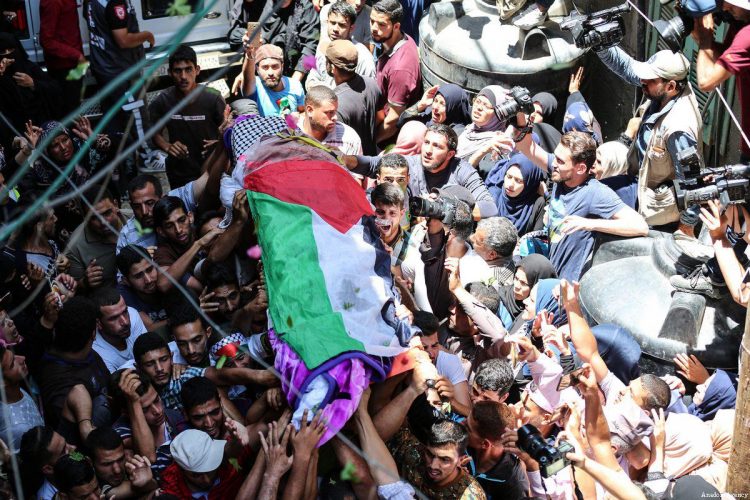
Palestinians attend the funeral of paramedic Razan Al-Najjar, 21, shot dead by Israeli forces while healing the wounded during ‘Great March of Return’ [Mustafa Hassona – Anadolu Agency]
By Rick Sterling | RT | June 4, 2018
After 70 years, the Israeli-Palestinian conflict is still unresolved. The conflict simmers for a few years, then erupts again with new massacres and violence.
After the failure of the two-state solution, recent events have again highlighted the need for a different approach. In the past couple months, Israeli Defence Force (IDF) soldiers have killed 118 Palestinian protesters and seriously wounded many thousands more. The protesters were unarmed and no threat to the soldiers. Gaza hospitals overflowed with victims.
Human rights groups filed a legal petition to make it unlawful for Israeli soldiers to fire on unarmed protesters. Last week the Israeli Supreme Court rejected the petition.
Israeli violence is usually portrayed as a “response” to Palestinian violence, but the reality is the opposite. The sequence of recent events is as follows:
– From the end of March till May 25, Palestinians in Gaza protested against their oppression as close as they could get to the border fences. About 118 were killed and many thousands seriously injured by Israeli snipers. They were all shot inside Gaza.
– On May 27 – 28, the Israeli military launched tank mortars at Palestinian military outposts inside Gaza, killing at least three.
– Next day, on May 29, Palestinian militants launched unguided mortars into nearby Israel. Most of them fell harmlessly and there were no Israeli casualties.
– Then, on May 30, Israeli jets and helicopters launched guided missiles and bombs on 65 different locations within Gaza.
Clearly, the violence started with Israelis killing protesters and then militants inside Gaza, but it’s not portrayed that way. Time magazine began its article with, “Palestinian militants bombarded southern Israel….”
Pro-Israel advocates wish to prevent people from seeing what is really happening. They know the potential damage if people see video such as Israeli snipers celebrating the shooting of unarmed protesters. To prevent this, a proposed law will make it illegal to photograph or video record Israeli soldiers. Palestinian journalists have condemned this attempt to criminalize journalism.
Reality of Israeli occupation
Israel calls itself the “Startup Nation” because of the economic and technological achievements. But in Gaza and the West Bank, Israeli policies and actions strangle the economies and worsen living conditions.
Palestinians in Gaza are kept separate from Palestinians in the West Bank. There is no trade, travel or inter-family visitation. This is in violation of international agreements including the Oslo Accords.
The claim that Israel “departed” Gaza is false. Israel controls the borders, sky and waters around Gaza, a coastal strip just 5 miles wide by 25 miles in length. Unemployment in Gaza is approaching 50 percent, the highest unemployment in the world. Fishermen are prevented from going out into deeper waters and shot at when they go beyond Israel’s imposed zone. Gazan farmers cannot export independently. Israel frequently blocks the import and export of crops and products. It is almost impossible to leave Gaza. Even outstanding students winning international scholarships may have their exit denied. The electrical and water treatment facilities have been bombed and destroyed by Israel. Nearly all the drinking water is contaminated. Israel restricts the amount of food permitted to enter Gaza so there is continual shortage leading to nutritional deprivation, stunted growth and anemia.
This situation is not new. Eighteen years ago, Israeli journalist Amira Hass described the history, the facts and statistics as well as her personal experience living in Gaza in the profound book “Drinking the Sea at Gaza: Days and Nights in a Land Under Siege”. The situation was extremely grim then but keeps getting worse.
At the northern Gaza border, Israel is now building a “sea barrier” extending far out into the Mediterranean. It will be above and below the water line. A major reason for this expensive project is to block sewage and pollution from the waters in front of Gaza. Because of Israeli attacks on sewage treatment and electrical infrastructure, sewage flows into the sea. Last summer, Zikim Beach in southern Israel had to be closed due to the inflow of sewage from Gaza. The ‘sea barrier’ now in construction will block the sea currents. This will keep the Israeli beach clean and greatly compound the problem in Gaza.
The strangulation, impoverishment and oppression are not confined to Gaza. In the West Bank, Israeli settlements continue to expand. This increases the number of checkpoints, restrictions and repression. Travel from Bethlehem to Jerusalem is impossible for most Palestinians. The majority of West Bank water from the aquifers is transferred to Israel or provided cheaply to settlers while Palestinians must buy water and store it in tanks on their rooftops. In the last few years, Israel has made it increasingly difficult or impossible for humanitarian groups to provide medical support including breast cancer screening. A compelling new book titled “The Other Side of the Wall” describes the daily struggle in the West Bank where Palestinians and international allies protest against the theft of land, abuses, random killings and imprisonments.
Defiant Courage
There seems to be a trend towards greater Palestinian unity and strategic agreement. The tens of thousands of Palestinians protesting in Gaza were unarmed and united behind the Palestinian flag rather than separate party or movement flags of Hamas, Islamic Jihad, PFLP, or DFLP.
The Palestinian protesters in Gaza show remarkable courage. Beginning on Friday March 30, they have returned week after week despite seeing thousands of their fellows shot and wounded or killed.
In an article titled “The Gaza Fence that Separates the Brave from the Cowardly”, Amira Hass wrote, “The desperate courage demonstrated by tens of thousands of citizens of Gaza over the past few weeks in general and on Monday in particular hints at the energies, the talents, the dreams, the creativity and the vitality of the inhabitants of this strip of land – who have been subjected to a 27 year policy of closure and siege aimed at suffocating and crushing them.”
Steadfast and persistent
Palestinian resistance continues despite Israeli violence and bloodshed. Seven years ago Palestinian refugees in Syria and Lebanon held “March of Return” protests at the northern borders. Israeli soldiers killed 13 and wounded many more.
In recent days, Gazans have again challenged the Israeli port blockade which prevents ships from departing or arriving. International solidarity with the Palestinian cause is also persistent. Three ships (two Swedish and one Norwegian) recently departed Scandinavia heading for the Mediterranean Sea and Gaza. Named the 2018 Freedom Flotilla, the ships are carrying dozens of international citizens to again demand that Israel stop its blockade of Gaza.
Despite the huge imbalance today, time may be on the side of the Palestinian cause. Systemic apartheid in South Africa existed for a long time and seemed strong. But ultimately it collapsed quickly. The same may unfold in Israel / Palestine.
Today, South Africa is an important supporter of the Palestinian cause. South Africa was the first nation to recall its ambassador to protest the “indiscriminate and grave Israeli attack” in Gaza.
Israel has the military might but Palestinian resistance and courage persists. The Palestinian population is steadfast and growing. They have increasing number of allies who support their cause. Young American Jews are unlike their parents and increasingly critical of Israeli policies. Some courageous Israelis, such as Miko Peled, speak out unequivocally that Israeli apartheid must end and be replaced by one state with democracy and equality for all. A million registered Palestinian refugees live in Lebanon and Syria, patiently waiting. They have not forgotten their legal claim and right to return.
The recent bloodshed and massacres underscore the fact that there is no solution on the current path. It only leads to increasingly unlivable conditions in Gaza plus more illegal settlements and oppression in the West Bank. The so-called “two-state solution” has been dead for many years and should be forgotten. As happened in South Africa, the international community can and should help. It is time to increase international pressure and expand BDS (boycott, divestment and sanctions) against Israel to help bring a peaceful end to this conflict with its constant oppression and recurring massacres.
The alternative is very grim. As described by Israeli journalist Gideon Levy, “The truth is that Israel is well prepared to massacre hundreds and thousands, and to expel tens of thousands. Nothing will stop it. This is the end of conscience, the show of morality is over. The last few days’ events have proved it decisively. The tracks have been laid, the infrastructure for the horror has been cast. Dozens of years of brainwashing, demonization and dehumanization have borne fruit. The alliance between the politicians and the media to suppress reality and deny it has succeeded. Israel is set to commit horrors. Nobody will stand in its way any longer. Not from within or from without.”
Palestinian courage should spur international action.
Rick Sterling is an investigative journalist based in the San Francisco Bay Area. He can be contacted at rsterling1@gmail.com
Read more:
Merkel agrees with Netanyahu that Iran is a ‘concern’ for Israel’s security
RT | June 4, 2018
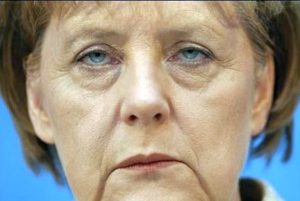 German Chancellor Angela Merkel said on Monday that she agreed with Israeli Prime Minister Benjamin Netanyahu that Iran’s activities in the Middle East are a concern, particularly for Israel’s security. She made the statement after a meeting in Berlin.
“We agree that the question of Iran’s regional influence is worrying, especially for Israel’s security,” the chancellor said.
Netanyahu’s European tour this week follows the US withdrawal from the 2015 nuclear deal which France, Germany and Britain have said they will continue to respect.
The Israeli leader is also expected to meet French President Emmanuel Macron and possibly British Prime Minister Theresa May to discuss ways to stop what Netanyahu called “Iran’s nuclear ambitions and regional expansionism,” Reuters said.
Almost 100 Local Tribes Form Coalition to Expel US Forces From Syria – Reports
Sputnik – June 4, 2018
The presence of US troops in Syria is escalating tensions between government forces and the Kurdish-dominated Syrian Democratic Forces (SDF), with some politicians and Syrian Army officers accusing the SDF of serving as “puppets” for the US and other western powers.
In excess of 70 Syrian tribal leaders met in the Aleppo Governorate, specifically the city of Deir Hafer, over the weekend to discuss plans and coordinate with one another to remove US forces from Syria, Al-Masdar News reported on Sunday.
Via a joint statement, the tribes, which are predominately Sunni Muslims, announced the formation of a coalition to oust US and French military personnel from Syria, in addition to liberating territory held by the SDF, provided Damascus is unable to negotiate a reconciliation deal with them.
The tribesmen also reportedly discussed the prospect of fighting Turkish forces in northwestern Syria.
The different tribes hail from various parts of Syria which are currently occupied by US-backed forces, including the oil-rich provinces of Deir ez-Zor and al-Hasakah.
Although there’s been some low-level, sporadic clashes and attacks on SDF bases in northern Syria in recent months, particularly in the Raqqa Governorate, where the Popular Resistance of Raqqa (PRoR) operates, we are yet to see the launch a wide scale, continuous anti-SDF operation, by either the Syrian Army or local militiamen.
However, in a recent interview with RT, President Bashar al-Assad warned that a wide scale anti-SDF offensive would be launched if negotiations fail.
In the meantime, the Syrian Army is mobilizing and deploying forces to southern Syria ahead of a major offensive in the Deraa government, where militants control a large chunk of territory, including parts of the provincial capital.
Last Friday, a military source confirmed to Sputnik reporter Suliman Mulhem that Hezbollah troops and other Iran-backed militiamen won’t be involved in the offensive, likely as part of an acceptable compromise reached with Israel via Russian mediators.
See Also:
Hezbollah, Iran-Backed Forces Won’t Take Part in South Syria Assault – Source
Israel joins NATO drill in Europe for the first time
RT | June 4, 2018
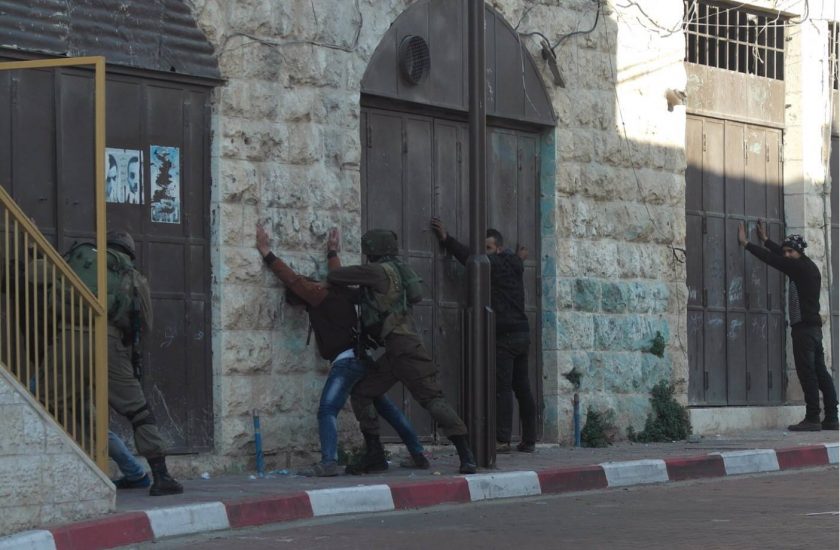
Israeli troops have joined NATO war games in Eastern Europe for the first time. One of the scenarios includes crushing an armed rebellion.
Soldiers from a paratrooper brigade are participating in the NATO exercise ‘Swift Response’, which “simulates combating military uprisings in Europe,” the Israeli spokesperson said on Monday.
The annual drill led by the US European Command takes place across Germany, Poland, Lithuania and Latvia, with 10 nations involved in the maneuvers. Troops from non-NATO member Israel will train alongside the US 173rd Airborne Brigade and the Texas National Guard. According to the Pentagon, the maneuvers include “rapid response infiltration”, air assault operations and the evacuation of non-combatants.
The exercise takes place simultaneously with two other NATO drills in Europe. The two-week war game ‘Saber Strike’ amasses 18,000 soldiers from 19 countries, with troops deployed in Poland and the Baltic States. They will master the deployment of military convoys to defend NATO’s eastern flank, as well as operations across rivers and bridges.
Additionally, 37 warships are docked at the Lithuanian port city of Klaipeda for an ongoing naval drill ‘BALTOPS’. All in all the exercise led by US 6th Fleet Vice Admiral Lisa Franchetti will involve 60 aircraft and 42 ships from 22 nations.
All three drills are taking place close to the Russian border, and Moscow has been regularly warning that NATO military buildup at its doorstep undermines the stability and security climate on the European continent.
Russia is “closely observing” the war games and undertaking all “necessary measures” to ensure Russia’s own security during the maneuvers, the president’s spokesman Dmitry Peskov said Monday. Commenting on the largest of its exercises in the region, US Army Europe has claimed that ‘Saber Strike’ “is not a provocation of Russia.”
Israel had been an active NATO partner since the 90s, and the cooperation with the Bloc intensified in recent years, particularly in the field of combating terror threats. Israeli diplomatic mission at NATO HQ in Brussels was opened in 2016, with several cooperation agreements following. However, as NATO General Secretary Jens Stoltenberg confirmed last week, the Bloc’s security guarantees “do not apply” to Israel since it is not a member of the alliance.
Read more:
US mulls expanding military intervention in Yemen: Report
Press TV – June 4, 2018
The United States is considering a request from the UAE to provide direct support for an attack to seize the Houthi-held port of Hudaydah, a major lifeline for Yemen, officials say.
US officials said Secretary of State Mike Pompeo has asked for a prompt assessment of the UAE’s appeal for assistance such as surveillance drone flights to help a Saudi-led coalition capture Hudaydah.
The debate over increasing US support to the UAE and Saudi Arabia comes amid escalating military operations around the Yemeni port despite UN warnings of catastrophic effects on the impoverished country.
Eighty percent of commercial and humanitarian supplies flow through Hudaydah, a central gateway. Since May 27, forces supported by Saudi Arabia have been closing in on the port, claiming that Yemen’s Ansarullah movement uses it for weapons delivery.
American officials say the UAE and Saudi Arabia have assured Washington that they won’t attempt to take the Red Sea port until they get support from the US.
“We continue to have a lot of concerns about a Hudaydah operation,” said one senior US official, quoted by The Wall Street Journal.
“We are not 100% comfortable that, even if the coalition did launch an attack, that they would be able to do it cleanly and avoid a catastrophic incident,” the official added.
Senior Yemen specialists in the US administration were expected to meet on Monday to discuss what to do, the newspaper said.
According to the Journal, Riyadh and Abu Dhabi have long sought to get backing from the US.
Last year, the Saudi-led coalition unsuccessfully sought to secure American intelligence, surveillance and direct support from elite US military forces for an attack on Hudaydah, former US administration officials said.
For now, prominent administration officials involved in the debate harbor reservations about expanding the American military role in Yemen, but some back providing assistance to the UAE, officials said.
“We have folks who are frustrated and ready to say: ‘Let’s do this. We’ve been flirting with this for a long time. Something needs to change the dynamic, and if we help the Emiratis do it better, this could be good,’” the senior US official said.
Some administration officials are also increasingly disappointed that both military and diplomatic efforts have bogged down, which is fueling efforts to cut US support for the fighting, the report said.
The US has been lavishing sophisticated weaponry upon Saudi Arabia since March 2015, when the latter attacked Yemen to restore its Riyadh-allied former government. Washington also helps to refuel Saudi and UAE warplanes that conduct airstrikes on Yemen.
According to figures released by the Yemeni Ministry of Human Rights, more than 600,000 people have been killed or injured in the Saudi war since 2015. Yemen has also turned into the scene of the world’s worst humanitarian crisis.
The Red Cross and the United Nations have warned against the dangers of the Saudi-led operations in Hudaydah.
“The push for Hudaydah is likely to exacerbate an already catastrophic security situation in Yemen,” said François Moreillon, head of the International Committee of the Red Cross delegation in Yemen.
United Nations’ new special envoy on Yemen, Martin Griffiths, is to present his proposal for reviving peace talks to the UN Security Council in the next two weeks. He has publicly warned that an assault on Hudaydah “would take peace off the table.”
“We are all very concerned about the possible humanitarian consequences of a battle for Hudaydah,” he said.
Russia pushes back at US on North Korea
By M.K. Bhadrakumar | Asia Times | June 4, 2018
The visit by the Russian Foreign Minister Sergey Lavrov to Pyongyang on May 31 was a poignant moment for both countries. This was a rare meeting between a senior Russian official and a member of the Kim dynasty. Yet, Russia has been the oldest friend and mentor of the ruling family in Pyongyang.
Kim’s family escaped from Japanese-occupied Korea to the Soviet Union in 1920 when the revered founder of North Korea, Kim Il Sung, was only eight years old. He grew up in Russia, joined the Red Army and fought the Japanese in Manchuria. When World War II ended, Kim returned to his country and with some Soviet backing, went on to lead North Korea’s Communist Party and lay the foundations of the new state north of the 38th parallel.
Make no mistake, it was not a coincidence that Kim received Lavrov on the same day his deputy Vice-Chairman Kim Yong-chol met US President Donald Trump at the White House. Kim told Lavrov in front of TV cameras: “I highly value the fact that Putin’s administration strictly opposes the US’ hegemony. You strictly oppose, and we are always ready to conduct negotiations and a profound exchange of opinions with the Russian side on this issue.” Russia’s Cold War ally is picking up the threads with ease.
Unsurprisingly, Lavrov gave whole-hearted backing for the North Korean stance on the vexatious issue of denuclearization. In Lavrov’s words: “We assume that a complete resolution cannot be achieved until all the sanctions are lifted. It is up to the negotiators to make this happen, but in any case, it would be impossible to achieve this in a single round. The same applies to denuclearization. For this reason, this should be a step-by-step process with reciprocal moves at each of the stages.”
Denuclearization not a stand-alone issue
Lavrov called for a “judicious approach” not to rush things and cautioned against any “rash actions”, bearing in mind the need for “careful consideration and coordination of all elements of a package decision.” The carefully-chosen expression “package decision” implies that denuclearization is not a stand-alone issue.
He underscored: “Russia and North Korea hold a common view… We know that this is an extremely complicated problem and that the goal of denuclearization is inseparably connected with the eventual restoration of peace, stability and a system of interaction, cooperation and equal and indivisible security in Northeast Asia.” Simply put, Lavrov asserted Russia’s role in the current process as a stakeholder in the stability and security of its region. Interestingly, Lavrov flagged the need at some point to revive the format of six-party talks (involving the two Koreas, US, China, Japan and Russia.)
The Russian Foreign Minister also discussed substantive issues of bilateral cooperation in the economic sphere in anticipation of a post-sanctions future. In particular, he brought up the languishing 10-year-old idea of linking the Trans-Siberian and Trans-Korean railway systems to connect Moscow with Seoul via Pyongyang and to build a parallel gas pipeline.
Meeting between Putin and Kim soon?
Meanwhile, the speaker of the upper house of the Russian parliament, Valentina Matviyenko, is expected to visit North Korea soon. Most importantly, a meeting between Putin and Kim is on the cards. Reports speculate that the meeting may take place as early as next week during Putin’s state visit to China following the Shanghai Cooperation Organization summit in Qingdao (June 9-10).
The Russian Deputy Foreign Minister Igor Morgulov who accompanied Lavrov to Pyongyang was in Beijing on May 29 and would have discussed the forthcoming trip with Chinese officials. While in Beijing, Morgulov made some highly critical remarks about US policies in the Asia-Pacific, which reflected the thrust of Lavrov’s mission:
“I am referring… to the idea of the Indo-Pacific region, which the United States and Japan are actively advocating. Essentially, it is designed to divide the regional countries into friends and foes… Both Russia and China hold a diametrically opposite view. They are against creating blocs and believe that an effective and system-wide response to security challenges in the Asia Pacific must include a comprehensive military and political détente and uniform rules of the game… This architecture must be based on the universal principles of indivisible security and the supremacy of international law, as well as non-use of force or threat of force.”
Beijing has welcomed “Russia’s positive role” and said high-level exchanges between Russia and North Korea are “conducive to promoting the political settlement process of Korean Peninsula issue and upholding the peace and stability of the peninsula and Northeast Asia.” Russia is airing opinions supportive of North Korean concerns and vital interests, which Beijing shares but for obvious reasons is not in a position to voice openly.
Process will be a long haul
Clearly, Lavrov’s mission is making it more difficult for Washington to pressure the North Korean leadership or dictate the dynamics of the current process. Moscow is signaling that it will not remain a passive bystander (as in the negotiations over the Iran nuclear issue). And, it has taken a common position with Beijing that the denuclearization of North Korea impacts on the regional security matrix in Northeast Asia. Given this developing situation, the final outcome is almost certainly going to be a long haul.
Simply put, the US’ containment strategy against Russia and China has created a complex regional security environment in Northeast Asia. On one side there is talk of a new US military base in Poland and additional deployment of 30,000 NATO troops to Central Europe on Russia’s western fringe, while on the other side US Secretary of Defence James Mattis promised at the Shangri-La Dialogue in Singapore on the weekend to step up military pressure on China in the South China Sea, and Trump is beating the drums of a trade war with Beijing.
However, somewhat incredibly, in this milieu of growing big-power tensions, Washington still expects Moscow and Beijing to remain docile as Trump and his team go about denuclearizing North Korea and reset the regional security calculus. This expectation is plainly unrealistic. Moscow has signaled that as a stakeholder, it will push back and will not allow a replay of what happened over the Iran nuclear deal.
Significantly, Lavrov disclosed that the North Korean leadership is “fully aware” of developments relating to the US’ exit from the Iran nuclear deal, and “will determine its position taking into consideration all these factors.”
Putin Signs Bill on Countermeasures Against US, Its Allies
Sputnik – 04.06.2018
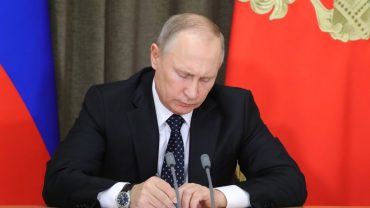 Russian president Vladimir Putin has signed a bill on countermeasures against the United States and its allies.
The law enters into force on the day it is published.
The bill was passed by the Russian Lower House in May. The goal of the legislation is to defend Russia’s sovereignty from “unfriendly actions” by Washington and other foreign states that have imposed political and economic sanctions on Moscow.
On April 6, Washington unveiled new sanctions on Russia over what it described as “global destabilization efforts.” The sanctions list included senior government officials, and lawmakers, as well as major business owners and private and state-owned companies under their control.
In response, Russian Prime Minister Dmitry Medvedev said that Moscow reserves the right to respond to the new US anti-Russia sanctions and may review trade deals.
The Russian Embassy in the United States said that the new package of sanctions is another hit to bilateral relations, adding that the sanctions will hurt thousands of Russian citizens who are part of the businesses that were targeted.
Italy: The Center Cannot Hold
By Diana Johnstone | Consortium News | June 3, 2018
The traditional governing parties, center “left” and center “right” all follow the same neoliberal policies and constitute the self-designated “center.” Mainstream media enforce center right claims to authority on the base of orthodox economic expertise, while the center left derives its authority from its “values,” centered on an identity politics version of human rights. “Center” sounds so reasonable, so safe from dangerous “extremes” and unpredictable populism. Against such threats, the Center presents itself as the champion and safeguard of “democracy.”
How true is this?
World Values Survey results indicate that in Europe and the United States, people who describe themselves as “centrist” on the average have less attachment to democracy (e.g. free and fair elections) that those on the left, and even those on the far right. This is not as surprising as it may seem at first, since “centrists” are by definition attached to the status quo. In European countries, the authoritarian neoliberal “center” is institutionalized in the European Union, which imposes economic policy over the heads of the parliaments of the member countries, dictating measures which conform to the choices of Germany and northern Europe, but are increasingly disastrous for the Southern EU members.
The Centrist fear of democracy was resoundingly confirmed by March 4 legislative elections in Italy. The Center was relegated to the margins and outsiders burst in. The winner, with 32 percent of the votes, was the Five Star Movement (M5S) whose campaign “against corruption” won popular support in the impoverished South. In second place, with 17 percent, was “the League”, formerly the Northern League – that is, a party of rich north Italy chauvinists ready to secede from the “lazy good-for-nothing” south. It took almost three months for this extremely odd couple to agree to a coalition government.
The mystique of the European Union is anti-nationalist, based on the theory that “nations” are bad because they caused the devastating wars of the twentieth century, while European unification is the sole guarantee of “peace.” Convinced of their mission, the Eurocentrists have had no qualms in throwing out the baby of democratic choice along with the nationalist bathwater.
The notion that “peace” depends on “Europe” persists despite the NATO bombing of Serbia and European participation in U.S. wars in Afghanistan, Iraq, Libya and Syria, not to mention EU participation in the current major military buildup in the Baltic States against “the Russian enemy.” Indeed, thanks to NATO, the EU is gearing for a war even worse than the previous ones.
Since the “nation-state” is blamed for evil in the world, the Eurocentrists react with horror at growing demands in Member States for a return to “national sovereignty.” This, however, is a natural reaction to the economic and social disasters resulting from policies dictated by EU institutions in Brussels. The 1992 Maastricht Treaty legally bound member countries to centralized neoliberal monetarist policies; not only “socialism” became illegal – even Keynesianism was ruled out. Promised endless peace and prosperity, citizens of European countries were cajoled into giving up their sovereignty to EU institutions, and many now want it back.
Disillusioned Italy
Italian disillusion is particularly significant. Italy was an exceptionally enthusiastic founding member of the unification begun with the 1957 Treaty of Rome. And yet, Italy’s own history illustrates what can go wrong with such unification, since the 19th century political creation of a unified Italy centered in Turin led to the enrichment of the industrial north at the expense of southern Italy, where the splendor of Naples declined into chronic poverty, crime and corruption. Now Italy itself is “the south” in the periphery of a European Union centered around Germany.
Antagonism between northern and southern Italy has given way to a much stronger antagonism between Italy and Germany – each blaming the other for the crisis.
It is only fair to recall that Germans were very attached to their Deutsche Mark and to their own austere financial policies. Germany could only be lured into the common currency by agreeing to let the euro follow German rules. France eagerly supported this concession based on the notion that the common currency would unify Europe. It is doing quite the opposite.
Germany is a major exporting nation. Its trade with the rest of the EU is secondary. It uses the EU as its hinterland as it competes and trades globally with China, the United States and the rest of the world. The proceeds of Germany’s favorable EU trade balance is less and less invested in those countries but in Germany itself or outside the EU. In the official German view, the main function of the Southern EU members is to pay back their debts to Germany.
Meanwhile, Italy’s once flourishing industrial network has lost its competitive edge due to the euro. It cannot save its exports by devaluation, as it was accustomed to doing. Italy’s debt is now 132 percent of its GNP, whereas the Maastricht Treaty governing the monetary union puts a ceiling of 60 percent on national debt. And to continue paying the debt, public services are cut back, the middle class is impoverished, the domestic market declines and the economy gets even weaker.
This is precisely the situation that has plunged Greece into ever deepening poverty.
But Italy is not Greece. Greece is a small peripheral country, which can be pounded to death by creditors as a warning of what can happen to others. Italy, on the contrary, is too big to fail. Its collapse could bring the whole EU crashing down.
Italy’s Potential Strength Through Weakness
The traditional Italian parties had no solution beyond those that have ruined Greece: cut back social spending, impoverish workers and pensioners, and pay back the foreign banks, with interest.
The odd coalition of the League and the M5S was obliged to try something different: basically, to invest in the economy rather than abandon it to its creditors. Their program combines lower taxes with Keynesian stimulation of investment. Since the leader of the League, Matteo Salvini, and Luigi Di Maio of M5S do not like each other, they selected law professor Giuseppe Conte to be Prime Minister in their coalition cabinet. The interesting choice was that of Paolo Savona for the key post of Minister of Economy and Finance. Savona, whose long career has taken him across the summits of Italian and international finance, was certainly the most qualified choice imaginable. Savona knows everything there is to know about the Italian economy and international currency creation.
And yet, it was the appointment of this 81-year-old expert that created outrage in the Eurocenter.
The uproar was spurred by the fact that in one of his books Savona had described the euro as “a German prison.” Savona had also said it was necessary to prepare a Plan B, to leave the euro if there is no other choice. “The alternative is to end up like Greece.”
This hint of disloyalty to the euro was totally unacceptable to the European establishment.
The Center struck back in the person of the largely figurehead President of Italy, Sergio Mattarella, who used, or misused, his unique constitutional power by refusing to approve the government. On May 28, he designated as prime minister Carlo Cottarelli of the International Monetary Fund – a man who represented everything the Italians had just voted against. Known in Italy as “Mr. Scissors” for his advocacy of drastic government spending cuts, Cottarelli was supposed to run an apolitical “technical” government until new elections could be held in the fall.
This coup against the Italian voters caused momentary rejoicing in the Authoritarian Center. The European Budget Commissioner (a German of course), Günther Oettinger, was reported to be gloating over the prospect that “the markets” (meaning the financial markets) would soon teach Italians how to vote. Italy’s economy “could be so drastically impacted,” he said, as to send a signal to voters “not to vote for populists on the right and left.”
This simply intensified Italian indignation against “German arrogance.”

Savona: Plan B just a negotiating tactic
Meanwhile Savona wrote a letter to President Mattarella which introduced a bit of cold reason into an increasingly hysterical situation. He reminded the president that an important meeting of EU heads of state was to be held at the end of June; without a political government, Italy would be absent from negotiations which could seal the fate of the EU. Italy’s plea for economic change could expect French support. Savona denied having called for leaving the euro; in the spirit of game strategy, he had mentioned the need for Plan B in order to strengthen one’s position before negotiations. He made it clear that his strategy was not to leave the euro but to transform it into a genuine rival to the dollar.
“Germany prevents the euro from becoming ‘an essential part of foreign policy’, as the dollar is for the United States”, wrote Savona. But change becomes necessary, as the dollar is less and less suitable for its role as world currency.
Indeed, the Italian crisis merges with a mounting trans-Atlantic crisis, as the U.S. uses sanctions as a weapon in competition with its European “partners.” The paradox is that Italy could use its very weakness to oblige Germany to reconsider its monetary policy in a moment when the German economy is also facing problems due to U.S. sanctions on deals with Russia and Iran, as well as protectionist measures. Savona’s message was that clever diplomacy could work to Italy’s advantage. In its own interest, Germany may need to accept transformation of the euro into a more proactive currency, able to defend European economies from U.S. manipulation.
It was a matter of hours before Cottarella stepped back and a new M5S-League government was formed, with Savona himself back as Minister of Relations with the European Union.
Italy’s Double Jeopardy
The new Italian cabinet sworn in on June 1 is riven with contradictions. Despite all the released anti-EU sentiment, it is definitely not an “anti-EU” government. Conte is back as prime minister. The new foreign minister, Enzo Moavero Milnesi, is a staunch pro-European. As interior minister, the northern Italy chauvinist Salvini – who doesn’t particularly care for southern Italians – will get tough with migrants. As minister of economic development M5S’ Di Maio will try to find ways to improve conditions in the southern regions that elected him. Since Salvini is the more experienced of the two, the League is likely to profit from the experiment more than the M5S.
Some Italians warn that by leaving the “German prison” Italy would simply find itself even more dependent on the United States.
One should never forget that ever since the end of World War II, Italy is an occupied country, with dozens of U.S. military bases on its territory, including air bases with nuclear weapons poised to strike the Middle East, Africa or even Russia. The Italian Constitution outlaws participation in aggressive war, and yet Italian bases are freely used by the United States to bomb whichever country it pleases, regardless of how Italians feel about it.
Worst of all, the U.S. used its Italian “NATO bases” to destroy Libya, a disaster for Italy which thereby lost a valuable trade partner and found itself inundated with African refugees and migrants. While international financial experts exhort Italy to cut government expenses, the country is obliged by NATO to spend around 13 billion euros to buy 90 U.S. F-35 fighters and to increase its military spending to around 100 million euros per day.
Italy’s economic prospects have also been badly hit by U.S.-enforced sanctions against trade with Russia and Iran, important potential energy sources.
U.S. economic aggression, in particular Trump’s rejection of the Iranian nuclear deal, is the issue with the potential to bring European leaders together at a time when they were drifting apart. But at present, the Europeans are unable to defy U.S. sanctions in punishment for trade with those countries because their international dealings are in dollars.
This has already led to the U.S. exacting billions of dollars in fines from the biggest French and German banks, the BNP and Deutsche Bank, for trading that was perfectly legal under their own laws. The French petroleum giant has been obliged to abandon contracts with Iran because 90% of its trade is in dollars, and thus vulnerable to U.S. sanctions. And that is why the idea is growing of building financial instruments around the euro that can protect European companies from U.S. retaliation.
The Disappearance of the Left
The disappearance of left political forces has been almost total in Italy. There are many reasons for this, but a curable part of the problem has been the inability of what remains of the left to face up to the two main current issues: Europe and immigration.
The left has so thoroughly transformed its traditional internationalism into Europism that it has been unable to recognize EU institutions and regulations as a major source of its problems. The stigmatization of “the nation” as aggressively nationalistic has held back the left’s ability to envisage and advocate progressive policies at the national level, instead putting its hopes forever in a future hypothetical “social Europe.” Such a transformation would require unanimity under EU rules – politically impossible with 28 widely differing Member States.
Without such inhibitions, the far right capitalizes on growing discontent.
Another related handicap of the left is its inability to recognize that mass immigration is indeed “a problem” – especially in a country like Italy, with a flagging economy and 20 percent official unemployment (although this figure is probably too high, considering undeclared labor). There is resentment that prosperous Germany issued a general invitation to refugees, which for geographic reasons pile in Mediterranean countries unable to cope. The mass influx of economic migrants from Africa is not even “taking jobs away from” Italians – the jobs are not there to take. These migrants fled war and misery to come to Europe in order to earn money to send back to their families, but how can they possibly meet these expectations?
It is all very well to extol the glorious hospitality of America entreating the world to “Give me your tired, your poor, Your huddled masses yearning to breathe free, The wretched refuse of your teeming shore. Send these, the homeless, tempest-tossed to me…”. Such generosity was suited to a new nation with huge empty spaces and rapidly growing industry in need of a work force. The situation of a “full” nation in a time of economic downturn is quite different. What is to become of the tens of thousands of vigorous young men arriving on Italian shores where there is nothing for them to do except sell African trinkets on the sidewalks of tourist centers? To make matters worse, the great contemporary thrust of technical innovation aims at replacing more and more workers with robots. Leftist denial of the problem leaves its exploitation and resolution to the extreme right.
Some leftist politicians in Italy, such as Stefano Fassina of the Sinistra Italiana are waking up to this need. A left that dogmatically ignores the real concerns of the people is doomed. A bold, honest, imaginative left is needed to champion Italians’ independence from both German-imposed austerity and the expensive military adventurism demanded by the United States. But the interlaced problems created by unregulated globalization do not lend themselves to easy solutions.
Diana Johnstone is a political writer, focusing primarily on European politics and Western foreign policy. She received a Ph.D. at the University of Minnesota and was active in the movement against the Vietnam War. Johnstone was European editor of the U.S. weekly In These Times from 1979 to 1990, and continues to be a correspondent for the publication. She was press officer of the Green group in the European Parliament from 1990 to 1996. Her books include Queen of Chaos: The Misadventures of Hillary Clinton, CounterPunch Books (2016) and Fools’ Crusade: Yugoslavia, NATO and Western Delusions, Pluto Press (2002).
Featured Video

Iran Is Not Our Enemy
or go to
Aletho News Archives – Video-Images
Frlom the Archives
The 52 Major Jewish American Organizations and Israel Celebrate Passover with the Slaughter of 25 Muslim, Christian and Secular Palestinians
By James Petras • Unz Review • April 8, 2018
Introduction
As of April 7, nearly three thousand unarmed Christian, Muslim and secular Palestinians have been wounded, over three dozen are in critical condition and at least twenty-five unarmed protestors, including children have been assassinated by hundreds of Israeli snipers and heavily armed troops shooting tank shells into crowds of civilians protesting their decades of incarceration by the racist Israeli state.
The Israeli government praised the ‘restraint and morality’ of the IDF, as did the fifty-two Major Jewish American Organizations (MJAO) who largely control the US Congress. These grotesque massacres began during the Christian Holy Week on Good Friday and Easter, coinciding with the Jewish Passover. The self-righteous officials of the MJAO and their relatives and friends broke matzos at joyful Seders as the blood of Palestinians soaked into ground at the fence containing the largest open-air prison camp in history, Gaza.
While tribal loyalties bonded the Israeli and Jewish American leaders, the politicians of the Western oligarchic electoral regimes refrained from criticizing the shocking display of brute force and even defended Israel’s cold blood mass killings of Palestinian civilians in their Gaza prison.
This paper will discuss and analyze the reasons for Israel’s willing Western accomplices and the centrality of its fifth column in the United States. … continue
Blog Roll
 Aletho News
- No Liability, No Studies, No Accountability: The Vaccine System Aaron Siri Exposed in Federal Court
- No time for losers: Why the war meant to save Israel may destroy it
- Top US Counterterrorism Official Resigns in Protest of Operation Against Iran
- Just Get Out! Now!
- Unpacking glaring contradictions in US-Zionist justifications for war against Iran
- Iranian model of warfare bleeds US dry while Persian Gulf states watch and learn: Analyst
- IRGC orders ‘defeated’ US to evacuate industrial facilities in region
- Hegseth’s call for ‘no mercy’ to Iranians deemed war crime
- Iran War Exposes Limits of US Military Power – Journalist
- Even The Neo-Cons Admit The Iran War Is Failing
- If Americans Knew
- Trump’s counterterrorism chief, whose own wife was killed by ISIS, quits over Iran War saying Tehran posed ‘no imminent threat’
- Here’s what US could fund instead of Bibi’s war on Iran
- Israel Killed Over a Dozen Lebanese Paramedics in Three Days, Now Claiming That Ambulances Are “Hezbollah” Targets
- War on Iran: These are the heritage sites devastated by US and Israeli attacks
- Four news stories from Israeli media that illustrate Israeli “justice”
- CIA Prepares Criminal Referral of Tucker Carlson, as Israel and Its Loyalists Demand His Arrest
- Top US counterterror advisor resigns in protest of “war manufactured by Israel” – Not a ceasefire Day 157
- ‘I Liked the House’: When Israeli Soldiers Turn Palestinian Homes into Barracks
- ‘They Were All I Had’: Lebanese Father Buries Parents, 4 Daughters Killed by Israeli Bombing
- Israel and its supporters are causing attacks on Jewish institutions. Case in point: Michigan synagogue tragedy.
- No Tricks Zone
- Storing Green Energy To Last Germany 10 Days Would Require A 60-Million Tonne Battery
- New Studies: UK Sea Levels Were 4 Meters Higher Than Today During The Mid-Holocene
- Destructive Green New Deal: German Energy And Metal Group Warns Of Drastic Crisis
- New Study Documents A 20-Year Pause In Arctic Sea Ice Decline – Driven By Internal Variability
- Wake-up Call: Survey Shows Majority Of Germans Now Favor Postponing Climate Targets!
- Televised! Leading German Political Candidate Tells Schoolchildren CO2 Makes Sun Hotter!
- New Study: A Century Warming Of 1.1°C Is ‘Commonplace’ And ‘Not Unusual’ During This Interglacial
- New Study: ‘Internal Noise’ And Volcanic Forcing Can Trigger 10-15°C Warming Within Decades
- Glaciers Worldwide Are Suddendly Surging, Experts Blame Warming!
- Surprising Discovery: Sahara Is Greening…Billions Of Trees Where Once Thought To Be Barren
 Aletho News