Butina Case: Neo-McCarthyism Engulfs America

By Philip M. GIRALDI | Strategic Culture Foundation | 09.08.2018
The United States Department of Justice would apparently have you believe that the Kremlin sought to subvert the five-million-member strong National Rifle Association (NRA) by having two Russian citizens take out life memberships in the organization with the intention of corrupting it and turning it into a mouthpiece for President Vladimir Putin. Both of the Russians – Maria Butina and Alexander Torshin – have, by the way, long well documented histories as advocates for gun ownership and were founders of Right to Bear Arms, which is not an intelligence front organization of some kind and is rather a genuine lobbying group with an active membership and agenda. Contrary to what has been reported in the mainstream media, Russians can own guns but the licensing and registration procedures are long and complicated, which Right to Bear Arms, modeling itself on the NRA, is seeking to change.
Maria Butina, a graduate student at American University, is now in solitary confinement in a federal prison, having been charged with collusion with Torshin and failure to register as an agent of the Russian Federation. It is unusual to arrest and confine someone who has failed to register under the Foreign Agents Registration Act of 1938, but she has not been granted bail because, as a Russian citizen, she is considered to be a “flight risk,” likely to try to flee the US and return home. It is to be presumed that she is being pressured to identify others involved in her alleged scheme to overthrow American democracy through NRA membership.
Indeed, in any event, it would be difficult to imagine why anyone would consider the NRA to be a legitimate intelligence target. It only flexes its admitted powerful legislative muscles over issues relating to gun ownership, not regarding policy on Russia. In short, Butina and by extension Torshin appear to have done nothing wrong. Both are energetic advocates for their country and guns rights, which they appear to believe in, and Butina’s aggressive networking has broken no law except not registering, which in itself assumes that she is a Russian government agent, something that has not been demonstrated. To put the shoe on the other foot, will every American who now travels to Russia and engages in political conversations with local people be suspected of acting as an agent of the US government? Once you open the door, it swings both ways.
One might dismiss the entire Affair Butina as little more than a reflection of the anti-Russia hysteria that has been sweeping the United States since Hillary Clinton lost the 2016 election, but that would be unfair to those remaining honest FBI agents who may have investigated Butina and Torshin and come up with what they believed to be a plausible case for an indictment. There were possibly suspicious money transfers as well as email intercepts that might be interpreted as incriminating.
But two important elements are clearly missing. The first is motive. Did the Kremlin seriously believe that it could get anything substantial out of having a gun totin’ attractive young Russian woman as a life member in the NRA? What did the presumed puppet masters in Moscow expect to obtain apart from the sorts of group photos including Butina that one gets while posing with politicians at the annual NRA convention? Sure, the photo might even evolve into a cup of coffee together, but what is the end game?
Second is the lack of any of the hallmarks of an intelligence operation, which is referred to in the business as tradecraft. Spies meet secretly or at least outside the public eye with prospective agents whereas Maria operated completely in the open and she made no effort to conceal her love for her country and her desire that Washington and Moscow normalize relations. Spies also communicate securely, which means that they use encrypted systems or various cut-outs, i.e. mis-directions, when maintaining contact with those who are running them. Again, Maria did none of that, which is why the FBI has her emails. Also spies work under what is referred to as an “operating directive” in CIA-speak where they have very specific information that they seek to obtain from their contacts. There is no indication that Maria Butina in any way sought classified information or intelligence that would relate either to the security of the United States or to America’s political system. And finally, Maria made no attempt to recruit anyone and turn them into an actual controlled Russian agent, which is what spies eventually seek to do.
It has come down to this: if you are a Russian and you are caught talking to anyone in any way influential, there is potentially hell to pay because the FBI will be watching you. You are automatically assumed to be part of a conspiracy. Once “evidence” is collected, you will be indicted and sent to prison, mostly to send a message to Moscow. It is the ultimate irony that how the old Soviet Union’s judiciary used to function is now becoming standing operating procedure in the United States.
The knife in Iran’s back: Trump opens door to chaos
By Vijay Prashad | Asia Times | August 9, 2018
On Tuesday night, Iranian President Hassan Rouhani went on television to talk about the reinstatement of sanctions by the United States against his country. He prepared the country for more privations as a result of the sanctions. Responding to US President Donald Trump’s offer of a meeting, Rouhani said pointedly, “If you stab someone with a knife and then say you want to talk, the first thing you have to do is to remove the knife.”
It is clear to everyone outside the US government that Iran has honored its side of the 2015 nuclear deal that it made with the governments of the five permanent members of the United Nations Security Council (the US, the UK, France, China and Russia) as well as the European Union. In fact, quite starkly, EU foreign-policy chief Federica Mogherini said, “We are encouraging small and medium enterprises in particular to increase business with and in Iran as part of something that for us is a security priority.”
In other words, Mogherini is asking companies to resist Trump’s policy direction. What she is saying, and what Rouhani said, is that it is the United States that has violated the nuclear deal, and so no one needs to honor the US sanctions that have been reinstated.
Mogherini pointed to “small and medium enterprises” because these would not be the kind of multinational corporations with interests in the United States. But it is more than small and medium-sized enterprises that are going to challenge the US sanctions. China, Russia and Turkey have already indicated that they will not buckle under US pressure.
China
“China’s lawful rights should be protected,” said the Chinese government. China has no incentive to follow the new US position.
First, China imports about US$15 billion worth of oil from Iran each year and expects to increase its purchases next year. State energy companies such as China National Petroleum Corporation (CNPC) and Sinopec have invested billions of dollars in Iran.
CNPC and Sinopec also have shares in Iran’s major oil and gas fields – CNPC has a 30% stake in the South Pars gas field and has investments in the North Azadegan oilfield, while Sinopec has invested $2 billion in the Yadavan oilfield.
China’s Export-Import Bank, meanwhile, has financed many large projects in Iran, including the electrification of the Tehran-Mashhad railway. Other Chinese investment projects include the Tehran metro and the Tehran-Isfahan train. These projects are worth tens of billions of dollars.
Second, China is in the midst of a nasty trade war with the United States. In late August, Trump’s government slapped 25% tariffs on $16 billion worth of Chinese imports into the United States. China responded with its own tariffs, with its Commerce Ministry saying that the US was “once again putting domestic law over international law,” which is a “very unreasonable practice.”
The “once again” is important. China is seized by the unfairness of the reinstatement of sanctions on Iran, not only for its own economic reasons but also because it sees this as a violation of international agreements and a threat to Iranian sovereignty – two principles that China takes very seriously.
Sinopec, knee-deep in Iran’s oil sector, has now said that it would delay buying US oil for September. Iran has now been drawn into the US “trade war” (on which, read more here).
The Chinese have been quite strong in their position. The Global Times, a Chinese government paper, wrote in an editorial, “China is prepared for protracted war. In the future, the US economy will depend more on the Chinese market than the other way around.” This fortitude is going to spill over into China’s defense of Iran’s economy.
Russia
Russia and Iran do not share the kind of economic linkages that Iran has with China. After the 2015 sanctions deal, Iran did not turn to Russian oil and gas companies for investment. It went to France’s Total – which signed a $5 billion deal. Russia and Iran did sign various massive energy deals ($20 billion in 2014), but these did not seem to go anywhere.
Russia’s Gazprom and Lukoil have toyed with entry to Iran. In May, Lukoil directly said that it would be hesitant to enter Iran because of the proposed US reinstatement of sanctions. Lukoil’s hesitancy came alongside that of European companies such as Peugeot, Siemens and even Total, which decided to hold off on expansion or cut ties with Iran. Daimler has now officially halted any work in Iran.
It was a surprise this year when the Iranian Dana Energy company signed a deal with the Russian Zarubezhneft company to develop the Aban and West Paydar oilfields. The contract is for $740 million, which in the oil and gas business is significant but not eye-opening.
In July, senior Iranian politician Ali Akbar Velayati met with Russian President Vladimir Putin in Moscow. He left the meeting saying, “Russia is ready to invest $50 billion Iran’s oil and gas sectors.” Velayati specifically mentioned Rosneft and Gazprom as potential investors – “up to $10 billion,” he said.
When Putin was in Tehran last November, Russian companies signed preliminary deals worth $30 billion. Whether these deals will go forward is not clear. But after Trump’s reinstatement of sanctions, Russia’s Foreign Ministry said it would “take appropriate measures on a national level to protect trade and economic cooperation with Iran.” In other words, it would see that trade ties were not broken.
Turkey
Both Iran and Turkey face great economic challenges. Neither can afford to break ties. Turkish Foreign Minister Mevlut Cavusoglu has said that his government will only honor international agreements, and that the US reinstatement of sanctions is not part of an international framework. Turkey, therefore, will continue to trade with Iran.
Iranian oil and gas are crucial for Turkey, whose refineries are calibrated to Iran’s oil and would not be able to adjust easily and cheaply to imports from Saudi Arabia. Almost half of Turkey’s oil comes from Iran.
Turkish-US relations are at a low. Conflict over the detention of an American pastor, Andrew Brunson, has led to the US sanctioning two Turkish cabinet ministers, Justice Minister Abdulhamit Gul and Minister of Interior Suleyman Soylu. Gul is a leader of the ruling Justice and Development Party (AKP), while Soylu came to the party at the personal invitation of President Recep Tayyip Erdoğan. These are not men to be intimidated by US pressure.
A US mission led by Marshall Billingslea, assistant secretary of the US Treasury, went to Turkey to persuade the government to join the US sanctions. Meanwhile, the US has begun to put pressure on Turkey’s Halkbank, one of whose senior officials was found guilty of violation of the US sanctions on Iran by a court in the United States this year. This kind of pressure is not sitting well with the Turkish government.
Inside Iran
Pressure is mounting inside Iran. Protests have begun across the country, a reflection of the distress felt by the population as the country’s currency, the rial, slides and as fears of inflation mount.
Last week, the Iranian government fired the head of the central bank, Valiollah Seif, and replaced him with Abdolnasser Hemati. It reversed the foreign-exchange rules, including the failed attempt to fix the value of the rial that was put in place in April.
Hemati had been the head of Iran’s state insurance firm and before that of Sina Bank and Bank Melli. He is highly trusted by the government, which had already appointed him as ambassador to China before hastily rescinding that offer and moving him to the central bank. Whether Hemati will be able to balance the stress inside the Iranian economy is yet to be seen. Faith in the currency will need to be strengthened.
As part of that, Iran’s government has cracked down harshly against financial fraud, particularly scandals over foreign exchange. The man who signed the 2015 nuclear deal, Deputy Foreign Minister Abbas Araghchi, had to watch as his nephew Ahmad Araghchi, the central bank’s vice-governor in charge of foreign exchange, was arrested along with five other people as part of an inquiry over fraud. The message: No one, not even the Araghchi family, is immune from the long arm of the law.
Trump’s belligerence, the refusal of key countries to abide by Trump’s sanctions (including the European Union, but mainly Russia and China), as well as the internal pressure in Iran could very likely create the conditions for a military clash in the waters around Iran. This is a very dangerous situation. Sober minds need to push against the reinstatement of these sanctions – which the Iranians see as economic warfare – as well as escalation into military war.
This article was produced by Globetrotter, a project of the Independent Media Institute.
Social Media Users in Scotland Planning on Boycotting BBC
Sputnik – August 9, 2018
Following the removal of the prominent Scottish independence blogger, Wings Over Scotland, social media users in Scotland are preparing for an outright boycott of the BBC. Earlier Sputnik spoke to the political analyst, Joe McGregor about this story.
Sputnik: So Joe can you explain a little bit about why people are planning on boycotting the BBC? Why are such a large proportion of Scots so disenfranchised with the BBC?
Joe McGregor: I’m deeply disenfranchised with that because it seems like Scotland don’t have a voice on the channel whatsoever – it’s very Westminster-centric, very England-centric. I don’t mean that as coming from the point of view that as a Scotsman I should be opposed… not at all. It seems to be that the BBC likes to show only the worst side of Scotland, or not give the SNP (Scottish National Party) a voice, when they are national broadcaster.
Sputnik: Does this have effect on Scottish political issues such as campaigns for Scottish independence and if so what kind of effect?
Joe McGregor: Eventually you become used to it. Say for the youth of Scotland that are coming through and they’re only having that information they would be guided to believing that information thinking that having nuclear weapons and having the nuclear base is a great thing. Scotland should be proud of having that there but they don’t show other side things, with nuclear apparatus being driven through city centers like Glasgow. If there was to be a problem there, it would wipe out most of central Scotland. Why does Scotland have to house that when Scotland doesn’t want to house that and why does the BBC not show that, that Scotland isn’t with that? They only tend to say ‘If it wasn’t there, then so many people would be out of work’ and that the local businesses wouldn’t have the customs of the people who work there – which I find ridiculous.
Sputnik: Is this boycott anti-English and what would you say to critics who suggest that it is?
Joe McGregor: It’s not anti-English, its anti-BBC. If the BBC was to give Scotland a fair crack of the whip and report the SNP are doing great things in Scotland and report on the fact that people aren’t happy having nuclear weapons on their doorstep, I think you would find that people don’t think its anti-English, its simply anti-BBC.
Sputnik: What would you like to see from the BBC that would improve the image of the broadcaster in your eyes?
Joe McGregor: I would just like to see every nation in the UK getting a fair crack of the whip. It’s not just Scottish issues; there’s Welsh issues, Northern Ireland issues… it’s not just Westminster-centric issues, it’s not like Westminster is big brother and its do what you say and everything will be ok and you know what, keep drinking beer because that will nullify any of the effects that may occur.
See also:
BBC Was in Bed With the Government to Flush Out ‘Subversives’ – Archives
Bjorn Lomborg: ‘Stop these silly, undocumented claims of ever-increasing fire’ Claims ‘based on anecdotes, not data’ – Reality is Global & U.S. fires declining
By Bjørn Lomborg · August 6 2018
Could we please stop with the misleading fire stories?
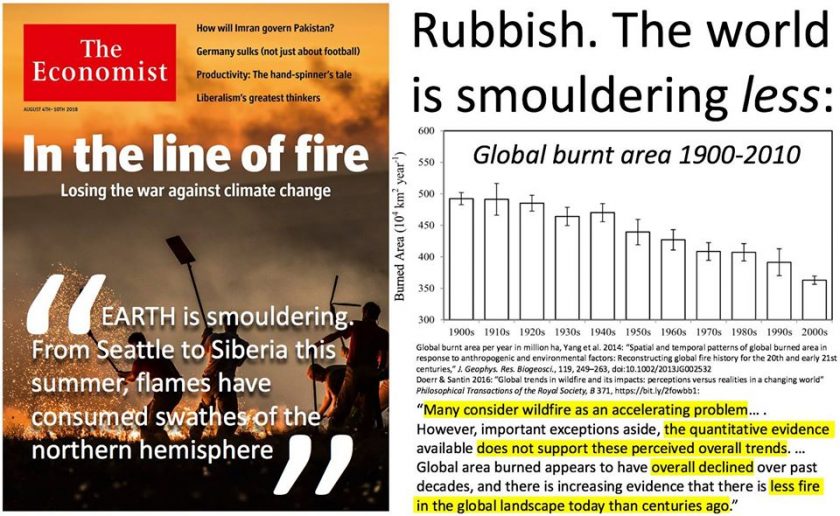
The Economist cover story, like so many other stories these last weeks, claim that forest fires are exceptional and record-breaking: “EARTH is smoldering. From Seattle to Siberia this summer, flames have consumed swathes of the northern hemisphere”
This is based on anecdotes, not data.
As I’ve shown in previous days, the US burnt area was much higher in the early part of last century, and the EU burnt area has declined by half over the past 36 years.
So: No, the US is not smoldering more – it is smoldering much less than it used to in the first part of the 20th century.
And no, the EU is not smoldering more – it is smoldering much less over the past 36 years.
Let’s finally look at the global perspective. While many of these fire scare stories are based on news from the US and the EU, the Economist claim was explicitly global.
Yet, the data does not support the argument that things are burning more and more.
The graph shows the estimated area burnt globally per year from 1900-2010. And it shows a steady decline.
It is from the article “Spatial and temporal patterns of global burned area in response to anthropogenic and environmental factors: Reconstructing global fire history for the 20th and early 21st centuries” One important point is to recognize that there is absolutely not enough data to do this only based on reported burning.
This is one of the reasons I started off with the US (where we have solid (if likely under-reported) data from 1926) and the EU. But clearly, the evidence for the global trend is unmistakable.
We see a similar pattern from the 2018 Nature article “Reduction in global area burned and wildfire emissions since 1930s enhances carbon uptake by land” which (as the title suggests, finds a strong decline in area burnt since 1930 (figure 2).
We also see declining area burnt from 1900-2000 from the article “Human impacts on 20th century fire dynamics and implications for global carbon and water trajectories”, figure 4b.
In a very recommendable (and freely available) overview article “Global trends in wildfire and its impacts: perceptions versus realities in a changing world” they clearly write that people (like the journalist at the Economist ) who believe there is more fire now, that is worse and have higher impact, are likely wrong:
“Many consider wildfire as an accelerating problem, with widely held perceptions both in the media and scientific papers of increasing fire occurrence, severity and resulting losses. However, important exceptions aside, the quantitative evidence available does not support these perceived overall trends. Instead, global area burned appears to have overall declined over past decades, and there is increasing evidence that there is less fire in the global landscape today than centuries ago.”
Beyond better fire prevention an important reason might be that more people and higher population densities perhaps surprisingly means *less* fire. The paper “Impact of human population density on fire frequency at the global scale” shows that “at the global scale, the impact of increasing population density is mainly to reduce fire frequency.”
So: Stop these silly, undocumented claims of ever-increasing fire, please.
Sources:
Graph from “Spatial and temporal patterns of global burned area in response to anthropogenic and environmental factors: Reconstructing global fire history for the 20th and early 21st centuries” https://agupubs.onlinelibrary.wiley.com/…/10.1…/2013JG002532.
“Reduction in global area burned and wildfire emissions since 1930s enhances carbon uptake by land” https://www.nature.com/articles/s41467-018-03838-0
“Human impacts on 20th century fire dynamics and implications for global carbon and water trajectories” https://www.sciencedirect.com/…/artic…/pii/S0921818117303910
“Global trends in wildfire and its impacts: perceptions versus realities in a changing world” http://rstb.royalsocietypublishing.org/cont…/…/1696/20150345 (not embargoed)
“Impact of human population density on fire frequency at the global scale.” https://www.biogeosciences.net/11/1085/2014/
US fire data: https://www.facebook.com/…/a.2217582089…/10157044699208968/… and additional data set here: https://www.facebook.com/bjornlomb…/posts/10157044718363968…
EU fire data: https://www.facebook.com/…/a.2217582089…/10157047962983968/…
Critical voices needed at development studies conference
By Yves Engler · August 8, 2018
Are they critical thinkers or cheerleaders pretending to be independent of the government that funds them? Given the title conference organizers chose — “Is Canada Back: delivering on good intentions?” — one would guess the latter. But, an independent researcher keeps an open mind.
Publicity for the mid-September conference organized by the Canadian Council for International Co-operation (CCIC) and the Canadian Association for the Study of International Development (CASID) notes: “Inspired by Justin Trudeau’s 2015 proclamation ‘Canada is Back’, we are presenting panels that illustrate or challenge Canada’s role in global leadership. Are we doing all that we could be doing in the world?”
Formulating the question this way seems like a sop to the government that provides their funding. Conference organizers must be aware of the Trudeau government’s arms sales to Saudi Arabia’s monarchy, backing for brutal mining companies, NATO deployments, antagonism towards Palestinian rights, efforts to topple the Venezuelan government, failure to end Canada’s ‘low level war’ on Iran, refusal to support nuclear weapons controls, promotion of military spending, etc.
The reality is that while the two conference sponsors are supported by some labour unions, left groups and internationalist-minded young people, they are heavily dependent/tied to Canada’s official foreign policy apparatus.
To understand government influence over the NGO/development studies swamp requires wading through acronym-filled historical waters. An umbrella group representing dozens of major development NGOs, the CCIC was created fifty years ago with financing from the Canadian International Development Agency (CIDA, now part of Global Affairs Canada). The aid agency expected it to coordinate relations with the growing NGO network and build domestic political support for the aid program. While it has challenged government policy on occasion, the CCIC is highly dependent on government funds. Shortly after it publicly complained the government created a “chill” in the NGO community by adopting “the politics of punishment … towards those whose public views run at cross purposes to the government,” the CCIC’s $1.7 million CIDA grant was cut in 2012. This forced it to lay off two thirds of its staff.
CASID and international development studies programs more generally have received significant support from CIDA and the International Development Research Centre (IDRC), a Crown Corporation. In 2015 CASID’s president thanked “IDRC for its support of CASID over the past decade and more.” As part of one contract, IDRC gave CASID $450,000 between 2012 and 2015.
In the mid-1990s IDRC sponsored an initiative to enhance university undergraduate international development programs. This led to the creation of the Canadian Consortium for University Programs in International Development Studies (CCUPIDS), which has as its primary objective to “strengthen the position of International Development Studies.” CIDA also funds CCUPIDS conferences.
CCUPIDS is a branch of CASID, which publishes the Canadian Journal of Development Studies. In the introduction to a journal special issue on Canadian universities and development, editors Leonora Angeles and Peter Boothroyd write:
Thanks mostly to grant funding from the Canadian International Development Agency (CIDA) and the International Development Research Council (IDRC), Canadian academics have been able to engage intensively in development work for over three decades.
CIDA and IDRC also directly fund international development studies initiatives. In the late 1960s CIDA sponsored a study with the Association of Universities and Colleges of Canada (AUCC) to investigate what schools offered development studies courses. According to IDRC: 40 years of ideas, innovation, and impact, “early on, it began funding Canadian area and development studies associations, their conferences, journals, and research — gathering and communication activities.” The Canadian Association of African Studies, Canadian Association of Latin American and Caribbean Studies, Canadian Asian Studies Association and Canadian Association of Studies in International Development all “received substantial core funding from IDRC, intermittently in the 1970s and 1980s, and continuously since 1990.”
Significant sums of aid money continue to flow to international development studies programs. The website of the McGill Institute for the Study of International Development lists a dozen contracts worth more than $600,000 from CIDA, as well as $400,000 in contracts from IDRC and Foreign Affairs. An NGO and CIDA training ground, these programs often include internships and volunteer opportunities funded by development aid. The Students for Development Internships is “offered through the AUCC and CIDA, and students are funded to work for up to four months with an NGO anywhere in the world.” Queen’s Global Development Studies exchange program, for instance, received $270,000 from CIDA in 2011.
Individuals who participated in aid agency-funded projects, notably the government-backed Canadian University Services Overseas (CUSO), spurred or launched international development studies programs. In Canada’s Global Villagers: CUSO in Development, 1961-86 Ruth Compton Brouwer writes:
CUSO staff and RV’s [returned volunteers] contributed substantially to the establishment of university-level courses and programs related to global issues and the centres for international education and development studies. These are now such ordinary features of Canadian universities that it is difficult to conceive of how novel they were when they began in the 1960s.”
Led by CUSO’s former West Africa coordinator Don Simpson, University of Western Ontario opened an office of international education in 1969, which “operated in collaboration with CIDA.” Similarly, “valued friends of CUSO” instigated development studies programming at the universities of Ottawa and Toronto.
Canadian aid also directly shapes international development studies research. Half of the respondents to a 2002 survey of 64 scholars reported that CIDA’s six development priorities influenced their research focus. A professor or student who aligns their pursuits with those of the aid agency or IDRC is more likely to find funding or a fellowship. And IDRC/Global Affairs Canada’s priorities don’t include challenging Canadian foreign policy.
Given the sponsors’ ties to the foreign policy apparatus it is likely that the September conference will offer little more than cheerleading for the Trudeau Liberals’ foreign policy. Still, one can’t be certain and, having been invited by a Facebook friend to attend, I emailed the conference organizers to ask if they would allow me to present a critical look at Trudeau’s foreign policy. Thus far they have not accepted my offer.
If you agree that answering the question “Are we doing all that we could be doing in the world?” requires some critical voices, please email (ac.cicc@stneve) and ask them to allow Yves Engler to speak on Justin Trudeau’s foreign policy at your upcoming conference.
I love a good debate and maybe both sides will learn something new.
US Imposing Sanctions on Russia Over Skripal Poisoning – State Department
Sputnik – August 8, 2018
The US State Department announced Wednesday that it would be imposing sanctions against Russia regarding the poisoning of Yulia and Sergei Skripal in the UK earlier this year.
The department said that it determined Russia had used the nerve agent Novichok against the Skripals deliberately. Sanctions are expected to take effect on or around August 22.
Prior to the announcement, the US had joined fellow European nations in blaming Russia for the incident; however, the Trump administration hadn’t issued a formal statement on the matter.
According to NBC News, the immediate repercussions will act as an add-on to previous sanctions limiting exports and financing. “The biggest impact from the initial sanctions is expected to come from a ban on granting licenses to export sensitive national security goods to Russia, which in the past have included items like electronic devices and components, along with test and calibration equipment for avionics,” the outlet states.
The sanctions could also suspend Aeroflot flights to the US and are certain to cool relations between the global powers, though a US State Department official noted after the announcement that Washington hoped to maintain relations with Moscow. The US wants assurances that Russia will not use chemical weapons and will allow inspections.
On March 14, days after the Skripals were found slumped on a park bench in Salisbury, England, UK Prime Minister Theresa May announced that she would be expelling 23 Russian diplomats from the country. May justified her decision by saying it was “highly likely” the mysterious poisoning had been carried out by Russia, in part because the substance used to poison the pair had been identified as novichok, a military-grade nerve agent developed in the Soviet Union. UK labs have not since been able to trace the origins of the specific substance that poisoned the Skripals, however.
Months later, on June 30, two other people were found unconscious in the UK city of Amesbury, near Salisbury. According to UK officials, both Dawn Sturgess and Charlie Rowley were exposed to the same nerve agent that the Skripals had come into contact with. This, too, was blamed on Russia. Sturgess later died.
Russia has adamantly denied that it played any role in either poisoning, stressing that the UK has failed to offer any solid evidence to back up their claims.
See also:
‘Still No Proof’: Scholar Questions Skripal Case Probe Amid Amesbury Incident
Venezuelan Opposition Calls for New Presidential Vote After Maduro Drone Attack
Sputnik – August 8, 2018
Venezuela’s opposition leader Julio Borges has called on Caracas to hold a new presidential vote to elect a new leader who will, in turn, form a new government that will bring order to the country after the recent assassination attempt on President Nicolas Maduro.
“There is a clear confusion with what happened over the weekend, but it has been demonstrated, once again, the disconnection and detachment that exists between the Venezuelan people and those who are in power today … The only way to stop the violence, anarchy, and chaos that exists in Venezuela is to allow the people to choose a different government through free elections,” Borges said Tuesday in a statement distributed by the Justice First.
He added that the Venezuelan population was confused and did not believe the government’s version of who was responsible for the assassination attempt.
On Tuesday, Maduro accused Borges, who is a former president of the country’s National Assembly and co-founder of Venezuela’s main opposition party Justice First, of being linked to the recent drone attack that attempted to kill the Venezuelan president.
On Saturday, a military parade in the Venezuelan capital of Caracas attended by Maduro was interrupted by what the authorities said was an attempt on the life of the president. Venezuela’s Information Minister Jorge Rodriguez has said several drones detonated close to where the president was giving a speech. The president was unharmed, but seven soldiers sustained injuries.
Maduro blamed the attack on Venezuelan right-wing opposition, Colombia, and individuals living in the United States. Both Washington and Bogota have denied any involvement in the incident.
A Four Person NATO-Funded Team Advises Facebook On Flagging “Propaganda”
By Tyler Durden | Zero Hedge | August 7, 2018
This is not at all comforting: during a week that’s witnessed Alex Jones’ social media accounts taken down by Facebook, Apple, Spotify and Google, and what appears to be a growing crackdown against alternative media figures including several prominent Libertarians, notably the Ron Paul Institute director, and the Scott Horton Show, who found their Twitter accounts suspended — we learn that the Atlantic Council is directly advising Facebook on identifying and removing “foreign interference” on the popular platform.
While the initiative was initially revealed last May through an official Facebook media release, more details of the controversial think tank’s role have been revealed.
Supposedly the whole partnership is aimed at bringing more objectivity and neutrality to the process of rooting out fake accounts that pose the threat of being operated by nefarious foreign states.
And yet as a new Reuters report confirms, Facebook is now itself a top donor to the Atlantic Council, alongside Western governments, Gulf autocratic regimes, NATO, various branches of the US military, and a number of major defense contractors and corporations.

What’s more is that the team of four total individuals running the Atlantic Council’s Digital Forensic Research Lab (DFR Lab) is headed by a former National Security Council advisor for the last four years of the Obama administration, Graham Brookie, who is also its founder.
Apparently the group’s work has already been instrumental in Facebook taking action against over two dozen “suspicious pages” flagged potential foreign actors such as Russia. According to Reuters:
Facebook is using the group to enhance its investigations of foreign interference. Last week, the company said it took down 32 suspicious pages and accounts that purported to be run by leftists and minority activists. While some U.S. officials said they were likely the work of Russian agents, Facebook said it did not know for sure.
This is indeed the shocking key phrase included in the report:“Facebook said it did not know for sure.” And yet the accounts were removed anyway.
The Facebook-Atlantic Council alliance reportedly springs from the social media giant’s finding itself desperate for outside “neutral” help after a swell of public criticism, mostly issuing from congressional leaders and prominent media pundits, for supposedly allowing Russian propaganda accounts to operate ahead of the 2016 elections.
The suspiciously simultaneous censorship of Infowars by Google, Apple, Facebook came just one week after U.S. Senate intelligence committee hawk Mark Warner (D) circulated this policy paper threatening new regulation against those same media companies: https://t.co/8kLI1GAedM pic.twitter.com/Qdo0frJbPJ
— WikiLeaks (@wikileaks) August 7, 2018
And in perhaps the most chilling line of the entire report, Reuters says, “But the lab and Atlantic Council bring geopolitical expertise and allow Facebook to distance itself from sensitive pronouncements.” This is ostensibly to defuse any potential conflict of interest arising as Facebook seems a bigger presence in emerging foreign markets.
Facebook’s chief security officer Alex Stamos recently told reporters, “Companies like ours don’t have the necessary information to evaluate the relationship between political motivations that we infer about an adversary and the political goals of a nation-state.” He explained further that Facebook would collect suspicious digital evidence and submit it to “researchers and authorities”.
Since at least May when the relationship was first announced, the DFR Lab has been key to this process of verifying what constitutes foreign interference or nefarious state propaganda.
But here’s the kicker. Reuters writes of the DFR Lab’s funding in the following:
Facebook donated an undisclosed amount to the lab in May that was enough, said Graham Brookie, who runs the lab, to vault the company to the top of the Atlantic Council’s donor list, alongside the British government.
Facebook employees said privately over the past several months that Chief Executive Mark Zuckerberg wants to outsource many of the most sensitive political decisions, leaving fact-checking to media groups and geopolitics to think tanks.
Facebook has defended the process as part of ensuring that it remains politically neutral, yet clearly the Atlantic Council itself is hardly neutral, as a quick perusal of its top donors indicates.

Among the DFR Labs partners include UK-based Bellingcat, which has in the past claimed “proof” that Assad gassed civilians based on analyzing YouTube videos and Google Earth. And top donors include various branches of the US military, Gulf sates like the UAE, and notably, NATO.
The Atlantic Council has frequently called for things like increased military engagement in Syria, militarily confronting the “Russian threat” in Eastern Europe, and now is advocating for Ukraine and Georgia to be allowed entry into NATO while calling for general territorial expansion of the Western military alliance.
Further it has advocated on behalf of one of its previous funders, Turkish dictator Recep Tayyip Erdoğan and gave a “Distinguished International Leadership” award to George W. Bush, to name but a few actions of the think tank that has been given authorization to flag citizens’ Facebook pages for possible foreign influence and propaganda.
Quite disturbingly, this is Mark Zuckerberg’s outside “geopolitical expertise” he’s been seeking.
Color Revolution in the Caucasus rattles Russian leaders
Armenia’s new Prime Minister has targeted Moscow’s confidantes in a corruption crackdown and angered the Kremlin by making overtures to NATO
By M.K. Bhadrakumar | Asia Times | August 8, 2018
No two “color revolutions” have been the same, although the anatomy may bear similarity. This explains why Russia continues to face a problem in calibrating its response to emerging revolutionary tides in its backyard.
Russia fumbled in Georgia (2003) and Ukraine (2004 and 2014), but digested the ‘color revolutions’ in Kyrgyzstan in 2005 and 2010. Of course, circumstances were different: Kyrgyzstan is a landlocked country.
The Moscow elite’s eternal dilemma has been that, when the defining moment came, the West invariably injected geopolitics into color revolutions in the post-Soviet space in a concerted strategy to encircle Russia with an arc of hostile states.
In this complex backdrop of historical uncertainty, Russia is unsure whether it made an error of judgment apropos the “Velvet Revolution” in Armenia, which shot a 42-year-old former journalist and previously uninspiring opposition politician, Nikol Pashinyan, to power. After a meteoric three-week rise he became prime minister in May.
The Velvet Revolution bore traits of a color revolution – although traces of outside interference were indistinguishable. Even as Pashinyan rode the revolutionary wave, Moscow chose not to cast aspersions on his stated agenda, that cleaning up the Augean stables in his country was his sole objective and his mission had no foreign-policy overtones.
Moscow’s approach probably ended up helping him climb the ladders of power, with the entrenched ruling party in Armenia meekly stepping aside to make way for him as the new prime minister.
Pashinyan pledges loyalty
Moscow appeared to accept at face value Pashinyan’s pledges of fealty. President Vladimir Putin was the first foreign leader to congratulate Pashinyan on May 8 when the ruling party elected him as the new head of government in a parliamentary vote.
Putin said: “I hope that your performance as the head of government will contribute to efforts to further strengthen friendly, allied relations between our countries, partnership within the Commonwealth of Independent States, the Eurasian Economic Union and the Collective Security Treaty Organization.”
Pashinyan nicely played along. Indeed, his first face-to-face with Putin in Sochi, only six days later on the sidelines of the summit meeting of the Eurasian Economic Union (EEU), had an effusive tone.
Pashinyan thanked Putin for what he called Moscow’s “balanced position” during the color revolution and reassured the Kremlin of the immutability of the Armenian-Russian “strategic alliance”.
In the presence of reporters, he told Putin that “the strategic alliance relations between Armenia and Russia” required “no discussion” and “there is a consensus on this issue in Armenia. I think that nobody in our country has or will cast doubt on the strategic importance of Armenian-Russian relations.”
Russia maintains a military base in Armenia.
Putin wished him success and said he hoped that bilateral ties “will develop just as steadily as they have up to now.” Putin added that Russia “views Armenia as our closest partner and ally in the region” on both economic and security issues.”
Moscow confidantes targeted
One week into the Velvet Revolution, it all seemed as if the Russian-Armenian alliance couldn’t be in better shape. But then, the sky began getting overcast and a stillness began descending in the air.
On May 10, Pashinyan began what appeared as a shake-up of the administration. It quickly snowballed into a veritable purge aimed at systemic change. He also launched a crackdown on public corruption, which has since made him a cult figure.
In a matter of three months his administration caught up with the two ex-presidents, Robert Kocharyan and Serzh Sargsyan, and the influential mayor of Yerevan Taron Margaryan, who were all Moscow’s confidantes in Yerevan.
Then, on July 27, Pashinyan struck hard by implicating the incumbent Secretary-General of the Collective Security Treaty Organization (CSTO) Yuri Khachaturov on charges dating back to his past assignment as Chief of the General Staff of Armenia under Sargsyan. The general is presently based in Moscow as the head of the Russia-led alliance.
That was when Moscow sat up.
On July 31, Foreign Minister Sergei Lavrov said Moscow was “concerned” that Armenia’s new leadership was making politically motivated moves against former leaders. Lavrov said: “The events of the last few days… contradict the recent declarations of the new Armenian leadership that it was not planning to pursue its predecessors on political grounds.”
Lavrov added: “Moscow, as an ally of Yerevan, has always had an interest in the stability of the Armenian state, and therefore what is happening there must be of concern to us.”
He disclosed that Moscow had repeatedly raised its concerns with Yerevan and expected a “constructive” response. These remarks amount to a rebuke.
NATO outreach spurs Russian warning
Meanwhile, what probably rung alarm bells in Moscow was that Pashinyan also began making overtures to the North Atlantic Treaty Organization (NATO). On the sidelines of the alliance’s summit on July 12 in Brussels, to which he was invited, Pashinyan said: “It would be very useful if NATO will send a strong message to Azerbaijan that any attempt to solve the Nagorno-Karabakh conflict using force will meet a strong reaction from the international community.”
In effect, he invited the Western alliance to get involved in the Southern Caucasus, which Russia traditionally regards as its sphere of influence.
While in Brussels, Pashinyan met the leaders of Germany, France, Canada among others, apart from a having a brief conversation with US President Donald Trump. Importantly, he began stressing the centrality of NATO as a forum for Armenia’s interactions with Georgia.
On August 2, the influential Moscow daily Kommersant wrote that Pashinyan’s moves had “driven a wedge into Moscow’s relations with Yerevan and may set the two countries at loggerheads even more”. The daily noted, citing Russian security officials, that the charges laid against CSTO Secretary General Khachaturov caused “outrage” in Moscow, because it “deals a blow to the image of the Russian-led military and political bloc”. It hinted at Western interference.
Equally, Moscow has taken exception to Armenia’s participation in the NATO exercises currently underway in Georgia. (Armenia is a member of the CSTO.)
In a hard-hitting statement on Friday, Russian Foreign Ministry spokesperson Maria Zakharova said the NATO exercise in Georgia aimed to “project power pressure, chiefly over South Ossetia, Abkhazia and Russia” and can only result in an “escalation of tensions.” Zakharova regretted that “Georgia’s neighboring countries are involved in these drills on various pretexts.”
On Monday, Russian Prime Minister Dmitry Medvedev said Georgia’s accession to NATO may trigger “a terrible conflict” and lead to catastrophic consequences. He closely echoed Putin’s stern warning last month: “We will respond proportionally to aggressive moves that pose a direct threat to Russia. Our [NATO] counterparts who bet on rising tensions, are trying to bring, say, Ukraine and Georgia into the alliance’s military orbit but they should think about the possible consequences of such an irresponsible policy.”
Clearly, Moscow’s preference would have been that Pashinyan pragmatically keeps Armenia in Russia’s orbit – and NATO out of the Caucasus. But the Velvet Revolution has mutated and Moscow’s dismal experience is that in such defining moments, environmental pressures cause changes to the genetic structure of color revolutions, resulting in variant DNA forms.
‘Truth is treason in empire of lies’: Ron Paul on Big Tech censorship
RT | August 7, 2018
After the executive director of the Ron Paul Institute got suspended on Twitter, the former congressman from Texas told RT that social media crackdowns are part of a broader effort to silence dissent in the US.
While social media could be a “real delight” and very informative, the biggest role social networks are playing is “working with the government,” Ron Paul told RT on Tuesday. The government is indirectly regulating speech through companies like Twitter and Facebook, he added.
“You get accused of treasonous activity and treasonous speech because in an empire of lies the truth is treason,” Paul said. “Challenging the status quo is what they can’t stand and it unnerves them, so they have to silence people.”
Paul served in the House of Representatives for over 25 years before retiring in 2013 and setting up the Ron Paul Institute for Peace and Prosperity. The institute’s executive director, Daniel McAdams, found himself suspended from Twitter on Monday, apparently for retweeting a comment by radio show host Scott Horton.
Horton, who is also the editorial director of Antiwar.com, was suspended for criticizing journalist Jonathan M. Katz, after Katz complained to Twitter and got former former State Department employee and author Peter Van Buren banned from the platform.
“I’m just hoping that technology can stay ahead of it all and that we can have real alternatives to the dependency on Twitter and other companies that have been working hand in glove with the government,” Paul told RT.
“And if we, some of us, tell the truth about our government, they call us treasonous and say we’re speaking out of line and they’d like to punish us, and I think that’s part of what’s happening with social media,” he added.
Peter Van Buren: Twitter Suspends Me Forever
By Peter Van Buren | We Meant Well | August 7, 2018
Some readers are aware I have been permanently suspended from Twitter as @wemeantwell.
This followed exchanges with several mainstream journalists over their support for America’s wars and unwillingness to challenge the lies of government. After two days of silence, Twitter sent me an auto-response saying what I wrote “harasses, intimidates, or uses fear to silence someone else’s voice.”
I don’t think I did any of that, and I wish you didn’t have to accept my word on it. I wish instead you could read what I wrote and decide for yourself. But Twitter won’t allow that. Twitter says you cannot read and make up your own mind. They have in fact eliminated all the things I have ever written there over seven years, disappeared me down the Memory Hole. That’s what censorship does; it takes the power to decide what is right and wrong away from you and gives it to someone else.
Hate what I write, hate me, block me, don’t buy my books, but please don’t celebrate handing over those choices to some company.
I lost my career at the State Department because I spoke out as a whistleblower against the Iraq War. I’ve now been silenced, again, for speaking, this time by a corporation. I am living in the America I always feared.
UPDATE: I’ve made a mistake. I was wrong to criticize the government, wrong to criticize journalists, wrong to oppose war. In fact, after much reflection, I have come to understand that I Love Big Brother.
I Didn’t Join Facebook to “Feel Safe”
By Thomas L. Knapp | William Lloyd Garrison Center | August 7, 2018
In early August, Facebook and other social media services banned content from radio/Internet shock jock Alex Jones. Surprising? No. Jones’s number was due to come up. The big players in Internet media have spent the last few years attempting to appease the perpetually outraged (and therefore unappeasable) by banning and blocking a continuous parade of Most Despised Persons of the Week.
Wikipedia describes Jones’s “INFOWARS” (yes, in all-caps) site as “a far right American conspiracy theorist and fake news website and media platform.” He’s continuously embroiled in litigation with plaintiffs ranging from the makers of Chobani yogurt to the families of Sandy Hook shooting victims. Definitely despised. So now it’s his turn.
The apparent end game: Turning the Internet into the same bland, homogeneous goop we got from network TV circa the 1950s — content without any rough edges that might spook advertisers. And they’re using pretty much the same justifications as movie and TV studios did with that era’s McCarthyist “blacklists.” To paraphrase Henry Ford, you can have any color Internet you want, so long as it’s beige.
Facebook’s statement on Jones: “We believe in giving people a voice, but we also want everyone using Facebook to feel safe.”
Really?
Why on Earth would Facebook’s users require protection from Alex Jones? He’s loud and red-faced and nuts, but it’s not like he can pop out of the screen and grab us. We don’t have to watch him. We don’t have to press the play button, we don’t have to turn the volume up from mute, and we can even block other users who try to push him at us.
Business note to Facebook: These “I don’t feel safe” people will never “feel safe” enough to stop demanding that you reduce the content options other Facebook users enjoy. It’s not about their actual safety. It’s about their compulsion to run everyone else’s lives.
Presumably there are more people in the “other Facebook users” category than in the “make anything that might conceivably cause me mental discomfort go away” category. For now, anyway. Keep this kind of thing up and sooner or later people who want more out of social media than finger-painting and group rounds of “Michael Rowed the Boat Ashore” will leave Facebook and go looking for that mythical Wild West Internet the “Poor Me! What About My Feelz?” crowd is always whining about.
Facebook is plenty big enough for “live and let live” to work just fine. We choose our Facebook friends. We control what we share with them and we don’t have to look at what they share with us unless we want to.
Please, stop letting those who WON’T live and let live control your content policies.
Thomas L. Knapp (Twitter: @thomaslknapp) is director and senior news analyst at the William Lloyd Garrison Center for Libertarian Advocacy Journalism (thegarrisoncenter.org).
Featured Video
Seyed M. Marandi: U.S. Military DIVIDED? Iran’s Secret Defense EXPOSED
or go to
Aletho News Archives – Video-Images
From the Archives
‘Israel sees Iran as obstacle to its policies’
Press TV – August 25, 2017
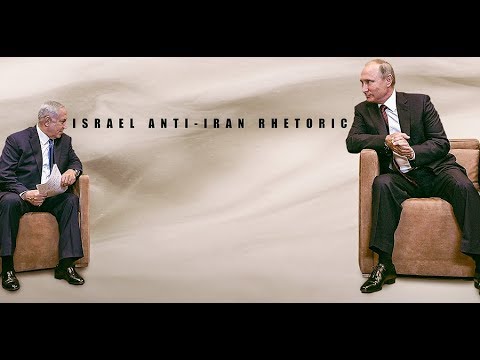
Prime Minister Benjamin Netanyahu has said that Israel felt threatened by Iran’s growing influence in the Middle East. Netanyahu expressed his Iranophobic view in a meeting with Russian President Vladimir Putin in Russia’s Black Sea resort of Sochi on Wednesday. Press TV has asked Scott Rickard, former American intelligence linguist from Tampa, Florida, and Brent Budowsky, a columnist at The Hill from Washington, to give their thoughts on the issue.
Rickard said Tel Aviv is concerned about the fact that the regime could not carry out its old project to spread sectarian divisions and pave the way for dismemberment of the countries in the Middle East region because of the Iranian-led resistance against Israeli policies, not only in the occupied territories of Palestine but also in the whole region.
“Iran is not a threat to Israel whatsoever. The threat that Israel sees is the fact that their Oded Yinon Plan is being put to a hold by Iran,” the intelligence linguist said on Thursday night.
“They (the Israelis) look at Iran as a threat only because they have no influence on their governments and Iran is autonomous and is not under the Zionist influence,” he added.
Since the victory of the Islamic Republic of Iran in 1979, Tehran has been critical of Israel’s policies in the region, whereas “no leaders [of other states] even dared to speak out against Zionism,” Rickard argued. … continue
Blog Roll
 Aletho News
- Iran declares ‘historic victory’ over US, says enemy forced to accept its proposal
- Trump Claims Ceasefire, Reopening of Strait of Hormuz Agreement with Iran
- Israeli tank fire killed UN peacekeeper in Lebanon, UNIFIL investigation finds
- Russia, China block Bahrain-sponsored UN resolution on Strait of Hormuz
- The US-Israeli War on Science is an Assault on our Future
- Trump’s Promise to Bomb Iran ‘Like Never Before’ Faces Brutal Logistics — Expert
- Germany seeks to restrict stays abroad for men of fighting age – Berliner Zeitung
- Evidence points to Ukraine being behind TurkStream attempted sabotage, but that should come as no surprise
- Sri Lanka secures supplies of Russia oil – minister
- Nations across Asia strike direct deals with Iran for Hormuz passage
- If Americans Knew
- Thousands dead and neighborhoods razed to the ground: Aid agencies fear southern Lebanon is becoming the new Gaza
- The war the US is fighting for Israel could cost trillions
- ‘Cigarette Burns, Nail Wounds’: Toddler Tortured in Gaza to Coerce Father
- Trump Says US Sent ‘a Lot of Guns’ to Protesters in Iran
- Israeli forces destroy 17 UN peacekeeper cameras in south Lebanon
- US-Israeli strikes ‘completely destroy’ synagogue in Tehran
- Archbishop for US Military Says Iran War Is Unjust Under Catholic Teaching
- Iranian leaders’ Open Letters to the American People
- Trump says Iranians appreciate bombs, WHO warns of nuclear risks – Daily Update
- U.N. experts demand Israel release prominent Gaza doctor after reports of ‘severe torture’
- No Tricks Zone
- An Inconvenient Tree: Uncovered In Alps… Europe Much Warmer Than Today 6000 Years Ago
- New Study Reports A 60% Slowdown In Greenland’s Ice Loss Rate In The Last Decade
- Low Intensity Tornado Wrecks Major Solar Farm, Creating A Potential Toxic Dump
- New Study Finds Warming Saves Lives…Cold Temperatures 12 Times More Deadly Than Excess Heat
- German Science Blog Accuses PIK Climate Institute Of Hallucinating Climate Tipping Points
- Devastating Assessment Of Comirnaty Vaccine By Former Senior Pfizer Europe Toxicologist
- New Study: CO2 Is ‘Effectively Negligible’ As An Explanatory Climate Change Factor Since 2000
- Former Pfizer Toxicologist Dr. Helmut Sterz Tells Bundestag Hearing Pfizer Vaccine Should Have Never Been Approved
- Energy Expert: Germany’s Nuclear Phaseout Was A “500 Billion Euro Mistake”
- New Research: South Australia’s Mid-Holocene Sea Surface Temperatures Were 4°C Warmer Than Today
 Aletho News