Why Is Assad An Insane Suicidal Monster? – #PropagandaWatch
corbettreport | September 17, 2018
As we know from the political puppets and their mouthpieces in the controlled corporate media, Syrian President Basher al-Assad is a bloodthirsty monster responsible for the wanton slaughter of (fill in the number) of his own citizens, and he particularly enjoys dropping chemical weapons on women and children despite knowing that this is the one thing that will bring him universal condemnation and ensure a full-scale assault on his country. . . But why? Why is he such a monster? That is the question, and the New York Times offers its own helpful explainer with predictably comic results. Don’t miss this edition of #PropagandaWatch from The Corbett Report.
SHOW NOTES: https://www.corbettreport.com/?p=28173
A Test of the Tropical 200-300 mb Warming Rate in Climate Models
By Ross McKitrick | Climate Etc. | September 17, 2018
I sat down to write a description of my new paper with John Christy, but when I looked up a reference via Google Scholar something odd cropped up that requires a brief digression.
Google Scholar insists on providing a list of “recommended” articles whenever I sign on to it. Most turn out to be unpublished or non-peer reviewed discussion papers. But at least they are typically current, so I was surprised to see the top rank given to “Consistency of Modelled and Observed Temperature Trends in the Tropical Troposphere,” a decade-old paper by Santer et al. Google was, however, referring to its reappearance as a chapter in a 2018 book called Climate Modelling: Philosophical and Conceptual Issues edited by Elizabeth Lloyd and Eric Winsberg, two US-based philosophers. Lloyd specifically describes herself as “a philosopher of climate science and evolutionary biology, as well as a scientist studying women’s sexuality” so readers should not expect specialized expertise in climate model evaluation, nor do the book’s editors exhibit any. Yet Google’s algorithm flagged it for me as the best thing out there and positioned two of its chapters as top leads in its “recommended” list.
Much of the first part of the book is an extended attack on a 2007 paper by David Douglass, John Christy, Benjamin Pearson and Fred Singer on the model/observational mismatch in the tropical troposphere. The editors add a diatribe against John Christy in particular for supposedly being impervious to empirical evidence, using flawed statistical methods and refusing to accept the validity of climate model representations of the warming of the tropical troposphere.
By way of contrast, and as an exemplar of research probity, they reproduce the decade-old Santer et al. paper and rely entirely on it for their case. If they are aware of any subsequent literature (which I doubt) they don’t mention it. They fail to mention:
- Santer bitterly fought releasing his data
- Despite having data up to 2007 he truncated his sample at 1999
- If he had used the same methodology on the full data set he’d have reached the opposite conclusion, supporting Douglass et al. rather than supposedly refuting them
- Steve McIntyre and I submitted a comment to the journal showing this. It was rejected, in part because the referee considered Santer’s statistical method invalid and didn’t want it perpetuated through further discussion
- We re-cast the article as a more detailed discussion of trend comparison methodology and published it in 2010 in Atmospheric Science Letters. We confirmed, among other things, that based on modern econometric testing methods the gap between models and observations in the tropical troposphere is statistically significant.
Ofgem exploited national security law to silence us, whistleblowers claim
By Paul Homewood | Not A Lot Of People Know That | September 17, 2018
From the Guardian :
Britain’s energy regulator has been fighting to keep secret the claims of two whistleblowers who independently raised concerns about potentially serious irregularities in projects worth billions of pounds, the Guardian can reveal.
The two men say Ofgem threatened them with an obscure but sweeping gagging clause that can lead to criminal prosecutions and possible jail terms for those who defy it.
MPs and the whistleblowing charity Protect fear Ofgem is abusing its position and exploiting a law that was intended to protect UK national security – not a regulator from potential embarrassment.
The Labour MP Peter Kyle said: “Whistleblowers save lives and protect our economy from harm; they should be protected by law, not have it used against them.”
One of the whistleblowers told the Guardian he was “continually threatened … for trying to tell the truth. For doing my job and uncovering an issue, Ofgem made my life hell.”
He said the regulator had attempted to “scare me witless with threats of imprisonment” and he felt “utterly ashamed” of Ofgem’s behaviour.
Ofgem said it encouraged staff to report suspected wrongdoing and took their concerns seriously.
Both men worked for Ofgem in entirely different areas of the business and were regarded as qualified experts in their respected fields.
One was Greg Pytel, an economist with oversight of the rollout of the £10.9bn smart meter programme, which is due to be completed in 2020.
Smart meters are electronic devices for homes and businesses that measure the use of electricity and gas. They are designed to make billing easier and to help energy companies manage the supply of electricity more efficiently.
The second whistleblower, who has asked to remain anonymous, worked on the renewable heat incentive (RHI), which offers financial rewards to promote the use of new technologies such as green boilers.
The scheme, which started in 2011, has been controversial – and could eventually cost taxpayers £23bn. Both projects are key to the government’s stated aim of making the UK a low-carbon economy.
The two whistleblowers do not know each other and have not been involved in each other’s cases. They say they are only linked by the reaction of Ofgem to their claims.
They found themselves in similar positions after being tasked with scrutinising elements of the two major projects they were working on between 2014 and 2017. Both raised concerns with their managers.
Instead of welcoming their input and investigating their concerns, the men allege they were bullied, treated unfairly and sidelined to such an extent they felt compelled to bring their grievances to an employment tribunal.
The RHI whistleblower claimed he was “continually ignored or threatened.” In both instances, the men say they were told they would not be allowed to reveal to the tribunal, or anyone else, the concerns they had. They say Ofgem warned them that the details were protected by Section 105 of the Utilities Act 2000.
This prohibits the disclosure of certain types of evidence relevant to the energy sector – and it is so restrictive that those who ignore it can be fined or jailed for up to two years.
At an early hearing of Pytel’s case, the tribunal ruled Ofgem was required to disclose his documents about public procurement arrangements for the smart meter programme, citing the Human Rights Act. It said he had the right to freedom of expression without interference from a public authority. But Ofgem has against appealed the decision.
Peter Daly at Bindmans, the legal firm that is acting for Pytel, said: “Ofgem’s position appears to be that anyone who disclosed or reported the content of his whistleblowing would be themselves committing a criminal offence.
“They [Ofgem] are appealing an employment tribunal order to provide disclosure in the proceedings because they say to do so would be a criminal offence. Ofgem’s appeal therefore indicates that in Ofgem’s view this prohibition extends to Ofgem themselves.”
Daly says if Ofgem wins this legal battle, it would “have a corrosive and asphyxiating effect on the rights of whistleblowers in the energy sector and would create a binding precedent.”
A second hearing of the case will take place in October.
The second whistleblower has described the alleged reaction of his managers when faced with the concerns he raised. “Specifically I was told that if I told the truth, my career with Ofgem would be finished.”
Despite the threats, he said, he briefed the National Audit Office – a move that infuriated Ofgem, he claimed.
He said a senior manager “screamed and shouted” at him, and he was then warned his disclosures were a breach of section 105 of the Utilities Act 2000.
The whistleblower says he left Ofgem last year after being “threatened with imprisonment if I shared information about the wrongdoings that I had witnessed”. He has described Ofgem as being “dishonestly secretive”.
Kyle, a member of the business, energy and industrial strategy select committee, said: “Ofgem do have many commercial secrets that are vital to the wellbeing of our nations’ infrastructure, but the power they have to gag whistleblowers is an extreme one and should be used in only extreme circumstances.
“I’m now extremely concerned about the potential abuse of these powers. Parliament might need to look at who has oversight and scrutiny of them and see if the law needs updating.”
Protect, formerly Public Concern at Work, has been helping both of the Ofgem whistleblowers, and has intervened in one of the ongoing legal cases.
The body’s chief executive, Francesca West, said: “The whole of the UK energy market – that’s more than 600,000 workers – are currently being held to ransom over Section 105 of the Utilities Act, and threatened with a prison sentence if they speak up over wrongdoing. It is utterly shameful.
“Our society needs whistleblowers to speak up, to stop harm. But we also need organisations to be honest, open and operate legally.”
Ofgem said it had only had to consider the use of section 105 once in the last five years.
“In carrying out our duties as the energy regulator, Ofgem handles large amount of information from consumers and businesses which is often both personal in nature and commercially sensitive.
“With the exception of a few prescribed circumstances, section 105 of the Utilities Act 2000 prohibits the disclosure of the information we receive. Section 105 is intended to ensure that consumers and businesses can share their information without fear that it may be subsequently disclosed. Ofgem takes our obligations under law very seriously, including the restrictions in section 105.
“Ofgem adheres to its whistleblowing policy which encourages staff to report suspected wrongdoing as soon as possible, in the knowledge that their concerns will be taken seriously and investigated.”
Curiously the Guardian gives no hint of what the two whistleblowers wanted to tell us.
It does not take a genius to work out the whole smart meter programme has been highly flawed from the outset, and an obscene waste of billions of pounds.
As for the RHI, many more billions are being wasted, often on environmentally damaging projects, and again for the same reasons of reducing CO2 emissions.
The fact that the Guardian has been wholeheartedly behind both schemes might give a clue as to why they are reluctant to tell the whole story.
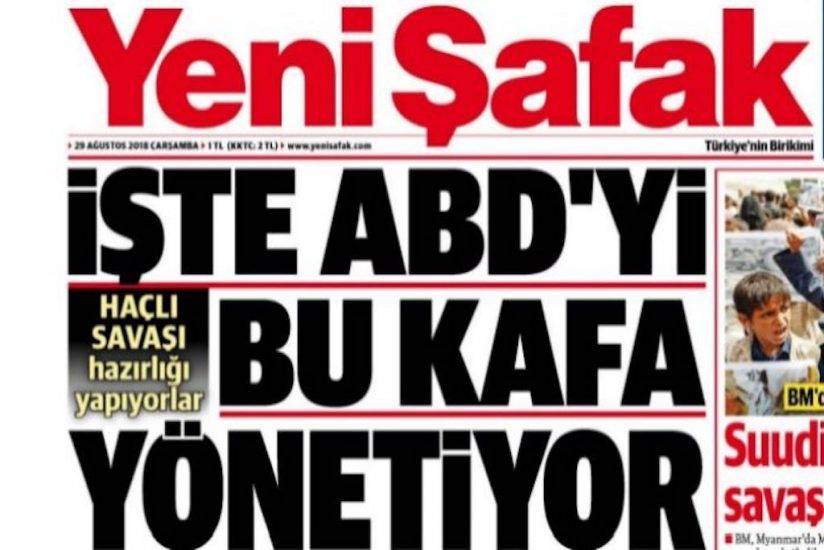
Turkey’s pro-Erdoğan daily declares Trump, Pence ‘lunatics of a deviant sect’
There Are No Sunglasses | September 17, 2018
The pro-Erdoğan Turkish Yeni Şafak daily claimed on Wednesday that US President Donald Trump and US Vice President Mike Pence are pondering a “crusade,” saying the US is run by the “lunatics of a deviant sect.”
“The world is facing the attacks of the Zionist-Christian sect of evangelicalism. The ‘superpower’ US is run by neocon evangelicals who espouse wiping out humanity to get to paradise. The lunatics of this deviant sect, US President Trump, who can shake the markets with a tweet, and his deputy Pence are a threat to humanity,” said the daily in its lead story.
“If Pence becomes president, it will pave the way for the US turning into a religious state,” the daily asserted, adding that Trump has been using the detention of American pastor Andrew Brunson in Turkey to get the support of evangelicals in the November 2018 congressional elections.
Yeni Şafak’s story was also shared on the websites of the Sabah, Takvim and Akşam newspapers, which are run by people close to Turkish President Recep Tayyip Erdoğan.
Turkey has been experiencing a currency crisis since its relations with the US administration were dramatically strained over a court decision to put American pastor Brunson under house arrest after almost two years in pretrial detention rather than release him as demanded by the US administration.
Following the court ruling, Trump and Pence threatened to impose “large sanctions” on Turkey if Brunson were not freed.
After declaring economic sanctions on two Turkish ministers on Aug. 1 for their role in Brunson’s continuing detention, Trump on Aug. 10 ramped up his attack on Turkey by doubling US tariffs on Turkish aluminum and steel imports to 20 percent and 50 percent, respectively.
“Some unaware people among us think that their target is Tayyip Erdoğan. No, the target is Turkey. The target is Islam,” Erdoğan said on Aug. 26, linking regional conflicts and the ongoing currency crisis in Turkey to previous attempts to invade Anatolia.
Erdoğan on Aug. 20 said, “attacks against the Turkish economy are no different than attacking the adhan [call to prayer] and the flag.” (turkishminute.com)
Putin & Erdogan agree Idlib buffer zone to avert new Syria crisis
RT | September 17, 2018
Russia and Turkey have agreed a “demilitarized zone” between militants and government troops in Syria’s Idlib, President Vladimir Putin said after hours-long talks with Turkey’s Recep Tayyip Erdogan focused on solving the crisis.
“We’ve focused on the situation in the province of Idlib, considering presence of large militant groups and their infrastructure there,” Putin said at a press conference after the talks.
“We’ve agreed to create a demilitarized zone between the government troops and militants before October 15. The zone will be 15-20km wide, with full withdrawal of hardline militants from there, including the Jabhat Al-Nusra.”
As part of solving the deadlock, all heavy weaponry, including tanks and artillery, will be withdrawn from the zone before October 10, Putin said. The zone will be patrolled by Turkish and Russian military units.
Before the end of the year, roads between Aleppo and Hama, and Aleppo and Latakia must be reopened for transit traffic, he said.
The agreement has received “general support” from the Syrian government, according to Putin.
The deal and other issues of Russian-Turkish ties apparently took almost 5 hours to hammer out. In what appears to a breakthrough solution, Putin and Erdogan have agreed to ensure peace with the help of Russian and Turkish troops.
“The territory controlled by the Syrian opposition must be demilitarized and the Syrian opposition that is holding these territories will remain there. But together with Russia we will make efforts to clear these territories of radical elements,” Erdogan said.
The agreement is designed to prevent a new “humanitarian crisis” in Syria, Erdogan stressed, and will help Turkey to avoid an even more “difficult situation.” He had previously warned of a surge in refugees hitting the country should a full-blown war break out in Idlib.
The plan is a major landmark for Syria, where the standoff in the last militant stronghold of Idlib has threatened to turn into a major international crisis in recent weeks. The US and other NATO countries backing anti-government forces had repeatedly warned Russia and Syria not to launch any new offensive in the region. US President Donald Trump tweeted earlier this month that to do so would be a “grave humanitarian error,” while US envoy to the UN Nikki Haley outright said that any Russian attack on Idlib would provoke “dire” consequences.
About 70 percent of Idlib province is controlled by various terrorist factions, including Al Qaeda’s Syria affiliate Hayat Tahrir al-Sham (formerly known as the Al-Nusra Front), according to the Russian military. At the same time, both Turkey and the West support various militant groups they consider as “moderate” opposition to Syrian President Bashar Assad’s forces.
This turned out to be a dilemma for Ankara, with the Turkish president simultaneously worried about Russia and Syrian action weakening the rebel groups, but also having concerns over the spread of terrorists and the potential influx of new refugees into areas bordering Turkey.
Now it appears that despite the rocky last few years of Russian-Turkish relations, the mutual trust built up between Putin and Erdogan has allowed them to overcome a clash of interests and reach a compromise.
Russian plane disappears from radars during Israeli attack on Syria’s Latakia – MoD
RT | September 17, 2018
A Russian military Il-20 aircraft with 14 service members on board went off the radars during an attack by four Israeli jets on Syria’s Latakia province, the Russian Defense Ministry said.
Air traffic controllers at the Khmeimim Air Base “lost contact” with the aircraft on Wednesday evening, during the attack of Israeli F-16 fighters on Latakia, said the MOD.
Russian radars also registered the launch of missiles from a French frigate in the Mediterranean on the evening of September 17.
Fourteen people were on board the plane at the time of the disappearance. A search and rescue mission is underway.
The Ilyushin 20 (IL-20) surveillance turboprop plane is an Electronic Intelligence (ELINT) platform, equipped with a wide range of antennas, infrared and optical sensors. The aircraft’s SLAR (Side-Looking Airborne Radar) and the plane’s satellite link allows the Russian military to monitor Syrian skies in real time.
An hour-long attack on Latakia began around 10 pm local time, and targeted a power station as well as two facilities belonging to the Syrian military. Syrian officials said the attack was “foreign” and came “from the sea,” but could not initially confirm rumors that Israel was behind it. Seven people were injured in the attack, according to Syrian officials.
While the Russian military said it recorded four F-16 Israeli jets over Syria at the time of the attack on Latakia, the IDF has refused to comment on the report.
The attack on Latakia came just hours after Russia and Turkey negotiated a partial demilitarization of the Idlib province, which is the last remaining stronghold of anti-government militants, including the Al-Qaeda affiliate Hayat Tahrir al-Sham (also known as the Jabhat Al-Nusra).
READ MORE:
Russia detects missile launches from French frigate off Syria’s coast in Mediterranean – MoD
Texas: ‘Arab rejection of Israel led to Israeli-Palestinian conflict’
Ma’an – September 17, 2018
BETHLEHEM – The State Board of Education of Texas, in the United States, voted to require teachers to teach students that the “Arab rejection of the State of Israel has led to ongoing conflict,” The Dallas Morning News reported.
The Jerusalem Post news outlet said that “this change will be made in ‘the rise of independence movements in Africa, the Middle East, and South Asia and reasons for ongoing conflicts’ section in high school social studies curriculum.”
The board also voted, over the weekend, to remove certain historical figures from the teaching syllabus, such as former first lady and secretary of state Hillary Clinton and author and political [anti-war] activist Helen Keller, as part of an effort to “streamline” the curriculum in public schools.
Reportedly, “the board also included Moses as an influence on the writing of the nation’s founding documents, while it removed political philosopher Thomas Hobbes from that section.”
The Dallas Morning News also reported that the voting was not final yet and could be amended by the board before the final vote in November.
This is not the first time all eyes focused on Texas’s education system. “In 2002 and 2014, the board adopted a new generation of social studies products. Moses was mentioned explicitly in learning standards in Texas, and publishers responded by including him in textbooks,” according to National Public Radio.
Forget Putin, Trump is Acting in Every Way Like Netanyahu’s Manchurian Candidate
By Miko Peled | Mint Press News | September 15, 2018
In the months leading up to the 25th anniversary of the Oslo Accords, the U.S. has colluded with Israel in a string of policies and decisions that completely undermine the legitimacy of the agreement, not to mention Palestinian claims to justice, freedom and ultimately peace. As these policies unfold, one cannot help recalling the words of the great Palestinian writer Ghassan Kanafani, who said that talking with the Israelis is “a conversation between the sword and the neck.”
There is a clear common thread that binds several of the U.S. policies enacted by President Donald Trump since last December. Moving the U.S. embassy from Tel Aviv to Jerusalem; pulling out of the Iran agreement; defunding UNRWA, and closing the PLO mission in D.C. all satisfy the objectives of the Israeli government while not benefiting the United States in the least. One might imagine that the United States is executing Israel’s policy, reading as it were from a menu that was provided by Benjamin Netanyahu. In fact, the Trump administration is every Israeli prime minister’s dream.
Jerusalem
Moving the U.S. embassy from Tel Aviv to Jerusalem was reckless, dangerous and absurd. The occupation and annexation of Jerusalem by Israel was in violation of UN resolution 181 from November 1947, which states in “Part III, City of Jerusalem” that:
“The City of Jerusalem shall be established as a corpus separatum under a special international regime and shall be administered by the United Nations. The Trusteeship Council shall be designated to discharge the responsibilities of the Administering Authority on behalf of the United Nations.”
Resolution 194 from December 1948 — in other words, more than a year after Resolution 181 was passed and the western half of Jerusalem was occupied and subjected to a total full ethnic cleansing, where not one Palestinian was permitted to remain — reiterates this:
8 | Resolves that, in view of its association with three world religions, the Jerusalem area, including the present municipality of Jerusalem plus the surrounding villages and towns, the most eastern of which shall be Abu Dis; the most southern, Bethlehem; the most western, Ein Karim (including also the built-up area of Motsa); and the most northern, Shu’fat, should be accorded special and separate treatment from the rest of Palestine and should be placed under effective United Nations control …
For this reason all diplomatic missions to Israel are situated in Tel Aviv and not Jerusalem. The diplomatic missions in Jerusalem mostly pre-date the establishment of the State of Israel and are considered sovereign and independent of their countries’ embassies in Tel Aviv. Even the U.S. consulate until recently reported directly to Washington, and the consul general was in fact an ambassador. This was not unlike placing the U.S. embassy to France in Berlin and — according to sources I spoke to at the U.S. consulate in Jerusalem — now that the ambassador’s office was moved to Jerusalem, the place is in a state of confusion and it is not at all clear who is responsible for what.
In addition to all of the above, the recognition of Jerusalem as the capital city of Israel legitimizes the crime of ethnic cleansing and destruction which Israel has perpetrated in Jerusalem since 1948. This move did not benefit the U.S. in any way but it boosted Benjamin Netanyahu’s political power, and can be viewed as nothing less than a personal political gift from the president of the United States to Netanyahu.
Iran Deal
Israel, and Netanyahu, in particular, have been against the nuclear deal with Iran from the very beginning. Needing a diversion from its own war crimes and violations of international law, Israel has for many years pointed to Iran as a threat to itself and the rest of the world. This was a point of serious disagreement between the Obama administration and Israel and then Donald Trump put the disagreement to rest and the U.S. withdrew from the agreement.
According to a piece in Rand.com, Trump withdrew the U.S. from the agreement “despite a lack of evidence that Iran is violating the agreement. To the contrary, the International Atomic Energy Agency has verified Iran’s compliance numerous times.” The article continues by saying, “the implications of this decision could be disastrous for the Middle East under any conceivable scenario.”
A piece in the British Independent bluntly claims that:
“The president’s foreign policy has so far been marked by a significant ratcheting of tensions with Iran, driven by his administration’s noted friendliness towards Israel, which opposes the [Iran nuclear] deal.”
According to a report from August 2018 by the IAEA, the International Atomic Energy Agency:
“Since Implementation Day, the Agency has been verifying and monitoring the implementation by Iran of its nuclear-related commitments under the JCPOA.” The report states that among other things:
“Since 16 January, 2016 [JCPOA Implementation Day], the Agency has verified and monitored Iran’s implementation of its nuclear-related commitments in accordance with the modalities set out in the JCPOA.”
The report states clearly that Iran was and continues to be compliant in all areas of the agreement. All the other countries that are signatories to the agreement remain committed to it, and they all insisted that a U.S. withdrawal was a mistake. Only one person insisted the U.S. must withdraw, and that is Benjamin Netanyahu, and he is the one person whose claims President Trump decided to accept. Once again, the United States had nothing to gain and everything to lose from the withdrawal and once again Netanyahu personally gained political strength as the sole voice to which the president of the United States listens.
UNRWA
The United States can see no benefit whatsoever in denying UNRWA funding; yet this is what the Trump administration decided to do. The very agency responsible for providing relief, albeit inadequate, to the refugees of Palestine was receiving $300 million per year, which is a drop in the bucket in terms of relief and of course in terms of the U.S. government’s total budget. In an open letter to Palestine refugees and UNRWA staff, dated September 1, 2018, Pierre Krähenbühl, UNRWA Commissioner-General, writes,
“The need for humanitarian action … in the case of Palestine refugees, was caused by forced displacement, dispossession, loss of homes and livelihoods, as well as by statelessness and occupation. … [T]he undeniable fact remains that they have rights under international law and represent a community of 5.4 million men, women and children who cannot simply be wished away.”
“The attempt to make UNRWA somehow responsible for perpetuating the crisis is disingenuous at best,” the commissioner said, responding to claims made by Netanyahu that “UNRWA is an organization that perpetuates the problem of the Palestinian refugees.” Netanyahu also stated that UNRWA “perpetuates the narrative of the so-called ‘right of return,’” which the state of Israel fears — and therefore, according to Netanyahu, “UNRWA must disappear.”
According to The New York Times, this move was pushed hard by Jared Kushner, Trump’s son-in-law, “as part of a plan to compel Palestinian politicians to drop demands for many of those refugees to return.” The right of the refugees to return is enshrined in UN Resolution 194, and one wonders why the U.S. should object to Palestinian demand for return of the refugees to their homes? Once again this is a gift to Netanyahu, who wants to see the refugee issue disappear.
PLO Mission
A product of the Oslo Accords, the PLO mission in Washington is the de-facto embassy of Palestine, the face and the voice of the Palestinian Authority in the U.S. Now, almost exactly on the 25th anniversary of the signing of the Accords, the Trump administration announces the closing of the mission. It could have come as no surprise when Netanyahu, who fiercely opposed the Accords, applauded the U.S. administration decision. This was yet one more insignificant step for the U.S., and one giant gift to Benjamin Netanyahu.
No bad reviews? Amazon employees might have deleted them for bribes
RT | September 17, 2018
Some Amazon employees have reportedly been bribed by sellers to remove bad reviews of products sold through the online retail giant. The average bribe is around $300 per review, with most of the demand coming from China.
The retail giant has launched an internal investigation into the shady practice, with a probe ongoing since May, when Eric Broussard, Amazon’s vice president, was reportedly notified of the problem, the Wall Street Journal reported on Sunday.
The transactions were facilitated by middlemen who used the messaging service WeChat in China.
Citing people familiar with the scheme, the WSJ reported that it costs around $300 to delete one review. However, brokers prefer to trade wholesale, with the minimum number of reviews for removal standing at five.
Depending on the type of data and its volume, the brokers also charge between $80 and $2,000 for coveted data.
Up for grabs are internal sales statistics, including keywords, as well as an option to delete reviews or buy customers’ email addresses.
One of the incentives prompting Amazon workers to go down this slippery slope and violate strict internal regulations that ban sharing sales and customer data, is the relatively low wages they receive in China, the publication notes.
Amazon has come under fire in the past for underpaying its employees and forcing them to work in harrowing conditions not only in China, but also across Europe and in the US. An undercover journalist working at an Amazon warehouse in Staffordshire, UK reported that workers are forced to pee in bottles so as not to miss work targets. In the US, a group of employees recently complained of exhaustion, dehydration and fatigue, as they were working without air-conditioning in the company’s warehouse in Minnesota.
At the moment, several suspected bribery cases, including one in the US, are reportedly being investigated by Amazon.
A spokesperson for the company has confirmed that the probe is ongoing, noting that it has been taking steps to avert the malpractice happening in the future by installing systems that would restrict workers’ access and monitor their actions.
While the trustworthiness of online reviews is crucial for businesses like Amazon, since online buyers are not able to examine a product themselves, it has long been plagued by the problem of fake reviews.
FakeSport.com founder Saoud Khalifah has recently estimated that some 30 percent of Amazon reviews are probably fake, with the number nearing 95 percent for “Chinese no-name companies.”
Read more:
Featured Video
John Mearsheimer: US Already lost Iran war – No off-ramp in sight
or go to
Aletho News Archives – Video-Images
Frlom the Archives
With apparently fabricated nuclear documents, Netanyahu pushed the US towards war with Iran
By Gareth Porter | The Grayzone | April 29, 2020
President Donald Trump scrapped the nuclear deal with Iran and continued to risk war with Iran based on Israeli Prime Minister Benjamin Netanyahu’s claim to have proven definitively that Iran was determined to manufacture nuclear weapons. Netanyahu not only spun Trump but much of the corporate media as well, duping them with the public unveiling of what he claimed was the entire secret Iranian “nuclear archive.”
In early April 2018, Netanyahu briefed Trump privately on the supposed Iranian nuclear archive and secured his promise to leave the Joint Comprehensive Plan of Action (JCPOA). That April 30, Netanyahu took the briefing to the public in a characteristically dramatic live performance in which he claimed Israel’s Mossad intelligence services had stolen Iran’s entire nuclear archive from Tehran. “You may well know that Iran’s leaders repeatedly deny ever pursuing nuclear weapons…” Netanyahu declared. “Well, tonight, I’m here to tell you one thing: Iran lied. Big time.”
However, an investigation of the supposed Iranian nuclear documents by The Grayzone reveals them to be the product of an Israeli disinformation operation that helped trigger the most serious threat of war since the conflict with Iran began nearly four decades ago. This investigation found multiple indications that the story of Mossad’s heist of 50,000 pages of secret nuclear files from Tehran was very likely an elaborate fiction and that the documents were fabricated by the Mossad itself. … continue
Blog Roll
 Aletho News
- US failures in Iran reveal Russia is key to South Korea’s strategic security
- ‘All ports in Persian Gulf will be legitimate targets if Iranian ports are attacked’
- 40 Years of Endless War, Data Point by Data Point
- Department of War Using Palantir AI to Pick Targets in Iran
- American bases do not protect – they attack the peoples of the Persian Gulf
- ‘We’ve Obliterated Their Missiles’
- Syrian president vows ‘absolute support’ to disarm Hezbollah
- Ukraine attacking Russian gas pipeline to stop deliveries to Europe – Defense Ministry
- ‘Heinous crime’: Iran denounces Israeli assassination of 4 Iranian diplomats in Lebanon
- John Mearsheimer: U.S. Already Lost Iran War – No Off-Ramp in Sight
- If Americans Knew
- Israeli strategic plans to “remake the Middle East” from the 1950s and since
- Honoring Gaza’s women who refused to let the world look away
- 97% of victims of war on Iran are Iranian, 98% of victims in war on Gaza are Gazans – Not a ceasefire Day 152
- Early Iran strikes cost $5.6 billion in munitions, Pentagon estimates
- Israel Decided the War, But Trump’s America Fights and Pays the Bill
- Conscientious Objector Group: Phone ‘Ringing Off Hook’ As Huge Mobilization Underway
- U.S. support for Israel continues to plummet, despite media’s best efforts
- Threats and missiles fly, death tolls soar in Iran, Lebanon, Gaza – Not a ceasefire Day 151
- Lebanon: Israel’s White Phosphorous Use Risks Civilian Harm
- Corporate Media Go All Out To Support The US-Israeli War On Iran
- No Tricks Zone
- Destructive Green New Deal: German Energy And Metal Group Warns Of Drastic Crisis
- New Study Documents A 20-Year Pause In Arctic Sea Ice Decline – Driven By Internal Variability
- Wake-up Call: Survey Shows Majority Of Germans Now Favor Postponing Climate Targets!
- Televised! Leading German Political Candidate Tells Schoolchildren CO2 Makes Sun Hotter!
- New Study: A Century Warming Of 1.1°C Is ‘Commonplace’ And ‘Not Unusual’ During This Interglacial
- New Study: ‘Internal Noise’ And Volcanic Forcing Can Trigger 10-15°C Warming Within Decades
- Glaciers Worldwide Are Suddendly Surging, Experts Blame Warming!
- Surprising Discovery: Sahara Is Greening…Billions Of Trees Where Once Thought To Be Barren
- New Research Reaffirms Clouds, Aerosols, And Surface Solar Radiation Are ‘Driving The Climate System’
- Germany: Electric Car Catches Fire At Charging Station, Sets Off Local “Inferno”, Widespread Damage
 Aletho News