Court orders psychiatric evaluation for Marine Le Pen, she slams it as ‘hallucination’
RT | September 20, 2018
French politician Marine Le Pen said a court ordered her to undergo psychiatric evaluation over a series of images she posted on Twitter showing Islamic State executions. She slammed the order as a “hallucination.”
The president of France’s National Rally (formerly Front National) has released an order saying it comes from the magistrates in Nanterre near Paris, calling on her to “undergo a psychiatric examination.”
“For denouncing the horrors of Daesh (Islamic State/IS, formerly ISIS) by tweets the “justice system” has referred [me] to a psychiatric assessment. How far will they go?!” she tweeted in response.
The 2017 presidential candidate denounced the order as “a hallucination,” saying: “This regime is really starting to scare [us].”
French major outlet BMFTV, which also broke the story, said that the procedure was in fact a “common” occurrence. The comment did not go down well with Le Pen though, who branded the claim “a lie.” Such an examination is required of “pedophiles or [those with] sexual deviance,” she argued.
In December of 2015, Le Pen tweeted three pictures of killings carried out by IS terrorists accompanied by the text “Daesh [Arabic term for ISIS] is THIS!” The tweets had been a response to journalist Jean-Jacques Bourdin, who compared Le Pen’s nationalist rhetoric to that of the Islamic terrorist group.
One of the pictures showed the body of James Foley, whom the extremists beheaded in August 2014. Back then his family said they had been “deeply disturbed by the unsolicited use of Jim for Le Pen’s political gain.”
Le Pen later deleted the images. Speaking to French media earlier this year she said that she is being charged for “having condemned the horrors of Daesh.”
If convicted, the politician faces a maximum punishment of a €75,000 fine and up to three years in prison.
A number of politicians have lambasted the judges’ decision towards Le Pen. According to National Assembly member Gilbert Collard, the order simply means “the psychiatrization of political opinion.”
Italian Deputy Prime Minister Matteo Salvini also took to Twitter to express support for the French politician. “A court orders a psychiatric assessment for Marine Le Pen. Words fail me! Solidarity with her and with the French who love freedom!” he wrote.
This is not the first time Marine Le Pen has locked horns with the authorities. In 2017, roughly two months before the presidential election, she was summoned by judges for alleged misuse of EU funds. The court said that Le Pen’s staff was fictitiously employed at the European Parliament as assistants. She denied the allegations.
This July, French judges blocked €2 million of subsidies to Le Pen’s party. Le Pen condemned the move as “a blow to democracy,” since withholding the funding would likely result in her party becoming defunct.
Iran urges UN to censure Israel’s nuclear threat, make it respect international rules
Press TV – September 20, 2018
Tehran has written to the United Nations, calling on the world body to condemn Israel for threatening Iran with a nuclear attack and bring the regime’s atomic weapons program under its supervision.
Standing right beside the Dimona nuclear facility late last month, Israeli Prime Minister Benjamin Netanyahu described Iran as a “threat” to the region and said Tel Aviv has the means to destroy its “enemies” in a veiled reference to Tel Aviv’s nuclear arsenal.
“Those who threaten to wipe us out put themselves in a similar danger, and in any event will not achieve their goal,” he said. “But our enemies know very well what Israel is capable of doing. They are familiar with our policy. Whoever tries to hurt us – we hurt them.”
In a letter addressed to the UN on Thursday, the Permanent Mission of the Islamic Republic of Iran to the world body said Netanyahu’s belligerent remarks poses “a serious threat to international peace and security.”
It also urged the UN to make Israel abide by international rules and the UN Charter.
The letter also highlighted Israel’s long history of aggression, occupation, militarism and state terrorism among other international crimes, urging the world community to take a firm position on the Zionist regime’s “unbridled actions and nuclear threat.”
In the letter, Iran further demanded that the UN condemn Israel’s anti-Iran threat, make the regime join the Nuclear Non-Proliferation Treaty (NPT) and bring its nuclear program under the supervesion of the International Atomic Energy Agency (IAEA).
It also reminded the UN that Iran is itself a victim of weapons of mass destruction, particularly chemical weapons.
The UN member states should not turn a blind eye to Israel’s threat and make efforts towards to the elimination of its entire nuclear stockpile, the letter read.
Responding to Netanyahu’s highly aggressive comments, Foreign Minister Mohammad Javad Zarif slammed the premier as “warmonger” and said the threat was “ beyond shameless.”
“Iran, a country without nuclear weapons, is threatened with atomic annihilation by a warmonger standing next to an actual nuclear weapons factory. Beyond shameless in the gall,” Zarif tweeted.
Israel is the only possessor of nuclear weapons in the Middle East, but its policy is to neither confirm nor deny that it has atomic bombs. The Tel Aviv regime is estimated to have 200 to 400 nuclear warheads in its arsenal.
Unlike Iran, the regime is not a member of the NPT — whose aim is to prevent the spread of nuclear arms and weapons technology – in defiance of international pressure.
Japanese Abu Town Mayor Opposes Aegis Ashore Deployment Nearby
Sputnik – 20.09.2018
Norihiko Hanada, the mayor of the Japanese town Abu, said on Thursday he was opposed to the deployment of Aegis Ashore component of the US ballistic missile defense system next to the town, NHK reported.
The mayor argued that such a deployment could be detrimental to the safety and security of the town residents, the NHK broadcaster reported.
According to the outlet, the town’s assembly has unanimously voted to back the residents’ petition against such a deployment.
The government wants to set up an Aegis Ashore unit at a military training range in the city of Hagi, next to Abu, while another unit is expected to be installed in the city of Akita.
In March, Japanese Foreign Minister Taro Kono said, in response to concerns voiced by Russia, that the system was needed to ensure Japan’s protection against North Korea’s missile and nuclear capabilities. Pyongyang has launched several missile and nuclear tests in the last few years. However, North Korea has not had one test since the beginning of 2018 as its relationship with South Korea began to improve.
U.S. Perversity on Peace in Korea
By Jacob G. Hornberger | FFF | September 19, 2018
Just when you think that the U.S. national-security state’s policy toward Korea can’t get more perverse, it does. The latest perversion? Opposing a peace agreement between North Korea and South Korea! Imagine that. And why would U.S. officials oppose such an agreement? Because it would inevitably lead to calls for U.S. troops in Korea to be sent packing home to the United States. After all, when a peace agreement is entered into, what would be the justification for keeping U.S. troops in that faraway land?
Don’t believe me? Well, take if from the New York Times, one of the most mainstream papers in the country:
President Moon Jae-in of South Korea arrived in Pyongyang Tuesday for his third summit with Kim Jong-un, North Korea’s leader, to work toward a common goal: fashioning a political statement this year declaring the end of the Korean War. Such a declaration, although not a legally binding treaty, could carry far-reaching repercussions, helping North Korea escalate its campaign for the withdrawal of American troops from the South, analysts said. For that and other reasons, the United States has strong reservations about such a breakthrough.
Why the strong reservations? Wouldn’t you think that U.S. officials would be ecstatic about the prospect of peace in Korea? Wouldn’t you expect that to be the response of any rational person?
Not for a regime that has come to view Korea as a constant flashpoint to keep people on edge and afraid, thereby assuring ever-increasing budgets for the Pentagon, the CIA, the NSA, and their army of contractors and sub-contractors. And not for a regime that has come to view Korea as a place that permanently bases tens of thousands of U.S. troops. And not for a regime that continues to target the North Korean regime for regime change.
A peace agreement between the two Koreas would threaten all of those things. Suddenly, the national-security state would lose one its principal flashpoints for crisis and fear, one that it has relied on since at least 1950. It would also mean having to bring all those troops home and trying to figure out what to do with them. And it would mean giving up its dream of regime change, at least through military force.
That’s why U.S. officials are so concerned about the ongoing improvement in relations between North and South Korea and the possibility that the two countries could enter into a peace agreement.
South Korean president Moon Jae-in and North Korea’s leader Kim Jong-un continue their efforts to improve relations between their two countries. They are currently holding their third summit, with Kim visiting Pyongyang, North Korea’s capital, for the first time ever. Kim was met by huge throngs of people, organized of course by the North Korean regime, cheering for Kim, waving flowers, and chanting “reunification of the fatherland.”
Left out of these negotiations are U.S. officials. But so what? Korea belongs to the Koreans, not to the Pentagon or the CIA. It’s their civil war, a civil war that the Pentagon and the CIA butted into more than 60 years ago, and without the constitutionally required congressional declaration of war. Koreans don’t need the permission of U.S. officials to resolve their war and their differences.
What is concerning U.S. officials is that the two leaders might reach an agreement that doesn’t involve “denuclearization” by North Korea. But the only reason that North Korea has nuclear weapons is to deter the Pentagon and the CIA from attacking and invading North Korea for the purpose of regime change. With no regime-change attack by the United States, North Korea’s nukes become irrelevant.
But there’s the rub: The Pentagon and the CIA refuse to give up their goal of regime change in North Korea. They don’t want U.S. troops to come home. They want to keep them in South Korea forever (just like they want to keep their wars in the Middle East and Afghanistan, their war on terrorism, and their war on drugs going on forever). In that way, there is always the chance that North Korea can be provoked into committing some provocative act that could serve as an excuse for bombing and destroying North Korea’s communist, anti-U.S. regime and replacing it with a pro-U.S. puppet regime.
Meanwhile, trying their best to ratchet up tensions and forcing North Korea to “denuclearize,” U.S. officials are doing everything they can to fortify their brutal systems of economic sanctions on the North Korea people, even lashing out against everyone they suspect is violating the sanctions, like Russia. They have to keep those North Korea citizens starving to death so that their public officials finally “denuclearize.”
In another perversity, South Koreans are being warned against violating U.S. sanctions by entering into mutually beneficial economic transactions with the North, such as working together to operate a passenger rail line between the two countries.
The best thing South Koreans could ever do for themselves and the American people would be to boot all U.S. troops out of their country, whether South and North arrive at a peace agreement or not. Korea remains no business of the Pentagon and the CIA. But at least the American people are getting to see the real truth about the U.S. national-security state and its perverse and destructive policies.
Tehran Has Sovereign Right to Develop Missile Program – Moscow
Sputnik – 19.09.2018
MOSCOW – Moscow believes that the development of the Iranian missile program is Tehran’s sovereign right, and all the issues arising in this regard should be resolved without pressure, especially military, at the negotiating table, Russian Deputy Foreign Minister Sergey Ryabkov told Sputnik.
“We have always supported resolving any problems that arise in interstate relations and in the dialogue on acute issues through negotiations and through relevant agreements,” Ryabkov said on Wednesday.
The deputy foreign minister further stressed that the developments in the situation around the Iran nuclear deal and other issues that American counterparts put in the context of this deal, as well as Iran’s behavior, attracted Russia’s close attention.
Speaking to Sputnik reporter, Ryabkov also revealed that the meeting of the five mediators and Iran at the level of foreign ministers will take place on the sidelines of the high-level week of the UN General Assembly at the end of September.
“The meeting of the participants of the Joint Comprehensive Plan of Action (JCPOA) — those who stayed in the agreement — will be held at the ministerial level,” the official stated.
He also noted that the definite time is being coordinated, and the European External Action Service is expected to make a relevant announcement in the near future. However, Ryabkov assured that it was certain that the meeting would take place.
The JCPOA stipulates the gradual removal of the West’s sanctions against Iran in exchange for Tehran maintaining a peaceful nature of its nuclear program. However, US President Donald Trump announced in May the withdrawal of the United States from the JCPOA and the reinstating of the first round of sanctions in August.
Israel gets far more than $38 billion under the new deal
By Nicole Feied | If Americans Knew | September 19, 2018
The AIPAC sponsored bill that guarantees $38 billion to Israel over the next ten years is a dramatic departure from the deal offered under President Obama’s 2016 Memorandum of Understanding (MOU).[1] Passed by the House of Representatives on September 12, 2018, the United States-Israel Security Assistance Authorization Act of 2018 effectively rolls back every limitation that President Obama placed on the amount of aid we give to Israel.
In addition, the House version provides Israel even more perks than the version passed by the Senate on August 11.
Most dramatically, this new act would eviscerate the ability of President Trump and his successors for the next ten years to withhold United States aid to Israel. Historically, almost every president since Eisenhower has attempted to withhold such aid at one time or another in order to force Israel to the peace table or to stop Israel from committing human right abuses or illegal acts such as taking Palestinian land and giving it to Israeli settlers.
In an unprecedented gift of our executive power to Israel, the House has passed for the very first time a law that forces the American president to give Israel a minimum of $3.8 billion per year. We have, in effect, crippled our ability to promote US interests in the Middle East.
President Eisenhower was the last American President who managed to use this threat effectively, when he forced Israel to withdraw from Egypt’s Sinai Peninsula in 1957.
Notably, President George Bush Senior failed miserably to make good on his threat to delay aid to Israel when their actions threatened a possible peace agreement with the neighboring Arab countries, complaining that he was “just one little lonely guy” in his battle against pro-Israel lobbyists. (New York Times, 1991 article, Bush Urges Delay On Aid For Israel; Threatens A Veto.)
Aid to Israel likely to increase even more
The second most important effect of this act is in Section 103. While the MOU limits the amount of aid we give Israel to the amount agreed upon, in this case $38 billion over 10 years, Section 103 of the current bill removes all limitations on how much we give Israel. Under the new act, instead of 38 billion being the cap, as Obama stipulated in his 2016 MOU, we must now give Israel a minimum of $3.8 billion per year until 2028.
Without a cap, and with incessant lobbying by Israel and her proxies in the United States, the amount we give could conceivably double over the next 10 years. This is a huge coup for Prime Minister Netanyahu and quite a slap in the face to the Obama administration.
Section 106 will increase Israel’s access to a war-reserve stockpile by completely removing the limits on how many precision guided missiles we can give Israel. The existing law set a maximum of $200 million worth of arms from the stockpile per year, to be charged against the agreed aid package.
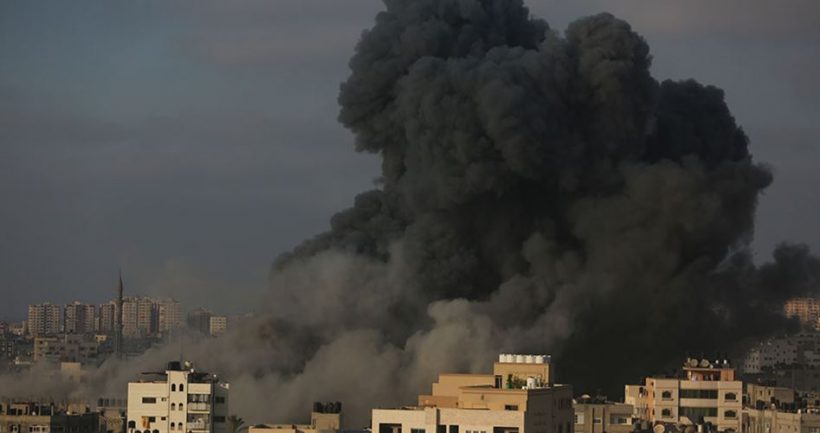
An Israeli official gloated that the package was obtained “despite budget cuts, including defense cuts, in the U.S.”
The House version of the bill differs from the Senate version, replacing the words “sell” and “sale” to “transfer,” which appears to open the door for more gifts in excess of the $38 billion. To put this in context, a Tomahawk Missile currently costs about $1 million. The media recently lambasted President Trump for using 60 such missiles in Syria because of the high cost.
Section 107 calls on the President to prescribe procedures for the rapid acquisition and deployment of precision guided munitions. The House text differs from the Senate version in that it removes all the detailed requirements for Israel to have such rapid acquisition. In the version just passed by the House, there is only one, extremely broad requirement, that Israel is under direct threat of missiles (in Israel’s opinion).
Israel can export U.S. arms
Section 108 of the Act authorizes Israel to export arms it receives from the U.S., even though this violates U.S. law. The Senate version included a provision calling on the President to make an assessment of Israel’s eligibility before adding Israel to the exemption list.
The House version deleted that requirement, and simply orders the American President to grant Israel the privilege. In fact, Israel is ineligible, having repeatedly made unauthorized sales in violation of this Act. The Export Act further forbids granting such an exemption to any country that is in violation of International Nuclear Non-proliferation Agreement, which Israel has refused to sign. Israel is known to be in possession of nuclear weapons, and hence in violation and ineligible for the export exemption. Congress thus reiterates the message that it will force the President to continue funding Israel even when that violates our laws.
NASA
Section 201 orders NASA to work with the Israel Space Agency, even though an Israeli space official has been accused of illegally obtaining classified scientific technology from a NASA research project. U.S. agencies periodically name Israel as a top espionage threat against the United States. The section also states that United States Agency for International Development (USAID) must partner with Israel in “a wide variety of sectors, including energy, agriculture and food security, democracy, human rights and governance, economic growth and trade, education, environment, global health, and water and sanitation.”
Israel eludes usual military aid requirement
All countries except Israel are required to spend US military aid on American goods. This ensures that the American economy benefits to some degree from these massive gifts. (Of course, if americans wished to subsidize these U.S. companies, money could be provided directly to them, and Israel and other countries left to buy their equipment with their own money.)
In the past, Israel has spent 40 percent of U.S. aid on Israeli companies, at the expense of U.S. industry. Under Obama’s 2016 MOU, this percentage was to be decreased over the 10-year span, and eventually Israel’s unique right not to spend use U.S. military aid to purchase items from American companies was to be ended. The new Act eliminates this requirement, putting Israeli economic interests before our own.
Many in Israel criticized Prime Minister Netanyahu for his aggressive attempts to undermine President Obama’s Iran deal, fearing that it would anger the White House and result in a less favorable aid offer. Analysts were particularly worried about what might happen if Trump were elected, since in 2016 he had said that he expected Israel to pay back the security assistance it receives from the US.
Yet just two years later it looks like the Israeli Prime Minister will obtain everything he sought and more. This is not surprising, since Trump, under extreme political pressure, is increasingly pandering to hardcore Israel supporters like billionaire Sheldon Adelson and South Carolina Senator Lindsay Graham. (Graham is a top recipient of pro-Israel campaign donations.[2])

Sheldon Adelson is known as the casino mogul who drives Trump’s Middle East policy

Lindsay Graham (R-SC) with pro-Israel billionaires Sheldon Adelson on his right and Haim Saban on his left. LobeLog reported: Over a glass of Riesling Graham described how to finance his campaign: “If I put together a finance team that will make me financially competitive enough to stay in this thing… I may have the first all-Jewish cabinet in America because of the pro-Israel funding. [Chuckles.] Bottom line is, I’ve got a lot of support from the pro-Israel funding.”
Netanyahu has demonstrated to the world that Israel can continue to act contrary to U.S. interests and still manage to get ever more military aid and greater concessions, greater access to U.S. secrets and technology, and greater control of U.S. foreign policy. An Israeli spokesperson crowed: “The landmark deal was reached despite budget cuts, including defense cuts, in the U.S.”
The bill now will go back to the Senate for approval, and then to Trump to be signed into U.S. law.
The $38 billion package amounts to $7,230 per minute to Israel, or $120 per second. And that’s before Israel advocates and ambitious politicians in our own country push it even higher.
Nicole Feied is an American writer and former criminal defense attorney, currently based in Greece. Alison Weir also contributed to the article.
Americans who wish to object, may contact their Congressional representatives here.
Informational cards to distribute about the bill, containing the top image, can be downloaded here.
1. The bill was timed to be introduced just before AIPAC’s 2018 annual conference in Washington D.C., so that delegates could lobby their representatives while they were in D.C.
2. Lobelog reported in 2015:
Sen. Lindsey Graham (R-SC) spoke bluntly about his plans for raising campaign funds for his prospective presidential campaign in an interview published today on “Washington Wire,” a Wall Street Journal blog. Over a glass of Riesling, according to the account, he answered a series of questions, including how he plans to finance his campaign.
He described “the means” as the biggest hurdle facing his potential campaign, adding:
If I put together a finance team that will make me financially competitive enough to stay in this thing… I may have the first all-Jewish cabinet in America because of the pro-Israel funding. [Chuckles.] Bottom line is, I’ve got a lot of support from the pro-Israel funding.
The House renamed the bill to honor Miami Congresswoman Ilean Ros-Lehtinen’s long service to Israel. The new name is now officially the “Ileana Ros-Lehtinen United States-Israel Security Assistance Authorization Act of 2018.”
Free Press Advocates Alarmed by US Government’s “Terrifying” Secret Rules for Spying on Journalists
Jessica Corbett – CommonDreams – September 17, 2018
Journalists and free press advocates are responding with alarm to newly released documents revealing the U.S. government’s secret rules for using Foreign Intelligence Surveillance Act (FISA) court orders to spy on reporters, calling the revelations “important” and “terrifying.”

The documents – obtained and released by the Freedom of the Press Foundation and the Knight First Amendment Institute at Columbia University through an ongoing Freedom of Information Act (FOIA) lawsuit filed last November – confirm long held suspicions that federal officials can target journalists with FISA orders.
New documents – obtained by @knightcolumbia and @FreedomofPress – appear to confirm longstanding suspicion that government has relied on Foreign Intelligence Surveillance Act to monitor journalist communications. @2ramyakrishnanhttps://t.co/VFDjk9oJqq pic.twitter.com/ybnEeuNsby
— Knight 1st Amendment (@knightcolumbia) September 17, 2018
The two 2015 memos from former Attorney General Eric Holder to the Federal Bureau of Investigation (FBI) lay out procedures to ensure that the attorney general or deputy attorney general signs off on any FISA applications “targeting known media entities or known members of the media.”
These secret rules, as Cora Currier reported for The Intercept, “apply to media entities or journalists who are thought to be agents of a foreign government, or, in some cases, are of interest under the broader standard that they possess foreign intelligence information.”
“There’s a lack of clarity on the circumstances when the government might consider a journalist an agent of a foreign power,” Ramya Krishnan, a staff attorney with the Knight Institute told Currier.
“Think about WikiLeaks; the government has said they are an intelligence operation.”
Additionally, even if they aren’t personally targeted by FISA orders, Krishnan pointed out that “journalists merely by being contacted by a FISA target might be subject to monitoring – these guidelines, as far as we can tell, don’t contemplate that situation or add any additional protections.”
Freedom of the Press Foundation executive director Trevor Timm noted that while “the fact that these were kept secret during the Obama administration is cause for great concern,” President Donald Trump “has repeatedly stated his hatred for the media, and his Attorney General Jeff Sessions has already tripled the amount of leak investigations since the Obama era (when they were already at an all time high).”
“This is critically important information at a time when press freedom has been under threat from the government, and its role in our democracy has never been more important,” Timm added, calling on the DOJ to disclose how often journalists have been subjected to FISA court orders, and why the rules were kept secret until this suit.
“It makes me wonder, what other rules are out there, and how have these rules been applied?” Victoria Baranetsky, general counsel with the Center for Investigative Reporting, previously of Reporters Committee for the Freedom of the Press, told Currier. “The next step is figuring out how this has been used.”
The DOJ’s rules for obtaining a FISA court order to target a journalist, Timm explained, “are entirely separate from – and much less stringent—than the rules for obtaining subpoenas, court orders, and warrants against journalists” detailed in the DOJ’s “media guidelines,” which Holder “strengthened in 2015 after several scandals involving surveillance of journalists during the Obama era.”
However, Holder’s guidelines still concerned media advocates, Currier noted, “because they left room for the use of National Security Letters,” which “are administrative orders with which the FBI can obtain certain phone and financial records without a judge’s oversight.” Currier previously reported on the FBI’s 2013 rules for such orders, and concerns about them, in 2016.
You can read the DOJ’s rules for targeting journalists with FISA court orders here.
FBI, DOJ To Defy Trump Order; Redactions Planned As Top ‘Deep State’ Dems Demand Insubordination
By Tyler Durden – Zero Hedge – 09/19/2018
Despite President Trump’s Monday order for the “immediate declassification” of sensitive materials related to the Russia investigation, “without redaction,” the agencies involved are planning to do so anyway, according to Bloomberg, citing three people familiar with the matter.

The Justice Department, FBI and Office of the Director of National Intelligence are going through a methodical review and can’t offer a timeline for finishing, said the people, who weren’t authorized to speak publicly about the sensitive matter. –Bloomberg
Trump ordered the DOJ to release the text messages of former FBI Director James Comey, his deputy Andrew McCabe, now-fired special agent Peter Strzok, former FBI attorney Lisa Page and twice-demoted DOJ official Bruce Ohr.
Also ordered released are specific pages from the FBI’s FISA surveillance warrant application on former Trump campaign aide Carter Page, as well as interviews with Ohr.
The DOJ and the FBI are expected to submit proposed redactions to the Office of the Director of National Intelligence – which will prepare a package for Trump to sign off on.
“When the president issues such an order, it triggers a declassification review process that is conducted by various agencies within the intelligence community, in conjunction with the White House counsel, to seek to ensure the safety of America’s national security interests,” a Justice Department spokesman said in a statement. “The department and the Federal Bureau of Investigation are already working with the Director of National Intelligence to comply with the president’s order.”
The agencies are likely to cite national security concerns over revealing classified “sources and methods” pertaining to the Russia investigation – which will put them in direct conflict with Trump’s order. Trump, as president, has the power to override the agencies and declassify material on his own.
Trump’s order to release the documents comes after months of requests from GOP lawmakers, while the DOJ has repeatedly denied their requests for more transparency.
The FBI’s spy…

According to Bloomberg, the DOJ is interpreting Trump’s request to include information about the use of confidential informant (spy) Stephan Halper during the early stages of the Trump-Russia investigation. After taking in over $400,000 from the Obama Pentagon under the auspices of a research contract, Halper befriended and spied on members of the Trump campaign, including aides Carter Page and George Papadopoulos.
Showdown?
Top Congressional Democrats Nancy Pelosi, Chuck Schumer, Adam Schiff and Mark Warner penned a joint letter to ODNI Director Dan Coates, Deputy AG Rod Rosenstein and FBI Director Christopher Wray demanding that the agencies defy President Trump.
Showdown? In letter, Pelosi/Schumer/Schiff/Warner order intel agencies to ignore presidential order on declassification until consulting with Congress. https://t.co/x7JDUJd4t0 pic.twitter.com/o64PC7EEFQ
— Byron York (@ByronYork) September 19, 2018
In the letter, the lawmakers “express profound alarm” at the decision to “intervene in an ongoing law enforcement investigation that may implicate the President himself or those around him.”
“Any decision by your offices to share this material with the President or his lawyers will violate longstanding Department of Justice polices, as well as assurances you have provided to us.”
The letter then demands that the agencies brief the Gang of Eight before releasing the materials “to anyone at the White House.”
In short, prepare for fireworks…
Israel’s Failed Attempt to Start WWIII Is the Beginning of the End in Syria

By Tom LUONGO | Strategic Culture Foundation | 19.09.2018
There is one thing that Israel fears more than anything else in Syria. The loss of its ability to fly its F-16’s with impunity and hit whatever targets it wants claiming defensive measures to stop Iran, their existential enemy.
Israel finally admitted to carrying out over 200 such missions over the past 18 months, only a few of which ever made any kind of international media, recently.
And with the sneak attack on Latakia which involved using a Russian IL-20 ELINT war plane as radar cover Israel has now not only raised the stakes to an unacceptable level, it has also ensured that this may be the last such aerial assault it will ever be able to carry out.
The setup is pretty clear. Israel and France coordinated an attack on multiple targets within Syria without US involvement but with absolute US knowledge of the operation to provoke Russia into going off half-cocked by attacking the inconsequential French frigate which assisted Israel’s air attack.
Any denunciation of sinister intent by Israeli Defense Forces is hollow because if they had not intended to provoke a wider conflict they would have given Russia more than one minute to clear their planes from the area.
That would constitute an attack on a NATO member state and require a response from NATO, thereby getting the exact escalation needed to continue the war in Syria indefinitely and touch off WWIII.
This neatly bypasses any objections to a wider conflict by President Trump who would have to respond militarily to a Russian attack on a NATO ally. It also would reassert NATO’s necessity in the public dialogue, further marginalizing Trump’s attacks on it and any perceived drive of his for peace.
That this took place within the 60 days window of the mid-term elections should also not be discounted.
This attack took place just hours after Presidents Erdogan and Putin negotiated a ‘peaceful’ settlement for Idlib province by declaring a De-Militarized Zone (DMZ) 15-20 kilometers wide which everyone, including Erdogan’s pets Jabhat al-Nusra would have to abide by.
Peace was breaking out in Syria and Israel and the war-hawks in D.C. weren’t standing for that.
By conducting this attack like this Israel and the NATO crowd figured it would be a win/win for them.
If Russia strikes back at France, then NATO invokes Article 5 and they get their wider war.
If Russia doesn’t strike back Putin loses face within Russia, his popularity drops 5 points and John Bolton begins salivating at the prospect of regime change in Russia. Yes, they are that insane.
It was a neat piece of geopolitical maneuvering, almost judo-like. Russia and Syria looked to be on the verge of victory, extending themselves in a major conflict that would result in months of bad press. We were expecting a possible false-flag chemical weapons attack, cries of humanitarian crisis and all the rest of the tired virtue-signaling we can expect by US ‘diplomatic’ officials that has been all too common even under Trump.
What we got was the opposite, a carefully-crafted assault on Russian military forces wherein Russia’s vaunted air-defense systems would be blamed for its own people’s deaths and a mistaken counter-attack that justifies the “Putin is a Vile War-Monger” narrative to justify a US invasion of Syria which has been held in amber since 2013 and Putin’s skillful defusing that situation via diplomatic means.
For once, this almost looked like a well-thought out plan. Not the usual ham-fisted crudities we’ve been treated to over the last few years. But, here’s the rub.
It didn’t work.
By naming names and immediately not responding militarily during the ‘fog of war’ Russia and Putin again prove to be more skilled at this than their adversaries.
Because none of what I just outlined will come to pass. And France, Israel and the US will be the ones to lose face here. And with Israel betraying Putin’s forbearance after April’s air strikes on Damascus, he will have no choice but to upgrade Syria’s air defense systems from S-200’s to S-300’s and possibly S-400’s.
This is Israel’s worst nightmare. A situation where any aerial assault on targets within Syria would be suicide missions, puncturing the myth of the Israeli air force’s superiority and shifting the delicate balance of power in Syria decidedly against them.
This is why Prime Minister Benjamin Netanyahu worked Putin so hard over the last two years. But, this incident wipes that slate clean. This was a cynical betrayal of Putin’s trust and patience. And Israel will now pay the price for their miscalculation.
Giving Syria S-300’s does not avenge the fifteen dead Russian soldiers. Putin will have to respond to that in a more concrete way to appease the hardliners in his government and at home. His patience and seeming passivity are being pushed to their limit politically. This is, after all, a side benefit to all of this for the neoconservative and globalist hawks in D.C., Europe and Tel Aviv.
But, the real loss here for Israel will be Russia instituting a no-fly zone over western Syria. Any less response from Putin will be seized upon by and the situation will escalate from here. So, Putin has to deploy S-300’s here. And once that happens, the real solution to Syria begins in earnest.
Because at that point it will be the US’s move to flat-out invade without provocation, now that a solution is in place in Syria between Russia and a NATO member, Turkey.
The only good news in all of this is that US forces were not involved. This still tells me that Trump and Mattis are still in charge of their chain of command and that other forces are conspiring to drag them into a conflict no one in their right minds wants.
Idlib: Lull Before the Hurricane
By Peter FORD, former UK ambassador to Syria | September 17, 2018
It appears that the Russians have pressed the pause button on their plans for an offensive alongside the Syrian government to retake Idlib. By the time they return to play mode the martial music may have changed.
New US policies for Syria
Without fanfare the US has just reformulated its position to create the conditions for it to launch devastating strikes on Syria no longer just on the pretext of alleged use of chemical weapons but on any ‘humanitarian’ pretext the US sees fit. In an interview with the Washington Post on 6 September, James Jeffrey, the hawkish new Special Envoy for Syria fresh from the neocon incubator of the Washington Institute for Near East Policy, did not mince words:
“We’ve started using new language,” Jeffrey said, referring to previous warnings against the use of chemical weapons. Now, he said, the United States will not tolerate “an attack. Period.”
“Any offensive is to us objectionable as a reckless escalation” he said. “You add to that, if you use chemical weapons, or create refugee flows or attack innocent civilians.”
Jeffrey’s remarks were little noticed because he was that day announcing something else more immediately striking: a ‘new’ policy on Syria involving cancellation of Trump’s announced departure of US troops before the end of 2018 and in statement of a plan to stay on indefinitely until achievement of the twin goals of removing all trace of the Iranian presence in Syria and installation of a Syrian government which would meet US conditions – conditions which President Assad would by Jeffrey’s own admission not be likely to meet.
The headlines naturally focussed on this latest Washington folly – do they think Iran will up sticks as long as there is a single US soldier on Syrian soil, or that there is a Syrian Mandela waiting in the wings? – and the importance of the remarks about Idlib was missed. Yet those words may be about to bring the world to the brink of global war.
New doctrine for US intervention
What Jeffreys was saying was quite clear. That with or without alleged use of chemical weapons, a sudden exodus of frightened civilians from a part of Idlib, use of the fabled ‘barrel bombs’, or launch of a major offensive will be taken by the US as a trigger for drastic and probably sustained bombing aimed at bringing the government of Syria to its knees.
Until now successive US administrations have been careful to draw the red line for intervention in Syria at use of chemical weapons, presumably on the grounds that there is universal agreement and international law to the effect that use of prohibited weapons is taboo. WMD after all were the casus belli for Iraq, even if it turned out to be false. Now suddenly we have a new, broader and consequently more dangerous doctrine.
The State Department has not yet favoured the American public, Congress or anyone else with an explanation or justification for the change, but we can speculate. Can it be, for example, that US policy makers realise that when the next alleged use of chemical weapons occurs in Syria, as surely it will, it will be more difficult to sell intervention to the public than the first two times because the game has now been rumbled? Not only has the idea that the White Helmets might not be all they seem entered the bloodstream of media discourse, but the OPCW inspectors, able for once after Douma actually to visit a crime site, failed to find any proof of use of prohibited weapons. Add to that those pesky Russians unhelpfully telling the world exactly how and where the White Helmets were going to stage their next Oscar-winning performances. So why bother with all that rigmarole over chemical weapons when Western opinion is already sufficiently primed to accept any intervention whatever as long as it is somehow ‘humanitarian’ and doing down the evil Russians?
Responsibility to Protect
Step up ‘Responsibility to Protect’, the innocuous-sounding UN-approved doctrine beloved of interventionists of both Left and Right. Never mind that most legal scholars utterly reject the notion that this doctrine legalises armed aggression other than with Security Council approval or in self-defence. Was it not effectively invoked in the British government’s legal position statement provided at the time of the post-Douma strikes? (The US administration, knowing their audience, never bothered to provide any legal justification whatever.)
Slight snag: although the British government have preemptively sought with their legal statement to give themselves cover to commit acts of war on a whim, and without recourse to Parliament, as long as it can be dressed up as humanitarian, nevertheless there might be considerable disquiet in Parliament and possibly even among service chiefs were the government to appear to be about to launch strikes alongside the US had there not been even the appearance of a chemical weapons incident. For this reason it is likely that the British government will attempt to persuade the US not to give up just yet on chlorine.
Is it this new amplified threat – of strikes whether or not Assad obliges or appears to oblige with suicidal use of chlorine – which has given the Russians reasons to call off the dogs, pro tem at least? Probably not, because the Russians were taking it as read that fake chemical attacks were coming anyway. They will take note however that the US has just effectively lowered the bar on its own next heavy intervention in Syria and will not be deterred by any blowing of the gaff.
For those who naively but sincerely believed that if Assad laid off the chlorine he would not get bombed the world has suddenly become a lot more dangerous. For realists however the new doctrine merely removes a hypocrisy, or rather introduces an inflexion into the hypocrisy, whereby the itch felt by those salivating at the prospect of striking Syria, Russia and Iran can be masked as a humanitarian concern which goes beyond abhorrence of chemical weapons.
Featured Video
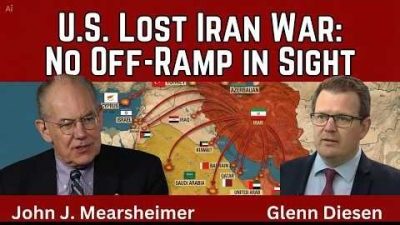
John Mearsheimer: US Already lost Iran war – No off-ramp in sight
or go to
Aletho News Archives – Video-Images
Frlom the Archives
With apparently fabricated nuclear documents, Netanyahu pushed the US towards war with Iran
By Gareth Porter | The Grayzone | April 29, 2020
President Donald Trump scrapped the nuclear deal with Iran and continued to risk war with Iran based on Israeli Prime Minister Benjamin Netanyahu’s claim to have proven definitively that Iran was determined to manufacture nuclear weapons. Netanyahu not only spun Trump but much of the corporate media as well, duping them with the public unveiling of what he claimed was the entire secret Iranian “nuclear archive.”
In early April 2018, Netanyahu briefed Trump privately on the supposed Iranian nuclear archive and secured his promise to leave the Joint Comprehensive Plan of Action (JCPOA). That April 30, Netanyahu took the briefing to the public in a characteristically dramatic live performance in which he claimed Israel’s Mossad intelligence services had stolen Iran’s entire nuclear archive from Tehran. “You may well know that Iran’s leaders repeatedly deny ever pursuing nuclear weapons…” Netanyahu declared. “Well, tonight, I’m here to tell you one thing: Iran lied. Big time.”
However, an investigation of the supposed Iranian nuclear documents by The Grayzone reveals them to be the product of an Israeli disinformation operation that helped trigger the most serious threat of war since the conflict with Iran began nearly four decades ago. This investigation found multiple indications that the story of Mossad’s heist of 50,000 pages of secret nuclear files from Tehran was very likely an elaborate fiction and that the documents were fabricated by the Mossad itself. … continue
Blog Roll
 Aletho News
- US failures in Iran reveal Russia is key to South Korea’s strategic security
- ‘All ports in Persian Gulf will be legitimate targets if Iranian ports are attacked’
- 40 Years of Endless War, Data Point by Data Point
- Department of War Using Palantir AI to Pick Targets in Iran
- American bases do not protect – they attack the peoples of the Persian Gulf
- ‘We’ve Obliterated Their Missiles’
- Syrian president vows ‘absolute support’ to disarm Hezbollah
- Ukraine attacking Russian gas pipeline to stop deliveries to Europe – Defense Ministry
- ‘Heinous crime’: Iran denounces Israeli assassination of 4 Iranian diplomats in Lebanon
- John Mearsheimer: U.S. Already Lost Iran War – No Off-Ramp in Sight
- If Americans Knew
- Israeli strategic plans to “remake the Middle East” from the 1950s and since
- Honoring Gaza’s women who refused to let the world look away
- 97% of victims of war on Iran are Iranian, 98% of victims in war on Gaza are Gazans – Not a ceasefire Day 152
- Early Iran strikes cost $5.6 billion in munitions, Pentagon estimates
- Israel Decided the War, But Trump’s America Fights and Pays the Bill
- Conscientious Objector Group: Phone ‘Ringing Off Hook’ As Huge Mobilization Underway
- U.S. support for Israel continues to plummet, despite media’s best efforts
- Threats and missiles fly, death tolls soar in Iran, Lebanon, Gaza – Not a ceasefire Day 151
- Lebanon: Israel’s White Phosphorous Use Risks Civilian Harm
- Corporate Media Go All Out To Support The US-Israeli War On Iran
- No Tricks Zone
- Destructive Green New Deal: German Energy And Metal Group Warns Of Drastic Crisis
- New Study Documents A 20-Year Pause In Arctic Sea Ice Decline – Driven By Internal Variability
- Wake-up Call: Survey Shows Majority Of Germans Now Favor Postponing Climate Targets!
- Televised! Leading German Political Candidate Tells Schoolchildren CO2 Makes Sun Hotter!
- New Study: A Century Warming Of 1.1°C Is ‘Commonplace’ And ‘Not Unusual’ During This Interglacial
- New Study: ‘Internal Noise’ And Volcanic Forcing Can Trigger 10-15°C Warming Within Decades
- Glaciers Worldwide Are Suddendly Surging, Experts Blame Warming!
- Surprising Discovery: Sahara Is Greening…Billions Of Trees Where Once Thought To Be Barren
- New Research Reaffirms Clouds, Aerosols, And Surface Solar Radiation Are ‘Driving The Climate System’
- Germany: Electric Car Catches Fire At Charging Station, Sets Off Local “Inferno”, Widespread Damage
 Aletho News