French Carbon Tax Protests
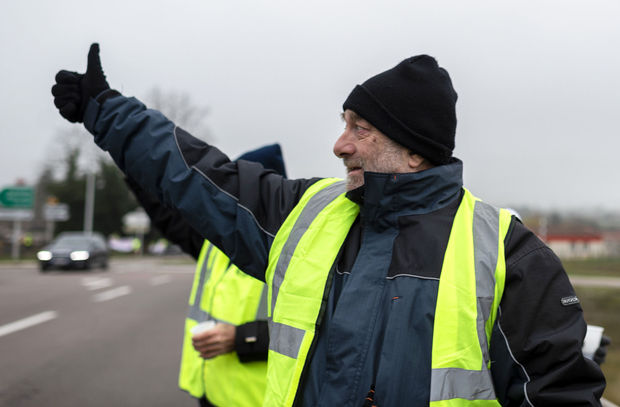
Yellow vests imposed on motorists become powerful anti-government symbol
By Donna Laframboise | Big Picture News | November 26, 2018
For more than a week, protests have been underway across France, sparked by January’s scheduled increase in carbon taxes on gasoline and diesel fuel. These taxes are supposed to save the world from climate change by encouraging everyone to drive less.
But working folk, especially those who reside outside of urban centers, have no choice. They need to get to work, and their elderly relatives need transporting to medical appointments. As Geoff Chambers observes: “Telling a plumber or refrigerator repair man to work from home or to travel by public transport seems…a sure recipe for starting a revolution.”
It’s a strange worldview that says we should lead diminished lives today so that people in the technologically advanced future will reap the rewards. (Human history is full of doomsayers who were convinced the future would be dire, but who have been proven wrong time and again.)
There’s a poetic aspect to these protests. French law mandates reflective yellow vests in every automobile. These aren’t to be kept in the trunk/boot, but within the cabin itself. In the event of a breakdown, a vest must be donned before one exits the vehicle.
Perhaps there’s some sense in this. But as soon as something stops being a suggestion and instead becomes a law, problems arise. One wonders how politically connected the manufacturers/distributors/retailers of such vests happened to be around the time that law got passed. More importantly, individual liberty is undermined when police have an excuse to harass anyone at any time under the guise of checking for the presence of such vests.
In a marvelous flourish, the good people of France have turned this lemon into lemonade. Dressed in these vests, they’ve taken to the streets to protest. An item everyone has been forced by the government to purchase has become a powerful symbol of resistance to a government-imposed carbon tax.
Visual impact is tremendously important if one hopes to attract media attention. A good visual can mean the difference between making it onto the television news or being wholly ignored.
The photos of, and videos from, these protests are fantastic. Those yellow vests (gilets jaunes) are the cat’s meow.
LINKS:
- See Geoff Chambers’ compelling exploration of the larger context of these protests here and here.
- See this photo collage posted on Facebook, this collection of images from search engine DuckDuckGo.com, and this collection of images from Google
- This BBC article says the fine for not having a yellow vest in one’s vehicle in France is 135 Euros – approximately 120 UK pounds, or 153 US dollars. The article also reports that these protests appear to be genuinely grassroots in nature: “In a country where protests are often tightly managed by one political party or trade union, this is a movement with no recognised national leader, no formal structure or affiliation, which unites voters of all ages from the far-left, the far-right, even those who once supported President Macron.”
- There’s a huge difference between peaceful protest and violence and vandalism. People who attack police and firefighters, and who damage property, aren’t admirable – whether they’re wearing gilets jaunes or not.
CAGW: a ‘snarl’ word?
By Andy West | Climate Etc. | November 26, 2018
The term ‘CAGW’ has both appropriate and inappropriate usage.
Introduction
Rational Wiki says: ‘“CAGW”, for “catastrophic anthropogenic global warming”, is a snarl word (or snarl acronym) that global warming denialists use for the established science of climate change. A Google Scholar search indicates that the term is never used in the scientific literature on climate.’10
Where in turn the link for ‘snarl word’ says: ‘A snarl word is a derogatory label that can be attached to something (or even to people), in order to dismiss their importance or worth, without guilt. When used as snarl words, these words are essentially meaningless; most of them can be used with meaning, but that seldom happens.’
So setting aside the snarl implications of the word ‘denialist’11 above, is all the usage of the ‘CAGW’ acronym meaningless, i.e. it is essentially a snarl word only? Or is there significant meaning associated with some usage, i.e. does it have legitimate, ‘non-snarl’ currency also, associated with real meaning?
In typical usage ‘CAGW’ may be followed by words such as narrative, message, story, line, debate, controversy, mantra, meme, myth, scare, hysteria, hoax, scam, religion, cult, cause, movement, believers, faithful, crowd, advocates, promoters, proponents, consensus, theory, hypothesis, premise, claim, case, conjecture and various others. Or it may appear in sentences without any direct descriptors such as those above, for example: ‘Proof positive that CAGW is about power, politics and greed is the fact that…’, ‘Without this strong feedback there is no real basis for CAGW since…’, ‘I have been waiting for someone, anyone, to enunciate a unique, broadly accepted goal for a program to “dodge” the CAGW “bullet”…’, ‘Cost / benefit analysis is apparently against the rules when it comes to CAGW…’, ‘The alarm is not about a warming of the globe, nor particularly AGW. It is about CAGW’.12
These demonstrate a much wider application than for just the ‘established science’, which I take to mean mainstream science, as expressed in the Working Group Chapters13 of the IPCC’s latest full report (AR5), so hereafter AR5WGC. Whether or not any such usages of ‘CAGW’ are justified, they are broadly categorized (albeit with overlaps, especially meme and consensus at the boundaries) as follows:
- expressing a communication aspect, applicable not only to climate scientists but to any parties communicating or exchanging on climate change, such as social authority sources, policy makers, NGOs, businesses, other scientists, whoever, and reflected by the words above starting narrative, message and similar.
- expressing a social phenomenon aspect, whether assumed to have deliberate causation or emergent causation, and reflected by the words starting, myth, scare and similar.
- expressing the aspect of adherents of the phenomena in b), as reflected by the words starting believers, faithful and similar, OR of subscribers to the science per d), OR both.
- expressing the science aspect, as reflected by the words starting theory, hypothesis and similar.
- expressing the aspect of actual physical climate change, sarcastically or not, as being potentially catastrophic (usually without extra descriptors in this context).
Usage without descriptors per the example sentences, are generally contextualized by one of these same categories.
The communication aspects
This is the most straightforward category to characterize. Within the public domain, there is manifestly a widespread narrative of certainty (absent deep emissions cuts) of near-term (decades) climate catastrophe. This has emanated from many of the most powerful and influential figures in the West throughout the twenty-first century, as exampled by the quotes listed a) to z) in footnote 1. While based only on English language reportage, this sample nevertheless includes leaders, ex-leaders and candidate leaders from 8 Western nations (with the US, Germany, UK and France being economically 4 of 7 and politically 4 of 6, top world powers9), along with high ministers, high UN officials, the Pope and UK royalty, over about the last 15 years. The narrative is also framed in a most urgent and emotive manner, which hugely increases its re-transmission capability14, is global in scope (‘the planet’), and unequivocally attributes the imminent catastrophe from global warming to humans (via ‘emissions’), i.e. the ‘C’ is due to AGW.
Rational Wiki is essentially correct regarding the literal usage of ‘CAGW’ in climate science literature (I found a few references on Google Scholar). Yet it’s right too in a more meaningful sense; i.e. nothing like this narrative of high certainty and imminent global catastrophe is represented within mainstream climate science, i.e. per the AR5WGC. A point that has been noted before on this and other climate blogs. Albeit ‘catastrophic’ (or similar) is actually used in AR5WGC, this is in reference to local / specific improbable scenarios only (e.g. the term used for maximal, yet very rare end of spectrum, episodic river flooding)15. No reasonable interpretation could produce the exampled narrative framing that has achieved such a high public profile over many years. So according to mainstream science, i.e. no skeptics required, this climate catastrophe narrative is flat wrong15a. Even at the best stretch it drags fuzzy possibilities plus probabilities from behind a hedge of caveats and limitations, then pushes them all front and centre, promoted to high certainty within an apparently well-mapped space15b. Nevertheless, this narrative / story / line / mantra exists, and at the highest authority level.
The sampled authority figures do not just speak for themselves. They represent their governments and parties and organizations, to some extent their nations. The power of this representation coupled with high emotive framing should be a very significant factor in the propagation of the catastrophic narrative across society, and especially down the pyramids of functionality spreading out from national / UN leaderships, so influencing policy (impending catastrophe is often cited as the main reason to act). However, other sources are transmitting in parallel, e.g. environmental NGOs, and total propagation will be due to the merged contributions of all. Penetration / propagation of the same catastrophe narrative is highly visible further out from primary leaderships, as exampled by the quotes listed a) to z) in footnote 2, which cover lesser-ranking / local politicians, leaders of less influential nations, NGOs, economists and influencers.
Emergent narratives typically spawn many variants, which are briefly analyzed in the companion post ‘The Catastrophe Narrative’, with further analysis in the (common) footnotes file.
There is nothing inappropriate about coining a name for the widely communicated narrative of certainty of imminent (decades) catastrophe as exampled by footnotes 1 and 2, which prior to the exception of the current US administration permeated Western / UN (and other) authorities high and low, and that falsely claims to be underwritten by ‘the’ science. ‘CAGW’ as a label for this narrative is suitable and has full meaning. Likewise for the narrative variant categories as exampled by footnotes 3 to 5; while as noted in the companion post, a few of such specimens or more emphatic localization may technically escape either full-on certainty or full-on global or maybe, depending especially upon ambiguous word-choices, full-on catastrophe, even this subset are highly emotive pitches of the same ilk that typically aren’t backed by mainstream climate science.
As climate scientist Mike Hulme noted a dozen years ago, this narrative created significant impact even back then: “It seems that mere ‘climate change’ was not going to be bad enough, and so now it must be ‘catastrophic’ to be worthy of attention. The increasing use of this pejorative term – and its bedfellow qualifiers ‘chaotic’, ‘irreversible’, ‘rapid’ – has altered the public discourse around climate change.” In 2010, Hans von Storch agreed16a.
The science aspects
Emphasizing the Rational Wiki quote above, Jacobs et al (in 2016 book) finds no merit in the claim ‘that catastrophic anthropogenic global warming is the mainstream scientific position’, i.e. mainstream science doesn’t support the concept of a high certainty (absent action) of imminent global catastrophe. So, although the IPCC integrates a range of scientific opinion and incorporates various outlier possibilities, within the scientific community there cannot be a widely accepted theory or hypothesis or premise or case for this. Hence directly tying mainstream climate science (including conventional AGW theory, no ‘C’) to this concept via ‘CAGW’ labeling, or implying that ‘CAGW theory’ is dominant (so perforce must cover the mainstream), is inappropriate. Some think no current science can claim the catastrophic15b, however…
This doesn’t imply an absence of scientific support for the principle. A minority of scientists, some very vocal, believe that ‘CAGW’ scenarios are more realistic. Footnotes 6 and 7 provide examples of about 50 climate scientists plus environmental and other scientists expressing their views of the catastrophic. To express a truly held belief is not to dissemble, so presumably these individuals have theories (probably not all the same) which lead them to this view, albeit not reflected by the mainstream / AR5WGC. Or at least they think such theories from other sources are highly credible. Their expressions typically ignore more balanced interpretations from their mainstream colleagues, or otherwise criticize the mainstream as being too conservative, often performing the same transformation / promotion as mentioned at the end of paragraph 2 section 2 above. Emotive phrasing is common, also featuring a large range of highly negative metaphors (e.g. hell or ballistic missiles or cars speeding towards cliffs), and / or the end of humans or civilization or the planet, with typically a sense of inevitability (unless major action). Hence using say ‘CAGW theory’ to label the claims of specific such scientists, is legitimate. But the much more typical sweeping references that imply ‘CAGW theory’ is the ‘official’ science, are illegitimate. In relation to the current mainstream, ‘CAGW theory’ is very much unofficial science.
Portraying scientists who propagate ‘CAGW’ notions as representative of the mainstream, via ‘CAGW’ labeling or any other means, is also inappropriate. However, this is a forgivable sin for the general public; how would they know that James Hansen, for instance17, occupies a minority fringe at odds with the main climate science community? And they aren’t the only ones subject to confusion about what is mainstream and where particular scientists might stand. Catastrophe narratives have infiltrated climate science and science communities generally. Their strong emotive content erodes objectivity17a and pressures scientists to reflect such narrative, hence especially within science communication.
In his book climate scientist Mike Hulme describes a step change towards the catastrophic in the ways that climate change risk was expressed in the public sphere, following an international climate change conference held in Exeter UK, in 2005. And to continue Hulme’s 2006 quote (via the BBC) from section 2: “This discourse is now characterized by phrases such as ‘climate change is worse than we thought’, that we are approaching ‘irreversible tipping in the Earth’s climate’, and that we are ‘at the point of no return’. I have found myself increasingly chastised by climate change campaigners when my public statements and lectures on climate change have not satisfied their thirst for environmental drama and exaggerated rhetoric. It seems that it is we, the professional climate scientists, who are now the (catastrophe) skeptics. How the wheel turns… … Why is it not just campaigners, but politicians and scientists too, who are openly confusing the language of fear, terror and disaster with the observable physical reality of climate change, actively ignoring the careful hedging which surrounds science’s predictions?” (bold mine). Yet in the face of continuing emotive pressure, even 12 years later a wider acknowledgement of this issue is still weak25.
So, in respect of the science aspects ‘CAGW’ has both appropriate and inappropriate usage. Without a proper survey it seems more typically the latter. Thus it’s likely regarding purely the science aspects that Rational wiki is mostly right, albeit only technically, in saying: ‘Despite the qualifier, denialists apply the term indiscriminately to anything approximating the mainstream scientific view on climate, regardless of whether or not “catastrophic” outcomes are implied’, and notwithstanding its own serious snarl word issue11. In practice, the deep entanglement of catastrophe narratives with climate science communication creates very understandable confusion, and an environment where serious misunderstanding is inevitable.
Given also that for many years the climate change narrative from highest authorities to the public is insistently catastrophic, Rational wiki’s claim that deployment of the acronym is a deliberate ploy of the desperate (‘an attempt to move the goalposts’), is one that ignores the big picture. A-list presidents and prime ministers plus the UN elite and other authorities too (along with some scientists), already moved the goalposts, and indeed repeatedly reinforce that the catastrophic is backed by mainstream science. This impressive and coordinated array of authorities are not generally referred to as ‘deniers’, and it shouldn’t be a surprise that very many folks believe their attribution. Hence such folks are confronted by a complete clash between the unequivocal authority expression that the catastrophic is indeed backed by science18, and affront from individual scientists or their supporters as expressed on side channels when they’re specifically associated with the catastrophic. This affront is very understandable18a. Yet so is the response of those who feel that somewhere within this clash they’ve been hoodwinked, and assume the enterprise of climate science must be the culprit (in fact, an emergent phenomenon is ultimate cause). It’s especially confusing that some actors have a foot in both camps (e.g. significant IPCC contributors who publicly express catastrophe narrative19).
Starting even before AR5 some scientists projecting more severe climate change consequences, including a subset clearly claiming catastrophic outcomes20, complain that mainstream science per the IPCC is way too conservative, even politically diluted. Whether their science is bunkum or has a basis in reality, they likely have significant support. Albeit that the important distinction between ‘severe’ and ‘catastrophic’ isn’t provided, 41% of 998 AGU+AMS members asked about ‘the likely effects of global climate change in the next 50 to 100 years’, replied ‘severe/catastrophic’ (2012, pay-walled, but some details at Wiki). In a more recent expression (Mar 2018) some climate scientists objected to oil companies presenting AR5 as evidence showing lack of serious harms, claiming it was outdated (published 2013/14), and later science predicts much worse consequences. Some scientists emphasizing much higher impacts are socially touted as having better understanding than the majority driving the ‘conservative’ consensus.
However, notwithstanding plenty of catastrophe narrative ballyhoo30 from usual voices regarding the new SR15, as the content itself indicates31 there seems little chance that the steady and incremental evolution of the IPCC reports will change to a dramatically different position for the full AR6, or indeed afterward. And ironically, if various outlier theories regarding the catastrophic did gain enough ground to cause a paradigm shift, becoming mainstream, most of the inappropriate usage of ‘CAGW’ would transform to legitimacy overnight. It’s likely that social pressure to converge upon (cultural, not scientific) narratives of the catastrophic, has contributed to such theories; emotive memes are a major component via which many large-scale social consensuses are formed, e.g. within religions. Such consensuses don’t relate to truth. Note: scientific probing of worst case scenarios is potentially useful, as long as such efforts don’t morph into emotive narratives that help panic the public and policy makers towards perceived ultra-urgency and radical solutions, or indeed towards any agenda. With its speculative nature preserved, such exploration doesn’t earn a ‘CAGW theory’ label. Yet wielding it as authority with sexed-up likelihoods and / or emotively overwhelmed conditionals in order to pressure and persuade (e.g. footnote example 7aa), certainly earns the label ‘CAGW narrative’.
The social phenomena and adherence aspects
Just as with the science section above, there is appropriate and inappropriate deployment of ‘CAGW’ to describe social phenomena in the climate domain. So for instance it’s appropriate to talk about a social consensus in catastrophe among certain groups, but not a scientific consensus within the IPCC, say. It’s appropriate to describe ardent members of a green NGO who are heavily involved in promoting climate catastrophe narratives, as ‘CAGW advocates’ say, yet certainly not to apply this term to ‘all Democrats’, for instance, even if statistically there is somewhat more catastrophe narrative promotion by members of that party. Such labelling even when appropriate, does not imply any wrong-doing or dysfunction on the part of those so labelled, although some level of ‘faith’ (to use another partner term that crops up) in the narrative that many world leaders have lavished on the public for many years, is both likely and eminently understandable. Partner terms like ‘hoax’ and ‘scam’ are generally inappropriate too, because they cannot be main causation for the CAGW phenomenon32.
It comes down to who is adding the catastrophic, or ‘C’, to the mix. Michael Barnard at Quora notes in his discussion of ‘CAGW’: ‘Emotive adjectives are intended to create an emotional response rather than an intellectual response. Catastrophic is an emotive adjective.’ Yes. For sure, over-emotive content tends to cloud judgment; in memetic terms more-emotive memes have a greater selection value than less-emotive ones in domains of high (or even perceived high) uncertainty, thus preferentially prospering. Which is exactly why the narrative of catastrophe abounds within authority statements about climate change, per footnotes 1 to 5, plus is so pervasive within the public domain generally. (However, an ‘intent’ can’t be assumed; regarding emergent narratives the great majority of people are propagating what they genuinely and passionately think is truth). The Quroa text continues: ‘Adding catastrophic to the neutral phrase “anthropogenic global warming” is making it needlessly emotive.’ So, if indeed the person deploying ‘CAGW’ is needlessly adding the ‘C’, then yes. But… if that ‘C’ merely reflects the catastrophic that already existed regarding the social phenomenon or group or followers being described (e.g. Greenpeace politically pressuring with a campaign based upon certain catastrophic climate change), or indeed per section 2 catastrophic narrative or section 3 *specific* science / scientists aligned to catastrophe, then the ‘C’ is a correct and proper description. Emotive persuasion was injected by that being described, not by the mere act of (correctly) describing it.
Michael’s valid points about emotive descriptors and neutrality miss the big picture. While emphasizing as I do that ‘CAGW’ misrepresents mainstream / AR5WGC climate science, he makes no mention that according to an array of the highest authority sources, so largely within the public understanding too, the catastrophic is backed by mainstream climate / AGW science. Not to mention missing that describing pre-existing highly emotive phenomena, requires a meaningful reference to the emotive content.
Summary and Discussion
According to majority / mainstream science and indeed minority skepticism too, the CAGW narrative is a major misrepresentation22. Yet according to a minority of scientists at the opposite fringe to skeptics, this narrative reflects a more realistic position. Whether future history proves notions of CAGW to be right or wrong, acronym usage like the last 2 instances is entirely meaningful; notions of the catastrophic (absent major emissions cuts) and a copious narrative about them, patently exist. Such narrative is widespread in the public domain, being emphatically promoted by highly influential Western authority (until the current US admin exception) plus a raft of other authorities too23, who frequently cite imminent catastrophe as the principal reason for action on emissions. Nor has it spread via demonstrable scientific confirmation (albeit such confirmation may conceivably occur one day), but merely via emotive persuasiveness.
Nevertheless A-list presidents, prime ministers and the UN elite (the latter contradicting their own IPCC) claim that CAGW is validated by mainstream science. It’s difficult to see how this false backing could ever be questioned in the public mind, unless the mainstream science community pushes back far more strongly against such assertions. Meanwhile the fringe camp, i.e. those scientists (general and climate disciplines) comfortable with catastrophic projections, are much less shy about pushing authority with their concerns.
Despite oft-used inflationary descriptors or terminal metaphors5g,7h, sometimes references to extreme weather, or even straight propositions like the ‘save the planet’ or absent action a collapse of civilization, catastrophe narrative as it appears in footnotes 1 to 5 has no consistent definition of what ‘catastrophe’ actually means, or indeed quite how this state is arrived at. From the PoV of narrative success this is a fantastic attribute, allowing the latitude for each person to interpret the worst in their own terms (hence over numerous propagations, a generic apocalypse canon eventually emerges). Perhaps such vagueness might be expected from non-scientists, yet the public propagation from exampled scientists6,7 is no less emotively descriptive and no more consistent regarding actual meaning. Arguably, it is more lurid and emotively penetrating, and less objective.
This fluidity allows the CAGW narrative to hi-jack any view that is not actively skeptical via highly emotive persuasion, also seize the perceived moral high ground, while simultaneously bypassing objective considerations about the real meaning, and by omission avoid culpability regarding any unsupported (by the mainstream) mechanisms of, and uncertainties regarding, global catastrophe, which are not actually detailed. (When quotes are from scientists some detail may appear in associated papers, typically falling short of the framing of high certainty of global catastrophe, yet the public and likely authority too, only sees the public quotes anyhow). In short, it has very high selective value. Its emotive potency even sets the bounds of what skepticism is perceived to be within the public domain, and thus enables authority sources to claim mainstream territory even though mainstream science doesn’t support the catastrophic via any reasonable interpretation of this collective narrative.
Along with appropriate usage, there is much inappropriate usage from engaged skeptics deploying the term ‘CAGW’. In complete contrast to the situation with A-listers and influencers above, whose linkage of the catastrophic with mainstream science isn’t challenged, indeed is often praised, similar associations from skeptics typically attract vociferous objection. Misuse increases polarization and impedes greater understanding; this blunder28 from skeptics shouldn’t be overlooked. However, it seems unlikely that the great majority of the public are even aware of the ‘CAGW’ acronym26, so the impact upon them of any misuse via this term must perforce be very modest indeed. Yet whether leaning skeptical or orthodox or indifferent regarding climate change, few of the public will be unaware of the narrative of certain (absent action) man-made catastrophe that perfectly reasonably earns the acronym ‘CAGW’.
The misdirection and bias plus instinctive kick-back invoked by such highly emotive misinformation, as propagated for years by the exampled A-listers / authorities / orgs, utterly dwarfs any above impact. This acronym may indeed be an invention of skeptics24, yet not the untamed narrative that it describes. The latter doesn’t injure only mainstream science, but all science, including even that work which may point towards more severe consequences, because its long and high profile in the public domain isn’t any result of science, and the emotive biases it amplifies leak back into science21.
So ‘CAGW’ can be used as a ‘snarl word’, and is, albeit misunderstanding is likely the main cause. It is also a perfectly reasonable and meaningful term for a long-lived narrative elephant (with consequent effects) in the public domain and from top authority sources, plus a presence in some science too, and an ethic behind some social responses. Thus, when describing these phenomena, CAGW is not at all the straw-man that some of the orthodox claim. When the naming of a valid concept is avoided, discussing that concept becomes difficult, with awkward / obscure phrases and dancing around the issue. Or still more comedic, like whispering about he-who-must-not-be-named in Harry Potter. Hence despite some acquired cultural aggressiveness, which often sticks to terms within conflicted domains, the appropriate use of ‘CAGW’ is meaningful and necessary. Without it, the domain would simply need a virtually identical replacement term27 to express the valid concept it accurately covers.
www.wearenarrative.wordpress.com
Link to footnotes [Footnotes]
Climate experts call out new federal report for hiding the decline in hurricanes
‘Were they thinking, no one would notice?’
By Marc Morano | Climate Depot | November 25, 2018
Climate expert Prof. Dr. Roger Pielke Jr. noted how the new federal National Climate Assessment report looks at hurricanes.
Pielke Jr. asked on November 24: “How it is that the 2018 US National Climate Assessment failed to include or overlooked trends in US landfalling hurricanes which would, ahem, seem pretty important in a US climate report[?]
Pielke Jr. then noted that the report ignored one of its own expert reviewers who wrote this: “National Hurricane Center going back to the 1800s data clearly indicate a drop in the decadal rate of US landfalling hurricanes since the 1960s… instead you spin the topic to make it sound like the trends are all towards more cyclones.”
Pielke Jr. continued: “Let’s observe here hurricanes are discussed at length in the report, and every hurricane that is discussed is … a landfalling storm. The failure to include trend data on US landfalling hurricanes in USNCA is a remarkable choice. What were they thinking, no one would notice?”
“Here are 2 papers on US hurricanes ignored by USNCA: 1. trends in rainfall & flooding from US hurricanes: https://www.sciencedirect.com/science/article/pii/S0022169418301549 … 2. trends in US landfalling, intense hurricanes: https://journals.ametsoc.org/doi/10.1175/BAMS-D-17-0184.1 … Neither show long-term trends, but that isn’t a reason to ignore them,” Pielke added.
Dr. Pielke also previously rebuked the new federal climate report, calling it “embarrassing.” See: ‘EMBARRASSING’: CLIMATE EXPERT EXPLAINS WHAT’S WRONG WITH THE WHITE HOUSE’S NEW CLIMATE REPORT – Prof. Roger Pielke Jr.: “By presenting cherrypicked science, at odds w/ NCA Vol,1 & IPCC AR5, the authors of NCA Vol.2 have given a big fat gift to anyone who wants to dismiss climate science and policy.”
Also see:
Russia calling urgent UN Security Council meeting over clash with Ukrainian ships in Azov sea
RT | November 26, 2018
Moscow is calling an emergency UN Security Council meeting following the incident near Crimea that saw the Russian military detain Ukrainian warships for breaking into its territorial waters in violation of the UN convention.
Russia has called for a meeting “in connection to the dangerous developments in the Azov sea and subsequent events,” Russia’s First Deputy Permanent Representative at the UN, Dmitry Polyanskiy, told media late on Sunday.
The meeting is preliminarily scheduled for 11.00 am Monday New York time, he said. “Maintenance of international peace and security” will be the sole item on its agenda.
The Russian military opened fire and seized three Ukrainian Navy vessels after they entered Russian territorial waters while heading to the Kerch Strait, which separates Crimea from mainland Russia.
Three Ukrainian crew members were injured during the altercation and have received medical assistance from Russian medics. Moscow says that the vessels, the ‘Berdiansk’, the ‘Nikopol’ and the ‘Yany Kapu’, did not respond to repeated Russian coast guard warnings as they were violating the Russian territorial sea. Kiev claims that it had given advance notice to the Russian side that the ships were sailing through the waterway towards the Ukrainian port of Mariupol, as per the established procedure. Russia says there was no such warning.
Russia has labeled the incident a deliberate provocation by the Ukrainian authorities, while Kiev denounced it as an “act of military aggression” and is about to declare martial law, pending approval from Ukrainian lawmakers.
Both parties accuse each other of violating international law, namely the UN Convention on the Law of the Sea. Ukrainian President Petro Poroshenko has already appealed to NATO and the EU, asking them to coordinate efforts for a potential rebuke to Russia.
Ukrainian Forces Pound Donbass Residential Area with Heavy Artillery
Sputnik – 25.11.2018
The Ukrainian army on Sunday opened up with massive artillery fire, shelling residential areas of the self-proclaimed Donetsk People’s Republic (DPR), an RIA Novosti correspondent has reported.
The shelling began at about 19:50 GMT, according to the correspondent. The Ukrainian army is using various weapons, including heavy artillery.
The number of attacks by the Ukrainian army in the Donbass region is likely to increase following new deliveries of Polish weapons to Ukraine, Eduard Basurin, deputy commander of the DPR Operational Command, said Friday.
According to Basurin, in mid-November, a Polish company supplied Kiev with over 23,000 60-mm mortar shells and noted that Ukrainian forces in Donbass would receive this ammunition in the near future.
The ongoing military operation in eastern Ukraine was launched by Kiev in 2014 against militias in Donbass, after local residents of the region refused to recognize the new Ukrainian government and its representatives.
In 2015, a ceasefire deal was signed between conflicting sides in Minsk after talks brokered by the leaders of the so-called Normandy group — Russia, France, Germany and Ukraine. Despite the ceasefire agreement, sporadic fighting has continued in Donbass. The situation remains tense, with both parties accusing the other of violating the ceasefire. According to the United Nations, over 10,000 people have died in the conflict.
A Gamechanger In European Gas Markets
By Irina Slav – Oilprice.com – November 22, 2018
The Southern Gas Corridor on which the European Union is pinning most of its hopes for natural gas supply diversification away from Russia is coming along nicely and will not just be on schedule, but it will come with a price tag that is US$5-billion lower than the original budget, BP’s vice president in charge of the project told S&P Global Platts this week.
“Often these kinds of mega-projects fall behind schedule. But the way the projects have maintained the schedule has meant that your traditional overspend, or utilization of contingency, has not occurred,” Joseph Murphy said, adding that savings had been the top priority for the supermajor.
The Southern Gas Corridor will carry natural gas from the Azeri Shah Deniz 2 field in the Caspian Sea to Europe via a network of three pipelines: the Georgia South Caucasus Pipeline, which was recently expanded and can carry 23 billion cubic meters of gas; the TANAP pipeline via Turkey, with a peak capacity of 31 billion cubic meters annually; and the Trans-Adriatic Pipeline, or TAP, which will link with TANAP at the Turkish-Greek border and carry 10 billion cubic meters of gas annually to Italy.
TANAP was commissioned in July this year and the first phase of TAP is expected to be completed in two years, so Europe will hopefully have more non-Russian gas at the start of the new decade. But not that much, at least initially: TANAP will operate at an initial capacity of 16 billion cubic meters annually, of which 6 billion cubic meters will be supplied to Turkey and the remainder will go to Europe. In the context of total natural gas demand of 564 billion cubic meters in 2020, according to a forecast from the Oxford Institute for Energy Studies released earlier this year, this is not a lot.
Yet at some point the TANAP will reach its full capacity and hopefully by that time, TAP will be completed. Surprisingly, it was the branch to Italy that proved the most challenging, and BP’s Murphy acknowledged that. While Turkey built TANAP on time to the surprise of the project operator, TAP has been struggling because of legal issues and uncertainty after the new Italian government entered office earlier this year.
At the time, the government of Giuseppe Conte said the pipeline was pointless but, said Murphy, since then he has accepted the benefits the infrastructure would offer, such as transit fees. And yet local opposition in southern Italy remains strong but BP still sees first deliveries of gas through Italy in 2020.
The BP executive admitted that at first the Southern Gas Corridor wouldn’t make a splash. “The 10 Bcm/year into Europe is not a game-changer from a volume point of view, but it is a game-changer from a new source of product into mainland Europe perspective and it can be expanded.”
Meanwhile, however, Russia and Turkey are building another pipeline, Turkish Stream, that will supply gas to Turkey and Eastern Europe, as well as possibly Hungary. The two recently marked the completion of its subsea section. Turkish Stream will have two lines, each able to carry up to 15.75 billion cubic meters. One will supply the Turkish market and the other European countries. In this context, the Southern Gas Corridor seems to have more of a political rather than practical significance for the time being, giving Europe the confidence that it could at some future point import a lot more Caspian gas because the infrastructure is there.
UAE to invest in Israeli plan to pipe gas to Europe

Press TV – November 25, 2018
The media in Tel Aviv have reported that the UAE has invested as much as $100 million in an ambitious Israeli project to pipe natural gas to Europe.
The investment would be made by a company based in Abu Dhabi for a pipeline project which is internationally known to be unique given its record length as well as the extreme depths it would be laid toward Europe, Lebanon’s al-Mayadeen quoted Israeli media as reporting.
The agreement has been described as “historic” by Israeli media, al-Mayadeen added.
Israel has signed a multilateral deal over the scheme – called the East Med Pipeline Project – with Greece, Italy and Cyprus. The European Union also supports the project.
The East Med Pipeline Project is to start about 170 kilometers (105 miles) off Cyprus’s southern coast and stretch for 2,200 kilometers (1,350 miles) to reach Otranto, Italy, via Crete and the Greek mainland, according to a report by The Times of Israel news website.
The pipeline will have the capacity to carry up to 20 billion cubic meters (706 billion cubic feet) of gas from Israeli fields each year. Europe’s gas import needs are projected to increase by 100 billion cubic meters (3.5 billion cubic feet) annually by 2030.
Work on the project is expected to begin within a few months, and to conclude within five years.
UAE’s investment in the project could trigger protests in the Muslim world. The Emirates has already taken moves to approach Tel Aviv with speculations recently emerging that it has even involved itself in certain military operations by Israel on Gaza.
Last December, Israel’s Energy Minister Yuval Steinitz said a study on the project showed that the project is feasible, even though it presents technical challenges due to the depths involved and has an estimated cost of 6.2 billion euro ($7.36 billion).
Israel has already engaged in disputes with Lebanon over tapping into Mediterranean energy resources.
Last February, Israel described as “very provocative” a Lebanese tender for projects in two of its 10 offshore blocks in the Mediterranean Sea.
Israel itself has long been developing a number of offshore gas deposits in the Mediterranean Sea, with the Tamar gas field, with proven reserves of 200 billion cubic meters, already producing gas, while the larger Leviathan field is expected to go online in the coming months.
A source close to Israeli Prime Minister Benjamin Netanyahu said in 2012 that Israel’s natural gas reserves were worth around $130 billion. A Business Week estimate later that year put the reserves’ value at $240 billion.
“THE CHIMERA OF DONALD TRUMP, RUSSIAN MONEY LAUNDERER”
Sic Semper Tyrannis | November 23, 2018
Is Donald Trump guilty of money laundering? If you ask most Democrats and anti-Trump Republicans, they fervently believe that he has been moving money for Russian mobsters for more than twenty years and that an investigation of this will bring Trump’s Presidency to an end. Don’t count on it. Although there is clear evidence of Trump’s past relationship with Russian/American mobsters, knowing someone or collaborating on a business deal is not proof of money laundering. I have spent three decades investigating money laundering cases (I helped develop the civil money laundering case against Philip Morris—click here) and it is clear to me that those who are earnestly accusing Trump of such a crime do not understand what constitutes money laundering.
Apart from not understanding how to make a money laundering case, the anti-Trumpers have failed to grasp another key element to the narrative that Trump was a puppet to the Russians—one of his longtime Russian business associates, Felix Sater, was an FBI informant during the entire time that Robert Mueller was FBI Director. Since Sater was a fully signed up FBI informant or asset, he was in a unique and powerful position to implicate Trump. But none of the “evidence” uncovered or planted by Sater ever produced an indictment of Donald Trump. With the benefit of hindsight it appears that the FBI, relying on Sater, used Trump and his organization as bait to go after Russian mobsters.
The Democrat case for Trump’s money laundering is laid out in a complaint the Democratic National Committee filed in April 2018 against the Russians, Julian Assange and Trump:
Beginning in 2003, Trump engaged in multiple real estate deals with the Bayrock Group, a firm founded and run by Soviet emigres, who reportedly had close ties to the Russian government and Russian organized crime. In 2004, Trump negotiated with the Deputy Mayor of Moscow over a potential real estate development. In the mid-2000s, Trump partnered with wealthy Russian-Canadian businessmen to develop real estate in Toronto. And in 2006, Trump contracted with the Russian Standard Corporation, a Moscow-based entity that owns and operates the Miss Russia beauty pageant, to allow the winner of the pageant to compete in Trump’s Miss Universe pageant, an action that had not been taken since at least 2002. In 2008, Trump sold a Palm Beach, Florida mansion to a Russian oligarch for a $54 million profit. In 2013, Trump established a business relationship with Russian oligarch Aras Agalarov, a close ally of Putin, to bring the Miss Universe pageant to Russia and work on plans to develop a Trump-branded project in Moscow. . . .
As Trump, Jr. explained, the Trump Organization “s[aw] a lot of money pouring in from Russia,” and “Russians make up a pretty disproportionate cross-section of our assets.” And Trump’s son Eric Trump has reportedly stated that substantial funding for Trump’s golf courses comes from Russian investors.
I do not know who was advising the DNC on this complaint, but it is clear that the drafter or drafters do not have a clue about money laundering. Money laundering is very easy to define:
The act of disguising the source or true nature of money obtained through illegal means.
The key element is the phrase, “illegal means.” If you are going to be charged as a participant or accessory in a money laundering case, you must be handling or receiving money that came from a criminal activity, such as trafficking in drugs, arms or people. So here’s the critical question with respect to Donald Trump and money laundering—what was the predicate crime?
In the world of real estate, the money laundering component is always in the financing. That is, you want to trade the bad money for good bank money by using the property as the chattel to do it. But when this is done as part of a money laundering scheme, it almost always involves the financing of major building projects. Someone with dirty money is not going to waste time purchasing individual condos or homes as their primary means of cleaning the money. When the dirty money comes from activities like drug trafficking, the amount of cash generated is enormous. You need big money projects to launder large quantities of cash.
Given Donald Trump’s extensive and controversial real estate ventures over the last thirty years, which have involved several Russians, it is understandable why those opposed to Trump seize on these transactions as evidence of “money laundering.” Unfortunately, the journalists who have tried to make the case that Donald Trump was “laundering” money for the Russian mob, have failed to provide actual evidence of such activity. Instead, they have relied on innuendo and guilt by association.
Yes, it is true that Russians with ties to organized crime purchased condos in Trump Towers in New York City. But there is no evidence that the sales of these condos were an organized, structured transaction. Individual Russians, acting in person or through shell companies, purchasing a condo is not proof of criminal activity. The fact that those who have made such purchases have not been arrested or indicted undermines the claim that their mere presence in a Trump building is proof of criminal activity.
As Shakespeare wrote, “Ay, there’s the rub.” Association with unsavory characters is not a criminal offense. While it is quite true that Trump associated with several Russians with links to organized crime it is also true that Trump has never been indicted or charged with such criminal activity. Is he really that good in hiding his trail?
One of the loudest voices claiming that Trump is in bed with the Russians is Craig Unger. Craig was known as a good reporter at one point in his life, but I think his work on Trump is both shoddy and incomplete. To be fair, Craig is not the only one claiming Trump is facilitating Russian money laundering. Other prominent journalists, including Richard Behar, Tom Burgis of the Financial Times and John Harwood of CNBC, also have echoed Unger’s thesis.
All four focus much of their reporting on a Russian born American “mobster”, Felix Sater, to implicate Trump as a Russian money laundering chump. The following snippet from an interview Unger did with Vox about his book, House of Trump, House of Putin is representative of how Sater is used as some sort of proof that Trump is part of a money laundering scheme:
Bayrock was a real estate development company located on the 24th floor of Trump Tower. The founder was a guy named Tevfik Arif and the managing director was Felix Sater, a man with numerous ties to Russian oligarchs and Russian intelligence. Bayrock proceeded to partner with Trump in 2005 and helped him develop a new business model, which he desperately needed.
Recall that Trump was $4 billion in debt after his Atlantic City casinos went bankrupt. He couldn’t get a bank loan from anywhere in the West, and Bayrock comes in and Trump partners with other people as well, but Bayrock essentially has a new model that says, “You don’t have to raise any money. You don’t have to do any of the real estate development. We just want to franchise your name, we’ll give you 18 to 25 percent royalties, and we’ll effectively do all the work. And if the Trump Organization gets involved in the management of these buildings, they’ll get extra fees for that.”
It was a fabulously lucrative deal for Trump, and the Bayrock associates — Sater in particular — were operating out of Trump Tower and constantly flying back and forth to Russia. And in the book, I detail several channels through which various people at Bayrock have close ties to the Kremlin, and I talk about Sater flying back and forth to Moscow even as late as 2016, hoping to build the Trump Tower there.
Tom Burgis, writing in the Financial Times, provides additional details on the relationship between Sater and Trump and implies something nefarious, perhaps even illegal, was afoot:
As work on Trump Soho got under way in 2007, the partnership between Mr Trump and Bayrock was gathering momentum. Another tower, in Fort Lauderdale, was rising. A 2008 Bayrock presentation includes a picture of Mr Trump grinning beside Mr Arif and names him as a referee. Bayrock had its office on the 24th floor of Trump Tower and calls the Trump Organization a “strategic partner”.
The same presentation says Bayrock was one of the backers of the redevelopment of the 101-year-old Hotel du Parc on the shores of Lake Geneva, owned by Swiss Development Group, a Geneva-based company. In May this year, Nicolas Bourg, a Belgian businessman who says he worked with Viktor Khrapunov’s son Ilyas on US real estate deals, claimed in a separate dispute that Swiss Development Group was “owned and controlled by Ilyas and his family and used to conceal the movement and investment of his family’s money”.
All of this sounds pretty bad on the surface until you examine what Sater actually did. Messrs. Unger and Burgis neglected to analyze the critical fact that Felix Sater was an FBI informant since 1998. If Trump was taking dirty money or engaged in criminal activity with Russians then he was doing it with Felix Sater, who was under the control of the FBI. Felix Sater was proposing deals and making contacts with Russian criminals overseas and this activity surely was known by the FBI. If there was any suspicion on the part of the FBI that Trump was taking bad money, they would have recorded such activity in detail and he would have been indicted. Instead of running around in an orange jump suit, Donald Trump ran for President.
Given Sater’s relationship with the FBI, one needs to look at Trump’s relationship with Russians, especially those facilitated by Sater, in a different light. Put simply, were Trump’s real estate deals being used as bait to attract targets of interest for the FBI. Was Trump a witting cooperator with the FBI or unwitting?
We do know that Sater was trying to put together real estate deals overseas while serving as a FBI informant and working from Trump Tower in New York City. This was reported in a March 2017 Los Angeles Times piece:
Working from a 24th-floor office in Manhattan’s Trump Tower, Felix Sater spent years trying to line up lucrative deals in the United States, Russia and elsewhere in Europe with Donald Trump’s real estate organization.
For much of that time, according to court records and U.S. officials, Sater also worked as a confidential informant for the FBI, and — he says — U.S. intelligence.
“I was building Trump Towers by day and hunting Bin Laden by night,” Sater, now 50, told the Los Angeles Times in a phone interview from New York.
As managing director of Bayrock Group LLC, a real estate development firm, the Russian-born businessman met Trump in 2003, court records show, when Trump was looking to expand his business and branding organization around the globe.
Why are the anti-Trump forces failing to grasp the import of Sater and his role as an FBI informant as undermining the claim that Trump was conspiring with the Russians? Sater’s role with the FBI has been widely reported:
There is no question that Sater led a double life during the years he worked with the Trump Organization.
In 1998, Sater pleaded guilty to a federal charge of racketeering for his role in a Mafia-linked $40-million stock fraud scheme. He quickly cut a deal, agreeing to become a secret FBI informant in hopes of getting a lenient sentence.
Court records were sealed to protect Sater’s identity, so his role in the fraud case stayed secret for a decade while he was at Bayrock. After a court hearing in 2009, he was fined $25,000 but was not sent to prison or ordered to pay restitution.
Along with press reports regarding Sater’s role with the FBI, we have Sater’s attorney, in a letter sent to Judge Leo Glasser of the Eastern District of NY on 1 September 2005, telling the court that:
. . . Mr. Sater has been involed in on-going cooperation activities with law enforcement agents, and has provided truthful and credible information on a wide variety of criminal activities, some of which has already led to criminal prosecution of others.
Even Obama’s Attorney General, Loretta Lynch, provided Sater cover :
At his sentencing hearing, several FBI officials vouched for Sater’s help. He got his biggest endorsement in January 2015 when Loretta Lynch was asked at her Senate confirmation hearing for U.S. attorney general why court records had been sealed in the fraud case.
If Trump was the target of the FBI, then fair observers must concede that the Bureau has failed during an 18 year period to obtain any incriminating information about Trump and his business practices. Had the FBI been successful, Trump surely would have already been indicted by now in the Southern District of New York and charged with criminal conduct.
Sater’s status as an FBI informant is not an honorary position. It is not a job that entitles the informant to regular social chats with an FBI agent. It is a job that puts the informant in the position of having to help the FBI make criminal cases, including entrapping folks willing to engage in illegal acts. The FBI website describes the informant role:
The courts have recognized that the government’s use of informants is lawful and often essential to the effectiveness of properly authorized law enforcement investigations. However, use of informants to assist in the investigation of criminal activity may involve an element of deception, intrusion into the privacy of individuals, or cooperation with persons whose reliability and motivation may be open to question. Although it is legally permissible for the FBI to use informants in its investigations, special care is taken to carefully evaluate and closely supervise their use so the rights of individuals under investigation are not infringed. The FBI can only use informants consistent with specific guidelines issued by the attorney general that control the use of informants.
And who was in charge of the FBI during all of the time that Sater was a signed up FBI snitch? You got it—Robert Mueller. Let us just stick with the facts—during Mueller’s term (2001 thru 2013) the FBI did not make or bring a case of money laundering against Donald Trump. Yet, during this period, Felix Sater, a fully signed up and operating FBI informant, was trying to cobble together real estate deals with Russians of questionable character. Trump and his organization were not implicated in any of this activity in a way that led the FBI to seek an indictment against them.
Many House Democrats are convinced that there is untapped evidence implicating Trump in a variety of money laundering schemes. But their belief, in my view, is based on a fundamental ignorance about money laundering and financial crimes in general. Tax avoidance, for example, is not money laundering. Highly publicized real estate deals are not the kind of cleaning operation that genuine money launderers embrace. Why? Those kind of deals come with scrutiny and the last thing that criminals with dirty money want is a high profile and public attention.
If you hate Trump and are betting that the Democrat investigative tsunami will bring Trump down, I have a word of advice—don’t bet your house. Donald Trump may be guilty of boorish behavior and brash comments, but the evidence of laundering money for the Russians is not there.
3 Ukrainian navy ships violate Russian border near Crimea, ignore orders to leave – FSB
RT | November 25, 2018
Russian Federal Security Service (FSB) says three Ukrainian navy vessels, violated its border on Sunday morning, and are heading for Kerch Strait that lies between Crimea and mainland Russia.
“This morning at around 7 a.m. Moscow time, three vessels belonging to Ukrainian armed forces violated the United Nations Convention on the Law of the Sea… to cross the Russian border,” read a statement from Russia’s federal security agency FSB, which is responsible for maintaining the country’s borders.
It said that the ships are sailing towards the Crimea Bridge, but have made no application to pass under it.
The vessels are undertaking dangerous maneuvers, and are not obeying lawful instructions from the Russian authorities.
Adding that they are taking “all necessary security measures” FSB also made public a series of photos of the Ukrainian vessels being escorted by larger Russian patrol ships.
“The purpose of these provocative actions by the Ukrainian navy is to create a conflict situation in the region,” said a statement from the FSB headquarters in Moscow.
The Ukrainian side, which does not recognize Crimea as Russian territory, or the status of its territorial waters, also accused the border forces of a “provocation” during what it said was a planned and routine vessel transfer between the Black Sea and the Azov Sea, which the Kerch Strait separates.
Accusing Moscow of “openly aggressive actions,” the Ukrainian Navy said through its Facebook page that one of the Russian ships rammed its tugboat that accompanied the two armored artillery boats, inflicting significant damage on the vessel.
While tensions between the two navies have run high since Crimea voted to leave Ukraine and join Russia in 2014, they have particularly escalated this year.
The Russian Nord fishing vessel was detained by Ukrainian border guards in March, while the Mekhanik Pogodin oil tanker has been held in the Ukrainian port of Kherson since August, as a result of Kiev-imposed sanctions against Moscow.
Russia has accused Ukraine of “marine terrorism” and in return, its vessels have been subjected to more regular inspections while moving through the Kerch Strait.
In September, Moscow accused another military ship belonging to Ukraine of violating its marine exclusive economic zone, and escorted them out of its waters.
Thanks to the BBC Propaganda Show, the Plausibility of the Door Handle Theory Just Plummeted to Freezing Point
By Rob Slane | The Blog Mire | November 25, 2018
Having now watched the rest of the BBC Panorama programme, Salisbury Nerve Agent Attack – the Inside Story, I have to say that I’m really very thankful. Thankful that after being subjected to an hour of what can only be described as relentless propaganda, half-baked truths, and fully-baked untruths, I have lived to tell the tale and emerged to come up for air.
One of the worst aspects of this programme was the fact that the BBC is surely well aware that large numbers of people have been sceptical about the Government and Metropolitan Police narrative from the start. Yet you wouldn’t know from the show that there was ever any room for doubt, and the number of questions that the nation’s public service broadcaster asked which might have represented the views of the many people who have had nagging doubts was less than one.
I want to make one big observation about the programme, which I believe pretty much destroys The Met’s narrative, but before I do here are 10 other points.
First: At one point the presenter, Jane Corbin, stated the following:
“In Salisbury, it takes two weeks of painstaking investigation for scientists and police to work out exactly how the Skripals came into contact with the Novichok.”
Dept Asst Commissioner Dean Haydon is then seen saying:
“To find the source of the Novichok, actually was our first breakthrough. We identified that it was Novichok on the front door the front door handle of their home address.”
This two week period makes little sense. From the moment it was known that Detective Sergeant Nick Bailey had been poisoned, it should have been very straightforward to start zeroing in on the location of the poisoning. The reason for this is that logically it could only have been in a place that both he and the Skripals had been. And according to Mr Bailey’s story, which was completely different than what many officials previously told us about his movements, this can only have been at the house (not even the bench according to his testimony, as he now apparently wasn’t there when the Skripals were). And so the house should have been locked down, with swabs taken as early as 6th March, and the location of the poison identified. But instead, we got two weeks of “it could be here, it could be there” — all in various places which couldn’t possibly have been the location because Mr Bailey hadn’t actually been to them.
Second: Despite the fact that the programme portrayed “Novichok” as “deadly,” “lethal,” “10X more toxic than any nerve agent created before or since,” “unique in its ability to poison individuals at quite low concentrations,” “the tiniest dose can be fatal,” there is of course the fact that it singularly failed to kill a 65-year-old, overweight diabetic, his daughter, and Mr Bailey. In order to get around this, Mrs Corbin interviewed one of the men who worked on the original Foliant (not “Novichok”) project, Vil Mirzyanov, who said:
“Maybe the dose was not high enough. Salisbury was rainy and muggy. Novichok breaks down in damp conditions, reducing its toxicity. It’s the Achilles Heel of Novichok.”
Perhaps it is the Achilles Heel of Novichok. But if it is, it is also the Achilles Heel of the whole premise of the Panorama programme, since it raises two vital questions: firstly, given that the English weather in general is often damp, and the weather conditions on that weekend in particular were very damp, how likely exactly do you think it is that professional assassins would place a substance that breaks down in damp conditions on an outside door handle? And secondly, if the substance had already broken down within an hour of its application, as The Met’s case relies on to explain how a deadly nerve agent didn’t kill, how exactly were the OPCW able to find traces of the toxic chemical which they described as high purity and with “almost complete absence of impurities,” nearly three weeks later after much rain, much snow, and much general dampness?
Third: I was struck by the fact that Mrs Corbin stood by the bed of Mr Skripal’s mother, and heard that clearly very distressed lady say that she just wanted to hear her son’s voice, and yet it did not appear to occur to Mrs Corbin to ask anyone in officialdom back home, “Why won’t you let the son talk to his mother?”
Fourth: Mrs Corbin claimed of Yulia Skripal that in her Reuters statement, she:
“appears in public, to deny continuing Russian claims that the Skripals have been abducted by the British.”
This is simply a falsehood. You can look at that video or the transcript and you will find no such statement from Yulia Skripal.
Fifth: The ex head of MI6, Sir John Sawers, who in the immortal words of Anne Widdecombe about Michael Howard, appears to have “something of the night” about him, stated the following:
“The GRU probably chose a time when she [Yulia] was coming here and would be in the house, because that would give them certainty that Sergei Skripal would be in the house as well. They weren’t targeting Yulia Skripal, but she was entirely dispensable.”
The first part of this statement may well win the prize for the most ridiculous statement of the whole programme. I’ll leave you to work out why. As for the second part, in the light of his comments, Sir John should explain the following: If it’s the case that the GRU carried out this reckless attempt on her father’s life, and viewed her as entirely dispensable, why is it that Yulia has, on numerous occasions, expressed a desire to go back to live in Russia? Has MI6 failed in its attempt to persuade her who was behind the poisoning and why this means she can never go back?
Sixth: A reconstruction of the alleged events on 4th March was shown, including the two suspects at Salisbury train station, followed by the Wilton Road, and then on the bridge at Fisherton Street. This was accompanied by a comment from Deputy Assistant Commissioner Dean Haydon, who said:
“I don’t think they were expecting to be captured on CCTV in the way they have.”
Here, he was seemingly vying with Sir John for the title of silliest comment on the programme, since:
a) Britain is well known for being the CCTV capital of the world, and the GRU are likely to be aware of this, and
b) It’s not like Petrov and Boshirov made attempts not to be seen, but got caught all the same, as Mr Haydon’s comment implies. No, the most obvious point about the men in the footage is that at no point do they make any attempt to keep their identities hid from the cameras.
Seventh: Mr Haydon also made the following comment during the “reconstruction”:
“Past the petrol station, what the CCTV shows is the two suspects on the way to Christie Miller Road. On the way to the Skripals home.”
This is simply misleading. The CCTV does not show them “on their way to Christie Miller Road”. When you see the two men walking next to the garage, Christie Miller Road is roughly perpendicular to them, about 400-500 yards away. It is true that they might have crossed the road and gone up Canadian Avenue, and then onto Christie Miller Road, but this CCTV doesn’t show this, and no other evidence was presented to show that this is what they actually did. And so without any further evidence that they crossed the road to go to Christie Miller Road, it is simply misleading to say that it “shows them on the way to Christie Miller Road.”
What the CCTV does do, however, is almost certainly rule out one of the possible routes they might have taken to get to Christie Miller Road, which is to go through a passageway just past the Shell garage, which leads to Montgomery Gardens and then onto Christie Miller Road. To take this passage, they would have had to cross the road, and the easiest way of doing this would be to cross to a small island just opposite the garage. But as you can see from the footage, they are walking straight on, and there is no sign whatsoever of them crossing to this island. Though not conclusive, it makes it extremely doubtful that they were intending to, or ever did, walk through this passage.
I also have to say that if I was walking that way up Wilton Road (as I have done), and wanted to go up Canadian Avenue, I would cross at that small island, since it is by far the easiest way to get there.
Eighth: One of the more glaring things about the programme was who was missing. Although Mr Bailey’s appearance was something of a surprise, hardly any of the key witnesses at the bench were interviewed, nor was Charlie Rowley, who seems to have disappeared after his claim about the bottle he found being cellophane wrapped kind of muddled things up a bit. And then of course Yulia Skripal, who has been mysteriously silent since July, when she informed her cousin that she finally understood what had happened. And the biggest one of all — Sergei Skripal himself. Strangely, Mrs Corbin expressed no surprise that he has not been seen of or heard of during this whole saga, and she made no reasonable attempt to explain why she had not been given access to him for an interview.
Ninth: Mrs Corbin asserted the following:
“Within a few weeks, the investigative website, Bellingcat, reveals their [Petrov and Boshirov] true identities.”
The odd thing about this, however, is that in their latest statement released on 22nd November, The Met does not mention the identities Bellingcat has claimed for them. They still refer to the two as Petrov and Boshirov, and although they state that these are aliases, they make no mention of the names Chepiga and Mishkin. I find it odd that these identities have yet to be confirmed or denied officially, but even odder that the BBC went with Bellingcat and not the official investigators.
Tenth: Deputy Assistant Commissioner Haydon stated the following:
“My ambition remains to bring these two individuals, and anybody else involved in this attack to justice through the British Criminal Justice System. I will not give up.”
Very difficult to stop oneself bursting out laughing at this point. There was Mr Haydon, taking part in a programme that, with its cast iron claims of guilt against the two suspects making it absolutely impossible for a fair trial to ever take place, saying that his aim is to see justice done. Hmm!!!
Now to the big revelation in the programme — the one that made it worth watching. This was it, from Mrs Corbin, describing the reconstruction of the moment that the two suspects went to the house:
“The Skripals are at home, oblivious to what is happening right outside.”
Aha! So they were at home were they? Since this programme was put together with the assistance of The Metropolitan Police, we can therefore assume that it is their official position that the Skripals were at home at 12:00pm and following, before they left some time around 13:30 to go to the City Centre.
There are many interesting things about this, not least of which is that it’s the first time that we have been officially told where the Skripals were before they went into town. In the early days of the inquiry, a few appeals were made for information as to what the pair were doing that morning, before their car was seen driving into town at just after 13:30. But that timeline was never completed, and quietly forgotten after the last update, which was on 17th March (last time I looked, even this incomplete timeline was no longer on their website).
So why did the Met, for the first time, come out with this piece of information, and what is its significance?
On the first question, my hunch is that the answer is connected with Mr Skripal’s best friend, Ross Cassidy. Here’s an extract from an article that appeared in the Mail, just after the police released their timeline of the two suspects back in September:
“Police say Novichok was sprayed on to the front door handle of the Skripal’s house the following afternoon between midday and about 1pm. Sergei and Yulia became ill around three hours later.
But Mr Cassidy questions the police timeline. It is his understanding that Sergei and Yulia were at home until 1pm. And he said Mr Skripal’s ‘heightened state of awareness’ would have frustrated any attack in broad daylight.”
I believe that Mr Cassidy put a bit of a spanner in the works of the Met’s claims with this interview. As I stated back here:
“For the claims of the Metropolitan Police to be true, that these two men were the assassins and that they placed “Novichok” on Mr Skripal’s door handle, two things must be shown to be true:
Firstly, the Skripals must have been out between the hours of 12:10 and 13:30.
Secondly, the Skripals must have returned at some point between these two times.
Why so?
Firstly, if the Skripal’s were at home before 12:10, the claims collapse since firstly the “assassins” would almost certainly not have targeted them whilst they were at home (Mr Skripal’s garage was used as an office, and so the car would be in the drive), but more crucially both Sergei and Yulia could not have both touched the outside door handle.
Secondly, if the Skripals were out at 12:10, but did not return between then and 13:30, again the claims would be proven false since there would be no possible way that they could have touched the door handle.”
Yet because Mr Cassidy somehow knew that they were in between 12:00 and 13:00, the BBC could hardly come out on a programme going out to millions and say that they were not there at the time. Why, Mr Cassidy and perhaps some neighbours might have popped up to say that actually they were in. How embarrassing would that be?
To get around this, the BBC employed what you might call a little craft. Prior to the reconstruction section, Mrs Corbin made the following statement, after talking about Yulia leaving Moscow:
“In Salisbury, her father has no idea how much danger he is in.”
But this is yet another of the programme’s many deceptions. Numerous reports stated that in the weeks prior to the incident, Mr Skripal began to get very nervous and to even change his routine. Apparently, he very much knew that he was in danger, and we can see this very clearly by once again turning to the interview with Ross Cassidy:
“Sergei was very apprehensive. It was as though he knew something was up. Had he been tipped off or heard that things were moving against him back in Russia? One thing is for sure. He was unusually twitchy. He was spooked …
Something had spooked Sergei in the weeks prior to the attack. He was twitchy, I don’t know why, and he even changed his mobile phone.”
You might say the precise timings [about when the alleged door handle daubing took place] don’t matter. But they do matter because they don’t currently make sense.’”
He’s dead right, they don’t make sense. All the more so when you consider what he had to say about the possibility of a daylight assassination with the Skripals at home:
“However, I was surprised that they said the Novichok was placed on the Sunday lunchtime. I have always thought it was placed on the Saturday afternoon when we were collecting Yulia from Heathrow, or even Saturday night. These guys are professional assassins. It would have been far too brazen for them to have walked down a dead-end cul-de-sac in broad daylight on a Sunday lunchtime. Sergei’s house faces up the cul-de-sac. He had a converted garage that he used as his office — this gives a full view of the street. Almost always, Sergei used to open the door to us before we had chance to knock. Whenever we visited, he’d see us approaching [my emphasis].”
So even under normal circumstances, because of the position of the house, Mr Skripal would see people approaching. But factor in that Mr Skripal was “very apprehensive,” “unusually twitchy,” “spooked,” “knew something was up,” and “even changed his mobile phone,” and now ask yourself these three questions:
1. What are the chances that two people could have walked up to Mr Skripal’s house, in broad daylight, gone right up to the door, whilst the “twitchy” Mr Skripal and his daughter were inside, and sprayed a chemical on the handle, without being noticed?
2. What are the chances that two highly trained GRU assassins would walk up to a door in broad daylight, with people inside the house, and the car in the drive, and spray a chemical which breaks down in damp conditions, onto the door handle in damp conditions, in order to try to kill one of the occupants (apart from anything, the driver car door handle would have been far more targeted)?
3. And if either of these ridiculously implausible scenarios had hypothetically happened, what are the chances that both of them would have come out of the house and touched the door handle, in order to have got said chemical on their hands?
This, in my view, is the significance of the admission, for the very first time, that the Skripals were at home when the suspects were alleged to have done their deed. This was the real big takeaway from this programme. What it does is effectively relegates the door handle theory to the realm of “crackpot conspiracy theories not to be believed by rational people”. The chances of it happening were already low, given that the Skripals went for a drive, a duck feed, a meal and a drink after apparently becoming contaminated. I would say that, thanks to this BBC propaganda show, its plausibility as an explanation just plummeted even further, all the way to freezing point.
Russian MoD Confirms Chlorine Used in Aleppo Attack, Dispatches Army Chem Team
Sputnik – 25.11.2018
MOSCOW – Russian military chemists arrived in the Syrian city of Aleppo, at which militants fired shells filled with poisonous agents on Saturday, Russian Defense Ministry spokesman Maj. Gen. Igor Konashenkov told reporters on Sunday.
“Groups from the observation posts of the radiation, chemical and biological protection units with special equipment stationed in Syria arrived to the area of shelling urgently. They work with the injured taken to medical institutions, monitor the situation in the area where the militants used poisonous substances,” Konashenkov said.
The symptoms of those injured shows that most likely, the shells had been filled with chlorine, he added.
“According to preliminary confirmed data, in particular, by the symptoms of poisoned victims, the shells that were fired at residential areas of Aleppo had been filled with chlorine,” the spokesman said.
He stressed that earlier the Russian side had drawn attention to the fact that the White Helmets organization had been trying to organize provocations using chemical agents in the demilitarized zone around Idlib to accuse government forces of using chemical weapons against the local population.
“It is clear that the White Helmets are directly connected with terrorist organizations operating in Syria, and in particular, in the Idlib de-escalation zone,” he said.
Russian specialists conduct a thorough monitoring of the situation around the Idlib de-escalation zone, for which the Turkish side is responsible, Konashenkov said.
According to the information of the Russian Defense Ministry’s Center for Syrian reconciliation, at 21.50 on Saturday, terrorist groups located in the Idlib de-escalation zone fired 120-millimeter shells at the northwestern districts of Aleppo from the southeastern part of the demilitarized zone (near the village of Al-Buraykat, controlled by the militants of Hayat Tahrir Ash-Sham, former Nusra Front).
Shells filled with poisonous substances exploded in the area of Nile Street in the quarter of Al-Khalidia.
“As a result of the shelling, 46 people, including 8 children, received a chemical damage. All the victims were taken to medical institutions of the city of Aleppo, where they received medical assistance,” Konashenkov said.
Earlier, Konashenkov reported that six special radiation, chemical and biological reconnaissance vehicles had been deployed to Russian observation posts in the immediate vicinity of the demilitarized zone in the province of Idlib, which would regularly carry out an assessment of the radiation, chemical and biological conditions.
Aleppo Governor Says Chlorine Attack Proves Militants Possess Chemical Weapons
Sputnik – 25.11.2018
DAMASCUS – The governor of the Syrian province of Aleppo, Hussein Diyab, reported an increase in the number of injured civilians in the attack by militants with chlorine-filled shells, saying that this is confirmation of the possession of chemical weapons by terrorists.
“The terrorists’ missiles contained poisonous gases, which proves that the terrorists possess chemical weapons,” the governor said, as quoted by Al Ekhbariya broadcaster, when he arrived at the ar-Razi hospital where the victims were hospitalized.
On Saturday, militants from terrorist groups fired shells at neighborhoods of al-Khalidiye and Al Zahraa as well as the Nile Street. At least four children were hospitalized with asphyxiation and other symptoms typical for poisoning.
The head of the health department of the Syrian city of Aleppo, Ziad Haj Taha, said Saturday that 50 residents of the city were injured in the attack by militants with chlorine-filled shells at the city’s residential areas.
“Of those injured, 25 were hospitalized to ar-Razi hospital, 25 to Aleppo University Hospital. Ambulance services continue to provide assistance to victims of poison gas use by terrorist groups, presumably chlorine,” Taha said.
Meanwhile, the number of victims with poisoning symptoms has reached 55, local media reported Sunday.
The city of Aleppo was liberated by the Syrian government troops from militant and terror groups in 2016 but militants continue to shell the city from their positions in Aleppo’s suburbs.
Featured Video
No Threat Can Force Iran’s Surrender /Trita Parsi & Lt Cl Daniel Davis
or go to
Aletho News Archives – Video-Images
From the Archives
What is the Israeli Lobby in Australia Doing in Interfaith Dialogue?
By Ali Kazak | Dissident Voice | October 11, 2015
For years Israel and its lobby around the world have been trying to normalise their relations with Arabs and Muslims without solving the Palestine Question.
One of the methods they resorted to in the last few years is using human rights and community organizations such as interfaith dialogue and Multiculturalism to achieve this objective and to: isolate the Palestinians, marginalise the Palestine question, end Israel’s isolation, and prevent criticism of Israel, knowing that these organisations will be the first to stand against Israel’s violations, racial and religious discrimination.
The group responsible for this task in Australia is The Australia/Israel & Jewish Affairs Council (AIJAC); its Director of International & Community Affairs, Jeremy Jones is in charge of lobbying religious community organizations, specifically Muslims and Christians. Consequently he convened the Faith Communities for Reconciliation, founding participant in the Australian Partnership of Religious Organisations and the Australian National Dialogue of Christians, Muslims & Jews.
AIJAC is a private political propaganda group. It is recognised as the main Israeli lobby in Australia. It coordinates its activities and works intimately with the Israeli embassy in Canberra and different institutions in Israel. It is privately funded by some Jewish businessmen. It monitors closely Australian politicians, the media, ethnic and religious groups, (especially Arabs and Muslims), unions and academics on their stands towards Israel and the Palestine question. … continue
Blog Roll
 Aletho News
- The war of liberation of the Arab and Islamic peoples expands across the Gulf
- Envoy warns UN on Trump’s threat to ‘obliterate’ Iran’s civilian infrastructure
- The Larak Corridor: Iran’s Rial Gate With No US, No Israel, and No Way Around
- ‘Economic terrorism’: Steel facilities hit again in US-Israeli strike
- ‘War Crime’: Iran condemns attacks on Arak, Ardakan nuclear sites
- Two-thirds of Americans want quick end to Iran war even if goals unmet
- Trump to Give “Important Update on Iran” Wednesday in Prime-Time Speech
- Theodore Postol: Iran’s Missiles & Drones Were Underestimated
- Iran To Target Military Industrial-Tech Complex That Facilitated Gaza Genocide
- Collapsing Empire: The Resistance Disarms ‘Israel’
- If Americans Knew
- Israel wants US to bomb more of Iran’s civilian structures (113,000 is not enough) – Not a ceasefire Day 173
- Ann Coulter Rips Into Fox News for Iran War Coverage
- Joe Kent Urges Americans To Call White House and Congress To Object To Sending Troops Into Iran
- DNC Resolution to Reject AIPAC Funding Puts Democratic Leaders in the Hot Seat
- Swedish foundation to build 400 schools as over 650,000 Gaza children remain without education for 2 years
- Israeli army admits photshopping image of slain Lebanese journalist
- This is how Israel is systematically killing health workers under the cover of war in Lebanon
- Carrying life under fire: Israeli invasion of Lebanon leaves pregnant women facing deadly risks
- Champagne all around for the new death penalty (for Palestinians) law – Not a ceasefire Day 172
- Why are Palestinian books struggling to be seen on Amazon?
- No Tricks Zone
- New Study Finds Warming Saves Lives…Cold Temperatures 12 Times More Deadly Than Excess Heat
- German Science Blog Accuses PIK Climate Institute Of Hallucinating Climate Tipping Points
- Devastating Assessment Of Comirnaty Vaccine By Former Senior Pfizer Europe Toxicologist
- New Study: CO2 Is ‘Effectively Negligible’ As An Explanatory Climate Change Factor Since 2000
- Former Pfizer Toxicologist Dr. Helmut Sterz Tells Bundestag Hearing Pfizer Vaccine Should Have Never Been Approved
- Energy Expert: Germany’s Nuclear Phaseout Was A “500 Billion Euro Mistake”
- New Research: South Australia’s Mid-Holocene Sea Surface Temperatures Were 4°C Warmer Than Today
- Storing Green Energy To Last Germany 10 Days Would Require A 60-Million Tonne Battery
- New Studies: UK Sea Levels Were 4 Meters Higher Than Today During The Mid-Holocene
- Destructive Green New Deal: German Energy And Metal Group Warns Of Drastic Crisis
 Aletho News