Haneyya: We will confront deal of the century
Palestine Information Center – November 24, 2018
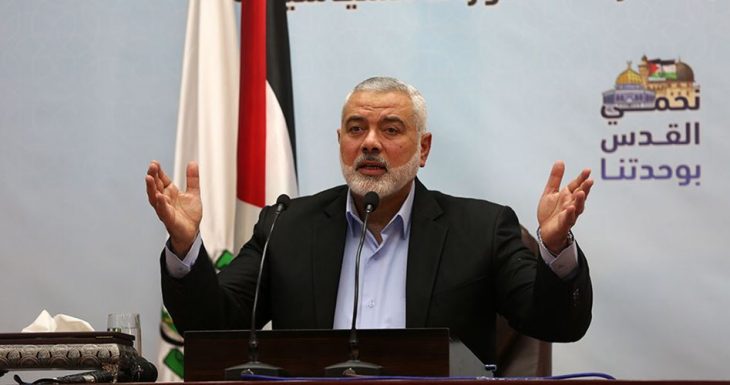
GAZA – Head of Hamas’s political bureau Ismail Haneyya has affirmed that his Movement will not allow the deal of the century to be implemented and will use armed resistance to prevent it.
Haneyya made his remarks in a televised speech during the 32nd Islamic Unity Conference that kicked off on Saturday in Tehran.
“We want to build a strong and strategic alliance that brings together all the forces to face the challenges surrounding the Palestinian cause,” Haneyya said.
He stressed that the Palestinian people have open options to defend their holy sites and stand like “an impenetrable dam” against any attempt to liquidate the Palestinian cause.
The Hamas official also underlined that all forms of resistance would remain his Movement’s strategic choice.
“We have one compass pointing towards the liberation of the land and the establishment of the Palestinian state, and every party sharing this goal with us is our ally,” he added.
He called on the organizers of the conference to adopt an Islamic strategy to confront Israeli schemes, strengthen the Palestinians’ steadfastness in Jerusalem and protect the Aqsa Mosque against Judaization.
US creates new facts on the ground in Syria
By M. K. BHADRAKUMAR | Indian Punchline | November 24, 2018
The Trump administration is making a determined effort to engage with Turkey, which used to be the anchor sheet of American regional strategies in the Middle East for several decades. Without a robust partnership with Turkey, US policies remain ineffectual on several regional fronts – ranging from the Black Sea and Eastern Mediterranean to post-conflict Syria, Iran oil sanctions and Gulf security — and even Khashoggi affair.
Turkey has a long list of grievances – real, feigned or imaginary. But President Trump senses that Turkish president Erdogan prioritizes two core issues – demand that a) Washington should extradite his arch political rival Islamist preacher Fetullah Gulen (who he alleges plotted the failed coup against him in 2016); and, b) that the so-called Halkbank case in a Manhattan court should be wound up.
Trump has lately signaled that he is acting on both issues. Gulen is a tough call for Trump insofar as he has been an “asset” of the CIA. The Halkbank file may be relatively easy to handle.
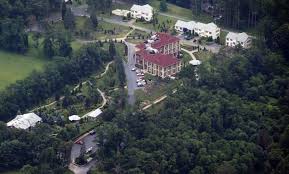
(Fetullah Gulen’s ‘retreat center’ in Pennsylvania)
In turn, Erdogan is holding the trump card in the Khashoggi affair, which has potential to undermine the US’ grand Middle East strategies. A top Saudi establishment commentator Abdulrahman Al-Rashed wrote in the Saudi daily Asharq Al-Awsat, “Turkey has been using the (Khashoggi) crime to push Trump to make concessions to release a convicted Turkish banker or hand over an opposition figure in exchange of stopping its campaign against Saudi Arabia.” Clearly, Trump expects Erdogan to stop fueling the Khashoggi affair.
Erdogan has now let it be known that he is open to meeting with the Saudi Crown Prince Mohammed bin Salman on the sidelines of the G20 summit in Argentina on November 30.
However, the Turkish-American engagement has a much bigger backdrop — Syrian conflict. How far the tango over Khashoggi helped US to address the Syrian situation is hard to tell, but American diplomacy has a way of juggling several balls. In particular, the Pentagon’s alliance with Syrian Kurdish groups worries Turkey and Erdogan has been threatening to move against them.
Now, the US has come up with an innovative idea to work with Turkish military apropos any terrorist threats from Syria. Two days ago, US defence Secretary James Mattis unveiled the idea with disarming simplicity during an interaction with the media:
“Turkey is a NATO ally and they have legitimate concerns about terror threats… from Assad’s Syria… And Turkey has a lot of reasons for concerns, being the NATO country with a border right along Syria. And we don’t dismiss any of their concerns. We are putting in OPs up in northern Syria, this is the change now, okay? We are putting in observation posts in several locations up along the Syria border — northern Syria border because we want to be the people who call the Turks and warn them if we see something coming out of an area that we’re operating in. This is closely collaborated – we are consulting closely with Turkey, military and State Department. Both were consulting with them.”
“We are going to track any threat that we can spot going up into Turkey. That means we will be talking to Turkish military across the border. They will be very clearly marked locations day and night so that the Turks know where they’re at.”
Meanwhile, Voice of America also reported on November 22 that “a large military convoy from an Arab country was deployed last week to the eastern Syrian province of Deir el-Zour” in the region under US control.
Prima facie, the US is pre-empting any excuse by Turkey to attack the Kurdish groups by offering a CBM. But the bottom line is that the US is marking as its exclusive preserve a vast swathe of territory in Syria’s northeastern region — roughly one-third of entire Syria — which is rich in hydrocarbon reserves and water resources, and it expects Turkey to respect the ground reality.
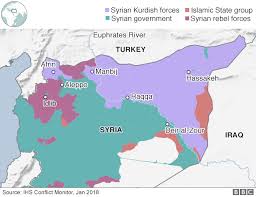
(Who controls what in Syria.)
Without doubt, an entity is being carved out of Syria that is beyond the reach of Damascus, with the Arab Forces providing the “steel frame” for internal security and acting as deterrent against any Turkish attacks against the Kurdish militia, while the US monitors the border region with Turkey.
Mattis claimed that Turkey is on board. But Turkey strongly supports Syria’s unity. Turkish Defence Minister Hulusi Akar has openly voiced disquiet over the US move to set up observation posts on Turkish-Syrian border. Akar disclosed that Turkey conveyed its “discomfort” to the Pentagon:
“We have stated that the observation points to be established by the US troops on the Syrian border will have a very negative impact… and in the course of our discussions we expressed that it could lead to a perception that US soldiers are somehow protecting terrorist YPG (Syrian Kurdish) members and shield them.”
Equally, could an Arab force’s – most likely Saudi and Emirati troops – deployment (just when the war is ending) have been without prior consultation between Washington and Ankara? The point is, Turkey has troubled relations with both Saudi Arabia and the UAE and will resent their deployment of troops to its border regions with Syria.
In sum, the US’ newfound role as the gatekeeper of the Turkish-Syrian border means the Pentagon is creating new facts on the ground, which signals a long-term US occupation of northern Syria. There are serious implications for Syria’s unity and territorial integrity. Indeed, the last thing that Turkey wants is an independent entity along its border with Syria where the Kurds enjoy autonomy. Turkey has a congruence of interests with Russia and Iran in this regard.
UK Commits Extra Military Forces to Ukraine: Irresponsible Policy, Dangerous Repercussions
By Arkady SAVITSKY | Strategic Culture Foundation | 24.11.2018
Ukraine’s Constitutional Court green-lighted a bill on amending the country’s main law by enshrining into it the final goal of obtaining NATO and EU membership. The decision was announced the next day after the UK and Ukraine’s defense ministries made a joint statement, stressing the need to expand military cooperation. The defense chiefs agreed that Operation Orbital, the Army training program started in 2015, was a success to be continued at least till 2020. Instructors from the British Army, most of who have significant experience in participating in combat operations in Iraq and Afghanistan, have trained over 9,500 Ukrainian servicemen. An unspecified number of UK soldiers would be sent to train Ukrainian special forces and marines, in addition to the 100 personnel deployed currently in the country.
A multi-role hydrographic survey ship will be deployed in the Black Sea next year to demonstrate Britain’s support for Ukraine and ensure “freedom of navigation”. HMS Echo is not a warship but it flies the naval ensign. In September, Great Britain made known it planned to increase the warships’ presence in the Black Sea next year with increasingly frequent port calls to Odessa.
NATO naval presence there is seen as provocative by Russia amid increasing tensions in the Azov Sea. A conflict appears to be imminent and the West has taken the side of Ukraine despite the fact that it was Kiev who has been provoking it. EU High Representative/Vice-President Federica Mogherini believes many vessels flying European Union flags were threatened to make Brussels consider “appropriate targeted measures” to be taken as a signal to Moscow.
The increase in UK military presence goes against the letter and spirit of Minsk accords, which state that the conflict in Ukraine should be managed through diplomatic and political means.
The US military already runs a maritime operations center located within Ukraine’s Ochakov naval facility designed to deliver flexible maritime support throughout the full range of military operations. Hundreds of US and Canadian military instructors are training Ukrainian personnel at the Yavoriv firing range. The US is to transfer two Oliver Hazard Perry-type frigates to Ukraine. The move will actually ensure constant NATO naval presence in the Black Sea going around the restrictions imposed by the Montreux Convention because the vessels will have America sailors onboard carrying out “training missions” and remain under US command, despite official sources saying otherwise. All in all, ten ships of that class are available for export. In September, the US Coast Guard transferred two Island-class cutters, armed with .50-caliber machine guns and 25mm deck guns. The transfers urge Kiev to challenge Moscow militarily.
Nobody in Washington or London asks why an industrialized nation and a large arms exporter, with abundant resources and fertile land should depend on foreign assistance unable to defend itself. Weapons are supplied and training is provided to the country, where corruption is rampant. Even the US State Department’s recent report says it is. Popular protests are commonplace. The conflict in Donbass is used to distract the people from domestic woes. The frustration with Kiev’s reluctance to introduce much-needed reforms and curtail the political influence of the oligarchs is rapidly growing. The common people of Ukraine need political and economic reforms, not increased foreign military presence on their soil.
The only reason for the West to keep the failed Ukraine afloat is its obsequiousness and readiness to be converted into a springboard to threaten Russia with an aggression. Despite Ukraine’s multiple problems, the country has recently been rewarded with an official status in NATO. The 2018 North Atlantic Alliance’s summit confirmed its support for Ukraine’s full-fledged membership to make a mockery of the so called “NATO standards.”
The UK government is going through hard times. It has just achieved as a draft agreement on post-Brexit relations with the EU. The deal has a little chance to make it through the Commons. Nobody knows exactly how it will end up if the MPs say no. There may be no Brexit at all finally. Chancellor Philip Hammond believes “If the deal is not approved by parliament, we will have a politically chaotic situation… In that chaos that would ensue, there may be no Brexit.” Or there may be endless negotiations, reconciliation conferences, delays and postponements. It’ll be a large order for the government to stay. There are supporters of no-confidence vote in parliament. You never know how it’s all going to pan out.
Nothing unites a divided nation better than an external threat, such as Russia. The Brexit deadline is March 29 to launch a 21-months transition period with Britain still a member. The events in Ukraine are needed to fuel the fire. Making people think that the UK is lending a helping hand to a poor nation under attack is a way to improve the government’s image and approval ratings. The cabinet members never tell their people that by rendering military assistance to Kiev their country becomes an accomplice to a conflict that has nothing to do with its national security or interests. The UK military aid eggs the Ukrainian government on to seek a military solution.
Russia is not watching idle. If the Minsk accords are washed out, it will have each and every reason to recognize the Lugansk and Donetsk self-proclaimed republics as independent states eligible for military cooperation agreements, including stationing Russian military bases on their soil, if their governments ask for it. No international law would be violated.
Ukraine’s government is ramping up tensions because President Petro Poroshenko is running for re-election in March 2019 on a national security platform. So he takes a tougher line on Azov. Those who rush to provide him with military assistance become accomplices in his adventurist actions that could have disastrous consequences. The UK will bear responsibility for goading Kiev into taking a confrontational approach and turning the Azov Sea into a flashpoint that can spark at any minute.
UK Provided ‘Extremely Flimsy’ Evidence in Skripal Poisoning Case – Journalist
Sputnik – November 24, 2018
Detective Sergeant Nick Bailey, one of the first people to be hospitalized in the poisoning of Sergei and Yulia in Salisbury in March, has given his first-ever interview to the BBC Panorama programme.
In the interview, which aired on Thursday evening, Bailey says he was contaminated by the poison as he inspected the Skripals house, after they were found ill on a park bench in Salisbury city centre.
The British government and media were quick to blame the Russian state for the poisonings of Yulia and Sergei, declaring that the substance was the nerve agent a-234, or ‘novichok’ which had been smeared on the door handle of the Skripals’ house by two Russian military intelligence officers.
The two suspects’ identities were later put forward by the blogger website Bellingcat, which British state broadcaster the BBC widely promoted.However for some, there are still many questions remaining in the British version of the Skripal case. Columnist for the Independent and Guardian newspapers, Mary Dejevsky spoke to Sputnik about her reservations with the British media’s representation and analysis of the Skripal case.
Sputnik: Mary you tweeted recently that the BBC Panorama programme aired on Thursday night and showing an interview with Detective Sergeant Nick Bailey was ‘close to propaganda’; what made you say that?
Mary Dejevsky: Although the UK doesn’t have a state television service, this came pretty close.
My particular problem with this programme was that it posed none of the questions that have been hanging in the air ever since the attack on the Skripals in Salisbury happened back in March.
There are an awful lot of questions that are open; there is a lot of the official version put out by the government which has been challenged, and rightly challenged because there are huge questions. But the programme on the BBC posed none of these questions.
Sputnik: Why do you think it is that there has been no real analysis from British mainstream media of the Skripal case?
Mary Dejevsky: Even when there was the death of Alexander Litvinenko there were a few people that were actually questioning the official version and it wasn’t really until after the enquiry that a lot of the questions closed down.But with the Skripal case it seems to me that there has been an extraordinary consensus from the very beginning. One of the reasons I think is that the government seemed so certain about its case, and supposedly they presented evidence which mobilized this international diplomatic action where there was coordination of countries expelling Russian diplomats who were, it was claimed, working undercover – undeclared members of the Russian security services – working under diplomatic cover.
Now it’s not clear to me because I think there have been reports from Germany for instance that there was no additional evidence provided by Britain other than what they presented to parliament which was extremely flimsy.
Sputnik: What questions remain unanswered in the Skripal case?
Mary Dejevsky: There are dozens of questions. One of the most obvious is that the CCTV footage of the two alleged GRU agents going from London to Salisbury and back again twice is highly selective.
We have no CCTV footage that’s been made public of the Skripals in central Salisbury that day, even though it is apparently known that the CCTV cameras were working efficiently across Salisbury that day. We were told that the two Russian agents went to the Skripals’ house and put novichok on the door handle.The only CCTV footage that has been produced of the two has been, at the closest, half a kilometer away from the Skripals’ house. There is enormous questions, in my view, about the whole version of whether novichok or anything was put on the door handle of the Skripals’ house.
How come that they apparently went in and out of the house, it’s not clear at what times, but how come they were apparently found together collapsed on a bench several hours later as the victims of what was supposed to be a potentially fatal substance that could kill anyone that went near it, in minutes?
Sputnik: A letter was written to The Times on 14th March by Dr Stephen Davies, consultant in Emergency Medicine at Salisbury hospital, saying ‘May I clarify that no patients have experienced symptoms of nerve agent in Salisbury, and there have only been three patients with significant poisoning’ – this really is a discrepancy in the story is it not?
Mary Dejevsky: Yes, this has always been in the background in this story, this letter that was published in The Times that denied that anyone was treated for nerve agent poisoning, and there have been various suggested explanations given since, including that when they were taken to hospital they had symptoms of fentanyl poisoning, not nerve agent poisoning, and that this explains the doctor’s letter.And there have been various attempts to square the circle, but to my mind none of them has been entirely convincing. We also have the question of the chemical weapons’ agency’s findings and whether the substance that the OPCW agency tested was actually the substance that the Skripals were poisoned with.
It doesn’t appear that there is a completely secure chain of evidence from as it were, start to finish, that nothing might have sort of inserted into the process. So there are all these questions and none of them were asked on the BBC programme.
Trial by Propaganda
By Rob Slane | The Blog Mire | November 23, 2018
I mentioned in a couple of comments yesterday that I don’t own a television. In fact, I haven’t had one since 2001. To begin with it’s hard, but if you stick with it you very soon come to see it as remarkably odd that you’ve spent a significant amount of your time sitting in front of a box, wondering if there’s anything on, and still watching it even if there isn’t, and letting other people drip their agenda and propaganda into your head night after night, through perhaps the most powerful medium ever created.
The downside is of course that there are sometimes things that are worth watching. I’m not that into football, but I quite fancied watching some World Cup games with my children this summer. But not having a TV or a licence I had to resort to watching the games broadcast on some dodgy website direct from Kazakhstan. So there is that.
But by and large the plusses far outweigh the minuses, one of which is the fact that I don’t have to hand over a penny of cash to an institution I have come to loathe — the BBC. But perhaps the biggest plus is that when I do get to watch a programme — especially a documentary on some political or social issue — I find that I’m better able to spot propaganda than I ever would have done had I been immersed in TV culture on a regular basis.
And so it was with the BBC’s Panorama programme. I’ve only managed to watch the first 20 minutes so far, and so I’m only able to comment on that (my thanks to David S for uploading it to YouTube). But what I’ve seen so far is one of the best — or worst depending on how you look at these things — examples of political propaganda I’ve seen in a long time.
There was of course lots of creepy music. There were of course no dissident voices. There were of course no difficult questions put to those in charge of an operation which has seen the narrative changing on a regular basis, and not making any more sense despite the changes.
Why, if the boot had been on the other foot, so to speak, and this sort of thing had been put out by Russian state television, I would find it hard to know whether to laugh or cry at it. But the one thing I would be certain of is that it was clear evidence that that country was slipping back into the dark days of Soviet propaganda, only using modern technology to make it all feel a lot more cool and spangly.
Let me say firstly that the worst thing by a country mile in the section I’ve watched so far came right at the very beginning, where the presenter, Jane Corbin, made the following statement:
“Now, moving images, never seen before of the Russian assassins just after the attack [my emphasis].”
I don’t know whether Mrs Corbin has any idea of what she just did, or whether she even cares, but in one foul swoop she completely undermined the concepts of due process, and innocent until proven guilty, and she also made it impossible for the two suspects to ever receive a fair trial, were it ever to come to that.
This is really bad. No, it’s worse than that: it’s really, really, stonkingly terribly bad. On the same day as the Panorama programme, The Metropolitan Police released CCTV footage of the men from 4th March, and the header at the top of their statement says, “Counter Terrorism Police continue appeal over Salisbury suspects [my emphasis].” In the statement itself they refer to the two men, Petrov and Boshirov, no less than five times using the word “suspects”. Yet the national broadcaster has just informed the populace that they are not suspects in an investigation, but assassins. Case closed by the Bellingcat Broadcasting Corporation?
It was basically this issue that got my goat about this case in the first place. The fact that the British Government came out and made pronouncements about what had happened, before an investigation had really properly started, literally tore up hundreds of years of English common law and indicated to me that we really are heading towards arbitrary, tyrannical Government. The fact that the BBC has now come out and pronounced authoritatively on a case that is still ongoing, where no facts whatsoever have been proven in open court, only serves to reinforce this view.
It seems that we need reminding of the following: it really doesn’t matter two hoots what our views are of what happened on 4th March in Salisbury, or whether we think that Alexander Petrov and Ruslan Boshirov were responsible, the principles of due process and the presumption of innocence, which were enshrined by people immensely wiser than our current foolish generation of leaders, still apply. They must apply, else we are done for. But the Government doesn’t seem to care about that. And the BBC doesn’t seem to care about it either. Do you?
As for the actual details of the programme, just two observations, and then maybe some more in another piece once I’ve had time to look at the rest of it.
Firstly, it seems to me that the programme contained an astonishingly glaring contrast between what we are supposed to believe about the substance apparently used, and what actually happened. Here are some quotes the programme put out about the substance itself:
“It’s very unique in its ability to poison individuals at quite low concentrations.” – Porton Down Professor Tim speaking about Novichok.
“The Russians called it Novichok. Thought to be 10X more toxic than any nerve agent created before or since.” – Jane Corbin.
“To kill a person, you need only 1mg. To be sure, 2mg.” – Vil Mirzyanov, who worked on the Foliant project.
“The person starts to go blind, that’s the first sign. The second is difficulty breathing, even to the point that they stop breathing. The third sign is constant vomiting. The fourth, uncontrollable convulsions.” – Vil Mirzyanov, on the effects of “Novichok”.
“The Russians weaponised Novichok for the battlefield. The tiniest dose can be fatal.”– Jane Corbin.
It’s like they had to keep reminding us of just how deadly the substance is. But if it is unique in its ability to poison individuals at quite low concentrations, if it is 10X more toxic than the next deadliest nerve agent, and if the tiniest dose can be fatal why — a reasonably person might ask — are the Skripals and Nick Bailey still alive? Why is the BBC reinforcing to us just how deadly a substance it is, then in the next breath telling us all about the 65-year-old diabetic who survived, even though he must have got much more than a tiny dose, since he apparently left trails of it all over the City (though interestingly, not at the duck feed, the car park meter, or the door handles at Zizzis and The Mill). And I’m afraid that the explanation of “excellent medical care will not do.” By their own admission, the hospital staff did not know how to treat it for a long while after the poisoning. And so either “Novichok” is not as deadly as they kept making out on the programme. Or “Novichok” was not used. Simple as that. But you can’t have it both ways. If you can square that particular circle, good luck. There’s a highly paid job out there for you somewhere.
The other huge anomaly was of course the movements of Nick Bailey. The account that he and a colleague went to 47 Christie Miller Road at about midnight raises some huge questions, not least because it flatly contradicts numerous previous reports. Very briefly, here are some questions that arise from what was said:
1. Many of the first reports said he was a first responder to the Skripals, but from his account on the BBC programme, I got the impression that he arrived at the bench after the Skripals had already been taken to hospital. Why then was he named as the hero cop who went to help the Skripals if he did not do this?
2. He states at one point that, “There was nothing lying near the bench”. This is a bit strange as Freya Church mentioned that both Mr Skripal and Yulia had bags with them next to the bench when she saw them. What had happened to these bags before Mr Bailey got there, and was the person who removed them also taken to Salisbury District Hospital (SDH) for tests?
3. He says that he and a colleague went to the house wearing “full protective suits.” How, then, could he have become contaminated at the house?
4. According to the report, Mr Bailey and his colleague went to 47 Christie Miller Road at around midnight on 4th March. Since their visit must have been known by his seniors, why did it take until 9th March before any news of his visit to the house was made public (by a man not even part of the investigation – former Met Commissioner, Lord Ian Blair)?
5. Assistant Commissioner Neil Basu claimed that Mr Bailey had worn a body camera when he went to the house. Why did the BBC not show this footage, but instead did their own reconstruction?
6. In his book, the BBC’s Mark Urban stated that Mr Bailey couldn’t get in the front door, and so went around the back. The programme directly contradicted this. Which one is correct?
7. Mr Bailey states that:
“Once I’d come back from the house, the Skripals house, my eyes were like … my pupils were like pinpricks, and I was quite sweaty and hot. At the time I put that down to being tired and stressed.”
But according to the programme, it was not until the Tuesday, well over 24 hours later, that he was apparently driven to SDH. How on earth could it have taken that time for him or his superiors to put two and two together, since the whole point in him doing the search and wearing the forensic suit was because it was known by that time that an unknown chemical had been used?
8. The claim that Mr Bailey was first at the house, and that this was at midnight flatly contradicts the testimony of a number of Mr Skripal’s neighbours. For instance, the Salisbury Journal reported the following on 5th March:
“Police arrived at Skripal’s home in Christie Miller Road, Salisbury, yesterday at 5pm, according to neighbours.”
And The Mirror said this:
“Neighbours say police have been at the ex-spy’s home since 5pm that day.”
If the lights are still on at either publication, perhaps the journalists who wrote those pieces might want to take it up with the BBC. And if the lights are still on in the country, perhaps we might want to reflect on whether it really is a very good idea to give up our precious legal safeguards, like due process, the presumption of innocence, and trial by jury, in favour of what we now appear to have, which is basically Trial by Propaganda.
The Final Push for Idlib Will Come Soon
By Federico PIERACCINI | Strategic Culture Foundation | 23.11.2018
The situation in Syria is that of a frozen conflict, following the agreements made between Russia, Turkey and Syria on the demilitarized zone created around Idlib. Except for some sporadic terrorist attacks, the truce seems to be holding up over the last few weeks, even though it has become clear to everyone what the next step is for the province.
The Syrian Arab Army (SAA) has been busy eradicating Daesh in the southern part of Syria in recent weeks, concentrating its efforts on securing all areas that have been liberated from terrorist control but which still remain vulnerable to sporadic attacks, as occurred in Sweida at the end of July 2018. In that incident, there were dozens of victims and numerous abductees who remained in the hands of Daesh for months. This caused the Syrian population in neighbouring areas to clamor for protection, forcing the SAA to undertake an anti-terrorist campaign that has been ongoing since August.
This effort by the SAA has slowed down in part due to subsequent events, with an agreement reached between Erdogan and Putin to create a demilitarized zone in the province of Idlib. From October 15, an area spanning 20 kilometres and guarded by Turkish and Russian troops guarantees a separation between the SAA and terrorist groups in the province.
Russian and Syrian efforts have been moving in two very specific directions over the last few weeks. While Moscow supplies Damascus with new equipment in preparation for the future advance on Idlib, Putin and his entourage continue diplomatic efforts to draw more of Syria’s enemies closer to the Russia-Iran-Syria axis. The meeting that brought about the demilitarized zone included Macron and Merkel, the Europeans having evidently come to terms with the impossibility of overthrowing the legitimate government of Syria. Macron and Merkel were offered a way out of the Syrian conflict, decoupling themselves from the belligerent stance of the United States, Israel and Saudi Arabia. The intention is to usher Paris and Berlin towards the same direction Qatar, Turkey and Jordan have been progressively gravitating. Certainly, these are not countries to be considered friends of Damascus. Rather, they are parties with whom a constructive dialogue needs to be entered into in order to advance common diplomatic interests.
Moscow has often found it possible to reach an agreement or start unpublicized negotiations with each of these parties. Erdogan seems to have preferred an agreement with Putin rather than waiting for the liberation of Idlib by the SAA, thus being able to postpone the natural conclusion of the war that will find him sitting at the table defeated. At the same time, Erdogan wants to concentrate on the Kurds in order to secure the border between Syria and Turkey controlled by the Syrian Democratic Forces (SDF), and to prevent any partition of Syrian territory that would favor other parties. Jordan has even reopened the border crossings with Syria, appearing to be the first country in opposition to Damascus that is now taking practical steps to mend fences.
The case of the participation of the two European countries at the summit with Erdogan and Putin is more complex. The rift between Washington and the other European capitals is wide and well documented, even more so after the events in Paris commemorating the end of the First World War. Macron and Trump seem to be diverging further in terms of policy and ideology, while Trump and Merkel have always had their differences. Trump’s choices in the Middle East, in the wake of the destructive actions of Israel and Saudi Arabia, marked a profound point of difference and mistrust with the European allies. Macron and Merkel have a huge problem dealing with refugees flowing from areas in North Africa and the Middle East destroyed by US-led wars. The prospect of working with Erdogan, and indirectly with Damascus, to bring back hundreds of thousands of refugees currently in France and especially Germany, seems to have been Putin’s winning argument during the talks in Istanbul.
This slow diplomatic approach has been accelerated as a result of Israel’s downing of a Russian electronic-surveillance aircraft. The need to avoid a direct conflict between Moscow and Tel Aviv allowed the Russian missile forces to deploy to Syria an advanced model of the S-300 in addition to the existing S-300/400 systems on the ground. The presence of these advanced systems, and Moscow’s threats to use them, together with American concerns over the possibility of an F-35 being shot down by Soviet systems dating from the 1970s, forced the Zionist entity to halt its attacks on Syria.
This situation has helped to create a frozen conflict in the country. Together with the agreement of Idlib, this gives the SAA plenty of time to rest, regroup, and receive supplies needed for future campaigns.
The current truce is a strategic pause that has all the appearance of what has happened in the past in the provinces of Homs and Aleppo. The need to free Idlib from terrorists goes hand in hand with the promise of Assad and the government of Damascus to liberate every inch of Syria from terrorists. The diplomatic efforts of Moscow serve to prepare the ground for what will happen in the coming months, with the SAA set to advance on Idlib. In this sense, the deployment of advanced systems in Syria serves as a deterrent against possible responses from countries like Israel and the United States, anxious to defend their jihadists, but continuing to have minimal influence on the ground.
Russia and Syria’s moves therefore seem to be in preparation for the battle for Idlib, to be the longest and most difficult yet. The liberation of the province is inevitable but requires all the necessary political, diplomatic and military preparation in order to ensure success and limit potential escalation. As is often the case, Moscow and her allies approach complex issues with simple and pragmatic solutions, even offering exit strategies to their (geo)political opponents, which contrasts with their demonstrated tendency to rush heedlessly towards war.
Countering Washington’s Confrontation
By Brian CLOUGHLEY | Strategic Culture Foundation | 23.11.2018
The United States continues to brandish its military power all round the globe and has recently been concentrating on confronting Russia and China. Its policy and deployments were explained by the US Air Force Secretary in September when she declared that Washington felt threatened because “Less than a week ago Russia began the largest exercise on Russian soil in four decades… with more than 300,000 troops and 1000 aircraft.
On the other side of the world, China’s first aircraft carrier was declared combat ready this year, and promptly sailed into the Pacific to conduct flight operations.”
The absurdity of that statement escaped fitting comment by the West’s mainstream media, which also considers it astonishing that Russia should carry out a military exercise in its own territory following the massive build-up by the US-NATO military alliance along its borders. As pointed out on November 15 by Russia’s Foreign Ministry, this expansion can be seen “along the entire stretch of land connecting the Baltic Sea and the Black Sea. Since October, vast operational resources have been concentrated in the Baltic Region and the north of Europe, due to a series of major international exercises. They are being deployed in addition to NATO regiments already present in the countries of the eastern flank. Those regions have never seen such a military presence since the end of the World War II”.
And it is growing.
Foreign Policy in Focus observes that “In all NATO countries in Eastern Europe, the US Air Force is investing multimillion-dollar sums in the expansion of its air bases, with more than $50 million pouring into a base in Hungary, more than $60 million allocated to the modernization of two air force bases in Romania, and two bases in Slovakia that will be upgraded with more than $100 million, besides various base upgrades in other countries in the region.”
In October President Putin said that “Russia doesn’t threaten anyone and has strictly adhered to its obligations in the sphere of international security and arms control,” but made it clear there would be decisive action if an attack takes place, and “the aggressor should know that retaliation is inevitable, and he will be destroyed.” Russia has “precision hypersonic weapons” exemplified by the Kinzhal missile and a new system, the Avangard, that will enter service in the next few months.
His outlook and approach are echoed by China’s leader, President Xi Jinping, who reminded those attending the Asia-Pacific Economic Cooperation summit in Papua New Guinea on November 17 that “History has shown that confrontation, whether in the form of a cold war, a hot war or a trade war, produces no winners.”
In early 2018 President Xi said plainly that China “will forge a powerful military that is ready to respond to the call, to fight and to win a war,” and in October, following Washington’s increasing military activity in and around the South China Sea, the President told his armed forces to “concentrate preparations for fighting a war”, which is as blunt a warning to Washington as might be expected in the circumstances, in which the US is deliberately provoking China by its widely-publicised support for Taiwan. This has gone so far as for the Defence Minister Wei Fenghe to announce that Beijing would never give up “one single piece” of its territory. He warned that “repeated challenges” to China’s stance on Taiwan would lead to military action.
What China and Russia are saying is plain, blunt and unambiguous : stay out of our territory; stop prodding our borders and cease your coat-trailing provocation.
Philippines President Rodrigo Duterte is an unpleasant person, but on November 17 he put things in perspective in his region. When questioned about US Navy operations in the South China Sea he asked in turn “Why do you have to create frictions that will prompt a response from China?”
One of the more ridiculous observations by the US Air Force Secretary concerned the commissioning of China’s first aircraft carrier. In tones of hushed horror she revealed that it “was declared combat ready this year, and promptly sailed into the Pacific to conduct flight operations.”
What upsets the US military is the fact that China now has an aircraft carrier that can defend the country from beyond its shores, unlike America’s eleven enormous aircraft carriers which sail round the world’s oceans in order to impose Washington’s will. At the moment there are two carrier groups in the Philippines Sea, ready to move into the South China Sea to conduct more provocative operations.
The Air Force Secretary added to absurdity by declaring that “now all of Southeast Asia is within reach of China’s long-range bombers” — presumably considering it irrelevant that in October, in the latest of a series of provocative operations, two nuclear-capable USAF B-52 bombers from Barksdale Air Force Base, Louisiana, overflew the South China Sea. As reported in the Air Force Times “the flights were in support of US Indo-Pacific Command’s Continuous Bomber Presence, a mission focused on deterring regional challengers.”
Regional challengers? Just who is challenging whom with a “continuous bomber presence”?
Like Russia, China has had to develop advanced weapons to counter the menace patrolling and probing its borders, and these could be employed effectively in the event of US confrontation getting out of hand.
A CNN headline in October was “US Navy proposing major show of force to warn China” and it indicated that the “Pacific Fleet has drawn up a classified proposal to carry out a global show of force as a warning to China and to demonstrate the US is prepared to deter and counter their military actions . . . The plan suggests sailing ships and flying aircraft near China’s territorial waters in the South China Sea and Taiwan Strait in freedom of navigation operations to demonstrate the right of free passage in international waters. The proposal means US ships and aircraft would operate close to Chinese forces.”
If Washington is insane enough to go ahead with this deliberately confrontational fandango, there could be serious consequences. Chinese warships could manoeuvre to bar US Navy vessels from coming with 12 nautical miles of one of its islands in the South China Sea, and if there were attempts by the US to penetrate that barrier, there could well be a serious incident. Should this involve damage to a Chinese ship, Beijing would not stand idly by and would respond appropriately. Given its inventory of weapons, especially its advanced torpedoes, this could involve destruction of one of the US Navy’s carriers.
There are similar possibilities in the north. CNN noted that “Currently the aircraft carrier USS Harry S Truman is taking the unexpected step of operating in the North Sea — sending a signal to Russia that US military forces can extend their reach to that area.” But if US warships behave aggressively it can be expected that Russia will counter such behaviour most forcefully.
In October the Commander of US Naval Forces Europe, Admiral James Foggo, told the US Naval Institute that “it would be important to have a greater naval presence in Europe than the US has had in the last two or three decades, and that this year’s presence by the Harry S Truman Carrier Strike Group and the Iwo Jima Amphibious Ready Group were part of the effort to boost presence to reassure allies and to keep an eye on Russian activity. With the Truman Strike Group now back in the region — spending time in Iceland and the North Sea ahead of Trident Juncture [the November 2018 anti-Russia US-NATO exercise based on Norway] — ‘that sends a very strong message that the United States will operate anywhere, either unilaterally or in collaboration with our NATO partners and allies. And like I said, nobody in the world can come close to a US nuclear-powered aircraft carrier in terms of firepower, dwell and endurance,’ he said.”
Foggo’s diatribe ended with the juvenile but still dangerous pronouncement that “And those guys and gals out on that carrier and the Marines are doing a fantastic job. So we’re keeping the adversaries back on their heels. They don’t know where we’re going next and that’s a good thing. And we’re working more with allies and partners because we have that additional capability. Right now I have — I think, at last count — 495,000 tons of grey-hulled shipping operating in the theatre. And that’s great. I love it.”
This type of trigger-happy immature belligerence is official warning of US policy as regards Russia and China, and it is not surprising that both nations are countering Washington’s confrontation.
What you won’t hear from US govt: Iran is open to working with Saudi Arabia
By Darius Shahtahmasebi | RT | November 22, 2018
Washington’s rhetoric regarding Iran paints the picture of an evil nation hellbent on destroying the world. In reality, it appears that Tehran would prefer dialogue with its rivals, which is unacceptable to the US.
Tuesday’s White House Statement from President Trump on “Standing with Saudi Arabia” was an outright condemnation of Iran and a total free pass for Saudi Arabia.
Iran is to blame for almost every issue in the Middle East, including the war in Yemen, according to the statement. The US-made and supplied bombs raining down on Yemeni school buses, with some 85,000 children dying in the process, is simply because of Iran. Not only is Iran responsible for the bloodshed in Yemen, Tehran has further helped “dictator Bashar Assad” in Syria kill “millions of his own citizens.” The official death toll of the Syrian war is under one million, and certainly the various jihadist groups, including Islamic State (IS), share responsibility for that figure.
“The Iranians” have also killed many Americans and other innocent people throughout the Middle East. Iran not only shouts “Death to America” and “Death to Israel” but it is also considered “the world’s leading sponsor of terror.”
It is curious enough that firstly, in a statement about Saudi Arabia, the term “world’s leading sponsor of terror” is not gifted to the prime sponsors of Al-Qaeda and IS. Secondly, the fact that Trump himself put that term in inverted commas seems to suggest that even he doesn’t quite believe that one to be true.
Remember, Saudi Arabia is the country that Trump, before becoming president, once accused of masterminding the 9/11 attacks. I wasn’t aware of this until reading the statement, but according to the White House, Saudi Arabia would gladly withdraw from Yemen if the Iranians would agree to leave. That’s right, Iran’s non-presence in Yemen must be removed in order for Saudi Arabia to cease blowing up children, hospitals, factories, food trucks, schools, agricultural land, strategic ports, and relinquish its complete stranglehold over the country.
If you were naive enough to take the White House statement at face value, you would surely think that Iran has much to answer for. Iran is, after all, public enemy number one and has been for some time. Conversely, Saudi Arabia has been a longstanding ally of the United States, a faithfully serving client state, and it should be protected at all costs especially if there is to be any hope at pushing back against Iran as it yells “Death to America” and “Death to Israel.”
But what if Iran was, despite all of its flaws, not interested in fighting a war with Saudi Arabia? What if we dug a little bit deeper and asked ourselves: is there another way of dealing with the “threat” that Iran poses?
In January this year, Iran’s Foreign Minister Mohammad Javad Zarif wrote an article that was published in the Financial Times which laid out the country’s proposed framework for bringing stability to the Middle East. The article was widely ignored by the rest of the world, even though its implications were potentially life-saving.
“The objective of a strong region — as opposed to a quest for hegemony and the exclusion of other actors — is rooted in recognising the need to respect the interest of all stakeholders,” Zarif wrote. “Any domineering effort by one country is not only inappropriate but essentially impossible: those who insist on following that path create instability. The arms race in our region is an instance of this kind of destructive rivalry: siphoning vital resources into the coffers of arms manufacturers has contributed nothing to achieving peace and security. Militarism has only served to fuel disastrous adventurism.”
Zarif states that the usual modes of forming alliances have become “obsolete” and suggests that security networking to address issues is a much better practice. He proposes that instead of ignoring conflicts of interests, the countries in the region should accept their differences.
“The rules of this new order are straightforward: common standards, most significantly the purposes and principles of the UN Charter, such as sovereign equality of states; refraining from the threat or use of force; peaceful resolution of conflicts; respect for the territorial integrity of states; non-intervention in the domestic affairs of states; and respect for self-determination within states,” Zarif adds.
Zarif recommends opening up dialogue and blames a “dialogue deficit” for instability throughout the region. Such a dialogue, he argues, could help other nations understand that all parties have “similar concerns, fears, aspirations and hopes.” His eventual vision is that these countries will eventually adopt a “non-aggression pact.”
Now, Zarif did not explicitly state who he was talking about in this proposed path to peace and stability. But what if his intention was to work with Saudi Arabia, is this not something that should be talked about, particularly by the US commander-in-chief when releasing statements stoking the fire of an already volatile region while pitting two major regional players against each other?
In October last year, Zarif was quoted as saying that Tehran is willing and ready for rapprochement with the Kingdom of Saudi Arabia, adding that he does not believe the two countries should have the type of relationship they have right now.
In December last year, Iran’s president Hassan Rouhani further intimated that Tehran is willing to resume ties with Saudi Arabia if it halted its military campaign in Yemen and severed its ties with Israel.
“We don’t have any problem with the country that is our neighbor and unfortunately speaks a lot and speaks irrationally. Saudi Arabia, as our neighbor, should stop bombing Yemen from tomorrow, stop bowing to Israel, stand straight and rely on its nation,” Rouhani said.
In March this year, Zarif then took his ambiguous article one step further and openly said that Iran is willing to resolve its differences with Saudi Arabia’s as part of Tehran’s desire for stability in the region. As Zarif notes, this is not the first time Iran has reached out to the kingdom, yet the Saudis continue to reject Iran’s proposed dialogue.
In August of this year, Zarif further stated that Iran wants to restore relations with Saudi Arabia as well as the United Arab Emirates (UAE) and Bahrain. Surprisingly, Saudi Arabia had just allowed the entry of an Iranian diplomat to head Iran’s interests in the Kingdom, a rare move since diplomatic ties had been cut almost two years prior.
Just last month, Zarif again called for Saudi Arabia’s cooperation to push back against the “repeated insults” made by the US president at the time.
“This is the reward of the illusion that security could be achieved through external support,” Zarif said. “We extend our hands to our neighbours, saying: let’s build a strong region to stop this arrogant pride.”
I could be wrong, but in its totality, it does appear that Iran is proposing a framework where Middle Eastern countries settle their disputes between themselves without outside interference, whereby the US would be left out completely. Such a suggestion is in itself a form of hubris so unacceptable to Washington that the proposal itself makes the country ripe for a targeted regime change operation. Despite this, Iran has been quite open about its blueprint for a new outlook to the Middle East.
“We don’t need foreigners to guarantee the security of our region,” Iran’s president said earlier this year.
“When it comes to regional security arrangements, we are ready to talk to our neighbours and friends, without the presence of foreigners,” he added. “We are, have been and always will be good neighbours.” Yes – even Saudi Arabia.
In August, UN experts went even further and said that Iran might be willing to play a “constructive role” in ending the war in Yemen, something Iran has said it has been wanting to do for years by working with Saudi Arabia.
Conversely, the Saudis and their US counterparts are not so willing to take the Iranians up on their offer.The Saudis always want to “fight the Iranians to the last American,” according to former Secretary of Defence Robert Gates. The Saudis have even openly abandoned the Palestinian cause in an attempt to cosy up to Israel and create a US-backed alliance that can confront Iran in the region. The Saudi Crown Prince also compared Iran’s supreme leader to Adolf Hitler, a brazen statement for a man who executes journalists and unarmed children with complete impunity. The kingdom continues to openly work with Al-Qaeda linked groups to prolong the fighting in Yemen, all because its anti-Iran hysteria cannot falter from its position.
A détente between Riyadh and Tehran appears to be a far cry away from happening any time soon, but we cannot continue to pretend we haven’t noticed the opportunity that continues to present itself, particularly from the Iranian side. Whether an Iran-Saudi relationship is a positive step or a disastrous one is an important question to ask; but we should at least consider it as an option if it can avoid a potential and unnecessary war between two regional powers, as well as its potential to diffuse an already devastating war which continues to kill thousands of people completely needlessly.
Kremlin Comments on Latest Footage Concerning Salisbury Poisoning
Sputnik – 23.11.2018
Russian presidential spokesman Dmitry Peskov has commented on the latest footage released by London Metropolitan Police on the Salisbury and Amesbury incidents, saying that while the use of the nerve agent in Europe was cause for concern, British investigators have yet to share any information with the Russian side.
“From the very beginning, Russia offered to cooperate with the British side to clarify the circumstances of this incident, but we were rejected. We were not met with reciprocity, and we do not have any information about what happened in Salisbury. We do not have information about what kind of agent was used, how much of it there was, what its volume was; we do not have information about who was poisoned, what happened to them, where they disappeared to, etc.,” Peskov said, speaking to reporters on Friday.
Despite this lack of information or cooperation, the spokesman said it was very concerning to see the use of such agents in Europe. “The use of such strong chemical warfare agents in Europe is a very dangerous fact, and is a matter of great concern,” he noted.
Earlier Friday, the London Metropolitian Police released fresh CCTV footage showing the two Russian nationals it suspects of involvement in the poisoning of Russian ex-spy Sergei Skripal and his daughter Yulia, showing them walking around the southern English town of Salisbury on March 4. The footage does not show the men at Skripal’s home, however, where police allege they sprayed a military-grade poison on the door handle.
Police also released images of what they said was a “specially made model of the counterfeit perfume bottle” in which they believe the toxic substance used to poison the Skripals was kept. Police said they are now investigating how the bottle got from Salisbury, where it was allegedly used to poison the Skripals, to Amesbury, when it was found by Charlie Rowley, one of the victims of the Amesbury poisoning incident which occurred in late June.
Sergei and Yulia Skripal were found unconscious on a bench at a Salisbury shopping center on March 4. London quickly concluded that they were poisoned by a Russian military-grade nerve agent, and accused Moscow of staging the attack, leading to a diplomatic row between the two countries which culminated in sanctions and the expulsions of dozens of diplomats. In September, UK investigators identified two Russian nationals named Alexander Petrov and Ruslan Boshirov, saying the names were possible aliases. Investigators accused the pair of working for Russian military intelligence and carrying out the poisoning attack. The men came forward for an interview with RT’s Margarita Simonyan on September 13, telling her that they were sport nutritionists who traveled to Salisbury as tourists, and that they had no ties to Russian military intelligence.
Russia has sent several dozen diplomatic notes to the UK calling for cooperation in the investigation of the case. London left these proposals unanswered, and accused the Russian side of refusing to cooperate.
Featured Video
No Threat Can Force Iran’s Surrender /Trita Parsi & Lt Cl Daniel Davis
or go to
Aletho News Archives – Video-Images
From the Archives
What is the Israeli Lobby in Australia Doing in Interfaith Dialogue?
By Ali Kazak | Dissident Voice | October 11, 2015
For years Israel and its lobby around the world have been trying to normalise their relations with Arabs and Muslims without solving the Palestine Question.
One of the methods they resorted to in the last few years is using human rights and community organizations such as interfaith dialogue and Multiculturalism to achieve this objective and to: isolate the Palestinians, marginalise the Palestine question, end Israel’s isolation, and prevent criticism of Israel, knowing that these organisations will be the first to stand against Israel’s violations, racial and religious discrimination.
The group responsible for this task in Australia is The Australia/Israel & Jewish Affairs Council (AIJAC); its Director of International & Community Affairs, Jeremy Jones is in charge of lobbying religious community organizations, specifically Muslims and Christians. Consequently he convened the Faith Communities for Reconciliation, founding participant in the Australian Partnership of Religious Organisations and the Australian National Dialogue of Christians, Muslims & Jews.
AIJAC is a private political propaganda group. It is recognised as the main Israeli lobby in Australia. It coordinates its activities and works intimately with the Israeli embassy in Canberra and different institutions in Israel. It is privately funded by some Jewish businessmen. It monitors closely Australian politicians, the media, ethnic and religious groups, (especially Arabs and Muslims), unions and academics on their stands towards Israel and the Palestine question. … continue
Blog Roll
 Aletho News
- The war of liberation of the Arab and Islamic peoples expands across the Gulf
- Envoy warns UN on Trump’s threat to ‘obliterate’ Iran’s civilian infrastructure
- The Larak Corridor: Iran’s Rial Gate With No US, No Israel, and No Way Around
- ‘Economic terrorism’: Steel facilities hit again in US-Israeli strike
- ‘War Crime’: Iran condemns attacks on Arak, Ardakan nuclear sites
- Two-thirds of Americans want quick end to Iran war even if goals unmet
- Trump to Give “Important Update on Iran” Wednesday in Prime-Time Speech
- Theodore Postol: Iran’s Missiles & Drones Were Underestimated
- Iran To Target Military Industrial-Tech Complex That Facilitated Gaza Genocide
- Collapsing Empire: The Resistance Disarms ‘Israel’
- If Americans Knew
- Israel wants US to bomb more of Iran’s civilian structures (113,000 is not enough) – Not a ceasefire Day 173
- Ann Coulter Rips Into Fox News for Iran War Coverage
- Joe Kent Urges Americans To Call White House and Congress To Object To Sending Troops Into Iran
- DNC Resolution to Reject AIPAC Funding Puts Democratic Leaders in the Hot Seat
- Swedish foundation to build 400 schools as over 650,000 Gaza children remain without education for 2 years
- Israeli army admits photshopping image of slain Lebanese journalist
- This is how Israel is systematically killing health workers under the cover of war in Lebanon
- Carrying life under fire: Israeli invasion of Lebanon leaves pregnant women facing deadly risks
- Champagne all around for the new death penalty (for Palestinians) law – Not a ceasefire Day 172
- Why are Palestinian books struggling to be seen on Amazon?
- No Tricks Zone
- New Study Finds Warming Saves Lives…Cold Temperatures 12 Times More Deadly Than Excess Heat
- German Science Blog Accuses PIK Climate Institute Of Hallucinating Climate Tipping Points
- Devastating Assessment Of Comirnaty Vaccine By Former Senior Pfizer Europe Toxicologist
- New Study: CO2 Is ‘Effectively Negligible’ As An Explanatory Climate Change Factor Since 2000
- Former Pfizer Toxicologist Dr. Helmut Sterz Tells Bundestag Hearing Pfizer Vaccine Should Have Never Been Approved
- Energy Expert: Germany’s Nuclear Phaseout Was A “500 Billion Euro Mistake”
- New Research: South Australia’s Mid-Holocene Sea Surface Temperatures Were 4°C Warmer Than Today
- Storing Green Energy To Last Germany 10 Days Would Require A 60-Million Tonne Battery
- New Studies: UK Sea Levels Were 4 Meters Higher Than Today During The Mid-Holocene
- Destructive Green New Deal: German Energy And Metal Group Warns Of Drastic Crisis
 Aletho News