What Does Israel ‘Occupy’?
By Blake Alcott | Palestine Chronicle | December 17, 2018
In what is written and said about Israel and Palestine the word ‘occupation’ is ubiquitous. But what territory, exactly, is the ethnocratic state occupying? Is it just the Gaza Strip and the West Bank, or all of Palestine?
Everybody agrees that the territories Israel took over in 1967 are occupied. However, both pro-Palestinians and liberal Zionists routinely write of ‘the Occupation’ or ‘occupied Palestine’ to refer to these territories only. The demeaning acronym ‘OPT’ means only the West Bank and Gaza Strip only. But if those territories are ‘occupied’, then by the same token so is the 80% of historic Palestine called ‘Israel’. All of Palestine has been taken over.
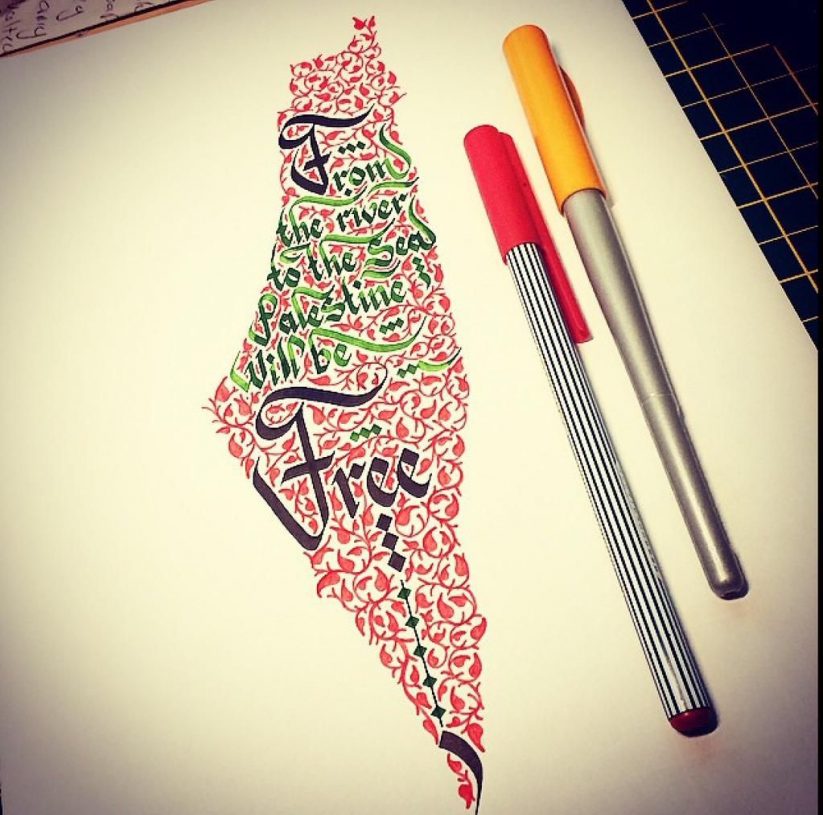
When we demand freedom ‘from the river to the sea’ what are we demanding other than an end to rule, control, and occupation by a non-indigenous Power? When Palestinians use the term ihtilal they always distinguish between the ‘1948 occupation’ and the ‘1967 occupation’. Why, then, does the international discourse in Western languages ignore the 1948 occupation, in denial of the fact that Israel in 1948 merely took over from the British-Mandate occupation of 1917-1948?
Palestine was a British colony, and all colonies by definition are occupied by the colonial Power. And indeed, when we correctly and routinely call Britain’s successor Israel a ‘settler-colony’ we are not just referring to the West Bank and Gaza Strip. Especially since it is thoroughly supported by pro-Zionist forces outside of historic Palestine, all of Palestine is now a settler-colony and thus occupied from the river to the sea. And if the settler-colonialist paradigm is accurate, all non-indigenous Israelis are ‘settlers’, not just those in the West Bank. If we talk of boycotting ‘settlement goods’, that should mean all Israeli goods.
Does this matter? Yes: If it is only the West Bank and Gaza Strip that are occupied, then the rest of Palestine ‘within the Green Line’, is not occupied, and if it is not occupied, what is it then? It can then only be rightfully controlled by Israel, for if you are not ‘occupying’ a territory, it must be yours. Using the term limited to the 1967 occupation thus implies that the Europeans who colonized Palestine under British protection for thirty years are the rightful owners of the land of Palestine. The basic premise of Zionism is conceded.
That is, withholding the epithet ‘occupation’ from today’s Israel normalizes the Zionist Entity’s presence; it pulls the rug out from underneath Palestinian claims to political rights in Palestine. As Colonial Minister Churchill and High Commissioner Samuel wrote in their pathbreaking 1922 White Paper on the Palestine question, one worldwide outside ethno-religious group is in Palestine “by right and not on sufferance” and thus cannot be an Occupier.
Which Narrative?
Denying implicitly in this way that Israel occupies the lands taken over in 1948 is thus a key part of the Zionist narrative that Jews own Palestine, while the diametrically opposing Palestinian narrative claims that rightful ownership lies with the indigenous inhabitants (whatever their ethnicity or religion). It insists that this is the territorial and historical ‘self’ entitled to realize self-determination in non-partitioned Palestine. If moreover, this political ‘self’ consists of all Palestinians, they are all ‘occupied’, and the logic in calling only West Bank or Gazan land ‘stolen’ undermines the unity of all Palestinians.
We similarly identify Israel as an ‘apartheid’ state, exercising and enacting discriminatory separation not only on the Palestinians in ‘Israel proper’ and in the West Bank and Gaza Strip, but as well on the 6 or 7 million Palestinians residing outside of Palestine – as Richard Falk and Virginia Tilley argued in their UNESCWA report in 2017. The Green Line upon which the restricted use of the concepts ‘occupation’ and ‘apartheid’ would rely is historically, ethically and emotionally irrelevant.
A third, ‘liberal-Zionist’ narrative also contends that Israel is occupying only what it took over from the Egyptian and Jordanian occupiers in 1967. This diverges from the Jewish-Israeli mainstream in at least admitting it, but it leaves Israel intact – although, sadly, bereft of ‘Judea and Samaria’. This soft Zionism certainly takes comfort in seeing that some Palestinians and many of their supporters join them in granting that the Jewish state is not guilty of occupying the 1948 territories.
The fatal consequence of this limited use of ‘the Occupation’, in whichever camp, is the implication that once Israel quits doing its occupying of 20% of Palestine (and a part of Syria), as far as its relations with its neighbors goes it reverts to a normal, well-behaved state. The use of this central term is thus a litmus test. If limited to the West Bank and Gaza Strip, Israel is normalized.
A common-language Definition
In common parlance, a state is ‘occupying’ territory if, first, a force or a state has come in from outside the territory in question. Second, that force has established military and political hegemony in that territory. Third, this happens against the will of the indigenous inhabitants.
The second and third conditions obtain in the entirety of Palestine. Disputed is only whether Israel was a force that moved into ‘1948’ Palestine from the outside. Or was it somehow already there? Was it by 1948 somehow also ‘indigenous’, in which case the situation should be described not as an ‘occupation’ but as a victory in a civil war – as the Israeli narrative indeed describes it? Even though the European-Jewish community was obviously vastly ‘less indigenous’ than the Palestinians in terms of length and unbrokenness of habitation, perhaps on 15 May 1948 it suddenly became legitimate.
However, left to their own devices after freed from the Ottoman occupation in 1918, the Palestinians would, by the early 1920s, certainly have constituted their state covering all of Palestine – or perhaps a single sovereign Greater Syria would have emerged covering al-sham, i.e. historic Palestine plus today’s Lebanon, Syria, and Jordan. But instead, outsiders from and in Britain occupied it.
But were the Jewish Agency and its military arm the Haganah, together renamed ‘Israel’ in May 1948, any different from Britain in terms of coming from the outside? The overwhelming majority of Jews in Palestine as of that date was, after all, very recent European immigrants, and given near-unanimous indigenous opposition based on justified fear of political takeover, a necessary condition for their implantation was thirty years of support by colonial Power Britain. ‘British bayonets’ both fostered Jewish military strength and, especially during the years of the 1936-39 Revolt, crushed Arab military as well as political potential. Without this enablement by Britain and its fellow Powers, the self-described Jewish entity would not have had a shred of a plausible claim to statehood in any part of Palestine at the time of the decisive debates of 1947 leading to the Partition Resolution of the UN General Assembly (Resolution 181).
In other words, the most realistic picture of the forces taking over Palestine is of a British/European-Jewish amalgam functioning during three entire decades. It is one occupation, an overlapping transfer of power from protector to protected.
By the way, even the usurped 55% of Palestine recommended for the “Jewish State” by the General Assembly majority had a slight indigenous non-Jewish majority of 509,780 to 499,020 if the 105,000 Bedouins living there were counted, a fact that strengthens the notion of an outside occupier rejected by a majority.
What about the territory conquered during 1948 over and above that 55% granted by the outsiders at the UN, amounting to about half the area it granted to the “Arab State”? Certainly, by any criterion, it is ‘occupied’ – taken by force without even a pretense of legitimacy. It is thus especially egregious to exclude it from the term OPT, the more so as it included the almost-totally indigenous Galilee.
To be consistent and coherent, there is thus no way around terming the whole territory ‘within’ the 1949 armistice line ‘occupied’. As Uri Davis wrote in 1972 in the Journal of Palestine Studies, he “first had to come to grips with the fact that, essentially, the right-wing Zionist contention that there was no essential difference between the colonization of Tel Aviv and Jaffa prior to and immediately after 1948, and the colonization of Hebron in 1967, was correct.”
Examples of the Problem
The Quakers in Britain recently decided to quit supporting the “occupation… now in its 51st year”, thus dating this “illegal occupation” from 1967 only. The other 80% is thus not occupied and of necessity ‘legal’, under legitimate Israeli control. In consequence, since it is this 51-year occupation that motivates the Quakers, they will cease boycotting Israeli goods when the occupation of the West Bank and Gaza Strip is ended, whatever the fate of the other Palestinians. This results from distinguishing between a boycott of ‘settlement-complicit’ goods and the blanket boycott of Israel that would target the source of the problem and be a true successor to the blanket boycott of South Africa which brought down Apartheid.
Another example is the discourse of the large US-based organization which starting in 2001 called itself the “US Campaign to End the Israeli Occupation”. It fought for most Palestinian rights, but as its name suggested most strongly against the occupation of the 1967-occupied areas. Perhaps aware that having ‘Israeli Occupation’ in its title lent implicit recognition to Israel’s permanency, in 2016 it changed its name to “US Campaign for Palestinian Rights”. However, its “common principles” and “Factsheet” still make it clear that the term “military occupation” refers only to what Israel took over in 1967, for conceptually it treats the refugees and the “Palestinian citizens of Israel” separately. Its use of “settlements” refers likewise consistently only to the West Bank.
Part and parcel of this narrative, moreover, is this US Campaign’s support for “all relevant UN resolutions”. This must include the soft-Zionist position of Security Council Resolution 242 which cements the Green Line and the Jewish state on one side of it. The group is also careful to criticize only “Israel’s policies and practices”, not its right to be in Palestine in the first place. Finally, its reference to the “illegal West Bank colonies” implies that the earlier Jewish Agency/Israeli colonization of the bulk of Palestine was legal.
A final example of an ‘occupation’ narrative leaving room for an Israel legitimately present in Palestine is an article in Haaretz on 29 November 2018 by Gideon Levy entitled “Why I am obsessed with Israel’s occupation of the Palestinians”. Said occupation is again that of the West Bank and Gaza Strip. Its main victims, to be sure, are “the Palestinians”, but it also “harms” an Israel worth saving because of its “crucial impact on our daily lives and on the image of this country.”
Referring to Israel’s culture-loyalty, nation-state, nakba, citizenship, and anti-BDS laws Levy even claims that “In the absence of the occupation, all these laws would be redundant.” I interpret this to mean that for him Israel’s worst crime is its treatment of the West Bank and Gaza Strip – a view certain to disappoint the roughly three-quarters of Palestinians living in Israel or outside of Palestine.
Counter-arguments
I have challenged various speakers on their restricted use of the term. The most common answer is that one can’t apply it to all of Palestine because by that logic California – or all of North America, or Australia – would be ‘occupied’.
My first reaction was ‘So what? So be it. If it’s true, deal with it.’ But more deeply, or unconsciously, this answer takes the indigenous conquered less seriously than they deserve, for how could any Native American say anything but Yes, Europeans moved in, took over and occupied their lands? If meant as an assertion that the world’s settler-colonies are somehow legitimate, this is not post-Zionism but simply Zionism.
Another answer is that ‘occupation’ is a specific term in international law and should not be watered down by broader use. But to the extent the term is defined at all in international law, it is not useful for a political discussion; it is only a backdrop for humanitarian rules for treating occupied people in armed conflicts between states.
And in general, terms such as ‘occupation’ which function perfectly well in common and historical language should not be co-opted for specialist purposes. In fact, routinely using the term ‘illegal’ to characterize the 1967 occupation and the ‘settlements’ there – as does even the BDS Movement – doesn’t just imply that the rest is legal, but detracts from more important ethical and political dimensions.
A third answer is that we should not use our terms in ways that regard Palestinians as one polity because this erases the Green Line. The division of Palestine gives (a limited number of) Palestinians leverage at international institutions and courts to plead within the mainstream narrative as political, if not military, equals. The danger of this ‘parity pitfall’ cannot be covered here, but it definitely belongs to the liberal-Zionist narrative that the Israeli state of the two-state solution is rightful.
Israel’s Illegitimacy
The basic, fatal effect of co-opting the Arabic term ‘occupation’ for the 1967 territories only is its implication that a non-occupying, non-Palestinian ethnic state is in legitimate, or at least acceptable, ownership of the rest. This is not compatible with Palestinian self-determination, liberation of the Land, right of return, or anti-Zionism.
In terms of the fashionable ‘rights-based approach’, it is likewise not compatible with all the rights of all the Palestinians because it normalizes the Zionist premise that, ethically, at least in part of Palestine indigenous wishes can be ignored. If this premise is rejected, on the other hand, the Zionist Entity is occupying all of Palestine.
We often advise ourselves to watch our words carefully. Israel spends millions to tailor certain words to serve its goals – ‘right to exist’, ‘return’, ‘democratic and Jewish’, and ‘anti-semitism’ being a few examples – and those in solidarity with Palestine should take a page out of that approach and ask whether the word ‘occupation’ is not worth utmost care.
Both logically and in the context of actively arguing for Palestinian self-determination, joining the Zionist narrative or even just indulging in ambiguity serve no purpose. The time is ripe to say that, if Palestine belongs to the Palestinians, it is not right that Israel occupies it.
No comments yet.
Featured Video

Bombing Hitler’s Hometown
or go to
Aletho News Archives – Video-Images
From the Archives
‘Conspiracy Theory’ Now Fact: Greater Israel Has Arrived
By Kit Klarenberg | Mint Press News | January 28, 2025
Ever since Tel Aviv’s 1948 creation, much has been said and written about ‘Greater Israel’ – the notion Zionism’s ultimate end goal is the forcible annexation and ethnic cleansing of vast swaths of Arab and Muslim lands for Jewish settlement, based on Biblical claims this territory was promised to Jews by God. The mainstream media typically dismisses this concept as antisemitic conspiracy theory, or at most the fringe fantasy of a minuscule handful of extremist Israelis.
In reality … continue
Blog Roll
 Aletho News
- Pro-Israel terrorist arrested before assassination of pro-Palestinian activist
- Bombing Hitler’s Hometown
- German journalist threatened with homelessness as German court upholds EU sanctions in landmark free speech case
- US Tells Allies That Ukraine-Bound Arms Could be Sent to Middle East
- Organized terrorism: Iran condemns killing of its diplomats in Lebanon
- Why could Gaza enter the regional war?
- Hamas official rejects Mladenov Plan linking disarmament to Gaza reconstruction
- Two Primary Elections for the Soul of ‘America First’
- Japan Clings to US Vassalage Despite Energy Crunch Caused By Iran War
- US Seeks Control Over Global Energy Infrastructure – Kremlin
- If Americans Knew
- Researchers at Human Rights Watch Resign Over Blocked Report on Palestinian Refugee Return
- Jewish Groups Are Backing a War Americans Don’t Want
- Eric Fingerhut Thinks He’s the President of the Jews
- Top Jewish Philanthropists, Rabbis Urge Israeli President to Take Action Against ‘Jewish Extremists’
- Don’t Be Fooled. Zionist Leaders Have Always Wanted to Control Southern Lebanon
- Israel’s widespread use of torture is a core element of its genocide against the Palestinian people
- In Israel’s War on Iran, Many Middle East US Bases Rendered “All But Uninhabitable”
- ‘Burn the lawn’: Israel pursues ‘Rafah model’ in southern Lebanon
- A genocide here, an amputation there
- Reports: Iran mobilizing 1M fighters, Israel-US run low on ammo, Israeli army faces shortage – Not a ceasefire Day 168
- No Tricks Zone
- Devastating Assessment Of Comirnaty Vaccine By Former Senior Pfizer Europe Toxicologist
- New Study: CO2 Is ‘Effectively Negligible’ As An Explanatory Climate Change Factor Since 2000
- Former Pfizer Toxicologist Dr. Helmut Sterz Tells Bundestag Hearing Pfizer Vaccine Should Have Never Been Approved
- Energy Expert: Germany’s Nuclear Phaseout Was A “500 Billion Euro Mistake”
- New Research: South Australia’s Mid-Holocene Sea Surface Temperatures Were 4°C Warmer Than Today
- Storing Green Energy To Last Germany 10 Days Would Require A 60-Million Tonne Battery
- New Studies: UK Sea Levels Were 4 Meters Higher Than Today During The Mid-Holocene
- Destructive Green New Deal: German Energy And Metal Group Warns Of Drastic Crisis
- New Study Documents A 20-Year Pause In Arctic Sea Ice Decline – Driven By Internal Variability
- Wake-up Call: Survey Shows Majority Of Germans Now Favor Postponing Climate Targets!
 Aletho News
Leave a comment