British Government Covert Anti-Russian Propaganda and the Skripal Case
By Craig Murray | December 21, 2018
It is worth starting by noting that a high percentage of the Integrity Initiative archive has been authenticated. The scheme has been admitted by the FCO and defended as legitimate government activity. Individual items like the minutes of the meeting with David Leask are authenticated. Not one of the documents has so far been disproven, or even denied.
Which tends to obscure some of the difficulties with the material. There is no metadata showing when each document was created, as opposed to when Anonymous made it into a PDF. Anonymous have released it in tranches and made plain there is more to come. The reason for this methodology is left obscure.
Most frustratingly, Anonymous’ comments on the releases indicate that they have vital information which is not, so far, revealed. The most important document of all appears to be a simple contact list, of a particular group within the hundreds of contacts revealed in the papers overall. This is it in full:
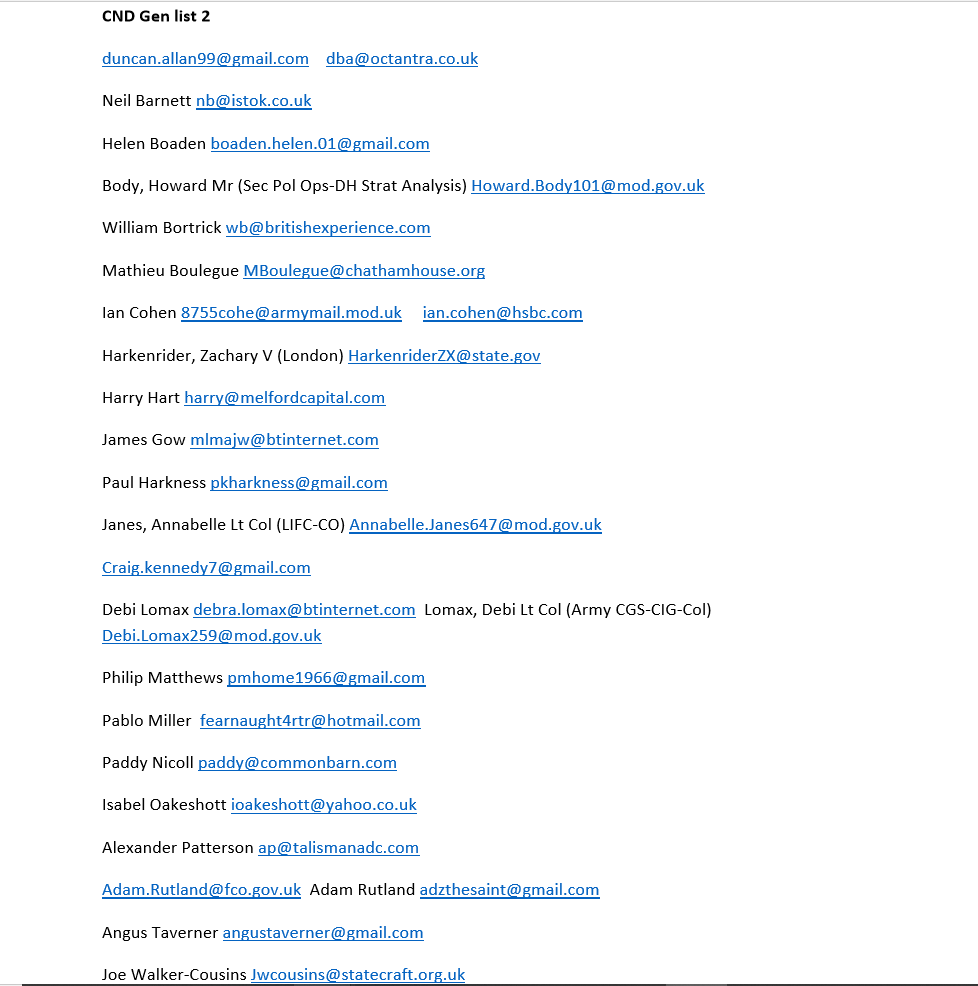
Tantalisingly, Anonymous describe this as a list of people who attended a meeting with the White Helmets. But there is no evidence of that in the document itself, nor does any other document released so far refer to this meeting. There is very little in the documents released so far about the White Helmets at all. But there is a huge amount about the Skripal case. With the greatest of respect to Anonymous and pending any release of further evidence, I want you to consider whether this might be a document related to the Skripal incident.
The list is headed CND gen list 2. CND is Christopher Nigel Donnelly, Director of the Institute for Statecraft and the Integrity Initiative and a very senior career Military Intelligence Officer.
The first name on the list caught my eye. Duncan Allan was the young FCO Research Analyst who, as detailed in Murder in Samarkand, appears in my Ambassadorial office in Tashkent, telling me of the FCO staff who had been left in tears by the pressure put on them to sign up to Blair’s dodgy dossier on Iraqi WMD. During the process of clearing the manuscript with the FCO, I was told (though not by him) that he denied having ever said it. It was one of a very few instances where I refused to make the changes requested to the text, because I had no doubt whatsoever of what had been said.
If Duncan did lie about having told me, it did his career no harm as he is now Deputy Head of FCO Research Analysts and, most importantly, the FCO’s lead analyst on Russia and the Former Soviet Union.
Now let us tie that in with the notorious name further down the list; Pablo Miller, the long-term MI6 handler of Sergei Skripal, who lived in Salisbury with Skripal. Miller is the man who was, within 24 hours of the Skripal attack, protected by a D(SMA) notice banning the media from mentioning him. Here Pablo Miller is actively involved, alongside serving FCO and MOD staff, in a government funded organisation whose avowed intention is to spread disinformation about Russia. The story that Miller is in an inactive retirement is immediately and spectacularly exploded.
Now look at another name on this list. Howard Body. Assistant Head of Science Support at Porton Down chemical weapon research laboratory, just six miles away from Salisbury and the Skripal attack, a role he took up in December 2017. He combines this role with Assistant Head of Strategic Analysis at MOD London. “Science Support” at Porton Down is a euphemism for political direction to the scientists – Body has no scientific qualifications.
Another element brought into this group is the state broadcaster, through Helen Boaden, the former Head of BBC News and Current Affairs.
In all there are six serving MOD staff on the list, all either in Intelligence or in PR. Intriguingly one of them, Ian Cohen, has email addresses both at the MOD and at the notoriously corrupt HSBC bank. The other FCO name besides Duncan Allan, Adam Rutland, is also on the PR side.
Zachary Harkenrider is the Political Counsellor at the US Embassy in London. There are normally at least two Political Counsellors at an Embassy this size, one of whom will normally be the CIA Head of Station. I do not know if Harkenrider is CIA but it seems highly likely.
So what do we have here? We have a programme, the Integrity Initiative, whose entire purpose is to pump out covert disinformation against Russia, through social media and news stories secretly paid for by the British government. And we have the Skripals’ MI6 handler, the BBC, Porton Down, the FCO, the MOD and the US Embassy, working together in a group under the auspices of the Integrity Initiative. The Skripal Case happened to occur shortly after a massive increase in the Integrity Initiative’s budget and activity, which itself was a small part of a British Government decision to ramp up a major information war against Russia.
I find that very interesting indeed.
With a hat-tip to members of the Working Group on Syria, Media, and the Propaganda, who are preparing a major and important publication which is imminent. UPDATE Their extremely important briefing note on the Integrity Initiative is now online, prepared to the highest standards of academic discipline. I shall be drawing on and extrapolating from it further next week.
US leaves trail of bitterness in Syria
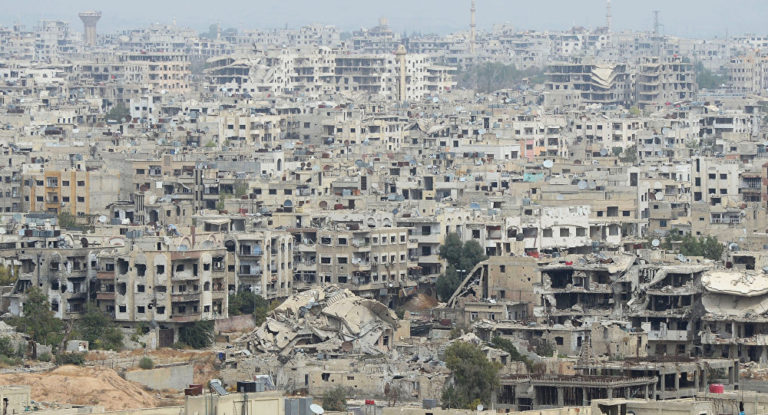
Stalingrad of Syrian war: ancient Syrian city of Raqqa after US bombing
By M. K. BHADRAKUMAR | Indian Punchline | December 21, 2018
On December 17, Ankara was notified of President Trump’s decision on troop withdrawal from Syria. During an earlier phone conversation between him and President Recep Erdogan on Dec 14, Trump had pointedly asked and elicited a positive response from the Turkish leader as to whether Turkey would have the capability to eliminate the remnants of the ISIS in the Syrian tract east of the Euphrates in the event of a US withdrawal from Syria. Erdogan reportedly “reaffirmed” Turkey’s commitment to fight the ISIS.
Ankara likely shared this information with Moscow and Tehran. The three foreign ministers met in Geneva on Dec 19 for a trilateral meeting as guarantors of the Astana format on Syria. The joint statement issued after the meeting, therefore, can be seen as indicative of Turkey’s resolve to give primacy to the trilateral format with Russia and Iran on issues concerning Syria.
To be sure, Turkey will have issues to take up with the Trump administration in the coming days and weeks. As one commentator put it, “For example, will the U.S. collect the weapons provided to the YPG? What measures will the U.S. take for preventing a chaos in the region after the withdrawal? All these require more military and political talks between Turkey and the U.S. Turkey will continue to cautiously follow the situation in Syria.”
However, senior Turkish officials have made it clear that the planned military operations against Syrian Kurds will continue to unfold. Defence Minister Hulusi Akar has been quoted by the state news agency Anadolu as saying, “Now we have Manbij and the east of the Euphrates in front of us. We are working intensively on this subject. Right now it is being said that some ditches, tunnels were dug in Manbij and to the east of the Euphrates. They (Kurds) can dig tunnels or ditches if they want, they can go underground if they want, when the time and place comes they will buried in the ditches they dug. No one should doubt this.”
Yesterday, Erdogan told the visiting Iranian president Hassan Rouhani that Ankara hopes to work closer with Tehran to end the fighting in Syria. Erdogan said at a joint press conference with Rouhani, “There are many steps that Turkey and Iran can take together to stop the fighting in the region and to establish peace. Syria’s territorial integrity must be respected by all sides. Both countries are of the same opinion regarding this.” Significantly, Erdogan also voiced Turkey’s support for Iran (“brotherly nation”) against the US sanctions.
However, Ankara is yet to make an official statement regarding Trump’s Syrian pullout plan. All three countries – Turkey, Russia and Iran – seem skeptical about Trump’s clout to enforce his decision overcoming resistance from the Pentagon. From such a perspective, the resignation of Defence Secretary James Mattis on December 20 will come as confirmation that Trump is indeed forcing his political will, exercising his presidential prerogative to take foreign policy decisions as well as insisting on his supreme authority as commander-in-chief to decide on issues of war involving the US armed forces.
Unlike Turkey and Iran, Russia has voiced opinions on Trump’s withdrawal plans. President Vladimir Putin stated at a press conference in Moscow on Dec 20:
“As concerns the defeat of ISIS, overall I agree with the President of the United States. I already said that we achieved significant progress in the fight against terrorism… There is a risk of these and similar groups migrating to neighbouring regions… We know that, we understand the risk fully. Donald is right about that, and I agree with him.”
“As concerns the withdrawal of American troops, I do not know what that is. The United States have been present in, say, Afghanistan, for how long? Seventeen years, and every year they talk about withdrawing the troops. But they are still there. This is my second point.”
“Third… The current issue on the agenda is building a constitutional committee… We submitted the list to the UN… Maybe not by the end of this year but in the beginning of the next the list will be agreed and this will open the next stage of the settlement, which will be political settlement.”
“Is the presence of American troops required there? I do not think it is. However, let us not forget that their presence… is illegitimate… The military contingent can only be there under a resolution of the UN Security Council or at the invitation of the legitimate Syrian Government…. So, if they decide to withdraw their troops, it is the right decision.”
Overall, Putin commended Trump’s decision, while keeping fingers crossed that as the focus is shifting to the political process will gain traction. Putin didn’t mince words in calling the US intervention in Syria as a violation of international law and UN Charter. The Kremlin spokesman Dmitry Peskov who spoke later in a TV interview was also quite upfront: “The American presence on the Syrian soil is not conductive to attaining the goals of a political and diplomatic solution.” (TASS )
Neither Russia nor Turkey and Iran would expect a cooperative attitude from the American side in a near term over Syria. The US has a stony heart when it comes to Syria’s reconstruction – although it caused immense destruction in that country during its occupation. The US military will be leaving behind a trail of bitterness in Syria. The three other protagonists understood perfectly well that Pentagon commanders were fighting a secretive geopolitical war against each of them. “Good riddance” – that must be the refrain in Ankara, Moscow and Tehran.
Trump Syria Withdrawal Decision Requires Congressional Hearings – Senator Graham
Sputnik – December 21, 2018
WASHINGTON – President Donald Trump’s plan to pull all American forces out of Syria needs to be examined by Congress to determine the impact on US national security, Senator Lindsey Graham said on Friday.
“It is imperative Congress hold hearings on withdrawal decision in Syria — and potentially Afghanistan — to understand implications to our national security,” Graham said on Twitter.
Any hearings, as suggested by Graham, would likely be held when the new Congress convenes in January.
Trump announced plans this week to pull 2,000 US troops out of northern Syria, where they have been backing Kurdish rebels in the US-allied Syrian Democratic Forces (SDF). The president has also ordered the withdrawal of about half of the 14,000 US forces in Afghanistan, according to media reports.
The planned withdrawals – which are opposed by many Republicans and Democrats in Congress — prompted the resignation of Defense Secretary James Mattis on Thursday.
More: ‘Trump Plunging Country Into Chaos’: GOP, Dems Slam Trump for Mattis Resignation
Ex-Diplomat: US Elites Alarmed That Trump May Accomplish Promised Foreign Policy
Sputnik – 21.12.2018
WASHINGTON – The US troop withdrawal from Syria and the resignation of Defense Secretary James Mattis has the establishment fearful that President Donald Trump might finally implement the foreign policy he campaigned on, former diplomat Jim Jatras told Sputnik.
“Terror has again gripped the establishment that the Trump who was elected president in 2016 might actually start implementing what he promised,” Jatras, who was also once a US Senate foreign policy adviser, said on Thursday.
Trump needed to also overhaul the rest of his top-tier defense and national security advisers and chiefs, Jatras said.
“This will be a critical time for the Trump presidency. If he can get the machinery of the Executive Branch to implement his decision to withdraw from Syria, and if he can pick a replacement to General Mattis who actually agrees with [his own] views,” Jatras said. “It is imperative that he pick someone for the Pentagon — and frankly, clear out the rest of his national security team — and appoint people he can trust and whose views comport with his own.”
Trump in a tweet earlier in the day commenting on his decision to withdraw US troops from Syria, said it was “time to come home and rebuild.”
On Thursday, Mattis stepped down citing the fact his views no longer aligned with Trump’s a day after the White House announced that US troops were leaving Syria.
Earlier on Thursday, the Wall Street Journal reported that Trump has ordered the US military to withdraw some 7,000 troops from Afghanistan in the coming weeks.
The president made promises during his campaign to stop expending money and lives on foreign wars to rebuild the United States.
White Helmets Engaged in Looting, Human Organ Trafficking in Syria – Watchdog
Sputnik – 21.12.2018
Members of the organization White Helmets were engaged in the forced removal of human organs as well as theft and corruption in Syria, according to evidence presented at the United Nations by Foundation for the Study of Democracy Director Maxim Grigoriev on Thursday.
“People evacuated by the White Helmets often did not come back alive,” Grigoriev said quoting a witness who lives in an area where the White Helmets operated. “For example, a person receives a minor injury, is rescued, evacuated and then brought back with their stomach cut open and with their internal organs missing.”
Grigoriev noted that according to multiple witnesses, including members of the White Helmets, the organization was also involved in looting wounded individuals in Syria, especially women, as well as plundering stores and damaged buildings.
“Sometimes we came to help, entered a flat, and, if we found gold or jewelry, seized it,” Grigoriev quoted a White Helmets member in Douma. “In one flat, there was a woman who felt ill, we came to help her, found some gold and stole it.”
Members of the White Helmets in Saqba also reported about the extensive system of corruption and theft among sponsors in the organization. Referring to the information provided by a White Helmets member, Grigoriev said the leaders of the organization took for private gain parts of donations they received.
Moreover, the White Helmets constructed the fortifications for terrorists and illegal armed groups in Syria, the Foundation for the Study of Democracy revealed.
“There is overwhelming evidence which proves that the White Helmets centers were permanently engaged in building fortifications for battle positions for terrorist and illegal armed groups who had been supplying them with water and food and evacuating wounded terrorists from the front line,” Grigoriev reported on Thursday on the research completed by the Foundation in Syria.
Grigoriev said that a White Helmets member in Douma told him the group constructed earthen mounds, dug trenches, transport fighters, weapons and ammunition for the fighters.”
“For instance, we dug trenches in the towns of Mesraba and al-Shaifuniya and constructed an earthen mound,” Grigoriev quoted the White Helmets member as saying.
The report on the activities of the White Helmets was prepared using information provided by more than 100 Syrian eyewitnesses, including members of the organization, Syrian Civil Defence, former fighters from illegal groups and terrorist groups, and people living in the areas controlled by terrorists where White Helmets conducted their activities.
The White Helmets, a non-governmental organization that operates in parts of rebel-controlled Syria and Turkey, claims to be a group of volunteer rescue workers.
Both Damascus and Moscow have accused the White Helmets of staging several provocations involving chemical weapons to influence public opinion and justify foreign intervention in Syria.
In August, US State Department Spokesperson Heather Nauert said that Washington would continue to provide life-saving and needs-based humanitarian assistance to vulnerable Syrians and support for the White Helmets operating in Syria.
Syria Insanity Must Continue, Sez Washington Establishment & Media
By James Bovard | December 20, 2018
The Washington Post front page today is in full panic mode over Trump’s decision on Syria. Reading the Post, one would think that US intervention had achieved something aside from getting vast numbers of Syrians pointlessly killed. Washington’s laptop bombardiers are hysterically opposed to Trump’s withdrawal of US troops from Syria. But the “Combat Veterans for Continued Carnage” lobby is almost nonexistent. I slammed Trump’s Syria policy last year in USA Today as his “worst foreign policy folly” but his decision to exit Syria is one of his best decisions yet.
Here’s a link to a USA Today oped I did five years ago on why Americans couldn’t trust Obama on Syria. In a 2014 blog on “Obama’s Great Syrian Bombing Scam,” I groused: “Obama loves to preen as if he is spreading peace, freedom, and democracy with his bombs. But there is no reason to presume that bombing Syria is not as idiotic as it appears. Thus far, the Establishment media is largely playing a lapdog role.” The media’s response to Trump’s withdrawal announcement vivifies how the pro-war bias continues.
When Trump denounced “trigger-happy Hillary” on the campaign trail in 2016, crowds roared. Hopefully exiting Syria is the start of a sea change in U.S. intervention abroad.
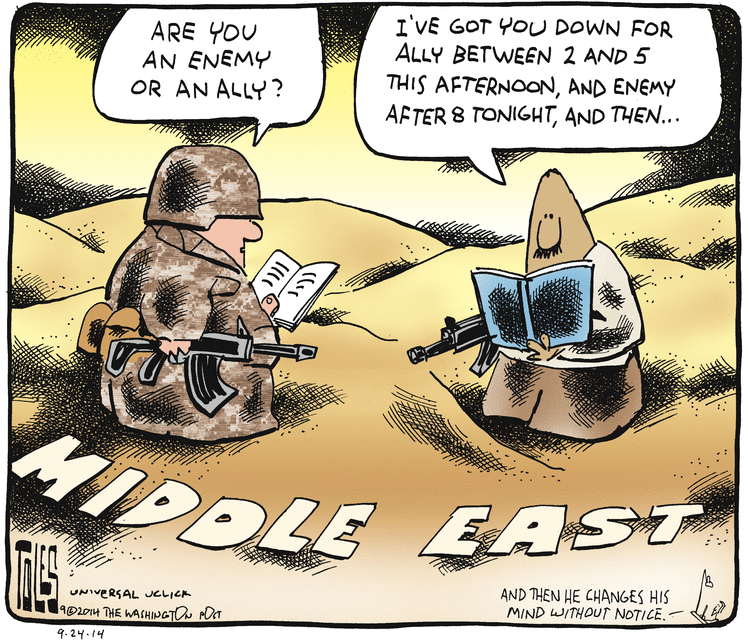
Cartoonist Tom Toles beautifully captured the idiocy of U.S. policy in this 2014 cartoon. Two years later, CIA-backed Syrian rebels were fighting Pentagon-backed Syrian rebels. What could possible go wrong?
A
Be Offensive and Be Damned: The Cases of Peter Ridd and Tim Anderson
By Binoy Kampmark | Dissident Voice | December 20, 2018
It has been an ordinary year for universities in Australia. While the National Tertiary Education Union pats itself on the back for supposedly advancing the rights and pay of academics, several face removal and castigation at the hands of university management. Consumerism and pay are the sort of quotidian matters that interest the NTEU. Less interesting is the realm of academic ideas and how they clash with the bureaucratic prisons that have been built into universities.
At James Cook University, Peter Ridd was sacked on “code of conduct” grounds applied with a delightful elasticity. He claimed that it was for holding views on climate change out of step with his colleagues, and attacking the credibility of the Australian Institute of Marine Science and the ARC Centre of Excellence for Coral Reef Studies. (The pettiness of such institutions knows no bounds: Ridd’s knuckles were rapped, for instance, for satirising, trivialising or parodying the university.)
At the University of Sydney, Tim Anderson, a full time critic of Western interventions in the Middle East and acquitted for ordering the 1978 Sydney Hilton Hotel bombing, has been suspended pending what would seem to be imminent sacking. Causing “offense” was what mattered.
A cardinal rule applies in this case: Be suspicious of those who use good behaviour as a criterion of policing, notably in an environment where bad behaviour and dangerous ideas should hold sway over meek bumbling and submissiveness. Be wary of the demands to be vanilla and beige – behind them lies administrative venality and the dictates of compliance.
Such rubbery provisions as being “civil” or not causing offense shield the weak, spineless and fraudulent and, most dangerously, create the very same intolerable workplace that managers are supposedly opposed to. Very importantly, such code of conduct regulations are designed to immunise management from questions about their behaviour and often daft directives, letting institutions grow flabby with corruption. Inoculated, that class thrives in its toxicity.
The Deputy Vice-Chancellor of JCU, Iain Gordon, has drawn upon the usual stock nonsense defending the decision regarding Ridd. “The issue has never been about Peter’s right to make statements – it’s about how he has continually broken a code of conduct that we would expect all our staff to stick to, to create a safe, respectful professional workplace.” The thrust of this is simple: Never cause offense; be compliantly decent; be cripplingly dull and go back to your homes in your suburbs living a life unexamined. As an academic, you are merely delivering a service mandated by individuals several steps removed from the education process, not performing an ancient duty to educate mankind.
The code of conduct, the product of a corporatized imbecility, assumes the mantle of dogma in such disputes. “All staff members must comply with the Code of Conduct,” goes Gordon’s official statement in May, with its distinct politburo flavour of placing things beyond debate. “This is non-negotiable. It is a fundamental duty and obligation that forms part of their employment.” Ridd, explains Gordon, “sensationalised his comments to attract attention, has criticised and denigrated published work, and has demonstrated a lack of respect for his colleague and institutions in doing so. Academic rebuttal of his scientific views on the reef has been separately published.”
Anderson, having found himself at stages in the University of Sydney’s bad books, has also run the gauntlet of offensiveness. The specific conduct resulting in his suspension featured lecture materials shown to students suggesting the imposition of a swastika upon Israel’s flag. This was deemed “disrespectful and offensive, and contrary to the university’s behavioural expectations”. Tut, tut, Anderson.
The Sydney University provost and acting vice-chancellor Stephen Garton followed the line taken at JCU towards Ridd with zombie-like predictability. “The university has, since its inception, supported and encouraged its staff to engage in public debate and it has always accepted that those views might be controversial.” But debate – and here, behavioural fetters were again to be imposed – had to be undertaken “in a civil manner.” Contrarianism should be expressed with a good measure of decency.
The letter of suspension from Garton to Anderson is one-dimensionally authoritarian. Principles of academic freedom were supported by the university, but only in “accordance with the highest ethical, professional and legal standards”. But the all supreme, and trumping document, remained the Code of Conduct, capitalised by the bureaucrats as Mosaic Law. “The inclusion of the altered image of the Israeli flag in your Twitter Posts, Facebook Posts and teaching materials is disrespectful and offensive, and contrary to the University’s behavioural expectations and requirements for all staff.”
Some heart can be taken from the protest last Friday on the part of 30 academics who signed an open letter objecting to the treatment meted out to Anderson, stating that academic freedom was “meaningless if it is suspended when its exercise is deemed offensive.” His suspension pending termination of his employment was “an unacceptable act of censorship and a body-blow to academic freedom at the University of Sydney”. Reaction to Ridd has been somewhat cooler.
The point with Anderson is that his views are deemed bad for university business, which tolerates no room for the offensive. This, in a place where the most varied, and, at points, tasteless views, should be expressed. But as universities have become shabby entrepreneurial endeavours which see students as obesely delicious milch cows for their existence, the idea is less important than the process.
As is so often the case of free speech, advocates of it always assume it doesn’t apply to others. It is only to be extolled as a mark on paper and university policy. But never, for instance, challenge inane university policy or the hacks who implement it. Never ridicule ideas that deserve it. Never mock the obscene nature of managerialism’s central principle: massaged incompetence and assured decline. University managers and the colourless suits aided by their ill-tutored human resources goon squads tend to hold sway over opinions, taking against anybody who questions certain aspects of their (non)performance.
The Ridd and Anderson cases, coming from separate parts of the academic spectrum, demonstrate the prevalence of toadyism on the part of those who wish to avoid questioning the rationale of a university’s management process. They also suggest an immemorial tendency of authority to savagely oppress those who ignore it; to manifest its existence through punishment. In truth, it is precisely in ignoring those officials long barnacled upon the research and teaching endeavours of the University and drawing revenue best spent on students and scholars that a grave sin is committed. Such officialdom should be ignored, treated as the bureaucratic irrelevance that it is. Time for sit-ins, occupations, boycotts and a retaking of the University.
Binoy Kampmark was a Commonwealth Scholar at Selwyn College, Cambridge. He lectures at RMIT University, Melbourne and can be reached at: bkampmark@gmail.com.
Influencing Foreigners Is What Intelligence Agencies Do
By Philip M. GIRALDI | Strategic Culture Foundation | 20.12.2018
The Rand Corporation defines America’s influence operations as… “the coordinated, integrated, and synchronized application of national diplomatic, informational, military, economic, and other capabilities in peacetime, crisis, conflict, and post-conflict to foster attitudes, behaviors, or decisions by foreign target audiences that further US interests and objectives. In this view, influence operations accent communications to affect attitudes and behaviors but also can include the employment of military capabilities, economic development, and other real-world capabilities that also can play a role in reinforcing these communications.”
In a world where communications and social networks are global and accessible to many ordinary people, influence operations are the bread-and-butter of many intelligence agencies as a means of waging low intensity warfare against adversaries. During the past week there have been two accounts of how influencing foreign audiences has worked in practice, one relating to Russia and one to Great Britain.
The Russian story is part of the continuing saga of Russiagate. On Monday, the Senate Intelligence Committee released two reports on Russian operations before during and after the 2016 election to influence targeted groups, to include African-Americans, evangelical Christians and Second Amendment supporters to confuse voters about what the candidates stood for. Russia Internet Research Agency, headed by Yevgeny V. Prigozhin, alleged to be a friend of President Vladimir Putin, reportedly coordinated the effort.
The New York Times, slanted its coverage of the story, claiming that Moscow was “weaponizing” social media and that it was intended to support the candidacy of Donald Trump who “had a Russian blind spot and an army of supporters willing to believe convenient lies and half-truths.” They also dubbed it “a singular act of aggression that ushered in an era of extended conflict.” Of course, one might note that in 2016 the Times itself had a blind spot regarding Hillary Clinton compounded by a bias against Trump and his “deplorable” supporters, while one must also point out that Russian intentions are unknowable unless one were a fly on the wall inside the Kremlin when the US election was under discussion, so one might conclude that the newspaper is itself spreading something like disinformation.
It is undoubtedly true that Russia had a vital national interest in opposing Clinton, whose malevolent intentions towards Moscow were well known. It is also undoubtedly true that there was a campaign of manipulation of social networks by the Kremlin and its proxies to influence readers and also to assess the development of the two major party campaigns. But it also should be observed that the claim that it was seeking to suppress Democratic voters is not really borne out given the other much more conservative demographics that were also targeted. Indeed, involvement by Russia did not alter the outcome of the election and may have had virtually no impact whatsoever, so the claims by the Times that the world is seeing a new form of warfare is clearly exaggerated to reflect that paper’s editorial stance.
The fact that the Times is trying to make the news rather than reporting it is clearly indicted by its sheer speculation that “The Internet Research Agency appears to have largely sat out the 2018 midterm elections, but it is likely already trying to influence the 2020 presidential election, in ways social media companies may not yet understand or be prepared for. And Russia is just the beginning. Other countries, including Iran and China, have already demonstrated advanced capabilities for cyberwarfare, including influence operations waged over social media platforms.” It is certainly convenient to have all one’s enemies collectivized in two sentences, but the Times manages that quite neatly.
The second story, much less reported in the US media, relates to how the British intelligence services have been running their own disinformation operations against Russia, also using social networks and the internet. The British government has been financing a program that was given the name Integrity Initiative. It has been tasked with creating and disseminating disinformation relating to Russia in order to influence the people, armed forces and governments of a number of countries that Moscow constitutes a major threat to the west and its institutions.
Former British intelligence officer and established Russo-phobe Christopher Nigel Donnelly (CND) is the co-director of The Institute for Statecraft and founder of its offshoot Integrity Initiative. The Initiative ironically claims to “Defend Democracy Against Disinformation.” According to leaked documents, the Initiative plants disinformation that includes allegations about the “Russian threat” to world peace using what are referred to as journalists ‘clusters’ in place both in Europe and the United States.
Even though the Institute and Initiative pretend to be independent Non-Government Organizations (NGOs), they are both actually supported financially by the British government, NATO and what are reported to be other state donors, possibly including the United States.
The Integrity Initiative aside, the United States has also long been involved in influence operations, sometimes also referred to as perception management. Even before 9/11 and after the breakup of the Soviet Union the State Department, Pentagon and National Security Agency were all active on the internet in opposing various adversaries, to include terrorist groups. The CIA has been spreading disinformation using paid journalists and arranging foreign elections since 1947. Sometimes US federal government agencies are operating openly, but more often they are using covert mechanisms and cover stories to conceal their identities. America’s internet warriors are adept at spreading misinformation aimed at target audiences worldwide.
The fact is that spreading disinformation and confusion are what governments and intelligence services do to protect what they consider to be vital interests. It is naïve for the US Senate and America’s leading newspapers to maintain that intelligence probing and other forms of interference from Russia or China or Iran or even “friend” Israel occur in a vacuum. Everyone intrudes and spreads lies and everyone will continue to do it because it is easy to understand and cheap to run. In the end, however, its effectiveness is limited. In 2016 the election result was determined by a lack of trust on the part of the American people for what the establishment politicians have been offering, not because of interference from Moscow.
This Isn’t News. This Is War Crimes Apologia.
By Caitlyn Johnstone | Medium | December 18, 2018
The fact that George W Bush has given Michelle Obama two pieces of candy is once again making headlines in mainstream outlets like Time, The Hill, and Newsweek. He has not given her any new pieces of candy since the last time he did so at his father’s funeral. He also has not ceased to be the man who facilitated the murder of a million Iraqis and inflicted a whole new level of military expansionism and Orwellian surveillance upon our world. As near as I can tell, the only reason this story is once again making headlines is because Michelle Obama and the mainstream media have decided to bring it up again.
“He has the presence of mind and the sense of humor to bring me a mint, and he made it a point to give me that mint right then and there and that’s the beauty of George Bush,” Obama said of the war criminal in conversation at the SAP Center over the weekend, which we apparently need to know about because the news is telling us about it.
“We’re all Americans. We all care about our family and our kids, and we’re trying to get ahead,” Obama continued. “And that’s how I feel about [Bush]. You know? He’s a beautiful, funny, kind, sweet man.”

If you’re starting to feel like attempts to rehabilitate George W Bush’s image are being aggressively shoved down your throat by the mass media at every opportunity, it’s because that is exactly what is happening. Every few weeks there’s a new deluge of headlines explaining to consumers of mainstream media why they should love the 43rd president because he’s such a cutesy wootsey cuddle pie, and completely forget about the piles upon piles of human corpses he is responsible for creating for no legitimate reason at all. The last Bush appreciation blitz was less than two weeks ago.
And there is a reason for this. Make no mistake, this relentless, aggressive campaign to rehabilitate George W Bush whether you like it or not is actually a campaign to rehabilitate what he did and the mass media’s unforgivable complicity in it.
The mass media failed spectacularly to practice due diligence and hold power to account in the lead-up to the illegal and unconscionable Iraq invasion, not just the ghouls at Fox News but respected centrist outlets like CNN, the New York Times and the Washington Post as well. Bogus government reports were passed on uncritically and unquestioned, antiwar demonstrations with hundreds of thousands of protesters were ignored and downplayed, and the words “Saddam Hussein” and “9/11” were deliberately mentioned in the same breath so frequently that seven out of ten Americans still believed Saddam was responsible for the September 11 attacks months after the Iraq invasion had occurred.
In an environment where the New York Times is instructing its readers how to “help fight the information wars” against Russia, the BBC is coaching its audience to scream the word “whataboutism” whenever a skeptic of establishment Russia narratives brings up Iraq, and the US Secretary of Defense is claiming that Putin is trying to “undermine America’s moral authority,” the massive credibility hit that imperial media and institutions took by deceiving the world into the destruction of Iraq matters. Propaganda is a lot more important in cold war than in hot war since avoiding direct military confrontation limits the options of the participants, and Iraq is a giant bullet hole in the narrative of US moral authority which Moscow is rightly all too happy to point out.
Without the claim of moral authority, none of America’s manipulations against Russia make any sense. It’s absurd for America to spend years shrieking about Russian election meddling after it openly rigged Russia’s elections in the nineties, unless America claims that it rigged Russia’s elections for moral reasons while Russia rigged America’s elections for immoral reasons. It makes no sense to have mainstream western media outlets uncritically manufacturing support for wars and coaching their audiences on how to help government agencies fight “information wars” against Russia while also criticizing RT as “state media”, unless you can say that western media functions as an arm of the US government for moral reasons while RT does so for immoral reasons. It makes no sense for the US to criticize Russian military interventionism when the US is vastly more guilty of vastly more egregious forms of military interventionism, unless the US can claim its interventionism is moral while Russia’s is immoral.
For this reason it’s been necessary to rehabilitate the image of the Iraq invasion, and since there is no aspect of the Iraq invasion itself that isn’t soaked in blood and gore, they are rehabilitating its most recognizable face instead. Mainstream media outlets are doing this both to restore their own credibility and the credibility of the US world order they serve, in order to help secure crucial narrative control as we slide ever closer to a direct military confrontation with Russia and/or China.
Whoever controls the narrative controls the world, and Iraq is a major weak point in the US-centralized empire’s narrative control. When you see a political insider like Michelle Obama constantly facilitating the mass media’s fixation on how cuddly wuddly George W Bush has become, you are not witnessing a heartwarming moment, you are not witnessing redemption, and you are most certainly not witnessing the news. You are witnessing war propaganda, plain and simple.
What stopped Chad’s Idriss Déby from visiting Israel before now?
Dr Mustafa Fetouri | MEMO | December 20, 2018
If you did not know much about Chad, a country in the middle of Africa, it most likely it caught your eye on 26 November when its President, Idriss Déby, landed in Israel for an unannounced visit to the Zionist state. The visit was shrouded in secrecy until Déby’s plane touched down at Ben Gurion Airport. His closest aides had no idea that he was heading to Tel Aviv until the last minute. It reminds me of November 1977, when Egypt’s then President Anwar Sadat made his surprise trip to Israel.
Sadat justified his move by the fact that Egypt and Israel were at war with each other and such a visit, he believed, helped to make peace. Déby, on the other hand, has been in power since December 1990, Chad is not at war with Israel and the two countries are thousands of miles apart; so what motivated him to embark on such an endeavour at this time? Or, indeed, what stopped him from making such a visit before now?
Israeli journalist Herb Keinon answered this question by explaining that, “Chad severed ties with Israel in 1972 after coming under pressure from Libya.” Reuters reported that Dore Gold, the Director of Israel’s Foreign Ministry in 2016, explained after his own visit to Chad why the government in N’Djamena cut ties with Israel over four decades earlier: “[his Chadian hosts] told him that they cut off ties 44 years prior under Libyan pressure, a factor removed with the toppling of Muammar Gaddafi [in 2011].”
Indeed Libya under Gaddafi was the fiercest opponent of Israeli expansion in Africa. As early as 1972, just three years after taking power, Gaddafi forced the then Chadian President, François Tombalbaye, to sever ties with Tel Aviv. Gaddafi believed strongly that any Israeli diplomatic expansion into Africa undermined the continent’s pro-Palestinian position. The late Libyan leader considered Israel to be an enemy best kept as far away as possible from Libya and Africa.
Libya has a history of ties with Chad going back to Italy’s invasion and occupation of Libya in 1911, which saw hundreds of Libyans seeking safety in Chad; their descendants still live in Libya’s southern neighbour. Gaddafi capitalised on this to strengthen ties between this community of exiles and their home country. He also sought to prevent Chad from becoming a threat to Libya’s security, which is why Tripoli was involved in toppling Chadian regimes considered unfriendly, particularly between 1972 and 1990.
Idriss Déby himself became President of Chad in December 1990, with Libyan political and military support. Gaddafi invested Libya’s oil money in Chad; the North African state owns two banks there and some luxury hotels, and built dozens of schools, mosques and medical facilities, as well as communication and agriculture infrastructure.
The late Libyan leader also used his political clout in Africa to keep African countries away from western influence, knowing too well that it would only benefit Israel as many western capitals would encourage them to embrace and help Tel Aviv to infiltrate the continent even more. In this context, Libya founded the African Union in 1999, for Pan-African cooperation. Tripoli also founded the Community of Sahel-Saharan States (CEN-SAD), bringing 24 Sub-Saharan African counties closer to neighbouring North African Arab states to share investment, free trade, security and foreign policy coordination.
This put Libya, before 2011, in direct competition with western powers in Africa. One of Tripoli’s long term objectives was to launch a golden dinar, backed by its own huge financial reserves, as a currency for African states to replace the CFA franc which is backed by the French treasury. This was one of the reasons behind French President Nicolas Sarkozy’s attack on Libya to topple the Gaddafi regime in 2011.
After Gaddafi was killed in 2011, many of his long term African initiatives were, under French pressure, abandoned. CEN-SAD, for example, is being replaced by the smaller Group of 5 Sahel (G5S) made up of Chad, Niger, Mali, Mauritania and Burkina Faso. Ironically, though, the members of G5S are the weakest in Africa and are focusing on security by allowing France and the United States to establish military bases in Mali and Niger. This would have been unthinkable if Gaddafi was still around.
Having the best military among the G5S countries, Chad’s Idriss Déby has become even more influential in Africa. This makes his link with Israel even more dangerous.
As the leading armed forces within G5S, Chad’s army is responsible for fighting terrorism in the Sahel region. Déby and Mohamed Ould Abdel Aziz of Mauritania are seeking to promote G5S as a trusted partner in Africa. In this context, visiting Israel is an important step to unlock further diplomatic and military support.
Israeli Prime Minister Benjamin Netanyahu has made it his objective since 2016 to visit as many Muslim majority countries as possible. It would not be surprising to see some sort of rapprochement between Israel and Mali, Mauritania or Niger, or all three. Déby’s ice breaking visit to Tel Aviv has helped open the door for such rapprochement in Africa which, once upon a time, was a no-go area for Israel.
Apart from diplomatic gains, Israel is also interested in using Chad and its neighbours as stopovers for flights to South America, saving time and cost. A flight from Tel Aviv to Brazil, for example, will be around four hours shorter if central African airspace can be used. At the moment, such flights take around 17 hours, with at least one stopover in Europe or North America for refuelling.
Déby is facing more security challenges from his own people as armed rebel groups become more organised and stronger thanks to the safe bases they have in southern Libya. Young people in Chad’s Sahel region of Bahr El-Ghazal and Kanem in particular are becoming increasingly disenchanted with the authority in N’Djamena. The President’s security apparatus has been using discriminatory and heavy-handed tactics in the region under the pretext of fighting Boko Haram and other terror groups which infiltrated this vital area after Libya was destroyed by NATO in 2011.
The Chadian President is likely to seek Israeli help to keep himself in power. France, his main backer, “encouraged him to visit Israel,” according to Aqreen Saleh, the former Libyan ambassador to Chad who knows Déby personally. Saleh insists that “security for [Déby’s] regime is the main driver behind the visit to Israel,” not least because, over the past five years, the government in N’Djamena has been challenged by the rebel groups operating from southern Libya.
However, going to Israel is likely to backfire, particularly among Chad’s Muslim majority population. Historically, and especially since Chad gained independence, it has been Muslims who have risen against and toppled the central government.
Before 2011, thousands of Chadians depended on Libya for employment opportunities. Now they are heading to Libya to join rebel groups or work as mercenaries fighting for different Libyan factions, compounding Déby’s problems.
Idriss Déby needs arms and military equipment to fight the threat from the rebels operating out of Libya and Israel is only too happy to supply them to him. In the absence of any strong Arab leadership in Africa post-Gaddafi and the destruction of Libya, more African leaders are likely to embrace apartheid Israel at the expense of African support for the Palestinians and links with the Arab world.
Ukraine plans another incursion into Kerch Strait, hopes NATO ships will join in – top official
RT | December 20, 2018
Kiev is considering sending its Navy ships through the Kerch Strait again, a high-ranked official said weeks after a tense standoff between Russian and Ukrainian vessels in the area.
Another passage by Ukrainian Navy ships through the Kerch Strait which connects Black and Azov Seas might take place very soon, according to Alexander Turchinov, head of Ukraine’s National Security and Defense Council. “I think that this issue cannot be delayed,” he told BBC News Ukraine on Wednesday.
Turchinov, who briefly served as interim president after the Western-backed 2014 Euromaidan coup in Kiev, didn’t mince his words while explaining the rationale between the action. To him, Russia is after “seizing the Azov Sea,” install new maritime borders and “legitimize the occupation of Crimea.”
The only antidote to the plan is “to show to the entire world that Ukraine has not lost its position in the Azov Sea.” Turchinov was speaking several weeks after three Ukrainian ships attempted to break through the strait which Russia had closed on safety reasons.
On November 25, three Ukrainian Navy vessels, including two combat-ready gunboats, entered the Kerch Strait without getting proper clearance first, according to Moscow. After ignoring multiple warnings and demands to stop, they were fired upon and seized by the Russian coast guard, while the sailors were taken to custody.
This time, the official said he hopes Ukraine will not be left alone in the next endeavor. “It would be very logical if NATO ships which we invited [to visit] the Azov Sea ports make sure that Russia complies with international law,” he said, lamenting the military bloc provided no response yet.
Nevertheless, Turchinov hopes that “during the next passage of Ukrainian warships through the Kerch Strait they will at least send their observers to us.” Kiev had also invited officials from OSCE and other international bodies to be on board Ukrainian ships to prove “that Ukraine and its sailors do not violate any laws and international rules.”
The latter phrase sounds odd given that Moscow had accused Ukrainian sailors of deliberately violating Russia’s maritime borders in the Kerch Strait and breaking specific rules of passing through the narrow, complex water area. Top Russian officials maintained that this was a premeditated and provocative act plotted by the Ukrainian government.
Turchinov’s BBC interview was predictably met with little praise in Moscow. “This was just an announcement of another provocation,” Foreign Ministry spokeswoman Maria Zakharova said on Wednesday, calling it “utterly irresponsible.” She noted the inflammatory remark came at the time when “many Ukraine’s partners try to defuse tensions in this situation and seek ways of de-escalation.”
It also comes several days after the UN General Assembly passed a Ukrainian resolution, condemning the presence of the Russian military in the Crimean Peninsula and the surrounding waters of the Black Sea and the Azov Sea. 66 countries supported the non-binding resolution but 72 abstained from voting altogether.
DPRK Is Still Being Persecuted For “Violating Human Rights”
By Konstantin Asmolov – New Eastern Outlook – 20.12.2018
The ties between South and North Koreas are becoming closer and there are fewer tensions in the relationship between DPRK and the USA. That often makes us forget that, though it was rather the Democrats’ strategy to pick on North Korea for violating human rights, the pressure on Pyongyang for this reason has merely become less blatant.
For example, on 23 October 2018, the UN Special Rapporteur on the situation of human rights in DPRK, Tomás Ojea Quintana, announced that over the past year many changes had taken place on the Korean Peninsula, but the situation with human rights in DPRK remained the same. He referred to testimonies, made by defectors from North Korea, when he said that ordinary North Korean inhabitants were starving and had no access to medical services due to lack of money. During his speech he even showed a padlock, which had been given to him as a gift by a teenage defector from North Korea, and said that specifically the United Nations had the key to improving the human rights situation in DPRK.
On 15 November, the UN General Assembly Third Committee on human rights, humanitarian affairs and social matters unanimously (without a vote) approved yet another resolution, put forward by Japan and the European Union, condemning DPRK for violating human rights. The UN has been adopting such resolutions since 2005, and the latest resolution happens to be the 14th one. And just as the resolutions approved earlier, it condemns DPRK for constant, systematic, widespread and grave violations of human rights in the north of the Korean Peninsula. It demands, among other things, that all labor camps be immediately closed, all prisoners freed, and all parties, responsible for violating human rights, be held responsible. The authors of the document urge for the situation in DPRK to be resolved in the International Criminal Court; for the North Korean leader Kim Jong-un to be brought to justice, and for concrete measures to be taken on this issue, with due consideration to be given to the conclusions reached by the UN Commission of Inquiry (COI) to investigate violations of human rights in DPRK (as it turns out the notorious 2014 report was, for the most part, based on false testimonies).
In reality, no serious changes were made to the document, which, according to South Korean media sources, lends evidence to the idea that no progress has been made to resolve human rights issues in North Korea, and does not illustrate the fact that such resolutions are produced regardless of the reality on the ground in North Korea. Still, the UN Committee on humanitarian affairs “has welcomed” Pyongyang’s attempts to normalize diplomatic relations with the international community and to abide by the inter-Korean agreements on families split up by the conflict.
In response, North Korea’s Ambassador to the United Nations, Kim Song, stated that discussions about human rights violations in DPRK were out of the question, and that the international community was meddling in internal affairs of a sovereign nation. China, Russia, Syria, Myanmar and other countries also did not support the resolution, but they did not demand for its approval to be put to a vote. They did not do so because the international community cannot demand that Pyongyang abide by its conditions, and the pressure applied by the resolution on North Korea is not great enough to start a confrontation over it. DPRK media outlets also called the resolution a thinly veiled campaign to tarnish North Korea’s reputation, and stated that the step taken by the UN was aimed at halting the current trend towards better dialogue and peace.
In November 2018, Moon Jong In, a special advisor to the South Korean President on issues connected with diplomacy and unification, advised the DPRK leader to start focusing on human rights issues, and to better still close labor camps. In his opinion, any rhetoric voiced by Kim Jong-un on human rights issues can substantially help Pyongyang gain more trust from the international community. Quoting the statement made by Moon Jong In, Amnesty International estimated (it would be interesting to know how) that there are more than 130,000 political prisoners in North Korea. And on 31 October 2018, experts from the international organization Human Rights Watch published an 86-page report, entitled “You Cry at Night but Don’t Know Why: Sexual Violence against Women in North Korea”, which stated that North Korean officials used the lawless rape of women as a mechanism of repression. We will dedicate a separate article to the analysis of this report, as it is a good example of how broad interpretations of the meaning of the word “rape”, and inaccurate information selection help transform DPRK into an analogue of those African nations where mass rape is actually part of repression means, used by authorities.
On 26 November, the main DPRK newspaper commented on the Human Rights Watch report and the repeated allusions to this issue, by noting that the USA had been using these mind games in order to gain concessions from DPRK in negotiations and to destabilize the North Korean regime. The paper also reported that, currently in the US, it is being asserted that the stumbling block in the relationship between the USA and DPRK is the nuclear issue. But once this issue is resolved to the benefit of Washington, the US will use the human rights violation issue or another reason to apply pressure on DPRK to change its regime.
On 27 November, the international news agency France-Presse announced that Washington approached the UN Security Council with a request to hold a meeting on the human rights issues in North Korea on 10 December. Such meetings have taken place since 2014, and despite objections from Beijing, the request has already received support from 9 nation-participants, which is essential for its approval.
DPRK’s Ambassador to the United Nations once again expressed regret at the fact that the UN Security Council followed orders from Washington blindly, and highlighted that the decision would not have a favorable effect on the outcomes of diplomatic negotiations between the international community and Pyongyang.
Along with international sanctions, imposed in response to the violations, unilateral ones are also being used. Hence, on 29 November, in order to reinforce the fight against human trafficking, Donald Trump signed an executive order to ban provision of non-humanitarian and non-trade financial assistance to a number of countries in year 2019. Eighteen countries were placed in this banned list, which includes DPRK, China, Iran, South Sudan, Eritrea, Venezuela and even the Russian Federation. They were included, because their local authorities failed to make enough effort to combat human trafficking, and these restrictions will remain in place until the nations take decisive action. Trump appealed to the International Monetary Fund and development banks to not offer credit lines to the previously mentioned nations.
Every year, the USA publishes a report on human trafficking, and every time DPRK, for 16 years in a row now, is listed as a nation which actively engages in human trafficking. Since 2003, the country has received the lowest rating, which means that it is actively involved in human trafficking within its borders, and that local authorities take no measures to resolve this issue. In the case of DPRK, “slave trade” usually refers to the fate of North Korean defectors to China, who end up in inhumane conditions on account of the efforts made by the so-called “brokers” that are often protected by South Korean NGOs.
As the UN Special Rapporteur on the situation of human rights in DPRK, Tomás Ojea Quintana, stated, the United Nations would embrace closer ties between the two Koreas, but human rights violations were impossible to ignore. The author urges the readers to remember this statement and also recall it when answering the question “Will DPRK be left alone after it (let us say this is possible) fulfills the denuclearization requirements?” After all, in one possible scenario any mistake on North Korea’s part is presented as deplorable, but in another, as an unfortunate incident, which is easily forgotten. It is probably not worth explaining what the reaction of the international community would have been if the diplomatic mission where a dissident was dismembered had been a North Korean and not a Saudi one.
Konstantin Asmolov, PhD in History, Leading Research Fellow at the Center for Korean Studies of the Institute of Far Eastern Studies of the Russian Academy of Sciences.
Featured Video

Michael von der Schulenburg: Europe’s Self-Defeating Iran War Policy
or go to
Aletho News Archives – Video-Images
Frlom the Archives
Who Rules America?
The Power Elite in the Time of Trump
By James Petras | Axis of Logic | September 6, 2017
Introduction
In the last few months, several competing political, economic and military sectors – linked to distinct ideological and ethnic groups – have clearly emerged at the centers of power.
We can identify some of the key competing and interlocking directorates of the power elite:
- Free marketers, with the ubiquitous presence of the ‘Israel First’ crowd.
- National capitalists, linked to rightwing ideologues.
- Generals, linked to the national security and the Pentagon apparatus, as well as defense industry.
- Business elites, linked to global capital.
This essay attempts to define the power wielders and evaluate their range of power and its impact. … continue
Blog Roll
 Aletho News
- Michael von der Schulenburg: Europe’s Self-Defeating Iran War Policy
- Sorry, The New Republic, Climate Change Isn’t Causing Somali Migration. Blame Civil Strife and Poverty.
- Expert Guts Claims That HPV Vaccine Reduces Cancer Risk
- No evidence Russia sabotaged Baltic cables – Finnish intel
- The Strategic Folly of a (Serious) US Ground Invasion of Iran
- US-Israeli war of aggression on Iran meant to reshape region: Omani FM
- Iran Does Not Consider Israel Party to Talks to Need Mediators With It – Ambassador
- Macron’s aircraft carrier and warplanes to the Persian Gulf is a dangerous vanity project
- Meet The Ellisons: Zionists, Technocrats, Moguls
- US failures in Iran reveal Russia is key to South Korea’s strategic security
- If Americans Knew
- Are we on the precipice of World War III?
- ‘Catastrophic,’ Says UNICEF: 1,100+ Children Killed or Wounded in Mideast Since US-Israel Launched Iran War
- The Unbelievable Madness of Our War With Iran
- World Council of Churches calls on govts to hold Israel accountable for violations of intl law
- How to end the war on Iran that costs US taxpayers $1M per minute – Not a ceasefire Day 153
- Israeli strategic plans to “remake the Middle East” from the 1950s and since
- Honoring Gaza’s women who refused to let the world look away
- 97% of victims of war on Iran are Iranian, 98% of victims in war on Gaza are Gazans – Not a ceasefire Day 152
- Early Iran strikes cost $5.6 billion in munitions, Pentagon estimates
- Israel Decided the War, But Trump’s America Fights and Pays the Bill
- No Tricks Zone
- New Studies: UK Sea Levels Were 4 Meters Higher Than Today During The Mid-Holocene
- Destructive Green New Deal: German Energy And Metal Group Warns Of Drastic Crisis
- New Study Documents A 20-Year Pause In Arctic Sea Ice Decline – Driven By Internal Variability
- Wake-up Call: Survey Shows Majority Of Germans Now Favor Postponing Climate Targets!
- Televised! Leading German Political Candidate Tells Schoolchildren CO2 Makes Sun Hotter!
- New Study: A Century Warming Of 1.1°C Is ‘Commonplace’ And ‘Not Unusual’ During This Interglacial
- New Study: ‘Internal Noise’ And Volcanic Forcing Can Trigger 10-15°C Warming Within Decades
- Glaciers Worldwide Are Suddendly Surging, Experts Blame Warming!
- Surprising Discovery: Sahara Is Greening…Billions Of Trees Where Once Thought To Be Barren
- New Research Reaffirms Clouds, Aerosols, And Surface Solar Radiation Are ‘Driving The Climate System’
 Aletho News