How a NeoCon-Backed “Fact Checker” Plans to Wage War on Independent Media
It will soon become almost impossible to avoid Newsguard’s ranking systems on any technological device sold in the United States
By Whitney Webb | Mint Press News | January 9, 2019
Soon after the social media “purge” of independent media sites and pages this past October, a top neoconservative insider — Jamie Fly — was caught stating that the mass deletion of anti-establishment and anti-war pages on Facebook and Twitter was “just the beginning” of a concerted effort by the U.S. government and powerful corporations to silence online dissent within the United States and beyond.
While a few, relatively uneventful months in the online news sphere have come and gone since Fly made this ominous warning, it appears that the neoconservatives and other standard bearers of the military-industrial complex and the U.S. oligarchy are now poised to let loose their latest digital offensive against independent media outlets that seek to expose wrongdoing in both the private and public sectors.
As MintPress News Editor-in-Chief Mnar Muhawesh recently wrote, MintPress was informed that it was under review by an organization called Newsguard Technologies, which described itself to MintPress as simply a “news rating agency” and asked Muhawesh to comment on a series of allegations, several of which were blatantly untrue. However, further examination of this organization reveals that it is funded by and deeply connected to the U.S. government, neo-conservatives, and powerful monied interests, all of whom have been working overtime since the 2016 election to silence dissent to American forever-wars and corporate-led oligarchy.
More troubling still, Newsguard — by virtue of its deep connections to government and Silicon Valley — is lobbying to have its rankings of news sites installed by default on computers in U.S. public libraries, schools, and universities as well as on all smartphones and computers sold in the United States.
In other words, as Newsguard’s project advances, it will soon become almost impossible to avoid this neocon-approved news site’s ranking systems on any technological device sold in the United States. Worse still, if its efforts to quash dissenting voices in the U.S. are successful, Newsguard promises that its next move will be to take its system global.
Red light, green light . . .
Newsguard has received considerable attention in the mainstream media of late, having been the subject of a slew of articles in the Washington Post, the Hill, the Boston Globe, Politico, Bloomberg, Wired, and many others just over the past few months. Those articles portray Newsguard as using “old-school journalism” to fight “fake news” through its reliance on nine criteria allegedly intended to separate the wheat from the chaff when it comes to online news.
Newsguard separates sites it deems worthy and sites it considers unreliable by using a color-coded rating — green, yellow, or red — and more detailed “nutrition labels” regarding a site’s credibility or lack thereof. Rankings are created by Newsguard’s team of “trained analysts.” The color-coding system may remind some readers of the color-coded terror threat-level warning system that was created after 9/11, making it worth noting that Tom Ridge, the former secretary of Homeland Security who oversaw the implementation of that system under George W. Bush, is on Newsguard’s advisory board.
As Newsguard releases a new rating of a site, that rating automatically spreads to all computers that have installed its news ranking browser plug-in. That plug-in is currently available for free for the most commonly used internet browsers. NewsGuard directly markets the browser plug-in to libraries, schools and internet users in general.
According to its website, Newsguard has rated more than 2,000 news and information sites. However, it plans to take its ranking efforts much farther by eventually reviewing “the 7,500 most-read news and information websites in the U.S.—about 98 percent of news and information people read and share online” in the United States in English.
A recent Gallup study, which was supported and funded by Newsguard as well as the Knight Foundation (itself a major investor in Newsguard), stated that a green rating increased users likelihood to share and read content while a red rating decreased that likelihood. Specifically, it found 63 percent would be less likely to share news stories from red-rated websites, and 56 percent would be more likely to share news from green-rated websites, though the fact that Newsguard and one of its top investors funded the poll makes it necessary to take these findings with a grain of salt.
However, some of the rankings Newsguard itself has publicized show that it is manifestly uninterested in fighting “misinformation.” How else to explain the fact that the Washington Post and CNN both received high scores even though both have written stories or made statements that later proved to be entirely false? For example, CNN falsely claimed in 2016 that it was illegal for Americans to read WikiLeaks releases and illegally colluded with the DNC to craft presidential debate questions.
In addition, in 2017, CNN published a fake story that a Russian bank linked to a close ally of President Donald Trump was under Senate investigation. That same year, CNN was forced to retract a report that the Trump campaign had been tipped off early about WikiLeaks documents damaging to Hillary Clinton when it later learned the alert was about material already publicly available.
The Washington Post, whose $600 million conflict of interest with the CIA goes unnoted by Newsguard, has also published false stories since the 2016 election, including one article that falsely claimed that “Russian hackers” had tapped into Vermont’s electrical grid. It was later found that the grid itself was never breached and the “hack” was only an isolated laptop with a minor malware problem. Yet, such acts of journalistic malpractice are apparently of little concern to Newsguard when those committing such acts are big-name corporate media outlets.
Furthermore, Newsguard gives a high rating to Voice of America, the U.S. state-funded media outlet, even though its former acting associate director said that the outlet produces “fluff journalism” and despite the fact that it was recently reformed to “provide news that supports our [U.S.] national security objectives.” However, RT receives a low “red” rating for being funded by the Russian government and for “raising doubts about other countries and their institutions” (i.e., including reporting critical of the institutions and governments of the U.S. and its allies).
Keeping the conversation safe for the corporatocracy
Newsguard describes itself as an organization dedicated to “restoring trust and accountability” and using “journalism to fight false news, misinformation and disinformation.” While it repeatedly claims on its website that its employees “have no political axes to grind” and “care deeply about reliable journalism’s pivotal role in democracy,” a quick look at its co-founders, top funders and advisory board make it clear that Newsguard is aimed at curbing voices that hold the powerful — in both government and the private sector — to account.
Newsguard is the latest venture to result from the partnership between Steven Brill and Louis Gordon Crovitz, who currently serve as co-CEOs of the group. Brill is a long-time journalist — published in TIME and The New Yorker, among others — who most recently founded the Yale Journalism Initiative, which aims to encourage Yale students who “aspire to contribute to democracy in the United States and around the world” to become journalists at top U.S. and international media organizations. He first teamed up with Crovitz in 2009 to create Journalism Online, which sought to make the online presence of top American newspapers and other publishers profitable, and was also the CEO of the company that partnered up with the TSA to offer “registered” travelers the ability to move more quickly through airport security — for a price, of course.
While Brill’s past does not in itself raise red flags, Crovitz — his partner in founding Journalism Online, then Press+, and now Newsguard — is the last person one would expect to find promoting any legitimate effort to “restore trust and accountability” in journalism. In the early 1980s. Crovitz held a number of positions at Dow Jones and at the Wall Street Journal, eventually becoming executive vice president of the former and the publisher of the latter before both were sold to Rupert Murdoch’s News Corp in 2007. He is also a board member of Business Insider, which has received over $30 million from Washington Post owner Jeff Bezos in recent years.
In addition to being a member of the Council on Foreign Relations, Crovitz proudly notes in his bio, available on Newsguard’s website, that he has been an “editor or contributor to books published by the American Enterprise Institute and Heritage Foundation.” Though many MintPress readers are likely familiar with these two institutions, for those who are not, it is worth pointing out that the American Enterprise Institute (AEI) is one of the most influential neoconservative think tanks in the country and its “scholars,” directors and fellows have included neoconservative figures like Paul Wolfowitz, Richard Perle, John Bolton and Frederick Kagan.
During the George W. Bush administration, AEI was instrumental in promoting the invasion and subsequent occupation of Iraq and has since advocated for militaristic solutions to U.S. foreign policy objectives and the expansion of the U.S.’ military empire as well as the “War on Terror.” During the Bush years, AEI was also closely associated with the now defunct and controversial neoconservative organization known as the Project for a New American Century (PNAC), which presciently called, four years before 9/11, for a “new Pearl Harbor” as needed to rally support behind American military adventurism.
The Heritage Foundation, like AEI, was also supportive of the war in Iraq and has pushed for the expansion of the War on Terror and U.S. missile defense and military empire. Its corporate donors over the years have included Procter & Gamble, Chase Manhattan Bank, Dow Chemical, and Exxon Mobil, among others.
Crovitz’s associations with AEI and the Heritage Foundation, as well as his ties to Wall Street and the upper echelons of corporate media, are enough to make any thinking person question his commitment to being a fair watchdog of “legitimate journalism.” Yet, beyond his innumerable connections to neoconservatives and powerful monied interest, Crovitz has repeatedly been accused of inserting misinformation into his Wall Street Journal columns, with groups like the Electronic Frontier Foundation accusing him of “repeatedly getting his facts wrong” on NSA surveillance and other issues. Some of the blatant falsehoods that have appeared in Crovitz’s work have never been corrected, even when his own sources called him out for misinformation.
For example, in a WSJ opinion piece that was written by Crovitz in 2012, Crovitz was accused of making “fantastically false claims” about the history of the internet by the very people he had cited to support those claims.
As TechDirt wrote at the time:
Almost everyone he [Crovitz] sourced or credited to support his argument that the internet was invented entirely privately at Xerox PARC and when Vint Cerf helped create TCP/IP, has spoken out to say he’s wrong. And that list includes both Vint Cerf, himself, and Xerox. Other sources, including Robert Taylor (who was there when the internet was invented) and Michael Hiltzik, have rejected Crovitz’s spinning of their own stories.”
The oligarch team’s deep bench
While Brill and Crovitz’s connections alone should be enough cause for alarm, a cursory examination of Newsguard’s advisory board makes it clear that Newsguard was created to serve the interests of American oligarchy. Chief among Newsguard’s advisors are Tom Ridge, the first Secretary of Homeland Security under George W. Bush and Ret. General Michael Hayden, a former CIA director, a former NSA director and principal at the Chertoff Group, a security consultancy seeking to “advise corporate clients and governments, including foreign governments” on security matters that was co-founded by former Homeland Security Secretary Michael Chertoff, who also currently serves as the board chairman of major weapons manufacturer BAE systems.
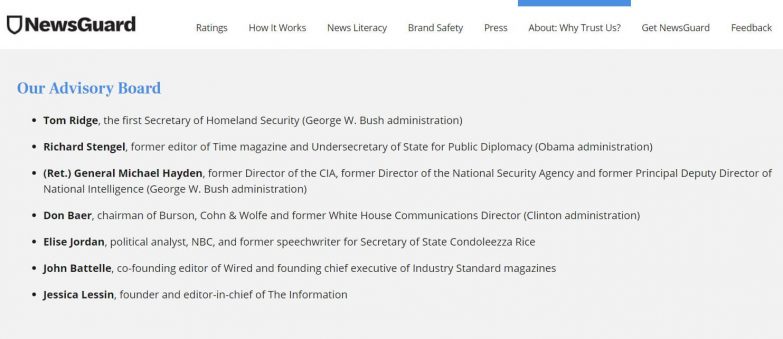
Another Newsguard advisor of note is Richard Stengel, former editor of Time magazine, a “distinguished fellow” at the Atlantic Council and Undersecretary of State for Public Diplomacy under President Barack Obama. At a panel discussion hosted last May by the Council on Foreign Relations, Stengel described his past position at the State Department as “chief propagandist” and also stated that he is “not against propaganda. Every country does it and they have to do it to their own population and I don’t necessarily think it’s that awful.”
Other Newsguard advisors include Don Baer, former White House communications director and advisor to Bill Clinton and current chairman of both PBS and the influential PR firm Burson Cohn & Wolfe as well as Elise Jordan, former communications director for the National Security Council and former speech-writer for Condoleezza Rice, as well as the widow of slain journalist Michael Hastings — who was writing an exposé on former CIA director John Brennan at the time of his suspicious death.
A look at Newguard’s investors further illustrates the multifarious connections between this organization and the American political and corporate elite. While Brill and Crovitz themselves are the company’s top investors, one of Newsguard’s most important investors is the Publicis Groupe. Publicis is the third largest global communications company in the world, with more than 80,000 employees in over 100 countries and an annual revenue of over €9.6 billion ($10.98 billion) in 2017. It is no stranger to controversy, as one of its subsidiaries, Qorvis, recently came under fire for exploiting U.S. veterans at the behest of the Saudi government and also helped the Saudi government to “whitewash” its human rights record and its genocidal war in Yemen after receiving $6 million from the Gulf Kingdom in 2017.
Furthermore, given its size and influence, it is unsurprising that the Publicis Groupe counts many powerful corporations and governments among its clientele. Some of its top clients in 2018 included pharmaceutical giants Eli Lilly, Merck, Pfizer and Bayer/Monsanto as well as Starbucks, Procter & Gamble, McDonalds, Kraft Heinz, Burger King, and the governments of Australia and Saudi Arabia. Given its influential role in funding Newsguard, it is reasonable to point out the potential conflict of interest posed by the fact that sites that accurately report on Publicis’ powerful clients — but generate bad publicity — could be targeted for such reports in Newsguard’s ranking.
In addition to the Publicis Groupe, another major investor in Newsguard is the Blue Haven Initiative, which is the venture capital “impact investment” fund of the wealthy Pritzker family — one of the top 10 wealthiest families in the U.S., best known as the owners of the Hyatt Hotel chain and for being the second largest financial contributors to Hillary Clinton’s 2016 presidential campaign.
Other top investors include John McCarter, a long-time executive at U.S. government contractor Booz Allen Hamilton, as well as Thomas Glocer, former CEO of Reuters and a member of the boards of pharmaceutical giant Merck & Co., financial behemoth Morgan Stanley, and the Council on Foreign Relations, as well as a member of the Atlantic Council’s International Advisory Board.
Through these investors, Newsguard managed to raise $6 million to begin its ranking efforts in March of 2018. Newsguard’s actual revenues and financing, however, have not been disclosed despite the fact that it requires the sites it ranks to disclose their funding. In a display of pure hypocrisy, Newsguard’s United States Securities and Exchange Commission Form D — which was filed March 5, 2018 — states that the company “declined to disclose” the size of its total revenue.
Why give folks a choice?
While even a quick glance at its advisory board alone would be enough for many Americans to decline to install Newsguard’s browser extension on their devices, the danger of Newsguard is the fact that it is diligently working to make the adoption of its app involuntary. Indeed, if voluntary adoption of Newsguard’s app were the case, there would likely be little cause for concern, given that its website attracts barely more than 300 visits per month and its social-media following is relatively small, with just over 2,000 Twitter followers and barely 500 Facebook likes at the time of this article’s publication.
To illustrate its slip-it-under-the-radar strategy, Newsguard has gone directly to state governments to push its browser extension onto entire state public library systems, even though its website suggests that individual public libraries are welcome to install the extension if they so choose. The first state to install Newsguard on all of its public library computers across its 51 branches was the state of Hawaii — which was the first to partner with Newsguard’s “news literacy initiative,” just last month.
According to local media, Newsguard “now works with library systems representing public libraries across the country, and is also partnering with middle schools, high schools, universities, and educational organizations to support their news literacy efforts,” suggesting that these Newsguard services targeting libraries and schools are soon to become a compulsory component of the American library and education system, despite Newsguard’s glaring conflicts of interest with massive multinational corporations and powerful government power-brokers.
Notably, Newsguard has a powerful partner that has allowed it to start finding its way into public library and school computers throughout the country. As part of its new “Defending Democracy” initiative, Microsoft announced last August that it would be partnering with Newsguard to actively market the company’s ranking app and other services to libraries and schools throughout the country. Microsoft’s press release regarding the partnership states that Newsguard “will empower voters by providing them with high-quality information about the integrity and transparency of online news sites.”
Since then, Microsoft has now added the Newsguard app as a built-in feature of Microsoft Edge, its browser for iOS and Android mobile devices, and is unlikely to stop there. Indeed, as a recent report in favor of Microsoft’s partnership with Newsguard noted, “we could hope that this new partnership will allow Microsoft to add NewsGuard to Edge on Windows 10 [operating system for computers] as well.”
Newsguard, for its part, seems confident that its app will soon be added by default to all mobile devices. On its website, the organization notes that “NewsGuard will be available on mobile devices when the digital platforms such as social media sites and search engines or mobile operating systems add our ratings and Nutrition Labels directly.” This shows that Newsguard isn’t expecting its rating systems to be offered as a downloadable application for mobile devices but something that social media sites like Facebook, search engines like Google, and mobile device operating systems that are dominated by Apple and Google will “directly” integrate into nearly every smartphone and tablet sold in the United States.
A Boston Globe article on Newsguard from this past October makes this plan even more clear. The Globe wrote at the time:
Microsoft has already agreed to make NewsGuard a built-in feature in future products, and [Newsguard co-CEO] Brill said he’s in talks with other online titans. The goal is to have NewsGuard running by default on our computers and phones whenever we scan the Web for news.”
This eventuality is made all the more likely given the fact that, in addition to Microsoft, Newsguard is also closely connected to Google, as Google has been a partner of the Publicis Groupe since 2014, when the two massive companies joined Condé Nast to create a new marketing service called La Maison that is “focused on producing engaging content for marketers in the luxury space.” Given Google’s power in the digital sphere as the dominant search engine, the creator of the Android mobile operating system, and the owner of YouTube, its partnership with Publicis means that Newsguard’s rating system will soon see itself being promoted by yet another of Silicon Valley’s most powerful companies.
Furthermore, there is an effort underway to integrate Newsguard into social media sites like Facebook and Twitter. Indeed, as Newsguard was launched, co-CEO Brill stated that he planned to sell the company’s ratings of news sites to Facebook and Twitter. Last March, Brill told CNN that “We’re asking them [Facebook, Twitter, Microsoft and Google] to pay a fraction of what they pay their P.R. people and their lobbyists to talk about the problem.”
On Wednesday, Gallup released a poll that will likely be used as a major selling point to social media giants. The poll — funded by Newsguard and the Knight Foundation, which is a top investor in Newsguard and has recently funded a series of Gallup polls relating to online news — seems to have been created with the intention of manufacturing consent for the integration of Newsguard with top social media sites.
This is because the promoted findings from the study are as follows:“89% of users of social media sites and 83% overall want social media sites and search engines to integrate NewsGuard ratings and reviews into their news feeds and search results” and “69% would trust social media and search companies more if they took the simple step of including NewsGuard in their products.” However, a disclaimer at the end of the poll states that the results, which were based on the responses of 706 people each of whom received $2 to participate, “may not be reflective of attitudes of the broader U.S adult population.”
With trust at Facebook nose-diving and Facebook’s censorship of independent media already well underway, the findings of this poll could well be used to justify its integration into Facebook’s platform. The connections of both Newsguard and Facebook to the Atlantic Council make this seem a given.
Financial censorship
Another Newsguard service shows that this organization is also seeking to harm independent media financially by targeting online revenue. Through a service called “Brandguard,” which it describes as a “brand safety tool aimed at helping advertisers keep their brands off of unreliable news and information sites while giving them the assurance they need to support thousands of Green-rated [i.e., Newsguard-approved] news and information sites, big and small.”
At the time the service was announced last November, Newsguard co-CEO Brill stated that the company was “in discussions with the ad tech firms, leading agencies, and major advertisers” eager to adopt a blacklist of news sites deemed “unreliable” by Newsguard. This is unsurprising given the leading role of the Publicis Groupe, one of the world’s largest advertising and PR firms, has in funding Newsguard. As a consequence, it seems likely that many, if not all, of Publicis’ client companies will choose to adopt this blacklist to help crush many of the news sites that are unafraid to hold them accountable.
It is also important to note here that Google’s connection to Publicis and thus Newsguard could spell trouble for independent news pages that rely on Google Adsense for some or all of their ad-based revenue. Google Adsense has long been targeting sites like MintPress by demonetizing articles for information or photographs it deemed controversial, including demonetizing one article for including a photo showing U.S. soldiers involved in torturing Iraqi detainees at the infamous Abu Ghraib prison.
Since then, Google — a U.S. military contractor — has repeatedly tried to shutter ad access to MintPress articles that involve reporting that is critical of U.S. empire and military expansion. One article that has been repeatedly flagged by Google details how many African-Americans have questioned whether the Women’s March has aided or harmed the advancement of African-Americans in the United States. Google has repeatedly claimed that the article, which was written by African-American author and former Washington Post bureau chief Jon Jeter, contains “dangerous content.”
Given Google’s already established practice of targeting factual reporting it deemed controversial through Adsense, Brandguard will likely offer the tech giant just the excuse it needs to cut off sites like MintPress, and other pages equally critical of empire, altogether.
An action plan for the genuine protection of journalism
Though it is just getting started, Newsguard’s plan to insert its app into every device and major social-media network is a threat to any news site that regularly publishes information that rubs any of Newsguard’s investors, partners or advisors the wrong way. Given its plan to rank the English-language U.S. news sites that account for 98 percent of U.S. digital news consumption, Newsguard’s agenda is of the utmost concern to every independent media page active in the United States and beyond — given Newsguard’s promise to take its project global.
By linking up with former CIA and NSA directors, Silicon Valley Giants, and massive PR firms working for some of the most controversial governments and corporations in the world, Newsguard has betrayed the fact that it is not actually seeking to “restore trust and accountability” in journalism, but to “restore trust and accountability” in news outlets that protect the existing power structure and help shield the corporate-led oligarchy and military-industrial complex from criticism.
Not only is it trying to tank the reputations of independent media through its biased ranking system, Newsguard is also seeking to attack these alternative voices financially and by slipping its ranking system by default onto all computers and phones sold in the U.S.
However, Newsguard and it agenda of guarding the establishment from criticism can be stopped. By supporting independent media and unplugging from social media sites committed to censorship, like Facebook and Twitter, we can strengthen the independent media community and keep it afloat despite the unprecedented nature of these attacks on free speech and watchdog journalism.
Beyond that, a key way to keep Newsguard and those behind it on their toes is to hold them to account by pointing out their clear conflicts of interest and hypocrisy and by derailing the narrative they are carefully crafting that Newsguard is “non-partisan,” “trustworthy,” and true guardians against the scourge of “fake news.”
While this report has sought to be a starting point for such work, anyone concerned about Newsguard and its connections to the war machine and corrupt corporations should feel encouraged to point out the organization’s own conflicts of interests and shady connections via its Twitter and Facebook pages and the feedback section on Newsguard’s website. The best way to defeat this new tool of the neocons is to put them on notice and to continue to expose Newsguard as a guardian of empire, not a guardian of journalism.
Whitney Webb is a staff writer for MintPress News and a contributor to Ben Swann’s Truth in Media. Her work has appeared on Global Research, the Ron Paul Institute and 21st Century Wire, among others. She has also made radio and TV appearances on RT and Sputnik. She currently lives with her family in southern Chile.
Back to the USSR: How to Read Western News

By Patrick ARMSTRONG | Strategic Culture Foundation | 08.01.2019
The heroes of Dickens’ Pickwick Papers visit the fictional borough of Eatanswill to observe an election between the candidates of the Blue Party and the Buff Party. The town is passionately divided, on all possible issues, between the two parties. Each party has its own newspaper: the Eatanswill Gazette is Blue and entirely devoted to praising the noble Blues and excoriating the perfidious and wicked Buffs; the Eatanswill Independent is equally passionate on the opposite side of every question. No Buff would dream of reading “that vile and slanderous calumniator, the Gazette“, nor Blue ”that false and scurrilous print, the Independent“.
As usual with Dickens it is both exaggerated and accurate. Newspapers used to be screamingly partisan before “journalism” was invented. Soon followed journalism schools, journalism ethics and journalism objectivity: “real journalism” as they like to call it (RT isn’t of course). “Journalism” became a profession gilded with academical folderol; no longer the refuge of dropouts, boozers, failures, budding novelists and magnates like Lord Copper who know what they want and pay for it. But, despite the pretence of objectivity and standards, there were still Lord Coppers and a lot of Eatanswill. Nonetheless, there were more or less serious efforts to get the facts and balance the story. And Lord Coppers came and went: great newspaper empires rose and fell and there was actually quite a variety of ownership and news outlets. There was sufficient variance that a reader, who was neither Blue nor Buff, could triangulate and form a sense of what was going on.
In the Soviet Union news was controlled; there was no “free press”; there was one owner and the flavours were only slightly varied: the army paper, the party paper, the government paper, papers for people interested in literature or sports. But they all said the same thing about the big subjects. The two principal newspapers were Pravda (“truth”) and Izvestiya (“news”). This swiftly led to the joke that there was no truth in Pravda and no news in Izvestiya. It was all pretty heavy handed stuff: lots of fat capitalists in top hats and money bags; Uncle Sam’s clothing dripping with bombs; no problems over here, nothing but problems over there. And it wasn’t very successful propaganda: most of their audience came to believe that the Soviet media was lying both about the USSR and about the West.
But time moves on and while thirty years ago 50 corporations controlled 90% of the US news media, today it’s a not very diverse six. As a result, on many subjects there is a monoview: has any Western news outlet reported, say, these ten true statements?
- People in Crimea are pretty happy to be in Russia.
- The US and its minions have given an enormous amount of weapons to jihadists.
- Elections in Russia reflect popular opinion polling.
- There really are a frightening number of well-armed nazis in Ukraine.
- Assad is pretty popular in Syria.
- The US and its minions smashed Raqqa to bits.
- The official Skripal story makes very little sense.
- Ukraine is much worse off, by any measurement, now than before Maidan.
- Russia actually had several thousand troops in Crimea before Maidan.
- There’s a documentary that exposes Browder that he keeps people from seeing.
I typed these out as they occurred to me. I could come up with another ten pretty easily. There’s some tiny coverage, far in the back pages, so that objectivity can be pretended, but most Western media consumers would answer they aren’t; didn’t; don’t; aren’t; isn’t; where?; does; not; what?; never heard of it.
Many subjects are covered in Western media outlets with a single voice. Every now and again there’s a scandal that reveals that “journalists” are richly rewarded for writing stories that fit. But after revelations, admissions of bias, pretending it never happened, the media ship calmly sails on (shedding passengers as it goes, though). Coverage of certain subjects are almost 100% false: Putin, Russia, Syria and Ukraine stand out. But much of the coverage of China and Iran also. Many things about Israel are not permitted. The Russia collusion story is (privately) admitted to be fake by an outlet that covers it non stop. Anything Trump is so heavily flavoured that it’s inedible. And it’s not getting any better: PC is shutting doors everywhere and the Russian-centred “fake news” meme is shutting more. Science is settled but genders are not and we must be vigilant against the “Russian disinformation war“. Every day brings us a step closer to a mono media of the One Correct Opinion. All for the Best Possible Motives, of course.
It’s all rather Soviet in fact.
So, in a world where the Integrity Initiative is spending our tax dollars (pounds actually) to make sure that we never have a doubleplusungood thought or are tempted into crimethink, (and maybe they created the entire Skripal story – more revelations by the minute), what are we to make of our Free Media™? Well, that all depends on what you’re interested in. If it’s sports (not Russian athletes – druggies every one unlike brave Western asthmatics) or “beach-ready bodies” (not Russian drug takers of course, only wholesome Americans) – the reporting is pretty reasonable. Weather reports, for example (Siberian blasts excepted) or movie reviews (but all those Russian villains). But the rest is some weird merger of the Eatonswill Gazette and Independent : Blues/Buffs good! others, especially Russians, bad!
So, as they say in Russia, что делать? What to do? Well, I suggest we learn from the Soviet experience. After all, most Soviet citizens were much more sceptical about their home media outlets than any of my neighbours, friends or relatives are about theirs.
My suggestions are three:
- Read between the lines. A difficult art this and it needs to be learned and practised. Dissidents may be sending us hints from the bowels of Minitrue. For example, it’s impossible to imagine anyone seriously saying “How Putin’s Russia turned humour into a weapon“; it must have been written to subversively mock the official Russia panic. I have speculated elsewhere that the writers may have inserted clues that the “intelligence reports” on Russian interference were nonsense.
- Notice what they’re not telling you. For example: remember when Aleppo was a huge story two years ago? But there’s nothing about it now. One should wonder why there isn’t; a quick search will find videos like this (oops! Russian! not real journalism!) here’s one from Euronews. Clearly none of this fits the “last hospitals destroyed” and brutal Assad memes of two years ago; that’s why the subject has disappeared from Western media outlets. It is always a good rule to wonder why the Biggest Story Ever suddenly disappears: that’s a strong clue it was a lie or nonsense.
- Most of the time, you’d be correct to believe the opposite. Especially, when all the outlets are telling you the same thing. It’s always good to ask yourself cui bono: who’s getting what benefit out of making you believe something? It’s quite depressing how successful the big uniform lie is: even though the much-demonised Milosevic was eventually found innocent, even though Qaddafi was not “bombing his own people”, similar lies are believed about Assad and other Western enemies-of-the-moment. Believe the opposite unless there’s very good reason not to.
In the Cold War there was a notion going around that the Soviet and Western systems were converging and that they would meet in the middle, so to speak. Well, perhaps they did meet but kept on moving past each other. And so, the once reasonably free and varied Western media comes to resemble the controlled and uniform Soviet media and we in the West must start using Soviet methods to understand.
Always remember that the Soviet rulers claimed their media was free too; free from “fake news” that is.
Is Paul Whelan a Spy?
By Philip M. GIRALDI | Strategic Culture Foundation | 10.01.2019
The media has a new bit of speculation that fits neatly into the flagging Russiagate narrative. It concerns Paul Whelan, a high school graduate Marine Corps dishonorable discharge, who is currently working in corporate security for a Michigan-based auto parts manufacturer. Whelan, who lives alone, is self-taught in Russian and has engaged in tourist travel to the country a number of times. He was reportedly arrested late last month in Moscow while ostensibly attending a friend’s wedding and charged with espionage. Forty-eight year-old Whelan is clearly an odd duck and is notable for having four passports – Great Britain, Ireland, Canada and that of the United States.
Press coverage of the incident has nearly unanimously decided that the spying charge against Whelan is phony and that he is being held as bait to arrange for an exchange with Maria Butina, who is in jail in Virginia after being charged with acting as an unregistered agent of the Russian government and engaging in conspiracy. The media and the usual pundits base their conclusion on absolutely no evidence whatsoever apart from their conviction that Russian President Vladimir Putin is a bad man who would do almost anything to irritate the United States and overthrow its system of government. Oddly, the press watchdogs fail to note how the current federal government is doing a damned fine job destroying itself without any assistance from the Kremlin. If Putin really wanted to damage the US, he would be best advised to leave it alone and let Congress and the White House do the heavy lifting for him.
Unlike the mainstream media, I rather expect that the charges against Whelan could be more-or-less correct, though not in the way the press has framed the story, which is that Whelan is such a flawed character that he could not possibly meet the requirements to be working for any sophisticated spy organization. The New York Times in its coverage of the story interviewed several former CIA officers who had served in Russia, but asked the wrong questions. The reporter wanted to know if Whelan could possibly be an employee of US intelligence. The ex-Agency officers replied “no” because of his criminal record while a Marine and other oddities in his career, which included some marginal involvement with low-level law enforcement.
The former spooks were correct to state that Whelan would not pass the security hurdles for employment as a staff officer, but there is also a whole other level of possible engagement with the Agency, DIA or JSOC – cooperating as one of the sources which intelligence organizations recruit and run to collect information. The flawed but nevertheless useful Whelan would be a perfect target for recruitment as an intelligence source, referred to in the business as “agents.”
Unusually for a foreigner, Whelan has a social media account on Vkontakte, the Russian equivalent of Facebook, which is quite likely how he came to the attention of CIA or the Pentagon. And The New York Times, interestingly, describes his friends on the site as “men with some sort of connection to academies run by the Russian Navy, the Defense Ministry or the Civil Aviation Authority.” That alone would be enough to generate considerable interest in American intelligence circles as sources with that kind of access are hard to find.
And the details of Whelan’s arrest, if true, are completely consistent with how a low- to mid-level source might be run and used by a US government case officer. According to Russian accounts published in Rosbalt, a news agency close to the Kremlin, an unidentified intelligence source revealed that Whelan was trying to recruit a Russian citizen to obtain classified information regarding employees at various government agencies when he was caught in flagrante. He was arrested five minutes later in what was clearly a sting operation after having received a USB stick that included a list of all of the employees that he apparently had requested.
It may turn out that Paul Whelan is completely innocent and is merely a pawn in a tit-for-tat chess game being played by Washington and Moscow. If so, it is to be hoped that he will be proven innocent and released, but no one should rule out his having been recruited and exploited by a US government agency. Spying is not a game. It is a dangerous business, with serious consequences for those who are caught.
‘America must rebuild understanding of Russia’: How Integrity Initiative drafted US for new Cold War
RT | January 9, 2019
Shortly after Donald Trump’s election, a UK-funded covert influence group proposed opening a new office in the US to train a “younger generation of Russia watchers” and “strengthen” American role in countering Moscow, leaks show.
The latest tranche of documents, anonymously uploaded online last week, include an outline for “developing a US arm of [the] Integrity Initiative Program” and a schedule for a visit to Washington of its director, which details meetings with former senior Trump adviser Sebastian Gorka, and top diplomats and officials.
‘West badly needs US leadership’
Despite the elected White House administration tentatively attempting a rapprochement with the Kremlin at the time, the group, effectively a foreign agent on US soil, suggests in the first document, dated to August 2017, that Washington needs to go in a radically different, if familiar, direction, “before it is too late.”
“The West is badly in need of a reassertion of US leadership. The EU has been unable to generate any strategic thinking or to exercise convincing leadership. Russia (& China) are successfully driving wedges between EU Member States and between Allies within NATO,” reads the plaintive precis.
The solution: revive the Cold War-era resistance to Moscow through a Washington-dominated NATO, which is elsewhere also listed as a financial sponsor of Integrity Initiative, alongside the UK’s Foreign Office.
“The US needs to rebuild its understanding of Russia and how to deal with it,” while “the UK needs reminding how to play its key role of encouraging/enabling US leadership in Europe/NATO.”
To serve these aims Integrity Initiative plans to “bring together academics, think tankers, journalists, civil servants, politicians, business people,” who understand “the problem” of Russia, but “have not been working coherently.”
This is a facsimile of the model Integrity Initiative rolled out in the UK after its founding in 2015, where it used its “cluster” of influential public voices to discreetly sway, manipulate or to outright dictate Russian coverage on such issues as cyber warfare, Syria and the Skripals. Or, as the text euphemistically puts it, their function is “to ensure the popular support for governments that democracies require.”
With many of the original Cold Warriors now of pensionable age, a vital responsibility of the recruits would be “attracting a new generation of younger analysts to learn from the older generation.”

Screenshot from the leaked US office proposal
There also appears to be implicit criticism of how the actual chosen US president is handling foreign policy, with the document urging the US to “improve its own governance at a time of transition.”
But, luckily for America, it doesn’t have to fear foreign meddling, as “the cluster will work completely impartially and not become involved in US party politics.”
Goulash with Gorka
The second document contains the dates and locations of a trip by Chris Donnelly, the UK military intelligence veteran and director of Integrity Initiative, to the American capital between September 18 and 22 of an unstated year. In the same upload folder, there are several support documents related to some of the events he was set to attend.
The trip involved wall-to-wall meetings, dinners, lectures and workshops, with separate visits to the State Department, National Defense University and the Pentagon, but several names stand out.
One is breakfast with Sebastian Gorka, the hawkish TV intelligence pundit, who served as a deputy assistant to Donald Trump between January and August 2017, and was credited as a key foreign policy inspiration prior to that. Another is a meeting with McCain Institute director Kurt Volker, a former US ambassador to NATO, who currently represents the US in the Ukrainian peace negotiations.
There is a meeting with officials from the State Department’s Global Engagement Center, an official counter-propaganda department, which, perhaps not coincidentally, has recently switched from fighting jihadis online, to combating Russia, having received a boost in funding. On the last day of the four-day trip, Donnelly was due to talk to Dorothy Rayburn, an official at USAID, the civilian aid agency, which has previously been accused by foreign governments of operating as an arm of US intelligence, and has been expelled from Russia since 2012.
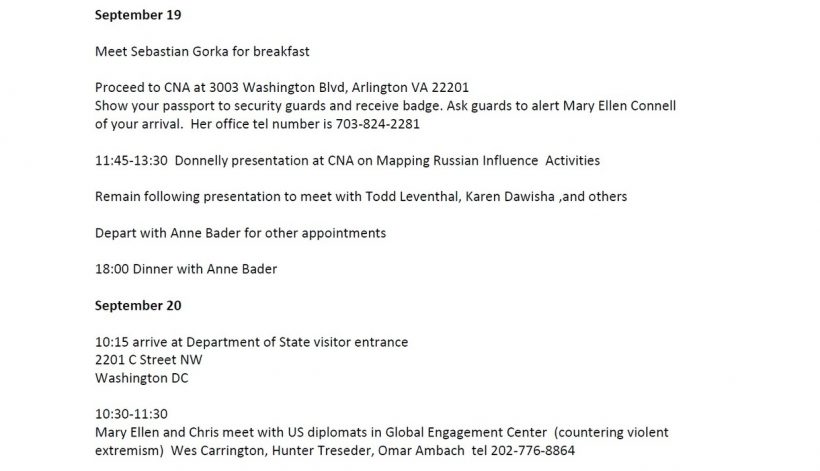
Screenshot from leaked file
It’s not ‘meddling’ when Integrity Initiative does it
Integrity Initiative has acknowledged that its private documents were “hacked” though it has not confirmed or denied the authenticity of any that have been made public in four separate tranches starting from November.
So, with only partial evidence available, it is not possible to conclude if Integrity Initiative did open an office in the US, or whether the talks held by Donnelly resulted in a shift in Russia policy.
Nonetheless, the first leak did contain a document listing a dozen names under the heading “US Cluster,” including several Donnelly was due to meet. There is also an exchange with an FCO official in which Integrity Initiative says that it is in the process of opening a non-profit in the US and, as well as a “simple office” in Washington, plans to create several clusters “in key states, not in DC.” It is not clear what would constitute a “key state” for an agency with Integrity Initiative’s apparently boundless remit.
What does appear certain is that the outfit was setting up its networks of influence covertly, and without declaring its true purpose, despite operating in an allied state. While the meeting with government figures seems to give it a sheen of legitimacy, it is also notable that none of those it met are representative officials, but rather narrowly-known but influential members of various Washington letter agencies. Its policy aims are not democratically-vetted, and possibly even at odds with those officially pursued by the United States.
Nonetheless, while a Russian outfit operating in “key US states” –even if it cultivated peaceful engagement– would surely command the attention of the Mueller investigation, the activities of a UK organization advocating a return to Soviet-era tensions are almost sure to be allowed to continue, without so much as a peep from Washington.
Kristol a Kremlin agent? Shady outfit claims term ‘neocon’ is Russian propaganda
RT | January 9, 2019
Anyone using the term ‘neocon’ is doing the Kremlin’s bidding, according to PropOrNot, a shadowy outfit that sees Russian agents everywhere, in its quest to police social media on behalf of the ruling US establishment.
The anonymous and self-appointed guardians of democracy declared this week that terms such as “neocon,” “corporatist”, “imperialist”, “Zionist” or “establishment” – among others – are “tropes/slurs primarily used by Russian propaganda.” To illustrate this, they tweeted a chart by someone called “Northern Conspirator,” another anonymous Twitter thought-police account.
Reactions to PropOrNot’s claim have been swift and satirical, with outspoken critics of the corporatist imperial warmongering neocon-neoliberal establishment declaring themselves totally convinced.
“PropOrNot ID Service,” as its full name goes, first made headlines in late 2016, as one of the outfits cited by the Washington Post claiming Russian meddling in US politics. The Post described them as “an independent team of concerned American citizens.”
Hiding behind anonymity, the outfit compiled a list of websites and people it declared “Russian” agents. After protests from multiple people who found themselves on the blacklist, the Post had to publish an editor’s note, saying it could not “vouch for the validity of PropOrNot’s findings regarding any individual media outlet.”
Its influence continued, however, with multiple outlets on its blacklist finding themselves banned by Facebook in October 2018 as “Russian propaganda.”
The efforts of anonymous outfits to police speech in the US is problematic, given the recent revelations that another self-appointed guardian of democracy, New Knowledge, actually spearheaded a “false flag” social media operation in 2017 – one of the four such operations identified so far, all on behalf of Democrats in a hotly contested Senate race in Alabama. New Knowledge was later commissioned by the Senate Intelligence Committee to write a report on social media meddling, in which they attributed their own methods and tactics to the Russian government.
In addition to its malice in declaring all criticism of US establishment “Russian propaganda,” PropOrNot is factually wrong: neoconservatism is very much an American thing, as argued by its “godfather” Irving Kristol.
The “historical task and political purpose of neoconservatism would seem to be this: to convert the Republican party, and American conservatism in general, against their respective wills, into a new kind of conservative politics suitable to governing a modern democracy,” Kristol wrote in an essay titled The Neoconservative Persuasion, published in 2003 by the Weekly Standard. That was also the title of Kristol’s collected writings, which came out after his death in 2009.
Kristol’s son Bill now sits on the advisory council of ‘Alliance for Securing Democracy,’ the parent organization of the Hamilton68 dashboard, a brainchild of New Knowledge’s co-founder Jonathon Morgan that purports to track “Russian bots” on Twitter.
The burning question now in everyone’s mind is how such luminaries of neoconservatism – from Irving and Bill Kristol to Norman and John Podhoretz – have managed to be undetected Kremlin agents for so long.
Priorities? Only 14 MPs showed up to debate ‘extreme poverty’ in the UK
RT | January 9, 2019
Ending poverty doesn’t seem to be a top priority for British MPs, as only 14 of them showed up to attend a parliamentary debate on the UN report urging the government to address the burning problem.
MPs were supposed to debate the findings of a United Nations report on ‘Extreme Poverty and Human Rights in Northern Ireland’ on Monday, but the House of Commons remained almost empty as the debate got underway.
Labour MP Liz McInnes, who did show up, accused the Conservative Party government of showing disdain towards the poor and said that the United States had shown similar disinterest when the UN highlighted poverty there.
“I know that we have a special relationship with the United States, but I think it shames us all that we share that disdain,” McInnes said.
UN Special Rapporteur on extreme poverty Professor Philip Alston said in November that the level of poverty in the UK risked causing damage to “the fabric of British society” and accused the Conservative government of favoring policies that compounded poverty levels in one of the richest countries in the world. The report said that the level of child poverty in particular in Britain was “not just a disgrace, but a social calamity and an economic disaster.”
Alston said that while the British government focuses on an impending exit from the European Union, it has treated poverty as an “afterthought” — an accusation which seems to be supported by the minimal attendance at Monday’s debate.
There was no sign of Theresa May or even new Work and Pensions Secretary Amber Rudd, who sent a junior minister in her place.
The debate was hosted by Labour’s Shadow Minister for Children, Emma Lewell-Buck MP, who said that 14 million people across the UK live in poverty — one fifth of the population — and accused the government of inflicting “degradation, shame and harm” on the poorest in society.
Conservative MP Justin Tomlinson said the government would consider the report “seriously” but added that it does “not agree with all the points” made by Alston.
Russian to Conclusions? NYT Misreports Manafort’s Ukraine Ties as Russian
Sputnik – 10.01.2019
The New York Times is so eager to find proof that Paul Manafort was the definitive go-between for the 2016 Donald Trump presidential campaign and Russian actors that it tweeted out a claim a court filing unsealed Tuesday proved the connection, when the connections named were Ukrainians, not Russians.
The Times article on Tuesday is based on information from a court filing unsealed that day showing that Paul Manafort, Trump’s former campaign manager, asked his associate in Ukraine, Konstantin V. Kilimnik, to pass information about Trump’s polling numbers to Serhiy Lyovochkin and Rinat Akhmetov, two Ukrainians connected to the Ukrainian Party of Regions, the party of deposed Ukrainian President Viktor Yanukovych.
However, when one of the story authors, Kenneth P. Vogel, tweeted about the story Tuesday, he accidentally said that Manafort asked Kilimnik to pass that information not to Lyovochkin and Akhmetov, their Ukrainian business associates, but to Oleg Deripaska, a Russian billionaire sanctioned by the US government following his rejection of FBI attempts to “flip” him into an agent of theirs, as Sputnik has reported.
If that were true, it would indeed be quite the story. It still wouldn’t vindicate the Russiagate narrative, since Deripaska is a man who despises Russian President Vladimir Putin and Manafort, both of whom have caused him no shortage of bad business, but in entirely different ways. The corrected Times article only says that Manafort might have hoped to curry personal favor with Deripaska, who he owed millions at the time, by offering him “private briefings,” but never polling data.
The newspaper’s Twitter account later redacted the statement and tweeted a correction, but the eagerness to jump to conclusions that fit their preconceived narrative is worrisome. It’s also far from the first incident of carelessly biased reporting by the mainstream media regarding Russiagate topics.
Let’s take a moment to recall some of them.
On December 1, 2017, ABC’s Brian Ross reported that Trump had directed former National Security Advisor Michael Flynn to make contact with Russian officials before the November 2016 election, when really Flynn was only asked to make such contact after the election. What a difference a single word makes!
Ross earned himself four weeks of suspension without pay for that mishap, after being forced to recant his error.
Only days later, CNN was forced to correct several dates in a story that made it sound as if the president’s son, Donald Trump Jr., had played a role in the supplying of hacked Democratic National Committee emails to WikiLeaks.
An exclusive story December 8 reported that Don Jr., along with his father and other key Trump campaign officials, received a mysterious email on September 4, 2016, offering a website and decryption key for the hacked WikiLeaks documents. This heavily suggested that someone in the campaign was responsible for leaking a trove of stolen DNC emails to WikiLeaks, since that website published the emails on September 13.
However, CNN was soon forced to correct this story: It wasn’t September 4, but September 14 — the day after the leak — that the campaign officials in question received the email. The network was also forced to change the date it reported Don Jr. had first tweeted about Hillary Clinton and WikiLeaks, which also happened on September 14, and not on September 4 as originally reported.
Pretty remarkable, considering that every network that reported it claimed they’d corroborated the information from “multiple sources.” All those sources got the date wrong in the same way?
Only six months prior, CNN had been forced to correct another major report about Trump and Russia. In June 2017, the network retracted a story about ties between Trump officials and a Russian investment fund, a faux pas that caused three of the news agency’s journalists to weigh anchor.
In September 2017 (wow, 2017 was a bad year for reporting on Trump and Russia!), almost every major US news outlet reported that Russian-government-backed hackers targeted the voting systems of 21 states during the 2016 presidential election. However, a senior Department of Homeland Security official corrected this before Congress, telling a House of Representatives panel that November that no attack had happened. Virtually no network reported this whatsoever, except for Sputnik.
Can you guess how many issued retractions? One less than the Times on Tuesday. At least we’ll give NYT that. But it probably won’t be the last time a major news outlet trips over their preconceived narrative of Russian collusion or interference.
Fake News of Trump’s Volte-face on Syria Exit Strategy
By Nauman Sadiq | Blacklisted News | January 8, 2019
Quoting Donald Trump’s National Security Advisor John Bolton, who was recently on a visit to Israel and told reporters in Jerusalem that American forces would remain in Syria until the last remnants of the Islamic State were defeated and Turkey provided guarantees that it would not strike Kurdish forces allied with the United States, fake news have been circulating on the mainstream media that Trump has made a turnaround by delaying his planned Syria withdrawal.
Quoting the corporate media’s preferred, though highly partisan and dubious source of information on Syria, The Syrian Observatory for Human Rights (SOHR), Al-Jazeera’s sister news outlet The New Arab in particular is reporting [1] the Syrian Observatory’s purportedly “extensive network of on-ground activists and reporters” has seen American military convoys of hundreds of trucks and vehicles headed to the US military bases in Raqqa in eastern Syria, and Manbij and Tal Abyad in northern Syria from the Iraq border.
The policy decision to withdraw American forces from Syria, however, has already been taken in principle by the Trump administration, and whether the complete exit of the US troops from Syria would take a few weeks or several months is simply a matter of modalities to be worked out by operational commanders of the American forces.
Taking notice of the fake news, even Donald Trump was compelled to clarify his intentions on the Syria exit strategy in a tweet on Monday, January 7, saying: “The Failing New York Times has knowingly written a very inaccurate story on my intentions on Syria. No different from my original statements, we will be leaving at a proper pace while at the same time continuing to fight ISIS and doing all else that is prudent and necessary.”
Regarding the American military convoys headed to Raqqa, Manbij and Tal Abyad, the US commanders planning for the withdrawal of the American troops from Syria have recommended that the Kurdish fighters battling the Islamic State be allowed to keep the US-supplied weapons, a move that would likely anger NATO-ally Turkey, according to an exclusive report [1] by Reuters.
The report further adds: “The proposal to leave the US-supplied weapons with the Kurdish YPG militia, which could include anti-tank missiles, armored vehicles and mortars, would reassure Kurdish allies that they were not being abandoned.”
Thus, the convoys carrying surplus weapons of the American forces in Iraq to the US military bases in Syria were actually meant to distribute the weapons among Washington’s Kurdish allies in order to compensate the Kurds for their loyalty, despite objections from Washington’s NATO-ally Ankara.
Regarding inveterate neoconservative hawk John Bolton’s reassurance to the Israelis on Washington’s Syria withdrawal in Jerusalem, it should be looked at in the backdrop that over the years, Israel not only provided medical aid and material support to militant groups battling Damascus – particularly to various factions of the Free Syria Army (FSA) and al-Qaeda’s Syrian affiliate al-Nusra Front in Daraa and Quneitra bordering the Israel-occupied Golan Heights – but Israel’s air force virtually played the role of the air force of the Syrian jihadists and conducted hundreds of airstrikes in Syria during the eight-year conflict.
Though after Russia provided the S-300 missile system to the Syrian military after a Russian surveillance plane was shot down in Syria on September 18, killing 15 Russians onboard, Israel has conducted only a couple of airstrikes in Syria, one on the Christmas Day in which Israeli F-16s took cover [2] of civilian airliners flying to Damascus and Beirut airports. The purpose of the airstrike was to locate the precise location of the S-300 air defense system installed in Syria by the Russians in order to target it on a later date, or to keep the Israeli air force out of its reach.
Notwithstanding, on December 28, the Syrian army said it entered Manbij for the first time in years, after the Syrian Kurds urged Damascus to protect the town from the threat of impending Turkish military offensive, though Turkish President Erdogan has termed the handover a “psyops” by the Kurds.
According to a report by RT: [3] “A high-ranking Turkish delegation arrived in Moscow on Saturday, December 29, only a day after international media broke news on Kurdish militias inviting Syrian forces to enter Manbij before the Turks do. Syria’s military proclaimed they ‘raised the flag’ over Manbij, but there have been no independent reports confirming the moving of troops into the city.”
The report notes: “The Saturday Moscow meeting was key to preventing all actors of the Syrian war from locking horns over the Kurdish enclave. Obviously, Turkey will insist that it is their forces that should enter Manbij, Russia will of course insist the city should be handed over to Assad’s forces, Kirill Semenov, an Islamic studies expert with Russia’s Institute for Innovative Development, told RT.”
The report further adds: “Realpolitik, of course, plays a role here as various locations across Syria might be used as a bargaining chip by all parties to the conflict. Semenov suggested the Turks may agree on Syrian forces taking some parts of Idlib province in exchange for Damascus’ consent for a Turkish offensive toward Manbij or Kobani.”
It becomes abundantly clear after reading the RT report that a land swap agreement between Ankara and Damascus under the auspices of Moscow is in the offing to avoid standoff over Manbij.
The agreement would likely stipulate that Damascus would give Ankara a free hand to mount offensives in the Kurdish-occupied Arab-majority towns Manbij and Kobani in northern Syria in return for Ankara withdrawing its militant proxies from Maarat al-Numan, Khan Sheikhoun and Jisr al-Shughour, all of which are strategically located in the south of Idlib governorate.
Just as Ankara cannot tolerate the presence of the Kurds in northern Syria along Turkey’s southern border in line with its “east of Euphrates” military doctrine, similarly even Ankara would acknowledge the fact that Damascus cannot possibly conceive the long-term presence of Ankara’s jihadist proxies in the aforementioned strategic locations in the south of Idlib governorate threatening the Alawite heartland of coastal Latakia.
If such a land swap agreement is concluded between Ankara and Damascus, it would be a win-win for all parties to the Syrian conflict, excluding the Kurds, of course. But the response of Damascus and Moscow to the concerns of the Kurds has been tepid of late.
Not only have the Kurds committed the perfidy of playing the proxies of Washington during the Syrian conflict which abandoned them after Trump’s announcement of withdrawal of American troops from Syria, but we must also recall another momentous event that took place in Deir al-Zor governorate in February 2018.
On February 7, the US B-52 bombers and Apache helicopters struck a contingent of Syrian government troops and allied forces in Deir al-Zor that reportedly [4] killed and wounded scores of Russian military contractors working for the Russian private security firm, the Wagner group.
The survivors described the bombing as an absolute massacre, and Kremlin lost more Russian citizens in one day than it had lost throughout its more than three-year-long military campaign in support of the Syrian government since September 2015.
The reason why Washington struck Russian contractors working in Syria was that the US-backed and Kurdish-led Syrian Democratic Forces (SDF) – which is mainly comprised of Kurdish YPG militias – had reportedly handed over the control of some areas east of Euphrates River to Deir al-Zor Military Council (DMC), which is the Arab-led component of SDF, and had relocated several battalions of Kurdish YPG militias to Afrin and along Syria’s northern border with Turkey in order to defend the Kurdish-held areas against the onslaught of the Turkish armed forces and allied Syrian militant proxies during Ankara’s “Operation Olive Branch” in Syria’s northwest that lasted from January to March 2018.
Syrian forces with the backing of Russian contractors took advantage of the opportunity and crossed the Euphrates River to capture an oil refinery located to the east of Euphrates River in the Kurdish-held area of Deir al-Zor.
The US Air Force responded with full force, knowing well the ragtag Arab component of SDF – mainly comprised of local Arab tribesmen and mercenaries to make the Kurdish-led SDF appear more representative and inclusive – was simply not a match for the superior training and arms of Syrian troops and Russian military contractors, consequently causing a carnage in which scores of Russian citizens lost their lives.
Clearly, Moscow and Damascus hold the Kurds responsible for the atrocity along with Washington, and hence it is unlikely that the Syrian military would come to the rescue of the Kurds in the event of a Turkish military offensive east of Euphrates.
Sources and links:
[1] US weapons rushed to SDF signaling possible U-turn over Syria:
[2] Israel Used Civilian Airliners as Cover in Christmas Day Airstrikes in Syria:
[3] Land swap between Turkey and Syria – an option to avoid standoff over Manbij:
https://www.rt.com/news/447698-syria-manbij-russia-turkey-talks/
[4] Russian toll in Syria battle was 300 killed and wounded:
Featured Video
Laith Marouf: Hezbollah’s position on US-Iran ceasefire
or go to
Aletho News Archives – Video-Images
From the Archives
The Dirty Little Secret behind the “Global Terrorism Index”
The Omission of Israeli Terrorism in the Occupied Palestinian Territories
By Karin Brothers | Global Research | December 6, 2014
… The Israeli settlements — all of which are illegal – have been identified as a major impediment to peace. The refusal of a major “global” terrorism report to name the Israeli settlers as one of the groups most responsible for terrorism not only misrepresents a major source of regional violence but exposes the Global Terrorism Index as a propaganda tool that supports a U.S. agenda.
In recent years, governments have been attempting to thwart terrorism by blocking supportive fund-raising. When it comes to Israeli settlements, however, the US and Canada actually encourage fund-raising by giving organizations (such as Christian Friends of Israeli Communities (CFOIC) and the Jewish National Fund) financial support in the form of donor tax-deductions.
Charities which provide funds for the Israeli settlements should be regarded as terror-financing organizations. They should not only lose their tax-deductible status, but they should be banned because they support the violation of international humanitarian law. The terror-financing laws that are being strictly enforced for Muslim charities should be applied to Christian and Jewish charities as well. … Read full article
Blog Roll
 Aletho News
- The Black Cube Files: How Former Mossad Operatives Flipped a Nation
- Laith Marouf: Hezbollah’s position on US-Iran ceasefire: What you’re not being told
- Israel’s priority lies in destroying chances of peace between Iran, US: Ex-UN nuclear chief
- Ceasefire for all or for none: Iran shuts Hormuz over Lebanon attacks
- Strait of Hormuz is Iran’s ‘nuclear weapon’ that forced US retreat: Medvedev
- Energy crisis will last for months – Kremlin envoy
- Europe’s quiet role in the war on Iran
- Forty days that shook the Empire: How Iran turned the tables on US and prevailed
- Netanyahu unilaterally declares Lebanon outside of ceasefire deal
- Israeli leaders: ‘Not a single goal’ achieved in war with Iran
- If Americans Knew
- Gazans face a triple crisis: severe shortages of water and bread, healthcare in tatters
- NY Times reports how Netanyahu took the US into Iran War
- A sigh of relief over Iran, but Gaza and Lebanon in dire straits – Daily Update
- Thousands dead and neighborhoods razed to the ground: Aid agencies fear southern Lebanon is becoming the new Gaza
- The war the US is fighting for Israel could cost trillions
- ‘Cigarette Burns, Nail Wounds’: Toddler Tortured in Gaza to Coerce Father
- Trump Says US Sent ‘a Lot of Guns’ to Protesters in Iran
- Israeli forces destroy 17 UN peacekeeper cameras in south Lebanon
- US-Israeli strikes ‘completely destroy’ synagogue in Tehran
- Archbishop for US Military Says Iran War Is Unjust Under Catholic Teaching
- No Tricks Zone
- An Inconvenient Tree: Uncovered In Alps… Europe Much Warmer Than Today 6000 Years Ago
- New Study Reports A 60% Slowdown In Greenland’s Ice Loss Rate In The Last Decade
- Low Intensity Tornado Wrecks Major Solar Farm, Creating A Potential Toxic Dump
- New Study Finds Warming Saves Lives…Cold Temperatures 12 Times More Deadly Than Excess Heat
- German Science Blog Accuses PIK Climate Institute Of Hallucinating Climate Tipping Points
- Devastating Assessment Of Comirnaty Vaccine By Former Senior Pfizer Europe Toxicologist
- New Study: CO2 Is ‘Effectively Negligible’ As An Explanatory Climate Change Factor Since 2000
- Former Pfizer Toxicologist Dr. Helmut Sterz Tells Bundestag Hearing Pfizer Vaccine Should Have Never Been Approved
- Energy Expert: Germany’s Nuclear Phaseout Was A “500 Billion Euro Mistake”
- New Research: South Australia’s Mid-Holocene Sea Surface Temperatures Were 4°C Warmer Than Today
 Aletho News