The Palestinian Children Killed by Israel in 2018 Have Been Forgotten by the World

By Ramona Wadi | Palestine Chronicle | January 9, 2019
Defense for Children International Palestine (DCIP) paints a bleak prospect for Palestinian children in revealing that in 2018, at least 56 were killed by Israel. Individuals who witnessed some of the murders have insisted that the targeted children were unarmed and posed no threat to the state or its citizens.
Palestinian children have been killed by Israeli army snipers, drones and security forces across the occupied Palestinian territories. Five of the murdered children were under 12 years of age. In Gaza, 49 children were murdered by Israel in activities pertaining to the Great March of Return protests.
Live ammunition was used by Israel in 73 percent of the fatalities documented by DCIP, which also recorded “140 cases of Palestinian children who were detained by Palestinian forces.” Israeli forces also arrested 120 children within the occupied West Bank. In both groups, the detained children suffered abuse at the hands of the security forces holding them, whether the PA or the Israeli military.
These tactics show that Israel’s colonial collaboration with the Palestinian Authority is targeting a very vulnerable segment of Palestinian society. What’s more, the killing and wounding of Palestinian children by Israeli snipers at the Great March of Return is a direct maiming of the generation which can carry on the anti-colonial struggle.
Citing international law is pointless when Israel, and even the Palestinian Authority, have extended the parameters for an ongoing cycle of abuse against Palestinian children. International law is only relevant when used to point out that violations are taking place and the Palestinians are facing a UN member state which treats international law with contempt, while the international community gives its tacit agreement to the abuse and is, in some cases, complicit.
DCIP’s research establishes the fact that Israel killed an average of more than one child per week in 2018. Earlier shocking official statistics revealed that between 2000 and 2014 Israel killed a Palestinian child every three days on average, for fourteen years. Throughout the year there was ongoing discussion about Israel’s genocidal intent and actions which were mostly discarded due to the monopoly over the term in reference to the Holocaust. Yet, Article II of the UN Convention on the Prevention and Punishment of the Crime of Genocide defines the term as “acts committed with the intent to destroy, in whole or in part, a national, ethnical, racial or religious group.” What else is Israel doing to the people of Palestine, “in whole or in part”?
The international community’s responses are so predictable that Israel finds no obstacles in maneuvering beyond the limits set by international law; it is allowed to act with impunity. The “drip, drip” rate of the killing of Palestinian children and the almost routine nature of their detention sneaks under the radar of human rights violations. As the international community fails to respond to Israeli violations within its established framework, Israel succeeds in bridging the gap between violations and rights.
To speak of Israel’s violations now is, in fact, also to speak of the international community’s irresponsibility. Yet neither are scrutinized and held to account; the result is the regular yet somewhat reluctant citing of what should happen according to international law being juxtaposed against Israeli breaches of the law. Accountability, however, has long since absconded from the scene of the crime. If Israel wants to kill Palestinian children (or women and men, come to that), it will kill because it has decided, quite deliberately, to do so.
Meanwhile, the international community will steer clear from ever associating Israeli actions with genocide, preferring instead to rely on “alleged war crimes”, the perpetrators of which will never be brought to justice. Palestinian children killed by Israel over many years, last year included, have been forgotten by the world.
Australian Jewish Association urges boycott of Palestine football team
MEMO | January 9, 2019
The Australian Jewish Association (AJA) has urged the Australian national football team to boycott their Asian Cup group match against Palestine scheduled for this Friday.
According to reports, the AJA believes “Palestine is not a country recognised by the international community and that soccer has been ‘blatantly politicised’ by the Asian Football Confederation admitting the Arab state as a member.”
On Friday, “Australia will take on Palestine in a crucial Group B clash in Dubai, needing to bounce back from their opening game loss to Jordan.” Palestine, meanwhile, picked up their first point in a major tournament on Sunday, “when they held Syria to a 0-0 draw in Sharjah”.
Palestine was admitted to FIFA in 1998 and qualified for their first Asian Cup in 2015 in Australia.
As the report notes, “despite having diplomatic relations, Australia is one of several countries globally which do not recognise Palestinian statehood.”
The AJA said Australia playing Palestine “legitimises the politicisation of the tournament” and has called on the Football Federation Australia to not take part in Friday’s match.
“The FFA board should not allow the Socceroos to play Palestine,” AJA president David Adler said yesterday. “If compelled to do so, then at the very least it must do so under protest.”
How Mainstream Media Join the US Government Offensive Against Iran: Case Study of Reuters
By Ivan KESIĆ | Strategic Culture Foundation | 09.01.2019
Summary: A 2013 news investigation of Iranian corruption by Reuters news service has been cited by at least four books published one after another, the most recently in 2018.
It has also been cited by US Secretary of State Mike Pompeo in 2018 speech. Given the article’s ongoing influence, this article will scrutinize flaws in the reporting techniques and raise reasonable questions about several of its findings. The article will also mention, a piece of important historical context, that was long assumed, but made official in 2013 – the same year the story was published – when the US government released classified documents about its involvement in the overthrow of Iran’s democratically elected leader in 1953 and the establishment of the Shah. The purpose of this article is not to stain the reputation of an entire news agency – but to simply lay out an alternative context for interpreting a single, influential story.
Ever since the beginning of the Iranian Islamic Revolution, the United States has been leading a propaganda campaign against Iran, minimizing own harmful role in key historical events, justifying an ousted monarchist regime, and demonizing the new political system. Frequently it is done in lighter forms, for example by claiming that new government is far from perfect or even the same as a previous one, but the methods can sometimes be so radical that the characteristics of the two systems are completely inverted.
While the Reuters claims Iran is active in spreading disinformation online, the history of the agency’s reports about Iran shows the opposite. The latest of such reports is a false report about Iran’s missile program. The falsehood of the article has been dissected here. The case which I have dissected is a 2013 article authored by Steve Stecklow, Babak Dehghanpisheh, and Yeganeh Torbati. The article represents a perfect example of such radicalism and disinformation reporting about Iran.
The Reuters report has been cited by at least four books published one after another, the most recently in 2018. The books are Iran’s Political Economy since the Revolution by Suzanne Maloney (2015); Democracy in Iran: Why It Failed and How It Might Succeed by Misagh Parsa (2016); Challenging Theocracy: Ancient Lessons for Global Politics by David Tabachnick, Toivo Koivukoski, and Herminio Meireles Teixeira (2018); and Losing Legitimacy: The End of Khomeini’s Charismatic Shadow and Regional Security by Clifton W. Sherrill (2018).
The chorus doesn’t stop there and it’s not limited to academic publishing or book industry. The 2013 report lays the ground for an ongoing war of words and decisions to impose more sanctions on Iran. Speaking at Ronald Reagan Presidential Foundation and Library in July 22, 2018, Secretary of State Mark Pompeo used the 2013 Reuters report to attack Iran; he said:
“And not many people know this, but the Ayatollah Khamenei has his own personal, off-the-books hedge fund called the Setad, worth $95 billion, with a B. That wealth is untaxed, it is ill-gotten, and it is used as a slush fund for the IRGC. The ayatollah fills his coffers by devouring whatever he wants. In 2013 the Setad’s agents banished an 82-year-old Baha’i woman from her apartment and confiscated the property after a long campaign of harassment. Seizing land from religious minorities and political rivals is just another day at the office for this juggernaut that has interests in everything from real estate to telecoms to ostrich farming. All of it is done with the blessing of Ayatollah Khamenei.”
The speech applauded by Iran hawks in Washington.
The year 2013 was the year of big news about Iran. Four months before the release of the Reuters’ article, CIA finally admitted its role in 1953 Iranian coup. “Marking the sixtieth anniversary of the overthrow of Iranian Prime Minister Mohammad Mosaddeq, the National Security Archive is today posting recently declassified CIA documents on the United States’ role in the controversial operation. American and British involvement in Mosaddeq’s ouster has long been public knowledge, but today’s posting includes what is believed to be the CIA’s first formal acknowledgement that the agency helped to plan and execute the coup.” Disinformation is dangerous. It used once to oust democratically elected Prime Minister Mohammed Mossadegh, and has been leveraged again to bring back the Shah of Iran, William David Pear writes. He continues, “Since Iran was a developing democracy, an excuse had to be found for a US intervention. Churchill accused Mossadegh of being a communist. There was no evidence that he was. Mossadegh was an anti-colonial nationalist who cared about the welfare of the Iranian people, and that was all the evidence that Eisenhower needed. Mossadegh had to be punished for standing up to the British and demanding Iran’s natural resources for the benefit of the Iranian people.” The 2013 article of Reuters reminds us of the same pattern of disinformation about Iran.
The 2013 Reuters story claims that the Execution of Imam Khomeini’s Order (EIKO), also known as Setad, a little-known organization created to help the poor, morphed into the $95 billion financial empire controlled by Iran’s Supreme Leader, Ayatollah Ali Khamenei. More precisely, they uncovered something unknown to Western intelligence services, economists and most prominent scholars of Iranian studies, even to the Iranian leadership themselves. In fact, much to the contrary, among ordinary Iranians the organization is known for their social programs, helping the poor families and doing charity works.
According to the Reuters article, the Iranian president’s office and the Foreign Ministry didn’t respond to requests for comment. Iran’s embassy in the UAE issued a statement calling their findings “scattered and disparate” and said that “none has any basis,” but it didn’t elaborate. Hamid Vaezi, the Setad’s then director general of public relations, said that the information presented is “far from realities and is not correct,” but he also didn’t go into specifics. Their short denials are understandable, considering that the same response would be received from a scientist if asked to make a serious review of a fantasy book. For the same reason, there is no scientific review of Reuters‘ article. Fortunately, this review will go deeply into the details, focusing on personal testimonies and claims of several groups of informers, thus developing a linear counter-story.
Baha’i personal testimonies
First, there’s the story of Pari Vahdat-e-Hagh, an 82-year-old Baha’i woman living in Europe, who claims that she lost family’s property, more precisely three apartments in a multi-story building in Tehran, allegedly “built with the blood of herself and her husband.” She further claims that her husband Hussein was imprisoned in 1981 because he began working for a gas company that had been set up to assist unemployed members of the Baha’i faith, and finally executed a year later. All of this happened, as the article claims, just because they were Baha’i.
The article does not mention the fact that her husband, alleged philanthropist, was actually a lieutenant in Pahlavi regime’s military. It neither mentions the conditions for obtaining such amount of property in Iran’s capital city center at that time. Ordinary military personnel were provided with an apartment, but not three apartments, nor was it possible to earn such vast properties with a salary of a lieutenant and teacher, no matter how hard you work. Miss Vahdat-e-Hagh explicitly stated that all had been obtained by herself and her husband, so it’s very easy to exclude the possibility of inheritance.
The only way of being awarded with three apartments was, in fact, an extraordinary and obedient service to the Pahlavi’s regime, and taking into account that Hussein Vahdat-e-Hagh’s career was military as well as the only war that Shah led was one against his own people, his merits to the dictatorship become crystal clear. This also perfectly explains why Hussein Vahdat-e-Hagh was imprisoned and executed, while tens of thousands of other Baha’is and hundreds of ordinary lieutenants, those without ‘special merits’ and three apartments, were not. In other words, the only blood that Vahdat-e-Hagh mentioned can be the blood of the people and the blood on her husband’s hands. Fake philanthropy and contradictions do not stop here.
Pari Vahdat-e-Hagh, also known as Paridokht Khaze, lives in Berlin where she earns a living by giving interviews and selling memoirs about the Baha’i victimhood. In the preface of her 2014 book titled In Search of Justice, Vahdat-e-Hagh claimed that before the 1979 revolution she had hoped to one day fulfill her dream of serving the needy in Africa. Before selling fictitious biographies, according to her own personal testimony to Reuters, during the 1980s she was living in one of the above-mentioned three apartments and was earning by renting other two. During these years of war the country was full of orphans and the poor, but giving any free accommodation was obviously out of the question for a self-proclaimed philanthropist.
Her lucrative rental business continued in the 1990s when she was living in Germany, taking the rental income out of all three apartments. According to the Reuters article, she left Iran in 1993 and it took six years before Iranian authorities realized she was no longer living in the country. This information contradicts her other statement that government representatives came to her apartment and threatened to beat her if she did not leave, while she bravely opposed them and yelled: “You can come and kill me.” So this old lady, allegedly under constant pressure and control, indeed left her apartment and was further able to leave the country, and the government, allegedly so greedy for her properties that it sent thugs at her doors, did not even notice that she’s out of the country and renting the same properties for six years. Makes perfect sense, isn’t it?
In both the Reuters article and the Vahdat-e-Hagh’s memoirs, her departure from Iran is described as some sort of “courageous escape” typical for a dissident genre, from books to Hollywood movies. In reality, she was free to leave the country and there was no any ban, no control, no chase at the airport. In the Reuters article, her false courage and principles are additionally enhanced by claims that government finally discovered her absence and demanded to pay rent on the unit, but she refused. The reality is again quite the opposite: she was actually refusing to pay tax on the rental income profit for six years, and in the meantime, she did not even report the change of address i.e. living abroad. Putting aside the controversial origin of properties, the consequences of such long-term lawbreaking are pretty much identical all over the world.
The Reuters‘ caricature story of courage and injustice ends with a claim that Vahdat-e-Hagh’s “stolen” building appears to be vacant, most of the windows are broken, and property’s ownership isn’t clear. This rumors allegedly came from merchants in the neighborhood, but how three Reuters journalists based in New York, London and Dubai managed to obtain the information in the streets of Tehran, also isn’t clear. Even less clear is their message, which may imply either that the building remains unused since Vahdat-e-Hagh stopped renting it, or it is basically worthless. Both possibilities make the whole story even less credible than it already is. Most likely, it is only a dystopian allegory or their own fantasy conception of post-revolutionary Iran.
Besides the story of Vahdat-e-Haghs, the Reuters article also offers the story of Katirais, yet another Baha’i family, whose narrative is similar in terms of structure. Again, there’s a rented three-story building in central Tehran, owner’s emigration to Canada, controversial ties to the Pahlavi regime, and of course, “just because they’re Baha’i” cliche. Apart from the building, there’re also 750 hectares of land around the city of Hamedan in northwest Iran. The Iranian official version says that owner had left the country and had abandoned properties, as well as that prior to 1979 he collaborated with the Pahlavi government, while owner’s daughter Heideh Katirai claims that he was being targeted solely because of his religion and never had any ties to the Shah’s government. Now, who to trust?
Making a choice on this question is much easier if we consider there was the Shah’s White Revolution of 1963 which its purpose was to weaken those classes that supported the traditional system, primarily landed elites. Virtually all landlords lost their possessions, with only a few exceptions, i.e. just those with close ties to the government were spared. Taking also into account that the general status of Baha’is during the Pahlavi period was far from thriving, the claim that a Baha’i person without any connections to the Shah’s regime could keep 750 hectares of land and stay intact by land reforms, is clearly an insolent lie.
Instead of sticking to the facts known to every historian and Iranian, Reuters journalists use logically fallacious methods like appeals to emotion through empathy, false dilemmas, and good ol’ victimhood. For example, an article quotes Katirai’s daughter saying “I took my kids there every Friday to see the family” and “each corner of that house is a memory for us.” One may wonder whether these trite phrases can be applied in the same way to their former land holdings, perhaps “every single square meter is a memory for them” also, out of 7,500,000 square meters in total. Such colossal amount of land was highly uncommon even for the richest landlords, and since Katirais weren’t historically attested among noble or wealthy merchant families prior to the Pahlavi period, it is clear that they did not just keep the property due to the ties with the Shah’s regime, but they also gained it.
Other statements are less subtle and bear aggressive religious and political messages. “We know that Islam is a religion of peace, but how can a government that claims to be an Islamic government allow this to happen?” Katirai’s daughter had asked, and thus offered the false dilemma: either the Iranian government is not Islamic, or Islam is not a religion of peace. The third option, unoffered in the article but the most realistic one, is that she is a liar and demagogue. Additional evidence for it is yet another claim of hers that legal representatives refused to consider her father’s case solely because he did not belong to any of three constitutive minorities: Zoroastrians, Jews or Christians. This implies that all others, from Iranian Hindus to foreign-born East Asian communities, have no any legal rights. Utterly bizarre.
Legal and human rights “experts”
Another group of people used as a reference in the Reuters article are self-proclaimed human rights “experts” and lawyers, all Iranian-born and living abroad. The first one is Naghi Mahmoudi who in the introduction claimed that Khamenei as the Supreme leader oversaw the creation of a body of legal rulings and executive orders that enabled and safeguarded asset acquisitions, as well as that no supervisory organization can question its property. The article represents him as a “lawyer” and uncritically accepts his allegations which serve as the basis for further elaboration.
In reality, Naghi Mahmoudi is only a petty political activist who has a history of lying and manipulating. Back in mid-2010, Mahmoudi and his colleague Javid Hustan Kian claimed to be defectors and “lawyers” of an Iranian woman sentenced to lapidation, but the whole case turned out to be a well-organized hoax, while they were disclosed as impostors and members of the MEK terrorist cult. In the meantime, he almost completely vanished from the media, held several pro-MEK speeches in Germany, and sometimes shared a propaganda material on Twitter, including ridiculous pan-Turkist claims that “40% of Iranians are Azeri Turks deprived of basic human rights.” Ironically, even Ali Khamenei was born into an Azeri family, as the Reuters article correctly mentions.
The biographical details of other informers are no less controversial. Ottawa-based Hossein Raeesi is a legal advisor to the IHRDC, a US government-sponsored organization blacklisted as subversive by the Iranian Interior Ministry, and London-based Mohammad Nayyeri is a close associate of Shadi Sadr, an anti-Iranian activist who publicly advocated Arab separatism in Iran. It is interesting that both of them, along with certain Beverly Hills-based Reghabi couple, complain about legal complications over the return of property, but at the same time, they confirm it is actually possible and feasible. It only takes time, and money, as everywhere.
However, the informers could not agree on a precise legal fee, some of them claiming it is 20% while others even over 50%. Since both amounts are obviously extremely exaggerated and hardly provable, for this purpose two anonymous sources jump into the story and Reuters journalists use their testimonies as evidence. The first is an Iranian Shi’ite Muslim businessman now living abroad who put fee at 55%, and the second is alleged Nayyeri’s client who recovered the house but had to pay 20% of the property’s assessed value, a religious payment called “khoms” mandated under Islamic law. No names, no documents, and no sense. To fill such logical gaps and inconsistent claims, journalists also used orientalist cliché of ubiquitous corruption.
Political circles
Finally, the last group of informers consists of individuals more deeply involved in politics, comparing to the previous activists who operate under the guise of human rights. The Reuters article intentionally conceals the organizations they represent and introduces them as respectable scholars and politicians, allegedly authoritative on the subject. For example, three journalists first claim that they had identified “about $95 billion in property and corporate assets controlled by Setad” and that amount “surpasses independent historians’ estimates of the late shah’s wealth,” and as an evidence for such comparison they further used statements by Abbas Milani who believes the estimate of the Shah’s fortune was “extremely exaggerated” and stood at “a billion dollars.” In other words, about $3 billion in today’s money, or only a fraction of the worth of Setad’s holdings, Reuters concluded.
It is hard to enumerate how many manipulations this escapade contains. First of all, there are no “historians” here, but only one, namely Abbas Milani, who is far from “independent” because he is a member of the neoconservative Hoover Institution, an advocate of multilateral crippling sanctions against Iran in the US Congress. His books are full of revisionist portrayal of the US role in the 1953 coup, support of the Pahlavi regime’s oppression, the 1979 Revolution and afterward, and he offers other contorted interpretations like a claim that “Iran went from politically moderate Monarchy to totalitarian Islamic Republic.” Milani’s statement about the Pahlavi fortune does not represent a historical consensus, nor a serious scholarly assessment, only utter whitewashing of the Shah’s financial crime.
Already in January 1979, the New York Times reported that the Pahlavi wealth is rivaled in the Middle East only by the holdings of the Sauds of Saudi Arabia and the al‐Sabah dynasty in Kuwait, and according to bankers, the Shah’s personal portfolio is worth “well over $1 billion.” New York bankers told journalists that “a substantial part of the $2 billion to $4 billion belongs to the Pahlavi family,” speaking only of the sums that have been “transferred from Iran to the United States during last two years” [1977 and 1978]. The NYT article further states that “the accumulation of immense sums was made possible through the blurring of state funds and royal funds in Iran,” primarily the Pahlavi Foundation which the Shah controlled absolutely.
In 1958, the Shah formed the Pahlavi Foundation, declaring at the time that he was transferring 90% of his holding to the new institution, a combination of charitable organization and family trust. Documents proved the royal family’s penetration of almost every corner of the nation’s economy, including among other things 17 banks and insurance companies, an 80% ownership in the nation’s third-largest insurance company, 25 metal enterprises, 8 mining companies, 10 building materials companies, 45 construction companies, 43 food companies, and 26 enterprises in trade or commerce, and a share of ownership in almost every major hotel in Iran, or 70% of the hotel capacity. Some of these holdings are joint ventures with American corporations.
Behind a facade of charitable activities, the NYT article continues, “the foundation is apparently used in three ways: as a source of funds for the royal family, as a means of exerting control over the economy through the foundation’s holdings in key sectors, and as a conduit for rewards to supporters of the regime.” The transfer of billions of dollars out of Iran had started already in 1974, partly in the form of loans to members of his family that were never repaid, and numerous transactions from Iran were made through American corporations and banks as well as some New York investment houses. The additional uncounted resources were deposited in banks in Switzerland and other countries with strictly enforced bank-secrecy laws.
In the autumn of 1978, during the revolutionary turmoil, 64 members of the Pahlavi family have gone abroad. Like other wealthy Iranians, they all have made substantial deposits in Swiss bank accounts and bought luxury residences in Europe and North America. Of course, the court never revealed the true extent of its wealth, but Iranian and Western estimates place the fortune accumulated by the royal family, both inside and outside Iran, far above Abbas Milani’s “a billion dollars” claim. As New York bankers, Ervand Abrahamian and Michael Axworthy, both highly critical of the Islamic Republic but still regarded as authoritative historians of modern Iran in the West, offer a completely different picture.
According to Abrahamian’s monographies, the royal family’s total assets were estimated “anywhere between five and twenty billion dollars” (1982:437) or “in excess of $20 billion” (2008:131). With inflation, that would equal up to $60 billion by today’s currency. In Axworthy’s book, the capital that had been sent out of the country was “estimated around $120 billion” (2013:297). This figure includes the comprehensive wealth of all Iranian emigrants, but there is no doubt that the majority was concentrated in hands of the ruling family.
In January 1981, the Iranian government filed a $36 billion lawsuit in New York against 65 defendants, most of them relatives of the Shah, in an attempt to recover stolen wealth. Reuters journalists mentioned this fact but in the context of denying figures. “The suit was dismissed,” their paragraph ends, and therefore imply that “claimed” figure must be false. It is again a gross manipulation because the New York courts did not deny the amount of money, they dismissed the proceedings on the ground of ‘forum non conveniens’ though they admitted that there was no alternative forum. According to the book by Trevor C. Hartley, Emeritus Professor of Law at the LSE, this was an abuse of the doctrine, for political reasons, the courts were determinated to shield the Shah, and ‘forum non conveniens’ was the tool they chose (2009:238). After all, those are the same courts which recently ordered Iran to pay billions to relatives of 9/11 victims.
In addition to Abbas Milani, the Reuters article also quotes Mohsen Sazegara, introduced as a co-founder of the Revolutionary Guards who is now in exile in the United States, and David S. Cohen, then undersecretary of the Treasury for Terrorism and Financial Intelligence who also served as deputy director of the CIA. The former is a member of the Washington Institute for Near East Policy (WINEP), a subsidiary of the notorious American Israel Public Affairs Committee (AIPAC), while the latter is a member of the Foundation for Defense of Democracies (FDD), a hawkish and neoconservative organization led by Mark Dubowitz that was intensively lobbying for the anti-Iranian and anti-Setad sanctions for years.
Agenda unveiled
All of the above-mentioned lobbyists and their advocacy groups, along with three Reuters journalists, have the same agenda and are trying to convince the world that Iran’s Supreme Leader Ali Khamenei is the same as Shah Mohammad Reza Pahlavi, while Setad is no different than the Pahlavi Foundation. There is, however, a serious problem with this picture. More precisely, there are no Khamenei’s jewels, crowns or designer clothes, no luxury cars or art collections, no luxurious villas or expensive estates, either in Iran or abroad. There are no rich members of the family, no foreign bank accounts, no documents, no independent experts, no New Yorker or Swiss bankers. There is absolutely nothing which proves their claim.
There is, indeed, the Reuters “investigative” article with fancy charts and listed properties. Only a few months before the publication of Reuters‘ article, Washington imposed sanctions on Setad and some of its alleged corporate holdings, and the Treasury Department issued a press release containing boring numbers, hard charts, Persian-named properties and other dull text, incomprehensible for wider audiences. And that’s why the Reuters article jumped out.
Investigative journalism is when a report is built on the basis of the collected data, but here is an opposite case, all the details serve as buttress or decoration of the central point. In other words, when you take off all worthless tree charts, personal testimonies, stories of poor old ladies, allegations by fake human rights activists and lobbyists, and numerous other cliches, the only thing left standing is the official US press release and accompanying political rampage against the Iranian leadership. Nothing more.
Regarding Setad itself, as seen through the eyes of the US government, it serves as a useful bogeyman and has multiple purposes. Its first dimension is political-ideological because it follows the old discourse of bashing Iranian leaders and veterans, equalizing them with corrupt royal elites. Second, the economy of Iran is now being discussed under the guise of “Setad” name, a sort of trade name which sounds less offensive in public debates and official documents. Third and most important, it is a perfect tool for further targeting Iran’s economy and expanding sanctions, because any new emerging company can easily be declared as a Setad holding.
France Moves To Ban All Protests As PM Announces Major Crackdown On Yellow Vests
By Tyler Durden – Zero Hedge – 01/09/2019
France is signaling it’s making preparations for a massive new crackdown on the gilets jaunes or “yellow vests” anti-government protests that have gripped the country for seven weeks. A new law under consideration could make any demonstration illegal to begin with if not previously approved by authorities, in an initiative already being compared to the pre-Maiden so-called “dictatorship law” in Ukraine.
In the name of reigning in the violence that has recently included torching structures along the prestigious Boulevard Saint Germain in Paris, and smashing through the gates of government ministry buildings, the French government appears set to enact something close to a martial law scenario prohibiting almost any protest and curtailing freedom of speech.
Prime Minister Edouard Philippe presented the new initiative to curtail the violence and unrest while targeting “troublemakers” and banning anonymity through wearing masks on French TV channel TF1 on Monday. He said the law would give police authority crack down on “unauthorized demonstrations” at a moment when police are already arresting citizens for merely wearing a yellow vest, even if they are not directly engaged in protests in some cases.
PM Philippe said the government would support a “new law punishing those who do not respect the requirement to declare [protests], those who take part in unauthorized demonstrations and those who arrive at demonstrations wearing face masks”.
Philippe’s tone during the statements was one of the proverbial “the gloves are off” as he described the onus would be on “the troublemakers, and not taxpayers, to pay for the damage caused” to businesses and property.
“Those who question our institutions will not have the last word,” he added.
However, if anything the protests have grown fiercer in response to any police crackdown or violence against demonstrators. Should all protests be banned under the new law, it could be the start of more violent riots gaining steam, as what began Nov. 17 as anger over fuel tax hikes has now turned into rage at President Emmanuel Macron and policies that seem to favor the urban elite.
Other yellow vest inspired protests previously broke out across Europe, and in perhaps a sign of things to come a video from The Netherlands of a woman pushing her baby in a stroller being arrested by police apparently for merely wearing a yellow vest is going viral.
Shocking Video of police brutality in The #Netherlands of a Women being arrested yesterday, because she was wearing an Yellow Vest, and did not wanted to take it off. while walking with her baby in the streets. #YellowVests SHAME ON YOU DUTCH POLICE OFFICERS! RT this to the world pic.twitter.com/vL99D1ThW0
— Sotiri Dimpinoudis (@sotiridi) January 6, 2019
In the video, police confront the woman in what appears a quiet neighborhood far away from any visible protest. Police were photographed alongside the baby on the street as the mother was dragged away.

Image via journalist Sotiri Dimpinoudis
With the French prime minister now announcing coming draconian measures banning all protest, this is precisely the horrific scene that could begin to be repeated across France and the EU.
In total at least six people have died and over 1,400 people injured during the French protests, with thousands arrested weekly, according to international reports. Over the weekend some 50,000 protesters continued demonstrating in multiple cities, leading to significant clashes in Paris, Bordeaux and Rouen. A number of commentators have noted that though there appear fewer demonstrators compared to December, there appears a serious uptick in violent acts on the part of both demonstrators and police response.
Trump Foreign Policy for 2019
By Philip Giraldi • Unz Review • January 8, 2019
Never before has any presidential administration been as all over the place in terms of national security and foreign policy as is that of Donald J. Trump. Indeed, one might well argue that there is no overriding policy at all in terms of a rational doctrine arrived at through risk versus gain analysis of developing international situations. Instead, there has been a pattern of emotional reactions fueled by media disinformation supplemented by “gut feelings” about a series of ultimately bilateral relationships that frequently have little or nothing to do with American national interests.
This is not to suggest that the “gut feelings” are always wrong. Established wisdom in Washington has long reflected the view that the United States must exercise leadership in establishing and maintaining the neoliberal consensus that gained currency after the devastation of the Second World War. Elections, free trade and a free media were to be the benchmarks of the new world order but they also came packaged with U.S. hegemony to confront those who resisted the development. And it turned out that those “benefits” were frequently difficult to achieve as elections sometimes produced bad results while trade agreements and an uncontrolled media often worked against broader U.S. objectives. All too often the United States found itself going to war against nations that it disapproves of for reasons unrelated to any actual interests, routinely claiming inaccurately that dissident regimes were both “threatening” and disruptive of the universal values that Washington claimed to be promoting.
To consider how the neoliberal order works in practice one only has to consider the Clintons, who justified brutal military interventions in the Balkans and in Libya based on what they claimed to be humanitarian principles. Or Obama, who demanded regime change in Damascus and was prepared to launch a large-scale attack on Syria before he realized that there was no public support for such a move and backed down.
More recently, particularly since 9/11, neoconservatives have dominated U.S. foreign policy through their think tanks, access to the media and their ability to infiltrate both major political parties based on their essentially fraudulent appraisals of threats to national security. They have been so successful at selling their product that the bogus claims that Iran is a threat to the United States are generally accepted without question by both Democrats and Republicans, not to mention the White House. Russia, meanwhile, remains the target of bipartisan wrath, from the left over the results of the 2016 election and from the right due to fearmongering over alleged threats to Eastern Europe.
But hope springs eternal, even in 2019. There have recently been some encouraging signs that change is in the air. Donald Trump has declared that he will be pulling all American soldiers out of Syria and half of U.S. forces out of Afghanistan, though the timetable appears to have slipped somewhat and might slow even more as the Establishment pushes back. That Trump may have chosen to break with the interventionist model with Syria, if he succeeds in doing so, is certainly commendable, but one wit has observed that the departure will be somewhat like the line in the Eagles’ song Hotel California, “you can check out any time you want, but you can never leave.”
There are other indications that something is afoot. On January 3rd, Trump offhandedly commented that Iran could do what it wishes in Syria, a comment that generated shock waves through the neoconnish Washington Post’s coverage of the remarks. To be sure, other Administration officials have continued to send different signals, with Secretary of State Mike Pompeo insisting that the U.S. will stay in Syria as long as Iran remains there.
Pompeo has also cautioned Iran against the development of ballistic missiles in connection with a claimed space program, a warning that Tehran has rejected. Israel meanwhile, presumably acting with U.S. connivance, has introduced a new destabilizing element into the Middle East cauldron, using civilian airliners to mask the approach of its military jets to attack targets in Syria. The possibility of an airliner being shot down with great loss of life by “accident” has thereby gone up exponentially.
To be sure, there are some who believe that the Trump anti-interventionist turn is essentially fraudulent. They cite the unrelenting hostility coming out of the White House regarding Iran, which is vilified on a nearly daily basis for its alleged threats not only to the Middle East region but also to Western Europe and the United States. That the Administration’s fulminations have little basis in reality is beside the point as it would seem that Trump, Pompeo, John Bolton and the now departed Nikki Haley all believe that the case for disarming Iran and bringing about regime change has been made effectively. Indeed, warfare directed against the Iranian economy has already begun by virtue of a punitive series of targeted sanctions with much more to come when a complete ban on oil exports kicks in in May.
Iran has responded to the threats by restating in early December its intention to exercise control over all ship traffic leaving the Persian Gulf via the Straits of Hormuz if its own oil exports are blocked by the United States. The U.S. responded immediately by sending the aircraft carrier U.S.S. John C. Stennis to the Gulf, the first such deployment in the region in eight months. With all the pieces in place, the possibility that there will be some accident in the region, presumably involving Iranian Revolutionary Guards and U.S. naval units, will escalate just as the largely contrived Gulf of Tonkin incident famously accelerated American involvement in the Vietnam War.
Much of what happens in the Middle East will ultimately depend on the extent to which America’s feckless allies, Saudi Arabia and Israel, succeed in selling their version of what is going on in the region. Trump, uncharacteristically, seems to be standing firm, telling a journalist that concerns about the Syria pullout are misplaced because “We give Israel $4.5 billion a year. And we give them, frankly, a lot more money than that, if you look at the books — a lot more money than that. And they’ve been doing a very good job for themselves.” Likewise, the much more important relationship, with Russia, will depend on the ability to ignore congressional hostility towards the Kremlin as well as the media bias that continues to promote Russiagate as a national security threat.
There is also North Korea, which has now indicated clearly that it is willing to talk to the U.S. but will revert to its nuclear development program unless sanctions are removed. And anyone for Latin America? Bolton has dubbed Cuba, Nicaragua and Venezuela as a “troika of tyranny,” though fortunately suggestions that Venezuela might be invaded by the U.S. to restore order appear to have faded.
If one reads the neocon press one cannot help but notice that China is the anointed over the horizon threat, but it is also a major trading partner and the drive to somehow renegotiate the terms whereby the two nations are linked economically will be complicated. Care must be taken lest what now appears to be an aggravated sense of great power competition becomes something more dangerous. The detention of Weng Manzhou in Canada one month ago together with the implication that the United States can and will enforce U.S. imposed sanctions globally could easily develop into a major problem with China as well as with others, including some NATO allies. The arrest has already disappeared from the media but several Canadians have been detained by Beijing and the U.S. government has warned American businessmen about traveling to China at the present time.
All of the above sounds somewhat depressingly familiar, but the real question is whether in 2019 Donald J. Trump will have both the vision and the necessary gumption to fulfill his campaign promises to change the face of American foreign policy by withdrawing from useless wars overseas and mending fences with countries that are actually important like Russia. There is admittedly a long way to go and it is very much a work in progress, but Trump actually has the ability to overrule the hawks in his administration and change the entire conversation about America’s place in the world.
Philip M. Giraldi, Ph.D., is Executive Director of the Council for the National Interest, a 501(c)3 tax deductible educational foundation that seeks a more interests-based U.S. foreign policy in the Middle East. Website is www.councilforthenationalinterest.org, address is P.O. Box 2157, Purcellville VA 20134 and its email is inform@cnionline.org.
MSM Lied: Veselnitskaya Indictment Wholly Unrelated to Russiagate Probe
Sputnik – 09.01.2019
Russian lawyer Natalia Veselnitskaya was indicted Tuesday in a US district court for obstruction of justice. The case is unconnected to the Russiagate investigation, but that hasn’t stopped US media from essentially reporting that it is.
The indictment itself is just a headline-grabber, trying to bring a charge against her for “what lawyers do all the time,” Jim Kavanagh, the editor of thepolemicist.net, told Radio Sputnik’s Loud and Clear Tuesday. “They help each other formulate positions… There’s nothing here except the desire to get headlines.”
The origin of the indictment is a 2013 lawsuit brought against Russian real estate firm Prevezon Holdings Ltd. by US prosecutors for an alleged $230 million tax fraud scheme. Veselnitskaya was hired to represent the company in US federal court. While representing Prevezon Holdings, she submitted a document from a Russian prosecutor that Veselnitskaya claimed was an independent finding, AP reported.
Tuesday’s unsealed indictment, actually brought last month, claims that this document was an “intentionally misleading declaration” Veselnitskaya had drafted herself.
“Fabricating evidence — submitting false and deceptive declarations to a federal judge — in an attempt to affect the outcome of pending litigation, not only undermines the integrity of the judicial process, but it threatens the ability of our courts to ensure that justice is done,” Manhattan US Attorney Geoffrey Bernman said in the indictment.
The civil case was settled in 2017, but Prevezon hasn’t paid the negotiated price, AP noted. A federal judge ordered the company to pay the US government $6 million last February.
Among the companies that claimed Prevezon had defrauded them in the 2013 case was Hermitage Capital Management, whose CEO, William Browder, aided the US government’s case. Browder is well-known as a champion of sanctions against Russia following the 2009 death of a tax accountant, Sergei Magnitsky, who had represented him in a massive tax fraud case. Magnitsky’s death in a Russian prison led to Browder and the US government claiming the Russian government was responsible.
Interest in Veselnitskaya doesn’t end there, though. The Russian lawyer was also part of the infamous meeting hosted by Donald Trump, Jr., that took place in Trump Tower in June 2016, which special counsel Robert Mueller has heavily scrutinized as a key event in alleged collusion between the 2016 presidential campaign of Donald Trump and the Russian government. Veselnitskaya has previously said the meeting focused on the issue of US nationals adopting Russian children and the Magnitsky Act, Sputnik noted.
However, James Margolin, a spokesman for the Manhattan US attorney’s office, told AP that the present case against Veselnitskaya did not originate from a referral by Mueller, and the charges are “unrelated to any other investigation.”
Radio Sputnik spoke with Kavanagh and Lee Stranahan, co-host of the Radio Sputnik show Fault Lines, about Veselnitskaya and the history of the case.
Kavanagh noted that “this woman is being charged in an American court for activities representing her client in Russia.”
“This is a case that has been settled a year and a half ago, and there’s no reason to be bringing these charges. This is what lawyers do all the time: they talk to each other, they help each other formulate positions… There’s nothing here except the desire to get headlines.”
Kavanagh noted that the core of the indictment stems from leaked, hacked emails between Veselnitskaya and a Russian prosecutor that included suggested edits and discussions about what the prosecutor should include in the statement to the court, which prove that she was actually the one who drafted that documents and not him, as she claimed.
Kavanagh pointed out the highly disingenuous title of the New York Times’ article, “Veselnitskaya, Russian in Trump Tower Meeting, Is Charged in Case That Shows Kremlin Ties,” which casually suggests a relationship between the Trump Tower meeting and Tuesday’s indictment.
“It’s really just to generate the idea that there’s some kind of groundswell of evidence that’s going to prove some kind of collusion with Russia that doesn’t exist,” Kavanagh said, noting that both the NY Times and the Washington Post “repeat flat-out lies about the situation,” including that Sergei Magnitsky was a lawyer working for Browder (he wasn’t a lawyer) who exposed fraud (that he was actually a part of).
Stranahan noted that the propaganda and misrepresentation of the situation wasn’t just coming from liberals. On Fox News, “the story is being pitched to show that Natalia Veselnitskaya set up [Donald Trump Jr.] and that the Kremlin ties prove that Putin is behind it… In both of these scenarios, the left and the right, Vladimir Putin is the unquestioned evil-doer,” the puppetmaster, “and Natalya Veselnitskaya is his pawn who’s being used for either this collusion or this frame-up,” said Stranahan.
Stranahan told hosts Brian Becker and John Kiriakou that Browder “is at the center of this. He is a proven liar.” He noted that Browder’s 2015 deposition doesn’t match his public story. “The reason they settled this case is that he was going to be forced to testify.”
Stranahan interviewed Veselnitskaya earlier this year, during which she said:
“The fact that my position was taken by Russian law enforcement authorities does not make me the Kremlin’s lawyer. The fact alone that I was communicating some information to the general prosecutor’s office of the Russian Federation does not make me its lawyer in the least. I am acting as a source of information for Russian law enforcement, and I shared this very information with US authorities as well. I was also willing to share this information with Congress, but I didn’t get a chance.”
Kavanagh said this was at the heart of Veselnitskaya attending the Trump Tower meeting: “She was naively saying, ‘If I get to the right people, and I’m able to talk to them, I’ll show them that Browder’s a liar and a fraud.’ Of course, that was never going to happen.”
Organizer of Macron’s ‘grand debate’ with Yellow Vests defends her ‘shocking’ €176,000 salary
RT | January 8, 2019
Emmanuel Macron’s plan for a nationwide public debate, intended to defuse months of Gilets Jaunes protests, is off to a rocky start. The spotlight has shifted to the extravagant salary of the official in charge of organizing it.
Chantal Jouanno is a former sports minister in the conservative government of Nicolas Sarkozy, and the current chairwoman of the CNDP, an official body for public debates, a role for which she receives an annual salary of €176,000 ($201,000).
The prominent position for yet another well-paid bureaucrat has caused outrage against the backdrop of street protests that were fueled by the disconnect between decisions taken by financially secure public officials, and the impact they have on ordinary citizens, such as the now-cancelled petrol tax.
Jouanno, a former national karate champion, deployed a series of blocks to stave off the discontent.
She insisted she was not specifically being paid for the “unprecedented” public discussions, but for a broader role that she assumed last year, adding that she does not negotiate her salary, which is set by the “CNDP, whoever they are.”
“I think it’s important that people can express their shock with my salary, and if they want to propose a different salary for my role, they are free to do so,” she told France Info TV.
She was also defended by her colleague, Ecology Minister Francois de Rugy, who said that if people wanted political posts to be “filled for free, or the minimum wage, it means society no longer recognizes that there is a scale of responsibilities.” With a self-reported salary of just €114,000 ($130,400) per annum – de Rugy must consider himself to be about a third less responsible than Jouanno.
The French president’s proposal for three months of public consultations and town-hall debates starting from January 15 was a bold gambit, but fraught with risk. As part of the process, the government is sure to receive thousands of ambitious and contradictory demands, which may be at odds with its own past tax and labor reforms, and its planned pension proposals.
The government has already vowed to push back against even widely popular suggestions, such as reintroducing a wealth tax, which was abolished in 2017. However, it has promised that ideas proposed during the consultations will reach the National Assembly as early as April.
It is not yet clear whether the proposed measures will be enough to thin out the ranks of those turning out in major cities, battling police each weekend. Many representatives of the Yellow Vest movement have rejected Macron’s plan, and officials suggested that 25,000 people took to the streets at the weekend, with organizers claiming higher figures.
‘They made a mess & are fighting fires’: UK academic says Integrity Initiative fatally hurt by leaks
RT | January 8, 2019
Despite being ignored by Western media, leaks from Integrity Initiative have paralyzed the operations of this UK-funded covert influence network, and could lead to its dismantling, says a leading British academic.
“This has made a mess of [Integrity Initiative’s] operations, they are spending most of their time now trying to fire-fight on the coverage this is getting. And they are not doing essentially what they are being paid to do, which is to counter the Russians,” David Miller, Professor of Political Sociology at the University of Bristol School for Policy Studies, told RT.
“The British government is getting bad value for money, if it was ever getting better value.”
As part of the Working Group on Syria, Propaganda and Media, which studies Western attempts to control media coverage of key international events, Miller has played a crucial role in studying the four tranches of data anonymously uploaded and sourced from the previously little-known group, which has been backed by the UK Foreign Office, NATO and Facebook, to the tune of over £1 million per year.
The documents, whose authenticity has not been denied, contain details of psyops operations against public figures, of the manipulation of media coverage in leading Western outlets, and have also revealed worldwide networks of prominent journalists and academics, secretly engaged to discredit, at every turn, pro-Moscow points of view and political developments.
Despite the refusal by all of those named to either admit their connection or to say that there was nothing untoward in their activities, Miller believes that getting rumbled has made it more difficult for them to push and publish anti-Russian content.
“Most of the people named are trying to pretend that this is not all of great significance, but the revelation of the involvement of the government in manipulating other countries, and the political process in the UK, is extremely damaging for them,” he said, via video link.
For Miller, the “cardinal sin” from a UK perspective was smearing Labour Party leader Jeremy Corbyn, as a potential Kremlin ally in Whitehall, which would mean that a state-paid intelligence operation was meddling in domestic politics.
Miller bemoans the absence of coverage of what he calls a “real, genuine scandal” in top English-language news sources, which, he says, are themselves implicated in the fallout. But regardless, such is the scope of Integrity Initiative’s ambition – from indoctrinating schoolchildren to infiltrating Hollywood – that it should lead to a national dialogue about the role intelligence agencies should play in public life.
“Integrity Initiative are beyond the realms of sense. The activities they are engaged in are morally and ethically dubious, and will certainly – as we can see already – backfire on them,” he said.
“This will result hopefully in the ending of this operation, and if we are lucky, a sensible discussion in parliament about controlling the future British covert operations.”
Beyond Kafka: How Youtube & Facebook Keep Purging Alternative Media
Hassan Nasrallah is persona non grata on Social Networks, where Anti-Zionism is the ultimate thoughtcrime
By Sayed Hasan | Resistance news, unfiltered. | January 8, 2019
The guillotine’s blade fell again, one year later. On December 2017 already, my 5-years-old Youtube channel Sayed Hasan, mainly translating speeches from Hezbollah Secretary General Hassan Nasrallah, was completely removed by Youtube, along with its 10 000 subscribers, +6 millions views and +400 subtitled videos of anti-Zionist & anti-Imperialist content. I then denunced this censorship in detail in my article Kafka 2.0: How Youtube’s Political Censorship is Exercised. And just around New Year’s Eve 2019, the +6000 Subscribed Facebook Page Resistance News Unfiltered, along with all its similar content, got deleted without explanation. The only thing left online is a cache view of the page dating back from this summer, in French.
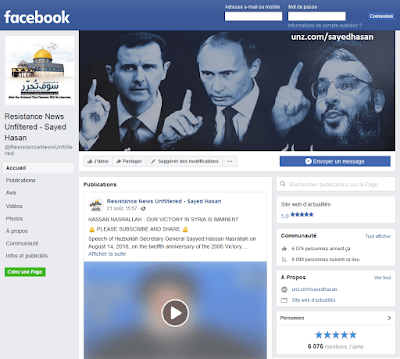
I had created this Page at the beginning of 2018, since no other place can compete with Youtube and its near-monopoly on video content, in order to reach a broader audience. But it was deleted without explanation by Facebook short of its first anniversary. I can’t even know the precise date of termination. Youtube did at least bother to send emails notifying of the removal of a video or of a whole channel, but Facebook has only internal notifications for posts removals. Here is how it happened.
I got two warnings from Facebook, dated December 24th and December 25th, 2018:
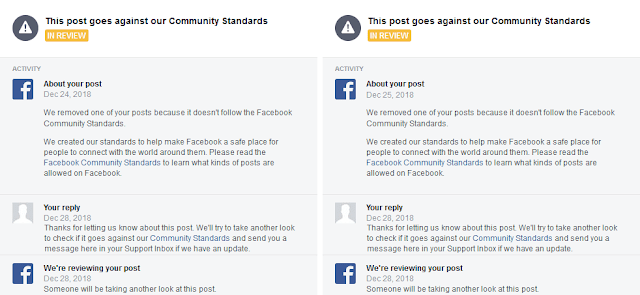
When I logged in on December 28th and saw these messages, I immediately appealed the decisions through the automated procedure, as shown above, though the specific posts alledgedly violating the Communnity Standards weren’t even accessible, since they had been removed. It means that I didn’t –and still don’t– even know which posts got me these “strikes”. At least, Youtube was specific about the videos alledgedly violating their rules –three speeches of Hassan Nasrallah–, though they didn’t say more than that. I don’t know if the whole Page was finally removed because of a third “strike” –Facebook does not even state how much “strikes” you can get before termination– or because of something else, like constant flagging and reports by cyber-IDF soldiers and Hasbara trolls. But I am positive it has to do with my anti-Zionist content. It is a blatant attempt to take down important speech and silence already marginalized voices, as stated by Vera Eidelman from the ACLU.
Of course, one should always protest and complain using the due procedures. After all, Facebook has been known to restore such Pages after the public outcry following their removal without proper reason (TeleSur, VenezuelAnalysis, etc.). I did protest, and I am still expecting an answer from them, without much hope, since earlier appeals as old as September 17th are still awaiting a response almost 4 months later, as shown below (screenshot dated January 4th, 2019).
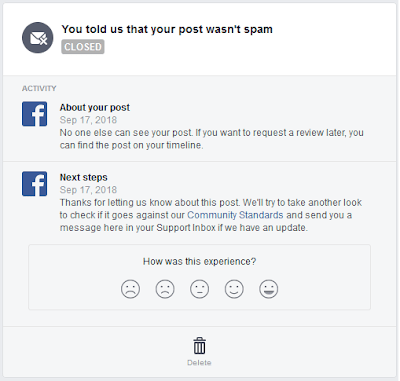
Appeals are not suspensive. Anyway, without any mention of a motive, corpus delicti and mere notification of removal of my page, not even in Facebook’s internal notifications on my personnal account, we are clearly beyond kafkaesque.
This witch-hunt against the voice of the Resistance Axis online, especially Hezbollah Secretary General Hassan Nasrallah (I am the main translator of his speeches in English and French, voluntary and non-affiliated), is not new. Over and over again –most often after Israeli-backed indictment campaigns–, in 2012, 2014, 2016 and June 2018, Facebook, Youtube and Twitter closed down all accounts affiliated to the Lebanese –and Palestinian– Resistance, including Al-Manar TV Channel, banned for good. In 2014 and 2016, Facebook was hunting down Nasrallah’s very picture and temporarily blocking the accounts that featured it, even though they were individuals having no link whatsoever with the organization: not only Hezbollah’s missiles and fighters, but the very voice and picture of its Secretary General are considered as an existential threat for Israel, whose paid trolls keep reporting his videos as terrorist hate-speech to ban mercilessly. The right to information, neutrality or equity is a chimera in the Internet Giants’ turf, where only alternative views, especially videos hostile to Zionism, are subject to censorship and banishment.
On January 8, 2019, Norman Finkelstein commented on the issue:
It is a scandal that the speeches of Hassan Nasrallah are banned on Youtube. Whatever one thinks of his politics, it cannot be doubted that Nasrallah is among the shrewdest and most serious political observers in the world today. Israeli leaders carefully scrutinize Nasrallah’s every word. Why are the rest of us denied this right? One cannot help but wonder whether Nasrallah’s speeches are censored because he doesn’t fit the stereotype of the degenerate, ignorant, blowhard Arab leader. It appears that Western social media aren’t yet ready for an Arab leader of dignified mind and person.
Thankfully, my first article got the attention of Ron Unz, who offered to safeguard my videos in his own website, and I published them back gradually in a new Dailymotion Channel from where they are automatically saved in The Unz Review’s internal storage system. Thus, even if they end up deleted by Dailymotion, they’ll still be accessible in one and same place without need to re-upload them again. I will keep posting my videos on Dailymotion –though it has its own, more subtle way of censorship: age-restricting videos, burying them in the search results… –, and I call on everyone to subscribe to my channel on the Unz Review (RSS feed) and on all those who can to donate to support this work. Whatever happens, the Electronic Intifada to which Hassan Nasrallah called will carry on.
Featured Video
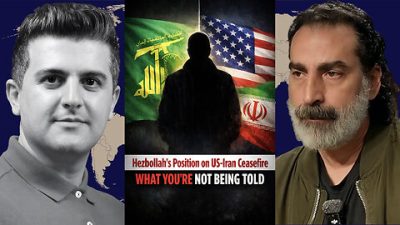
Laith Marouf: Hezbollah’s position on US-Iran ceasefire
or go to
Aletho News Archives – Video-Images
From the Archives
The Dirty Little Secret behind the “Global Terrorism Index”
The Omission of Israeli Terrorism in the Occupied Palestinian Territories
By Karin Brothers | Global Research | December 6, 2014
… The Israeli settlements — all of which are illegal – have been identified as a major impediment to peace. The refusal of a major “global” terrorism report to name the Israeli settlers as one of the groups most responsible for terrorism not only misrepresents a major source of regional violence but exposes the Global Terrorism Index as a propaganda tool that supports a U.S. agenda.
In recent years, governments have been attempting to thwart terrorism by blocking supportive fund-raising. When it comes to Israeli settlements, however, the US and Canada actually encourage fund-raising by giving organizations (such as Christian Friends of Israeli Communities (CFOIC) and the Jewish National Fund) financial support in the form of donor tax-deductions.
Charities which provide funds for the Israeli settlements should be regarded as terror-financing organizations. They should not only lose their tax-deductible status, but they should be banned because they support the violation of international humanitarian law. The terror-financing laws that are being strictly enforced for Muslim charities should be applied to Christian and Jewish charities as well. … Read full article
Blog Roll
 Aletho News
- How UK Regulator Ofcom Quietly Bypassed International Law to Police American Speech
- The Black Cube Files: How Former Mossad Operatives Flipped a Nation
- Laith Marouf: Hezbollah’s position on US-Iran ceasefire: What you’re not being told
- Israel’s priority lies in destroying chances of peace between Iran, US: Ex-UN nuclear chief
- Ceasefire for all or for none: Iran shuts Hormuz over Lebanon attacks
- Strait of Hormuz is Iran’s ‘nuclear weapon’ that forced US retreat: Medvedev
- Energy crisis will last for months – Kremlin envoy
- Europe’s quiet role in the war on Iran
- Forty days that shook the Empire: How Iran turned the tables on US and prevailed
- Netanyahu unilaterally declares Lebanon outside of ceasefire deal
- If Americans Knew
- Gazans face a triple crisis: severe shortages of water and bread, healthcare in tatters
- NY Times reports how Netanyahu took the US into Iran War
- A sigh of relief over Iran, but Gaza and Lebanon in dire straits – Daily Update
- Thousands dead and neighborhoods razed to the ground: Aid agencies fear southern Lebanon is becoming the new Gaza
- The war the US is fighting for Israel could cost trillions
- ‘Cigarette Burns, Nail Wounds’: Toddler Tortured in Gaza to Coerce Father
- Trump Says US Sent ‘a Lot of Guns’ to Protesters in Iran
- Israeli forces destroy 17 UN peacekeeper cameras in south Lebanon
- US-Israeli strikes ‘completely destroy’ synagogue in Tehran
- Archbishop for US Military Says Iran War Is Unjust Under Catholic Teaching
- No Tricks Zone
- An Inconvenient Tree: Uncovered In Alps… Europe Much Warmer Than Today 6000 Years Ago
- New Study Reports A 60% Slowdown In Greenland’s Ice Loss Rate In The Last Decade
- Low Intensity Tornado Wrecks Major Solar Farm, Creating A Potential Toxic Dump
- New Study Finds Warming Saves Lives…Cold Temperatures 12 Times More Deadly Than Excess Heat
- German Science Blog Accuses PIK Climate Institute Of Hallucinating Climate Tipping Points
- Devastating Assessment Of Comirnaty Vaccine By Former Senior Pfizer Europe Toxicologist
- New Study: CO2 Is ‘Effectively Negligible’ As An Explanatory Climate Change Factor Since 2000
- Former Pfizer Toxicologist Dr. Helmut Sterz Tells Bundestag Hearing Pfizer Vaccine Should Have Never Been Approved
- Energy Expert: Germany’s Nuclear Phaseout Was A “500 Billion Euro Mistake”
- New Research: South Australia’s Mid-Holocene Sea Surface Temperatures Were 4°C Warmer Than Today
 Aletho News