As she enters White House race, demonization of ‘Kremlin’s crush’ Tulsi Gabbard goes full tilt

By Igor Ogorodnev | RT | February 3, 2019
The sky may have been clear in Hawaii when Tulsi Gabbard read her speech promising to fight “greed and corruption,” but she enters her bid under a cloud of negative media coverage and accusations of being Russia’s darling.
At first glance Gabbard would seem almost too perfect for the Democratic candidate to face Trump in 2020: a 37-year-old part-Samoan woman, who previously broke off a promising career in local politics to volunteer for combat zone service in Iraq, and is unfailingly popular with voters on her home island.
“What our country needs now more than ever is the spirit of Aloha. That spirit of respect and love for one another and for our country,” she said in a launch speech that the 2008 Barack Obama, himself, might have found too idealistically bland.
Hours earlier, in a two-author NBC investigation an entirely different picture had been painted of the “controversial” Gabbard – the centerpoint of “the first stirrings of an upcoming Russian campaign” in which the Kremlin “propaganda machine” would seek to inject pro-Russian positions into the Democratic Party’s discussions and debates with help from “inauthentic accounts.”
I’m Not With Her
To understand why Gabbard is not treated as a customary feel-good story of a woman breaking multiple glass ceilings, but as a tool of the Kremlin, several pages of her biography need to be revisited.
The first, her resignation from the senior post of Vice President of the Democratic National Committee in protest at the lack of scheduled debates between frontrunner Hillary Clinton and the rising Bernie Sanders, whom she subsequently went on to endorse.
The second, a now-famous meeting with Bashar Assad in 2017, and Gabbard’s insistence that Washington should not engage in “regime change” or sponsorship of radical militant organizations in Syria or anywhere else.
Those two incidents alone have pitted Gabbard against two major establishment forces, and that is before one gets into the details of her socialist-tinged platform from healthcare for all to anti-Wall Street policy proposals. Or her support of stronger border control, which puts her at odds with her party’s official position.
Friendly fire
None of Gabbard’s stances are beyond debate, but she may not even get as far as debating them in public with the other Democrat nominees, if her campaign is dead on arrival. And the media hasn’t been her friend.
All candidates face scrutiny and an airing of their skeletons, but not only has she received less airtime than fellow relative novices Cory Booker and Kamala Harris, but the overall coverage of Gabbard has been uncharacteristically toxic, perhaps comparable only to the Democratic ostracism of Howard Schultz, following the former Starbucks CEO’s unbidden decision to enter the race.
The favored genre has been the expose.
In the past month alone: CNN has dug up Gabbard’s activism and comments, some dating back to the late 1990s, when she was a teenager, against same-sex marriage, for a campaign backed by her legislator father. The Intercept has accused her of associating with Hindu Nationalists, while the Daily Beast has published an article under the title ‘Horseshoe theory: Why Conservative Media and the Far Right Love Tulsi Gabbard for President’, in which it was emphasized that the “enigmatic” Gabbard had “earned substantial praise” from, among others, white nationalist David Duke. Huffington Post accused her of hypocrisy for accepting money from arms manufacturers in the past, even though she never concealed that fact, and is in reality one of just several members of the House who explicitly refuse campaign donations.
Politico published a detailed dissection of her campaign being “in disarray” based on detailed unattributed revelations from the inside, while Daily Kos, the Democrat politics blog, has already endorsed her rival for the 2020 Congress run, which equates to the real election in a district where the Democrats have never lost against the GOP.
‘Defended’ her in an article – how dare they?
On Friday, came NBC’s coup de grace.
“An NBC News analysis of the main English-language news sites employed by Russia in its 2016 election meddling shows Rep. Tulsi Gabbard of Hawaii, who is set to make her formal announcement Saturday, has become a favorite of the sites Moscow used when it interfered in 2016,” wrote the authors, one of whom Ben Popken, concluded that the Kremlin “has a crush” on Gabbard when he posted his article to Twitter.
The “analysis” – which appears to have been a name search – found that 20 articles have been published on Gabbard by RT (is it 21 now?), Sputnik and Russia Insider, twice as many as Joe Biden or Bernie Sanders. And not just that, but in these articles Gabbard was not mentioned “perfunctorily” but “celebrated” and “defended” despite her “lack of voter recognition.”
Even supposing that all that is correct, does RT have to cover Joe Biden every time it mentions Tulsi Gabbard? Elizabeth Warren? Julian Castro? Should CNN stop putting Kamala Harris in almost every piece about the race? As a non-US news outlet is RT allowed to find her non-interventionist views more interesting for its international audience than those of a status quo Democratic runner? What about as an alternative media outlet? Should covering a candidate who “lacks voter recognition” be considered suspicious? How much of this is sufficient to justify accusations of meddling and being branded a “Russian troll” and presumably sanctioned? Does all of this apply when the US media writes about Juan Guaido in Venezuela?
But wait, there are also “experts who track inauthentic social media accounts” who back this up.
“A few of our analysts saw some chatter on 8chan saying she was a good ‘divider’ candidate to amplify,” New Knowledge’s director of research Renee DiResta told NBC. 8chan? Chatter? Also New Knowledge? The establishment Democrat tech outfit that has just been caught planting and creating fake Russian bots in the Alabama election as part of a false flag operation. They are your experts, NBC?
Even much of Dem-voting Twitter was appalled at such a ham-fisted smear job.
Incompetent, threat or victim of smear campaign?
The media are now fulfilling their own prophecies, as they publish pieces about the “rocky” or “chaotic” start to Gabbard’s campaign. As she keeps going on the defensive – apologizing for the gay marriage remarks, standing firm on Assad meeting – the Hawaiian representative may survive or wilt.
But two questions remain: Is Gabbard just a stumbling novice with odd views, or is the media trying to systematically bury her, as opposed to informing their readers, all because she presents a threat to accepted positions? And secondly, is it doing so at the behest of and with help from a network of influence, be it DNC operatives, or Washington insiders? If the answer to the first question is “the latter” or to the second is “yes,” perhaps instead of spending so much time on our website, investigative reporters should have a look at the provenance and motivations behind some of their own coverage.
What the mainstream media doesn’t tell you about Venezuela
By Yves Engler · February 3, 2019
The corporate media is wholeheartedly behind the federal government’s push for regime change in Venezuela. The propaganda is thick and, as per usual, it is as much about what they don’t, as what they do, report. Here are some important developments that have largely been ignored by Canada’s dominant media:
- At the Organization of American States meeting called by US Secretary of State Mike Pompeo on January 25 the Canadian-backed interventionist resolution was defeated 18-16.
- The “Lima Group” of governments opposed to Venezuela’s elected president was established 18 months ago after Washington, Ottawa and others failed to garner the votes necessary to censure Venezuela at the OAS (despite the head of the OAS’s extreme hostility to Venezuela’s President Nicolas Maduro).
- Most of the world’s countries, with most of the world’s population, have failed to support the US/Canada push to recognize National Assembly head Juan Guaidó as president of Venezuela.
- The UN and OAS charters preclude unilateral sanctions and interfering in other countries’ affairs.
- UN Human Rights Council Special Rapporteur for sanctions, Idriss Jazairy, recently condemned US/Canadian sanctions on Venezuela.
As well, here are some flagrant double standards in Canadian policy the media have largely ignored:
- “Lima Group” member Jair Bolsonaro won the recent presidential election in Brazil largely because the most popular candidate, Lula Da silva, was in jail. His questionable election took place two years after Lula’s ally, Dilma Rousseff, was ousted as president in a ‘parliamentary coup’.
- Another “Lima Group” member, Honduras president Juan Orlando Hernandez, defied that country’s constitution a year ago in running for a second term and then ‘won’ a highly questionable
- “At the same time”as Canada and the US recognized Juan Guaidó, notes Patrick Mbeko, “in Democratic Republic of Congo they refuse to recognize the massive recent victory of Martin Fayulu in the presidential election, endorsing the vast electoral fraud of the regime and its ally Félix Tshisekedi.”
Beyond what the media has ignored, they constantly cite biased sources without offering much or any background. Here are a couple of examples:
- The Globe and Mail has quoted Irwin Cotler in two recent articles on Venezuela. But, the decades-long anti-Palestinian and anti-Hugo Chavez activist lacks any credibility on the issue. At a press conference in May to release an OAS report on alleged rights violations in Venezuela, Cotler said Venezuela’s “government itself was responsible for the worst ever humanitarian crisis in the region.” Worse than the extermination of the Taíno and Arawak by the Spanish? Or the enslavement of five million Africans in Brazil? Or the 200,000 Mayans killed in Guatemala? Or the thousands of state-murdered “subversives” in Chile, Argentina, Uruguay, Brazil?
- CBC and Canadian Press (to a slightly lesser extent) stories about former Venezuelan Colonel Oswaldo Garcia, whose family lives in Montréal, present him as a democracy activist. But, notes Poyan Nahrvar, Garcia participated in a coup attempt last year and then launched raids into Venezuela from Colombia until he was captured by the Venezuelan military.
- The media blindly repeats Ottawa’s depiction of the “Lima Group”, which Prime Minister Justin Trudeau described as an organization established to “bring peace, democracy and stability in Venezuela.” One report called it “a regional block of countries committed to finding a peaceful solution” to the crisis while another said its members “want to see Venezuela return to democracy.” This portrayal of the coalition stands its objective on its head. The “Lima Group” is designed to ratchet up international pressure on Maduro in hopes of eliciting regime change, which may spark a civil war. That is its reason for existence.
As part of nationwide protests against the “Lima Group” meeting taking place in Ottawa on Monday, activists in Montréal will rally in front of Radio Canada/CBC’s offices. They will be decrying not only Canada’s interference in Venezuela but the dominant media’s effort to “manufacture consent” for Canadian imperialism.
Diesel driving ban in Stuttgart provokes Yellow Vest protests
Press TV – February 3, 2019
Hundreds of Germans have donned yellow vests to match protesters in France, demonstrating in the bastion of Germany’s car industry in Stuttgart against a recent driving ban on older diesels.
The protest came after organizers asked people to hit the streets clad in the yellow high-visibility vests that have defined months of protests in France — themselves triggered by an increase in tax on diesel.
“The French are an example to us, because they dared take to the streets to protect their rights,” organizer Vasilos Topalis told Agence France-Presse (AFP).
Stuttgart is home of Mercedes-Benz maker Daimler, Volkswagen subsidiary Porsche and the world’s biggest car parts supplier Bosch.
Since January 1, only diesel vehicles meeting the Euro 5 emissions standard are allowed into Stuttgart, with efforts underway to implement similar driving bans in many German cities.
Topalis said tens of thousands of people are affected by the bans and cannot afford to buy a new car. “What’s happening to people is unjust,” he added.
The protest came as France’s yellow vest protesters returned to the streets Saturday to keep up the pressure on the government and decry the number of people being injured by police during demonstrations.
Multiple protests took place in Paris and other cities to denounce President Emmanuel Macron’s economic policies, which they view as favoring the rich, for the 12th straight weekend of demonstrations.
The government says around 2,000 people have been injured in protests since the movement began Nov. 17 and 10 people have died in traffic accidents related to yellow vest actions.
The protesters paid homage to those injured since the onset of the rallies on November 17.
Protesters and rights groups have denounced the French police’s response to the yellow vests marches as “excessive,” including their use of controversial high-velocity rubber bullets.
France’s Council of State, however, ruled Friday that security forces have a right to use them for crowd control.
Meanwhile, a bill is under debate in the French parliament to strengthen measures against protesters whom they view as troublemakers. Rights groups and opposition lawmakers say the bill goes too far in restricting the right to protest.
The bill would authorize police to prevent people they see as a serious threat to public order from taking part in protests. It would also make it a crime for protesters to conceal their faces during demonstrations.
If the Polar Vortex is due to Global Warming, Why are U.S. Cold Waves Decreasing?
By Roy W. Spencer, Ph. D. | Watts Up With That? | January 31, 2019
It’s much easier to devise and promote a climate change theory than it is to falsify it. Falsification requires a lot of data over a long period of time, something we don’t usually have in climate research.
The “polar vortex” is the deep cyclonic flow around a cold air mass generally covering the Arctic, Canada, and Northern Asia during winter. It is irregularly shaped, following the far-northern land masses, unlike it’s stratospheric cousin, which is often quite symmetric and centered on the North and South Poles.
For as long as we have had weather records (extending back into the 1800s), lobes of cold air rotating generally from west to east around the polar vortex sometimes extend down into the U.S. causing wild winter weather and general unpleasantness.
We used to call this process “weather”. Now it’s called “climate change”.
When these cold air outbreaks continued to menace the United States even as global warming has caused global average temperatures to creep upward, an explanation had to be found. After all, snow was supposed to be a thing of the past by now.
Enter the theory that decreasing wintertime sea ice cover in the Arctic (down about 15% over the last 40 years) has tended to displace the polar vortex in the general direction of southern Canuckistan and Yankeeland.
In other words, as the theory goes, global warming sometimes causes colder winters. This is what makes global warming theory so marvelously adaptable — it can explain anything.
In the wake of the current cold wave, John Christy skated into my office this morning with a plot of U.S. winter cold waves since the late 1800s. He grouped the results by region, and examined cold waves lasting a minimum of 2 days at a station, and 5 days at a station. The results were basically the same.
As can be seen in the plot below, there is no evidence in the data supporting the claim that decreasing Arctic sea ice in recent decades is causing more frequent displacement of cold winter air masses into the eastern U.S., at least through the winter of 2017-18:
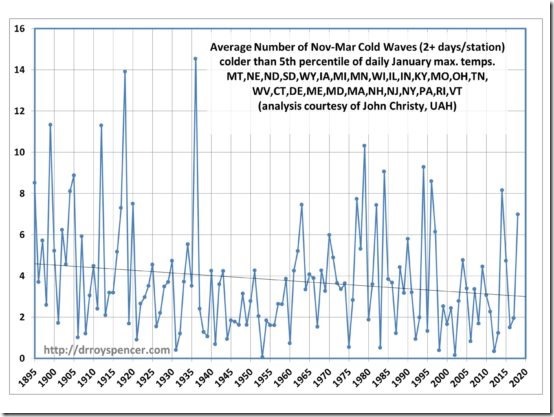
The trend is markedly downward in the most recent 40 years (since 1979) which is the earliest we have reliable measurements of Arctic sea ice from satellite microwave radiometers (my specialty).
Now, I suppose that Arctic sea ice decline could have some influence. But weather is immensely complex. Cause and effect is often difficult to ascertain.
At a minimum we should demand good observational support for any specific claim. In this case I would say that the connection between Eastern U.S. cold waves and Arctic sea ice is speculative, at best.
Just like most theories of climate change.
Maduro proposes early parliamentary elections in Venezuela
RT | February 2, 2019
Venezuelan President Niсolas Maduro has called for early elections to the National Assembly – a legislative body dominated by the opposition and led by Juan Guaido who declared himself interim leader last week.
Maduro’s statement comes as thousands are rallying in the streets of Caracas both in support of and against his government.
Guaido’s coup received immediate support from the US and its allies in Latin America and Europe while Russia, Mexico, China and other countries urged not to interfere into the domestic situation in the country. The political turmoil comes as Venezuela’s economy has been plummeting due to low oil prices, sanctions and mismanagement leaving most of its population in poverty.
The regular parliamentary elections were expected to be held in Venezuela in 2020. However, Maduro said that the body needs to be “re-legitimized” as he addressed a large crowd of his supporters during a rally in Caracas.
The president said that he would consult the Venezuelan Constituent Assembly – a body elected in 2017 to draft the new constitution – on the issue. If the assembly backs the proposal the vote will be scheduled for some time this year. Earlier, Venezuela’s Supreme Court declared all acts of the National Assembly, headed by Guaido, as null and void.
Meanwhile, Venezuela continues to witness both pro and anti-government rallies. Tens of thousands of people took to the streets of the Venezuelan capital on Saturday to join a pro-government demonstration to celebrate 20 years since the late Venezuelan president, Hugo Chavez, launched the Bolivarian revolution.
A sea of people can be seen flooding a kilometers-long stretch of Bolivar Avenue in downtown Caracas to listen to Maduro’s speech. Crowds were waving Venezuela’s national flags and holding placards with portraits of Chavez.
Tens of thousands of people also gathered in the eastern part of the capital for a rally organized by the opposition. The national flag-waving crowds also occupied a long stretch in the city as they came to listen to Guaido.
In his speech, Maduro hailed the determination and “deep loyalty” of the people as demonstrated over the last 20 years, and called on Guaido-led opposition to engage in a dialog.
The president appealed to the reason of the opposition politicians and said he is ready to meet them “the day they want.” He also said economics and “national peace” would be the focus of the conversation.
The opposition leader’s statements were more belligerent, however. He declared that the upcoming month would become a “breaking point” in the opposition’s struggle for power and called for new massive protests on February 12. He also claimed that 90 percent of Venezuelans “want change” and “no one here fears a civil war.”
Spain company rejects Israel tender for Jerusalem railway
MEMO – February 2, 2019
A Spanish company announced yesterday that it had rejected an Israeli tender to build part of the Jerusalem railway, which will cut deep into occupied territory.
Construcciones y Auxiliar de Ferrocarriles (CAF or Construction and Other Railway Services) announced that it “refuses to build a section of the railway in Jerusalem because [it] included Palestinian land that will be confiscated, in violation of the resolutions of international legitimacy,” Al-Wattan Voice reported.
The company’s workers also rejected its participation in the project on the same grounds. Representatives of the workers said that the problem lies in the fact that the railway will pass through Palestinian lands to serve illegal settlements in East Jerusalem.
“Any project in any city around the world, especially Jerusalem, must respect human rights and international legitimacy in its implementation,” CAF stressed.
CAF added: “The General Assembly of the United Nations and the International Court of Justice [ICJ], through various resolutions, have said that they are against the occupation of land through which will pass the section of the railway.”
Read also:
Jerusalem Archbishop: ‘Everything Palestinian is targeted by Israel’s occupation’
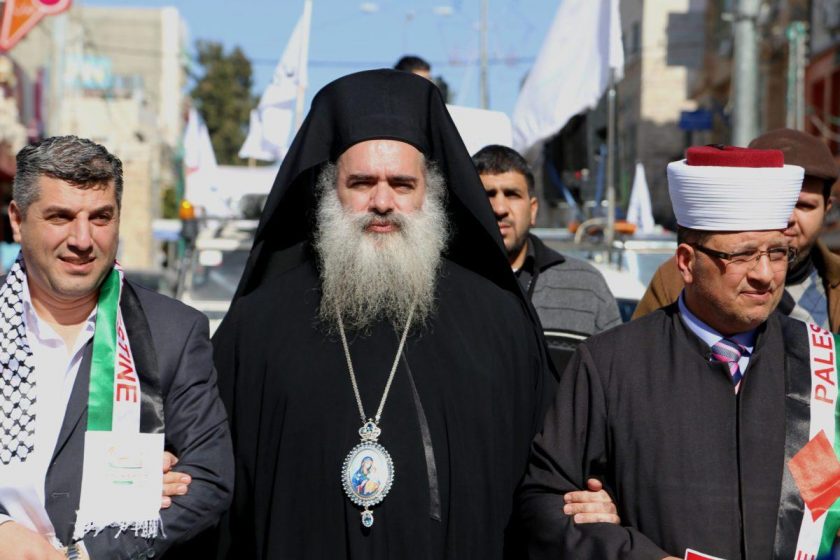
Archbishop of Jerusalem’s Greek Orthodox Church, Atallah Hanna, seen during a protest in the West bank city of Hebron, January 22, 2015 [Muhesen Amren / ApaImages]
MEMO | February 2, 2019
The Palestinian Archbishop of Jerusalem’s Greek Orthodox Church, Atallah Hanna, said yesterday that “everything Palestinian in Jerusalem is targeted by the Israeli occupation”.
During a meeting with a delegation from Médecins Sans Frontières (Doctors without Borders, MSF), Hanna explained the dangers threatening Palestinians’ existence and identity in the Holy City, Al-Wattan Voice reported.
“Everything is in danger in Jerusalem,” Hanna said, adding: “The Islamic and Christian holy sites and endowments are targeted in order to change our city, hide its identity and marginalize our Arabic and Palestinian existence.”
Hanna added that “recently, the Israeli occupation cancelled a planned celebration on the 50th anniversary of establishing Al-Maqased Hospital,” noting that the Israeli occupation had cancelled many other Palestinian events planned to take place in Jerusalem.
The Archbishop said that Palestinians “are living under severe torture and harsh persecution,” pointing to Israel’s closure of Palestinian institutions in the city. “It seems that they wanted us to give up Jerusalem and submit to their polices, measures and practices,” he added.
Hanna continued: “Jerusalem is for us and will remain for us. We will never give up our rights in Jerusalem and we will defend it against Israeli oppression.”
Addressing the MSF staff, he said: “We want you to know closely the suffering of the Palestinians and the oppression inflicted by the Israeli occupation on them in Jerusalem. We want our message to reach all the people around the world as we want more friends for the Palestinians.”
Read also:
Israeli forces detain secretary of Fatah in Jerusalem
14 Palestinians homeless as Israel forces 2 Jerusalem homes to be torn down
Forty years that changed Iran’s history

(Ayatollah Khomeini waves to followers from the balcony of his headquarters in Tehran, Feb 2, 1979, on second day of return from exile.)
By M. K. BHADRAKUMAR | Indian Punchline | February 2, 2019
The annual event known as the Ten Days of Dawn marking the political celebration of the Islamic Revolution in Iran on February 11 has begun. This year’s anniversary is a special occasion – the revolution completes 40 years. It becomes a defining moment.
Forty years ago, these ten days shook not only the Middle East but the Muslim world. The Islamic Revolution in Iran was a milestone for political Islam. It underscored that Islam and democracy are compatible. Iran’s electoral politics may have unique Iranian characteristics, which is only natural and far from unusual for other practitioners of democracy such as India or Brazil, for instance, but there can be no two opinions that Iran’s elected governments have acquired representative character and their legitimacy is not in doubt.
Basically, what irks many of Iran’s neighbours is also this compelling political reality of the empowerment of the people, which they themselves lack – be it Saudi Arabia, Bahrain, the UAE, Egypt or Jordan. They are nervous that their own people chaffing under authoritarian rule might get wrong ideas from Iran.
Several cross currents went into the alchemy of Iran’s Islamic Revolution ranging from Persian nationalists to the Communist Tudeh Party, and from Grand Ayotallah Sayyid Mohammad Kazem Shariatmadari (who was at odds with Imam Khomeini’s interpretation of the concept of Vilayat al-faqih or ‘Leadership of Jurists’ and espoused that the clergy ought to serve society and remain aloof from politics) to the charismatic ideologue of ‘Red Shi’ism’ Dr. Ali Shariati (who argued that religion in its pure form is concerned with social justice and salvation of the masses and should dispense with idolatrous rituals and established clergy – an entire current of non-Marxian socialism.) That explains the large social base of the Iranian revolution and its capacity to withstand relentless assaults by the US and its allies to undermine the established regime of the Vilayat al-faqih.
The Ten Days of Dawn is an occasion to read again the classic 1978 essay chronicling the upheaval leading to the Iranian revolution authored by the French philosopher Michel Foucault, What Are the Iranians Dreaming About? Foucault concluded his essay like this:
One bears on Iran and its peculiar destiny. At the dawn of history, Persia invented the state and conferred its models on Islam. Its administrators staffed the caliphate. But from this same Islam, it derived a religion that gave to its people infinite resources to resist state power. In this will for an “Islamic government,” should one see a reconciliation, a contradiction, or the threshold of something new?
The other question concerns this little corner of the earth whose land, both above and below the surface, has strategic importance at a global level. For the people who inhabit this land, what is the point of searching, even at the cost of their own lives, for this thing whose possibility we have forgotten since the Renaissance and the great crisis of Christianity, a political spirituality. I can already hear the French laughing, but I know that they are wrong.
“Political spirituality” – that is what gives a particular coloration to the Iranian revolution and makes it virtually impossible to repeat anywhere outside Iran.
The festivities of the Ten Days of Dawn began on February 1, which was the day Ayatollah Ruhollah Khomeini returned home from France after 14 years in exile to be the supreme leader of the Islamic Republic of Iran. They conclude on February 11, which dates back to the collapse of the Shah’s regime following clashes between some army units and revolutionaries triggered by nationwide protests.
The chartered Air France plane, which brought Khomeini from Paris was half empty so that it could carry extra fuel lest Shah didn’t allow the aircraft to land in Tehran. Khomeini’s allies in Tehran feared for his life. A 50000-strong police force deployed in Tehran on that day but it lost control in no time as swirling crowds overwhelmed the Shah’s security henchmen. An estimated 5 million people had lined the streets of Tehran to witness Khomeini’s homecoming. Read here a poignant BBC dispatch from Tehran on that historic day.
When the history of the decline of US influence in the Middle East gets written, the starting point has to be the Iranian Revolution of 1979. The US could never get over the “loss” of Iran as its key regional ally. An effective regional strategy became difficult to sustain. The consequent inability to let go of Iran accounted for much of the tensions in the Middle East politics in the past four decades. And, inevitably, the US kept losing ground while the Islamic regime in Iran gained in stature and influence as a permanent factor in the political life of the Middle East.
Suffice to say, it won’t be an exaggeration to estimate that the Iranian revolution has proved to be the nemesis of the Western political, economic, cultural domination of the Muslim Middle East. Having said that, it will be erroneous to estimate that the Islamic regime in Iran is locked in a mortal conflict with the West. Far from it. Iran is an ambitious regional power and it factors in that access to Western technology and capital is of crucial importance. Equally, the leadership is acutely conscious that for the preservation of the social base of the Islamic regime, economic development is critical, which again means trade and investment from the West. Iran’s middle class is heavily orientated toward ‘Westernism’.
The bottom line is that much as this may sound a paradox, the reality is that integration into the West is a core objective of the regime’s policies. Europe understands the complexity of Iran’s motivations. Interestingly, the European Union announced on January 31 (on the eve of the anniversary of Khomeini’s return from exile to Tehran) the creation of the so-called Instrument in Support of Trade Exchanges (INSTEX) as a channel for trade exchanges with Iran circumventing the US sanctions.
Tehran is delighted. Foreign Minister Mohammad Zarif promptly tweeted, “Iran welcomes #INSTEX—a long overdue 1st step—in E3 implementation of May 2018 commitments to save JCPOA (Iran nuclear deal) by ensuring dividends for Iranians after US’ illegal reimposition of sanctions. We remain ready for constructive engagement with Europe on equal footing & with mutual respect.”
The heart of the matter is that the fortieth anniversary of the Islamic Revolution would have been an occasion to bury the hostility between the US and Iran if only the Trump administration had the sense of history and political foresight to comprehend that Iran can be a factor for regional stability. President Trump did not have to look beyond Iran for an effective partner to bring to a closure the “endless wars” in the Middle East.
US Treasury to Foreigners: No More Venezuelan Oil Transactions
teleSUR | February 2, 2019
The United States Treasury Department announced Friday that non-U.S. companies that buy Venezuelan oil through the U.S. financial system or U.S. commodity brokers, will not be allowed to carry out any purchase after April 28.
“Transactions to purchase petroleum and petroleum products from PDVSA or any entity in which PDVSA owns, directly or indirectly… and that involve U.S. persons or any other U.S. nexus… must be wound down by April 28, 2019,” the U.S. Treasury states in a note, adding that “U.S. person employees and contractors of non-U.S. companies located in a country other the U.S. or Venezuela are authorized to engage in certain maintenance or wind-down transactions with PDVSA, or any entity in which PDVSA owns, directly or indirectly… through Mar. 29, 2019.”
The U.S. Treasury release follows the U.S. sanctions imposed, on Jan. 27, on the Venezuelan state-owned oil company, Petroleos de Venezuela (PDVSA). As a consequence, Venezuela’s oil revenues obtained from sales to the U.S. market will be confiscated de facto.
Since most of the international oil trade is done in dollars, the United States is able to continue economic warfare against Venezuela, a country whose income comes mainly from oil exports.
Before President Donald Trump’s measures were put in place against Venezuela, the U.S. was the destination of 40% of Venezuela’s oil exports.
The sanctions affect some US$7 billion in PDVSA assets and will cause other US$11 billion in losses for the Venezuelan company throughout the next year.
Why the War on Conspiracy Theories Is Bad Public Policy
By Kevin Barrett • Unz Review • February 1, 2019
A Review of Conspiracy Theories and Other Dangerous Ideas by Cass Sunstein (based on an earlier paper co-authored with Adrian Vermeule); In Defense of Troublemakers: The Power of Dissent in Life and Business by Charlan Nemeth; and Conspiracy Theories and the People Who Believe Them, edited by Joseph E. Uscinski
On January 25 2018 YouTube unleashed the latest salvo in the war on conspiracy theories, saying “we’ll begin reducing recommendations of borderline content and content that could misinform users in harmful ways—such as videos promoting a phony miracle cure for a serious illness, claiming the earth is flat, or making blatantly false claims about historic events like 9/11.”
At first glance that sounds reasonable. Nobody wants YouTube or anyone else to recommend bad information. And almost everyone agrees that phony miracle cures, flat earthism, and blatantly false claims about 9/11 and other historical events are undesirable.
But if we stop and seriously consider those words, we notice a couple of problems. First, the word “recommend” is not just misleading but mendacious. YouTube obviously doesn’t really recommend anything. When it says it does, it is lying.
When you watch YouTube videos, the YouTube search engine algorithm displays links to other videos that you are likely to be interested in. These obviously do not constitute “recommendations” by YouTube itself, which exercises no editorial oversight over content posted by users. (Or at least it didn’t until it joined the war on conspiracy theories.)
The second and larger problem is that while there may be near-universal agreement among reasonable people that flat-earthism is wrong, there is only modest agreement regarding which health approaches constitute “phony miracle cures” and which do not. Far less is there any agreement on “claims about 9/11 and other historical events.” (Thus far the only real attempt to forge an informed consensus about 9/11 is the 9/11 Consensus Panel’s study—but it seems unlikely that YouTube will be using the Consensus Panel to determine which videos to “recommend”!)

YouTube’s policy shift is the latest symptom of a larger movement by Western elites to—as Obama’s Information Czar Cass Sunstein put it—“disable the purveyors of conspiracy theories.” Sunstein and co-author Adrian Vermeule’s 2008 paper “Conspiracy Theories,” critiqued by David Ray Griffin in 2010 and developed into a 2016 book, represents a panicked reaction to the success of the 9/11 truth movement. (By 2006, 36% of Americans thought it likely that 9/11 was an inside job designed to launch wars in the Middle East, according to a Scripps poll.)
Sunstein and Vermuele begin their abstract:
Many millions of people hold (sic) conspiracy theories; they believe that powerful people have worked together in order to withhold the truth about some important practice or some terrible event. A recent example is the belief, widespread in some parts of the world, that the attacks of 9/11 were carried out not by Al Qaeda, but by Israel or the United States. Those who subscribe to conspiracy theories may create serious risks, including risks of violence, and the existence of such theories raises significant challenges for policy and law.
Sunstein argues that conspiracy theories (i.e. the 9/11 truth movement) are so dangerous that some day they may have to be banned by law. While awaiting that day, or perhaps in preparation for it, the government should “disable the purveyors of conspiracy theories” through various techniques including “cognitive infiltration” of 9/11 truth groups. Such “cognitive infiltration,” Sunstein writes, could have various aims including the promotion of “beneficial cognitive diversity” within the truth movement.
What sort of “cognitive diversity” would Cass Sunstein consider “beneficial”? Perhaps 9/11 truth groups that had been “cognitively infiltrated” by spooks posing as flat-earthers would harbor that sort of “beneficial” diversity? That would explain the plethora of expensive, high-production-values flat earth videos that have been blasted at the 9/11 truth community since 2008.
Why does Sunstein think “conspiracy theories” are so dangerous they need to be suppressed by government infiltrators, and perhaps eventually outlawed—which would necessitate revoking the First Amendment? Obviously conspiracism must present some extraordinary threat. So what might that threat be? Oddly, he never explains. Instead he briefly mentions, in vapidly nebulous terms, about “serious risks including the risk of violence.” But he presents no serious evidence that 9/11 truth causes violence. Nor does he explain what the other “serious risks” could possibly be.
Why did such highly accomplished academicians as Sunstein and Vermuele produce such an unhinged, incoherent, poorly-supported screed? How could Harvard and the University of Chicago publish such nonsense? Why would it be deemed worthy of development into a book? Why did the authors identify an alleged problem, present no evidence that it even is a problem, yet advocate outrageously illegal and unconstitutional government action to solve the non-problem?
The too-obvious answer, of course, is that they must realize that 9/11 was in fact a US-Israeli false flag operation. The 9/11 truth movement, in that case, would be a threat not because it is wrong, but because it is right. To the extent that Americans know or suspect the truth, the US government will undoubtedly find it harder to pursue various “national security” objectives. Ergo, 9/11 “conspiracy theories” are a threat to national security, and extreme measures are required to combat them. But since we can’t just burn the First Amendment overnight, we must instead take a gradual and covert “boil the frog” approach, featuring plenty of cointelpro-style infiltration and misdirection. “Cognitive infiltration” of internet platforms to stop the conspiracy contagion would also fit the bill.
It is quite possible, perhaps even likely, that Sunstein and Vermeule are indeed well-informed and Machievellian. But it is also conceivable that they are, at least when it comes to 9/11 and “conspiracy theories,” as muddle-headed as they appear. Their irrational panic could be an example of the bad thinking that emerges from groups that reflexively reject dissent. (Another, larger example of this kind of bad thinking comes to mind: America’s disastrous post-9/11 policies.)
The counterintuitive truth is that embracing and carefully listening to radical dissenters is in fact good policy, whether you are a government, a corporation, or any other kind of group. Ignoring or suppressing dissent produces muddled, superficial thinking and bad decisions. Surprisingly, this turns out to be the case even when the dissenters are wrong.
Scientific evidence for the value of dissent is beautifully summarized in Charlan Nemeth’s In Defense of Troublemakers: The Power of Dissent in Life and Business (Basic Books, 2018). Nemeth, a psychology professor at UC-Berkeley, summarizes decades of research on group dynamics showing that groups that feature passionate, radical dissent deliberate better, reach better conclusions, and take better actions than those that do not—even when the dissenter is wrong.
Nemeth begins with a case where dissent would likely have saved lives: the crash of United Airlines Flight 173 in December, 1978. As the plane neared its Portland destination, the possibility of a problem with the landing gear arose. The captain focused on trying to determine the condition of the landing gear as the plane circled the airport. Typical air crew group dynamics, in which the whole crew defers to the captain, led to a groupthink bubble in which nobody spoke up as the needle on the fuel gauge approached “E.” Had the crew included even one natural “troublemaker”—the kind of aviator who joins Pilots for 9/11 truth—there almost certainly would have been more divergent thinking. Someone would have spoken up about the fuel issue, and a tragic crash would have been averted.
Since 9/11, American decision-making elites have entered the same kind of bubble and engaged in the same kind of groupthink. For them, no serious dissent on such issues as what really happened on 9/11, and whether a “war on terror” makes sense, is permitted. The predictable result has been bad thinking and worse decisions. From the vantage point of Sunstein and Vermeule, deep inside the bubble, the potentially bubble-popping, consensus-shredding threat of 9/11 truth must appear radically destabilizing. To even consider the possibility that the 9/11 truthers are right might set off a stampede of critical reflection that would radically undermine the entire set of policies pursued for the past 17 years. This prospect may so terrify Sunstein and Vermeule that it paralyzes their ability to think. Talk about “crippled epistemology”!
Do Sunstein and Vermeule really think their program for suppressing “conspiracy theories” will be beneficial? Do YouTube’s decision-makers really believe that tweaking their algorithms to support the official story will protect us from bad information? If so, they are all doubly wrong. First, they are wrong in their unexamined assumption that 9/11 truth and “conspiracy theories” in general are “blatantly false.” No honest person with critical thinking skills who weighs the merits of the best work on both sides of the question can possibly avoid the realization that the 9/11 truth movement is right. The same is true regarding the serial assassinations of America’s best leaders during the 1960s. Many other “conspiracy theories,” perhaps the majority of the best-known ones, are also likely true, as readers of Ron Unz’s American Pravda series are discovering.
Second, and less obviously, those who would suppress conspiracy theories are wrong even in their belief that suppressing false conspiracy theories is good public policy. As Nemeth shows, social science is unambiguous in its finding that any group featuring at least one passionate, radical dissenter will deliberate better, reach sounder conclusions, and act more effectively than it would have without the dissenter. This holds even if the dissenter is wrong—even wildly wrong.
The overabundance of slick, hypnotic flat earth videos, if they are indeed weaponized cointelpro strikes against the truth movement, may be unfortunate. But the existence of the occasional flat earther may be more beneficial than harmful. The findings summarized by Nemeth suggest that a science study group with one flat earther among the students would probably learn geography and astronomy better than they would have without the madly passionate dissenter.
We could at least partially solve the real problem—bad groupthink—through promoting genuinely beneficial cognitive diversity. YouTube algorithms should indeed be tweaked to puncture the groupthink bubbles that emerge based on user preferences. Someone who watches lots of 9/11 truther videos should indeed be exposed to dissent, in the form of the best arguments on the other side of the issue—not that there are any very good ones, as I have discovered after spending 15 years searching for them!
But the same goes for those who watch videos that explicitly or implicitly accept the official story. Anyone who watches more than a few pro-official-story videos (and this would include almost all mainstream coverage of anything related to 9/11 and the “war on terror”) should get YouTube “suggestions” for such videos as September 11: The New Pearl Harbor, 9/11 Mysteries, and the work of Architects and Engineers for 9/11 Truth. Exposure to even those “truthers” who are more passionate than critical or well-informed would benefit people who believe the official story, according to Nemeth’s research, by stimulating them to deliberate more thoughtfully and to question facile assumptions.
The same goes for other issues and perspectives. Fox News viewers should get “suggestions” for good material, especially passionate dissent, from the left side of the political spectrum. MSNBC viewers should get “suggestions” for good material from the right. Both groups should get “suggestions” to look at genuinely independent, alternative media brimming with passionate dissidents—outlets like the Unz Review!
Unfortunately things are moving in the opposite direction. YouTube’s effort to make “conspiracy videos” invisible is being pushed by powerful lobbies, especially the Zionist lobby, which seems dedicated to singlehandedly destroying the Western tradition of freedom of expression.
Nemeth and colleagues’ findings that “conspiracy theories” and other forms of passionate dissent are not just beneficial, but in fact an invaluable resource, are apparently unknown to the anti-conspiracy-theory cottage industry that has metastasized in the bowels of the Western academy. The brand-new bible of the academic anti-conspiracy-theory industry is Conspiracy Theories and the People Who Believe Them (Oxford University Press, 2019).
Editor Joseph Uscinski’s introduction begins by listing alleged dangers of conspiracism: “In democracies, conspiracy theories can drive majorities to make horrible decisions backed by the use of legitimate force. Conspiracy beliefs can conversely encourage abstention. Those who believe the system is rigged will be less willing to take part in it. Conspiracy theories form the basis for some people’s medical decisions; this can be dangerous not only for them but for others as well. For a select few believers, conspiracy theories are instructions to use violence.”
Uscinski is certainly right that conspiracy theories can incite “horrible decisions” to use “legitimate force” and “violence.” Every major American foreign war since 1846 has been sold to the public by an official theory, backed by a frenetic media campaign, of a foreign conspiracy to attack the United States. And all of these Official Conspiracy Theories (OCTs)—including the theory that Mexico conspired to invade the United States in 1846, that Spain conspired to sink the USS Maine in 1898, that Germany conspired with Mexico to invade the United States in 1917, that Japan conspired unbeknownst to peace-seeking US leaders to attack Pearl Harbor in 1941, that North Vietnam conspired to attack the US Navy in the Gulf of Tonkin in 1964, and that 19 Arabs backed by Afghanistan, Iraq, Iran, and everybody else Israel doesn’t like conspired to attack the US in 2001—were false or deceptive.
Well over 100 million people have been killed in the violence unleashed by these and other Official Conspiracy Theories. Had the passionate dissenters been heeded, and the truths they told about who really conspires to create war-trigger public relations stunts been understood, none of those hundred-million-plus murders need have happened.
Though Conspiracy Theories and the People Who Believe Them generally pathologizes the conspiracy theories of dissidents while ignoring the vastly more harmful theories of official propagandists, its 31 essays include several that question that outlook. In “What We Mean When We Say ‘Conspiracy Theory’ Jesse Walker, books editor of Reason Magazine, exposes the bias that permeates the field, pointing out that many official conspiracy theories, including several about Osama Bin Laden and 9/11-anthrax, were at least as ludicrously false and delusional as anything believed by marginalized dissidents.
In “Media Marginalization of Racial Minorities: ‘Conspiracy Theorists’ in U.S. Ghettos and on the ‘Arab Street’” Martin Orr and Gina Husting go one step further: “The epithet ‘conspiracy theorist’ is used to tarnish those who challenge authority and power. Often, it is tinged with racial undertones: it is used to demean whole groups of people in the news and to silence, stigmatize, or belittle foreign and minority voices.” (p.82) Unfortunately, though Orr and Husting devote a whole section of their article to “Conspiracy Theories in the Muslim World” and defend Muslim conspiracists against the likes of Thomas Friedman, they never squarely face the fact that the reason roughly 80% of Muslims believe 9/11 was an inside job is because the preponderance of evidence supports that interpretation.
Another relatively sensible essay is M R.X. Dentith’s “Conspiracy Theories and Philosophy,” which ably deconstructs the most basic fallacy permeating the whole field of conspiracy theory research: the a priori assumption that a “conspiracy theory” must be false or at least dubious: “If certain scholars (i.e. the majority represented in this book! –KB) want to make a special case for conspiracy theories, then it is reasonable for the rest of us to ask whether we are playing fair with our terminology, or whether we have baked into our definitions the answers to our research programs.” (p.104). Unfortunately, a few pages later editor Joseph Uscinski sticks his fingers in his ears and plays deaf and dumb, claiming that “the establishment is right far more often than conspiracy theories, largely because their methods are reliable. When conspiracy theorists are right, it is by chance.” He adds that conspiracy theories will inevitably “occasionally lead to disaster” (whatever that means). (p.110).
I hope Uscinski finds the time to read Nemeth’s In Defense of Troublemakers and consider the evidence that passionate dissent is helpful, not harmful. And I hope he will look into the issues Ron Unz addresses in his American Pravda series.
Then again, if he does, he may find himself among those of us exiled from the academy and publishing in The Unz Review.
Putin meeting with Foreign Minister Lavrov and Defence Minister Shoigu on INF Treaty
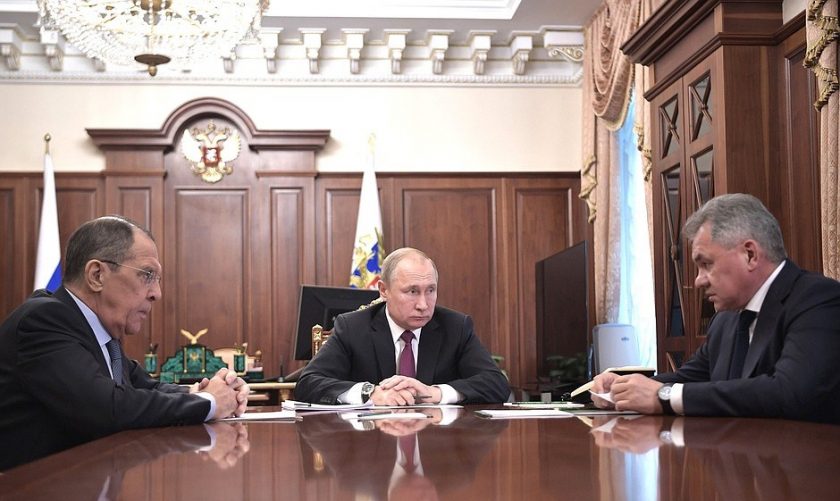
Russian President Vladimir Putin with Foreign Minister Sergei Lavrov (left) and Defence Minister Sergei Shoigu.
The Kremlin, Moscow | February 2, 2019
President of Russia Vladimir Putin: Foreign Minister Sergei Lavrov, please provide an update on the Treaty on the Elimination of Intermediate-Range and Shorter-Range Missiles, and the disarmament dossier in general. What is going on in terms of limitation of offensive arms?
Foreign Minister Sergei Lavrov: Mr President,
Regarding the Intermediate-Range Nuclear Forces Treaty, as you know, it has been in force since 1988. It had an indefinite term. According to the information at our disposal, the United States has been violating the Treaty since 1999, when it started testing combat unmanned aerial vehicles that have the same characteristics as land-based cruise missiles banned by the Treaty.
The United States went on to use ballistic target missiles for testing their missile defence system, and in 2014 they began the deployment in their missile defence system positioning areas in Europe of Mk 41 vertical launching systems. These launchers are fully suitable as they are for Tomahawk intermediate-range attack missiles.
Vladimir Putin: And this is an outright violation of the Treaty.
Sergei Lavrov: This is an outright violation of the Treaty. Launchers of this kind have already been deployed in Romania, and preparations are underway to deploy them in Poland, as well as Japan.
Another matter of concern for us is that only recently, just a year ago, the United States in its 2018 Nuclear Posture Review set the task of developing low-yield nuclear weapons, and it is probable that intermediate-range missiles will serve as a means of delivery for these weapons. It was also announced only recently that this provision of the US nuclear doctrine is beginning to materialise with missiles of this kind entering production.
In October 2018, the United States officially declared its intention to withdraw from the Treaty on the Elimination of Intermediate-Range and Shorter-Range Missiles. We did everything we could to save the Treaty considering its importance in terms of sustaining strategic stability in Europe, as well as globally. The last attempt of this kind was undertaken on January 15, when the US finally agreed to our request for holding consultations in Geneva.
In coordination with the Defence Ministry, we proposed unprecedented transparency measures that went far beyond our obligations under the INF Treaty in order to persuade the US that Russia was not in violation of this essential instrument. However, the US torpedoed these proposals. Instead, the US presented yet another ultimatum. It is obvious that we cannot accept it since it contradicts the INF Treaty in both letter and spirit.
The US announced that it was suspending its participation in the INF Treaty, launched the official withdrawal from it, and said that it will no longer consider itself restricted by the INF Treaty. As far as we can see, this means that the US will make missiles in addition to engaging in research and development activities that have already been factored into the current budget.
There is no doubt that these developments make things worse overall in the sphere of nuclear disarmament and strategic stability. It all started with the 1972 Anti-Ballistic Missile Treaty, when the US decided to withdraw from it in 2002, as you know all too well. This was done despite numerous initiatives by the Russian Federation at the UN General Assembly to save the ABM Treaty. The UN General Assembly passed a number of resolutions supporting the ABM Treaty. However, this did not stop the United States from withdrawing from it.
As a partial replacement for the ABM Treaty, the US and Russia signed a joint declaration that same year, 2002, on new strategic relations with a promise to settle all issues related to the so-called third positioning area of the missile-defence system being deployed in Europe at the time. The declaration provided for holding consultations as a way to reach common ground. This did not happen due to the unwillingness of the United States to take up Russia’s concerns in earnest.
In 2007, we made another gesture of good will at your instructions by coming forward with an initiative that consisted of working together to resolve the problems related to US missile defence system’s third positioning area in Europe. Once again, the US backed out of this proposal.
However, at the Russia-NATO Summit in Lisbon in 2010, we once again called for Russia, the US and Europe to work together on a continental missile-defence system. This call was not heeded. Nevertheless, two years later, in 2012, at the NATO Summit in Chicago it was NATO that called for dialogue with Russia on missile defence. However, all this good will boiled down to the US insisting that we simply come to terms with their missile defence approach, despite all the obvious risks and threats to our security posed by this approach.
Let me remind you that in 2013 Russia once again called on the US Department of State to open consultations, and came forward with concrete proposals. There was no reply. And in 2014, the United States brought the dialogue on missile defence to a halt and declared the intention to deploy its positioning areas in Europe and Asia, while also strengthening other systems, including in Alaska and on the east coast.
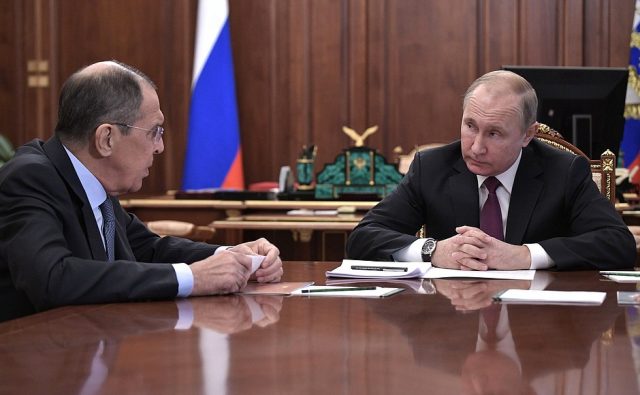
With Foreign Minister Sergei Lavrov.
Talking about other essential international security and strategic stability instruments, the approach adopted by the United States to performing its commitments under the universal Treaty on the Non-Proliferation of Nuclear Weapons has been a matter of concern for Russia. In fact, despite numerous reminders on our part, the United States commits serious violations of the Treaty in its actions within NATO. The Treaty commits nuclear powers to refrain from transferring the corresponding nuclear technologies.
Despite these provisions, NATO engages in so-called joint nuclear missions whereby the United States together with five NATO countries where US nuclear weapons are deployed conduct nuclear weapons drills with countries that are not part of the five nuclear-weapons states. This is a direct violation of the Non-Proliferation Treaty.
Another treaty that had a special role in removing the threat of nuclear war, or, to be more precise, whose preparation was a source of hope for addressing these threats, was the Comprehensive Nuclear-Test-Ban Treaty [CTBT]. The United States did not ratify it even though doing so was among Barack Obama’s campaign promises when he ran for president.
Right now, this instrument is completely off the radar, since the United States has lost all interest in any consultations on joining this Treaty. Being a party to the CTBT and acting in good faith, Russia holds special events at the UN General Assembly every year in order to promote the Treaty and mobilise public opinion in favour of its entry into force, which requires the United States to join it, among other things.
Apart from the INF Treaty, there is the Strategic Offensive Arms Treaty [START] that remains in force. It is also essential for preserving at least some measure of strategic stability and global parity. It is also under threat, since its effective functioning has come into question after the recent move by the United States to remove from accountability under the treaty 56 submarine based Trident launchers and 41 heavy bombers by declaring them converted into nun-nuclear.
This is possible under the treaty, but the other party has the right to make sure that once converted these weapons cannot be reconverted back into nuclear arsenals.
Vladimir Putin: An inspection has to be carried out.
Sergei Lavrov: Yes, an inspection. And there have to be technical means to persuade us that these systems cannot be reconverted and returned into the nuclear arsenal.
We have been holding talks since 2015 to make sure that the United States complies with its obligations on this matter. So far, there have been no results. The technical solutions we have been offered so far cannot persuade us that more than 1,200 warheads, which is an enormous amount, cannot be returned to the nuclear arsenal. Unfortunately, repeated proposals by Russia to launch talks on extending the Strategic Offensive Arms Treaty beyond 2021, when its first term is set to expire, have fallen on deaf ears in the United States. All we hear is that the decision on the New START has yet to be taken.
All in all, the situation is quite alarming. Let me reiterate that the decision taken by the United States on the INF Treaty is of course a matter of serious concern for the entire world, especially for Europe. Nevertheless, the Europeans followed in the footsteps of the United States with all NATO members speaking out in explicit support of the position adopted by the United States to refrain from any discussions on mutual concerns. All we hear are groundless ultimatums requiring us to take unilateral measures without any evidence to support unfounded accusations.
Vladimir Putin: Thank you.
Mr Shoigu, what is the Defence Ministry’s view on the current situation? And what do you propose in this regard?
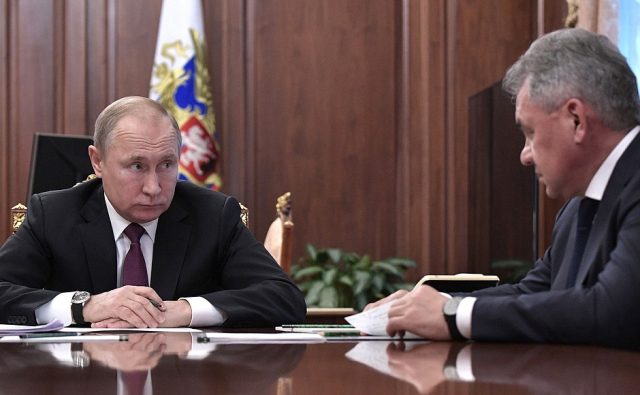
With Defence Minister Sergei Shoigu.
Defence Minister Sergei Shoigu: Mr President, it is obvious to us, despite the murky language that we hear, that apart from openly conducting research and development on the production of intermediate-range and shorter-range missiles, there have been actual violations of the INF Treaty, and this has been going on for several years. To put it simply, the United States has started producing missiles of this kind.
In this connection, we have the following proposals regarding retaliatory measures.
First, we propose launching in the coming months research and development, as well as development and engineering with a view to creating land-based modifications of the sea-based Kalibr launching systems.
Second, we propose launching research and development, followed by development and engineering to create land-based launchers for hypersonic intermediate-range and shorter-range missiles.
We ask you to support these proposals.
Vladimir Putin: I agree. This is what we will do. Our response will be symmetrical. Our US partners announced that they are suspending their participation in the INF Treaty, and we are suspending it too. They said that they are engaged in research, development and design work, and we will do the same.
I agree with the Defence Ministry’s proposals to create a land-based version of the Kalibr launchers and work on a new project to develop a land-based hypersonic intermediate-range missile.
At the same time, I would like to draw your attention to the fact that we must not and will not let ourselves be drawn into an expensive arms race. I wanted to ask you, would it be possible to finance these initiatives using the existing budget allocations to the Defence Ministry for 2019 and the following years?
Sergei Shoigu: Mr President, we closely studied this matter, and will propose adjustments to the 2019 budget in order to be able to carry out these initiatives within the limits set by the state armaments programme and the defence procurement orders for 2019 without going over budget.
Vladimir Putin: This should not entail any increases in the Defence Ministry’s budget.
Sergei Shoigu: Yes.
Vladimir Putin: Good.
In this connection, there is one more thing I wanted to ask you. Every six months we hold meetings in Sochi to discuss the implementation of the state defence order with the commanders of the Armed Forces and the defence sector representatives.
Starting this year, I propose modifying this format. I want to see how efforts to deploy our systems are progressing. This refers to the Kinzhal hypersonic air-launched ballistic missile, the Peresvet combat laser weapon, which has already been delivered to the army, and the Avangard system, which is now in serial production, having completed the test phase. I want to see how the production of the Sarmat missile is advancing alongside preparations for placing it on combat duty.
Several days ago, you reported to me on the completion of a key stage in testing the Poseidon multipurpose strategic unmanned underwater vehicle. We have to look at how these efforts are advancing.
We are aware of the plans by some countries to deploy weapons in outer space. I want to hear a report on how this threat can be neutralised.
There is another important topic I wanted to raise with both the Foreign Ministry and the Defence Ministry.
For many years, we have been calling on numerous occasions for holding meaningful disarmament talks on almost all aspects of this matter. In recent years, we have seen that our partners have not been supportive of our initiatives. On the contrary, they always find pretexts to further dismantle the existing international security architecture.
In this connection, I would like to highlight the following considerations, and I expect the Foreign Ministry and the Defence Ministry to use them as guidance. All our proposals in this area remain on the table just as before. We are open to negotiations. At the same time, I ask both ministries not to initiate talks on these matters in the future. I suggest that we wait until our partners are ready to engage in equal and meaningful dialogue on this subject that is essential for us, as well as for our partners and the entire world.
Another important consideration I would like to share with the senior officials of both ministries. We proceed from the premise that Russia will not deploy intermediate-range or shorter-range weapons, if we develop weapons of this kind, neither in Europe nor anywhere else until US weapons of this kind are deployed to the corresponding regions of the world.
I ask the Foreign Ministry and the Defence Ministry to closely monitor developments and promptly submit proposals on ways to respond.
Featured Video
Daniel Davis: U.S. Military Options & War Narrative Collapse
or go to
Aletho News Archives – Video-Images
Book Excerpt
“Vaccines Do Not Cause Autism!” The Science is Settled. Right?
ICAN urges the IACC to actually study infant vaccines and autism
 By Aaron Siri | Injecting Freedom | March 16, 2026
On behalf of ICAN, we just sent a copy of chapter 11 of Vaccines, Amen to the newly appointed members of the federal Interagency Autism Coordinating Committee (IACC).
If you haven’t already read this chapter, you can read the whole thing in the attached letter. I trust that after you read it, you’ll see why the statement “vaccines do not cause autism” is a belief, not science!

IACC Public Comment Letter
1.53MB ∙ PDF file
Includes chapter 11 of Vaccines, Amen
Blog Roll
 Aletho News
- Daniel Davis: U.S. Military Options & War Narrative Collapse
- Protesters call on Brussels university to cut partnership with Israeli defense-linked firm
- Weapons makers cash in on Trump’s Iran war
- Why Trump’s anti-Iran naval coalition in Strait of Hormuz is doomed to fail
- IRGC says regional energy sites linked to US will be reduced to ashes
- Qatar condemns ‘dangerous’ Israeli attack on gas field
- Iran made ‘unexpectedly substantial’ offer during Geneva talks, US envoys ‘dragged’ Trump into war: Report
- Russia condemns Israel’s attack near Bushehr plant, files complaint
- Russia Strongly Condemns Actions Aimed at Harming Health of Iranian Leadership – Kremlin
- Israeli Journalist Demands Tucker Carlson and Candace Owens Be Placed in WWII-Style Internment Camps
- If Americans Knew
- How ignorance, misunderstanding and obfuscation ended Iran nuclear talks
- Israeli media reports grotesque settler attack in West Bank
- UK security adviser attended US-Iran talks and judged deal was within reach
- Tucker Carlson says ‘neocons’ will try to destroy Joe Kent over resignation
- Lebanon death toll exceeds 900, another assassination in Iran, bombing in Gaza – Not a ceasefire Day 159
- Trump’s counterterrorism chief, whose own wife was killed by ISIS, quits over Iran War saying Tehran posed ‘no imminent threat’
- Here’s what US could fund instead of Bibi’s war on Iran
- Israel Killed Over a Dozen Lebanese Paramedics in Three Days, Now Claiming That Ambulances Are “Hezbollah” Targets
- War on Iran: These are the heritage sites devastated by US and Israeli attacks
- Four news stories from Israeli media that illustrate Israeli “justice”
- No Tricks Zone
- Energy Expert: Germany’s Nuclear Phaseout Was A “500 Billion Euro Mistake”
- New Research: South Australia’s Mid-Holocene Sea Surface Temperatures Were 4°C Warmer Than Today
- Storing Green Energy To Last Germany 10 Days Would Require A 60-Million Tonne Battery
- New Studies: UK Sea Levels Were 4 Meters Higher Than Today During The Mid-Holocene
- Destructive Green New Deal: German Energy And Metal Group Warns Of Drastic Crisis
- New Study Documents A 20-Year Pause In Arctic Sea Ice Decline – Driven By Internal Variability
- Wake-up Call: Survey Shows Majority Of Germans Now Favor Postponing Climate Targets!
- Televised! Leading German Political Candidate Tells Schoolchildren CO2 Makes Sun Hotter!
- New Study: A Century Warming Of 1.1°C Is ‘Commonplace’ And ‘Not Unusual’ During This Interglacial
- New Study: ‘Internal Noise’ And Volcanic Forcing Can Trigger 10-15°C Warming Within Decades
 Aletho News