US House Intel Chief ‘Pounded’ Russiagate Conspiracy ‘With No Regard for Truth’

Sputnik | March 29, 2019
US Rep. Adam Schiff (D-CA) has continued to push a tale of collusion between the Trump campaign and Russian actors without taking into consideration the truth or facts of the matter, journalist and author Daniel Lazare told Sputnik.
“It’s been utterly outrageous,” Lazare told Radio Sputnik’s Loud & Clear on Thursday. “He has pounded the story into the ground with no regard for the truth whatsoever.”
“Back in March 2017, when the House Intelligence Committee had its first hearing on Russiagate, Schiff devoted roughly 15 or 20 minutes to a point by point recitation of the Steele dossier. Everything from the golden showers to Cohen’s secret rendezvous in Prague to Trump cavorting with prostitutes on another occasion… and there’s just no concern for the truth,” he continued.
“Truth is irrelevant, it’s whatever will get him campaign donations, whatever gets him airtime on CNN. It’s a complete outrage.”
On Thursday during a House Intelligence Committee hearing, every Republican member of the House Intelligence Committee, which Schiff chairs, called for the California democrat to resign from his post, citing his”willingness to continue to promote a demonstrably false narrative” regarding alleged collusion.
A letter signed by all Republican members of the committee and read by Rep. Mike Conaway states that Schiff has been “at the center of a well-orchestrated media campaign claiming, among other things, the Trump campaign colluded with the Russian government.”
“The findings of the Special Counsel conclusively refute your past and present assertions and have exposed you as having abused your position to knowingly promote false information, having damaged the integrity of this Committee, and undermined faith in US government institutions,” the letter added.
Schiff responded to the sudden turn of events by raising a list of questionable interactions between Trump campaign officials and Russian actors.
“My colleagues may think it is OK that the president’s son was offered dirt as part of an effort to help Trump… You might think it is OK. I don’t,” the US lawmaker said, occasionally pausing for dramatic effect.
The call for Schiff’s resignation comes just one day after US Sen. Rand Paul fired off a tweet revealing that a “high-level source” informed him that “it was [former CIA Director John] Brennan who insisted that the unverified and fake Steele dossier be included in the Intelligence report.”
Paul went on to call for Brennan to testify under oath before Congress about his involvement in pushing the dossier, which helped to kick off special counsel Robert Mueller’s investigation into alleged collusion.
Lazare told host Brian Becker that it’s “imperative” that Brennan be required to testify under oath in order to better understand just how Washington became enveloped in the collusion investigation.
“It’s absolutely imperative that we figure out how this happened,” Lazare stressed. “[We need to] get to the bottom of it and expose those who were guilty in this whole misadventure.”
Australian Defence Strategy Still Locked in A Past Era
By James O’Neill | American Herald Tribune | March 28, 2019
According to a report in the Sydney Morning Herald (25 March 2019) the coalition government, if re-elected, would spend $2.5 billion on an air defence system. The object of the expenditure is said to “bolster Australia’s capacity to intercept enemy aircraft”. The new system will also defend against helicopters, cruise missiles and unmanned aerial systems.
The cost is divided between an initial acquisition price of $1.5 billion and a further $1 billion to operate and maintain it over two decades. The Minister for Defence, Linda Reynolds, said that the project had great export potential.
Once again, one has to wonder exactly what planet our defence politicians and their advisors actually inhabit. While the cost of this touted new system is small change compared to the tens of billions of dollars being lavished on expensive boondoggles such as the F35 joint strike fighter and the French built submarines, it is another illustration of wasted expenditure on military equipment not fit for purpose.
The stated object is to be able to defend against four intruders: helicopters; unmanned aerial systems; enemy aircraft and cruise missiles. Why one would need a $1 billion system to defend against helicopters, with their low altitude, short range, slow moving and noisy character simply boggles the mind.
Exactly what is meant by ‘unmanned aerial systems’ is not defined, but presumably refers to drones. The same point applies here as to helicopters. The more serious question relates to enemy aircraft and cruise missiles, and the source of those hostile intruders.
There is no obvious reason for Australia to be attacked by Indonesia, Papua New Guinea or any other country for whom Australia would be within the range of its bombers. The unspoken “enemy” here is presumably China, although again that raises the obvious question as to why China would wish to attack Australia. The only obvious answer to this is as a defensive reaction to an attack upon China itself.
Australia would only do that as part of yet another United States led “Coalition”, but why Australia would wish to be involved in such a foolhardy exercise against its largest trading partner should not be seriously contemplated by our defence planners, and if it is they need to spell out their rationale in clear terms.
Let us assume for arguments sake that China did attack Australia. It would not be with helicopters, unmanned aerial vehicles, cruise missiles or bombers. It would be done with one or more of its repertoire of supersonic missiles from the Dong Feng family of missiles, most probably the DF41. This missile system travels at hypersonic speed (Mach 20) and has 8 to 10 independently targetable nuclear warheads.
There is nothing in the current repertoire of United States or Australian missile defence systems that can defend against such an attack, and the heroic claims of former defence minister Christopher Pyne that it will be a “highly effective defence system” is simply nonsense.
If Australia did get into a shooting war with China, that war would likely involve China’s strategic partner Russia, whose missile systems (for example, Zircon, Burevestnik, Avangaard and Kinzhal) are decades ahead of US military technology, as even the United States itself admits (www.news.com.au 19 December 2018). For details of these Russian systems see Martyanov www.unz.com 5 March 2018; and Vineyard of the Saker www.thesaker.is 24 January 2019.
If Australia was serious about having a missile defence system then the world leader by a significant margin is the Russian S400 system, recently bought by China, Turkey, Saudi Arabia and India among others. Turkey, a NATO member, is proceeding with the purchase of the S400 despite overt threats by the Americans. The Saudis, huge purchasers of US military equipment in the past, also know where to go in order to purchase the best available system. Quite why a similar degree of realism is not allowed to intrude upon discussions of Australian defence strategy remains a puzzle. Has Australia become so “joined at the hip” with the Americans that it is willing to compromise on real military defence strategy? Instead of coherent debate we are fed the mindless pap exemplified in the SMH article referenced above.
‘Russiagate’ hoax helped turn ordinary Russians against the US
By Bryan MacDonald | RT | March 28, 2019
‘Russiagate’ is over. But its toxic legacy will endure. And in Russia it has led to disenchantment with the United States.
Red Army Street is a 3km-long thoroughfare in Krasnodar, southern Russian, notable for its many bars and nightclubs, which number in the dozens. Indeed, it’s so raucous it makes snooty Moscow look rather pedestrian.
Last summer, I was in one hostelry, with a South African farmer who was visiting the region. Naturally, we spoke in English. This seemed to upset three drunken locals who (in Russian) were loudly exchanging anti-American slurs.
Eventually, the largest, and scariest, of the trio broke into English to shout “Yankee, go home.” To which I swiftly replied that I was Irish. Suddenly, he ran over, bear-hugged me, and shouted at the top of his voice: “Conor McGregor!”
It wasn’t always like this. When I moved to Russia, nine years ago, Americans were very popular here. And Russians knew little of my homeland, most wrongly seeing it as an extension of the United Kingdom.
If I’d had a dollar, in the early part of the decade, for every Russian who’d expressed a desire to visit the US, I’d easily have had enough to fund return tickets there myself, plus a few weeks in a decent hotel.
However, times have changed. And admiration and curiosity towards the US has been replaced with disappointment, hostility and often anger. We’re a long way from Mikhail Gorbachev advertising “Pizza Hut” now.
Wide Awake
And, it’s largely down to the Russiagate hoax which consumed American politics and its mainstream media for almost three years, before Robert Mueller kicked it into touch last weekend. Of course, there are other factors, among them US interference in Ukraine, anti-Russia sanctions and continued NATO expansion, but it’s the xenophobia Russiagate unleashed which has done the most damage.
Russians are not stupid. And their media is not behind a Chinese-style firewall. Instead, Russian news outlets are firmly positioned in the Western information ecosystem and carry unfiltered stories from various international sources, many of them American.
As a result, when a famous publication like the Washington Post reports how Netflix is Russian propaganda and alleges Russia hacked the Vermont power grid, people read all about it in the local press.
Furthermore, even if most can’t speak English well, a great many of them understand it. Thus, they know what’s been going on and can see online how prominent Americans have smeared them, and their country, during the mass hysteria of the past few years.
And, viewed from here, the delirium, panic and frenzy is greeted with dismay and incredulity. Because, for Russians, the notion of Putin somehow swaying the US election isn’t credible. But the fact so many prominent Americans deluded themselves into believing the trope serves to make the US, once seen as mighty, look very, very weak. Which confuses people who spent close on two decades lamenting how feeble Russia itself had become after the Soviet collapse ended Moscow’s superpower days.
Not Easy
 Especially given the Kremlin can’t even control domestic Russian elections. For evidence, witness the failures of Putin’s preferred candidates in various Gubernatorial contests last year, including Khabarovsk, Khakassia and Vladimir. Now, given the latter region’s administrative centre is only 180km from Moscow, United Russia’s defeat there doesn’t say much for the efficiency of Kremlin election manipulation.
Despite this, high-profile fantasists in the US, such as Rachel Maddow, Michael McFaul and Joy-Ann Reid, have spent years whipping up delirium about a “Trump/Putin” conspiracy. And Russians are fully aware. They know James Clapper, the former Intelligence chief, said “the Russians are not our friends”, before he added how Russians are “almost genetically driven to co-opt, penetrate, gain favor.” Comments which were xenophobic and bigoted towards an entire ethnicity and far beyond criticism of Putin and his government.
They’ve also seen Morgan Freeman’s nutty video, where the veteran American actor tells viewers “we are at war with Russia”. As a result, the biggest legacy of “Russiagate” here is the transformation of attitudes to the US. And it’s hard to see how goodwill can be restored, in the immediate term.
In simpler times, at the tail end of the Cold War, a series of TV shows named “Space Bridge” tried to help Russians and Americans understand each other, as the hosts, Vladimir Pozner and Phil Donahue, encouraged dialogue between their audiences.
Both are still around. For his part, Pozner hosts a weekly show on Russia’s First Channel. However, Donahue was fired by MSNBC in 2002, due to his opposition to the illegal US-led invasion of Iraq. Perhaps this, in itself, explains a lot about how the two countries have diverged.
No Terror Camps Found in Pakistan at Locations Pointed by India – Islamabad
Sputnik – March 28, 2019
New Delhi – Categorically denying the presence of any terror camps, Pakistan’s Foreign Office on Thursday stated that it has thoroughly investigated the entire dossier related to the Pulwama terror attack and has neither found any evidence of terror camps at the locations mentioned by India, nor of any of the persons mentioned therein that could be linked to the said attack.
“During the course of investigations, all aspects of the information provided by India have been thoroughly examined including the ‘confessional’ video of Adil Dar, ‘claim’ of responsibility for the attack, WhatsApp and Telegram numbers used to share videos and messages in support of Pulwama attack, list of 90 individuals suspected of belonging to a proscribed organisation and 22 pin locations of alleged training camps”, Pakistan’s Ministry of Foreign Affairs said on Thursday in a statement.
On 27 February, India had shared a dossier related to the Pulwama militant attack in which at least 40 Indian soldiers were killed on 14 February. Pakistan’s Foreign Ministry said that it had constituted an investigation team, detained a number of persons for investigations and initiated work on the technical aspects of social media content, on the basis of the Indian paper.”While 54 detained individuals are being investigated, no details linking them to Pulwama have been found so far. Similarly, the 22 pin locations shared by India have been examined. No such camps exist. Pakistan is willing to allow visits, on request, to these locations”, the Foreign Ministry added.
Pakistan also alleged that out of 91 pages and six parts shared as dossier by India, only part two and three pertain to Pulwama attack, other parts are generalised allegations.
Pakistan reiterated that additional information and documents from India would be essential to continue the process of investigations. Pakistan remains committed to taking this process to its logical conclusion, it added.
The two nuclear-armed South Asian neighbours India and Pakistan have been embroiled in an escalated border conflict after the Pulwama terror attack in the Indian state of Jammu and Kashmir that killed over 40 Indian soldiers. Pakistan-based terror outfit Jaish-e-Mohammed claimed the responsibility for the attack.
Israel official reveals plan to change Golan Heights’ demographic balance
MEMO | March 28, 2019
An Israeli official revealed a plan to triple the number of Jewish settlers in the Golan Heights in the coming years in order to create a Jewish majority in the occupied Syrian territory.
The Mayor of Katzrin settlement in the occupied Golan, Dmitry Apartzev, said the plateau’s total population will increase to 150,000 people which means the number of Jews will reach 100,000 people while the number of Druze will be 50,000.
Apartzev expected the population of Katzrin settlement alone to increase from 8,500 to 50,000.
According to the Israeli official, the recognition of Israel’s sovereignty over the Golan will open new horizons for foreign investment in the area, hoping that the recognition would also contribute to counter the international boycott campaigns urging investors not to invest in the occupied territories.
Apartzev claimed that the Golan economy is growing despite the campaigns.
Today, some 40,000 people live in the occupied Golan, 50 per cent of them are Arab Druze who consider themselves Syrian citizens.
On Monday, US President Donald Trump signed an executive resolution recognising Israel’s sovereignty over the Golan Heights, internationally recognised as Syrian territory occupied in 1967.
Lebanon Decides to Confront Israel And The US in Shebaa, Kfarshouba And Syria
By Elijah J. Magnier | American Herald Tribune | March 28, 2019
Lebanese Judge Ahmad Mezher has given orders that a survey be conducted of Lebanese occupied territories in the Shebaa Farms, Kfarshouba, Huneen, Ideise and Bleeda. These villages are bordering Hasbaiya, Rashaya al-Fukhar and Kiyam and have been under Israeli occupation since 1981, as Syria’s Golan Heights have been since 1967. This step coincides with the illegal “gift” of the Syrian Golan Heights offered by US President Donald Trump to his closest ally Prime Minister Benyamin Netanyahu. Although Trump’s move was verbally condemned by the international community, no other state or international body seems likely to openly oppose Trump’s move at the moment.
However, Lebanon has decided to confront this move on the ground, showing its readiness to defend its territory if US “gifts” were ever seen to include Lebanese occupied territories. The Lebanese presidency, the Parliament and the government agreed that it is the right of Lebanon to regain its occupied territory and that the equation “the army, the people, the resistance” is united under one umbrella. Thus, the possibility of confrontation between the Resistance – i.e. Hezbollah in this case – and Israel is now on the table.
The level of tension and chances of confrontation increased during Lebanese President Michel Aoun’s visit to Moscow. During meetings with his homologue Russian President Vladimir Putin, the Christian President Aoun rejected US pressure on his country. The US establishment, including Secretary of State Mike Pompeo and his envoys to Lebanon, wants to prevent the over one and a half million Syrian refugees in Lebanon from returning home. President Aoun also rejected Trump’s gift to Netanyahu, stating clearly that the Golan Heights is Syrian territory illegally occupied by Israel, and not the property of the US to dispose of as it will.
It remains unclear whether the Shebaa Farms, Kfarshouba and neighbouring villages are part of Trump’s gift to Israel. This is why Lebanese authorities have requested the judiciary authority officially survey the southern Lebanese territories occupied by Israel. If, in response to the survey, any attempt is made to assert that these areas are part of Israel, then the Lebanese triad (the army, the people and the resistance) will be bound to recover its occupied territory. The timing of the decision is important because it shows the readiness of the Lebanese government to raise the subject and to confront Israel in the wake of the US decision on the Golan Heights, a territory closely linked to the Lebanese farms and villages. As recently as 2009 some of these lands were contested between Syria and Lebanon, but now that Lebanon is in a better position than Syria to vindicate its claims against Israel, the Syrian government will be happy for it to do so.
President Aoun raised these issues with President Putin in the context of Trump’s previous gift of Jerusalem, by virtue of his recognition of an undivided Jerusalem as the capital of Israel. Lebanon fully supports the right of return of Palestinians to their land, particularly since there are over 800,000 Palestinians living in Lebanon. Just as the US would prefer these Palestinians to remain in Lebanon, the US now seems to want Lebanon to accept an ongoing presence of Syrian refugees on Lebanese soil. The US policy of keeping Syrian refugees in Lebanon has several goals.
The first is to shift the religious balance of power in Lebanon. Most Syrian refugees are Sunni (mainly hostile to Assad and to his allies) and the US would like to see a Sunni plurality in Lebanon to confront Shia Hezbollah and the society behind it. All Israeli wars have failed to curb Hezbollah and could not reduce its strength. On the contrary, Hezbollah military power is increased to an unprecedented level domestically and regionally. Moreover, in the last Lebanese Parliamentary polls, Hezbollah won more votes than any religious party, surprising everyone. Support for Hezbollah goes beyond any one religious confession; it has proved itself as a force defending Christians and Shia against Wahhabi takfiri extremists. Confronting Hezbollah face to face would lead to certain failure, hence the US need to strategically build another society to stand against it.
President Aoun insists on the return of Syrian refugees to Syria, notwithstanding the financial incentives being offered by the US and Europe to keep them in Lebanon. The presence of the refugees upsets the religious equilibrium in Lebanon, and accelerates the process by which Christians are becoming a minority on Lebanese soil. The religious terrorism that hit the Middle East over the last decade targeted regional minorities, notably the Christians. The same NATO leaders whose governments sponsored takfiri terrorism against Christians in the Levant proposed to Lebanese Christian leaders that they leave the land of their ancestors and settle in the west. Christians who were raped, murdered and terrorized by ISIS and al-Qaeda in Iraq and Syria would have suffered the same fate in Lebanon had Hezbollah decided to entrench themselves in the south of Lebanon, in the Beirut suburbs, or in selected villages of the Bekaa Valley.
Moreover, the Lebanese President considers the Syrian refugees a security and a financial burden that is placing a heavy burden on the fragile and chaotic Lebanese infrastructure. These refugees currently represent a third of the total Lebanese population.
Another objective of US refugee policy in Lebanon is to recover from Syrian President Bashar al-Assad what it failed to achieve by arming militants to overthrow his government over the last 8 years. The US establishment would like to keep over 5 million Syrian refugees outside Syria, mainly in Lebanon, Jordan, Turkey and Europe. This, in US thinking, could impede forthcoming presidential elections in Syria, and prevent both the rebuilding of the Syrian Army and the reconstruction of the country. Syrians are skilful craftsmen; keeping them away from home impedes rebuilding. All these US objectives do not help Lebanon in any way. On the contrary, they weaken Lebanon, which needs a healthy relationship with neighbouring Syria for its security and commercial development.
Trump has made the Middle East less secure. He has offered Israel an illegal and unnecessary gift. Israel was already controlling the Syrian Golan Heights; Syria posed no threat to it. Syria had not fired a bullet against Israeli occupation of the Golan for 30 years and will be busy for the next ten years rebuilding its destroyed infrastructure. Moreover, the late President Hafez Assad had engaged with Israel, through US mediation, to negotiate a peace deal in exchange for the Golan Heights. It was Israel who rejected the deal at the last minute. Assad then said he would leave liberation of the territory to the generation to come.
The US establishment is undermining Lebanon’s security and peace by imposing one and a half million refugees on the country, destabilizing the local society, and threatening to impose sanctions if Lebanon does not submit to US bullying.
Trump gave Jerusalem to Israel and can no longer be considered a partner in any peace process. This realization has given new urgency to the Palestinian cause. He is not willing to give a state to the Palestinians, but he is disposing of their rights.
US forces are unwelcome in Syria, occupying a third of the country and a bordering passage, while ISIS no longer controls any Syrian territory in the north-east. At the same time the US is keeping tens of thousands of Syrian refugees at the al-Rukban camps from returning home.
In Iraq, the parliament is divided between those willing to see the last US soldier depart and those who want to maintain some training and intelligence collaboration. Iraqi politicians are afraid of asking the US to stay or to leave permanently for fear of seeing ISIS return with US support in either case (if US forces stay there is fear of seeing the US support for ISIS, an eventuality Iraqis also fear if the US were to leave).
Finally, the US is now seen as a superpower ruled by a thug sucking wealth from the oil-rich Arab countries, forcing them to buy US weapons so that Middle Easterners can continue killing each other at their own expense. Arab countries, once very rich, are imposing local taxes they have never imposed before on their own nationals and are going through a financial crisis unheard of for decades. Syria, Iraq, Yemen, Palestine and Lebanon are on the floor financially and even Saudi Arabia, the Emirates, Qatar and Bahrain are not in their best financial shape. Iran’s nuclear deal was revoked and since Trump took power the country is facing the harshest sanctions ever.
It is unclear when the next war may erupt to challenge US hegemony in this part of the world. It is clear that Russia and China are already present in the Middle East, ready to take the place of a US establishment which is no longer regarded as a friendly nation by any state but Israel.
Elijah J. Magnier is a veteran war correspondent Senior Political Risk Analyst with over 35 years’ experience covering Europe, Africa & the Middle East.
UK troops accused of training child soldiers in Yemen
Press TV – March 28, 2019
UK Foreign Office minister Mark Field has promised to get to the bottom of “very serious and well sourced” allegations that British special forces have been training child soldiers in the Saudi-led war against Yemen.
He was answering an urgent question asked in the Commons on Tuesday by the shadow foreign secretary, Emily Thornberry, who suggested the British troops may have been witnesses to war crimes.
She claimed as many as 40 percent of the soldiers in the Saudi coalition were children, a breach of international humanitarian law.
Field also said he would be making inquiries with the UK Ministry of Defence in light of a report that British Special Air Service (SAS) soldiers were injured in a firefight with the Houthi Ansarullah movement in Yemen.
The UK government has a general policy of not discussing the operations of its special forces but Field seemed determined to provide an explanation to members of Parliament.
There had been social media reports from Yemen in February suggesting that British soldiers had been injured in a firefight, and the Daily Express newspaper claimed two SAS members had been injured during a “humanitarian” operation.
However, it was claimed in The Mail on Sunday, a weekly newspaper, that UK special forces were not just involved in so-called humanitarian operations, but providing mentoring teams inside Yemen, including medics, translators and forward air controllers, whose job is to request air support from the Saudis. It claimed five special forces soldiers have been injured.
Conservative Party MP Andrew Mitchell said the allegations were so serious because they flew in the face of successive assurances given by ministers that the UK was not a participant in the Saudi war against Yemen, and was only providing general logistical support to Riyadh.
“These serious allegations that are authoritative and credible, and fly in the face of assurances that have been given from the despatch box on countless occasions,” Mitchell told the Commons.
The UK is known to be close to the Saudi military but denies it is involved in operations against the Houthis in Yemen.
A number of Western countries, the US and Britain in particular, are accused of being complicit in the ongoing aggression in Yemen as they supply the Riyadh regime with advanced weapons and military equipment as well as logistical and intelligence assistance.
The Saudi-led war has taken a heavy toll on the country’s infrastructure, destroying hospitals, schools, and factories. The UN has already said that over 22 million Yemenis are in dire need of food, while 8.4 million are threatened by severe hunger.
According to the world body, Yemen is suffering from the most severe famine in more than 100 years.
Saudi Arabia and a number of its regional allies launched the devastating campaign on March 26, 2015, with the aim of bringing a former government to power and crushing the Houthi Ansarullah movement. Riyadh has failed to fulfill its objectives.
Syria’s Rukban Now Little More Than a US-Controlled Concentration Camp – and the Pentagon Won’t Let Refugees Leave
By Whitney Webb | MintPress News | March 28, 2019
DAMASCUS, SYRIA — The United States military has rejected offers to resolve the growing humanitarian crisis in the Rukban refugee camp in Syria, which sits inside a 55 km zone occupied by the U.S. along the Syria-Jordan border. The U.S. has also refused to let any of the estimated 40,000 refugees — the majority of which are women and children — leave the camp voluntarily, even though children are dying in droves from lack of food, adequate shelter and medical care. The U.S. has also not provided humanitarian aid to the camp even though a U.S. military base is located just 20 km (12.4 miles) away.
The growing desperation inside the Rukban camp has received sparse media coverage, likely because of the U.S.’ control over the area in which the camp is located. The U.S. has been accused of refusing to let civilians leave the area — even though nearly all have expressed a desire to either return to Syrian government-held territory or seek refuge in neighboring countries such as Turkey — because the camp’s presence helps to justify the U.S.’ illegal occupation of the area.
Though the U.S. has long justified its presence in al-Tanf as necessary to defeat Daesh (ISIS), the U.S. government has also acknowledged that al-Tanf’s true strategic importance lies in U.S. efforts to “contain” Iran by blocking a connection from Iran to Syria through Iraq. Al-Tanf lies near the area where the borders of Syria, Iraq and Jordan meet. Thus, in the U.S.’ game of brinkmanship with Iran, Rukban’s estimated 40,000 inhabitants have become pawns whose basic needs are ignored by their occupiers.
U.S. shows no interest in meeting
On Tuesday, delegations from Russia, Syria, the UN, and the Rukban refugee camp met to discuss the fate of the camp’s inhabitants after a UN survey found that 95 percent of the camp’s inhabitants wanted to leave the camp, while 83 percent wanted to return to their hometowns in areas of Syria now under Syrian government control.
However, the U.S. military and State Department officials in nearby Jordan rejected an invitation to Tuesday’s meeting. The U.S. military also prohibited a Syrian-Russian delegation from entering the Rukban camp on Tuesday. The delegation had sought to assess conditions in the camp, which have become increasingly desperate according to reports from a variety of outlets, including U.S. government-funded outlets like Voice of America.
The U.S.’ refusal to attend the meeting or allow the delegation passage comes less than a month after the U.S. military blocked the entry of evacuation buses overseen by Russian and Syrian forces that would have allowed refugees to leave the camp.
The buses would have entered through the “humanitarian corridors” that were recently opened on the Syrian-controlled side of the U.S.-occupied enclave. While camp inhabitants can, in theory, leave the camp through the corridors on foot, the barren area’s remoteness makes such evacuations unfeasible without vehicle transport. Although some families have left this way, the lack of record keeping within the camp has made it impossible to know how many have tried leaving this way since the corridors were opened last month.
An often overlooked problem that has prevented them from leaving is that U.S.-backed and U.S.-trained “moderate rebel” groups have been known to block camp inhabitants from leaving, demanding large payments in U.S. dollars to leave the area. The U.S. military took control of Al-Tanf alongside “moderate” rebel forces in 2014 after wresting the area from Daesh. Many of those opposition groups have since been revealed to have ties and sympathies to terrorist groups, including Daesh.
The U.S. has not given a reason for its rejection of Tuesday’s meeting and had previously said that its rejection of the evacuation buses was based on its view that the buses did not meet the U.S.’ “protection standards.”
Horrific conditions and a U.S. shrug
While the U.S. has blocked refugees from leaving on Russian-Syrian buses under U.S. “protection,” it has done little to abet the suffering of the tens of thousands of civilians in Rukban, even though the area is under complete U.S. military control and a U.S. military base is just a few miles away. Indeed, the extent of U.S. “aid” to the Rukban camp has been medical training of the handful of nurses in the camp, who work in conditions they describe as being like “the Stone Age” owing to the chronic lack of basic medications and doctors.
While medical care is decidedly lacking, the most pressing problem is the access to food, as starvation has become a real threat for those living in Rukban. Last October the opposition-aligned news service, the Syrian Observatory for Human Rights (SOHR), reported that the Rukban camp had been without food or essential supplies for months. Only two aid deliveries, managed jointly by the Syrian Arab Red Crescent (SARC) and the UN, were able to enter the camp.
One of those shipments, however, almost didn’t happen after the UN delayed the aid “for logistical and security reasons.” While the UN did not specify which “security reasons” had prompted the delay, it was apparently not the Syrian government, as the UN also said in the same statement that the convoy had received approval from Damascus. This suggests that the “security” concerns were related to U.S.-backed militants in the U.S.-controlled area surrounding al-Tanf. Notably, Russian and Syrian sources have claimed that these same militants often “plunder” the aid intended for the camp’s inhabitants for themselves.
Since then, the situation inside the camp has continued to deteriorate. Indeed, things have gotten so desperate that, in January, a mother attempted to set herself and her three children on fire after she couldn’t find food for three straight days and preferred to give her children a quick death rather than watch them starve. Others in the camp rescued the family, though the mother and her infant were seriously injured. Recently aid from the UN and SARC arrived in early February, the first aid shipment in over three months.
The lack of food combined with the lack of medical care has been responsible for scores of deaths in the camp — the majority of which are of children under the age of two, who often die from malnutrition and preventable diseases. Others have died from freezing weather owing to a lack of adequate shelter, with eight children dying in January for that very reason. Satellite images taken of the camp in early March showed the recent creation of a mass grave containing an estimated 300 bodies adjacent to the camp.
Despite the desperate conditions less than 13 miles from its military base, the U.S. has declined to send food, doctors, medical supplies or other forms of aid to Rukban’s inhabitants, while also preventing them from leaving. However, the U.S. has been providing militant groups in the same area with military and logistical support.
Rukban provides a pretext
In addition to presiding over the squalid and starvation conditions in the Rukban camp, the U.S. has also given militant groups present in the area it controls — including Daesh terrorists who have “embedded” themselves in the camp on the U.S.’ watch — free rein to terrorize the camp’s refugees. These militant groups not only control the flow of food and aid in the camp but terrorize its most vulnerable inhabitants, forcing women and children into sex slavery and engaging in human trafficking. All of this is taking place in a “deconfliction zone” controlled by the U.S. military.
These extremist groups, including Daesh, are well-armed, according to Jordanian Brigadier General Sami Kafawin, who told NBC News in 2017 that these groups “have whole weapons systems … small arms, RPGs, anti-aircraft.”
The official reason for the U.S. base in al-Tanf has long been counterterrorism operations that ostensibly target Daesh. However, very few attacks against the terror group have been launched from this base and a UN report released last August found that Daesh had been given “breathing space” in U.S.-occupied areas of Syria, including al-Tanf. The U.S. has stated that it uses the al-Tanf base to train Syrian opposition fighters who then control the area around the base, including Rukban.
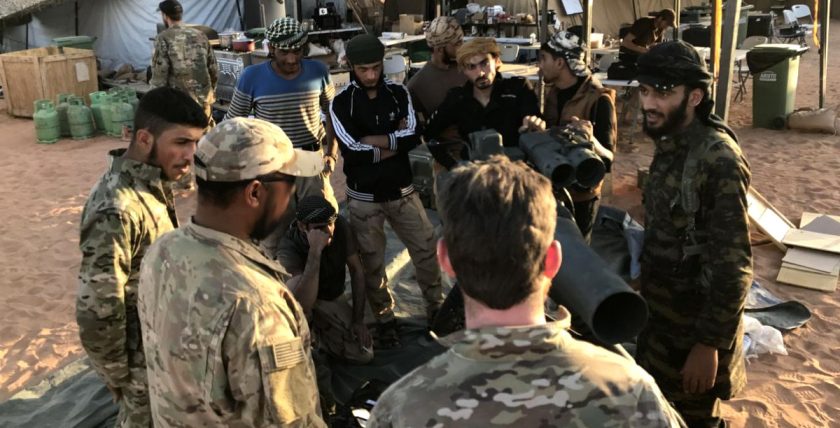
Unidentified Syrian rebels surround a piece of US weaponry during training by an American special forces member in Tanf. Photo | Hammurabi’s Justice News
With the U.S. now having claimed that Daesh has been completely defeated in Syria, the official justification for its illegal occupation of Syrian territory is wearing thin. With that justification now on shaky ground, the U.S. is increasingly having to acknowledge its main motive for its presence in al-Tanf — containing Iran and keeping Syria divided.
Indeed, a recent Reuters article notes that the U.S.-controlled area around al-Tanf that includes the Rukban camp “is designed to shield U.S. troops at the Tanf garrison and maintain for Washington a strategic foothold in an area close to a crucial supply route for Iranian weapons entering Syria from Iraq.” This was confirmed by General Joseph Votel late last year when he told NBC News that the U.S. base in al-Tanf was key in countering “the sway of Iran” in Syria.
This followed statements made last July by National Security Advisor John Bolton that U.S. troops would remain in Syria “as long as the Iranian menace continues throughout the Middle East.” This policy of Iran containment has clearly guided U.S. policy in Syria of late, with at least 1,000 U.S. troops set to stay in Syria illegally despite Daesh’s defeat and President Donald Trump’s recent calls for a troop withdrawal.
The U.S. has been accused of using the civilians trapped in Rukban as a “shield” for its continued operations in Syria aimed at containing Iran’s regional influence. Russian Foreign Minister Sergei Lavrov said earlier this month that “the fact that people are not allowed to leave [the camp] and are held hostage makes one suggest that the U.S. needs this camp to continue justifying its illegitimate presence there.” There appear to be few other explanations for the U.S.’ refusal to let camp inhabitants leave the area.
The hypocrisy of U.S. “humanitarian concerns”
The situation in the Rukban camp reveals the dark reality behind the U.S.’ occupation of Syrian territory in Al-Tanf and elsewhere. In order to pursue its policy of Iran “containment” and a divided and partitioned Syria, the U.S. is willing to imprison some 40,000 people — many of them children — in a concentration camp where international aid is blocked and where food is so scarce that mothers are setting themselves and their children on fire so they can avoid slowly starving to death.
According to the Cambridge Dictionary, a concentration camp is defined as “a place where large numbers of people are kept as prisoners in extremely bad conditions, especially for political reasons.” It is undeniable that the Rukban camp fits this definition to the letter.
That the U.S. justifies its aggressive policies around the world — from Syria to Venezuela and elsewhere — as being motivated by “humanitarian concerns” — when a refugee camp under the U.S.’ complete control in Syria is facing starvation conditions and its inhabitants are being forcefully kept confined in the camp by the U.S. military despite their expressed desire to leave — is an obscene Orwellian twist. All this to “contain” Iranian influence in the Middle East.
Whitney Webb is a MintPress News journalist based in Chile. She has contributed to several independent media outlets including Global Research, EcoWatch, the Ron Paul Institute and 21st Century Wire, among others. She has made several radio and television appearances and is the 2019 winner of the Serena Shim Award for Uncompromised Integrity in Journalism.
Featured Video

Michael von der Schulenburg: Europe’s Self-Defeating Iran War Policy
or go to
Aletho News Archives – Video-Images
Frlom the Archives
Who Rules America?
The Power Elite in the Time of Trump
By James Petras | Axis of Logic | September 6, 2017
Introduction
In the last few months, several competing political, economic and military sectors – linked to distinct ideological and ethnic groups – have clearly emerged at the centers of power.
We can identify some of the key competing and interlocking directorates of the power elite:
- Free marketers, with the ubiquitous presence of the ‘Israel First’ crowd.
- National capitalists, linked to rightwing ideologues.
- Generals, linked to the national security and the Pentagon apparatus, as well as defense industry.
- Business elites, linked to global capital.
This essay attempts to define the power wielders and evaluate their range of power and its impact. … continue
Blog Roll
 Aletho News
- Michael von der Schulenburg: Europe’s Self-Defeating Iran War Policy
- Sorry, The New Republic, Climate Change Isn’t Causing Somali Migration. Blame Civil Strife and Poverty.
- Expert Guts Claims That HPV Vaccine Reduces Cancer Risk
- No evidence Russia sabotaged Baltic cables – Finnish intel
- The Strategic Folly of a (Serious) US Ground Invasion of Iran
- US-Israeli war of aggression on Iran meant to reshape region: Omani FM
- Iran Does Not Consider Israel Party to Talks to Need Mediators With It – Ambassador
- Macron’s aircraft carrier and warplanes to the Persian Gulf is a dangerous vanity project
- Meet The Ellisons: Zionists, Technocrats, Moguls
- US failures in Iran reveal Russia is key to South Korea’s strategic security
- If Americans Knew
- Are we on the precipice of World War III?
- ‘Catastrophic,’ Says UNICEF: 1,100+ Children Killed or Wounded in Mideast Since US-Israel Launched Iran War
- The Unbelievable Madness of Our War With Iran
- World Council of Churches calls on govts to hold Israel accountable for violations of intl law
- How to end the war on Iran that costs US taxpayers $1M per minute – Not a ceasefire Day 153
- Israeli strategic plans to “remake the Middle East” from the 1950s and since
- Honoring Gaza’s women who refused to let the world look away
- 97% of victims of war on Iran are Iranian, 98% of victims in war on Gaza are Gazans – Not a ceasefire Day 152
- Early Iran strikes cost $5.6 billion in munitions, Pentagon estimates
- Israel Decided the War, But Trump’s America Fights and Pays the Bill
- No Tricks Zone
- New Studies: UK Sea Levels Were 4 Meters Higher Than Today During The Mid-Holocene
- Destructive Green New Deal: German Energy And Metal Group Warns Of Drastic Crisis
- New Study Documents A 20-Year Pause In Arctic Sea Ice Decline – Driven By Internal Variability
- Wake-up Call: Survey Shows Majority Of Germans Now Favor Postponing Climate Targets!
- Televised! Leading German Political Candidate Tells Schoolchildren CO2 Makes Sun Hotter!
- New Study: A Century Warming Of 1.1°C Is ‘Commonplace’ And ‘Not Unusual’ During This Interglacial
- New Study: ‘Internal Noise’ And Volcanic Forcing Can Trigger 10-15°C Warming Within Decades
- Glaciers Worldwide Are Suddendly Surging, Experts Blame Warming!
- Surprising Discovery: Sahara Is Greening…Billions Of Trees Where Once Thought To Be Barren
- New Research Reaffirms Clouds, Aerosols, And Surface Solar Radiation Are ‘Driving The Climate System’
 Aletho News