Gitmo Destroyed Our Constitutional Order
By Jacob G. Hornberger | FFF | April 23, 2019
Sunday’s Washington Post carried an article about the suicide of former Peruvian President Alan García, who Peruvian officials had charged with official corruption while he was in office. The article posited the possibility that García committed suicide because under Peru’s judicial system, he would have faced up to three years in pretrial detention without actually being indicted, which the Post said was “a term unthinkable in many democracies, even for suspects facing overwhelming evidence of the most heinous crimes.”
What the Post did not point out is that indefinite detention without a trial is not unthinkable in the United States. Instead, thanks to the Pentagon and the CIA, indefinite detention has now become a core feature of America’s criminal-justice system. As the Post implies, it is also a hallmark of tyranny.
Among the potential acts of tyranny with which our American ancestors were most concerned was the power of the federal government to keep people in jail indefinitely without a trial. That was why the Constitution, which called into existence a government of limited powers, did not delegate such a power to federal officials. It’s also why the American people enacted the Fifth, Sixth, and Eighth Amendments, which expressly guaranty the rights of trial by jury, a speedy and public trial, bail, and protection from cruel and unusual punishments.
The Pentagon and the CIA destroyed those rights with the establishment of their prison, torture program, and “judicial” center at Guantanamo Bay, Cuba. Today, there are people at Gitmo who have been languishing for more than a decade, denied the benefits of trial by jury, a speedy and public trial, and bail.
This shouldn’t surprise us. In the long sordid history of the U.S. national-security establishment and its infamous regime-change operations in foreign countries, it has always stood for installing dictatorships into power, preferably military ones. By their very nature, military establishments almost always lean conservative, viewing procedural protections as nothing more than “technicalities” that permit guilty people to go free. Thus, the last thing that military regimes are going to do is honor and respect the principles enunciated in the U.S. Bill of Rights.
An example was the U.S.-inspired coup in Chile in 1973, where the regime of military Gen. Augusto Pinochet had his national-security state forces round up some 50,000 people, incarcerate them, rape them, torture them, and murder or disappear around 3,000 of them. No trial by jury. No bail. Fearful of the power of the Chilean national security establishment, the Chilean federal courts went silent, as did the Chilean legislature.
The same thing happened in the CIA’s coup in Guatemala some 20 years before that. The CIA succeeded in ousting the democratically elected president of the country, Jacobo Arbenz, and installed a brutal military general in his stead, who proceeded to round up, torture, and kill people without a trial.
We saw it with Iran, when a CIA coup in 1953 ousted the democratically elected prime minister, Mohammad Mossadegh, and restored the brutal tyranny of the Shah. While the Shah wasn’t a military general, his U.S.-supported rule was every bit as tyrannical as that of any military general. Indefinite detention and torture, without the benefit of a trial, were hallmarks of his brutal rule, which came to an end in 1979 when the Iranian people revolted against it.
We see it today in the military dictatorship in Egypt. Indefinite detention and torture, without trial. All fully supported by the Pentagon, the CIA, and most of the rest of the federal government.
Therefore, it shouldn’t surprise us that the Pentagon and the CIA established this same type of system in Cuba, where the ruling leftist communist regime, ironically enough, engages in indefinite detention and torture without trial as well. In fact, don’t forget that that is why our ancestors demanded that the Bill of Rights be enacted — they were certain that federal officials would do the tyrannical acts proscribed by the Amendments. What the Pentagon and the CIA have done in Cuba is a confirmation of the concerns that motivated Americans to enact the Bill of Rights.
One irony in all this, of course, is that U.S. military officials and CIA officials take an oath to support and defend the U.S. Constitution. But it’s obvious that the oath is nothing more than a lie. After all, the reason that the Pentagon and the CIA established their prison and torture center in Cuba was precisely to avoid the provisions of the Constitution. Their very aim was to establish a Constitution-free zone, one in which they could keep people jailed forever and torture them to their heart’s content and never have to bring them to trial.
It’s a sad and pathetic legacy of the decision after World War II to convert the U.S. government from a limited-government republic to a national-security state, a type of governmental structure that is inherent to totalitarian regimes, one in which government officials wield tyrannical powers. That’s why it’s not enough to close the Pentagon’s and CIA’s imperialist prison and torture center in Cuba. To restore freedom and justice to our land, it’s also necessary to restore a limited-government republic to ensure that this type of dark tyranny never afflicts our nation again.
‘We don’t have hate for anyone’: Nigerian brothers sue Jussie Smollett’s lawyers for defamation
RT | April 23, 2019
Two Nigerian brothers who say actor Jussie Smollett paid them to beat him up as part of an elaborate hoax are suing his lawyers for defamation over allegations made about them, including that one engaged in sex acts with Smollett.
In late January, Smollett claimed he had been attacked by two masked men who made racist and homophobic slurs during the assault, and tied a rope around his neck. He also claimed they had made reference to Donald Trump’s famous slogan, ‘Make America great again’.
The incident sparked a public outcry and was investigated as a hate crime. However, Chicago police found that Smollett himself had orchestrated the attack as an elaborate hoax and indicted him for disorderly conduct for allegedly paying two men to help him stage the entire thing. The charges were dropped by Chicago prosecutors, but the FBI and Department of Justice are reviewing that decision.
Brothers Abel and Ola Osundairo are now suing Smollett’s attorneys for making what they say are defamatory statements falsely claiming the two men launched a “criminally homophobic, racist and violent attack against Mr Smollett,” their suit says.
According to the lawsuit, the actor’s lawyers suggested that the reason he initially said his ‘attackers’ were white might have been because the two men wore white makeup. Earlier this month, one of the lawyers claimed in a podcast interview that the brothers were involved in illegal steroid trafficking, and that one had engaged briefly in homosexual acts with Smollett.
Speaking to reporters on Tuesday, the Osundairo’s lawyer Gloria Schmidt said her clients deserve to have their reputations restored, and have lost work as a result of the Smollett stunt. Schmidt also said that while the pair took part in the stunt, they cooperated with police and told the truth.
In a statement, the brothers said that comments from Smollett’s lawyers “are destroying our character and our reputation and our personal and professional lives,” Fox reports. “Those who know us personally know we don’t have hate for anyone… We will no longer sit back and allow these lies to continue.” They also denied the accusations of drug trafficking and homosexuality, saying such claims put their lives in danger in Nigeria where same sex activity is illegal.
Earlier this month, Smollett was sent a $130,000 city bill to reimburse the cost of the seven-day investigation into his assault claims. The actor refused to pay, and is now facing a lawsuit from the city to recoup the costs plus damages.
Also on rt.com:
Nigerian brothers paid to beat up Jussie Smollett ‘might have worn WHITEFACE,’ lawyer says
Earth Day, 2019: Fifty Years of Apocalyptic Global Warming Predictions and Why People Believe Them, Part 1

By Peter Baggins, Ph.D. | Occidental Observer | April 19, 2019
Two of the most important problems that the so-called Green New Deal will attempt to solve at the cost of incalculable trillions are global warming and its consequences, including drought, famine, floods and massive starvation. You may recall that Obama in his 2015 State of the Union speech declared that the greatest threat facing us was neither terrorism nor ISIS. It wasn’t nuclear weapons in rogue states either. “No challenge poses a greater threat to future generations than climate change,” said Obama.
His entire administration including Vice President Joe Biden, and Secretary of State John Kerry, frequently repeated the claim that climate change was the greatest threat facing the world. It was a sentiment Obama stressed again during an Earth Day trip to the Florida Everglades where he said, “This is not a problem for another generation. It has serious implications for the way we live right now”.
More recently, presidential hopefuls like Beto O’Rourke, along with most Democrat candidates, declared their zealous support for the Green New Deal in forecasting that the world will end in 12 years if nothing is done. “This is the final chance, the scientists are absolutely unanimous on this — that we have no more than 12 years to take incredibly bold action on this crisis. Not to be melodramatic, but the future of the world depends on us right now here where we are.”
This leads to the question I pose in this brief, data-driven, essay: What kind of track record do the politicians and their experts have in their climate predictions? After all, some of these predictions were made 10, 20 or even 50 years ago. Can’t we now look back at their predictions and begin to hold them accountable?
As others have done, I have chosen to begin with the first Earth Day “Celebration” in 1970. Now who can be against Earth Day? It’s a charming idea, and I have been an enthusiastic supporter since my college days in Ann Arbor, when we celebrated the event on the campus of the University of Michigan.
Here’s what the experts were saying almost a half century ago on Earth Day, 1970:
- “Civilization will end within 15 or 30 years unless immediate action is taken against problems facing mankind.”
— Harvard biologist George Wald
- “It is already too late to avoid mass starvation,”
— Denis Hayes, Chief organizer for Earth Day
- “We are in an environmental crisis which threatens the survival of this nation, and of the world as a suitable place of human habitation.”
— Washington University biologist Barry Commoner
- “Population will inevitably and completely outstrip whatever small increases in food supplies we make. The death rate will increase until at least 100–200 million people per year will be starving to death during the next ten years. … Most of the people who are going to die in the greatest cataclysm in the history of man have already been born. … [By 1975] some experts feel that food shortages will have escalated the present level of world hunger and starvation into famines of unbelievable proportions. Other experts, more optimistic, think the ultimate food-population collision will not occur until the decade of the 1980s.
— Stanford University biologist Paul Ehrlich
- “Demographers agree almost unanimously on the following grim timetable: by 1975 widespread famines will begin in India; these will spread by 1990 to include all of India, Pakistan, China and the Near East, Africa. By the year 2000, or conceivably sooner, South and Central America will exist under famine conditions …. By the year 2000, thirty years from now, the entire world, with the exception of Western Europe, North America, and Australia, will be in famine.”
— North Texas State University professor Peter Gunter
- “In a decade, urban dwellers will have to wear gas masks to survive air pollution… by 1985 air pollution will have reduced the amount of sunlight reaching earth by one half.”
— Life magazine - “At the present rate of nitrogen buildup, it’s only a matter of time before light will be filtered out of the atmosphere and none of our land will be usable. … By the year 2000, if present trends continue, we will be using up crude oil at such a rate … that there won’t be any more crude oil. You’ll drive up to the pump and say, ‘Fill ‘er up, buddy,’ and he’ll say, ‘I am very sorry, there isn’t any. … The world has been chilling sharply for about twenty years. If present trends continue, the world will be about four degrees colder for the global mean temperature in 1990, but eleven degrees colder in the year 2000. This is about twice what it would take to put us into an ice age.”
— Kenneth Watt
Global Warming and Massive Starvation
I will focus my attention on the two most important predictions: Global Warming and Massive Starvation. If we return to the failed prediction of global cooling noted above, we can put the temperature data in a wider perspective. NASA data show that a period of warming in the 1920’s and 30’s was followed by two or three decades of cooling temperatures, from the 1940s to 1970. At that time many experts, including Carl Sagan, warned us of a possible ice age—only to have the climate change on them. From the 1970s to the late 1990s, scientists began to record slightly warmer temperatures. Curiously, as we look back at this period NASA sounded the alarm for global warming while a short time later the New York Times cited NOAA [National Oceanic and Atmospheric Administration] data showing no warming over the past 100 years in the US.
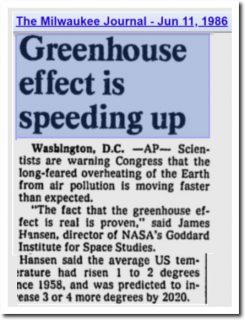
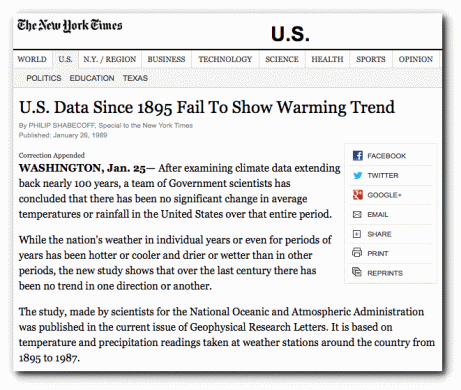
Since then, group think and political correctness, plus rewards in government grants and university promotions, have created incentives for nearly everyone to jump onto the current bandwagon of projecting an escalating warming trend. Once again we came back to the doomsday scenario that characterized 1970’s.
Then, out of the blue, the darned climate changed again. Global temperature data has been roughly flat since about 1998, even cooling by .056 degrees C from February 2016 to February 2018, according to official NASA global temperature data. Of course, this is just a two-year trend.
You may have noticed that nearly all of the doomsday theories seem to begin with the phrase, “if current trends continue.” But, as I have just reviewed, current trends don’t continue. Global temperatures go down, then up, then stay flat. Population growth tapers off, new oil reserves are discovered, agricultural yields increase at even higher rates. Doomsday forecasters always overestimate gloomy trends and underestimate human ingenuity in problem solving.
This raises the question: How would an informed citizen make sense of our current predicament?
Without question there has been an increase in carbon dioxide and other greenhouse gases released by the burning of fossil fuels and other human activities. A majority of scientists believe this to be the primary source of the global warming that has occurred.
Just how much warming has occurred?
The scientific consensus is that the average temperature of the Earth has risen about 0.4 °C over the past 100 years. This is far less than experts predicted. And therein lies the problem: scientists are better at observation than prediction.
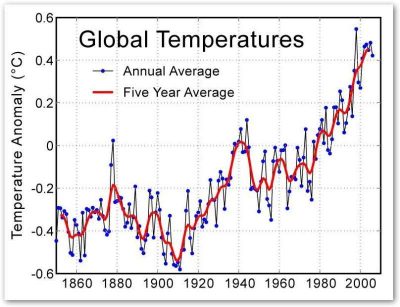
A case in point: experts from the Intergovernmental Panel on Climate carrying out global warming research have now predicted that average global temperatures could increase between 1.4 and 5.8 °C by the year 2100. Notice the nearly 5-fold difference between the conservative and more liberal (one is tempted to say “progressive”) estimates. This strikes me as akin to meteorologists predicting tomorrow’s high as somewhere between 40 and 80 degrees. Not much of a forecast if you are trying to decide whether to head to the beach or not. The confidence interval seems pretty safe, but the precision leaves much to be desired. Just how much faith should one put in such projections, given the flawed models and track record of failed predictions?
Regarding the other staggering Earth Day forecast of widespread starvation into hundreds of millions, recent satellite data from NASA and NOAA offer a compelling explanation for the spectacular failure of these predictions.
Almost half of Earth’s vegetated lands have shown significant greening over the past 35 years largely due to rising levels of atmospheric carbon dioxide, according to a recent study published in the journal Nature Climate Change. An international team of 32 authors from 24 institutions in eight countries led the effort, which involved using satellite data from NASA’s Moderate Resolution Imaging Spectrometer and the National Oceanic and Atmospheric Administration’s Advanced Very High Resolution Radiometer instruments to help determine the leaf area index, or amount of leaf cover, over the planet’s vegetated regions.
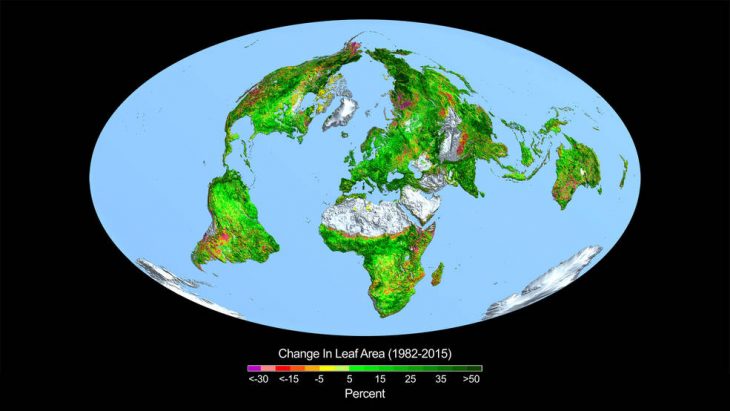
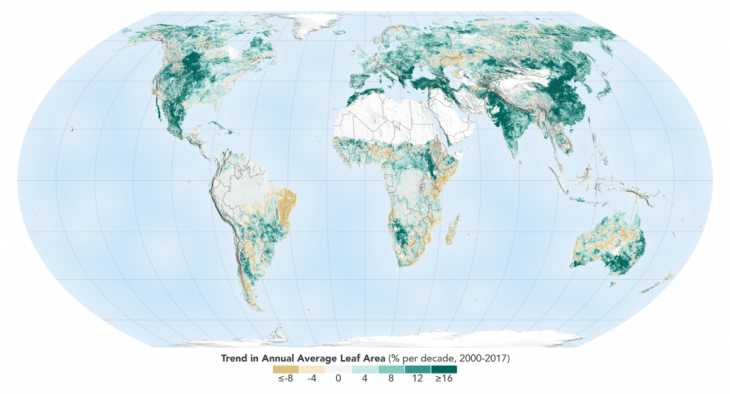
This greening represents an increase in leaves on plants and trees equivalent in area to two times the continental United States, or more than two million square miles of extra green leaf area per year, compared to the early 2000’s. That increase represents an enormous amount of food to feed a hungry planet, which is one reason the Earth Day predictions of mass starvation never materialized.
Because the mainstream media refuses to report such important data as this is from NASA and NOAA that do not support their doomsday narrative, I have never actually met anyone who knew anything about this when I mention it. I only learned about this myself a few years ago because of Matt Ridley, whose excellent blog I recommend without reserve:
You may remember from high school biology that increased concentrations of carbon dioxide increase photosynthesis, spurring plant growth. Green leaves use energy from sunlight through photosynthesis to chemically combine carbon dioxide with nitrogen drawn in from the air with water and nutrients tapped from the ground to produce sugars, which are the main source of food, fiber and fuel for life on Earth. The good news is that the impact that this greening has had in reducing hunger and starvation around the globe is undiminished, despite going unreported. When is the last time you heard a report of massive human starvation of hundreds of millions, or even tens of milions. How about 1 million … do I hear a hundred thousand, anyone? Anyone?
Fact Check: Fewer and fewer people die from climate-related naturaldisasters.
This is clearly the opposite of what you hear from the mainstream media, which loves to provide as much coverage as possible of one disaster after another. A more rational analysis would examine the average number of deaths per decade from 1920-1917. But this would show a “huuuge” decline in deaths caused by climate change, and we can’t have that now can we? The data below are from the most respected global database, the International Disaster Database.
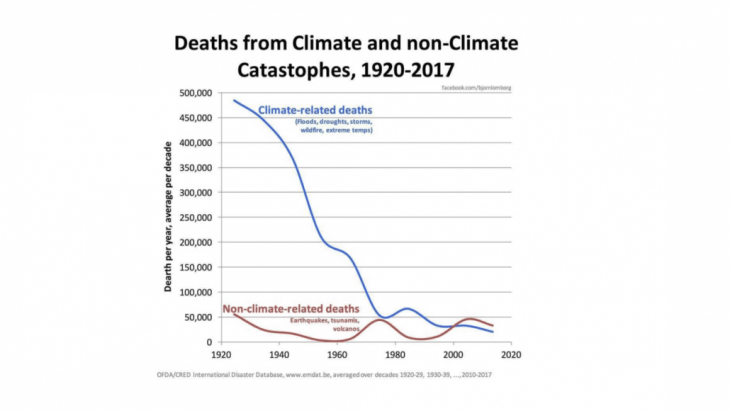
In contrast to the dire Earth Day predictions of 1970, climate-related deaths have been declining strongly for 70 years. Notice that this decline in the absolute number deaths occurred while the global population increased four-fold. Thus, the individual risk of dying from climate-related disasters has declined almost 99% from the 1920s to the present day. Our increased wealth and technological capacity to respond to natural disasters has greatly reduced our collective human climate vulnerability – Good news for rational beings, bad news for Democrat candidates.
Netanyahu ordered Trump to end sanctions waivers on Iranian oil: Analyst
Press TV – April 22, 2019
Israeli Prime Minister Benjamin Netanyahu has ordered US President Donald Trump to end exemptions from sanctions for several countries buying oil from Iran, says an American political analyst
Rodney Martin, a former congressional staffer based in Scottsdale, Arizona, made the remarks in an interview with Press TV after Netanyahu praised Trump for not renewing waivers that allowed eight countries to buy oil from Iran without getting sanctioned.
Last November, the US enforced sanctions targeting the Islamic Republic’s banking and energy sector. However, it agreed to grant waivers to China, India, Japan, Turkey, Italy, Greece, South Korea and Taiwan, allowing them to continue buying Iranian oil.
Netanyahu said on Monday that Trump’s decision “is of great importance for increasing pressure” on Iran.
The White House made the announcement earlier in the day saying “Trump has decided not to reissue Significant Reduction Exceptions (SREs) when they expire in early May.”
“This decision is intended to bring Iran’s oil exports to zero,” White House press secretary Sarah Huckabee Sanders said in a statement.
The waivers were scheduled for renewal on May 2.
“I have no doubt that Netanyahu requested if not outright ordered the US State Department via Donald Trump vie AIPAC, via Trump’s Jewish Zionist donors and supporters. And I think he ordered that this policy be implemented. So Israel and Netanyahu are very pleased,” Martin said.
“On a broader scale, it further exposes the fact that Israel has a greater network of influencers in US political system, and not Russia,” he stated.
The analyst said that it’s “a glaring example” that Israel meddles in US policy.
After Trump’s announcement, oil prices on Monday spiked to their highest levels since October. Brent crude rocketed past $74 a barrel, its highest point this year.
US Iran sanctions amount to aggression against entire world: Nasrallah
Press TV – April 22, 2019
The secretary general of the Lebanese Hezbollah resistance movement has denounced US economic sanctions against Iran, describing the punitive measures as “an act of aggression” against all world nations.
“US efforts to increase economic pressure on Iran, especially its pledge to drive the country’s oil exports to zero, will have negative repercussions and will affect the entire world, including the US itself,” Sayyed Hassan Nasrallah said as he addressed his supporters via a televised speech broadcast live from the Lebanese capital Beirut on Monday evening.
He then called on world nations to stand up against “US arrogance,” pointing out, “The tyrannical US government has no respect whatsoever for international law and regulations.”
Nasrallah also lashed out at Saudi Arabia and the United Arab Emirates for following in US footsteps and joining Washington’s economic pressure campaign against Iran.
The Hezbollah chief also roundly rejected media allegations that the Israeli regime is planning to launch a surprise war against Lebanon this summer.
“There is very little likelihood that Israel would launch another war on Lebanon. The Israeli army is not prepared for any aggression against the country. I personally don’t think such a thing would happen,” Nasrallah highlighted.
The Hezbollah chief also dismissed claims of infighting between Russian and Iranian forces in Syria’s eastern province of Dayr al-Zawr as well as the northern province of Aleppo, stating that Saudi-owned al-Arabia television news network has “disseminated such lies.”
“Saudi-backed media outlets are spreading lies and fallacies about Hezbollah, Iran and the region to a large extent,” Nasrallah said.
The Hezbollah secretary general then slammed Saudi Arabia and the UAE for spreading terrorism and chaos in countries like Yemen, Sudan and Libya.
Nasrallah also blamed Wahhabism for the emergence of regional terrorism and Takfiri terrorist groups like al-Qaeda and Daesh.
Wahhabism is the radical ideology dominating Saudi Arabia, freely preached by government-backed clerics there, and inspiring terrorists worldwide. Daesh and other Takfiri terror groups use the ideology to declare people of other faiths as “infidels” and then kill them.
“There are many agents in the Middle East, who are pushing for sectarian strife to serve the interest of the Zionist regime (of Israel). All those seeking to colonize the region will only raise public awareness,” the Hezbollah chief said.
Elsewhere in his remarks, Nasrallah touched upon the economic crisis in Lebanon, demanding greater cooperation and unity among Lebanese political factions.
“All Lebanese parties agree that Lebanon is suffering from serious financial woes. They are all involved in coping with the economic crisis. Resolving Lebanon’s problems requires patience and efforts by all political parties. Ministers affiliated to Hezbollah, lawmakers as well as specialists have already prepared a number of draft solutions for Lebanon’s economic crisis,” Nasrallah underlined.
Maximum Pressure on Iran Still Isn’t Working
By Paul R. Pillar | LobeLog | April 2, 2019
Almost a year after President Trump reneged on U.S. commitments in the Joint Comprehensive Plan of Action (JCPOA), otherwise known as the Iran nuclear deal, there is not the slightest sign that this move is achieving the declared objective of Iran crawling back to the negotiating table to negotiate a “better deal.” Tehran instead has been exuding perseverance and hardline resistance. The most recent high-level Iranian statement, a speech by Supreme Leader Ali Khamenei marking the Persian new year, was full of recalcitrance. Khamenei’s themes included self-sufficiency and boosting Iran’s defense capabilities.
It is not surprising that determined opponents of the JCPOA—the most vocal of whom are determined opponents of any agreement with Iran—have been trying hard to spin this situation to make it look as if something positive is being accomplished. Patrick Clawson of the Washington Institute for Near East Policy, for example, suggests that the new year’s speech was “not the confident Khamenei of days past” and that the speech indicated that “the Trump administration has had considerable success convincing Khamenei that the pressure will continue, and that Iran cannot count on outlasting U.S. hostility.”
It also is not surprising that when The New York Times ran a story by Ben Hubbard, reporting from Beirut, about the financial strains that Hezbollah and other Iranian clients are feeling, columnist Bret Stephens jumped into action. “Heavens to Betsy,” Stephens exclaimed in a column in the next day’s Times, arguing that this must mean President Barack Obama was wrong when he said sanctions relief “wouldn’t make much difference in terms of Iran’s capacity to make mischief in the Middle East.”
Actually, Obama was right. The fallacy that Stephens, and others who defend the Trump administration’s re-imposition of nuclear sanctions, are promoting is that making life more difficult, costly, or painful for someone else somehow advances U.S. interests—at least if the U.S. government sufficiently hates whoever that someone else is. That would be true only if schadenfreude were a U.S. national interest, which it isn’t. Pain infliction serves U.S. interests only if it changes the targeted country’s behavior in a desired direction, by either limiting its capabilities or inducing it to change its policies. Regarding Iran over the past year, this is not happening.
It’s Not All About the Money
Most of Hubbard’s article—the part Stephens doesn’t mention—describes how and why Iran and its clients are not changing their policies and operations despite the financial pinch. The reporter notes that the client groups “are relatively inexpensive, remain ideologically committed to Iran’s agenda and can promote it through local politics in ways that the United States struggles to thwart.” Many of the groups “have income streams that give them some financial independence.” That certainly is true of Lebanese Hezbollah, which also benefits from having achieved broad acceptance as a political actor. Hubbard recalls how much pushback Secretary of State Mike Pompeo received on this point when he recently met with senior Lebanese officials. Foreign Minister Gibran Basil, standing next to Pompeo at a subsequent public appearance, said, “From our side, for sure, we reiterated that Hezbollah is a Lebanese party, not terrorist. Its deputies are elected by the Lebanese people with great popular support.”
The article mentions that, to the extent Iran is scaling back militia operations in Syria, this may be due less to financial reasons than to the fact that Iran’s ally Bashar al-Assad has largely won the war. In Iraq, financial stringency has led Iran not to curtail involvement but instead to seek stronger economic ties with its next-door neighbor. Militias that Iran sponsored “are now paid by the Iraq government, giving Iran leverage in Iraqi politics at little cost to itself.”
Hubbard quotes an anonymous Hezbollah fighter as saying that a financial pinch would not push members away from the organization. “You’re not in Hezbollah for the money,” he said. Something similar could be said about Iran in the Middle East. Iran’s activity in the region is shaped not by the money but instead by Tehran’s perception of what is in Iran’s security interests.
None of this should be surprising. Hubbard notes that “recent history suggests that financial pressure on Iran does not necessarily lead to military cutbacks.” As multiple independent studies have concluded, that also is true of the recent and not-so-recent history of Iran’s overall activity in the Middle East, including activity that the United States finds objectionable.
Continued Iranian Compliance with the JCPOA
Stephens tries to milk another supposed accomplishment out of the administration’s pressure campaign by pointing to the fact that Iran is still observing its obligations under the JCPOA despite the United States having reneged on its own commitments. While acknowledging that Iran outwaiting Trump has something to do with this, Stephens also says the Iranian compliance “suggests an edge of fear in Tehran’s calculations. The U.S. can still impose a great deal more pain on the Islamic Republic if it chooses to do so.”
Reflect first on the irony of an anti-JCPOA voice like Stephens pointing to Iran’s continued rigorous observance of its obligations under the JCPOA—the terms of which Stephens and other opponents have been excoriating for three years—as a supposed accomplishment of the Trump administration’s pressure campaign. Reflect further on how much Iran’s compliance with those obligations undermines opponents’ rhetoric about how Iran supposedly has been hell-bent on getting nuclear weapons, with the JCPOA just a way-station where it gets an economic fillip. If that really were Iran’s intention all along—and given that it is not now getting the fillip—Iran would have renounced the JCPOA as soon as the United States reneged.
Think also about what sort of diplomacy Stephens’s suggestion implies: that the way to get another state to stick to agreed terms is not to stick to them oneself but instead to renege and then to threaten something worse. That would be a bizarre brand of diplomacy, to put it mildly, and one that neither the United States nor anyone else could use to get much business done.
“Tehran’s calculations” are unlikely to be anything like what Stephens suggests they are. The Trump administration, through both its actions and its rhetoric, has given Iranian leaders ample reason to conclude that the administration is determined to punish Iran as much as possible no matter what Iran does. Any hesitation within the administration not to push the sanctions pedal all the way to the metal appears to be a reaction not to Iranian restraint but instead to economic concerns about how elimination of waivers for importing Iranian oil would affect the world oil market and ultimately the price of gasoline at the pump.
Iranian Patience Not Unlimited
Iran’s continued compliance with the JCPOA despite U.S. reneging definitely involves an Iranian decision to outwait Trump. This is partly, but not solely, a matter of some Democratic presidential candidates, as Stephens correctly notes, stating their intention if elected to bring the United States back into compliance with the agreement. Iran is making its decisions about nuclear policy within a larger context in which not Iran, but instead the United States under Trump, is the isolated actor. It is not just Iran but all the non-U.S. parties to the JCPOA that are committed to its preservation. So is the larger world community, as expressed in the unanimously adopted United Nations Security Council Resolution 2231.
Iran may continue to outwait Trump, despite not getting the economic relief it bargained for, until the end of the current U.S. presidential term. Politics inside Tehran probably would make it impossible to wait any longer. This is where the 2020 U.S. presidential election comes into play. Former Deputy Secretary of State William Burns, when asked about this subject recently, replied, “My sense right now is that this Iranian regime would like to try and wait out the Trump administration. But if the president was elected to a second term, then their interest in doing that probably goes out the window.”
If that happens, the damage from the pressure campaign will not be limited to the consequences that Stephens ignores, such as how economic warfare against Iran has become economic warfare against Western allies and has contributed to the poisoning of U.S. relations with them. The damage will include a new Iranian nuclear crisis that was totally avoidable if only the administration had not embarked on its destructive course a year ago.
Why the US & Saudi Arabia fear Iran-Pakistan cooperation
© AFP / IRANIAN PRESIDENCY
By Darius Shahtahmasebi | RT | April 23, 2019
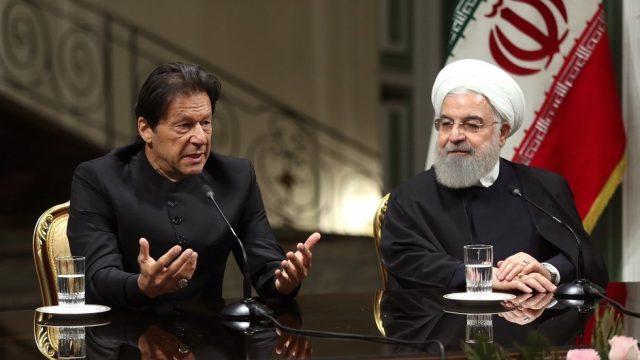
Pakistani Prime Minister Imran Khan’s visit to Tehran has been marred by two recent deadly attacks. Despite an apparent willingness to cooperate, there remain many outside players who will push for this alliance to fail.
Someone clearly hates the idea of peaceful dialogue between Iran and Pakistan. Whether a coincidence or not, the timing of an attack in Pakistan within barely a day or two of a planned visit to Iran’s capital by Pakistani Prime Minister Imran Khan is certainly perfect timing for those who view an increasing relationship between the two nations through negative terms. The attack in question saw at least 14 Pakistani security forces personnel killed in a bus ambush. Not helping the issue, is the fact that Pakistan’s foreign office instantly blamed the attack on Iran, accusing Iran of inaction against ethnic Baloch separatist groups, even as Khan was set to visit Tehran.
In February, there was similarly an attack in eastern Iran that killed at least 27 Iranian security personnel. Tehran warned Islamabad it would “pay a heavy price” for allegedly harboring the militants who planned the suicide bombing, which was claimed by the Pakistan-based Jaish al-Adl group.
Now, I am not saying that there is any conspiracy behind the attacks. I mean, why would I need to bother? Whether there are attacks or not, the media and a handful of notable leaderships will continue to portray Iran-Pakistan relations as the worst possible form of détente imaginable.
All this being said, the two countries were able to have a somewhat fruitful and productive engagement during Khan’s visit. The news that is likely to infuriate some other major players on the world stage is the announcement of a creation of a joint rapid reaction force along the shared border of Iran and Pakistan.
Ironically, the recent attacks against Iranian and Pakistani personnel may have brought these two nations closer together, as Khan announced that Pakistan will not allow any militant groups to operate from Pakistani soil, vowing to dismantle any militant group inside the country.
On a side note, WikiLeaks documents have shown that Saudi Arabia financed militant groups inside Pakistan. Even Deutsche Welle notes that most of the Pakistani based militant groups “unleashing terror” on Pakistan’s minority Shiite population “take inspiration from the hardline Saudi-Wahhabi Islamic ideology”.
Khan’s visit also magically coincided with US Secretary of State Mike Pompeo’s announcement that it was clamping down hard on countries who sought to buy Iranian oil, namely, India, Japan, South Korea, Turkey and of course, China, who account for about half of Iranian oil exports. This would undoubtedly send a clear picture to Pakistan about what will happen if it continues down its current trajectory.
Undeterred, Pakistan and Iran have agreed to establish a so-called barter committee to help in a planned increase in trade, with an eye for bypassing US-enforced sanctions.
Despite the picture the media wants to paint of a hostile Pakistan weary of an aggressive, terrorist-supporting Iran, the truth is that Iran and Pakistan are not really traditionally that adversarial.
Historically speaking, the two countries have had relatively friendly relations. Iran was one of the first countries to recognise and reach out to Pakistan after its creation in 1947. In fact, then-Shah Mohammad Reza Pahlavi was the first head of a foreign nation to visit the newly created country. Iran also provided moral and material support to Pakistan during its infamous conflicts with India in 1965 and 1971.
The countries only really split along a Sunni-Shia divide after the Islamic revolution in Iran in 1979. Aside from strengthening its relations with Saudi Arabia, Iran’s major rival, Pakistan also became a major US ally, particularly during the Afghan-Soviet war in the 1980s. Iran then viewed Pakistan as nothing but a lackey state of the United States.
Even though, Khan has made it clear that Pakistan holds no ill will to Iran following the revolution, purportedly stating that “I came here [to Iran] in 1972. I saw a big difference between the rich and the poor, a big cultural difference. Iran has become a more egalitarian society that is what the revolution has done.”
Despite the fact these two countries have many long standing differences and areas of competition, they still have many avenues of cooperation that they have felt the need to pursue.
One such avenue is the question of Afghanistan. For example, India has increased its interest in the war-ravaged nation, which puts Pakistan in a very compromising position indeed given it is essentially on the verge of a major war with its Indian neighbour.
According to Khan, both Pakistan and Iran have been affected by the conflict in Afghanistan, hosting millions of refugees between the two nations.
Iran and Pakistan have also been in the line of fire of Donald Trump’s hawkish administration. While Trump’s desire to annihilate Tehran is much more apparent than any such desire to go to war with Pakistan, we cannot ignore the major blows to US-Pakistan relations that have occurred under the watch of Trump.
The two nations further share close relations with China, the formulation of which has been termed as a trilateral nexus by the Asia Times. Pakistan and Iran also have a pipeline of their own capability of pursuing, which will most likely entail the deepening of cooperation even in spite of their major differences.
Another interesting aspect that comes into play in this dynamic – which I guarantee you, you will never see highlighted in a corporate media outlet – is that Iranian President Rouhani actually enjoys the support of the local ethnic Sunni population of Iran. Therefore, it is not beyond the administration of Rouhani to work more closely with its predominantly Sunni neighbours (if you don’t believe me, I wrote an extensive article highlighting the notable attempts by Iran to reach out to Sunni Saudi Arabia over the last few years).
The major problem that Pakistan faces is that while it can find common ground with Iran, including on matters in relation to economic ties and security, it does not want to irk Saudi Arabia too much, a nation which just pledged $20 billion in investments to Pakistan. Islamabad is likewise not impressed by Iran’s growing relationship with India. This is why Pakistan put itself in a questionable position whereby its former Chief of Army staff was appointed to what is essentially the head of a Saudi-led Arab NATO, which does not include Iran (indeed, it seems as though its existence is based on the idea that it needs to counter Iran).
At the end of the day, the optimist in me reckons that there are enough areas of cooperation between the two countries which can help to balance out the devastating rivalries between Iran and Saudi Arabia and prevent a deadly war. But in all honesty, if you were to compare the outcomes between Saudi Crown Prince Mohammed bin Salman’s (MBS) visit to Pakistan and Khan’s visit to Tehran, the latter seems a bit weak in substance. It seems as though no matter how far Iran reaches its hand out to Pakistan, its loyalty to Saudi Arabia will continue to prevail ($20 billion will always be worth more than anything Iran can ever offer to its neighbour). Not to mention the money that Pakistan is offered from the United Arab Emirates (UAE), which also views Tehran mostly in hostile terms.
Perhaps Khan can act as a mediator between Iran and Saudi Arabia, but the available evidence suggests there is nothing to mediate. Since 2015, Saudi Arabia has destroyed an entire country on its border simply on the suspicion that Iran could be backing the rebel movement inside Yemen. Even the possibility that a rebel-controlled government installed on its border could align itself with Tehran is a major deal-breaker for the Saudi Kingdom, worth starving over 85,000 children to death and threatening behind closed doors that Yemen should “shiver” for generations when they hear Saudi Arabia uttered.
The optimist in me is going to have to be a bit more realistic.
Read more:
Iranian President Rouhani declares joint border ‘reaction force’ with Pakistan
What you won’t hear from US govt: Iran is open to working with Saudi Arabia
India sponsoring terror activities in Balochistan: Pakistan FM
The Frontier Post | April 23, 2019
ISLAMABAD – Foreign Minister Shah Mahmood Qureshi has said that India is trying to destabilize Pakistan and sponsoring the terror activities in Balochistan.
FM Qureshi said this on Tuesday while talking to a private news channel; Qureshi said that India is behind the terror activities in Balochistan province.
Regarding the Ormara terror incident, he said that Pakistan has already shared the details of the incident with Iranian authorities, adding that Afghanistan and Iranian territories are being used for carrying out terror acts in Pakistan.
He said Pakistan is helping Iran in recovering their kidnapped border guard personnel.
Qureshi repeated Pakistan’s resolve to have a stable and peaceful border with its neighboring countries, including Iran, to check cross border terrorism.
Earlier on Monday, Prime Minister Imran Khan reiterated his resolve not to allow any militant group to use Pakistani soil against anyone.
Addressing a joint press conference along with Iranian President Hassan Rouhani, the prime minister had said, Islamabad is taking decisive action against the militant groups.
The premier had said we will not allow Iran to be harmed from Pakistani soil and hopes to ensure the same from Iran.
It may be noted that Pakistan and Iran have also agreed to set up a Joint Rapid Reaction Force to guard the common borders.
British Think Tank Reportedly Offered to Spy on Right-Wing Swedish Politicians
Sputnik – April 23, 2019
Not only has the Institute for Strategic Dialogue smeared a senior Sweden Democrat as a “far-right extremist”, it also offered the Swedish authorities its help in gathering data on him and his associates abroad through “investigative work”.
The Institute for Strategic Dialogue (ISD), a British think tank which had previously called for financial sanctions against Sweden’s alternative media, also offered the Swedish Civil Contingencies Agency (MSB) the ability to spy on Sweden’s right-wing politicians, the news outlet Samhällsnytt reported.
Samhällsnytt has gained access to an e-mail from the organisation’s researcher Chloe Colliver, who claimed to have “uncovered links” between the Swedish right-wingers, influencers she labelled “far right” and Hungary, naming anti-immigrant Sweden Democrat Kent Ekeroth as “the most obvious example”.
“To uncover more about these links, we would have had to engage in more offline, investigative journalism work. <…> I believe there would be lots more to uncover in terms of offline links, support and financial backing connecting Hungarian and Swedish far right movements. It was not something we were able to cover ourselves in any detail, but many journalists have started to see a real infrastructure of support built in Hungary to support these kind of international movements, both in elections and outside of elections. Let me know if I can provide any more information on that,” Chloe Colliver wrote, as quoted by Samhällsnytt.
This e-mail, the news outlet claims, is part of a longer correspondence between Colliver and a Swedish MSB official. A few days later, MSB published a report by ISD which proposed sanctions against alternative media outlets which offer substantiated criticism of immigration, such as Samhällsnytt, Fria Tider and Nyheter Idag.
Kent Ekeroth represented the Sweden Democrats in the Swedish parliament between 2010 and 2018, and profiled himself as a staunch opponent of Islam and immigration. During his time as an MP, Ekeroth supported the deportation of criminal immigrants, an idea that has since been adopted by the more radical Alternative for Sweden, which openly markets itself as a “repatriation party”. Ekeroth has since moved to the Hungarian capital Budapest.
“It is extremely serious when authorities receive offers to spy on Swedish politicians abroad. Colliver mentions ‘investigative journalism’ in her email, but she is not a journalist and her organisation is not part of the press. Therefore, it is crystal clear what this is about, political espionage against the opposition under the auspices of MSB. The fact that she repeatedly refers to Swedish politicians as ‘extreme right’ in the e-mail shows that this is an accepted way of communicating with MSB” Kent Ekeroth told Samhällsnytt.
The Institute for Strategic Dialogue is a London-based organisation which bills itself as a “think and do tank” poised to tackle the “rising challenges of violent extremism, inter-communal conflict and polarisation” and “empower grassroots networks against hate and extremism”.
MSB is a Swedish state authority that belongs to the Justice Ministry with responsibility for emergency preparedness and civil defence.
The Sweden Democrats are the country’s largest right-wing party, which despite its substantial electoral successes hasn’t been able to elevate any of its MPs to a cabinet-level post due to other parties collaborating to edge it out by forming a “cordon sanitaire”.
READ MORE:
70% of Swedes Lose Confidence in Politicians Amid Weakest Gov’t in Decades
Outrage as Swedish Greens Blame Swedes for Migrants’ Crime, Failure to Integrate
Featured Video

Michael von der Schulenburg: Europe’s Self-Defeating Iran War Policy
or go to
Aletho News Archives – Video-Images
Frlom the Archives
Who Rules America?
The Power Elite in the Time of Trump
By James Petras | Axis of Logic | September 6, 2017
Introduction
In the last few months, several competing political, economic and military sectors – linked to distinct ideological and ethnic groups – have clearly emerged at the centers of power.
We can identify some of the key competing and interlocking directorates of the power elite:
- Free marketers, with the ubiquitous presence of the ‘Israel First’ crowd.
- National capitalists, linked to rightwing ideologues.
- Generals, linked to the national security and the Pentagon apparatus, as well as defense industry.
- Business elites, linked to global capital.
This essay attempts to define the power wielders and evaluate their range of power and its impact. … continue
Blog Roll
 Aletho News
- Michael von der Schulenburg: Europe’s Self-Defeating Iran War Policy
- Sorry, The New Republic, Climate Change Isn’t Causing Somali Migration. Blame Civil Strife and Poverty.
- Expert Guts Claims That HPV Vaccine Reduces Cancer Risk
- No evidence Russia sabotaged Baltic cables – Finnish intel
- The Strategic Folly of a (Serious) US Ground Invasion of Iran
- US-Israeli war of aggression on Iran meant to reshape region: Omani FM
- Iran Does Not Consider Israel Party to Talks to Need Mediators With It – Ambassador
- Macron’s aircraft carrier and warplanes to the Persian Gulf is a dangerous vanity project
- Meet The Ellisons: Zionists, Technocrats, Moguls
- US failures in Iran reveal Russia is key to South Korea’s strategic security
- If Americans Knew
- Are we on the precipice of World War III?
- ‘Catastrophic,’ Says UNICEF: 1,100+ Children Killed or Wounded in Mideast Since US-Israel Launched Iran War
- The Unbelievable Madness of Our War With Iran
- World Council of Churches calls on govts to hold Israel accountable for violations of intl law
- How to end the war on Iran that costs US taxpayers $1M per minute – Not a ceasefire Day 153
- Israeli strategic plans to “remake the Middle East” from the 1950s and since
- Honoring Gaza’s women who refused to let the world look away
- 97% of victims of war on Iran are Iranian, 98% of victims in war on Gaza are Gazans – Not a ceasefire Day 152
- Early Iran strikes cost $5.6 billion in munitions, Pentagon estimates
- Israel Decided the War, But Trump’s America Fights and Pays the Bill
- No Tricks Zone
- Destructive Green New Deal: German Energy And Metal Group Warns Of Drastic Crisis
- New Study Documents A 20-Year Pause In Arctic Sea Ice Decline – Driven By Internal Variability
- Wake-up Call: Survey Shows Majority Of Germans Now Favor Postponing Climate Targets!
- Televised! Leading German Political Candidate Tells Schoolchildren CO2 Makes Sun Hotter!
- New Study: A Century Warming Of 1.1°C Is ‘Commonplace’ And ‘Not Unusual’ During This Interglacial
- New Study: ‘Internal Noise’ And Volcanic Forcing Can Trigger 10-15°C Warming Within Decades
- Glaciers Worldwide Are Suddendly Surging, Experts Blame Warming!
- Surprising Discovery: Sahara Is Greening…Billions Of Trees Where Once Thought To Be Barren
- New Research Reaffirms Clouds, Aerosols, And Surface Solar Radiation Are ‘Driving The Climate System’
- Germany: Electric Car Catches Fire At Charging Station, Sets Off Local “Inferno”, Widespread Damage
 Aletho News