Hamas: New Fatah government “separatist and unconstitutional”
Palestine Information Center – April 14, 2019
GAZA – The Hamas Movement has described the formation of a new Fatah-dominated government as “persistence in monopolizing power and excluding other political forces,” saying it will deepen the national division.
In a press release on Saturday, Hamas said the government of Mohamed Shtayyeh would work on fulfilling the desires of Fatah and Mahmoud Abbas at the expense of the Palestinian people’s interests, unity, struggle and sacrifices.
Hamas also described the government of Shtayyeh as “a separatist body that lacks constitutional and national legitimacy.”
The Movement warned that the new government would increase the chances of separating the West Bank from Gaza as a practical step towards executing the deal of the century.
How the U.S. Navy Sold the Vietnam War

Dr. Tom Dooley. (YouTube screen shot)
By Gareth Porter | TruthDig | March 27, 2019
Dr. Tom Dooley, whose best-selling book “Deliver Us From Evil” helped create a favorable climate of opinion for U.S. intervention in South Vietnam, has long been linked to legendary CIA officer Edward G. Lansdale and his black operations in Vietnam between 1954 and 1955. But the real story about Dooley’s influential book, which has finally emerged from more recent scholarly research, is that it was engineered by an official of the U.S. Navy’s Pacific Command, Capt. William Lederer.
Lederer is best known as the co-author, with Eugene Burdick, of the 1958 novel “The Ugly American,” which was turned into a 1963 movie starring Marlon Brando. Far more important, however, is the fact that from 1951 through 1957 Capt. Lederer was on the staff of the commander in chief of the U.S. Pacific Fleet (CINCPAC), Adm. Felix Stump.
The Pacific Command was intensely interested in Dooley, because the U.S. Navy had the greatest stake of all the military services in the outcome of the conflict between the communists and U.S.-backed anti-communist regimes in Vietnam and China during the mid-1950s. And the Pacific Command was directly involved in the military planning for war in both cases.
Adm. Arthur Radford, the former CINCPAC and then chairman of the Joint Chiefs of Staff, led the senior officials pressing President Dwight D. Eisenhower to approve a massive U.S. airstrike against the Viet Minh at Dien Bien Phu in April 1954. And between 1954 and 1955, Adm. Stump called for increasing the size of the Nationalist Chinese raids on the Chinese mainland from offshore islands. He also pushed for a U.S. attack on the mainland, including the use of nuclear weapons, if necessary, to defend those same offshore islands.
Capt. Lederer met Dooley in Haiphong, Vietnam, in 1954 after the Navy launched “Operation Passage to Freedom” to help transport more than 300,000 Vietnamese civilians, soldiers and members of the French Army from the French-controlled North to Saigon. A CIA psychological warfare team led by Lansdale had slipped into Hanoi and Haiphong to sabotage the Ho Chi Minh government takeover and to spread propaganda to provoke fear among Catholics and other residents.
The key tactic of the Lansdale team was to print a series of “black propaganda” leaflets—designed to appear as though they came from the Viet Minh—to frighten residents of the North into leaving for South Vietnam. The most dramatic such deception involved spreading the rumor that the U.S. military was going to bomb Hanoi, a story that was further promoted by leaflets showing concentric circles of destruction of the city by an atomic bomb.
Lt. Tom Dooley, a young Irish Catholic Navy doctor, was “loaned” by the U.S. Navy to Lansdale for the operation, although Dooley apparently thought the team’s function was to gather intelligence. Dooley’s job was ostensibly to manage medical supplies needed for the movement of North Vietnamese to the South, but in fact Dooley functioned as the team’s propagandist, briefing visiting news media and sending out out reports through Catholic media in the United States that supported the CIA’s anti-Viet Minh mission.
Lederer quickly recognized Dooley as a potentially valuable propaganda asset because of his connection with Vietnamese Catholics and his penchant for telling tales of Viet Minh atrocities. It was Lederer who suggested that Dooley write a book about his experiences with North Vietnamese refugees who wanted to move to the South. The Navy gave him a leave of absence to write it, and Lederer became Dooley’s handler for the project. Dooley was a charismatic public speaker but needed Lederer’s help with writing. Lederer also introduced Dooley to Reader’s Digest—by far the most popular magazine in America, with 20 million readers. Chief of Naval Operations Arleigh Burke officially embraced the book and even wrote the introduction to it.
Reader’s Digest published a highly condensed 27-page version of the book in its April 1956 edition, and Farrar, Straus and Cudahy immediately published the full-length version. It became a runaway bestseller, going through twelve printings.
The constantly reiterated theme of Dooley’s book “Deliver Us From Evil” was that the Ho Chi Minh government was determined to suppress the Catholic faith in Vietnam and used torture and other atrocities to terrorize Catholics into submission. That was a grotesque distortion of actual Viet Minh policy. The Ho Chi Minh government had worked hard from the beginning of the war to ensure that there was no interference with Catholics’ exercise of their faith, even establishing severe legal penalties on any infringement of that freedom.
But Dooley’s book was full of lurid descriptions of North Vietnamese Communist atrocities against Catholics that Dooley claimed to have known about from treating the victims. It told of the Viet Minh having partially torn off the ears of several teenagers with pliers and left them dangling—supposedly as punishment for their having listened to the Lord’s Prayer.
And he described the Viet Minh taking seven youths out of their classroom and forcing wooden chopsticks through their eardrums. The children, he wrote, had been accused of “treason” for having attended a religious class at night. As for the teacher, Dooley claimed the Viet Minh had used pliers to pull out his tongue, as punishment for having taught the religious class.
But it was widely recognized within the U.S. government that these stories were false. Six U.S. Information Agency officials who had been in North Vietnam during that period, as well as former Navy corpsmen who had worked in the Haiphong camp with Dooley, all said they had never heard of any such events. And in 1992 Lederer himself, who had made 25 fact-finding trips to Vietnam since 1951, told an interviewer, “[T]hose things never happened. … I traveled all over the country and never saw anything like them.”
Many years later, in an interview with scholar Edward Palm, Lederer disclaimed any significant influence on the content or tone of Dooley’s book, even though Dooley had credited Lederer with helping put the book in final form. Lederer also told Palm he didn’t remember any such stories appearing in the first draft of the book he read.
But Palm, who obtained the first draft of the manuscript from Dooley’s papers, confirmed to this writer that the first draft did contain those stories of atrocities. And Palm’s monograph documented the fact that the last draft chapter was dated the end of July 1955 and that communications from both men at the time indicated that Lederer had met repeatedly with Dooley during June and July to help him finish the draft.
Palm also quoted from Dooley’s first draft to show that it concluded with a call for Americans to be ready for a U.S. war against communism. If negotiations with the Soviet Union failed to bring “lasting peace,” Dooley’s draft warned, “Communism will have to be fought with arms … it must be annihilated….” Dooley concluded, “[T]here can be no concessions, no compromise and no coexistence.”
Palm pointed out that the published version of the book dropped that rabidly warlike rhetoric and instead introduced a new character named “Ensign Potts” to represent the view that America must be ready to fight a war to destroy communism. The role of the “Potts” character was to be converted to Dooley’s argument that service to the ordinary Vietnamese would be the most effective way to prevail in the Cold War—after Dooley’s tearful recounting of the story of the Viet Minh puncturing the Catholic youths’ ears with chopsticks, reduced “Potts” to tears as well.
Lederer and Burdick popularized the idea that personal kindness to the people of Southeast Asia from American could help defeat Communism in “The Ugly American” and that same idea infused Lederer’s own March 1955 Reader’s Digest article on the interactions between U.S. sailors and Vietnamese aboard a U.S. Navy ship. Lederer told Palm in a 1996 interview that he had suggested that Dooley model his book on that article.
Palm wrote that he didn’t believes Lederer’s personal preference was to promote a U.S. war in Vietnam. But Lederer had obviously approved Dooley’s portrayal of the Vietnamese Communists as an alien horde terrorizing the Catholics. Catholics were the fastest-growing religious denomination in America from 1940 to 1960, during which time their numbers doubled, and Dooley’s message was an obvious way of mobilizing American Catholics to support Adm. Stump and the Navy’s agenda for Vietnam.
Marine Lt. Col. William Corson, who was detailed to the CIA during much of his career and knew Dooley during the writing of his book, told fellow former Marine Edward Palm in a 1997 telephone interview, “Dooley was programmed toward a particular end.” He did not say specifically what that end was, but he appeared to mean building popular support for U.S. intervention in Vietnam.
While on a nationwide book tour, Dooley was one of the featured speakers at the first conference of The American Friends of Vietnam—later known as the “Vietnam Lobby”—in Washington, D.C., on June 1, 1956. The meeting was held at a crucial moment in U.S. Vietnam policy. Eisenhower was still supporting the election for a government throughout Vietnam as called for by the 1954 Geneva Agreement, with strict conditions for a free vote. Meanwhile, hardliners in the administration were pushing for opposing that election outright on the ground that Ho Chi Minh would certainly win it, regardless of conditions.
Dooley’s contribution was to describe “Communism” as an “evil, driving, malicious ogre” and recount the “hideous atrocities that we witnessed in our camps every single day.” And he retold the story of the Viet Minh punishing the schoolchildren by puncturing their eardrums.
A few weeks after the meeting, Eisenhower reversed his previous position of supporting the all-Vietnamese Vietnamese, opening the path to deeper U.S. political and military intervention in Vietnam.
Dooley had just learned that his secret life as a gay man in the Navy had been discovered by Naval intelligence, and he was forced to quietly resign. At Lansdale’s suggestion, Leo Cherne of the International Rescue Committee helped Dooley establish a primitive medical clinic near the Chinese border in northern Laos. But Dooley had to agree to cooperate with CIA in Laos by allowing it to smuggle arms into the site of the clinic to eventually be distributed to local anti-Communist militiamen.
The Dooley Clinic in Laos helped make him a hugely popular celebrity, with two more best-selling books, feature stories in popular magazines and network television appearances. By the time Dooley died of cancer in 1961, a Gallup Poll found that Americans viewed him as the third most admired person in the world, after Eisenhower and the pope. But his role in the larger tragedy of U.S. war in Indochina was to serve as the instrument of a highly successful campaign by the U.S. Navy to create the first false propaganda narrative of the conflict—one that has endured for most of Dooley’s fans for decades.
But Dooley’s popularity and saintly image increased the power of his tales of Viet Minh atrocities against Catholics that represented the first major false U.S. propaganda narrative of the Vietnam conflict—one that helped build public support for the U.S. military intervention in Vietnam that began under President John F Kennedy in 1962.
Gradually Re-establishing Historical Truth about Jeju Uprising
By Konstantin Asmolov – New Eastern Outlook – 14.04.2019
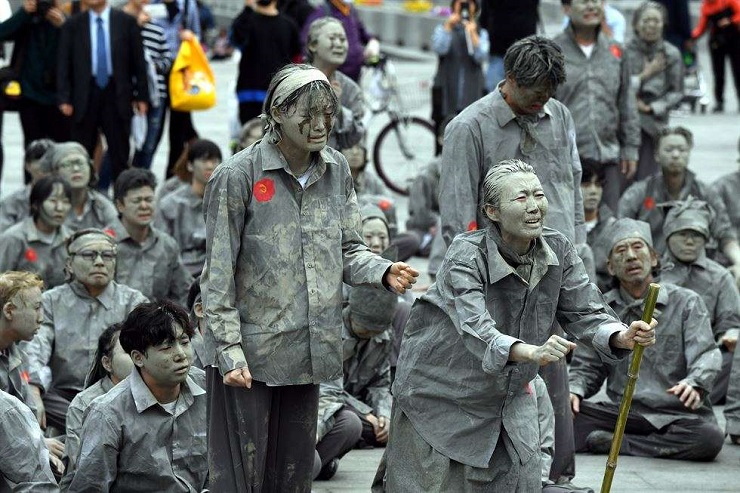
On 3 April, 2019 a commemoration ceremony to honor victims of a bloody suppression by government forces of the people’s uprising in 1948-1954 was held on the island of Jeju. More than 10,000 people, including representatives of the government and the National Assembly, revolt participants and offspring of the victims of its clampdown, took part in the memorial. South Korea’s Prime Minister, Lee Nak-yeon, gave a speech at the ceremony. He proposed to honor the memory of all those lost and expressed his deepest condolences to their families. The minister also referred to the incident in Jeju as the worst event in South Korea’s modern history. Lee Nak-yeon emphasized that Moon Jae-in’s administration has undertaken the monumental task of uncovering the truth behind the Jeju massacre, and of restoring the victims’ dignity.
The head of South Korea’s National Police Agency, Min Gap-Ryong, participated in a commemoration ceremony in Seoul. He wrote the following words in the visitor’s book: “I humbly share my condolences before the spirits of all those innocent people who were killed during Jeju April 3, and I respectfully share my wishes that they rest in peace.” Vice Minister of National Defense Seo Joo-seok, who made the aforementioned statement, was also in attendance. He highlighted that the army was fully committed “to the government investigation efforts going forward” and would “take part in healing the wounds and suffering of the family members while restoring the honor of those who were slain”. This was the first comment about the incident made by a South Korean military agency.
Officially, at least 10,000 Jeju residents were killed and almost 3,600 went missing, as a result of the tragedy that stemmed from Korea’s ideological split following its emancipation from Japanese colonial rule, which lasted from 1910 to 1945. In reality, the situation was even more complex. Propaganda from both North and South Koreas portray the uprising as a communist revolt against elections, which were to take place in the South on dividing the peninsula. However, in reality, the uprising was instigated by actions of the police and agitators from so-called “youth groups”, who used racketeering and violence to bring the region, with a powerful left-wing movement, under control.
South Korea’s current strategic policy has its origins at the start of the rebellion, 1 March 1947, when a child who suffered a blow from a police horse’s hoof died during a street protest in celebration of May Day. This led to a confrontation with the police and the crowd was fired on. In response, the Workers’ Party of South Korea declared a general strike. Instead of calming people down, the government made a decision to destroy the left-wing forces once and for all, which led to an even tougher response from the people.
On 3 April 1948, more than 350 armed civilians simultaneously attacked 12 police precincts and homes of representatives of legislative bodies, in order to free detained relatives and force the government to reconsider its policy. The leadership reacted even more violently in turn. Death squads mercilessly dealt with protesters and local residents who helped them. On 17 October 1948, a ban on movement in inner and mountainous regions of the island, with the exception of its 5-km coast line, was introduced. All the villages outside this perimeter were completely destroyed and so were their residents if they refused to leave these territories. 2,500 islanders were imprisoned although there were no charges against them or any written verdicts.
The bloodshed continued during the Korean War too. The truth is, however, in 1953 armed units had only approximately 60 people in them, and by the beginning of 1954, this number decreased to 5. 21 September 1954 is viewed as the last day of the uprising, when the ban on movement was finally lifted. The last guerrilla member was arrested on 2 April 1957.
Since a substantial portion of the population was massacred, and their bodies were often submerged or burned, the number of estimated victims ranges from 14,000 to 30,000 people. And if those who were indirectly affected by the government’s crackdown (i.e. victims of hunger or subsequent social cleansing) are added to the total, the number is even higher. Incidentally, only 14% of protesters were killed.
For decades after the uprising, memories of this event and the atrocities committed during the rule of Syngman Rhee were hidden from the public by means of censorship and repression. And only on 12 January 2000, a Special Act was decreed, in accordance with which a truth committee was established to investigate the Jeju massacre and to exonerate its victims. Approximately 14,000 people applied to have the status of a victim of those events. On 28 August of the same year, the special committee for investigating causes of death of the residents and their exoneration began their work.
In 2006, Roh Moo-hyun’s government issued an official apology for its role in the massacre. The leadership also promised reparations for the victims, but by the end of 2018 nothing had been done to this end.
On the plus side, a lot of work is being done to clear the good name of people, who, during the uprising, were preemptively jailed and tortured, without a single charge brought against them. Those who were released had to live under the umbrella of suspicion. And, finally, in January 2019, the Jeju District Court dismissed military court’s rulings with regard to the 18 plaintiffs, who survived, and recognized them as victims instead. The accusations levelled against them were deemed unsubstantiated since the military court did not follow prescribed legal procedures. This conclusion, in the opinion of those who issued the verdict, is supported by the fact that the plaintiffs were not aware of the criminal charges against them. Also the sheer number of people brought before the military courts-martial within a short period of time indicated relevant investigations were unlikely to have been carried out.
The plaintiffs demanded that their cases be reviewed as far back as 2017, as they claimed to have been arrested and jailed for a period of up to 20 years without as much as a fair trial. Since that time not a single court record has been found to indicate why the plaintiffs received such harsh sentences. Even after researchers had travelled to the peninsula and accessed central archives, they were unable to find any existing records about the investigation at that time. It turns out that people were detained and tortured without being charged for any crimes , which is consistent with the practice of preemptive arrests.
The court decided to retry the case in September 2018 due to renewed interest in the incident following the commemoration of its 70th anniversary and the official apology issued by President Moon Jae-in.
A few months later, on 17 January 2019, the Jeju court exonerated all the participants of the people’s uprising on 3 April 1948, who had served the sentences handed down to them by the military courts-martial.
This policy, exercised by Moon Jae-in’s government towards residents of Jeju, is part of a common trend. As part of this new shift, “a former police investigation building in Namyeong-dong, Seoul”, where intelligence agents “tortured hundreds of pro-democracy” and anti-government “activists in the 1970s and 1980s, has been turned into a memorial hall for human rights and democracy.” The Ministry of the Interior and Safety plans to outsource the building’s “operation to the Korea Democracy Foundation”. Prime Minister Lee Nak-yon participated in the transfer ceremony, along with Minister of the Interior and Safety Kim Boo-kyum; Seoul Mayor Park Won-soon; Commissioner General of the Korean National Police Agency Min Gap-Ryong, and victims of torture and their family members.
In 1976, the anti-communism investigation division office was located where the current facility stands now. During both the Park Chung-hee and Chun Doo-hwan administrations, the building was used to detain, interrogate and torture anti-government activists. Over a period of approximately 30 years, a combined total of 391 activists were tortured there. Their ranks included Seoul National University student Park Jong-chul, whose death resulted in mass protests that led to the fall of the Fifth Republic of South Korea.
In response to criticism, in 2005 the National Police Agency closed the Namyeong-dong division and transformed it into a human rights police center. However, civic groups demanded that the police stop operating this facility. This process began in earnest in June 2018, when Moon Jae-in promised to convert the building into a memorial for human rights and democracy.
In his speech, Prime Minister Lee Nak-yon said that Namyeong-dong “will forever contribute to the people and history as a place to warn against the state’s abuse of power”.
A similar policy is being used with respect to persecuted members of the Bodo League. This political organization was comprised of “re-educated” left-wing activists. But once the Korean War began, most of its members were subject to repression (as a preventative measure), and the majority were executed by firing squads. Groups, such as the Korean War Bereaved Family Members’ Association, claim that after this war 200,000 members of the League were killed throughout the country.
Numerous testimonies from family members of victims paint a grim picture: activists were gathered together under the pretense of going on an excursion to the mountains or to a ceremony. They were then transported out of town or city, executed by a firing squad and buried in unmarked graves.
Only in June 2014, did a number of residents gather enough courage to corroborate evidence of a civilian massacre, which local witnesses remembered. They carried out an excavation and unearthed burial sites, but there have not been any official exhumations so far.
On 22 June 2016, a testimony by prosecutor Song Jung-won (1918-2014), who is viewed as the founder of the Bodo League, became public knowledge. On 18 October 2007, he testified in front of the Truth and Reconciliation Commission and said that many members of the League were not partisans and, in fact, did not even know what a communist party was. As a rule, these were simple peasants or intellectuals, who wished to expunge the “Red Menace” label from their family name.
Civilian activists think this testimony may be viewed as proof of the fact that the government massacred countless numbers of innocent people knowing full well that they were not members of the Communist Party.
In addition, as far back as 2009, the Truth and Reconciliation Commission confirmed mass killings of at least 3,400 civilians and inmates held in prisons in Busan, Masan and Jinju from July to September 1950. Jail employees, police officers and members of counterintelligence services took part in these reprisals. Victims were either killed inside prisons or taken to the mountains, executed, and their bodies were disposed of in the sea. Only in a few cases were executions carried out after an official sentence was handed down by a military tribunal. Incidentally, most of these victims were prisoners sentenced to less than three years in jail, and they were killed only because of concerns that they would collaborate with DPRC.
Most investigations of this nature were conducted in the course of the work performed by the Truth and Reconciliation Commission. It was established in December 2005 and tasked with researching information connected with the anti-Japanese independence movement; mass killings of civilians during the Korean War, and violation of human rights by government forces during the military dictatorship. During a fairly short 5-year period, the commission uncovered the truth about 8,468 cases by concluding that extrajudicial massacres had taken place during the Korean War and earlier. In addition, the commission ascertained that evidence in a number of espionage cases from the 1980s was either distorted or completely fabricated.
However, during Lee Myung-bak’s presidency the work conducted by the Truth and Reconciliation Commission was discontinued. The final report highlighted the fact that both sides were responsible for atrocities, but failed to mention the fact that there were twice as many victims of the “White Terror”, and many culprits were absolved of responsibility. “As a result, true reconciliation and reckoning with the past ended up being put off until another day.”
And now, possibly, this day has arrived. Although old political myths often have a tendency to transform into new ones during Moon Jae-in’s presidency, hope remains that the final picture will be an accurate reflection of the historical truth.
Konstantin Asmolov, Ph.D. in History, is a leading research fellow at the Center for Korean Studies of the Institute of the Far East at the Russian Academy of Sciences.
Zarif Slams EU over Not Fulfilling Nuclear Deal Commitments
Iranian Foreign Minister Mohamamd Zarif
Al-Manar | April 14, 2019
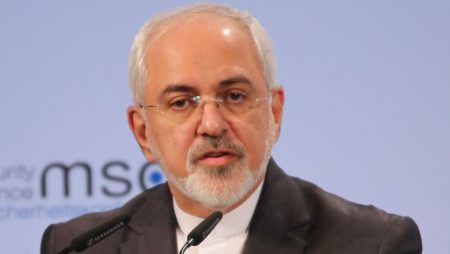
Iran’s Foreign Minister Mohamamd Javad Zarif slammed the EU on Sunday over delays in the implementation of the new mechanism for non-dollar trade with the Islamic Republic.
In comments on Sunday, the top Iranian diplomat deplored the European signatories to the 2015 Iran nuclear deal for failing to fulfill their commitments under the agreement, saying it is long overdue.
The Europeans are far behind on fulfilling their commitments under the Joint Comprehensive Plan of Action (JCPOA), Zarif said, adding: “They (EU) should not assume that the Islamic Republic of Iran will be waiting for them.”
Describing INSTEX -a payment channel that the three EU signatories to the JCPOA have set up to maintain trade with Iran- as a preliminary measure, Zarif said the Europeans need to work hard for a long time to honor their commitments.
The Iranian minister further noted that Iran has maintained close ties with its neighbors and has launched mechanisms similar to the INSTEX with many other countries.
“While the European countries have proposed INSTEX to maintain business ties with Iran in defiance of the US sanctions, the payment channel has not been put into practice yet,” he added.
On the other hand, Zarif said Iran will ask the international community to take a position on the US designation of its Revolutionary Guards as a terrorist organization.
“Today … we will send messages to foreign ministers of all countries to tell them it is necessary for them to express their stances, and to warn them that this unprecedented and dangerous U.S. measure has had and will have consequences,” Zarif was quoted as saying by state news agency IRNA.
The Iranian diplomat said he had also sent letters to United Nations Secretary-General Antonio Guterres and the United Nations Security Council to protest against “this illegal U.S. measure”.
Russia expands ties in Lebanon’s oil and gas sector
Michal Kranz – Al Monitor – April 10, 2019
During a Middle East tour last month, US Secretary of State Mike Pompeo focused primarily on Iran’s influence in the region, but on Mar. 20 in Jerusalem he also labeled Russia an adversary of US regional allies in addition to Iran and China when speaking about energy and security in the eastern Mediterranean. “Revisionist powers like Iran and Russia and China are all trying to take major footholds in the East and in the West,” Pompeo said, alongside Israeli Prime Minister Benjamin Netanyahu and the leaders of Greece and Cyprus.
Pompeo had also reportedly planned to set “red lines” on Russian projects in Lebanon while in Beirut March 22-23. Yet, whatever plans Pompeo may have had to counter Russia in Lebanon, they seem to have had little effect. Lebanese leaders have doubled down on working with Russian companies in their country’s expanding oil and gas sector in the weeks since Pompeo’s visit.
Although the United States maintains an important degree of diplomatic clout in Lebanese energy matters, Russian economic investments in the sector have far outpaced those of the Americans, and Russian officials and business leaders have expressed their desire to take further steps to cement roles as key players like the United States continue to lag behind.
“The Russians have an advantage over the Americans not only in Lebanon, but in the region as well,” Amal Abou Zeid, adviser for Lebanese-Russian affairs at Lebanon’s Foreign Ministry, told Al-Monitor.
Lebanon and Russia signed a memorandum of understanding to cooperate on oil and gas in October 2013, and since then cooperation between them has deepened. In December 2017, the Lebanese government awarded its first contracts for offshore oil and gas exploration to a consortium of three firms that included Novatek, Russia’s second-largest gas company.
This past January, Russia’s majority state-owned oil giant Rosneft signed a deal to manage, operate and potentially rehabilitate and expand part of the oil storage terminal in Tripoli, Lebanon’s second largest city, as part of a 20-year lease. Rosneft is also competing in a bidding process along with other consortiums, including an American company, for an offshore gas terminal off the Lebanese coast.
Days after Pompeo’s visit, Lebanese President Michel Aoun traveled to Moscow, where he met with Russian President Vladimir Putin and Rosneft CEO Igor Sechin, who said the company is interested in “elevating the oil facilities in north Lebanon.” According to Abou Zeid, Sechin is interested in building up to three additional oil storage facilities in Tripoli and potentially investing in a future refinery in the north.
Cesar Abi Khalil, a parliamentarian who served as energy minister when Lebanon signed the Tripoli deal with Rosneft, told Al-Monitor that there is “high interest” in Lebanon to work with companies, including American ones, on refinery construction and rehabilitation. He added that ultimately, contracts will be awarded to companies that present the best proposals, as Rosneft did for the Tripoli terminal.
Russia’s interest in Lebanon is tied to its regional strategy. Since 2016, Rosneft has steadily expanded its operations into Iraq, Egypt and Libya, and Gazprom, Russia’s state-owned gas company, has been making inroads in Syria’s gas market during the civil war there. While Syria’s oil and gas reserves are dwarfed by those in neighboring Iraq, its location is highly strategic for Russia, which has been supporting Syrian President Bashar al-Assad in the civil conflict since 2015. Hundreds of Russian mercenaries have reportedly been killed securing oil fields in the country [actually that is a myth], and Russia has begun exploring for oil and gas off the Syrian coast.
Abou Zeid confirmed that the rehabilitation of a long-disused oil pipeline connecting Tripoli with oilfields in Iraqi Kurdistan, where Rosneft is active, was one of the topics discussed by Aoun and Sechin in Moscow. It is likely that gaining access to oil infrastructure in Lebanon in addition to offshore reserves in the country will enhance Russia’s strategic position in Syria and across the eastern Mediterranean, but it remains possible that it could also use the Tripoli facilities to try to bypass US sanctions on fuel shipments to Syria.
Meanwhile, American companies have been unable or unwilling to secure stakes in Lebanon’s new offshore prospects, which the US Department of Energy estimates will produce almost $254 billion between 2020 and 2039. Abou Zeid said that he had heard that ExxonMobil had entered into a consortium before the first bidding process for the offshore exploration contract began, but ultimately they and many other American companies failed to submit bids once they were eligible.
“I am certain that the Americans are interested, and they were not very happy with the Russian presence in this sector,” Abou Zeid said, speculating that political issues, like Hezbollah’s role in Lebanese politics, may have scared off potential American investors.
Mona Sukkarieh, a political risk consultant and co-founder of Middle East Strategic Perspectives, told Al-Monitor that other factors were more likely to be involved.
“Repeated delays resulting from frequent vacuums within the executive branch, an incomplete legal framework, changes in blocks offered and a change in market conditions all affected companies’ enthusiasm for the first licensing round,” she said.
Abi Khalil agreed that market forces were partially to blame for the lack of interest from the United States during the first round of bidding, but he also said that he had found ongoing interest by American firms in Lebanese oil and gas during his three official visits to the States, including in potential refinery projects across the country.
Despite these difficulties, the Novatek consortium followed through on its interest and secured rights to two blocks in Lebanon’s Exclusive Economic Zone (EEZ), one of which is in a disputed zone that Israel has claimed as part of its own EEZ since 2010. On April 4, Lebanese Energy Minister Nada Boustani announced the opening of a second round of bidding for contracts to five additional offshore blocks, two of which lie along the disputed border area. Lebanese leaders have long maintained that Israel is encroaching on Lebanon’s maritime boundary.
On April 1, parliament Speaker Nabih Berri said that Lebanon won’t give Israel “one cup” of its water. According Berri’s office, on March 22 the speaker and Pompeo discussed the issue of Lebanon’s southern maritime border and efforts to settle the dispute with Israel.
Abou Zeid claims that all the involved parties are interested in seeing the United States play a mediating role in the boundary issue. Regardless, US influence over matters related to energy in Lebanon are quickly diminishing given American companies’ absence in the country’s oil and gas sector and the lack of trust among Lebanese leaders, who believe Washington is biased toward Israel’s geopolitical positions.
“The US is really, one, not that interested, and two, the space that the US used to have in Lebanon in terms of influence and shaping decisions, it’s been lost,” Hanin Ghaddar, a researcher specializing in Lebanon and Iran at the Washington Institute for Near East Policy, told Al-Monitor. She added that in her view, it is unlikely that American firms will gain any offshore contracts.
So far, US efforts to counter Russian expansion in the eastern Mediterranean through diplomacy have proven inadequate. Unless American companies get serious about acquiring stakes in Lebanon’s offshore reserves, it will likely be almost impossible for the United States to overcome the head start Russia has gotten in Lebanon’s oil and gas sector, allowing Moscow to continue to strengthen its economic position across the Middle East.
Pakistan Should Not Blindly Surrender to Modi Over Sikh Demonstrations
By Adam Garrie – EurasiaFuture – 2019-04-14
Sikh civil society groups have condemned Pakistan’s decision to ban activities of Sikhs peacefully campaigning for “Referendum 2020” in which Sikhs plan to defy New Delhi and exercise their democratic right to vote on the issue of self-determination. Next year, Sikhs intend vote “yes or no” on the question of whether Khalistan should be formed as an independent state that would separate from the Indian state of Punjab. Similar votes have happened throughout the world with a wide array of results.
In 2014, Scotland narrowly voted to remain part of the United Kingdom in such a vote whilst in 2017, in a vote that was not recognised by Spain, Catalonia voted to become an independent republic.
In Indonesia’s Western New Guinea (often referred to as West Papua internationally), there have long been calls for a new referendum after the initial vote in 1969 in which the region voted to integrate with Indonesia has been described as un-free and unfair to ordinary people in the region. Even more recently, the French overseas territory of New Caledonia voted to remain politically united with France. Perhaps the most politicised referendum in recent years was when Crimea voted to leave Ukraine and rejoin Russia. The result of this vote has been recognised by Russia, the DPRK and Syria but few other nations.
Of course, the world’s most controversial self-determination referendum is one that the UN first called for in 1948. This is the yet unrealised vote for self-determination in Kashmir.
In 2020, Sikhs in Indian Punjab are planning to hold a referendum on whether they want to form an independent nation known as Khalistan or whether they want to remain within India. India’s reaction thus far has been to browbeat, bully and threaten those who allow pro-Khalistan activities on their soil. Canada, Britain and some mainland European countries have refused to ban the Khalistan movement but India seems to have forced Pakistan’s hand in the matter.
While Pakistan has generally warm relations with the global and domestic Sikh community, it appears that Pakistan effectively succumbed to bullying from its militant BJP ruled neighbour. Of course, it is Pakistan’s domestic right to ban whatever political or activist groups it desires, including peaceful ones like the Khalistan movement. In this sense, the biggest problem is that Pakistan moved against a very small group of Sikhs who planned on hoisting banners and handing out literature at a time when India’s RAW continues to work with the Kabul regime to promote terrorism in Pakistan’s Balochistan province. Likewise, Indian occupation forces continue to inflict supreme violence against the civilians of Kashmir.
In this sense, Pakistan has leverage that it refused to exercise against India. If New Delhi is so desperate for Islamabad to prohibit insignificantly small groups of Sikhs from handing out non-violent political literature outside their places of worship, Islamabad could have said ‘we will only prohibit Khalistan activism if India gives Pakistan all of the details of the last 50 years worth of Indian meddling in Balochistan, ceases its promotion of terrorism in Balochistan via Kabul, begins a ceasefire in occupied Kashmir and renounces all forms of military violence as a means of conflict resolution with Pakistan’.
In other words, it takes two to tango. If India wants Pakistan to ban peaceful symbols of a Khalistan referendum on its soil, India had better cease fomenting violent separatism in south-western Pakistan. But in typically anti-strategic fashion, Pakistan simply capitulated to India’s bullying and got less than nothing for it. The concept of getting less than nothing for it can be proved by the fact that major pro-government Indian media outlets continue to claim (without evidence) that Pakistan is officially promoting the Khalistan movement in Indian Punjab when in fact the Khalistan movement’s presence outside of India is almost all in either Canada or the UK with other activists present in the United States and parts of continental Europe.
Forgetting any moral arguments, from a purely strategic view, Pakistan made a blunder. Islamabad could have asked India for something in return for actively prohibiting low level Khalistan activists and instead, Pakistan asked for nothing.
Euro-Med to EU: Stop funds for project serving Israeli settlements
Ma’an – April 13, 2019
BETHLEHEM – The Euro-Mediterranean Human Rights Monitor (Euro-Med) sent an urgent letter to the European Union’s European Commission regarding their participation in funding EuroAsia Interconnector, a power transmission project aiming to build the infrastructure necessary to link energy sources between Israel, Cyprus, and Greece.
The project, expected to be implemented in June 2019 with an estimated budget of 3.5 billion Euros, will not only link the electricity infrastructure between Israeli cities with Greece and Cyprus, however, will also include illegal settlements in the occupied Palestinian territories, including occupied East Jerusalem.
According to a Euro-Med press release, the EU has been labeled as one of the financiers and supporters of the project that nurtures and strengthens settlements built illegally on Palestinian lands in the West Bank and Jerusalem, a move that shows sheer disregard for international law and amounts to complicity in Israeli war crimes and crimes against humanity.
Audrey Ferdinand, Euro-Med’s legal researcher, said, “The EU must adhere to its legal obligations under international law, including by not violating its own long-held commitment to a two-state solution.”
Ferdinand stressed, “While Israel is working on projects to boost its energy sources, it denies Palestinians access to basic needs such as energy and clean water,” calling on the EU to “respect its international obligations and not to establish partnerships with states violating international human rights law and international humanitarian law for decades.”
Euro-Med expressed deep shock and surprise at the contradictory policies and non-neutral practices of the European Union. On the one hand, it funds projects to help Palestinians suffering under occupation, it also funds projects that serve Israeli settlers, calling the move as setting for a “double-standard logic.”
Euro-Med called on the European Union to seriously reconsider its policies that are biased to the Israeli authorities at the expense of the Palestinian people, to uphold its human rights obligations and to rise above the discourse of selfish interest, to stop the project, especially as Israel continues to expand its illegal settlement activities in the West Bank and East Jerusalem, and not reward them for such infamous record of human rights abuse.
WHO calls for protection of health workers, facilities in Gaza
Ma’an – April 13, 2019
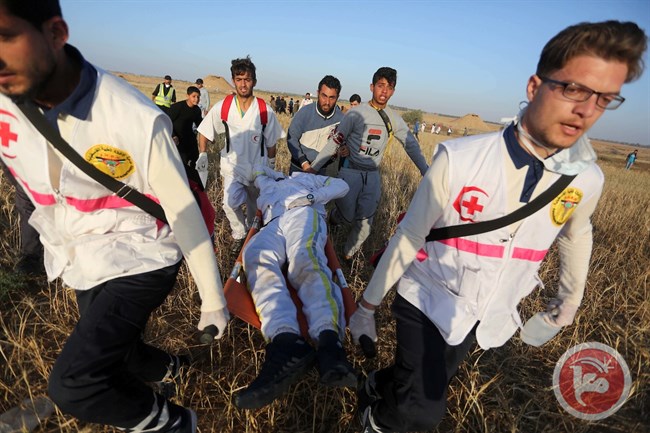
BETHLEHEM – The World Health Organization (WHO) called for the protection of health workers and health facilities in the besieged Gaza Strip, following a rise in the number of health workers killed or injured and facilities damaged by Israeli army gunfire.
WHO said in a press statement that it has recorded an unprecedented “446 attacks on health care in Gaza since the start of ‘The Great March of Return’ on 30th March 2018.”
Who stressed that these attacks have resulted in three deaths and 731 injuries among health workers, in addition to 104 ambulances and six other forms of health transport have been damaged, as well as five health facilities and one hospital.
In addition to personal risk and damage to health care, health workers also face substantial barriers to carrying out their work: firing between health workers and those injured prevents or hampers access and witnessing such events has significant implications for longer term mental health and continued work.
WHO concluded, “WHO reiterates its call for the protection of health workers and health facilities. Health care is #NotATarget.”
Iran, Iraq and Syria considering transnational railway project: Report
Press TV – April 13, 2019
Iraq says negotiations are underway with Iran and Syria to develop a transnational railway line linking the three countries.
Iraqi Republic Railways Company chief Salib al-Hussaini said a summit will be held between the countries to further discuss the matter, the Arabic-language al-Sumeria news website reported on Friday.
The comments made on the sidelines of the joint Syrian-Iraqi committee held in Damascus came a week after Iranian First Vice-President Eshaq Jahangiri spoke of an initiative to link the Persian Gulf to the Mediterranean.
“We will connect the Persian Gulf from Iraq to Syria and the Mediterranean via railway and road,” said Jahangiri, making reference to the construction of a railway linking the Iranian Shalamcheh border region to the Iraqi city of Basra.
The Shalamcheh-Basra railway project is estimated to cost 2.22 billion rials and can link Iran to Syria via Iraq.
Speaking last December, Director General of the Railway and Technical Structures Department at the Islamic Republic of Iran Railways (RAI) Mohammad Mousavi said Iran was planning to build a movable railway bridge over the Arvand river as part of the Shalamcheh-Basra project.
Mousavi said the project would effectively link the Iranian cities of Khorramshahr and Abadan along with the Imam Khomeini Port to the Iraqi city.
The railway project was agreed to last month when Iran and Iraq signed five memorandums of understanding for the expansion of bilateral cooperation in various economic and healthcare sectors.
Observers have described the new agreements as a sign of Baghdad’s serious intention of not being “party to the system of sanctions against Iran” as Prime Minister Abdul-Mahdi said earlier in February.
Iraq heavily depends on Iran for everything from food to machinery, electricity, natural gas, fruits and vegetables.
Last year, Iran exported $8.7 billion worth of commodities to Iraq, overtaking Turkey with $7.3 billion of exports.
President Hassan Rouhani said last week that Iran and Iraq had plans to expand bilateral trade volume to $20 billion in the future.
Iran and Syria also signed a series of “historic” agreements earlier this year, including a “long-term strategic economic cooperation” deal described as a sign of changing realities in the Middle East.
Syrian Prime Minister Imad Khamis said the “historic” agreements covered cooperation in fields of industry, trade and agriculture. He called the agreement “a message to the world on the reality of Syrian-Iranian cooperation.”
Iraq and Syria have been expanding political and economic ties with Iran as they seek assistance in the post-war reconstruction of their countries which had large swathes of their territories overrun by foreign-backed terrorist outfits in the past years.
Iran has been offering military advisory support to Iraq and Syria at the request of their governments, enabling their forces to speed up gains on various fronts against the terrorist groups.
3 people injured in Israeli rocket attack on Syria’s Hama province – reports
RT | April 13, 2019
Syria has shot down several missiles launched by Israel and targeting the city of Masyaf in northwestern Syria, Syrian state media reported. Three people have been wounded and several buildings destroyed in the attack.
The rockets were launched by Israeli warplanes from Lebanese airspace at about 2.30am on Saturday, SANA reported. In response, Syria activated its air defenses and intercepted several missiles, the agency said. The alleged Israeli raid hit a military post in the city and destroyed several buildings. Three people have been reported wounded.
Lebanese Al-Masdar News reported, citing a military source on the ground, that Israeli rockets damaged a number of sites near the Masyaf National Hospital.
While Israel has not commented on the reported attack, it is presumed that Tel Aviv has made another incursion into Syrian territory to take on alleged Iranian elements there.
Israeli media reported in February that three of the four S-300 surface-to-air defense systems delivered by Moscow to Syria in October last year and stationed in Masyaf were photographed in an “erect” position, prompting speculation that they might be soon deployed into combat.
According to the Al-Masdar source, the Russian-made systems had no role in fending off Saturday’s attack.
Israel routinely rains down missiles on Syrian territory under the pretext of engaging Iranian targets there. In late March, the Syrian missile defense forces responded to an attack by Israel that reportedly targeted a civilian airport and caused a blackout in Aleppo.
Featured Video
9/11 In Perspective
or go to
Aletho News Archives – Video-Images
From the Archives
Still No End in Sight of the Murder and Mayhem Wrought by the 9/11 Culprits
By Prof. Tony Hall | American Herald Tribune | July 17, 2016
The Kevin Barrett-Chomsky Dispute in Historical Perspective – Fourth part of the series titled “9/11 and the Zionist Question”
Back in 2006 all but a prescient few, such as Christopher Bollyn, perceived it as premature to try to identify and bring to justice the actual perpetrators of the 9/11 crimes. There was still some residue of confidence that responsible officials in government, law enforcement, media and the universities could and would respond in good faith to multiple revelations that great frauds had occurred in interpreting 9/11 for the public.
Accordingly, the main methodology of public intellectuals like Dr. Kevin Barrett or, for instance, Professors David Ray Griffin, Steven E. Jones, Peter Dale Scott, Graeme MacQueen, John McMurtry, Michael Keefer, Richard B. Lee, A.K. Dewdney, Nafeez Mossadeq Ahmed, and Michel Chossudovsky, was to marshal evidence demonstrating that the official narrative of 9/11 could not be true.
The marshaling of evidence was spurred on by observations coming from government insiders like Eckehardt Wertherbach, a former head of Germany’s intelligence service. In a meeting in Germany with Christopher Bollyn and Dr. Andreas von Bülow, Wertherbach pointed out that, “an attack of this magnitude and precision would have required years of planning. Such a sophisticated operation would require the fixed frame of a state intelligence organization, something not found in a loose group like the one led by the student Mohammed Atta in Hamburg.”
Andreas von Bülow was a German parliamentarian and Defense Ministry official. He confirmed this assessment in his book on the CIA and 9/11. In the text von Bülow remarked that the execution of the 9/11 plan “would have been unthinkable without backing from secret apparatuses of state and industry.” The author spoke of the “invented story of 19 Muslims working with Osama bin Laden in order the hide the truth” of the real perpetrators’ identity. … continue
Blog Roll
 Aletho News
- Epstein files may contain ‘crimes against humanity’ – UN
- UK Government Plans to Use Delegated Powers to Undermine Encryption and Expand Online Surveillance
- Epstein Files Expose Israeli Occupation of America
- The Mandelson Molecule: Exposing the Architecture of Cross-Border Political Suppression
- The U.S. Sanctions Cuban Journalist For Reporting On The U.S. Blockade
- Israeli firms transform cars into intelligence devices: Reports
- Zionist-controlled companies to surveil British citizens
- THE CHILDREN GAMBIT
- A note on comment posting at Alethonews
- Trump stalls over Iran strike plan, Iran holds all the aces
- If Americans Knew
- Why won’t Trump’s “Board of Peace” bring peace? – Not a ceasefire Day 131
- Help end the injustice against Shadi
- Israel’s Favorite American President
- Israel’s “Yellow Line” Is a Death Trap for Palestinians. We Drove Into It.
- Why Israel’s expanding occupation in Syria presents a critical legal test
- Gaza is not a natural disaster. It is the victim of genocide enabled by global inaction
- Netanyahu’s plan to “end” US aid to Israel is to give even more money under a different name
- Israel ceased firing on Gaza for just 15 days of the “ceasefire” – Not a ceasefire Day 130
- In Gaza, “rats run over our faces” – Not a ceasefire Day 129
- Israel-backed border guards, GHF-linked aid – Not a ceasefire Day 128
- No Tricks Zone
- Coal Power Back In Trend As Globe Tries To Keep Pace With Growing Demand For Power
- New Study: A 4°C Warmer Beaufort Sea Had ‘No Sea Ice’ 11,700 – 8200 Years Ago
- Unfudging The Data: Dutch Meteorological Institute Reinstates Early 20th Centruy Heat Waves It Had Erased Earlier
- German Gas Crisis…Chancellor Merz Allegedly Bans Gas Debate Ahead of Elections!
- Pollen Reconstructions Show The Last Glacial’s Warming Events Were Global, 10x Greater Than Modern
- Germany’s Natural Gas Storage Level Dwindles To Just 28%… Increasingly Critical
- New Study Rebuts The Assumption That Anthropogenic CO2 Molecules Have ‘Special’ Properties
- Climate Scientist Who Predicted End Of “Heavy Frost And Snow” Now Refuses Media Inquiries
- Polar Bear Numbers Rising And Health Improving In Areas With The Most Rapid Sea Ice Decline
- One Reason Only For Germany’s Heating Gas Crisis: Its Hardcore-Dumbass Energy Policy
 Aletho News