Don’t expect US-Iran war before 2021
By M. K. BHADRAKUMAR | Indian Punchline | April 10, 2019
There is no reason to disbelieve the boast by Israeli Prime Minister Benjamin Netanyahu claiming credit personally for US President Donald Trump’s decision to designate Iran’s elite Islamic Revolutionary Guards (IRGC) as a “foreign terrorist organisation” under American law. It is common knowledge that all major decisions and most minor decisions by Trump regarding the West Asian situation are dictated by Israel’s interests.
Deep-pocketed Jewish billionaires such as Sheldon and Miriam Adelson, far-right Christian evangelicals and the well-known Israeli lobby wield enormous influence over Trump whose son-in-law Jared Kushner is also known to be an ardent Zionist who has funded West Bank settlements. Both decisions by Trump in recent weeks — granting US recognition to the illegal Israeli annexation of Syria’s Golan Heights region as well as yesterday’s move against Iran’s IRGC — are to be seen as motivated by the desire to bolster Netanyahu’s campaign seeking a fresh term in Israel’s parliamentary election on April 9.
The Pentagon and the State Department had reportedly expressed misgivings over Trump’s decision branding IRGC as a terrorist organisation. Indeed, Trump’s announcement on April 8 says clearly that the US state department will take the lead role in implementing this decision. Trump avoided voicing any intention to confronting the IRGC militarily and instead underscored his decision is to impose economic sanctions against the Iranian security organisation.
Considering that the IRGC has a long reach in the economic arena, especially in vital sectors such as energy, telecommunications, etc., in effect, Trump’s decision amounts to an extension of the US sanctions against Iran. Therefore, as Trump put it, the decision becomes a template of his “maximum pressure” strategy against Iran, which has been under implementation.
Tehran’s reaction has been surprisingly restrained under the circumstances. To be sure, Tehran has retaliated by naming the US Central Command (which is headquartered in Doha and covers the so-called Greater Middle East stretching from the Levant to Central Asia) as a terrorist organisation. Interestingly, Iranian reports highlighted that it is a “tit-for-tat” measure — that is, a move Iran had no choice but to make. The overall mood is one of resignation that the Trump administration is under the Israeli spell and has taken a step that is not exactly in American interests.
There have been no threatening statements from Tehran directed at the US, either. In a highly nuanced remark, the influential chairman of the National Security and Foreign Policy Commission of the Iranian Parliament, Heshmatollah Falahatpisheh hastened to clarify that Iran’s measures against the US Central Command, in response to US anti-IRGC move, is defensive, not a declaration of war.
Again, Iran’s powerful Supreme National Security Council, which is the apex executive body on foreign and security policies, has also restricted itself to saying in a statement, “Undoubtedly, the US regime will bear all the responsibilities for the dangerous consequences of its adventurist move.” This must be noted carefully as a signal to the US defence and security establishment.
Most important, Iran’s Supreme Leader Ayatollah Ali Khamenei estimated Trump’s move as only to be expected, given the IRGC’s pivotal role in countering Iran’s enemies. He said the US move will fall flat. The head of Iran’s Revolutionary Guards, Gen. Mohammad Ali Jafari was quoted as saying, “This U.S. move was quite laughable since the Revolutionary Guards are in people’s hearts … The Revolutionary Guards will increase its defensive and offensive capabilities in coming year.”
On the political plane, however, Tehran will step up its “resistance”. More Iranian support for Hamas can be expected. Similarly, the US move, coming hot on the heels of recognising the Israeli occupation of the Golan Heights, will only further further consolidate the “resistance”. The known unknown is going to be the impact on Afghanistan. Tehran has links with the Taliban. But it has been voicing strong backing for President Ashraf Ghani’s insistence that the peace talks should be “Afghan-led, Afghan-controlled.” Iran’s overriding concern is the stability of Afghanistan and the welfare of the Shi’ite communities. Conceivably, the US must be factoring in the imperative need to discourage Iran from playing a spoiler role in Afghanistan.
Among the Iranian security agencies, it is the IRGC that is in the driver’s seat in steering policies in Syria, Iraq and Afghanistan. The point is, the US Central Command and the IRGC (plus various Iran-backed militia forces) “co-habitate” these theatres. It is inconceivable that the US would precipitate any hostile moves against the IRGC that draw forth retaliation and jeopardise the safety and security of American personnel. Iran has the capacity to infect pain and give sleepless nights to the US personnel deployed under the Central Command and, to be sure, the Pentagon and the CIA are well aware of that.
We may, therefore, expect a tacit understanding by the two antagonistic parties to stay out of each other’s path. Of course, that is easier said than done, since these are high kinetic theatres witnessing acute confrontation. But then, the US-Iran tango has a 40-year history of shadow boxing.
Some shrill rhetoric can be expected from the US side, especially from US secretary of state Mike Pompeo and National Security Advisor John Bolton. Both are stridently “anti-Iran”. Bolton had been in the payroll of Iranian dissident groups based in the West. Both Pompeo and Bolton are passionately devoted to serving Israeli interests. But, in the final analysis, it is Trump — and Trump alone — who matters.
Quite obviously, Trump will be extremely wary of getting into a shooting war with Iran. Trump knows only too well that a war with Iran will have regional ramifications and can hurt his presidency. His game plan through this year and the next will be to ensure that his “maximum pressure” strategy deters Iran from causing any serious political embarrassment during his campaign, which is due to start later this year, for his re-election bid in 2020.
Suffice to say, Trump’s IRGC designation is unlikely to lead to any shooting war with Iran — till end-2020, at least. Having said that, there will be no let-up in Tehran’s pursuit of “resistance” in Syria and Iraq. And, given the pivotal role of the IRGC in Iran’s foreign and security policies, any form of direct engagement politically or at the diplomatic level between Washington and Tehran can be ruled out. Having said that, make no mistake that the US’ regional strategies in Syria and Iraq will come under severe challenge. To be sure, a strategic stalemate is Israel’s objective too as the guarantee against US retrenchment from the Middle East.
The Unfinished Gaza War: What Netanyahu Hopes to Gain from Attacking Palestinian Prisoners
By Ramzy Baroud | Palestine Chronicle | April 10, 2019
The current violence targeting Palestinian prisoners in Israeli jails dates back to January 2. It was then that Israel’s Public Security Minister, Gilad Erdan declared that the “party is over.”
“Every so often, infuriating pictures appear of cooking in the terrorist wings. This party is coming to an end,” Erdan was quoted in the Jerusalem Post.
Then, the so-called Erdan’s Committee recommended various measures aimed at ending the alleged “party”, which included placing limits on prisoners’ use of water, banning food preparations in cells, and installing jamming devices to block the alleged use of smuggled cell phones.
The last measure, in particular, caused outrage among prisoners, for such devices have been linked to severe headaches, fainting, and other long-term ailments.
Erdan followed his decision with a promise of the “use of all means in (Israel’s) disposal” to control any prisoners’ protests in response to the new restrictions.
The Israel Prison Service (IPS) “will continue to act with full force” against prison “riots”, he said, as reported by the Times of Israel.
That “full force” was carried out on January 20 at the Ofer Military Prison near Ramallah, in the West Bank, where a series of Israeli raids resulted in the wounding of more than 100 prisoners, many of whom sustaining bullet wounds.
The Nafha and Gilboa prisons were also targeted with the same violent pattern.
The raids continued, leading to more violence in the Naqab Prison on March 24, this time conducted by the IPS force, known as the Metzada unit.
Metzada is IPS’ ‘hostage rescue special operation’ force and is known for its very violent tactics against prisoners. Its attack on Naqab resulted in the wounding of many prisoners, leaving two in critical condition. Palestinian prisoners fought back, reportedly stabbing two prison-guards with sharp objects.
On March 25, more such raids were conducted, also by Metzada, which targeted Ramon, Gilboa, Nafha and Eshel prisons.
In response, the leadership of Palestinian prisoners adopted several measures including the dismantling of the regulatory committees and any other form of representation of prisoners inside Israeli jails.
The decentralization of Palestinian action inside Israeli prisons would make it much more difficult for Israel to control the situation and would allow prisoners to use whichever form of resistance they may deem fit.
But why is Israel provoking such confrontations when Palestinian prisoners are already subjected to a most horrid existence and numerous violations of international law?
Equally important, why now?
On December 24, embattled Prime Minister, Benjamin Netanyahu and other leaders of Israel’s right-wing government dissolved the Knesset (parliament) and declared early elections on April 9.
A most winning strategy for Israeli politicians during such times is usually increasing their hostility against Palestinians in the Occupied Territories, including the besieged Gaza Strip.
Indeed, a hate-fest, involving many of Israel’s top candidates kicked in, some calling for war on Gaza, others for teaching Palestinians a lesson, annexing the West Bank, and so on.
Merely a week after the election date announcement was made, raids of prisons began in earnest.
For Israel, it seemed like a fairly safe and controlled political experiment. Video footage of Israeli forces beating up hapless prisoners, accompanied by angry statements made by top Israeli officials captured the imaginations of a decidedly right-wing, militant society.
And that’s precisely what took place, at first. However, on March 25, a flare in violence in Gaza led to limited, albeit, undeclared war.
A full-fledged Israeli war on Gaza would be a big gamble during an election season, especially as recent events suggest that the time of easy wars is over. While Netanyahu adopted the role of the decisive leader, so determined to crush the Gaza resistance, his options on the ground are quite limited.
Even after Israel accepted Egyptian-mediated ceasefire terms with the Gaza factions, Netanyahu continued to talk tough.
“I can tell you we are prepared to do a lot more,” Netanyahu said about the Israeli attack on Gaza during a video speech beamed to his supporters in Washington on March 26.
But, for once, he couldn’t, and that failure, from an Israeli viewpoint, intensified verbal attacks by his political rivals.
Netanyahu has “lost his grip on security,” the Blue and White party leader, Benny Gantz proclaimed.
Gantz’s accusation was just another insult in an edifice of similar blistering attacks questioning Netanyahu’s ability to control Gaza.
A poll, conducted by the Israeli TV channel, Kan on March 27, found that 53% of Israelis believe that Netanyahu’s response to the Gaza resistance is “too weak.”
Unable to counter with more violence, at least for now, the Netanyahu government responded by opening another battlefront, this time in Israeli prisons.
By targeting prisoners, especially those affiliated with certain Gaza factions, Netanyahu is hoping to send a message of strength and to assure his nervous constituency of his prowess.
Aware of the Israeli strategy, Hamas’ political leader, Ismail Haniyeh linked the ceasefire to the issue of prisoners.
We “are ready for all scenarios,” Haniyeh said in a statement.
In truth, the Netanyahu-Erdan war on Palestinian prisoners is foolish and unwinnable. It has been launched with the assumption that a war of this nature will have limited risks, since prisoners are, by definition, isolated and unable to fight back.
To the contrary, Palestinian prisoners have, without question, demonstrated their tenacity and ability to devise ways to resist the Israeli occupier throughout the years. But more importantly, these prisoners are far from being isolated.
The nearly 6,000 Palestinian prisoners in Israeli jails represent whatever semblance of unity among Palestinians that transcends factions, politics and ideology.
Considering the direct impact of the situation in Israeli prisons on the collective psyche of all Palestinians, any more reckless steps by Netanyahu, Erdan and their IPS goons will soon result in greater collective resistance, a struggle that Israel cannot easily suppress.
– Ramzy Baroud is a journalist, author and editor of Palestine Chronicle. His forthcoming book is ‘The Last Earth: A Palestinian Story’ (Pluto Press, London).
Hamas Won Again
By Gilad Atzmon – April 10, 2019
Prime Minister Benjamin Netanyahu won a decisive victory yesterday. He is likely to carry on to a fifth term in office. As of this morning, the right-wing bloc has a clear advantage of 65 seats (out of 120) over the centre/left parties and seems more likely to form a coalition.
The meaning of yesterday’s election results are obvious and undeniable. The Israeli left is now marginal, verging on non-existent. The Israeli Labour party has been reduced to a miniature caricature, pretty much the size of Meretz, themselves a parody of left thinking. Needless to mention that these two parties are Zionist to the core. They deny the Palestinian right of return and believe in segregation between Jews and Arabs by means of a two-state solution.
Netanyahu is, beyond doubt, the most sophisticated player in the Israeli political theatre. In the weekend he vowed to annex the West Bank Settlements. By performing this election ploy, he managed to completely obliterate his hard-line rivals on the right such as Bennett-Shaked’s New Right and even Zehut, which promised to be a ‘rising political force.’ As for this morning neither Zehut nor Bennett, who promised his voters he would be the next Defence Minister, made it to the Knesset. Netanyahu has also managed to reduce the USA into a subservient colony. We saw President Trump working hard for his friend in Jerusalem, recognising Israeli sovereignty over the Golan Heights and castigating Iran’s Islamic Revolutionary Guard Corps as a ‘terror organisation’. But most significantly, Netanyahu is also Hamas’s favourite prime minister.
Hamas knows very well that Israeli centrist government are genocidal in their approach to Arabs and Palestinians in particular. Hamas remembers Ehud Olmert, Tzipi Livni and Ehud Barak. They clearly prefer Bibi. They know very well that Bibi has been anxious to operate in Gaza. Hamas knows very well that Israel is running out of military and political options, let alone solutions to the conflict. Hamas voted Bibi. It entered ceasefire negotiations with Israel just a few days before the election. There is good reason to believe that Hamas would prefer to deal with Netanyahu rather than with a ‘centrist’ party led by three war criminals. Hamas won again, it has pushed Israel into a state of further paralysis. Israel does not have a prospect of a future in the region. Israel may not be defeated by Quasam rockets but by its own Ghetto mentality.
Canada Needs to Develop More Rules to Control its Spying Operations – Watchdog
Sputnik – 10.04.2019
According to a government watchdog’s report, the Canadian Department of National Defence (DND) and Armed Forces (CAF) have no rules when it comes to intelligence operations, and they do not answer to any independent body for their actions.
Canada needs to consider developing a legislation that will regulate how the military and the DND conduct intelligence operations, a national security watchdog committee in Canada’s parliament suggests.
In its report, the National Security and Intelligence Committee of Parliamentarians says the DND and the CAF have “one of the largest intelligence programs” in Canada, yet their operations face little to no outside scrutiny.
The DND and CAF enjoy a freedom known as the “Crown prerogative,” The Globe and Mail reports. This allows the Canadian government to make decisions as it sees fit unless its hands are somehow tied by statutes or the courts.
“Once a statute occupies the ground formerly occupied by the prerogative power, the Crown must comply with the terms of the statute,” the report quotes the Supreme Court of Canada as ruling.
This means that while Canada does have certain administrative directives and rules that govern defence intelligence operations, no legislation explicitly guides these activities. At the same time, the Canadian Security Intelligence Service (CSIS) and the Communications Security Establishment (CSE) are subject to laws that say what they can and cannot do, the Globe and Mail reports.
“DND/CAF is an anomaly in conducting its intelligence activities under the Crown prerogative. Those activities are similar in kind, risk, and sensitivity to those conducted by other Canadian security and intelligence organizations, which operate under and benefit from clear statutory authorities, limitations and requirements for ongoing review, tailored to the requirements of their specific mandates,” the Committee’s report says.
Besides, the Committee points out that, unlike CSIS and CSE, military intelligence is not subject to review by an independent and external body, meaning that military intelligence operations are not only unregulated, but also do not report to anyone.
Therefore, the Committee suggests developing legislation that would restrain the DND and CAF, as well as oblige them to report annually on their intelligence operations.
In the meantime, Committee chairman MP David McGuinty said the watchdog found “no evidence of wrongdoing” by defence personnel during its investigation.
Naturally, both the CAF and DND objected to the proposal, saying more oversight would make the military less flexible when it comes to operations; it would also undermine information sharing with Canada’s closest allies, they argued, according to the Globe and Mail.
Defence Minister Harjit Sajjan has said that his department would look at the Committee’s suggestions.
“There are internal processes that we have in place. Can we improve those? Of course we are looking at those,” he said after a cabinet meeting Tuesday.
However, he also noted that caution must be exercised in order to keep the military flexible, so that it “keep our soldiers safe.”
Putin Derangement Syndrome After Mueller
© Time Magazine
By Patrick ARMSTRONG | Strategic Culture Foundation | 09.04.2019
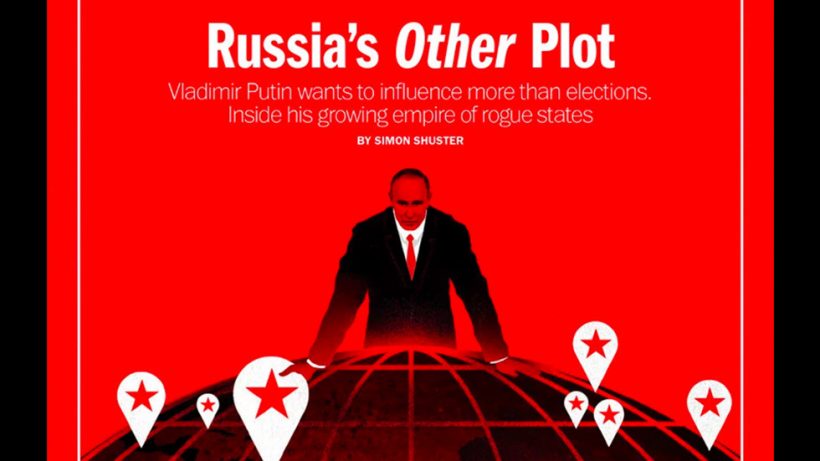
The West – its governments and its governments’ scribes – are obsessed with Russian President Vladimir Putin. “Obsessed” is probably too weak a word to describe the years of impassioned coverage, airy speculation and downright nonsense. He is the world’s leading cover boy: military hats, Lenin poses, imperial crowns, scary red eyes, strait-jackets, clown hats; anything and everything. He’s the avatar of Stalin, he’s the avatar of the Tsars, he’s the Joker, he’s Cthulhu, he’s Voldemort, he’s Satan. He’s the palimpsest for the New World Order’s nightmares. Putin is always messing with our minds. He weaponises information, misinformation and sexual assault accusations. Childrens’ cartoons, fishsticks, Pokemon and Yellow Vests, “Putin’s warships” are lurking when they aren’t stalking; “Putin’s warplanes” penetrate European airspace; “Putin’s tanks”, massing in 2016, massing in 2018, still massing. His empire of rogue states grows. All Putin, all the time.
In an especially imbecilic display in 2015, Western reporters (unable to find his website) thinking he hadn’t been seen for several days started a contest of speculation about coups, death, wars, plastic surgery, secret births and other nonsense; when he “re-appeared”, the story went down the Memory Hole.
For some reason, Americans personalise everything. In meetings with US intelligence agencies I was always fascinated how they would reduce every complicated reality to a single individual. But it isn’t Saddam, or Assad, or Qaddafi, or Osama, or Aidid, or Milosevic, or Maduro, or Castro or any of the other villains-of-the-day, it’s a whole country: these people got to the top for good reasons. Removing the boss makes some difference but never all the difference. They go but they never leave a Washington-friendly country behind and Washington does it all over again somewhere else. This peculiar blindness drives Putin Derangement Syndrome and has infected everybody else.
But Putin is much worse than the others. The other enemies had relatively weak countries but Russia could obliterate the USA. But worse, Putin’s team has steadily become more powerful and more influential. And worst of all, he’s still there: huffing and puffing has not blown him down, sanctions strengthen the economy and there is nothing to suggest he won’t be succeeded by someone who carries on the same policies. It’s a whole country, not just one man.
Vladimir Putin is the biggest man on earth.
Except that he’s short and can’t hide it. He’s a megalomaniac because he’s short; he’s trying to prove his bigness; napoleon complex says some shrink. Just another in a long list of crackpot “expert” opinions. From a list I complied in 2015: Asperger’s Syndrome, cancer of the spinal cord, personality disorders, gayness, Parkinson’s Disease, psychopath, people don’t like him so animals have to, sinister, lonely life, fears his own people, envious of Obama. Remember the “gunslinger walk”? Oh, in case you hadn’t heard, he was in the KGB and that explains everything: “Once a KGB man, always a KGB man”. Nothing is too absurd.
But laughing has passed – Putin Derangement Syndrome has become dangerous.
In 2016 Hillary Clinton lost a sure-fire election to Donald Trump and, looking for an excuse, jumped on the Russia claim. Putin Derangement Syndrome was ramped up to a much more dangerous level. War-level dangerous.
A popular actor made a video to tell us we were at war. “Warfare” says Haley, “act of war” said John McCain, could be says Cheney, 911 says Clinton, disappointed CIA guy agrees, Pearl Harbor says Nadler. Diplomatic expulsions and sanctions and more sanctions. These are much more serious than gassy op-eds about Putin’s gait or fish weights, these are actions: actions have consequences. Moscow doesn’t find war talk very funny.
Clinton’s victory was 99% certain until it wasn’t and excuses were needed. Clinton went through a lot of them but “Russian interference” was always the big one.
That strategy had been set within twenty-four hours of her concession speech. [9 November 2016] Mook and Podesta assembled her communications team at the Brooklyn headquarters to engineer the case that the election wasn’t entirely on the up-and-up. For a couple of hours, with Shake Shack containers littering the room, they went over the script they would pitch to the press and the public. Already, Russian hacking was the centerpiece of the argument. (From Shattered, quoted here.)
In What Happened, Clinton also says Russian President Vladimir Putin’s support for Trump was driven by his own anti-women sentiment, stacking the deck against her: “What Putin wanted to do was… influence our election, and he’s not exactly fond of strong women, so you add that together and that’s pretty much what it means.” At press events for her memoir, Clinton continues to warn Americans against Russia’s power over Trump and the country. “The Russians aren’t done. This is an ongoing threat, and that is one of the reasons why I wrote the book and one of the reasons I’m talking about it,” she said on Sunday at Southbank Centre’s London Literature Festival. (Newsweek)
Her claim is, to put it mildly, unproven; the so-called “all 17 agencies” report notwithstanding. (The first premise that it was hacked is here disproved: downloaded by someone in the building). Her accusation moved Putin Derangement Syndrome away from the realm of mere craziness into war talk. Taking the hint, Western politicians, under attack for their lacklustre performances, were happy to push the blame onto Putin. He’s attacking democracy! Western media weighed in until it became completely accepted by some people that anything that spoiled the happy complacency of the Western world must be a result of Putin’s interference: gilets jaunes, “assistance provided to far-right and anti-establishment parties”, he’s the poster boy of the dreaded populism, his populist tentacles reach Hungary and Italy. And the next thing we knew, Putin was mucking around in everybody’s votes: Brexit; Catalonia; Netherlands; Germany; Sweden; Italy; EU in particular and Europe in general; Mexico; Canada. Newsweek gives a helpful list. Sometimes he loses elections: Germany, Ukraine but he goes on, unstopping. But his greatest triumph was said to have been in the US election: he “won” because Donald Trump was his willing puppet.
(None of these “experts” ever seem to wonder why Putin’s influence, so decisive far away, is so ineffective in Ukraine or Georgia. But then, it’s not actually a rational, fact-based belief, is it?)
The entire ramshackle construction is collapsing: if Mueller says there was no collusion then even the last ditch believers will have to accept it: Robert Mueller Prayer Candles are out of stock, time to toss the other tchotchkes, it wasn’t a Mueller Christmas after all. Clinton’s fabrication had two parts to it: 1) Putin interfered/determined the election 2) in collusion with Trump. When the second part is blown up, so must the first be. And then what will happen to all the loyal little allies crying “ours were interfered with too”!? The two halves of the story had the same authors and the same purpose: if one dies, so must the other. Now that Trump is secured from the obstruction charges that hung there as long as Mueller was in session, he is free to declassify the background documents that will show the origin, mechanics, authors and extent of the conspiracy. And he has said he will. In the process, both halves of the story will be destroyed: they’re both lies.
(For those who now realise there is something they have to catch up on: Conrad Black has a good exposition of the overall conspiracy and here is a quick round-up of the mechanics of the conspiracy. This may show its very beginning, three years ago).
Will the exposure of the plot and the plotters end the war-talk stage of Putin Derangement Syndrome? In a rational world, it would (but can its believers be embarrassed by the exposure of their credulity? Can they be made to think it all over again from the beginning?). It is true that Russia stands in the way of the neocons and liberal interventionists who have been guiding Washington this century, but that hardly means that Putin is the enemy of the American people. Because, properly considered, it’s the neocons/liberal interventionists and their endless wars burning up lives, money and good will that are the enemies of Americans; in that respect Putin (unintentionally) stands with the true best interests of the American people. But the propaganda is so strong and the hysteria so unrestrained, that anyone who suggests that blocking the war party is in the best interests of Americans would be run out of town on a rail. (As the attacks on Tulsi Gabbard show.) The USA is far down the rabbit hole. (Although I should say US elites: a Rasmussen poll shows that slightly more Americans think Clinton colluded with a foreign power than think Trump did. Considering the news coverage of the last two and a half years, that’s a very interesting finding.)
So, the sad conclusion is that Putin Derangement Syndrome will probably endure and the best we can hope for is that it is dialed down a bit and the “act of war” nonsense is quietly forgotten. Derangement was strong before the interference/collusion lie and it will exist as long as Putin does: the war party is too invested in personalities ever to realise that it’s Russia, not its president, that’s the obstacle. Let alone ever understand that much of what Moscow does is a pushback against Washington’s aggression.
Let The Onion have the last laugh at this dismal matter:
“What the hell? I worked so hard on this—if I wasn’t colluding with the Trump campaign, who the hell was I colluding with?” said the dumbfounded Russian president, growing increasingly angry as he scrolled through his email inbox and recounted his numerous efforts at covert communication with individuals who he had thought were high-ranking Trump officials, but now he suspected were bots or anonymous internet trolls.”
Venezuela sabotage, evil Russians: 5 times video games were just blatant US war propaganda

© AFP / Frederic J. Brown
RT | April 9, 2019
It’s long been known that Hollywood works hand-in-glove with the CIA to produce entertainment imbued with unsubtle pro-US messaging — but the use of video games as propaganda, while as common, is less talked about.
A producer for Venezuela-based news outlet Telesur tweeted a video on Monday showing clips from the 2013 game ‘Call of Duty: Ghosts’ which appear to foreshadow massive electricity blackouts which left Venezuela’s capital city Caracas in almost total darkness in March.
In the game, US special forces are seen on a “mission” to cause a blackout by installing a virus onto a computer at the Guri Hydroelectric Dam — the very same location where a major failure caused the recent blackouts, which the Venezuelan government blamed on the US. The game’s creator said in 2014 that the Activision publishing company brought in “outside help” to produce the game, including “military advisers” and planners from the Department of Defense.
Here’s a look at some other games that don’t exactly do ‘subtle’ when it comes to pro-US propaganda.
Regime change in Bolivia!
US special forces are back in ‘Ghost Recon: Wildlands (2017)’, but this time the setting is Bolivia, where a brutal Mexican drug cartel called Santa Blanca are propping up another bad government. The good Americans, working for the CIA, must infiltrate Bolivia on the side of the harmless rebels to protect and liberate the innocent villagers we see dotted around the Bolivian landscape.
Depose the Venezuelan dictator…
Off to Venezuela again for the 2006 game ‘Mercenaries 2: World in Flames,’ where the goal is to oust “a power-hungry tyrant [who] messes with Venezuela’s oil supply, sparking an invasion that turns the country into a war zone.”
The game, developed by Pandemic Studios (which has also developed training aids for the US military), is set in what the makers called a “fully destructible Venezuela” and was criticized upon its release by the government of Hugo Chavez which said it was an attempt to drum up support for a real invasion.
US Army-funded recruitment tool
America’s Army is the “official” US Army game which “provides young Americans with a virtual web-based environment in which they can explore an army career.” AA was developed and offered for free as part of a post-9/11 campaign to help recruit new members to the military. It was revealed in 2009 through Freedom of Information Act requests that the game cost American taxpayers $33 million over eight years.
Evil Russians on the eastern front
Turning to World War 2, the 2013 game ‘Company of Heroes 2’ caused controversy in Russia over the presence of unnecessarily brutal Russian characters who killed for the fun of it. In one instance, the evil Russians even burn down civilian homes. Popular Ukrainian games blogger and developer told gaming website Polygon that the game “manages to use almost every single Russia-related trope” and that the missions even inexplicably show Soviet soldiers “killing more of their own people than the enemy.” The American characters, unsurprisingly, were depicted in a far more positive light.
‘Culture of consent’
Former associate professor of communication and journalism at Suffolk University in Boston, Nina Huntemann, wrote in a 2010 paper that video games are a vital part of US government efforts to create a “culture of consent” for war.
“The people need to consent to our government participating in war. To do that, we need a whole process of teaching us from childhood that killing is a legitimate mode of conflict resolution.”
This “soft propaganda,” she added, helps persuade the public by telling stories with universal appeal “where the sides of “good” and “evil” are unquestionable.”
It’s no secret that the earliest forms of digital gaming were heavily funded by military spending — not only for the purposes of propaganda but also to develop tools to train recruits. Historian Nick Turse told the Guardian in 2012 that by the late 1990s, the US Army was pouring tens of millions of dollars into the Institute of Creative Technologies at the University of Southern California, “specifically to build partnerships with the gaming industry and Hollywood.”
Video games and reality have become so intertwined that in 2010, when a United Nations investigator called for a halt to CIA-directed drone strikes in Afghanistan and Pakistan, he warned that killings ordered from afar could lead to a “Playstation mentality.”
But if any more proof was needed that the US government sees video games as the perfect tool for soft propaganda, look no further than former CIA director William Colby, who upon retiring from that job, went to work for video game company Activision to develop “spy thriller video games.”
US decision on Golan Heights violates UN Security Council resolutions – Putin
RT | April 8, 2019
The US’ decision to recognize Tel Aviv’s sovereignty over the Israeli-occupied Syrian Golan Heights region violates UN Security Council resolutions – a position that Moscow has already made clear, Russia’s president said.
Following a meeting between Vladimir Putin and his Turkish counterpart Recep Tayyip Erdogan in Moscow on Monday, the Russian leader was asked by reporters about Moscow’s stance on the US move.
“Regarding recognition of the Golan Heights as a part of Israel, you already know Russian stance. It’s been presented in a statement by Russia’s Foreign Ministry. The [US] move violates respective UN Security Council resolutions,” Putin stated.
Syria’s Golan Heights region has been occupied by Israel since 1967 and later Tel Aviv unilaterally proclaimed sovereignty over it. US President Donald Trump announced the decision to recognize Tel Aviv’s sovereignty over it in late March, gaining praise of Israel – and sparking world-wide outrage. Trump’s move has received no support outside of Israel, getting rejected even by the closest allies of the US.
Pakistan’s PM Slams India’s Modi and Israel’s Netanyahu as “Morally Bankrupt”
Sputnik – 09.04.2019
New Delhi – Pakistan Prime Minister Imran Khan on Tuesday launched a scathing attack on Indian Prime Minister Narendra Modi and Israeli Prime Minister Benjamin Netanyahu on the day when Israel is voting to elect its next government; India will begin the voting process for its general elections shortly.
“When leaders in Israel and India show a moral bankruptcy in their readiness to annex the occupied West Bank and India-Occupied Kashmir in defiance of international law, UN Security Council resolutions & their own Constitution for votes, don’t their people feel a sense of outrage and wonder how far they will go simply to win an election?” Imran Khan tweeted on Tuesday.
Israelis are voting on Tuesday, with Prime Minister Benjamin Netanyahu, leader of the right-wing Likud Party, seeking a fifth term in office.
Around 900 million will begin casting their votes starting on 11 April in a seven-phase polling process in India that will end with the announcement of its results on 23 May. The ruling Bharatiya Janata Party (BJP) hopes to retain control of the 543-seat Lok Sabha (Indian Lower House of Parliament).
“Our duty is to protect our nation, while Congress (the country’s main opposition party) and its supporters are anti-national. They are in favour of Article 370 (pertaining to unfair privileges to the strife-ridden state of Jammu and Kashmir). What Congress’s sham document (manifesto) is stating is exactly what Pakistan is saying,” PM Modi thundered at an election rally on Tuesday.
The BJP, in its 48-page manifesto, has made a new pledge to scrap Article 370 and Article 35A that gives special privileges to residents of India in the Kashmir region, such as laws preventing outsiders from buying property.
Earlier, Imran Khan took to Twitter to criticise the Indian government for fuelling war hysteria with Pakistan after the mid-February incident, when more than 40 Indian soldiers were killed in a terrorist attack in the Pulwama district of Kashmir.
Pakistan-based Jaish-e-Mohammed had claimed responsibility for the attack but the Indian government had squarely pegged blame on the Imran Khan government for allegedly sponsoring terror activities in India. In retaliation, the Indian Air Force had conducted an aerial strike on 26 February, describing it as a non-military strike against terrorist facilities in Balakot, inside Pakistan. The following day, the two nuclear-armed nations embroiled themselves in their first aerial clash in decades, which resulted in the loss of air assets.
Zionism, Crypto-Judaism, and the Biblical Hoax
By Laurent Guyénot • Unz Review • April 8, 2019
“What’s a neocon?” clueless George W. Bush once asked his father in 2003. “Do you want names, or a description?” answered Bush 41. “Description.” “Well,” said 41, “I’ll give it to you in one word: Israel.” True or not, that exchange quoted by Andrew Cockburn[1] sums it up: the neoconservatives are crypto-Israelis. Their true loyalty goes to Israel — Israel as defined by their mentor Leo Strauss in his 1962 lecture “Why We Remain Jews,” that is, including an indispensable Diaspora.[2]
In his volume Cultural Insurrections, Kevin MacDonald has accurately described neoconservatism as “a complex interlocking professional and family network centered around Jewish publicists and organizers flexibly deployed to recruit the sympathies of both Jews and non-Jews in harnessing the wealth and power of the United States in the service of Israel.”[3] The proof of the neocons’ crypto-Israelism is their U.S. foreign policy:
“The confluence of their interests as Jews in promoting the policies of the Israeli right wing and their construction of American interests allows them to submerge or even deny the relevance of their Jewish identity while posing as American patriots. […] Indeed, since neoconservative Zionism of the Likud Party variety is well known for promoting a confrontation between the United States and the entire Muslim world, their policy recommendations best fit a pattern of loyalty to their ethnic group, not to America.”[4]

The neocons’ U.S. foreign policy has always coincided with the best interest of Israel as they see it. Before 1967, Israel’s interest rested heavily on Jewish immigration from Eastern Europe. From 1967, when Moscow closed Jewish emigration to protest Israel’s annexation of Arab territories, Israel’s interest included the U.S. winning the Cold War. That is when the editorial board of Commentary, the monthly magazine of the American Jewish Committee, experienced their conversion to “neoconservatism,” and Commentary became, in the words of Benjamin Balint, “the contentious magazine that transformed the Jewish left into the neoconservative right .”[5] Irving Kristol explained to the American Jewish Congress in 1973 why anti-war activism was no longer good for Israel: “it is now an interest of the Jews to have a large and powerful military establishment in the United States. […] American Jews who care about the survival of the state of Israel have to say, no, we don’t want to cut the military budget, it is important to keep that military budget big, so that we can defend Israel.”[6] This tells us what “reality” Kristol was referring to, when he famously defined a neoconservative as “a liberal who has been mugged by reality” (Neoconservatism: the Autobiography of an Idea, 1995).
With the end of the Cold War, the national interest of Israel changed once again. The primary objective became the destruction of Israel’s enemies in the Middle East by dragging the U.S. into a third world war. The neoconservatives underwent their second conversion, from anti-communist Cold Warriors to Islamophobic “Clashers of Civilizations” and crusaders in the “War on Terror.”
In September 2001, they got the “New Pearl Harbor” that they had been wishing for in a PNAC report a year before.[7] Two dozens neoconservatives had by then been introduced by Dick Cheney into key positions, including Richard Perle, Paul Wolfowitz and Douglas Feith at the Pentagon, David Wurmser at the State Department, and Philip Zelikow and Elliott Abrams at the National Security Council. Abrams had written three years earlier that Diaspora Jews “are to stand apart from the nation in which they live. It is the very nature of being Jewish to be apart — except in Israel — from the rest of the population.”[8] Perle, Feith and Wurmser had co-signed in 1996 a secret Israeli report entitled A Clean Break: A New Strategy for Securing the Realm, urging Prime Minister Benjamin Netanyahu to break with the Oslo Accords of 1993 and reaffirm Israel’s right of preemption on Arab territories. They also argued for the overthrow of Saddam Hussein as “an important Israeli strategic objective in its own right.” As Patrick Buchanan famously remarked, the 2003 Iraq war proves that the plan “has now been imposed by Perle, Feith, Wurmser & Co. on the United States.”[9]
How these neocon artists managed to bully Secretary of State Colin Powell into submission is unclear, but, according to his biographer Karen DeYoung, Powell privately rallied against this “separate little government” composed of “Wolfowitz, Libby, Feith, and Feith’s ‘Gestapo Office’.”[10] His chief of staff, Colonel Lawrence Wilkerson, declared in 2006 on PBS that he had “participated in a hoax on the American people, the international community and the United Nations Security Council,”[11] and in 2011, he openly denounced the duplicity of neoconservatives such as Wurmser and Feith, whom he considered “card-carrying members of the Likud party.” “I often wondered,” he said, “if their primary allegiance was to their own country or to Israel.”[12] Something doesn’t quite ring true when neocons say “we Americans,” for example Paul Wolfowitz declaring: “Since September 11th, we Americans have one thing more in common with Israelis.”[13]
The neocons’ capacity to deceive the American public by posturing as American rather than Israeli patriots required that their Jewishness be taboo, and Carl Bernstein, though a Jew himself, provoked a scandal by citing on national television the responsibility of “Jewish neocons” for the Iraq war.[14] But the fact that the destruction of Iraq was carried out on behalf of Israel is now widely accepted, thanks in particular to the 2007 book by John Mearsheimer and Stephen Walt, The Israel Lobby and U.S. Foreign Policy. And even the best liars betray themselves sometimes. Philip Zelikow briefly dropped the mask during a conference at the University of Virginia on September 10, 2002:
“Why would Iraq attack America or use nuclear weapons against us? I’ll tell you what I think the real threat is and actually has been since 1990: it’s the threat against Israel. And this is the threat that dare not speak its name, because the Europeans don’t care deeply about that threat, I will tell you frankly. And the American government doesn’t want to lean too hard on it rhetorically, because it is not a popular sell.”[15]
From crypto-Judaism to crypto-Zionism
Norman Podhoretz, editor-in-chief of Commentary (and father-in-law of Elliott Abrams), said that after June 1967, Israel became “the religion of the American Jews.”[16] That is, at least, what he started working at. But, naturally, such religion had better remain discreet outside the Jewish community, if possible even secret, and disguised as American patriotism. The neocons have perfected this fake American patriotism wholly profitable to Israel, and ultimately disastrous for Americans — a pseudo-Americanism that is really a crypto-Israelism or crypto-Zionism.
This quasi-religious crypto-Zionism is comparable to the crypto-Judaism that has played a determining role in Christendom in the late Middle Ages. From the end of the 14th century, sermons, threats of expulsion, and opportunism made over a hundred thousand Jewish converts to Catholicism in Spain and Portugal, many of whom continued to “Judaize” secretly. Freed from the restrictions imposed on Jews, these “New Christians,” called Conversos or Marranos, experienced a meteoric socio-economic ascension. In the words of historian of Marranism Yirmiyahu Yovel:
“Conversos rushed into Christian society and infiltrated most of its interstices. After one or two generations, they were in the councils of Castile and Aragon, exercising the functions of royal counselors and administrators, commanding the army and navy, and occupying all ecclesiastical offices from parish priest to bishop and cardinal. […] The Conversos were priests and soldiers, politicians and professors, judges and theologians, writers, poets and legal advisors—and of course, as in the past, doctors, accountants and high-flying merchants. Some allied themselves by marriage to the greatest families of Spanish nobility […] Their ascent and penetration in society were of astonishing magnitude and speed.”[17]
Not all these Conversos were crypto-Jews, that is, insincere Christians, but most remained proudly ethnic Jews, and continued to marry among themselves. Solomon Halevi, chief rabbi of Burgos, converted in 1390, took the name of Pablo de Santa Maria, became Bishop of Burgos in 1416, and was succeeded by his son Alonso Cartagena. Both father and son saw no contradiction between the Torah and the Gospel, and believed that Jews made better Christians, as being from the chosen people and of the race of the Messiah.[18]
A new situation was created after the Alhambra Decree (1492) that forced Spanish Jews to choose between conversion and expulsion. Four years later, those who had stayed loyal to their faith and migrated to Portugal were given the choice between conversion and death, with no possibility of leaving the country. Portugal now had a population of about 12 percent so-called New Christians, deeply resentful of Catholicism. They learned and perfected the art of leading a double life. When they were eventually allowed to leave the country and engage in international trade in 1507, they “soon began to rise to the forefront of international trade, virtually monopolizing the market for certain commodities, such as sugar, to participate to a lesser degree in trading spices, rare woods, tea, coffee, and the transportation of slaves.”[19] When in 1540, the new Portuguese king introduced the Inquisition following the Spanish model, tracking down Portuguese Judaizers all over Europe and even in the New World, Marranos became more intensely resentful of the Catholic faith they had to fake, and more secretive. They would play an important role in the Calvinist or Puritan movement which, after undermining Spanish domination on the Netherlands, conquered England and ultimately formed the religious bedrock of the United States.
Catholic monarchs are to blame for having drafted by force into Christendom an army of enemies that would largely contribute to the ruin of the Catholic empire. By and large, the Roman Church has done much to foster the Jewish culture of crypsis. However, segregation and forced conversions were not the only factor. Crypto-Jews could find justification in their Hebrew Bible, in which they read:
“Rebekah took her elder son Esau’s best clothes, which she had at home, and dressed her younger son Jacob in them. […] Jacob said to his father, ‘I am Esau your first-born’” (Genesis 27:15–19).
If Jacob cheated his brother Esau of his birthright by impersonating him, why would they not do the same (Jacob being, of course, Israel, and Esau or Edom being codenames for the Catholic Church among medieval Jews)? Crypto-Jews also found comfort and justification in the biblical figure of Esther, the clandestine Jewess who, in the Persian king’s bed, inclined him favorably toward her people. For generations, Spanish and Portuguese Marranos prayed to “saint Esther.”[20] This is significant because the legend of Esther is a cornerstone of Jewish culture: every year the Jews celebrate its happy ending (the massacre of 75,000 Persians by the Jews) by the feast of Purim.[21] Another factor to consider is the ritual prayer of Kol Nidre recited before Yom Kippur at least since the 12th century, by which Jews absolved themselves in advance of “all vows, obligations, oaths or anathemas, pledges of all names,” including, of course, baptism .
Marranos and their descendants had a deep and lasting influence in economic, cultural and political world history, and their culture of crypsis survived the Inquisition. A case in point is the family of Benjamin Disraeli, Queen Victoria’s prime minister from 1868 to 1869, and again from 1874 to 1880, who defined himself as “Anglican of Jewish race.”[22] His grandfather was born from Portuguese Marranos converted back to Judaism in Venice, and had moved to London in 1748. Benjamin’s father, Isaac D’Israeli was the author of a book on The Genius of Judaism, but had his whole family baptized when Benjamin was thirteen, because administrative careers were then closed to the Jews in England.
Benjamin Disraeli has been called the true inventor of British imperialism, for having Queen Victoria proclaimed Empress of India in 1876. He orchestrated the British takeover of the Suez Canal in 1875, thanks to funding from his friend Lionel Rothschild (an operation that also consolidated the Rothschilds’ control over the Bank of England). But Disraeli can also be considered a major forerunner of Zionism; well before Theodor Herzl, he tried to introduce the “restoration of Israel” into the Berlin Congress agenda, hoping to convince the Ottoman Sultan to concede Palestine as an autonomous province.
What was Disraeli’s motivation behind his British imperial foreign policy? Did he believe in Britain’s destiny to control the Middle East? Or did he see the British Empire as the tool for the fulfillment of Israel’s own destiny? In mooring the Suez Canal to British interests, did he just seek to outdo the French, or was he laying the foundation for the future alliance between Israel and the Anglo-American Empire? No one can answer these questions with certainty. But Disraeli’s contemporaries pondered them. William Gladstone, his longtime competitor for the prime ministry, accused him of “holding British foreign policy hostage to his Jewish sympathies.”[23] So we see that the neoconservatives’ loyalty to Israel, and their control of the Empire’s foreign policy, is not a new issue. The case of Disraeli highlights the legacy between pre-modern crypto-Judaism and modern crypto-Zionism.
The dialectic of nation and religion
From his Darwinian perspective, Kevin MacDonald sees crypto-Judaism as “an authentic case of crypsis quite analogous to cases of mimetic camouflage in the natural world.”[24] But Judaism itself, in its modern form, falls into the same category, according to MacDonald. In the 18th century, by claiming to be adepts of a religious confession, Jews gained full citizenship in European nations, while remaining ethnically endogamic and suspiciously uninterested in converting anyone. Gilad Atzmon points out that the Haskalah motto, “Be a Jew at home and a man in the street” is fundamentally dishonest:
“The Haskalah Jew is deceiving his or her God when at home, and misleading the goy once in the street. In fact, it is this duality of tribalism and universalism that is at the very heart of the collective secular Jewish identity. This duality has never been properly resolved.”[25]
Zionism was an attempt to resolve it. Moses Hess wrote in his influential book Rome and Jerusalem (1862):
“Those of our brethren who, for purposes of obtaining emancipation, endeavor to persuade themselves, as well as others, that modern Jews possess no trace of a national feeling, have really lost their heads.”
For him, a Jew is a Jew “by virtue of his racial origin, even though his ancestors may have become apostates.”[26] Addressing his fellow Jews, Hess defended the national character of Judaism and denounced the assimilationist Jew’s “beautiful phrases about humanity and enlightenment which he employs as a cloak to hide his treason.”[27]
In return, Reformed Judaism opposed the nationalist version of Jewishness which would become Zionism. On the occasion of their 1885 Pittsburgh Conference, American reformed rabbis issued the following statement:
“We consider ourselves no longer a nation, but a religion community, and therefore expect neither a return to Palestine, nor the restoration of a sacrificial worship under the Sons of Aaron, or of any of the laws concerning the Jewish State.”[28]
Yet Reformed Judaism promoted a messianic theory that continued to ascribe an exalted role to Israel as chosen people, nation or race. German-American rabbi Kaufmann Kohler, a star of the Pittsburgh Conference, argued in his Jewish Theology (1918) for the recycling of the messianic hope into “the belief that Israel, the suffering Messiah of the centuries, shall at the end of days become the triumphant Messiah of the nations.”
“Israel is the champion of the Lord, chosen to battle and suffer for the supreme values of mankind, for freedom and justice, truth and humanity; the man of woe and grief, whose blood is to fertilize the soil with the seeds of righteousness and love for mankind. […] Accordingly, modern Judaism proclaims more insistently than ever that the Jewish people is the Servant of the Lord, the suffering Messiah of the nations, who offered his life as an atoning sacrifice for humanity and furnished his blood as the cement with which to build the divine kingdom of truth and justice.”[29]
It is easy to recognize here an imitation of Christianity: the crucifixion of Christ (by the Jews, as Christians used to say) is turned into a symbol of the martyrdom of the Jews (by Christians). Interestingly, the theme of the “crucifixion of the Jews” was also widely used by secular Zionist Jews as a diplomatic argument.
But what is more important to understand is that Reformed Judaism rejected traditional nationalism (the quest for statehood) only to profess a superior, metaphysical kind of nationalism. In this way, Reformed Judaism and Zionism, while affirming their mutual incompatibility and competing for the hearts of Jews, dovetailed perfectly: Zionism played the rhetoric of European nationalist movements to claim “a nation like others” (for Israelis), while Reformed Judaism aimed at empowering a nation like no other and without borders (for Israelites). That explains why in 1976, American Reformed rabbis crafted a new resolution affirming: “The State of Israel and the Diaspora, in fruitful dialogue, can show how a People transcends nationalism while affirming it, thus establishing an example for humanity.”[30] In a marvelous example of Hegelian dialectical synthesis, both the religious and the national faces of Jewishness contributed to the end result: a nation with both a national territory and an international citizenry, exactly what Leo Strauss had in mind. Except for a few orthodox Jews, most Jews today see no contradiction between Judaism as a religion and Zionism as a nationalist project.
The question of whether such dialectical machinery was engineered by Yahweh or by B’nai B’rith is open to debate. But it can be seen as an inherent dynamic of Jewishness: the Jewish cognitive elites may find themselves divided on many issues, but since their choices are ultimately subordinated to the great metaphysical question, “Is it good for Jews?” there always comes a point when their oppositions are resolved in a way that reinforces their global position.

With “what is good for the Jews” in mind, contradictions are easily resolved. Jewish intellectuals, for example, can be ethnic nationalists in Israel, and pro-immigration multiculturalists everywhere else. A paragon of this contradiction was Israel Zangwill, the successful author of the play The Melting Pot (1908), whose title has become a metaphor for American society, and whose Jewish hero makes himself the bard of assimilation by mixed marriages: “America is God’s Crucible, the great Melting-Pot where all the races of Europe are melting and reforming.” The paradox is that when he was writing this, Zangwill was a leading figure of Zionism, that is, a movement affirming the impossibility of Jews living among Gentiles, and demanding that they be ethnically separated. (Zangwill is the author of another famous formula: “Palestine is a land without people for a people without land.”)
Although it appears to be contradictory for non-Jews, this dual standard is not necessarily so from the point of view of Jewish intellectuals. They may sincerely believe in their universalistic message addressed to the Goyim, while simultaneously believing sincerely that Jews should remain a separate people. The implicit logic is that it is good that Jews remain Jews in order to teach the rest of mankind to be universal, tolerant, anti-racists, immigrationnists, and caring for minorities (specially Jews). This logic falls under the “mission theory”, the secular version of the “messianic nation” theory: Jews, who have invented monotheism, the Ten Commandments and so on, have a moral obligation to keep educating the rest of humankind. What the “mission” entails is open to reversible interpretations. Rabbi Daniel Gordis, in Does the World Need Jews? claims that “Jews need to be different in order that they might play a quasi-subversive role in society [. . .] the goal is to be a contributing and respectful ‘thorn in the side’ of society.”[31] That naturally tends to upset the Goyim, but it is for their good. It is to free them from their “false gods” that Jews are “a corrosive force”, also insists Douglas Rushkoff, author of Nothing Sacred: The Truth About Judaism.
Preaching universalism to the Goyim in the street while emphasizing ethnic nationalism at home is the great deception. It is the essence of crypto-Judaism and of its modern form, crypto-Zionism. It is so deeply ingrained that it has become a kind of collective instinct among many Jews. It can be observed in many situations. The following remark by historian Daniel Lindenberg illustrates that Jewish internationalists’ relation to Israel in the 20th century strongly resembled the Marranos’ relation to Judaism in pre-modern times:
“Anyone who has known Communist Jews, ex-Kominternists, or even some prominent representatives of the 1968 generation will know what frustrated crypto-Jewishness means: Here are men and women who, in principle, according to the ‘internationalist’ dogma, have stifled in themselves all traces of ‘particularism’ and ‘petty-bourgeois Jewish chauvinism,’ who are nauseated by Zionism, support Arab nationalism and the great Soviet Union—yet who secretly rejoice in Israel’s military victories, tell anti-Soviet jokes, and weep while listening to a Yiddish song. This goes on until the day when, like a Leopold Trepper, they can bring out their repressed Jewishness, sometimes becoming, like the Marranos of the past, the most intransigent of neophytes.”[32]
If Jews can be alternatively or even simultaneously nationalists (Zionists) and internationalists (communists, globalists, etc.), it is, in the last analysis, because this duality is inherent to the paradoxical nature of Israel. Let us not forget that until the foundation of the “Jewish state”, “Israel” was a common designation for the international Jewish community, for example when on March 24, 1933, the British Daily Express printed on its front-page: “The whole of Israel throughout the world is united in declaring an economic and financial war on Germany.”[33] Until 1947, most American and European Jews were satisfied of being “Israelites”, members of a worldwide Israel. They saw the advantage of being a nation dispersed among nations. International Jewish organizations such as B’nai B’rith (Hebrew for “Children of the Covenant”) founded in New York in 1843, or the Alliance Israélite Universelle, founded in Paris in 1860, had no claim on Palestine.

Even after 1947, most American Jews remained ambivalent about the new State of Israel, knowing perfectly well that to support it would make them vulnerable to the accusation of dual loyalty. It was only after the Six-Day War that American Jews began to support Israel more actively and openly. There were two reasons for this. First, Zionist control of the press had become such that American public opinion was easily persuaded that Israel had been the victim and not the aggressor in the war that led Israel to triple its territory. Secondly, after 1967, the crushing deployment of Israeli power against Egypt, a nation supported diplomatically by the USSR, enabled the Johnson administration to elevate Israel to a strategic asset in the Cold War. Norman Finkelstein explains:
“For American Jewish elites, Israel’s subordination to US power was a windfall. Jews now stood on the front lines defending America—indeed, ‘Western civilization’—against the retrograde Arab hordes. Whereas before 1967 Israel conjured the bogey of dual loyalty, it now connoted super-loyalty. […] After the 1967 war, Israel’s military élan could be celebrated because its guns pointed in the right direction—against America’s enemies. Its martial prowess might even facilitate entry into the inner sanctums of American power.”[34]
Israeli leaders, for their part, stopped blaming American Jews for not settling in Israel, and recognized the legitimacy of serving Israel while residing in the United States. In very revealing terms, Benjamin Ginsberg writes that already in the 1950s, “an accommodation was reached between the Jewish state in Israel and the Jewish state in America”; but it was after 1967 that the compromise became a consensus, as anti-Zionist Jews were marginalized and silenced.[35] Thus was born a new Israel, whose capital was no longer only Tel Aviv but also New York; a transatlantic Israel, a nation without borders, delocalized. It was not really a novelty, but rather a new balance between two inseparable realities: the international Diaspora of Israelites, and the national State of Israelis.
Thanks to this powerful diaspora of virtual Israelis now entrenched in all levels of power in the US, France and many other nations, Israel is a very special nation indeed. And everyone can see that it has no intention of being an ordinary nation. Israel is destined to be an Empire. If Zionism is defined as the movement for the foundation of a Jewish State in Palestine, then what we see at work today may be called meta-Zionism, or super-Zionism. But there is no real need for such a new term, for Zionism, in fact, had always been about a new world order, under the mask of “nationalism”.
David Ben-Gurion, the “father of the nation”, was a firm believer in the mission theory, declaring: “I believe in our moral and intellectual superiority, in our capacity to serve as a model for the redemption of the human race.”[36] In a statement published in the magazine Look on January 16, 1962, he predicted for the next 25 years:
“All armies will be abolished, and there will be no more wars. In Jerusalem, the United Nations (a truly United Nations) will build a Shrine of the Prophets to serve the federated union of all continents; this will be the seat of the Supreme Court of Mankind, to settle all controversies among the federated continents, as prophesied by Isaiah.”[37]
That vision was passed on to the next generation. In October 2003, the highly symbolic King David Hotel hosted a “Jerusalem Summit”, whose participants comprised three acting Israeli ministers, including Benjamin Netanyahu, and Richard Perle as guest of honor. They signed a declaration that recognized Jerusalem’s “special authority to become a center of world’s unity,” and professed:
“We believe that one of the objectives of Israel’s divinely-inspired rebirth is to make it the center of the new unity of the nations, which will lead to an era of peace and prosperity, foretold by the Prophets.”[38]
Both Ben-Gurion’s prophecy and the Jerusalem Declaration highlight the fact that Zionism is an international project based on the Bible. That Zionism is biblical doesn’t mean it is religious; to Zionists, the Bible is both a “national narrative” and a geopolitical program rather than a religious book (there is actually no word for “religion” in ancient Hebrew). Ben-Gurion was not religious; he never went to the synagogue and ate pork for breakfast. Yet he was intensely biblical. Dan Kurzman, who calls him “the personification of the Zionist dream,” titles each chapter of his biography (Ben-Gurion, Prophet of Fire, 1983) with a Bible quote. The preface begins like this:
“The life of David Ben-Gurion is more than the story of an extraordinary man. It is the story of a biblical prophecy, an eternal dream. […] Ben-Gurion was, in a modern sense, Moses, Joshua, Isaiah, a messiah who felt he was destined to create an exemplary Jewish state, a ‘light unto the nations’ that would help to redeem all mankind.”
For Ben-Gurion, writes Kurzman, the rebirth of Israel in 1948 “paralleled the Exodus from Egypt, the conquest of the land by Joshua, the Maccabean revolt.” Ben-Gurion himself emphasized: “There can be no worthwhile political or military education about Israel without profound knowledge of the Bible.”[39] Ten days after declaring Israel’s independence, he wrote in his diary : “We will break Transjordan [Jordan], bomb Amman and destroy its army, and then Syria falls, and if Egypt will still continue to fight—we will bombard Port Said, Alexandria and Cairo.” Then he adds: “This will be in revenge for what they (the Egyptians, the Aramis and Assyrians) did to our forefathers during biblical times.”[40] Can you be more biblical than that ? Ben-Gurion was in no way a special case. His infatuation with the Bible was shared by almost every Zionist leader of his generation and the next. Moshe Dayan, the military hero of the Six-Day War, wrote a book entitled Living with the Bible (1978) in which he biblically justified Israel’s annexation of Arab territories. Naftali Bennet, Israeli minister of Education, has also recently justified the annexation of the West Bank by the Bible.
Christian will say that Zionists don’t read their Bible correctly. Obviously, they don’t read it with the pink Christian glasses. In Isaiah, for example, Christians find hope that, one day, people “will hammer their swords into plowshares and their spears into sickles” (Isaiah 2:4). But Zionists correctly start with the previous verses, which describe these messianic times as a Pax Judaica, when “all the nations” will pay tribute “to the mountain of Yahweh, to the house of the god of Jacob,” when “the Law will issue from Zion and the word of Yahweh from Jerusalem,” so that Yahweh will “judge between the nations and arbitrate between many peoples.” Further down in the same book, they read:
“The riches of the sea will flow to you, the wealth of the nations come to you” (60:5); “For the nation and kingdom that will not serve you will perish, and the nations will be utterly destroyed” (60:12); “You will suck the milk of nations, you will suck the wealth of kings” (60:16); “You will feed on the wealth of nations, you will supplant them in their glory” (61:5-6);
Zionism cannot be a nationalist movement like other, because it resonates with the destiny of Israel as outlined in the Bible: “Yahweh your God will raise you higher than every other nation in the world” (Deuteronomy 28:1). Only by taking into account the biblical roots of Zionism can one understand that Zionism has always carried within it a hidden imperialist agenda. It may be true that Theodor Herzl and Max Nordau sincerely wished Israel to be “a nation like others,” as Gilad Atzmon explains.[41] But still, when they called their movement “Zionism”, they used Jerusalem’s biblical name borrowed from the most imperialistic prophecies, and most notably Isaiah 2:3 quoted above.
Biblical prophecies outline Israel’s ultimate destiny, or meta-Zionism, whereas the historical books, and particularly the Book of Joshua, set the pattern for the first stage, the conquest of Palestine, or Zionism. As wrote Avigail Abarbanel in “Why I left the Cult,” the Zionist conquerors of Palestine “have been following quite closely the biblical dictate to Joshua to just walk in and take everything. […] For a supposedly non-religious movement it’s extraordinary how closely Zionism […] has followed the Bible.”[42] In the same mood, Kim Chernin writes:
“I can’t count the number of times I read the story of Joshua as a tale of our people coming into their rightful possession of their promised land without stopping to say to myself, ‘but this is a history of rape, plunder, slaughter, invasion, and destruction of other peoples.’”[43]
A “history of genocide” would not be exaggerated, if we consider the treatment reserved to Canaanites: In Jericho, “They enforced the curse of destruction on everyone in the city: men and women, young and old, including the oxen, the sheep and the donkeys, slaughtering them all” (Joshua 6:21). The city of Ai met the same fate. Its inhabitants were all slaughtered, twelve thousand of them, “until not one was left alive and none to flee. […] When Israel had finished killing all the inhabitants of Ai in the open ground, and in the desert where they had pursued them, and when every single one had fallen to the sword, all Israel returned to Ai and slaughtered its remaining population” (8:22–25). Women were not spared. “For booty, Israel took only the cattle and the spoils of this town” (8:27). Then came to turn of the cities of Makkedah, Libnah, Lachish, Eglon, Hebron, Debir, and Hazor. In the whole land, Joshua “left not one survivor and put every living thing under the curse of destruction, as Yahweh, god of Israel, had commanded” (10:40).
It certainly helps to understand the Israeli treatment of the Palestinians to know that the Book of Joshua is considered a glorious chapter of Israel’s national narrative. And when Israeli leaders claim that their vision of the global future is based on the Hebrew Bible, we should take them seriously and study the Bible. It is helpful, for example, to be aware that Yahweh has designated to Israel “seven nations greater and mightier than you,” that “you must utterly destroy,” and “show no mercy to them.” As for their kings, “you shall make their name perish from under heaven” (Deuteronomy 7:1-2, 24). The destruction of the “Seven Nations,” also mentioned in Joshua 24:11, is considered a mitzvah in rabbinic Judaism, and by the great Maimonides in his Book of Commandments,[44] and it has remained a popular motif in Jewish culture. Knowing this will help to understand the neocon agenda for World War IV (as Norman Podhoretz names the current global conflict).[45] General Wesley Clark, former Supreme Commander for NATO in Europe (he led the NATO agression against Serbia twenty years ago), wrote, and repeated in numerous occasions, that one month after September 11, 2001, a Pentagon general showed him a memo “that describes how we’re gonna take out seven countries in five years, starting with Iraq, and then Syria, Lebanon, Libya, Somalia and Sudan and finishing off with Iran.”[46] Wesley Clark has managed to pass as a whistleblower, but I believe he belongs to what Gilad Atzmon sees as the Jewish controlled opposition, together with Amy Goodman of Democracy Now who interviewed him.[47] Only in 1999 has he revealed being the son of Benjamin Jacob Kanne and the proud descendant of a lineage of Kohen rabbis. It is hard to believe that he has never heard about the Bible’s “seven nations”. Is Clark a crypto-Zionist trying to write history in biblical terms, while blaming these wars on WASP Pentagon warmongers? Interestingly, in his September 20, 2001 speech, President Bush also cited seven “rogue states” for their support of global terrorism, but in his list, Cuba and North Korea replaced Lebanon and Somalia. It is because part of Bush’s entourage refused to include Lebanon and Somalia, while his neocon handlers insisted on keeping the number seven for its symbolic value? Whatever the explanation, I suspect that the importance of targeting exactly “seven nations” after 9/11 stems from the same biblical obsession as the need to have ten Nazis hanged on Purim day 1946 to match the ten sons of Haman hanged in the Book of Esther. Just like Rabbi Bernhard Rosenberg can now marvel at how prophetic the Book of Esther is,[48] the idea is to “realize,” a few decades from now, that World War IV fulfilled Deuteronomy 7: the destruction of Israel’s seven enemy nations. Christian Zionists will be in extasy and praise “the Lord” (as their Bible translates YHWH). Of course, fulfilling prophecies does not always come easy: Isaiah 17:1, “Behold, Damascus will soon cease to be a city, it will become a heap of ruins,” is not quite done, yet.
I believe that Gilad Atzmon is making a very important point when emphasizing:
“Israel defines itself as the Jewish state. In order to grasp Israel, its politics, its policies and the intrusive nature of its lobby, we must understand the nature of Jewishness.”
And I believe that Jewishness is, at the core, the ideology of the Tanakh. There was no Jewishness before the Tanakh, and the Tanakh is the single ultimate root connecting all expressions of Jewishness, whether religious or secular—for what that distinction is worth. Jewishness would simply wither without the Tanakh.
Zionism is an expression of Jewishness. As we have seen, it is inherently imperialistic because it is biblical. I will now argue that it is also inherently deceptive because it is biblical. There are two aspects to the deceptive nature of the Tanakh: historical and metaphysical. To understand them, we need to know the context of its writing. The greatest part of the Tanakh, including the historical books, was edited during the exilic period, and reached its near-final form after Babylon had fallen under Persian rule in 539 BCE. That thesis, first put forward by Baruch Spinoza in 1670,[49] has always met with fierce opposition from the Christian world, but it was accepted by the great British historian of civilizations Arnold J. Toynbee,[50] and it is now getting the high ground.[51] The Judean exiles, after having helped the Persians conquer Babylon, were rewarded by high offices at the Persian court, and obtained the right to return to Jerusalem and set up a government subject to Persia. The manner by which these Judeo-Babylonian Levites maneuvered the Persians’ imperial policy in support of their theocratic project for Palestine is unknown, but we can imagine it similar to the way the Zionists have hijacked the Anglo-American empire’s foreign policy in recent times; the edict of Cyrus the Great presented at the beginning of the Book of Ezra is comparable to the Balfour Declaration. In 458 BCE, eighty years after the return of the first exiles, Ezra, proud descendant of a line of Aaronite priests, went from Babylon to Jerusalem, mandated by the king of Persia and accompanied by some 1,500 followers. He was soon joined by Nehemiah, a Persian court official of Judean origin. As “Secretary of the Law,” Ezra carried with him the newly redacted Torah, and Spinoza plausibly suggested that he was the head of the scribal school that had compiled and edited most of the Tanakh.
The history of Israel and Judea that we have today was written as justification for that proto-Zionist enterprise, which implied the usurpation of the name and heritage of the ancient kingdom of Israel by the Judeans. Of course, not everything in the historical books is pure invention: ancient materials were used, but the main narrative that aggregates them is built on a post-exilic ideological construct. The central piece of that narrative is the glorious kingdom of Solomon, reaching from the Euphrates to the Nile (1Kings 5:1), with its magnificent temple and its lavish royal palace in Jerusalem (described in detail in 1Kings 5-8). Solomon had “seven hundred wives of royal rank and three hundred concubines” (11:3) and “received gifts from all the kings in the world, who had heard of his wisdom” (5:14). We know today that Solomon’s kingdom is a complete fabrication, a mythical past projected as the mirror image of a desired future, a fictitious justification for the prophecy of its “restoration”. Even the idea that Jerusalem, located in Judea, was once the capital of Israel is blatantly false: Israel never had any other capital than Samaria. Twentieth-century archeology has definitively exposed the fallacy: there is no trace whatsoever of Solomon and his “united kingdom”.[52]
The scam is quite evident from the way the authors of the Books of Kings, aware of the absolute baselessness of their story, back it with the grotesque testimony of a totally spurious Queen of Sheba:
“The report I heard in my own country about your wisdom in handling your affairs was true then! Until I came and saw for myself, I did not believe the reports, but clearly I was told less than half: for wisdom and prosperity, you surpass what was reported to me. How fortunate your wives are! How fortunate these courtiers of yours, continually in attendance on you and listening to your wisdom! Blessed be Yahweh your God who has shown you his favour by setting you on the throne of Israel! Because of Yahweh’s everlasting love for Israel, he has made you king to administer law and justice.” (1 Kings 10:6-9)[53]
When Ben-Gurion declared before the Knesset three days after invading the Sinai in 1956, that what was at stake was “the restoration of the kingdom of David and Solomon,”[54] and when Israeli leaders continue to dream of a “Greater Israel” of biblical proportions, they are simply perpetuating a two-thousand-year-old deception—self-deception perhaps, but deception all the same.
Deeper than the historical deception, at the very core of the Bible, lies a more essential metaphysical deception which goes a long way towards explaining the ambivalence of tribalism and universalism so typical of Jewishness. Biblical historian Philip Davies wrote that “the ideological structure of the biblical literature can only be explained in the last analysis as a product of the Persian period,”[55] and the central idea of that “ideological structure” is biblical monotheism. In the pre-exilic strata of the Bible, Yahweh is a national god among others: “For all peoples go forward, each in the name of its god, while we go forward in the name of Yahweh our god for ever and ever,” says pre-exilic prophet Micah (4:5). What sets Yahweh apart from other national gods is his jealousy, which supposes the existence of other gods: “You shall have no other gods to rival me” (Exodus 20:3). Only in the Persian period does Yahweh really become the only existing God, and, by logical consequence, the creator of the Universe—Genesis 1 being demonstrably taken from Mesopotamian myths.
That transformation of national Yahweh into the “God of heaven and earth” is a case of crypsis, an imitation of Persian religion, for the purpose of political and cultural ascendency. The Persians were predominantly monotheistic under the Achaemenids, worshipers of the Supreme God Ahura Mazda, whose representations and invocations can be seen on royal inscriptions. Herodotus—who, by the way, travelled through Syria-Palestine around 450 BCE without hearing about Jews—wrote about the Persians’ customs:
“they have no images of the gods, no temples nor altars, and consider the use of them a sign of folly. [….] Their wont, however, is to ascend the summits of the loftiest mountains, and there to offer sacrifice to Zeus, which is the name they give to the whole circuit of the firmament.” (Histories, I.131)
Persian monotheism was remarkably tolerant of other cults. In contrast, Judean monotheism is exclusivist because, although Yahweh now claims to be the universal God, he remains the ethnocentric, jealous god of Israel. And so Persian influence was not the only factor in the development of biblical monotheism, that is, the claim that “the god of Israel” is the One and Only God: Yahweh’s sociopathic jealousy, his murderous hatred of all other gods and goddesses, was an important ingredient from pre-exilic times: being the only god worthy of worship is tantamount to being the only god, and therefore God. In 1Kings 18, we see Yahweh compete with the great Syrian Baal Shamem (“Lord of Heaven”) for the title of True God, by means of a holocaust contest ending with the slaughter of four hundred prophets of Baal. Later on we read of the Judean general Jehu who, having overthrown and slaughtered Israel’s dynasty of King Omri, summoned all the priests of Baal for “a great sacrifice to Baal,” and, as sacrifice, massacred them all. “Thus Jehu rid Israel of Baal” (2Kings 10,18-28). This informs us on how Yahweh supposedly became Supreme God instead of Baal: by the physical elimination of all the priests of Baal, that is, exactly the same way that Jehu became king of Israel by exterminating the family of the legitimate king, as well as “all his leading men, his close friends, his priests; he did not leave a single one alive” (2Kings 10:11).
Yet these legendary stories have come to us in a post-exilic redaction, and although they may reflect an earlier competition between Yahweh and Baal, the metaphysical claim that Yahweh is the supreme God, the Creator of Heaven and Earth, only became an explicit creed and a cornerstone of Judaism from the Persian period. It was a means of assimilation-dissimulation into the Persian commonwealth, comparable to the way Reformed Judaism mimicked Christianity in the 19th century.
The Book of Ezra and the prostitute of Jericho
The process of how Yahweh was transformed from national to universal god, while remaining intensely chauvinistic, can actually be documented from the Book of Ezra. It contains extracts from several edicts attributed to succeeding Persian kings. All are fake, but their content is indicative of the politico-religious strategy deployed by the Judean exiles for their proto-Zionist lobbying. In the first edict, Cyrus the Great declares that “Yahweh, the God of Heaven, has given me all the kingdoms of the earth and has appointed me to build him a Temple in Jerusalem,” then goes on to allow “his [Yahweh’s] people to “go up to Jerusalem, in Judah, and build the Temple of Yahweh, the god of Israel, who is the god in Jerusalem” (Ezra 1:2–3). We understand that both phrases refer to the same entity, but the duality is significant. We find the same paradoxical designation of Yahweh as both “God of Heaven” and “god of Israel in Jerusalem” in the Persian edict authorizing the second wave of return. It is now King Artaxerxes who asks “the priest Ezra, Secretary of the Law of the God of Heaven,” to offer a gigantic holocaust to “the god of Israel who resides in Jerusalem” (7:12-15). We later find twice the same expression “God of Heaven” (Elah Shemaiya) interspersed with seven references to “your god,” that is, “the god of Israel” (keep in mind that capitalization is irrelevant here, being a convention of modern translators). “God of Heaven” appears one more time in the book of Ezra, and it is, again, in an edict signed by the Persian king: Darius confirms Cyrus’s edict and recommends that the Israelites “offer sacrifices acceptable to the God of Heaven and pray for the life of the king and his sons” (6:10). Everywhere else the book of Ezra only refers to the “god of Israel” (four times), “Yahweh, the god of your fathers” (once), and “our god” (ten times). In other words, according to the author of the book of Ezra, only the kings of Persia imagine that Yahweh is “the God of Heaven”—a common title of the universal Ahura Mazda—while for the Jews, Yahweh is merely their god, the “god of Israel,” the god of their fathers, in short, a national god. Indeed, imperial authorities are told that the Jerusalem Temple is dedicated to the God of Heaven, although the idea seems irrelevant to the Judeans themselves: when the Judeans are challenged the right to (re)build their temple by the local Persian governor, they tell him: “We are the servants of the God of Heaven and Earth” (5:11) and refer to Cyrus’s edict. And when Nehemiah wants to convince the Persian king let him go to Judea to oversee the rebuilding of Jerusalem, he offers a prayer “to the God of Heaven” (Nehemiah 2:4); but once in Jerusalem, he asks his fellow Jews to swear allegiance to “Yahweh our god” (10:30).
This unmistakable pattern in the books of Ezra and Nehemiah may be taken as a clue of the deepest secret of Judaism, and a key to understanding the real nature of “Jewish universalism”: for the Jews, Yahweh is the god of the Jews, whereas Gentiles must be told that he is the supreme and only God. “In the heart of any pious Jew, God is a Jew,” writes Maurice Samuel in You Gentiles (1924), while to Gentiles, Yahweh must be presented as the universal God who happens to prefer Jews.[56] The pattern is repeated in the book of Daniel when Nebuchadnezzar, impressed by Daniel’s oracle, prostrates himself and exclaims: “Your god is indeed the God of gods, the Master of kings” (Daniel 2:47).
The hypothesis that the dual nature of Yahweh (god of Israel for the Jews, God of the Universe for Gentiles) was intentionally encrypted into the Hebrew Bible becomes more plausible when we find the same pattern in the Book of Joshua. The book was probably written before the Exile, possibly under king Josiah (639-609 BCE). Its original author never refers to Yahweh simply as “God,” and never implies that he is anything but “the god of Israel” (9:18, 13:14, 13:33, 14:14, 22:16). Even Yahweh calls himself “the god of Israel” (7:13). When Joshua speaks to the Israelites, he speaks of “Yahweh your god” (1:11, 1:12, 1:15, 3:3, 3:9, 4:5, 4:23-24, 8:7, 22:3-4, 22:5, 23:3,5,8,11, 24:2). The Israelites collectively refer to “Yahweh our god” (22:19), or individually as “Yahweh my god” (14:8). Israel’s enemies speak to Joshua about “Yahweh your god” (9:9), and he tells them about “Yahweh my god” (9:23). Yahweh is once called “lord of the whole earth” by Joshua (3:13), and once “the god of gods” by enthusiastic Israelites (22:22), but none of this can be considered to contain any explicit theological claim that Yahweh is the Creator: it is more like the Persian king calling himself king of kings and ruler of the world. Neither can the mention of an altar built by the Israelites as “a witness between us that Yahweh is god” (22:34) be taken to mean anything more than “Yahweh is god between us.” If the Yahwist scribe of the Book of Joshua had believed Yahweh to be the universal God, he would have written of whole cities being converted rather than exterminated for the glory of Yahweh.
The only explicit profession of faith that Yahweh is the supreme God, in the whole Book of Joshua, is coming from a foreigner, just like in the books of Ezra and Nehemiah. Not a king, this time, but a prostitute. Rahab is a prostitute in Jericho, who infiltrates the invading Israelites into the city. As justification for betraying her own people, she tells the Israelites that “Yahweh your god is God both in Heaven above and on Earth beneath” (2:11), something that neither the narrator, nor Yahweh, nor any Israelite in the book ever claims. Rahab’s profession of faith is likely to be a post-exilic addition to the book, for it actually conflicts with her more prosaic motivation:
“we are afraid of you and everyone living in this country has been seized with terror at your approach. […] give me a sure sign of this: that you will spare the lives of my father and mother, my brothers and sisters and all who belong to them, and will preserve us from death.” (2:9-12).
In the final redaction, the pattern is the same as in the Book of Ezra, and reveals the secret of post-exilic Judaism: To the Jews, Yahweh is their national god, but it is good for the Jews that Gentiles (whether kings or prostitutes) regard Yahweh as the “God of Heaven”. It has worked wonderfully: Christians today believe that the God of humankind decided to manifest himself as the jealous “god of Israel” from the time of Moses, whereas the real historical process is the reverse: it is the tribal “god of Israel” who impersonated the God of humankind at the time of Ezra—while continuing to prefer Jews.
Worshipping a national god with imperialistic ambitions, while pretending to the Gentiles that they are worshipping the One True God, is manufacturing a catastrophic misunderstanding. A public scandal emerged in 167 CE, when the Hellenistic emperor Antiochos IV dedicated the temple in Jerusalem to Zeus Olympios, the Greek name of the supreme God. He had been led to understand that Yahweh and Zeus were two names for the same cosmic God, the Heavenly Father of all mankind. But the Jewish Maccabees who led the rebellion knew better: Yahweh may be the Supreme God, but only Jews are intimate with Him, and any way the Pagans worship Him is an abomination. Moreover, although the Israelites claimed that their Temple was dedicated to the God of all mankind, they also firmly believed that any non-Jew entering it should be put to death. This fact alone betrays the true nature of Hebrew monotheism: it was a deception from the beginning, the ultimate metaphysical crypsis. Only when that biblical hoax is exposed to the world will Zion start to lose its symbolic power. For it is the original source of the psychopathic bond by which Israel controls the world.
Notes
[1] Andrew Cockburn, Rumsfeld: His Rise, His fall, and Catastrophic Legacy, Scribner, 2011, p. 219. Cockburn claims to have heard this repeated by “friends of the family.”
[2] Leo Strauss, “Why we Remain Jews”, quoted in Shadia Drury, Leo Strauss and the American Right, St. Martin’s Press, 1999 (on archive.org), p. 31-43.
[3] Kevin MacDonald, Cultural Insurrections: Essays on Western Civilizations, Jewish Influence, and Anti-Semitism, The Occidental Press, 2007, p. 122.
[4] Kevin McDonald, Cultural Insurrection, op. cit., p. 66.
[5] Benjamin Balint, Running Commentary: The Contentious Magazine That Transformed the Jewish Left into the Neoconservative Right, Public Affairs, 2010.
[6] Congress Bi-Weekly, quoted by Philip Weiss, “30 Years Ago, Neocons Were More Candid About Their Israel-Centered Views,” Mondoweiss.net, May 23, 2007: mondoweiss.net/2007/05/30_years_ago_ne.html
[7] http://www.informationclearinghouse.info/pdf/RebuildingAmericasDefenses.pdf
[8] Elliott Abrams, Faith or Fear: How Jews Can Survive in a Christian America, Simon & Schuster, 1997, p. 181.
[9] Patrick J. Buchanan, “Whose War? A neoconservative clique seeks to ensnare our country in a series of wars that are not in America’s interest,” The American Conservative, March 24, 2003, www.theamericanconservative.com/articles/whose-war/
[10] Stephen Sniegoski, The Transparent Cabal: The Neoconservative Agenda, War in the Middle East, and the National Interest of Israel, Enigma Edition, 2008, p. 156.
[11] http://www.pbs.org/now/politics/wilkerson.html
[12] Stephen Sniegoski, The Transparent Cabal, op. cit., p. 120.
[13] April 11, 2002, quoted in Justin Raimondo, The Terror Enigma: 9/11 and the Israeli Connection, iUniverse, 2003, p. 19.
[14] April 26, 2013, on MSNBC, watch on https://www.youtube.com/watch?v=ZRlatDWqh0o.
[15] Noted by Inter-Press Service on March 29, 2004, under the title “U.S.: Iraq war is to protect Israel, says 9/11 panel chief,” and repeated by United Press International the next day, on www.upi.com.
[16] Norman Podhoretz, Breaking Ranks: A Political Memoir, Harper & Row , 1979, p. 335.
[17] Translated from the French edition, Yirmiyahu Yovel, L’Aventure marrane. Judaïsme et modernité, Seuil, 2011, pp. 119-120, 149–151.
[18] Yirmiyahu Yovel, L’Aventure marrane, op. cit., pp. 96–98, 141–143; Nathan Wachtel, Entre Moïse et Jésus. Études marranes (XVe-XIXe siècle), CNRS éditions, 2013, pp. 54–65.
[19] Yirmiyahu Yovel, L’Aventure marrane, op. cit., pp. 483, 347.
[20] Yirmiyahu Yovel, L’Aventure marrane, op. cit., pp. 149–151.
[21] Elliott Horowitz, Reckless Rites: Purim and the Legacy of Jewish Violence, Princeton University Press, 2006.
[22] Hannah Arendt calls him a “race fanatic” in The Origins of Totalitarianism, vol. 1: Antisemitism, Meridian Books, 1958, pp. 309–310.
[23] Stanley Weintraub, Disraeli: A Biography, Hamish Hamilton, 1993, p. 579.
[24] Kevin MacDonald, Separation and Its Discontents: Toward an Evolutionary Theory of Anti-Semitism, Praeger, 1998, kindle 2013, k. 5876–82.
[25] Gilad Atzmon, The Wandering Who? A Study of Jewish Identity Politics, Zero Books, 2011, pp. 55–56.
[26] Moses Hess, Rome and Jerusalem: A Study in Jewish Nationalism, 1918 (on archive.org), pp. 71, 27.
[27] Moses Hess, Rome and Jerusalem, op. cit., p. 74.
[28] Quoted in Alfred Lilienthal, What Price Israel? (1953), 50th Anniversary Edition, Infinity Publishing, 2003, p. 14.
[29] Kaufmann Kohler, Jewish Theology, Systematically and Historically Considered, Macmillan, 1918 (on http://www.gutenberg.org), pp. 290, 378–380.
[30] Quoted in Kevin MacDonald, Separation and Its Discontents, op. cit., k. 5463–68.
[31] Daniel Gordis, Does the World Need Jews? Rethinking Chosenness and American Jewish Identity, Scribner, 1997, p. 177.
[32] Daniel Lindenberg, Figures d’Israël. L’identité juive entre marranisme et sionisme (1649–1998), Fayard, 2014, p. 10.
[33] Alison Weir, Against Our Better Judgment: The Hidden History of How the U.S. Was Used to Create Israel, 2014, k. 3280–94.
[34] Norman Finkelstein, The Holocaust Industry: Reflections on the Exploitation of Jewish Suffering, Verso, 2014, p. 6.
[35] Benjamin Ginsberg, Jews in American Politics: Essays, dir. Sandy Maisel, Rowman & Littlefield, 2004, p. 22.
[36] Arthur Hertzberg, The Zionist State, Jewish Publication Society, 1997, p. 94.
[37] David Ben-Gurion and Amram Duchovny, David Ben-Gurion, In His Own Words, Fleet Press Corp., 1969, p. 116
[38] Official website: http://www.jerusalemsummit.org/eng/declaration.php.
[39] Dan Kurzman, Ben-Gurion, Prophet of Fire, Touchstone, 1983, pp. 17–18, 22, 26–28.
[40] Ilan Pappe, The Ethnic Cleansing of Palestine, Oneworld Publications, 2007, p. 144.
[41] Gilad Atzmon, Being in Time: A Post-Political Manifesto, Skyscraper, 2017, pp. 66-67.
[42] Avigail Abarbanel, “Why I left the Cult,” October 8, 2016, on mondoweiss.net
[43] Kim Chernin, “The Seven Pillars of Jewish Denial.” Tikkun, Sept./Oct. 2002, quoted in MacDonald, Cultural Insurrections, op. cit., pp. 27-28.
[44] http://www.chabad.org/library/article_cdo/aid/961561/jewish/Positive-Commandment-187.htm
[45] Norman Podhoretz, World War IV: The Long Struggle Against Islamofascism, Vintage Books, 2008.
[46] Wesley Clark, Winning Modern Wars, Public Affairs, 2003, p. 130.
[47] Gilad Atzmon, Being in Time: A Post-Political Manifesto, Skyscraper, 2017, p. 187-209.
[48] Another example: Bernard Benyamin, Le Code d’Esther. Si tout était écrit…, First Editions, 2012.
[49] Benedict de Spinoza, Theological-political treatise, chapter 8, §11, Cambridge UP, 2007, pp. 126-128.
[50] Arnold Toynbee, A Study of History, volume XII, Reconsiderations, Oxford University Press, 1961, p. 486, quoted on http://mailstar.net/toynbee.html
[51] Thomas Romer, The Invention of God, Harvard University Press, 2016.
[52] Read for example Israel Finkelstein and Neil Adher Silberman, David and Solomon: In Search of the Bible’s Sacred Kings and the Roots of the Western Tradition, S&S International, 2007.
[53] All Bible quotes are from the Catholic New Jerusalem Bible, which has the advantage of not altering YHWH into “the Lord,” as most other English translations have done for unscholarly reasons.
[54] Israel Shahak, Jewish History, Jewish Religion: The Weight of Three Thousand Years, Pluto Press, 1994, p. 10 .
[55] Philip Davies, In Search of “Ancient Israel”: A Study in Biblical Origins, Journal of the Study of the Old Testament, 1992, p. 94.
[56] Maurice Samuel, You Gentiles, New York, 1924 (on archive.org), pp. 74–75.
Canada’s Carbon Tax Will Kill People
‘Winter mortality is lower when the price of heating is lower’: new research report.

source: page 33 of this 2009 UK govt report
By Donna Laframboise | Big Picture News | April 8, 2019
Last month, the National Bureau of Economic Research released a dramatic working paper. Its conclusion: when US home heating costs fell, fewer people died.
In the authors’ words, we’ve known for decades that “mortality peaks in winter and that cold weather is associated with higher mortality.” When home heating gets expensive, many people – especially the poorest members of our community – turn down the thermostat. But lower indoor temperatures are associated with an uptick in fatal strokes, heart attacks, and infections.
After collecting reams of data, and performing careful calculations, the researchers conclude that US heating bills declined noticeably between 2005 and 2010 “due to the boom in shale production of natural gas.”
That price decline, they write, “caused a 1.6% decrease in the winter mortality rate for households using natural gas for heating.”
Only 58% of American households heat with natural gas, so the drop in the death rate for the US population as a whole over a full calendar year works out to about half a percentage point. The bottom line: lower energy prices saved 11,000 lives annually.
Which brings us to the carbon tax recently imposed on all sources of home heating here in more northerly Canada. Enbridge, the company which supplies natural gas to Ontario homes, says it needs to raise the price it charges households by 11% just to pay for this carbon tax.
If deaths drop when heating costs decline, they’ll surely increase when heating costs spike. So let’s not beat around the bush: Canada’s carbon tax is going to kill people.
Extrapolating from those US numbers, 1,100 Canadians will die unnecessarily next winter. And the winter after that. And the one after that. As the size of the carbon tax increases, the number of annual victims may well rise in tandem.
Certain categories of people are at higher risk of death-by-carbon-tax. People whose health is already compromised. People who are already struggling to pay their bills. (Seniors, of course, are over-represented amongst both groups.)
There’s nothing heroic about a policy that consigns old people to shivering in the dark. That’s an attack on our most vulnerable. That’s a betrayal.
When people die from opioid overdoses, our Prime Minister rightly calls it a ‘crisis.’ He calls it “devastating. Families ripped apart. Communities forever altered. Loved ones lost too soon.” Yet his carbon tax has set into motion a wave of similar tragedy and sorrow.
Where global carbon dioxide emissions are concerned, Canada’s 1.6% contribution is so trivial that nothing we do can possibly make a difference. We’re a rounding error, simply irrelevant to the big picture.
Which means that Canada’s carbon-tax-induced deaths won’t just be premature, they’ll be utterly meaningless.
Is Trump’s Designation of Iran Revolutionary Guard Corps as Terrorist Organization a Set-Up for War?
By Whitney Webb | MintPress News | April 8, 2019
WASHINGTON — The Trump administration designated Iran’s Islamic Revolutionary Guard Corps (IRGC), an elite group of that country’s military, as a foreign terrorist organization early Monday, confirming a report published last Friday in the Wall Street Journal that suggested that such a move was likely to occur in a matter of days. In a statement released Monday, the White House stated:
This unprecedented step, led by the Department of State, recognizes the reality that Iran is not only a State Sponsor of Terrorism, but that the IRGC actively participates in, finances, and promotes terrorism as a tool of statecraft.”
While most reports on the subject have interpreted the move as aimed at pressuring European countries and others from conducting business with Iran while also making the Iran nuclear deal much more difficult to revive, the move would further allow the Trump administration to conduct more “robust” combat operations against Iran’s military, all without congressional approval.
As was noted by the WSJ and other outlets, the Trump administration’s upcoming move to label the IRGC a foreign terrorist organization would mark the first time that any element of a foreign state is officially labeled as a terrorist group. The Bush administration had previously blacklisted the Quds Force, the IRGC unit in charge of foreign operations, in 2007 “for its support of terrorism,” and further described the group as Iran’s “primary arm for executing its policy of supporting terrorist and insurgent groups.” However, unlike the Trump administration, they stopped short of labelling the IRGC, or any of its elements, as foreign terrorist organizations themselves.
Reports from last month indicate that current Secretary of State and former CIA Director, Mike Pompeo, was one of the administration’s top officials behind the move. At the time, the New York Times noted that many officials in the Pentagon and the CIA opposed the move, given that such a designation against the IRGC could have profound repercussions for U.S. troops stationed abroad, particularly in the Middle East. Indeed, soon after the recent WSJ piece was published, IRGC’s commander, Mohammad Ali Jafari, warned that U.S. troops in the Middle East would “lose their current status of ease and serenity” and that Iran’s government would make a “reciprocal move” against the U.S. military — labeling it a terrorist group — were the Trump administration to go forward with its latest move to target the IRGC.
Where’s Trump going with this designation?
Several reports have mulled over the likely motives behind the move to label the IRGC a foreign terrorist organization, with some suggesting that the move would be used as a threat to dissuade other countries from conducting business with Iran, while others asserted that the move was aimed at curbing the ability of any future U.S. president — particularly if a Democrat takes the White House in 2020 — from resurrecting the Joint Comprehensive Plan of Action, know broadly as the Iran nuclear deal. Trump unilaterally withdrew from the Iran nuclear deal in 2018, a move which earned him strong praise from long-time Iran hawks as well Israel’s Prime Minister Benjamin Netanyahu and Trump’s most powerful political donor, billionaire Sheldon Adelson.
Yet, upon more careful consideration, an economic motive seems unlikely in light of the fact that the Trump administration has already imposed draconian sanctions on almost every sector of Iran’s economy and government, including the IRGC. In addition, making such a drastic move now to prevent a future president in 2020 or beyond from reviving the Iran deal also seems rather unrealistic given that the 2020 challenger to Trump is still unknown.
A much more likely reason for the designation is the fact that labeling any group a foreign terrorist organization allows that group to be targeted by the U.S. government by means of the Authorization for Use of Military Force (AUMF). Past reports on other groups labeled as terrorist organizations have noted that “though the CIA can gather intelligence on terror groups regardless of their status on a State Department list, official designation unlocks more robust means to combat them since it triggers the Authorization for Use of Military Force.”
Notably, the CIA opened a new “mission center” on Iran in June 2017 — when Pompeo was CIA director — aimed at “turning up the heat” on Iran and making the country a “higher priority” for American spies. Now, just under two years later, the designation of the IRGC as a terrorist group allows those clandestine operations to become “more robust” and more overt thanks to the years-long expansion of the 2001 AUMF.
Colonel W. Patrick Lang, a retired senior officer of U.S. Military Intelligence and U.S. Army Special Forces, noted on Sunday that the move amounts to a “declaration of war” against Iran’s military, writing:
The official designation as “terrorist” of the IRGC, which is a 125,000 man army with its own navy and air force, makes it legal for the U.S. Armed Forces to attack the IRGC and its people wherever they are found and under any circumstances that may occur.”
Other echoes Lang’s concerns, including Wendy Sherman, former under-secretary of state and current director of the Center for Public Leadership at the Harvard Kennedy School. Sherman told Reuters on Sunday:
One might even suggest, since it’s hard to see why this is in our interest, if the president isn’t looking for a basis for a conflict. The IRGC is already fully sanctioned and this escalation absolutely endangers our troops in the region.”
Stretching the AUMF
The Authorization for Use of Military Force (AUMF) was originally passed in 2001 in the wake of the September 11 attacks and its text authorizes the president:
[T]o use all necessary and appropriate force against those nations, organizations, or persons he determines planned, authorized, committed, or aided the terrorist attacks that occurred on September 11, 2001, or harbored such organizations or persons, in order to prevent any future acts of international terrorism against the United States by such nations, organizations or persons.”
Despite being expressly aimed at groups believed to be responsible for September 11, the AUMF has been expanded under the Bush, Obama and Trump administrations to justify military action in dozens of countries against dozens of groups, many of them with no links to al Qaeda.
Trump, since his first year in office, has been building a case to link the IRGC to al Qaeda, a case entirely devoid of evidence and one that has long seemed aimed at triggering military conflict between the United States and Iran, particularly by means of the 2001 AUMF. In remarks delivered on October 13, 2017, Trump made the following claims:
Iranian proxies provided training to operatives who were later involved in al Qaeda’s bombing of the American embassies in Kenya, Tanzania, and two years later, killing 224 people, and wounding more than 4,000 others.
The regime harbored high-level terrorists in the wake of the 9/11 attacks, including Osama bin Laden’s son. In Iraq and Afghanistan, groups supported by Iran have killed hundreds of American military personnel.”
Though Trump’s claims are demonstrably false, the fact that he is surrounded by many long-time Iran hawks does not bode well for the current state of affairs following the administration’s declaration of the IRGC as a foreign terrorist organization.
Setting up a new war?
Another point of concern is the fact that the 2002 AUMF, regarding the president’s ability to authorize the use of military forces in Iraq — which borders Iran — is still on the books. That AUMF, which gave the president authority to send U.S. military troops to Iraq in the lead-up to the Iraq War in order to defend “the national security of the United States against the continuing threat posed by Iraq,” still provides the executive branch with the ability to order military action in Iraq without approval either from the U.S. Congress or from Iraq’s government.
Dr. Jack Goldsmith, a former assistant attorney general in the Office of Legal Council during the George W. Bush administration, noted in 2014:
[The 2002 AUMF] gives the President the discretion to determine when the use of the U.S. Armed Forces is necessary and appropriate to defend U.S. national security against the continuing threat posed by Iraq (not the government of Iraq, not Saddam Hussein, but Iraq), and authorizes the President to use those forces in that circumstance.”
This AUMF is important now in light of the recent designation of the IRGC as a terrorist group and the fact that IRGC-aligned militias are present and active in Iraq, with many of them collaborating with U.S. troops stationed in Iraq in efforts to target terrorist groups like Daesh (ISIS). This declaration not only undermines that collaboration, it also would give Trump authority — per the 2002 AUMF — to send U.S. troops to Iraq without congressional approval in response to the supposed “national security threat” posed by the now-”terrorist” IRGC-aligned militias in the country. Notably, this declaration comes soon after the current Iraqi government called to expel all U.S. troops from its territory.
Not only that, but the new declaration of the IRGC as a terrorist group could also have consequences as far away as Venezuela. Indeed, the U.S. government has claimed for over a decade that the IRGC is “active” in Venezuela and accused them of involvement in Venezuelan intelligence operations, the training of left-wing Colombian paramilitary groups and security assistance to the Venezuelan government. With the IRGC now officially labeled a “terrorist organization”, the provisions of the AUMF now triggered following Trump’s declaration could have very real, troubling consequences for his administration’s regime change efforts in the oil-rich South American country.
With the IRGC now officially labeled a “foreign terrorist organization” by the U.S. government, the march to war with Iran — long a goal of top Trump administration officials — is closer than ever. With more overt and robust military and intelligence operations targeting Iran and the 2001 and 2002 AUMFs now triggered to allow the deployment of U.S. ground troops in and near Iran, the U.S. is just steps away from triggering what could turn into not just a regional war in the Middle East but a global one.
Editor’s note: This story was updated to explain the potential consequences of Trump’s decision to label the IRGC a terrorist group in relation to the Trump administration’s current campaign to topple the Venezuelan government.
Whitney Webb is a MintPress News journalist based in Chile. She has contributed to several independent media outlets including Global Research, EcoWatch, the Ron Paul Institute and 21st Century Wire, among others. She has made several radio and television appearances and is the 2019 winner of the Serena Shim Award for Uncompromised Integrity in Journalism.
Palestinian prisoners launch collective hunger strike to demand justice and dignity
Samidoun Palestinian Prisoner Solidarity Network – April 8, 2019
Palestinian prisoners have announced the launch of a collective hunger strike in Israeli prisons on Monday, 8 April to demand an end to the ongoing and escalated repression inside the prisons. The strike is being led by a number of leaders from all of the Palestinian political parties and organizations inside Israeli prisons, with 120 prisoners launching the open hunger strike as a first step toward a collective hunger strike of all prisoners, in a declaration of a “second battle of dignity (Karameh).”
The Handala Center for Prisoners and Former Prisoners said that the strike was launched in response to the Israel Prison Service’s reneging on previously agreed-upon understandings to lessen the level of repression imposed on the prisoners. Specifically, Allam Kaabi said, the prison administration had previously agreed to make telephone calls available to all except for those classified by the occupation as “security matters,” but then disavowed that understanding. The prisoners are represented by a leadership group representing all political forces; Ahmad Sa’adat, Palestinian national leader and the imprisoned General Secretary of the Popular Front for the Liberation of Palestine, is part of this coordinating committee.
The strike comes one day before the Israeli elections, in which a slew of right-wing candidates have competed with one another to pledge harsher attacks against the Palestinian people, including Palestinians in Gaza and Palestinian political prisoners.
As part of his own campaign efforts, Gilad Erdan, Israeli Minister of Internal Security, has imposed even more harsh repressive measures on Palestinian prisoners alongside public announcements and displays in an attempt to boost support for the Likud. (It should be noted that Erdan is also head of the Ministry of Strategic Affairs, responsible for global campaigns against the boycott, divestment and sanctions movement (BDS) and Palestine solidarity. In this context, Erdan has focused specific attacks on human rights organizations and solidarity groups supporting Palestinian prisoners, including Samidoun.)
These repressive attacks have included multiple invasions of prisoners’ cells, rooms and sections by heavily armed repressive units. Prisoners’ belongings have been searched and confiscated, while multiple prisoners have been transferred from section to section. Prisoners have been beaten by these forces, who have also fired tear gas within the confined space of prison sections, leading to multiple injuries. Thousands of books have been confiscated from the prisoners, while family visits have been banned for many prisoners, especially those associated with the Hamas movement. In addition, devices such as surveillance cameras and alleged mobile-phone jammers have been installed in the prisons, further elevating the level of surveillance faced by the prisoners.
These attacks have come under the banner of Erdan’s committee to “examine the conditions of the prisoners” in order to “impose a new reality” on Palestinian prisoners – precisely designed to roll back the rights that the prisoners have only won through years of struggle, including hunger strikes and other protests. The prisoners’ demands include: the installation of public telephones in the prisons to allow them to communicate with their families, the removal of the jamming devices, the return of family visits to normal and the abolition of all of the repressive measures, sanctions and penalties imposed on the prisoners.
According to breaking news reports from Palestine, key leaders of the prisoners’ movement and the Palestinian national liberation movement as a whole have joined the strike and hundreds are planning to join the strike in the coming days. The strike is planned to escalate on 17 April, marked in Palestine and internationally as Palestinian Prisoners’ Day. There are currently around 5,500 Palestinians held in Israeli jails, including 48 women, 230 children and nearly 500 held without charge or trial under indefinitely renewable administrative detention orders. … more at Samidoun
Featured Video
Marandi: Threat of Seizing Kharg Island & the Use of Nuclear Weapons
or go to
Aletho News Archives – Video-Images
Frlom the Archives
Iran War: United States Military Versus Israel Firsters
By James Petras | November 27, 2007
Why must Jewish organizations be and be seen as the loudest drum-beaters of all? Why can we not bring ourselves to say that military intervention is not on the table at all? Why not stash it under the table, out of sight and mount instead a diplomatic assault? – Leonard Fein, Forward
Introduction
As the White House and Congress escalate their economic sanctions and military threats against Iran, top military commanders and Pentagon officials have launched a counter-offensive, opposing a new Middle East War. While some commentators and journalists, like Chris Hedges (Truthdig, November 13, 2007), privy to this high stakes inter-elite conflict, attribute this to a White House cabal led by Vice President Cheney, a more stringent and accurate assessment puts the Zionist Power Configuration (ZPC) in the center of the Iran war debate.
There is a great deal riding in this conflict – the future of the American empire as well as the balance of power in the Middle East. Equally important is the future of the US military and our already heavily constrained democratic freedoms. The outcome of the continuous and deepening confrontation between top US military officials and the Israel Firsters over US foreign policy in the Middle East has raised fundamental questions over self-determination, colonization, civilian primacy and military political intervention, empire or republic. These and related issues are far from being of academic interest only; they concern the future of the United States. … continue
Blog Roll
 Aletho News
- American Military Failure in Afghanistan
- Friendly Skies of Georgia: Are Israeli-Linked Drones Launching False Flags from Georgian Territory?
- The Three Big Lies about Mammography Screening
- Ukrainian Embassy in Beirut sheltering top Mossad agent
- Palestinian family displaced after settlers violently attack them in Humsa, Jordan Valley
- The EU never learns – except for the wrong lessons
- Iran attacks on UAE leaves RSF militia high and dry
- Hosting Washington’s war: Bahrain faces the consequences
- The US fell for its own Iran propaganda
- Seyed M. Marandi: Threat of Seizing Kharg Island & the Use of Nuclear Weapons
- If Americans Knew
- ‘Of Course’: IDF Drops Case Against Soldiers Accused of Raping Palestinian Prisoner
- Don’t Fall for the Regime Change Talk. Israel Is ‘Mowing the Lawn’ in Iran
- Will Israel and the US wreck the Gulf States along with Iran?
- US so far burned through ‘years’ of munitions in Iran war: Report
- How the Israeli Tail Wags the American Dog
- Outdated intel likely led to deadly U.S. strike on Iranian elementary school, sources say
- Pentagon insider says high U.S official Douglas Feith reported to Netanyahu
- In fond memory of Walid Khalidi, the historian of Palestine
- 6 more Americans killed, as Israel ‘mows the lawn’ in Iran – Not a ceasefire Day 154
- Are we on the precipice of World War III?
- No Tricks Zone
- New Studies: UK Sea Levels Were 4 Meters Higher Than Today During The Mid-Holocene
- Destructive Green New Deal: German Energy And Metal Group Warns Of Drastic Crisis
- New Study Documents A 20-Year Pause In Arctic Sea Ice Decline – Driven By Internal Variability
- Wake-up Call: Survey Shows Majority Of Germans Now Favor Postponing Climate Targets!
- Televised! Leading German Political Candidate Tells Schoolchildren CO2 Makes Sun Hotter!
- New Study: A Century Warming Of 1.1°C Is ‘Commonplace’ And ‘Not Unusual’ During This Interglacial
- New Study: ‘Internal Noise’ And Volcanic Forcing Can Trigger 10-15°C Warming Within Decades
- Glaciers Worldwide Are Suddendly Surging, Experts Blame Warming!
- Surprising Discovery: Sahara Is Greening…Billions Of Trees Where Once Thought To Be Barren
- New Research Reaffirms Clouds, Aerosols, And Surface Solar Radiation Are ‘Driving The Climate System’
 Aletho News