Social Media Regulation: Speak of the Devil and in Walks Zuck
By Thomas L. Knapp | The Garrison Center | April 1, 2019
In a recent column on the mating dance between Big Government and Big Tech, I noted that “Big Tech wants to be regulated by Big Governments because regulation makes it more difficult and expensive for new competitors to enter the market.”
Two days after I hit “publish” on that column, Facebook CEO Mark Zuckerberg called for government regulation of social media in a Washington Post op-ed.
Zuckerberg offers expansive arguments for regulating four areas of social media content, but those arguments are specious. My own claim as to his real reasons leers visibly over the shoulder of each argument he makes.
Zuckerberg’s first proposed regulatory area is “harmful content.” “Regulation,” he writes, “could set baselines for what’s prohibited and require companies to build systems for keeping harmful content to a bare minimum.”
Who’s best equipped to build such systems? Facebook, with assets of nearly $100 billion and annual revenues of $56 billion? Or a new site started by some middle class guy (or even an affluent Harvard student like Mark Zuckerberg 15 years ago) with a great idea and some spare time?
The second regulatory area is “protecting elections.” Zuckerberg: “Our systems would be more effective if regulation created common standards for verifying political actors. … We believe legislation should be updated to reflect the reality of the threats and set standards for the whole industry.”
Facebook, of course, has already invested billions in developing technology to identify users and advertisers and connect the two types of parties — all in-house. Most startups don’t have the money to develop their own such systems. They hook into a third party advertising service or a standardized ad sales plug-in. The effect — and the intent — of those “updates” would be to protect Facebook from those startups (and the American political establishment from its own would-be competitors).
“Third, effective privacy and data protection needs a globally harmonized framework. … it should establish a way to hold companies such as Facebook accountable by imposing sanctions when we make mistakes.”
Facebook can easily accommodate “sanctions” that would kill most potential competitors. It already has big bucks in the bank (unlike a new company that may be years away from turning a profit), and that “globally harmonized framework” will almost certainly be built around its own standards and practices.
Finally, “data portability. If you share data with one service, you should be able to move it to another.” What will the “standard data transfer format” Zuckerberg calls for look like? Existing formats for handling user data. Who handles the most user data now? You know who. New competitors will be forced to build systems like Facebook’s, and forbidden to try their own, possibly better, user data handling schemes.
The Internet’s potential is encapsulated in the expropriated Maoism “let a hundred flowers blossom.” Zuckerberg agrees, but only if each of those hundred flowers is cloned from a geranium grown in his proprietary nursery.
Regulation, not competition, is where monopolies come from. Facebook isn’t a monopoly yet, but Zuckerberg clearly wants to make it one.
Thomas L. Knapp (Twitter: @thomaslknapp) is director and senior news analyst at the William Lloyd Garrison Center for Libertarian Advocacy Journalism (thegarrisoncenter.org).
Trump Tells the Truth: Sanctions Cause People to Suffer
By Ron Paul | April 1, 2019
This week President Trump admitted what the Washington policy establishment of both parties would rather be kept quiet. Asked why he intervened to block a new round of sanctions on North Korea, he told the media that he believes the people of North Korea have suffered enough. “They are suffering greatly in North Korea… And I just didn’t think additional sanctions at this time were necessary,” he said.
The foreign policy establishment in Washington, whether they are neocons, “humanitarian interventionists,” so-called “realists,” or even progressives have long embraced sanctions as a way to pressure governments into doing what Washington wants without having to resort to war.
During my time in Congress I saw many of my antiwar colleagues on the Left vote for sanctions because they believed sanctions are more “humane” than war. Neocons and other interventionists endorse sanctions because they know that sooner or later they will lead to war, their preferred foreign policy.
With his characteristic bluntness, President Trump has exposed this big lie. Sanctions are not a more humane alternative to war. They are just another form of war. In fact they are perhaps the cruelest form of war because they do not target the military of an adversary, but rather the innocent civilian population. As President Trump said, they make people suffer.
Sanctions are meant to make life so miserable for the civilian population that it rises up and overthrows a leader out of favor in Washington. In Iraq in the 1990s, those sanctions cost the lives of a half a million children, but then-Secretary of State Madeleine Albright infamously said she thought the price was worth it. But still the people didn’t rise up and overthrow Saddam even as their lives became more and more miserable. So the neocons had to concoct some lies about WMDs and Iraq was invaded anyway. An estimated million more people were killed in that war. So much for the “humanitarianism” of sanctions.
Sanctions often target water supplies, sewage treatment, medicine, food supply and other essentials for civilian life. After the people suffer under the “soft” war of sanctions, though, they most often are forced to suffer again as the US attacks anyway. That was the case in Iraq, Libya, Syria, and elsewhere. And it may soon be the case for Venezuela and perhaps even North Korea.
In Yemen, sanctions have contributed to the death of some 80,000 children from starvation. Millions more are facing starvation, yet they continue to resist Saudi and US demands that they overthrow their government.
Sanctions do not inspire people to rise up and overthrow their governments. Most civilians suffering under sanctions couldn’t throw out their rulers even if they wanted to – after being impoverished and malnourished for years they are really expected to take on their own government’s military?
I am glad to hear President Trump tell the truth about sanctions. They hurt the powerless in the false hope that the powerful will change their behavior. No new sanctions on North Korea is a good start. Now how about dismantling the inhumane and counterproductive sanctions from Caracas to Damascus and from Moscow to Beirut. Let’s return to a foreign policy of peace and engagement, backed by a strong military for our defense alone.
Featured Video
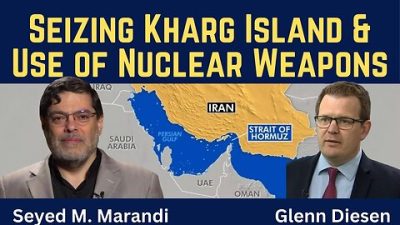
Marandi: Threat of Seizing Kharg Island & the Use of Nuclear Weapons
or go to
Aletho News Archives – Video-Images
Frlom the Archives
Iran War: United States Military Versus Israel Firsters
By James Petras | November 27, 2007
Why must Jewish organizations be and be seen as the loudest drum-beaters of all? Why can we not bring ourselves to say that military intervention is not on the table at all? Why not stash it under the table, out of sight and mount instead a diplomatic assault? – Leonard Fein, Forward
Introduction
As the White House and Congress escalate their economic sanctions and military threats against Iran, top military commanders and Pentagon officials have launched a counter-offensive, opposing a new Middle East War. While some commentators and journalists, like Chris Hedges (Truthdig, November 13, 2007), privy to this high stakes inter-elite conflict, attribute this to a White House cabal led by Vice President Cheney, a more stringent and accurate assessment puts the Zionist Power Configuration (ZPC) in the center of the Iran war debate.
There is a great deal riding in this conflict – the future of the American empire as well as the balance of power in the Middle East. Equally important is the future of the US military and our already heavily constrained democratic freedoms. The outcome of the continuous and deepening confrontation between top US military officials and the Israel Firsters over US foreign policy in the Middle East has raised fundamental questions over self-determination, colonization, civilian primacy and military political intervention, empire or republic. These and related issues are far from being of academic interest only; they concern the future of the United States. … continue
Blog Roll
 Aletho News
- Who Is closer to collapse?
- A War that Backfired: Why the US-Israeli Campaign Is Strengthening Iran
- How Zionist Control Is Hurting US Interests
- Iran warns it may target US missile launch sites in UAE cities
- American Military Failure in Afghanistan
- Friendly Skies of Georgia: Are Israeli-Linked Drones Launching False Flags from Georgian Territory?
- The Three Big Lies about Mammography Screening
- Ukrainian Embassy in Beirut sheltering top Mossad agent
- Palestinian family displaced after settlers violently attack them in Humsa, Jordan Valley
- The EU never learns – except for the wrong lessons
- If Americans Knew
- No let-up in attacks on Gaza as Israel takes on Iran, Lebanon – Not a ceasefire Day 155
- ‘Of Course’: IDF Drops Case Against Soldiers Accused of Raping Palestinian Prisoner
- Don’t Fall for the Regime Change Talk. Israel Is ‘Mowing the Lawn’ in Iran
- Will Israel and the US wreck the Gulf States along with Iran?
- US so far burned through ‘years’ of munitions in Iran war: Report
- How the Israeli Tail Wags the American Dog
- Outdated intel likely led to deadly U.S. strike on Iranian elementary school, sources say
- Pentagon insider says high U.S official Douglas Feith reported to Netanyahu
- In fond memory of Walid Khalidi, the historian of Palestine
- 6 more Americans killed, as Israel ‘mows the lawn’ in Iran – Not a ceasefire Day 154
- No Tricks Zone
- Storing Green Energy To Last Germany 10 Days Would Require A 60-Million Tonne Battery
- New Studies: UK Sea Levels Were 4 Meters Higher Than Today During The Mid-Holocene
- Destructive Green New Deal: German Energy And Metal Group Warns Of Drastic Crisis
- New Study Documents A 20-Year Pause In Arctic Sea Ice Decline – Driven By Internal Variability
- Wake-up Call: Survey Shows Majority Of Germans Now Favor Postponing Climate Targets!
- Televised! Leading German Political Candidate Tells Schoolchildren CO2 Makes Sun Hotter!
- New Study: A Century Warming Of 1.1°C Is ‘Commonplace’ And ‘Not Unusual’ During This Interglacial
- New Study: ‘Internal Noise’ And Volcanic Forcing Can Trigger 10-15°C Warming Within Decades
- Glaciers Worldwide Are Suddendly Surging, Experts Blame Warming!
- Surprising Discovery: Sahara Is Greening…Billions Of Trees Where Once Thought To Be Barren
 Aletho News