13 Israeli Violations against Journalists in April

By Tareq Astal | IMEMC News & Agencies | May 9, 2019
In its monthly report on Israeli violations against journalists, published today, WAFA said that 11 journalists were injured from rubber-coated metal bullets, live bullets and tear gas canisters, fired by Israeli soldiers, as well as from severe beatings. At the same time, one journalist was detained and another had his press papers seized.
On April 3, the Jerusalem District Court rejected an appeal filed by Mustafa Kharouf, a photographer with Turkish Anadolu news agency, to release him from prison so that he can be with his family in Jerusalem, and kept him incarcerated until May 5, the date he is to be expelled to Jordan. (Kharouf’s attorney got an injunction from the Israeli High Court on May 5, stopping his expulsion until it hears his plea.)
On April 5, Israeli forces shot Amad News Agency correspondent Safinaz al-Louh, with a teargas grenade, in her right foot, and Noor News photographer Mohammad Issa with a gas bomb, in his leg, while covering the March of Return protests, east of the Gaza Strip.
On April 10, Israeli forces raided the home of Ra’ed al-Sharif, in Hebron, holding his family in one room before embarking on a thorough search of the house and tampering with its contents.
On April 12, Israeli forces shot Filistin al-Hadath photographer and correspondent Ahmed al-Zurei, with a rubber-coated bullet, in the abdomen, while he was covering protests east of al-Bureij, in the central Gaza Strip.
On April 19, freelance photographer Abdel Rahim al-Khatib was hit with a rubber-coated bullet, in the left thigh, and Reuters photographer Bassam Massoud with a gas grenade, behind his left ear. A similar bomb injured Watan Radio reporter Mohammad al-Louh and freelance photographers Mahmoud Badr, in the left foot, and Ahmad Washah, in the head, while covering protests east of the Gaza Strip.
In the same day, Xinhua photographer Nidal Shtayeh and WAFA photographer Ayman Noubani were shot with rubber-coated metal bullets, in their thighs, while covering the Israeli army’s crackdown on the weekly protests in Kufr Qaddoum village, east of Qalqilia, in the north of the West Bank.
On April 26, Israeli forces targeted Shihab News Agency photographer Ramadan al-Sharif, with a live bullet that hit him in his right foot, while he covered protests east of Rafah, in southern Gaza.
The daily attacks on journalists in the West Bank are part of an ongoing Israeli policy against their activities and their role in covering the practices and violations committed by these forces, against Palestinian civilians and property.
Boondoggle, Inc.
Making Sense of the $1.25 Trillion National Security State Budget
By William D. Hartung and Mandy Smithberger | TomDispatch | May 7, 2019
In its latest budget request, the Trump administration is asking for a near-record $750 billion for the Pentagon and related defense activities, an astonishing figure by any measure. If passed by Congress, it will, in fact, be one of the largest military budgets in American history, topping peak levels reached during the Korean and Vietnam Wars. And keep one thing in mind: that $750 billion represents only part of the actual annual cost of our national security state.
There are at least 10 separate pots of money dedicated to fighting wars, preparing for yet more wars, and dealing with the consequences of wars already fought. So the next time a president, a general, a secretary of defense, or a hawkish member of Congress insists that the U.S. military is woefully underfunded, think twice. A careful look at U.S. defense expenditures offers a healthy corrective to such wildly inaccurate claims.
Now, let’s take a brief dollar-by-dollar tour of the U.S. national security state of 2019, tallying the sums up as we go, and see just where we finally land (or perhaps the word should be “soar”), financially speaking.
The Pentagon’s “Base” Budget: The Pentagon’s regular, or “base,” budget is slated to be $544.5 billion in Fiscal Year 2020, a healthy sum but only a modest down payment on total military spending.
As you might imagine, that base budget provides basic operating funds for the Department of Defense, much of which will actually be squandered on preparations for ongoing wars never authorized by Congress, overpriced weapons systems that aren’t actually needed, or outright waste, an expansive category that includes everything from cost overruns to unnecessary bureaucracy. That $544.5 billion is the amount publicly reported by the Pentagon for its essential expenses and includes as well $9.6 billion in mandatory spending that goes toward items like military retirement.
Among those basic expenses, let’s start with waste, a category even the biggest boosters of Pentagon spending can’t defend. The Pentagon’s own Defense Business Board found that cutting unnecessary overhead, including a bloated bureaucracy and a startlingly large shadow workforce of private contractors, would save $125 billion over five years. Perhaps you won’t be surprised to learn that the board’s proposal has done little to quiet calls for more money. Instead, from the highest reaches of the Pentagon (and the president himself) came a proposal to create a Space Force, a sixth military service that’s all but guaranteed to further bloat its bureaucracy and duplicate work already being done by the other services. Even Pentagon planners estimate that the future Space Force will cost $13 billion over the next five years (and that’s undoubtedly a low-ball figure).
In addition, the Defense Department employs an army of private contractors — more than 600,000 of them — many doing jobs that could be done far more cheaply by civilian government employees. Cutting the private contractor work force by 15% to a mere half-million people would promptly save more than $20 billion per year. And don’t forget the cost overruns on major weapons programs like the Ground-Based Strategic Deterrent — the Pentagon’s unwieldy name for the Air Force’s new intercontinental ballistic missile — and routine overpayments for even minor spare parts (like $8,000 for a helicopter gear worth less than $500, a markup of more than 1,500%).
Then there are the overpriced weapons systems the military can’t even afford to operate like the $13-billion aircraft carrier, 200 nuclear bombers at $564 million a pop, and the F-35 combat aircraft, the most expensive weapons system in history, at a price tag of at least $1.4 trillion over the lifetime of the program. The Project On Government Oversight (POGO) has found — and the Government Accountability Office recently substantiated — that, despite years of work and staggering costs, the F-35 may never perform as advertised.
And don’t forget the Pentagon’s recent push for long-range strike weapons and new reconnaissance systems designed for future wars with a nuclear-armed Russia or China, the kind of conflicts that could easily escalate into World War III, where such weaponry would be beside the point. Imagine if any of that money were devoted to figuring out how to prevent such conflicts, rather than hatching yet more schemes for how to fight them.
Base Budget total: $554.1 billion
The War Budget: As if its regular budget weren’t enough, the Pentagon also maintains its very own slush fund, formally known as the Overseas Contingency Operations account, or OCO. In theory, the fund is meant to pay for the war on terror — that is, the U.S. wars in Afghanistan, Iraq, Somalia, Syria, and elsewhere across the Middle East and Africa. In practice, it does that and so much more.
After a fight over shutting down the government led to the formation of a bipartisan commission on deficit reduction — known as Simpson-Bowles after its co-chairs, former Clinton Chief of Staff Erskine Bowles and former Republican Senator Alan Simpson — Congress passed the Budget Control Act of 2011. It officially put caps on both military and domestic spending that were supposed to save a total of $2 trillion over 10 years. Half of that figure was to come from the Pentagon, as well as from nuclear weapons spending at the Department of Energy. As it happened, though, there was a huge loophole: that war budget was exempt from the caps. The Pentagon promptly began to put tens of billions of dollars into it for pet projects that had nothing whatsoever to do with current wars (and the process has never stopped). The level of abuse of this fund remained largely secret for years, with the Pentagon admitting only in 2016 that just half of the money in the OCO went to actual wars, prompting critics and numerous members of Congress — including then-Congressman Mick Mulvaney, now President Trump’s latest chief of staff — to dub it a “slush fund.”
This year’s budget proposal supersizes the slush in that fund to a figure that would likely be considered absurd if it weren’t part of the Pentagon budget. Of the nearly $174 billion proposed for the war budget and “emergency” funding, only a little more than $25 billion is meant to directly pay for the wars in Iraq, Afghanistan, and elsewhere. The rest will be set aside for what’s termed “enduring” activities that would continue even if those wars ended, or to pay for routine Pentagon activities that couldn’t be funded within the constraints of the budget caps. The Democratic-controlled House of Representatives is expected to work to alter this arrangement. Even if the House leadership were to have its way, however, most of its reductions in the war budget would be offset by lifting caps on the regular Pentagon budget by corresponding amounts. (It’s worth noting that President Trump’s budget calls for someday eliminating the slush fund.)
The 2020 OCO also includes $9.2 billion in “emergency” spending for building Trump’s beloved wall on the U.S.-Mexico border, among other things. Talk about a slush fund! There is no emergency, of course. The executive branch is just seizing taxpayer dollars that Congress refused to provide. Even supporters of the president’s wall should be troubled by this money grab. As 36 former Republican members of Congress recently argued, “What powers are ceded to a president whose policies you support may also be used by presidents whose policies you abhor.” Of all of Trump’s “security”-related proposals, this is undoubtedly the most likely to be eliminated, or at least scaled back, given the congressional Democrats against it.
War Budget total: $173.8 billion
Running tally: $727.9 billion
The Department of Energy/Nuclear Budget: It may surprise you to know that work on the deadliest weapons in the U.S. arsenal, nuclear warheads, is housed in the Department of Energy (DOE), not the Pentagon. The DOE’s National Nuclear Security Administration runs a nationwide research, development, and production network for nuclear warheads and naval nuclear reactors that stretches from Livermore, California, to Albuquerque and Los Alamos, New Mexico, to Kansas City, Missouri, to Oak Ridge, Tennessee, to Savannah River, South Carolina. Its laboratories also have a long history of program mismanagement, with some projects coming in at nearly eight times the initial estimates.
Nuclear Budget total: $24.8 billion
Running tally: $752.7 billion
“Defense Related Activities”: This category covers the $9 billion that annually goes to agencies other than the Pentagon, the bulk of it to the FBI for homeland security-related activities.
Defense Related Activities total: $9 billion
Running tally: $761.7 billion
The five categories outlined above make up the budget of what’s officially known as “national defense.” Under the Budget Control Act, this spending should have been capped at $630 billion. The $761.7 billion proposed for the 2020 budget is, however, only the beginning of the story.
The Veterans Affairs Budget: The wars of this century have created a new generation of veterans. In all, over 2.7 million U.S. military personnel have cycled through the conflicts in Iraq and Afghanistan since 2001. Many of them remain in need of substantial support to deal with the physical and mental wounds of war. As a result, the budget for the Department of Veterans Affairs has gone through the roof, more than tripling in this century to a proposed $216 billion. And this massive figure may not even prove enough to provide the necessary services.
More than 6,900 U.S. military personnel have died in Washington’s post-9/11 wars, with more than 30,000 wounded in Iraq and Afghanistan alone. These casualties are, however, just the tip of the iceberg. Hundreds of thousands of returning troops suffer from post-traumatic stress disorder (PTSD), illnesses created by exposure to toxic burn pits, or traumatic brain injuries. The U.S. government is committed to providing care for these veterans for the rest of their lives. An analysis by the Costs of War Project at Brown University has determined that obligations to veterans of the Iraq and Afghan wars alone will total more than $1 trillion in the years to come. This cost of war is rarely considered when leaders in Washington decide to send U.S. troops into combat.
Veterans Affairs total: $216 billion
Running tally: $977.7 billion
The Homeland Security Budget: The Department of Homeland Security (DHS) is a mega-agency created after the 9/11 attacks. At the time, it swallowed 22 then-existing government organizations, creating a massive department that currently has nearly a quarter of a million employees. Agencies that are now part of DHS include the Coast Guard, the Federal Emergency Management Agency (FEMA), Customs and Border Protection, Immigration and Customs Enforcement (ICE), Citizenship and Immigration Services, the Secret Service, the Federal Law Enforcement Training Center, the Domestic Nuclear Detection Office, and the Office of Intelligence and Analysis.
While some of DHS’s activities — such as airport security and defense against the smuggling of a nuclear weapon or “dirty bomb” into our midst — have a clear security rationale, many others do not. ICE — America’s deportation force — has done far more to cause suffering among innocent people than to thwart criminals or terrorists. Other questionable DHS activities include grants to local law enforcement agencies to help them buy military-grade equipment.
Homeland Security total: $69.2 billion
Running tally: $1.0469 trillion
The International Affairs Budget: This includes the budgets of the State Department and the U.S. Agency for International Development (USAID). Diplomacy is one of the most effective ways to make the United States and the world more secure, but it has been under assault in the Trump years. The Fiscal Year 2020 budget calls for a one-third cut in international affairs spending, leaving it at about one-fifteenth of the amount allocated for the Pentagon and related agencies grouped under the category of “national defense.” And that doesn’t even account for the fact that more than 10% of the international affairs budget supports military aid efforts, most notably the $5.4 billion Foreign Military Financing (FMF) program. The bulk of FMF goes to Israel and Egypt, but in all over a dozen countries receive funding under it, including Jordan, Lebanon, Djibouti, Tunisia, Estonia, Latvia, Lithuania, Ukraine, Georgia, the Philippines, and Vietnam.
International Affairs total: $51 billion
Running tally: $1.0979 trillion
The Intelligence Budget: The United States has 17 separate intelligence agencies. In addition to the DHS Office of Intelligence and Analysis and the FBI, mentioned above, they are the CIA; the National Security Agency; the Defense Intelligence Agency; the State Department’s Bureau of Intelligence and Research; the Drug Enforcement Agency’s Office of National Security Intelligence; the Treasury Department’s Office of Intelligence and Analysis; the Department of Energy’s Office of Intelligence and Counterintelligence; the National Reconnaissance Office; the National Geospatial-Intelligence Agency; Air Force Intelligence, Surveillance and Reconnaissance; the Army’s Intelligence and Security Command; the Office of Naval Intelligence; Marine Corps Intelligence; and Coast Guard Intelligence. And then there’s that 17th one, the Office of the Director of National Intelligence, set up to coordinate the activities of the other 16.
We know remarkably little about the nature of the nation’s intelligence spending, other than its supposed total, released in a report every year. By now, it’s more than $80 billion. The bulk of this funding, including for the CIA and NSA, is believed to be hidden under obscure line items in the Pentagon budget. Since intelligence spending is not a separate funding stream, it’s not counted in our tally below (though, for all we know, some of it should be).
Intelligence Budget total: $80 billion
Running tally (still): $1.0979 trillion
Defense Share of Interest on the National Debt: The interest on the national debt is well on its way to becoming one of the most expensive items in the federal budget. Within a decade, it is projected to exceed the Pentagon’s regular budget in size. For now, of the more than $500 billion in interest taxpayers fork over to service the government’s debt each year, about $156 billion can be attributed to Pentagon spending.
Defense Share of National Debt total: $156.3 billion
Final tally: $1.2542 trillion
So, our final annual tally for war, preparations for war, and the impact of war comes to more than $1.25 trillion — more than double the Pentagon’s base budget. If the average taxpayer were aware that this amount was being spent in the name of national defense — with much of it wasted, misguided, or simply counterproductive — it might be far harder for the national security state to consume ever-growing sums with minimal public pushback. For now, however, the gravy train is running full speed ahead and its main beneficiaries — Lockheed Martin, Boeing, Northrop Grumman, and their cohorts — are laughing all the way to the bank.
William D. Hartung is the director of the Arms and Security Project at the Center for International Policy and the author of Prophets of War: Lockheed Martin and the Making of the Military-Industrial Complex.
Mandy Smithberger is the director of the Center for Defense Information at the Project On Government Oversight.
Copyright 2019 William D. Hartung and Mandy Smithberger
US-backed SDF militants kill six civilians during raid in Syria’s Dayr al-Zawr
Press TV – May 9, 2019
Kurdish-led militants from the so-called Syrian Democratic Forces (SDF), backed by helicopters from the US-led coalition, have reportedly stormed a town in Syria’s eastern province of Dayr al-Zawr, killing and injuring a number of locals.
Local sources, requesting not to be named, told Syria’s official news agency SANA that the US-sponsored militants laid siege to the al-Katef neighborhood of al-Shuhayl town for more than two hours on Thursday, before raiding the area and firing at people indiscriminately.
The sources added that six civilians lost their lives and four others sustained injuries as a result. SDF militants rounded up a number of local residents as well.
Back in late April, hundreds of people took to the streets in the northeastern Syrian towns of al-Busayrah, Masheikh, al-Tayyana as well as the villages of Tal al-Dhaman, al-Namliyah and Tayyeb Al Faall to protest the presence of SDF militants, rising cases of abduction and assassination in their areas and plunder of Syria’s oil wealth by the US-sponsored forces.
The protesters closed the main roads to their areas, burning tires and demanding the expulsion of SDF militants from their hometowns.
Local sources said the Kurdish-led militants fired indiscriminately at demonstrators in al-Tayyana to disperse the protest. There were no reports about possible casualties.
The development came only a day after dozens of people staged demonstrations in the towns of al-Shuhayl, al-Sur and al-Hissan as well as Mweileh village against the presence of SDF militants in their areas.
Local residents, speaking on condition of anonymity, said the Kurdish-led forces opened fire on protesters in Hissan, injuring a number of them.
SDF militants illegally transport Dayr al-Zawr’s crude oil to neighboring Hasakah province in Syria’s northeast, a move that has angered local people.
The United States has long been providing the SDF, a Kurdish alliance, with arms and militants, calling them a key partner in the purported fight against the Daesh terrorist group.
Many observers, however, see the support in the context of Washington’s plans to carve out a foothold in the Arab country.
Such support has also angered Washington’s NATO ally, Turkey, which views militants of the People’s Protection Units (YPG), the backbone of the SDF, as a terrorist organization tied to the homegrown Kurdistan Workers’ Party (PKK) militant group.
The PKK has been seeking an autonomous Kurdish region in Turkey since 1984.
The Real Muellergate Scandal
By Craig Murray | May 9, 2019
Robert Mueller is either a fool, or deeply corrupt. I do not think he is a fool.
I did not comment instantly on the Mueller Report as I was so shocked by it, I have been waiting to see if any other facts come to light in justification. Nothing has. I limit myself here to that area of which I have personal knowledge – the leak of DNC and Podesta emails to Wikileaks. On the wider question of the corrupt Russian 1% having business dealings with the corrupt Western 1%, all I have to say is that if you believe that is limited in the USA by party political boundaries, you are a fool.
On the DNC leak, Mueller started with the prejudice that it was “the Russians” and he deliberately and systematically excluded from evidence anything that contradicted that view.
Mueller, as a matter of determined policy, omitted key steps which any honest investigator would undertake. He did not commission any forensic examination of the DNC servers. He did not interview Bill Binney. He did not interview Julian Assange. His failure to do any of those obvious things renders his report worthless.
There has never been, by any US law enforcement or security service body, a forensic examination of the DNC servers, despite the fact that the claim those servers were hacked is the very heart of the entire investigation. Instead, the security services simply accepted the “evidence” provided by the DNC’s own IT security consultants, Crowdstrike, a company which is politically aligned to the Clintons.
That is precisely the equivalent of the police receiving a phone call saying:
“Hello? My husband has just been murdered. He had a knife in his back with the initials of the Russian man who lives next door engraved on it in Cyrillic script. I have employed a private detective who will send you photos of the body and the knife. No, you don’t need to see either of them.”
There is no honest policeman in the world who would agree to that proposition, and neither would Mueller were he remotely an honest man.
Two facts compound this failure.
The first is the absolutely key word of Bill Binney, former Technical Director of the NSA, the USA’s $14 billion a year surveillance organisation. Bill Binney is an acknowledged world leader in cyber surveillance, and is infinitely more qualified than Crowdstrike. Bill states that the download rates for the “hack” given by Crowdstrike are at a speed – 41 Megabytes per second – that could not even nearly be attained remotely at the location: thus the information must have been downloaded to a local device, eg a memory stick. Binney has further evidence regarding formatting which supports this.
Mueller’s identification of “DC Leaks” and “Guccifer 2.0” as Russian security services is something Mueller attempts to carry off by simple assertion. Mueller shows DNC Leaks to have been the source of other, unclassified emails sent to Wikileaks that had been obtained under a Freedom of Information request and then Mueller simply assumes, with no proof, the same route was used again for the leaked DNC material. His identification of the Guccifer 2.0 persona with Russian agents is so flimsy as to be laughable. Nor is there any evidence of the specific transfer of the leaked DNC emails from Guccifer 2.0 to Wikileaks. Binney asserts that had this happened, the packets would have been instantly identifiable to the NSA.
Bill Binney is not a “deplorable”. He is the former Technical Director of the NSA. Mike Pompeo met him to hear his expertise on precisely this matter. Binney offered to give evidence to Mueller. Yet did Mueller call him as a witness? No. Binney’s voice is entirely unheard in the report.
Mueller’s refusal to call Binney and consider his evidence was not the action of an honest man.
The second vital piece of evidence we have is from Wikileaks Vault 7 release of CIA material, in which the CIA themselves outline their capacity to “false flag” hacks, leaving behind misdirecting clues including scraps of foreign script and language. This is precisely what Crowdstrike claim to have found in the “Russian hacking” operation.
So here we have Mueller omitting the key steps of independent forensic examination of the DNC servers and hearing Bill Binney’s evidence. Yet this was not for lack of time. While deliberately omitting to take any steps to obtain evidence that might disprove the “Russian hacking” story, Mueller had boundless time and energy to waste in wild goose chases after totally non-existent links between Wikileaks and the Trump campaign, including the fiasco of interviewing Roger Stone and Randy Credico.
It is worth remembering that none of the charges against Americans arising from the Mueller inquiry have anything to do with Russian collusion or Trump-Wikileaks collusion, which simply do not exist. The charges all relate to entirely extraneous matters dug up, under the extraordinary US system of “Justice”, to try to blackmail those charged with unrelated crimes turned up by the investigation, into fabricating evidence of Russian collusion. The official term for this process of blackmail is of course “plea-bargaining.”
Mueller has indicted 12 Russians he alleges are the GRU agents responsible for the “hack”. The majority of these turn out to be real people who, ostensibly, have jobs and lives which are nothing to do with the GRU. Mueller was taken aback when, rather than simply being in absentia, a number of them had representation in court to fight the charges. Mueller had to back down and ask for an immediate adjournment as soon as the case opened, while he fought to limit disclosure. His entire energies since on this case have been absorbed in submitting motions to limit disclosure, individual by individual, with the object of ensuring that the accused Russians can be convicted without ever seeing, or being able to reply to, the evidence against them. Which is precisely the same as his attitude to contrary evidence in his Report.
Mueller’s failure to examine the servers or take Binney’s evidence pales into insignificance compared to his attack on Julian Assange. Based on no conclusive evidence, Mueller accuses Assange of receiving the emails from Russia. Most crucially, he did not give Assange any opportunity to answer his accusations. For somebody with Mueller’s background in law enforcement, declaring somebody in effect guilty, without giving them any opportunity to tell their side of the story, is plain evidence of malice.
Inexplicably, for example, the Mueller Report quotes a media report of Assange stating he had “physical proof” the material did not come from Russia, but Mueller simply dismisses this without having made any attempt at all to ask Assange himself.
It is also particularly cowardly as Julian was and is held incommunicado with no opportunity to defend himself. Assange has repeatedly declared the material did not come from the Russian state or from any other state. He was very willing to give evidence to Mueller, which could have been done by video-link, by interview in the Embassy or by written communication. But as with Binney and as with the DNC servers, the entirely corrupt Mueller was unwilling to accept any evidence which might contradict his predetermined narrative.
Mueller’s section headed “The GRU’s Transfer of Stolen Material to Wikileaks” is a ludicrous farrago of internet contacts between Wikileaks and persons not proven to be Russian, transferring material not proven to be the DNC leaks. It too is destroyed by Binney and so pathetic that, having pretended he had proven the case of internet transfer, Mueller then gives the game away by adding “The office cannot rule out that stolen documents were transferred by intermediaries who visited during the summer of 2016”. He names Mr Andrew Muller-Maguhn as a possible courier. Yet again, he did not ask Mr Muller-Maguhn to give evidence. Nor did he ask me, and I might have been able to help him on a few of these points.
To run an “investigation” with a pre-determined idea as to who are the guilty parties, and then to name and condemn those parties in a report, without hearing the testimony of those you are accusing, is a method of proceeding that puts the cowardly and corrupt Mr Mueller beneath contempt.
Mueller gives no evidence whatsoever to back up his simple statement that Seth Rich was not the source of the DNC leak. He accuses Julian Assange of “dissembling” by referring to Seth Rich’s murder. It is an interesting fact that the US security services have shown precisely the same level of interest in examining Seth Rich’s computers that they have shown in examining the DNC servers. It is also interesting that this murder features in a report of historic consequences like that of Mueller, yet has had virtually no serious resource put into finding the killer.
Mueller’s condemnation of Julian Assange for allegedly exploiting the death of Seth Rich, would be infinitely more convincing if the official answer to the question “who murdered Seth Rich?” was not “who cares?”.
The Strange Case of Chrystia Freeland and the Failure of the ‘Super Elite’
By Matthew Ehret | Strategic Culture Foundation | May 9, 2019
Canadian Foreign Minister Chrystia Freeland has become a bit of a living parody of everything wrong with the detached technocratic neo-liberal order which has driven the world through 50 years of post-industrial decay. Now, two years into the Trump presidency, and five years into the growth of a new system shaped by the Russia-China alliance, the world has become a very different place from the one which Freeland and her controllers wish it to be.
Having been set up as a counterpart to the steely Hillary Clinton who was supposed to win the 2016 election, Freeland and her ilk have demonstrated their outdated thinking in everything they have set out to achieve since the 2014 coup in Ukraine. Certainly before that, everything seemed to be going smoothly enough for End of History disciples promoting a script that was supposed to culminate in a long-sought for “New World Order”.
The Script up until Now
Things were going especially well since the collapse of the Soviet system in the early 1990s. The collapse ushered in a unipolar world order with the European Union and NAFTA, followed soon thereafter by the World Trade Organization and the 1999 destruction of Glass-Steagall (1). The trans-Atlantic at last was converted into a cage of “post-sovereign nations” that no longer had actual control of their own powers of credit generation. Under NATO, even national militaries were subject to technocratic control. This cage was perfect for the governing elite “scientifically managing” from above while the little people bickered over their diminishing employment and standards of living from below.
Even though the former Soviet bloc nations were in tatters by 1992, their sovereign powers could only be undone by applying the liberalization process which took 30 years in the west in a short space of only a decade. This was done under the direction of such monetarist “reformers” such as Anatoly Chubais and Yegor Gaidar under Yeltsin. Similar privatization and liberalization reforms were applied viciously to Ukraine and other Warsaw pact countries during the same period. Those pirates that became the “nouveau riche” of the west were joined by such contemporary modern oligarchs such as Oleg Deripaska, Boris Berezovksy, Mikhail Fridman, Roman Abramovich in Russia, alongside Petro Poroshenko, Rinat Akhmetov, Mikhail Khodorkovsky and Viktor Pinchuk of Ukraine (to name a few). Not to forget their spiritual roots, many of these oligarchs soon purchased houses in the swank upmarket sections of London which has come to be known as “Moscow on Thames.” (2)
By the end of the 1990s a new phase of this de-nationalization was unleashed with the unveiling of the Blair doctrine explicitly calling for a “post-Westphalia” world order which unleashed a wave of hellish regime change wars in the Arab World beginning with 9-11, and with a long term intention to target Libya, Syria, Iran, and Lebanon while expanding NATO’s hegemony against the potential re-emergence of Russia and China.
The Economic Meltdown Was Always the Intention
Let’s be clear: the whole point of the post-1971 world was directed with the intention of destroying the moral-political and economic foundations for western society. The belief in scientific progress and industrial growth was the cause of all true progress from the 15th century Golden Renaissance to the assassinations of the 1960s. The intended consequences of this post-1971 (zero growth) policy were:
1) The destruction of the productive forces of labor vis a vis outsourcing to “cheap labour markets” driven by shareholder profit.
2) The consolidation of wealth into an ever smaller array of private multi-billionaire owners under a logic of Darwinian survival of the fittest.
3) The creation of a vast speculative bubble supported by ever greater rates of unpayable debt and totally detached from the physically productive forces of reality.
Just like 1929, after years of speculation known as the roaring twenties, the “plug could be pulled” on the bubble in order to impose a bit of shock therapy onto a sleeping population who would beg for fascism as a solution if only it would put bread on their tables. Though this plan failed 80 years ago due to the American rejection of fascism under President Roosevelt, the belief that the formula could succeed in the 21st century was adhered to most closely as long as America was brought firmly under control of the City of London and their Wall Street lackies (3).
Although the fascist “solution” to their manufactured crisis was put down during WWII, this new attempt was premised upon the policy that a new system of Global Government managed by draconian regulation would be imposed under a “Green New Deal” framework whereby the instruments of banking regulation, state directed capital and centralized government (not evils unto themselves), would be directed only to green, low energy flux density forms of energy which inherently lower the population of the earth. This is very different from the protectionism, bank regulation, state credit and central authority exerted by America during the 1930s New Deal (or Eurasian New Silk Road policy today). The difference is that one system empowers sovereign nations, and increases the productive powers of labor and energy flux density of humanity while increasing quality of life, the other “Green” agenda has the opposite effect whereby monetary incentives are tied to decreasing the “carbon footprint” of the earth. The image of a drug addict getting paid heroine as an incentive to bleed himself to death is useful here.
With the slow collapse of first world economies after the assassination of nationalist leaders in the 1960s, the plan for depopulation and global government seemed to be unfolding without serious opposition.
The Role of Chrystia Freeland
Freeland’s bizarre role in this whole affair was to do what every good Rhodes Scholar is conditioned to do upon their completion of their indoctrination at Oxford: facilitate the tough transition of the “pre-collapse” world economy into a new operating system that was meant to be the “green post-collapse” world economy. It wasn’t going to be easy to tell a new “pirate class” of billionaires that they would have to accept losing much of their wealth (less population equals less money), and operate under a strict new global operating system of regulation necessary to contract the society. The Rhodes Scholarship program begun in 1902 to advance a re-organized British Empire and had worked alongside the Fabian Society for over a century producing more than 7000 scholars who have permeated across all fields of society (media, education, government, military and corporate).
In his 1877 will, Cecil Rhodes said this group should be “a society which should have its members in every part of the British Empire working with one object and one idea we should have its members placed at our universities and our schools and should watch the English youth passing through their hands just one perhaps in every thousand would have the mind and feelings for such an object, he should be tried in every way, he should be tested whether he is endurant, possessed of eloquence, disregardful of the petty details of life, and if found to be such, then elected and bound by oath to serve for the rest of his life in his Country. He should then be supported if without means by the Society and sent to that part of the Empire where it was felt he was needed.”
After leaving Oxford in 1993, Chrystia Freeland learned the ropes of “perception management” by working for the London Economist, Washington Post, Financial Times and Globe and Mail and Reuters. After serving a stint as editor-at-large of Reuters, the time had come for her to play the role of Valery Jarrett to the “Barack Obama” of Canada then being prepped for Prime Ministership of Justin Trudeau.
She was perfect.
As an asset of the global propaganda system, Freeland had made high level contacts with those Ukrainian, Russian, and Western oligarchs mentioned above including Viktor Pinchuk and Mikhail Khodorkovsky. Larry Summers, George Soros and Al Gore, were just a few players in the west whom she considered her “close friends” and whom she was happy to bring into Canada during the period of re-organization of the Liberal Party (2011-2014) as it prepared to take power under the banner of the Canada 2020 think tank. What made Freeland even more special was that she was bred from a zealous family of Ukrainian nationalists under the patriarchy of her Nazi grandfather Michael Chomiak. This network was brought to Canada after WWII by Anglo-American intelligence and cultivated as a force with ties to pro-Nazi Ukrainian counterparts ever since.
Freeland’s admission into politics was managed by another Rhodes Scholar named Bob Rae who served as interim controller of the Liberal Party during several of the Harper years and was a major player in Canada 2020. Rae, who had been the NDP Premier of Ontario from 1990-1995 was happy to abdicate his seat to Freeland ensuring her entry into Trudeau’s inner circle and thus becoming his official handler (4).
Freeland Promotes the New Global Elite
Freeland has made it clear that she understands well that there is a fundamental difference in cultural identities of the “new rich” relative to the older oligarchic families which she serves. In the 2011 Rise of the New Global Elite, she describes it as follows:
“To grasp the difference between today’s plutocrats and the hereditary elite, who “grow rich in their sleep” one need merely glance at the events that now fill high-end social calendars.”
Freeland then breaks down the categories of “new plutocrats” into two subcategories: the good, technocratic friendly plutocrats who are ideologically compatible with the New World Order of depopulation, such as Bill Gates, Warren Buffet, George Soros, et al and the “bad” plutocrats who tend not to conform to the British Empire’s program of global governance and depopulation under the green agenda. In Freeland’s world “good oligarchs” are those who adhere to this agenda, while “bad oligarchs” are those who do not. Trump is a terrible Plutocrat, and – Viktor Yanukovych was a good plutocrat until he decided to not sacrifice Ukraine on the altar of the collapsing European Union and chose to throw Ukraine’s destiny into the Eurasian Economic Union in October 2013.
In the same paper, Freeland wrote:
“if the plutocrats’ opposition to increases in their taxes and tighter regulation of their economic activities is understandable, it is also a mistake. The real threat facing the super-elite, at home and abroad, isn’t modestly higher taxes, but rather the possibility that inchoate public rage could cohere into a more concrete populist agenda– that, for instance, middle-class Americans could conclude that the world economy isn’t working for them and decide that protectionism… is preferable to incremental measures.” Quoting billionaire Mohamed El-Erian, the CEO of Pimco she wrote: “one of the big surprises of 2010 is that the protectionist dog didn’t bark.”
Freeland ended her article with this message:
“The lesson of history is that, in the long run, super-elites have two ways to survive: by suppressing dissent or by sharing their wealth… Let us hope the plutocrats aren’t already too isolated to recognize this”.
But what does Freeland really think of the technocratic management under a plutocratic governance of society? In Plutocrats vs. Populists (Nov. 2013), Freeland lets her pro-plutocratic worldview out of the bag when she gushes:
“At its best, this form of plutocratic political power offers the tantalizing possibility of policy practiced at the highest professional level with none of the messiness and deal making and venality of traditional politics… a technocratic, data-based, objective search for solutions to our problems”
Since a technocratic managerial class committed to a common ideology must be solidified for this system to work, Freeland goes on to make the case to recruit young people to the imperial civil service:
“Smart, publicly minded technocrats go to work for plutocrats whose values they share. The technocrats get to focus full time on the policy issues they love, without the tedium of building, rallying– and serving– a permanent mass membership. They can be pretty well paid to boot.”
The End of a Delusion?
Now that Russia and China’s new operating system shaped by the Belt and Road Initiative has created a force of opposition to this British-run Deep State design, nothing which those would-be gods of Olympus have attempted to achieve has succeeded. Syria stands strong and the Arab nations are increasingly joining China’s Belt and Road Initiative. Venezuela has failed to fall the way so many regimes have done before 2014 and NAFTA has been seriously challenged by a nationalistic president in the USA who has also totally rejected the Malthusian agenda with the killing of COP21 and the Green New Deal. Trudeau’s usefulness has withered away quicker than you can say “SNC Lavalin” and now the decision appears to be seriously humored whether Freeland will take the reins of Canada after Trudeau is eliminated in order to “preserve the dying British Empire” and the dream of Cecil Rhodes. While the universe may be organized by a principle of reason, no one can say the same applies to the mind of an oligarchic.
Notes
(1) The separation of speculative from commercial banking was the bedrock of financial regulation since its implementation in 1933. Its destruction as Clinton’s last act in office resulted in the creation of the largest bubble in history amounting to a $700 trillion derivatives time bomb now ready to explode.
(2) When Putin began exiling many of these unrepentant oligarchs, they quickly made their way to London where many became disposable playthings of the British Empire.
(3) The self-professed “Fabian Society of Canada” was set up in the height of the Depression by five Rhodes Scholars in order to create a Canadian fascist regime in 1932. This organization known as the League of Social Reconstruction, set up a political party called the Cooperative Commonwealth Federation (CCF) which later changed its name to the New Democratic Party (NDP) in 1961. While good people have found themselves members of the NDP and Liberals over the years, it is useful to keep in mind that this rotten core tied to the highest echelons of the British oligarchy are real.
(4) It is a useful point to make here that as Premier of Ontario Bob Rae brought in Maurice Strong as President of Ontario Hydro from 1992-1994 during which time Canada’s nuclear sector was nearly shut down and a prototype for a “green New Deal” was applied. Strong had famously described a “fiction book he wished to write someday saying: “What if a small group of world leaders were to conclude that the principal risk to the Earth comes from the actions of the rich countries? And if the world is to survive, those rich countries would have to sign an agreement reducing their impact on the environment. Will they do it? The group’s conclusion is ‘no’. The rich countries won’t do it. They won’t change. So, in order to save the planet, the group decides: Isn’t the only hope for the planet that the industrialized civilizations collapse? Isn’t it our responsibility to bring that about?”
Pandering to Israel Means War With Iran
By Philip Giraldi | Strategic Culture Foundation | May 9, 2019
The United States is moving dangerously forward in what appears to be a deliberate attempt to provoke a war with Iran, apparently based on threat intelligence provided by Israel. The claims made by National Security Advisor John Bolton and by Secretary of State Mike Pompeo that there is solid evidence of Iran’s intention to attack US forces in the Persian Gulf region is almost certainly a fabrication, possibly deliberately contrived by Bolton and company in collaboration with Prime Minister Benjamin Netanyahu. It will be used to justify sending bombers and additional naval air resources to confront any possible moves by Tehran to maintain its oil exports, which were blocked by Washington last week. If the US Navy tries to board ships carrying Iranian oil it will undoubtedly, and justifiably, provoke a violent response from Iran, which is precisely what Bolton, Pompeo and Netanyahu are seeking.
It would be difficult to find in the history books another example of a war fought for no reason whatsoever. As ignorant as President Donald Trump and his triumvirate or psychotics Bolton, Pompeo and Elliott Abrams are, even they surely know that Iran poses no threat to the United States. If they believe at all that a war is necessary, they no doubt base their judgment on the perception that the United States must maintain its number one position in the world by occasionally attacking and defeating someone to serve as an example of what might happen if one defies Washington. Understanding that, the Iranians would be wise to avoid confrontation until the sages in the White House move on to some easier target, which at the moment would appear to be Venezuela.
The influence of Israel over US foreign policy is undeniable, with Washington now declaring that it will “review ties” with other nations that are considered to be unfriendly to the Jewish state. For observers who might also believe that Israel and its allies in the US are the driving force behind America’s belligerency in the Middle East, there are possibly some other games that are in play, all involving Benjamin Netanyahu and his band of merry cutthroats. It is becoming increasingly apparent that foreign politicians have realized that the easiest way to gain Washington’s favor is to do something that will please Israel. In practical terms, the door to Capitol Hill and the White House is opened through the good offices of the American Israel Public Affairs Committee (AIPAC).
Israel is desperate to confirm its legitimacy in international fora, where it has few friends in spite of an intensive lobbying campaign. It seeks to have countries that do not have an embassy in Israel to take steps to establish one, and it also wants more nations that do already have an embassy in Tel Aviv to move to Jerusalem, building on the White House’s decision taken last year to do just that. Not surprisingly, nations and political leaders who are on the make and want American support have drawn the correct conclusions and pander to Israel as a first step.
One only has to cite the example of Venezuela. Juan Guaido, the candidate favored by Washington for regime change, has undoubtedly a lot of things on his plate but he has proven willing to make some time to say what Benjamin Netanyahu wants to hear, as reported by the Israeli media. The Times of Israel describes how “Venezuela’s self-proclaimed leader Juan Guaido is working to re-establish diplomatic relations with Israel and isn’t ruling out placing his country’s embassy in Jerusalem, according to an interview with an Israeli newspaper published Tuesday.”
One would think that Guaido would consider his interview sufficient, but he has also taken the pandering process one step farther, reportedly displaying huge video images of the flags of both Israel and the United States at his rallies.
This deference to Israel’s interests produced an almost immediate positive result with Netanyahu recognizing him as the legitimate Venezuelan head of state, followed by an echo chamber of effusive congratulations from US (sic) Ambassador to Israel David Friedman, who praised the Jewish state for “standing with the people of Venezuela and the forces of freedom and democracy.” Donald Trump’s esteemed special envoy for international negotiations, Jason Greenblatt, also joined in, praising the Israeli government for its “courageous stand in solidarity with the Venezuelan people.”
A similar bonding took place regarding Brazil, where hard right conservative leader Jair Bolsonaro was recently elected president. Netanyahu attended the Bolsonaro inauguration last December and the two men benefit from strong support from Christian Evangelicals. Bolsonaro repaid the favor by promising that Israel would be his first foreign trip. In the event he went to Washington first, but the state visit to Israel took place in April, just before that country’s elections, in a bid to demonstrate international support for Netanyahu.
Brazilian Jews constitute a wealthy and powerful community which reacted positively to Bolsonaro’s pledges to fight corruption and high crime rates while also repairing a struggling economy. They also appreciated his stance on Israel. He committed to moving the Brazilian embassy to Jerusalem from Tel Aviv, though he has backpedaled a bit on that pledge. And he also promised to shut the Palestinian embassy in the capital Brasilia. He famously asked and answered his own question, “Is Palestine a country? Palestine is not a country, so there should be no embassy here. You do not negotiate with terrorists.”
Bolsonaro’s pro-Israel anti-Venezuela credentials also endeared him to Donald Trump on a visit to Washington in mid-March which was described by the media as a “love fest.” The Brazilian leader’s visits to Israel and the US as well as Guaido’s promises to Israel reveal that the foreign policies of Tel Aviv and Washington have become inextricably intertwined, with supplicant nations and politicians wisely seeking to do homage to both regimes to gain favor. It is a development that would shock the Founding Fathers, most particularly George Washington, who warned against entangling alliances, and it means that American interests will be seen through an Israeli prism, a reality that has already produced very bad results.
Senior diplomat: Withdrawal from nuclear deal on Iran’s agenda

Iranian Deputy Foreign Minister for Political Affairs Abbas Araqchi during an interview with state TV on May 08, 2019.
Press TV – May 8, 2019
A senior Iranian diplomat says the Islamic Republic has put a “step-by-step” withdrawal from the 2015 nuclear deal, known as the Joint Comprehensive Plan of Action (JCPOA), on the agenda.
“We have not left the JCPOA so far, but we have put such a move on our agenda and that would happen step-by-step,” Iranian Deputy Foreign Minister for Political Affairs Abbas Araqchi said in an interview on Wednesday.
“No country can accuse Iran of breaching or leaving the nuclear deal,” the diplomat noted, adding that all the measures Tehran has adopted so far, including Wednesday’s move, has been within the deal’s framework.
The ambassadors of the countries remaining in the nuclear deal — France, Britain, Germany, Russia and China — on Wednesday received a letter penned by Iranian President Hassan Rouhani elaborating the suspension of some of Iran’s commitments under the accord, officially called the JCPOA.
The letter was handed over by Araqchi to the ambassadors of the five countries, who had been invited to the Foreign Ministry. The document specifies the details of the decision taken by Iran’s Supreme National Security Council, which is chaired by Rouhani himself.
The document says Tehran has exercised utmost self-restraint and patience since Washington’s exit from the deal last May, and has given the remaining signatories “considerable” time at their own request to compensate for Washington’s withdrawal and guarantee Iran’s interests.
Nevertheless, the other parties have failed to adopt any “practical measures” to blunt the impact of the economic sanctions that were re-imposed against Tehran by the US following its withdrawal, the statement said.
The Islamic Republic is thus entitled to restore the balance between its rights and obligations under the JCPOA, and has no option but to “reduce its commitments” within the framework of the deal, it added.
At the current stage, the statement said, Iran will no longer consider itself committed to the limits agreed under the deal on its stocks of enriched uranium and heavy water stocks.
Under the JCPOA, Iran is allowed to keep 300 kilograms of uranium enriched up to 3.67 percent. The deal requires Tehran to sell off any enriched uranium above the limit on international markets in return for natural uranium.
Tehran’s stock of heavy water is also restricted to 130 tonnes under the deal, which also calls for Iran’s excess heavy water to be sold to a foreign buyer.
The council has given Iran’s partners in the deal “60 days to meet their commitments, especially in the banking and oil sectors,” said the statement.
If they fail to address Iran’s concerns, Tehran will suspend the implementation of two more commitments under the JCPOA, according to the statement.
In the next stage, Tehran will no longer be bound by its commitment to enrich uranium up to 3.67 percent and will also begin developing its Arak heavy water reactor based on its pre-JCPOA plans, it added.
Trump’s “Deal of the Century” Will Use Sanctions, Military Threats to Force Palestinian Acceptance
By Whitney Webb | MintPress News | May 8, 2019
The Israeli newspaper Israel Hayom, owned by top Trump donor Sheldon Adelson, has published in Hebrew a leaked draft of the Trump administration’s “Deal of the Century” for the Israel-Palestine conflict. The draft was given to the newspaper by an official from Israel’s Foreign Ministry, which is currently headed by Israeli Prime Minister Benjamin Netanyahu. The plan, which has been drafted by President Donald Trump’s son-in-law Jared Kushner and Jason Greenblatt, is expected to be released this June after the conclusion of the Muslim holy month of Ramadan, according to Mondoweiss.
The draft plan published by Israel Hayom, while in keeping with many of the details that have been leaked to the press in past weeks and months, contains several new and troubling claims, including the Trump administration’s plan to force Palestinian leadership to accept the plan through threats of economic strangulation and military force.
For instance, if Palestinian leadership — such as the Palestinian Authority (PA) or Hamas — rejects the Trump administration’s “peace plan,” the United States will respond aggressively by ensuring that “no country in the world transfer money” to Palestine, which would apparently be accomplished through U.S. sanctions. With Palestine’s economy and the livelihood of many Palestinians dependent on foreign aid, such an act would amount to economic strangulation of the over 6 million Palestinians in the West Bank and around 2 million Palestinians in the Gaza Strip.
Furthermore, if the PA accepts the plan but Gaza’s leadership — i.e., Hamas — rejects it, “the U.S. will back Israel to personally harm leaders of Hamas and Islamic Jihad” and the U.S. will hold Hamas fully responsible for any future “round of violence between Israel and Hamas,” regardless of the circumstances that initiate that violence. In other words, the Trump administration is willing to join a future war against the embattled Gaza Strip, described by the United Nations as an open-air prison that is already largely unlivable for its inhabitants and under a full blockade, if Hamas rejects the Trump administration’s plan for the Israel-Palestine conflict.
Thus, the draft plan states that the Trump administration’s tactic of negotiating with the Palestinians involves a combination of threats of economic destruction and military destruction aimed at bullying an already dispossessed people into accepting a plan that clearly favors their occupiers.
Creating a “new” Palestine
In addition to the Trump administration’s apparent game plan to force Palestinian compliance with the so-called “Deal of the Century,” the plan also calls for the creation of a demilitarized state of “New Palestine” that would be incredibly small, as the document calls for the Israeli annexation of the entirety of the Jordan Valley (around 30 percent of the West Bank) and the annexation of all illegal Israeli settlements in the West Bank, which now cover well over half of what international law maintains is Palestinian territory.
This “new” state would be showered in aid from several countries, including the Gulf monarchies, European nations and the United States, allegedly amounting to $30 billion over the next five years. Most of the funding, according to the plan, will come from oil-producing Gulf states like Saudi Arabia. It is unclear whether “New Palestine” would be considered a sovereign state and whether it would be allowed to apply for full membership in the United Nations.
While the plan would allow “New Palestine” access to Jerusalem as a shared, undivided capital with Israel, Palestinians would be responsible for paying the state of Israel for their security because it would be forbidden from having its own army. In other words, Palestinians would be forced to pay the Israel Defense Force (IDF), the military force that has occupied the West Bank for over 50 years, to “protect” them despite the fact the Palestinians are regularly extrajudicially murdered by IDF soldiers. However, the apparent “concession” offered by the Trump administration in this regard would be allowing the “New Palestine” to maintain a police force with “light weaponry.”
In addition, the plan apparently concedes to some past Palestinian demands, such as the release of Palestinian prisoners over a three-year period. However, the draft of the plan published by Israel Hayom does not address Palestinian refugees or the right of return of those refugees in any capacity.
Outsourcing the destruction of Palestine
The fact that this draft of the plan was released to the Netanyahu- and Trump-aligned Israel Hayom by Israel’s Foreign Ministry — itself run by Netanyahu — strongly suggests that Israel’s government was ready to make the details of the plan known to the Israeli public. The draft, which was dismissed by at least one unnamed White House official as “speculative,” reveals an Israeli-centric plan that will likely be rejected by both Israeli right-wing hardliners and a majority of Palestinians.
However, Israel’s leadership is likely to accept the plan only because they know that the Palestinians will reject it, allowing them to blame the failure of the Trump administration-brokered “peace process” on the Palestinians.
Indeed, Dr. Riyad Mansour, the Palestinian ambassador to the United Nations, affirmed on Tuesday that the PA considered the “peace plan” as merely a pretext to a long-planned West Bank land grab by Israel and planned to reject the so-called “Deal of the Century. “If what we read is what is to be expected from this plan, then it seems that the objective of it is not a solution to the conflict, but to give pretext to the Israeli government to annex other portions [of the West Bank],” Mansour recently stated at UN headquarters.
Mansour added:
Some in the [Trump] administration, they think, ‘Yes, what will help peace is break the legs of the Palestinians, break one arm and five teeth, and when they are on the ground they will come crawling to you for anything you offer them.’ Those who think that way don’t know the Palestinians.”
The Palestinian plan to reject the Trump administration’s deal is no secret, with the outgoing French ambassador recently describing the plan as “dead on arrival.” This fact of assured rejection makes all the details of the plan irrelevant, save for the part of the plan that deals with “penalties” for the Palestinians if they reject the plan.
Those penalties should draw the most concern as the “peace plan” is made public, as it harkens coming U.S. military involvement in a future war between Israel and Gaza –regardless of whether that war is initiated by Gazans or Israelis — as well as extreme economic hardship on the West Bank through U.S. sanctions.
Netanyahu has made no secret of the fact that he does not want the two-state solution provided in this U.S. plan, even if the Palestinian “state” is demilitarized and minuscule. However, if the Palestinians reject the plan — as he knows they will — the United States will do the work of further destroying Palestine for him by committing to a future U.S. invasion of Gaza and to the economic strangulation of the West Bank. These “penalties” will allow Israel’s government to blame Palestinians for their own foreign-imposed hardship while giving Netanyahu’s government leeway to fulfill its long-standing goal of “conquering” the Gaza Strip and completely annexing the entirety of the West Bank.
As Mansour noted, the “peace plan” is indeed a pretext, but for far more than a land grab. Instead, it is a pretext for outsourcing the destruction of Palestine to the United States under the cover of a “peace process” that no diplomats — in Israel, Palestine or elsewhere — have at any point taken seriously since the early days of the Trump administration.
Whitney Webb is a MintPress News journalist based in Chile. She has contributed to several independent media outlets including Global Research, EcoWatch, the Ron Paul Institute and 21st Century Wire, among others. She has made several radio and television appearances and is the 2019 winner of the Serena Shim Award for Uncompromised Integrity in Journalism.
New Iran sanctions: Trump threatens anyone trading aluminum, iron, steel & copper
RT | May 8, 2019
The US has imposed sweeping new sanctions on anyone who trades with Iran in iron, steel, copper, aluminum and related products, escalating the economic blockade of Tehran as the nuclear deal continues to unravel.
An executive order signed by US President Donald Trump on Wednesday says the property of anyone who owns or operates or engages in “significant” transactions with Iran’s metals sector will be seized by the US under sanctions laws. Likewise, anyone accused of materially assisting, sponsoring or supporting anyone who is sanctioned will have their property blocked as well.
The blocked property “may not be transferred, paid, exported, withdrawn, or otherwise dealt in,” says the executive order. The sanctions apply to property inside the US, or in possession or control of any US person.
The Treasury Department announced it would allow a 90-day “wind-down” period for any transactions related to Iran’s metal sector.
The new sanctions are part of the continuing US policy to “deny Iran all paths to both a nuclear weapon and intercontinental ballistic missiles, and to counter the totality of Iran’s malign influence in the Middle East,” it said, adding that revenues from the metals trade could be used to “provide funding and support for the proliferation of weapons of mass destruction, terrorist groups and networks, campaigns of regional aggression, and military expansion.”
Metals are said to represent about 10 percent of Iran’s exports.
Trump’s latest move comes exactly a year after he unilaterally withdraw the US from the JCPOA nuclear agreement, negotiated by his predecessor in 2015 to limit Iran’s ability to develop atomic weapons. Tehran has consistently claimed its nuclear program was peaceful, but Israel has disagreed and actively campaigned against the deal.
Earlier on Wednesday, Iran announced it would no longer sell excess uranium and heavy water as provided under the JCPOA, citing last week’s decision by the US to end sanction waivers on these transactions. Tehran officially remains party to the JCPOA, but has grown increasingly frustrated by the lack of practical steps from Europe to offset US sanctions.
UN Targets the Sand People
Control sand to limit concrete to control housing to limit human reproduction and achieve eugenics

By Donna Laframboise | Big Picture News | May 8, 2019
On Monday in Paris, four UN bodies released a summary of an 1,800-page report about threats to biodiversity. It declares that “fundamental structural change is called for…for the broader public good.”
On Tuesday in Geneva, the United Nations Environment Program (UNEP) released another report. Its press release tells us that sand needs to be planned, regulated, and managed by the UN. Yes, really. Sand.
Apparently, those who currently trade in sand and gravel sometimes do so in an unsustainable manner. “[R]ules, practices and ethics” apparently differ worldwide. Imagine that. Moreover, “irresponsible and illegal extraction” needs to be curbed. In other words: the UN has now set its sights on this industry.
In the foreword to the 56-page Sand and Sustainability: Finding new solutions for environmental governance of global sand resources, Joyce Msuya, UNEP’s executive director, declares that humanity is “spending our sand ‘budget’ faster than we can produce it responsibly.”
While this report says it merely wants to spark a conversation, that it doesn’t intend to be “prescriptive,” Msuya’s remarks belie that. She advocates “improved governance of global sand resources,” talks about implementing global standards, and looks forward to the creation of brand new “institutions that sustainably and equitably manage extraction.” What’s another level of red tape, after all?
UN bureaucrats see only one conceivable solution to every problem: meddling from above. This woman wants to “cut consumption of sand and gravel” by “reducing over-building and over-design.” In her view, keeping her nose out of other people’s business isn’t an option. She doesn’t trust poor nations to become more environmentally responsible on their own schedule. It doesn’t occur to her that people struggling to drag themselves out of poverty don’t need UN busybodies second-guessing the trade-offs they’re compelled to make.
How did this report come about? Last October, UNEP invited 19 ‘experts’ to gather in Geneva. Three were UN employees. Activist organizations were also well-represented: the World Wildlife Fund for Nature (WWF), the International Union for Conservation of Nature (IUCN), the Awaaz Foundation, SandStories.org, and the World Economic Forum.
Also in attendance were a lobbyist, a sustainable energy expert, a researcher from the Responsible Mining Foundation, a journalist who’s written a book about sand, and a representative of Switzerland’s federal environment ministry. As far as I can tell, only two people had any connection to entities that do things with sand in the real world.
Based on the conversation that took place at this one-day event, a report got written which was then reviewed by 11 other people – including, once again, representatives of the WWF and the IUCN.
So it’s no surprise that the final version relies heavily on activist-produced ‘evidence’ – such as a WWF report titled Impacts of Sand Mining on Ecosystem Structure, Process & Biodiversity in Rivers.
You see what’s going on here. The wholly activist WWF writes a report which then gets cited repeatedly by the UN. Like money-laundering, the questionable nature of the original source becomes obscured. The public will now get told that illegal sand mining threatens fish, birds, turtles and dolphins. After all, the UN says so.
The public is unlikely to be advised that the UN’s only source for this claim is an activist document. Because activists never indulge in hyperbole. They never ever exaggerate.
Oh, wait. Didn’t Greenpeace argue in court recently that it is “well-known for advancing…opinions, not hard news”? When accused of using phony photos and phony videos, didn’t Greenpeace tell the court that ordinary people “clearly understand” its accusations aren’t factual but are merely an “interpretation”?
The bottom line is that there’s an octopus of aligned/interconnected interests out there. UN bureaucrats. Activists. Academics. These people work hand in glove, pushing certain ideas into the public square in an orchestrated manner.
It’s no accident that the UN press release and the WWF’s press release yesterday had the same headline – Rising demand for sand calls for resource governance – and shared nine paragraphs of identical content.
How the UNEP press release began:

How the WWF press release began:

Trump and Putin Hold a 90-Minute Telephone Call, US Liberals Go Ballistic
By Robert Bridge | Strategic Culture Foundation | May 8, 2019
Like a pit bull with its favorite chew toy, the Democrats refuse to abandon the debunked ‘Russian collusion’ script, to the point where a simple phone call between Moscow and Washington triggers rabid media hysterics.
When tasked to cover last week’s telephone conversation between Donald Trump and Vladimir Putin, the left-leaning mainstream media had a golden opportunity to prove it had moved beyond partisan politics, above intrigue, and above subjective bias. Predictably, it failed the test miserably. What the media did prove, however, came as no surprise: it is totally incapable of casting a gaze beyond the debris-strewn battlefield field known as Russiagate and report on US-Russia relations in a dispassionate and honest manner.
Instead, it obsessed over petty details, like the duration of the phone call and the fact that it was initiated by Donald Trump instead of the Russians. “Trump Initiated Putin Call, And It Was 90 Minutes, Not 60,” a snooty headline in the Huffington Post screamed, much like dozens of other unhinged outlets as if the world’s myriad problems can be sorted out in an afternoon over Twitter.
White House press secretary Sarah Sanders told the journalists that Trump and Putin discussed a number of global flash points, predominantly Venezuela, where the US, Russia and even China are jockeying for position as a showdown continues between Washington’s man in Caracas, Juan Guaido and the embattled but duly elected President Nicolás Maduro. Given that the US has long considered Latin America its private hunting grounds makes it all the more unacceptable for Washington policymakers and the media that Moscow and Beijing are nosing around in their backyard.
With no loss of irony, which we’ll come to in a moment, the US pundit class assailed Trump for taking Vladimir Putin’s word at face value when he said that Russia, as quoted by Trump, “is not looking at all to get involved in Venezuela other than he’d like to see something positive happen for Venezuela.”
In one uniformed and very agitated voice, the media bloodhounds demanded to know how it was possible that Trump placed faith in Putin, when just days earlier his Secretary of State Mike Pompeo claimed that Maduro was preparing to flee to Cuba – but was discouraged by Russia.
“He had an airplane on the tarmac, he was ready to leave this morning as we understand it and the Russians indicated he should stay,” Pompeo told CNN’s Wolf Blitzer with a remarkably straight face. “He was headed for Havana.”
Trump himself probably didn’t know exactly who or what to believe since just last month Pompeo the pompous practically fell out of his chair laughing as he told an audience from Texas A&M University about his heyday as CIA chief.
“I was the CIA director,” he began with a smile. “We lied, we cheated, we stole. We had entire training courses. It reminds you of the glory of the American experiment.”
When glory moments involve the lowest examples of human behavior it is painful to imagine what a bad day looks like. But I digress.
Regrettably, the young and impressionable students and faculty welcomed the creepy confession as some kind of a big joke, chortling as Pompeo resembled a frat boy discussing last night’s drunken endeavors. It may speak volumes about the American state of mind that no audience member thought to inquire as to what use Mr. Secretary of State was putting those “entire training courses” especially as the United States continues to employ psychological warfare against Maduro. Those methods include suggesting that top officials in his inner circle have secretly betrayed him, while disseminating the ‘news’ that he is about to flee. Such tricks from the regime change handbook may be giving the Venezuelan leader many a sleepless nights, but thus far it has failed to dislodge him from power.
Featured Video
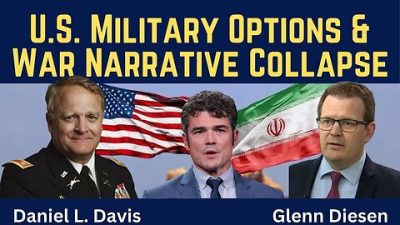
Daniel Davis: U.S. Military Options & War Narrative Collapse
or go to
Aletho News Archives – Video-Images
Book Excerpt
“Vaccines Do Not Cause Autism!” The Science is Settled. Right?
ICAN urges the IACC to actually study infant vaccines and autism
 By Aaron Siri | Injecting Freedom | March 16, 2026
On behalf of ICAN, we just sent a copy of chapter 11 of Vaccines, Amen to the newly appointed members of the federal Interagency Autism Coordinating Committee (IACC).
If you haven’t already read this chapter, you can read the whole thing in the attached letter. I trust that after you read it, you’ll see why the statement “vaccines do not cause autism” is a belief, not science!

IACC Public Comment Letter
1.53MB ∙ PDF file
Includes chapter 11 of Vaccines, Amen
Blog Roll
 Aletho News
- Washington’s War on Cuba Is Older Than You Think
- Daniel Davis: U.S. Military Options & War Narrative Collapse
- Protesters call on Brussels university to cut partnership with Israeli defense-linked firm
- Weapons makers cash in on Trump’s Iran war
- Why Trump’s anti-Iran naval coalition in Strait of Hormuz is doomed to fail
- IRGC says regional energy sites linked to US will be reduced to ashes
- Qatar condemns ‘dangerous’ Israeli attack on gas field
- Iran made ‘unexpectedly substantial’ offer during Geneva talks, US envoys ‘dragged’ Trump into war: Report
- Russia condemns Israel’s attack near Bushehr plant, files complaint
- Russia Strongly Condemns Actions Aimed at Harming Health of Iranian Leadership – Kremlin
- If Americans Knew
- How ignorance, misunderstanding and obfuscation ended Iran nuclear talks
- Israeli media reports grotesque settler attack in West Bank
- UK security adviser attended US-Iran talks and judged deal was within reach
- Tucker Carlson says ‘neocons’ will try to destroy Joe Kent over resignation
- Lebanon death toll exceeds 900, another assassination in Iran, bombing in Gaza – Not a ceasefire Day 159
- Trump’s counterterrorism chief, whose own wife was killed by ISIS, quits over Iran War saying Tehran posed ‘no imminent threat’
- Here’s what US could fund instead of Bibi’s war on Iran
- Israel Killed Over a Dozen Lebanese Paramedics in Three Days, Now Claiming That Ambulances Are “Hezbollah” Targets
- War on Iran: These are the heritage sites devastated by US and Israeli attacks
- Four news stories from Israeli media that illustrate Israeli “justice”
- No Tricks Zone
- Energy Expert: Germany’s Nuclear Phaseout Was A “500 Billion Euro Mistake”
- New Research: South Australia’s Mid-Holocene Sea Surface Temperatures Were 4°C Warmer Than Today
- Storing Green Energy To Last Germany 10 Days Would Require A 60-Million Tonne Battery
- New Studies: UK Sea Levels Were 4 Meters Higher Than Today During The Mid-Holocene
- Destructive Green New Deal: German Energy And Metal Group Warns Of Drastic Crisis
- New Study Documents A 20-Year Pause In Arctic Sea Ice Decline – Driven By Internal Variability
- Wake-up Call: Survey Shows Majority Of Germans Now Favor Postponing Climate Targets!
- Televised! Leading German Political Candidate Tells Schoolchildren CO2 Makes Sun Hotter!
- New Study: A Century Warming Of 1.1°C Is ‘Commonplace’ And ‘Not Unusual’ During This Interglacial
- New Study: ‘Internal Noise’ And Volcanic Forcing Can Trigger 10-15°C Warming Within Decades
 Aletho News