Maimed Yellow Vest Protestors: Worse Than Getting Shot
By Tim Kirby | Strategic Culture Foundation | May 2, 2019
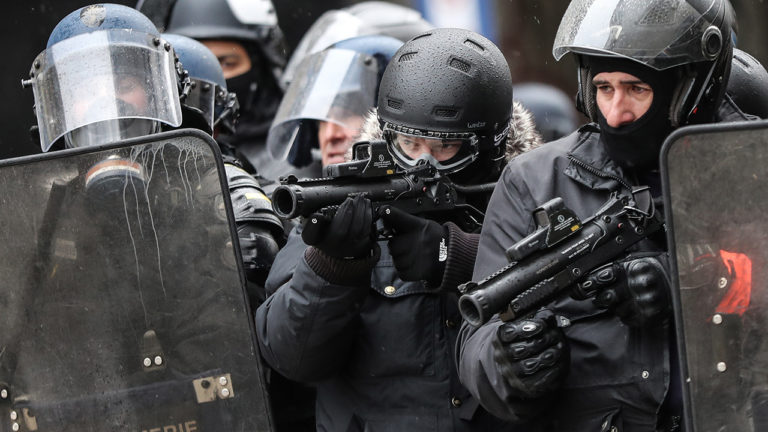
The French marched off to war in 1914 in glorious lines of infantry in baby blue coats and bright red trousers to be mowed down by the finest technology the Industrial Revolution had to offer. For us now it is easy to see how insane this was and how flawed the understanding of both the commoners and even the experts was in terms of how combat and war actually worked at the time. This naive view of modern tactics certainly applies to street conflicts we are seeing in France as part of the Yellow Vest protests. The so-called non-lethal (and less-lethal) arms of the French authorities gives them a tactical advantage far beyond that of any assault rifle.
Thanks to the media we have become accustomed to video of protestors getting sprayed by water or having their ranks dispersed thanks to tear gas, leaving everyone wet or coughing respectively but otherwise unharmed. However this humane picture does not meet up with the realities of this civilian vs. cop style warfare.
If we are to take the Yellow Vest protestors at their word then at least 22 of them have lost an eye (from “less-lethal” Flash-ball guns) and 5 have had their hands blown off with 154 being “seriously injured”. Obviously the protestors will want to maximize their statistics but there are plenty of videos from the various actions/demonstrations showing horrible injuries which are too numerous to all be fakes. So the numbers may be off but the overall general tendencies of these injuries do occur from the French authorities in the Human Rights defending EU is a proven fact. The simple reality is that despite a nice marketing phrase non-lethal weapons cripple and on occasion kill.
In order to understand the tactical advantage that non-lethal weapons offer the government (not the individual police but the state itself) we need to put aside our emotional response to seeing French people having their limbs blown off. We have to not jump into ranting about the flagrant hypocrisy of the EU when it comes to human rights and rationally break down how the conflicts between Yellow and Blue vests could look if the arms situation were different.
Scenario A: What if the Yellow Vests were armed?
If the organizers of the Yellow Vests (all movements are organized by someone regardless of what the media tells you) were able to arm their masses with rifles this would indeed lead to horrific short-term violence that would leave a permanent stain on French history. Often hundreds or thousands of protestors are met by dozens of police and handfuls of soldiers, if the protestors were on par with their adversaries in terms of guns, then their numerical advantage would shatter the police’s will to fight.
No policemen are going to fight to the last man against a force 20 times their number, which they may partially agree with dying for nothing, nor will they open fire with tanks in the centers of their own cities. Human psychology would allow them to kill foreigners in some distant country in this manner but not at home.
In this instance of near certain death from pure numbers the police would either “stay home” or possibly switch sides overtly or covertly.
Obviously a full civil war could start from this situation, but in a street warfare sense, escalating from protest to actual hot war is technically a winning scenario as it advances them closer to attaining/changing power.
Scenario B: What if the police fought like an army?
One key component of many Color Revolutions is getting the “bad leader” to be blamed for some sort of direct use of lethal bloody media-friendly massacre. If the French police actually used assault rifles against the protestors this would demonize them to the point of justifying a Revolution. This would not just cause a civil conflict but be a national call to arms to join it, which would be a bad move on the state’s part.
Furthermore, only sociopaths can fire rifles into unarmed crowds (who are not posing a direct threat) of people who speak their own language (i.e. their own “kind”). If the French police just decided to give the order to shoot them all, then in this instance many of the French police would find rifle and bayonet worthless as they would have no desire to shoot.
The result would be a handful of deaths from each protest but the utter collapse of legitimacy of the state and possible “retreats” of police forces unwilling to fire on “their own”.
Scenario C: The “non-lethal” reality we see today.
Psychologically it is much easier for the French police to use non-lethal (in their minds) weapons against the protestors. In the subconscious mind of the policeman he can justify shooting into masses much easier with this type of weapon because in theory it “shouldn’t” kill anyone and if it does it was an “accident”. This is much easier on our psyche and morals than shooting someone in the chest with a Lebel Rifle.
Research by the University of Cambridge supports this tendency. They found that police are far more likely to use force when it is supposedly from non-lethal weapons. This non-lethal status of weapons like tasers (which can and do kill people all the time) makes them so much easier to apply on the populace especially when the subconscious of the police officer tells him that, the guy he fried the other day with a taser died as an accident, one in every so many thousand people just has a weak heart.
So looking at non-lethal weapons tactically they offer the massive psychological advantage of being able to attack without an attack registering in the conscience of the user. As stated above they are also very media and propaganda friendly when anyone who dies from them is just “an accident” giving the government the ability to retain legitimacy while gouging out they eyes of its own populace. Real guns fail at both of these points completely.
Conclusion:
One bizarre irony in our strange postmodern times is that if the Yellow Vests were actually being shot at by real guns and being killed they would be far closer to achieving some sort of systemic change. Being mutilated by all sorts of gadgets and devices of one sort or another makes it easy for the police to do their job psychologically without generating the levels of sympathy and horror from live rounds hitting the innocent that the protestors need to shatter or change the system.
The French Flash-Ball gun should be made the symbol for the EU for it provides crushing repression of the masses with great PR spin to make it seem humane and caring. It is for our safety after all that they use these right?
Major hike in US missile spending indicative of approaching ‘new Cold war’: Study
Press TV – May 2, 2019
America has been dramatically increasing its missile development spending after deciding to leave a Soviet-era arms control treaty with Russia, a new study shows, warning that the extravagant approach could be the tell-tale sign of a looming “new Cold War.”
In the three months following President Donald Trump’s announcement in October last year that he would leave the Intermediate-range Nuclear Forces (INF) agreement, Washington has signed more than $1 billion in new missile contracts, according to the study by campaign group PAX and the International Campaign to Abolish Nuclear Weapons (ICAN).
“The withdrawal from the INF Treaty has fired the starting pistol on a new Cold War,” Beatrice Fihn, who heads the Nobel Peace Prize-winning ICAN, warned in a statement on Thursday.
Upon announcing his plans to abandon the INF, Trump accused Russia of violating the treaty through a new missile system and began the official process of withdrawing from the pact in February.
Russia has denied the US charges. It even rolled out the missile in question last year and exposed many of its sensitive details to reporters in order to ensure the international community that the INF was not breached.
Russian President Vladimir Putin responded to Trump’s move by saying that Moscow would also leave the 1987 accord, which is considered the cornerstone of global arms control by preventing the deployment of nuclear-tipped ground-launched ballistic missiles with ranges between 500 kilometers (330 miles) to 5,500 kilometers.
The report by PAX and ICAN detailed over $1.1 billion in new contracts signed with six mainly US companies between October 22, 2018 and January 21, 2019.
Raytheon took the biggest share of the money, scoring 44 new contracts worth some $537 million.
Lockheed Martin meanwhile received 36 new contracts worth $268 million and Boeing scooped up only four new contracts worth $245 million.
Fihn said in a statement that the massive contracts were worthy of congressional investigations because of suspected corporate collusion.
“Congress should investigate the lobbying roles of Boeing, Lockheed Martin and Raytheon who took the lion’s share of these contracts,” she asserted.
The report authors said they could not verify whether all of the new contracts were for developing new nuclear weapons.
“What is clear is that there is a new rush towards building more missiles that benefit a handful of US companies and intend to flood the market with missiles regardless of their range,” they noted.
Washington confirmed in March that it was preparing to test two new two ground-launched missiles that it has been developing for more than 30 years in August.
The projects include a low-flying cruise missile with a range of about 1,000 kilometers and a ballistic missile with a range of roughly 3,000 to 4,000 kilometers, military officials who could not reveal their name under the Pentagon’s security rules told the media.
American officials insist that none of the new missiles will be capable of delivering nuclear payloads but that is not the real threat of such weapons.
‘New nuclear race has begun’
Susi Snyder, PAX nuclear disarmament program manager and the lead author of the report, accused Washington and its nuclear-armed allies of hypocrisy by calling for the denuclearization of other countries while expanding their own arsenals.
“President Trump is heralding the need for global denuclearization, but US deeds, and those of nuclear-armed allies do not match those words,” She said.
“We see the US and other states planning for a nuclear-armed century, with contracts to maintain weapons through at least 2075, despite growing domestic and global calls to reverse course,” she added.
“The research confirms that there is a new nuclear arms race happening,” Snyder told Quartz.
US tests strategic ICBM
The study came shortly after the US Air Force test-launched an unarmed Minuteman 3 intercontinental ballistic missile (ICBM).
The Air Force Global Strike Command said the missile was launched from Vandenberg Air Force Base northwest of Los Angeles on early Wednesday and its re-entry vehicle hit its designated target in the Kwajalein Atoll in the Marshall Islands afte traveling approximately 4,200 miles (6,759 kilometers) over the Pacific.
The missile, manufactured by Boeing, is the only land-based ICBM in service in America and its development began in mid-1950s with the specific intent of attacking hardened military targets, specifically those in the former Soviet Union.
The latest version, Minuteman III, with an operational range of 13,000 km entered service in 1970.
Each unit can carry up to three nuclear warheads and is estimated to cost $7 million.
Breaking the Grip of Militarism: The Story of Vieques
By Lawrence Wittner | CounterPunch | May 2, 2019
Vieques is a small Puerto Rican island with some 9,000 inhabitants. Fringed by palm trees and lovely beaches, it attracts substantial numbers of tourists. But, for about six decades, Vieques served as a bombing range, military training site, and storage depot for the U.S. Navy, until its outraged residents, driven to distraction, rescued their homeland from the grip of militarism.
Like the main island of Puerto Rico, Vieques—located eight miles to the east―was ruled for centuries by Spain, until the Spanish-American War of 1898 turned Puerto Rico into an informal colony (a “nonsovereign territory”) of the United States. In 1917, Puerto Ricans (including the Viequenses) became U.S. citizens, although they continue to lack the right to representation in the U.S. Congress and to vote for the U.S. president.
During World War II, the U.S. government, anxious about the security of the Caribbean region and the Panama Canal, expropriated large portions of land in eastern Puerto Rico and on Vieques to build a mammoth U.S. naval base. As a result, thousands of Viequenses were evicted from their homes and deposited in razed sugar cane fields that the navy declared “resettlement tracts.”
The U.S. Navy takeover of Vieques accelerated in 1947, when it designated the base as a naval training installation and storage depot and began utilizing the island for firing practice and amphibious landings by tens of thousands of troops. Expanding its expropriation to three-quarters of Vieques, the navy used the western section for its ammunition storage and the eastern section for its bombing and war games, while sandwiching the native population into the small strip of land separating them.
Over the ensuing decades, the navy bombed Vieques from the air, land, and sea and conducted military training exercises averaging 180 days per year. It also used the island for tests of biological weapons.
Naturally, for the Viequenses, this military domination created a nightmarish existence. “When the wind came from the east, it brought smoke and piles of dust from their bombing ranges,” one resident recalled. “They’d bomb every day, from 5 am until 6 pm. It felt like a war zone. You’d hear . . . eight or nine bombs, and your house would shudder. Everything on your walls . . . would fall on the floor and break,” and “your cement house would start cracking.” In addition, with the release of toxic chemicals into the soil, water, and air, the population began to suffer from dramatically higher rates of illnesses.
Eventually, the U.S. Navy determined the fate of the entire island, including the nautical routes, flight paths, aquifers, and zoning laws in the remaining civilian territory, where the residents lived under constant threat of eviction. In 1961, the navy actually drafted a secret plan to remove the entire civilian population from Vieques, with even the dead slated to be dug up from their graves. But U.S. President John F. Kennedy blocked the plan from implementation.
Long-simmering tensions between the Viequenses and the navy boiled over from 1978 to 1983. In the midst of heightened U.S. naval bombing and stepped up military maneuvers, a vigorous local resistance movement emerged, led by the island’s fishermen. Activists engaged in picketing, demonstrations, and civil disobedience―most dramatically, by placing themselves directly in the line of missile fire, thereby disrupting military exercises.
But this first wave of popular protest, involving thousands of Viequenses and their supporters throughout Puerto Rico and the United States, failed to dislodge the navy from the island. In the midst of the Cold War, the U.S. military clung tenaciously to its operations on Vieques. Also, the prominence in the resistance campaign of Puerto Rican nationalists limited the movement’s appeal.
In the 1990s, however, a more broadly-based resistance movement took shape. Begun in 1993 by the Committee for the Rescue and Development of Vieques, it accelerated in opposition to navy plans for the installation of an intrusive radar system and took off after April 19, 1999, when a U.S. navy pilot accidentally dropped two 500-pound bombs on an allegedly safe area, killing a civilian.
Rallying behind the demand of Peace for Vieques, this massive social upheaval drew heavily upon the Catholic and Protestant churches, as well as upon the labor movement, celebrities, women, and university students. Hundreds of thousands of Puerto Ricans participated, with some 1,500 arrested for occupying the bombing range or for other acts of nonviolent civil disobedience. When religious leaders called for a March for Peace in Vieques, some 150,000 protesters flooded the streets of San Juan in what was reportedly the largest demonstration in Puerto Rico’s history.
Facing this firestorm of protest, the U.S. government finally capitulated. In 2003, the U.S. Navy not only halted the bombing, but shut down its naval base and withdrew from Vieques.
Despite this enormous victory for a people’s movement, Vieques continues to face severe challenges today. These include unexploded ordnance and massive pollution from heavy metals and toxic chemicals that were released through the dropping of an estimated trillion tons of munitions on the tiny island. As a result, Vieques is now a major Superfund Site, with cancer and other disease rates substantially higher than in the rest of Puerto Rico. Also, with its traditional economy destroyed, the island suffers from widespread poverty.
Nevertheless, the islanders, no longer hindered by military overlords, are grappling with these issues through imaginative reconstruction and development projects, including ecotourism. Robert Rabin, who served three jail terms for his protest activities, now directs the Count Mirasol Fort―a facility that once served as a prison for unruly slaves and striking sugar cane workers, but now provides rooms for the Vieques Museum, community meetings and celebrations, and Radio Vieques.
Of course, the successful struggle to liberate the island from the burdens of militarism also provides a source of hope for people around the world. This includes the people in the rest of the United States, who continue to pay a heavy economic and human price for their government’s extensive war preparations and wars.
Dr. Lawrence Wittner is Professor of History emeritus at SUNY/Albany and the author of Confronting the Bomb (Stanford University Press.)
Pompeo Lies, Cheats and Steals (But He’s Still a Good Christian)
By Philip Giraldi | Strategic Culture Foundation | May 2, 2019
Secretary of State Mike Pompeo recently recounted to an audience at Texas A&M University that when he was head of the Central Intelligence Agency he was responsible for “lying, cheating and stealing” to benefit the United States. “Like we had entire training courses. It reminds you of the glory of the American experiment.”
The Secretary made the comment with a grin, noting that when he was a cadet at West Point he subscribed to the Academy honor code, which stated that “You will not lie, cheat, or steal or tolerate those who do.” The largely student audience clearly appreciated and irony and laughed and applauded, though it is not clear what they made of the “glory of the American experiment.” The normally humorless Pompeo was suggesting ironically that yesterday’s Pompeo would be required to turn today’s Pompeo in to the appropriate authorities for lying and also conniving at high crimes and misdemeanors while at the Agency.
Certainly, some might find Pompeo’s admission a bit lame though perhaps understandable as he arrived at CIA without any experience in intelligence. Someone should have whispered in his ear, “That is what spy agencies do Mike.” And if he found the moral ambiguities vexing, he should have turned down the job. Equally lame has been the international media coverage of the comments (it was not reported in any major national news outlet in the US) which reflected both shock and vindication at finding a top-level official who would admit that Washington does all that sort of nasty stuff.
And Pompeo is not alone in his doing what would have hitherto been unthinkable as many senior figures in the Trump Administration who have sworn an oath to uphold the Constitution now find themselves conniving at starting various wars without the constitutionally required declaration of war from Congress. Pompeo has personally assured both the Venezuelans and Iranians that “all options are on the table,” while also arming the Ukrainians and warning the Russians to get out of Caracas or else face the consequences. And it is a good thing that he has now learned how to lie as he does so when he keeps insisting that the Iranians are the leading state sponsors of terrorism or that the Saudis are fighting a just war in Yemen.
And then there is the ethical dimension. The United States government is already involved in economic acts of war through use of its sanctions worldwide. It is currently dedicated to starving the Iranian and Venezuelan people to force them to change their governments. This week, a global boycott of Iranian oil sales to be enforced unilaterally by Washington kicks in with the objective, per Pompeo, of reducing “Iran’s oil exports to zero” to deny its government its “principal source of revenue.” The problem with the Pompeo objective is that attacking a foreign government normally rallies the people around their leadership. Also, denying a country income ultimately hurts ordinary people much more than it does those who make the decisions. One recalls the famous Madeleine Albright line about killing 500,000 Iraqi children through malnutrition and disease brought about by sanctions as “being worth it.”
Pompeo believes himself to be a good Christian. Indeed, a very good Christian in that he believes that the second coming of Jesus Christ is imminent and by virtue of his good deeds he will be saved and “raptured” directly to heaven. He, like Vice President Mike Pence, is referred to as a Dispensationalist, and he also believes that those who are not “born again” and accept Jesus will be doomed to hell. Most Dispensationalists think that the second coming will be preceded by a world war centered in the Middle East referred to as Armageddon, which will pit good against evil. How that shapes Pompeo’s thinking vis-à-vis encouraging a major armed conflict with Iran is certainly something that war-weary Americans should be considering.
One of the really interesting things about fanatics like Pompeo and his dos amigos Vice President Mike Pence and National Security Advisor John Bolton is how they are unable to figure out what comes next after the “lying, cheating, stealing” and shooting are over. After American air and naval power destroy Iran, what comes next? If Iraq and Afghanistan are anything to go by, “next” will be kind of figured out as one goes along. And as for an end game, fuggedaboutit.
Now let us suppose that with the crushing of the Mullahs all the requirements for Armageddon will be met and Jesus Christ makes his second appearance, what happens after that when the world as we know it ends? Presumably the rapture itself is painless but when Pompeo and Pence arrive at heaven what will they do all day? Play cards? There will be no television one presumes and no Muslims or Latinos to kick around as they will all be in hell. Drinking and smoking are probably not allowed and acquiring a girlfriend will likely be discouraged. One suspects that engaging in philosophical symposia to pass one’s time is not particularly favored by either gentleman.
Perhaps Pompeo and Pence look forward to something like the Mormon model, where they and their extended families going back genetically to the Pleistocene period will have their own planets where they can sit around and hobnob all day long. God, who, according to the Mormons, also has his own planet called Kolob, might just pop by for a visit every once in a while.
The point of all this is that we Americans are in the hands of a group of people who are adept at self- deception and who are also quite capable of doing some very dangerous things in light of their religious and personal views. It is one thing to have a strong foreign policy defending actual American interests but it is quite another to have a propensity to go to war to satisfy a personal predilection about how one goes about enabling a biblical prophecy. Equally, having a moral compass that is flexible depending who is on the receiving end is like having no real morals at all.
We have reached a point here in the United States where bad decisions and behavior best described as evil are masked by a certain kind of expressed piety and visions of national greatness. It is time to get rid of the Pompeos and Pences to end the charade and restore genuine morality unencumbered by the book of Revelations together with a national dignity that is not linked to threats or projection of military power.
Iran mission to UN slams US for violating Resolution 2231, pressuring others to do so
Press TV – May 2, 2019
Iran’s mission to the UN has blasted the US for violating Resolution 2231 — which endorsed a 2015 multilateral nuclear deal — and “shamelessly” threatening other UN members to do the same, saying such an approach is “destructive and hypocritical.”
In a press release on Wednesday night, the mission censured the US for attempting to portray Iran’s ballistic missile program as inconsistent with Resolution 2231, which was unanimously approved by the UN Security Council (UNSC) in 2015 and endorsed the multilateral Iran nuclear deal, officially called the Joint Comprehensive Plan of Action (JCPOA).
It added that the US abandoned the deal in a “serious and blatant” violation of Resolution 2231, which had been adopted with Washington’s own support, and is now “shamelessly” threatening other world countries into violating the international document.
After withdrawing from the JCPOA, the US reinstated the anti-Iran sanctions that had been lifted under the accord.
It has also been attempting to dissuade other signatories to the JCPOA from living up to the accord, threatening “secondary sanctions” against the firms that refuse to abide by Washington’s restrictive measures against Iran
The administration of President Donald Trump said in a statement on April 22 that, in a bid to reduce Iran’s oil exports to zero, that buyers of Iranian oil must stop purchases by May 1 or face sanctions, sending oil prices to their highest levels since last November.
The Iranian statement came after the US State Department said US Special Representative for Iran Brian Hook would be in New York on April 30 and May 1 to “underscore the importance of holding Iran accountable for its defiance of UN Security Council resolutions on the development and testing of ballistic missiles.”
Resolution 2231 terminated the provisions of previous UN resolutions against Iran, some of which had imposed restrictions on Iranian missile activities. It “calls on” Iran “not to undertake any activity related to ballistic missiles designed to be capable of delivering nuclear weapons, including launches using such ballistic missile technology.”
Tehran has always said it has no nuclear warheads and that none of its missiles have been designed to carry nuclear weapons.
The Iranian side’s compliance with the JCPOA has been repeatedly confirmed by the International Atomic Energy Agency (IAEA).
Iran’s UN mission once again highlighted that fact that Resolution 2231 is a substitute for all former Security Council resolutions on Iran’s peaceful nuclear program.
Consequently, such activities in Iran are not incompatible with the resolution, which the US has itself violated, it added.
Instead of abusing the UNSC and trying to spread fake allegations aimed at advancing its own malicious policies against Iran, American officials must act responsibly in accordance with their international obligations, the mission added.
The mission added that American officials need to explain at the Security Council why Washington has breached Resolution 2231 and why it has been coercing other UN member states into doing the same thing.
Washington has been under fire by the entire international community, including its own allies, for leaving the Iran deal and slapping Tehran with sanctions again.
Despite Washington’s withdrawal, Iran has not left the deal yet, but stressed that the remaining signatories to the agreement have to work to offset the negative impacts of the US pullout for Iran if they want Tehran to remain in it.
‘Warrantless & Suspicionless’: US Border Searches of Devices Illegal – Lawsuit
Sputnik – May 1, 2019
The number of US government searches of travelers’ cellphones and laptops at airports and border crossings has almost quadrupled since 2015, according to a federal lawsuit filed Tuesday by the Electronic Frontier Foundation (EFF) and the American Civil Liberties Union (ACLU).
“Today’s electronic devices contain vast quantities of highly personal information that the Supreme Court has repeatedly held requires a warrant to be searched in other contexts,” the suit, which was filed in the US District Court of Massachusetts, states. “The border search context is no different.”
Tuesday’s filing follows a September 2017 lawsuit by the ACLU and the EFF against the Department of Homeland Security. The 2017 case was filed on behalf of 10 US citizens and one lawful US permanent resident whose smartphones and laptops were searched without warrants or probable cause at the US border, according to the ACLU. The lawsuit filed Tuesday also refers to the “warrantless and suspicionless searches” of the 11 plaintiffs in the 2017 case based on new information gathered by the ACLU and the EFF.
In May 2018, the court found that the plaintiffs in the case could sue the Department of Homeland Security for violating their First and Fourth Amendment rights, which protect freedom of speech and bar unreasonable searches and seizures, respectively.
“This is a win for constitutional rights at the border,” ACLU attorney Esha Bhandari said in a press release at the time. “The court has rightly recognized the severity of the privacy violations that travelers face when the government conducts suspicionless border searches of electronics. We look forward to arguing this case on the merits and showing that these searches are unconstitutional.”
Since the court ruled in May 2018 to reject the government’s request to dismiss the lawsuit, the US Customs and Border Protection (CBP) and US Immigration and Customs Enforcement (ICE) were forced to provide documents about how “warrantless and suspicionless” searches of electronic devices are conducted for their deposition testimony, according to the ACLU. In addition, CBP and ICE officials discussed — under oath — their warrantless search policies with the ACLU and the EFF, according to a press release by the ACLU.
Based on the new information provided by the officials, the ACLU and EFF decided to file a motion Tuesday, asking the judge to rule in favor of the plaintiffs without a trial. In the filing, it is revealed that US border officers searched the smartphones and other electronic devices of more than 33,000 travelers last year, which is almost four times the the number of searches from just three years ago.
In addition, the new information reveals that CBP and ICE officials search travelers’ devices for “general law enforcement purposes, such as looking for potential evidence of illegal activity beyond violations of immigration and customs law.” They look for violations of laws governing tax filing, bankruptcy, environmental regulations and consumer protection, according to the filing.
“They may even conduct searches of electronic devices when the subject of interest is someone other than the traveler, such as when the traveler is a US citizen and ICE is seeking information about a suspected undocumented immigrant; when the traveler is a journalist or scholar with foreign sources who are of interest to the US government; or even when the traveler is the business partner of someone under investigation,” the filing states, alleging that even friends or family members of targeted travelers may be subject to warrantless searches as well.
Furthermore, the government agencies allow officers to save information from travelers’ electronic devices and share it with state, local and foreign government entities as they please.
“Crossing the US border shouldn’t mean facing the prospect of turning over years of emails, photos, location data, medical and financial information, browsing history, or other personal information on our mobile devices. That’s why we’re asking a federal court to rule that border agencies must do what any other law enforcement agency would have to do in order to search electronic devices: get a warrant,” the ACLU concluded in a Tuesday press release.
US lawmaker’s bill would ban funds to Israeli military

MEMO | May 1, 2019
Veteran Congresswoman Betty McCollum introduced legislation Wednesday that would prohibit US funding to any foreign military that detains children, including Israel, Anadolu reports.
The bill would additionally authorize the creation of an annual $19 million fund to support non-governmental organizations that monitor rights abuses pertaining to the Israeli military’s detention of children.
“Israel’s system of military juvenile detention is state-sponsored child abuse designed to intimidate and terrorize Palestinian children and their families,” McCollum said in a statement announcing the bill’s introduction.
McCollum said Israel’s military detention of children “must be condemned,” adding that “it is equally outrageous that US tax dollars in the form of military aid to Israel are permitted to sustain what is clearly a gross human rights violation against children.”
Roughly 10,000 children have been detained by Israeli security forces since 2000 and subjected to military court proceedings, according to McCollum’s bill.
“Israeli security forces detain children under the age of 12 for interrogation for extended periods of time even though prosecution of children under 12 is prohibited by Israeli military law,” it says.
It further goes on to note that Human Rights Watch reported in 2018 that Israel’s military “detained Palestinian children “often using unnecessary force, questioned them without a family member present, and made them sign confessions in Hebrew, which most did not understand.”
McCollum’s bill faces an uphill battle in Congress where it is likely to face near-uniform opposition from Republicans and is unlikely to garner sufficient Democratic support to clear the House if Speaker Nancy Pelosi chooses to send it to the floor.
Still, the Democratic lawmaker was adamant that “Congress must not turn a blind eye to the unjust and ongoing mistreatment of Palestinian children living under Israeli occupation.”
Israel killed 102 Palestinian journalists since 1972
Palestine Information Center – May 1, 2019
 RAMALLAH – The Palestinian Journalists Union in the West Bank on Tuesday said that Israeli occupation forces have killed 102 Palestinian journalists since 1972.
Naser Abu Baker, head of the union, said during his speech for a conference on press freedom in Ramallah that 19 journalists have been killed since 2014.
During the past four months, the Palestinian Journalists Union documented 136 Israeli attacks on Palestinian journalists, and 838 in 2018, including the killing of Yaser Murataj and Ahmad Abu Hussein in Gaza.
In 2018, 52 Palestinian journalists were arrested, and 47 were injured by live ammunition, 189 by tear gas canisters, and 17 by rubber-coated metal bullets.
Baker said that 2018 witnessed an unprecedented increase in the violations and crimes committed against Palestinian journalists, including attacks carried out by settlers.
Zero Percent of Elite Commentators Oppose Regime Change in Venezuela
By Teddy Ostrow | FAIR | April 30, 2019
A FAIR survey of US opinion journalism on Venezuela found no voices in elite corporate media that opposed regime change in that country. Over a three-month period (1/15/19–4/15/19), zero opinion pieces in the New York Times and Washington Post took an anti–regime change or pro-Maduro/Chavista position. Not a single commentator on the big three Sunday morning talkshows or PBS NewsHour came out against President Nicolás Maduro stepping down from the Venezuelan government.
Of the 76 total articles, opinion videos or TV commentator segments that centered on or gave more than passing attention to Venezuela, 54 (72 percent) expressed explicit support for the Maduro administration’s ouster. Eleven (14 percent) were ambiguous, but were only classified as such for lack of explicit language. Reading between the lines, most of these were clearly also pro–regime change. Another 11 (14 percent) took no position, but many similarly offered ideological ammo for those in support.
The Times published 22 pro–regime change commentaries, three ambiguous and five without a position. The Post also spared no space for the pro-Chavista camp: 22 of its articles expressed support for the end to Maduro’s administration, eight were ambiguous and four took no position. Of the 12 TV opinions surveyed, 10 were pro-regime change and two took no position.
(The Times and Post pieces were found through a Nexis search for “Venezuela” between 1/15/19–4/15/19 using each paper as a source, narrowed to opinion articles and editorials. The search was supplemented with an examination of each outlet’s opinion/blog pages. The TV commentary segments were found through Nexis searches for “Venezuela” and the name of the talkshow during the same time period, in the folders of the corresponding television network: NBC News/CBS News transcripts, ABC News transcripts, and PBS NewsHour. Non-opinion TV news segments were omitted. The full list of items included can be found here.)
Corporate news coverage of Venezuela can only be described as a full-scale marketing campaign for regime change. If you’ve been reading FAIR recently (1/25/19, 2/9/19, 3/16/19)—or, indeed, since the early 2000s (4/18/02; Extra!, 11–12/05)—the anti-Maduro unanimity espoused in the most influential US media should come as no surprise.
This comes despite the existence of millions of Venezuelans who support Maduro—who was democratically elected twice by the same electoral system that won Juan Guaidó his seat in the National Assembly—and oppose US/foreign intervention. FAIR (2/20/19) has pointed out corporate media’s willful erasure of vast improvements to Venezuelan life under Chavismo, particularly for the oppressed poor, black, indigenous and mestizo populations. FAIR has also noted the lack of discussion of US-imposed sanctions, which have killed at least 40,000 Venezuelans between 2017–18 alone, and continue to devastate the Venezuelan economy.
Many authors in the sample eagerly championed the idea of the US ousting Maduro, including coup leader Juan Guiadó himself, in the Times (1/30/19) and Post (1/15/19), and on the NewsHour (2/18/19).
The Times made its official editorial opinion on the matter crystal clear at the outset of the attempted coup (1/24/19): “The Trump administration is right to support Mr. Guaidó.” Followed by FAIR’s favorite Times columnist, Bret Stephens (1/25/19):
The Trump administration took exactly the right step in recognizing National Assembly leader Juan Guaidó as Venezuela’s constitutionally legitimate president.
It’s generally a nation’s supreme court that has the final say on who is constitutionally legitimate, but in this case they can apparently be overruled by a foreign government—or a foreign newspaper columnist.
The Post editorial board also joined Team Unelected President (1/24/19):
The [Trump] administration’s best approach would be to join with its allies in initiatives that would help Venezuelans while bolstering Mr. Guaidó.
The Times even produced an opinion video (4/1/19) with Joanna Hausmann, “a Venezuelan American writer and comedian,” as she is described in her Times bio. Between sarcastic stabs at Venezuela’s “tyrannical dictator” and cute animations of “Ruth Bader Ginsburg in workout clothes”—Hausmann’s self-described “spirit animal”—come more serious declarations about the nation’s political situation:
Juan Guiadó is not an American right-wing puppet leading an illegitimate coup, but a social democrat appointed by the National Assembly, the only remaining democratically elected institution left in Venezuela…. Let’s provide humanitarian aid and support efforts to restore democracy.
Odd that the Times didn’t find it necessary to note a blaring conflict of interest: Hausmann’s father is Ricardo Hausmann, Juan Guaidó’s appointed Inter-American Development Bank representative. Mint Press News (3/19/19) bluntly described him as the “neoliberal brain behind Juan Guaidó’s neoliberal agenda.”
It would be ludicrous to think the Times would withhold as blatant a connection to Maduro if one of his aides’ daughters made a snarky opinion video calling Juan Guaidó a would-be “brutal dictator”—even if our theoretical commentator was “an independent adult woman who has built a popular following on her own,” as Times opinion video producer Adam Ellick said in defense of the omission. Such a crucial relationship to a powerful Chavista politician would never go undisclosed—in the unlikely event that such a perspective would be tolerated in the opinion pages of an establishment paper.
These are just a few of many media pundits’ endorsements of Guaidó—someone whose name most of the Venezuelan population did not even recognize before he declared himself interim president. Put more accurately, they are endorsements of a US-backed coup attempt.
One of the more muddled regime change endorsements came from Rep. Ro Khanna’s Post op-ed (1/30/19), in which he says no! to military intervention, no! to sanctions, yet yes! to… “diplomatic efforts”:
The United States should lend its support to diplomatic efforts to find some form of power-sharing agreement between opposition parties, and only until fair elections can take place, so that there is an orderly transition of power.
“Diplomatic” is a reassuring term, until you realize that US diplomacy, as FAIR’s Janine Jackson explained on Citations Needed podcast (3/20/19), is “diplomacy where we try to get other countries to do what we want them to do”—in this case, effecting a “transition of power” in another country’s government.
Francisco Rodríguez and Jeffrey D. Sachs (New York Times, 2/2/19) envision similar efforts for a “peaceful and negotiated transition of power,” and Khanna made sure to characterize Maduro as “an authoritarian leader who has presided over unfair elections, failed economic policies, extrajudicial killings by police, food shortages and cronyism with military leaders.”
In other words, Maduro the Dictator must be overthrown—but don’t worry, the US would be diplomatic about it.
Those that didn’t take explicit positions nonetheless wrote articles blaming all or most of Venezuela’s woes on Maduro and Chávez. Economics wiz Paul Krugman (New York Times, 1/29/19) gave his spiel:
Hugo Chávez got into power because of rage against the nation’s elite, but used the power badly. He seized the oil sector, which you only do if you can run it honestly and efficiently; instead, he turned it over to corrupt cronies, who degraded its performance. Then, when oil prices fell, his successor tried to cover the income gap by printing money. Hence the crisis.
Note that Krugman failed to mention the 57 percent reduction in extreme poverty that followed Chávez’s replacement of management of the state-owned oil industry (which has been nationalized since 1976, long before Chavismo). Nor does he acknowledge the impact of US sanctions, or any other sort of US culpability for Venezuela’s economic crisis.
Caroline Kennedy and Sarah K. Smith (Washington Post, 2/5/19) did not explicitly blame Maduro and Chávez for Venezuela’s “spiral downward,” but similarly ignored evidenced US involvement in that spiral. There are only so many places where you can point fingers without naming names.
Dictatorship-talk—writers lamenting the horrific and helpless situation under an alleged “dictator”—characterized many of the ambiguous and no-position articles. In the Post (1/24/19), Megan McArdle asked:
You have to look at Venezuela today and wonder: Is this what we’re seeing, the abrupt end of Venezuela’s years-long economic nightmare? Has President Nicolás Maduro’s ever-more-autocratic and incompetent regime finally completed its long pilgrimage toward disaster?
By simply describing the declining situation of a country (Times, 2/12/19, 4/1/19) and using words like “regime” (Times, 2/14/19), “authoritarian” (Post, 1/29/19) and, of course, “dictatorship” (Post, 1/23/19; Times, 2/27/19) in reference to government officials, commentators create the pretext for regime change without explicitly endorsing it.
The Sunday talkshows and NewsHour also couldn’t find a single person to challenge the anti-Maduro narrative. They did find room, however, for three of the most passionate advocates of regime change in Venezuela: Sen. Marco Rubio (Meet the Press, 1/27/19), Donald Trump (Face the Nation, 2/3/19) and Guaidó himself (NewsHour, 2/18/19).
Other TV regime change proponents included Florida Sen. Rick Scott (Meet the Press, 2/3/19), 2020 Democratic presidential hopefuls Peter Buttigieg (This Week, 2/3/19) and Amy Klobuchar (Meet the Press, 3/17/19), Sen. Tim Kaine (Face the Nation, 3/17/19), and Guaidó-appointed, Mike Pence-approved “chargé d’affaires” Carlos Vecchio (NewsHour, 3/4/19).
But leave it to Nick Schifrin of the NewsHour (1/30/19) to bring on “two views” of the US intervention question that are both pro-regime change and pro-US intervention. View No. 1 came from Isaias Medina, a former Venezuelan diplomat who resigned from his post in protest against Maduro. Medina made the unlikely claim that 94 percent of the Venezuelan population—or 129 percent of the population over the age of 14—support US intervention to overthrow the Maduro government:
Not only I, but 30 million people, support not only the US circumstance, but also the Latin American initiative to restore the rule of law, democracy and freedom in Venezuela.
View No. 2, the ostensibly anti-regime change take, came from Benjamin Gedan, who served on the Obama administration’s National Security Council as director for Venezuela and the Southern Cone. When asked if he supported Trump’s moves to sanction Maduro and possibly use US troops to oust him, Gedan responded:
I think both of those steps are problematic. I think the sense of urgency that the United States administration has shown is absolutely correct…. The question is, how can we assist the Venezuelan people [to] promote a peaceful transition in Venezuela, without harming the people themselves, or fracturing the coalition that we have built over two administrations?
In other words, how can we overthrow the Venezuelan government without destroying the country—or “fracturing the coalition we have built”? The US has many options on the table, but none of them involve not pursuing the overthrow of Maduro.
In the “no position” camp for TV news, New York Times chief Washington correspondent David Sanger (Face the Nation, 1/27/19) noted that the problem with US support for Guaidó is one of “both history and inconsistency”:
Our history in Latin America of intervening is a pretty ugly one, and the inconsistency of not applying the same standards to places like Saudi Arabia and Egypt, where the president has embraced strong men, I think may come back to make the United States look pretty hypocritical, not for the first time.
Sanger indulged in the popular “hypocrisy takedown”: The problem, as presented, isn’t that the US disrupts democracies, destroys economies and kills people, but rather that it does so inconsistently. While vaguely acknowledging the US’s horrific track record of Latin American interventions, and Trump’s cherry-picking of governments worthy of regime change, Sanger didn’t take the logical next step of calling for the US to keep its hands off Venezuela. Instead, he called Maduro’s supporters—defined as “China, Russia and Cuba”—“not a great collection,” and failed to push back against the claim that Maduro “fixed the last” election. Without a formal declaration, Sanger did all the ideological preparation for foreign-backed regime change.
That elite media didn’t find a single person to vouch for Maduro or Chavismo, and that almost all the opinions explicitly or implicitly expressed support for the ouster of Venezuela’s elected president, demonstrates a firm editorial line, eerily obedient to the US government’s regime change policy.
This isn’t the first time that FAIR (e.g., 3/18/03, 4/18/18) has found a one-sided debate in corporate media on US intervention. When it comes to advocating the overthrow of the US government’s foreign undesirables, you can always count on opinion pages to represent all sides of why it’s a good thing. And the millions of people who beg to differ? Well, they’re just out of the question.
UK Labour leader targeted for accepting ‘Jews control banks’
Press TV – May 1, 2019
Leader of Britain’s opposition Labour Party is facing attacks from pro-Israeli lobbies in the country for merely endorsing thoughts of a thinker who suggested a century ago that Jews control the media and political discourse through their dominance on the European financial system.
Labour politicians and other notable political and social figures called on Corbyn on Wednesday to apologize for a foreword he wrote to a book first released in 1902 and re-published in 2011.
In his foreword to John Atkinson Hobson’s ‘Imperialism: A Study’, Corbyn said the economist’s description of how a certain Jewish household controlled banks and newspapers were “brilliant”, “very controversial at the time” and “a great tome.”
The book mainly argues that men of a singular and peculiar race use centuries of financial experience to control finance in Europe. It says that the dominance puts the Jews “in a unique position to control the policy of nations” and gives them a control that “they exercise over the body of public opinion through the press.”
However, pro-Israeli activists and politicians labeled Corbyn’s endorsement of the idea as a clear form of support for antisemitism and asked him to apologize.
“Jeremy Corbyn endorsed book that peddles racist stereotypes of Jewish financiers and imperialism as “brilliant” and a “great tome”,” said former Labour MP Ian Austin.
“The revelation Jeremy Corbyn wrote the foreword for a reportedly deeply antisemitic book is damning and damaging,” said Euan Philipps, of the campaign group Labour against antisemitism.
Corbyn, well known for his support of the Palestinian cause, has repeatedly been described by pro-Israeli lobbies in Britain as a threat to the life of Jews in the country if he takes office. He has denied having anything against the Jews and has sought to sort out differences with the Jewish community in the UK.
A senior Labour lawmaker said on Wednesday that Corbyn’s endorsement of Hobson’s thoughts in economy and politics was not antisemitic.
“I haven’t read the book myself but as I understand it, Jeremy like many politicians, has quoted this relevant political thinker,” said Rebecca Long-Bailey, a Labour frontbencher, adding, “I think he was looking at the political thought within the whole text itself, not the comments that were antisemitic in any shape or form.”
The New York Times Apologizes for “Anti-Semitic” Cartoon While Enabling Real Bigotry in Israel
By Helen Buyniski | Aletho News | May 1, 2019
The New York Times has begged forgiveness for printing a cartoon that supposedly “included anti-Semitic tropes” in its international edition, but no amount of shameless groveling will stop the Israeli weaponization of the “anti-Semitism” smear as it steamrolls America’s once-sacred First Amendment freedoms. This is a crusade to silence all legitimate criticism of a criminal regime, and if the Times has anything to apologize for, it is its complicity in that quest.
The offending cartoon depicts President Donald Trump as a blind man being led by a guide dog with the face of Israeli PM Benjamin Netanyahu, identified by a star-of-David collar. It’s unclear what the “anti-Semitic trope” in this case is supposed to be – the collar is arguably necessary to confirm the dog is Netanyahu, and the reader would have to be a political illiterate to interpret that as a stand-in for “all Jews.” The Times’ willingness to slap the “anti-Semitic trope” label on the cartoon anyway should put to rest the ridiculous “anti-Semitic trope” trope that is tirelessly deployed to smother accusations of wrongdoing by Israel or its lobbying organizations inside the US.
Netanyahu himself has boasted that Trump acted on his orders when he declared Iran’s Islamic Revolutionary Guard Corps a terrorist organization earlier this month, and Trump’s willingness to flout international law to unilaterally “give” the Golan Heights to Netanyahu as a re-election present shocked the world, unsettling even some Zionists who believe the land is rightfully theirs but worry the US’ official declaration will galvanize regional opposition to the occupation. Netanyahu’s last election campaign was arguably based on his ability to “lead” the US president blindly off the edge of a geopolitical cliff. Is he guilty of perpetuating anti-Semitic tropes for bragging about it?
Most papers only apologize when they’ve printed something erroneous. The Times has chosen instead to issue a correction for one of the few accurate depictions of the relationship between Israel and the White House, a glimmer of truth even more notable for its contrast with the paper’s usual disinformation painting Trump as some sort of foaming-at-the-mouth anti-Semite.
The Times’ decision to apologize for this cartoon while remaining silent when a cartoon depicting Trump in a gay love affair with Vladimir Putin was condemned by LGBT readers last year betrays the editorial board’s high moral dudgeon as the most transparent hypocrisy. US media has long smeared Putin’s government as homophobic, yet here they were presenting him half-clothed in a stomach-turning romantic embrace with Trump – a president who, it should be noted, has presided over the deterioration of US-Russia relations to levels not seen since the Cold War. But LGBT Twitter ultimately has little power in society, unlike the Israeli lobby, and the unfavorable depiction of Trump ensured most influential LGBT organizations steered clear of criticizing the cartoon. Outrage has become yet another commodity to be traded, not a genuine response to offense.
If it’s in a repentant mood, however, the Times could apologize for its one-sided coverage of the Israeli-Palestinian conflict – much of it fed to them by The Israel Project, which skews US coverage of the facts on the ground in Israel by supplying American reporters with talking points in order to “neutralize undesired narratives.” From these spinmeisters we get the passive voice used to frame IDF soldiers mowing down unarmed protesters as “clashes occurred” and “Palestinian protesters were killed,” as well as breathless coverage of tunnels, kites, and rocket attacks that rarely seem to hit anyone.
The Times could apologize for its failure to expose the global campaign to redefine “anti-Zionism” as “anti-Semitism,” instead of playing into it by pretending a truthful cartoon is somehow an affront to Jews – as if all Jews support the racist policies of the Israeli government. Indeed, to assume all Jews back the criminal Netanyahu regime in its openly genocidal campaign to eradicate the Palestinians from the few enclaves of the West Bank in which they remain while maintaining an open-air concentration camp in Gaza is wildly anti-Semitic.
The Times could apologize for failing to report on the massive Israeli spying operation – funded, in no small part, by the US taxpayer – targeting American activists on American soil, exposed in detail in the suppressed al-Jazeera documentary “The Lobby,” which leaked last year to deafening silence in the media. Journalist Max Blumenthal actually spoke with a Times journalist who wanted to cover the explosive revelations of the documentary, but no story ever appeared. As Ali Abunimah, founder of the Electronic Intifada, has pointed out, the suppression of the documentary should have been a story in and of itself – and would have, had it involved any other country.
“Imagine that this had been an undercover documentary revealing supposed Russian interference, or Iranian interference… in US policy, and powerful groups had gone to work to suppress its broadcast and it had leaked out. Just that element of it – the suppression and the leak – should be front page news in the Washington Post and the New York Times,” he told Chris Hedges, whose RT program was the closest thing to mainstream coverage the documentary received in the US.
The Times instead chooses to cover up the actions of groups like the Israel on Campus Coalition as they surveil and smear pro-Palestinian activists – college students, professors, and others sympathetic to Israel’s sworn enemy – using a strategy the ICC’s executive director Jacob Baime admits is based on US General Stanley McChrystal’s counterinsurgency strategy in Iraq. “The Lobby” revealed that agents working for the Israeli government infiltrate pro-Palestinian, pro-peace groups using fake social media accounts and report their findings back to the Israeli Ministry of Foreign Affairs, a shocking fact that none of the organizations named in the film have disputed. A foreign government operating a military-style surveillance network to target and smear American citizens in their own country – for nothing more than exercising their freedom of speech – gets a pass from the Times, but a cartoon showing Trump’s blind loyalty to Israel for what it is must be condemned.
It’s tough to electrify an outraged mob based on a story that wasn’t printed, but the Times’ failure to address the very real threat to Americans exercising their free speech – a threat all the more dire because it is funded by US tax dollars to the tune of $3.8 billion per year – merits at least a full-page apology. Compounding the insult is a domestic economic crisis, with many American cities facing record homelessness, skyrocketing cost of living, a dearth of secure employment and an excess of exploitative “gig economy” temp work, and a rapidly-disappearing social safety net. Israel is a wealthy country, as Netanyahu often boasts, a successful country. Only a truly blind government could continue to fork over such enormous sums of money while Americans languish in poverty.
“The anti-Semitism smear is not what it used to be,” one lobbyist laments to al-Jazeera’s hidden camera-equipped reporter. Perhaps this is why the state of Florida has advanced a bill to criminalize “anti-Semitism,” now broadly redefined to include “alleging myths… that Jews control the media, economy, government, or other institutions.” The bill passed the House unanimously, the one holdout bullied into submission when she voiced concerns about its incompatibility with the First Amendment, yet to point out – as AIPAC does – that this bipartisan approval exists because the Israeli lobby has influence over both parties, or that this influence can make or break a candidate, is about to become illegal. When even a milquetoast like Democratic congressman Beto O’Rourke has stuck his neck out to call Netanyahu a racist – and he receives more money from the Israeli lobby than most of his House colleagues – the Times should be ashamed of itself for pushing the fiction that criticism of Israel and its iron grip on the US government is equivalent to anti-Semitism.
The Times’ own article about its apology quotes an interview with the “guilty” party, Portuguese cartoonist Antonio Moreira Antunes, from the aftermath of the Charlie Hebdo attack, when four cartoonists and the magazine’s editor were murdered, supposedly for printing an offensive cartoon. There is a definite parallel with the Zionist outrage mobs calling for Antunes’ head – figuratively, if not yet literally; many are unsatisfied with the Times’ apology and insist Antunes suffer for his insolence by losing his job, if not his life. Antunes, in the interview, called his job “a profession of risk,” but states “there is no other option but to defend freedom of expression.”
The New York Times, and everyone else who demanded they apologize for a truthful cartoon while ignoring their failure to oppose genuine bigotry in the Netanyahu regime and supporters of Zionism, clearly do not agree that freedom of expression is worth defending. A press that cannot even defend itself does not deserve to be called “free.’
A Desperate Empire Crashes in Venezuela
By Maximilian Forte | Zero Anthropology | May 1, 2019
The April 30, 2019, coup attempt in Venezuela has come and gone. The coup has failed. “Failed state” theory just got a lot more complicated. No longer can the “failed state” designation apply only to those states targeted for recolonization after a prolonged period of destabilization and foreign intervention. Now “failed state” theory has to apply to a degenerate imperial state at its wit’s end, and to the failure of its proxies on the ground, as well as the failure of its invented political fictions to materialize. Even worse than any “failed state,” is the failure of aspirants to power who pretend to have power—namely, the incompetent Venezuelan opposition activist, Juán Guaidó. It’s time that even the few critical media outlets left stop dignifying Guaidó, opposition activist, with the title of self-declared “interim president,” because even that is too grandiose.
This so-called “interim president” is, by the tortured logic of Elliot Abrams, the president of an interim that has not yet begun. So that means he is not the interim president even. Or, he was the interim president, but his 30-day term (as specified by the Constitution), expired months ago. Or, he is still the interim president, but only if a defunct opposition body, that calls itself the National Assembly, believes it has the authority to unilaterally overwrite the Constitution—it does not, so he is still not even a self-declared interim president. This is what the US wants the world to recognize as “interim president”: a total fiction that cannot be sustained without reference to other fictions.
This bundle of fictions has not even been wielded by people who have the good sense to know when it’s time to shut up. No, instead the authors of these inventions spin even more, as if wanting to be spotted in all their foolishness. So we had the US government almost triumphantly declaring that it was withdrawing US diplomats from Venezuela—when Venezuela’s government was the one that ordered them out. Then we had US officials rejoice that Venezuela’s representatives had been expelled from the Organization of American States—when Venezuela already declared it was withdrawing from the OAS two years ago, and this month marked the final step in the process. Then we had the US State Department pretend that it could hand the Venezuelan Embassy in Washington, DC, over to representatives of an interim president of an interim that had not even started, or that already ended. One has to really have faith in the stupidity of audiences, and be unflinching about treating everyone as idiots, to mount such an absurd production in public. It also means that they literally have no shame.

Impressive “uprising” you have there.
As a bad work of fiction, Guaidó could not mount even a lame imitation of a military-backed coup on April 30, which is just the latest in a long line of his failures this year. This character, unknown to 80% of Venezuelans a few months ago, leader of a minority party in a defunct parliament, who never campaigned for the presidency and was never elected to it—this same character posed in front of cameras and claimed military backing which he never had. So he calls on the resources of a hostile foreign power in the vain hope it make his fiction reality, clearly showing he understands nothing at all. Even worse: it shows a total lack of any care for all those who would suffer and die in war—Guaidó is ready to sacrifice them all. It’s an ill bird that fouls its own nest.
The response to Guaidó’s call? A few hundred violent protesters showed up, traded rocks with the Bolivarian National Guard, and then stood around talking to each other for hours on end. John Bolton, pushing US intervention in the name of keeping Venezuela free of external dominance (he knows no irony), even tried to nudge Venezuelans in a pitiful attempt at bribery, promising US economic relief if Guaidó took power. As far as attempted coups go, this was fortunately among the most pathetic, lame farces. There is now no resemblance between Venezuela 2019 and Libya 2011, where in the latter case opponents actually seized towns and cities and mounted protests that lasted days on end. What remains the same in the two cases is the determination of the US to implement through violent proxies a fiction of rule.
One also has to wonder how John Bolton, Mike Pompeo, and Elliot Abrams still have jobs today. Trump is not a tower of managerial business acumen after all—if one ever believed the fiction constituting his performance on The Apprentice. Bolton, who was most prominent during the April 30 coup farce, could not even keep himself from tripping over his own excremental attempt at a “narrative”. First, John Bolton called on the Venezuelan military to side with Guaidó—but then invalidated his call, turning around and asserting that, in any case, Venezuela was under (imaginary) Cuban occupation, and it was Cuban troops who were really in charge. So everything fell apart… because of Cuba, and thus Trump threatened Cuba with an embargo, which it has already been under for six decades. Cuba was the fiction used to mask another fiction—the only thing that was real here was how utterly ridiculous US empire has become.

All the action, caught live on camera.
On the night of April 30, as I often do I listened to live radio from Caracas, where the assembled panellists spent a good amount of time engaged in the healthiest, most robust guffawing I have heard in ages. The subject of their laughter? Erik Prince, the war criminal who headed BlackWater and is now begging Trump for cash in return for a “plan”—a plan to send a grand total of 5,000 mercenaries to Venezuela. On RNV radio they wondered if the Americans had really become so stupid and psychotic to think that 5,000 clowns could take and hold so much as a bakery in a country which has 2,000,000 armed citizens in militias alone, not counting the hundreds of thousands in the armed forces and the paramilitary police. Apparently Prince mixed up Venezuela with Grenada—and even in Grenada it took US Marines a week to subdue armed opposition from a comparatively tiny group of diehard patriots.
Nothing is working for the US, not even what might be the most extreme sanctions ever imposed, and weeks of power outages. Certainly, none of the “humanitarian” theatre worked, whether it was the forced “aid” stunt, or the myth that Venezuelan troops set their fake aid on fire. The US was forced to imagine and fantasize about Maduro fleeing the country: witness Mike Pompeo’s bout of deranged lying about Maduro getting on a plane to Cuba, until Russia stopped him. Fictions, lies, propaganda, disinformation, fake news. To top it all off, the news came: this was not even a coup, you see. The real problem here, with such a monumental loss of face, in such a magnificent failure as April 30, is that the US will turn to even more desperate and thus more dangerous measures. However, that comes at a real cost: if the US invades, Trump has to go into an electoral contest with a new war on his back, and it’s not like such a war would come even close to a “cake walk”.
One has to wonder: will those national leaders who—without the authorization of their citizens—unilaterally “recognized” Guaidó as this so-called “interim president” thing, now take stock finally? Or will they cling to this science-fiction that there is a popular movement opposing Nicolás Maduro’s legitimate and very real government?
Clearly, very clearly as it was televised live worldwide all day on April 30 for all to see, Guaidó does not lead a popular movement. He has no authority, no legitimacy, and only a paltry amount of futile support. This so-called “uprising” was an embarrassing failure for his own image as a supposed leader. Then he takes shelter and says “tomorrow, more protests”—yes, junior, that will do the trick. Remember, sport, more always works, and besides, “there’s always tomorrow”. Keep at it, son.
This is what practice without theory looks like. This is what a “movement” without support looks like. This is what science-fiction looks like when it tries to escape the theatre and mingle with real people in the street.
Meanwhile, members of the Lima Group such as Canada, and those members of the European Union that have called for a “peaceful transition” in Venezuela, there is a lot for which they must answer. What “democracy” do they think it is where someone, not elected by the people, marshals the forces of violence in an effort to impose a government on a country? If this were to be done in their countries, would they accept it as democracy? This is the other outrageous fiction that we face: that we in North America live in democratic polities. Democracy should recognize itself in democracy—but when you instead recognize your partner in a violent clutch of putschists, then what are you?
Featured Video

Total War – Attacking Nuclear Plants, Desalination & Infrastructure
or go to
Aletho News Archives – Video-Images
From the Archives
The Heirs of Meyer Lansky Want Compensation from Cuba. They Shouldn’t Get a Dime.
By Jack Colhoun | History News Network | June 19, 2016

Meyer Lansky
The heirs of Meyer Lansky, the impresario of the North American Mafia gambling colony in Cuba (1933-1958) are betting on a big payback from the negotiations between the United States and Cuba to normalize relations between the two countries. Compensation claims by U.S. citizens or businesses for properties nationalized by the Cuban revolution are among the issues under discussion.
Lansky’s daughter Sandi, her son Gary Rapoport, and her brother Paul have filed a compensation claim against Cuba for the Riviera Hotel and Casino with the U.S. Foreign Claims Settlement Commission. The Cuban revolution confiscated the Riviera and other Mafia-owned properties after it toppled the gangster-linked regime of General Fulgencio Batista in 1959.
“It was through my grandfather’s hard work that the hotel was built,” Rapoport told the U. K. Daily Mail Online on December 23, 2015. “We are his natural relations . . . . By right, it should be our property.” He says the Riviera is valued at $70 million. The Tampa Bay Tribune, Reuters, and Haaretz have also covered the story.
The Riviera, which overlooks the Straits of Florida, was the crown jewel of Lansky’s casinos, hotels, and nightclubs in Havana. When the Riviera opened in December 1957, it was the largest Mafia-owned hotel-casino outside Las Vegas. The hotel’s 440 double rooms were booked solid for the winter season of 1957-1958.
However, the narrative that the success of the Riviera was the product of Meyer Lansky’s “hard work” is undercut by Lansky’s own assessment of his arrangement with Batista. … continue
Blog Roll
 Aletho News
- Seyed M. Marandi: Total War – Attacking Nuclear Plants, Desalination & Infrastructure
- Israel systematically torturing Palestinians in custody: UN special rapporteur Albanese
- How the US-Israeli aggression against Iran is affecting the war in Ukraine
- Italy Is Caught Between Two Wars. Russia’s LNG Tanker
- Iran Beats US & Israeli Missile Defenses by Exploiting Their Weaknesses
- Report: White House Making ‘Detailed Preparations’ for Invasion of Iran
- US Air Defenses Not Suited for Modern Combat — Ex-Air Force Officer
- Eight Iraqi resistance attacks hit US Victoria base near Baghdad airport
- US Dirty War Iran Revelations 2026: Ex-Counterterrorism Chief Joe Kent Exposes Proxy Strategy
- Iran’s Dimona Strike Shatters Myth of ‘Impenetrable’ THAAD, Patriot & Arrow Air Defenses – Analyst
- If Americans Knew
- Lebanon deaths top 1,200; Palantir AI to be embedded across US military – Not a ceasefire Day 163
- Israel’s assassination game: Take all pragmatists off the board
- Food shortages return to Gaza as Israel tightens aid restrictions under the cover of its war on Iran
- Trump demands trillions in payments from Gulf countries, billions from Harvard – Not a ceasefire Day 162
- Meet the former fashion blogger and shady doctor behind the ‘30,000 dead’ Iran psy-op
- Vatican Secretary of State to Trump, Israel: End the war as soon as possible
- The Majority of Americans Believe War Against Iran Benefits Israel More Than US
- Efforts to shut down pro-Palestinian speech face series of setbacks in court
- What has Israel done to my brother?
- Eid without worship in Al Aqsa – Not a ceasefire Day 161
- No Tricks Zone
- Former Pfizer Toxicologist Dr. Helmut Sterz Tells Bundestag Hearing Pfizer Vaccine Should Have Never Been Approved
- Energy Expert: Germany’s Nuclear Phaseout Was A “500 Billion Euro Mistake”
- New Research: South Australia’s Mid-Holocene Sea Surface Temperatures Were 4°C Warmer Than Today
- Storing Green Energy To Last Germany 10 Days Would Require A 60-Million Tonne Battery
- New Studies: UK Sea Levels Were 4 Meters Higher Than Today During The Mid-Holocene
- Destructive Green New Deal: German Energy And Metal Group Warns Of Drastic Crisis
- New Study Documents A 20-Year Pause In Arctic Sea Ice Decline – Driven By Internal Variability
- Wake-up Call: Survey Shows Majority Of Germans Now Favor Postponing Climate Targets!
- Televised! Leading German Political Candidate Tells Schoolchildren CO2 Makes Sun Hotter!
- New Study: A Century Warming Of 1.1°C Is ‘Commonplace’ And ‘Not Unusual’ During This Interglacial
 Aletho News