Ecuador: Galapagos Islands Will Now Serve US Military as Airfield
teleSUR | June 12, 2019
Ecuador’s right-wing government has agreed for the United States (U.S.) to use the airport of San Cristobal, in the Galapagos Islands, as an airfield for U.S. air force and navy Pacific ocean operations, according to the Minister of Defense Oswaldo Jarrin.
“Galapagos is Ecuador’s natural aircraft carrier because it ensures permanence, replenishment, interception facilities and is 1,000 kilometers from our coasts,” he assured, explaining that now U.S. military planes will also have access to it based on “cooperation” agreements signed under Lenin Moreno’s administration to “fight drug trafficking.”
On September 2018, a Lockheed P-3 Orion intelligence-gathering plane from the U.S. Customs and Border Protection agency began to operate from Ecuador. While a Boeing 707 aircraft from the U.S. air force, carrying a long-range radar surveillance and control center (AWAC), will now also be “patrolling” the Pacific. Both operations are reminiscent of those made by the U.S. government from the Base in Manta from 1999 to 2009.
“A base means permanence, there will be no permanence of anyone, the P3 and Awac will meet periods no longer than a week,” Jarrin argued. Yet he himself said on Aug. 27, 2018, that “the important thing is to recognize that everything that the base did in its time, can now be done by just one plane, because of the advance of technology.”
Despite the technicalities of such “cooperation” any presence of foreign armies in Ecuadorean territory is unconstitutional. According to article five of the 2008 Constitution, Ecuador declares itself as a territory of peace, where “the establishment of foreign military bases or foreign installations for military purposes will not be allowed. In addition, it is prohibited to cede national military bases to foreign armed or security forces.”
No, Mr. Minister. Galapagos is not an “aircraft carrier” for the gringos to use. It is an Ecuadorean province, world heritage, patriotic ground.
In what seems like an attempt to appease critics, the defense official, emphasized that the readjustments to the airfield will be paid by the U.S. Yet once again history warns that this is no sort of “assurance.”
In 1942, as the U.S. was just entering World War II both in the Pacific as the western front, another right-wing government in Ecuador allowed the U.S. army and navy to use the Island of Baltra, in the Galapagos, as an airfield. An airstrip was constructed, houses, barracks, movie theaters and dining halls for the armed personnel and families, all paid by the U.S.
However, in 1946 as the U.S. left they bombed and destroyed everything leaving nothing behind for the Ecuadorans.
US must show evidence if it wants to claim Russia breached nuke test treaty – Moscow
RT | June 14, 2019
If the United States accuses Russia of violating a crucial nuclear test treaty, there should be robust evidence backing up those claims, the Russian Foreign Ministry official has said.
Washington on Thursday “assessed that Russia has conducted nuclear weapons tests,” Ambassador Mikhail Ulyanov tweeted. “This allegation was earlier disregarded by CTBTO Prepcom on the basis of data of international monitoring system. Interesting: 2 weeks ago US said ‘probably.’ Now it’s affirmative. Did the US get new evidence?,” he wrote.
Last month, Lt. Gen. Robert P. Ashley Jr, the head of the Pentagon’s intelligence arm, claimed that the US believes Russia has “probably” restarted low-yield nuclear tests, in violation of the Comprehensive Test Ban Treaty (CTBT).
Ashley alleged that Russia may be developing tactical nuclear weapons for use on conventional battlefields. However, he later softened the tone and said that Russia only “has the capability” to conduct a test with a low nuclear yield.
Nicaragua Honors Police Killed During US-backed Protests

teleSUR | June 15, 2019
The National Police of Nicaragua’s Sandinista government held a ceremony Wednesday to honor the 22 police officers killed by right-wing protesters during the failed coup d’etat against President Daniel Ortega one year ago. Activists also paid tribute to two Sandinista supporters who were murdered during the same period.
The ceremony was held in the nation’s capital of Managua by senior National Police members and attended by the friends and families of the police officers who were killed during the violent coup attempt by armed right-wing groups backed by the United States.
Also Wednesday, the city of Jinotepe paid tribute to Marcos Gutierrez and Guillermo Mendez, two Sandinista activists, at the one year anniversary of their murder at the hands of the anti-government protesters.
In Managua, Police Commissioner General Aldo Saenz Ulloa said at the ceremony: “Thanks to the sacrifice of our 22 fallen brothers and sisters in defense of the well-being of Nicaragua’s families, we have peace, stability and security that we will carry forward to rebuild well-being (in Nicaragua) for all”.
Jinotepe Mayor Mariano Madrigal spoke at the city’s gathering, saying “Nicaragua will never forget the spirit of hate that was inculcated in the population when terrorist and coup elements kidnapped, tortured and assassinated citizens here.”
Violence broke out in Nicaragua during May and June of 2018 when the right-wing opposition launched a bid to overthrow the leftist Sandinista administration lead by Ortega. The opposition in Nicaragua have been recipients of funds and training from the U.S. government.
Right-wing elements also burned the leftist Radio Ya! Community radio station during the protests, and kidnapped and tortured elderly Sandinista supporter Bismarck Martinez, whose remains were recently found after a year long search.
The Amnesty Law was approved this week by the Nicaraguan National Assembly that grants a one-off amnesty for those involved in clashes on the condition that perpetrators do not re-offend. The government hopes this law will bring peace and reconciliation to the nation.
‘We need points!’ US must invade Venezuela to scare Iran & N. Korea, Graham claims
RT | June 15, 2019
Sen. Lindsey Graham has suggested President Trump “put military force on the table” by invading Venezuela (and possibly Cuba) in order to scare North Korea and Iran into doing what they’re told. What could possibly go wrong?
“Give Cuba an ultimatum – without Cuba, Maduro doesn’t last one day – tell Cuba to get out of Venezuela. Do what Reagan did in Grenada – put military force on the table!” Graham told a Fox News host, going from zero to invasion in ten seconds flat in response to a question about how Trump should handle his foreign conflicts.
“We need points on the board,” the South Carolina senator insisted. “Start with your own backyard… Fix Venezuela and everybody else will know you’re serious.” North Korea and Iran, he implied, would fall right into line after Venezuela was put in its place.
While Graham paid lip service to the president’s non-military accomplishments, reluctantly congratulating him on slowing down North Korea’s nuclear ambitions, his advice didn’t include much by way of diplomacy: “When it comes to Rocketman, letters don’t matter anymore to me, it’s performance.” Graham notably called for Trump to “end the nuclear threat” mere hours after the president’s Hanoi summit with the North Korean leader collapsed.
Graham’s Monroe-doctrine-on-steroids patter isn’t exactly unfamiliar to those who’ve been following his bellicose ravings – the Republican senator dropped a Grenada reference just last month as Venezuelan President Nicolas Maduro prepared to meet his US-backed would-be replacement Juan Guaido in Oslo for negotiations, perhaps seeing his chance for a war in South America slipping away.
It’s easy to see why Graham would take such a fond view of Reagan’s bullheaded 1983 Grenada invasion. While it was universally condemned – the UN deemed it a “flagrant violation of international law” by a vote of 108 to 9, and even UK PM Margaret Thatcher privately disapproved (though she backed her ally in public) – Americans supported the invasion, having been convinced via a well-orchestrated propaganda campaign that a few hundred American medical students on the island were in mortal danger under the island’s new government.
Reagan hoped the neat and tidy four-day invasion would shore up Americans’ faith in their own military, which had been on a steady downhill slide since Vietnam, and Graham appears to believe the US would similarly receive a morale boost from Venezuela, despite the obvious differences in population and military power.
Iran can be Trump’s nemesis
By M. K. BHADRAKUMAR | Indian Punchline | June 15, 2019
What a coincidence that a leaked document from the Organization for the Prohibition of Chemical Weapons (OPCW) just exposed that the chemical weapons attack in Douma, Syria in April, 2018 was most likely staged. In security parlance, it was a false flag operation — stage-managed cunningly to create the alibi for a ‘humanitarian intervention’ by the West in Syria.
As it happened, the US and France did stage a missile strike at Syrian government targets in July that year, alleging that Damascus was culpable for what happened in Douma, ignoring the protests by Russia.
False flag operations are not uncommon, but the US holds a PhD on that genre. The most famous one in modern history was the Gulf of Tonkin incident of August 1964 where the US government deliberately misrepresented facts to justify a war against Vietnam.
Prima facie, there is enough circumstantial evidence to estimate that the attack on two tankers in the Gulf of Oman on June 13 has been a false flag operation. The attack on the two tankers with cargo heading for Japan took place just as the Japanese PM Shinzo Abe sat down for the meeting yesterday with Iran’s Supreme Leader Ayatollah Ali Khamenei in Tehran.
The fact of the matter is that Abe was on a delicate mission to try to kickstart talks between the US and Iran. It is one of those delicate moments when a slight push can derail or even undermine the nascent move for dialogue. True, in the first round, Khamenei rejected talks with the US. But, as Abe said later, more efforts are needed for easing tensions between the US and Iran.
Therefore, as regards the incident yesterday in the Gulf of Oman, the question to be asked is: Who stands to gain? Most certainly, it cannot be Iran, which has just laid on the table in plain terms what it takes for negotiations to commence between the US and Iran — President Trump abandoning what Tehran calls the US’ ‘economic terrorism’ against it. Khamenei told Abe with great frankness that it is futile to negotiate with the US, which keeps resiling from international agreements. No doubt, Trump has been highly erratic by making overtures to Iran on the one hand and tightening the screw on the other hand. (See my blog Abe’s mediatory mission to Tehran hangs in the balance.)
Simply put, Iran has no axe to grind by undermining Abe’s mission, especially since Japan is the only western power, which, historically speaking, never ever acted against Iran but on the contrary consistently maintained friendly ties and showed goodwill. (Once in 1953, Japan even ignored the British-American embargo against Iran and went ahead to import Iranian oil.)
However, this much cannot be said about certain regional states — which Iran has called the ‘B Team’ — that are bent on perpetuating the US-Iran standoff and incrementally degrade Iran to a point that a military confrontation ensues at some point in which American power dispatches that country to the “Stone Age”, as the present US National Security Advisor John Bolton once put it.
In this rogues’ gallery, apart from Israel, there is also Saudi Arabia and the UAE. Bolton, of course, is mentored by Israel and it is an established fact that he has received money for services rendered from the Mojahedin-e Khalq, the anti-Iran terrorist group based in France, which espouses the overthrow of the Islamic regime in Tehran.
Iran has sounded warnings in recent weeks, including at the level of Foreign Minister Javad Zarif, that this ‘B Team’ would at some point stage false flag operations to ratchet up tensions and/ or precipitate a crisis situation, that would in turn prompt Trump to order some sort of military action against Iran.
To be sure, the stakes are very high for Israel, Saudi Arabia and the UAE if Abe’s mission advances further and the current tensions begin to ease. An added factor for the ‘B Team’ is that time is the essence of the matter. It increasingly seems that Bolton’s job as NSA is in danger. Trump has hinted more than once that he does not subscribe to Bolton’s warmongering. The well-known ex-CIA officer and commentator John Kiriakou wrote this week that the White House has “very quietly and discreetly begun informal meetings with a list of a half-dozen possible replacements for Bolton.” (See the commentary in Consortium News titled JOHN KIRIAKOU: Bolton’s Long Goodbye.) It is crucial for the ‘B Team’ that Bolton keeps his job in the White House. And there is no better way to hold back Trump from sacking his NSA when a crisis situation looms large in the Middle East.
Be that as it may, the US Secretary of State Mike Pompeo has announced that Iran is responsible for the incident in the Gulf of Oman. He claimed in a statement, “This assessment is based on intelligence, the weapons used, the level of expertise needed to execute the operation, recent similar Iranian attacks on shipping, and the fact that no proxy group operating in the area has the resources and proficiency to act with such a high degree of sophistication.”
Now, doesn’t Israel too have the intelligence capability, weapons and expertise to execute such a false flag operation? Read Pompeo’s statement carefully and its laboured tone gives away that the ex-CIA Director (who recently even bragged openly about the art of lying in diplomacy and politics) was far from convincing.
So, where’s the beef? Pompeo has instructed that the UN Ambassador Jonathan Cohen raise the matter in the UN Security Council. There is an eerie similarity to what once one of Pompeo’s predecessors as state secretary, Colin Powell did — manufacturing evidence of WMD program by Saddam Hussein to pave the way for the US to invade Iraq.
What needs to be factored in is that the US anticipates that in another fortnight, Iran’s 60-day deadline for the European countries to come up with concrete steps to fulfil their commitments under the 2015 Iran nuclear deal will expire. The German Foreign Minister Heiko Maas’s visit to Tehran last week was a calculated attempt to persuade Iran to accept the stark reality that it must unilaterally fulfil its commitments under the nuclear deal while there is little the EU can do in practical terms to defy the US sanctions. Maas tried to persuade Iran to accept the US’ demand that non-nuclear issues (such as Iran’s missile programme, regional policies, etc.) also be negotiated under a new pact. Quite obviously, the European powers, despite their bravado (in words), are falling in line with Trump’s strategy of ‘maximum pressure’ against Iran.
If Iran decides to reject the idea of unilaterally observing the 2015 deal (without any reciprocal acts by the international community), the US and its western allies will want to take the matter to the UNSC to revive the UN’s past (pre-2015) sanctions against Iran. The big question is whether Russia and China would allow such a turn of events. Tehran has categorically denied any involvement in yesterday’s incident. And Iran is playing it cool. President Hassan Rouhani and Foreign Minister Javad Zarif left Tehran for Bishkek on June 13, as scheduled previously, to participate in the Shanghai Cooperation summit.
Meanwhile, the US has made an additional deployment to the region. But then, the US Central Command has also signalled to Tehran in a statement: “We have no interest in engaging in a new conflict in the Middle East. We will defend our interests, but a war with Iran is not in our strategic interest, nor in the best interest of the international community.”
At this point, the logical thing to do will be to insist on an impartial investigation by the UNSC on the incident. But, curiously, no country is willing to bell the cat. Russia, which is usually quick on demanding facts before reaching any definitive opinion on such murky situations, is also not in a hurry to demand investigation. Can it be that everyone understands that this was a false flag operation and could only be Bolton’s last waltz with Netanyahu?
Trump is walking a fine line. He has blamed Iran, but refrained from saying what he proposed to do. The fact remains that a highly dangerous situation is developing in and around the Straits of Hormuz, which is a choke point for oil tankers.
An entanglement with Iran’s Pasdaran is the last thing Trump would want as he plans to announce shortly his candidacy for the 2020 election. The situation is fraught with grave political risks, if one recalls how the Iran crisis spelt doom for Jimmy Carter’s re-election campaign in 1980.
Trump has bitten more than he could chew, as the strong rebuke Iran’s Supreme Leader Ali Khamenei administered to him underscores. Iran may turn out to be Trump’s nemesis.
Read the CNN ‘analysis’ here taunting Trump to walk the talk on Iran.
Backing Pompeo’s ‘Gulf of Tonkin’ incident is a massive anti-Iran online propaganda campaign
By Helen Buyniski | Helen of Destroy | June 14, 2019
Twitter has declared victory over disinformation, deplatforming thousands of pro-Iranian Twitter accounts this week to coincide with US Secretary of State “Rapture Mike” Pompeo’s evidence-free declaration that Iran had attacked two oil tankers in the Gulf of Oman. But the mass deletion is merely an effort to distract from the implosion of two anti-Iran troll campaigns dedicated to smearing pro-peace Americans, both tacitly Twitter-approved. And there’s plenty more where those came from. As US media and politicians continues to hyperventilate about Russian bots, who’s the real troll-master?
Pompeo was out front with the blame hours after the attack, absent a shred of proof beyond unspecified “intelligence” and a few other dubious incidents in the Middle East that the US has previously pinned on Iran (also absent a shred of proof). But even mainstream media has initially been reluctant to take his word for it, mostly because the narrative is so improbable – Japan’s PM Shinzo Abe was in Tehran when it happened, promising to make the “utmost effort” to de-escalate tensions, when, as if on cue, one Japanese ship and another carrying Japanese cargo were hit? What are the odds?
When even CNN acknowledged that the attack “doesn’t appear to benefit any of the protagonists in the region,” and Bloomberg admitted “Iran has little to gain” from blowing up the ships of its esteemed guest, Pompeo clearly understood another route of influence was required. Who better to call in for reinforcements than Twitter, which has demonstrated time and again its willingness to serve the US’ preferred narrative with mass deplatformings? 4,779 accounts believed to be “associated or backed by Iran” were removed – less than an hour after Pompeo’s declaration of Iranian guilt – for nothing more than tweeting “global news content, often with an angle that benefited the diplomatic and geostrategic views of the Iranian state.” This was deemed “platform manipulation,” and therefore unacceptable.

One troll down, thousands more to go
Tweeting with an angle that benefits the diplomatic and geostrategic views of the American state, however, is perfectly acceptable – at least, it wasn’t Twitter that brought the “Iran Disinformation Project” crashing to a halt earlier this month. The State Department officially ended its @IranDisinfo influence operation after the social media initiative, ostensibly created to “counter Iranian propaganda,” went rogue, smearing any and all critics of Trump’s hawkish Iran policy as paid operatives of the Iranian government. Human rights activists, students, journalists, academics, even insufficiently-militant American propagandists at RFE/RL, Voice of America and other US-funded outlets were attacked by @IranDisinfo – all on the US taxpayer’s dime.
Congress only learned of the project in a closed-door hearing on Monday, when the State Department confessed the troll campaign had taken $1.5 million in taxpayers’ money to attack those same taxpayers – all in the name of promoting “freedom of expression and free access to information.” The group contracted to operate Iran Disinfo, E-Collaborative for Civic Education, is run by an Iranian immigrant and claims to focus on strengthening “civil society” and “democracy” back home, though its work is almost exclusively US-focused and its connections with pro-war think tanks like the Foundation for Defense of Democracies have alarmed congressional staffers.
“What rules are in place to prevent state-funded organization from smearing American citizens? If there wasn’t public outcry, would the Administration have suspended funding for Iran Disinfo?” Rep. Ilhan Omar (D-Minnesota) tweeted after the mea culpa meeting. While the State Department was long barred from directing government-funded propaganda at its own citizens, that rule was quietly repealed in 2013 with the passage of the Smith-Mundt Modernization Act, which gave its narrative-spinners free reign to run influence operations at home. And while the Pentagon is technically forbidden from running psychological operations (“psy-ops”) against American citizens, that rule goes out the window in case of “domestic emergencies” – and the domestic emergency declared by then-President George W. Bush days after the September 11 terror attacks remains in effect, 18 years later.

Trump’s favorite anti-Iran troll
Nor was the State Department’s trolling operation the only anti-Iran psy-op to be unmasked in recent weeks. Heshmat Alavi, a virulently anti-Iranian columnist promoted by the Trump administration and published in Forbes, the Hill, and several other outlets, was exposed by the Intercept as a propaganda construct operated by the Mojahedin-e Khalq (MEK), a controversial Iranian exile group often called a cult that has only recently lobbied its way off the US’ terror list. The MEK is notorious for buying the endorsement of American political figures, and national security adviser John Bolton, Senator Bob Menendez (D-NJ), and former New York mayor Rudy Giuliani are among those who have spoken at its events.
The fictional Heshmat Alavi’s stories were used to sell Trump’s withdrawal from the Iran deal to the Washington Post and other more reputable outlets, as well as to promote the MEK as a “main Iranian opposition group” and viable option for post-regime-change leadership of Iran – even though it is very much fringe and hated by the majority of Iranians for fighting on the side of Iraq during the Iran-Iraq war of the 1980s. Indeed, Alavi’s relentless advocacy for the MEK may have scared off a few of the sites that initially published his work – the Diplomat and the Daily Caller both quit publishing him in 2017, citing quality concerns.
None of the editors who’d published Alavi’s work had ever spoken to him or even paid him, and none could provide the Intercept with any evidence that he was not, in fact, “a persona run by a team of people from the political wing of the MEK.” Defectors confirmed that Alavi is a small part of a massive US-directed propaganda campaign.
“We were always active in making false news stories to spread to the foreign press and in Iran,” a Canadian MEK defector told the Intercept, describing a comprehensive online propaganda operation run out of the group’s former base in Iraq that sought to control the narrative about Iran on Facebook and Twitter. Alavi may be gone, his account quietly suspended by Twitter in the wake of the Intercept’s unmasking and his stories pulled from Forbes and the Diplomat, but there are more where he came from. The Intercept delivered Twitter all the evidence they needed to take down the MEK’s trolling network, a swamp of “coordinated inauthentic behavior” in which Alavi was a prominent node, but the social network sat on its hands.
Friends funding fiends
Add to this toxic US-approved stew the Israeli astroturf operation Act.IL, which in 2018 took $1.1 million from Israel’s Ministry of Strategic Affairs to troll Americans critical of Israeli policies, including its hostility toward Iran. Initially founded to combat the Iran nuclear deal, the Ministry’s mission has pivoted to combating the Boycott, Divestment and Sanctions movement, for which it receives significant US funding (Israeli Lt-Gen Gabi Ashkenazi admitted in 2012 that American taxpayers contribute more to the country’s defense budget than Israeli taxpayers). Act.IL boasts it has gotten Americans fired from their jobs, and the app encourages users to accuse American students and journalists who support BDS of antisemitism, mass-report their posts, and otherwise engage in what would be called “coordinated inauthentic behavior” if any other country did it.
Act.IL is by no means the only Israeli trolling campaign aimed at American eyeballs, either. Psy-Group, the Israeli private intelligence company that infamously pitched a social media influence operation to the Trump campaign, ran a multi-pronged online smear operation to influence a local election in California in 2017 and has pitched dozens more. The Israel on Campus Coalition attacks pro-Palestinian student activists and professors through coordinated social media campaigns, while The Israel Project operates a network of Facebook groups whose admitted purpose is to smuggle pro-Israeli propaganda into users’ newsfeeds by concealing it among bland inspirational messages.

Such clear-cut deception by state-sponsored actors is a blatant violation of Facebook’s policies as they’ve been applied to other users, but the site claims the Israeli groups are kosher. Yet of the pro-Iran accounts deleted by Twitter, one “set” included 248 accounts “engaged with discussions related to Israel specifically” – these were shut down for nothing more than their country of origin, even as inauthentic accounts run by Israel were given carte-blanche to spew propaganda. Twitter and Facebook don’t mind being weaponized in the propaganda wars, as long as they’re working for the “right” side.
As 21st century wars are fought more and more in the informational sphere, the brightly-colored propaganda posters of the previous century have been replaced with relatively sophisticated social media influence operations. What Pompeo can’t accomplish by lying to the American public, the State Department will attempt to achieve through the slow and steady drip of disinformation.
US politicians, meanwhile, remain so fixated on the “Russian trolls stole the election!” narrative they’ve been flogging for the last three years that the Senate last week unanimously passed a bill to restrict entry to any foreign national convicted of “election meddling,” a toothless piece of legislative virtue-signaling that reveals their utter disconnection from reality. It’s more than a little ironic that they’d embrace and even pay for foreign meddling as long as they believe the trolls are working for them.
As Friedrich Nietzsche said, “Whoever fights monsters should see to it that in the process he does not become a monster.” Or a troll.
[originally published in abbreviated form at RT]
‘Does Not Make Sense’: Fallout From Oil Tanker Attack Benefits Emiratis, Saudis, Not Tehran
Sputnik – 15.06.2019
In an interview with Radio Sputnik’s Loud and Clear, Mohammed Marandi, an expert on American studies and postcolonial literature who teaches at the University of Tehran, dismissed the US accusation that Iran was responsible for the attacks on two oil tankers in the Gulf of Oman Thursday, saying Tehran had nothing to gain from such a move.
“There is obviously a great deal of skepticism [in Iran], because the first attack that was carried out about a month ago on a number of ships near the port off the UAE [United Arab Emirates] coast happened almost immediately after [US National Security Adviser John] Bolton said that he had received intelligence from the Israelis that Iran wants to carry out attacks on US interests,” Marandi told hosts John Kiriakou and Brian Becker.
Bolton previously accused Iran of attacking tankers located off the coast of the Emirati port of Fujairah earlier this month. On May 12, four oil tankers — two Saudi, one Norwegian and one Emirati — were targeted by acts of sabotage in the UAE’s exclusive economic zone in the Gulf of Oman. According to Bolton, the four oil tankers were targeted by “naval mines almost certainly from Iran.”
On Thursday, the “Front Altair” oil tanker, owned by Norwegian company Frontline, and the chemical tanker “Kokuka Courageous,” owned by Japanese company Kokuka Sangyo, were attacked near the Strait of Hormuz, a narrow stretch of water between the Persian Gulf and Gulf of Oman, and one of the most important passageways for world oil supplies.
“Now as the Japanese Prime Minister comes to Iran after 41 years … he is on his way to see the [Iranian Supreme] leader [Ayatollah Ali Khamenei] in the morning, and as he’s getting ready, two ships are hit right outside that are linked to Japan,” Marandi explained. “These attacks seem, again, to be designed to harm Iranian interests, because the Iranian leader, in the meeting with the prime minister, called Japan a friend of Iran. So why would Iran attack targets affiliated or associated with Japan at a time when the prime minister is in Iran? It simply does not make sense.”
On Friday, US President Donald Trump accused Iran of attacking the tankers, claiming that a video released by the US military proves Tehran’s culpability. Just a day prior, US Secretary of State Mike Pompeo claimed that the attacks were executed with such a high degree of sophistication, with all 44 crew members of the tankers being safely evacuated, that Iran was the only power in the region that could have been behind them.
However, on Friday, Yutaka Katada, the president of Kokuka Sangyo, refuted the US version of events, claiming that crew members on the Japanese ship saw a flying object right before the attack.
“I do not think there was a time bomb or an object attached to the side of the ship. A mine doesn’t damage a ship above sea level. We aren’t sure exactly what hit, but it was something flying towards the ship,” Katada said, according to Japanese media.
“I’m glad to know that people think that when Iran carries out an attack, they’re very careful not have people killed. I guess that means that they expect the Israelis and Americans to kill innocent people in such attacks,” Marandi told Sputnik.
“But I don’t think that is a credible argument. In fact, it runs in contrast to American claims. Americans are claiming that Iranian oil exports are down to zero, which is not true, but if that’s the case, what’s the use in driving up the price of oil?” Marandi asked.
Following the attacks Thursday, oil prices rose by 4% with Brent Crude, the international benchmark for oil prices, spiking to $61.99 a barrel. The US has previously threatened to reduce Iranian crude oil exports “to zero” via sanctions.
“[The rise in oil prices] only benefits the Saudis and the Emiratis. It would make the vast amount of oil that they export more expensive,” Marandi noted.
“The most important point [that one] can make about Iranian responses to the US is a) that the Iranians will restart elements of the nuclear program, and they will decrease their commitment to the [Joint Comprehensive Plan of Action] JCPOA, and that will put pressure on the US and the Europeans; and b) I am very confident that the Iranians are helping the Yemenis in their fight against Saudi and Emirati aggression,” Marandi added. “And the amount of damage that the Yemeni armed forces are doing to the Saudis has gone up dramatically. We have seen how sophisticated the Yemeni defense capabilities have become over the last couple of years, and I think that the transfer of tech to the Yemenis has been from friendly countries like Iran.”
In May 2018, Trump announced the US’ withdrawal from the 2015 Iran nuclear deal, the JCPOA, reinstating harsh sanctions against Tehran. Last month, Iranian President Hassan Rouhani said that Iran would begin stockpiling low-enriched uranium and heavy water, which can be used to build nuclear weapons in nuclear reactors. He also said the country would start enriching uranium to higher levels than permitted under the terms of the JCPOA.
Convenient “Tanker Attacks” as US Seeks War with Iran
By Tony Cartalucci | New Eastern Outlook | June 13, 2019
… it would be far more preferable if the United States could cite an Iranian provocation as justification for the airstrikes before launching them. Clearly, the more outrageous, the more deadly, and the more unprovoked the Iranian action, the better off the United States would be. Of course, it would be very difficult for the United States to goad Iran into such a provocation without the rest of the world recognizing this game, which would then undermine it. – Brookings Institution, “Which Path to Persia?” 2009
For the second time since the United States unilaterally withdrew from the so-called Iran Nuclear Deal, Western reports of “suspected attacks” on oil tankers near the Stait of Hormuz have attempted to implicate Iran.
The London Guardian in an article titled, “Two oil tankers struck in suspected attacks in Gulf of Oman,” would claim:
Two oil tankers have been hit in suspected attacks in the Gulf of Oman and the crews evacuated, a month after a similar incident in which four tankers in the region were struck.
The article also claimed:
Gulf tensions have been close to boiling point for weeks as the US puts “maximum economic pressure” on Tehran in an attempt to force it to reopen talks about the 2015 nuclear deal, which the US pulled out of last year.
Iran has repeatedly said it has no knowledge of the incidents and did not instruct any surrogate forces to attack Gulf shipping, or Saudi oil installations.
The Guardian would admit that “investigations” into the previous alleged attacks in May carried out by the UAE found “sophisticated mines” were used, but fell short of implicating Iran as a culprit.
The article would note US National Security Advisor John Bolton would – without evidence – claim that Iran “was almost certainly involved.”
This news of “attacked” oil tankers near the Stait of Hormuz blamed by the US on Iran – comes all too conveniently on the heels of additional steps taken by Washington to pressure Iran’s economy and further undermine the Iranian government.
The US just recently ended waivers for nations buying Iranian oil. Nations including Japan, South Korea, Turkey, China, and India will now face US sanctions if they continue importing Iranian oil.
Coincidentally, one of ships “attacked” this week was carrying “Japan-related cargo,” the Guardian would report.
Also convenient was the US’ recent designation of Iran’s Islamic Revolutionary Guard Corps (IRGC) just ahead of this series of provocations attributed to Iran.
AP in a May 2019 article titled, “President Trump Warns Iran Over ‘Sabotaged’ Oil Tankers in Gulf,” would claim:
Four oil tankers anchored in the Mideast were damaged by what Gulf officials described as sabotage, though satellite images obtained by The Associated Press on Tuesday showed no major visible damage to the vessels.
Two ships allegedly were Saudi, one Emirati, and one Norwegian. The article also claimed:
A U.S. official in Washington, without offering any evidence, told the AP that an American military team’s initial assessment indicated Iran or Iranian allies used explosives to blow holes in the ships.
And that:
The U.S. already had warned ships that “Iran or its proxies” could be targeting maritime traffic in the region. America is deploying an aircraft carrier and B-52 bombers to the Persian Gulf to counter alleged, still-unspecified threats from Tehran.
This more recent incident will likely be further exploited by the US to continue building up its military forces in the region, applying pressure on Iran, and moving the entire globe closer toward war with Iran.
The US has already arrayed its forces across the Middle East to aid in ongoing proxy wars against Iran and its allies as well as prepare for conventional war with Tehran itself.
All of this amounts to a renewed push toward a more direct conflict between the United States and Iran after years of proxy war in Syria Washington-backed forces have decisively lost.
It is also a continuation of long-standing US foreign policy regarding Iran put into motion over a decade ago and carried out by each respective presidency since.
Washington’s Long-Standing Plans
Continued sanctions and the elimination of waivers are part of Washington’s unilateral withdrawal from the Joint Comprehensive Plan of Action (JCPOA) or the “Iran Nuclear Deal.” The deal was signed in 2015 with the US withdrawing in 2018.
While the decision is portrayed as political differences between former US President Barack Obama and current US President Donald Trump – in reality – the plan’s proposal, signing, and then withdrawal from by the US was planned in detail as early as 2009 as a means of justifying long sought-after war with Iran.
In their 2009 paper, “Which Path to Persia?: Options for a New American Strategy Toward Iran” (PDF), the corporate-financier funded Brookings Institution would first admit the complications of US-led military aggression against Iran (emphasis added):
… any military operation against Iran will likely be very unpopular around the world and require the proper international context—both to ensure the logistical support the operation would require and to minimize the blowback from it.
The paper then lays out how the US could appear to the world as a peacemaker and depict Iran’s betrayal of a “very good deal” as the pretext for an otherwise reluctant US military response (emphasis added):
The best way to minimize international opprobrium and maximize support (however, grudging or covert) is to strike only when there is a widespread conviction that the Iranians were given but then rejected a superb offer—one so good that only a regime determined to acquire nuclear weapons and acquire them for the wrong reasons would turn it down. Under those circumstances, the United States (or Israel) could portray its operations as taken in sorrow, not anger, and at least some in the international community would conclude that the Iranians “brought it on themselves” by refusing a very good deal.
And from 2009 onward, this is precisely what the United States set out to achieve.
First with President Obama’s signing of the 2015 Iran Nuclear Deal, up to and including President Trump’s attempts to backtrack from it based on fabricated claims Iran failed to honor the agreement.
The 2009 policy paper also discussed “goading” Iran into war, claiming (emphasis added):
With provocation, the international diplomatic and domestic political requirements of an invasion [of Iran] would be mitigated, and the more outrageous the Iranian provocation (and the less that the United States is seen to be goading Iran), the more these challenges would be diminished. In the absence of a sufficiently horrific provocation, meeting these requirements would be daunting.
Unmentioned directly, but also an obvious method for achieving Washington’s goal of provoking war with Iran would be the US simply staging an “Iranian provocation” itself.
As the US had done in Vietnam following the Gulf of Tonkin incident, or US fabrications regarding “weapons of mass destruction” Washington claimed Iraq held in its possession, the US has a clear track record of not just simply provoking provocations, but staging them itself.
The Brookings paper even admits to the unlikelihood of Iran falling into Washington’s trap, lamenting (emphasis added):
… it is certainly the case that if Washington sought such a provocation, it could take actions that might make it more likely that Tehran would do so (although being too obvious about this could nullify the provocation). However, since it would be up to Iran to make the provocative move, which Iran has been wary of doing most times in the past, the United States would never know for sure when it would get the requisite Iranian provocation. In fact, it might never come at all.
The alleged sabotaging of oil tankers off the shore of the UAE in May and now additional “attacks” this month could be the beginning of a series of staged provocations aimed at leveraging the recent listing of the IRGC as a “terrorist organization” coupled with increased economic pressure as a result of US sanctions re-initiated after the US’ own withdrawal from the Iran Deal.
Synergies Toward War
The US has already attempted to leverage allegations in May of “Iranian sabotage” to further build its case against Iran. Washington hopes that either war – or at least the impending threat of war – coupled with crippling economic sanctions, and continued support of political and armed sedition within Iran itself will create the synergies required for dividing and destroying Iran’s political order.
In a wider regional context, the US has seen political losses particularly in Iraq where Iranian influence has been on the rise. Militarily, US-backed proxy forces have been defeated in Syria with Iran and Russia both establishing permanent and significant footholds there.
Despite the setbacks, the success of Washington’s designs against Tehran still depends mainly on America’s ability to offer political and economic incentives coupled with equally effective threats to friend and foe alike – in order to isolate Iran.
How likely this is to succeed remains questionable – decades of US sanctions, covert and overt aggression, as well as proxy wars have left Iran resilient and with more influence across the region now than ever. Still, Washington’s capacity for sowing regional destruction or dividing and destroying Iran should not be underestimated.
The intentional creation of – then withdrawal from the Iran Deal, the US’ persistent military presence in the Middle East, and sanctions aimed at Iran all indicate that US policymakers remain dedicated isolating and undermining Iran. It will continue to do so until its geopolitical goals are met, or until a new international order creates conditions in the Middle East and throughout the global economy making US regime change against Iran impossible.
Chinese company making F-35 parts?! Embarrassing ‘discovery’ further erodes ‘Huawei spying’ hysteria
RT | June 15, 2019
After a Chinese company was found manufacturing circuit boards for the F-35 jet, the UK Ministry of Defense insisted there is nothing to worry about, rendering the fuss over omnipresent Beijing spies increasingly silly.
Exception PCB, a Chinese-owned company based in Gloucestershire, England, manufactures the circuit boards that control the engines, lighting, fuel and navigation systems of the F-35 Joint Strike Fighter, the most expensive weapons system ever made. While the UK’s Ministry of Defense insists the company is an established supplier to the defense industry and presents “no risk,” months of flogging the China-spying narrative have done their job, and UK media and politicians are up in arms over this “shocking revelation.”
“We have been completely and utterly naive about the role of China and it is only now that people are beginning to wake up,” former Tory defense minister Sir Gerald Howarth told the Telegraph, expressing concern about Chinese involvement in a classified defense program.
“I think it’s breathtaking,” Tory MP and army reservist Bob Seely told SkyNews. “It’s not a question of: Is this bad? But it’s a question of: how bad is it?”
Exception PCB was bought by Shenzhen Fastprint in 2013, has never concealed its Chinese ownership and has also worked on the Eurofighter Typhoon fighter jet and the Apache attack helicopter, among other sensitive programs. A director from the company told SkyNews there are “clear firewalls in place” between the Exception and its Chinese owners, that the company only produces bare circuit boards, and that no additional electronic information is supplied. But Lockheed Martin didn’t seem so sure, informing Sky that “like all components of the F-35,” the circuit boards “are inspected repeatedly at each stage of manufacture.”
“Exception PCB has no visibility or access to any sensitive program information and there is limited to no risk associated with their minimal role in the program,” Lockheed said, adding that they had alternate sources of supply to draw from “should Exception PCB be determined an unapproved source in the future.”
This isn’t the first time the US military has concealed Chinese involvement in the F-35’s supply chain. In 2014, the Pentagon sought multiple waivers to a ban on using Chinese-built components in its efforts to keep the cost-overrun-plagued program on schedule. Suppliers Northrop Grumman and Honeywell both were permitted to use Chinese-made magnets in the plane’s radar system and landing gears as the Pentagon feared further delays to the project would cut into foreign orders needed to finance it, ultimately triggering an investigation by the Government Accountability Office over whether the “mistake” was made “knowingly and willfully.”
The nonchalance with which both US and UK defense ministries have made use of Chinese parts should raise questions about the Huawei spying panic, if nothing else. The US has banned Huawei from doing business with American telecom companies and has made a concerted effort to have Huawei and other Chinese tech firms blacklisted throughout Europe, to the point of threatening to freeze the UK out of the Five Eyes intelligence-sharing network over merely the suggestion that the Chinese company might be allowed to bid on a peripheral component of the country’s 5G network. Germany, too, has been threatened with curtailment of intelligence-sharing over worries that Huawei tech is riddled with backdoors to the Chinese government.
Another Chinese firm making their top-secret military equipment, however, is just fine. This is because the US is not actually worried about the security risks of Huawei equipment at all, according to Huawei chief security officer John Suffolk, who has offered US officials the opportunity to test its equipment in whatever way they need to confirm the absence of the dreaded backdoors. Instead, it’s competition they fear – both in technological development and in control of global communications networks. As Suffolk has pointed out more than once, it’s US technology that has been weaponized to surveil the entire world. And it doesn’t take kindly to competitors.
US video not enough to blame Iran for tanker attacks: Germany
Press TV – June 14, 2019
Video footage released by the US military to blame Iran for the recent attacks on two oil tankers in the Sea of Oman has been disputed even by Washington’s allies and Western analysts.
Less than a day after the US Central Command (CENTCOM) released the video late Thursday purportedly showing “Iranian sailors” removing a mine from the Japanese-owned Kokura Courageous’ hull earlier in the day, European governments — except for Britain — have so far refused to accept the US’ narrative that Tehran was to blame for the “suspicious” attacks.
They are reluctant to accept the White House’s claims at face value, and do not want to provide Washington with any pretext for war.
German Foreign Minister Heiko Maas said on Friday the video is not sufficient to prove the US claim that Iran was behind the attacks.
“The video is not enough. We can understand what is being shown, sure, but to make a final assessment, this is not enough for me,” Maas, who was in Iran earlier this week on an official two-day visit, told reporters in Oslo.
Nathalie Tocci, a senior adviser to European foreign policy chief Federica Mogherini also rejected the US allegations, saying, “Before we blame someone, we need credible evidence.”
Iranians are deeply rational actors, she said. And for Iran to have attacked a Japanese ship when the Japanese prime minister was in Tehran “is not an especially rational thing to do.”
In the video released, a small boat is shown coming up to the side of the Japanese-owned tanker. An individual stands up on the bow of the boat and can be seen removing an object from the tanker’s hull. The US claims that the object is likely an unexploded mine.
“At 4:10 p.m. local time an IRGC Gashti Class patrol boat approached the M/T Kokuka Courageous and was observed and recorded removing the unexploded limpet mine from the M/T Kokuka Courageous,” the CENTCOM said in a statement.
The claim, however, was soon rejected by the Japanese ship’s operator, whose president said on Friday its sailors on board the Kokuka Courageous saw “flying objects” just before the attack, suggesting the tanker wasn’t damaged by mines.
“The crew told us something came flying at the ship, and they found a hole,” President Yutaka Katada of Kokuka Sangyo told a press conference in Tokyo. “Then some crew witnessed the second shot.”
The video was also disputed by Western investigative journalists and defense analysts.
Investigative historian and journalist Gareth Porter said he had “written to the CENTCOM media desk to ask why the video the command has released does not show what happened before the moment something is removed from the side of the boat.”
The investigative journalism website Bellingcat also wrote that “there’s currently no evidence to verify what was removed from the side of the vessel was a mine, and there’s no evidence at the moment about who placed it there, so claiming it was a mine placed by the Iranians is pure conjecture at this point in time.”
Some analysts and observers even questioned the authenticity of the video, arguing that the US military has edited the video to make it misleading.
False-flag operation
The attacks on Thursday morning sent shock waves through the world which was awaiting the news of a meeting between Japanese Prime Minister Shinzo Abe and Leader of the Islamic Revolution Ayatollah Seyyed Ali Khamenei in Tehran.
François Heisbourg, a French defense analyst, told The New York Times there’s a lot of suspicion among US allies in Europe about American motives.
“The maritime milieu is especially susceptible to manipulation — remember the Gulf of Tonkin,” a dubious report of naval hostilities that President Lyndon B. Johnson used to escalate the war in Vietnam. And then, he said, are the bitter memories of the Iraq war, which was based on faulty intelligence and badly split Europe.
Heisbourg said there are several potential beneficiaries from the attacks, among them Washington hard-liners like the national security adviser, John Bolton, and “wild ones” in Saudi Arabia or in the UAE.
Back in April, Iranian Foreign Minister Mohammad Javad Zarif had warned that an “accident” could be plotted to take place so as to trigger a broader crisis.
Speaking in an interview with Reuters at the Iranian mission to the United Nations in New York on April 24, Zarif said the so-called “B-Team,” including Bolton and Israeli Prime Minister Benjamin Netanyahu, could goad Trump into a conflict with Tehran.
In a tweet after the recent incidents in the Sea of Oman, Zarif referred to his earlier warnings, and said, “The B-Team is sabotaging diplomacy (including important and constructive visit of PM Shinzo Abe) and covering up economic terrorism by the US against Iran.”
Last month, the Trump administration had accused Iran of being behind a similar attack on four oil tankers in the Persian Gulf while independent analysts blamed US and Israeli intelligence agencies for carrying out a false flag operation in order to ignite a conflict in the Middle East region.
Last week, the United Nations Security Council held a meeting on the vessel attacks near the UAE port of Fujairah, but member states refused to blame any party despite Abu Dhabi’s claim that a “state actor” was behind the incident. Russian Deputy Ambassador Vladimir Safronkov told reporters that no evidence on Iran’s alleged link to the attacks were presented during the briefing.
Days before the Security Council briefing, Bolton had vowed to present to the UN evidence on Iran’s involvement in the Fujairah attacks, but he didn’t.
Following those allegations, Iran officially warned about the use of fake intelligence, similar to those which resulted in the US invasion of Iraq in 2003, to push Washington toward a war with Tehran.
“Those who were responsible for the Iraqi invasion back in 2003 are the same people who are trying to create a conflict in our region,” Iranian ambassador to the UN Majid Takht-Ravanchi said in May, referring to Bolton’s role in the Iraqi invasion.
DOJ Bloodhounds on the Scent of John Brennan
By Ray McGovern – Consortium News – June 13, 2019
The New York Times Thursday morning has bad news for one of its favorite anonymous sources, former CIA Director John Brennan.
The Times reports that the Justice Department plans to interview senior CIA officers to focus on the allegation that Russian President Vladimir Putin ordered Russian intelligence to intervene in the 2016 election to help Donald J. Trump. DOJ investigators will be looking for evidence to support that remarkable claim that Special Counsel Robert Mueller’s final report failed to establish.
Despite the collusion conspiracy theory having been put to rest, many Americans, including members of Congress, right and left, continue to accept the evidence-impoverished, media-cum-“former-intelligence-officer” meme that the Kremlin interfered massively in the 2016 presidential election.
One cannot escape the analogy with the fraudulent evidence of weapons of mass destruction in Iraq. As in 2002 and 2003, when the mania for the invasion of Iraq mounted, Establishment media have simply regurgitated what intelligence sources like Brennan told them about Russia-gate.
No one batted an eye when Brennan told a House committee in 2018, “I don’t do evidence.”
Leak Not Hack
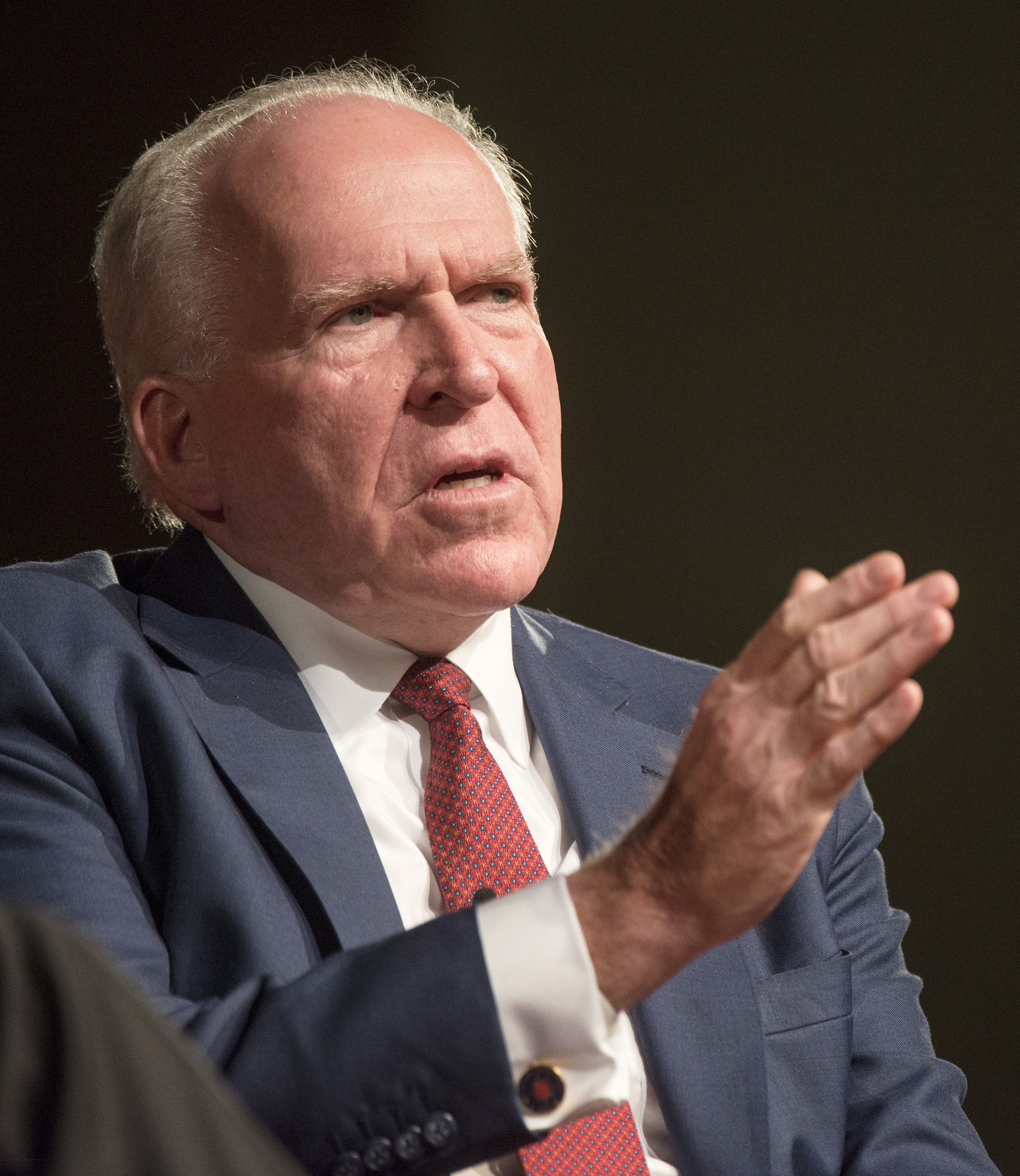
Brennan: Is the jig up? ( LBJ Library photo/ Jay Godwin)
As we Veteran Intelligence Professionals for Sanity have warned numerous times over the past two plus years, there is no reliable forensic evidence to support the story that Russia hacked into the DNC. Moreover, in a piece I wrote in May, “Orwellian Cloud Hovers Over Russia-gate,” I again noted that accumulating forensic evidence from metadata clearly points to an inside DNC job — a leak, not a hack, by Russia or anyone else.
So Brennan and his partners, FBI Director James Comey and National Intelligence Director James Clapper were making stuff up and feeding thin but explosive gruel to the hungry stenographers that pass today for Russiagate obsessed journalists.
Is the Jig Up?
With Justice Department investigators’ noses to the ground, it should be just a matter of time before they identify Brennan conclusively as fabricator-in-chief of the Russiagate story. Evidence, real evidence in this case, abounds, since the Brennan-Comey-Clapper gang of three were sure Hillary Clinton would become president. Consequently, they did not perform due diligence to hide their tracks.
Worse still, intelligence analysts tend to hang onto instructions and terms of reference handed down to them by people like Brennan and his top lieutenants. It will not be difficult for CIA analysts to come up with documents to support the excuse: “Brennan made me do it.”
The Times article today betrays some sympathy and worry over what may be in store for Brennan, one of its favorite sons and (anonymous) sources, as well as for those he suborned into making up stuff about the Russians.
The DOJ inquiry, says the Times, “has provoked anxiety in the ranks of the C.I.A., according to former officials. Senior agency officials have questioned why the C.I.A.’s analytical work should be subjected to a federal prosecutor’s scrutiny.” Attorney General William Barr is overseeing the review but has assigned the U.S. attorney in Connecticut, John Durham, to conduct it.
No Holds Barred
Barr is approaching this challenge with a resoluteness and a calm candor rarely seen in Washington — particularly when it comes to challenging those who run the intelligence agencies.
The big question, once again, is whether President Donald Trump will follow his customary practice of reining in subordinates at the last minute, lest they cross the vindictive and still powerful members of the Deep State.
Happily, at least for those interested in the truth, some of the authors of the rump, misnomered “Intelligence Community Assessment” commissioned by Obama, orchestrated by Brennan-Clapper-Comey, and published on January 6, 2017 will now be interviewed. The ICA is the document still widely cited as showing that the “entire intelligence community agreed” on the Russia-gate story, but this is far from the case. As Clapper has admitted, that “assessment” was drafted by “handpicked analysts” from just three of the 17 intelligence agencies — CIA, FBI, and NSA.
U.S. Attorney Durham would do well to also check with analysts in agencies — like the Defense Intelligence Agency and State Department Intelligence, as to why they believe they were excluded. The ICA on Russian interference is as inferior an example of intelligence analysis as I have ever seen. Since virtually all of the hoi aristoi and the media swear by it, I did an assessment of the Assessment on its second anniversary. I wrote:
“Under a media drumbeat of anti-Russian hysteria, credulous Americans were led to believe that Donald Trump owed his election victory to the president of Russia, whose “influence campaign” according to the Times quoting the intelligence report,helped “President-elect Trump’s election chances when possible by discrediting Secretary Clinton.”
Hard evidence supporting the media and political rhetoric has been as elusive as proof of weapons of mass destruction in Iraq in 2002-2003. This time, though, an alarming increase in the possibility of war with nuclear-armed Russia has ensued — whether by design, hubris, or rank stupidity. The possible consequences for the world are even more dire than 16 years of war and destruction in the Middle East. …
The Defense Intelligence Agency should have been included, particularly since it has considerable expertise on the G.R.U., the Russian military intelligence agency, which has been blamed for Russian hacking of the DNC emails. But DIA, too, has an independent streak and, in fact, is capable of reaching judgments Clapper would reject as anathema. Just one year before Clapper decided to do the rump “Intelligence Community Assessment,” DIA had formally blessed the following heterodox idea in its “December 2015 National Security Strategy”:
“The Kremlin is convinced the United States is laying the groundwork for regime change in Russia, a conviction further reinforced by the events in Ukraine. Moscow views the United States as the critical driver behind the crisis in Ukraine and believes that the overthrow of former Ukrainian President Yanukovych is the latest move in a long-established pattern of U.S.-orchestrated regime change efforts.”
Any further questions as to why the Defense Intelligence Agency was kept away from the ICA drafting table?
Ray McGovern works with Tell the Word, a publishing arm of the ecumenical Church of the Saviour in inner-city Washington. During his 27 years as a CIA analyst, he was Chief of the Soviet Foreign Policy Branch, and preparer/briefer of the President’s Daily Brief. He is co-founder of Veteran Intelligence Professionals for Sanity (VIPS).
Iran’s supreme leader ‘has no intention’ to make or use nuclear weapons – Japan’s PM
RT | June 13, 2019
Tehran has no intention of making or using nuclear weapons, Iranian supreme leader Ayatollah Ali Khamenei said, according to Japanese Prime Minister Shinzo Abe.
“Supreme Leader Khamenei made a comment that the country will not and should not make, hold or use nuclear weapons, and that it has no such intentions,” Abe told reporters in Tehran on Thursday following his meeting with Khamenei.
The previous day, Abe called on Iran to play a constructive role in securing peace and stability in the Middle East, saying that Tokyo is determined to do everything it can to help, Reuters reported.
Featured Video
John Mearsheimer: US Already lost Iran war – No off-ramp in sight
or go to
Aletho News Archives – Video-Images
Frlom the Archives
70 Neocons Petition Congress To Effectively Allow Israel To Say When The US Should Attack Iran
By Damian Lataan | January 10, 2014
Seventy senior Israeli-centric neoconservatives have written an open letter to Congress imploring them to do more to ensure Iran complies with the conditions of any agreement finally reached with the P5+1 over Iran’s nuclear program.
While the neocons are ostensibly asking Congress to ensure compliance, it is clear that their real aim is to convince members of Congress to support the bill currently passing through the Senate which calls for tighter sanctions against Iran in the event of any waywardness on Iran’s part.
The neocons are eager to see the bill currently passing through the Senate with enough support to make it veto-proof, not so much because they are concerned about Iran’s so-called nuclear weapons program – there’s still not a skerrick of hard evidence that Iran has a nuclear weapons program – but, rather, because embedded within the bill is this clause:
… if the Government of Israel is compelled to take military action in legitimate self-defense against Iran’s nuclear weapon program, the United States Government should stand with Israel and provide, in accordance with the law of the United States and the constitutional responsibility of Congress to authorize the use of military force, diplomatic, military, and economic support to the Government of Israel in its defense of its territory, people, and existence…
Essentially, the clause is an automatic trigger for the US to attack Iran at any time the Israelis choose to launch a first strike – regardless of whether President Obama is in favour or not.
Partial list… continue
Blog Roll
 Aletho News
- John Mearsheimer: U.S. Already Lost Iran War – No Off-Ramp in Sight
- UK Parliament Plans ISP Blocking and Age Verification Powers
- World cannot remain silent as US and Israel attack ‘heritage of humankind’: Iran
- Emirati billionaire rebukes US senator over call for Gulf states to join war with Iran
- Op. True Promise 4: Iran’s missile blitzkrieg dismantles US war machine in West Asia
- Aramco CEO warns ‘catastrophe’ imminent if Strait of Hormuz remains shut
- What If Iran Says No?
- Trump Threatens to ‘Hit’ Iran ‘Twenty Times Harder’ Over Strait of Hormuz Oil Flows
- Spare the hypocrisy: Baghaei slams Ursula’s support for US
- Iran War Supporters Invent a New and Absurd Justification: It Is All About China
- If Americans Knew
- Israel Decided the War, But Trump’s America Fights and Pays the Bill
- Conscientious Objector Group: Phone ‘Ringing Off Hook’ As Huge Mobilization Underway
- U.S. support for Israel continues to plummet, despite media’s best efforts
- Threats and missiles fly, death tolls soar in Iran, Lebanon, Gaza – Not a ceasefire Day 151
- Lebanon: Israel’s White Phosphorous Use Risks Civilian Harm
- Corporate Media Go All Out To Support The US-Israeli War On Iran
- US-Israel war on Iran is creating a steady growing number of amputees
- Israel planned this war on Iran for 40 years. Everything else is a smoke screen
- The wrong question about the war in Iran
- ‘Your Tax Dollars Being Used to Raise Your Gas Prices’: US-Israel Bomb Major Iranian Oil Depots
- No Tricks Zone
- New Study Documents A 20-Year Pause In Arctic Sea Ice Decline – Driven By Internal Variability
- Wake-up Call: Survey Shows Majority Of Germans Now Favor Postponing Climate Targets!
- Televised! Leading German Political Candidate Tells Schoolchildren CO2 Makes Sun Hotter!
- New Study: A Century Warming Of 1.1°C Is ‘Commonplace’ And ‘Not Unusual’ During This Interglacial
- New Study: ‘Internal Noise’ And Volcanic Forcing Can Trigger 10-15°C Warming Within Decades
- Glaciers Worldwide Are Suddendly Surging, Experts Blame Warming!
- Surprising Discovery: Sahara Is Greening…Billions Of Trees Where Once Thought To Be Barren
- New Research Reaffirms Clouds, Aerosols, And Surface Solar Radiation Are ‘Driving The Climate System’
- Germany: Electric Car Catches Fire At Charging Station, Sets Off Local “Inferno”, Widespread Damage
- New Study: Canada’s New Brunswick Was 1°C Warmer Than Today During The Medieval Warm Period
 Aletho News