Amazon Plant In China Accused Of Forcing High School Interns To Work 60 Hour Weeks

By Tyler Durden – Zero Hedge – 09/2019
In addition to not paying taxes and putting the entire brick and mortar retail industry out of business single-handedly, Amazon has now opened itself up to even more criticism. The company is being accused of using a Chinese assembly plant that relies on temporary workers, including high school interns, and overtime limits set beyond law, according to Bloomberg.
In fact, Foxconn fired two executives from the plant, which assembles Echo speakers and Kindle e-readers, in response to a labor group’s allegation that it cut wages and broke labor laws. This marks the second time that Amazon and its Taiwanese peer have been under scrutiny for the treatment of workers at the Hengyang plant.
The plant’s chief and head of human resources were fired, while managers at the plant who were responsible for using interns were “punished”, according to Foxconn.
China Labor Watch said:
“Amazon and Foxconn responded that they would make improvements to the factory’s working conditions. However, CLW’s 2019 investigation found that Foxconn’s working conditions did not improve, and instead deteriorated.”
The labor group deemed the factory’s wages too low to support a “decent standard of living last year”. Since then, they’ve been slashed another 16% in 2019.
The poor salary hasn’t been enough to fill the company’s 58 assembly lines, which require 7,000 people to operate during peak production, which begins in July. To fill the void, Foxconn instead tapped interns as young as 16 from vocational schools, some of which were forced to work overtime.
One 17 year old computing major at a vocational school, who was responsible for putting protective film over Amazon Echo Dots, said she worked 40 hour work weeks. She was then asked to start working overtime and put in 60 hour work weeks. When she complained to the manager, she reportedly was warned by her teacher that turning down the work could jeopardize her graduation.
Foxconn admits that its proportion of contract workers and student interns had “on occasion exceeded legal thresholds and that some interns had been allowed to work overtime or nights”.
“We were not in full compliance with all relevant laws and regulation,” Foxconn said. The company continued, in a statement:
“Effective immediately, the percentage of interns assigned to that facility will be brought into full compliance with the relevant labor law.”
The specific allegations made by the China Labor Watch report included:
- Interns from local vocational schools accounted for more than 20% of the plant’s current workforce, double the levels permitted by law
- Such student workers were forced to work night shifts and overtime, in violation of the law, and that some interns were physically and verbally abused by teachers overseeing their work
- The factory used “dispatch workers” — similar to temporary staff in the U.S. — for around one in three positions at the plant, in excess of the 10% permitted by law
- Some 375 workers had been asked to work overtime on Sunday without receiving makeup days off, contrary to labor rules that stipulate at least one scheduled day off per week
Foxconn has battled criticism of how it has treated its workers for over a decade now. Those critiques came to a head in 2010 when a rash of suicides by workers at the company forced it to make a major overhaul of how it treated workers.
A report from China Labor Watch last year once again shone a spotlight on the company, as well as on Amazon. Amazon claims that it asked Foxconn to make changes in 2018 after a labor audit of the Hengyang facility showed similar overtime violations. Amazon’s investigators arrived on site Wednesday and the company says it has started doing “weekly audits” of the labor issue. Let’s see how long that lasts.
Amazon commented: “We are urgently investigating these allegations and addressing this issue with Foxconn at the most senior level.”
China backs the opening of Kashmir file in UNSC
By M. K. BHADRAKUMAR | Indian Punchline | August 10, 2019
The “special and emergency visit” by Pakistani Foreign Minister Shah Mahmood Qureshi to Beijing on Friday August 9 has been highly successful in getting China to voice open support for Islamabad’s proposed move to raise the Kashmir issue in the UN Security Council.
From both Pakistani and Chinese accounts, the outcome of the meeting between the Chinese State Councilor and Foreign Minister Wang Yi and Qureshi conveys a significant “pro-Pakistan” shift in Beijing’s stance apropos the situation around J&K, which was more or less on neutral ground initially. (See my blog China reacts to J&K, India demands reciprocity.)
How far the reference to China’s “internal affairs” in the MEA spokesman’s remarks on August 6 (which appeared to be a knee-jerk reaction) provoked Beijing is a moot point now. Indeed, Qureshi’s air dash to Beijing signalled Pakistan’s desperate need of Chinese open support and China cannot afford to be seen wanting.
According to the Xinhua report, the cutting edge of Wang’s remarks lies in his listing of the UN Charter (which upholds international peace and security, fundamental human rights, adherence to international law and obligations of member states to adhere to treaties, etc.), relevant resolutions of the UN SC on Kashmir (on the status of J&K, holding of plebiscite, UNMOGIP, etc.) and the bilateral agreements between Pakistan and India (Shimla Agreement and the Lahore Declaration) — in that sequence as the road map on Kashmir.
China has de facto pledged support to Pakistan when the latter raises the Kashmir issue in the UN SC. Wang doubled down on Beijing going the whole hog to support Pakistan: “China and Pakistan are all-weather strategic partners and have always understood and supported each other on issues concerning core interests, which is also a good tradition that both countries should cherish. China will continue to firmly support Pakistan in safeguarding its legitimate rights and uphold fairness for Pakistan in international affairs.”
Qureshi reciprocated subsequently by telling the media in Beijing, “Pakistan is not looking at the military option. We are rather looking at political, diplomatic and legal options to deal with the prevailing situation.” Wang reportedly advised Qureshi that Pakistan should prioritise its national development and peace in South Asia and seek a new path of peaceful co-existence with India.
The Radio Pakistan reported that the Wang-Qureshi meeting lasted for two and half hours, which suggests that substantive discussions took place regarding strategy on Kashmir. The Pakistani report said Wang also agreed that “steps taken by India are unilateral that have changed the status quo and structure” of J&K and “could jeopardize the peace and stability in the region.” It added that Wang “was in concurrence that Jammu and Kashmir has been recognized as a disputed region and its resolution should also be in the light of UN resolutions.”
The overt, dramatic shift in the Chinese stance against Indian interests would have taken into account the ambivalence in the US position on Kashmir. Against the backdrop of the controversial remarks by President Trump to mediate on Kashmir, the US state department spokesperson, when asked on Friday’s press briefing in Washington, blithely passed the buck to the White House.
The spokesperson also underscored, “Obviously, we just had Prime Minister (Imran) Khan here, not just because of Kashmir. That’s certainly an incredibly important issue and something that we follow closely, but we have a host of issues that we work with India on quite closely and that we work with Pakistan on quite closely. I would say that we are – as a State Department, we are incredibly engaged in Southeast Asia.”
During the coming week, two senior US officials are landing in Delhi at the same time — US deputy secretary of state John Sullivan (corresponding to ministerial rank) and Acting deputy secretary of state in charge of South Asia Alice Wells. Sullivan is reaching Delhi from Bhutan while Wells who was on a scheduled visit to Islamabad has extended her tour by travelling to India as well.
By the way, Sullivan becomes the highest ranking US official to visit Bhutan in decades. His visit signals a Churchillian approach in the US policies toward China lately — “We shall fight on the beaches, we shall fight on the landing grounds, we shall fight in the fields and in the streets, we shall fight in the hills.” Historically, this is the first time that Bhutan finds itself being courted as a frontline state in the Cold War cockpit.
Clearly, Sullivan’s visit augurs the same centrality to Bhutan in the US geo-strategy that Washington has lately begun attaching to Mongolia. In June, US National Security Advisor John Bolton visited Ulaanbaatar; in July, President Trump hosted Mongolian President Khaltmaa Battulga in the White House; by August already, the US Defence Secretary Mark Esper touched down in Ulaanbaatar on a daylong follow-up visit “to expand their military training, joint exercises and defense intelligence sharing”, according to Stratfor, US think tank wired into the security and defence establishment.
The big question is, whether Sullivan is delivering an invitation from Trump to the Dragon King of the Kingdom of Bhutan, Jigme Khesar Namgyel Wangchuck.
Equally, there is the likelihood that the US may seek the establishment of intelligence outposts in Bhutan. En route to Mongolia, Def Secy Esper told reporters openly that the US is working to build relationships with key countries in the Indo-Pacific that share values and respect for each other’s sovereignty, “whether it’s Mongolia this trip, Vietnam, a future trip, Indonesia, other countries who I think are key.”
In a reference to China, Esper said, “We’ve got to be able to compete with them.” An AP report quoted a senior US official that the US seeks to expand its defense and intelligence cooperation with Mongolia, noting that its location makes it ideal for listening posts and monitoring stations for peering into both U.S. adversaries.
According to the US state department, Sullivan “will explore expanding and deepening our ties with the government and people of Bhutan.” Of course, any significant expansion of US-Bhutan relations can only happen with the concurrence and approval of India. This is where Chinese sensitivities arise.
Possibly, Beijing senses that Sullivan’s Bhutan trip figured in the meeting between foreign minister S. Jaishankar and his American counterpart Mike Pompeo in Thailand recently. Sullivan is expected to meet Jaishankar.
Most importantly, the state department announcement on Thursday implied that Sullivan’s visits to Thimpu and Delhi are a back-to-back mission with the aim “to advance the United States’ partnership with two nations that are critical to preserving the rules-based order in the Indo-Pacific region.”
To be sure, Beijing would have taken note that the fizz has gone out of the Wuhan Spirit — with just a couple of months left for the visit by Chinese President Xi Jinping to India in October. The Wang-Qureshi meeting testifies to it.
4 Palestinians Killed by Israeli Forces at Gaza Border
By Ali Salam | IMEMC | August 10, 2019
Four Palestinians were shot and killed by Israeli forces for allegedly coming too close to the border fence between Gaza and Israel, east of Dir al-Balah, in the central Gaza Strip, according to Israeli media sources.
Israeli forces stationed along Gaza borders to the east of Khan Younis reportedly opened fire on a group of Palestinians after they allegedly approached the Israeli-installed barbed-wire fence along Gaza’s border with Israel, shooting and killing four.
The identities of the Palestinians remain unknown.
Israeli sources claimed that the group of Palestinians had fired toward the military base at the border, and there was an exchange of fire.
The Israeli Ynetnews said that the Golani Brigades that opened fire on the Palestinians are the same Brigade that came under fire two days ago, when two soldiers were injured.
Following the shooting of the two Palestinians, the Israeli airforce dropped bombs on what they claimed were two observation posts for the Al-Qassam Brigades, the armed wing of the Hamas party.
Military vehicles also invaded the area east of Dir al-Balah and began combing the area.
Israel has imposed a buffer zone inside the Gaza Strip along the border between Gaza and Israel, preventing Palestinians from reaching their lands near the border fence. It regularly opens fire at anyone who enters that buffer zone.
In a fact sheet about Israeli attacks on border areas and their consequences, the Palestinian Center for Human Rights (PCHR) said, “preventing Palestinians from accessing their lands and fishing areas violates numerous provisions of international human rights law, including the right to work, the right to an adequate standard of living, and the right to the highest attainable standard of health.”
Court overturns ruling to seize Iran-linked building in NY
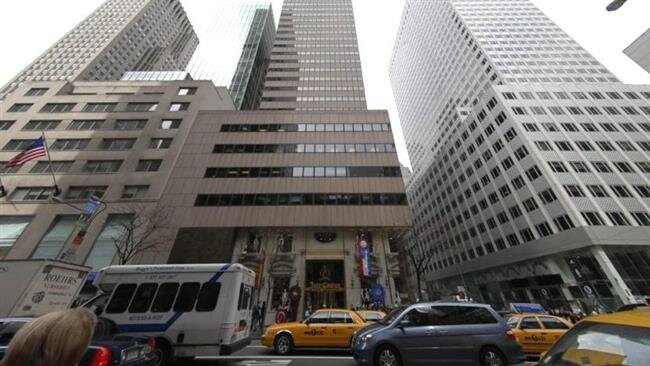
650 Fifth Avenue, a New York City skyscraper that houses the headquarters of the Alavi Foundation.
Press TV – August 9, 2019
A US federal appeals court has overturned a 2017 verdict that allowed the seizure of an Iran-linked skyscraper in New York City.
In June, 2017, a US court verdict allowed the government to seize the midtown Manhattan office tower owned largely by a charity organization, the Alavi Foundation.
The jury then claimed that the charity was controlled by the Iranian government and the rent generated from the tower constituted a violation of US sanctions against Iran.
On Friday, the 2nd US Circuit Court of Appeals in Manhattan ruled 3-0 that there was “a troubling pattern of errors on relatively straightforward issues” in this case.
“Getting to any outcome requires a fair and procedurally adequate process, something that has been lacking in this case. There are no shortcuts in the rule of law,” said Circuit Judge Richard Wesley.
The decision is considered as a defeat for the US Department of Justice as the government had hoped to sell the building for nearly one billion dollars.
Also in 2014, US District Judge Katherine Forrest granted authority to federal prosecutors to confiscate the building. However, an appeals court reversed that ruling in 2016.
Established in 1978, the non-profit organization has been working to advance the Islamic and Persian culture in the US.
The assets of the Alavi Foundation includes the building in Manhattan, as well as Islamic centers consisting of schools and mosques in New York City, Maryland, California, Texas and Virginia.
Without rent from the office building, the Alavi Foundation would have almost no way to continue supporting the Islamic centers.
American legal scholars say they know of only a few cases in US history in which law enforcement authorities have seized a house of worship.
The organization has also given millions of dollars to American schools, universities and charitable organizations; among them Harvard, Columbia and Rutgers university.
Israel settlers’ month of violence against Palestinians documented

MEMO | August 9, 2019
The month of June saw Israeli settler attacks against at least ten Palestinian villages in the occupied West Bank, with significant damage done to property and crops.
According to Israeli human rights organisation B’Tselem, June was yet “another month of routine settler violence fully backed by the military”.
Settlers vandalised property in ten communities across the West Bank, as well as burning some 1,800 trees and dozens of dunams of grain fields, “uprooting more than 700 vegetable seedlings and damaging at least 55 cars and spray painting hate graffiti on buildings”, stated B’Tselem.
In the Nablus area, “settlers threw stones at a family home in the village of Yasuf, shattering the windows, and punctured the family car’s tires”, while “in the village of Jalud, settlers burned more than a thousand trees in lands belonging to 21 farmers and threw stones at the school”.
Meanwhile, “in the village of Madama, settlers torched farmland and the fire spread to land belonging to the village of Burin, consuming about 180 fruit trees”, and “in the village of ‘Einabus, settlers punctured the tires of three cars and graffitied slogans on the mosque”.
In the central West Bank, settlers punctured the tyres of 22 cars in Beitin, Sinjil and Kafr Malik. In Burqah, “settlers set fire to fields and burned about 200 olive and other fruit trees”, while in Al-Mughayir, “settlers burned some fifty dunams of wheat and hay fields and some 370 olive trees”.
Other examples cited by B’Tselem include attacks by settlers in the Bethlehem region, where they “vandalised farming equipment in the village of Wadi Fukin and uprooted more than 700 saplings and four olive trees”.
According to B’Tselem, “these acts of violence, which are backed by the military, have been occurring every month for years.”
“It is part of Israel’s policy in the West Bank, and it serves the state’s agenda. The policy itself is designed to reduce Palestinian farming and gradually transfer areas that have been abandoned due to fear of violence over to settlers,” the NGO added.
“As part of this policy, and to enable these acts of violence, the authorities rarely investigate the crimes and the odds that any of the criminals would be punished for their actions are minuscule. Settlers are well aware of this fact, as are Palestinians who remain defenceless.”
Ecuadorian Court Orders Pre-Trial Detention for Former President Correa
Sputnik – August 9, 2019
Ecuador’s National Court of Justice has ordered pre-trial detention for former president Rafael Correa, who served as the country’s president from 2007-2017 over an alleged corruption scheme, a statement from the country’s prosecutor said.
“The judge of the National Court of Justice, Daniella Camacho, accepted the measures requested by the Prosecutor’s Office and issued pre-trial detention for former President Rafael C.”, the statement said.
Former vice president Jorge Glas and several other high-ranking officials are also on the detention list.
According to the prosecution, the former head of state is involved in the bribery and corruption case in the largest political party in Ecuador, PAIS Alliance, which he founded. The prosecutor’s office says that he refuses to cooperate with the investigation.
In response, Correa stated that the case was launched in order to prevent him from participating in the upcoming elections.
“The judicial proceedings against me are intended to prevent me from returning to the country and prevent my possible participation in the [2021] elections. They know that the polls show that we are doing very well. Do not underestimate hate. Some people live only for the sake of hate and I believe that this feeling is stronger than love. Some people live to hate me”, he said.
The ex-president is currently outside Ecuador. November 2018, the media reported that Correa allegedly requested asylum from Belgium, where he lived with his family, but the politician denied this information.
In the meantime, Correa called the request of the country’s prosecutor for his pre-trial detention merely a political show in an interview with Sputnik. He added that the case would not prevent him from continuing his career in Ecuador in the future.
To Avoid US Big Tech’s Wiretapping Users Should Shift to Chinese Software & Devices – Cyber Expert
By Ekaterina Blinova – Sputnik – August 9, 2019
Forbes has reported alleged plans by Facebook to “wiretap” WhatsApp and other messaging services thereby rendering their end-to-end encryption useless. While the tech giant rubbished the claim, concerns continue to mount over Facebook’s use of surveillance techniques to track users.
In late July, Kalev Leetaru, a Forbes contributor, raised concerns over Facebook’s alleged plan to insert a backdoor content-scanner or “wiretapping algorithm” into its popular messaging apps.
“In Facebook’s vision, the actual end-to-end encryption client itself such as WhatsApp will include embedded content moderation and blacklist filtering algorithms,” Leetaru claimed, suggesting that the tech giant would be able to scan messages before they are sent, allowing it to report suspicious activity.
Will Cathcart, WhatsApp’s vice president of product management, vehemently rejected Leetaru’s assumption.
“We haven’t added a backdoor to WhatsApp,” Cathcart told tech and science publication OneZero. “To be crystal clear, we have not done this, have zero plans to do so, and if we ever did, it would be quite obvious and detectable that we had done it. We understand the serious concerns this type of approach would raise, which is why we are opposed to it.”
A Facebook spokesperson told OneZero that any research specialist would be capable of examining the WhatApps code to find out if anything had been changed, adding that the application is one of the most “scrutinised” in the world.
Earlier, US Attorney General William Barr criticised tech companies for not providing access to their “warrant-proof” encryption thereby thwarting law enforcement efforts to track criminal activities.
In September 2018 that the US Department of Justice reportedly tried but failed to force Facebook to break the end-to-end encryption of its Messenger chat app to provide law enforcement with a backdoor to spy on the voice conversations of gang suspects.
Facebook’s Surveillance Practices
“Facebook wants to provide users with end-to-end encrypted communication. This is very good for privacy and ‘democracy promotion,'” said Petri Krohn, a Finnish cybersecurity analyst. “Kalev Leetaru is saying that totally secret communication would not be in the interests of internet companies, as they need to access and read the messages to target their advertising. Reading the messages in the end devices would solve the problem. This seems to be what Facebook is planning to do. The end result would be cryptography that could be breached by US technology companies and the US government, but not other governments.”
The cyber-security analyst draws attention to a whole set of Facebook’s surveillance techniques aside from the disputed “wiretapping algorithm” story.
Krohn does not rule out the possibility that Facebook is already using “edge AI” to listen in on conversations referring to Leetaru’s May claim that the tech giant could use users’ microphones “to scan the surrounding background environment 24/7, creating a globally distributed network of billions of always-on microphones transcribing global private conversations.”
Earlier, in July, cyber-security experts raised concerns about the Silicon Valley giant’s “automatic alternative text” that uses “object recognition technology to create a description of a photo for the blind and vision-loss community.” Experts suggested that it could be used to track users and warned that it could be abused either by law enforcement and intelligence agencies or by hackers.
In February, CNBC revealed that Facebook maintains a list of individuals issuing threats against the company and tracks their whereabouts using the location data these users provide through Facebook apps and websites. Several of the tech giant’s former employees called the tactics “very Big Brother-esque.”
In June 2018, Siva Vaidhyanathan, a US cultural historian and media scholar, said in a Slate article that Facebook was conducting commercial surveillance on billions of users on behalf of its advertising clients, “using biographical data, records of interactions with others, the text of their posts, location (through Facebook apps on mobile phones equipped with GPS features), and the ‘social graph’—a map of the relationships between items on Facebook (photos, videos, news stories, advertisements, groups, pages, and the profiles of its 2.2 billion users).”
“The chief danger from the Facebook commercial surveillance system lies in the concentration of power,” Vaidhyanathan wrote, adding that the tech firm’s huge set of personalised dossiers could be abused by both “peers and states.”
The only way to avoid the US-based tech giants’ surveillance is to use alternative devices and software, Krohn believes.
“To escape wiretapping by the US or the Five Eyes one must use Chinese phones with purely Chinese software and services. Or use a PC with only open source software, preferably a PC with a processor at least 10 years old, without the embedded spyware in the Intel Management Engine”, the cybersecurity expert suggests, referring to an autonomous subsystem that has been incorporated in all of Intel’s processor chipsets since 2008.
Russia delivers electronic warfare systems to Iran
By Drago Bosnic | Fort-Russ News | August 3, 2019
 Anzali, Iran – Russia just delivered the R-330Zh Zhitel SIGINT/jammer advanced electronic warfare system to Iran. The system saw combat use by DNR (Donetsk People’s Republic) and LNR (Lugansk People’s Republic) forces during the Ukrainian invasion. It gave the Novorussian forces an edge in fighting Ukrainian drones, scrambling their communications and offsetting artillery fire navigation which saved countless lives, military and civilian alike.
The R-330Zh Zhitel is a jamming communication station designed and manufactured by the Russian Company Protek. The whole system includes one Ural-43203 or KAMAZ-43114 truck and one shelter with four telescopic masts. The truck is the control center for the operators. The shelter is equipped with four telescopic active phased array transmitter antennas mounted on a four wheels trailer. The R-330Zh is designed for detection, analysis, direction-finding, and jamming of satellite and cellular phone communication systems operated in the frequency from 100 to 2,000 MHz. The jamming system provides analysis and selection of emitters’ signal parameters. The system’s jamming station was used successfully by the Russian army during the Crimean crisis in March 2014.
If Novorussian combat experience is taken into account, the Iranian military just got a crucial system which gives it a serious advantage over US troops stationed in the Middle East. Considering the fact that the US and their Persian Gulf allies are over-reliant on advanced communications and UAVs (unmanned aerial vehicle) in order to conduct military operations, the Russian R-330Zh Zhitel electronic warfare system, if used properly, will give the Iranian military an edge which the potential invading forces cannot hope to overcome easily, if at all.
8chan: The Latest Fearporn Drive
Guardian in Hysterics Over Threat of Homeless, Anonymous Shitposters
By Kit Knightly | OffGuardian | August 9, 2019
The Problem
8chan may have been shut down, but that doesn’t mean we’re safe.
You see, all the people that used 8chan before it was shut down are still out there. They might be on Twitter. They might be on Facebook. They might be ordering coffee at a Starbucks. They might be plotting some sort of far-right apocalypse. They might just be talking about movies on reddit. There’s no way of knowing.
We should all be terribly worried.
At least, according to The Guardian, who headline today:
8chan: ex-users of far-right site flock to new homes across internet
First off, of course, 8chan was not a “far-right site”, it was a site with some “far-right” people on it.
There are hundreds of boards on 8chan, with thousands upon thousands of different posters. Boards could be created by anyone to discuss anything.
The vast majority were dedicated to perfectly ordinary topics. Video games, fashion, cars, movies. There were many much more specific, fetishy, niche and weird… but not “far-right”. The site didn’t have an ideology except “free speech”.
The general shifting of “free speech” from something we all take for granted to being described as a “far-right agenda” is one of the most worrying trends in modern politics.
The article is actually funny, not least for the total lack of web literacy on display:
Former members of 8chan have scattered across the internet after the far-right site was shut down over the weekend
This is simply ridiculous to anyone who knows anything about the nature of 8chan et al. There are no “members”. That, indeed, is the whole entire point of the place. It is anonymous and temporary. No usernames, no registration, no “membership”.
The press has a long history of simply not being able to grasp the way the internet works (as in the famous “Who is this 4chan?” CNN interview or Fox’s “internet hate machine” piece), but this is such basic ignorance of the topic at hand that I almost can’t believe it’s genuine.
Indeed, it might not be. It might be that portraying “8chan” as some sort of organized community plays into the media’s need to generate fear. This generates, “the problem”, which sets us up for…
The Reaction
Having established that 8chan’s “far-right” “members” are out there in the ether, being terrifying, the article needs to get some feedback on what that means.
To do this they go to two “consultants”:
- Joan Donovan, who runs the Technology and Social Change (TaSC) Research Project
- Ben Decker the CEO of “Memetic Consultancy” (sic. It’s actually “Memetica”).
They are portrayed as two essentially different voices, as if we’re getting a spectrum of opinion. But the most cursory check on Donovan and Decker shows they are both research fellows at the Shorenstein Institute of the Kennedy School of Government. They aren’t separate. At all.
(NOTE: In fact, Memetica, Shorenstein, and other NGOs currently talking up the need for internet censorship are a ripe subject for a full-on exposé, and will be in the near future)
Not at all surprisingly, being research fellows for the same institute at the same university, Decker and Donovan absolutely agree on pretty much everything.
Primarily, that shutting down 8chan was a really good idea, but won’t – on its own – solve the “far-right” problem.
Apparently, all the people that posted on 8chan will NOT flee the internet forever, but will now just go and post somewhere else. Why anyone would need two Harvard-trained academics to tell them this, I don’t know.
Where will they go?
Well, other scary places of course. Like the “far-right forum” Gab, or back to 4chan or reddit. Some of them will be “absorbed” by the social media giants (meaning they will post on Twitter and Facebook), and some will post in discussions on encrypted message services like Telegram and Discord.
For some reason, Gab is a real bugbear for centrists, being regularly attacked simply for existing. Its one claim to infamy is that the Pittsburgh synagogue shooter apparently had a Gab account…this, apparently, makes it a far-right social network.
Niche and independent networks are always attacked by-association in this way. The Dayton shooter and “MAGABomber” both had twitter accounts, and the Christ Church attack was live-streamed on Facebook…but they are not shut down.
The Solution
Having established that shutting down 8chan was brilliant, but more is needed, our two NGO representatives set out what else needs to be done:
One way to prevent 8chan users from migrating to alternative social media spaces like YouTube and Facebook would be to build a moat around the platforms to prevent inbound links from these sites,”
This is total, complete nonsense. 8chan is gone, so “preventing inbound links” from it is now moot. Secondly, users don’t click from 8chan to YouTube, or Facebook or whatever. That’s not how the internet works. This would never control users crossposting, or prevent people having different accounts on different platforms or anything like that.
All this would do is prevent people from linking to sources. It stops the flow of information, not users. If Ben is really a “social media consultant”, he knows that. He’s just dishonestly suggesting censorship on totally spurious grounds.
There is an inherent value in deplatforming the site as a whole and making it harder to be accessed because the nature of these communities makes it difficult to inoculate the spread of this toxicity.”
Just “deplatform” websites “as a whole” if they are “toxic”. That’s the solution. Who decides what’s “toxic”?
Well, obviously the government does. Duh.
That’s just the start though. Whilst these Harvard academics give us the problem a reaction and just a hint of “solution”, elsewhere on the Guardian we are presented with a full, detailed (final?) solution.
Julia Ebner – another researcher for yet another creepy-sounding NGO the “Institute for Strategic Dialogue” – headlines:
How do we beat 8chan and other far-right sites? The same way we beat Isis
Essentially, as CJ Hopkins has written, this is just a rebranding of the War on Terror for a modern age. More like a remake, actually, to use Hollywood parlance. The same themes, the same characters. New dialogue. Different casting.
Bellingcat got in on this one too, hosting an article claiming:
Until law enforcement, and the media, treat these shooters as part of a terrorist movement no less organized, or deadly, than ISIS or Al Qaeda, the violence will continue.
(NOTE: The ISIS comparison is more than apt. Now would be a good time to remember just how phony and manipulated the ISIS narrative was. Catte did excellent work on this.)
Julia writes that what we need is:
a stronger international response to condemn political rhetoric that belittles, legitimises or even endorses the dangerous concepts and conspiracy theories of far-right extremists.
Translation – Governments cooperating to suppress free speech. “Conspiracy theories” can, and will, mean absolutely anything they want it to mean. The DNC fixing the primaries for Clinton, for example. Or the Skripals being poisoned by MI6. Press bias against Corbyn. Criticism of Israel, or even mentioning the “Labour Friends of Israel”. These can all be defined as “conspiracy theories”.
On top of this Julia wants:
an international definition of terrorism that is ideologically agnostic and includes not only traditional jihadi organisations but also loose far-right networks.
Translation – An international definition of terrorism that is loose enough to be deployed against anybody for anything.
“Terrorism” will become even more absurdly vague than it is now. These “loose far-right networks” will mean “anybody who posts on Gab”, or “anyone who thinks 9/11 was an inside job”. Joining certain Facebook groups, visiting certain websites (there was actually a meme about this one). Watching RT. She says “loose”, and she means it.
It will shock you how “loose” these networks are. You’re probably in one, right now, just for reading this article. Welcome to our “loose network of far-right extremists”.
Most importantly Julia thinks…
… governments will need to look beyond the big tech platforms and introduce legal frameworks that tackle the ongoing migration of extremists to the smaller alt-tech sites.
Translation – Banning certain opinions from the big platforms that cooperate with the state is not enough. We then need to move against the smaller, independent platforms that – unlike Google, Facebook and Twitter – refuse to toe the party line.
Censor Twitter, and shutdown any platform – like Gab or Parler – that attempts to fill the “free speech” market niche. The state machine will love that, because it gives it control of narrative and information flow, while the social media giants will love it because it essentially writes their monopoly into law. That’s a massive win-win.
In that sense it coincides perfectly with the famous Mussolini definition of fascism – “Fascism should more appropriately be called Corporatism because it is a merger of state and corporate power”
The establishment is signalling intent here – the way they always do when these opportunities are either presented to them, or created by them. Harness that fear, sense the opening, and drive the push through.
It’s all rather like that old joke – “Q: What do you call 1000 lawyers at the bottom of the ocean? A: A good start.”
Q: What do you call one website shut down for allowing free speech?
A: Just the beginning.
Kit Knightly is co-editor of OffGuardian. The Guardian banned him from commenting. Twice. He used to write for fun, but now he’s forced to out of a near-permanent sense of outrage.
Malaysia charges 17 current & ex-Goldman Sachs bosses with looting of country’s wealth fund

Superyacht linked to Malaysia’s state fund looting scandal © AFP / Sonny Tumbelaka
RT | August 9, 2019
Malaysia has extended pressure on Wall Street titan Goldman Sachs, filing criminal charges against 17 current and former directors of the bank’s subsidiaries over alleged involvement in the multi-billion-dollar 1MDB scandal.
Goldman Sachs has been under scrutiny for its role in helping to arrange $6.5 billion through bond offerings for Malaysian state fund, the 1Malaysia Development Berhad (1MDB). The fund is at the center of one of the biggest financial scandals of all time, and is now being investigated for money laundering.
In the filings issued on Friday, Malaysian Attorney General Tommy Thomas said the executives mentioned in the document should be held responsible for the US bank’s role in the scheme. The prosecution wants to seek custodial sentences and criminal fines for the accused, “given the severity of the scheme to defraud and fraudulent misappropriation of billions in bond proceeds, the lengthy period over which the offenses were planned and executed.”
Each charge carries a maximum jail term of 10 years and a penalty of at least 1 million ringgit ($239,000), according to Reuters.
The list includes 17 people who were in charge of three Goldman Sachs subsidiaries between May 2012 and March 2013, during which the alleged fraud took place, according to the attorney general. Richard Gnodde, who leads the bank’s international business in London, as well as Canadian business executive Michael Evans, a former Goldman Sachs Asia chief who is currently the president of Chinese e-commerce giant Alibaba, were among those charged on Friday. British banker Michael Sherwood, former vice chairman of the Wall Street firm, is also on the list.
The latest case adds to last year’s accusations, when Malaysian authorities filed charges against three Goldman Sachs units and two ex-employees. Kuala Lumpur is seeking $7.5 billion in compensation from the bank.
The US investment bank has repeatedly denied any wrongdoing, claiming it fell victim to the previous corrupt Malaysian government. Commenting on the latest accusations, Goldman Sachs said the charges were misdirected and promised to “vigorously” contest them.
Thoughts on China’s Currency
By Dean Baker | Beat the Press | August 9, 2019
There is a conventional wisdom on China’s currency that gets repeated almost everywhere and never seems to be challenged in the media. The basic story is that in the bad old days China ‘manipulated” its currency, but that stopped years ago. At present, its currency controls are actually keeping the value of its currency up, not down. As much as I hate to differ with the conventional wisdom, there are a few issues here that deserve closer examination.
First, it’s great see that everyone now agrees that China managed its currency in the last decade. (I prefer the term “manage” to “manipulate,” since the latter implies something sneaky and hidden. There was nothing sneaky about China’s undervalued currency. It had an official exchange rate that it bought trillions of dollars of foreign reserves to maintain.) Unfortunately, almost none of these people acknowledged China’s actions at the time, when the under-valuation of China’s currency was costing the United States millions of manufacturing jobs. Oh well, it wasn’t like the Wall Street bankers were losing their jobs.
The second point is that there is a common assertion that only the buying, not the holding, of reserves affects currency prices. It is easy to show that China is not currently buying large amounts of reserves. In fact, it has been selling some in recent years to keep its currency from falling.
Okay, let’s take a step back. The Federal Reserve Board bought more than $3 trillion in assets to try to boost the economy following the Great Recession. This was done to directly reduce long-term interest rates by increasing the demand for bonds. While it stopped buying assets several years ago, it still holds more than $3 trillion in assets.
Virtually all economists agree that by holding these assets, the Fed is keeping down long-term interest rates. If this additional $3 trillion in assets were on the market, then long-term interest rates would be higher. (The size of the impact is debated, but not the direction.)
If the holding (not buying) of assets has an impact on interest rates, why does China’s holding of more than $3 trillion in foreign reserves not have an impact on the price of the dollar and other reserve currencies relative to the RMB? (It would actually be well over $4 trillion if we add in the trillion plus dollars held in China’s sovereign wealth fund.)
In the magical world of make it up as you go along conventional wisdom economics there can be peaceful coexistence of this logical conflict, but those of us who are not part of the club need not accept it.
It’s also worth adding that the Fed has raised interest rates several times in the last three years, just as China has occasionally sold reserves. Would anyone say that this means that the net effect of the Fed’s actions at the moment is to raise interest rates above the level they would be at if the Fed were not holding assets?
Finally, we get the story that if China were to remove all capital controls then the value of the RMB would fall, as Chinese sought to diversify their holdings. While this is true, it is at best half of the story as every fan of I.M.F. policies knows. The I.M.F. always tells countries to eliminate capital controls because it will increase the amount of capital that flows into the country. Investors are more likely to put their money into a country where they can freely withdraw it than one where they can’t.
While the capital inflow story needs some qualifications, there is a basic logic to it. Obviously, foreign investors will feel more comfortable putting money into a country where they can get back their investment quickly than in one where they can’t. In spite of the fact that this logic is imposed on developing countries all the time, it is virtually invisible in discussions of China’s currency.
As a practical matter we continually see stories about how European retirees are unhappy with the negative interest rates they get on the bonds of countries like Germany and France. Getting an interest rate of more than 3.0 percent on long-term bonds issued by the Chinese government would look pretty good in comparison. Furthermore, with China’s purchasing power parity GDP almost twice its GDP measured by exchange rates, most people would probably expect the general direction of its currency over the long-term to be upward, as it has been in the past. This would further increase the potential gains from holding Chinese government debt relative to the debt of European countries or the United States.
It seems as though the conventionally wise people never thought about this issue, or at least if they have, they don’t mention it in public discussions. Anyhow, it is not surprising that the conventional wisdom is missing much of the story here. After all, the conventional wisdom in economics could not see the $8 trillion housing bubble ($12 trillion in today’s economy), the collapse of which sank the U.S. economy and gave us the Great Recession. The conventional wisdom doesn’t seem any wiser today.
The Unanswerable Case
By Craig Murray | August 9, 2019
Simon Jenkins gets it with this simple and unanswerable argument.
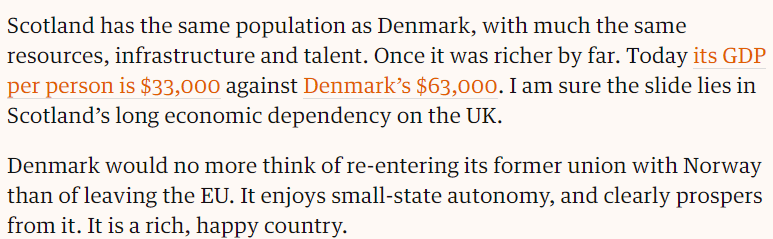
Scots are now very significantly poorer than the Irish, the Norwegians, the Swedes, the Danes, the Icelanders or any of their obvious comparators. Every one of those nations is in the top 10 of the UN Human Development Index. The UK is not, and Scotland is below the mean for the UK. It is not because Scots are stupid or feckless, it not because of climate and it is certainly not a lack of natural resources. It is because of the draining away of human and physical resource by London over centuries.
Against that fundamental fact, the cloud of stupid obfuscation around the minutiae of transition is a mere distraction, and a deliberate one at that. Countries which are far poorer than Scotland successfully run on their own currencies – scores of them. Why would people believe Scotland is unique among nations in being incapable of having a currency? Yet such pathetic shibboleths are pounded out by the media, and particularly the BBC, on a daily basis to make a significant number of Scots believe that what is possible for every nation that has tried it, is uniquely impossible to them.
It is particularly galling to see those that have made us poor tell us we cannot be independent because we are poor. Particularly when the entire system of government accounting has been manipulated over decades to ascribe Scotland’s revenue to the wider UK, to ascribe a portion of infrastructure projects in SE England such as Crossrail as Scottish expenditure, and to present an entirely distorted picture of the Scottish fiscal position.
I am entirely at the end of my patience. It really is time that we claimed our Independence and stopped this slavish adherence to the laws of the Imperial state which seeks to continue its leeching out of our resources.
Featured Video

John Mearsheimer: US Already lost Iran war – No off-ramp in sight
or go to
Aletho News Archives – Video-Images
Frlom the Archives
With apparently fabricated nuclear documents, Netanyahu pushed the US towards war with Iran
By Gareth Porter | The Grayzone | April 29, 2020
President Donald Trump scrapped the nuclear deal with Iran and continued to risk war with Iran based on Israeli Prime Minister Benjamin Netanyahu’s claim to have proven definitively that Iran was determined to manufacture nuclear weapons. Netanyahu not only spun Trump but much of the corporate media as well, duping them with the public unveiling of what he claimed was the entire secret Iranian “nuclear archive.”
In early April 2018, Netanyahu briefed Trump privately on the supposed Iranian nuclear archive and secured his promise to leave the Joint Comprehensive Plan of Action (JCPOA). That April 30, Netanyahu took the briefing to the public in a characteristically dramatic live performance in which he claimed Israel’s Mossad intelligence services had stolen Iran’s entire nuclear archive from Tehran. “You may well know that Iran’s leaders repeatedly deny ever pursuing nuclear weapons…” Netanyahu declared. “Well, tonight, I’m here to tell you one thing: Iran lied. Big time.”
However, an investigation of the supposed Iranian nuclear documents by The Grayzone reveals them to be the product of an Israeli disinformation operation that helped trigger the most serious threat of war since the conflict with Iran began nearly four decades ago. This investigation found multiple indications that the story of Mossad’s heist of 50,000 pages of secret nuclear files from Tehran was very likely an elaborate fiction and that the documents were fabricated by the Mossad itself. … continue
Blog Roll
 Aletho News
- ‘We’ve Obliterated Their Missiles’
- Syrian president vows ‘absolute support’ to disarm Hezbollah
- Ukraine attacking Russian gas pipeline to stop deliveries to Europe – Defense Ministry
- ‘Heinous crime’: Iran denounces Israeli assassination of 4 Iranian diplomats in Lebanon
- John Mearsheimer: U.S. Already Lost Iran War – No Off-Ramp in Sight
- UK Parliament Plans ISP Blocking and Age Verification Powers
- World cannot remain silent as US and Israel attack ‘heritage of humankind’: Iran
- Emirati billionaire rebukes US senator over call for Gulf states to join war with Iran
- Op. True Promise 4: Iran’s missile blitzkrieg dismantles US war machine in West Asia
- Aramco CEO warns ‘catastrophe’ imminent if Strait of Hormuz remains shut
- If Americans Knew
- Israel Decided the War, But Trump’s America Fights and Pays the Bill
- Conscientious Objector Group: Phone ‘Ringing Off Hook’ As Huge Mobilization Underway
- U.S. support for Israel continues to plummet, despite media’s best efforts
- Threats and missiles fly, death tolls soar in Iran, Lebanon, Gaza – Not a ceasefire Day 151
- Lebanon: Israel’s White Phosphorous Use Risks Civilian Harm
- Corporate Media Go All Out To Support The US-Israeli War On Iran
- US-Israel war on Iran is creating a steady growing number of amputees
- Israel planned this war on Iran for 40 years. Everything else is a smoke screen
- The wrong question about the war in Iran
- ‘Your Tax Dollars Being Used to Raise Your Gas Prices’: US-Israel Bomb Major Iranian Oil Depots
- No Tricks Zone
- New Study Documents A 20-Year Pause In Arctic Sea Ice Decline – Driven By Internal Variability
- Wake-up Call: Survey Shows Majority Of Germans Now Favor Postponing Climate Targets!
- Televised! Leading German Political Candidate Tells Schoolchildren CO2 Makes Sun Hotter!
- New Study: A Century Warming Of 1.1°C Is ‘Commonplace’ And ‘Not Unusual’ During This Interglacial
- New Study: ‘Internal Noise’ And Volcanic Forcing Can Trigger 10-15°C Warming Within Decades
- Glaciers Worldwide Are Suddendly Surging, Experts Blame Warming!
- Surprising Discovery: Sahara Is Greening…Billions Of Trees Where Once Thought To Be Barren
- New Research Reaffirms Clouds, Aerosols, And Surface Solar Radiation Are ‘Driving The Climate System’
- Germany: Electric Car Catches Fire At Charging Station, Sets Off Local “Inferno”, Widespread Damage
- New Study: Canada’s New Brunswick Was 1°C Warmer Than Today During The Medieval Warm Period
 Aletho News