Dutch court starts hearing in war crime case against Israel’s Gantz
Press TV – September 17, 2019
A Dutch court has held a hearing on a war crime case against a former Israeli general challenging incumbent Israeli Prime Minister Benjamin Netanyahu in ongoing general elections.
The Hague District Court weighed on Tuesday whether it should hear a lawsuit brought by a Palestinian man seeking compensation from Benny Gantz for his role in the killing of six of his relatives during the Israeli war on the besieged Gaza Strip in 2014.
On July 20, 2014, Ismail Ziada lost his mother, three brothers, a sister-in-law, and a 12-year-old nephew when their family home was bombed by the Israeli air force.
A visitor was also killed in the Israeli bombardment.
“I was shot at a very close range with a rubber coated metal bullet in the head. I witnessed another boy being shot in the head next to me, dying on the spot,” said Ziada about his encounters with the Israeli army.
Ziada, who now lives in the Netherlands, filed a civil lawsuit in 2018 seeking damages from Gantz, who was the chief of staff of Israel’s military at the time of the bombing, and the then-air force commander Amir Eshel.
Ziada says the attack violated international humanitarian law because it deliberately targeted civilians.
The Tuesday session addressed a motion filed by Gantz and Eshel’s lawyers asking the court to dismiss the case. They argued the ex-commanders were immune because the Dutch court had no jurisdiction over the case.
Ahead of the hearing, Ziada’s lawyer, Liesbeth Zegveld, said Palestinians from Gaza could not receive fair treatment in Israeli courts.
Dutch courts can exercise universal jurisdiction over war crimes, provided the accuser cannot get a fair trial elsewhere.
Israel launched several wars on the Palestinian coastal sliver, the last of which began in early July 2014. The military aggression, which ended on August 26, 2014, killed nearly 2,200 Palestinians. Over 11,100 others were also wounded in the war.
The Gaza Strip has been under Israeli siege since June 2007. The blockade has caused a decline in the standards of living as well as unprecedented levels of unemployment and unrelenting poverty.
Apartheid Made Official: Deal of the Century is a Ploy and Annexation is the New Reality
By Ramzy Baroud | Palestine Chronicle | September 17, 2019
Israeli Prime Minister Benjamin Netanyahu is moving quickly to alter the political reality in Palestine, and facing little or no resistance.
On September 10, Netanyahu declared his intentions to annex swathes of Palestinian land adjacent to the Jordan River, an area that covers 2,400 square kilometers, or nearly a third of the Occupied West Bank. That region, which extends from Bisan in the north to Jericho in the south, is considered to be Palestine’s food basket, as it accounts for an estimated 60 percent of vegetables that are produced in the West Bank.
While Israel has already colonized nearly 88 percent of the entire Palestinian Ghoor (or Jordan Valley), dividing it between illegal agricultural settlements and military zones, it was always assumed that the militarily occupied region will be included within the border of a future Palestinian state.
Netanyahu’s announcement has been linked to Israel’s general elections of September 17. The Israeli leader is desperate, as he is facing “unprecedented alliances” that are all closing in to unseat him from his political throne. But this cannot be all. Not even power-hungry Netanyahu would alter the political and territorial landscape of Israel and Palestine indefinitely in exchange for a few votes.
Indeed, talks of annexation have been afoot for years and have long preceded the September elections or the previous ones in April.
A sense of euphoria has been felt among Israel’s rightwing officials since the advent of Donald Trump to the White House. The excitement was not directly linked to Trump but to his Middle East team, like-minded pro-Israel US officials whose support for Israel is predicated on more than personal interests, but religious and ideological beliefs as well.
White House senior adviser, Jared Kushner, selected his team very carefully: Jason Greenblatt as special envoy for Middle East peace, David Friedman as United States Ambassador to Israel, and layers of other second-tier officials whose mission was never aimed at resolving conflict or brokering peace, but supervising a process in which Israel finalizes its colonization of Palestine unhindered.
Kushner’s masterstroke is epitomized in the way he presented his objectives as part of a political process, later named “Deal of the Century”.
In all fairness, Kushner’s team hardly labored or even pretended to be, peacemakers, especially as they oversaw the US recognition of Jerusalem as Israel’s capital and of the occupied Golan Heights as Israeli territories. Indeed, none of these officials tried to hide their true motives. Just examine statements made by the just-resigned Greenblatt where he refused to name illegal Jewish settlements as such, but as “neighborhoods and cities”; and Friedman’s outright support for the annexation of parts of the Occupied West Bank, and much more.
The US political discourse seemed in complete alignment with that of Israel’s right-wing parties. When right-wing extremist politicians, the likes of Naftali Bennett and Ayelet Shaked, began floating the idea of annexing most or all of the Occupied West Bank, they no longer sounded like marginal and opportunistic voices vying for attention. They were at the center of Israeli politics, knowing full well that Washington no longer had a problem with Israel’s unilateral action.
It could be argued, then, that Netanyahu was merely catching up, as the center of gravity within his right-wing coalition was slipping away to younger, more daring politicians. In fact, Israel, as a whole, was changing. With the Labor Party becoming almost entirely irrelevant, the Center’s political ideology moved further to the right, simply because supporting an independent Palestinian state in Israel has become a form of political suicide.
Therefore, Netanyahu’s call for the annexation of Palestinian land east of the Jordan River must not be understood in isolation and only within the limited context of the Israeli elections. Israel is now set to annex large parts of the West Bank that it deems strategic. This is most likely to include all illegal settlement blocs and the Jordan Valley as well.
In fact, Netanyahu said on September 11 that he was ready to annex the Jordan Valley region even before the election date, but was blocked by the Attorney General’s office. Netanyahu would not have taken such a decision if it represented a political risk or if it faced pushback from Washington. It is, then, sadly, a matter of time.
Suspiciously absent in all of this are the Palestinian Authority (PA), the Arab League, the European Union and, of course, the United Nations and its many outlets and courts. Aside from a few shy statements – like that of the spokesperson of the UN, Stéphane Dujarric, decrying that “unilateral actions are not helpful in the peace process” – Israeli leaders are facing little or no hindrance whatsoever as they finalize their complete colonization of all Palestinian land.
Unable to stage any kind of meaningful resistance against Israel, the Palestinian leadership is so pathetically insisting on utilizing old terminologies. The official Palestinian response to Netanyahu’s annexation pledge, as communicated by Prime Minister Mohammed Shtayyeh, came only to underscore the PA’s political bankruptcy.
“Netanyahu is the chief destroyer of the peace process,” Shtayyeh said, warning that annexing parts of the West Bank would have negative consequences.
For his part, the PA leader Mahmoud Abbas resorted, once more, to empty threats. Abbas said in a statement, “All agreements and their resulting obligations would end if the Israeli side annexes the Jordan Valley, the northern Dead Sea, and any part of the Palestinian territories occupied in 1967.”
Neither Abbas nor Shtayyeh seem troubled by the fact that a “peace process” does not exist, and that Israel has already violated all agreements.
While the PA is desperately hanging on to any reason to justify its continued existence, Netanyahu, with the full support of Washington, is moving forward in annexing the West Bank, thus making apartheid an official and undisputed reality.
The Palestinian leadership must understand that the nature of the conflict is now changing. Conventional methods and empty statements will not slow down the Israeli push for annexation nor Tel Aviv’s determination to expand its apartheid to all of Palestine. If Palestinians continue to ignore this reality altogether, Israel will continue to single-handedly shape the destiny of Palestine and its people.
– Ramzy Baroud is a journalist, author and editor of The Palestine Chronicle. His last book is ‘The Last Earth: A Palestinian Story’, and his forthcoming book is ‘These Chains Will Be Broken: Palestinian Stories of Struggle and Defiance in Israeli Prisons’. Baroud has a Ph.D. in Palestine Studies from the University of Exeter and is a non-resident research fellow at the Center for Islam and Global Affairs (CIGA) at Zaim University in Istanbul. His website is www.ramzybaroud.net.
Iran, Pakistan sign new agreement on major gas project: Report
Press TV – September 17, 2019
A major deal for exports of gas from Iran to Pakistan has been revised after several years of uncertainty surrounding the project, shows a report in the Pakistani media.
The Express Tribune said in a Monday report that national gas companies from Iran and Pakistan had inked an agreement to revise the terms of an old deal meant for exports of gas from Iran which had been supposed to be implemented by 2015.
The deal had stalled mainly because Pakistan was unable to construct a pipeline through its territory to transfer the Iranian gas to the port of Karachi. Islamabad was also unwilling to pay compensation for its delay, saying it had been caused by sanctions imposed on Iran.
The report said the Inter State Gas Systems (ISGS) of Pakistan and the National Iranian Gas Company (NIGC) had agreed to allow Pakistan to finish construction of the pipeline in its territory until 2024.
It cited sources as saying that Iran would not sue Pakistan for a fresh delay beyond 2024 unlike the previous contract under which Iran had threatened Islamabad with legal action. There was no comment on the report from the Iranian officials.
It said the two companies would seek to devise solutions for completion of the project which would enable Pakistan to import 750 million cubic feet of gas per day from Iran.
Based on the terms of the previous deal, Pakistan had been supposed to complete its section of the gas pipeline within 22 months after construction activities for the project kicked off in March 2013.
However, Pakistan later backtracked from the commitment and officials said that sanctions imposed on Iran had made it impossible for the country to build the 1,600-kilometer pipeline.
Iran has almost completed its sides of the pipeline which starts from installations of the South Pars gas field located on the Persian Gulf port of Asaluyeh and runs 1,172 kilometers through two provinces to reach the Pakistani border.
Trump is in no rush to jump into Saudi defence
By M. K. BHADRAKUMAR | Indian Punchline | September 17, 2019
The geopolitical faultlines of the drone attack on the Saudi Aramco plants on Saturday are surfacing. These are early days but three broad trends have appeared. One, Saudi investigators have begun pointing a finger at Iran, which is certain to exacerbate regional tensions. Two, the all-important US response to the event is unfolding on multiple templates, each interconnected but intrinsic at the same time in relations to US interests. Three, the extreme volatility in the world oil market and its likely impact on the world economy makes this an international issue.
The Saudi Foreign Ministry statement on Monday is notable for its affirmation that the “weapons used in the attack were Iranian weapons. Investigations are still ongoing to determine the source of the attack”; that the primary target of this attack is global energy supplies; that “this attack is in line with the previous attacks against Saudi Aramco pumping stations using Iranian weapons”; that Riyadh “will invite UN and International experts to view the situation on the ground and to participate in the investigations”; and, fifthly, that Saudi Arabia has the “capability and resolve to defend its land and people, and to forcefully respond to these aggressions.”
Riyadh’s lingering dilemma is that it is yet to substantiate Iran’s culpability and is looking for the proverbial needle in the haystack. The keenness to involve the UN in the investigations suggests that Saudis are reasonably confident of a definitive conclusion that helps isolate Iran completely in the world arena.
The Saudi Foreign Ministry statement is based on the initial finding by the investigators that “all operational evidences and indication as well as the weapons used… are Iranian weapons.” Importantly, the Joint Coalition Forces Command in Riyadh has alleged that “the terrorist attack was not launched from Yemeni territory as the Houthi militias claimed, whereas these militias are mere tools to implement the agenda of the Iranian Revolutionary Guards and its terrorist regime.”
It implies that the Saudi authorities have much more materials than they are willing to disclose. There is also a pointed reference to the Iranian Revolutionary Guards Corps.
On Monday, the US Defence Secretary Mark Esper telephoned the Saudi Crown Prince Mohammed bin Salman (MbS). The Saudi press release said Esper “affirmed his country’s full support for the Kingdom” and conveyed that Washington is “currently studying all possible options in addressing the attacks.” Esper commended the Saudi role in the US efforts to “confront the Iranian danger which threatens maritime navigation.” But neither Esper or MbS accused Iran.
It is against the above backdrop that President Trump waded into the topic on Monday at a press conference in the White House. (Trump spoke in the presence of the visiting Crown Prince of Bahrain.) The transcript is here. The main takeaways are as follows:
One, the US is inclined toward an estimation that Iran is responsible for Saturday’s attacks. But the Saudi investigation hasn’t yet come up with definitive evidence. The US does not propose to attack Iran.
Two, Saudi Arabia is a key ally, but the US cannot underwrite Saudi defence. While it can offer protection to Saudi Arabia, Riyadh will have to bankroll the effort. Top US officials will be traveling to Riyadh “at some point” for consultations.
Clearly, the Saudis “are going to have a lot of involvement in this if we [US] decide to do something. They’ll be very much involved, and that includes payment. And they understand that fully.”
Plainly put, “Saudis want very much for us to protect them, but I say, well, we have to work. That was an attack on Saudi Arabia, and that wasn’t an attack on us. But we would certainly help them… we will work something out with them. But they also know that — you know, I’m not looking to get into new conflict, but sometimes you have to.”
Four, Trump has an eye on Tehran, too. A meeting between Trump and Iranian President Hassan Rouhani in New York during the UNGA is not to be expected but the scope for diplomacy has not been “exhausted”. The Iranians want to make a deal “but they’d like to do it on certain terms and conditions, and we won’t do that. But at some point, it will work out, in my opinion.”
Depending on the actual finding by Saudi investigators, the US may toughen its stance toward Iran, but that depends on what Riyadh comes up with. “There’s plenty of time. You know, there’s no rush. We’ll all be here a long time. There’s no rush.”
The stunning thing is, Trump claims he is in no tearing hurry. Significantly, while addressing a group of seminary students in Tehran on Tuesday, Iran’s Supreme Leader Ali Khamenei seemed to acknowledge Trump’s remarks the previous day.
In a relatively conciliatory tone, Khamenei said: “If the US retracts its words, repents and returns to the nuclear accord that it has violated, it can then take part in sessions of other signatories to the deal and hold talks with Iran… Otherwise, no talks at any level will be held between Iranian and American authorities, neither in New York nor elsewhere.”
Equally, Trump admitted that he isn’t unduly perturbed about the cascading oil price.

US government satellite image showed that attacks on the infrastructure at Saudi Aramco’s Abaqaiq oil processing facility on September 14, 2019 were extremely surgical.
Separately, in a tweet Monday, Trump noted: “Because we have done so well with Energy over the last few years (thank you, Mr. President!), we are a net Energy Exporter, & now the Number One Energy Producer in the World. We don’t need Middle Eastern Oil & Gas, & in fact have very few tankers there, but will help our Allies!”
The point is, a high oil price isn’t such a bad thing for the US shale industry. Hydraulic fracturing, or fracking, opened up more natural gas for production in the US, but the technology added costs. Shale oil costs more than conventional oil to extract, ranging from a cost-per-barrel of production from as low as $40 to over $90 a barrel.
Now, Saudi Arabia can produce at under $10 per barrel, while worldwide costs range from $30 to $40 a barrel. The US shale industry becomes a wild card in the Saudi Aramco calculus.
Saudi Oil Attacks: Time to Back Off on the Threats
Saudi Arabia Feels Some Pain
By Philip Giraldi | American Herald Tribune | September 17, 2019
Attacks on two Saudi Arabian oil facilities on Saturday reportedly reduced the production of Aramco, the state oil company, by one half. It was a devastating demonstration of just how vulnerable the Kingdom’s oil economy actually is. Initial reports suggested that the damage had been caused by explosive drones launched by the Houthi rebels in Yemen, who claimed responsibility, but there has been considerable skepticism regarding whether the drones available to the Houthi could actually have carried out the attack.
Inevitably, the United States and the Saudis are blaming Iran, which has often been accused of being the Houthi’s sponsor. U.S. Secretary of State Mike Pompeo quickly claimed there was no evidence that the attacks emanated from Yemen and blamed Tehran, tweeting predictably that “amid all the calls for de-escalation, Iran has now launched an unprecedented attack on the world’s energy supply.”
As is often the case, Pompeo strung together some lies and half-truths. That Iran was the culprit was and still is unproven and the attack was on Saudi Arabia, which has been subjecting the Houthis to brutal bombardment that has produced famine and introduced cholera to Yemen, not on the “world’s energy supply.” Pompeo’s language is intentionally seeking to broaden the conflict by depicting Iran as a rogue nation seeking to do damage to everyone and preparing the audience for a possible counter-strike.
U.S. and Saudi officials have indeed been investigating whether the attacks involved cruise missiles fired from Iraq or Iran and would love to come to that conclusion, whatever the actual facts might be. The Iranians are believed to have a locally developed cruise missile that goes by the name Hoveyzeh, which is very mobile and can be fired from improvised sites. It is capable of flying at low altitudes to evade radar and has a five-hundred pound conventional warhead that would be more than capable of doing the reported damage to the oil facilities, much more so than would be possible using the missiles and drones that the Houthis are known to possess.
President Trump has also added his two cents, tweeting ominously on Sunday that “Saudi Arabia oil supply was attacked. There is reason to believe that we know the culprit, are locked and loaded depending on verification, but are waiting to hear from the Kingdom as to who they believe was the cause of this attack, and under what terms we would proceed!” Trump, who called Crown Prince Mohammed bin Salman to assure him of American support, also overreacted in his usual fashion, authorizing access to the United States’ Strategic Petroleum Reserve. The move has nothing to do with any real shortage of oil, particularly in the U.S., which imports little from the Middle East, and is clearly rather intended to stabilize oil prices during the two or more weeks it will take the Saudis to repair the damage to their facilities.
The attacks have forced Saudi Arabia to suspend production of 5.7 million barrels of oil a day, which is half of its normal output and over 5 percent of the global supply, so there will be considerable impact on global crude prices. The Saudi stock market felt the pain immediately, declining by 3 percent on Sunday with the expectation that crude prices will increase sharply over the next few days.
The damage to the facilities comes at a particularly bad time for the Saudis, perhaps by design by whoever carried out the attacks. Aramco will soon be floating an initial public offering (IPO) that could be one of the world’s largest. Potential foreign investors in particular will inevitably be concerned about the long-term security of the country’s reserves from future attacks by rebels or neighboring states, to include Iran.
Officials in Iran both and Iraq have denied allegations that the attacks had come from their respective territories, but that would be expected in any case. What is certain is that the success of the attack, from whatever source, has changed the calculus for what is taking place in the Middle East. Saudi Arabia has been waging a pitiless war in Yemen, but it now finds itself far more vulnerable than it deemed to be possible. Iran for its part, benefits from the Saudi knowledge that it’s oil production can be hit and hit hard, possibly even put out of business, meaning that Riyadh will now be much more careful in how it proceeds.
The United States and possibly even Israel will also be reading the tea leaves. In a recent interview Brigadier General Amir Ali Hajizadeh, commander of the aerospace unit of the Islamic Revolution Guards Corps (IRGC), said that Iran had been prepared to attack American bases in the Persian Gulf region if the U.S. had attempted to retaliate after Iranian forces recently shot down its intruding spy drone over the Straits of Hormuz. He said: “… if they wanted to attack, we would have attacked U.S. bases with missiles, and we were ready, and we would have targeted the U.S. base in al-Udeid in Qatar or al-Dhafra in the Emirates or their ships in the Gulf of Oman or Arabian Sea, and if they had hit us, we would have hit them back.”
Missile warfare has created a new reality. The presumed use by poorly armed Houthis of relatively cheap and available weapons to defeat multi-billion dollar defenses sends a message not only to the Saudis but also to Washington and Jerusalem, who have similar defensive configurations. The Saudis and Americans will be forced to rethink their options while Israel, for its part, has already clearly recognized that its air defenses would be overwhelmed by the sheer volume of missiles that opponents like Hezbollah would be able to send its way. It has called off several planned major attacks on Lebanon for that reason.
The final question has to be what will Washington and Riyadh do if they come to the conclusion, whether true or false, that Iran carried out the attack. President Donald Trump is, as usual, talking tough and threatening with his favorite “locked and loaded” metaphor, but he is basically unstable and this time he might actually be intending to pull the trigger. If he does, the Iranian response would undoubtedly be both serious and sustained. Many people on both sides would die.
The correct response would be for the Saudis, the U.S. and Israel to realize that more adventurism in the Persian Gulf region could easily spin out of control. Iran or its presumed proxies have sent the message that the consequences of continued provocations could be devastating for all involved. Time to back off on the threats and it is past time for the U.S. to stop knee-jerk support of the reckless actions undertaken by both the Kingdom and Israel.
Ignorant Iran ‘experts’ just the beginning of Washington’s foreign policy troubles
By Nebojsa Malic | RT | September 16, 2019
An explosive essay calling out the lack of legitimate expertise about Iran ought to be a wake-up call for the US foreign policy field. Yet the same problem also affects Washington’s analysis of Russia, China and many other places.
Imagine a field of study in which less than a third of the experts had related doctorates, half of them could not read, speak or write the language required, and just as many have never set foot inside the relevant country. Preposterous, you might say – yet scientific observation has shown that this is precisely what the US expertise on Iran looks like, according to an essay by political anthropologist Negar Razavi, recently published in the journal Jadaliyya.
Razavi describes the think-tank culture of DC as “a wider system of knowledge production in Washington – one which has consistently rewarded ungrounded, ideologically driven assessments of the Islamic Republic at the expense of qualified, in-depth, and evidence-based analysis.”
This is her conclusion after two years of “ethnographic fieldwork” in the US capital, attending hundreds of events, following the writings and presentations of think-tank experts, and interviewing over 180 people between 2014 and 2016. In other words, this was a serious academic study.
This culture of “expert impunity” when it comes to Iran has combined with historical and contemporary US grievances against Tehran to produce the current policy of confrontation, in which allegations are treated as unquestioned facts while any nuanced assessments are dismissed as the work of “regime apologists,” according to Razavi.
If this sounds familiar, that’s because the problem is not limited to Iran. Though Razavi focused exclusively on the state of Iran expertise, her assessment applies in equal measure to the self-styled experts on Venezuela, or Russia, or China, or the Balkans…
The examples are legion. Razavi herself mentions (though not by name) “Heshmat Alavi,” a supposed expert on Iran who recently turned out to be a construct – an online persona operated by the Iranian exile group Mojahedin-e Khalq (MEK). This is an outfit that seeks regime change in Tehran, and has been endorsed by former National Security Advisor John Bolton and President Donald Trump’s personal lawyer Rudy Giuliani.
Gordon Chang, who predicted the “coming collapse of China” in a 2001 book, has been embraced by CNN and Fox News alike as an expert on Beijing – despite the obvious failure of his prediction to actually materialize. Likewise, Swedish economic Anders Aslund has heralded the demise of Russia since 2000 – and cashed in his “expertise” with the Atlantic Council and the governments of Ukraine, Kyrgyzstan and the Baltic states.
Then there was the never-ending parade of “Russia experts” on cable news shows helping cultivate and propagate the hoax of President Donald Trump’s “Russian collusion” over the past three years, only to see the Mueller Report conclusively quash their fabrications. Have there been apologies? Of course not. As Razavi points out, being an “expert” in DC means never having to admit wrongdoing.
Her essay reveals how actual experts and scholars – who warned against things like the 2003 invasion of Iraq or ‘Russiagate’ – have been been sidelined or smeared time and again, while the think-tank factories churned out false expertise on cable channels and social media. Their takes would then find their way into official papers at the State Department and the Pentagon, morphing along the way into facts that “everybody knows” and no one is allowed to question.
The result of this unholy alliance of tanks and think-tanks has been decades of mis-shapen US foreign policy, with arguably disastrous results – from trillions in squandered treasure to millions of deaths around the world.
Israel Spies and Spies and Spies
This time the target was Donald Trump
By Philip Giraldi • Unz Review • September 17, 2019
Here we go again! Israel is caught red handed spying against the United States and everyone in Congress is silent, as are nearly all the mainstream media which failed to report the story. And the federal government itself, quick to persecute a Russian woman who tried to join the NRA, concedes that the White House and Justice Department have done absolutely nothing to either rebuke or punish the Israeli perpetrators. One senior intelligence official commented that “I’m not aware of any accountability at all.”
Only President Donald Trump, predictably, had something so say in his usual personalized fashion, which was that the report was “hard to believe,” that “I don’t think the Israelis were spying on us. My relationship with Israel has been great… Anything is possible but I don’t believe it.”
Ironically, the placement of technical surveillance devices by Israel was clearly intended to target cellphone communications to and from the Trump White House. As the president frequently chats with top aides and friends on non-secure phones, the operation sought to pick up conversations involving Trump with the expectation that the security-averse president would say things off the record that might be considered top secret.
The Politico report, which is sourced to top intelligence and security officials, details how “miniature surveillance devices” referred to as “Stingrays” imitate regular cell phone towers to fool phones being used nearby into providing information on their locations and identities. According to the article, the devices are referred to by technicians as “international mobile subscriber identity-catchers or IMSI-catchers, they also can capture the contents of calls and data use.”
Over one year ago, government security agencies discovered the electronic footprints that indicated the presence of the surveillance devices around Washington including near the White House. Forensic analysis involved dismantling the devices to let them “tell you a little about their history, where the parts and pieces come from, how old are they, who had access to them, and that will help get you to what the origins are.” One source observed afterwards that “It was pretty clear that the Israelis were responsible.”
The Israeli Embassy denied any involvement in the espionage and Prime Minister Benjamin Netanyahu adroitly and predictably lied regarding the report, saying “We have a directive, I have a directive: No intelligence work in the United States, no spies. And it’s vigorously implemented, without any exception. It is a complete fabrication, a complete fabrication.”
The Israelis are characteristically extremely aggressive in their intelligence gathering operations, particularly in targeting the United States, even though Trump has done the Netanyahu government many favors. These have included moving the U.S. Embassy to Jerusalem, withdrawing from the nuclear deal and sanctioning Iran, recognizing Israeli sovereignty over the Golan Heights, and looking the other way as Israel expands its settlements and regularly bombs Syria and Lebanon.
Israel’s high-risk spying is legendary, but the notion that it is particularly good at it is, like everything having to do with the Jewish state, much overrated. Mossad has been caught in flagrante numerous times. In 2010, an undercover Mossad hit team was caught on 30 minutes of surveillance video as it wandered through a luxury Dubai hotel where it had gone to kill a leading Hamas official. And the notion that Mossad and CIA work hand-in-hand is also a fiction. Working level Agency officers dislike their reckless Mossad counterparts. Newsweek magazine’s “Spy Talk” once cited a poll of CIA officers that ranked Israel “dead last” among friendly countries in actual intelligence cooperation with Washington.
The fact is that Israel conducts espionage and influence operations against the United States more aggressively than any other “friendly” country, including tapping White House phones used by Bill Clinton to speak with Monica Lewinski. Israeli “experts” regularly provide alarmist and inaccurate private briefings for American Senators on Capitol Hill. Israel also constantly manufactures pretexts to draw the U.S. into new conflicts in the Middle East, starting with the Lavon Affair in Alexandria Egypt in 1954 and including the false flag attack on the U.S.S. Liberty in 1967. In short, Israel has no reluctance to use its enormous political and media clout in the U.S. to pressure successive administrations to conform to its own foreign and security policy views.
The persistent spying, no matter what Netanyahu claims, is a very good reason why Israel should not receive billions of dollars in military assistance annually. Starting in 1957, Israel’s friends stole enriched uranium from a Pennsylvania refinery to create a nuclear arsenal. More recently we have learned how Arnon Milchan, a Hollywood producer/billionaire born in Israel, arranged the illegal purchase of 800 krytron triggers to use in the production of nuclear weapons. The operation also involved current Israeli Prime Minister Netanyahu.
The existence of a large scale Israeli spying effort at the time of 9/11 has been widely reported, incorporating Israeli companies in New Jersey and Florida as well as hundreds of “art students” nationwide. Five “dancing” Israelis from one of the companies were observed celebrating against the backdrop of the twin towers going down.
While it is often observed that everyone spies on everyone else, espionage is a high-risk business, particularly when spying on friends. Israel, relying on Washington for billions of dollars and also for political cover in international fora like the United Nations, does not spy discreetly, largely because it knows that few in Washington will seek to hold it accountable. There were, for example, no consequences for the Israelis when Israeli Mossad intelligence officers using U.S. passports and pretending to be Americans recruited terrorists to carry out attacks inside Iran. Israelis using U.S. passports in that fashion put every American traveler at risk.
Israel, where government and business work hand in hand, has obtained significant advantage by systematically stealing American technology with both military and civilian applications. The U.S. developed technology is then reverse engineered and used by the Israelis to support their own exports. Sometimes, when the technology is military in nature and winds up in the hands of an adversary, the consequences can be serious. Israel has sold advanced weapons systems to China that incorporate technology developed by American companies.
The reality of Israeli large-scale spying in the United States is indisputable. One might cite Jonathan Pollard, who stole more highly classified information than any spy in history. And then there were Ben-Ami Kadish, Stuart Nozette and Larry Franklin, other spies for Israel who have been caught and tried, but they are only the tip of the iceberg. Israel always features prominently in the annual FBI report called “Foreign Economic Collection and Industrial Espionage.” The 2005 report states “Israel has an active program to gather proprietary information within the United States. These collection activities are primarily directed at obtaining information on military systems and advanced computing applications that can be used in Israel’s sizable armaments industry.” It adds that Israel recruits spies, uses electronic methods, and carries out computer intrusion to gain the information.
A 1996 Defense Investigative Service report noted that Israel has great success stealing technology by exploiting the numerous co-production projects that it has with the Pentagon. It says “Placing Israeli nationals in key industries … is a technique utilized with great success.” A General Accounting Office (GAO) examination of espionage directed against American defense and security industries described how Israeli citizens residing in the U.S. had stolen sensitive technology to manufacture artillery gun tubes, obtained classified plans for reconnaissance systems, and passed sensitive aerospace designs to unauthorized users.
The GAO has concluded that Israel “conducts the most aggressive espionage operation against the United States of any U.S. ally.” In June 2006, a Pentagon administrative judge ruled against a difficult to even imagine appeal by an Israeli denied a security clearance, saying that “The Israeli government is actively engaged in military and industrial espionage in the United States.” FBI counter intelligence officer John Cole has also reported how many cases of Israeli espionage are dropped under orders from the Justice Department., making the Jewish state’s spying consequence free. He provides a “conservative estimate” of 125 viable investigations into Israeli espionage involving both American citizens and Israelis that were stopped due to political pressure.
So, did Israel really spy on Donald Trump? Sure it did. And Netanyahu is, metaphorically speaking, thumbing his nose at the American president and asking with a grin, “What are you going to do about it?”
Philip M. Giraldi, Ph.D., is Executive Director of the Council for the National Interest, a 501(c)3 tax deductible educational foundation (Federal ID Number #52-1739023) that seeks a more interests-based U.S. foreign policy in the Middle East. Website is https://councilforthenationalinterest.org, address is P.O. Box 2157, Purcellville VA 20134 and its email is inform@cnionline.org.
Rapprochement with Russia?
By Gilbert Doctorow | September 16, 2019
Starting in July and running to the present day, there have been repeated calls from mainstream media, from leading statesmen and from diplomats, in the United States and in Europe, for some kind of rapprochement with Russia to be put in place. This is remarkable given the continually escalating informational, economic, military confrontation between Russia and the US-led West over the past five years. That confrontation has emerged in two waves of anti-Russian hysteria: the first, after the daring (or brazen) Russian reunification with (or annexation of) Crimea in March 2014, and the second, with still greater momentum towards war, following the November 2016 election of Donald Trump to the presidency, which was accompanied by allegations of Russian collusion with candidate Trump and other meddling in the U.S. election processes.
Since the United States initiated the New Cold War, it is only fitting that the first steps towards its resolution are coming from there. And it is not in the least surprising that these steps were taken in the aftermath of the April 2019 release of the Mueller Report, which showed that the allegations of Russiagate were without merit or not actionable. Trump’s political enemies were compelled to move on to other issues of contention that would serve better in the next presidential campaign, which is quickly approaching.
That is the context in which I place the fairly amazing editorial of The New York Times dated 21 July 2019 entitled “What’s America’s Winning Hand if Russia Plays the China Card?” The NYT, which along with The Washington Post, had been among the most fervent disseminators of Russiagate theories and of poisonous characterizations of the “Putin regime” now was calling for… re-establishing civilized relations with Russia in order to draw the country back from its growing alliance with China.
While the editorial opens by citing a recent Defense Department report on the serious security threat to the U.S. from any Sino-Russian alliance, the fact of such alliance in formation has been obvious to anyone following the growing cooperation between these two countries in energy, aviation, military exercises, common positions taken in the UN Security Council and much more. It was also obvious for years that a major factor encouraging the Russian-Chinese embrace was the political, military and economic pressure each was receiving from the United States going back to the administration of George W. Bush and running through the Obama and Trump administrations. What is new is only the Times’ using this impending geopolitical tectonic shift to justify an extensive reversal of U.S. policy towards Russia. Now we read that “… President Trump is correct to try to establish a sounder relationship with Russia and peel it away from China.”
This is not to say that the NYT raised the white flag and abandoned its identification of Russia as a malevolent rival: “America can’t seek warmer relations with a rival power at the price of ignoring its interference in American democracy.” Nor did it abandon its identification of Russia as a “declining power” which it very inaccurately ranks as “not even in the top 10” economies, when in fact Russia is close to taking the fifth largest economy slot when purchasing power parity is applied.
Specifically, The Times called for cherry-picking topics for cooperation with Russia such as space travel, managing the Arctic and arms control “especially by extending the New Start Treaty.”
I have taken time with this editorial because the reasoning did not come from nowhere. Moreover, the same logic underlies most, though not all of the calls for rapprochement with Russia that have punctuated the past two months on both sides of the Atlantic.
As for where it came from, I would put forward the name of Henry Kissinger, who exerted considerable influence on candidate Trump in 2016 and continued to have his ear in the early days of the new administration. There can be little doubt that Kissinger urged Trump to reach out to Putin precisely to halt the dangerous drift of Moscow towards Beijing under pressure from successive US administrations. After all Kissinger was Nixon’s man who drew China into an informal alliance with the United States, implementing the policy whereby Washington was closer to both Moscow and Beijing than either was to the other. He did not need to wait for Pentagon white papers in 2019 to know what was afoot and what had to be done to avert the worst, which spelled the destruction of his single greatest achievement during his time in power.
At the same time, Kissinger would have been advising only selective cooperation with Moscow, not full-blown détente. This is precisely the position that he and other ‘wise men’ from the Reagan and George H.W. Bush administrations urged upon both candidate Barack Obama and candidate John McCain during the electoral campaign of 2008, when relations between Russia and the United States were fraught with danger relating to the August 2008 war in Georgia. Their recommendations eventually became the “re-set” policy approved by Obama and implemented by Vice President Joe Biden and Secretary of State Hilary Clinton early in 2009.
“Re-set” achieved progress on the various select issues for cooperation chosen by the Americans, in particular on arms control, resulting in the New START that today faces expiration. However, the ‘’re-set,’’ like what the New York Times editors now call for, did not begin to address the overriding issue driving the Russian foreign and military policy which the U.S. finds so unacceptable: Russia’s exclusion from the security arrangements that the Europeans have put in place together with the U.S., an architecture that is in fact directed against them. That very issue was the subject of the single most important diplomatic initiative of Russia’s President in 2008, Dmitry Medvedev: his call for negotiations to establish new security arrangements for Europe, outside of NATO, where Russia could be an equal member. That initiative met with no response whatsoever from either the United States or its European allies, and so the days of ‘’re-set’’ were numbered.
* * * *
In the period just before, during and after the G7 meeting in Biarritz on 24—26 August 2019 there have been several widely noted remarks from senior Euro-Atlantic statesmen on the need to improve relations with Russia.
A week before the summit, French President Emanuel Macron received Vladimir Putin for talks at his summer residence on the Côte d’Azur. Macron “played up efforts ‘to tie Russia and Europe back together’ and underscored his belief that ‘Europe stretches from Lisbon to Vladivostok.’…. In his Facebook post [after the meeting] Macron said …. ’I’m convinced that, in this multilateral restructuring, we must develop a security and trust architecture between the European Union and Russia…” (The Moscow Times, 20 August 2019).
Before and during the G7, Donald Trump told reporters that Russia should be there with them. At the summit’s conclusion, he indicated he was thinking of inviting Russia to the meeting when he hosts the group in Florida next year. Implicitly this means reviving full lines of communications with Russia which were cut at the insistence of Obama to punish Moscow for its misbehavior in Ukraine.
On 27 August, the day after the G7 closed, in the course of a speech to the assembled ambassadors of France in the Elysée palace, President Macron spoke at some length about the need to ‘reconsider’ ties with Russia within the context of facing up to the major challenges of a world in which the West had lost its hegemony. He called the exclusion of Russia from the New Europe following the fall of the Berlin wall a ‘’profound mistake.” He insisted that “if we do not know how to do something useful with Russia, then we will remain with a profoundly sterile tension, we will continue to have frozen conflicts everywhere in Europe, to have a Europe which is the theater of a strategic struggle between the United States and Russia, thus to have the consequences of the Cold War on our soil.” (http://www.liberation.fr ).
Several days later, on 4 September, in an interview with the Financial Times, Finnish Foreign Minister, Pekka Haavisto used his country’s current position as rotating president of the EU to make a similar point, saying “It’s very difficult to imagine a solution [to global crises] without Russia – or a solution that Russia is not somehow an active partner on.”
The FT deemed it worthwhile to quote him extensively:
“Mr Haavisto also said that the uncertainties created by Brexit and statements by US president
Donald Trump’s administration ‘distancing themselves from European affairs” meant EU states
needed to do more themselves to maintain stability in Europe. ‘It creates a space where
European countries need to think … ’how can we guarantee security here and what can we
do… together?’ he said.”
It went on to note: “Finland’s thinking is significant both because of its EU presidency and its unique relationship with Russia.”
Finally, in this listing of statements by public figures advocating better relations with Russia, I call attention to another article in the Financial Times, dated 15 September setting out the contents of an internal diplomatic note written by EU ambassador to Russia Dr. Markus Ederer. Dated 3 September, the addressees of the report were Ederer’s senior colleagues, the managing director for Asia Pacific at the EU’s External Action Service, and the acting managing director for Europe and Central Asia. The paper sets out arguments and options for engaging with Russia ‘taking into account the political environment, but also Russia’s natural relevance for EU-Asia connectivity.” It was drafted in preparation for the forthcoming 27 September meetings in Brussels on EU-Asia links to which Japanese Prime Minister Shinzo Abe has been invited and in which European Commission president Jean-Claude Juncker is expected to take part.
Among the choice quotations from the report which the FT shares with its readers we find:
“[The EU] would have everything to lose by ignoring the tectonic strategic shifts in Eurasia.”
“Engaging not only with China but with Russia, selectively, is a necessary condition to be part of the game and play our cards where we have comparative advantage.”
The FT article calls attention to five areas for prospective cooperation with Russia: the Arctic, digital, the Eurasian Economic Union, regional infrastructure and the ‘Northern Dimension’ joint policy between the EU, Russia, Norway and Iceland. In these areas, the EU could ‘’engage effectively, on concrete, technical matters’’ with Russia. The paper concludes that ‘’[t]he aim would be to set up a ‘framework of exchanges with Russia on longstanding issues in the EU interest’ involving European business and commission officials.”
* * * *
Considering where we stand today in relations with Russia, at a low point more dangerous than any time since the Cuban Missile Crisis of 1962, all of the aforementioned calls for improving relations made by very prominent and influential heads of state, public officials and media deserve a round of applause. The wise saying “jaw–jaw is always better than war–war” attributed to Winston Churchill applies with equal relevance today.
Looking at all the calls for better relations cited above, I believe the leitmotiv of them all is geopolitical considerations rather than fear of war, particularly nuclear war between the major world powers. Arms control is cited as only one of several objectives for cooperation. Concerns about the future alignment of those powers around the global board of governors are predominant. If humankind is said to be driven by the contradictory emotions of fear and greed, it would seem that our global leaders are presently acting in the spirit of greed rather than fear.
In his 27 August speech to the French diplomatic corps, President Macron called for an “audacious” foreign policy, effectively one that would move outside the box of conventional thinking. Correspondingly, thus far he is the only advocate of improved relations with Russia from among world leaders who had broached the subject of a comprehensive détente with Russia rather than cooperation in selective areas of greatest convenience to us. He is the only leader to have raised the question of revising the architecture of security in Europe to accommodate the fellow Europeans to the East.
Those who follow closely the political démarches of President Macron will object that his thinking about Russia has been all over the place since taking office. And I am among the first to consider him a shallow opportunist rather than the tower of intellect that he styles himself. The summit meetings he called with both Presidents Putin and Trump soon after moving into the Elysée palace had only one objective: to position himself as a prospective power broker in resolving the New Cold War in formation; they had no material content.
In the two years that have passed since he assumed power in France, Macron has been unlucky in domestic politics when his ill-considered fuel tax sparked the Gilets Jaunes movement. But he has been very lucky in foreign policy, because the dominant personality in European politics for the past decade or more, German Chancellor Angela Merkel, entered into the twilight period of her reign and the path opened for Macron to take the lead of EU politics with what he now calls an audacious roadmap.
The specific concept that emerges from Macron’s recent statements is an entente between Russia and the European Union based on shared values and creating a third force in global affairs alongside the United States and China. The alternative, which is looming absent any initiative such as Macron is proposing, will be for the EU to remain a junior partner to the USA and for Russia to be a junior partner to China while their two principals square off. Let us hope that in the days and months ahead Macron can muster the consistency of purpose and powers of successful execution to see through to conclusion what he has begun.
Gilbert Doctorow is an independent political analyst based in Brussels. His latest book, “Does the United States Have a Future?” was published on 12 October 2017.
©Gilbert Doctorow, 2019
Explaining CIA’s ‘Agent Smolenkov’
By Finian Cunningham | Strategic Culture Foundation | September 16, 2019
The saga of daring escape by a supposed Russian CIA agent from the Kremlin’s clutches and then the added twist of a security-risk American president putting the agent’s life in danger does indeed sound like a pulp fiction novel, as Kremlin spokesman Dmitry Peskov put it.
How to explain this sensational story? “Opportunism” is one word that comes to mind.
The news media who pushed the story, CNN, the New York Times and Washington Post, are vehemently “anti-Trump”. Any chance to damage this president and they grab it.
Also, perhaps more importantly, these media are desperate to salvage their shot-through journalistic credibility since the “Russiagate” narrative they had earnestly propagated died a death, after the two-year Mueller circus finally left town empty-handed.
This damage to supposed bastions of US journalism cannot be overstated. More than two years of spinning speculation-cum-reporting about Russian collusion with Trump and/or interference in US politics has produced not a crumb of substantive fact. That means those media responsible for the “Russiagate” nonsense have forfeited that precious quality – credibility. They no longer deserve to be categorized as news services, and are more appropriately now listed as fiction peddlers.
So when they got the chance to seemingly resurrect their buried “Russiagate” yarn with this latest fable about agent Oleg Smolenkov being exfiltrated from Russia to the US, they leapt at it because their equally buried reputations are also at stake.
As far as we can tell, an anonymous intelligence source started the ball rolling. The source is likely to be former CIA chief John Brennan or former Director of National Intelligence James Clapper. Both are hangouts for the anti-Trump media since they lost their intel jobs at the beginning of 2017, and both are believed to have seeded the “Russiagate” narrative in 2016 from before Trump was elected.
Notably, the current CIA assessment of the latest US media reporting on the exfiltrated spy is that the reporting is “false” and “misguided”. In particular, the CNN spin that the agent (Smolenkov) had to be extricated from Russia in 2017 because Langley feared that Trump may have endangered the supposed Kremlin mole when he hosted Russian foreign minister Sergei Lavrov in the White House in May 2017.
Also of note is the dismissive response from US Secretary of State Mike Pompeo who rubbished the reports. He was head of the CIA during 2017. (Admittedly, Pompeo is a self-confessed liar.)
According to CNN, NY Times and Washington Post, the former spy in the Kremlin, named as Oleg Smolenkov by subsequent Russian media reporting, was a top mole with direct access to President Vladimir Putin. It is claimed that Smolenkov confirmed allegations about a Putin-directed plot to interfere in US presidential elections. The agent is said to have also confirmed that Putin (allegedly) ordered the hacking of the Democratic party’s central database to obtain scandalous material on Hillary Clinton which was then fed to the Wikileaks whistleblower site for the purpose of scuttling her bid for the presidency in November 2016, thus favoring Trump.
Smolenkov was allegedly providing this information on a purported Kremlin interference campaign in 2016.
The US media claim Smolenkov was exfiltrated from Russia by the CIA in June 2017 – out of concern for his safety, which CNN reported was being jeopardized by President Trump due to his implied compromised relations with Putin. Smolenkov and his family disappeared while on a holiday in Montenegro in June 2017.
After the story broke earlier this week about the exfiltrated Kremlin mole, subsequent media reporting tracked down Oleg Smolenkov and his wife living in a $1-million-dollar mansion in Stafford, Virginia. Curiously, public records showed the house purchase was in their names, which seems odd for a supposed top-level spy, who had apparently committed extreme betrayal against the Kremlin, to be living openly. The family apparently fled the house to unknown whereabouts on September 9 after the story about his alleged spy role broke this week.
Who is Oleg Smolenkov? The Kremlin said this week that he previously worked in the presidential administration, but he was sacked “several years ago”. He did not have direct access to President Putin’s office, according to the Kremlin. For his part, Russian foreign minister Sergei Lavrov says he never heard of the man before, never mind ever having met him.
It is understood that Smolenkov previously worked in the Russian embassy in Washington under ambassador Yuri Ushakov (1999-2008). Smolenkov reportedly continued working for Ushakov when the diplomat returned to Moscow after his ambassadorial tenure in the US.
Here is where we may speculate that Smolenkov was recruited by the CIA during his diplomatic assignment in the US. But we assume that the Kremlin’s assessment is correct; he did not have a senior position or access to Putin’s office. By contrast, the US media are claiming Smolenkov was “one of the CIA’s most valuable assets” in the Kremlin and that he was providing confirmatory information that Putin was (allegedly) running an interference campaign to subvert the US presidential elections.
The discerning detail as to the truth of the imbroglio is revealed by the US media claims that Smolenkov corroborated the alleged hacking into the Democratic party database in 2016. However, that specific allegation has been disproven by several top hacker experts, notably William Binney who was formerly technical head at the US National Security Agency. There was no hacking. The damaging information on Hillary Clinton was leaked by a Democratic party insider, possibly Seth Rich, who soon after was shot dead by an unknown attacker. In short, the entire narrative about the Kremlin hacking into the Democratic party is a fiction. The premise to “Russiagate” is baseless.
Thus, if Smolenkov is peddling fiction to his former handlers in the CIA, that means he has no credibility as a “top mole”.
Again, opportunism is the key. Somebody came up with a lurid story about “Russian interference” in US democracy and “collusion” with Trump. Maybe it was Smolenkov who saw an opportunity to win a big pay day from his CIA patrons by flogging them a blockbuster. Or maybe, Brennan and Clapper (known liars in the public record) dreamt up a scheme of Kremlin malignancy to benefit Trump, and if that could be tied to Trump then his election would be discredited and nullified. But what they needed was a “Kremlin source” to “corroborate” their readymade story of “Russian interference”. Step forward Oleg Smolenkov – fired and out of work – to do the needfed “corroboration” and in return he gets a new life for himself and family with a mansion in a leafy Virginian suburb.
CNN, NY Times, Washington Post, Brennan and Clapper are so much damaged goods from past failure of “Russiagate” fabrications, they find an opportunity to salvage their disgraced names by outing the hapless Smolenkov at this juncture.
That then raises the grave question of why he was permitted to live openly in his own name?
There is a sinister similarity here to the Sergei Skripal case in England. Is Smolenkov being set up for a hit which can then be conveniently blamed on Russia as “revenge” by the Russophobic, anti-Trump, deep state US media?
The Magnitskiy Myth Exploded
By Craig Murray | September 16, 2019
The conscientious judges of the European Court of Human Rights published a judgement a fortnight ago which utterly exploded the version of events promulgated by Western governments and media in the case of the late Mr Magnitskiy. Yet I can find no truthful report of the judgement in the mainstream media at all.
The myth is that Magnitskiy was an honest rights campaigner and accountant who discovered corruption by Russian officials and threatened to expose it, and was consequently imprisoned on false charges and then tortured and killed. A campaign over his death was led by his former business partner, hedge fund manager Bill Browder, who wanted massive compensation for Russian assets allegedly swindled from their venture. The campaign led to the passing of the Magnitskiy Act in the United States, providing powers for sanctioning individuals responsible for human rights abuses, and also led to matching sanctions being developed by the EU.
However the European Court of Human Rights has found, in judging a case brought against Russia by the Magnitskiy family, that the very essence of this story is untrue. They find that there was credible evidence that Magnitskiy was indeed engaged in tax fraud, in conspiracy with Browder, and he was rightfully charged. The ECHR also found there was credible evidence that Magnitskiy was indeed a flight risk so he was rightfully detained. And most crucially of all, they find that there was credible evidence of tax fraud by Magnitskiy and action by the authorities “years” before he started to make counter-accusations of corruption against officials investigating his case.
This judgement utterly explodes the accepted narrative, and does it very succinctly:
The applicants argued that Mr Magnitskiy’s arrest had not been based on a reasonable suspicion of a
crime and that the authorities had lacked impartiality as they had actually wanted to force him to
retract his allegations of corruption by State officials. The Government argued that there had been
ample evidence of tax evasion and that Mr Magnitskiy had been a flight risk.
The Court reiterated the general principles on arbitrary detention, which could arise if the
authorities had complied with the letter of the law but had acted with bad faith or deception. It
found no such elements in this case: the enquiry into alleged tax evasion which had led to
Mr Magnitskiy’s arrest had begun long before he had complained of fraud by officials. The decision
to arrest him had only been made after investigators had learned that he had previously applied for
a UK visa, had booked tickets to Kyiv, and had not been residing at his registered address.
Furthermore, the evidence against him, including witness testimony, had been enough to satisfy an
objective observer that he might have committed the offence in question. The list of reasons given
by the domestic court to justify his subsequent detention had been specific and sufficiently detailed.
The Court thus rejected the applicants’ complaint about Mr Magnitskiy’s arrest and subsequent
detention as being manifestly ill-founded.
“Manifestly ill founded”. The mainstream media ran reams of reporting about the Magnitskiy case at the time of the passing of the Magnitskiy Act. I am offering a bottle of Lagavulin to anybody who can find me an honest and fair MSM report of this judgement reflecting that the whole story was built on lies.
Magnitskiy did not uncover corruption then get arrested on false charges of tax evasion. He was arrested on credible charges of tax evasion, and subsequently started alleging corruption. That does not mean his accusations were unfounded. It does however cast his arrest in a very different light.
Where the Court did find in favour of Magnitskiy’s family is that he had been deprived of sufficient medical attention and subject to brutality while in jail. I have no doubt this is true. Conditions in Russian jails are a disgrace, as is the entire Russian criminal justice system. There are few fair trials and conviction rates remain well over 90% – the judges assume that if you are being prosecuted, the state wants you locked up, and they comply. This is one of many areas where the Putin era will be seen in retrospect as lacking in meaningful and needed domestic reform. Sadly what happened to Magnitskiy on remand was not special mistreatment. It is what happens in Russian prisons. The Court also found Magnitskiy’s subsequent conviction for tax evasion was unsafe, but only on the (excellent) grounds that it was wrong to convict him posthumously.
The first use of the Magnitskiy Act was to sanction those subject to Browder’s vendetta in his attempts to regain control of vast fortunes in Russian assets. But you may be surprised to hear I do not object to the legislation, which in principle is a good thing – although the chances of Western governments bringing sanctions to bear on the worst human rights abusers are of course minimal. Do not expect it to be used against Saudi Arabia, Bahrain or Israel any time soon.
Martial Law Masquerading as Law and Order: The Police State’s Language of Force
By John W. Whitehead | The Rutherford Institute | September 16, 2019
Forget everything you’ve ever been taught about free speech in America.
It’s all a lie.
There can be no free speech for the citizenry when the government speaks in a language of force.
What is this language of force?
Militarized police. Riot squads. Camouflage gear. Black uniforms. Armored vehicles. Mass arrests. Pepper spray. Tear gas. Batons. Strip searches. Surveillance cameras. Kevlar vests. Drones. Lethal weapons. Less-than-lethal weapons unleashed with deadly force. Rubber bullets. Water cannons. Stun grenades. Arrests of journalists. Crowd control tactics. Intimidation tactics. Brutality.
This is not the language of freedom.
This is not even the language of law and order.
Unfortunately, this is how the government at all levels—federal, state and local—now responds to those who choose to exercise their First Amendment right to peacefully assemble in public and challenge the status quo.
Recently, this militarized exercise in intimidation—complete with an armored vehicle and an army of police drones—reared its ugly head in the small town of Dahlonega, Ga., where 600 state and local militarized police clad in full riot gear vastly outnumbered the 50 protesters and 150 counterprotesters who had gathered to voice their approval/disapproval of the Trump administration’s policies.
To be clear, this is the treatment being meted out to protesters across the political spectrum.
The police state does not discriminate.
As a USA Today article notes, “People demanding justice, demanding accountability or demanding basic human rights without resorting to violence, should not be greeted with machine guns and tanks. Peaceful protest is democracy in action. It is a forum for those who feel disempowered or disenfranchised. Protesters should not have to face intimidation by weapons of war.”
A militarized police response to protesters poses a danger to all those involved, protesters and police alike. In fact, militarization makes police more likely to turn to violence to solve problems.
You want to turn a peaceful protest into a riot?
Bring in the militarized police with their guns and black uniforms and warzone tactics and “comply or die” mindset. Ratchet up the tension across the board. Take what should be a healthy exercise in constitutional principles (free speech, assembly and protest) and turn it into a lesson in authoritarianism.
Frankly, any police officer who tells you that he needs tanks, SWAT teams, and pepper spray to do his job shouldn’t be a police officer in a constitutional republic.
Indeed, this is martial law masquerading as law and order.
All that stuff in the First Amendment sounds great in theory. However, it amounts to little more than a hill of beans if you have to exercise those freedoms while facing down an army of police equipped with deadly weapons.
It doesn’t have to be this way.
There are other, far better models to follow.
For instance, back in 2011, the St. Louis police opted to employ a passive response to Occupy St. Louis activists. First, police gave the protesters nearly 36 hours’ notice to clear the area, as opposed to the 20 to 60 minutes’ notice other cities gave. Then, as journalist Brad Hicks reports, when the police finally showed up:
They didn’t show up in riot gear and helmets, they showed up in shirt sleeves with their faces showing. They not only didn’t show up with SWAT gear, they showed up with no unusual weapons at all, and what weapons they had all securely holstered. They politely woke everybody up. They politely helped everybody who was willing to remove their property from the park to do so. They then asked, out of the 75 to 100 people down there, how many people were volunteering for being-arrested duty? Given 33 hours to think about it, and 10 hours to sweat it over, only 27 volunteered … and were escorted away by a handful of cops. The rest were advised to please continue to protest, over there on the sidewalk … and what happened next was the most absolutely brilliant piece of crowd control policing I have heard of in my entire lifetime. All of the cops who weren’t busy transporting and processing the voluntary arrestees lined up, blocking the stairs down into the plaza. They stood shoulder to shoulder. They kept calm and silent. They positioned the weapons on their belts out of sight. They crossed their hands low in front of them, in exactly the least provocative posture known to man. And they peacefully, silently, respectfully occupied the plaza, using exactly the same non-violent resistance techniques that the protesters themselves had been trained in.
As Forbes concluded, “This is a more humane, less costly, and ultimately more productive way to handle a protest. This is great proof that police can do it the old fashioned way – using their brains and common sense instead of tanks, SWAT teams, and pepper spray – and have better results.”
It can be done.
Police will not voluntarily give up their gadgets and war toys and combat tactics, however. Their training and inclination towards authoritarianism has become too ingrained.
As I make clear in my book Battlefield America: The War on the American People, if we are to have any hope of dismantling the police state, change must start locally, community by community. Citizens will have to demand that police de-escalate and de-militarize. And if the police don’t listen, contact your city councils and put the pressure on them.
Remember, they work for us. They might not like hearing it—they certainly won’t like being reminded of it—but we pay their salaries with our hard-earned tax dollars.
We must adopt a different mindset and follow a different path if we are to alter the outcome of these interactions with police.
The American dream was built on the idea that no one is above the law, that our rights are inalienable and cannot be taken away, and that our government and its appointed agents exist to serve us.
It may be that things are too far gone to save, but still we must try.
‘World order based on empires’: EU’s Verhofstadt ridiculed online for bizarre ‘Vote Leave’ rhetoric
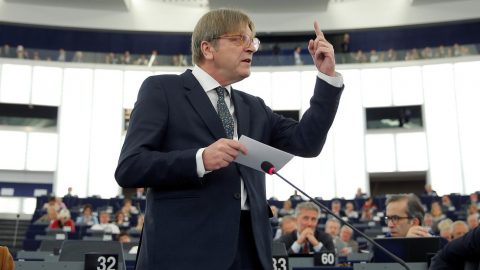
European Union’s chief Brexit coordinator Guy Verhofstadt © Reuters / Vincent Kessler
RT | September 16, 2019
EU Brexit coordinator Guy Verhofstadt’s rant that tomorrow’s world order is “based on empires” has been met with mockery on social media, and with accusations that such rhetoric is ironically out of the ‘Brexiteers’ playbook.’
Belgian MEP Verhofstadt, who was a guest speaker at the Liberal Democrats Party conference in Bournemouth on Saturday, told the audience that the world order is no longer about nation states, but about empires, like the European Union. His words received a rapturous response from the pro-EU party delegates.
The world order of tomorrow is not a world order based on nation states or countries. It is a world order that is based on empires.
Verhofstadt claims that countries like China, India and the US have more characteristics of empires than nation states, because of the size of their populations and their influence on the world, and because of this, the EU has to respond.
However, the MEP’s remarks have been met with amusement and bemusement in equal measure, and with accusations that his rhetoric is that of “a madman.”
Brexiteers on Twitter have been quick to highlight the irony of Verhofstadt’s sentiments. They are astounded that the case for an EU empire has been warmly received by Remain supporters, who have consistently ridiculed Brexiteers for “harking back to Empire days.”
Others suggested the cheers for Verhofstadt were like a party political broadcast for ‘Vote Leave’ — the official campaigning organisation that helped win the 2016 EU referendum for Brexiteers.
Verhofstadt’s comments came as the Liberal Democrats officially decided their new Brexit policy at their conference. They stated that they would revoke article 50 and cancel Brexit altogether, if they won a majority at the next general election.
It’s a bold, if slightly risky position to take, which may embolden their core base of strong Remainers, but could disenfranchise other potential voters including ‘soft’ Leavers who may think such a move would be anti-democratic.
Featured Video
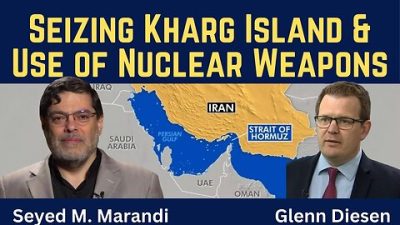
Marandi: Threat of Seizing Kharg Island & the Use of Nuclear Weapons
or go to
Aletho News Archives – Video-Images
Frlom the Archives
Provoking a Path to Persia
The Saban Center’s prescient paper on war with Iran
By Maidhc Ó Cathail | October 20, 2011
In June 2009, the Saban Center for Middle East Policy published “Which Path to Persia?—Options for a New American Strategy toward Iran.” Writing in a tone strikingly reminiscent of the Project for a New American Century’s infamous pre-9/11 paper “Rebuilding America’s Defenses,” the six co-authors noted that, “It seems highly unlikely that the United States would mount an invasion without any provocation or other buildup.” For a think tank specifically established by media mogul Haim Saban to protect Israel, this could prove to be a formidable obstacle impeding their desired march—of U.S. troops—to Tehran.
“In fact, if the United States were to decide that to garner greater international support, galvanize U.S. domestic support, and/or provide a legal justification for an invasion, it would be best to wait for an Iranian provocation, then the time frame for an invasion might stretch out indefinitely,” Saban’s think-tankers ruefully observed.
“With only one real exception, since the 1978 revolution, the Islamic Republic has never willingly provoked an American military response, although it certainly has taken actions that could have done so if Washington had been looking for a fight. Thus it is not impossible that Tehran might take some action that would justify an American invasion. And it is certainly the case that if Washington sought such a provocation, it could take actions that might make it more likely that Tehran would do so (although being too obvious about this could nullify the provocation). However, since it would be up to Iran to make the provocative move, which Iran has been wary of doing most times in the past, the United States would never know for sure when it would get the requisite Iranian provocation. In fact, it might never come at all.”
Seemingly undeterred by Iran’s frustrating unwillingness to provide the requisite provocation, the analysts continued to examine this option… continue
Blog Roll
 Aletho News
- Palestinian family displaced after settlers violently attack them in Humsa, Jordan Valley
- The EU never learns – except for the wrong lessons
- Iran attacks on UAE leaves RSF militia high and dry
- Hosting Washington’s war: Bahrain faces the consequences
- The US fell for its own Iran propaganda
- Seyed M. Marandi: Threat of Seizing Kharg Island & the Use of Nuclear Weapons
- Is there even an off ramp?
- Michael von der Schulenburg: Europe’s Self-Defeating Iran War Policy
- Sorry, The New Republic, Climate Change Isn’t Causing Somali Migration. Blame Civil Strife and Poverty.
- Expert Guts Claims That HPV Vaccine Reduces Cancer Risk
- If Americans Knew
- 6 more Americans killed, as Israel ‘mows the lawn’ in Iran – Not a ceasefire Day 154
- Are we on the precipice of World War III?
- ‘Catastrophic,’ Says UNICEF: 1,100+ Children Killed or Wounded in Mideast Since US-Israel Launched Iran War
- The Unbelievable Madness of Our War With Iran
- World Council of Churches calls on govts to hold Israel accountable for violations of intl law
- How to end the war on Iran that costs US taxpayers $1M per minute – Not a ceasefire Day 153
- Israeli strategic plans to “remake the Middle East” from the 1950s and since
- Honoring Gaza’s women who refused to let the world look away
- 97% of victims of war on Iran are Iranian, 98% of victims in war on Gaza are Gazans – Not a ceasefire Day 152
- Early Iran strikes cost $5.6 billion in munitions, Pentagon estimates
- No Tricks Zone
- New Studies: UK Sea Levels Were 4 Meters Higher Than Today During The Mid-Holocene
- Destructive Green New Deal: German Energy And Metal Group Warns Of Drastic Crisis
- New Study Documents A 20-Year Pause In Arctic Sea Ice Decline – Driven By Internal Variability
- Wake-up Call: Survey Shows Majority Of Germans Now Favor Postponing Climate Targets!
- Televised! Leading German Political Candidate Tells Schoolchildren CO2 Makes Sun Hotter!
- New Study: A Century Warming Of 1.1°C Is ‘Commonplace’ And ‘Not Unusual’ During This Interglacial
- New Study: ‘Internal Noise’ And Volcanic Forcing Can Trigger 10-15°C Warming Within Decades
- Glaciers Worldwide Are Suddendly Surging, Experts Blame Warming!
- Surprising Discovery: Sahara Is Greening…Billions Of Trees Where Once Thought To Be Barren
- New Research Reaffirms Clouds, Aerosols, And Surface Solar Radiation Are ‘Driving The Climate System’
 Aletho News