Fishy Findings: 100% Replication Failure
Eight fish studies were double-checked. Not one was accurate.

By Donna Laframboise | Big Picture News | January 13, 2020
Science proves… Science says… Research shows…
Every week, the above phrases are employed by TV personalities, newspaper journalists, coworkers, friends, and family. When these phrases are uttered, certain ideas get elevated above the fray, enthroned on a pedestal.
Science has spoken. Who are you to be arguing with SCIENCE?
The problem, of course, is that scientific research is conducted by human beings. Who not only make mistakes, but are susceptible to peer pressure, group think, intellectual fads, and noble cause corruption.
The fallibility of ‘science’ is splendidly illustrated by a paper published last week in Nature. It concludes that not one, not two, but eight previously published studies about how climate change affects the behaviour of coral reef fish are unsound.
When a second team of researchers conducted the same experiments, the results were startlingly different. Here’s a quote from the abstract in Nature:
we comprehensively and transparently show that… ocean acidification levels have negligible effects on important behaviours of coral reef fishes… we additionally show that … [results] that have been reported in several previous studies are highly improbable. [bold added]
Extending back to 2010, many of these studies were highly publicized at the time they appeared. Physicist Peter Ridd points out they were all produced by Australia’s James Cook University. Ridd, remember, was fired by James Cook after raising concerns about research quality.
Responsibility appears to lie squarely with ecologist Philip Mundy, who investigates “the effects of climate change on reef fish populations” via “a range of laboratory and field-based experiments.” Thanks to Mundy’s team, a good chunk of what the world thinks it knows about coral reef fish and climate change has now been shown to be dead wrong.
Zero out of eight. How many other James Cook research papers should we be taking seriously?
To be continued…
Sealed Off and Forgotten: What You Should Know about Israel’s ‘Firing Zones’ in the West Bank
![A concrete marker placed by Israeli forces demarcating the beginning of the military zone near Tubas in the Jordan Valley, northern West Bank [DCIP/Cody O'Rourke]](https://i1.wp.com/www.middleeastmonitor.com/wp-content/uploads/2020/01/DBDJ.png?resize=1200%2C800&quality=85&strip=all&ssl=1)
A concrete marker placed by Israeli forces demarcating the beginning of the military zone near Tubas in the Jordan Valley, northern West Bank [DCIP/Cody O’Rourke]
By Ramzy Baroud | MEMO | January 13, 2020
A seemingly ordinary news story, published in the Israeli newspaper, Haaretz, on January 7, shed light on a long-forgotten, yet crucial, subject: Israel’s so-called “firing zones” in the West Bank.
“Israel has impounded the only vehicle available to a medical team that provides assistance to 1,500 Palestinians living inside an Israeli military firing zone in the West Bank,” according to Haaretz.
The Palestinian community that was denied its only access to medical services is Masafer Yatta, a tiny Palestinian village located in the South Hebron hills.
Masafer Yatta, which exists in complete and utter isolation from the rest of the occupied West Bank, is located in ‘Area C’, which constitutes the larger territorial chunk, about 60%, of the West Bank. This means that the village, along with many Palestinian towns, villages and small, isolated communities, is under total Israeli military control.
Do not let the confusing logic of the Oslo Accords fool you; all Palestinians, in all parts of the occupied West Bank, East Jerusalem, and the besieged Gaza Strip, are under Israeli military control as well.
Unfortunately for Masafer Yatta, and those living in ‘Area C’, however, the degree of control is so suffocating that every aspect of Palestinian life – freedom of movement, education, access to clean water, and so on – is controlled by a complex system of Israeli military ordinances that have no regard whatsoever for the well-being of the beleaguered communities.
It is no surprise, then, that Masafer Yatta’s only vehicle, a desperate attempt at fashioning a mobile clinic, was confiscated in the past as well, and was only retrieved after the impoverished residents were forced to pay a fine to Israeli soldiers.
There is no military logic in the world that could rationally justify the barring of medical access to an isolated community, especially when an Occupying Power like Israel is legally obligated under the Fourth Geneva Convention to ensure medical access to civilians living in an Occupied Territory.
It is only natural that Masafer Yatta, like all Palestinians in ‘Area C’ and the larger West Bank, feel neglected – and outright betrayed – by the international community as well as their own quisling leadership.
But there is more that makes Masafer Yatta even more unique, qualifying it for the unfortunate designation of being a Bantustan within a Bantustan, as it subsists in a far more complex system of control, compared to the one imposed on black South Africa during the Apartheid regime era.
Soon after Israel occupied the West Bank, East Jerusalem, and Gaza, it devised a long-term stratagem aimed at the permanent control of the newly occupied territories. While it designated some areas for the future relocation of its own citizens – who now make up the extremist illegal Jewish settler population in the West Bank – it also set aside large swathes of the Occupied Territories as security and buffer zones.
What is far less known is that, throughout the 1970s, the Israeli military declared roughly 18% of the West Bank as “firing zones”.
These “firing zones” were supposedly meant as training grounds for the Israeli occupation army soldiers – although Palestinians trapped in these regions often report that little or no military training takes place within “firing zones”.
According to the Office for the UN Coordination of Humanitarian Affairs (OCHA) in Palestine, there are around 5,000 Palestinians, divided among 38 communities that still live, under most dire circumstances, within the so-called “firing zones”.
The 1967 occupation led to a massive wave of ethnic cleansing that saw the forced removal of approximately 300,000 Palestinians from the newly-conquered territory. Many of the vulnerable communities that were ethnically cleansed included Palestinian Bedouins, who continue to pay the price for Israel’s colonial designs in the Jordan Valley, the South Hebron Hills and other parts of occupied Palestine.
This vulnerability is compounded by the fact that the Palestinian Authority (PA) acts with little regards to Palestinians living in ‘Area C’, who are left to withstand and resist Israeli pressures alone, often resorting to Israel’s own unfair judicial system, to win back some of their basic rights.
The Oslo Accords, signed in 1993 between the Palestinian leadership and the Israeli government, divided the West Bank into three regions: ‘Area A’, theoretically under autonomous Palestinian control and consisting of 17.7% of the overall size of the West Bank; ‘Area B’, 21%, and under shared Israeli-PA control and ‘Area C’, the remainder of the West Bank, and under total Israeli control.
This arrangement was meant to be temporary, set to conclude in 1999 once the “final status negotiations” were concluded and a comprehensive peace accord was signed. Instead, it became the status quo ante.
As unfortunate as the Palestinians living in ‘Area C’ are, those living in the “firing zone” within ‘Area C’ are enduring the most hardship. According to the United Nations, their hardship includes “the confiscation of property, settler violence, harassment by soldiers, access and movement restrictions and/or water scarcity.”
Expectedly, many illegal Jewish settlements sprang up in these “firing zones” over the years, a clear indication that these areas have no military purpose whatsoever, but were meant to provide an Israeli legal justification to confiscate nearly a fifth of the West Bank for future colonial expansion.
Throughout the years, Israel ethnically cleansed all remaining Palestinians in these “firing zones”, leaving behind merely 5,000, who are likely to suffer the same fate should the Israeli occupation continue on the same violent trajectory.
This makes the story of Masafer Yatta a microcosm of the tragic and larger story of all Palestinians. It is also a reflection of the sinister nature of Israeli colonialism and military occupation, where occupied Palestinians lose their land, their water, their freedom of movement and eventually, even the most basic medical care.
These harsh “conditions contribute to a coercive environment that creates pressure on Palestinian communities to leave these areas,” according to the United Nations. In other words, ethnic cleansing, which has been Israel’s strategic goal all along.
Danish Daesh fighter convicted in Spain worked for Denmark intelligence
MEMO | January 13, 2020
A Danish man who joined Daesh in Syria and who is consequently serving eight years imprisonment in Spain has revealed that he was working for Denmark’s intelligence services.
The 30-year-old Danish national, Ahmed Samsam, travelled to Syria “several” times in order to join the terror group under the authorisation and direction of Denmark’s Police Intelligence Service and Defence Intelligence Service, as was reported in the Danish newspaper Berlingske yesterday.
According to several sources who informed the paper, it was confirmed that Samsam was indeed recruited by the Danish intelligence services in December 2012 before being sent to Syria in February 2013.
These assignments, in which he received up to 20,000 Kroner ($2,975) per month as well as military training, continued all the way up until late 2015, after which he was arrested by Spanish authorities on the Costa del Sol in 2017.
“I wanted to help prevent a terrorist attack in Denmark. I have a family that uses public transport, which is at high risk of being hit by terror,” he told the paper.
Samsam has said that Danish authorities were well aware of his travels and assignments to Syria, and that they had guaranteed that he would not be punished upon his return.
The subsequent arrest of Samsam has therefore reportedly angered some in Denmark due to the country not having immediately informed Spain of his case.
Among those calling for Denmark to take action to return him is the member of parliament Karina Lorentzen Dehnhardt – part of the Socialist People’s Party – who urged for Samsam to be helped.
The case comes amid increasing debate over the transfer of imprisoned Daesh fighters back to their home countries which they left, with many reportedly being regretful of joining the group and wanting to return following the military defeat of the group over the past two years.
Both Turkey and US President Donald Trump have called on European nations to take back their fighters due to their responsibility towards their citizens, but they have long been concerned over the security risks of such a move, suspecting that there are former fighters who feign regret in order to carry out attacks within their home countries.
Libyan leaders Sarraj & Haftar to hold talks in Moscow on Monday – Russian Foreign Ministry
RT | January 13, 2020
Libya’s two key political figures – Fayez al-Sarraj, the prime minister of the Government of National Accord (GNA), and Commander of the Libyan National Army (LNA) Khalifa Haftar will take part in talks held under the auspices of the Russian and Turkish Foreign and Defense Ministries in Moscow on Monday, the Russian Foreign Ministry told TASS.
“In [the] context of implementing the initiative of the Russian and Turkish presidents announced following a summit in Istanbul, inter-Libyan contacts will be held today in Moscow,” the diplomats said. “The contacts are expected to be attended by Sarraj, Haftar and representatives of other Libyan parties.”
Moscow will host talks between Russian Foreign Minister Sergey Lavrov and Defense Minister Sergey Shoigu with their Turkish counterparts, Mevlut Cavusoglu and Hulusi Akar. The main topics on the agenda are settlement in Libya, cooperation in Syria, and developments in the Middle East.
On January 12, a ceasefire entered into force between the conflicting sides in Libya.
Libya’s warring parties vow to observe ceasefire without preconditions, stop all offensive military actions – draft agreement
RT | January 13, 2020
The Libyan National Army (LNA) and the internationally recognized Government of National Accord (GNA) in Tripoli have pledged to observe the ceasefire suggested by Russia and Turkey after negotiations in Moscow.
The draft document suggests that all parties would stop military actions and observe the ceasefire conditions. Meanwhile, a commission is to be established to determine a contact line between the warring sides. Russia and Turkey promised to support all sides in the conflict to help them implement the agreement.
Libya has been plunged into chaos for years after its longtime ruler Muammar Gaddafi was ousted and killed during a NATO-led bombing campaign. Following the years of devastation and chaos, the country became engulfed in a civil war.
Previous lengthy UN-backed talks on reconciliation, which led to the establishment of the GNA, eventually failed to bring peace to the war-ravaged land.
Haftar began an offensive against Tripoli last year and over the last few months the two sides were engaged in intense fighting. LNA controls most of Libya’s territory, but it is the GNA which is recognized by the international community.
Ankara became involved in the conflict in December promising to send troops to help the government in Tripoli as the international community called on all sides to enter negotiations.
US to Iraq: ‘Vote All You Want, We’re Not Leaving!’
By Ron Paul | January 13, 2020
President Trump’s decision earlier this month to assassinate Iran’s top military general on Iraqi soil – over the objection of the Iraqi government – has damaged the US relationship with its “ally” Iraq and set the region on the brink of war. Iran’s measured response – a few missiles fired on an Iraqi base after advance warning was given – is the only reason the US is not mired in another Middle East war.
Trump said his decision to assassinate Gen. Qassim Soleimani was intended to prevent a war, not start a war. But no one in his right mind would think that killing another country’s top military leader would not leave that country annoyed, to say the least. Senators Mike Lee (R-UT) and Rand Paul (R-KY) said the Trump Administration’s briefing to Congress on its evidence to back up claims that Soleimani was about to launch attacks against the US was among the worst briefings they’d ever attended.
After initially claiming that Soleimani had to be taken out immediately because of “imminent” attacks he was launching against the US, Trump Administration officials including Secretary of State Pompeo and Defense Secretary Esper have been busy walking back those claims. Esper claimed over the weekend that he had not seen the intelligence suggesting an attack on US embassies was in the works. If the Secretary of Defense did not seen the intelligence, then who did?
No doubt the Iraqi leadership recognized these kinds of deceptions: the same kinds of lies were used to push the US into attacking their own country in 2003. So it should not have come as a big surprise that the Iraqi government met last week and voted that all foreign military personnel should leave Iraqi soil.
Then a funny thing happened when the Iraqi prime minister attempted to communicate to the US government the will of the Iraqi people through their democratically-elected officials. On Thursday Iraqi Prime Minister Mahdi phoned Pompeo to urgently request that Washington enact a US troop “withdrawal mechanism” in Iraq. American troops are in Iraq by invitation of the Iraqi government and the Iraqi government had just voted to revoke that invitation.
The State Department responded with a statement titled “The US Continued Partnership with Iraq,” in which it essentially said that the US would not abide by the request of its Iraqi partners because the US military is a “force for good” in the Middle East and that as such it is “our right” to maintain “appropriate force posture” in the region.
The US invaded Iraq based on Bush Administration lies and a million Iraqis died as a result. Later, President Obama ramped up the drone program and also backed al-Qaeda affiliated terrorists to overthrow the secular Syrian government. Obama also attacked Libya based on lies, leaving the country totally destroyed. Trump is assassinating foreign officials and threatening destruction of Iran.
And the State Department calls that a “force for good”?
The United States can be a true force for good, however. End the military occupation of the Middle East, end foreign military aid, stop using the CIA to overthrow governments. Allow Americans to travel and do business in any country they wish. Lead by example and demonstrate how free markets and peace benefit all. A “force for good” means not forcing others to bow to your will.
Copyright © 2020 by RonPaul Institute.
U.S. Media Says Russia the True Winner in Hostilities Against Iran
By Paul Antonopoulos | January 13, 2020
While the final outcome of the U.S.-Iran conflict is not yet clear, US media outlets and think tanks are already claiming that Russian President Putin is the winner. The U.S.-Iran hostilities have undermined Washington’s confidence and reputation in the region, allowing Russian influence in the Middle East to increase as a force for peace and stability. While it is unclear exactly how Moscow can benefit from escalations between Washington and Tehran, U.S. media are convinced that any outcome will be consistent with the Kremlin’s plans to increase its political influence in the region and create a rift between Washington and its allies.
This simplistic explanation does not account the fact that Moscow has a clear foreign policy to achieve its geopolitical goals in the Middle East while Washington mostly depends on their own internal contradictions and events on the domestic political scene to guide their foreign policy. The assassination of Iranian General Soleimani, made on orders from Trump, questions whether this was to demonstrate his power and determination to protect U.S. national interests in the face of domestic criticisms, to serve Evangelical Christian interests on behalf of Israel, or part of a clear guided policy that the U.S. has for the Middle East.
The Democrats are trying to show the public that everything Trump does is contributing more to Russian interests rather than American. It appears that the Democratic Party will continue with the same rhetoric to try and win this year’s election.
Moscow maintains good relations with all countries in the Middle East region and there is no country with which Russia has an openly hostile relationship. Moscow successfully balances its relations between Saudi Arabia, Iran, Syria and Israel, while the U.S. attempts to divide the region into competing camps with no interest of defusing tensions, suggesting that even if Washington has a clearly defined Middle East policy, it is one based on division and destruction rather than one of balance and peace.
As a result of the assassination of General Soleimani, calls for U.S. troops to withdraw from Iraq under pressure from local authorities have been made. Without troops in Iraq, the Americans are incapable of retaining their positions in Syria, which increases Russia’s manoeuvring space, strengthens its positions, influence, and opens space for filling the political vacuum. The U.S. has become embroiled with so many Middle Eastern countries that it is now struggling to cope to withdraw. Washington has already tried to withdraw its troops from Iraq during the Obama era.
But it is one thing to militarily withdraw on your own will and based on your decision, and another to withdraw because you have been asked too. Although the U.S. criticizes Iranian influence across the region and claims the Islamic Republic is acting in an aggressive manner, the Trump administration has not even hid away from the fact its an occupying force by flatly refusing to withdraw from Iraq despite being told to by the country’s parliament.
However it was the assassination of Soleimani that the most ridiculous claims were being made about, with Bloomberg even suggesting that Putin needs a “Plan B” because the Iranian General’s death disrupted Russian plans for Syria, Iran and Turkey. This scenario implied that Trump’s aggressive actions would elicit an even more aggressive response from the Iranian side, eventually leading to an escalation of the conflict in which Tehran lacked adequate defense capabilities. This implies that Iran will lose the status of a regional power and Russia will have no choice but to betray Syria. This option quickly disappeared from the media space as reality completely denied this possibility.
As for Putin’s victory, many cite the fact that many European leaders are increasingly turning to Russia as a reliable partner in face of Trump’s unpredictability. It is fair to say that the U.S. strategy in the Middle East is a mystery even to U.S. allies. With Washington being unrelenting in attempting to maintain the unipolar world order, it has forced Europeans to cooperate with reliable Russia.
This is not the first time that Washington has made a problem for its allies, citing the example of the U.S. invasion of Iraq in 2003 when Germany and France, along with Russia, protested U.S. President George Bush and his actions. While Iraq was an example of typical aggression, the Americans did not lose allies because of this, nor did NATO disintegrate. However, domestic politics has always been a major focus for U.S. presidents, obviously, which in turn can influence foreign policy decisions for internal political use. In the case of killing an Iranian general and in the propaganda that Russia is the victor in the U.S.-Iran conflict, nothing new has happened.
Paul Antonopoulos is a Research Fellow at the Center for Syncretic Studies.
Esper Contradicts Trump: “Didn’t See” Specific Evidence Of Iran Plot To Attack 4 Embassies
By Tyler Durden – Zero Hedge – 01/12/2020
When late last week President Trump first referenced a Soleimani-directed plot to “blow up” the US embassy in Baghdad, which during a Friday Fox interview became in the president’s words “I believe it would’ve been four embassies” — senators which had been given a classified briefing Wednesday balked, saying no such intelligence was referenced but should have been if there was evidence.
And now no less than Secretary of Defense Mark Esper appears to have publicly contradicted the White House’s rationale for taking out the “imminent” threat of Qasem Soleimani. Esper told CBS’ Face the Nation on Sunday that he “didn’t see” specific evidence for embassy attacks, while adding that he still believes such an attack was likely.
“The president didn’t cite a specific piece of evidence. What he said was he believed,” Esper said.
“What the president said was that there probably could be additional attacks against embassies. I shared that view,” Esper said. “The president didn’t cite a specific piece of evidence.”
When pressed on whether intelligence officers offered concrete evidence on that point he said: “I didn’t see one with regards to four embassies.” — Reuters
During a separate CNN interview on Sunday, the Pentagon chief continued to awkwardly dance around the question of whether specific intelligence showed such an attack was being planned. Esper described that Trump merely “believed” it to be the case, while refusing to confirm any particular intelligence.
But earlier statements of Secretary of State Mike Pompeo, who before reporters defended Trump’s assertion about the IRGC targeting the embassies, suggested there was specific intelligence.
When Pompeo was pressed on Friday by reporters over the nature of the “imminent threat” claims, he said: “We had specific information on an imminent threat and that threat stream included attacks on U.S. embassies. Period. Full stop.” And asked about what made it imminent, Pompeo simply said: “It was going to happen.”
At first it was unclear whether President Trump was claiming to have seen specific intelligence outlining such a threat, or perhaps was just speaking generally and in his usual hyperbolic style (“blow up” the embassy) of the pro-Iranian mob’s actions besieging the US embassy in Baghdad days prior to the Soleimani assassination.
The demonstrators had been filmed setting the outer walls of the compound on fire during the chaotic events nearly two weeks ago which resulted in a contingent of Marines rapidly deploying from Kuwait to bolster embassy security.
So now Esper appears to be saying it was Trump’s personal belief, while Pompeo appeared to base it on “specific information” — in other words direct intelligence. But which is it?
It can’t be both ways.
Like the Bush administration’s famously evolving rationale for the war in Iraq, are we witnessing the narrative on Iran made up on the fly?
For Western Press, the Only Coup in Venezuela Is Against Guaidó
By Lucas Koerner – FAIR – January 10, 2020
The international corporate media have entered crisis mode following the replacement of Venezuelan opposition leader Juan Guaidó as head of the country’s National Assembly.
In headline after headline, Venezuelan President Nicolás Maduro “Takes Over” (NBC, 1/6/20), “Claims Control of” (New York Times, 1/5/20; CNBC, 1/6/20) or “Seizes” (Reuters, 1/5/20; NPR, 1/6/20) parliament, and “Ousts” Guaidó (Wall Street Journal, 1/5/20) in the process.
The Washington Post (1/5/20) takes this hysteria to another level, hyperbolically proclaiming that “Venezuela’s Last Democratic Institution Falls as Maduro Attempts De Facto Takeover of National Assembly.”
Such headlines obscure the elementary if inconvenient fact that Guaidó failed to secure the necessary votes from his own coalition’s deputies to continue as president of the legislature, leading him to convene a parallel, ad hoc session in the offices of the right-wing El Nacional newspaper.
Serving up state propaganda
Corporate journalists repeat unceasingly the US State Department talking point that the January 5 assembly election, which chose Luis Parra as the legislative body’s new president, was “phony” because Guaidó and his loyalists were barred from attending the session, rendering the vote void.
“Venezuela’s socialist government installed a new head of Congress on Sunday after armed troops blocked opposition legislators from entering parliament,” Reuters (1/5/20) misinformed readers.
As Venezuelanalysis (1/5/20) reported, this narrative was refuted by pro-Guaidó lawmaker William Davila, who, after strolling in to the legislature, told press that with few exceptions, virtually all deputies were permitted to take their seats. Other senior opposition lawmakers, including the outgoing first and second vice presidents of the body, were visibly present inside the parliament.
Moreover, video evidence reveals that Guaidó was not himself “prevented,” as the New York Times (1/5/20) had it, from entering the legislature, but rather refused to do so except in the company of fellow lawmakers whose parliamentary immunity had been revoked for alleged criminal offenses. Likely knowing he did not have the votes to secure reelection, Guaidó appears to have declined to attend the session, going as far as to scale a fence in a publicity stunt widely reported by Western outlets that all but ignored the crucial facts behind the day’s events.
Corporate media followed up their lie that the pro-Guaidó opposition was banned from parliament with the dubious claim that the subsequent vote held in the offices of El Nacional was “official.” The Washington Post (1/5/20) matter-of-factly stated, “In a 100-to-0 tally — enough to put him over the top in a full session of the 167-seat chamber — those present reelected Guaidó as head of the legislature.” The reporters evidently neglected to inspect the actual vote tally, which contained glaring irregularities such as votes by legislators abroad fleeing criminal charges, as well as those cast by substitutes for deputies who had already voted for Parra. As even hard-right, Miami-based journalist Patricia Polea highlighted, Jose Regnault Hernandez, the substitute for newly sworn-in National Assembly Second Vice President Jose Gregorio Noriega, was allowed to vote for Guaidó despite Noriega having himself stood for election on a rival ticket earlier that afternoon.
It is also deeply ironic that Western outlets would rush to declare the legitimacy of an irregular vote held in the offices of a local newspaper, given the lengths they have gone to deny the existence of press freedom in Venezuela (FAIR.org, 5/20/19).
Why isn’t Guaidó in jail?
Procedural formalities aside, the real question, which corporate journalists will never ask, is why an opposition figure who arbitrarily declared himself “interim president” with the backing of hostile foreign powers, and who urged the military to rise up to install him in the presidential office, would be permitted to set foot outside a jail cell in Venezuela, let alone stand for reelection as head of parliament?
The answer would require admitting that this naked violation of sovereignty is only tolerated because of the constant threat of lawless imperial violence, which US corporate media enthusiastically cheerlead against other independent Global South states like Iran.
Instead, Western journalists continue to whitewash the US-sponsored coup–the sixth major attempt since 2002–impugning Maduro’s democratically elected government as “authoritarian” or a “dictatorship” (FAIR.org, 4/11/19; 8/5/19), which is newspeak for “legitimate target for bombing and/or murderous sanctions.”
Throwing to the wind any semblance of neutrality, the New York Times (1/5/20) reported:
Venezuela’s authoritarian leader, Nicolás Maduro, moved on Sunday to consolidate his grip on power by taking control of the country’s last independent institution and sidelining the lawmaker who had staked a rival claim to the presidency.
“The political chaos comes at a time when Venezuela is facing economic collapse,” the paper of record added, bolstering the rationale for Maduro’s overthrow. “Hunger is widespread, and millions have fled the country.” Like most corporate media (FAIR.org, 6/26/19), the Times reflexively avoided mention of US economic sanctions’ role in severely exacerbating the crisis and killing tens of thousands since 2017, writing off the illegal, inhumane measures as “sanctions on Mr. Maduro’s government.”
For the corporate press, it would appear that the only “coup” is that perpetrated by Maduro in insisting on serving out his elected mandate (Washington Post, 1/6/20; Wall Street Journal, 1/6/20; Forbes, 1/7/20).
Concealing corruption
In their elegies to the “last democratic institution in the authoritarian South American state” (Washington Post, 1/5/20), Western journalists rarely attribute Guaidó any significant blame for the perceived debacle.
Despite acknowledging Guaidó’s falling popularity, following his utter failure to oust Maduro, mainstream outlets have turned a blind eye to the opposition leader’s string of humiliating scandals. Guaidó has been linked to Colombian paramilitary drug lords, while his inner circle has been accused of embezzling hundreds of thousands of dollars in aid funds, among other illicit acts.
Tellingly, the only corruption allegations mentioned in the latest corporate coverage are those against Parra and his dissident opposition colleagues. Making little effort to conceal its bias, CBC (1/6/20) describes the new National Assembly president as “a previously unknown backbencher mired in accusations of bribe-taking,” whose “rambling comments” were challenged by journalists.
The double standard is striking, given that Western media have devoted strenuous efforts over the past year to anointing a “previously unknown backbencher” as president of Venezuela. The attacks on Parra comes amid threats of US sanctions against him and other opposition politicians who broke with Guaidó. The blatant imperial blackmail recalls similar US threats reportedly issued against opposition presidential candidate Henri Falcón, who defied the opposition’s 2018 electoral boycott that paved the way for the current coup efforts.
Corporate journalists’ discouragement over Guaidó’s failures (FAIR.org, 7/23/19) is becoming ever more pronounced (e.g., Reuters, 12/3/19; Washington Post, 12/17/19; New York Times, 1/6/20). But at the end of the day, they have simply invested too much in this smooth, technocratic figure to fundamentally fault him, let alone actually question the imperial regime-change machinery that produced him and his elite coterie.
Western media coverage of Russia as an exercise in propaganda
By Gilbert Doctorow | January 12, 2020
The notion of “fake news” has entered our vocabulary as a pejorative term for dissemination of bogus information, usually by social media, sometimes by traditional print and electronic channels which happen to hold positions contradicting the tenets of our conventional wisdom, i.e., liberal democracy. The term has been applied to Russian state owned media such as RT to justify denying such outlets normal journalistic credentials and privileges.
In this essay, I will employ the more traditional term propaganda, which I take to mean the manipulation of information which may or may not be factually true in order to achieve objectives of denigrating rivals for influence and power in the world, and in particular for denigrating Russia and the “Putin regime.”
The working tools of such propaganda are
- tendentious determination of what constitutes news, which build on the inherent predisposition of journalism to feature the negative and omit the positive from daily reporting while they carry this predisposition to preposterous lengths
- the abandonment of journalism’s traditional “intermediation,” meaning provision of necessary context to make sense of the facts set out in the body of a news report. In this regard, the propagandistic journalist does not deliver the essential element of paid-for journalism which should distinguish it from free “fake news” on social media and on the internet more broadly
- silence, meaning under-reporting or zero reporting of inconvenient news which contradicts the conventional wisdom or might prompt the reader-viewer to think for himself or herself. As a colleague and comrade in arms, professor Steve Cohen of Princeton and NYU, has said in his latest book War with Russia? : the century old motto of The New York Times “All the news that’s fit to print” has in our day turned into “All the news that fits.”
Demonstrations of the arguments I present here could easily fill a book if not a library shelf. However, I think for purposes of this essay, it suffices to adduce several examples of the three violations of professional journalism giving us a constant stream of propaganda about Russia and its political leadership by offering a few reports drawn from the very cream of our print and electronic media. In particular, I have chosen as markers the Financial Times and the BBC. The use of propaganda methods in their coverage of Russia is all the more telling and damaging, given that in a great many domains these channels otherwise represent some of the highest quality standards to be found in reporting anywhere today and consequently enjoy the respect of their subscribers and visitors, who little suspect they could be so prejudicial in their coverage of select domains like Russia.
* * * *
As 2019 drew to a close, many of our media outlets drew attention to two Russia-related anniversaries: the just celebrated thirtieth anniversary of the fall of the Berlin Wall with the retreat of Soviet armed forces from Eastern Europe that it touched off; and the soon to be celebrated twentieth year of Vladimir Putin’s hold on power in the Kremlin. Both subjects may be fairly called news worthy and so fully correspond to traditional journalistic values. What has been exceptional and unacceptable has come in the second category of violations listed above – lack of context.
Starting in October 2019, the BBC’s Moscow correspondent Steve Rosenberg did several programs dedicated to the fall of the Berlin Wall. During the Christmas to New Year’s period, the BBC aired one program which consisted of two parts. In the first half, Rosenberg considered the impact of the withdrawal of Russian forces from East Germany on the Russians themselves and interviewed the former chief of those forces, who explained at length how they “came home” to shocking living conditions in the provinces, how they were abandoned to their fate by their own government. The tone of the reporting was sympathetic to Russians’ hardships and it was good that their side of the story from the ground up was given the microphone. What implied criticism there was of the powers that be came from a patriotic source. However, the second half of the program was turned over to a certain Lydia Shevtsova, a very outspoken Putin-hater, formerly with the Carnegie Center Moscow, till she was finally booted out and moved to a more congenial and supportive think tank, Chatham House, in London, where her anti-Russian vitriol is encouraged and disseminated by her co-author, ex-British ambassador to Moscow Sir Andrew Wood. Among the gem quotations which Shevtsova delivered was the claim that Russia under Putin is a declining power which is capable only of disrupting the world order, a spoiler not capable of any creative or productive contribution. Of course, Shevtsova has a right to her opinions, however the BBC had an obligation to its audience to explain exactly who the lady is and, if they wanted to practice fair play, to offer an alternative interpretation of what Vladimir Putin’s Russia stands for on the global stage today. They did not do either. The result was pure propaganda not news and analysis.
As for violations in the categories one and two above, a very good example arose following the recent publication of a study performed by the Levada Center public opinion polling organization in Moscow during October which showed that “53 per cent of 18-to-24 year-olds wanted to leave the country.” This was written about by many of our news peddlers, including FT. The decision to feature this factoid and use it to support claims that the Putin regime’ is a failure fits well with tendentiousness of our news coverage. Meanwhile, nearly all coverage of that study, including in the Financial Times, offered no contextual information whatsoever, when the context was begging to be told.
The article in FT which carried the Levada Center findings was published on 9 January as “Generation Putin: how young Russians view the only leader they’ve ever known.” The remarks on Levada followed directly on another statement begging for context: “Youth unemployment in Russia is more than three times the rate of the total population, according to 2018 data, compared with just twice the rate in 2000.”
First, as regards those 53% would-be “leavers,” one might ask: and so, why don’t they just leave? Russia today is truly a free country: anyone other than convicted felons who wants a passport can get it, and get it rather quickly. And thanks to the efforts of their remarkably hard-working Ministry of Foreign Affairs, most of the world welcomes Russian travelers without a visa requirement. But for that matter, getting a Schengen visa for the EU is not so complicated either.
However, those 53% are, in fact, not going anywhere. They are just sounding off about their youthful disgruntlement with a world created and run by their parents.
At the same time, as the Financial Times editorial board knows full well, young, middle-aged and even old have been leaving the Baltic States, Bulgaria, Romania and other former Soviet Bloc countries in droves, for the past thirty years up to the present day. That was the subject of an article published in the FT on the next day, 10 January 2020 under a title which speaks for itself: “Shrinking Europe.” The states I mentioned here have seen 25 and 30% loss of their population to citizens voting with their feet and departing the shrinking economies and personal prospects which result directly from deindustrialization and economic colonization by Germany and other founding Member States of the EU since 1991. The issue appears in the news now because, as the FT explains, “Andrej Plenkovic, the Croatian prime minister, has decided to elevate population decline to the top of his agenda as Zagreb assumes the EU’s rotating presidency.” Good for him! Now that the skeleton has finally come out of the EU closet, all the stories about Russia’s demographic crisis can be put in context – by those few who wish to do so.
Second, as regards unemployment in Russia today, I believe that similar ratios of youth unemployment to the general population unemployment can be found most everywhere in Western Europe if not in the world at large. The fact that this ratio has worsened comparatively in Russia since 2000 may be explained by the anomalous situation in Russia prevailing throughout the 1990s in step with the economic collapse that accompanied the transition to a market economy. Precisely the older generations, those over 40, were thrown into the street and their children or grandchildren were the first to be hired by the newly emerging industrial conglomerates, not to mention by Western multinationals settling in. What has happened since 2000 is merely a reversion to more normal distribution of employment and unemployment in the population as the Russian economy stabilizes.
Dear Reader!
For those who find my examples above too subtle to support my argument for egregious propagandistic treatment of Russia in our media, allow me to introduce violation number three, silence, in a way that should sweep away all objections to my thesis.
I draw your attention to an event that occurred in the past week about which you probably know nothing, or perhaps a wee bit from the odd man out reporting in the Wall Street Journal and a few other outlets. I am talking about the visit of Vladimir Putin to Damascus on Tuesday, 7 January. To their credit, the WSJ carried a short article in their 8 January edition, but went no further than to note this was the second visit by Putin since the Russians joined the fight in support of President Bashar Assad back in September 2015, turning the tide in the civil war his way. That is true, but only represents a tiny slice of what all our journalists, including the WSJ’s could have and possibly did learn from watching Russian state television on the 7th. What our media chose not to report was passed over in silence because it shows the complexity of Russia’s policy in the Middle East that includes but goes well outside the domain of pure geopolitics. This is so not least because of the date chosen for the visit, which happens to be Orthodox Christmas.
On the evening of the 6th, that is to say on Christmas eve, by the Russian Orthodox calendar, Russian state television broadcast live coverage of the Christmas service in the Christ the Savior cathedral in Moscow officiated by Patriarch Kirill, with prime minister Medvedev present on behalf of the Government. Then it cut to the service in St Petersburg, where Vladimir Putin sat in the congregation, as is his custom. The commentator mentioned in passing that the Patriarch’s father, a parish priest, just happened to be the one who baptized Vladimir Putin as a child where they all lived, in the Northern Capital.
The next coverage of Putin on state television was from Damascus on the 7th, where he obviously arrived on a night flight from Petersburg. I did not see video coverage [video coverage has now been posted] … But still photos and reports on state television informed us that Putin had not merely held talks with President Assad on the Russian military base outside the capital, but had strolled together with him down the streets of Damascus, had visited the main church in the (still existing) Christian quarter of the city, had presented to the Patriarch of Antioch an icon of the Virgin and had also gone on to visit the city’s oldest and largest mosque.
What you have here is precisely the second line of justification for Russian presence in Syria alongside military/geopolitical reasons: resuming Russia’s 19th century role as protector of the Orthodox population in the Holy Land and the broader Middle East. A similar role was exercised back then by France on behalf of the Catholic populations, but that since has been totally negated by rampant secularism and multiculturalism in Western Europe.
It also has to be said that Putin’s visit to Damascus was back-to-back with other very high visibility political statements: his visit to Istanbul on the 8th for the official opening of the TurkSteam gas pipeline and for lengthy talks with President Erdogan that ended in a joint statement calling for a truce in the Libyan civil war for which Russia and Turkey support opposing sides; and his visit on the 9th to Russian naval exercises in the Eastern Mediterranean that included the launch of Russia’s latest hypersonic missiles, the reality of which U.S. and other Western experts have yet to acknowledge.
With this I rest my case on the unfortunate propagandistic behavior of our media which deprive the broad Western public of any chance to make sense of the most dangerous military and political stand-off of our age.
©Gilbert Doctorow, 2020
Epstein accomplice Ghislaine Maxwell reportedly hiding in Israel
If Americans Knew | January 12, 2020
Jewish Telegraphic Agency reports: “Ghislaine Maxwell, a British socialite who has been accused of helping late sex offender Jeffrey Epstein, is reportedly hiding out in Israel.”
The story quotes a New York Post article based on information from an unnamed source who told the Post : “She is sometimes in the U.K., but most often in other countries, such as Israel, where her powerful contacts have provided her with safe houses and protection.”
According to the Post source: “Ghislaine is protected. She and Jeffrey were assets of sorts for multiple foreign governments. They would trade information about the powerful people caught in his net — caught at Epstein’s house.”
Reuters recently reported that the FBI is investigating Maxwell, who allegedly recruited under age girls to have sex with Epstein. It is unknown whether the Israeli government is assisting the US in locating Maxwell. Critics have complained that Israeli law enforcement is frequently lax on those who have committed crimes in other countries. The US gives Israel over $10 million per day.
Maxwell is the the daughter of Robert Maxwell, who died under mysterious circumstances in 1991. Maxwell was an Anglo-Jewish multi-millionaire who was suspected of working with the Israeli Mossad.
Former CIA officer Philip Giraldi reports: “After his death, he was given a state funeral by Israel in which six serving and former heads of Israeli intelligence listened while Prime Minister Yitzhak Shamir eulogized: “He has done more for Israel than can today be said.”
Giraldi writes that the Epstein case “has all the hallmarks of a major espionage case, possibly tied to Israel… the whole filming procedure smacks of a sophisticated intelligence service compiling material to blackmail prominent politicians and other public figures.”
Epstein, who had been facing sex trafficking charges for allegedly abusing dozens of girls as young as 14, died in a New York City jail cell in August. While law enforcement officials said it was suicide, a forensic pathologist hired by his family said the autopsy pointed to homicide.
An attorney for one of the young victims says Maxwell “was integral in maintaining the sex trafficking ring,”
“Jeffrey Epstein couldn’t have done what he did for as long as he did it without the services of somebody like Ghislaine Maxwell. She is as culpable, in my judgment, as Jeffrey Epstein himself.”
Victims depict her as dominating, controlling, and abusive.
Featured Video
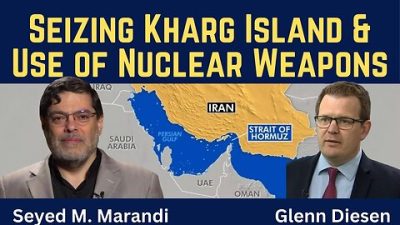
Marandi: Threat of Seizing Kharg Island & the Use of Nuclear Weapons
or go to
Aletho News Archives – Video-Images
Frlom the Archives
Iran War: United States Military Versus Israel Firsters
By James Petras | November 27, 2007
Why must Jewish organizations be and be seen as the loudest drum-beaters of all? Why can we not bring ourselves to say that military intervention is not on the table at all? Why not stash it under the table, out of sight and mount instead a diplomatic assault? – Leonard Fein, Forward
Introduction
As the White House and Congress escalate their economic sanctions and military threats against Iran, top military commanders and Pentagon officials have launched a counter-offensive, opposing a new Middle East War. While some commentators and journalists, like Chris Hedges (Truthdig, November 13, 2007), privy to this high stakes inter-elite conflict, attribute this to a White House cabal led by Vice President Cheney, a more stringent and accurate assessment puts the Zionist Power Configuration (ZPC) in the center of the Iran war debate.
There is a great deal riding in this conflict – the future of the American empire as well as the balance of power in the Middle East. Equally important is the future of the US military and our already heavily constrained democratic freedoms. The outcome of the continuous and deepening confrontation between top US military officials and the Israel Firsters over US foreign policy in the Middle East has raised fundamental questions over self-determination, colonization, civilian primacy and military political intervention, empire or republic. These and related issues are far from being of academic interest only; they concern the future of the United States. … continue
Blog Roll
 Aletho News
- How Zionist Control Is Hurting US Interests
- Iran warns it may target US missile launch sites in UAE cities
- American Military Failure in Afghanistan
- Friendly Skies of Georgia: Are Israeli-Linked Drones Launching False Flags from Georgian Territory?
- The Three Big Lies about Mammography Screening
- Ukrainian Embassy in Beirut sheltering top Mossad agent
- Palestinian family displaced after settlers violently attack them in Humsa, Jordan Valley
- The EU never learns – except for the wrong lessons
- Iran attacks on UAE leaves RSF militia high and dry
- Hosting Washington’s war: Bahrain faces the consequences
- If Americans Knew
- ‘Of Course’: IDF Drops Case Against Soldiers Accused of Raping Palestinian Prisoner
- Don’t Fall for the Regime Change Talk. Israel Is ‘Mowing the Lawn’ in Iran
- Will Israel and the US wreck the Gulf States along with Iran?
- US so far burned through ‘years’ of munitions in Iran war: Report
- How the Israeli Tail Wags the American Dog
- Outdated intel likely led to deadly U.S. strike on Iranian elementary school, sources say
- Pentagon insider says high U.S official Douglas Feith reported to Netanyahu
- In fond memory of Walid Khalidi, the historian of Palestine
- 6 more Americans killed, as Israel ‘mows the lawn’ in Iran – Not a ceasefire Day 154
- Are we on the precipice of World War III?
- No Tricks Zone
- New Studies: UK Sea Levels Were 4 Meters Higher Than Today During The Mid-Holocene
- Destructive Green New Deal: German Energy And Metal Group Warns Of Drastic Crisis
- New Study Documents A 20-Year Pause In Arctic Sea Ice Decline – Driven By Internal Variability
- Wake-up Call: Survey Shows Majority Of Germans Now Favor Postponing Climate Targets!
- Televised! Leading German Political Candidate Tells Schoolchildren CO2 Makes Sun Hotter!
- New Study: A Century Warming Of 1.1°C Is ‘Commonplace’ And ‘Not Unusual’ During This Interglacial
- New Study: ‘Internal Noise’ And Volcanic Forcing Can Trigger 10-15°C Warming Within Decades
- Glaciers Worldwide Are Suddendly Surging, Experts Blame Warming!
- Surprising Discovery: Sahara Is Greening…Billions Of Trees Where Once Thought To Be Barren
- New Research Reaffirms Clouds, Aerosols, And Surface Solar Radiation Are ‘Driving The Climate System’
 Aletho News