Hopefulness Despite 2.9 Billion Lost Birds
By Jim Steele | Watts Up With That? | May 1, 2020
What’s Natural
In 2019 bird researchers published Rosenberg et al “Decline of the North American Avifauna”, reporting a decline in 57% of the bird species. They estimated a net loss of nearly 2.9 billion birds since 1970, and urged us to remedy the threats, claiming all were “exacerbated by climate change”, and we must stave off the “potential collapse of the continental avifauna.” Months before publication the researchers had organized an extensive media campaign. Typical doomsday media like the New York Times piled on with “Birds Are Vanishing From North America” and Scientific American wrote, “Silent Skies: Billions of North American Birds Have Vanished.”
As I have now been sheltering in place, I finally had ample time to thoroughly peruse Rosenberg’s study. I had a very personal interest in it, having professionally studied bird populations for over 20 years and had worked to restore their habitat. I also had conducted 20 years of surveys which were part of the study’s database. Carefully looking at their data, a far more optimistic perspective is needed. So here I join a chorus of other ecologists, as reported in Slate, that “There Is No Impending Bird Apocalypse”. As one ecologist wrote, it’s “not what’s really happening. I think it hurts the credibility of scientists.”
First consider since 1970 many species previously considered endangered such as pelicans, bald eagle, peregrine falcon, trumpeter swan, and whooping crane have been increasing due to enlightened management. Despite being hunted, ducks and geese increased by 54%. Secondly, just 12 of the 303 declining species account for the loss of 1.4 billion birds, and counterintuitively their decline is not worrisome.
Three introduced species – house sparrows, starlings and pigeons – account for nearly one half billion lost birds. These birds were pre-adapted to human habitat and are considered pests that carry disease and tarnish buildings and cars with their droppings. Across America, companies like Bird-B-Gone are hired to remove these foreign bird pests. Furthermore, starlings compete with native birds like bluebirds and flickers for nesting cavities, contributing to native bird declines. The removal of starlings is not an omen of an “avifauna collapse”, but good news for native birds.

When European colonists cleared forests to create pastures and farmland or provide wood for heating, open-habitat species “unnaturally” increased. Previously confined to the Great Plains, brown‑headed cowbirds quickly invaded the newly opened habitat. Unfortunately, cowbirds parasitize other species by laying its eggs in their nests. A cowbird hatchling then pushes out all other nestlings, killing the parasitized species’ next generation. The loss of 40 million cowbirds only benefits our “continental avifauna”.
Several bird species had evolved to colonize forest openings naturally produced by fire, or floods or high winds. Those species “unnaturally” boomed when 50% to 80% of northeastern United States became de-forested by 1900. Still, eastern trees will reclaim a forest opening within 20 years, so open habitat species require a constant supply of forest openings. However as marginal farms and pastures were abandoned, fires were suppressed and logging reduced, forests increasingly reclaimed those openings. With a 50% decline in forest openings, their bird species also declined; now approaching pre-colonial numbers. Accordingly, birds of the expanding forest interior like woodpeckers are now increasing.
White-throated Sparrows and Dark-eyed Juncos quickly colonize forest openings but then disappear within a few years as the forest recovers. Those 2 species alone accounted for the loss of another quarter of a billion birds; not because of an ecosystem collapse, but because forests were reclaiming human altered habitat. Nonetheless those species are still 400 million strong, and juncos remain abundant in the open habitat maintained by suburban back yards. If environmentalists want to reclaim the abundance of their boom years, they must manage forest openings with logging or prescribed burns.
Insect outbreaks also create forest openings. For hundreds of years forests across Canada and northeastern US have been decimated every few decades by spruce bud worm eruptions. So, forest managers now spray to limit further outbreaks. Today there are an estimated 111 million living Tennessee Warblers that have specialized to feed on spruce bud worms. But the warbler’s numbers have declined by 80 million because insect outbreaks are more controlled. Still they have never been threatened with extinction. Conservationists must determine what is a reasonable warbler abundance while still protecting forests from devastating insect infestations.
The grassland biome accounted for the greatest declines, about 700 million birds. Indeed, natural grasslands had been greatly reduced by centuries of expanding agriculture and grazing. But in recent times more efficient agriculture has allowed more land to revert to “natural” states. However fossil fuel fears reversed that trend. In 2005 federal fuel policies began instituting subsidies to encourage biofuel production. As a result, 17 million more acres of grassland have been converted to corn fields for ethanol since 2006.
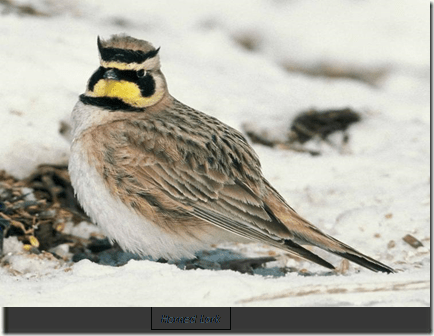
Although still very abundant, just 3 species account for the loss of 400 million grassland birds: Horned Larks, Savannah Sparrows and Grasshopper Sparrows. Horned Larks alone accounted for 182 million fewer birds due to a loss of very short grass habitats with some bare ground. To increase their numbers, studies show more grazing, mowing or burning will increase their preferred habitat.
It must be emphasized that the reported cumulative loss of 2.9 billion birds since 1970, does not signify ecosystem collapses. But there are some legitimate concerns such as maintaining wetlands. And there are some serious human-caused problems we need to remedy to increase struggling bird populations. It is estimated that cats kill between 1 to 3 billion birds each year. Up to 1 billion birds each year die by crashing into the illusions created by window reflections. Collisions with cars and trucks likely kill 89 to 350 million birds a year. Instead of fearmongering ecosystem collapse, our avifauna would best be served by addressing those problems.
Questioning Bird Models
Population estimates for most land birds are based on data from the US Geological Surveys Breeding Bird Surveys (BBS). I conducted 2 BBS surveys on the Tahoe National Forest for 20 years. Each survey route consists of 50 stops, each a half‑mile apart. At each stop for a period of just 3 minutes, I would record all observed birds, the overwhelming majority of which are heard but not seen. Many birds can be missed in such a short time, but the BBS designers decided a 3-minute observation time allowed the day’s survey to cover more habitat. Each year on about the same date, the BBS survey was repeated.
Each BBS route surveys perhaps 1% the region’s landscape. To estimate each species’ population for the whole region, the survey’s observations are extrapolated and modeled. However, models rely on several assumptions and adjustments, and those assumptions can inflate final estimates. For example, in 2004 researchers estimated there were 6,500,000 Rufous Hummingbirds. By 2017, researchers estimated there were now 21,690,000. But that larger population cannot be deemed a conservation success. That tripling of abundance was mostly due to new adjustments.
Because singing males account for most observations, the number of observed birds is doubled to account for an unobserved female that is most likely nearby. Furthermore, it is assumed different species are more readily detected than others. The models assume that each stop will account for all the birds within a 400‑meter radius. Because a crow is readily detected over that distance, no adjustments are made to the number of observed crows. But hummingbirds are not so easily detected. The earlier surveys assumed a hummingbird could only be detected if it was within an 80‑meter radius. So, to standardize the observations to an area with a 400‑meter radius, observations were multiplied by 25. Recent survey models now assume hummingbirds can only be detected within 50 meters, so their observations are now adjusted by multiplying by 64.
Thus, depending on their detection adjustments, one real observation could generate 50 or 128 virtual hummingbirds. That number is further scaled up to account for the time‑of‑day effects and the likely number of birds in the region’s un-surveyed landscapes.
Setting aside assumptions about the regional homogeneity of birds’ habitat, one very real problem with these adjustments that has yet to be addressed. If one bird is no longer observed at a roadside stop, the model assumes that the other 127 virtual birds also died.
Survey routes are done along roadsides and up to 340 million birds are killed by vehicles each year. Many sparrows and warblers are ground nesters and will fly low to the ground. Many seed eating birds like finches will congregate along a roadside to ingest the small gravel needed to internally grind their seeds. Every year I watched a small flock of Evening Grosbeaks ingesting gravel from the shoulder of a country road, get picked off one by one by passing cars. Roadside vegetation often differs from off-road vegetation. Roads initially create openings that are suitable for one species but are gradually grown over during the lifetime of a survey to become unsuitable habitat. So, it should never be assumed that the loss of roadside observations represents a decline for the whole region.
The larger the models’ detectability adjustments are for a given species, the greater the probability that any declining trend in roadside observations will exaggerate a species population loss for the region. The greatest population losses were modeled for warblers and sparrows and most warbler and sparrow data are adjusted for detectability by multiplying actual observations 4 to 10-fold. It is worth reporting good news from recent studies in National Parks that used a much greater density of observation points and were not confined to roadsides. Their observation points were also much closer together and thus required fewer assumptions and adjustments. Of the 50 species they observed, all but 3 populations were stable.
Pushing a fake crisis, Rosenberg et al argued that declining numbers within a species that is still still very abundant doesn’t mean they are not threatened with a quick collapse. He highlighted the Passenger Pigeon was once one of the most abundant birds in North America and they quickly went extinct by 1914. That doomsday scenario was often repeated by the media. But comparison to the Passenger Pigeon’s demise is a false equivalency. Passenger Pigeons were hunted for food when people were suffering from much greater food insecurity.
Rosenberg et al summarized their study with one sentence: “Cumulative loss of nearly three billion birds since 1970, across most North American biomes, signals a pervasive and ongoing avifaunal crisis.” But it signals no such thing. Wise management will continue. With better accounting of the natural causes of each species declines, plus more accurate modeling, it will be seen that Rosenberg’s “crisis” was just another misleading apocalyptic story that further erodes public trust in us honest environmental scientists.
Jim Steele is director emeritus of the Sierra Nevada Field Campus, SFSU and authored Landscapes and Cycles: An Environmentalist’s Journey to Climate Skepticism.
No comments yet.
Featured Video

Iran Is Not Our Enemy
or go to
Aletho News Archives – Video-Images
Frlom the Archives
The 52 Major Jewish American Organizations and Israel Celebrate Passover with the Slaughter of 25 Muslim, Christian and Secular Palestinians
By James Petras • Unz Review • April 8, 2018
Introduction
As of April 7, nearly three thousand unarmed Christian, Muslim and secular Palestinians have been wounded, over three dozen are in critical condition and at least twenty-five unarmed protestors, including children have been assassinated by hundreds of Israeli snipers and heavily armed troops shooting tank shells into crowds of civilians protesting their decades of incarceration by the racist Israeli state.
The Israeli government praised the ‘restraint and morality’ of the IDF, as did the fifty-two Major Jewish American Organizations (MJAO) who largely control the US Congress. These grotesque massacres began during the Christian Holy Week on Good Friday and Easter, coinciding with the Jewish Passover. The self-righteous officials of the MJAO and their relatives and friends broke matzos at joyful Seders as the blood of Palestinians soaked into ground at the fence containing the largest open-air prison camp in history, Gaza.
While tribal loyalties bonded the Israeli and Jewish American leaders, the politicians of the Western oligarchic electoral regimes refrained from criticizing the shocking display of brute force and even defended Israel’s cold blood mass killings of Palestinian civilians in their Gaza prison.
This paper will discuss and analyze the reasons for Israel’s willing Western accomplices and the centrality of its fifth column in the United States. … continue
Blog Roll
 Aletho News
- Israeli Journalist Demands Tucker Carlson and Candace Owens Be Placed in WWII-Style Internment Camps
- No Liability, No Studies, No Accountability: The Vaccine System Aaron Siri Exposed in Federal Court
- No time for losers: Why the war meant to save Israel may destroy it
- Top US Counterterrorism Official Resigns in Protest of Operation Against Iran
- Just Get Out! Now!
- Unpacking glaring contradictions in US-Zionist justifications for war against Iran
- Iranian model of warfare bleeds US dry while Persian Gulf states watch and learn: Analyst
- IRGC orders ‘defeated’ US to evacuate industrial facilities in region
- Hegseth’s call for ‘no mercy’ to Iranians deemed war crime
- Iran War Exposes Limits of US Military Power – Journalist
- If Americans Knew
- Trump’s counterterrorism chief, whose own wife was killed by ISIS, quits over Iran War saying Tehran posed ‘no imminent threat’
- Here’s what US could fund instead of Bibi’s war on Iran
- Israel Killed Over a Dozen Lebanese Paramedics in Three Days, Now Claiming That Ambulances Are “Hezbollah” Targets
- War on Iran: These are the heritage sites devastated by US and Israeli attacks
- Four news stories from Israeli media that illustrate Israeli “justice”
- CIA Prepares Criminal Referral of Tucker Carlson, as Israel and Its Loyalists Demand His Arrest
- Top US counterterror advisor resigns in protest of “war manufactured by Israel” – Not a ceasefire Day 157
- ‘I Liked the House’: When Israeli Soldiers Turn Palestinian Homes into Barracks
- ‘They Were All I Had’: Lebanese Father Buries Parents, 4 Daughters Killed by Israeli Bombing
- Israel and its supporters are causing attacks on Jewish institutions. Case in point: Michigan synagogue tragedy.
- No Tricks Zone
- New Research: South Australia’s Mid-Holocene Sea Surface Temperatures Were 4°C Warmer Than Today
- Storing Green Energy To Last Germany 10 Days Would Require A 60-Million Tonne Battery
- New Studies: UK Sea Levels Were 4 Meters Higher Than Today During The Mid-Holocene
- Destructive Green New Deal: German Energy And Metal Group Warns Of Drastic Crisis
- New Study Documents A 20-Year Pause In Arctic Sea Ice Decline – Driven By Internal Variability
- Wake-up Call: Survey Shows Majority Of Germans Now Favor Postponing Climate Targets!
- Televised! Leading German Political Candidate Tells Schoolchildren CO2 Makes Sun Hotter!
- New Study: A Century Warming Of 1.1°C Is ‘Commonplace’ And ‘Not Unusual’ During This Interglacial
- New Study: ‘Internal Noise’ And Volcanic Forcing Can Trigger 10-15°C Warming Within Decades
- Glaciers Worldwide Are Suddendly Surging, Experts Blame Warming!
 Aletho News
Leave a comment