‘I want blood’: Rachel Maddow’s audience fired up by NYT story baselessly accusing ‘Russian hackers’ of attacking US hospital
By Nebojsa Malic | RT | November 30, 2020
Accusing Russia of hacking anything from the 2016 election to US cancer hospitals may be fun and games for MSNBC host Rachel Maddow, but when her audience responds by demanding apocalypse, the shtick stops being funny.
Maddow’s conspiracy theories about ‘Russian collusion’ and supposed hacking of the 2016 election that resulted in President Donald Trump have been a staple of MSNBC audiences over the past four years. She’s not giving up that routine now, even as the entire mainstream media machine has turned on a dime and insists that the 2020 election was flawless – since it resulted in Democrat Joe Biden’s victory, that is.
On Monday, Maddow cherry-picked a couple of quotes and linked a New York Times story – published last week – about ‘Russian’ hackers allegedly targeting the University of Vermont Medical Center last month.
The Times story is long on feelings and emotions of the medical personnel and cancer patients affected by the fact that the UVMC computers stopped working, but short on actual facts about the case. It works in a jab at President Donald Trump for firing head of the cybersecurity agency Chris Krebs – for disputing “baseless claims of voter fraud,” of course – even though that happened long after the alleged attack.
The story also notes that the FBI has requested the center administrators to refrain from commenting on the case – even to confirm or deny their own statements about alleged ransom requests. Absent the facts, the Times is happy to fill in the blanks by citing a private cybersecurity company, Hold Security.
Hold Security and its chief executive Alex Holden are the sole source for the claim that ‘Russian’ hackers were behind the alleged cyberattack on UVMC and other US hospitals – at least according to the Times, as well as the media coverage of the FBI’s warning in late October that Maddow referenced.
The whole thing sounds much like the debunked Times story about Russia allegedly paying “bounties” to the Taliban for killing US troops in Afghanistan, a June bombshell that was used to hammer Trump and oppose his efforts to end the endless US war there.
Even the Pentagon’s own denials didn’t make a difference; Maddow and her colleagues were “all in” on the bounties story being true. So was her audience, as evidenced by some of the replies to her tweet.
While much of the replies were in the same vein, there were some that crossed the line from partisanship into genocidal – and apocalyptic – calls for blood.
“Russia needs to finally be handled. They need to be knocked back into the stone age,” said one follower.
“I did not hate the leaders of the old Soviet Union as much as I hate the leaders of Russia right now. I want them to experience monumental, historic, unprecedented, apocalyptic pain for what they have done to us. I want blood,” said another.
Earlier this year, MSNBC’s lawyers defended Maddow against a defamation lawsuit by One America News (OANN) – whom she called “literally Russian propaganda” – by arguing her show isn’t news but opinion, and that her statement was “rhetorical hyperbole” that no reasonable person would understand as fact.
While that admission got Maddow and MSNBC off the legal hook, it raises the question of how many of her followers and their audience qualify as “reasonable” people – as the comments on her tweet about the Times story show anew.
No one, Maddow included, should be held legally liable for the content of their replies, obviously. It’s something beyond their control. But when a steady diet of propaganda, ‘insinuendo’ and conspiracy theories presented as facts creates an atmosphere that results in this sort of bloodthirst that’s on display, it doesn’t inspire confidence in her audience’s mental state.
Keep in mind that the politicians Maddow supports may soon end up with absolute power, if Trump’s claims about election fraud are really as “baseless” as the media claim. Also, don’t forget that the US and Russia have enough nuclear weapons between themselves to destroy all life on the planet. And that’s something people so obsessed with their feelings to be calling for “monumental, historic, unprecedented, apocalyptic pain” clearly haven’t given any thought.
Killing The Future: COVID Madness Will Lead To HALF A MILLION Fewer U.S. Births In 2021
By Steve Watson | Summit News | November 30, 2020
Research has concluded that the US will experience 500,000 fewer births in 2021, as couples choose not to have children because of the coronavirus fallout.
The findings by the Brookings Institute were published last week in the Wall Street Journal, which noted that there will be “between 300,000 to 500,000 fewer births in the U.S. next year, compared with a drop of 44,172 last year.”
The numbers equate to a 13% drop from the 3.8 million babies born in 2019.
The “analysis, partly based on what happened following the 2007-2009 recession, is that weaker job prospects equate to fewer births,” the report further notes.
“Women will have many fewer babies in the short term, and for some of them, a lower total number of children over their lifetimes,” the research, previously previewed in the Summer, noted.
The US birthrate is already at its lowest level on record, and according to clinics, there has been a 50% jump in requests for birth control since the beginning of the pandemic, and a 40% increase in requests for Plan B.
CDC research notes that the birth rate in the US has been below replacement level since 1971. It is now a problem across all major racial groups including Hispanics, non-Hispanic whites, non-Hispanic blacks, and non-Hispanic Asians. All have below replacement birth levels.
A recent survey from the Guttmacher Institute discovered that 34% of women able to have babies in the US have made a decision to either delay having a child, or to just have fewer children because of COIVD.
Analysts say this will have a long and profound impact on the economy for many years to come, as the US could be falling into a so called ‘Fertility trap’ where there are fewer women around to have babies, resulting in smaller families, and low population growth reducing economic growth.
All of this results in increased pessimism and a downward spiral that is difficult to break.
It will also mean that in the near future there will be a huge mismatch between the amounts of younger and older people in the country.
Indeed, by 2034 Americans over age 65 are expected to outnumber those under 18 for the first time in the history of the nation.
Unless it is stopped now, the COVID madness, the lockdowns, the panic, the social engineering will not only be causing irrevocable damage to our collective psyche, societal morale, and cultural richness, it will also destroy future prosperity and literally deny life to millions along the way.
But perhaps that was the endgame all along?
Biden Appointee Neera Tanden Spread the Conspiracy That Russian Hackers Changed Hillary’s 2016 Votes to Trump
By Glenn Greenwald | November 30, 2020
The announcement that Joe Biden intends to nominate Neera Tanden as his Director of the Office of Management and Budget — a critical position overseeing U.S. economic and regulatory policy — triggered a wide range of mockery, indignation and disgust from both the left and the right.
That should not be surprising: though a thoroughly mediocre and ordinary D.C. swamp creature from the perspective of both ideology and competence, Tanden’s uniquely unhinged, venomous, corrupt and pathologically dishonest conduct as a Clinton Family and DNC apparatchik and President of the corporatist-and-despot-funded Center for American Progress (CAP) has earned her a list of enemies far longer and more impressive than her accomplishments.
When news of her appointment broke, many of the journalists and activists she has spent years abusing, slandering, and lying about instantly stepped forward to compile just some of her worst political and behavioral lowlights. And some preliminary signs emerged that she might encounter difficulty in obtaining the Senate confirmation needed for her to assume this position. The Communications Director for GOP Senator John Cornyn of Texas announced that “Tanden stands zero chance of being confirmed” by the Senate.
Former Sanders campaign aide David Sirota hypothesized that “it is not a coincidence that they are putting Neera Tanden — the single biggest, most aggressive Bernie Sanders critic in the United States of America — specifically at OMB while Sanders is Senate Budget Committee ranking/chair.” Sirota’s statement suggests Biden’s nomination of Tanden was intended as yet more humiliation doled out to the Democratic-loyal Sanders left by cucking the Vermont Senator even further by forcing him to shepherd the confirmation of one of his most vicious and amoral attackers (who Sanders himself in 2019 vehemently denounced). But Sirota’s point also raises the prospect that Tanden’s nomination could even encounter trouble from that side of the aisle as well (given Sanders’ compliant and disciplined conduct over the last six months, it’s more likely we will see him roll out a literal red carpet for Tanden to walk on, gently toss red roses on it before she passes, and then serve her a glass of Chardonnay rather than meaningfully obstruct her confirmation).
The list of sociopathic and even monstrous acts from Tanden is too long to list comprehensively. She punched one of her own employees, a reporter for CAP’s now-abolished blog ThinkProgress, after he had the temerity to ask Hillary Clinton in 2008 about her support for the Iraq War (Tanden claimed she “merely” had “pushed,” not punched, her undeferential reporter). In 2011, as the Obama administration was participating in the NATO bombing of Libya, Tanden suggested in internal CAP discussions that the U.S. steal Libya’s oil as a way of reducing the U.S. deficit (a story I was able to report only because Tanden had abused and alienated so many of her employees that they worked together to leak her incriminating emails to me).
During her tenure as CAP’s President, Tanden accepted millions of dollars from the regime of the United Arab Emirates, which built Dubai and Abu Dhabi using slave labor, along with massive donations from Facebook, Google, Microsoft, J.P. Morgan, the Walton Family and Michael Bloomberg, while hiding the identity of some of her think tank’s largest donors. A huge chapter on the NYPD’s abusive policies toward Muslims under Mayor Michael Bloomberg was removed from a CAP report after Boomberg donated more than $1 million to Tanden’s organization, and he continued to donate even more after that courteous gesture.
She ordered the supposedly independent journalists of the ThinkProgress blog, including Muslim writers, to stop writing critically about Israel after key CAP donors, including Barney Frank’s sister Ann Lewis and long-time Clinton advisor Howard Wolfson, complained. [More info on this and about AIPAC’S influence is here and here. and here and here]
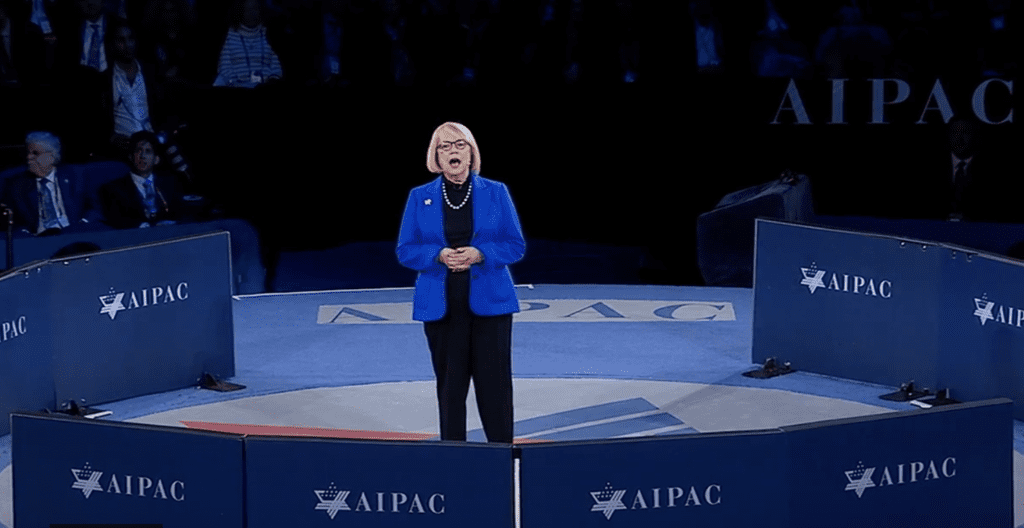
Ann Lewis speaks at AIPAC national conference, March 20, 2016 in Washington DC. Lewis is a Democratic political strategist and former White House Communications Director to President Bill Clinton.
Tanden and Wolfson plotted in 2016 how to weaponize female journalists and people of color against Hillary’s critics as well to use their identity to stigmatize and thus stop undesirable coverage from The New York Times. In 2018, she outed a CAP employee at a staff-wide meeting who had filed an anonymous complaint of sexual harassment and retaliation against one of Tanden’s male allies. Secure with her UAE-and-corporate-funded large salary, she has long urged cuts to Social Security. The list goes on and on.
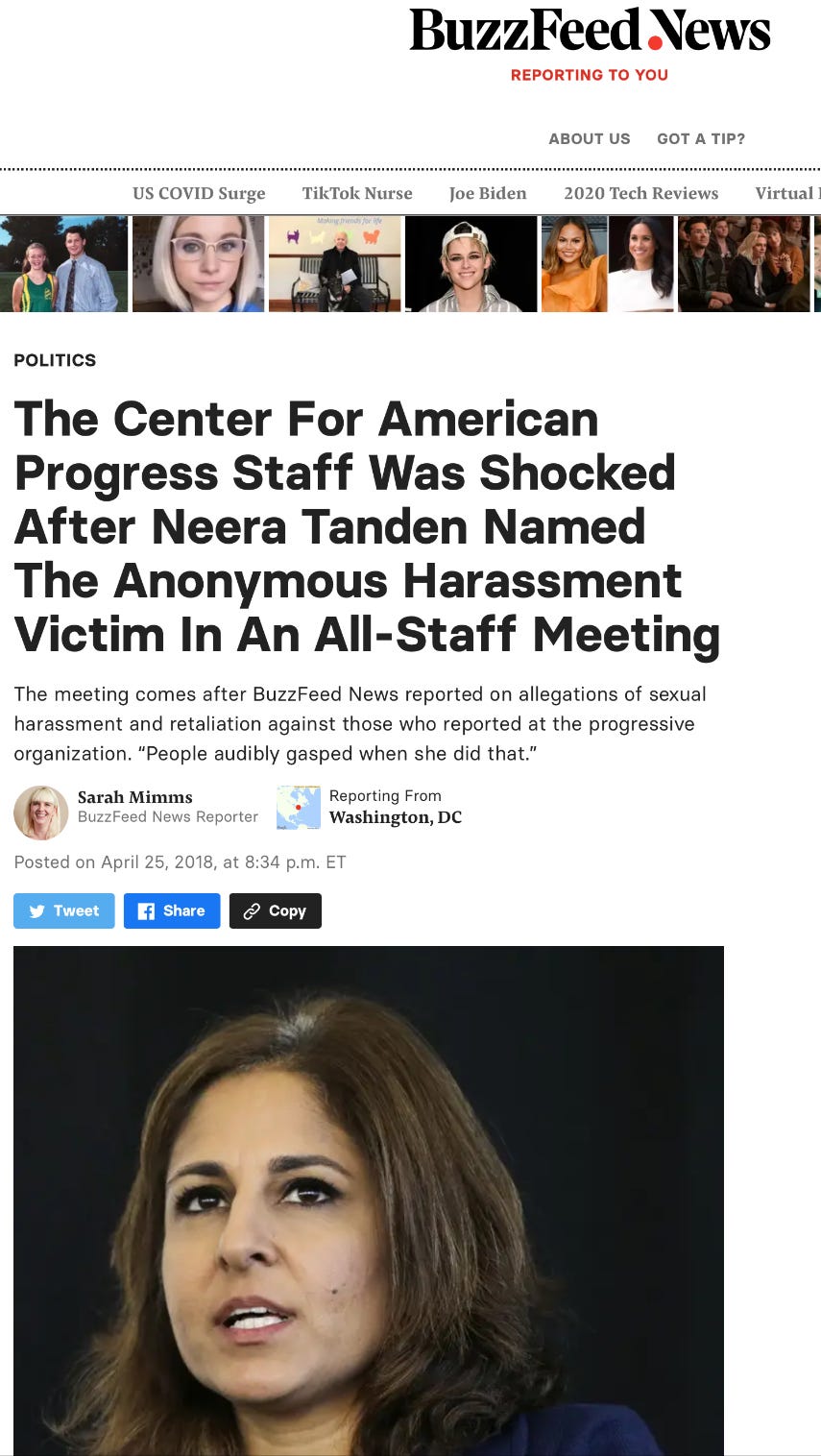
One can reasonably view Biden’s choice of Tanden as a positive. She is no different in character or ideology than any of the faceless, more obscure DNC operatives who would occupy this position if she did not. But because of how well-known her sociopathy, militarism and corporatism are to many on the liberal-left, her face serves as an undeniable and unavoidable reminder of what the Biden administration and the Democratic Party really are. She illuminates the truth about their real aims.
But beyond things like wanting to steal Libya’s oil after bombing it into oblivion, outing sexual harassment complainants, and physically assaulting and censoring her own employees, there is one uniquely abominable feature of Neera Tanden. She is one of the most deranged conspiracy theorists in the United States, and has done more than almost any other Washington functionary to contaminate Democrats’ mental health, capacity to reason, and faith in the legitimacy of U.S. elections.
Tanden owes her entire career to the patronage of Hillary Clinton, and her devotion to Hillary approaches restraining-order levels of creepiness (here you can watch Tanden beam with adoration as then-Senator Hillary Clinton, on the Senate floor in 2004, explains her steadfast opposition to marriage equality for same-sex couples on the ground that “marriage is a sacred bond between a man and a woman” and “exists between a man and a woman going back into the mists of history” for the primary purpose of raising children — just a few short years before Democrats changed views on this, after which it instantly became the hallmark of an unreconstructed hateful bigot to say this).
Few people took Hillary’s 2016 loss to Donald Trump as hard as Tanden, or handled it as poorly. Indeed, she refused to believe it really happened, and encouraged others to similarly refuse to accept its reality.
In the weeks after Trump’s victory, Tanden joined numerous Democrats in encouraging electors of the Electoral College to ignore their states’ votes and refuse to elect Trump as President (many rationale were invoked for this: Tanden’s was a CAP article promoting #Resistance fanatic Richard Painter’s argument that Trump’s violations of the Emolument Clause precluded an Electoral College win). She insisted that Hillary lost because of Russia, claiming the “Russians did enough damage to affect more than 70k votes in 3 states.” And she was not only one of the first to push the Steele Dossier’s claim that Russia held blackmail power over Trump but also one of the last to do so — insisting in 2018 that “the dossier been mostly proven to be true” and claiming as late as 2019 that nothing in this discredited junk report had been disproven.
Tanden’s bizarre claims about Russian hackers
But what really distinguished Tanden when it came to unhinged and toxic behavior was her repeated (and obviously baseless) claims that Hillary only lost because Russian hackers invaded the U.S. voting system and clandestinely changed Hillary’s votes to Trump’s, costing the real winner — Hillary — her rightful place on the throne, behind the Resolute Desk.
Four days after the 2016 election, Tanden began strongly implying, if not outright stating, that Russian hackers changed the vote totals, and that this is why “Trump was as surprised as everyone else” by his victory. When I highlighted her conspiratorial claims, she did not deny their obvious meaning, but rationalized them by insisting that her conspiracies were not as bad as Trump’s refusal, in advance of the election, to acknowledge the legitimacy of an election that had not yet taken place:
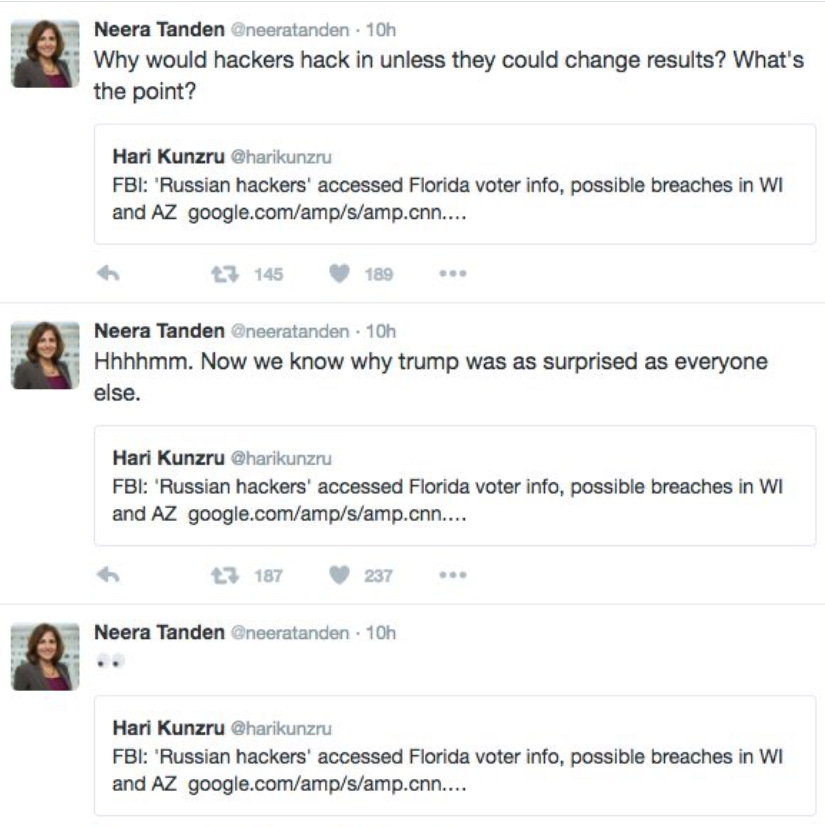
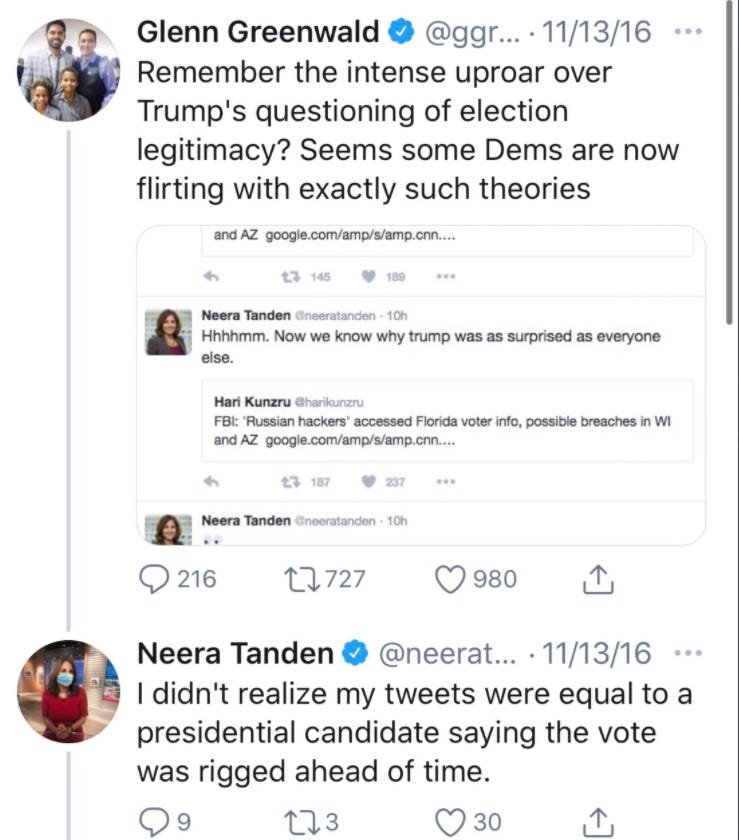
Tanden’s insistence that Russia changed the voting results through hacking did not once her traumatic shock in the weeks after Hillary’s loss dissipated (if it ever did). After The Intercept published an anonymous, evidence-free document in June, 2017, allegedly sent by NSA employee Reality Winner, which led that site to claim that “Russian military intelligence executed a cyberattack on at least one U.S. voting software supplier and sent spear-phishing emails to more than 100 local election officials,” Tanden returned to pushing this bizarre conspiracy theory, demanding that I “retract” my post-election criticism of her for peddling this Russia-changed-the-votes madness — as if this NSA document published by The Intercept proved vote-changing hacking by Russia.
This conspiracy-mongering led by Tanden and other prominent liberal activists had a corrosive effect on the ability of Democrats to perceive basic reality, to put that mildly. A 2018 poll from Economist/YouGov — conducted more than a year after Trump’s inauguration — found that a large majority of Democrats (66%) believe that “Russia tampered with vote tallies in order to get Donald Trump elected President.”
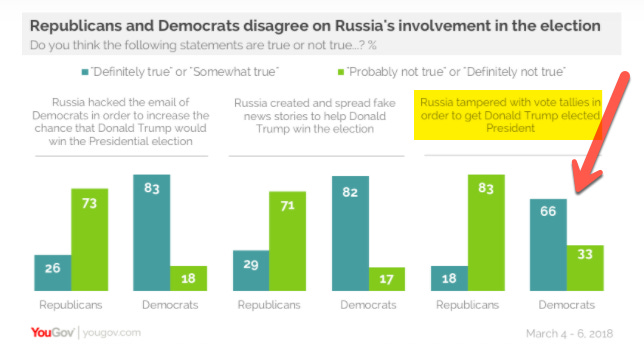
Economist/YouGov poll, published Mar. 9, 2018
Thereafter, Hillary herself took to calling Trump an “illegitimate” president, further fueling the destruction of confidence and faith among Democrats in the legitimacy of the vote totals and specifically the outcome of the 2016 presidential election.
Democratic leaders and their media allies love to patronizingly warn that conservative media outlets and their audiences are prone to spread and believe crazy conspiracy theories. They purport particular worry when such conspiracies are designed to undermine faith and trust in the U.S. electoral system itself.
Yet few have done more to destroy such confidence and faith than Neera Tanden, achieved by disseminating over the course of several years some of the most unhinged, evidence-free and deranged conspiracy theories in which she deliberately deceived Democratic partisans into believing that Moscow’s dastardly hackers invaded the sanctity of the U.S. voting system to change Hillary’s votes to Trump’s. And it worked: at least as of 2018, large majorities of Democrats believe that this utterly unproven but dangerous assertion is true.
If Joe Biden succeeds in empowering someone like Neera Tanden without extreme opposition from supposedly adversarial journalists, not only Democrats but also these media outlets will lose whatever lingering credibility they have to denounce conspiracy theories and to defend the legitimacy of U.S. elections. And they will deserve that fate. You can’t run around expecting people will take you seriously when you warn of the dangers of toxic, moronic conspiracy theories when you yourself embrace, elevate and promote the most prolific and reckless purveyors of them.
IMF refuses to help Ukraine
By Lucas Leiroz | December 1, 2020
Ukraine’s economic situation is getting more and more complicated. The country is going through a moment of great crisis, from which it hoped to mitigate the effects by receiving emergency financial aid from the International Monetary Fund. However, the IMF now refuses to provide a large part of such emergency aid and launches Kiev into a danger of financial collapse. Now, the country must look for other ways to end this fiscal year after facing a large debt in its budget.
The new support program for Ukraine, approved by the IMF Board of Governors in early June, provides for the sending of 5 billion dollars over a period of one and a half years. Kiev has already received the first payment, valued at 2.1 billion. The remaining amount was expected to be sent in four installments of around 700 million dollars each one, in late June and late September, with two revisions next year. However, there will be no further installment until the end of 2020. Therefore, Ukraine must work within the current amount and meet its targets, which is truly complicated, if not impossible.
According to Yaroslav Zhelezniak, the first vice-chairman of the Ukrainian Parliament’s Financial and Fiscal Policy Committee, more than a billion dollars are missing – adding to the amount already collected – for the state to be able to pay the so-called “protected expenses”, which are those that according to Ukrainian national law cannot be cut, such as salaries, pensions, defense industry, among others. In any event, spending considered “secondary” would be canceled, but now, with the IMF’s delay, Kiev will not even be able to afford its protected expenses.
The accumulation of debts with protected expenses is precisely the greatest current threat to the Ukrainian state, as it represents a structural danger not only for finances but also for all strategic sectors affected by the lack of resources. For reasons of confidentiality, current Treasury information does not show which specific items of protected expanses have stopped receiving funding, but currently protected sectors account for 80% of all budgetary expenses.
As for unprotected items, everything is clear: simply, nothing is paid. In November, nothing outside the strategic sectors was financed from the Ukrainian state budget. That is, the authorities simply decided not to pay service providers and public-private partnerships in November. Obviously, this was a forced choice: without money available, there is no way to pay. However, it is undeniable that the social consequences of such default will be severe and will only further weaken Ukraine.
Given this scenario, the draft budget for 2021 has already been rewritten by the Council of Ministers. The new version was approved at an extraordinary meeting on 26 November and sent to Parliament for evaluation. In particular, the first budget plan for 2021 was one of the reasons for the refusal by the IMF of the aid to Ukraine, considering that the project had a deficit forecast of 6%, instead of the 5.3% agreed with the IMF. In the revised version, the deficit was reduced to 5.5%. This required increasing revenues and cutting expenses. Still, Ukraine remains hopeful of receiving aid with such a reduction.
In the draft of the second version of the 2021 budget, GDP growth remains estimated at 4.6%. However, it is important to note that this forecast appeared in the middle of the year, when nothing was known about the second wave of the coronavirus pandemic in Ukraine and the current crisis, which means that the calculations must be updated. Currently, the World Bank expects Ukrainian GDP growth of less than 1.5%, contrary to the optimism of Kiev’s experts.
It is interesting to note how Ukraine has struggled over the past six years to establish a political and economic orientation totally focused on the interests of Western powers, having been completely abandoned by such powers during its most fragile moment. In recent years, Kiev has entered a crisis that is already considered by many experts to be the worst since World War II. And the positioning of its western allies in the face of this scenario of imminent national collapse has been an absolute omission. Washington, for example, constantly announces military cooperation projects with Ukraine valued at millions of dollars, providing equipment and human resources, but at least in the past five years no effective financial aid project to the Ukrainian state has been established, having been limited to one small participation in European aid announced in 2014.
Amid the pandemic and the rise of economic isolationism, Ukraine will only be more and more alone. Perhaps the best path to follow is a general review of state priorities. For example, why include the defense industry in protected expenses when the country is experiencing a deep social crisis? It would be more strategic – and in line with the humanitarian values that Kiev claims to defend – to retreat in military spending and invest capital in partnerships with the private sector that can improve the lives of the Ukrainian people. This is currently the only possible way to Kiev.
Lucas Leiroz is a research fellow in international law at the Federal University of Rio de Janeiro.
Featured Video

Chinese jet fuel and the myth of energy independence
or go to
Aletho News Archives – Video-Images
Book Review
Former Insiders Criticize Iran Policy as U.S. Hegemony
By GARETH PORTER | CounterPunch | February 27, 2013
“Going to Tehran” arguably represents the most important work on the subject of U.S.-Iran relations to be published thus far.
Flynt Leverett and Hillary Mann Leverett tackle not only U.S. policy toward Iran but the broader context of Middle East policy with a systematic analytical perspective informed by personal experience, as well as very extensive documentation.
More importantly, however, their exposé required a degree of courage that may be unparalleled in the writing of former U.S. national security officials about issues on which they worked. They have chosen not just to criticise U.S. policy toward Iran but to analyse that policy as a problem of U.S. hegemony. … continue
Blog Roll
 Aletho News
- Chinese jet fuel and the myth of energy independence
- Ukraine Sea Drone Fired From Libya Hit Russian Tanker in Mediterranean
- IRGC: Iranian forces launched no attacks during ceasefire hours
- Trump Administration Moves To Automate U.S. Military Draft Registration
- Spain orders reopening of Tehran embassy, condemns Israel’s carpet bombing of Lebanon
- Israel faces ‘unsustainable’ strategic crisis following 40-day war against Iran: Analyst
- Iran restricts Hormuz access to 15 vessels per day under ceasefire terms: Report
- The ‘Opposition Party’ Has Done Nothing to Stop the Iran War and Much to Goad Trump Into Continuing It
- Moscow backs Tehran on status of Lebanon in US-Iran deal
- How UK Regulator Ofcom Quietly Bypassed International Law to Police American Speech
- If Americans Knew
- Amnesty: Urgent – Protect Lebanese civilians from brutal escalation in Israeli attacks
- Is The War Against Iran Over?
- Inside the Israeli army’s propaganda wing
- Hundreds of Gaza Amputees Stranded in Legal Limbo
- The gallows law: Israel moves toward executing Palestinian children
- Tucker Carlson: The Path to Peace requires ending ‘special alliance’ with Israel
- This is ceasefire? Israel’s biggest massacre yet in Lebanon, another journalist killed in Gaza – Daily Update
- Tucker Carlson on Israel: This Is the Behavior of an Ally? Really?
- Gazans face a triple crisis: severe shortages of water and bread, healthcare in tatters
- NY Times reports how Netanyahu took the US into Iran War
- No Tricks Zone
- An Inconvenient Tree: Uncovered In Alps… Europe Much Warmer Than Today 6000 Years Ago
- New Study Reports A 60% Slowdown In Greenland’s Ice Loss Rate In The Last Decade
- Low Intensity Tornado Wrecks Major Solar Farm, Creating A Potential Toxic Dump
- New Study Finds Warming Saves Lives…Cold Temperatures 12 Times More Deadly Than Excess Heat
- German Science Blog Accuses PIK Climate Institute Of Hallucinating Climate Tipping Points
- Devastating Assessment Of Comirnaty Vaccine By Former Senior Pfizer Europe Toxicologist
- New Study: CO2 Is ‘Effectively Negligible’ As An Explanatory Climate Change Factor Since 2000
- Former Pfizer Toxicologist Dr. Helmut Sterz Tells Bundestag Hearing Pfizer Vaccine Should Have Never Been Approved
- Energy Expert: Germany’s Nuclear Phaseout Was A “500 Billion Euro Mistake”
- New Research: South Australia’s Mid-Holocene Sea Surface Temperatures Were 4°C Warmer Than Today
 Aletho News