California utility PG&E admits it probably started yet ANOTHER devastating wildfire
RT | July 20, 2021
Pacific Gas & Electric (PG&E) seems to have once again helped ignite a deadly wildfire in California, contributing to the carnage in the most populous US state for the fourth year in a row, according to a report on its website.
Documents posted to the utility’s website on Monday and filed with the California Public Utilities Commission indicate that a PG&E employee saw “blown fuses in a conductor on top of a pole, a tree leaning into the conductor, and a fire at the base of the tree” when he responded to a reported circuit outage around 7am local time last Tuesday. The equipment problem is believed to have helped contribute to the start of the Dixie Fire in Feather River Canyon, a devastating blaze that is still just 15% contained.
Unable to access the pole until nearly 12 hours after first taking note of the fire, due to “challenging terrain and road work resulting in a bridge closure,” the employee reported that upon returning to the site around 4:40pm local time, he encountered “a fire on the ground near the base of the tree” plus “two of three fuses blown and what appeared to him to be a healthy green tree leaning into the Bucks Creek 1101 12 kV conductor, which was still intact and suspended on the poles,” according to the report.
Only then did the worker call his supervisor – who subsequently called 911. Given PG&E’s abysmal track record of responding to wildfires (especially those linked to its equipment), it is perhaps unsurprising that the utility reportedly waited five days – rather than the required two to four hours – to report the nascent blaze to the state regulatory agency.
The Dixie Fire has already consumed more than 30,000 acres as of Monday, and continues to force evacuations in Plumas and Butte counties. PG&E’s systems reportedly showed an outage near Cresta Dam in the area of Feather River Canyon where the fire began. Mandatory evacuation orders remain in force in High Lakes, Bucks Lake, and Meadow Valley in Plumas County; Jonesville and Philbrook in Butte County are also under evacuation order. Cal Fire reported on Monday that 800 structures remain under threat.
PG&E has become notorious for its dysfunctional equipment’s apparent contributions to the increasingly devastating wildfires plaguing the region. PG&E equipment has been connected to at least one wildfire every year for the past four years, starting with the deadly 2018 Camp Fire.
The utility pleaded guilty last year to 84 counts of manslaughter, each count representing one life lost in the Camp Fire. The deadly blaze began in October in the town of Pulga, eventually engulfing 140,000 acres aided by high winds and low humidity. Some 8,700 homes were destroyed and tens of thousands of people forced to evacuate, while even those whose homes were spared the destruction were unable to go outside due to the extremely unhealthy air quality. The worst wildfire in California history, the Camp Fire killed 85 people and all but wiped out the town of Paradise.
The judgment pitched PG&E into a bankruptcy from which it finally emerged last year, with a promise to compensate fire victims for whatever damages had not been covered by their insurance – a sum of $13.5 billion that will be partially paid in company stock.
Last year, PG&E equipment was found to be partially responsible for the Zogg Fire in Shasta County. The company is still facing a criminal investigation over that blaze and was forced to pay out $43 million to local governments for that fire and the previous year’s Kincade Fire in Sonoma County. The utility still faces prosecution in Sonoma County over the 2019 fire.
Should PG&E continue to perform not just poorly but criminally, the utility could ultimately be taken over by the state, though California’s Public Utilities Commission requires the firm to progress through six ‘tiers’ of its so-called enhanced oversight program first. PG&E is already on the first tier, having been nailed for the shoddy job it did clearing out tree limbs and other kindling from its riskiest lines since November, and has pledged to spend $4.9 billion on “wildfire safety” this year.
Its promise to “do better” after four years of contributing to the devastating losses experienced by California residents was made as a condition for exiting bankruptcy. Meanwhile, company officials have attempted to blame drought and climate change, instead of taking responsibility.
PG&E has also outraged and alienated customers by shutting off the power supply during peak usage hours for hundreds of thousands of people, hoping to prevent the sparking that has been known to cause wildfires out of fear that high winds could topple the power lines altogether.
An investigation by the CPUC accused the utility of lacking even a rudimentary safety strategy, noting it only makes “positive changes” when forced to do so by dire accidents like fires and explosions. The CPUC report itself was issued seven years after the explosion of a gas pipeline in 2010, which killed eight people and uncovered poor if not criminal business practices such as overcharging customers, underspending on maintenance, and in general placing profit over everything – including but not limited to safety.
This year’s fire season is already predicted to be especially devastating, with expectations it will be longer, drier, and riskier than previous years’ even as PG&E struggles to fix its decaying infrastructure.
Over 158,000 acres of Northern California forest have burned so far this season, including the Tamarack Fire, which grew to 23,000 acres as of Monday morning and remains entirely uncontained. It was reportedly ignited by a lightning strike earlier this month, and local firefighters made the questionable decision not to dispatch fire crews “because of safety concerns,” leaving Alpine County Sheriff Rick Stephens to explain the bizarre response to local residents who now face losing their homes to the inferno. The Beckwourth Complex Fire has burned over 105,000 acres as of Monday and is 82% contained.
China: US-led hacking allegations fabricated out of nothing
Press TV – July 20, 2021
China has roundly rejected the “groundless” and “irresponsible” hacking allegations made by the United States and its allies, saying they are “fabricated out of nothing.”
Chinese Foreign Ministry spokesman Zhao Lijian hit back at Washington on Tuesday, calling the US the “world champion” of cyber-attacks.
“The US has mustered its allies to carry out unreasonable criticisms against China on the issue of cybersecurity,” he said. “This move is fabricated out of nothing.”
In a coordinated move, Washington and several allies in Europe and Asia publicly accused Beijing of hacking the Microsoft Exchange Server software in March. Microsoft Exchange is an email platform used by corporations around the world.
Senior US officials claimed that hackers tied to China’s Ministry of State Security carried out the unusually indiscriminate hacking. Secretary of State Antony Blinken said on Monday that Washington and “countries around the world” are holding China “accountable for its pattern of irresponsible, disruptive, and destabilizing behavior in cyberspace, which poses a major threat to our economic and national security.”
Japanese government spokesperson Katsunobu Kato followed suit on Tuesday, saying that Japanese companies had been targeted by a hacking group called APT40. He alleged that “the Chinese government is highly likely” behind the attack.
Earlier, China’s diplomatic missions around the world reacted to the charges.
The Chinese Embassy in New Zealand’s capital, Wellington, said the accusations were “totally groundless and irresponsible” and a “malicious smear.”
“Given the virtual nature of cyberspace, one must have clear evidence when investigating and identifying cyber-related incidents,” said the embassy.
The Chinese mission in Canberra said Australia was “parroting” US rhetoric. It also described the US as “the world champion of malicious cyber-attacks.”
The United Kingdom (UK) and European Union (EU) also joined the others in accusing China of carrying out hacking attacks, which they alleged to have targeted an estimated hundreds of thousands of mostly small businesses and organizations.
The Chinese Embassy in Norway also reacted to the allegations made by Oslo, saying that Beijing was a staunch defender of cyber security and was resolutely opposed to any form of cyberattacks.
“It is reasonable to question and doubt whether this is a collusively political manipulation,” it said, demanding that Oslo provide evidence for the claims. The embassy said that Beijing was “willing to cooperate with all relevant parties, based on facts and evidence, to jointly combat illegal activities in cyber space.”
The US-led global campaign against China is an apparent move to open a new front in cyber offensive following years of blaming Russia for cyberattacks against American organizations. Moscow time and again denied involvement.
Biden Doubles Down on Voters
Fraud in 2020 election is only a preview of what is coming
BY PHILIP GIRALDI • UNZ REVIEW • JULY 20, 2021
President Joe Biden has now declared that the United States is facing an existential crisis comparable to what it experienced during the Civil War, a struggle that will produce a truly democratic form of government with universal franchise or which will result in the denial of basic rights to many citizens. And he is quite willing to address the issue employing a maximum of emotion and fear mongering unmitigated by a minimum of reasonable suasion, saying “We’re facing the most significant test of our democracy since the Civil War. That’s not hyperbole. Since the Civil War — the Confederates back then never breached the Capitol as insurrectionists did on January the 6th. I’m not saying this to alarm you. I’m saying this because you should be alarmed.”
Of course, what may have occurred on January 6th has nothing to do with the issue currently in play, which is voting rights, though it is only one aspect of what is essentially a revolution sponsored by the Democratic Party to reorder the American political system in such a fashion as to guarantee its dominance for decades to come. Other steps will include greatly increased immigration, a war on so-called domestic terrorists and decriminalizing or choosing not to prosecute many felonies committed by party constituencies.
The voting rights legislation currently before Congress includes the interestingly named For the People Act and its successor the John Lewis Voting Rights Advancement Act, both of which would seek to restore certain unconstitutional aspects of the Voting Rights Act of 1965. Most important, they would eliminate the ability of the states to pass legislation that creates conditions on registering and voting. The text of the John Lewis Act now before Congress refers to these steps as “discriminatory laws, needless barriers, and partisan dirty tricks.”
At the heart of the push by the Democrats is the creation of a uniform national electoral system which will essentially make it much easier for people to vote, permitting block voting, ballot harvesting and both registration and voting itself by mail. If passed, the new legislation will compel each state to adopt “automatic and same-day voter registration, voting rights for felons, no-excuse absentee balloting, mandatory early voting, and taxpayer funding for political campaigns.”
The key objections to the new voting procedure being promoted by Biden are several, largely related to its lack of any requirement for potential voters to provide information or show documentation confirming citizenship and residency or even one’s identity. The Democrats are denouncing their Republican opponents who are raising these issues as guilty of “voter suppression.” If the Democrats win the debate, it will be possible for anyone to vote in elections without having any human contact whatsoever using the mail-in ballots which are potentially susceptible to large scale fraud.
Another problem with the Biden program to nationalize voting procedures is that the there are four amendments to the United States Constitution that make it clear that it is left to the states to determine the modalities of voting. That means that even if the new voting act passes through Congress and is signed by the president there still would certainly be challenges based on its unconstitutionality. While Blue states will presumably go along with the guidance from Washington, those states still leaning Red will undoubtedly resist any nationalization of voting procedures.
It is not as if the current voting system is fraud-resistant. All too often it is not, which is why state legislatures in Georgia, Texas and several other Republican controlled states have passed new voting laws that actually require in many cases one’s physical presence to vote as well as production of documentation or information confirming citizenship and residency. They also include the purging of electoral rolls of voters who have died or moved. The new laws come as close as is reasonably possible to creating a system where voting security and integrity will be greatly enhanced, but the fact is that the Democrats are not at all interested in reducing criminal voting. They are interested in creating a permissive environment where all their presumed supporters will be able to vote without having to make any effort to do so or even be compelled to demonstrate who they really are and that they are citizens.
Prior to the recent national election, I examined the procedures to register and vote in my home state of Virginia and determined that one could both register and vote without any human contact at all. The registration process can be accomplished by filling out an online form, which is linked here. Note particularly the following: the form requires one to check the box indicating US citizenship. It then asks for name and address as well as social security number, date of birth and whether one has a criminal record or is otherwise disqualified to vote. You then have to sign and date the document and mail it off. Within ten days, you should receive a voter’s registration card for Virginia which you can present if you vote in person, though even that is not required.
It is important to realize that no documents have to actually be presented to support the application, which means that all the information can be false. You can even opt out of providing a social security number by checking the box indicating that you have never been issued one, even though the form indicates that you must have one to be registered, and you can also submit a temporary address by claiming you are “homeless.” Even date of birth information is useless as the form does not ask where you were born, which is how birth records are filed by state and local governments. Ultimately, it is only the social security number that validates the document and that is what also appears on the Voter’s ID Card, but even that can be false or completely fabricated, as many illegal immigrant workers in the US have discovered.
Prior to the November election my wife and I received unsolicited four mail-in ballots, all of which were sent to us anonymously. I examined the ballots carefully and noted that they bore no serial numbers or other forms of validation that could conceivably be used to limit the potential for fraud. In a state like Virginia, the actual mail-in ballot only requires your signature and that of a witness, who can be anyone. That is also true in six other states. Thirty-one states require only your own signature on the ballot while just three states require that the document be notarized, a good safeguard since it requires the voter to actually produce some documentation and identification. Seven states require your additional signature on the ballot envelope and two states require that a photocopy of the voter ID accompany the ballot. Some of these procedures may have been changed since the November allegation but it appears that only the handful of Republican states that are in the process of passing new voting laws are taking the problem seriously. In other words, the safeguards in the system continue at this time to vary from state to state but in most cases, fraud would be relatively easy if one is using mail-in voting. In fact, former President Jimmy Carter’s headed a bipartisan commission in 2005 that concluded that mail-in ballots constitute the “largest source of potential voter fraud” of any voting system.
Joe Biden is of course right about a crisis developing comparable to the Civil War, but what he is choosing to ignore is that his White House is carelessly feeding into what has become a growing chorus of dissent. He and his colleagues in Congress are deliberately and with malice pushing an agenda that, if successful, will lead to something like one party rule in the United States. Combine that with impending legislation and executive action to pursue “domestic extremists,” whom the Administration has also defined as “white supremacists,” it is not hard to imagine what kind of trouble is brewing.
Philip M. Giraldi, Ph.D., is Executive Director of the Council for the National Interest, a 501(c)3 tax deductible educational foundation (Federal ID Number #52-1739023) that seeks a more interests-based U.S. foreign policy in the Middle East. Website is https://councilforthenationalinterest.org address is P.O. Box 2157, Purcellville VA 20134 and its email is inform@cnionline.org
Covid vaccines: We’ve been misled from the very start
By Neville Hodgkinson | The Conservative Woman | July 20, 2021
IT IS truly amazing how self-deceiving a profession that sets out to help and heal sick people can be when it comes to acknowledging that the cure is sometimes worse than the illness. Evidence is mounting that just such a state of denial is manifesting in the mass rollout of the Covid vaccine.
Decades ago, I examined evidence for the effectiveness of flu vaccine and found that it rested entirely within studies showing an increase in antibodies to the circulating virus, but that this did not translate into less illness.
A group of GPs who were uneasy about the impact of the vaccine on old and frail people set up a trial of their own in which they found that those who had the jab had no less flu, but more non-specific illness, in the ensuing year compared with a group of similar frailty who were not inoculated.
Similarly, doctors at two boarding schools who conducted trials among their own pupils dropped the vaccine after finding it was of no benefit.
It would be almost impossible to do similar studies today because the NHS mounts such a relentless campaign every winter to have everyone vaccinated. It is in effect the marketing arm for the flu vaccine manufacturers, of which GlaxoSmithKline, Sanofi and AstraZeneca are leading players, making billions from the jabs.
The UK-based Cochrane research network, however, has been constantly evaluating global studies on the effectiveness of flu vaccinations since 1999. Put together, the data from dozens of well-conducted studies covering more than 80,000 participants fails to prove a reduction in deaths from flu or flu-like illnesses, and shows that vaccinations could even increase the number of hospitalisations.
Germany’s renowned Robert Koch Institute has found clear evidence that for the over-60s, in the 2017/18 and 2018/19 flu seasons, vaccination increased the risk of flu instead of protecting against it.
The fact that despite the scientific evidence, illusions still continue about such a commonly used vaccine bodes ill for hopes that governments and their advisers will listen to the evidence with regard to Covid-19.
The mantra that the jab is ‘safe and effective’ is becoming a sick joke. There is now massive evidence of harm and mounting evidence that it does not work anything like as well as hoped.
The harm is there for all to see. As of mid-June, UK regulators received 276,867 adverse events reports, including 1,332 deaths; in the US, there were more than 6,000 deaths, and 400,000 events serious enough to be reported; and in the European Union, some 1,500,000 injuries and 15,000 deaths.
Claims that these reports are unconfirmed as cause-and-effect related are countered by the argument ‘Where is the proof that they are not?’ Under-reporting is known to be common, and many of the injuries occurred within hours or days of the victim receiving the jab. There has never been a vaccine with anything like this measure of recorded harm.
Government agencies assert that thousands of lives have been saved by the vaccination drives. But wherever the claims are examined carefully, as opposed to being passed on by doctors and journalists who accepted them uncritically and are now desperately hoping they are true, the evidence is found to be increasingly thin.
As Dr Will Jones noted in the newly launched Daily Sceptic (formerly Lockdown Sceptics), latest data from the ZOE app, the world’s largest ongoing study of Covid-19, shows that as of July 12, infections in the vaccinated (at least one dose) in the UK now outnumber those in the unvaccinated for the first time, as the former continue to surge while the latter plummet.
What does Germany’s Robert Koch Institute, which seems more independent-minded than leaders of the UK’s state-run NHS, tell us about the Covid vaccine?
It published a 74-page paper last January in which the effectiveness in the age group 75 and over was said to be ‘subject to a high degree of uncertainty’ and no longer statistically significant. What’s more, the quality of the data across all age groups, based on proof of prevention of serious illness, was ‘very low’.
Reporting these findings, the German magazine Multipolar said it was scandalous that they are not mentioned in their government’s information services, and that the big media remain silent on the topic.
In truth, we have been misled about the vaccine from the start. Repeatedly publicised claims of 95 per cent ‘efficacy’ do not mean you are 95 per cent protected against Covid if you have the jab.
They are based on studies such as Pfizer’s in which 40,000 participants in different countries were divided into two groups, one of which received the vaccine and the other a placebo. There were no deaths in either group, so the trial told us nothing about risk of death. But 162 of the placebo group were designated Covid cases, compared with only eight among those vaccinated. The diagnosis was on the basis of the participants having one or more symptoms of the disease, confirmed through a lab test.
Eight compared with 162 gives what is called a relative risk reduction (RRR) of 95 per cent. It is a self-contained figure that has only a marginal bearing on the experience of the trial participants generally.
What we rarely hear about is what is known as the absolute risk, that is, the percentage of cases reported in each group of 20,000. For the vaccinated individuals, their chances of becoming a case were 0.04 per cent, and for the placebo group, 0.75 per cent. That represents an absolute risk reduction (ARR) of 0.71 per cent (0.75 per cent minus 0.04 per cent) which does not sound like much to write home about. Even that was probably an exaggeration, because side-effects in the vaccinated group would have been obvious to observers, making them less likely to report them as cases.
It gets even worse. One of the criteria of a ‘case’ in the trials was that it should be contracted not earlier than seven days after the second jab. That helped keep the number down enormously – to only eight – in the vaccinated group. This is because so many vaccine recipients have Covid-like symptoms in the first few days after the jab.
A subsequent analysis, hidden away in a report by the US Food and Drug Administration, found that when Covid-like symptoms reported in those first few days were included, there were 407 cases among the vaccinated compared with only 287 in the placebo group, an entirely different risk-benefit picture and one consistent with many studies showing an increase in death rates among the elderly immediately after the jab.
All of this means we should not be surprised to find that ‘a disturbing trend’ has appeared among the most vaccinated nations in the world, as TrialSite News reports. In Gibraltar, Malta, Seychelles, UAE and the Isle of Man, Covid cases are considerably up, including deaths in some of these nations, despite ‘overwhelming’ percentages of their populations being vaccinated.
Israel, too, with 81 per cent of its adult population fully vaccinated and cases that went right down to a handful a day, is now seeing a surge in new infections, of which an estimated 40-50 per cent are in vaccinated individuals.
Is this because of a new variant of the virus, against which the existing vaccines don’t work? Will it mean subjecting ourselves to booster shots, with the accompanying risks, every few months? Or is it because there is ultimately going to be no escaping actual infection with the virus?
We just do not know.
There is one light in the darkness. Several studies have shown that once an individual has had the infection, even if only mildly, their immune system develops lasting protection against the toxic spike protein encoded by the genetically engineered virus.
Appellate Court Puts Back in Force CDC’s Vaccine Passports Requirement and Other Mandates on Cruises
By Adam Dick | Ron Paul Institute | July 19, 2021
There was some great news last month when the state of Florida won, in a United States district court, a preliminary injunction against the enforcement of Centers for Disease Control and Prevention (CDC) mandates, including for vaccine passports, under the CDC’s draconian and unprecedented “conditional sailing order” imposed on cruises in the name of countering coronavirus. I provided details about the court decision in an article here.
Unfortunately, late Saturday night — before the district court’s preliminary injunction was set to take effect on Sunday, a panel of three judges of the 11th Circuit decided by a two to one vote to stay the preliminary injunction pending appeal. The appellate court’s decision thus dictates that the CDC’s mandates on cruises, and cruise ship crews and passengers, remain enforceable for the time being.
Responding to news of the appellate court’s decision, Florida Governor Ron DeSantis is pledging to continue the fight in the courts to remove the CDC mandates on cruises. In a Monday Orlando Weekly article by Tom Urban and Jim Saunders, DeSantis is quoted as follows:
‘We are absolutely going to pursue getting the stay removed, either at the full 11th Circuit or at the U.S. Supreme Court. I think probably to the full 11th Circuit en banc,’ DeSantis said during an appearance in Central Florida.
En banc consideration would involve all judges of the circuit court weighing in on the matter, a process that could yield a different result than was obtained in the split three judge panel decision.
Further quoted in the Orlando Weekly article, DeSantis expresses optimism that the state of Florida will ultimately be successful in its court battle against the CDC’s mandates for cruises:
‘I think most courts at this point have had their limit of the CDC issuing these dictates without a firm statutory basis,’ DeSantis said. ‘I am confident we’d win on the merits at the full 11th Circuit, and obviously I am confident we would win at the U.S. Supreme Court.’
Hopefully, DeSantis’ prediction of victory proves correct.
Copyright © 2021 by RonPaul Institute.
The BBC vs Donald Trump
By Freddie Attenborough | The Daily Sceptic | July 19, 2021
In March 2021, the BBC reported that one of their investigative teams had, “Been tracking the human toll of coronavirus misinformation”. During this investigation they claimed to have found links to “assaults, arsons and deaths”. Worryingly, experts also told them that, “The potential for indirect harm caused by rumours, conspiracy theories and bad health information could be much worse”. Sounds like an interesting investigation, doesn’t it? Public service output at its finest, you might think. Just the kind of article we’d all like to read.
Alas. Not quite.
The problem with the BBC is that it simply can’t help itself. Having teed an ostensibly interesting story up in this open, investigatory journalistic type of way, its authors then proceed to devote a good-ish chunk of what follows to that most favourite of all BBC pastimes, namely, implicating Donald Trump in the act of mass murder. As with the butterfly so beloved of chaos theory (you know the one: that little blighter who’s always flapping his wings and causing tsunamis to crash into the coast of Bangladesh) no sooner have the BBC shown us Trump tweeting about the FDA’s preliminary research into hydroxychloroquine as a prophylactic against Covid than the magic of non-deterministic linear physics kicks in and people all over Nigeria and Vietnam suddenly start mopping up the old bleach-based products like vacuum cleaners.
In the end, then, the only interesting thing about this article is the way it reminds us just how little time and attention the BBC have paid to exploring the link that surely must exist between Covid ‘misinformation’ (as they themselves insist on calling it) and the huge rise in cases of psychosomatic disorder – health anxiety in particular – that we’ve witnessed in the UK since the dawn of the Age of Lockdown (2020-present). Let me explain what I mean.
And to do so, let me start by asking a question: what might disinformation likely to precipitate new, or to heighten existing, levels of anxiety amongst those suffering from psychosomatic disorders look like? How, in other words, might we define such a thing? Well, perhaps we might say that it would be information that unduly exaggerated the risks associated with Covid. Perhaps we might go further and say that it would represent the risks associated with Covid in a highly misleading and/or a sensationalist way. Come to think of it, perhaps we might end up concluding that it would look rather like the BBC’s recent article, ‘Long COVID funding to unearth new treatments.’ Below is the thumbnail picture accompanying the piece.
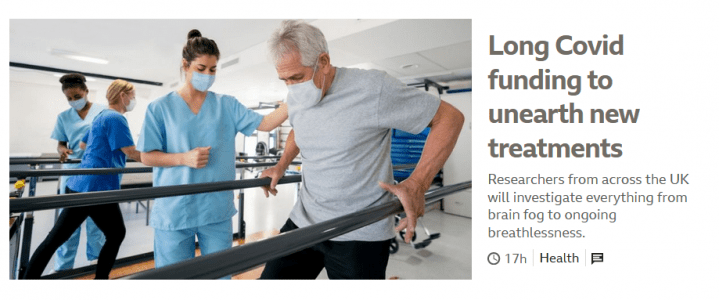
As you can see, it depicts two masked patients, chaperoned by two masked nurses, who look unmistakably like they’re having to learn how to walk again. (And by the way, anyone who’s going to counter that it could just as plausibly be a depiction of two patients being tested for, say, oxygen carrying capacity or pulse rate during recovery from a respiratory illness like Covid would need to explain to me why it is that neither patient is shown to be wearing any tracking/monitoring equipment, and, in addition, why neither nurse is shown to be holding/studying any data monitors). The male patient in the foreground of the image looks particularly unsteady on his feet, relying heavily on the metal frame surrounding him for bodily support. One of the masked nurses stands next to him, watching his legs and feet intently, presumably scanning for any warning signs of imminent collapse or a stumble. Her right arm is stretching out towards him, and no doubt a guiding/supportive hand is resting on the patient’s shoulder. Just behind the male patient, you can also see the lower half of the wheelchair in which he will have been brought from his hospital ward and into this rehabilitation class.
But if that’s what it shows, then what kind of patient might actually need rehabilitation of this kind; rehabilitation, that is, in which patients are having to learn how to walk again? It’s the type of thing that you’d imagine is normally reserved for patients needing post-surgery rehabilitation; patients who’ve suffered spinal cord injuries, neurological disorders, car-crashes, amputations and the like. That’s big league, serious stuff. We’re essentially talking about a type of rehabilitative treatment for people who’re on the cusp of, or who’re already suffering from, life-changing injuries/illnesses.
So is this the type of treatment that people suffering from Long Covid are likely to need? I ask because as we’ve already established, it’s the type of treatment that’s depicted in the image the BBC have attached to an article entitled, “Long Covid funding to unearth new treatments” the first paragraph of which reads: “Thousands of people with ‘long Covid’ could benefit from the funding of 15 new studies of the condition, its causes and potential treatments”. To help us on the way towards answering this question, here’s what the NHS guide to the symptoms currently associated with ‘Long Covid’ has to say for itself:
Common Long Covid symptoms include:
- extreme tiredness (fatigue)
- shortness of breath
- chest pain or tightness
- problems with memory and concentration (‘brain fog’)
- difficulty sleeping (insomnia)
- heart palpitations
- dizziness
- pins and needles
- joint pain
- depression and anxiety
- tinnitus, earaches
- feeling sick, diarrhoea, stomach aches, loss of appetite
- a high temperature, cough, headaches, sore throat, changes to sense of smell or taste
- rashes
Now I’m no doctor, admittedly, but I’m not entirely satisfied that a programme of rehabilitative walking usually reserved for wheelchair bound patients in post-surgery recovery is going to prove particularly efficacious when it comes to the treatment of long Covid patients with earache, diarrhoea and changes of smell or taste. In fact, I’m not satisfied at all.
Indeed it rather seems to me that the BBC’s choice of image, when considered as an accompaniment to this particular article, might justifiably be described as misinformation; that is, as information that unduly exaggerates the risks associated with long Covid in a highly misleading or a sensationalist way.
By the way, do you like my definition of misinformation? Thanks. Perhaps it might interest you, then, to know it’s culled from the BBC’s own editorial guidelines. Specifically, therein we find “Section 3, Accuracy”, and, more particularly, “Sub-section 3.3.24”, which states that, “Reconstructions [which this image undeniably is] are when events are quite explicitly re-staged”, and that in order to abide by the BBC’s editorial guidelines, “They should normally be based on a substantial and verifiable body of evidence… [and they] should not overdramatise in a misleading or sensationalist way”.
On this basis, then, is it not the case that the BBC’s own reality-check team, that bastion of fairness and impartiality in a world gone wrong, should hold the organisation to account for spreading long Covid misinformation? Is it not an article that exaggerates and sensationalises the effects of long Covid? Further, is it not likely to generate additional, or indeed to heighten existing cases of, psychosomatic health disorders in the U.K.?
I guess if you’re the type of person who’s already suffering from heightened worry about your health, about lockdown, about physical contact with others, about viruses, about disease; I guess if you surf the web but never really read anything carefully; if you scan the thumbnails on the BBC’s news homepage but never click through to the articles; if you look at an article’s opening image and then only scan the first two or three paragraphs of text thereafter… then I guess, absolutely, it might indeed be considered ‘misinformation.’
“But isn’t this all just a little pedantic?” I hear you ask. “A bit nit-picky?” Oh, absolutely. And doesn’t it feel good to be playing the BBC at their own game for a change. So good, in fact, that you really must forgive me. I’m enjoying myself so much that I’m going to continue to be pedantic for a little while yet.
Because you see I guess, too, that if you’re prone to experiencing psychosomatic disorders of one kind of another, if you’re already well-known to your local GP surgery and A&E, then it might panic you quite a bit to think that the image the BBC have chosen to use here depicts a fate that might lie in store for you too if you ever contracted Covid and then experienced Long Covid. I guess too that if you’re that way inclined, then you might even feel you needed to take the vaccine, any vaccine, right this minute, no questions asked, jab jab jab, please, put it in me doctor, oh God, put it in me… and to hell with any kind of informed consent.
Jabbed or not, if you’re that way inclined then I guess you might nevertheless see that picture, that image of the Long Covid patient struggling to walk in the BBC’s article, and then, at some point later, get around to thinking that you’re experiencing the symptoms of Long Covid, that you’re really ill, that you’re dying, that you’re in need of immediate and very urgent medical attention, that you’ve got to go to A&E immediately because you might end up in a wheelchair unable to walk; I guess, too, that you might see that picture and then end up yo-yo-ing in and out of the healthcare system for the rest of your life, costing the taxpayer money, wasting valuable medical time, worrying that there’s a direct line of causality that “the science” has established between you coughing, you sneezing and you ending up in hospital needing a wheelchair to get you to your rehabilitative walking therapy sessions.
It’s strange, isn’t it? I mean, the BBC is normally so keen, so eager, to castigate others for disseminating what they’ve decreed to be Covid misinformation capable of causing or exacerbating existing physical disorders. Yet in the case of psychosomatic disorders – i.e. panic, hyperventilating, health anxiety, generalised anxiety, hypertension, depression, chills, gastrointestinal disturbances – they’re curiously reluctant to take up those same sanctimonious ‘fact-checking’ cudgels.
It’s a reluctance that matters, though, isn’t it? The sad and unfortunate thing about psychosomatic disorders is that those suffering from them are more likely than almost any other group in society to place unnecessary pressure on the NHS. After all, if you’re worried that you’re seriously unwell and/or in imminent danger of dying, where’s the first place you’re going to go? That’s right: a primary or secondary healthcare provider. The problem, of course, is that people who suffer from those types of disorders are neither seriously ill nor in imminent danger of dying. What they ‘are’ is suffering from severe anxiety. That’s not nothing, of course; but it’s hardly first responder or A&E type stuff, is it?
That this might constitute a problem during a global pandemic of a mild respiratory illness in which we’ve all been told to put our lives, businesses, careers on hold because the NHS is under massive existential pressure, seems obvious. If the NHS is already clogged up with respiratory tract illness and you then go and add a whole bunch of psychosomatic patients to the mix… well, you’ve got a problem, haven’t you? You’d think the BBC would care about that sort of thing, particularly given the pious, reverent tone it normally adopts when it’s representing the NHS. You’d think they’d want to provide balanced, calm, rational reportage of what was going on; reportage that was clear about the extremely low risk Covid poses to the vast majority of people in this country.
I wonder. Could it be that if we were to widen the scope of the concept of ‘misinformation’ to include not only information capable of causing physical harm, but also that likely to cause psychosomatic harm, we’d be forced to conclude that the BBC, with all its Covid exaggerations, its hyperbole, its uncritical, unreflexive treatment of “the science” handed down to it by SAGE, its failure to hold the Government to account, to approach statistics sceptically, to put case numbers into perspective, its obsession with filming death porn reports from inside hospitals (etc etc)… if we were to consider all of that as misinformation too, might we not end up concluding that the BBC has done as much damage to the psychological health and wellbeing of the nation it purports to inform, educate and entertain as Donald Trump ever did with his tweety-tweety chit-chat about preliminary research into hydroxychloroquine as a prophylactic against Covid? I wonder indeed.
Dr Freddie Attenborough is a former academic. You can see his substack account here.
Britain has a choice on Freedom Day: Embrace liberty or slide into total biosecurity tyranny
By Neil Clark | RT | July 19, 2021
Domestic Covid restrictions have ended in England, but the threat to our freedoms remains, with the government urging businesses to adopt vaccine passports. The nightclub industry’s opposition to the scheme shows the way forward.
Freedom has been restored in Merrie England after 16 months of unremitting grimness the likes of which we’ve not seen since the days of Oliver Cromwell’s Commonwealth and Matthew Hopkins’ witch-hunting. Well, sort of. No more state-mandated face masks. No more state-mandated restrictions on crowd sizes at sports venues. No more ‘social distancing’. All good things in themselves – except the message from the government has been massively confused, given that it has spent the past seven days encouraging businesses to maintain restrictions. And, having ruled out vaccine passports not so long ago, the government is now very keen on them again.
Not just for the autumn and winter, but now. Check out the new Step 4 policy document released last week. It states, “The government will work with organisations that operate large, crowded settings, where people are likely to be in close proximity to others outside their household to encourage the use of the NHS COVID Pass. If sufficient measures are not taken to limit infection, the Government may consider mandating the NHS COVID Pass in certain venues at a later date.”
That’s quite a threat, isn’t it? Basically, the government is saying, “If you don’t introduce Covid certification now, we’ll do it for you.” We’ve already had a ‘Whitehall source’ informing the Daily Mail that the scheme could be used to “keep open a much wider range of venues” over the winter, when we always get an increase of people coming down ill with flu and flu-like symptoms.
The source said, “The reason we are trialling Covid certification this summer is partly to get mass events open more safely with bigger crowds, but also partly to get people used to the idea.” Nudge nudge, wink, wink, as Monty Python might have said.
Of course, another lockdown would be ruinous for the hospitality and events sector. But business now needs to call the government’s bluff. The paradox is that rejecting Covid certification won’t make another lockdown more likely, but much less so. Because at the end of the day, this is a ‘compliance test’ and has been for the past 16 months. You defeat people who threaten to close you down, not by doing what they want but by defying them – and making them back down. Otherwise you’ll only face fresh demands.
The nightclub industry shows us the way to go. Full marks to Peter Marks, the CEO of REKOM UK, which owns 42 nightclubs and who said his venues would be operating at full capacity without the need to show a negative Covid test. Marks said that would provide a ‘barrier’ to customer enjoyment. Another big player, Tokyo Industries, has also stated it won’t be going down the Covid certification route. And there’s been rejection from the pub and hospitality industry too.
Just about the only body that seems to be enthusiastically embracing the prospect of Covid passes is football’s Premier League.
It was revealed last week that the EPL was ‘working closely’ with the government and drawing up its own plans for Covid certification. What a terrible own goal that would be. A reminder: the Public Administration and Constitutional Affairs Committee report on Covid passports was absolutely damning. The cross-party group of MPs held there was “no justification” for Covid passports and that the government had failed to make the scientific case for them.
The case for Covid passports was weak enough in June, when the report came out, but is even weaker now, as almost daily we are reading of people who have had both jabs becoming ill, or even hospitalised with Covid. If the vaccine doesn’t stop transmission – which the government admits – why are vaccine passports being promoted? Answer: there is obviously another agenda. The passports are a gateway. To something very sinister indeed.
It should set everyone’s alarm bells ringing very loudly that the most prominent public promoter of the Covid certification scheme is one Anthony Linton Blair. Last September, the man who assured us Iraq had weapons of mass destruction which could be assembled and launched within 45 minutes, said it was “common sense” to move in the direction of digitalised IDs to fight coronavirus.
In June, ‘The Blair Creature’ – to use Peter Hitchens’ memorable description – declared, “The world will move to biometric ID and they will do it because in the end, it is better for people.” But which people? The vast majority of humanity, or those who meet at Davos each year and wish to control us? A ‘temporary’ Covid pass could quite easily morph into a permanent biometric ID system – which is clearly what Blair wants. And we know what that could morph into. A ‘restricted access’ social credit system, in which behaviour which is regarded as ‘good’ by the state authorities is rewarded and that which is ‘bad’ is penalised. Imagine being denied entry to a football ground or railway station, not just because you don’t have the latest Covid booster jab, but also because your ‘social credit’ score is too low after you refused to attend a ‘training course’ on ‘Good Citizenship’?
New technology means that governments have the means to control us in a way that the worst dictators in history could only dream of. It might sound a cliché, but today, on July 19, in England we really are at a crossroads. One path is marked ‘freedom’; the other takes us to a new digital servitude from which it will be very hard, if not impossible, to escape.
Neil Clark is a journalist, writer, broadcaster and blogger. His award winning blog can be found at http://www.neilclark66.blogspot.com.
RUSSIAGATE: Luke Harding’s Hard Sell
By Joe Lauria | Consortium News | July 17, 2021
Luke Harding of The Guardian on Thursday came out with a new story that looks at first glance like an attempt to rescue the Russiagate story and the reputations of Harding and U.S. intelligence.
The headline reads, “Kremlin papers appear to show Putin’s plot to put Trump in White House” with the subhead: “Exclusive: Documents suggest Russia launched secret multi-agency effort to interfere in US democracy.”
Harding’s report says that during a Jan. 22, 2016 closed session of the Russian national security council, President Vladimir Putin ordered Russian spies to back a “mentally unstable” Donald Trump for the White House to “help secure Moscow’s strategic objectives, among them ‘social turmoil’ in the US.”
“Russia’s three spy agencies were ordered to find practical ways to support Trump, in a decree appearing to bear Putin’s signature,” Harding writes. “A report prepared by Putin’s expert department recommended Moscow use ‘all possible force’ to ensure a Trump victory.”
The article, starting with the headline, is littered with the use of qualifiers such as “appears,” “suggests,” “apparent,” and “seems.” Such qualifiers tell the reader that even the newspaper is not sure whether to believe its own story.
Quoting from what he says is an authentic document marked “secret,” Harding writes that there is “apparent confirmation” that the Kremlin had dirt on Trump it could use to blackmail him, gathered during earlier Trump “‘non-official visits to Russian Federation territory.’”
This would seem to confirm a central part of the so-called Steele dossier, which Harding hawked in his bestselling book Collusion.
Harding’s newest story though says nothing about the involvement of Trump operatives with this Kremlin plot, as that was unfounded by Special Counsel Robert Mueller’s report.
Harding also suggests that the documents that came into his possession provides evidence of a Russian hack of Democratic National Committee computers.
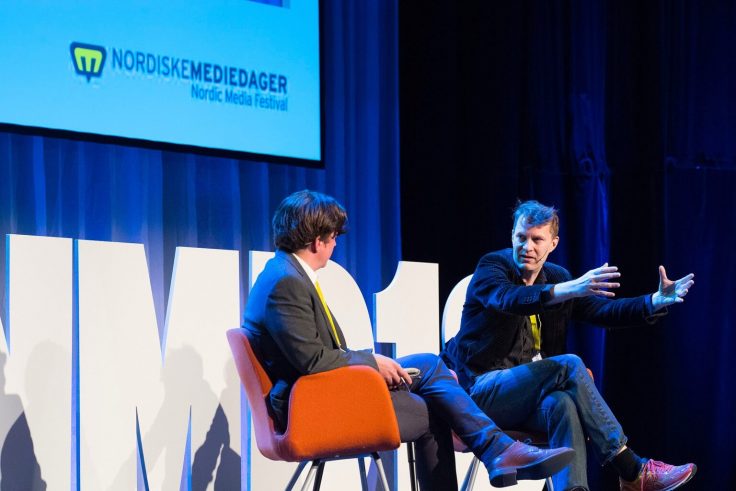
Harding at the Nordic Media Festival, 2018. (Thor Brødreskift / Nordiske Mediedager/ Wikimedia Commons)
He writes:
“After the meeting, according to a separate leaked document, Putin issued a decree setting up a new and secret interdepartmental commission. Its urgent task was to realise the goals set out in the ‘special part’ of document No 32-04 \ vd. …
The defence minister was instructed to coordinate the work of subdivisions and services. [Sergei] Shoigu was also responsible for collecting and systematising necessary information and for “preparing measures to act on the information environment of the object” – a command, it seems, to hack sensitive American cyber-targets identified by the SVR. …
The papers appear to set out a route map for what actually happened in 2016.
A matter of weeks after the security council meeting, GRU hackers raided the servers of the Democratic National Committee (DNC) and subsequently released thousands of private emails in an attempt to hurt Clinton’s election campaign.”
These documents would perfectly confirm the story put out by U.S. intelligence and an eager Democratic media: that Russia’s defense intelligence agency GRU hacked the DNC and Russia leaked DNC emails to damage Hillary Clinton.
Except that Shawn Henry, the head of the company CrowdStrike hired by the Democratic Party and the Clinton campaign (while keeping the FBI away) to examine the DNC servers declared under oath to the House Intelligence Committee that no evidence of a hack was discovered. “It appears it was set up to be exfiltrated, but we just don’t have the evidence that says it actually left,” Henry told the committee.
WikiLeaks, which Harding doesn’t mention, has also denied getting the DNC material from Russia that Harding says was released by Moscow. And Harding ignores the true contents of the emails.
Dmitri Peskov, Putin’s spokesman, told The Guardian the story was “great pulp fiction.”
Let’s look at the motives of the players involved in this story.
Harding’s Motives
Henry’s denial of a hack and Mueller’s inability to prove Collusion, embarrassed Harding after he staked his reputation on his bestseller of that name. The book is essentially the story of Christopher Steele, the ex-MI6 agent, who was paid by the DNC and the Clinton campaign to come up with opposition research against Trump.
Harding, like the Democratic media establishment, mistook opposition research, a mix of fact and fiction to smear a political opponent, for an intelligence document paid for by taxpayers, presumably in the interests of protecting the country rather than a political candidate. Of course, the FBI and the CIA sold it to the media as such to undermine the other candidate.
Harding has had a major omelet on his face after the Russiagate tale was ultimately exposed as opposition research paid for by the Democrats, who elevated it to a new Pearl Harbor.
Now I will engage in qualifiers here but it seems Harding is desperate to find anything that might rescue the story and his reputation. That’s a vulnerable position to be in, easily exploited by intelligence operatives, the way he was exploited with the original story.
An earlier attempt by Harding at rescuing himself was the disastrous piece he wrote for The Guardian that Paul Manafort, briefly Trump’s 2016 campaign manager, had visited Julian Assange at the Ecuador Embassy in London. It blew up in Harding’s face though his paper has never pulled the story.
U.S. Intelligence Motives
Members of the U.S. intelligence community were staring at possible prosecution in the investigation run by U.S. Attorney John Durham for their role in pushing the opposition research as truth, leading, among other things, to a doctored FBI report to the Foreign Intelligence Surveillance Court to monitor a Trump campaign worker.
The Steele dossier became the basis for other shenanigans by U.S. intelligence. Though in the end there were no indictments, the reputation of especially the FBI took a hit.
Leaking a story now that it was all true, after all, might do wonders to restore its standing among wide sections of the U.S. public who lost faith in the bureau over Russiagate.
A Kremlin Leakers’ Motives
Harding writes in a cryptic way about how he got hold of these materials. He says the story is based on “what are assessed to be leaked Kremlin documents.” As they were marked “secret,” and supposedly came from Putin’s innermost circle, as Harding says, it stands to reason that few people in the Russian government would have had access to them outside of that circle.
We are being asked to believe that someone closest to Putin leaked these documents either directly to Harding or to U.S. or British intelligence who then passed it on to Harding. (Harding calling it a leak would rule out that they were obtained through a Western intelligence hack.)
It can’t be dismissed that U.S. intelligence may have an active mole inside the Kremlin. But one must ask would that mole — if he or she exists — risk their freedom by leaking documents that have absolutely no current strategic or even political significance, rather than, say, classified information about Russian troop movements and military intentions?
The only interests this leak serves — if it was a leak — are those of Harding and U.S. intelligence, who were hung out to dry by the collapse of the Russiagate narrative.
Evaluating the Story
Harding is clearly reporting from Russian-language documents, snapshots of which are reproduced in The Guardian article. He writes that these documents were shown to “independent experts” who said they “appear” to be “genuine.” Harding does not reveal who these experts are.
To evaluate the credibility of Harding’s story would require knowing how he got the documents, not the names of the person or persons who gave them to him, but the interests they represent. He is especially vague about this.
Harding writes:
“Western intelligence agencies are understood to have been aware of the documents for some months and to have carefully examined them. The papers, seen by the Guardian, seem to represent a serious and highly unusual leak from within the Kremlin.”
If they were handed to Harding by U.S. or British intelligence who had them for months, the idea that these are the products of spycraft cannot be dismissed. Crafting what looks like classified evidence from an adversarial power and then leaking it to friendly press has long been in the arsenal of intelligence agencies the world over.
It is unlikely we will ever know how Harding came into possession of these documents or who the experts are who said they “seem” genuine.
But the purpose of this piece may have already been achieved.
Joe Lauria is editor-in-chief of Consortium News and a former UN correspondent for The Wall Street Journal, Boston Globe, and numerous other newspapers. He was an investigative reporter for the Sunday Times of London and began his professional career as a stringer for The New York Times. He can be reached at joelauria@consortiumnews.com
Israeli Firm Helped Governments Target Journalists, Activists with 0-Days and Spyware
By Ravie Lakshmanan | The Hacker News | July 16, 2021
Two of the zero-day Windows flaws rectified by Microsoft as part of its Patch Tuesday update earlier this week were weaponized by an Israel-based company called Candiru in a series of “precision attacks” to hack more than 100 journalists, academics, activists, and political dissidents globally.
The spyware vendor was also formally identified as the commercial surveillance company that Google’s Threat Analysis Group (TAG) revealed as exploiting multiple zero-day vulnerabilities in Chrome browser to target victims located in Armenia, according to a report published by the University of Toronto’s Citizen Lab.
“Candiru‘s apparent widespread presence, and the use of its surveillance technology against global civil society, is a potent reminder that the mercenary spyware industry contains many players and is prone to widespread abuse,” Citizen Lab researchers said. “This case demonstrates, yet again, that in the absence of any international safeguards or strong government export controls, spyware vendors will sell to government clients who will routinely abuse their services.”
Founded in 2014, the private-sector offensive actor (PSOA) — codenamed “Sourgum” by Microsoft — is said to be the developer of an espionage toolkit dubbed DevilsTongue that’s exclusively sold to governments and is capable of infecting and monitoring a broad range of devices across different platforms, including iPhones, Androids, Macs, PCs, and cloud accounts.
Citizen Lab said it was able to recover a copy of Candiru’s Windows spyware after obtaining a hard drive from “a politically active victim in Western Europe,” which was then reverse engineered to identify two never-before-seen Windows zero-day exploits for vulnerabilities tracked as CVE-2021-31979 and CVE-2021-33771 that were leveraged to install malware on victim boxes.
The infection chain relied on a mix of browser and Windows exploits, with the former served via single-use URLs sent to targets on messaging applications such as WhatsApp. Microsoft addressed both the privilege escalation flaws, which enable an adversary to escape browser sandboxes and gain kernel code execution, on July 13.
The intrusions culminated in the deployment of DevilsTongue, a modular C/C++-based backdoor equipped with a number of capabilities, including exfiltrating files, exporting messages saved in the encrypted messaging app Signal, and stealing cookies and passwords from Chrome, Internet Explorer, Firefox, Safari, and Opera browsers.
Microsoft’s analysis of the digital weapon also found that it could abuse the stolen cookies from logged-in email and social media accounts like Facebook, Twitter, Gmail, Yahoo, Mail.ru, Odnoklassniki, and Vkontakte to collect information, read the victim’s messages, retrieve photos, and even send messages on their behalf, thus allowing the threat actor to send malicious links directly from a compromised user’s computer.
Separately, the Citizen Lab report also tied the two Google Chrome vulnerabilities disclosed by the search giant on Wednesday — CVE-2021-21166 and CVE-2021-30551 — to the Tel Aviv company, noting overlaps in the websites that were used to distribute the exploits.
Furthermore, 764 domains linked to Candiru’s spyware infrastructure were uncovered, with many of the domains masquerading as advocacy organizations such as Amnesty International, the Black Lives Matter movement, as well as media companies, and other civil-society themed entities. Some of the systems under their control were operated from Saudi Arabia, Israel, U.A.E., Hungary, and Indonesia.
Over 100 victims of SOURGUM’s malware have been identified to date, with targets located in Palestine, Israel, Iran, Lebanon, Yemen, Spain (Catalonia), United Kingdom, Turkey, Armenia, and Singapore. “These attacks have largely targeted consumer accounts, indicating Sourgum’s customers were pursuing particular individuals,” Microsoft’s General Manager of Digital Security Unit, Cristin Goodwin, said.
The latest report arrives as TAG researchers Maddie Stone and Clement Lecigne noted a surge in attackers using more zero-day exploits in their cyber offensives, in part fueled by more commercial vendors selling access to zero-days than in the early 2010s.
“Private-sector offensive actors are private companies that manufacture and sell cyberweapons in hacking-as-a-service packages, often to government agencies around the world, to hack into their targets’ computers, phones, network infrastructure, and other devices,” Microsoft Threat Intelligence Center (MSTIC) said in a technical rundown.
“With these hacking packages, usually the government agencies choose the targets and run the actual operations themselves. The tools, tactics, and procedures used by these companies only adds to the complexity, scale, and sophistication of attacks,” MSTIC added.
Do drug trials underestimate side effects?

By Dr Sebastian Rushworth | July 19, 2021
One commonly used trick in drug trials is to exclude any group that might make the drug look worse, such as those that are more likely to experience side effects. A good recent example of this is the covid vaccine trials, which largely excluded people with auto-immune diseases (more likely to develop an auto-immune disease after vaccination), people with allergies (more likely to have an allergic reaction to the vaccine), and, of course, the elderly (less likely to develop immunity after getting the vaccine, and more likely to become seriously sick from it).
These three groups are all frequently excluded from trials, and the exclusion is particularly galling when it comes to the elderly, because they are a big segment of the population, and they are also usually the most likely to end up actually using the drugs being tested.
When drug companies have gotten a drug approved, and move on to market the drug, they will studiously avoid mentioning the fact that large segments of the population were excluded from the trials. When drug reps show their flashy powerpoints to gatherings of doctors, say for a new drug to lower blood pressure, they will always present impressive looking graphs of benefit, and they will of course point out how safe their drug was shown to be in the trials. Not once will they mention that the groups of patients the doctors will primarily be prescribing the drug to weren’t even included in the trials.
The doctors will then happily go off and prescribe the drug to multi-morbid 90 year olds, which might explain why prescription drugs are now the third leading cause of death in the western world.
The manipulation of who is included in trials is probably one of the main reasons why findings of side effects always end up being much higher in reality than in clinical trials. It might explain, for example, why muscle pain is a massively common side effect of statins in the real world, while being vanishingly rare in the statin trials (as Dr. Malcolm Kendrick has written about in detail).
A study recently published in the Lancet Healthy Longevity sought to estimate the extent to which drug trials underestimate side effects. It was funded by the UK Medical Research Council and the Wellcome Trust. The study chose as its particular focus people being treated for high blood pressure with a certain class of blood pressure lowering drugs known as RAAS blockers (which includes all drugs with names ending in -pril and all drugs with names ending in -sartan). The advantage with looking at this particular class of drugs is that there are a ton of trials. Every major pharmaceutical company has its own RAAS-blocker. It should therefore be possible to draw relatively broad conclusions about the results – whatever they show, they apply to the entire pharmaceutical industry, not just to a few specific companies. It’s also reasonable to think that the results apply to other classes of drugs too – there’s no reason to think trials of RAAS-blockers have been done differently than trials of other drug classes.
What the study sought to do more specifically was compare the rate of serious adverse events in clinical trials of RAAS-blockers with the rate observed in the real world. A serious adverse event is any event that is potentially life threatening or that results in death, hospitalization or lasting disability. If a trial has been designed in such a way that it is representative of reality, then the rate of serious adverse events in the trial should largely mirror that seen in the real world.
110 trials of RAAS-blockers were identified by the researchers. Of these, 11 were specifically designed to look at older people (i.e. didn’t recruit anyone under the age of 60). The data on serious adverse events from these 110 trials was extracted and compared to real world data on deaths and hospitalizations taken from a UK government funded database of 55,000 people living in Wales, who were being treated with RAAS-blockers. Deaths and hospitalizations are not exactly the same thing as serious adverse events (which as mentioned above also include “life threatening events”, and could for example include someone who is treated in an emergency department after a fall but not admitted to the hospital), but they’re close enough to allow a reasonable comparison.
So, what were the results?
Let’s begin with comparing the trials of older people with the “standard” trials. The relative rate of serious adverse events in the trials of older people was 76% higher than the rate in the standard trials. This shows the importance of including elderly people in drug trials – they are much more likely to experience adverse events of all kinds (including those actually caused by the drug being tested), and excluding them will therefore likely underestimate side effects.
Considering that many of the drugs in common use show marginal benefits at best (statins have, for example, only been shown to prolong life by a few days on average), this is important information. Why? Because a drug that is beneficial, on balance, to a fifty year old, who has a fully functioning kidney and liver, and is therefore unlikely to suffer side effects, could easily be harmful, on balance, to an 80 year old.
That’s why drug studies done on younger people should not be used to guide treatment of older people. No shock there. Everyone already knows that we shouldn’t be extrapolating results from one group to another (even though it happens all the time, as we’ve seen most recently with the covid vaccine trials).
Next we come to the more important, and perhaps more shocking finding.
The real world patients were between 300% and 400% more likely to experience a serious event than the participants in the trials! That is in spite of the fact that the trials, as mentioned above, were using a broader definition of what constituted a serious event. If the trials were representative of reality, then they should have a higher rate of events than is seen in the real world data. Instead they have a rate that is several times lower!
Interestingly, the trials of older people were just as far from the real world results as the trials of younger people. Clearly, doing trials on the elderly is not enough on its own to produce trials that are representative of reality. What’s happening here exactly?
There are three possible explanations, as far as I can see. The first explanation is that the trials are representative of reality, but that the Welsh die and are hospitalized at a rate that is several times higher than people in the countries where the studies were conducted. Many of the trials were conducted in the US, not in Wales. But Wales has a higher life expectancy than the United States, so that seems unlikely. I think we can discount that explanation.
The second explanation is that the trials are unrepresentative in so many different ways that just correcting the age issue doesn’t make a noticeable difference. That’s probably part of the explanation. The average age even in the trials of “older people” was 73, which isn’t very old from my perspective. And those 73 year olds included in the trials were probably at the healthier end of the spectrum.
The third, more sinister explanation, is that the pharmaceutical companies are hiding serious adverse events… But wait a minute, the trials are randomized and blinded, so the people running the drug trials have no way of knowing if someone experiencing a possible side effect is in the treatment group or the placebo group, right?
Yes, that’s right, so the easiest solution, if you want to avoid finding nasty side effects, is to not report them, regardless of which treatment group the participant is in. That will cut down on total adverse events in both groups, which will make any difference between the groups that does exist smaller in absolute terms, and also less likely to reach the level of statistical significance. Voila – the treatment group and the placebo group end up having similar rates of side effects, and the drug company can conclude that the drug is completely safe.
Is that what’s happened here? Are the pharmaceutical companies hiding adverse events? Well, it’s very strange that the real world data shows a rate of serious adverse events that is several times higher than is found in the trials. It’s hard to see how that massive difference could be explained in any other way.
So, how big a problem is this?
Big. Very big. It should shake the very foundations of evidence based medicine. If the drug trials and the real world data show such wildly different rates of adverse events, then it really begs the question how much we can trust the trials at all. It would be perfectly reasonable in this situation to say that all “evidence” produced by pharmaceutical companies is so suspect that it should be dismissed out of hand, and that only independently funded trials should be used as a basis for medical treatment decisions.
The problem with that is that it would mean saying goodbye to most of the trials that form the basis of modern medical treatment, and there is not much to replace them with. This issue could be solved over the longer term through large tax payer funded investments in new independent trials. But there’s no quick fix.
The problem is most acute when it comes to the many drugs in common use that only show marginal benefits, such as statins. If the rate of side effects is actually 300% to 400% higher than seen in the trials, then the harms of these drugs could easily outweigh the benefits. In other words, the cost-benefit calculation could shift entirely for many of the most commonly used drugs.
Ok, let’s wrap this up. What can we conclude?
Drug trials do no accurately represent rates of adverse events. It is likely that the true rate of side effects is often many times higher than that seen in drug trials.
Featured Video

Theodore Postol: Iran’s Missiles & Drones Were Underestimated
or go to
Aletho News Archives – Video-Images
From the Archives
Wars for Israel: A reminder of who’s giving the marching orders
By Damian Lataan | February 7, 2012
As the West prepares to march off to yet another war in the Middle East, we should perhaps remind ourselves of who is giving the West their marching orders.
In February 2003, just weeks before the US and their allies launched their attack on Iraq and her peoples, a delegation of US congressmen, together with the US Ambassador to the United Nations, John Bolton, a well known pro-Zionist and neoconservative war-hawk, were in Israel at the invitation of the Israeli government then led by Israeli Prime Minister Ariel Sharon.
Addressing the congressmen, Sharon told them ‘that Iran, Libya and Syria should be stripped of weapons of mass destruction after Iraq’. Later, Sharon told John Bolton ‘that Israel was concerned about the security threat posed by Iran, and stressed that it was important to deal with Iran even while American attention was focused on Iraq’. … continue
Blog Roll
 Aletho News
- A New Resistance Front: How Does Syria Factor into the Regional War?
- Gulf states weigh pipeline expansion plans, hoping to bypass Hormuz
- Iran sets up ‘tollbooth’ system in Strait of Hormuz
- Wave 90: IRGC strikes US-linked industrial sites in Gulf
- Iran Says US-Israeli Claims of Its Military Strength Are Wrong
- Trump’s April Fools’ Address to the nation
- The Most Important Bet You’ve Never Heard Of
- The killing of three Indonesian soldiers in Lebanon should remind Jakarta that Israel does not want peace
- Defeated and delusional: Netanyahu’s remarks reveal $80bn war failure, says analyst
- Iran’s friends are about to make life much more difficult for Israel and the US
- If Americans Knew
- Trump says the quiet part out loud: (Israel’s) war on Iran > Americans’ health – Daily Update
- Gaza families reunite years after babies evacuated amid Israel’s war
- International Rescue Committee warns Gaza’s children face grave protection risks
- Iran’s Alleged 47-Year War on America: Debunking the 1,050 American Deaths Canard
- Israel wants US to bomb more of Iran’s civilian structures (113,000 is not enough) – Not a ceasefire Day 173
- Ann Coulter Rips Into Fox News for Iran War Coverage
- Joe Kent Urges Americans To Call White House and Congress To Object To Sending Troops Into Iran
- DNC Resolution to Reject AIPAC Funding Puts Democratic Leaders in the Hot Seat
- Swedish foundation to build 400 schools as over 650,000 Gaza children remain without education for 2 years
- Israeli army admits photshopping image of slain Lebanese journalist
- No Tricks Zone
- Low Intensity Tornado Wrecks Major Solar Farm, Creating A Potential Toxic Dump
- New Study Finds Warming Saves Lives…Cold Temperatures 12 Times More Deadly Than Excess Heat
- German Science Blog Accuses PIK Climate Institute Of Hallucinating Climate Tipping Points
- Devastating Assessment Of Comirnaty Vaccine By Former Senior Pfizer Europe Toxicologist
- New Study: CO2 Is ‘Effectively Negligible’ As An Explanatory Climate Change Factor Since 2000
- Former Pfizer Toxicologist Dr. Helmut Sterz Tells Bundestag Hearing Pfizer Vaccine Should Have Never Been Approved
- Energy Expert: Germany’s Nuclear Phaseout Was A “500 Billion Euro Mistake”
- New Research: South Australia’s Mid-Holocene Sea Surface Temperatures Were 4°C Warmer Than Today
- Storing Green Energy To Last Germany 10 Days Would Require A 60-Million Tonne Battery
- New Studies: UK Sea Levels Were 4 Meters Higher Than Today During The Mid-Holocene
 Aletho News