BMJ Publishes Belated Attack on the Great Barrington Declaration, but It Doesn’t Hit the Target
By Noah Carl • The Daily Sceptic • October 13, 2021
The Great Barrington Declaration, which advocates a focused protection strategy for dealing with COVID-19, was published in October last year – before many countries around the world imposed their winter lockdowns.
Recently, The BMJ Opinion – a journalistic offshoot of the well-known medical journal – published a very belated hit piece against the authors. As you might expect, it’s light on scientific arguments and heavy on tactics like ad hominem, guilt by association and appeals to authority.
The authors, David Gorski and Gavin Yamey, really don’t mince words. For example, they describe the Declaration (which has been signed by hundreds of scientists and healthcare professionals) as a “well-funded sophisticated science denialist campaign based on ideological and corporate interests”.
Not exactly a respectful way to talk about your colleagues. But it’s hardly the first time the Declaration’s critics have sunk to this level. Just last month, Jay Bhattacharya became the subject of a censorious petition which claimed that he “sows mistrust of policies designed to protect the public health”.
Gorski and Yamey begin their article by criticising the Declaration’s authors for collaborating with the American Institute for Economic Research, which they claim is a “libertarian, climate-denialist, free market think tank”.
I’m not sure why this is a ‘gotcha’. Lockdown is about as un-libertarian a policy as you could imagine, so it’s not really surprising that a libertarian think tank would oppose it. And in any case, the Declaration’s website clearly states that the document was “was written and signed at the American Institute for Economic Research”.
Martin Kulldorff has since clarified that the AIER president and board did not know about the Declaration until after it was published. But even if they had done, so what? As Kulldorff notes, universities like Duke and Stanford have received money from the Koch brothers. Should we therefore completely disregard what their academics have to say?
Gorski and Yamey’s next move is to cite social media censorship of lockdown sceptics as evidence that their arguments constitute ‘misinformation’. (Incidentally, that term – which basically means ‘information that’s missing from the mainstream narrative’ – appears no fewer than six times in the article.)
However, this argument relies on circular logic: ‘Something was censored on social media? Therefore, it’s misinformation. How do we know? Well, misinformation is what social media companies censor.’ In reality, of course, the fact that something was censored is no indication whatsoever that it’s factually incorrect.
The authors then allege that when Sunetra Gupta and Carl Heneghan met Boris Johnson in September of last year, they were successful in “persuading him to delay” a ‘circuit breaker’ lockdown, which could have forestalled the second wave of infections.
As historian Phil Magness has already noted, this argument is deficient on two counts. It’s not clear that Gupta and Heneghan did persuade the Prime Minister to shelve the ‘circuit breaker’ idea. But even if they did, there’s no reason to believe that policy would’ve prevented a large number of deaths.
Finally, Gorski and Yamey compare lockdown sceptics to ‘climate science deniers’, insofar as both groups “argue that evidence-based public health measures do not work”. They call for experts to push back against the Great Barrington Declaration by highlighting “scientific consensus”, citing the John Snow Memorandum.
Of course, the pro-lockdown John Snow Memorandum is just another public statement signed by scientists and health professionals. If it constitutes “scientific consensus”, then so does the Great Barrington Declaration. I’m only aware of one attempt to gauge overall expert opinion on focused protection: the survey by Daniele Fanelli.
He asked scientists who’d published at least one relevant paper, “In light of current evidence, to what extent do you support a ‘focused protection’ policy against COVID-19, like that proposed in the Great Barrington Declaration?” Of those who responded, more than 50% said “partially”, “mostly” or “fully”.
Regardless of the exact number of experts who support focused protection, claiming there is a “scientific consensus” against it is simply false. Long before the Declaration itself was published, many scientists had proposed some version of precision shielding. In fact, this was basically the U.K.’s plan until the middle of March, 2020.
On March 5th, Chris Whitty told the Health and Social Care Committee that we are “very keen” to “minimise economic and social disruption”, and mentioned that “one of the best things we can do” is “isolate older people from the virus”.
Another prominent scientist who has argued in favour of focused protection is Sir David Spiegelhalter. In an article published on May 29th, he and George Davey Smith said that we ought to “stratify shielding according to risk” because lockdown is “seriously damaging many aspects of people’s lives”.
They noted that this would require “a shift away from the notion that we are all seriously threatened by the disease, which has led to levels of personal fear being strikingly mismatched to objective risk of death”.
Among the ad hominems, appeals to authority and repeated uses of ‘misinformation’, finding a scientific argument in Gorski and Yamey’s article is not easy. And given that the content’s almost a year out of date, I’m not sure why the authors felt the need to publish it.
In 20 Years of Practicing Medicine, ‘I’ve Never Witnessed So Many Vaccine-Related Injuries’
The Defender | October 13, 2021
In a letter dated Sept. 28 to officials at the U.S. Food and Drug Administration (FDA) and Centers for Disease Control and Prevention (CDC), an ICU physician detailed her concerns about the adverse reactions, including deaths, she witnessed in people who had received a COVID vaccine.
Dr. Patricia Lee, a licensed physician in California, said her experience with patients harmed by the vaccine “does not comport with claims made by federal health authorities regarding the safety of COVID-19 vaccines.”
In the letter, Lee described observing “entirely healthy individuals suffering serious, often fatal, injuries,” including transverse myelitis, resulting in quadriplegia, pneumocystis pneumonia, multi-system organ failure, cerebral venous sinus thrombosis, postpartum hemorrhagic shock and septic shock.
Lee, a practicing physician for more than 20 years, said she “never witnessed so many vaccine-related injuries until this year.”
Lee told Dr. Peter Marks, director of the FDA’s Center for Biologics Evaluation and Research, and Dr. Tom Shimabukuro with the CDC’s COVID-19 Vaccine Task Force Vaccine Safety Team, that while “causation is difficult to prove definitively, it is my clinical judgment that each of these injuries were caused by a COVID-19 vaccine, because there was no other plausible explanation for these injuries other than the fact that the patients had recently been vaccinated.”
Lee acknowledged that her report reflects the experience of a single physician. However, she wrote, it appears “statistically improbable” that any one physician should witness this many COVID-19 vaccine injuries if the federal health authority claims regarding the vaccines’ safety were accurate.
“I can no longer silently accept the serious harm being caused by the COVID-19 vaccines,” Lee concluded. “It is my sincere hope that the reaction to this letter will not be to focus on me, but rather to focus on addressing the serious safety issues with these products that, without doubt, you have either missed or are choosing to ignore.”
Since the issuing of the original letter, Lee’s attorneys sent another letter to the CDC and FDA saying that the agencies’ “failure to respond is highly concerning,” adding that they are seeking a response so they can “arrange a discussion and information gathering session between Dr. Lee and the appropriate representatives at the CDC and FDA.”
© 2021 Children’s Health Defense, Inc. This work is reproduced and distributed with the permission of Children’s Health Defense, Inc. Want to learn more from Children’s Health Defense? Sign up for free news and updates from Robert F. Kennedy, Jr. and the Children’s Health Defense. Your donation will help to support us in our efforts.
SPECIAL BROADCAST: DR. ROBERT MALONE ON HIS MRNA CREATION
STEW PETERS | OCTOBER 13, 2021
Stew Peters sat down with Dr. Robert Malone, the creator of the mRNA technology being used in the shots being falsely referred to as “vaccines”, which have proven to be dangerous, and in many cases DEADLY.
Deaths Following Vaccination Reported in Taiwan Exceed Nation’s COVID Death Total
BY BLUEAPPLES | ZERO HEDGE | OCTOBER 14, 2021
Since the onset of the COVID-19 pandemic, few nations have been lauded as much for their management of the disease as Taiwan has. Since the first cases of COVID-19 in the country were reported in February 2020, only 16,313 infections and 846 deaths have been recorded. Despite how successfully the nation had managed the outbreak, it still enrolled itself in the World Health Organization-led COVAX exchange program and began its first wave of vaccinations on March 22, 2021. While the nation hadn’t had even a dozen deaths attributed to COVID-19 by the time the first vaccine was administered, 836 of the 846 deaths attributed to COVID-19 have occurred since the vaccination program began. In an even more dubious display concerning the safety and effectiveness of the vaccines administered in Taiwan, the nation’s Central Epidemic Command Center (“CECC”) has stated that 850 deaths have been reported as adverse events following vaccinations. That totally eclipses the number of fatalities attributed to the virus itself.
Taiwan’s vaccination campaign began much later than many other nations, a lag which many blame on political interference from China which was best illustrated by the island nation’s difficulties procuring orders of Pfizer-BioNTech’s mRNA vaccines. Despite these hurdles, the country was at first able to procure 117,000 doses of AstraZeneca’s vaccines. Additional deliveries of 200,000 and 400,000 doses from the same manufacturer arrived the following two months before another 150,000 vaccines from Moderna were delivered in May 2021. It gave emergency approval to a domestically engineered alternative made by Medigen Vaccine Biologics Corporation with shipments from Pfizer-BioNTech and Johnson & Johnson soon following. As of October 11, 4.48 million Taiwanese, about 19% of the population, have been fully vaccinated and 13.7 million, or about 59% of population, have received one dose. The country has stated that it seeks to have 70% of its population fully vaccinated.
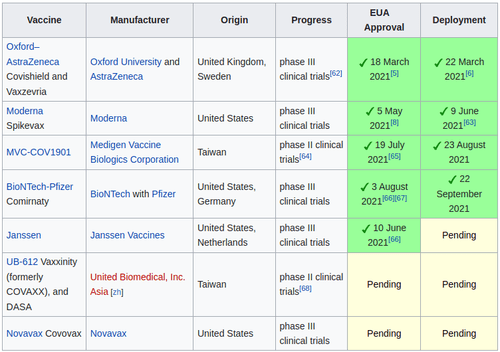
Yet, by the time Taiwan had approved those five vaccines for emergency use, an alarming trend began appearing. The highest seven-day average of new cases of COVID-19 observed in Taiwan before its first vaccines were deployed was just 3. By May 28, 2021, that seven-day average exploded to 597. As the rest of the world grappled with an increase in cases despite the global advancement of vaccination efforts, most those countries had recorded their all-time highs for new cases and deaths before any vaccines were available. One exception to that rule was seen in Israel, where the record for a highest single-day case count was recorded following the beginning of the nation’s campaign to administer third doses of the Pfizer-BioNTech vaccines in the wake of concerns of the delta variant’s impact of the efficacy of vaccines. Yet, even though Israel did surpass its previous one-day high, the amount by which it exceeded that paled in comparison to Taiwan. The seven-day average in Taiwan would not fall under 10 new cases again until September 2021. Since then, despite the increase in vaccinations, that national average has never managed to reach its pre-vaccination levels. The lowest seven-day average Taiwan has seen since it began vaccinating its citizens was recorded at 5 on September 5, 2021.
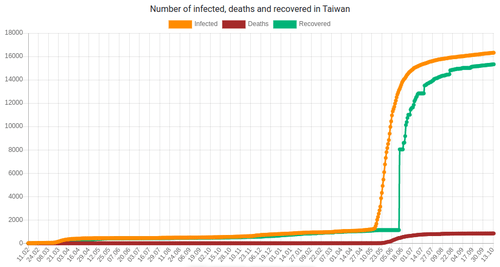
While the increase in viral transmission since March will likely be attributed to mutations like the delta variant, it could also be indicative of the antibody dependent enhancement onset from vaccines that has been forewarned about by scientists and physicians such as Dr. Robert Malone, one of the scientists behind the development of mRNA technology. Though not all vaccines used in Taiwan utilize mRNA technology, the viral vector-based vaccines like AstraZeneca’s still predicate their promotion of antibodies by exposing the immune system of vaccinated patients to the spike protein of SARS-CoV-2. Antibodies based on the genetic fragment of the spike protein alone opposed to a whole genetic sequence of a viral particle are suspected to be less capable of warding off infection. Scientists like Dr. Michael Yeadon, formerly of Pfizer, attest that these inadequate antibodies actually facilitate viral entry because they don’t possess the necessary protein structures, or paratopes, to the corresponding protein structures on the viral particles, called epitopes. This phenomenon was observed in clinical trials of mRNA vaccines aimed at combating the coronavirus which caused Middle Eastern Respiratory Syndrome. Advocates of that theory warning against that risk have expressed concerns that this same outcome of the potential deficiencies in COVID-19 vaccines has been overlooked by a hurried regulatory process.
As far as the 850 deaths reported to the Taiwanese CECC following vaccinations are concerned, 643 have been attributed to patients receiving AstraZeneca doses, 183 received Moderna doses, and just 22 received Taiwan’s own Medigen vaccine. Despite being recorded as adverse events following vaccination, many Taiwanese officials have responded to the CECC report by stating that these deaths may not be inherently due to the vaccines. The CECC has previously affirmed its position that reactions from the Moderna vaccine have resulted in fatal adverse events. As the seven-day average of COVID-19 deaths continues to hover between 0 and 1 as it has over the last several weeks, it’s possible that deaths reported to the Taiwanese CECC following vaccination will continue to exceed those attributed to viral infection for some time.
Biden praises Southwest Covid vaccine mandate amid cancelation chaos, says it will help ‘eliminate this disease’
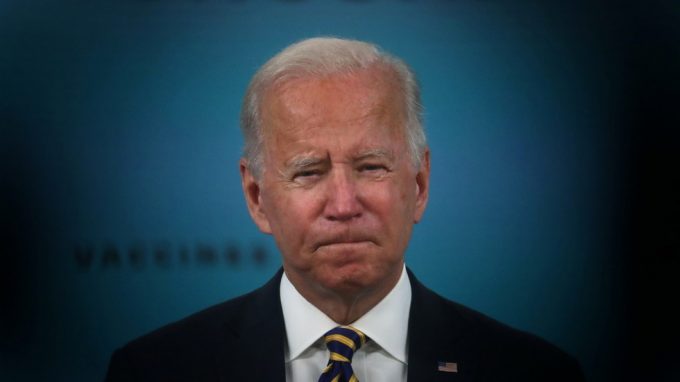
© REUTERS/Leah Millis
RT | October 14, 2021
In an address from the White House, President Joe Biden praised companies like Southwest Airlines enforcing his Covid-19 vaccine mandate, despite the CEO seemingly rebuking the requirement the day before.
Addressing the government’s effort to battle the coronavirus pandemic on Thursday through vaccine mandates, Biden praised private companies that have already been “stepping up” to combat misinformation about the Covid-19 vaccine and the implementation of their vaccine mandates.
“Southwest Airlines … the head of the pilots’ union and its CEO dismissed critics who claim vaccination mandates contributed to flight disruptions,” Biden said, referring to mass cancelations at Southwest Airlines that peaked on Sunday, shortly after the company began enforcing the vaccine mandate put forth by the president.
The company and the White House have denied the mandate and ensuing staffing shortages caused them to delay a third of their flights in the US. White House Press Secretary Jen Psaki even deemed the mandates “good for the economy” following the cancelations and speculation by critics.
In his address, Biden went on to praise school board members, doctors, and other healthcare workers for battling “misinformation” about vaccines.
“All of these efforts,” Biden said of the companies and individuals facing “misinformation” about vaccines and mandates, “are going to help us continue moving the dial to eliminate this disease.”
Biden’s comments came shortly after Southwest CEO Greg Kelly appeared to distance himself from the mandate, despite the company saying there was no connection between their scheduling troubles and the requirement.
The CEO told CNBC he had never “been in favor of corporations imposing that kind of a mandate,” though adding again it has nothing to do with the cancelations.
Biden pushed back against the divisive response his vaccine mandates have received from the public, saying mandates “should not be another issue that divides us” and is only part of the larger effort to battle the virus and get the still lagging, according to the president, vaccination rate up.
“Mandates work,” the president said, and companies like Southwest that have already implemented them prove that, he added.
The Department of Labor will be requiring all businesses with 100 or more employees to require Covid vaccinations, an order multiple companies have already said they will defy.
Iran writes to UNSC, warns against any Israeli ‘adventurism’ amid rise in threats
Press TV – October 14, 2021
Iran has written to the United Nations Security Council over a sharp increase in Israeli threats against the country, warning against any “miscalculation” or “military adventurism” on the part of the regime against the Islamic Republic, including its nuclear program.
In a letter submitter to the current president of the Security Council on Wednesday, Iran’s Ambassador to the United Nations Majid Takht-Ravanchi warned that the frequency and severity of the regime’s provocative and adventurous threats had steadily increased over the past months and reached an alarming level.
Such blatant systematic threats against one of the founding members of the United Nations are a gross violation of international law, in particular Article 2 (4) of the United Nations Charter, he added.
As a case in point, the diplomat referred the recent comments by the Israeli military chief, Aviv Kochavi, who said earlier this month that the regime was in constant preparations for an attack on the Iranian nuclear program.
Kochav had said, “The operational plans against Iran’s nuclear program will continue to evolve and improve,” and that “operations to destroy Iranian capabilities will continue, in any arena and at any time.”
The fact that the Tel Aviv regime continues to try to “destroy Iran’s capabilities” proves without any doubt that it had been responsible for terrorist attacks against Iran’s peaceful nuclear program in the past, Takht-Ravanchi said.
Given the ominous history of the Israeli regime’s destabilizing practices in the region and its covert operations against Iran’s nuclear program, it is necessary to counter the regime and stop all its threats and disruptive behavior, the top diplomat added.
Israel prevents realization of nuke-free Middle East: Iran
Meanwhile, Iran’s Representative to the UN General Assembly First Committee Heidar Ali Balouji also said at a Wednesday session on “Nuclear Weapons, Other WMDs, Outer Space, and Conventional Weapons” that the Israeli regime is the main hurdle to a Middle East free of nuclear weapons.
“We reiterate our call on the international community to compel Israel to dismantle its nuclear arsenal, promptly accede to the NPT as a non-nuclear-weapon party without any preconditions and place all of its nuclear facilities under the IAEA’s full-scope safeguards,” he said.
He described the Islamic Republic as one of the countries “with the highest record in accession to the international instruments banning” weapons of mass destruction (WMDs).
“Achieving global nuclear disarmament remains one of the most long-lasting goals of the United Nations. Today, international security is under threat by the existence of almost 14,000 nuclear weapons with well-funded, long-term plans to not only modernize but also strengthen the arsenals of NWSs (nuclear weapons states) and so nuclear arms race,” he said.
He said the United States’ withdrawal from the Intermediate-Range Nuclear Forces Treaty and its unwillingness to return to the Joint Comprehensive Plan of Action — the 2015 nuclear agreement signed between Iran and major world powers — have inflicted immense damage on international disarmament measures.
The diplomat said chemical weapons remain a grave concern, with the United States as the only possessor, urging Washington to meet a 2012 deadline for the destruction of its stockpile of such weapons.
Balouji said the ratification of a legally binding protocol would be the most effective way to strengthen the Biological Weapons Convention, urging the United States to withdraw its objection to the adoption of such a measure.
Similarly, a legally binding instrument is required to prevent an arms race in outer space, he said, saying the United States already has a space force with a $17 billion budget, which will increase by 13 percent, he noted.
Iran believes that the arms race in space should be stopped through a binding legal document, he emphasized.
The Iranian diplomat defended countries’ right to possess conventional weapons, warning that massive and irresponsible production and transfer of such weapons in the Middle East pose a threat to the entire region.
“Israel is the largest recipients of US arms aids in the region. Using these weapons, it is committing different crimes and causing destabilization and insecurity that must be stopped,” he said.
Chinese Uyghur responsible for suicide bombing; Taliban and Turkey accuse CIA of creating ISIS-K
By Eric Striker | National Justice | October 14, 2021
Afghanistan’s ISIS-K has identified the suicide bomber behind last weeks gruesome suicide attack on a Shiite mosque, “Muhammad al-Uyghuri,” a member of China’s Uyghur population that the United States has in recent years claimed is being oppressed by Beijing.
The bombing in Afghanistan’s Kunduz province killed up to 80 people and injured 143 others and represents a drastic escalation in ISIS-K’s war on the Taliban’s rule.
Both the Taliban and even NATO ally Turkey are publicly accusing the CIA and US government of creating ISIS-K to destabilize the region.
It is rare for ISIS to identify the ethnicity of its suicide bombers. Experts believe the decision was made to recruit Uyghurs in China and inspire them to commit similar attacks.
According to a statement made by Turkish Foreign Minister Mevlut Cavusoglu last Saturday, his nation holds credible intelligence showing that the CIA and US military were covertly transporting members of ISIS out of Syria and unleashing them in Afghanistan. It is believed that thousands of Chinese Uyghur jihadists, who developed a close relationship with Washington under former Secretary of State Mike Pompeo, fought with and beside ISIS in Syria.
ISIS-K has officially declared war on the Taliban, citing its diplomatic overtures towards China and Iran. Ahmad Yasir, a Taliban spokesman in Qatar, has also said that his government has evidence that ISIS-K is an American intelligence operation and will be releasing it in the future. The Taliban has held that the ISIS-K problem is manageable because the group has no local contacts or popular support in Afghanistan.
Numerous governments have blamed the US for the sudden resurrection of ISIS in Central Asia. Last May, Iran provided reports and testimony, including from former US allies in the Afghan government, revealing that CIA aircraft was transporting jihadists out of Syria and Iraq and into Afghanistan.
The cruel acts this latest iteration of the terrorist group has performed in the last two years has made it such a pariah that even Al Qaeda has vowed to fight against them. Last year, ISIS-K was identified as the group that committed a suicide bombing targeting a maternity ward in Kabul that slaughtered dozens of mothers in labor and newborn babies.
A piece published yesterday by analyst Julia Kassem theorizes that ISIS-K is part of an American geopolitical operation that seeks to drag China into a costly Afghan quagmire. The large number of jihadists belonging to China’s Uyghur population, who come from the Xinjiang province, that have spread throughout Central Asia and the Middle East create a risk of terrorism against Chinese economic ambitions in the region.
Colonel Lawrence Wilkerson, former Chief of Staff to Colin Powell, has written and spoken extensively about discussions inside the Pentagon regarding the use of the CIA to penetrate Xinjiang to destabilize China.
The goal would not only be to create chaos in the Chinese mainland, but also to encourage and support terrorist groups that target the Chinese Belt and Road Initiative (BRI) in neighboring countries. The Taliban has shown significant interest in joining the BRI since taking power.
Neo-conservative writers in America have started calling for a military re-entry into Afghanistan to address the supposed threat of ISIS-K. The Taliban is adamantly opposed to the idea.
Little is known about ISIS-K other than many of its members were interned in the US’ Bagram Air Base and released during the withdrawal.
This follows a pattern in the history of ISIS, which was reportedly created at Camp Bucca in Iraq under the supervision of US forces. The Pentagon has claimed that ISIS was created by inmates who radicalized one another at the camp under the noses of US personnel because they did not speak Arabic and had no idea what the inmates were talking about.
Investors Are Steering Away From Oil & Gas
By Paul Homewood | Not A Lot Of People Know That | October 14, 2021
This item appeared in the Wall Street Journal’s daily 10-point guide to the top stories yesterday.
It goes to the heart of the energy crisis:

Large swings in energy markets are nothing new. Because demand is so inelastic, even small changes in either supply or demand can cause big price changes.
We saw similar price spikes in the oil and gas markets in the years leading up to the 2008 financial crash. Indeed, it was arguably those price rises which triggered the crash. The cause of these rises was the increased demand from Asia, as China and other economies there began their rapid growth, thus increasing demand for energy.
Normally the energy market reacts by increasing capital spending to increase output. After 2008, it did just that, and, as tends to happen, the market swung the other way with surplus production and prices falling to economically unviable levels a few years ago.
However, this time around energy companies appear to be more reluctant to commit to new investment, as the WSJ notes, thanks to a combination of shareholder and government pressure, share buybacks and the easy money to be had from heavily subsidised renewable energy.
We have a similar situation in the UK and Europe, with companies like Shell keen to move away from oil and gas, along with political pressure to block North Sea oil development.
It is absolutely clear that, despite climate policies and renewable energy, global demand for fossil fuels will remain high, and probably increase, for at least the next decade. But if new investment does not come forward to maintain output levels, energy markets will become tighter still, driving up prices to crisis levels.
The knock on effect this will have on the world’s economy could be frightening.
House of Commons Covid Report Gets Some Things Right, Most Things Wrong
By Toby Young • The Daily Sceptic • October 12, 2021
On Monday evening two House of Commons select committees – the Science and Technology Committee and the Health and Social Care Committee – published a joint report on the Government’s handling of the COVID-19 pandemic that was predictably damning. It was published in time to make the following day’s front pages – “Britain must learn from ‘big mistakes’ on Covid, says report”, reported the Times on its front page – but not in time for newspaper reporters or broadcast journalists to properly assess its findings. Not that that stopped all the usual suspects from using it as a stick to beat the Government with. For instance, Labour’s Shadow Health Secretary Jonathan Ashworth told the BBC that the “damning” findings showed that “monumental errors” had been made and called for the public inquiry – scheduled for next spring – to be brought forward.
The authors of the report say in the Executive Summary that the reason they’ve published it now, when there are still a large number of ‘known unknowns’ as well as ‘unknown unknowns’, is because we urgently need to learn from what the Government got right and what it got wrong so we are better prepared for the next pandemic, which might come along at any moment. But if it’s too soon to say what was a mistake and what wasn’t, that argument collapses. Indeed, a premature report that draws the wrong conclusions, e.g. that the Government didn’t lock down in March of last year early enough, which is one of the main findings of this report, is worse than useless since it may encourage future Governments to repeat the same mistakes.
I’ve now read the report – yes, all 145 pages – so you don’t have to.
What the report gets right
- It criticises the Government for discharging elderly patients from hospitals into care homes without testing them first to see if they had COVID-19 and without putting any measures in place in care homes to mitigate the impact of that policy, as well as for the lack of PPE in care homes. The report says these errors “led to many thousands of deaths which could have been avoided”. Hard to argue with that, although one of the oddities of the report is that it criticises the lack of infection control in care homes, but not in hospitals. Weird, given that ~20% of cases over the course of the U.K.’s epidemic have been hospital-acquired infections.
- The authors praise the RECOVERY trial for carrying out large randomised control trials of different COVID-19 treatments and identifying dexamethasone as an effective treatment. That too seems right.
- The report highlights the disproportionately high Covid death rates among black, Asian and minority ethnic populations and acknowledges that part of the explanation for that may be biological differences between those populations and the white British population. Even acknowledging that genetic factors may be part of the reason for these disparities makes a refreshing change. Unfortunately, the report goes on to play down these biological differences and claims that social, economic and health inequalities are much bigger factors.
- It criticises hospitals and care homes for issuing ‘Do Not Attempt CPR’ notices to patients/clients with learning disabilities and autism, often without the consent of their families. No argument there.
- Rather than blame Boris and other senior members of the Government for the decision not to lock down before March 23rd 2020, the report emphasises that they were just following the recommendations they were being given by their scientific advisors. As I’ve pointed out before, that is correct.
- The report is at least ambivalent about how effective a two-week ‘circuit breaker’ would have been in England in September of 2020.
It is impossible to know whether a circuit breaker in the early autumn of 2020 would have had a material effect in preventing a second lockdown given that the Kent (or Alpha) variant may already have been prevalent. Indeed such an approach was pursued in Wales, which still ended up having further restrictions in December 2020.
Unfortunately, having written this, the authors then go on to say:
It is likely that a “circuit break” of temporary lockdown measures if introduced in September 2020, and earlier lockdown measures during the winter, could have impeded the rapid seeding and spread of the Kent variant.
Make up your mind guys!
What the report gets wrong
- The report claims that the U.K.’s Pandemic Preparedness Strategy wasn’t fit for purpose because it prepared us for “an influenza-like pandemic” rather than a more serious infectious disease that was spread, in part, by asymptomatic transmission. Professor Devi Sridhar, who gave evidence to the joint committees, is quoted as saying the mistake our Government made was to assume COVID-19 was “just like a bad flu”. In fact, it was like a bad flu, as judged by the latest estimates of the infection fatality rate, and the jury’s still out on whether asymptomatic people who test positive for Covid are infectious.
- One of the reasons the Government didn’t lock down before March 23rd, according to the authors, is because its scientific advisors were guilty of following the flawed playbook of the Pandemic Preparedness Strategy. In particular, the initial advice was to try to ‘manage’ the spread of the virus through the general population rather than to suppress it altogether, which the authors believe would have been the correct strategy. They claim the Government didn’t realise this sooner because it had failed to learn the lessons of the SARS, Swine Flu and MERS pandemics and embed those lessons in its strategy. But, surely, one of the lessons of those pandemics is that national lockdowns aren’t necessary to contain pandemics – and that advice was embedded in the U.K. Government’s strategy document. The mistake the Government made was not to initially follow that advice; the mistake was to stop following it on March 23rd. The only time a government has tried quarantining entire regions as a strategy to mitigate the impact of a viral outbreak prior to 2020 was in Mexico in 2009 when something like a lockdown was imposed on April 27th in Mexico City, the State of Mexico and the State of San Luis Potosí. That was policy abandoned on May 6th because of the mounting social and economic costs.
- Bizarrely, the authors of the report claim the reason the British Government didn’t abandon the Pandemic Preparedness Strategy sooner was because of “groupthink”. But, surely, the reason for putting a carefully thought out strategy document in place, incorporating the lessons from the mistakes made during previous pandemics, was precisely to avoid Government decisions being influenced by groupthink. And that approach was successful until mid-March, at which point Boris Johnson and his closest political allies abandoned it and decided to copy what other Western leaders were doing, i.e. lockdown. In other words, it was groupthink that was responsible for the disastrous U-turn, not the comparatively sensible initial approach.
- One of the main conclusions of the report is that the Government should have locked down earlier than it did – that’s one of the “big mistakes” in all the headlines – and they quote Professor Neil Ferguson to that effect:
The initial U.K. policy was to take a gradual and incremental approach to introducing non-pharmaceutical interventions. A comprehensive lockdown was not ordered until March 23rd 2020 – two months after SAGE first met to consider the national response to COVID- 19. This slow and gradualist approach was not inadvertent, nor did it reflect bureaucratic delay or disagreement between Ministers and their advisers. It was a deliberate policy – proposed by official scientific advisers and adopted by the Governments of all of the nations of the United Kingdom. It is now clear that this was the wrong policy, and that it led to a higher initial death toll than would have resulted from a more emphatic early policy. In a pandemic spreading rapidly and exponentially every week counted. The former SAGE participant Professor Neil Ferguson told the Science and Technology Committee that if the national lockdown had been instituted even a week earlier “we would have reduced the final death toll by at least a half”.
- In fact, it’s far from clear that “this was the wrong policy” or that it “led to a higher initial death toll”. The authors of this report take it for granted that – in the words of Professor David Paton – “governments can turn infections on or off like a tap by imposing or lifting restrictions”, when all the real-world data we’ve accumulated in the past 18 months suggests that is hopelessly naive (see these 30 studies, for instance). Governments around the world, including ours, have been guilty of wildly over-estimating the impact of non-pharmaceutical interventions on the spread of the virus.
- In the British case, there’s no reason to believe that locking down earlier would have reduced the final death toll at all, let alone by half. As David Paton points out, the Czech Republic locked down on March 16th, imposed hard border controls and rolled out the first national mask mandate in Europe. Yet it had a second surge in the Autumn of 2020, prompting it to lock down again, and then an even bigger one in December, leading to a third lockdown. Cases surged again in Czechia in February and March of this year and, six months ago, it had the second-highest per capita Covid death toll in the world, according to Reuters.
More damning still is the comparison with Sweden, which didn’t lock down at all in 2020 and, as of today, is ranked 50th in Worldometers’ table ranking countries according to per capita deaths. The U.K., by contrast, is ranked 25th.
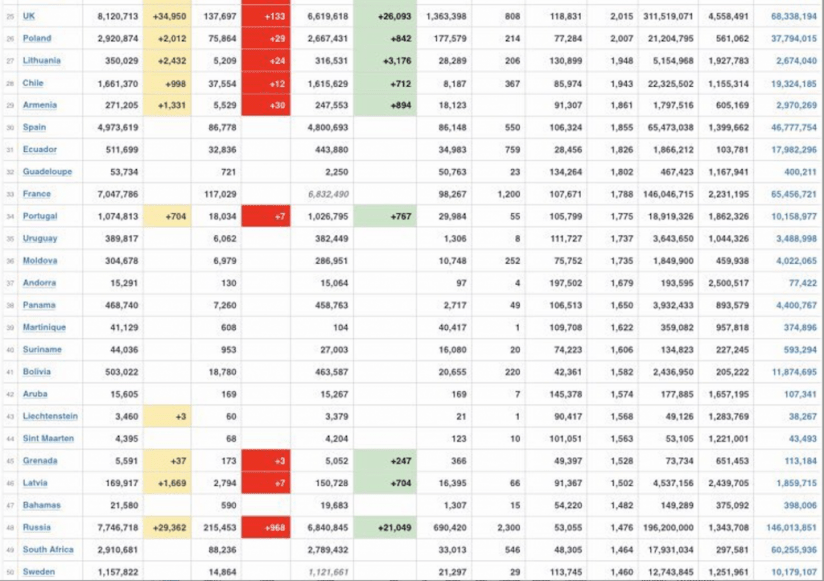
- There are only three mentions of Sweden in this report, two of them in a single footnote. Any assessment of the U.K. Government’s response to the pandemic that fails to compare it with that of the Swedish Government – particularly one advocating we should have locked down sooner and for longer – doesn’t deserve to be taken seriously.
- The report’s authors take at face value the “reasonable worst-case” scenarios that various modellers (including a sidekick of Dominic Cummings’) came up with in mid-March to show that if the Government continued to follow Plan A, i.e. the Pandemic Preparedness Strategy, the NHS was on track to become overwhelmed many times over. Here is Matt Hancock giving evidence on June 8th 2021, appealing to a prediction of “slightly below” 820,000 deaths, absent a lockdown:
I asked for a reasonable worst-case scenario planning assumption. I was given the planning assumption based on Spanish flu, and it was signed off at Cobra on January 31st. That was a planning assumption for 820,000 deaths. […]
In the week beginning March 9th, what happened is that the data started to follow the reasonable worst-case scenario. By the end of that week, the updated modelling showed that we were on the track of something close to that reasonable worst-case scenario. I think the numbers were slightly below that, but they were of a scale that was unconscionable.
- Rather than just take those projections at face value, couldn’t the House of Commons committees have interrogated the models a little bit? The report’s most damning criticism – that the Government’s delay in imposing the first lockdown resulted in thousands of unnecessary deaths – is contingent on not questioning those forecasts. In light of SAGE’s over-estimate of the likely uptick in cases following the easing of restrictions on July 19th of this year, as well as its more recent over-estimate of hospitalisations this autumn, wouldn’t it have been prudent to scrutinise those models? That’s a particularly glaring omission, given that the authors of the report criticise members of the Government for not challenging the scientific advice they were given: “Those in Government have a duty to question and probe the assumptions behind any scientific advice given, particularly in a national emergency, but there is little evidence sufficient challenge took place.” Why do “those in Government” have a duty to do this, but not those serving on select committees who are supposed to be holding the Government to account?
- In case further evidence is required that the authors of the report have credulously lapped up the doom-mongering of SPI-M and others, consider this passage:
It seems astonishing looking back that – despite the documented experiences of other countries; despite the then Secretary of State referring to data with a Reasonable Worst Case Scenario of 820,000 deaths; despite the raw mathematics of a virus which, if it affected two-thirds of the adult population and if one percent of people contracting it died would lead to 400,000 deaths – it was not until March 16th that SAGE advised the Government to embark on a full lockdown (having said on March 13th that “it was unanimous that measures seeking to completely suppress the spread of COVID-19 will cause a second peak”) and not until March 23rd that the Government announced it.
- Note the appeal to an IFR of 1% when even Neil Ferguson’s team at Imperial College, which predicted 510,000 deaths if the Government stuck with Plan A in its famous March 16th paper, assumed an IFR of 0.9%. In fact, a WHO bulletin put the IFR at 0.23% as long ago as October 2020.
- This unwillingness to interrogate the modelling data that underpins the report’s conclusions is particularly odd, given that the authors acknowledge the limitations of modelling elsewhere – “Models can be useful and informative to policymakers, but they come with limitations” – and at one point try to blame the delay in lockdown down on an “overreliance on specific mathematical models”! Again it’s a case of one rule for me and another for thee.
- The report compares the response of the British government in the first months of the pandemic unfavourably to that of various East Asian and South East Asian governments, but overlooks the fact that many Asian countries that successfully suppressed infection by closing borders at the beginning of 2020, and rolling out successful test, trace and isolate programmes, are now in the grip of devastating waves in spite of having vaccinated large swathes of their populations. That suggests their non-pharmaceutical interventions only succeeded in postponing the impact of SARS-CoV-2, not avoiding it. (It also fails to note that these supposed role models didn’t issue stay-at-home orders, close schools or shutter businesses in their initial responses to the pandemic.)
- The report criticises the Government for stopping community testing in March 2020 due to PHE’s lack of testing capacity and praises Matt Hancock for setting the 100,000 tests a day target to galvanise the system into massively ramping up that capacity. Indeed, the authors claim that had a proper test-and-trace system been in place at the beginning of 2020, the initial lockdown might have been avoided. That, too, is a shaky assumption. After all, the Government has spent £37 billion and counting on a ‘world-beating’ test, trace and isolate programme but that didn’t stop us locking down for a second and third time. The authors of the report acknowledge this point, but blame Baroness Harding for not doing a better job of running NHS Test and Trace. That seems a tad harsh, particularly as the authors repeatedly say – Uriah Heap-like – that it’s not their intention to apportion blame for the mistakes they’ve identified.
- The report praises the speed at which the Nightingale hospitals were created, although it acknowledges that, for the most part, they weren’t used. But the reason they weren’t used is partly because the NHS lacked the trained employees to staff them with – ICU nurses, for instance. Perhaps if they’d been built with less speed – at a cost to the taxpayer of roughly half a billion pounds, don’t forget – the Government would have had time to spot this obvious flaw in the plan. Or, more realistically, those aware of it from the start would have had more time to organise and obstruct this expensive PR stunt.
- The authors praise the Government – and the NHS – for at no point running out of ICU beds and becoming overwhelmed, as the health system did in some parts of Italy during the first phase of the pandemic. But given the enormous cost of protecting the NHS – both in terms of seriously ill people who were either discharged or went untreated, as well as the collateral damage inflicted by the lockdowns on the economy, education, family life, mental health, etc. – it’s impossible to say whether prioritising the NHS at the expense of absolutely everything else was in fact the right strategy. To bottom that out you need to do some cost-benefit analysis, of which there is precisely none in this report.
- The report concludes by praising the Vaccine Taskforce under the leadership of Kate Bingham and highlights the ‘success’ of the U.K.’s vaccine programme – “one of the most effective in Europe and, for a country of our size one of the most effective in the world”. But they ignore the fact that the efficacy of the Covid vaccines is much less impressive than the initial trial data indicated and looks less impressive with each passing week, something Dr. Will Jones has been meticulously documenting for the Daily Sceptic. So was the massive Government expenditure on the development and trialling of home grown vaccines, as well as procuring hundreds of millions of vaccines manufactured overseas, worth it? One notable omission from the report is any acknowledgement of the risks associated with a fast-tracked vaccine approval process – it just breathlessly praises the speed with which vaccines were made available to the public and expresses the hope that “in the future this could be conducted in much shorter time still”.
Conclusion
This is a pretty feeble document that seems to have been written with an eye on getting Jeremy Hunt and Greg Clark – the chairs of the two select committees involved – on the BBC news rather than making a serious contribution to understanding what the Government got right and what it got wrong over the past 18 months. It’s hard to argue with some of its findings, but its headline conclusion – that the Government should have locked down earlier – isn’t based on any serious analysis, let alone a careful consideration of the evidence that seems to point in the opposite direction. Talk about groupthink!
I hope the official inquiry, when it comes, is a bit more intellectually weighty than this.
Featured Video

America Racing to Strategic Defeat in Iran
or go to
Aletho News Archives – Video-Images
From the Archives
An Expert Military Analysis of War with China
Actually, None is Necessary
By Fred Reed • Unz Review • December 13, 2020
The Correlation of Armed Forces: U.S. goods and services trade with China totaled an estimated $634.8 billion in 2019. Exports were $163.0 billion; imports were $471.8 billion. The U.S. goods and services trade deficit with China was $308.8 billion in 2019. Trade in services with China (exports and imports) totaled an estimated $76.7 billion in 2019. Services exports were $56.5 billion; services imports were $20.1 billion. The U.S. services trade surplus with China was $36.4 billion in 2019.
There is talk within the Washingtoniat of a possible war with China. Steve Bannon, who apparently was dropped on his head as a child, actually favors such a war. We hear the usual shoo-the-boobs alarm about how the Chinese are doing something terrible and we must gird our loins and American values and show them what for, bow wow, woof. The danger is that the current game of who-blinks-first in Asian waters might actually provoke a shooting war. You know the kind of thing: One warship refuses to get out of the way of another, a collision ensues, some retard lieutenant who signed up on waivers opens fire, and we’re off and running. It is not a good idea to let children play with matches.
The said war is discussed either in emotional terms by idiots or in purely naval terms by those familiar with such things, so we hear of the First Island Chain and the Second Island Chain and whose missiles against the other’s missiles and so on. This would be appropriate if we were fighting World War Two again. Which we aren’t. Let’s take a quick-and-dirty look at how such a war might go.
To begin the war, America would overestimate itself and underestimate China. This is doctrine in the Pentagon. … continue
Blog Roll
 Aletho News
- Poland rules out sending Patriot missiles to US/Israel amid war on Iran
- Tehran approves new Hormuz plan with major restrictions
- No Threat Can Force Iran’s Surrender /Trita Parsi & Lt Cl Daniel Davis
- UK’s New Pandemic Plan Would Turn Big Tech Into a Mass Location Tracking Network
- Growing insecurity, soaring prices fuel protests in north as regime bans evacuation: Sources
- Iran denies responsibility for ‘depraved’ attack on Kuwait desalination plant
- Bring The Troops Back. End This War Now!
- Can we please stop calling Israel the ‘only democracy in the Middle East’ now?
- US should start removing its troops from Germany, proposes AfD co-leader Chrupalla
- Iran Red Crescent: 600 educational centers attacked in US-Israeli ‘war crimes’
- If Americans Knew
- The Line Between Affinity and Conspiracy
- As Iran targets US military bases, will they be relocated to Israel? Not a ceasefire Day 171
- Will Trump Go Kamikaze?
- Is the University of Florida Shutting Down College Republicans over Israel Criticism?
- Jewish extremist arrested over alleged plot to firebomb Palestinian activist Nerdeen Kiswani’s home
- More than half of Palestinian child detainees have no charges
- The More Murderous Israel Gets, The More We Hear About “Antisemitism”
- Land Day and the Palestinian struggle after 30 months of genocide
- The Iran War Is About Palestine
- Israeli soldiers echo settler ideology, talk of revenge after targeting Palestinians and detaining CNN crew in the West Bank
- No Tricks Zone
- New Study Finds Warming Saves Lives…Cold Temperatures 12 Times More Deadly Than Excess Heat
- German Science Blog Accuses PIK Climate Institute Of Hallucinating Climate Tipping Points
- Devastating Assessment Of Comirnaty Vaccine By Former Senior Pfizer Europe Toxicologist
- New Study: CO2 Is ‘Effectively Negligible’ As An Explanatory Climate Change Factor Since 2000
- Former Pfizer Toxicologist Dr. Helmut Sterz Tells Bundestag Hearing Pfizer Vaccine Should Have Never Been Approved
- Energy Expert: Germany’s Nuclear Phaseout Was A “500 Billion Euro Mistake”
- New Research: South Australia’s Mid-Holocene Sea Surface Temperatures Were 4°C Warmer Than Today
- Storing Green Energy To Last Germany 10 Days Would Require A 60-Million Tonne Battery
- New Studies: UK Sea Levels Were 4 Meters Higher Than Today During The Mid-Holocene
- Destructive Green New Deal: German Energy And Metal Group Warns Of Drastic Crisis
 Aletho News