University receives $750k of federal funds to stop reporters from creating “negative unintended outcomes”
The government continues to get involved with shaping journalism
By Christina Maas | Reclaim The Net | October 24, 2021
Researchers at Temple University received $750,000 from the National Science Foundation (NSF) to develop a tool that warns journalists that they are about to publish polarizing content. The NSF is a federal government agency focused on supporting research and education in non-medical fields of engineering and science.
The initiative is part of NSF’s “Trust & Authenticity in Communication Systems.” It is called the “America’s Fourth Estate at Risk: A System for Mapping the (local) Journalism Life Cycle to Rebuild the Nation’s News Trust.”
The focus of the project, according to a report on Campus Reform, is creating a system that alerts journalists that the content they are about to publish might have “negative unintended outcomes” such as “the triggering of uncivil, polarizing discourse, audience misinterpretation, the production of misinformation, and the perpetuation of false narratives.”
The researchers hope that the system will help journalists measure the long-term impact of their stories, that go beyond existing metrics such as likes, comments, and shares.
One of the researchers involved in the project, Temple University’s professor Eduard Dragut, said that the system will “use natural language processing algorithms along with social networking tools to mine the communities where [misinformation] may happen.”
“You can imagine that each news article is usually, or actually almost all the time, accompanied by user comments and reactions on Twitter. One goal of the project is to retrieve those and then use natural language processing tools or algorithms to mine and recommend to some users [that] this space of talking, this set of tweets, which may lead to a set of people, like a sub-community, where this article is used for wrong reasons,” he added.
Journalists and other players in the news industry will be involved with the project, which already includes researchers from other universities including Boston University and the University of Illinois-Chicago.
“We want journalists to be part of the process, not just the mere users of the product itself,” Dragut said. “So you can imagine sort of an analytics tool that informs the journalists and editors and other people involved in this business how their products or how their creative act is used or misused in social media.”
He added that the project is attempting to “create a collaborative environment with both social media platform[s] and other organizations like Google” because of their expertise.
“We have some preliminary conversation with Bloomberg, for instance, and we will have to define exactly how they are going to help us. Google has an initiative to help local news, and we are working to create a relationship with them, and there are others,” Dragut told Campus Reform. “This product will not work unless we are successful in bringing some of these high tech companies into the game.”
Another researcher involved in the project, professor Lance Holbert, said that, for now, the misinformation the project is focusing on is that of the spread on local media.
“Certainly some topics over time will become more versus less interesting, but also we’re focused here initially on local media as well, so each locality may have different topics or particular points of interest that come up in the news,” he said. “We’re trying to keep this generalizable across topics.”
Holbert noted that misinformation is not “happening in the political spectrum” alone.
“[It’s happening] in sports, it’s happening in economics,” he said. “Like a few years back, I know, an example from Starbucks where there was a sort of a campaign on Twitter [saying] that Starbucks is targeting, in the wrong way, African Americans, which was wrong.”
The NSF is expected to further fund the project when its first phase becomes successful.
Several German cities halt use of e-buses following series of unresolved cases of fire
By Paul Homewood | Not A Lot Of People Know That | October 24, 2021
The potential risks of electromobility are being closely examined in Germany after a third major fire in a bus depot apparently caused by an electric bus. Public transport companies are taking action after the electric bus allegedly triggered a fire in Stuttgart last week, newspaper Die Welt reports.
The Munich public transport company, MVG, is taking eight similar e-buses out of service until the cause of the fire in Stuttgart has been clarified. The fire may have started while the bus was being charged in the depot, according to investigators, who assume that a technical defect may be the cause of the fire. The 30 September fire completely destroyed 25 buses in the depot, including two with electric drives, causing damage worth millions of euros.
The Stuttgart transport company, SSB, has also halted the use of electric buses in the city. The incident followed a similar fire in June in a bus depot in Hanover, which destroyed the hall and nine buses. E-buses were then recalled but are expected to resume service in November. In April, a fire at the Rheinbahn depot in Düsseldorf caused damages totalling several million euros. Investigators determined the fire had been triggered by a technical issue but could not clearly identify the cause.
While the number of electric buses in German public transport doubled last year compared to 2019, a recent survey found that 58 percent of Germans had doubts about the “environmental compatibility” of electric mobility.
NATO’s new secret plan for nuclear war & space battles with Russia risks spiraling into a new arms race
By Paul Robinson | RT | October 24, 2021
Tensions between Russia and NATO are at an all-time high. But instead of seeking a way off the ladder of escalation, the US-led bloc’s new plan for hybrid war risks accelerating an already dangerous lethal arms race with Moscow.
There’s a concept in international relations, almost one of the first that students learn, called the ‘security dilemma’. It’s hardly rocket science, but it’s something governments and armed forces planners seem to consistently forget when it comes to making policy.
The idea is basically this: Country A feels threatened by country B; it therefore takes some measures – such as increasing its defence spending – to make itself more secure; but when country B sees what country A is doing, it in turn feels threatened, and so takes reciprocal measures of its own. The result is that country A ends up less safe than it was to start with.
The dilemma is that if you do nothing to strengthen your defences, you’ll be insecure, but if you do something you’ll end up worse off because of the counter-measures the other side will take. What do you do? If countries A and B both take action to defend themselves, they will find themselves in an ever-escalating process – what theorists like to call the ‘spiral model’, but which in public parlance is often called an arms race.
The obvious way out is to break the spiral. Avoid escalating and resort to other measures, such as negotiation and arms control. All it may take is for one side to unilaterally step back, and the vicious circle will turn into a virtuous one.
It’s pretty basic stuff, but again and again, state leaders choose to ignore it and prefer instead to march down the path of the spiral. So it is today in the case of Russian-NATO relations, which are as classic an example of the security dilemma as you could possibly hope to find. Deep down, there’s no fundamental reason for conflict, but mutual suspicion leads to a continuing ramping up of reciprocal measures that deepen the suspicion, leading to more measures, more suspicion, and so on, seemingly ad infinitum.
For instance, earlier this year, the Russian military undertook a series of exercises close to its Western borders. From a Russian perspective, these were purely defensive. From a Western perspective, they appeared potentially threatening, justifying in turn Western exercises that NATO claims are entirely for defence, but which Russia considers a threat, prompting further Russian measures.
The latest round in this dangerous process is the announcement this week that NATO has developed a new ‘masterplan’ to defend against a possible Russian attack. The plan itself is secret, so we don’t know its contents, but it’s said to focus on non-conventional war, including nuclear strikes, cyberwarfare, and even war in space. Geographically, it covers the whole spread of NATO’s border with Russia, from the Baltic to the Black Seas inclusive.
In part, this is just what military institutions do: They plan for possible future conflicts. The Russian military almost certainly also has similar contingency planning in place for a potential war with NATO. It would be very odd if it didn’t. In this sense, NATO’s new masterplan shouldn’t in theory be seen as a cause for alarm. Moreover, NATO insists that its purpose is not aggressive. Rather, the plan’s aim is deterrence, thus its formal title: ‘Concept for Deterrence and Defence in the Euro-Atlantic Area’.
However, as students of the spiral model know, reality is much less important than perception. Deterrence is a matter of signals. One sends a message to potential enemies that if they attack, they will suffer devastating consequences. The problem is that although this message may be clear to the one doing the signalling, it may not be so clear to the one to whom it is sent. You think you are deterring, but they think you are threatening. They therefore respond in kind. In this way, deterrence ends up being counter-productive.
This doesn’t always happen, but in this instance, it seems to be the case. Some aspects of NATO’s announcement seem unnecessarily escalatory, in particular the references to nuclear war. We’ve come a long way from the musings of nuclear strategists like Herman Kahn and Bernard Brodie, who tried to calculate how it was possible to fight and win a nuclear war. One shouldn’t be surprised that when other people hear such talk being revived, they’re not deterred but alarmed.
Unsurprisingly, Russia’s reaction to NATO’s new military concept has been decidedly negative. “There is no need for dialogue under these conditions,” Kremlin spokesman Dmitry Peskov said, continuing: “this alliance was not created for peace, it was conceived, designed and created for confrontation.”
From the Russian point of view, NATO’s actions justify Russia’s recent decision to sever ties with the Atlantic alliance. Rather than bringing Russia to heel, NATO may merely be driving it into an ever more hostile position.
In this way, the West’s perception of Russia as a threat becomes a self-fulfilling prophecy. The same, of course, could be said the other way around. For if the West perceives Russia as threatening, it is because of things that Russia has done – as it sees it, for its own defence. For instance, NATO argues that what has made its new plan necessary is Russia’s strengthening of its armed forces and its recent advances in military technology.
The more Russia defends itself, the more it incites NATO. And the more NATO defends itself, the more it incites Russia. A security dilemma par excellence. The risk both parties run is that the situation will continue to spiral further and further into ever more dangerous territory. Already this spring, Europe passed through a period of high tension in which it looked entirely possible (although unlikely) that war might erupt between Ukraine and Russia. Anything that contributes to a further worsening of the situation is therefore thoroughly undesirable. NATO’s new military plan, it seems fair to say, runs the risk of doing just that.
Paul Robinson, a professor at the University of Ottawa. He writes about Russian and Soviet history, military history and military ethics, and is the author of the Irrussianality blog.
Viral Tweet Opposing ‘Herd Immunity’ Gets Pretty Much Everything Wrong
By Noah Carl • The Daily Sceptic • October 22, 2021
In a recent viral tweet, the anti-Brexit campaigner Jolyon Maugham criticised the Government’s initial Covid strategy (which, as we know, was later ditched in favour of lockdowns).
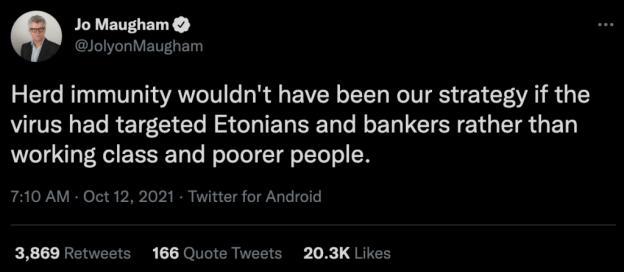
I’m no defender of the Government’s response to the pandemic, but it’s hard to imagine a more wrong-headed criticism than this. Indeed, it’s impressive how many fallacies Maugham managed to pack into 280 characters.
First: “Herd immunity”. As the authors of the Great Barrington Declaration have tirelessly pointed out, describing any response to the pandemic as a ‘herd immunity strategy’ is like describing a pilot’s plan to land a plane as a ‘gravity strategy’. Given that Covid cannot be eliminated, herd immunity will eventually be reached, regardless of what we do.
The goal of any plan to address Covid, write Kulldorff and Bhattacharya, “should be to minimise disease mortality and the collateral harms from the plan itself, while managing the build-up of immunity in the population.”
Second, the implication of Maugham’s tweet is that the Government’s initial strategy was motivated by Conservative ideology, and that the alternative – lockdown – is what’s backed by science.
Yet, as I and others have pointed out, it’s actually lockdown that deviates substantially from the pre-Covid consensus. Indeed, the UK’s pandemic preparedness plan does not even mention the term. And in 2019, the WHO classified “quarantine of exposed individuals” as “not recommended under any circumstances”.
Given that the first lockdown was implemented by a communist one-party state, and that subsequent lockdowns were imposed with almost no prior discussion, it would make more sense to say lockdown was motivated by ideology.
Third, the virus does not “target” working class and poorer people, while leaving Etonians and bankers unscathed. It is not some pathogenic agent of class warfare.
If “target” is taken to mean “infect”, then the virus targets people who aren’t immune to it. And if “target” is taken to mean “kill”, then it would be most accurate to say the virus targets the old and the immunocompromised. After all, these groups account for the overwhelming majority of deaths.
Now, it’s true that death rates have been higher in working class occupations, as I noted in a previous post. But this is far more plausibly due to lockdown than to the Government’s initial strategy, which was in any case abandoned in March of 2020.
As the art critic J. J. Charlesworth quipped, “There was never any lockdown. There was just middle-class people hiding while working-class people brought them things.” Middle-class people like Jolyon Maugham, I might add.
17,000+ deaths reported after COVID vaccines, including new report of 12-year-old who died after Pfizer vaccine
By Megan Redshaw | The Defender | October 23, 2021
Data released Friday by the Centers for Disease Control and Prevention (CDC) showed that between Dec. 14, 2020, and Oct. 15, 2021, a total of 818,044 adverse events following COVID vaccines were reported to the Vaccine Adverse Event Reporting System (VAERS).
The data included a total of 17,128 reports of deaths — an increase of 362 over the previous week, and a new report of a 12-year-old who died after getting the Pfizer vaccine.
There were 117,399 reports of serious injuries, including deaths, during the same time period — up 5,434 compared with the previous week.
Excluding “foreign reports” to VAERS, 612,125 adverse events, including 7,848 deaths and 50,225 serious injuries, were reported in the U.S. between Dec. 14, 2020, and Oct. 15, 2021.
Of the 7,848 U.S. deaths reported as of Oct. 15, 11% occurred within 24 hours of vaccination, 15% occurred within 48 hours of vaccination and 28% occurred in people who experienced an onset of symptoms within 48 hours of being vaccinated.
In the U.S., 406.1 million COVID vaccine doses had been administered as of Oct. 15. This includes: 237 million doses of Pfizer, 154 million doses of Moderna and 15 million doses of Johnson & Johnson (J&J).

The data come directly from reports submitted to VAERS, the primary government-funded system for reporting adverse vaccine reactions in the U.S.
Every Friday, VAERS makes public all vaccine injury reports received as of a specified date, usually about a week prior to the release date. Reports submitted to VAERS require further investigation before a causal relationship can be confirmed.
Historically, VAERS has been shown to report only 1% of actual vaccine adverse events.
This week’s U.S. data for 12- to 17-year-olds show:
- 21,921 total adverse events, including 1,325 rated as serious and 25 reported deaths. Two of the 25 deaths were suicides.
The most recent death involves a 12-year-old girl (VAERS I.D. 1784945) who died from a respiratory tract hemorrhage 22 days after receiving her first dose of Pfizer’s vaccine.
Another recent death includes a 15-year-old male who died six days after receiving his first dose of Pfizer’s COVID vaccine. According to his VAERS report (VAERS I.D. 1764974), the previously healthy teen complained of brief unilateral shoulder pain five days after receiving his COVID vaccine.
The next day he played with two friends at a community pond, swung on a rope swing, flipped into the air, and landed in the water feet first. He surfaced, laughed and told his friends “Wow, that hurt!” He then swam toward shore underwater, as was his usual routine, but did not re-emerge.
An autopsy showed no external indication of a head injury, but there was a small subgaleal hemorrhage — a rare, but lethal bleeding disorder — over the left occiput. In addition, the boy had a mildly elevated cardiac mass, increased left ventricular wall thickness and small foci of myocardial inflammation of the lateral wall of the left ventricle with myocyte necrosis consistent with myocardial infarction.
- 57 reports of anaphylaxis among 12- to 17-year-olds where the reaction was life-threatening, required treatment or resulted in death — with 96% of cases attributed to Pfizer’s vaccine.
- 535 reports of myocarditis and pericarditis (heart inflammation) with 527 cases attributed to Pfizer’s vaccine.
- 119 reports of blood clotting disorders, with all cases attributed to Pfizer.
This week’s U.S. VAERS data, from Dec. 14, 2020, to Oct. 15, 2021, for all age groups combined, show:
- 19% of deaths were related to cardiac disorders.
- 54% of those who died were male, 42% were female and the remaining death reports did not include gender of the deceased.
- The average age of death was 72.7.
- Of the 3,014 cases of Bell’s Palsy reported, 51% were attributed to Pfizer vaccinations, 41% to Moderna and 8% to J&J.
- 666 reports of Guillain-Barré syndrome, with 40% of cases attributed to Pfizer, 31% to Moderna and 28% to J&J.
- 2,010 reports of anaphylaxis where the reaction was life-threatening, required treatment or resulted in death.
- 10,290 reports of blood clotting disorders. Of those, 4,488 reports were attributed to Pfizer, 3,709 reports to Moderna and 2,040 reports to J&J.
- 2,878 cases of myocarditis and pericarditis with 1,815 cases attributed to Pfizer, 939 cases to Moderna and 114 cases to J&J’s COVID vaccine.
NATO, Not Russia, Perpetuates Cold War Logic… It is a Relic Best Ignored
Strategic Culture Foundation | October 22, 2021
It was the end of an era this week when Russia announced that it was severing diplomatic links with the North Atlantic Treaty Organization. For the past 30 years since the dissolution of the Soviet Union, the Russian Federation has engaged with the US-led military bloc in a bid to establish partnership and secure peace.
The incipient detente culminated in the NATO-Russia Founding Act in 1997 which demarcated certain boundaries for peaceful coexistence. Those boundaries were subsequently flouted as NATO doubled its members over the ensuing years to stand at the current membership of 30 countries, including states that share a border with Russia.
There was also established in 2002 a NATO-Russia Council which in principle provided a forum for dialogue between delegations hosted in the Belgian capital Brussels where NATO has its headquarters.
But the truth is initial promises of partnership have waned. For several years now, at least since the 2014 Ukraine crisis, NATO’s relations with Russia have been characterized more and more with an imperious attitude of lecturing Moscow over a litany of alleged transgressions. These allegations are more accurately described as slanders because they are never substantiated beyond bald accusation.
Russia is routinely accused of posing a threat to Europe and plotting to sabotage Western democracies. This week the NATO defense ministers held a summit in which it was breathlessly claimed that Russia is becoming an even greater threat to the transatlantic alliance. On the back of that hysterical claim, NATO has now moved to implement a “master plan” to “defend” Europe from a “potential Russian attack on multiple fronts”.
Reality check. Moscow has repeatedly stated that it has no intent of aggression towards the United States, NATO, Europe or anyone else for that matter. Despite this categorical assurance, the Western bloc has persisted in talking up tensions with Russia.
It is the United States that has abrogated several arms-control treaties and introduced new missile systems into Europe. It is NATO that is encroaching on Russia’s territory. Reality is turned on its head by Western accusations.
Indeed there have been conflicts over Georgia in 2008 and ongoing in Ukraine. But in each case, there are substantial grounds for laying the blame of these conflicts on NATO. How did the coup d’état in Kiev happen in 2014, who supported it? And why did the people of Crimea vote in a constitutional referendum to secede from Ukraine to join the Russian Federation with which they have centuries of shared history and culture?
In any case, if there were proper partnership and dialogue between NATO and Russia then such concerns and disputes could have been appropriately aired and discussed in the assigned forum. But the fact is there was never any genuine attempt at dialogue by NATO. Russia has become an object of harangue and hostility. The supposed partnership envisaged some three decades ago became a travesty. Instead of dialogue and debate there was simply disdain. Instead of equality there was vilification, opprobrium, and sensationalized smears without the slightest due process afforded to Russia (the Skripals, Navalny, Novichok, electoral interference, cyberattacks, shooting down a Malaysian airliner, and so on and so on, like an old skipping vinyl record incapable of moving on.)
The supposed diplomatic channels were nothing but echo chambers for NATO propaganda talking points, rather than being used as a means to resolve misapprehensions through mutual dialogue and presentation of evidence.
As the Russian foreign ministry noted this week in explaining the severance of diplomatic ties, it is NATO that systematically destroyed relations and “chose the Cold War logic”.
Alexander Grushko, Russia’s deputy foreign minister, commented that normal relations were not possible amid unfriendly steps taken by NATO “sliding into Cold War schemes”.
The last straw was the expulsion earlier this month by NATO of Russian diplomats from the NATO forum in Brussels. The Russian staff were accused of being “undeclared spies” allegedly working for military intelligence. No evidence was provided, as usual, by the accusers. It was the familiar high-handed approach of fait accompli and Russia “guilty until proven innocent”.
Everyone recognizes that relations between the Western states and Russia are at their lowest since the end of the former Cold War. Thus it may be put to Moscow that it is being reckless to close down channels of communication at this precarious time.
Russia has not ruled out pursuing a more productive relationship in the future. It has said, however, that it is up to NATO to make the first move towards improving relations. Until then, henceforth, any communications can be submitted through Russia’s ambassador to Belgium.
It is our view that Russia has made the correct call to drop diplomatic channels with NATO. Russia will pursue bilateral relations with individual nations as it does already, for example, with the United States on the vital issues of arms control and cybersecurity. NATO has proven to be incapable of progressive negotiations owing to an organizational “groupthink” that is encumbered with Russophobia and Cold War ideology.
By engaging directly with individual nations, it may be more productive for mutual understanding to be advanced because the noise of “groupthink” and of competing group negativity is removed.
Unfortunately, it has to be noted that the original purpose of NATO when it was formed in 1949 was rooted in Cold War hostility towards the Soviet Union. Such animosity has not abated even though the Soviet Union no longer exists.
Fundamentally, NATO is an organization in search of enemies in order to justify the militarism that is essential for the functioning of Western capitalism. There is a pivotal contradiction between NATO and today’s emerging world of multipolar cooperation and peaceful development. Its disgraceful, diabolical destruction of Afghanistan alone debars that organization from having any progressive role in today’s world.
Russia is right to disabuse the illusion of “partnership” with NATO. It is a relic of Cold War hostility that belongs in a war museum not in a modern forum for diplomacy.
Illinois Sheriffs Reject Mayor Lightfoot’s Urgent Plea To Cover Police Shortage In Crime-Hit Chicago
By Tyler Durden | Zero Hedge | October 22, 2021
As hundreds of Chicago police are being put on “no-pay leave” over their refusal to submit their personal Covid vaccination status with the city, Chicago Mayor Lori Lightfoot appears to have fewer and fewer allies as she desperately tries to fill the gap of officer shortages due to the vax order. Area county sheriffs are refusing to send additional manpower that’s she requesting to urgently cover the gaps, telling her that’s it’s a problem of the mayor’s own making.
“Chicago Mayor Lori Lightfoot received a rude awakening after multiple sheriffs in nearby jurisdictions refused her request to fill the gap in police manpower after she threatened to fire 3,000 local officers for not complying with the city’s COVID-19 vaccine mandate,” The Washington Examiner reports on the latest developments. “DuPage County Sheriff James Mendrick and Kane County Sheriff Ron Hain said they’ve helped Lightfoot in the past, but her latest request is a self-inflicted wound that could have been avoided. They said they would only step in and help the Chicago Police Department if city officers were in distress or under duress.”
Sheriff Hain had this to say, echoing recent criticisms of the Chicago police union which has cited terrible communication and heavy-handedness in place of requests for dialogue on the issue: “[The Illinois Law Enforcement Alarm System] typically responds to emergency situations where there is no opportunity for planning,” Hain said. “This situation to me is much different.”
Despite sheriff’s offices shutting the door on the mayor’s request to cover Chicago PD officer shortages, police continue to reportedly be summoned to headquarters where they are given one last on the spot ultimatum: submit to last week’s vaccine status order or be relieved from duty without pay.
So far the city says it’s not yet going after street patrol officers, which is obviously on fears of a coming crime wave that will hit an already understaffed notoriously high-crime city.
BBC has compiled recent statistics as the standoff over the vax mandate continues:
Chicago, a city of nearly three million people, has seen more than 1,600 sexual assaults, nearly 3,000 shootings and 649 murders this year – a 14% increase over last.
Just as violent crimes have risen, though, thousands of the city’s police force may not show up to work.
… Nearly one-third of Chicago’s almost 13,000-member police department have so far refused to register their vaccination status, putting them on track for dismissal. Twenty-one have been officially removed from active duty so far, but some officials have warned that the mandate could leave Chicago’s police force dangerously depleted.
Adding fuel to the fire of the crisis, President Joe Biden during his CNN Town Hall remarks Thursday night continued pushing his view that emergency responders should be fired for defying local vaccine mandates.
The president even appeared to mock those rejecting vaccine mandates on the basis of “freedom”…
“I have the freedom to kill you with my COVID,” Biden said, mocking what he sees as the attitude of mandate opponents. “No, I mean, come on, freedom.”
Meanwhile the head of Chicago’s largest police union, John Catanzara, is still urging officers to hold the line, despite a weekend gag order imposed on him by the city.
“It is the city’s clear attempt to force officers to ‘Chicken Little, the sky is falling’ into compliance,” he’s recently urged the union’s 11,000 members. “Do not fall for it. Hold the line.”
Featured Video

Meet The Ellisons: Zionists, Technocrats, Moguls
or go to
Aletho News Archives – Video-Images
Frlom the Archives
With apparently fabricated nuclear documents, Netanyahu pushed the US towards war with Iran
By Gareth Porter | The Grayzone | April 29, 2020
President Donald Trump scrapped the nuclear deal with Iran and continued to risk war with Iran based on Israeli Prime Minister Benjamin Netanyahu’s claim to have proven definitively that Iran was determined to manufacture nuclear weapons. Netanyahu not only spun Trump but much of the corporate media as well, duping them with the public unveiling of what he claimed was the entire secret Iranian “nuclear archive.”
In early April 2018, Netanyahu briefed Trump privately on the supposed Iranian nuclear archive and secured his promise to leave the Joint Comprehensive Plan of Action (JCPOA). That April 30, Netanyahu took the briefing to the public in a characteristically dramatic live performance in which he claimed Israel’s Mossad intelligence services had stolen Iran’s entire nuclear archive from Tehran. “You may well know that Iran’s leaders repeatedly deny ever pursuing nuclear weapons…” Netanyahu declared. “Well, tonight, I’m here to tell you one thing: Iran lied. Big time.”
However, an investigation of the supposed Iranian nuclear documents by The Grayzone reveals them to be the product of an Israeli disinformation operation that helped trigger the most serious threat of war since the conflict with Iran began nearly four decades ago. This investigation found multiple indications that the story of Mossad’s heist of 50,000 pages of secret nuclear files from Tehran was very likely an elaborate fiction and that the documents were fabricated by the Mossad itself. … continue
Blog Roll
 Aletho News
- Meet The Ellisons: Zionists, Technocrats, Moguls
- US failures in Iran reveal Russia is key to South Korea’s strategic security
- ‘All ports in Persian Gulf will be legitimate targets if Iranian ports are attacked’
- 40 Years of Endless War, Data Point by Data Point
- Department of War Using Palantir AI to Pick Targets in Iran
- American bases do not protect – they attack the peoples of the Persian Gulf
- ‘We’ve Obliterated Their Missiles’
- Syrian president vows ‘absolute support’ to disarm Hezbollah
- Ukraine attacking Russian gas pipeline to stop deliveries to Europe – Defense Ministry
- ‘Heinous crime’: Iran denounces Israeli assassination of 4 Iranian diplomats in Lebanon
- If Americans Knew
- Israeli strategic plans to “remake the Middle East” from the 1950s and since
- Honoring Gaza’s women who refused to let the world look away
- 97% of victims of war on Iran are Iranian, 98% of victims in war on Gaza are Gazans – Not a ceasefire Day 152
- Early Iran strikes cost $5.6 billion in munitions, Pentagon estimates
- Israel Decided the War, But Trump’s America Fights and Pays the Bill
- Conscientious Objector Group: Phone ‘Ringing Off Hook’ As Huge Mobilization Underway
- U.S. support for Israel continues to plummet, despite media’s best efforts
- Threats and missiles fly, death tolls soar in Iran, Lebanon, Gaza – Not a ceasefire Day 151
- Lebanon: Israel’s White Phosphorous Use Risks Civilian Harm
- Corporate Media Go All Out To Support The US-Israeli War On Iran
- No Tricks Zone
- Destructive Green New Deal: German Energy And Metal Group Warns Of Drastic Crisis
- New Study Documents A 20-Year Pause In Arctic Sea Ice Decline – Driven By Internal Variability
- Wake-up Call: Survey Shows Majority Of Germans Now Favor Postponing Climate Targets!
- Televised! Leading German Political Candidate Tells Schoolchildren CO2 Makes Sun Hotter!
- New Study: A Century Warming Of 1.1°C Is ‘Commonplace’ And ‘Not Unusual’ During This Interglacial
- New Study: ‘Internal Noise’ And Volcanic Forcing Can Trigger 10-15°C Warming Within Decades
- Glaciers Worldwide Are Suddendly Surging, Experts Blame Warming!
- Surprising Discovery: Sahara Is Greening…Billions Of Trees Where Once Thought To Be Barren
- New Research Reaffirms Clouds, Aerosols, And Surface Solar Radiation Are ‘Driving The Climate System’
- Germany: Electric Car Catches Fire At Charging Station, Sets Off Local “Inferno”, Widespread Damage
 Aletho News