World Cup puts Palestinian cause in the spotlight
Free West Media | December 20, 2022
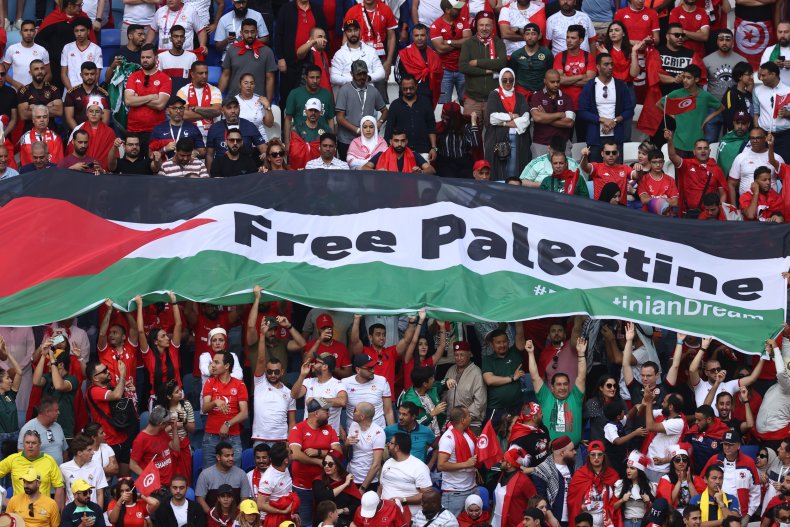
For this first World Cup in an Arab country, the Palestinian flag was visible everywhere, especially through the demands of fans.
During this World Cup in Qatar, the first in an Arab country, the Palestinian cause was honoured through its flag, which was omnipresent in the stands and in scenes of fan jubilation, reported L’Équipe on Sunday 18 December. During the group match between France and Tunisia, a supporter managed to run onto the pitch with the Palestinian flag, to the cheers of the crowd chanting “Palestine”, recalled another daily Le Monde.
According to Le Monde, the infatuation for the Palestinian cause is fed by an Arab sensibility that transcends the state framework. This is why the Palestinian flag was so visible during the competition.
Palestine, a member of FIFA since 1998 but not of the UN, was ironically renamed “the 33rd qualified country”, reported L’Équipe. “The real winner of the World Cup on social networks is Palestine,” according to the left-wing Israeli daily Haaretz.
The Palestinian cause even eclipsed Ukrainian leader Vladimir Zelensky’s request to share his message which he had planned to broadcast before Argentina faced France on Sunday and which FIFA had rejected.
FIFA refused Ukraine’s proposal to show a video message from Zelensky in Qatar’s Lusail Stadium ahead of the World Cup final on Sunday.
Scathing Report Blasts Finland’s Role in Afghanistan
By Igor Kuznetsov – Samizdat – 20.12.2022
The decades-long Afghanistan intervention, in which Finland played an active role, ultimately fueled large-scale corruption and resulted in the death of thousands of civilians, an august research institute established by the Finnish parliament has concluded in a gloomy assessment of the US’ longest war.
Finland’s involvement in Afghanistan has been slammed by a new scalding report by the Finnish Institute of International Affairs, a body largely funded by the parliament.
Not only was the Finnish role in the US-led intervention motivated by geopolitics rather than goodwill, it also had a limited efficacy because of a lack of long-term strategy, the report found.
Although Finnish involvement in Afghanistan was largely portrayed as a humanitarian act by politicians and media, in actual fact the Nordic country’s main interest was to strengthen its relationship with the US and NATO, as well as solidifying its decision-making clout within the UN, the report said.
“Finland’s actions in Afghanistan were guided primarily by the desire to maintain and deepen its international foreign and security policy partnerships. The aims related to Afghanistan’s development and the strategic monitoring of their attainment remained secondary concerns, and Finland’s actual efforts were not based on a comprehensive approach or a realistic analysis of the situation”, the Finnish Institute of International Affairs wrote.
As regards Afghanistan and its development, the objectives of the various activities remained “vague, unrealistic and unclear, and received insufficient attention”, the report said. Instead of critical analysis and strategic monitoring, attempts were made to meet the stated objectives, however vague, by highlighting the progress made and keeping silent about the combats and difficulties, it added.
At the same time, the report stressed that the intervention, in which Finland played an active role, ultimately led to large-scale corruption and resulted in the unnecessary death of thousands of civilians.
Some 2,500 Finnish soldiers and 140 crisis management experts served in Afghanistan with the total price tag of around 700 million euros (about $740 million).
Finland’s involvement in NATO’s Afghanistan mission was seen as an early sign that the Nordic nation was slowly drifting towards the alliance and attempting to bolster its partner status. Earlier this year, Finland and its western neighbor Sweden both abandoned their historic military non-alignment and rushed to become members of NATO, citing Russia’s special operation in Ukraine and the ensuing “security situation” as a pretext.
The Costs of War project by the Watson Institute of International and Public Affairs estimated the total cost of the US involvement in Afghanistan since 2001 as part of the post 9/11 wars at $2.3 trillion, with funds spent on lifetime care of US veterans and future interest payments on money borrowed not included. The same project also estimated that at least 243,000 people have died as a direct result of this war.
In its aftermath, after the hasty retreat of the coalition forces, the Taliban surged back to power in 2021, two decades after US-led forces embarked on their longest war in history.
Ukraine is not our ally – Croatian president
RT | December 20, 2022
Croatian President Zoran Milanovic said on Tuesday that Ukraine “is not an ally” of his country and warned against bringing “war” to the Balkans.
“Ukraine is not an ally. It’s being forcibly made into one. It was cynically granted the status of an EU candidate. That’s what the EU is today: squalor, zero.”
Talking to reporters, he also hit out against Prime Minister Andrej Plenkovic for his proposal to have Ukrainian troops trained in Croatia. Milanovic said such a move would “bring war” to the country.
“You keep pushing moral blackmail,” he addressed Plenkovic, “but you have no morals yourself. Go to Ukraine and fight.”
Speaking of the Croatian military’s preparedness to fight, Milanovic noted it had a shortage of anti-tank rockets, for example. “We have Americans, who will defend us the way they defend the Ukrainians. Great!” he said sarcastically.
The president’s comments come after Croatian lawmakers failed to adopt a motion for the country to join an EU program intended to train some 15,000 Ukrainian military personnel to fight against Russia. Last week, only 97 Croatian MPs out of 151 voted for the proposal, just short of the two-thirds of lawmakers it needed to pass.
Ahead of the vote, Milanovic, who is the commander-in-chief of the Croatian armed forces, warned that joining the program could make Zagreb a target for Russia. Plenkovic, whose cabinet backed the mission, in turn accused the president of harboring “pro-Russian views.”
Japan’s $320 billion militarization plan wastes precious resources amid rapid societal decline
By Drago Bosnic | December 20, 2022
In the aftermath of the Second World War, Japan went through a process of thorough demilitarization. The country’s militaristic ideology, the effects of which were disastrous for the entire Asia Pacific region during WWII, was also dismantled by American occupation forces. The changes were codified in the new Japanese constitution which effectively banned the country from possessing a fully fledged military.
This changed to a certain degree during the zenith of the (First) Cold War when the Japan Self-Defense Forces (JSDF) essentially became the country’s military, although its role was limited to effectively being a footnote within the larger context of US-led “Free World” security policies. This approach lasted up until recently, when Tokyo decided to start a massive rearmament program aimed at turning Japan into a major military power.
On December 16, the Japanese government announced a $320 billion program that would make it possible for the JSDF to launch standoff strikes against China and other regional adversaries (presumably North Korea). Reportedly, the plan also involves the expansion of Japanese military power to include the ability to maintain a sustained front against advanced opponents. Speculation about the program started in late November when Tokyo hinted it could soon equip its submarines with long range missiles. According to a report by the Naval News, the Japanese Defense Ministry announced it was in the process of extending the range of its Type 12 surface-to-ship missiles deployed by the Ground Self-Defense Force (JGSDF) from the current 200 km to a maximum of 1,200 km.
A Reuters report claims the new military plan would take approximately five years to complete and would also make Japan the world’s third largest military spender, right after the United States and China. The program would also focus on logistics as it would include the stockpiling of spare parts and various types of munitions, expanding transport capacity, as well as the development of cyber warfare capabilities.
The deal is also set to benefit the Japanese military industry, as companies such as the Mitsubishi Heavy Industries are expected to be at the helm of the development efforts for long-range missiles that are set to constitute the backbone of the country’s new military power projection in the Asia-Pacific region. The company is currently involved in a project to develop Japan’s next generation fighter jet. The effort, which also includes corporate giants such as the BAE Systems and Leonardo SPA, is a joint venture between Japan, the UK and Italy. So far, the project received at least $5.6 billion in funding.
Foreign companies, particularly those from the US, are also expected to benefit from Japan’s (re)militarization efforts.
Additionally, Tokyo says it plans to arm its ships with the latest iteration of the “Tomahawk” cruise missile (most likely referring to the new Block V) made by the Raytheon Technologies. According to Reuters, other weapons set to be acquired as part of the new five year program will very likely include interceptor missiles for ballistic targets (apparently including the troubled ship-borne “Aegis” and its land-based “Aegis Ashore” version), attack and ISR (intelligence, surveillance, reconnaissance) drones, satellite communications equipment, F-35 fighter jets, helicopters, submarines, warships and heavy-lift transport jets.
Prime Minister Fumio Kishida recently stated that “Japan is at a turning point in history,” adding that “the ramp-up in its military was my answer to the various security challenges that we face.” According to Reuters, Kishida’s government is allegedly concerned that “Russia has set a precedent that will encourage China to attack Taiwan, threatening nearby Japanese islands, disrupting supplies of advanced semiconductors and putting a potential stranglehold on sea lanes that supply Middle East oil.” Needless to say, the claim that Russia set a precedent is quite bemusing, especially when considering the countless examples of the massive scope of US aggression against the world.
Expectedly, the program will be closely coordinated with the US, as shown in a separate national security document in which Tokyo pledged to maintain close security ties with Washington DC and its other vassals. The US itself was quick to show public support for the program. US Ambassador to Japan Rahm Emanuel stated that “the Prime Minister is making a clear, unambiguous strategic statement about Japan’s role as a security provider in the Indo-Pacific.”
In addition, the cooperation is apparently also set to include China’s breakaway island province of Taiwan. During a meeting with Japan-Taiwan Exchange Association Chairman Mitsuo Ohashi on Friday, the incumbent head of the government in Taipei Tsai Ing-wen stated she expected greater defence cooperation with Japan. “We look forward to Taiwan and Japan continuing to create new cooperation achievements in various fields such as national defence and security, the economy, trade, and industrial transformation,” Reuters claims the presidential office cited Tsai as saying.
The plan is expected to double Japan’s military expenditures to around 2% of the country’s GDP over a period of five years. The previous 1% limit was self-imposed in 1976, nearly 50 years ago. This is also set to increase the share of military expenditures to around 10% of all public spending. To secure funding for the program, the current Japanese government announced tax hikes, which can only further exacerbate the country’s woes, including the disastrous demographic situation which is set to get even worse in the coming years.
With nearly 1,400,000 deaths and approximately 840,000 births per year, Japan is highly unlikely to get out of its current demographic “black hole”. And yet, instead of focusing on preventing further societal decline, the Japanese government is still blindly following the suicidal US diktat by investing precious remaining resources into a military project which is bound to fail from the start, as China’s unrelenting rise will dwarf anything its opponents could hope to accomplish.
Drago Bosnic is an independent geopolitical and military analyst.
‘About $45 billion’ in new Ukraine aid tucked into omnibus bill
By Kelley Beaucar Vlahos | Responsible Statecraft | December 20, 2022
According to reports overnight, House and Senate lawmakers have agreed to an omnibus package —a massive spending bill to keep the government going after Friday and into next year — that includes “about $45 billion” in new Ukraine aid. That’s eight billion more than what President Biden was reportedly asking for to finish out the year.
If it passes, that will mean U.S. assistance to Ukraine in its war against Russia will top out at more than $100 billion for the year. This includes humanitarian/economic aid as well as the steady flow of weapons into that country since Putin declared his “special operation” and invaded Ukraine in February.
To put this into context, Russia’s projected defense budget for 2023 is $84 billion.
There are no new details at this time but this will be the fourth package for Ukraine. The first was after the invasion in March for $13.6 billion, the second was $40 billion in May and the third was $12.3 billion, which was attached to the continuing resolution in September to keep the current budget going. Altogether, the three packages total some $65 billion.
Of that, according to CSIS defense analyst Mark Cancian, nearly $30 billion has been military aid, including direct short and long term support to Ukraine, U.S. military operations in the region, and “general support” that is “tangentially related to Ukraine.”
As of this writing, we do not know the breakdown of the new $45 billion package, how much is military, or where it would go, but if you want to see where the money has been going since February, my colleague Connor Echols has been keeping with each new disbursement of the military aid, here.
Former Austrian vice-chancellor launches peace platform
Free West Media | December 20, 2022
The launch of a remarkable peace initiative has been reported from Austria. The initiator of the “Platform for Peace and Neutrality” is the former FPÖ boss Heinz-Christian Strache. On Monday, a highly acclaimed panel discussion took place in Vienna.
Guests included FPÖ veteran Andreas Mölzer, the former Liberal National Councilor Peter Fichtenbauer, AfD member of parliament Christina Baum, former Baden-Württemberg AfD member of parliament Heinrich Fiechtner and non-aligned Efgani Dönmez.
The motive for the event and the founding of his platform was that there were “no loud and audible peace initiatives,” explained Strache, who moderated the discussion. Russia is not being invited to the negotiating table, he added, blaming Western nations for not taking the initiative.
Former MEP Mölzer stated: “Nothing positive is being brought to the table from the European side at the moment.”
The panellists also agreed that Russia was being portrayed too negatively in the Western media. However, the causes of the war are much more complex, stated Mölzer. He added: “Not everyone who is critical [of the war], is a Putin supporter.”
For the AfD member of parliament Christina Baum, who had already spoken out in the Bundestag against Sweden and Finland joining NATO, Russia or Kremlin chief Putin was not responsible for the war in Ukraine. “The aggressor is the one who forces his opponent to take up arms,” she quoted Frederick the Great as saying. Even before the war, she thought, “I hope Putin won’t lose his nerve,” because he was “permanently provoked”.
The former Greens and ÖVP member Dönmez, a representative from the camp of the mainstream parties also participated in the round of talks.
Dönmez pleaded for restraint and understanding towards Russia: “We are presented with a narrative, a story that we have to accept without thinking. As a mediator, I say: I would also like to understand Mr. Putin.” This also applies in the case of the Ukrainian President Vladimir Zelensky and the Turkish President Erdogan. Instead, the West is deliberately escalating tensions.
The war is a proxy war of the great powers, said Dönmez. The EU only acts as a “vassal state” of the USA. Putin did them a favor with the war: the EU has now moved closer to the USA and has distanced itself from Russia, while the EU should actually pursue an independent peace policy, explained Dönmez.
Asked by moderator Strache whether Ukraine was the epitome of “Western values”, ex-AfD member of parliament Heinrich Fiechtner replied: “Unfortunately yes, it is – in all its corrupt amalgamation.”
The roundtable convened in Vienna also agreed that Austria’s neutrality should be upheld, which has been increasingly undermined since the beginning of the war. “I think joining NATO is the last thing the Austrians want,” Strache said. AfD MP Baum agreed and expressed the opinion that “it is very important that Austria remains neutral”. She wished the same for Germany, but chances are slim that Atlanticist politicians will abandon their course.
New enemies
While a year ago the unvaccinated and those who refused to wear masks were marginalized in society, today friends of Russia or critics of the war are the new enemy to be denunciated and discriminated against.
The deputy leader of the Union parliamentary group in the Bundestag Andrea Lindholz (CSU) has demanded a “reporting office” and a “nationwide situation report” on alleged Russian disinformation.
“The danger of Russian propaganda and disinformation in Germany must not be underestimated,” Lindholz is quoted as saying. “Especially now that everything is getting more expensive, there is a risk that people will become more receptive to pro-Russian fake news,” the CSU politician told the Redaktionsnetzwerk Deutschland.
Of course, it is particularly insidious when more and more alleged “fake news” turn out to be true as is currently being experienced with the Corona pandemic.
Over 60 Russians ‘Held Hostage’ in US, Arrested on False Charges, Deputy Foreign Minister Says
Samizdat – 20.12.2022
MOSCOW – The United States is practically holding over 60 Russians hostage by arresting people on false charges and sentencing them to dozens of years in prison, Russian Deputy Foreign Minister Sergey Vershinin told Sputnik on Tuesday.
“The US authorities have been literally hunting Russians across the globe especially in countries that have bilateral treaties on extradition with the US, seeking the arrest of our citizens on false charges… The overall number of Russian citizens basically held hostage exceeds 60,” the deputy minister said.
Vershinin said that US courts sentence Russians to dozens of years in prison, with the tendency becoming even stronger under the current US administration amid rising political tensions between the two countries.
The senior Russian diplomat also urged Russian people to weigh up the risks they could face when traveling to unfriendly countries if there is even the “slightest suspicion” that they could be of specific interest to US secret services and law enforcement as Russians are presumed guilty in this country.
Russia’s foreign ministry, embassy in Washington, general consulates in New York and Houston will continue to provide all possible help to Russians who are in trouble and seek their return home, Vershinin added, noting that Moscow would decisively respond to all hostile actions by the US authorities.
DEL BIGTREE DRAWS THE LINE ON CHILDHOOD VACCINES
The Highwire with Del Bigtree | December 15, 2022
Governor Ron DeSantis’ Vaccine Accountability Roundtable was a groundbreaking moment in the fight for medical freedom. While The HighWire celebrates certain impactful moments from the event, Del takes note of the pro-vaccine sentiment displayed during the forum toward childhood vaccines, and sends a clear message on where The HighWire stands after years of research on Vaccine Safety, Research, and Policy.
‘Twitter Files’ Make it Clear: We Must Abolish the FBI
By Ron Paul | December 19, 2022
As we learn more and more from the “Twitter Files,” it is becoming all too obvious that Federal agencies such as the FBI viewed the First Amendment of our Constitution as an annoyance and an impediment. In Friday’s release from the pre-Musk era, journalist Matt Taibbi makes an astute observation: Twitter was essentially an FBI subsidiary.
The FBI, we now know, was obsessed with Twitter. We learned that agents sent Twitter Trust and Safety chief Yoel Roth some 150 emails between 2020 and 2022. Those emails regularly featured demands from US government officials for the “private” social media company to censor comments and ban commenters they did not like.
The Foreign Influence Task Force (FITF), a US government entity that included the FBI as well as other US intelligence agencies expressly forbidden from domestic activities, numbered 80 agents engaged regularly in telling Twitter which Tweets to censor and which accounts to ban. The Department of Homeland Security brought in outside government contractors and (government-funded) non-governmental organizations to separately pressure Twitter to suppress speech the US government did not like.
US Federal government agencies literally handed Twitter lists of Americans it wanted to see silenced, and Twitter complied. Let that sink in.
This should be a massive scandal and likely it would have been had it occurred under a Trump Administration. Indeed, Congress would be gearing up for Impeachment 3.0 if Trump-allied officials had engaged in such egregious behavior. But since these US government employees were by-and-large acting to suppress pro-Trump sentiment, all we hear are crickets.
What is interesting about these Twitter revelations is how obsessed the FBI and its government partners were with satire and humor. Even minor Twitter accounts with small numbers of followers were constantly flagged by the Feds for censorship and deletion. But knowledge of history helps us understand this obsession: in Soviet times the population was always engaged in joking about the ineptitude, corruption, and idiocy of the political class. Underground publications known as samizdat were rich with satire, humor, and ridicule.
Tyrants hate humor and cannot withstand satire. That is clearly why the FBI (and CIA) was determined to see a heavy hand raised against any American poking fun at the deep state.
There is good news in all of this, however. As Constitutional Law Professor Jonathan Turley wrote over the weekend, a new Harvard CAPS/Harris Poll found that even though the mainstream media has ignored the “Twitter files,” Americans have not. Nearly two-thirds of respondents believe that Twitter was involved in politically-motivated censorship in advance of the 2020 election. Some 70 percent of those polled believe Congress must take action against this corporate/state censorship.
As Professor Turley points out, although the First Amendment only applies to the US government, “it does apply to agents or surrogates of the government. Twitter now admits that such a relationship existed between its former officials and the government.”
So now we have proof that the FBI (along with US intelligence agencies and the Department of Homeland Security) have been acting through “private” social media companies to manipulate what Americans are allowed to say when they communicate with each other.
Is there anything more un-American than that? Personally, I find it sickening.
We do not need the FBI and CIA and other federal agencies viewing us as the enemy and attacking our Constitution. End the Fed… and End the Federal Bureau of Investigation!
Copyright © 2022 by RonPaul Institute
After Twitter revelations, Rep. Comer says Google and Facebook need to be investigated for similar censorship collusion
By Christina Maas | Reclaim The Net | December 18, 2022
Commenting on the recent Twitter Files’ revelation of the FBI’s constant communication with Twitter, including recommending account bans, Republican Ranking Member of the House Oversight Committee Rep. James Comer said investigations should go beyond Twitter to Google and Facebook.
“The entire FBI needs to be dismantled, we need to start all over. We need to enact strict reforms, and there need to be checks and balances at the FBI,” Comer said, speaking to Tammy Bruce on Fox News’ Hannity. He added that fixing and holding the FBI accountable should start with the budget process, which is why he is against the push for an omnibus.
“My concern was that this was a rogue FBI employee or two…but what we found today is the FBI had its own ministry of propaganda,” Comer continued.
“This is serious. What else are they involved in at the FBI? The entire FBI needs to be dismantled. We need to start all over. We need to enact strict reforms and there need to be checks and balances at the FBI.”
Bruce then asked, “I trust, though, that you are going to expand this beyond Twitter. You mentioned Google, you mentioned, perhaps, Facebook… are you going to expand and include those platforms, which we also know, at least from Mark Zuckerberg, he too was contacted by the FBI. I think we only know a portion of that. Are you going to expand this investigation?”
The Republican lawmaker, set to chair the Oversight Committee starting in January, replied: “Yes. This is going to take several committees focusing a lot of attention. Big tech is going to be a priority for the Republican majority…”
He added that “the FBI was involved in censorship… they have stepped in where the government does not belong. And this has to end. People have to be held accountable and we’re going to have to start with the budget, that’s what is so frustrating about what’s going on right now in Washington.”
Released files reveal how FBI grilled Twitter
RT | December 19, 2022
Twitter’s former safety chief has said he was baffled when the FBI grilled the company over assessed foreign influence threats on the platform, the latest trove of documents released by journalist Matt Taibbi and Twitter owner Elon Musk shows.
According to excerpts from internal communications that were published on Sunday, FBI agent Elvis Chan told Twitter’s former head of trust and safety, Yoel Roth, in July 2020 to expect written questions from the Foreign Influence Task Force, adding that the intelligence community sought “clarifications” from the company.
The FBI then sent a list of detailed questions, asking Twitter to explain why, during an earlier briefing for US security and intelligence agencies, “you indicated you had not observed much recent activity from official propaganda actors on your platform.” At the end of their letter, the FBI attached references to several news articles about Russian and Chinese “propaganda” campaigns on social media.
Roth shared the questionnaire with other Twitter executives, saying that he was “frankly perplexed by the requests here, which seem more like something we’d get from a congressional committee than the Bureau,” according to screenshots published by Taibbi.
The former safety head added that he felt “not particularly comfortable” with the FBI demanding written answers on the matter. According to the released files, Roth wrote that the premise of the questions “seems flawed,” arguing that the intelligence community had “fundamentally misunderstood” Twitter’s position on disinformation.
“We’ve been clear that official state propaganda is definitely a thing on Twitter,” Roth wrote, suggesting he contact Chan over the phone as soon as possible.
The exchange took place when US officials, think tanks and media outlets were warning about alleged foreign meddling in the ongoing US presidential election campaign and disinformation related to the Covid-19 pandemic.
Musk, who finalized his acquisition of Twitter in October, promised more transparency at the company, and fired some of its top executives.
The files previously released by Taibbi with Musk’s blessing revealed how Twitter staffers struggled to rationalize the permanent ban of former US President Donald Trump, and the blocking of a story about the laptop belonging to Hunter Biden, President Joe Biden’s son.
Featured Video
Jeffrey Epstein’s ‘one single cause’: Israel
or go to
Aletho News Archives – Video-Images
Book Excerpt
Leslie Wexner’s Inner Demon
BY WHITNEY WEBB |
UNLIMITED HANGOUT| JUNE 10, 2022
This short excerpt from Whitney Webb’s upcoming book “One Nation Under Blackmail” examines an obscure media profile of Leslie Wexner, Jeffrey Epstein’s mentor, from the 1980s that contains disconcerting revelations about Wexner’s personality and his inner world. … continue
Blog Roll
Recent Comments
Coronistan on Why can’t western leaders acce… John Edward Kendrick on German government ‘embezzling’… loongtip on Von der Leyen to have new secu… papasha408 on First Gaza, then the world: Th… papasha408 on Is Nixing Aid to Israel a Pois… papasha408 on Japan to Sign Up For NATO’s Uk… Redracam on Iran Willing to Dilute Enriche… loongtip on When Threats Replace Evid… loongtip on Zelensky tried to kill the cha… eddieb on I might get killed for posting… Bill Francis on I might get killed for posting… loongtip on Beijing cancels Panama deals a…


 Aletho News
- Israel Demanding that Iran Limit the Range of Missiles to 300 Kilometers
- Why can’t western leaders accept that they have failed in Ukraine?
- German government ‘embezzling’ taxpayer money to fund Ukraine – veteran politician
- Russian Soldiers Tortured in Secret Ukrainian Prisons
- Tensions between Hungary and Ukraine could lead to a new regional conflict
- Russia preparing oil lifeline to Cuba – embassy
- Jeffrey Epstein’s ‘one single cause’: Israel
- Instagram suspends Track AIPAC, watchdog tracking pro-Israel lobby spending
- Nouri al-Maliki defends Hashd al-Shaabi as inseparable part of Iraqi security system
- First Gaza, then the world: The global danger of Israeli exceptionalism
- If Americans Knew
- Jewish terrorism, apartheid rule the West Bank – Not a ceasefire Day 125
- Why Israel persecutes children like my son Shadi
- In Gaza, One Man Is Searching for the Remains of His Family With a Flour Sifter
- Horrific situation in Gaza, West Bank – Not a ceasefire Day 124
- Mysterious ‘peace’ groups are sending Americans pro-Israel texts
- Epstein files: Western media must stop burying the Israel connection
- Software developer exposes Israeli nonprofits’ massive spending to influence Americans
- Israel preparing for another, more intense Gaza offensive – Not a ceasefire Day 123
- Ronald Lauder’s son-in-law Kevin Warsh emerges as the next Fed chair
- A 14-year-old Palestinian Bled to Death for 45 Minutes as Israeli Soldiers Stood Nearby
- No Tricks Zone
- German Gas Crisis…Chancellor Merz Allegedly Bans Gas Debate Ahead of Elections!
- Pollen Reconstructions Show The Last Glacial’s Warming Events Were Global, 10x Greater Than Modern
- Germany’s Natural Gas Storage Level Dwindles To Just 28%… Increasingly Critical
- New Study Rebuts The Assumption That Anthropogenic CO2 Molecules Have ‘Special’ Properties
- Climate Scientist Who Predicted End Of “Heavy Frost And Snow” Now Refuses Media Inquiries
- Polar Bear Numbers Rising And Health Improving In Areas With The Most Rapid Sea Ice Decline
- One Reason Only For Germany’s Heating Gas Crisis: Its Hardcore-Dumbass Energy Policy
- 130 Years Later: The CO2 Greenhouse Effect Is Still Only An Imaginary-World Thought Experiment
- New Study Affirms Rising CO2’s Greening Impact Across India – A Region With No Net Warming In 75 Years
- Germany’s Natural Gas Crisis Escalates … One Storage Site Near Empty …Government Silent
 Aletho News