Moscow waiting for Western leaders ‘to sober up’ – Lavrov
RT | March 27, 2023
Moscow will determine how its future relations with Western nations will develop only after they come to their senses, Russian Foreign Minister Sergey Lavrov said on Monday.
Speaking at the Gorchakov Public Diplomacy Fund, which provides support to Russian and foreign NGOs and think tanks, Lavrov accused the US and its allies of being “mired in cave Russophobia, while sacrificing the glaring problems in their own societies.”
“When and if they sober up, we will decide on our position regarding further relations with them. But we will make this decision, of course, on our own and based on our terms,” the foreign minister added.
Lavrov went on to point out that, despite the ongoing “dirty campaign to cancel everything linked to Russia,” it still had a lot of friends worldwide – including in the West – who like Russian culture and share the traditional family values it promotes.
At the same time, the minister warned that Russia would give a harsh response to all hostile actions. He claimed that Western countries wanted to stir unrest in Russia and undermine its stability. “They have found very capable agents of their will in the current Nazi regime in Ukraine, whose roots were laid a long time ago,” Lavrov said.
Against this backdrop, the top diplomat reiterated that Russia was fighting to protect not only the Russian-speaking population in the new territories that chose to join the country in public referendums last autumn, but also its own statehood.
Russia has repeatedly warned the West against supporting Ukraine, arguing that such policies make it a direct participant in the conflict. While Moscow maintains it is open to talks with Kiev, on Saturday, Kremlin spokesman Dmitry Peskov claimed that the US “had maniacally set itself up for not allowing Ukrainians to even think about” a potential peaceful settlement of the conflict.
Russian tactical nuclear weapons in Belarus – escalation or legitimate response?
By Drago Bosnic | March 27, 2023
On March 25, Russian President Vladimir Putin announced that Russia will start deploying its tactical nuclear weapons in Belarus. Construction of designated storage facilities for the weapons is planned to be completed by July 1. The decision to transfer nuclear weapons to Belarus was made after Minsk issued a formal request, essentially mirroring Washington DC’s nuclear sharing agreements with several NATO member states. And while the decision was officially made after the United Kingdom announced it would supply depleted uranium munitions to the Kiev regime, the actual reasoning might have to do with much more sinister plans by the United States.
Namely, Warsaw and Washington DC have been floating the idea of transferring some of the US nuclear weapons stockpiled in Europe to Poland. The move has been mentioned several times in recent years, including in early October last year, when Polish President Andrzej Duda mentioned it in an interview with Gazeta Polska. The US has nuclear sharing agreements with the Netherlands, Belgium, Germany, Italy and Turkey, with approximately 100 (mainly air-launched) tactical nuclear weapons deployed in all five countries. Greece also took part in the program, but discontinued its participation in 2001, although it’s widely believed Athens still keeps the necessary storage facilities functional.
President of Belarus Alexander Lukashenko advised against UK plans to deliver depleted uranium munitions to the Kiev regime and warned that Russia would soon supply Belarus with “munitions with real uranium”. However, Putin himself stated that “even outside the context of these events”, Belarus still has legitimate security concerns and that “Alexander Grigoryevich [Lukashenko] has long raised the question of deploying Russian tactical nuclear weapons on the territory of Belarus”. This clearly implies that threats to Minsk transcend the immediate danger of depleted uranium munitions deliveries to the Neo-Nazi junta in Kiev.
“There is nothing unusual in such a decision, as the United States has been doing this for decades. They have long placed their tactical nuclear weapons on the territories of their allies, NATO countries, and in Europe. In six states – the Federal Republic of Germany, Turkey, the Netherlands, Belgium, Italy and Greece – well, not in Greece now, but there is still a storage facility,” Putin stressed, further adding: “[Russia and Belarus] will do the same, without violating our international obligations on the non-proliferation of nuclear weapons”.
He added that Russia is indeed mirroring the United States in this regard and that it’s not transferring the ownership of its tactical nuclear weapons to Belarus, but that it’s simply deploying them to the country and training the Belarussian military to operate and use them in the case of a wider escalation by the US and NATO. The Russian military has already provided Belarus with the necessary upgrades to be able to deliver tactical nuclear warheads. At least 10 (presumably Belarussian Air Force) jets have been assigned and equipped to carry such weapons, although neither side specified what type of aircraft received the said upgrades.
Belarus operates several types of nuclear-capable fighter jets, including the recently acquired Su-30SM and the Soviet-era MiG-29. In addition to air-launched nuclear weapons, Russia already deploys ground-based assets in Belarus, including the “Iskander” systems capable of launching nuclear-tipped hypersonic and regular cruise missiles. Minsk also operates its own “Iskander” units, meaning that those too could be equipped with tactical nuclear warheads, further bolstering the country’s deterrence capabilities. This is particularly important as Belarus has also been targeted by US/NATO covert/black operations in recent years, including an attempted Maidan-style color revolution in 2020.
“We have handed over to Belarus our well-known and very effective ‘Iskander’ system that can carry [nuclear weapons],” Putin stated, adding: “On April 3, we will start training the crews and on July 1 we will complete the construction of a special storage [facility] for tactical nuclear weapons on the Belarussian territory.”
In addition to the “Iskander”, Belarus still maintains a number of Soviet-era nuclear-capable assets, including a substantial arsenal of “Tochka-U” tactical ballistic missiles. These could serve as a secondary delivery option given their shorter range and inferior accuracy when compared to the “Iskander” which boasts a 500 km range, high precision, extreme maneuverability at every stage of flight, as well as a hypersonic speed estimated to be at least Mach 5.9, although military sources indicate that it can go up to Mach 8.7. This makes the “Iskander” virtually impossible to intercept, as evidenced by its performance during the SMO (special military operation). The system also provides a significant advantage over NATO forces in Eastern Europe.
President Lukashenko strongly indicated that Minsk could host Russian nuclear weapons as soon as NATO implied it could deploy US B61 nuclear bombs to Poland, highlighting that his country’s Soviet-era infrastructure for such weapons remains intact despite US pressure to destroy it during the 1990s. Belarus is home to a growing arsenal of state-of-the-art Russian military units and equipment, including strategic assets such as the S-400 SAM (surface-to-air missile) systems, as well as the advanced Su-35S air superiority fighter jets and MiG-31 interceptors, including the K/I variants capable of deploying the already legendary “Kinzhal” hypersonic missiles, which are also nuclear-capable.
Drago Bosnic is an independent geopolitical and military analyst.
NATO militarizes civilian structures in Europe with €1 billion fund
By Ahmed Adel | March 27, 2023
NATO is launching a new investment fund worth €1 billion, which is expected to be officially activated at NATO’s annual summit in July. The fund aims to militarize the civil sector by using the knowledge and skills of manufacturers, scientific institutions, and start-ups to develop technology with military and defence applications.
The fund, described by NATO as the “world’s first multi-sovereign venture capital fund”, will invest €1 billion into developing dual-use (civilian and military) emerging and disruptive technologies over a 15-year time frame. However, it demonstrates that NATO wants to permanently employ the European economy to the Russian border so they can collectively focus on the Ukrainian crisis.
It will also serve as preparation for any future war against Russia, something that is at great risk of eventuating considering Western efforts to deter Moscow from its special military operation in Ukraine have failed.
In the Ukrainian crisis, the material needs of the Ukrainian military are evident, and especially in preparation for any potential scenario of using NATO forces against Russia. This primarily refers to artillery, ammunition, rockets, bombs, air defence systems and drones. Due to these shortages, projects like this are being developed under the auspices of the NATO pact and are now becoming an investment fund for the economies of member states, depending on the ability of those countries to produce equipment needed for combat needs.
NATO approaches this project by effectively purchasing knowledge and engaging civil institutions, but also by opening various civil-military programs and projects. In addition, there are also investments in the so-called information war, which is part of the intelligence-reconnaissance activity, which is very important for modern warfare.
One NATO official told EURACTIV that the Alliance is looking to have a “competitive edge over strategic competitors”, an obvious reference to Russia.
The Netherlands already announced that it will house the fund. The country also announced that it will facilitate innovative startup companies by helping them find capital.
“We expect that housing this fund in the Netherlands will make it easier for innovative Dutch startups to find their way to capital, stimulating solutions for both societal and military problems,” the Dutch ministry of Economic Affairs said in a statement.
For this reason, the specific technologies invested will include artificial intelligence, big-data processing, biotechnology and human enhancement, novel materials, quantum-enabled technologies as well as propulsion and space. Although the headquarters will likely be in Amsterdam, regional offices will also be established “across the Alliance […] given the wide geographic remit of the Fund”, according to a NATO press release.
It is recalled that the new fund was first announced last year, meaning that the latest announcement made by the Dutch government is a demonstration of a laid-out plan by NATO to bring European civilian structures to operate as if it were in a war time economic climate. This could suggest that NATO is preparing Europe for a much larger conflict with Russia.
However, these provocative actions by the Dutch government comes as the country has been gripped by a wave of strikes in the public and private sectors since the beginning of 2023, something unseen in such a manner for many years. Every week since January, Dutch workers have protested for better wages and living conditions.
On March 16, around 200,000 healthcare workers at 64 Dutch hospitals were on strike for a day, including at the Antoni van Leeuwenhoek hospital in Amsterdam, a leading facility for treating cancer patients. Doctors and healthcare workers in 48 departments of the facility went on strike for the first time ever.
Although the Dutch economy will not shrink this year, its growth will slow down, according to ABN Amro. The bank expects the economy to grow 1.2% this year and 1.3% in 2024, a miniscule amount compared to the 4% growth the Dutch economy enjoyed in the previous years. Persistent inflation will ensure that growth will remain low this year, with ABN Amro expecting consumer prices to rise by 4.4% this year and 4% in 2024.
The higher interest rates, keeping in mind the central banks are trying to curb inflation, also slow the Dutch economy. It costs more to borrow money, which has repercussions for the housing market and investments, ABN Amro said.
Yet, with the Netherlands having no security issues to contend with given its geography, it is voluntarily deepening its involvement in NATO structures aimed against Russia, and all at a time when citizens are protesting weekly and suffering from the Western-wide economic crisis.
Ahmed Adel is an Cairo-based geopolitics and political economy researcher.
Why is the West Paranoid About the Putin-Xi Summit?
By Salman Rafi Sheikh – New Eastern Outlook – 26.03.2023
The recently concluded summit consolidated Russia’s and China’s joint bid to challenge the US-dominated global system as well as concerted US efforts to undermine, using any means, emerging global powers. That the push to challenge this system is gaining momentum, evident from the support that both Russia and China continue to receive from the non-Western world, has left the West – especially, the US – paranoid about the future of the system they created after the Second World War. This growing paranoia is at the heart of an arrest warrant that the International Criminal Court issued last week against Putin. Ridiculous as this may sound, such actions only reveal the West’s inner anxieties about the failure of their combined efforts to defeat Russia in Ukraine.
On the contrary, even as reports in the mainstream US media show, assembling enough military strength from within NATO countries for Ukraine against Russia has become an extremely difficult task, as more and more NATO countries are becoming “worried” about their own ammunition stockpiles. In addition to this, as reports in the US media show, there are growing differences between Washington and Kyiv as well with regard to the conduct of the war. How will Russia be defeated in such a case? For many Western powers – especially, the US and its old allies (the UK) – this is nothing short of a nightmare.
This nightmare is exacerbated by the Russia-China alliance. China, as it stands, has more manufacturing capacity today than the US-Europe combined. And, it is strong enough a military power to confront any western power in the Pacific or beyond. What can the West do to break this alliance? There is virtually no way the West can do any damage to this alliance; hence, the growing paranoia.
In fact, the West’s combined failure to defeat Russia has given a bit more confidence to the Russia-China alliance to pursue its politics of creating a multipolar world. For decades, the combined West projected its supposed superiority over the non-West. China’s rapid emergence as a global power and Russia’s success against the combined strength of NATO has unambiguously proven this sense of superiority to be false. Xi, in an article he wrote for Russian media, minced no words to express the same fact:
“The international community has recognized that no country is superior to others, no model of governance is universal, and no single country should dictate the international order. The common interest of all humankind is in a world that is united and peaceful, rather than divided and volatile.”
Reinforcing the same, Putin said,
“Our countries, together with like-minded actors, have consistently advocated the shaping of a more just multipolar world order based on international law rather than certain ”rules“ serving the needs of the “golden billion.” Russia and China have consistently worked to create an equitable, open and inclusive regional and global security system that is not directed against third countries.”
For the West, this agreement is nothing short of a shock, as many western politicians and media political pundits are known to have argued for years regarding some underlying – and seemingly irreconcilable – differences between Russia and China. These differences, the argument goes, were supposed to be exacerbated by the military conflict in Ukraine. Clearly, yet another western prediction has proven to be utterly wrong and self-defeating.
Now that Russia and China are not only allies but have no-limits friendship too, the West stands petrified.
This alliance is not passive. It is active and dynamic and is working to reshape the world. While Russia is facing off the combined military strength of NATO in Ukraine, China recently found a big success in the Middle East where it was able to broker a peace deal between two arch-rivals: Saudi and Iran. This deal has allowed the Russia-China alliance to expand the strength of the alliance into other countries and regions, thus squeezing the space for the US and its allies.
China is seeking to play the same role between Russia and Ukraine. The recent peace proposal Beijing offered is promising. Although the West has so far ignored it, the political message that this peace proposal contains is very hard for many non-western powers to ignore. In fact, its opening lines reflect the very world that China and Russia are seeking to build. The message is not only powerful but also enticing. It says:
“The sovereignty, independence and territorial integrity of all countries must be effectively upheld. All countries, big or small, strong or weak, rich or poor, are equal members of the international community. All parties should jointly uphold the basic norms governing international relations and defend international fairness and justice. Equal and uniform application of international law should be promoted, while double standards must be rejected.”
Why would countries that have traditionally been mistreated by the west reject this message and the principle of equality? Granted that absolute equality – especially in material terms – may not be possible even in the multipolar world that Russia and China are trying to build, it seems fair to emphasise that no international system can work when a few countries are able to bend rules to suit their own interests at the expense of other states. Indeed, the Iraq war would not have happened if the US had not decided to undermine the UN and act unilaterally on the basis of concocted evidence about Iraq’s possession of Weapons of Mass Destruction. NATO’s intervention in Libya destroyed a stable system, a fact that the British Parliament’s foreign affairs committee admitted years after completely destroying the country. Who is responsible for this destruction? Will the ICC act against the proven culprits?
For the West – especially, the US – the Russia-China bid to create a new world order will create a space in which Western unilateralism would become extremely costly, especially if directed against their competitors. For them, the end of “their” world must be prevented at any cost. But the problem lies in their consistent failure in preventing this from happening and in the success of Russia and China in pushing ahead.
Salman Rafi Sheikh is a research-analyst of International Relations and Pakistan’s foreign and domestic affairs.
Jabbed pilots’ roll call of death and injuries
By Sally Beck | TCW Defending Freedom | March 27, 2023
‘Mayday! Mayday!’ is something no airline pilot wants to say, and no passenger wants to hear, but this month Virgin Australia, Emirates, United and Southwest airlines have all turned back aircraft or made emergency landings because air crew have suffered serious health incidents. A British Airways pilot died of a heart attack just before he was due to fly a plane from Egypt.
Here’s the timeline:
· March 3: Virgin Australia crew received a memo describing why flight VARA A320 from Adelaide to Perth returned 30 minutes into the journey: ‘The First Officer [co-pilot] became unwell. A return to Adelaide was considered the best course of action by the captain.’
· March 11: United flight 2007 from Guatemala to Chicago was diverted because the captain had chest pains, landing at George Bush airport in Houston.
· March 12: It is reported that a British Airways pilot collapsed and died in a hotel in Cairo, Egypt, shortly before he was due to fly.
· March 13: Emirates flight EK205 from Milan turned back because the co-pilot felt unwell 90 minutes after take-off.
· March 22: Josh Yoder, President of US Freedom Flyers, an organisation fighting vaccine mandates for airline staff, tweeted: ‘On a Southwest flight departing Las Vegas, the captain became incapacitated soon after take-off. He was replaced by a non-Southwest pilot who was commuting on that flight.’
According to pilot and medical aviation doctor Jackie Stone, airline pilots have Class One medical clearance. This means they are extremely fit and extremely healthy, with less than a 1 per cent chance per year of having a medical incident that could immobilise them. They receive extensive annual medicals and are grounded if an incapacitating condition is picked up.
This makes the above highly unusual, and the favourite explanation for this increase is vaccine injury. Especially as we now know vaccines can cause myocarditis, heart inflammation which can cause heart attacks, and blood clots, which can lead to heart attacks and strokes, although authorities claim these are ‘rare’.
Glen Waters, a member of Aussie Freedom Flyers, a group fighting aviation vaccine mandates, is a former captain with Virgin Australia whose career was terminated on its twentieth anniversary for refusing the Covid jab. He said: ‘Injuries in aviation following Covid-19 vaccination are occurring and data is not being vigilantly collected or reported. We have a growing list of anecdotal post-vaccination injury reports from pilots, and other staff, across the airline industry.’
Captain Lee Maisey, who worked for Jetstar, New Zealand (owned by Qantas), was fired after 13 years for not being fully vaccinated. She not only suffered vaccine injury but felt her employer was unsympathetic. She said: ‘In November 2021, I reluctantly took a first dose of Pfizer vaccine because I was threatened with being fired. Ten days later I was walking on the beach when my feet went a funny colour, then my legs started going numb and tingly. By the end of the day both arms and both legs were just fizzing.
‘My heart would miss beats and I’d have palpitations.
‘Then came the insomnia. I lay down in bed and my eyes just didn’t shut. It was like that all night. I found out later that this is a side-effect of the vaccine.
‘I told my bosses at Jetstar what was happening. They were not sympathetic. They arranged for me to speak with an aviation medical doctor over the phone. His response to my side-effects was “Yes, that’s normal.”
‘The second was the head of medical. I spent over two hours on the phone, and I was particularly worried about the insomnia. On any other occasion that would be enough to pull my medical [clearance to fly]. I asked her if this would happen, and she said: “It’s up to you.” Which I found remarkable.’
International airline pilot Brit Malone (not his real name) was injured by the AstraZeneca vaccine, not recommended by the FAA but available to pilots outside the US. He was advised not to have another AZ vaccine, but his airline then insisted he get a dose of Pfizer so that he had received the recommended two doses.
Mr Malone said: ‘I succumbed to pressure and had the first dose of AstraZeneca. While I was flying, I was aware of this pain forming in my leg. I didn’t pay too much attention, I go to the gym a lot and thought I’d pulled a muscle.
‘I woke up one morning and found a blue line up the inside of my leg. It was a blood clot. I was off work for three months on blood thinners. It’s been confirmed by a number of specialists that it was vaccine-related.’ Mr Malone has since been diagnosed with cancer and has a 17cm tumour in his liver.
Josh Yoder of US Freedom Flyers said: ‘To ensure passenger safety the pilot medical should be updated to include d-dimer tests, which pick up blood clots, and troponin tests, which measure troponin proteins released when the heart muscle has been damaged.’
Many airlines mandated Covid-19 vaccines even though pilots are not allowed to take part in drug trials and are allowed to receive only approved medication which has been in general use for a minimum of 12 months. The Covid vaccines were, and are still, experimental and we are currently in phase four trials, so pilots should have been exempt.
The US Federal Aviation Administration (FAA)’s recommendations are followed globally by all aviation governing bodies. The FAA website says: ‘The FAA generally requires at least one year of post-marketing experience with a new drug before consideration for aeromedical certification purposes. This observation period allows time for uncommon, but aeromedically significant, adverse effects to manifest themselves.’
Some airlines, especially in Australia and New Zealand, simply sacked pilots refusing to have a Covid vaccination with the result that those still in service and suffering health conditions potentially caused by the jab are trying to hide it. Glen Waters said: ‘The most worrying is flight deck crew failing to disclose medically significant conditions for fear of losing their pilot’s licence.’
Airlines are aware that Covid vaccinations are being questioned for causing serious adverse events but have chosen to ignore all safety signals.
Dr Kate Manderson, the principal medical officer of Australia’s Civil Aviation Safety Authority (CASA), says she has no concerns about Covid vaccinations although she is aware of the case of American Airlines pilot Bob Snow, who suffered a heart attack last year, six minutes after landing his plane in Dallas, Texas. Citizen journalist and entrepreneur Steve Kirsch talked directly to Susan Northrup, who is the Federal Air Surgeon for the FAA, the top medical officer. She has never talked to Snow either although Kirsch provided her with Snow’s phone number. Bob Snow says that he has never been contacted by any authority for information about his vaccine-induced heart attack.
In June 2021, I reported that four British Airways pilots had died unexpectedly but BA refused to confirm or deny whether vaccines were implicated.
Fed up with negotiating with their airlines, pilots are fighting back. Qantas pilot Alan Dana, who set up Aussie Freedom Flyers, and former Virgin Australia captain Shane Murdock have launched a legal action on behalf of pilots, engineers, ground staff, and cabin crew, against Qantas and Virgin for breach of contract and unfair dismissal. They say aviation staff cannot be legally injected if they are being coerced, while both airlines argue this is not the case.
To support Aussie Freedom Flyers’ class action please donate here or here.
US Freedom Flyers have also launched a legal action.
The FAA issued this statement: ‘The FAA’s Federal Air Surgeon determined that pilots and air traffic controllers can safely receive the Pfizer, Moderna, Johnson & Johnson or Novavax vaccine. The FAA has seen no credible evidence of aircraft accidents or incapacitations caused by pilots suffering medical complications associated with COVID-19 vaccines.’
A Jetstar spokesperson said: ‘All New Zealand-based pilots, irrespective of the airline they work for, were required under New Zealand government health orders to be fully vaccinated in order to fly. All Jetstar employees are required to comply with government requirements at all times.’
We contacted all five airlines mentioned at the top of this article and Australia’s Civil Aviation Safety Authority but received no response.
Biden Administration demanded crackdown on “vaccine-skeptical” WhatsApp chats
Despite it being end-to-end encrypted
By Ken Macon | Reclaim The Net | March 26, 2023
The Biden administration was pushing for the censorship of COVID-related content on WhatsApp, according to communications between the White House and Meta, the company that owns the messaging platform.
This move has raised concerns about freedom of expression and the ability to communicate privately on digital platforms.
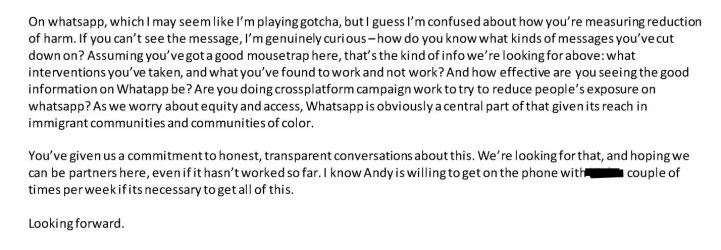
Unlike Facebook and Instagram, which are also owned by Meta, WhatsApp is an encrypted direct messaging platform that is used for private conversations between individuals or small groups. The White House has been pressing Meta executives to find ways to measure “reduction of harm” on WhatsApp, insisting that they must have a “good mousetrap” to observe what conversations are shared on the platform.
According to the report by David Zweig, who echoed Reclaim The Net’s reporting from January, the White House has also offered to work closely with Meta to curb the spread of so-called “vaccine-skeptical” content.
However, because of WhatsApp’s structure, targeted suppression or censorship of certain information is not possible. Instead, the focus of content moderation on WhatsApp has been to push information to users.
This has included partnering with the World Health Organization, UNICEF, and over 100 governments and health ministries to send COVID-19 updates and vaccine-related messages to users.
This move by the Biden administration raises concerns about the impact on freedom of expression and the ability to communicate privately on digital platforms.
With the White House pressing for content moderation on the platform, it could undermine this privacy and freedom of expression that is expected on end-to-end encrypted apps (although WhatsApp is perhaps less trusted anyway over its ties to Meta.)
EU warns of response to Belarus nuclear move
RT | March 26, 2023
The EU will respond with further sanctions if Belarus presses ahead with hosting Russian nuclear weapons on its soil, the bloc’s top diplomat, Josep Borrell, has stated. Borrell called the decision to transfer tactical weapons to Belarus “an irresponsible escalation” by Moscow.
“Belarus hosting Russian nuclear weapons would mean an irresponsible escalation and threat to European security,” Borrell tweeted on Sunday. “Belarus can still stop it, it is their choice,” he continued, adding that “the EU stands ready to respond with further sanctions.”
Russian President Vladimir Putin revealed on Saturday that his country’s tactical nuclear weapons will arrive in Belarus as early as this summer. Putin said that he made the decision after the UK announced it would transfer toxic depleted uranium munitions to Ukraine, a move he described as a sign of London’s “absolute recklessness.”
Belarus has already been extensively sanctioned by the EU and US since the start of Russia’s military operation in Ukraine last February. Brussels has blacklisted more than 20 Belarusian officials, cut five of the nation’s banks off from the SWIFT system, and imposed numerous trade restrictions.
Prior to 2022, the EU banned Belarusian flights from operating in its airspace and imposed five separate sets of sanctions in response to President Alexander Lukashenko’s 2020 election victory, which the EU deemed fraudulent.
In his announcement on Saturday, Putin explained that any nuclear weapons transferred to Belarus would remain under Russian control.
“There is nothing unusual,” about this arrangement, Putin stated, explaining that “the United States has been doing this for decades” by keeping its own nuclear weapons in Belgium, Germany, Italy, the Netherlands, and Türkiye.
“They have long deployed their tactical nuclear weapons on the territory of their allies,” he said. “We agreed that we will do the same, without violating our international obligations on the non-proliferation of nuclear weapons.”
Fake News No More: Dozens of Babylon Bee Satire Pieces Turn Into Real Stories
Sputnik – 26.03.2023
The Florida-headquartered satirical news website became a household name ahead of the 2020 presidential election, and has been characterized as The Onion for conservatives and Christians, although it is also enjoyed by independents and those who can handle a political joke or two.
The Babylon Bee has repeatedly been caught in government and media dragnets to crack down on so-called disinformation and fake news, with major outlets occasionally falling for and reprinting some of its gut-busting satirical claims, and Snopes even fact-checking a Bee piece about CNN buying an industrial-sized washing machine to literally spin the news.
Now, the company, whose tagline is ‘Fake News You Can Trust’, has a problem of another sort: its fake news pieces becoming reality.
According to Babylon Bee founder Seth Dillon, over 90 of the site’s joke headlines have become actual news stories over time.
“It ranges from really silly stuff like – we did a joke during the pandemic about how pants sales were plummeting because everyone was working from home. And it was this picture of a guy sitting there in his boxers, but he’s got a nice dress shirt on at his desk. And the very next day in Yahoo Finance there was this story about how Walmart was seeing increased sales of tops, but not bottoms,” Dillon recalled in an interview with US media.
“We make a joke about how Kamala Harris was taking likability lessons from Hillary Clinton, which is just insane and silly – who would take likeability lessons from Hillary Clinton? But then a month later there’s a real story that her staff reached out to Hillary’s staff to make her more likable,” he added.
In another example, last fall, the Bee penned a joke-style article offering “9 Reasons Not to Worry About the Tanking Economy.” Days later, a column appeared in Jeff Bezos’ Washington Post on “7 ways a recession could be good for you financially.”
“We even did one about Trump, about how Trump had claimed to have done more for Christianity than Jesus himself. That one went crazy viral, it got fact-checked and rated ‘false’, and two years later he actually said it. He said he’d ‘done more for Christianity than anyone else in history, in fact he’s done more for religion than anyone else in history,’” Dillon recalled.
The problem, Dillon said, is that today’s news stories often already come across as satire due to their whimsical, “incredibly outrageous” nature. “We’re living in really crazy, insane times. So yes, there are plenty of times where we pull up a headline, and we’re just baffled by it.”
The issue of fake, satirical news blending with reality has been a feature of reality for at least the past two decades, and been fueled by the rise of the internet and social media, and the often surreal political clown show in Washington. Academics have speculated that satire has become an important feature of the postmodern age in which we live because the latter denies the difference between reality and what appears to be, and embraces incoherence and meaninglessness.
Despite its obvious satirical nature, the Bee’s close-to-the-real-news approach and sharp political angle has gotten it into repeated trouble with censors. In 2022, the site saw its Twitter account suspended after jokingly labeling a transgender Biden administration official “man of the year.” The account was restored by Elon Musk after he bought out the microblogging giant last October.
What you need to know about Russia-China relations, but were afraid to ask
By Fyodor Lukyanov | RT | March 26, 2023
So much has been said about Xi Jinping’s visit to Russia last week, that the descriptive genre has been exhausted. What is needed instead is either details on specific aspects or some sort of in-depth socio-cultural analysis. That will no doubt be done by specialists in those areas, so we will confine ourselves here to brief answers to the most frequently asked questions.
Are Russia and China allies?
Both countries have limited experience of alliances and are not really inclined towards this form of relationship. Such a declaration implies a commitment and, more importantly, a limitation of one’s own interests and capabilities in favor of the other state. If it is reciprocal, it is fine – and can be mutually beneficial – but the dominant attitude in both Chinese and Russian political logic is freedom of action and maximum sovereignty. As a result, both Moscow and Beijing shy away from describing their relationship as an alliance, preferring more fluid phrases. This has happened again. It should be noted, however, that the expressions used by Xi come perhaps as close to the idea of an alliance (as is possible in Chinese culture) without using the term.
Is the relationship equal?
The question of equality is largely arbitrary – it is not clear how to measure it. There is no formal hierarchy in relations between Russia and China, and in principle there cannot be such a system. It is difficult to compare the weight. China is, of course, much more powerful economically, and now also in many technological respects. However, Russia is a major military and political power in its own right. Indeed, when it comes to preparedness for adverse changes and shocks (let’s call it state endurance), Moscow is probably in the lead, but Beijing’s room for maneuver in global politics is now much greater.
The question could be posed differently: who needs it more, and who should therefore do more to strengthen ties? At first glance, Russia would seem to need it the most – no matter how well you do, an acute conflict with a group of the world’s most successful and influential states significantly limits your options. Thus, they need to be compensated by other partners which are no less important and therefore able to impose conditions. The most powerful of them all is China.
This is true, but there is another side to it. Beijing has finally realized that the time of peaceful and comfortable development is over. It is China that the United States sees as its main adversary for decades to come, and the pressure on it will only increase. Beijing has no more solid and reliable partner than Moscow; there is simply no other candidate. And the importance of such a relationship will continue to grow. Traditional Chinese pragmatism works in our favor.
Did China support Russia in the Ukrainian conflict?
The Ukraine crisis is a complex phenomenon with multiple dimensions. China’s position on different aspects can vary. As far as the conflict between Moscow and Kiev itself is concerned, Beijing’s position boils down to restraint. China does not see it as its right (or interest) to interfere directly, limiting itself to calling for peace and respect for common norms. Russia’s set of claims against Ukraine, accumulated under specific historical circumstances, is not important to the Chinese, and is not their concern. There is, however, the other aspect – the conflict is central to Russia’s relations with the West and, consequently, has an effect on the state of the global hierarchy and the very world order itself. Beijing is much more active here, taking a position very close to Moscow’s and in opposition to that of the West.
Perhaps most importantly, China has no interest in seeing the US-led bloc succeed in Ukraine, which would significantly weaken Russia.
Beijing will therefore undoubtedly tread carefully, stressing the need for a cessation of hostilities and that there is no alternative, but it will not pressure Russia or take any action that would complicate its position. On the contrary, a gradual increase in support can be expected.
The Western orientation of Russia’s trade flows is a long-standing and complex problem. The current crisis, in which these relations have been abruptly severed on the initiative of the West, makes the task somewhat easier and leaves no other options open. Nevertheless, the restructuring will be painful and will take time, at least to build the infrastructure. The emerging political will (or lack of it) is stimulating a process of change in our country.
China is a global economic superpower, and its interests and needs extend almost everywhere. In strengthening relations with Russia, which is currently at a disadvantage in terms of external pressure, Beijing will carefully weigh the risks to itself. The Chinese are not going to blow themselves up for the sake of their northern brother.
However, Xi’s visit was crucial as a signal from the ruling Communist Party to all companies that they should work and look for opportunities in this country. This is understood in China. Russia’s task, for its part, is to support this process in every way possible.
Fyodor Lukyanov is the editor-in-chief of Russia in Global Affairs, chairman of the Presidium of the Council on Foreign and Defense Policy, and research director of the Valdai International Discussion Club.
Xi’s ‘Chilling’ Remarks: A Multipolar World Offers Challenges and Opportunities to the Middle East and Africa
By Ramzy Baroud | MEMO | March 26, 2023
The final exchange, caught on camera between visiting Chinese President Xi Jinping and his Russian host and counterpart, Vladimir Putin, sums up the current geopolitical conflict, still in its nascent stages, between the United States and its Western allies on the one hand, and Russia, China and their allies, on the other.
Xi was leaving the Kremlin following a three-day visit that can only be described as historic. “Change is coming that hasn’t happened in 100 years and we are driving this change together,” Xi said while clasping Putin’s hand.
“I agree,” Putin replied while holding Xi’s arm. ‘Please take care, dear friend,” he added.
In no time, social media exploded by sharing that scene repeatedly. Corporate western media analysts went into overdrive, trying to understand what these few words meant.
“Is that part of the change that is coming, that they will drive together?” Ian Williamson raised the question in the Spectator. Though he did not offer a straight answer, he alluded to one: “It is a chilling prospect, for which the west needs to be prepared.”
Xi’s statement was, of course, uttered by design. It means that the Chinese-Russian strong ties, and possible future unity, are not an outcome of immediate geopolitical interests resulting from the Ukraine war, or a response to US provocations in Taiwan. Even before the Ukraine war commenced in February 2022, much evidence pointed to the fact that Russia and China’s goal was hardly temporary or impulsive. Indeed, it runs deep.
The very language of multipolarity has defined both countries’ discourse for years, a discourse that was mostly inspired by the two countries’ displeasure with US militarism from the Middle East to Southeast Asia; their frustration with Washington’s bullying tactics whenever a disagreement arises, be it in trade or border demarcations; the punitive language; the constant threats; the military expansion of NATO and much more.
One month before the war, I argued with my co-writer, Romana Rubeo, that both Russia and China might be at the cusp of some kind of unity. That conclusion was drawn based on a simple discourse analysis of the official language emanating from both capitals and the actual deepening of relations.
At the time, we wrote,
“Some kind of an alliance is already forming between China and Russia. The fact that the Chinese people are taking note of this and are supporting their government’s drive towards greater integration – political, economic and geostrategic – between Beijing and Moscow, indicates that the informal and potentially formal alliance is a long-term strategy for both nations”.
Even then, like other analysts, we did not expect that such a possibility could be realized so quickly. The Ukraine war, in itself, was not indicative that Moscow and Beijing will grow closer. Instead, it was Washington’s response, threatening and humiliating China, that did most of the work. The visit by then-US House Speaker, Nancy Pelosi, to Taiwan in August 2022 was a diplomatic disaster. It left Beijing with no alternative but to escalate and strengthen its ties with Russia, with the hope that the latter would fortify its naval presence in the Sea of Japan. In fact, this was the case.
But the “100 years” reference by Xi tells of a much bigger geopolitical story than any of us had expected. As Washington continues to pursue aggressive policies – with US President Joe Biden prioritising Russia and his Republican foes prioritising China as the main enemy of the US – the two Asian giants are now forced to merge into one unified political unit, with a common political discourse.
“We signed a statement on deepening the strategic partnership and bilateral ties which are entering a new era,” Xi said in his final statement.
This ‘no-limits friendship‘ is more possible now than ever before, as neither country is constrained by ideological confines or competition. Moreover, they are both keen on ending the US global hegemony, not only in the Asia and Pacific region, but in Africa, the Middle East and, eventually, worldwide as well.
On the first day of Xi’s visit to Moscow, Russia’s President Putin issued a decree in which he has written off debts of African countries worth more than $20 billion. Moreover, he promised that Russia is “ready to supply the whole volume sent during the past time to African countries particularly requiring it, from Russia free of charge ..,” should Moscow decide “not to extend the (grain) deal in sixty days.”
For both countries, Africa is a major ally in the upcoming global conflict. The Middle East, too, is vital. The latest agreement, which normalised ties between Iran and Saudi Arabia is earth-shattering, not only because it ends seven years of animosity and conflict, but because the arbitrator was no other than China itself. Beijing is now a peace broker in the very Middle East which was dominated by failed US diplomacy for decades.
What this means for the Palestinians remains to be seen, as too many variables are still at work. But for these global shifts to serve Palestinian interests in any way, the current leadership, or a new leadership, would have to slowly break away from its reliance on western handouts and validation, and, with the support of Arab and African allies, adopt a different political strategy.
The US government, however, continues to read the situation entirely within the Russia-Ukraine war context. US Secretary of State Antony Blinken responded to Xi’s trip to Moscow by saying that “the world should not be fooled by any tactical move by Russia, supported by China or any other country, to freeze the war (in Ukraine) on its own terms.” It is rather strange, but also telling that the outright rejection of the potential call for a ceasefire was made by Washington, not Kyiv.
Xi’s visit, however, is truly historic from a geopolitical sense. It is comparable in scope and possible consequences to former US President Richard Nixon’s visit to Beijing, which contributed to the deterioration of ties between the Soviet Union and China under Chairman Mao Zedong.
The improved relationship between China and the US back then helped Washington further extend its global dominance, while putting the USSR on the defensive. The rest is history, one that was rife with geostrategic rivalry and divisions in Asia, thus, ultimately, the rise of the US as the uncontested power in that region.
Nixon’s visit to Beijing was described by then-Ambassador Nicholas Platt as “the week that changed the world.” Judging that statement from an American-centric view of the world, Platt was, in fact, correct in his assessment. The world, however, seems to be changing back. Though it took 51 years for that reversal to take place, the consequences are likely to be earth-shattering, to say the least.
Regions that have long been dominated by the US and its western allies, like the Middle East and Africa, are processing all of these changes and potential opportunities. If this geopolitical shift continues, the world will, once again, find itself divided into camps. While it is too early to determine, with any degree of certainty, the winners and losers of this new configuration, it is most certain that a US-western-dominated world is no longer possible.
Featured Video

Pentagon Fast Tracks Iran War Ground Option
or go to
Aletho News Archives – Video-Images
From the Archives
The Heirs of Meyer Lansky Want Compensation from Cuba. They Shouldn’t Get a Dime.
By Jack Colhoun | History News Network | June 19, 2016

Meyer Lansky
The heirs of Meyer Lansky, the impresario of the North American Mafia gambling colony in Cuba (1933-1958) are betting on a big payback from the negotiations between the United States and Cuba to normalize relations between the two countries. Compensation claims by U.S. citizens or businesses for properties nationalized by the Cuban revolution are among the issues under discussion.
Lansky’s daughter Sandi, her son Gary Rapoport, and her brother Paul have filed a compensation claim against Cuba for the Riviera Hotel and Casino with the U.S. Foreign Claims Settlement Commission. The Cuban revolution confiscated the Riviera and other Mafia-owned properties after it toppled the gangster-linked regime of General Fulgencio Batista in 1959.
“It was through my grandfather’s hard work that the hotel was built,” Rapoport told the U. K. Daily Mail Online on December 23, 2015. “We are his natural relations . . . . By right, it should be our property.” He says the Riviera is valued at $70 million. The Tampa Bay Tribune, Reuters, and Haaretz have also covered the story.
The Riviera, which overlooks the Straits of Florida, was the crown jewel of Lansky’s casinos, hotels, and nightclubs in Havana. When the Riviera opened in December 1957, it was the largest Mafia-owned hotel-casino outside Las Vegas. The hotel’s 440 double rooms were booked solid for the winter season of 1957-1958.
However, the narrative that the success of the Riviera was the product of Meyer Lansky’s “hard work” is undercut by Lansky’s own assessment of his arrangement with Batista. … continue
Blog Roll
 Aletho News
- Zionist takeover: Trump’s war on Iran reveals who really dictates US foreign policy
- Iran’s strike on Dimona – Israel’s nuclear weapons research center – shows Israeli air defences are weakened
- Fidel Castro’s War on Jewish Mobster Meyer Lansky
- US Trying to Oust Russia From All Energy Markets – Lavrov
- Western silence allows Israel to get away with killing journalists
- The Israeli Media Is Laying The Groundwork For a Permanent Israeli Occupation Of Southern Lebanon
- Role reversal – “divide & conquer” used against the west
- Iran signals upper hand as the US-Israeli war reaches third week
- Airlines Suffer Losses Estimated at $53Bln Due to Middle East Conflict
- Have you heard the latest joke about Trump and Iran?
- If Americans Knew
- Israel’s assassination game: Take all pragmatists off the board
- Food shortages return to Gaza as Israel tightens aid restrictions under the cover of its war on Iran
- Trump demands trillions in payments from Gulf countries, billions from Harvard – Not a ceasefire Day 162
- Meet the former fashion blogger and shady doctor behind the ‘30,000 dead’ Iran psy-op
- Vatican Secretary of State to Trump, Israel: End the war as soon as possible
- The Majority of Americans Believe War Against Iran Benefits Israel More Than US
- Efforts to shut down pro-Palestinian speech face series of setbacks in court
- What has Israel done to my brother?
- Eid without worship in Al Aqsa – Not a ceasefire Day 161
- Trump: Israel attacked Iranian gas field without US knowledge. No more such attacks!
- No Tricks Zone
- Former Pfizer Toxicologist Dr. Helmut Sterz Tells Bundestag Hearing Pfizer Vaccine Should Have Never Been Approved
- Energy Expert: Germany’s Nuclear Phaseout Was A “500 Billion Euro Mistake”
- New Research: South Australia’s Mid-Holocene Sea Surface Temperatures Were 4°C Warmer Than Today
- Storing Green Energy To Last Germany 10 Days Would Require A 60-Million Tonne Battery
- New Studies: UK Sea Levels Were 4 Meters Higher Than Today During The Mid-Holocene
- Destructive Green New Deal: German Energy And Metal Group Warns Of Drastic Crisis
- New Study Documents A 20-Year Pause In Arctic Sea Ice Decline – Driven By Internal Variability
- Wake-up Call: Survey Shows Majority Of Germans Now Favor Postponing Climate Targets!
- Televised! Leading German Political Candidate Tells Schoolchildren CO2 Makes Sun Hotter!
- New Study: A Century Warming Of 1.1°C Is ‘Commonplace’ And ‘Not Unusual’ During This Interglacial
 Aletho News