Leaked files: Britain’s secret propaganda ops in Yemen
By Kit Klarenberg | The Cradle | April 17 2023
Yemen’s civil war, considered the world’s gravest humanitarian crisis, appears to be nearing its end due to a China-brokered detente between Iran and Saudi Arabia, who support opposing sides in the bitter conflict.
Early signs suggest that the rapprochement between Tehran and Riyadh may not only end hostilities in Yemen, but across the wider region.
The US, Israel, and Britain have the most to lose from a sudden onset of peace in West Asia. In the Yemeni context, London may be the biggest loser of all. For years, it provided the Saudi-led coalition with weaponry used to target civilians and civilian infrastructure, with receipts running into billions of pounds sterling.
During the entirety of the war, Yemen was struck by British-made bombs, dropped by British-made planes, flown by British-trained pilots, which then flew back to Riyadh to be repaired and serviced by British contractors. In 2019, a nameless BAE Systems executive estimated that if London pulled its backing for the proxy war, “in seven to 14 days, there wouldn’t be a jet in the sky.”
In addition to supplying weapons, the war also presented a golden opportunity for Britain to establish a military base in Yemen, fulfilling long-held fantasies of recovering the Empire’s long-lost glory days “East of Suez.”
Al-Ghaydah airport in al-Mahrah, Yemen’s far eastern governorate, has for some time quietly housed “a fully-fledged force” of British soldiers, providing “military training and logistical support” to coalition forces and Saudi-backed militias. There are even indications that this involvement could extend to torture methods, which is a troubling reflection of one of London’s leading exports.
The Cradle has obtained exclusive information about a previously undisclosed aspect of London’s role in the proxy war against Yemen’s Ansarallah-led resistance. It has been revealed that a multi-channel propaganda campaign, led by the intelligence cut-out ARK and its founder Alistair Harris, a veteran MI6 operative, has been operating in complete secrecy throughout the nine-year-long conflict – one that specifically targeted Yemen’s civilian population.
Anti-Ansarallah ops
Leaked Foreign Office documents have revealed that ARK’s “multimedia” information warfare campaign was designed to undermine public sympathy for the Ansarallah movement and ensure that the conflict would only end on terms that aligned with London’s financial, ideological, and geopolitical interests.
For instance, public acceptance of the UN’s widely unpopular peace proposal required propaganda support from local NGOs and media organizations that “support UK objectives” to “communicate effectively with Yemeni citizens” and change their minds.
It was also necessary to counter “new actors” in the information space that were critical of the Saudi-led coalition’s brutal bombing campaigns and the illegitimate, US-backed puppet government that the aerial assaults sought to protect.
Considering the high rate of illiteracy in the local population, ARK conceived the creation of a suite of “visually rich” products extolling the virtues of a Riyadh-dominated peace plan. These products would be disseminated on and offline, would “deliberately include different demographics, sects, and locations to ensure inclusivity,” and would be informed by focus groups and polling of Yemenis. ARK’s campaign even extended to convening “gender-segregated poetry competitions using peace as a theme” and “plays and town hall meetings.”
Publicly, many of these propaganda products appeared to be the work of Tadafur – Arabic for “work collectively and unite” – an astroturf network of NGOs and journalists constructed by ARK. Its overt mission was to “resolve local level conflicts” and “unite local communities in their conflict resolution efforts.”
The campaign began initially at a “hyper-local level” across six Yemeni governorates, “before being amplified at the national level.” Activities “[in] all areas and at both levels” had unified messaging across “common macro themes,” such as the slogan “Our Yemen, Our Future.”
In each governorate, a “credible” local NGO was identified as a messenger, along with “well-known” and “respected and influential” journalists who served as “dedicated field officers” across the sextet, managed by ARK.
In Hajjah – “a site of strong Houthi influence” – the Al-Mustaqbal Institute for Development was ARK’s NGO of choice; in Ansarallah-governed Sanaa, it was the Faces Institution for Rights and Media; in Marib, the Marib Social Generations Club; in Lahij, Rouwad Institution for Development and Human Rights; in Hadhramaut, Ahed Institute for Rights and Freedom; in Taiz, Generations Without Qat.
These local NGOs were instrumental in promoting ARK’s agenda and advancing the narrative that aligned with Britain’s objectives in Yemen.
The company’s roster of “field officers” comprised of individuals with various backgrounds, such as:
“Human rights abuse” specialist Mansour Hassan Mohammad Abu Ali, TV producer Thy Yazen Hussain, Public Organisation to Protect Human Rights press official and “experienced journalist” Waleed Abdul Mutlab Mohammed al-Rajihi, producer from Alhadramiah Documentary Institute Abdullah Amr Ramdan Mas’id, editorial secretary of Family and Development magazine and the Yemen Times’ Taiz news manager Rania Abdullah Saif al-Shara’bi, as well as journalist and activist Waheeb Qa’id Saleh Thiban.
A Trojan Horse
Once ARK’s field officers and NGOs “successfully designed and implemented hyper-local campaigns,” coverage of “information around the related activities will then be amplified at the national level.” A key platform for this amplification was a Facebook page called “Bab,” launched in 2016 with tens of thousands of followers who were unaware that the page was created by ARK as a British intelligence asset.
Under the guise of a popular grassroots online community, ARK used the Bab page to broadcast slick propaganda “promoting the peace process,” including videos and images of “local peacebuilding initiatives” organized by its NGO and field officer nexus.
“Campaign content will highlight tangible, real-life examples of compelling peacebuilding efforts that all Yemenis, regardless of their political affiliation, can relate to,” ARK stated.
“These will offer inspirational examples for others to emulate, demonstrating practical ways to engage with the peace process at a local level. Taken together, these individual stories form the broader campaign with a national message: Yemenis share a collective desire for a peaceful resolution to the conflict.”
When “high engagement levels” with this content were secured, Bab users were invited to submit their own, which demonstrated “support for the peace process.” They were explicitly asked “to mirror content ARK has produced, such as voxpops, short videos, or infographics.” This was then “shared by the project and field teams through influential WhatsApp messaging groups, a key way of reaching Yemeni youth.”
ARK’s “well-connected communications team” would then “strategically share packaged stories with broadcast media or key social influencers, or offer selected journalists exclusive access to stories.” Creating a constant flow of content was a deliberate ploy to “collectively be as ‘loud’ as partisan national political and military actors.” In other words, to create a parallel communications structure to Ansarallah’s own, which would drown out the resistance movement’s pronouncements.
ARK’s role in Yemen’s peace process
While one might argue that the non-consensual recruitment of private citizens as information warriors by British intelligence was justified by the moral urgency of ending the Yemen war quickly, the exploitation of these individuals was cynical in the extreme. It amounted to a Trojan Horse operation aimed at compelling Yemenis to embrace a peace deal that was wildly inequitable and contrary to their own interests.
Multiple passages in the leaked files refer to the paramount need to ensure no linkage between these propaganda initiatives and the UN’s peace efforts. One passage refers to how campaign “themes and activities” would at no point “directly promote the UN or the formal peace process,” while another says concealing the operation’s agenda behind ostensibly independent civil society voices “minimizes the risk” that “outputs are perceived as institutional communications stemming from or directly promoting the UN.”
Yet, once ARK’s campaigns began “performing successfully at the national level,” the company’s field officers planned to “build a bridge” between its local foot soldiers and national “stakeholders” – and, resultantly, the UN. In other words, the entire ruse served to entrench ARK’s central role in peace negotiations via the backdoor.
Diminished western influence
At that time, the ceasefire deal proposed by the UN required Ansarallah and its allied forces to virtually surrender before Riyadh’s military assaults and economic blockade of the country could be partially lifted, along with other stringent requirements that the Saudis refused to compromise on. The US aggressively encouraged such intransigence, viewing any Ansarallah influence in Yemen as strengthening Iran’s regional position.
However, these perspectives are no longer relevant to Yemen’s peace process. China has now encouraged Riyadh to offer significant concessions, and as a result, the end of the war is within sight, with critical supplies finally allowed to enter Yemen, prisoners returned, Sanaa’s airport reopened, and other positive developments.
Evidently, Washington’s offers of arms deals and security assurances are no longer sufficient to influence events overseas and convince its allies to carry out its agenda. The failure of ARK’s anti-Ansarallah propaganda campaigns to coerce Yemenis to accept peace on the west’s terms also highlights Britain’s significantly reduced power in the modern era.
Whereas wars could once be won on the coat-tails of well-laid propaganda campaigns, the experiences of Yemen, Syria, Iraq, and Afghanistan show that the tide has turned. Subversive information campaigns can confuse and misdirect populations but, at best, can only prolong conflict – not win it.
Losing ‘Deterrence’: How Palestinian, Arab Resistance changed rules of war with Israel
By Ramzy Baroud | MEMO | April 17, 2023
When Israel launched a war against the Gaza Strip in August 2022, it declared that its target was the Islamic Jihad only. Indeed, neither Hamas nor the other Gaza-based groups engaged directly in the fighting. The war then raised more questions than answers.
Israel rarely distinguishes between one Palestinian group and another. For Tel Aviv, any kind of Palestinian Resistance is a form of terrorism or, at best, incitement. Targeting one group and excluding other supposedly ‘terrorist groups’ exposes a degree of Israeli fear in fighting all Palestinian factions in Gaza, all at once.
For Israel, wars in Gaza have proved progressively harder with time. For example, Israel’s so-called ‘Protective Edge’ in 2014 was very costly in terms of loss of lives among the invading troops. In May 2021, the so-called ‘Breaking Dawn’ was an even bigger flop. That war unified the Palestinians and served as a strategic blow to Israel, without considerably advancing Israeli military interests.
Though the Gaza groups provided the Islamic Jihad with logistical support in August 2022, they refrained from directly engaging in the fight. For some Palestinians, this was unexpected and was interpreted by some as indicative of weakness, disunity and even political opportunism.
Nearly a year later, another war loomed, following the release of harrowing footage of Israeli police senselessly beating up peaceful Palestinian worshipers at Al-Aqsa Mosque on the 14th day of the holy month of Ramadan. Like in May 2021, Palestinians rose in unison. This time, it was Resistance groups in Gaza and, eventually, Lebanon and Syria that fired rockets at Israel first.
Though Israel hit back at various targets, it was obvious that Tel Aviv was disinterested in a multi-front war with Palestinians, in order to avoid a repeat of the 2021 fiasco.
The violent and repeated Israeli military raids at Al Aqsa – and limited, though deadly attacks on Jenin, Nablus, and other parts of the West Bank – were meant to achieve political capital for the embattled government of Benjamin Netanyahu. But this strategy could only succeed if Israel manages to keep the violence confined to specific, isolated regions.
Large-scale and protracted military operations have proven useless for Israel in recent years. It has repeatedly failed in Gaza, as it did before in South Lebanon. The unavoidable change of strategy was also costly from the Israeli viewpoint, as it empowered the Palestinian Resistance, and denied Israel its so-called deterrence capabilities.
Indeed, the political discourse emanating from Israel recently is quite unprecedented. Following a security briefing with Netanyahu on 9 April, Israel’s opposition leader, Yair Lapid, left with ominous words. “I arrived at the briefing with Netanyahu worried, and I left even more worried.”
“What our enemies see in front of them, in all arenas, is an incompetent government … We’re losing our deterrence,” he added. The Times of Israel also quoted Lapid as saying that “Israel is losing the support of the United States and the international community.”
Though Israeli politics is inherently divisive, the country’s politicians have always managed to unify around the subject of ‘security’. During wars, Israelis often exhibited unity, and ideological divides seemed largely irrelevant. The fact that Lapid would publicly expose Israel’s weaknesses for political gains further highlights the deterioration of Tel Aviv’s political front.
But more dangerous for Israel is the loss of deterrence.
In an article published in the Jerusalem Post on 11 April, Yonah Jeremy Bob highlighted another truth: “Israel no longer decides when wars are fought.”
He writes: “One could have concluded this from the 2014 and May 2021 Gaza wars that Israel stumbled into, and which Hamas used to score various public relations points … but now Hamas learned in a more systematic way … how to instigate its own ring of fire around Jerusalem.”
The writer’s hyped language aside, he is not wrong. The battle between Israel and Palestinian Resistance groups has been largely centred around timing. Though Israel did not ‘stumble’ into a war between 2014 and 2021, it has not been able to control the duration and the political discourse around these wars. Though thousands of Palestinians were killed in what seemed like one-sided Israeli military campaigns, these conflicts almost always resulted in a public relations disaster for Tel Aviv abroad and further destabilised an already shaky home front.
This explains, at least in part, why Palestinians were keen not to expand the August 2022 war, which was also entirely initiated by Israel, while taking the initiative by firing rockets at Israel, starting on 5 April. The latest Palestinian action forced Israel to engage militarily on several fronts – Gaza, Lebanon, Syria and, arguably, the West Bank.
Throughout its 75 years of military conflict with Palestinians and Arabs, Israel’s success on the battlefield has been largely predicated on the unhindered military, logistical and financial support from its Western allies, and the disunity of its Arab enemies. This has allowed Israel to win wars on multiple fronts in the past, with the 1967 war serving as the main, and possibly, last example.
Since then, and especially following the considerable Arab resistance in the 1973 war, Israel shifted to different types of military conflicts: strengthening its occupation in the West Bank, Gaza and East Jerusalem, while launching massive wars at singular fronts – for example, Lebanon 1982.
The Israeli retreat from Lebanon in 2000, and the utter failure to re-invading parts of the country in 2006, brought Israel’s military ambitions in Lebanon to a complete halt.
Then, Israel turned to Gaza, launching one devastating war after the other, starting in 2008, only to discover that its military options in the besieged Strip are now as limited as that of Lebanon.
For Lapid, and other Israelis, the future of Israel’s ‘deterrence’ is now facing an unprecedented challenge. If the Israeli military is unable to operate at ease and at the time of its choosing, Tel Aviv would lose its ‘military edge’, a vulnerability that Israel has rarely faced before.
While Israeli politicians and military strategists are openly fighting over who has cost Israel its precious ‘deterrence,’ very few seem willing to consider that Israel’s best chance at survival is peacefully co-existing with Palestinians according to the international principles of justice and equality. This obvious fact continues to elude Israel after decades of a violent birth and troubled existence.
– Dr. Ramzy Baroud is a journalist, author and the Editor of The Palestine Chronicle. He is the author of six books. His latest book, co-edited with Ilan Pappé, is ‘Our Vision for Liberation: Engaged Palestinian Leaders and Intellectuals Speak Out’. His other books include ‘My Father was a Freedom Fighter’ and ‘The Last Earth’. Baroud is a Non-resident Senior Research Fellow at the Centre for Islam and Global Affairs (CIGA).
The RESTRICT Act will usher in a new era of censorship under the guise of “national security”
By Tom Parker | Reclaim The Net | April 17, 2023
45 days after 9/11, the United States government passed the PATRIOT Act — a chilling law that used the guise of “national security” to greatly expand the federal government’s secret surveillance powers.
Almost 23 years later, another far-reaching bill, the “Restricting the Emergence of Security Threats that Risk Information and Communications Technology Act,” better known by its acronym, the RESTRICT Act, is using the same national security talking point to justify further federal government encroachment on Americans’ rights.
Although the bill doesn’t mention TikTok, its authors, Democratic Senator Mark Warner and Republican Senator John Thune, have framed it as “the best way to counter the TikTok threat.”
However, the impact of the bill extends far beyond TikTok and gives the US government sweeping powers to ban a wide range of apps and services.
The bill authorizes the Secretary of Commerce to review and prohibit “current, past, or potential future transactions” involving technology products or services with more than one million US-based annual active users that:
- Are deemed to pose an “undue or unacceptable risk” in various areas (such as national security and election interference)
- Involve anyone determined to be “owned, directed, or controlled” by a “foreign adversary” (a term that can currently be applied to China, Cuba, Iran, North Korea, Russia, and Venezuela but can be extended to other nations by the Secretary)
The Secretary of Commerce can also refer these tech products and services to the President who can take action to “compel divestment of, or otherwise mitigate the risk” associated with them.
Caitlin Vogus, the deputy director of rights group the Center for Democracy & Technology’s Free Expression Project, warned that these powers target the free speech rights of Americans. In a statement to Motherboard, she said:
“The RESTRICT Act could lead to apps and other ICT [information communication technology] services with connections to certain foreign countries being banned in the United States. Any bill that would allow the US government to ban an online service that facilitates Americans’ speech raises serious First Amendment concerns.”
Rights groups have also sounded the alarm about the RESTRICT Act’s threats to fine or imprison those who attempt to “evade the provisions” of the bill — a threat that they fear could be aimed at US citizens who attempt to access banned apps or services.
The RESTRICT Act states: “No person may engage in any transaction or take any other action with intent to evade the provisions of this Act.”
The bill even makes it unlawful to “approve” of “any act” that tries to evade the provisions of the bill.
People that violate these rules can be fined up to $1 million and imprisoned for up to 20 years.
Senator Warner has insisted that these penalties won’t be used to target individual users.

However, digital rights group the Electronic Frontier Foundation (EFF), has noted that the bill doesn’t actually prevent individual users from being targeted. In an article about the RESTRICT Act, the EFF warned:
“Due to undefined mitigation measures coupled with a vague enforcement provision, the bill could also criminalize common practices like using a VPN or side-loading to install a prohibited app.”
Another concerning aspect of the RESTRICT Act is that it allows the Secretary of Commerce to form technical advisory committees without them being subject to Chapter 10 of part 1 of title 5 of the United States Code.
This section of the law aims to reduce “the undue influence” of special interests and lobbyists. It allows Congress to review the proposed activities of advisory committees before they’re formed and ensure that these committees aren’t being “inappropriately influenced” by special interests. It also requires advisory committees to report their activities and goals to Congress, make their meetings open to the public, make transcripts available to the public, and file reports with the Library of Congress.
Excluding RESTRICT Act advisory committees from this section of the law opens the door for lobbyists representing US tech giants to serve on these committees, push for their competitors in other countries to be banned, and further cement their dominance.
And the problems don’t end here. The RESTRICT Act also limits judicial, congressional, and public scrutiny of the government’s actions.
Actions taken by the Secretary of the Treasury under this act are exempt from sections 551, 553-559, and 701-707 of title 5 of the United States Code — sections that require federal officials and agencies to provide public notice when proposing rule making, allow interested persons to participate in the rule making, and give those who suffer legal wrong as a result of government action the right to judicial review.
The scope of judicial review under the RESTRICT Act is limited to the US Court of Appeals for the District of Columbia Circuit and the court is prohibited from disturbing “any action taken” by the Secretary or the President when they review or prohibit transactions or take action against tech products and services, unless a petitioner demonstrates that the action is unconstitutional or violates a statutory command.
Additionally, Americans have “no right of access” to the information that the government uses when deciding whether to prohibit transactions involving technology products or services under this bill. The Freedom of Information Act also doesn’t apply to any information submitted by affected parties or created by the government when reviewing such transactions.
We obtained a copy of the RESTRICT Act for you here.
Despite the glaring problems with the bill, its architects are blaming TikTok for the criticism and claiming that the owners of the app are “spreading false claims about the Restrict Act in an effort to continue operating with impunity.”
According to Warner, the RESTRICT ACT has more than 20 bipartisan cosponsors.

The bill also has the full support of the Biden White House which has already demonstrated that it’s no fan of free speech and is currently being sued for alleged First Amendment violations.
If the RESTRICT Act passes, the Biden admin and any future pro-censorship administrations will be handed new powers to continue their crackdowns on online speech.
Canada’s state media quit Twitter over label
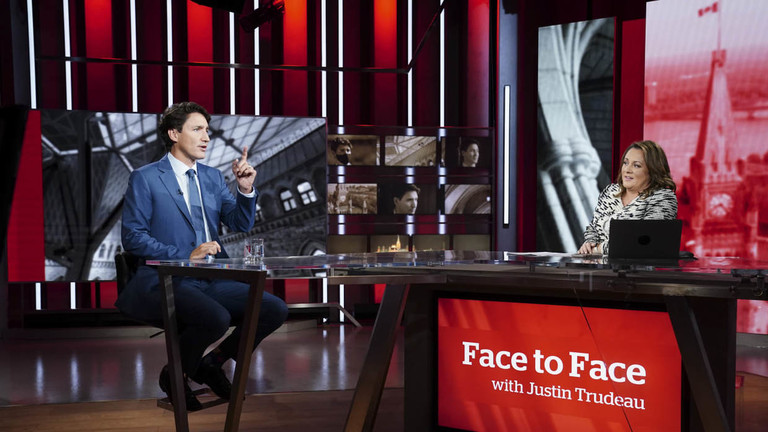
Canadian PM Justin Trudeau on CBC’s Face To Face with host Rosemary Barton in Toronto, September 12, 2021. © Global Look Press/Keystone Press Agency
RT | April 17, 2023
The Canadian Broadcasting Corporation (CBC) announced on Monday that it was “pausing” its activity on Twitter after the social media platform labeled it as state-funded, arguing that this somehow impugned their editorial independence.
“Our journalism is impartial and independent. To suggest otherwise is untrue. That is why we are pausing our activities on Twitter,” the government-funded outlet tweeted.
“Twitter can be a powerful tool for our journalists to communicate with Canadians, but it undermines the accuracy and professionalism of the work they do to allow our independence to be falsely described in this way,” CBC spokesperson Leon Mar said on Sunday evening. “Consequently, we will be pausing our activity on our corporate Twitter account and all CBC and Radio-Canada news-related accounts.”
The CBC is a Crown corporation, entirely owned by the Canadian state. In its 2021-22 annual analysis, it reported receiving 1.24 billion ($930 million) Canadian dollars in government funding. However, the outlet insists that its editorial policies are entirely independent of the government and guided only by “public interest.”
Mar argued that Twitter’s own policy defines government-funded media as those in which the authorities “may have varying degrees of government involvement over editorial content,” which is “clearly not the case with CBC/Radio Canada.”
Leader of the opposition Conservative Party Pierre Poilievre reacted to the labeling of CBC by tweeting that “Now people know that it is [Canadian PM Justin] Trudeau propaganda, not news.”
Last week, Poilievre called on Twitter owner Elon Musk to add the label to the broadcaster, saying it was needed to protect Canadians against “disinformation and manipulation by state media.” Describing the CBC as government-funded is a fact, the politician said, “and Canadians deserve the facts.”
The CBC’s Twitter boycott echoes the actions of two US outlets, the National Public Radio (NPR) and the Public Broadcasting Service (PBS). Both stopped tweeting last week, in response to being labeled as government-funded.
PBS also insisted that it was entirely editorially independent and produced “trustworthy content that features unbiased reporting.” The outlet could not argue that it didn’t receive government funding, as 31% of its revenue came from federal, state and local authorities, with another 12% coming from regional public broadcasters and universities, also heavily subsidized by the government.
Twitter originally rolled out the labeling of outlets in August 2020, tagging Russian and Chinese media as “state-affiliated” but exempting Western outlets such as the BBC and Voice of America (VOA). As documents published after Musk’s takeover showed, the platform was working hand in glove with what several US journalists described as a “censorship-industrial complex” of government agencies and politically motivated NGOs.
MORE UNANSWERED RED FLAGS REGARDING JACK TEXEIRA
By Larry Johnson | SONAR | April 16, 2023
Several former military and intelligence professionals have contacted me and voiced similar doubts about the pat story being circulated regarding National Guard Airman Jack Texeira and the allegations that he removed TOP SECRET documents from a SCIF, photographed them and then posted them to a gamer chat. They all agree, something is not right. The media account does not make sense.
The biggest oddity are the two two separate documents from the CIA’s Operations Center. Neither are complete and both deal only with the Ukrainian/Russian war. To reiterate a point from my previous article, that CIA Operations Center produces two daily reports — one in the morning and one in the afternoon. It is not a “Community” product, i.e., it is not distributed to the other intelligence agencies. It is an internal CIA document (of course, it is available to the Director of National Intelligence).
Texeira’s alleged possession of two separate reports is doubly odd because he did not copy the full reports. The one dated 1 March 2023 only shows 3 of 8 pages. If he was taking the documents to impress the youngsters on the gamer chat, why did he not take the whole enchilada? And why did he only publish the portions of the intel report that dealt exclusively with Ukraine and Russia?
There has been some media reports that he also posted a State Department EXDIS cable. I have not seen it and cannot confirm that it exists. If it does, that would be another huge red flag. EXDIS is bureaucratic speak for EXCLUSIVE DISSEMINATION. It has a cousin, NODIS — i.e., NO DISTRIBUTION. The U.S. military does not have access to such cables.
There was a time when State EXDIS was available to U.S. military commands on a restricted basis. That was pre-Chelsea Manning. After Manning’s leaks in 2010, that access was cut off. I know this first hand because I was part of a team scripting military exercises for all U.S. regional commands (i.e., EUCOM, NORTHCOM, AFRICOM, PACOM, CENTCOM and SOUTHCOM) during the course of a year. I was the State Department Subject Matter Expert. That means I had the job of creating cable traffic from the Secretary of State or U.S. Embassies that the U.S. military might see during a terrorist crisis. Prior to the Manning/Wikileaks leak, I had full access to State Department messages, including EXDIS. After Manning, that access was terminated. Not just for me but for all the uniformed personnel I worked with. All held TS SCI clearances. There has been no change in that policy, which means there is no way that Jack Texeira would have had any access to copy and take a State Department EXDIS message.
Another curiosity with the story, apart from Jack’s youth and the claim that he held TS SCI clearances and had access to CIA internal reports, is the schedule of his Massachusetts Air National Guard unit. That outfit had not been called up and assigned a 24 x 7 mission. Instead, the Air National Guard unit meets one weekend a month. In other words, Jack had to work his magic over a two or three day period surrounded by peers and those in command of the unit. You do not just show up and pursue your own interests. There are drills and assigned work, which is supervised by Non-Commissioned Officers (i.e., Sergeants) and Officers.
The documents I have seen posted on Twitter and Telegram, were dated 28 February, 1 March and 2 March, i.e., Tuesday, Wednesday and Thursday. According to the MI-6 funded Bellingcat, those documents were published on 4 March, a Saturday. Let’s assume that Texeira’s National Guard unit assembled for drill on March 4. We’re asked to believe that Jack Texeira showed up for monthly Air National Guard duty on Saturday, quickly scoured the high side computer for sensitive documents, printed them off, smuggled them out of the SCIF, returned home sometime after 5 pm (normal end of duty day), photographed the documents and quickly uploaded them to the Discord server. If that is what happened, it smacks of urgency. Most young airmen, after a long day at work, want to go out and party rather than stay at home photographing documents.
I remain skeptical of the narrative and hope by raising these questions that some genuine journalists will explore the oddities and try to get to the ground truth.
Blair knew Iraq bombing was illegal but ordered it anyway – media

Tony Blair and Bill Clinton at the National Constitution Center in Philadelphia, Pennsylvania, September 13, 2010 © AP / Matt Rourke
RT | April 17, 2023
Former British Prime Minister Tony Blair ordered the 1998 bombing of Iraq despite repeated warnings that such a move was unlawful, according to documents published by Declassified UK on Monday. Blair would follow the same template – insisting that illegal military action was legal – when the UK invaded Iraq in 2003.
The US and UK launched a four-day bombing campaign against Iraq in December 1998, after then-US President Bill Clinton accused Saddam Hussein of breaching commitments to the UN and developing weapons of mass destruction. As many as 1,400 Iraqi soldiers were killed in strikes on around 100 military facilities.
In the runup to the bombings, Blair was repeatedly told by his advisers that using force against Iraq would be illegal without a resolution from the UN Security Council, according to documents from the National Archives cited by Declassified UK, an investigative outlet that focuses on Britain’s military and intelligence agencies.
Attorney General John Morris reportedly told Blair in November 1997 that obtaining a statement from the Security Council would be “an essential precondition” to military action, while Blair’s private secretary, John Holmes, told the prime minister that British law officers and Foreign Secretary Robin Cook had a “serious problem about using force unless the Security Council declares that Iraq is in ‘material breach’ of previous resolutions.”
When the law officers refused to authorize the military to draw up targeting plans, Blair reportedly wrote to Holmes, stating that he found their argument “unconvincing.”
Blair continuously received warnings throughout 1998, the report alleged, with Cook’s private secretary writing to Holmes that February to warn that “the negative implications for international support if we resort to military action without a new resolution would be serious.”
When Blair announced military action to Parliament in November, he declared: “I have no doubt that we have the proper legal authority, as it is contained in successive Security Council resolution documents.” British officials claimed that a 1990 resolution authorizing UN members to force Hussein’s army out of Kuwait gave them permission to intervene again in Iraq, an argument that only the US, Japan, and Portugal supported.
According to the documents, Blair saw bombing Iraq as essential to maintaining his close relationship with Clinton. In a meeting with advisers in November, he supposedly said that failing to intervene would cause “extreme damage” to US-UK relations. That same day, even as his own aides maintained that intervention was illegal, Blair told Clinton that the US “could count on our support.”
Five years later, Blair would find himself in the same situation, when he falsely claimed that Hussein was harboring weapons of mass destruction and invoked earlier Security Council resolutions to justify invading Iraq. Again, Blair was warned by his attorney general that military action would defy international law, and again he pressed ahead regardless.
More than a decade later, a public inquiry found that the legal case for the invasion was “far from satisfactory,” while then-UN Secretary General Kofi Annan maintained from the outset that the war was “illegal.”
The Planned Ukrainisation of Georgia
By Alexander Markovics | Arktos | April 15, 2023
Protesters throw Molotov cocktails at police officers. With the EU flag in hand, they try to storm the parliament. What sounds like a civil war scenario or a textbook colour revolution took place from 6 to 10 March in the Caucasus state of Georgia. The ‘bone of contention’ here, quite literally, was a legislative proposal by the Georgian government, which aimed to disclose the foreign funding of NGOs if they receive more than 20% of their money from abroad. Such organisations would have been obliged to grant the Ministry of Justice access to all data, including personal information. However, what is common practice in the USA and other Western countries was denounced as an ‘authoritarian turn’ by Brussels and Washington in this case.
The main call for protests came from the organisation Transparency International, which would have been primarily affected by this law. Its publicly accessible supporters belong to a geopolitically Western-oriented family: the EU Commission, the Open Society Foundation of the self-proclaimed ‘King of Eastern Europe’ George Soros, and the International Republican Institute, which is close to the National Endowment for Democracy, in turn, a think tank and revolution factory funded by the United States. The Georgian government had every reason to cast a critical eye on the numerous NGOs in the country, not least because a colour revolution had already taken place in 2003, the so-called Rose Revolution. This not only subsequently brought Mikheil Saakashvili to power in 2004 but also led to the country’s rearmament by the US, which eventually urged Georgia to provoke Russia in 2008. The result was the Caucasus War of 2008, which Georgia lost.
Not least thanks to Georgia’s pro-Western president, Salome Zourabichvili, the protesters were ultimately successful, and the law was withdrawn. So far, so sobering is the current state of Georgia’s sovereignty. In the face of external pressure on his country, Prime Minister Irakli Garibashvili warns of a Ukrainianisation of the nation. He claims that the Western strategy is to carry out a coup in Georgia and establish a subservient leader to open a new front against Russia, thereby changing the course of the war in favor of the West. So will people soon be dying not only to the ‘last Ukrainian’ but also to the ‘last Georgian’? Against this background, the notorious German Foreign Minister Baerbock visited Georgia to bring the country onto an EU course. But for now, Brussels is unwilling to give the country a membership perspective, as the reforms are progressing ‘too slowly’. The government in Tbilisi, on the other hand, does not seem to be in a hurry and prefers to gradually free itself from the clutches of the West. The memory of the defeat in the 2008 war is still too fresh for them to be rushed into the next conflict. Georgia’s future, therefore, remains open.
Translated by Constantin von Hoffmeister
Born in 1991 in Vienna, Alexander Markovics is a historian, journalist, and translator who follows the New Right, Fourth Political Theory, and Neo-Eurasianism. He has a BA in History and was the founder, first chairman and spokesperson of the Identitarian Movement in Austria from 2012 to 2017.
The Slow Art of Whole-of-Government ‘Warfare’
By Alastair Crooke | Strategic Culture Foundation | April 17, 2023
The Washington Post tells us that President Macron’s China jaunt has created an European ‘uproar’. So it seems. Though on the face of it, his geo-strategic recommendation that Europe should keep equidistant from both the U.S. behemoth and the China colossus, is scarcely so very radical. Yet, whatever Macron’s underlying motivations, his comments seem to have touched raw nerves. He is accused of something approaching ‘betrayal’. The betrayal of America curiously – rather than a betrayal of ordinary Europeans.
Perhaps the irritation reflects our habitual love of comfort, normalcy, and a desire to ‘not rock the boat’. This normalcy bias keeps people frozen in a state of status quo, as if some inner voice intrudes to say: ‘things will be somehow ok. This will pass, and things will again be as they were. “Everything must change, for everything to remain the same”, in the famous quotation pronounced by Tancredi, Prince Fabrizio Salina’s beloved nephew in The Leopard.
On the other hand, Malcom Kyeyune, writing from Sweden, detects a more profound shift under way – an agony writhing within European Atlanticism:
“The war fever that swept Europe in the summer of 2022 made discussion impossible. Ritual denunciations of “Putinists” and even supposed Russian spies became commonplace on social media, and chest-thumping about the immense power of the West and NATO became obligatory. Again, there was a huge pressure not to notice things:
“The only acceptable position was maximalist: Suggesting that a peace deal would likely involve coming to some sort of compromise marked you out as a “Putin loyalist” and “Russian agent.”
“But once again, the fever is starting to break. Few still post about Ukraine on social media; people by and large prefer to pretend it isn’t happening. The chest-thumping has gone away, replaced with a sullen, bitter silence. People aren’t quite ready to admit that the sanctions were a failure and that the West overplayed its hand, but many know these things are true, and that the economic and political consequences of these failures are only really beginning to be felt.”
Is Macron picking up on these ‘vibes’? That is to say, the self-deception, by which we feel the illogicality of going about our daily lives with ‘darkening clouds’ looming ever closer, yet never questioning why Europe is being de-industrialised; why its industry is relocating to the U.S. or China; or why Europeans have to import Liquid Natural Gas at three or four times its going price.
Are Europeans then beginning to notice things again? Are they asking ‘how come’ the economic paradigm has been so drastically eclipsed, or ‘how come’ the fall into mad fervour for incipient wars with China and Russia?
Macron’s equidistant prescription is entirely aspirational. He gives it no substance; he gives no explanation of how strategic autonomy would be achieved, nor does he address the issue of ‘the empty stable’. There is no point in shutting the stable door now after the autonomy horse’ has long fled; It ‘fled’ with the war fever of 2022. We are therefore, where we are. Can the autonomy horse still be led home? That seems improbable.
So much of the ‘uproar’ no doubt reflects the warding-off of uncomfortable admissions, as things begin to be noticed again. Macron at least has opened the issue (however sensitive it may be); He is an outlier for the moment, but is not alone.
EU Council chief, Michel, in an interview, said: “Some European leaders wouldn’t say things the same way that Emmanuel Macron did”, adding: “I think quite a few really think like Macron.” And SPD chair in the Bundestag, Rolf Mützenich, said “Macron is right” and “we must be careful not to become party to a major conflict between the U.S. and China.”
There are multiple revolutions afoot everywhere across the globe. And Macron asks where does the EU fit in, which is fine. But he doesn’t give the answer. To be fair, though, at this point, maybe there isn’t one, for now.
Equidistant from the U.S.? Does Macron mean equidistant from specifically the Neo-con strategy of maintaining U.S. global hegemony through aggressive projections of military and sanctions power? If so, this needs to be made explicit.
For America, too, is undergoing a quiet revolution, and the Macron prescription could need nuancing in the case that the Ukraine war marks the final collapse of the Neo-cons’ short-lived ‘American Century’. There has been a noticeable tone of desperation to western MSM reportage this past week. Ever since the Intelligence leaks, it’s been doom, gloom and panic. The leaks have made uncomfortable truths unmissable (even to those who preferred not to notice) – that the vast ‘optics’ construct that is the Ukraine project is slowly coming undone.
The ‘Saving Ukraine for Democracy’ project was supposed to underwrite the legitimacy of the U.S.-led World Order. In reality, Ukraine has become the “harbinger of terminal crisis”, Kyeyune suggests.
The political path likely to be followed in America however, is far from straight-forward. It is possible though that today’s ‘Other Project’, the ‘western class war’ inversion ‘project’ may similarly collapse in the crisis (in this case) of U.S. societal schism. The Woke ‘project’ is an unlikely one – a strange neo-Marxist construct, in which an ‘oppressed class’ actually is composed of élite affirmative-action intellectuals (who lay claim to the mantle of being redeemed oppressors), whilst Americans, working in industry and in the low-paid service industry, are conversely denigrated as racist supremacist, anti-diversity, white oppressors.
China, too, is undergoing transformation: It is preparing for the war which the American ‘uniparty’ China hawks increasingly clamour. Meanwhile, its ‘political warfare’ strategy is to use geo-political mediation, underpinned by a powerful economy, as the non-intrusive means by which to pursue the Chinese operational art. This project already has re-shaped the Middle East –and its geo-strategic appeal is spanning the globe.
President Putin’s slow, long-term practice of political warfare (as opposed to China’s operational ‘art’) is clearly conceived with an understanding that the slowly-building disillusionment in the West with woke-liberalism – requires time in the chrysalis. In the Russian perspective, this Sun Tzu approach (overcoming the western paradigm, without militarily fighting it) calls for the ‘economy of military application’ within an all-of-system, holistic political ‘war’.
Russia’s is perhaps then, the more complex and more revolutionary: Embracing reform and efficiencies in all areas (cultural, economic, and political) of Russian society too.
China disavows the explicit aim to force a change of behaviour on the West, but for Russia its security is contingent on the U.S. fundamentally changing its military posture in Europe and Asia. This objective requires both patience and employing all complementary means at Russia’s command, (i.e. effectively ‘weaponising’ non-military tools such as financial ‘warfare’ and energy) to overcome the enemy – yet staying at some threshold, just short of all-out war.
The West, by contrast, conceptually separates the military from the political means, which perhaps explains why western analysts misconceive Russian ‘switching’ between military procedures to diplomatic or financial pressures as reflecting some deficiency or stumble in the Russian military machine. It is not. Sometimes the violins play; other times the cellos. And sometimes it is the moment for the big bass drums to sound; It is up to the conductor.
Julian Macfarlane has commented that Russia has started a veritable ‘revolution’, with China now joining in. To make his point, Macfarlane adapts Thomas Jefferson’s “we hold these truths to be self-evident …” speech and glosses it to say “… that all States are equally entitled to sovereignty, undivided security and full respect”. He contextualises this in terms of a Jefferson focus on the tyranny of the British Crown, whereas Putin formulates his multi-polar order doctrine, as versus U.S. hegemonic ‘Rules’ tyranny.
Xi Jinping says it straight: “All countries, irrespective of size, strength and wealth, are equal. The right of the people to independently chose their development paths should be respected, interference in the affairs of other countries opposed – and international fairness and justice maintained. Only the wearer of the shoes knows if they fit or not”.
It is a doctrine winning support across the globe. The EU would be unwise to discount its appeal.
So, back to Macron and the equidistant concept for European Union ‘strategic autonomy’: It is hard to see what space might comprise a median ground between homogenous, ‘Rules Hegemony’ and the Sino-Russian declaration of heterogenic ‘National Rights’. It will have to be one or the other (with perhaps a little ‘betweenness’ just possible, should the U.S. drop its “with us; or against us” dogma).
Equally, Macron warns the EU against the extra-territorial reach of the U.S. dollar (and therefore of sanctions and Third Country sanctions).
Yet, the EU cannot escape the U.S. dollar. The Euro is its’ derivative.
Europe has little autonomous defence manufacturing infrastructure. NATO is the political, as well as the military, framework in which the EU operates. How does it escape from a NATO framework that is so closely meshed in with the EU political one?
The EU is deeply divided on its future path: Macron wants more strategic autonomy for Europe (and Charles Michel says this is supported by not a few member-states), whereas Poland, the Baltic States and certain others want more America and more NATO and a continuing war to destroy Russia. Poland has proved to be a vociferous critic of Western Europe’s perceived softness toward the Kremlin.
Indeed, the war in Ukraine has ushered in a kind of geopolitical shift in Europe, Ishaan Tharoor writes, moving “NATO’s centre of gravity” – as Chels Michta, a U.S. military intelligence officer, recently put it – away from its traditional anchors in France and Germany, and eastward to countries such as Poland, its Baltic neighbours and other former Soviet Republics. In Central and Eastern Europe, wrote Le Monde columnist Sylvie Kauffmann, “the weight of history is stronger … than in the West, the traumas are fresher and the return of tragedy is felt more keenly”.
The EU is deeply divided on structure as well: Warsaw, nervous about a general election due this autumn, is encouraging anti-German paranoia. Its propaganda suggests that Polish opposition politicians are secret agents in a German plot to take control of the EU, and to force degenerate western permissiveness on heterosexual Catholic Poland – a ‘bastion of western Christian civilisation’ – unlike Brussels, which is viewed as a as a “Germanised” conspiracy to overrule the right of independent nations to make their own laws.
Jarosaw Kaczyski, leader of the PiS party, plays with an alternative future for Europe. This would be a Europe des patries, almost on de Gaulle’s model: an alliance of fully sovereign nation states, within NATO but independent of Brussels, which would include post-Brexit Britain, rather than just the EU’s present members. (No EU Third ‘Empire’ there).
In a major speech, the Polish Prime Minister has emphasised that now is the moment to shake up the status quo further West and dissuade those in Brussels who would “create a super-state government by a narrow elite. In Europe nothing can safeguard the nations, their culture, their social, economic, political and military security better than nation states”, Morawiecki said. “Other systems are illusory or utopian”.
Elections are due this autumn in Poland, and polls suggest that the outcome will be close.
It seems that Macron has opened a veritable can of worms. Possibly, this was his intent; or maybe he just didn’t care – his objective being primarily domestic: i.e. to shape a new image in the context of a changing, and turbulent, French electoral landscape.
But in any event, the EU is caught in the midst of a maelstrom of geopolitical change at a moment when it faces the possibility of a banking crisis, high inflation and economic contraction. Simple survival may become more pressing than addressing Macron’s speculative musings about the EU becoming a Third Force.
Czechs rally against ‘warmonger’ government
RT | April 17, 2023
Thousands protested in downtown Prague on Sunday, arguing that the Czech government is devoting too many resources to helping Ukraine fight Russia rather than tackling the energy crisis and high inflation at home. Many are calling on Prime Minister Petr Fiala to resign.
The ‘Czechia Against Poverty’ rally was spearheaded by the opposition party Law, Respect, Expertise (PRO 2022). Protesters gathered at Wenceslas Square, condemning what one called “the lying government” and carrying banners that said “No to war” and “Get out of NATO.”
Addressing the crowd, Jaroslav Foldyna, an MP from the Freedom and Direct Democracy party, said that “the government needs to go before it destroys the country.”
A protester named Renata Urbanova told AFP that the government is “full of warmongers” who “are making us suffer economically.”
A group of people with Ukrainian flags rallied in support of Kiev in the center of the capital at around the same time. Members of opposing camps shouted at each other, but were ultimately separated by police.
A similar anti-government demonstration was held last month. More than a dozen people were arrested and scuffles with police broke out at that event.
The monthly cost of living has increased for most Czechs and up to 70% of households were forced to resort to austerity measures, according to a survey released by pollster Median in January.
At the same time, Prague has supplied heavy weapons to Ukraine, including 89 tanks, and has backed economic sanctions imposed on Russia by the EU. More than 460,000 Ukrainian refugees arrived in the Czech Republic after February 2022, and around 300,000 of them are still in the country, according to Euronews.
Last year, the Czech parliament adopted a law aimed at providing assistance to refugees, which was recently extended until April 2024.
Russia, China Believe US, Allies Responsible for Escalation on Korean Peninsula
Sputnik – 17.04.2023
MOSCOW – Russian Deputy Foreign Minister Andrey Rudenko discussed the situation around the Korean peninsula with Chinese special envoy on North Korea Liu Xiaoming in Moscow, and the parties agreed that Washington and its allies bear responsibility for the escalation of the situation around the peninsula.
“The parties discussed in detail the current situation around the Korean Peninsula. The parties agreed that Washington and its allies are responsible for the current escalation and contrary to their own obligations, refuse to conduct a dialogue with North Korea on providing it with security guarantees and take practical confidence–building measures, on the contrary, they are increasing large-scale military exercises in the region that are provocative,” the ministry said in a statement following the meeting of Rudenko and Liu.
The diplomats emphasized the need to focus the efforts of the parties involved on finding a political and diplomatic solution to the problems of Northeast Asia, taking into account the legitimate security concerns of all states in the region. China and Russia agreed to maintain close coordination on the matter, according to the ministry.
Last week, the North Korean state-run news agency reported that the new-type Hwansong-18 intercontinental ballistic missile was tested under supervision of North Korean leader Kim Jong Un. Earlier on Monday, United States and South Korea started large-scale combined air drills involving over 100 aircraft — the Korea Flying Training (KFT).
EU in crisis: Eurosceptism persists in Italy, Greece, France, and Poland
By Ahmed Adel | April 17, 2023
Although Euroscepticism has existed since the inception of the European Union, the UK’s departure from the bloc in 2020, the only sovereign country to have left, demonstrated to other member states that it is possible to leave. Many member states are frustrated by forced immigration quotas, scandals such as Qatargate, and a lack of strategic depth by the bloc as it prioritises the interests of the US instead of Europe. Seemingly, it appears that Italy, Greece, Poland, and France are the most Eurosceptic countries.
This lack of strategic depth led to the decline of European economies because sanctions against Russia have been self-sabotaging. When paired with the aforementioned scandals and migration issues, as well as the loss of legislative control, it is understandable why Eurosceptism persists across the bloc.
According to OddsChecker, an online bookie comparison site, Italy was ranked as the country which is most likely to leave the EU,” specifically with odds of 3/1 or 33 percent. It is recalled that in the September 2022 election, the former president of the European Central Bank (ECB), Mario Draghi, was ousted from power by the right-wing populist Brothers of Italy party. In the same manner, Italian Prime Minister Giorgia Meloni had previously condemned the hostility by Brussels against the UK’s decision to leave the EU, describing its actions as an effort to “humiliate the British people who have freely chosen Brexit.”
The next likely country after Italy is Greece, with odds of 6/1 or 16.67 percent. Although Eurosceptism has always been prominent in Greece, it especially accelerated during the sovereign debt crisis, with discussions of a possible “Grexit” entering the mainstream.
Eurosceptic party SYRIZA lost power to the liberal-conservative New Democracy party in 2019, but Greeks are returning to the polls this May. Although it is expected the ruling party will maintain power, the gap between the two parties has now narrowed from ten to five percent over the past year as Greeks are angered by having to pay the most expensive energy bills in Europe and in their majority are against weapon transfers to the Ukrainian military.
Poland comes in third place, with odds of 7/1 or 14.3 percent. President Andrzej Duda, of the ring-wing Law and Justice (PiS) party, has been continuously criticised for limiting freedom of expression and LGBTQ+ rights. However, since Poland positioned itself as a regional player in the context of the war in Ukraine, much of the criticism from Brussels has alleviated.
None-the-less, although Brussels might have quietened its criticisms of Poland, there is still a high degree of eurosceptism within Polish society, something which will grow as the negative effects of the war in Ukraine are crippling the country, resulting in war weariness.
War weariness has set in so much so that Poland, and neighbouring Hungary, took unilateral action to ban grain and other food imports from Ukraine. This is to protect their local agricultural sector, something which still received the wrath of the EU.
“In this context, it is important to underline that trade policy is of EU exclusive competence and, therefore, unilateral actions are not acceptable. In such challenging times, it is crucial to coordinate and align all decisions within the EU,” said a spokesperson of the European Commission.
Poland’s ruling nationalist PiS party are seeking re-election in the 2023 parliamentary election, and people in rural areas, where support for PiS is usually high, are angered about large quantities of Ukrainian grain, which is cheaper than that produced in the European Union, staying in Central Europe due to logistical problems, thus making prices and sales for local farmer’s plummet.
Meanwhile, the fourth most likely country to leave the EU is France, with a 12.5% chance. French President Emmanuel Macron, another liberal like his Greek counterpart Kyriakos Mitsotakis, has been facing endless largescale protests against pension reform. Protestors have sworn to not stop until Macron backtracks on his plans.
At the same time, the French President was branded a “madman” and accused of insisting on a “political coup de force” by Boris Vallaud, leader of the PS deputies in the National Assembly.
When speaking about Macron, Vallaud told LCI and Le Figaro : “When you discredit social dialogue, when you step on the social partners (…), when you do not respect the parliamentary institution, when you brutalise it (…), when in the street you have people demonstrating by the hundreds of thousands, by the millions, yes, it is a democratic coup because you are diminishing democracy.”
What makes eurosceptism all the more interesting is that it spans across different political ideologies, with only liberals in support of the failed European project. In the case of France, it is mostly comprised by anti-Macron elements, whilst in Greece it is represented mostly by SYRIZA, a radical Left party. This is contrasted by Italy and Poland, where right-wing politics prevails.
With Brussels failing to deal with migration issues in Italy, Greeks having a general tendency to be Russophile, Poland being lambasted for not implementing liberal policies, and the French having a desire to be an independent country in the vision of Charles de Gaulle, Eurosceptism is not only a persistent issue, but one that will continue to deepen.
Ahmed Adel is a Cairo-based geopolitics and political economy researcher.
DR-Congo’s Audit & Attempted Renegotiation Of A Chinese Mining Deal Is A Major Move
BY ANDREW KORYBKO | APRIL 17, 2023
Quartz published a concise report earlier this month about the Democratic Republic of the Congo’s (DRC) audit of a Chinese mining deal from the early aughts and attempts to renegotiate its terms more in Kinshasa’s favor. President Tshisekedi claims that his predecessor Kabila agreed to a massively lopsided arrangement, which he claims Beijing hasn’t even perfectly honored. Accordingly, he wants it to pay more taxes as well as invest more in the DRC’s infrastructure like was initially agreed.
This is a major move for several reasons, the first being that the lion’s share of the world’s cobalt reserves (70%) that are indispensable for the green revolution and modern-day technological devices is located in the DRC, almost all of which (80%) is exported to China according to Quartz’s report. Second, China’s positive reputation across Africa is largely based on the perception that it’s a reliable infrastructure investment partner, but the DRC’s latest claims challenge that notion.
The third and fourth reasons why everyone should pay attention to this concern the potential outcome of their planned negotiations. If they successfully agree to new terms, then this could inspire copycat efforts– including those on false pretexts – for pressuring China into revising the terms of other deals elsewhere. Should they fail to agree to new terms, however, then Kinshasa could potentially demand that Beijing sell back its earlier purchased shares in the DRC’s state-run mining firm.
The final reason why all of this is so important is because either outcome could set a precedent that complicates China’s Belt & Road Initiative (BRI) deals across the Global South that have already been under intense scrutiny since the US declared its trade war against the People’s Republic in 2018. While it’s true that some of the unsavory reports and related investigations into those deals were baseless provocations by the US’ intelligence services, others nevertheless have some substance to them.
This means that they should each be approached on a case-by-case basis exactly as the DRC-Chinese one presently is since it’s inaccurate to paint the scrutiny into every deal with the same brush by either dismissing it all as a foreign intelligence provocation or assuming that every criticism is valid. The outcome of this latest audit and attempted renegotiation might set a standard across the Global South in terms of reshaping perceptions about China for better or for worse depending on the ultimate result.
On the one hand, agreeing to renegotiate the deal’s terms would show flexibility on China’s part and thus counteract the weaponized narrative that it’s laid a series of so-called “debt traps” for its partners through BRI. That said, the cumulative effect of potentially setting into motion a series of seemingly never-ending renegotiations on other deals elsewhere could reduce the profitability of its BRI projects, prolong the time that it takes to recoup its investments, and thus imperil this model in the long run.
On the other hand, however, refusing to renegotiate the deal’s terms would feed into the aforesaid weaponized narrative and risk setting the precedent for Kinshasa to demand that Beijing sell back its earlier purchased shares. Instead of setting into motion a series of seemingly never-ending renegotiations on other deals elsewhere, this could catalyze the process whereby BRI states – irrespective of US influence – consider reappropriating Chinese assets just like the DRC might do.
Both outcomes could have outsized consequences for BRI, but the first-mentioned related to successfully renegotiating the DRC-Chinese deal is preferred when all the risks are considered since it would counteract weaponized narratives while also keeping the BRI model alive for the time being. The second scenario could quickly deal immense strategic damage to Chinese interests, especially if US intelligence weaponizes that process, hence why all efforts should be made to avoid it.
It remains to be seen what will happen, but there’s no question that the DRC’s audit and attempted renegotiation of its mining deal with China is a major move that could have far-reaching economic-strategic reverberations in the New Cold War, particularly with respect to its African front. Observers should closely monitor this process for that reason and remain especially alert for any signs of foreign forces like the US’ intelligence agencies and/or media attempting to influence the outcome.
Featured Video

The 1964 Coup in Brazil
or go to
Aletho News Archives – Video-Images
Frlom the Archives
70 Neocons Petition Congress To Effectively Allow Israel To Say When The US Should Attack Iran
By Damian Lataan | January 10, 2014
Seventy senior Israeli-centric neoconservatives have written an open letter to Congress imploring them to do more to ensure Iran complies with the conditions of any agreement finally reached with the P5+1 over Iran’s nuclear program.
While the neocons are ostensibly asking Congress to ensure compliance, it is clear that their real aim is to convince members of Congress to support the bill currently passing through the Senate which calls for tighter sanctions against Iran in the event of any waywardness on Iran’s part.
The neocons are eager to see the bill currently passing through the Senate with enough support to make it veto-proof, not so much because they are concerned about Iran’s so-called nuclear weapons program – there’s still not a skerrick of hard evidence that Iran has a nuclear weapons program – but, rather, because embedded within the bill is this clause:
… if the Government of Israel is compelled to take military action in legitimate self-defense against Iran’s nuclear weapon program, the United States Government should stand with Israel and provide, in accordance with the law of the United States and the constitutional responsibility of Congress to authorize the use of military force, diplomatic, military, and economic support to the Government of Israel in its defense of its territory, people, and existence…
Essentially, the clause is an automatic trigger for the US to attack Iran at any time the Israelis choose to launch a first strike – regardless of whether President Obama is in favour or not.
Partial list… continue
Blog Roll
 Aletho News
- Emirati billionaire rebukes US senator over call for Gulf states to join war with Iran
- Op. True Promise 4: Iran’s missile blitzkrieg dismantles US war machine in West Asia
- Aramco CEO warns ‘catastrophe’ imminent if Strait of Hormuz remains shut
- What If Iran Says No?
- Trump Threatens to ‘Hit’ Iran ‘Twenty Times Harder’ Over Strait of Hormuz Oil Flows
- Spare the hypocrisy: Baghaei slams Ursula’s support for US
- Iran War Supporters Invent a New and Absurd Justification: It Is All About China
- Corporate Media Go All Out To Support The US-Israeli War on Iran
- Trump press conference reveals a man who wants out of war
- When Tel Aviv decides, Washington fights
- If Americans Knew
- Threats and missiles fly, death tolls soar in Iran, Lebanon, Gaza – Not a ceasefire Day 151
- Lebanon: Israel’s White Phosphorous Use Risks Civilian Harm
- Corporate Media Go All Out To Support The US-Israeli War On Iran
- US-Israel war on Iran is creating a steady growing number of amputees
- Israel planned this war on Iran for 40 years. Everything else is a smoke screen
- The wrong question about the war in Iran
- ‘Your Tax Dollars Being Used to Raise Your Gas Prices’: US-Israel Bomb Major Iranian Oil Depots
- ‘Bogus Evidence’: Former Nuclear Watchdog Head Debunks US Justification for Iran War
- EXPLAINER – Dimona: What to know about Israel’s nuclear site
- Fires and toxic air in Iran (thanks, Israel) – Not a ceasefire Day 150
- No Tricks Zone
- Wake-up Call: Survey Shows Majority Of Germans Now Favor Postponing Climate Targets!
- Televised! Leading German Political Candidate Tells Schoolchildren CO2 Makes Sun Hotter!
- New Study: A Century Warming Of 1.1°C Is ‘Commonplace’ And ‘Not Unusual’ During This Interglacial
- New Study: ‘Internal Noise’ And Volcanic Forcing Can Trigger 10-15°C Warming Within Decades
- Glaciers Worldwide Are Suddendly Surging, Experts Blame Warming!
- Surprising Discovery: Sahara Is Greening…Billions Of Trees Where Once Thought To Be Barren
- New Research Reaffirms Clouds, Aerosols, And Surface Solar Radiation Are ‘Driving The Climate System’
- Germany: Electric Car Catches Fire At Charging Station, Sets Off Local “Inferno”, Widespread Damage
- New Study: Canada’s New Brunswick Was 1°C Warmer Than Today During The Medieval Warm Period
- Coal Power Back In Trend As Globe Tries To Keep Pace With Growing Demand For Power
 Aletho News