RT International extends reach via new platforms
RT | April 7, 2023
RT International is now freely available via satellites operated by the Arab Satellite Communications Organization, which is based in Saudi Arabia, and Egypt’s Nilesat. The channel has also been added to India’s DD Free Dish service.
The Russian news network’s English-language channel is now broadcast by Arabsat’s Badr 4 satellite and the Nilesat 201 satellite. No subscription is required for either service.
Both transmitters predominantly serve audiences in North Africa and the Arab Peninsula. The Badr 4 signal can also be picked up in numerous European countries, according to its stated coverage. Viewers in some parts of Sub-Saharan Africa can likewise tune in to Badr 4 and Nilesat 201.
The receiver settings for the two satellites and the list of places where they are available are as follows:
Badr 4
Position: 26.0°E
Frequency (MHz): 12054
Polarization: V
Modulation: DVB-S (QPSK)
Symbol Rate (SR): 27500
FEC: 5/6
SID: 1850
VPID: 2140
APID: 2255
Albania, Algeria, Andorra, Austria, Bahrain, Belgium, Bosnia and Herzegovina, Bulgaria, Croatia, Cyprus, Czech Republic, Denmark, Djibouti, Egypt, Eritrea, Faroe Islands, France, Gaza Strip, Germany, Gibraltar, Greece, Hungary, Iran, Iraq, Ireland, Israel, Italy, Jordan, Kuwait, Lebanon, Libya, Liechtenstein, Luxembourg, Malta, Monaco, Montenegro, Morocco, Netherlands, North Macedonia, Oman, Palestine (PNA), Poland, Portugal, Qatar, Romania, SADR (Western Sahara), San Marino, Saudi Arabia, Serbia, Serbia (Kosovo), Slovakia, Slovenia, Sudan, Sweden, Switzerland, Syria, Tunisia, Türkiye, UAE, United Kingdom, Vatican City, West Bank, Yemen.
Nilesat 201
Position: 7.0°W
Frequency (MHz): 11958
Polarization: H
Modulation: DVB-S (QPSK)
Symbol Rate (SR): 27500
FEC: 5/6
SID: 839
VPID: 554
APID: 555
Algeria, Bahrain, Cyprus, Djibouti, Egypt, Eritrea, Ethiopia, Gaza Strip, Gibraltar, Iraq, Israel, Jordan, Kenya, Kuwait, Lebanon, Libya, Malta, Mauritania, Morocco, Oman, Palestine (PNA), Qatar, SADR (Western Sahara), Saudi Arabia, Somalia, South Sudan, Sudan, Syria, Tunisia, UAE, Uganda (in some parts), West Bank, Yemen.
Residents of India can now find RT International on the DD Free Dish satellite service operated by state-owned broadcaster Prasar Bharati. The channel was added to its content on April 1.
The US and its allies have been working for years to reduce RT’s international presence, claiming that the outlet serves as an instrument of Russian propaganda. After the conflict in Ukraine escalated last year, many Western nations demanded that platforms ban RT content from being shown on their territory.
READ MORE: Ban on Russian media protects ‘freedom of expression’ – Borrell
RT offers a viewpoint that it believes Western mainstream media outlets fail to present to their audiences, and urges people to “question more” when consuming news. RT programming is available in several languages, including Arabic, English, French, German, Serbian, and Spanish.
YouTube suspends pro-Trump network on eve of President Trump’s arraignment
By Cindy Harper | Reclaim The Net | April 4, 2023
YouTube has suspended the channel of Right Side Broadcasting Network (RSBN) for allegedly violating its election misinformation policies. The 7-day ban came a day before Donald Trump’s arraignment in Manhattan, and the network’s coverage of the arraignment.
RSBN is an independent media organization founded in 2015, primarily focused on providing conservative news coverage and commentary in the United States.
The network gained prominence during the 2016 presidential campaign by live-streaming Donald Trump’s rallies and events. Since then, the network has continued to cover conservative political events, speeches, and interviews, while also providing analysis and opinion on relevant topics.
RSBN is recognized for its pro-Trump stance and sharing of conservative viewpoints in the media landscape.
On Monday, the network received a notice that several of its videos, including an exclusive interview with Trump in Mar-a-Lago, his recent rally in Waco, Texas, and his comments at the most recent CPAC event, had been removed for violating its election misinformation policies.
Aside from violating policies against making claims of fraud in the 2020 elections and 2022 election in Brazil, the videos were also removed for lack of “countervailing views.”
Because of the violations, YouTube imposed one strike and temporarily suspended the channel for a week, the same week when President Trump became the first US President in history to face criminal charges.
“Accordingly, the videos have been removed and a strike has been applied to the channel, and as a result, uploads and live streams by your account are suspended for a week. You can read more about our strikes system here,” a YouTube representative told RSBN.
“Conveniently, YouTube’s Orwellian censorship practices have returned just one day before President Trump is arraigned in a gross weaponization of the justice system,” RBN said in a statement.
“Rather than allowing RSBN to show a countervailing view to the mainstream media’s version of the arraignment, they are simply shutting down our efforts. Again, they are leaving millions of Americans voiceless in the face of tyranny.”
This isn’t the first time RSBN has been suspended from YouTube just hours before a planned event.
Twitter faces fines for not acting on German censorship demands
By Cindy Harper | Reclaim The Net | April 7, 2023
Twitter is facing fines in Germany for not censoring content deemed illegal under the country’s strict “hate speech” laws.
The federal government announced that it was investigating Twitter’s failures to act on censorship requests.
According to Chan-jo Jun, founder of specialist IT law firm JunIT Rechtsanwälte, the federal government is only acting on a few, out of the hundreds, of cases that have been reported.
Jun will be representing the Antisemitism Commissioner of the state Baden-Württemberg, Michael Blume.
Towards the end of last year, Jun’s firm filed a lawsuit against Twitter for refusing to remove hate speech content.
The court said that the tweets were “illegal.” On Tuesday the federal government said that there were “sufficient indications of failures” by Twitter.
Jun initially reported several tweets to the Federal Justice Office (BfJ). However, they were told that there was not enough material to prove systemic failure.
“We had reported a number of cases to the [BfJ] at that time, and found that they agreed that these tweets were illegal but said they do not have enough material for a systematic failure. And that’s when a group of volunteers started to systematically search for illegal content and keep reporting that and making a huge database… and they kept submitting that to the [BfJ]. So it’s over 600 cases,” he said.
“The ones that are now subject to the [federal government’s] case appear to be just the first ones. They picked them out because they were all similar in that way — I think they came from the same user and had the same content. That’s probably why they chose those because it would be the easiest case to see that is systematical failure. That it was not a single failure of one content moderator but actually that the vast majority — or all — of reports were wrongly handled.”
NetzDG carries a fine of up to €50 million per case, but Jun said it was unlikely that Twitter would be fined the maximum.
“The law expects fines of up to €50 million for each case. It is possible that at first they will not take the full amount. There’s actually a table… that states the intensity of the failure. So I would expect something between €5M and €20M to be the first fine,” he suggested, in an interview with TechCrunch.
US efforts to ban TikTok are pure projection by the world’s biggest spy power
By Timur Fomenko | RT | April 4, 2023
As the United States contemplates a possible ban on TikTok, it relentlessly accuses Beijing of using the popular Chinese-owned social media application as a means of espionage, claiming that the Communist Party has access to user data.
Ironically, Washington itself is known to be doing exactly what US politicians are accusing China of doing. Using the unique advantage of having jurisdiction over the world’s top internet companies, the US has given itself the right to look into the private communications of foreign citizens anywhere in the world. Combine that data-sharing between intelligence agencies of the US and its allies, and you get the most comprehensive espionage regime in the world.
While American politicians and media constantly talk about fears of Chinese espionage, the near-absence of coverage of Washington’s own spying efforts ought to be a reminder of where the true power lies. When it comes to the shady activities of the CIA and the NSA, the public tends to only learn what they did years later from declassified documents, or what they “have been doing all along” from rare whistleblowers like Edward Snowden. All discussion and speculation about what they “may be doing right now” tends to be dismissed as conspiracy theories. Conversely, allegations of Chinese spying activities are constantly explained as “we all know they’re doing it” in the public eye, despite the lack of solid proof.
These warning signs remind us that the most cryptic source of all spying in the world is not China, but the US. Since the Second World War, the US has, in conjunction with Australia, Canada, New Zealand and the United Kingdom, maintained a worldwide spying regime known as the ‘Five Eyes’ which, in the age of mass communications, has been designed so that each government can bypass its own privacy laws and judicial restraints in order to spy on each other’s citizens, while supplying information within the group. In doing so, they have created a number of communication interception and surveillance programs, as revealed by Snowden, such as PRISM, ECHELON, XKEYSCORE, etc.
Of course, the US nearly holds a monopoly over the means of information and data gathering – definitely more so than any other country. This is because it has the privilege of having the world’s most dominant internet companies located on its own soil, such as Google, Microsoft, Twitter and Meta. These organizations are required by law to share data with the US government and authorities should they request it. But the US has also gone even further, as revealed by the Washington Post in 2020, the CIA had secretly acquired a Swiss cryptography company and used it to rig those machines to be able to spy on all who used them.
In pursuing its comprehensive spying regime, the US has been keeping an eye on friend and foe alike. This has included wiretapping the chancellor of Germany, coordinating with the intelligence services of other countries to undermine their commercial interests, such as Denmark and the Eurofighter program, and the list goes on.
And yet, American lawmakers suggest that you should truly be scared of TikTok, even as they prepare to reauthorize Section 702 of the Foreign Intelligence Surveillance Act (FISA), which allows US intelligence agencies to spy on foreign citizens’ phones and online communications without a warrant. Legalized in 2008, Section 702 needs to be reauthorized every few years lest it lapses under a sunset clause. Congress extended it in 2012 and again in 2018 and there’s little reason to believe it will fail to do so again before the next deadline, set for December this year.
The real problem Washington has with TikTok is not the alleged spying for Beijing’s benefit – it’s the fact that TikTok is the first global-spanning social media network of its magnitude that isn’t under US control – and thus, cannot be weaponized by the US for its own espionage. As such, it weakens the global surveillance regime built up by the US, which is, perhaps, the principal motivation behind Washington’s obsession with keeping control of “the future of the internet” out of Beijing’s hands. It’s more than a matter of spy games – it’s a matter of hegemony, and as such, it’s pure projection on Washington’s part to sound the alarm over TikTok’s alleged breaches of privacy.
As it stands, the US has an unrivaled digital spying network and is the greatest single threat to individual privacy online. If major internet companies are not owned or controlled by Washington or its closest allies, then the privacy of individuals around the world is increased, not decreased. The US has never been apologetic or open about how it monitors the communications of billions of people. Even if one has their suspicions about China, how can Washington’s claims about TikTok, and the motives behind the mounting pressure on the social media platform, be taken at face value?
China warns US seeking cyber ‘hegemony’
RT | April 8, 2023
China has dismissed US moves to control spyware and accused Washington of seeking to maintain “hegemony in cyberspace” under the false pretext of “national security.”
Foreign Ministry spokesperson Mao Ning said the recent White House order to crack down on certain surveillance tech would not change the fact that Washington is the “biggest threat to global cybersecurity.” US agencies have targeted foreign states and companies “under the pretexts of national security and human rights without any evidence,” Ning claimed.
“The US government, in an attempt to maintain its hegemony in cyberspace, knowingly abuses technology for cyber surveillance and theft of secrets,” she told reporters on Friday, urging the US to “stop its global hacking operations.”
While US president Joe Biden’s new executive order called to ban “commercial spyware that poses risks to national security or has been misused by foreign actors,” a reporter at Friday’s press briefing noted the move was at odds with the administration’s previous work with the Israeli cyber surveillance firm NSO Group.
According to a report in the New York Times earlier this week, the US government signed a “secret contract” with the firm through a front company in 2021, which allowed officials to use NSO Group’s ‘Landmark’ geolocation tool to covertly track “thousands” of phone users in Mexico. The deal also “allows for Landmark to be used against mobile numbers in the United States,” though the outlet said it had no evidence that had happened yet.
Despite language in the executive order urging federal agencies to stop employing tools that have been “misused” by governments abroad, the deal with NSO Group “still appears to be active,” the NYT reported.
The Israeli firm has previously come under fire for allegedly working with more than a dozen foreign states to target lawyers, journalists and human rights activists using its powerful ‘Pegasus’ spyware program, including in Saudi Arabia, the United Arab Emirates and Mexico. Other media reports have also claimed the FBI bought the tech under a secret agreement and tested ways to hack into American cell phones, though it remains unclear to what extent the program was deployed against US citizens.
Macron & Von Der Leyen’s Trip To China Served A Very Pragmatic Purpose
By Andrew Korybko | April 8, 2023
Many in the Alt-Media Community (AMC) dismissed the importance of French President Macron and European Commissioner Von Der Leyen’s trip to China, implying that President Xi wasted his precious time meeting with them over several days all for nothing. In truth, their trip actually served a pragmatic purpose in that it allowed each party to speak candidly about their concerns at this pivotal moment in the global systemic transition, hence why all sides made the time to meet with one another in Beijing.
While it’s true that the two European representatives wishfully hoped that they’d sway their Chinese counterpart around to seeing the NATO-Russian proxy war in Ukraine the same way that they do, that wasn’t the primary reason why everyone took the time out of their busy schedules last week. What really brought them all together in Beijing was the impending inflection point that’s quickly approaching in that aforementioned conflict.
Kiev’s upcoming counteroffensive will be a make-or-break moment. On the one hand, it could wildly succeed in pushing Russia back to its pre-2014 borders, in which scenario China could then feel compelled to arm Moscow as a last resort in order to preemptively avert the possibility of it losing. That would in turn prompt the US to pressure the EU into sanctioning the People’s Republic, thus spiking the chances that they’ll swiftly decouple, which would harm both of their interests while advancing the US’.
On the other hand, however, Kiev’s counteroffensive might not ultimately achieve all that much as evidenced by the Washington Post’s report a month back about how poorly its troops are faring. In that scenario, Russia could either flip the momentum to make a major breakthrough across the Line of Contact and beyond or seriously encourage Kiev to agree to a ceasefire. The last-mentioned possibility would certainly be supported by China and most likely France now too.
Considering the grand strategic stakes connected to the outcome of Kiev’s upcoming counteroffensive, which will probably lead either to a Chinese-EU decoupling per the first scenario or China and France jointly mediating a ceasefire per the second, it made sense why they’d all meet ahead of time. The real drivers of events are the US, its Polish-led Central European partners (which includes the Baltic States), and their proxies in Kiev, whose success or lack thereof will shape the future of Chinese-EU ties.
It doesn’t have to be this way, of course, but the fact of the matter is that the EU is unlikely to be able to effectively resist the US’ sanctions pressure in the event that China feels compelled into arming Russia as a last resort as was earlier explained. They know how painful it would be for their already struggling economies, especially since this dramatic scenario could push them over the edge into a full-fledged recession, but that’s precisely why two of their top representatives wanted to speak to President Xi.
He wanted to speak to them too in order to clarify that China hasn’t yet armed Russia but perhaps also explain why it might feel compelled to do so in the hypothetical sense without directly confirming this contingency plan due to how sensitive it is. Simply put, the EU wanted to know what would have to happen for China to cross Brussels’ “red line” by arming Russia, while China wanted to know whether the EU would be willing to cross Beijing’s “red line” in that scenario by sanctioning it in response.
Both sides also wanted to explore just how far the other would go if they felt compelled by circumstances or pressured by the US respectively, ergo another reason why they all felt it important enough to take the time out of their busy schedules to meet over the past few days. If the whole purpose was just for the European representatives to spew propaganda to President Xi aimed at swaying him to their side in the NATO-Russian proxy war, then the trip wouldn’t have taken place.
The AMC’s top influencers were therefore far off the mark in assessing the purpose of last week’s visit, which failed to account for the pragmatic reason why all three parties prioritized meeting at this specific time. It was important for them to speak candidly about how they’ll react to the two most likely forthcoming scenarios to emerge from Kiev’s upcoming counteroffensive, which will result in them either decoupling under US pressure or working together to broker a ceasefire.
In the interim between their meeting and whichever of those two trajectories their ties are pushed along, all sides at least had something tangible to show with respect to the statements released by Macron and Von Der Leyen after their respective meetings with President Xi. Russia’s TASS drew attention to three highlights from the former concerning their support for a UN-enshrined multipolar world order, peace in Ukraine based on international law, and overlap on many other issues.
While cynics might claim that these statements have more symbolism to them than substance, they’re at least something that all parties can build upon in the scenario that China doesn’t feel compelled to arm Russia as a last resort or the EU largely resists the US’ pressure to sanction it if that happens. In any case, President Xi wouldn’t waste his valuable time staging a multi-day photo-op just for the sake of releasing several perfunctory statements so it should be taken for granted that China’s intent is sincere.
This insight further discredits the AMC’s over-simplistic conclusion that the whole trip was a gigantic waste of everyone’s time and failed to achieve anything worth the three parties’ while. It might not result in avoiding the worst-case sequence of events that was earlier described regarding their accelerated decoupling under US pressure, but the intent was to candidly discuss the future of their ties in that context in an attempt to mitigate the mutually disadvantageous consequences if that unfolds.
Xi divides and conquers during Macron’s China visit
By Timur Fomenko | RT | April 8, 2023
French President Emmanuel Macron has wrapped up a three-day visit to China, accompanied partly by European Commission Chief Ursula von der Leyen, who went home a day earlier.
The dual visit came at a time when EU nations, worried about a growing Sino-Russian partnership, are looking for ways to strengthen their own diplomatic engagement with Beijing.
Von der Leyen’s presence on the trip was widely seen as a “check” on Macron, there to ensure he complied with “European unity” on the matter of the EU’s relationship with China. Before the visit, she gave a hawkish address warning China against supporting Russia in the Ukraine conflict and slamming Beijing for becoming “more repressive at home and more assertive abroad.”
While she urged the bloc to reduce “dependencies” on China, she also opposed full “decoupling” of economies, as called for by the US. Enduring trade relations were made abundantly clear by the fact that Macron was accompanied by a 50-strong delegation of business leaders who came to Beijing to sign deals.
It is unusual that Macron, an advocate of the EU’s so-called “strategic autonomy” in negotiating with other actors on the world stage, and von der Leyen, an ardent atlanticist who is reportedly in the wings to be the next NATO secretary general, were both in China together.
Despite their somewhat conflicting agendas, their visit was a net positive for Beijing and a net negative for US attempts to force the EU to fully take its side in its own geopolitical crusade against Beijing. The US looks upon all attempts by the EU to engage with China with disdain, and does its best to undermine it where possible.
Likewise, when it comes to the Ukraine conflict, China’s effort to open talks by presenting its 12-step peace plan was immediately dismissed by Washington, with US Secretary of State Antony Blinken accusing Beijing of providing “diplomatic cover” for what he called Russia’s attempts to “freeze the war.” However, Xi Jinping’s recent visit to Moscow has apparently shown EU leaders, who would prefer the war to end rather than drag on indefinitely, the potential consequences of “losing China” – and now Macron is urging Xi to mediate a return to the negotiating table by “bringing Russia to its senses.”
In other words, many EU leaders, bar the overzealous and fanatical ones in states such as Lithuania, now realize that they must pursue a diplomatic effort to “keep China on board,” which in turn illustrates the tactical shrewdness of Xi Jinping in preserving his partnership with Moscow without explicitly endorsing the Ukraine conflict. This has given China geopolitical leverage.
It should also be noted that China has never sought to oppose Europe, but its principal objective has been to try and keep Europe out of the American camp at all costs. The EU, after all, collectively represents the largest export market China has in the developed world and is therefore critical to China’s growth and development.
Of course, on the other hand, the US has long been pushing very aggressively to undermine China’s prospects in the EU. It has been waging a public opinion war against Beijing, using its own state-sponsored think-tanks, and pushing issues such as human rights to create negative sentiment and to block engagement, such as on the Comprehensive Agreement on Investment (CAI), which was proposed back in 2013 and is still pending ratification a decade later. Similarly, the US uses bilateral and unilateral diplomacy to undermine China’s relationships with specific European countries in a bid to wreck its attempts to engage with the bloc as a whole.
For example, the US explicitly supported Lithuania in undermining the ‘One China’ principle by opening a “Taiwan representative office.” It also forced the Netherlands to agree to new export controls on sending advanced lithography machines (used for making computer chips) to China. Similarly, because the EU could never agree to a comprehensive ban of Huawei’s application in 5G networks in 2020, the US simply resorted to bilaterally approaching countries one by one, making them agree to the ban until those states that were not on board, such as Germany, were effectively isolated and could not drive the EU agenda.
Ultimately, the EU is a bloc which can only operate by consensus between all of its member states, but if the US can undermine that consensus, it can throw a spanner in the works and break the entire machine. This is why it is so difficult for Europe to truly create an “autonomous” foreign policy capable of serving coherent “European interests.” This means when nations such as France and Germany declare their desire for engagement with China, they of course have influence, but the overall effect is never truly consistent. The bloc is being subjected to a constant tug of war in its foreign policy direction, which ultimately shows that Europe remains more of a passenger, rather than a player, in the world of US-China competition.
However, despite the traditional dominance of the US over Europe, Beijing is by no means out of the game, because as much as the US can play divide and conquer against EU countries, so can China – and the outcome of the visit demonstrates that very well. Having given von der Leyen and her message of “unity” a noticeably cooler reception, the Chinese hosted a cordial tea ceremony for Macron, after signing a joint communique that spoke at length about improving trade, economic and cultural ties, but made barely any mention of the main political sticking point between China and the EU – Beijing’s good relations with Moscow and Xi’s refusal to condemn Russian President Vladimir Putin over the Ukraine crisis.
For China, this is a clear win. For France, this is a win in terms of enduring business and economic relations with China, but a loss in that all of Macron’s attempt to change Xi’s mind on Putin and Ukraine were comprehensively stonewalled.
For von der Leyen, whose mission in Beijing was purely political, it was a complete failure. Not only did her message fall on deaf ears, the wooing of France continued unabated under her nose. But perhaps most importantly, the result of this visit dealt a blow to US agenda, showing that positive relations between China and the EU are worth working towards and Washington’s attempts to drive wedges between them are, so far, futile.
Half of ‘Long Covid’ Sufferers Have Never Had Covid, Says New Study

BY IAN MACLEOD | THE DAILY SCEPTIC | APRIL 3, 2023
The battle of ideas around Covid has few clashes as hotly contested as Long Covid. Alarmists have hyped the frequency and severity with which infection causes long-term damage. Sceptics see no reason for panic. A new study helps to settle at least part of this debate.
The paper in the Journal of the American Medical Association’s (JAMA) Network Open looked at “post–COVID-19 condition (PCC) in young people after mild acute infection” to find how common it was and to find risk factors. Participants were aged between 12 and 25.
The authors offer this straightforward conclusion: “PCC was not associated with biological markers specific to viral infection.” That is, participants were equally likely to suffer from ‘Long Covid’, whether or not they had suffered from acute COVID-19.
The researchers concluded that Long Covid is predicted by “initial symptom severity” and, intriguingly, “psychosocial factors”.
The full article is available on JAMA Network Open.
The main results from the present study were: (1) the prevalence of PCC six months after acute COVID-19 was approximately 50%, but was equally high in a control group of comparable SARS-CoV-2-negative individuals; (2) acute COVID-19 was not an independent risk factor for PCC; (3) the severity of clinical symptoms at baseline, irrespective of SARS-CoV-2 status, was the main risk factor of persistent symptoms six months later.
Symptom prevalence data are consistent with other controlled studies of young people after acute COVID-19 reporting a high symptom load, with only subtle differences between individuals testing positive and negative for SARS-CoV-2. Correspondingly, a large population-based study found no associations between most persistent symptoms attributed to COVID-19 and serological evidence of SARS-CoV-2 infection. …
These findings suggest that persistent symptoms in this age group are related to factors other than SARS-CoV-2 infection, and therefore question the usefulness of the WHO case definition of PCC.
Worth reading in full.
Pfizer’s RSV Vaccine for Older Adults Linked to Guillain-Barré Syndrome, But Drugmaker Says It’s ‘Safe’
By Brenda Baletti, Ph.D. | The Defender | April 7, 2023
People who receive Pfizer’s respiratory syncytial virus (RSV) vaccine should be monitored for Guillain-Barré syndrome, according to the authors of a Pfizer-funded study published this week in the New England Journal of Medicine (NEJM).
The paper — one of several published Wednesday reporting interim analyses for Pfizer’s phase 3 clinical trials for the RSV vaccine — concluded the vaccine was effective in preventing RSV in adults age 60 and over “without evident safety concerns.”
But that same article also flagged Guillain-Barré syndrome as a safety concern moving forward with the vaccine.
“If RSVpreF vaccine [Pfizer’s RSV vaccine] is approved and recommended, these adverse events warrant close monitoring in future studies and with real-world data and post-marketing surveillance,” the authors of the NEJM study said.
The U.S. Food and Drug Administration (FDA) is expected to approve Pfizer’s RSV vaccine for older adults in May.
Safe and effective?
Guillain-Barré syndrome is a rare disorder in which the body’s immune system attacks its own nerves. Symptoms can range from brief weakness to paralysis.
The FDA asked Pfizer to include the condition as an “important potential risk” of the vaccine and to develop a safety study to monitor for potential cases if the shot is approved, CNBC reported.
When the FDA vaccine advisory panel met in February to review Pfizer’s data pre-publication, there was substantial disagreement about the data on safety and effectiveness, although the majority of the committee voted to recommend the vaccine for approval.
Four of 12 committee members voted that the safety data was not adequate for approval — and one abstained — because of their concerns with the Guillain-Barré cases.
Four committee members also voted the evidence of vaccine effectiveness was not adequate for approval, while seven said it was and one member abstained.
In the NEJM study, one person developed Guillain-Barré syndrome and another developed Miller Fisher syndrome, a subset of Guillain-Barré. The symptoms appeared six and seven days post-vaccination, respectively.
The person with Miller Fisher syndrome recovered. The person diagnosed with Guillain-Barré continues to suffer from loss of motor function.
CNBC reported:
“In the New England Journal of Medicine article, the scientists said the two cases occurred in patients who were in an age group that has an increased risk of developing Guillain-Barré. Potential factors other than the vaccine also could have caused the individuals to develop the syndrome, they added.
“But the FDA said the agency views the Guillain-Barré cases as possibly related to the vaccine because the patients developed the syndrome shortly after receiving the shot, according to briefing documents published in February.
“Pfizer concluded that the cases were unrelated, and the clinical trial’s data monitoring committee did not identify any safety concerns with the vaccine.”
Dr. Hana El Sahly, the FDA committee chair and professor of molecular virology and microbiology and infectious diseases at the Baylor College of Medicine, said Guillain-Barré has an incidence of about 1 in 100,000 among people ages 60 and older. But in the vaccine trial, the rate was closer to 1 in 9,000, which is significantly higher.
“It’s significant in terms of incidence,” she said. The FDA advisors told Pfizer that safety monitoring for Guillain-Barré after FDA approval “would be crucial,” CNBC reported.
There is currently no vaccine approved to prevent RSV, a lower respiratory disease that is one of the most common causes of childhood cold-like illness and was first discovered in humans in 1956.
The illness is mild for most people.
In children under age 5, RSV causes 58,000 to 80,000 hospitalizations per year and 100 to 300 deaths.
In adults ages 65 and older, RSV causes 6,000 to 10,000 deaths and 60,000 to 160,000 hospitalizations per year, according to the Centers for Disease Control and Prevention.
Research shows the virus originated in monkeys housed in a Maryland facility where they were used to conduct polio vaccine research.
Brian Hooker, Ph.D., P.E., chief scientific officer for Children’s Health Defense (CHD), told The Defender :
“I find it ironic that Pfizer is creating a vaccine for RSV, an illness that was created due to the development of the polio vaccine. It seems like vaccine manufacturers are paid to prevent diseases that they already created.
“The incidence of Guillain-Barré is very troubling and although many patients recover, there is nerve damage associated with it leading to permanent weakness, numbness and fatigue.”
The NEJM study reported that the vaccine was 86% effective at preventing lower respiratory tract illness with three or more symptoms, and 66% effective at preventing the illness with two or more symptoms, among adults over age 60.
The study determined there were not enough cases of severe RSV-associated lower respiratory tract illness — meaning cases needing hospitalization or ventilation or extra oxygen — to determine whether the vaccine was effective for those cases, CNN reported.
RSV vaccines for pregnant women failed to meet major goal in trials
Pfizer is also seeking FDA approval for its vaccine to protect infants from RSV by vaccinating pregnant mothers.
However, in the interim data on clinical trials, also published Wednesday in the NEJM, the vaccine failed to meet one of its two main goals.
Last year, Pfizer reported that its vaccine was highly effective at protecting newborns from RSV. The drugmaker also sought rapid FDA approval for the vaccine for pregnant mothers.
The FDA is expected to decide by August.
According to the study published Wednesday, the vaccine was 82% effective in preventing severe lower respiratory tract illness — such as very low oxygen levels or need for ventilator support — in infants in the first 90 days of life, but that dropped to 69% efficacy up to 180 days after a baby is born.
But the vaccine failed to meet its second big goal: reducing non-severe RSV-associated lower respiratory illness in infants.
The study enrolled 7,128 women — half received the RSV vaccine and half received the placebo.
Severe illness occurred within three months in six infants whose mothers received the vaccine, compared with 33 infants from the placebo group who contracted serious RSV infections.
The company evaluated 3,570 infants as part of the study, Reuters reported.
Big Pharma’s race for the RSV vaccine
The RSV virus causes annual outbreaks of respiratory illnesses in all age groups, typically during the fall, winter and spring in most regions of the U.S. It has existed for decades and doesn’t usually spark alarm.
But RSV made headlines last fall as part of a “tripledemic” — COVID-19, flu and RSV — scare, just as these new RSV products were preparing to come on the market.
Robert F. Kennedy, Jr., CHD chairman-on-leave, said at the time, “fear sells,” tweeting:
As The Defender reported, pharmaceutical companies have been working on the development of a vaccine for RSV since the 1960s — at times with deadly outcomes.
After a disastrous attempt at producing a vaccine, where 80% of vaccinated children were hospitalized, RSV vaccine development was put on hold.
Over the last several years, “lured by the prospect of a large untapped global RSV vaccine market,” four manufacturers set their sights on RSV vaccine development for infants, pregnant women and the elderly.
Initially, Johnson & Johnson and Bavarian Nordic also were developing RSV vaccines, but the former dropped out of the race last month and Bavarian Nordic’s clinical trials are in progress.
That leaves Pfizer and GlaxoSmithKline (GSK), who have been in a tight race to be the first Big Pharma player to tap into the RSV vaccine market, which is estimated to be over $5 billion and could exceed $10 billion by 2030, Reuters reported last month.
Both companies have RSV vaccines under regulatory review with the FDA.
The FDA advisory committee voted unanimously in favor of GSK’s vaccine’s effectiveness in preventing lower respiratory tract disease caused by RSV in adults aged 60 and above, and voted 10 to 2 for its safety last month, based on interim data presented last October, Reuters reported.
Brenda Baletti Ph.D. is a reporter for The Defender. She wrote and taught about capitalism and politics for 10 years in the writing program at Duke University. She holds a Ph.D. in human geography from the University of North Carolina at Chapel Hill and a master’s from the University of Texas at Austin.
This article was originally published by The Defender — Children’s Health Defense’s News & Views Website under Creative Commons license CC BY-NC-ND 4.0. Please consider subscribing to The Defender or donating to Children’s Health Defense.
Highly Vaccinated COVID ‘Success’ New Zealand Sees Huge Increase in Death Rates
Concerning increase in mortality in New Zealand
By Ian Miller | Unmasked | April 7, 2023
COVID has unfortunately created any number of repetitive stories.
Jurisdiction imposes mask mandates, population complies, masks prove ineffective, media claims masks didn’t work because of lack of compliance.
Another example would be when countries with extraordinary compliance, such as Singapore or South Korea, would see increases ignored entirely, or blamed on the population not wearing masks of a correct level of quality.
Yet as a general rule, the most consistently predictable repetitive storyline has been the media and expert community declaring that a country was a pandemic success, only for their results to dramatically change in a relatively short period of time.
This was the case with the Czech Republic, with Australia, with Taiwan and many other locations.
Even within the United States adjustments showed that states like California – heralded as pandemic winners – actually had significantly worse results than previously realized.
But few places on earth have been as heavily praised as New Zealand.
Their science-following leadership was repeatedly hailed, honored, and praised for their effective communication, endless lockdowns, tyrannical response to protests, and prolific commitment to mandates.
All of the above, combined with their strict border controls, should have meant that New Zealand would avoid the significant increase in negative outcomes seen in other parts of the world.
At least, that’s what the media and activist public health authorities claimed would happen.
The reality is far more complicated.
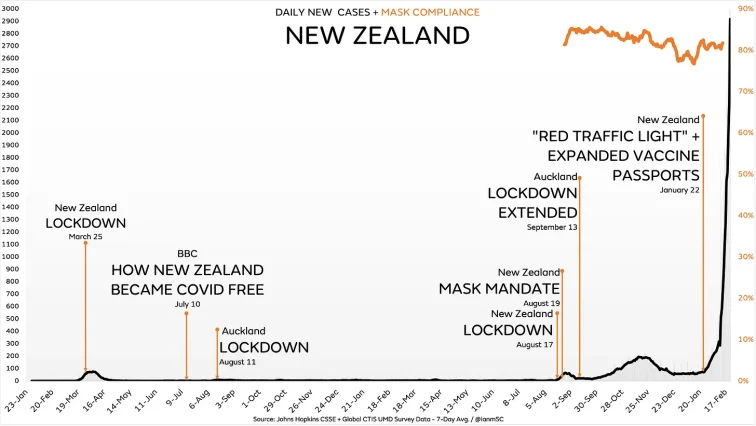
Throughout 2020 and into 2021, New Zealand saw very little COVID transmission.
Unsurprisingly, the BBC praised the country for their efforts, explaining in detail how the country had become “COVID free.”
Jacinda Arden, now former prime minister, was once so completely committed to maintaining an illusion of infallibility that she claimed that the only source of accurate information available to the public was the government.
Of course, Arden then made the provably inaccurate claim that those who were vaccinated would net get sick and would not die.
The ridiculous over-confidence in the proclamations of public health authorities led to Arden convincing New Zealanders that strict mandates and interventions could stop the spread of the virus.
As winter and new variants arrived in 2021, Arden and local leaders predictably enforced increasingly strict measures. Mask mandates, lockdowns and “red traffic light” policies include vaccine passports.
Surprise. None of it worked.

After several months of completely unchecked spread, even the country’s cumulative metrics, once seemingly so impressive, exploded in dramatic fashion.
Consistently and exceptionally high mask wearing rates were also entirely ineffective.
And yet defenders of New Zealand’s authoritarian policies still believed that the country’s strategy was warranted, for one specific reason.
They had delayed the spread of the virus until the COVID vaccines became widely available.
In theory, that was supposed to prevent a substantial increase in deaths, especially considering their extraordinary rate of uptake.
That didn’t work either.
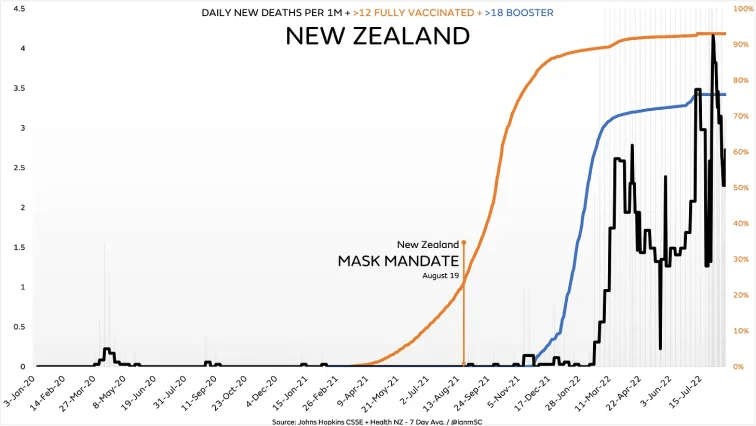
While these rates were generally lower after adjusting for population than many other countries, they still represented an obvious, significant surge compared to previous time periods.
But COVID related deaths only tell a part of the story, often influenced by attribution methodology and testing.
In theory, New Zealand’s exceptional vaccination rate and consistently high mask compliance should have meant that all cause mortality would also remain low.
So did it?
Fortunately, thanks to the New Zealand government’s own data, we now have an answer. And just as the country’s failure to stop omicron, it presents another contradiction to the endless media praise.
Despite the exceptionally high vaccination rate, despite their exceptionally high booster rate, despite vaccine passports, strict lockdowns, “red traffic light” policies and border controls, the pandemic came for New Zealand as well.
The government’s own data shows that all cause deaths in New Zealand jumped significantly in 2022, to the highest level in recorded data.
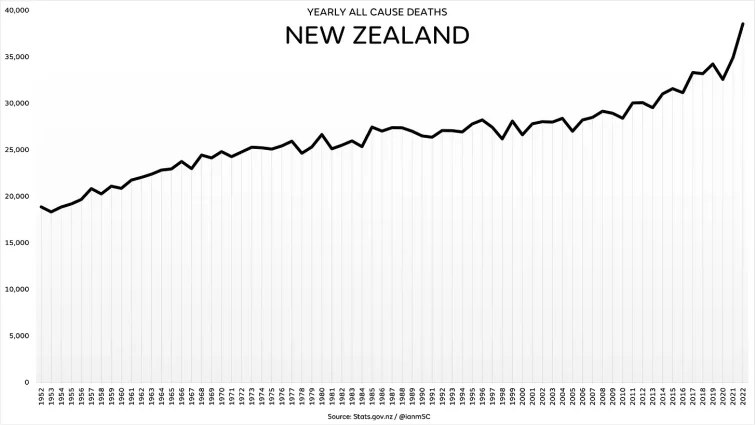
The country universally praised for their dedication to following The Science™, whose leadership told the public that following her dictates would keep them safe, stop the spread and control outcomes, has seen a record level of all cause mortality.
Exactly the same as other countries who were criticized for their supposedly less effective response.
Even after adjusting for population, the scale of the surge in 2022 is exceptional.

In fact, it represents an over 17% increase from 2020.
Not to mention that the one year increase, over 10%, represented the largest single year increase in New Zealand since the 1918 flu.
So why didn’t their policies prevent this? Why didn’t waiting for widespread vaccination to open up prevent this?
The New Zealand government themselves blame COVID for at least a portion of the increase. So why were so many people dying of COVID given the country’s exceptional vaccination and booster uptake and masking?
After all, ~95% of the population over 12 had been fully vaccinated by the middle of 2022, with over 90% fully vaccinated by early 2022. Similarly, adult booster rates were nearly 80% by early in 2022.
Why didn’t it work?!
Some may try to claim that their results would have been worse had they not had such policies.
But countries like Sweden thoroughly debunk that theory. Sweden had one of the least restrictive responses anywhere on earth, yet their results were among the best in their region.
Even throughout 2022, excess deaths remained low.

So why did New Zealand fail?
Compared to other countries, New Zealand’s cumulative COVID mortality rate still remains low. But the all cause mortality tells a different story.
Their strict policies and delayed opening were supposed to prevent this exact situation from occurring. All because the government put their faith in experts.
The experts mistakenly believed that vaccinations would prevent virtually all deaths, as Jacinda “we are your sole source of truth” Arden explained.
Obviously that was not the case.
It’s not clear what percentage of the excess mortality rate came from vaccinated people. But even more importantly, the majority of the increase was entirely unrelated to COVID.
Nearly 6,000 more people died in 2022 than did in 2020, despite a relatively small population increase. Yet the government says just 2,400 were associated with COVID.
So what caused the other 3,600 unexpected deaths?
In raw numbers, nearly 7,500 more people died in 2022 than in 2016. Accounting for population increases, that meant virtually 100 more people per 100,000 died in 2022 than in 2016.
What happened?
Whatever it was, it’s almost certainly related to New Zealand’s mistaken assumptions. Ancillary lockdown-related causes, missed health screenings, side effects — any or all of it could have contributed to the dramatic increase.
And all of it was because the government mistakenly proclaimed that they could control COVID. Instead, they delayed the inevitable.
Governments have many lessons to learn from the pandemic, but the first should be to never, ever, put blind faith in “experts.”
All too often they’re flying blind themselves.
KSA readies draft peace deal to end Yemen war
The Cradle | April 7, 2023
A comprehensive peace document is being drafted to end the Yemen war as it enters its ninth year, an informed Yemeni source revealed to Saudi-owned Asharq Al-Awsat newspaper today, 7 April.
The peace proposal is being sponsored by the UN and is said to cover three phases to end the conflict that has killed some 400,000 people through direct and indirect causes since 2015 and created the world’s worst humanitarian crisis.
The first phase of the peace deal would include a nationwide ceasefire, the reopening of all land, air, and sea routes, the merger of the central banks, and comprehensive prisoner exchanges.
The parties would then hold direct negotiations to establish how the Yemenis envision a state, followed by a transitional period.
Saudi Defense Minister Prince Khalid bin Salman held talks in Riyadh with the Chairman of the Yemeni Presidential Leadership Council (PLC) Dr. Rashad Al-Alimi, to discuss the latest efforts to revive the peace process in line with the UN proposal.
The source speaking with Asharq Al-Awsat expected a ceasefire to be declared in the coming days, for the truce to be consolidated, and for fighting to stop at the battlefronts. Other arrangements will need weeks to be implemented.
The source also claimed Ansarallah has sought to escalate the fighting in recent weeks to make additional military gains before a ceasefire is declared.
Yemeni sources similarly told Al-Mayadeen that “the Saudi vision for the solution provides for the extension of the existing truce in Yemen for another year in understanding with [the Ansarallah-led government in] Sanaa,” adding that “the vision provides for the extension of the truce in exchange for the delivery of salaries, the unification of the currency and the full opening of the port of Hodeidah.”
Further, “The extension of the truce on its new terms will be followed by an official Saudi announcement of the end of the war and the cessation of its intervention in Yemen,” Al-Mayadeen’s sources said.
Optimism surrounding a peace deal has increased following the recent Saudi-Iranian rapprochement, as some observers contend the Ansarallah movement is an Iranian proxy and that Saudi Arabia is no longer interested in prolonging this conflict and is serious in its efforts to reach a solution.
However, resistance to a peace deal may come from the US and UAE.
Abu Dhabi controls most of Yemen’s southern ports, from which Yemeni oil is exported, and is also occupying several strategic islands off the country’s coast and is in the process of establishing a “maritime empire” in Yemeni waters.
Because of this, analysts have suggested that the UAE is uninterested in a solution that ends the war in Yemen.
According to an exclusive by The Cradle, the US, and UAE have “furiously sought to undermine” the understanding reached between Saudi Arabia and Ansarallah in order “to prevent a resolution of the Yemen war.”
The US is unlikely to welcome an end to the war, given that US weapons manufacturers profit significantly from the conflict.
According to a US Government Accountability Office report, the United States concluded over $54 billion in arms sales to Saudi Arabia and the UAE from 2015, the first year of the Yemen war, through 2021. These arms sales accounted for 17 percent of total sales under the U.S. government’s Foreign Military Sales program.
Featured Video

Chinese jet fuel and the myth of energy independence
or go to
Aletho News Archives – Video-Images
Book Review
Former Insiders Criticize Iran Policy as U.S. Hegemony
By GARETH PORTER | CounterPunch | February 27, 2013
“Going to Tehran” arguably represents the most important work on the subject of U.S.-Iran relations to be published thus far.
Flynt Leverett and Hillary Mann Leverett tackle not only U.S. policy toward Iran but the broader context of Middle East policy with a systematic analytical perspective informed by personal experience, as well as very extensive documentation.
More importantly, however, their exposé required a degree of courage that may be unparalleled in the writing of former U.S. national security officials about issues on which they worked. They have chosen not just to criticise U.S. policy toward Iran but to analyse that policy as a problem of U.S. hegemony. … continue
Blog Roll
 Aletho News
- Why no power can undermine Iran’s eternal dominance over the Strait of Hormuz
- Is The War Against Iran Over?
- Iran war will leave long-term ‘scar’ on Wall Street, investors warn
- How Iran decimated US power projection in West Asia: Military lessons of 40-day war
- Iran’s report details US-Israeli war crimes in targeting schools, hospitals, livelihoods
- NATO’s Slow Fracture: How Trump’s Iran War Exposed the Instrument of Hegemony
- Chinese jet fuel and the myth of energy independence
- Ukraine Sea Drone Fired From Libya Hit Russian Tanker in Mediterranean
- IRGC: Iranian forces launched no attacks during ceasefire hours
- Trump Administration Moves To Automate U.S. Military Draft Registration
- If Americans Knew
- TCN: Is Israel Blackmailing President Trump?
- Israel killed at least 303 Lebanese yesterday – who were they? Daily Update
- Amnesty: Urgent – Protect Lebanese civilians from brutal escalation in Israeli attacks
- Is The War Against Iran Over?
- Inside the Israeli army’s propaganda wing
- Hundreds of Gaza Amputees Stranded in Legal Limbo
- The gallows law: Israel moves toward executing Palestinian children
- Tucker Carlson: The Path to Peace requires ending ‘special alliance’ with Israel
- This is ceasefire? Israel’s biggest massacre yet in Lebanon, another journalist killed in Gaza – Daily Update
- Tucker Carlson on Israel: This Is the Behavior of an Ally? Really?
- No Tricks Zone
- An Inconvenient Tree: Uncovered In Alps… Europe Much Warmer Than Today 6000 Years Ago
- New Study Reports A 60% Slowdown In Greenland’s Ice Loss Rate In The Last Decade
- Low Intensity Tornado Wrecks Major Solar Farm, Creating A Potential Toxic Dump
- New Study Finds Warming Saves Lives…Cold Temperatures 12 Times More Deadly Than Excess Heat
- German Science Blog Accuses PIK Climate Institute Of Hallucinating Climate Tipping Points
- Devastating Assessment Of Comirnaty Vaccine By Former Senior Pfizer Europe Toxicologist
- New Study: CO2 Is ‘Effectively Negligible’ As An Explanatory Climate Change Factor Since 2000
- Former Pfizer Toxicologist Dr. Helmut Sterz Tells Bundestag Hearing Pfizer Vaccine Should Have Never Been Approved
- Energy Expert: Germany’s Nuclear Phaseout Was A “500 Billion Euro Mistake”
- New Research: South Australia’s Mid-Holocene Sea Surface Temperatures Were 4°C Warmer Than Today
 Aletho News