Kissinger’s ‘Sino-Soviet Split 2.0’ destined to fail
By Drago Bosnic | July 25, 2023
A bit over half a century ago, the United States under the Nixon administration sent its then-State Secretary Henry Kissinger to China in order to exploit the infamous Sino-Soviet split that nearly escalated into a full-blown war between Moscow and Beijing. The “cold war” between the two previously closely allied communist powers was a strategic gift to the US-led political West, as the belligerent thalassocracy was terrified of the prospect of facing a giant Eurasian monolith spanning from East Germany to Vietnam. The brewing ideological conflict between the post-Stalinist Soviet Union and Maoist China was heavily (ab)used by the US to somewhat soften the consequences of the humiliating defeat of America’s genocidal aggression in Indochina, where millions were killed in its indiscriminate attacks on Vietnam, Laos and Cambodia.
Henry Kissinger is often credited as the instrumental figure in engineering the Sino-American detente that gave the US much-needed geopolitical breathing room in the late 1970s and much of the 1980s after the belligerent thalassocracy pulled back to “lick its Vietnam wounds”. However, it should be noted that, despite Kissinger’s vast diplomatic experience and knowledge, the very fact that the early 1970s China was still largely isolationist, as well as in the process of recovering from the consequences of WWII and the Cultural Revolution, made his efforts significantly easier. Still, thanks to Kissinger, the Nixon administration achieved a major diplomatic win that lasted until the very end of the Cold War and was completely nullified only by the recent suicidal US foreign policy.
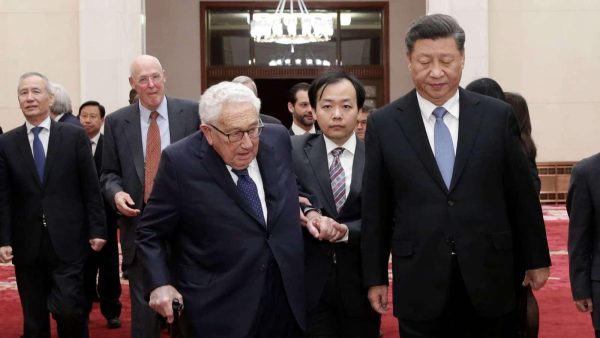
Back in the 1970s, it would’ve been almost entirely unimaginable that Henry Kissinger, quite literally a historical figure at this point, not only due to his Cold War-era achievements, but also his advanced age (now in triple digits), would have to engage in his “shuttle” and “triangular diplomacy” concepts once again. However, precisely this happened last week, culminating with Kissinger’s meeting with Xi Jinping himself on July 20. The Chinese President even called the centenarian “an old friend of China”. Owing to the Asian giant’s great attention to detail, particularly when it comes to diplomatic protocols, the meeting was held at the Villa 5 of the Diaoyutai State Guesthouse, the exact same place where Kissinger met the then-Chinese Premier Zhou Enlai in 1971.
Precisely that meeting was instrumental in preparing Richard Nixon’s visit to China the next year. However, that’s where the historical parallels end. Despite the reputation, influence and respect that he enjoys in China and worldwide, Kissinger went to Beijing in an unofficial capacity. Not representing the US anymore, he was largely relieved of the burden and responsibility for America’s diplomatic standing in China, a far cry from what it used to be during the (First) Cold War. The situation has changed drastically since Kissinger’s tenure, as the Asian giant is anything but a poor, underdeveloped nation with major ideological identity issues that could be exploited to further US interests. On the contrary, precisely Washington DC is the side that’s been going through major internal issues and waning global influence.
In this regard, Kissinger’s room for maneuver was extremely narrow, despite the overall cordiality of his hosts. Beijing is perfectly aware of the rabid hostility and ever-growing Sinophobia in Washington DC, as well as the fact that the belligerent thalassocracy will not change its course anytime soon. Whether it’s the lies about China’s supposed “spy balloon”, apparent doom and gloom propaganda about its alleged “strategic military advantage” or the numerous statements by the Pentagon about the “inevitable war with China“, Beijing is certainly prepared for any scenario and contingency, including the deployment of its forces in “America’s backyard”. This is despite Washington DC’s attempts to resuscitate its Monroe Doctrine, largely dormant up until the recent contraction of America’s geopolitical influence.
There’s only so much Kissinger could do given the active US threats that it will place China’s breakaway island province of Taiwan under its nuclear umbrella, a move that would be tantamount to a declaration of war. Beijing has already started to push back against not only the ongoing US aggression in the Asia-Pacific region, aided by its numerous vassals and satellite states (as well as some “Trojan horses” that have previously declared their intention of joining BRICS+), but also the openly announced involvement of NATO. Since the start of Russia’s special military operation (SMO), the belligerent alliance has repeatedly called China a “security threat” and has clearly defined it as such at its recent summit in Lithuania’s Vilnius. The US-led political West is desperate to keep its wanton “rules-based world order” on life support for as long as possible.
The consolidation and partial relegation of America’s geopolitical responsibilities to its vassals are the crucial segments of this controversial approach, and precisely China’s regional adversaries are poised to play a critical role in this regard. It’s wholly impossible for any US diplomat (former or current), even Kissinger himself, to offer any sort of detente with China while the US keeps talking, bragging even, that it will continue with its “strategic containment” policies, as well as arming not only Beijing’s neighbors, but also its breakaway province. This is without even considering the fact that two consecutive US administrations have been trying to derail China’s unparalleled economic and technological rise, a move that China only recently answered to with limited rare-earth elements restrictions. For these reasons, Kissinger’s attempts to create and then exploit another “Sino-Soviet split” are doomed to fail.
Drago Bosnic is an independent geopolitical and military analyst.
What Are Black Hornet Nano Drones and Why is US Sending Them to Ukraine?

By Ilya Tsukanov – Sputnik – 25.07.2023
American officials have announced another military aid package for Ukraine, this time including a batch of tiny Black Hornet reconnaissance drones. What exactly are Black Hornets? Who makes them? And why are they so expensive? Sputnik explores.
US officials have spent nearly a week touting a new $400 million weapons package for Kiev to assist in NATO’s ongoing proxy war against Russia, with the weapons, taken directly from the Pentagon’s own stocks, including NASAMS, Stinger and Patriot air defense missiles, Stryker armored vehicles, TOW and Javelin anti-tank missiles, howitzer ammo, HIMARS rockets and 28 million rounds of small arms ammunition.
On Monday, anonymous officials revealed to media that the arms package will also include Black Hornet Nanos, a pricy, sophisticated unmanned aerial vehicle about the size of a small bird.
What are Black Hornet Drones Used For?
Black Hornet Nanos are a micro UAV weighing in at just 17-18 grams. They can be carried around by troops and deployed to provide hi-res images and video of the surrounding environment using three separate onboard cameras. The drones resemble a tiny helicopter, are about 100 mm long and 25 mm wide, with their main rotor blade’s diameter measuring in at about 120 mm.
Who Makes Black Hornet Drones?
Black Hornets were developed by Norwegian nano drone helicopter startup Prox Dynamics in the early 2010s, and are now manufactured by FLIR Unmanned Aerial Systems, another Norwegian company, which bought out Prox Dynamics in 2016 for $134 million. FLIR specializes in surveillance and automated systems, equipment for armored vehicles, traffic detection systems, and firefighting cameras.
What is the Black Hornet’s Range and How Fast Do They Fly?
Black Hornets have a flight time of up to 25 minutes, are equipped with a digital data-link effective to ranges up to 1.6 km, and have a top speed of 21 km per hour.
How Much do Black Hornets Cost, and Why are They So Expensive?
Black Hornet drones had an estimated price tag of about $195,000. That figure is based on a 2013 contract by the UK’s Defense Ministry on the purchase of 160 Black Hornet sets (320 micro copters total) for the equivalent of $31 million. For 195k, you get a remote control, handheld touch screen, rechargeable battery pack, and a two-in-a-set pack of mini drones stored in a special portable, wearable bump resistant container.
Where Have Black Hornets Been Deployed?
Over 14,000 Black Hornets have been produced since their debut in 2011, with the drones purchased en masse by the Norwegian and NATO militaries, as well as by Algeria, Australia, India, Indonesia, Malaysia, New Zealand, and South Africa for military and police use.
The systems’ first combat deployment was reported in 2013, with the systems used by British troops during NATO’s occupation of Afghanistan. The US began using modified versions of the base drone equipped with night vision and improved navigation in 2015, reporting their deployment with Marine Corps Special Operations units; the US Army followed up with a $140 million contract for its Soldier Borne Sensor (SBS) program.
The US is not the first country to equip Ukraine with Black Hornets. In August 2022, the UK and Norway jointly purchased 850 Black Hornet Nanos, promising to deploy them by November of that year. Earlier this month, the Norwegian Defense Ministry announced that FLIR would supply another 1,000 Black Hornets, plus spare parts, and would train Ukrainian operators and instructors to fly them (a process which reportedly takes as little as 20 minutes).
Are Black Hornets the Smallest Military Drones in the World?
Black Hornets are touted as the smallest military drones in the world. UK Defense Media hinted back in late 2015 that the military was considering experiments using even smaller UAVs weighing as little as 5 grams, but additional information on these plans has yet to materialize.
Last year, a Chinese company known as Huaqing Innovation unveiled the Fengniao (lit. ‘Hummingbird’) drone at a defense expo in Abu Dhabi, with the UAV measuring in at 17 cm and weighing 35 grams, and capable of transmitting snapshots or real-time footage at distances of more than 2 km. It has a reported flight time of about 25 minutes, and is powered by replaceable batteries, rather than a battery pack. The Fengniao can reportedly be used in combination with up to 15 other drones of the same type to form a swarm, and controlled by a smart phone app. Huaqing Innovation has not revealed the drone’s likely price tag.
For the more budget-conscious buyers, there are commercially available helicopter-style drones fitted with cameras (which have already been used en masse in Ukraine), such as the Eachine E110 RC, which features a 720 pm HD camera with 90 degree rotatable lens.
These drones can be yours for as little as $95, meaning, in theory, that one can buy over 1,000 of the mass-market drones for the price of a single Black Hornet. But there are many tradeoffs, including a flight time of just 15 minutes, a 20 km per hour flight speed, and crucially, a transmission distance of just 50-120 meters. Eachines are equipped with automatic hover and stare modes, and user-selectable waypoint controls, and an automatic return feature. The drones are also substantially larger than Black Hornets, with a nose to tail length of about 30 cm and a similar rotor span. However, as the saying goes, in some circumstances quantity has a quality all its own.
What Weapons Can Be Used to Counter Black Hornet Drones?
Black Hornets’ tiny size and quiet operation make them basically impossible to destroy using conventional missile defenses, although small arms (or an aptly thrown bag of groceries) might just be able to do the job at close range.
Alternatively, they can be targeted by specially-designed countermeasures, such as the RLK-MTs Valdai, a special-purpose radar designed by Russian missile maker Almaz-Antey to detect, suppress and neutralize small drones with extremely low radar cross sections at close-in ranges of 2 km or less. The RLK-MTs’s detection systems include an X-band radar module, thermal imagers and cameras, and a radio signal source-finder module. But these systems are heavy. Heavy enough that they have to be mounted on a truck.
Alternatively, there are military-grade anti-UAV systems such as the PARS-S Stepashka, a 9.6 kg Russian anti-drone gun with the ability to hijack enemy drones and force them to land or return to their launch sites. These weapons have an effective range between 500 and 1,500 meters.
And if that doesn’t work, there’s the Stupor rifle, which uses electromagnetic pulses to suppress drones’ control channels and similarly force them down.
Russia has major electronic warfare advantage – Ukraine
Russian troops deploy an electronic warfare system © Sputnik/Konstantin Mikhalchevsky
RT | July 25, 2023
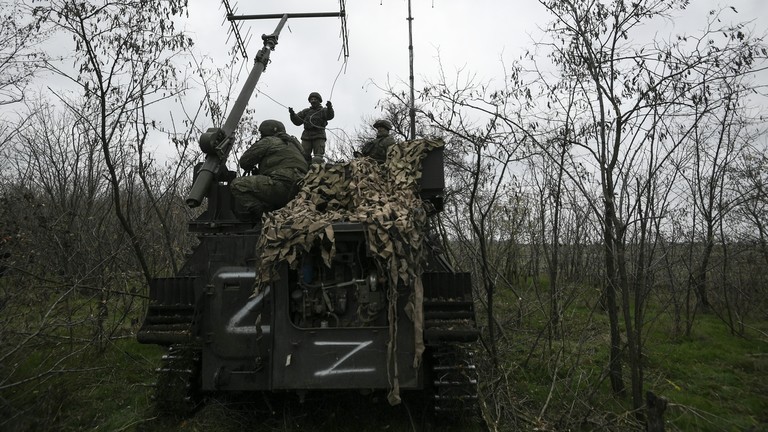
Moscow enjoys a significant advantage over Kiev in terms of electronic warfare, Ukrainian Air Force spokesman Yury Ignat has admitted. He cited the disparity as among the reasons why Ukraine is struggling in its long-anticipated counteroffensive.
Russian forces use electronic countermeasures to disable Ukrainian drones, an approach that Kiev wishes it could also adopt, Ignat said in a TV interview on Monday.
“You don’t need to shoot down a drone with missiles or guns. You can simply force it to go down, intercept it with electronic warfare,” the official stated.
“Russia has powerful systems that interfere with the actions of our defense forces. They have plenty of those systems. Ukraine has made some progress, but we started late,” he added.
The Russian Defense Ministry regularly reports the downing of Ukrainian drones without firing a shot. A raid on Crimea on Monday involved 17 UAVs, 14 of which were disabled by jamming, according to the Russian military.
Russian electronic warfare superiority has been widely acknowledged. A study released by the Royal United Services Institute in London last November estimated that by the summer of that year, Kiev had lost 90% of the thousands of drones it possessed at the beginning of hostilities in February. Once Russian electronic warfare infrastructure was deployed, the life expectancy of Ukrainian UAVs over the battlefield dwindled to three flights for quadcopters and six flights for fixed-wing aircraft, it said.
The issue was also highlighted at the weekend by the New York Times. Ukrainian electronic warfare troops find it difficult to jam Russia’s Lancet loitering munitions because they don’t know how exactly operators communicate with them, the newspaper reported. Meanwhile, their opponents detect Ukrainian mobile phone signals, interfere with GPS geopositioning, and call artillery strikes on Starlink routers, which are essential for Ukrainian communications.
In a CNN interview this week, Ukrainian Defense Minister Aleksey Reznikov acknowledged that Kiev’s counteroffensive was lagging behind schedule, but insisted that otherwise it was proceeding as planned. Russian officials have said Ukraine has suffered tens of thousands of casualties for no tangible gains.
The West threw Ukrainians into a meat grinder thinking “courage” would prevail
By Ahmed Adel | July 25, 2023
The West knew that Kiev did not have enough weapons for a successful counteroffensive but hoped that the “courage and resourcefulness” of Ukrainian soldiers’ would compensate for this deficit, reported The Wall Street Journal. Obviously, those hopes did not materialise as one cannot win a battle based on “courage and resourcefulness.”
“When Ukraine launched its big counteroffensive this spring, Western military officials knew Kyiv didn’t have all the training or weapons—from shells to warplanes—that it needed to dislodge Russian forces. But they hoped Ukrainian courage and resourcefulness would carry the day. They haven’t,” reported the newspaper.
“Deep and deadly minefields, extensive fortifications and Russian air power have combined to largely block significant advances by Ukrainian troops. Instead, the campaign risks descending into a stalemate with the potential to burn through lives and equipment without a major shift in momentum,” added the Wall Street Journal.
According to the newspaper, the offensive risks a stalemate. It will cost Ukraine lives and equipment without significant progress. The publication also notes that there are not enough reserves in Europe to provide Kiev with everything necessary.
Moreover, according to Western diplomats, European leaders are unlikely to opt for a significant increase in aid to Ukraine if they feel a lack of enthusiasm on the part of the US, which in turn is preparing for the presidential election.
The Ukrainian offensive began on June 4 and has experienced catastrophy. But since the beginning of the special military operation in February 2022, Ukraine has lost 457 warplanes, 243 helicopters, 5,236 unmanned aerial vehicles, 426 air defence missile systems, 10,868 tanks and other armoured fighting vehicles, 1,139 fighting vehicles equipped with MLRS, 5,585 field artillery cannons and mortars, as well as 11,860 special military motor vehicles.
This catastrophic loss of military equipment demonstrates the complete failure of the Ukrainian offensive and is why more questions are being raised in Western countries about why support is still being provided when it is evidently making no difference in Ukraine’s fortunes.
In fact, it begs the question as to why the counteroffensive was ever launched to begin with.
As renowned political scientist Max Abrahms highlighted in a tweet, the White House boasted in May that “Ukraine has everything necessary for a counteroffensive.” This is a far cry from the recent revelation that the West believed that the “courage and resourcefulness” of Ukrainian soldiers’ would compensate for the lack of weapons.
For British military expert Jack Watling, Ukraine’s much-anticipated counteroffensive against Russia has been impeded by Western delivery delays and bureaucracy. The senior researcher on land warfare at the Royal Institute of United Services argues, “A bureaucratic, peacetime approach to training and stockpiling among Zelenskiy’s allies is posing a threat to European security.”
According to the author, Kiev has clearly communicated to Western capitals about what it needs to succeed on the battlefield, requesting artillery, engineering capacity, protected means of mobility, anti-aircraft defence systems and personnel training. Watling points out that Kiev did receive enough artillery and protected mobility assets but had a harder time obtaining other items on the list.
Western countries did not approve deliveries of tanks and infantry fighting vehicles to Ukraine until January 2023, making the situation difficult for Ukrainian forces: “Months of delays gave Russian forces time to build their defences, significantly complicating the task for the Ukrainians,” added Watling.
Effectively, it was a well-known fact, despite the public bravado, that the Ukrainian counteroffensive was going to fail. It questions why Ukrainians are being so easily sent into the Russian meat grinder to die or be maimed. This is difficult to reconcile since Ukrainians are literally being dragged off the street and sent to the front line.
Notably, more prominent voices in the West, such as Douglas MacKinnon, a former adviser for policy and communications at the Pentagon, and British Foreign Secretary Ben Wallace, are beginning to speak out against Zelensky’s entitled and spoiled behaviour. Although this has not deterred weapons transfers to Ukraine, it does suggest that patience could run out, especially as the US elections will take place in November 2024. British Prime Minister Rishi Sunak is also eyeing November 2024 for the UK’s General Election.
Particularly in the case of the US, the Republicans will likely use all the wasted billions of dollars and failure in Ukraine as a major election discussion point. With more and more revelations emerging that the Ukrainian counteroffensive never stood a chance of success, with foolish beliefs of “courage and resourcefulness” leading to tens of thousands of casualties, criticisms against the ruling governments in the West will only mount.
Ahmed Adel is a Cairo-based geopolitics and political economy researcher.
Stacey Plaskett: allowing RFK Jr. to speak will make the Biden administration “hesitant” about stopping “misinformation”
She then complains that people are accusing her of censorship
By Didi Rankovic | Reclaim The Net | July 24, 2023
Some politicians seem either unwilling or unable to pick a lane: are they pro, or against censorship?
In other words, they’re dedicated to trying to eat their cake and have it, too. Take Democrat Congresswoman Stacey Plaskett, who on one hand wants to silence people like Robert F. Kennedy Jr. (RFK), and on the other, complains when faced with criticism of advancing censorship.
The way Plaskett rationalizes the first of her efforts is that allowing people like RFK to speak freely is not only “insidious” in nature, and not only equals “desensitizing Americans” (to what?) but brings about a host of serious, and it seems, powerful problems, that would afflict such institutions like the US administration, and (major) social platforms.
Free speech, according to Plaskett – who was commenting on RFK’s testimony in Congress, i.e., giving him an opportunity to speak there – would make the White House and social media “hesitant” to combat misinformation. You would think the First Amendment would be what gives the administration the most pause.
But then Plaskett doesn’t want to be seen as a champion of censorship. And this behavior might, or might not, prompt her supporters to stop and think what, then, it is that she is championing (other than the Biden administration). And, it becomes increasingly clear that all these roads lead to the 2024 presidential election.
The concern about Republicans “elevating” RFK – pejoratively dubbed an “anti-vaxxer” by outlets like MSNBC – is “far more insidious” than simply criticizing Biden, suggests Plaskett. That’s because of the fear the current administration might get stripped of the tools of censorship, stubbornly yet less and less convincingly promoted as noble and just fight against “untruths and misinformation.”
And if anybody was wondering if Democrats would drop the tactic of claiming that any election that doesn’t go their way must be the work of ingenious foreign masterminds – they will not.
Judging by Plaskett, the current apparently “steely will” to stop disinformation (and the Twitter Files tell us how it’s done) might turn into “hesitancy.”
And, of all times – “during the height of the 2024 presidential elections.”
And just like that, seamlessly Plaskett and MSNBC managed to link the issue of giving the likes of RFK a voice in Congress, with “Russian, Iranian, and Chinese” trolls that the congresswoman is certain will swarm the internet, as they “try to suppress the American voters.”
Are we Slipping Toward Dictatorship?
By John S Leake | The Kennedy Beacon | July 24, 2023
History teaches us that dictatorial power is rarely if ever achieved all at once. The aspiring dictator invariably begins with censorship. By controlling the flow of information to the public, he shapes public perceptions in his favor, and against his critics.
Facts, worldviews, and opinions that challenge his own are expunged from the marketplace of ideas. Individuals who communicate to the public about these facts and opinions are silenced, segregated, and ostracized.
Through this process of elimination, the aspiring dictator hones his craft and eventually becomes a complete dictator.
Enter the current Biden Administration. In a recent interview with Aaron Kheriaty, MD—a psychiatrist and medical ethics expert who is a plaintiff in Missouri v. Biden—Kheriaty told me about the censorship program that the White House and an array of federal agencies have erected in recent years. He and his co-plaintiffs knew that some such program was operational, but they were still shocked by the discovery of its size and scope. As Kheriaty described it, the program is a Leviathan—a vast and systematic apparatus for exerting pressure on social media companies to censor any opinion or content that displeases the government. There’s a name for such an apparatus—namely, DICTATORSHIP.
In other words, a program of widespread censorship is the creation and work of a dictator. By way of censorship, the fledgling dictator not only silences his critics, but also prevents his dictatorial powers, privileges, and activities from being detected and reported. Thus, censorship is the means by which an aspiring dictator becomes a complete dictator.
Missouri v. Biden shows us that the Biden Administration, its lackeys in Congress, and its electoral organ, the DNC, have not yet erected a full dictatorship. Nevertheless, their conduct reveals that they aspire to do so and have already done much to achieve their ambition. They therefore treat with withering contempt anyone who threatens their ambition.
We saw a shocking expression of this at the House Judiciary Committee (Select Subcommittee on the Weaponization of the Federal Government) hearing that was held on Thursday, July 20, 2023. While the Committee’s chair, Jim Jordan of Ohio, and his fellow Republican members welcomed the testimony of Robert F. Kennedy, Jr., the Committee’s minority (Democrat) members did everything in their power to censor the hearing.
The mind reels in trying to comprehend this strange and paradoxical reality, so I will restate it. Last week, a hearing was held to “examine the federal government’s role in censoring Americans, the Missouri v. Biden case, and Big Tech’s collusion with out-of-control government agencies to silence speech.” Instead of listening to the witness and considering his testimony, the Committee’s minority members tried to censor him.
Ranking Member of the minority, Stacey Plassket—a non-voting delegate to the House from the United States Virgin Islands’ (USVI)—began by asserting that presidential candidate RFK, Jr.’s speech is not protected by the First Amendment:
Many of my Republican colleagues across the dais will rush to cover that they have Mr. Kennedy here because they want to protect his free speech. This is not the kind of free speech that I know of.
Free speech is not an absolute. The Supreme Court has stated that. And others’ free speech that is allowed—hateful, abusive rhetoric—does not need to be promoted in the halls of the people’s house.
These folks have a plan. They want to give expression to the most vile sorts of speech here in this committee room because it prepares the ground for their own conspiracy theories and pseudoscience.
And they apparently don’t care how many people are hurt or die as a consequence of their actions.… Because nothing, nothing is more important to them than power.
Plaskett’s assertions are an expression of the same strategy deployed by every dictator in history—namely, to dehumanize a dissident by characterizing his opinions as vile and dangerous. By the dictator’s logic, the dissident is not free to express his opinions because they pose a threat to the body politic. While such assertions are couched in the benevolent sounding language of protecting the citizenry, the true threat the dissident poses is not to the citizenry, but to the dictator’s power.
Assuming the role of Grand Inquisitor at the hearing was Rep. Debbie Wasserman Schultz (D-Fla.). She began by motioning the Committee to move into executive session, thereby closing the hearing to the public. She made this motion on the grounds that RFK, Jr.’s remarks about COVID-19 at a recent press event are harmful to the public.
Readers who are interested in the reality of these remarks—as distinct from the mainstream media’s blitz of mendacious propaganda about them—may consider reading my Substack post about it. In a nutshell, RFK, Jr. mentioned the vast medical literature about genetic variations in the ACE-2 receptor that cause some ethnic groups, especially Chinese and Ashkenazi Jews, to be less susceptible to severe COVID-19 illness than other ethnic groups.
Following the Committee’s rejection of Rep. Wasserman Schultz’s motion, she characterized RFK, Jr.’s recent remarks as perpetuating a longstanding anti-Semitic trope that Jews are responsible for infectious disease outbreaks. She then claimed (with perfect humbug) that she wanted to give the witness “a chance to correct his statements and repair some of the harm that he’s helped cause” to the Jewish people.
Her idea of “giving the witness a chance” was making grossly distorted representations of what he has purportedly said in the past, and then interrupting him every time he tried to set the record straight. Such methods of interrogation have been employed by every dictator’s kangaroo court in history.
Readers of this Substack may recall that Schultz is the former chair of the Democratic National Committee. On July 28, 2016, leaked emails showed that she and other DNC staff had taken actions to favor Hillary Clinton over Bernie Sanders in the 2016 Democratic primaries. The leaked e-mails indicate that she did this in exchange for funds for paying off the DNC’s remaining debt from the 2012 presidential campaign. After eliminating Sanders from the 2016 race, Schultz is now (in her capacity as member of the House) hard at work to eliminate Kennedy from the 2024 race.
Schultz’s conduct is another expression of the dictator’s spirit—that is, the conviction that the ends justify means. It doesn’t matter that she once resigned her chair at an institution governing the electoral process after her corrupt, duplicitous, and unfair conduct was exposed. Her party and its supporters are still giving her license to abuse and censor RFK, Jr., and to mislead the public about statements he has made about public policy.
To learn more about Missouri v. Biden, please see my interview with plaintiff Aaron Kheriaty, MD.
John Leake with Aaron Kheriaty on Censorship
John Leake with Aaron Kheriaty on the origin of the citizenry needs to be protected from itself.
John Leake with Aaron Kheriaty on the way to correct false ideas.
Full Interview
The Kennedy Beacon Podcast EP1: John Leake with Aaron Kheriaty, MD
Australia to Buy 20 C-130J Aircraft From US for Almost $10Bln
Sputnik – 24.07.2023
Australia will buy 20 new C-130J Hercules aircraft from the United States for $9.8 billion, with first deliveries expected in late 2027, the Australian Defense Ministry said on Monday.
The first aircraft is expected to be delivered beginning in late 2027, according to the statement.
“The Albanese Government will purchase 20 new C-130J Hercules aircraft for the Royal Australian Air Force for $9.8 billion. This will provide the Air Force with state of the art C-130 Hercules to meet the air transport needs of the future,” the ministry said in a statement.
The new acquisitions will replace and expand the 12 Hercules aircraft currently in service, the ministry added. The aircraft are used by the Australian military to transport personnel, equipment and humanitarian supplies, as well as for search and rescue operation, disaster relief and medical evacuation missions, the statement said.
The C-130J Hercules are designed by US aerospace giant Lockheed Martin.
Hungary may leave EU – former banking chief
Hungarian Prime Minister Viktor Orban attends the NATO summit in Lithuania © Beata Zawrzel / NurPhoto via Getty Images
RT | July 24, 2023
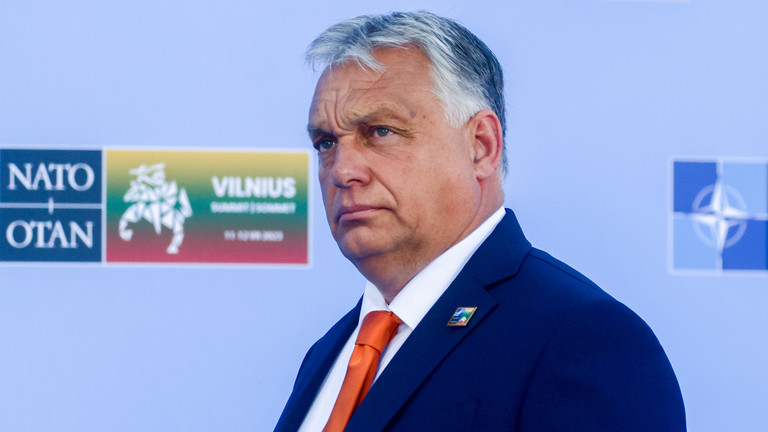
Leaving the European Union may soon become “a real alternative” for Hungary, the former governor of the Hungarian National Bank claimed in a television interview on Sunday.
Speaking on Hungary’s ATV network, Andras Simor said that while a Brexit-style departure from the bloc is an unlikely scenario, “it is a possible one.”
“It’s probability,” he explained. “If it was 10% last year, by now it has risen to 20%, to 30%.”
Citing the country’s rising inflation rate and the EU’s withholding of $30 billion in funding to Budapest, Simor stated that he is “afraid that Hungary’s government will maneuver the country into a situation where an exit from the European Union becomes a real alternative.”
Although Hungary is a net beneficiary of EU aid, much of this assistance has remained frozen for several years, with officials in Brussels citing Prime Minister Viktor Orban’s hardline anti-immigration policies and alleged crackdown on judicial independence and media freedoms as reasons for the holdup.
While Orban’s government successfully gained access to some of this money by lifting a veto on EU economic aid for Ukraine last year, the Hungarian PM has continued his criticism of the bloc’s support for Kiev. Orban has repeatedly called for an immediate ceasefire in Ukraine, and accused “pro-war Brussels bureaucrats” of stoking conflict with Russia “at the expense of European interests.”
Orban’s disagreements with the EU go beyond the realm of geopolitics. Speaking at a youth event in Romania on Saturday, he declared that the bloc “rejects Christian heritage, carries out the replacement of its population via migration… and conducts an LGBTQ offensive” against conservative societies.
Despite his regular broadsides against Brussels, Orban has repeatedly dismissed the idea of leaving the EU. Polls taken since the 2016 Brexit referendum have consistently found high public support for staying in the bloc, although a recent Eurobarometer survey recorded a 12-point drop in those with a “positive image” of the EU, with only 39% now viewing the union favorably.
German Business Fears Best Days Behind It as Economy Crushed by Loss of Russian Energy
By Ilya Tsukanov | Sputnik | July 24, 2023
European industrial behemoth Germany has found itself among the nations hit hardest by the West’s attempt to “punish” Russia for its military operation in Ukraine, with industrial output slumping and the country sinking into a recession earlier this year after losing access to the cheap and reliable supply of Russian hydrocarbons.
German business, administrative, and government leaders have expressed widespread dissatisfaction with the government’s energy and economic policy, and expressed fears that the Central European industrial powerhouse’s economy may have “passed its zenith,” with its best days behind it.
A survey of 484 company board members, managing directors, government ministers, and other senior decision-makers by the Allensbach Institute for Public Opinion Research for German media has found that only 24 percent of the country’s managerial class is satisfied with Economic and Climate Minister Robert Habeck’s job performance, down from 91 percent just a year ago.
Fewer than a quarter of those surveyed expect things to improve over the next six months, with two thirds saying there’s “little chance” the country can restore its lost international competitiveness, and 76 percent saying they don’t believe Habeck or the Ministry of Economic Affairs has the interests of German business in mind to a sufficient degree.
Among the top five problems cited by managers which hamper Germany’s competitiveness are high energy costs (77 percent), a shortage of skilled workers (70 percent), excessive government regulation (68 percent), a backlog in digitization programs (65 percent), and dilapidated infrastructure (61 percent).
58 percent of those polled said Germany appears to have “passed its zenith” economically, with just 22 percent expecting the economy to pick up again.
About three quarters of respondents expressed criticism of Chancellor Olaf Scholz’s Traffic Light coalition (which includes Scholz’s Social Democratic Party, the Greens – represented by Habeck and Foreign Minister Annalena Baerbock, and the Free Democratic Party). Satisfaction with the coalition government has dropped from 62 percent in 2022 to 21 percent now, with 65 percent of those polled suggesting the coalition’s policies are “weakening the country.”
The Allensbach Institute conducted its survey between June 13 and July 7, with the 484 businessmen and officials polled including 89 board members of large companies, 18 ministers, and 28 heads of firms.
The German economy officially sunk into a recession in May after economic growth shrunk by 0.3 percent in the first three months of 2023.
In the aftermath of the escalation of the Donbass crisis into a full-blown Russia-NATO proxy war in Ukraine in February 2022, Germany has faced all the problems other Western countries have related to the decision to decouple themselves economically from Russia, like high inflation and spiking energy prices. However, as Europe’s main industrial economy, Germany’s crisis has been even more painful for local businesses, which have expressed concerns about the loss of competitiveness to other global behemoths like the US and China due to the energy-intensive nature of their products.
Washington added insult to Germany’s injuries last year after announcing federal subsidies to certain “green” industries, effectively trying to entice European industry to relocate to the United States for tax breaks and cheaper energy.
Russian President Vladimir Putin warned in May 2022 that decoupling the European economy from Russian energy resources would threaten the entire region with widespread deindustrialization and loss of competitiveness.
Last month, German Finance Minister Christian Lindner announced that cuts in the budget had forced Berlin to halt additional contributions to the European Union’s budget.
“Germany is both an important supplier for other European countries and an important buyer. A lasting recession in the German economy will certainly have significant effects on France, Italy, Spain, Belgium, and the Netherlands,” Paris-based economist Jacques Sapir told Sputnik earlier this month.
“If this recession lasts until next spring, the economies of the countries mentioned will also go into depression, which in turn will affect the German economy even more,” Sapir predicted, characterizing Berlin and Europe’s anti-Russian sanctions policy as “a form of suicide.”
Ukraine and the pitfalls of foreign aid
By Paul Robinson | Canadian Dimension | July 24, 2023
Few people came out of America’s 20-year war in Afghanistan looking good. A rare exception was John Sopko, the Special Inspector General for Afghanistan Reconstruction (SIGAR). Sopko was the Cassandra of the American war effort, repeatedly revealing unwelcome truths only to be equally repeatedly ignored. In charge of auditing the vast sums of money that the US government spent on economic aid and reconstruction in Afghanistan, SIGAR’s office issued regular reports detailing waste, incompetence, and corruption on a scale that boggles the mind. Among other things, SIGAR published stories of how the US spent $6 million airlifting nine Italian goats to Afghanistan; spent $486 million buying aircraft for the Afghan airforce which were so dangerous to fly that they were never used and were turned into $32,000 of scrap metal; and spent $150 million building luxury villas to lodge staff of its economic development office. All this was just the tip of a very large iceberg.
The basic lesson of SIGAR’s many reports was that throwing vast sums of money into poor countries doesn’t promote economic development. Instead, it encourages corruption and inefficient economic practices. Formal institutions (laws, governments) depend upon informal ones, such as local customs and social structures, that foreigners do not understand, leading to misguided policies and misdirection of funds. Efforts to impose Western formal institutions on top of these very different informal ones, and then flooding the country with Western advisors and money, ends up being counterproductive. None of this, of course, is particularly revelatory. Critics of foreign aid programs have been saying much the same for years. Still, it is an important message.
Although the United States has left Afghanistan, Sopko is continuing his work. Last week, he published a letter written in response to a request from various US Senators. In this, he discussed how lessons from rebuilding Afghanistan could be applied to Ukraine. All wars come to an end. When that in Ukraine does so, there will no doubt be huge pressure on Western governments to flood that country with development assistance. SIGAR’s letter provides a dose of caution that is well worth listening to.
SIGAR notes that “many of the challenges US agencies faced in Afghanistan—coordinating efforts, dealing with corruption, and effectively monitoring and evaluating projects and programs—will be the same as the ones they will face in Ukraine.” He identifies seven particular lessons. These are:
- “The US government struggled to develop a coherent strategy for what it hoped to achieve in Afghanistan and imposed unrealistic timelines that led to wasteful and counterproductive programs.”
- “Lack of effective coordination—both within the US government and across the international coalition—was a major obstacle to success in Afghanistan and resulted in a disjointed patchwork of ineffective efforts, rather than a united and coherent approach.”
- “Though viewed as our greatest strength, the level of financial assistance in Afghanistan was often our greatest weakness.”
- “Corruption was an existential threat to the reconstruction mission in Afghanistan.”
- “Building and reforming the Afghan security forces was hindered by their corruption, predation, and chronic dependency on the United States.”
- “Tracking equipment provided to Afghan security forces proved challenging well before the government collapsed.” And:
- “Monitoring and evaluation efforts in Afghanistan were weak and often measured simple inputs and outputs rather than actual program effectiveness.”
Sopko makes a number of important points under these headings. One that is, “In Afghanistan, the US government spent too much money, too quickly, in a country that was unable to absorb it.” Yet estimates of how much money will be required to rebuild Ukraine far surpass what was spent in Afghanistan. The US (and by implication other Western states also) must take care not to provide more than Ukraine is able to effectively absorb or more than the donor states are able to effectively monitor. More is not necessarily better.
SIGAR also notes that “Under pressure to produce results quickly, agencies bypassed Afghan institutions and government channels when they encountered corruption, rather than slog through efforts at reform. When aid did flow through Afghan budgets and institutions, the United States prioritized the survival and short-term stability of the Afghan government over following through on anti-corruption efforts.” This is a problem that is likely to be repeated in Ukraine, where corruption is “likely to be a significant obstacle to the country’s recovery” given the country’s status as “the most corrupt country in Europe.”
Strangely, SIGAR misses a key fact, which is that this point and the previous one are connected—corruption feeds off excessive foreign aid. So does poor governance more generally. It is no coincidence that so-called “rentier” states (states that derive their income not from taxes on citizens but from what economists call “rents,” such as revenues from natural resource production or from foreign aid) tend to be corrupt, undemocratic, and generally unresponsive to citizens’ needs. When your revenues come from your citizens, you have to pay attention to what they want. When they don’t, you can afford to ignore them. A post-war Ukrainian government that is dependent on foreign assistance, maintains a huge military and security apparatus that is beyond its means, and has few sources of finance of its own, will have few incentives to listen to its own people or to act in an honest way.
A final point made by SIGAR is that in Afghanistan US agencies “often failed to measure programs and projects against the ultimate outcomes and impacts they sought to achieve. Instead, how much money was spent, and how quickly, became the measure of success, regardless of the actual result. This poured money into a fragile environment with no concept of whether projects achieved their intended goal, or even necessarily where all the money was going.” This is a perpetual problem in aid and development projects. Post-war, Western governments will no doubt feel a strong need to be seen to be “doing something” to help Ukraine. They will therefore be likely to throw money at the problem, publicizing their “success” in terms of funds expended and projects begun, but ignoring the actual outcomes.
SIGAR sees part of the solution as lying in better monitoring and evaluation. The problem with this is that there are generally few incentives to carry out such monitoring, because if one does there is a high possibility that one will come to the conclusion that one’s aid is failing, a conclusion that one cannot politically admit. In addition, the recipient of the aid is very possibly aware of this, and thus lacks incentives to use the aid appropriately. Confident that the donor is politically committed to supporting him come what may, he is free to act as irresponsibly as he wishes.
Simply put, giving money away in large quantities tends to produce perverse incentives that cause people to behave in ways that engender negative results. This isn’t a problem that can be fixed by better monitoring, anti-corruption efforts, and the like. It’s inherent in aid itself. If there is a weakness in Sopko’s reporting, it is that, as an auditor, it’s not his job to say whether aid should be given, just to point out whether it is being used effectively. Consequently, his reports end up consisting of lists of how things could be done better without ever challenging whether they should be done in the first place.
Still, they are vital reading for anybody who wants to think about how to reconstruct war-torn societies. What is clear is that if Western states want to produce better results in Ukraine than they did in Afghanistan, they will have to think a lot more intelligently about what sorts of aid they give and how they deliver it. But it’s not as if they weren’t previously aware of the problems mentioned above. SIGAR warned them repeatedly. Nobody listened. One must wonder if they are listening now.
Paul Robinson is a professor in the Graduate School of Public and International Affairs at the University of Ottawa and a Senior Fellow at the Institute for Peace and Diplomacy. He is the author of numerous works on Russian and Soviet history, including Russian Conservatism, published by Northern Illinois University Press in 2019.
Austrian conservatives oppose EU’s ‘scandalous’ planned expansion of Ukraine funding

Austrian People’s Party (FPÖ) politician Petra Steger. (Wikimedia Commons)
MAGYAR NEMZET | July 24, 2023
The European Union’s desire to increase budget contributions from member states to continue funding Ukraine’s drawn-out conflict with Russia is scandalous, the conservative Austrian Freedom Party (FPÖ) has claimed.
Prominent FPÖ politicians sharply criticized the Austrian government for supporting the pro-war efforts in Brussels. Petra Steger, the party’s spokesperson on European affairs, insisted the European Union should not be fueling the conflict by providing an endless supply of military and financial support to Ukraine, and should instead be promoting peace talks in the region.
Steger slammed the plans proposed by the EU’s top diplomat Josep Borrell for the European Union to provide, in addition to existing measures, up to €5 billion per year for Ukraine’s defense needs and to guarantee a substantial contribution to the military training program of the Ukrainian Armed Forces.
She said the plan represents a “bottomless pit,” and her party therefore reiterated its calls for the Austrian federal government to suspend its additional contributions to the European Union budget.
“The scandalous increase in the EU budget hasn’t even been implemented yet, and here they come with their next crazy demand. In the meantime, more than enough billions have been transferred to Ukraine, which has brought nothing but bloodshed and a boom for the U.S. arms industry,” Steger said.
“All this at a time when the European Union is constantly giving billions in gifts to third countries, openly supporting a warring party while the EU itself is degenerating into a debt union. Moreover, the European Central Bank is constantly overstepping its mandate. The hard-earned money of the Austrians is no longer in good hands in the institutions of the European Union,” she added.
Instead, Brussels should be hell-bent on promoting a ceasefire between Kyiv and Moscow to help bring peace back to the region.
“Until then, the EU’s behavior can only be described as a brazen Brussels rip-off that has turned into the ultimate disaster for the European financial budget,” she claimed.
More than €60 billion has flowed into Ukraine since the beginning of the war, and the European Union wants to approve even more funding through the European Peace Facility. This, however, comes at an additional cost for member states, and net contributors to the EU budget, like Austria, aren’t impressed.
“Our hard-earned prosperity over decades is incessantly sent to Ukraine by the EU,” Steger said, adding that the federal government supported Brussels in its plans and gave the European Commission its nod.
Her party colleague Axel Kassegger also criticized the European Union and the Austrian government for not being firmly opposed to the deployment of cluster bombs in Ukraine by the United States.
The New York Times Finally Told The Truth About The Failure Of Kiev’s Counteroffensive
BY ANDREW KORYBKO | JULY 24, 2023
The failure of Kiev’s NATO–backed counteroffensive is undeniable six weeks after Westerners wrongly expected that Russia would swiftly be expelled from Ukraine’s pre-2014 borders. The New York Times (NYT) finally told the truth about this in their report on Sunday about “Weary Soldiers, Unreliable Munitions: Ukraine’s Many Challenges”. None of the facts contained within it are surprising since they’re all connected to the poor state of affairs that the Washington Post (WaPo) candidly described in March.
The observations shared by that Beltway outlet one-third of a year ago were dismissed by Kiev’s supporters as either being “Russian propaganda” despite WaPo’s leading role in pushing the Russiagate conspiracy theory or a “psy-op” that was designed to deceive Russia about the counteroffensive. It’s now known from the NYT’s latest report that this was a factual representation of the situation, the conclusion of which was extended credence by two other narrative developments over the weekend.
The Wall Street Journal (WSJ) reported on Saturday that the West knew that Kiev wasn’t ready to launch its counteroffensive but still allowed it to go ahead anyhow. Zelensky then told CNN’s Fareed Zakaria the day after in an interview that “we had not enough munitions and armaments and not enough brigades properly trained in these weapons” for the counteroffensive to swiftly succeed. This backdrop set the stage for the NYT’s report, the highlights of which are as follows:
* The conflict has reached a “violent stalemate”;
* Ukrainian forces “are struggling… because of dense minefields” along the Zaporozhye front;
* They also “described a determined foe” whose morale remains high despite prior setbacks;
* “The Ukrainian military (is) facing a litany of new and enduring challenges”;
* Coordination problems between its troops persist;
* Ukraine has experienced “tens of thousands of casualties”;
* Its experienced and younger fighters have been replaced with “lesser-trained and older troops”;
* Russian forces have “become more adept” at dislodging Kiev from whatever ground it gains;
* “Ammunition is in short supply, and there is a mixture of munitions sent from different countries”;
* Old foreign-supplied munitions are “damaging [Ukraine’s] equipment and injuring soldiers”;
* Ukraine’s near-total dependence on Starlink has led to communication delays during assaults;
* “Training for more specialized skills, such as for snipers, has been sidelined in favor of trench attacks”;
* Ukraine’s lower-quality recruits, however, struggle to successfully carry out these assaults;
* Russia’s Lancet drones have been highly effective in destroying Ukrainian artillery and tanks;
* And it’s “impossible” to jam them, “at least for now”, and they’re also “hard to shoot down”.
The fifteen facts shared above leave no doubt that Kiev’s NATO-backed counteroffensive has failed exactly as President Putin once again claimed on Sunday, which in turn makes it all the more likely that peace talks will resume by year’s end as was earlier explained here and here. The NATO-Russian “race of logistics”/“war of attrition” that Stoltenberg finally acknowledged in mid-February, which is the most important variable shaping this proxy war’s trajectory, is indisputably trending in Moscow’s favor.
Kiev’s supporters can no longer tell themselves that all reports about disadvantageous developments are either “Russian propaganda” or “psy-ops” designed to deceive their opponent after the NYT’s latest report confirmed that Zelensky’s damning admission about his side’s unpreparedness is indeed true. The situation is likely much worse than both of them described it as being considering their self-interested motivation in not wanting to demoralize everyone.
Nevertheless, their disclosures on Sunday still shattered the delusions that Kiev’s most diehard supporters had clung to since none of them would dare to defy their cult’s dogma by suggesting that Zelensky hadn’t spoken the truth. The coincidental release of the NYT’s report on the same day as his damning admission made it impossible to deny the veracity of what he said due to the detailed information contained therein, which runs the chance of catalyzing a crisis of confidence in their ranks.
Featured Video

Meet The Ellisons: Zionists, Technocrats, Moguls
or go to
Aletho News Archives – Video-Images
Frlom the Archives
The Doctrine of ‘Superior People’: The Bond between Israel and World Zionism
By James Petras :: 09.04.2015
Introduction
The single greatest feat of Israel and its overseas missions has not been material success, or the military conquest of millions of unarmed Palestinians, it has been ideological – the widespread acceptance in the US of a doctrine that claims ‘Jews are a superior people.’
Apart from small extremist rightwing sects who exhibit visceral anti-Semitism and denigrate everything Jewish, there are very few academics and politicians willing to question this supremacist doctrine. On the contrary, there is an incurable tendency to advance oneself by accepting and embellishing on it.
For example, in August 2015, US Vice-President Joseph Biden attributed ‘special genius’ to Jews, slavish flattery that embarrassed even New York’s liberal Jewish intellectuals.
Israel’s dominant role in formulating US Middle East policy is largely a product of its success at recruiting, socializing and motivating overseas Jews to act as an organized force to intervene in US politics and push Israel’s agenda.
What motivates American Jews, who have been raised and educated in the US to serve Israel? After all, these are individuals who have prospered, achieved high status and occupy the highest positions of prestige and responsibility. Why would they parrot the policies of Israel and follow the dictates of Israeli leaders (a foreign regime), serving its violent colonial, racist agenda?
What binds a majority of highly educated and privileged Jews to the most rabidly rightwing Israeli regime in history – a relationship they actually celebrate?
What turns comfortable, prosperous American Jews into vindictive bullies, willing and able to blackmail, threaten and punish any dissident voices among their Gentile and Jewish compatriots who have dared to criticize Israel?
What prevents many intelligent, liberal and progressive Jews from openly questioning Israel’s agenda, and especially confronting the role of Zionist zealots who serve as Tel Aviv’s fifth column against the interest of the United States?
There are numerous historical and personal factors that can and should be taken into account to understand this phenomenon.
In this essay I am going to focus on one – the ideology that ‘Jews are a superior people’. The notion that Jews, either through some genetic, biologic, cultural, historical, familial and/or upbringing, have special qualities allowing them to achieve at a uniquely higher level than the ‘inferior’ non-Jews.
We will proceed by sketching the main outline of the Jewish supremacist ideology and then advance our critique.
We will conclude by evaluating the negative consequences of this ideology and propose a democratic alternative. … continue
Blog Roll
 Aletho News
- Meet The Ellisons: Zionists, Technocrats, Moguls
- US failures in Iran reveal Russia is key to South Korea’s strategic security
- ‘All ports in Persian Gulf will be legitimate targets if Iranian ports are attacked’
- 40 Years of Endless War, Data Point by Data Point
- Department of War Using Palantir AI to Pick Targets in Iran
- American bases do not protect – they attack the peoples of the Persian Gulf
- ‘We’ve Obliterated Their Missiles’
- Syrian president vows ‘absolute support’ to disarm Hezbollah
- Ukraine attacking Russian gas pipeline to stop deliveries to Europe – Defense Ministry
- ‘Heinous crime’: Iran denounces Israeli assassination of 4 Iranian diplomats in Lebanon
- If Americans Knew
- Israeli strategic plans to “remake the Middle East” from the 1950s and since
- Honoring Gaza’s women who refused to let the world look away
- 97% of victims of war on Iran are Iranian, 98% of victims in war on Gaza are Gazans – Not a ceasefire Day 152
- Early Iran strikes cost $5.6 billion in munitions, Pentagon estimates
- Israel Decided the War, But Trump’s America Fights and Pays the Bill
- Conscientious Objector Group: Phone ‘Ringing Off Hook’ As Huge Mobilization Underway
- U.S. support for Israel continues to plummet, despite media’s best efforts
- Threats and missiles fly, death tolls soar in Iran, Lebanon, Gaza – Not a ceasefire Day 151
- Lebanon: Israel’s White Phosphorous Use Risks Civilian Harm
- Corporate Media Go All Out To Support The US-Israeli War On Iran
- No Tricks Zone
- Destructive Green New Deal: German Energy And Metal Group Warns Of Drastic Crisis
- New Study Documents A 20-Year Pause In Arctic Sea Ice Decline – Driven By Internal Variability
- Wake-up Call: Survey Shows Majority Of Germans Now Favor Postponing Climate Targets!
- Televised! Leading German Political Candidate Tells Schoolchildren CO2 Makes Sun Hotter!
- New Study: A Century Warming Of 1.1°C Is ‘Commonplace’ And ‘Not Unusual’ During This Interglacial
- New Study: ‘Internal Noise’ And Volcanic Forcing Can Trigger 10-15°C Warming Within Decades
- Glaciers Worldwide Are Suddendly Surging, Experts Blame Warming!
- Surprising Discovery: Sahara Is Greening…Billions Of Trees Where Once Thought To Be Barren
- New Research Reaffirms Clouds, Aerosols, And Surface Solar Radiation Are ‘Driving The Climate System’
- Germany: Electric Car Catches Fire At Charging Station, Sets Off Local “Inferno”, Widespread Damage
 Aletho News