Deploying elite brigade will not revitalise Kiev’s failed counteroffensive
By Ahmed Adel | August 18, 2023
The Ukrainian 82nd Air Assault Brigade, one of the last reserves of the Ukrainian Army but described as its “most powerful unit,” has entered the battlefield and is combating Russian forces. However, their entry will not revitalise an already failed and exhausted counteroffensive.
The Russian Army confirmed on August 15 that it repelled three attacks from this elite Ukrainian unit near Robotyne, Zaporozhye. In the battle, 200 Ukrainian soldiers were killed, and five tanks, eight armoured and infantry fighting vehicles and two Msta-B howitzers were destroyed.
Forbes reported that the brigade — which had spent most of the last two and a half months in reserve as the Ukrainian army tried to mount its counteroffensive — had finally been deployed, calling it “good and bad news” for Kiev.
Equipped with Challenger 2 tanks armed with depleted uranium shells, the Ukrainian 82nd Air Assault Brigade is also armed with Marder and Stryker armoured vehicles, among the most modern NATO equipment delivered to Kiev.
The 82nd Brigade is said to be among “the last major units” at the disposal of the Ukrainian command. Their deployment “could significantly boost” the firepower of the Ukrainian forces in the near term. Still, when the 82nd and its sister, the 46th Air Assault Brigade, withdraw, “there might not be any equally powerful fresh brigades to fill in for them,” meaning “the counteroffensive could lose momentum,” Forbes warned.
“If the Russians in Robotyne can hold their ground, and endure what is likely to be a major but temporary surge in Ukrainian combat power, they might eventually find themselves in a position to strike back at the Ukrainians—once the surge brigades rotate off the front line without replacement,” the article concluded.
Nonetheless, the author exaggerates the capabilities of the 82nd Air Assault Brigade, which is not even a division. To date, Ukrainian troops have been unable to break through the first line of Russian defences. Therefore, throwing an elite reserve into battle already demonstrates Ukraine’s desperate situation of being unable to break the meat grinder.
The fact that the 82nd Air Assault Brigade is armed with British tanks and modern Western combat vehicles does not mean it can change the situation. This is because Ukrainian forces cannot overcome minefields and break through the opposition posed by Russian reconnaissance and strike forces operating along the entire line of contact.
Deploying the 82nd Air Assault Brigade also points to Russian Defence Minister Sergei Shoigu correctly assessing that Ukraine’s military resources are almost exhausted.
“The preliminary results of the fighting show that Ukraine’s military potential is practically exhausted,” Shoigu said when speaking at the 11th International Security Conference in Moscow on August 15.
While the counteroffensive has failed, Kiev and Western leaders have started pointing the finger. Ukrainian officials blame Western governments and media for the overoptimism surrounding the counteroffensive. However, this is gaslighting by the Kiev regime as they were the source of much hype and propaganda surrounding the offensive, which Western governments and media were more than happy to disseminate.
It is recalled that in the preparation stages of the counteroffensive in 2022, Chief of Ukraine’s Main Directorate of Intelligence Kyrylo Budanov predicted that the capture of Crimea would happen “not in summer [of 2023], but by the end of spring – perhaps, even a little earlier.”
Budanov said he was not afraid of making such predictions because “it’s not even the beginning of the end [of the war]; it’s a process, and it’s in the making.” He even refused to backtrack from his audacious predictions when given an opportunity in April, saying he had “no reason” to reassess his prediction.
As it turned out, the much-lauded offensive did not even begin in the spring, but in the first week of summer, humiliating Budanov’s predictions that led to NAFO ridiculously planning parties and events in Crimea in the expectation the peninsula would be captured by Ukrainian forces.
For his part, Ukrainian President Volodymyr Zelensky tried to control expectations while also building Western confidence to maintain the flow of equipment, weapons, and, of course, money. Zelensky only attempted to temper expectations when it was evident that the highly promoted spring offensive would become a summer one.
It can be said that deploying the elite 82nd Air Assault Brigade into the Russian meat grinder is the last throw of the dice for Ukraine with only weeks of summer left, which marks a symbolic and literal reminder of how the “spring” offensive was an utter failure. Ukraine has reportedly committed over 90% of its troops in recent days, and in the likelihood that they fail in their objectives, the country will be left with no serious fighting forces, leaving it at the mercy of the Russian military.
Ahmed Adel is a Cairo-based geopolitics and political economy researcher.
Dr. Meryl Nass sues Maine Medical Board over suspension, alleges Board violated her first amendment rights
By Brenda Baletti, Ph.D. | The Defender | August 17, 2023
Dr. Meryl Nass today filed suit against the Maine Board of Licensure in Medicine and its individual members, alleging the board violated her First Amendment rights and her rights under the Maine Constitution.
The complaint alleges the board engaged in retaliatory conduct against Nass, a practicing internal medicine physician and member of the Children’s Health Defense (CHD) scientific advisory board, when the board suspended her medical license for publicly expressing her dissenting views on official COVID-19 policies, the COVID-19 vaccine and alternative treatments.
“Because she was outspoken, the board targeted Dr. Nass as someone to silence,” her attorney, Gene Libby told The Defender.
In fall 2021, the board issued a position statement, quoted in the complaint, stating that licensees could face disciplinary action if they “generate and spread COVID-19 vaccine misinformation or disinformation.”
In October 2021, soon after the statement was issued, the board received a complaint alleging Nass was spreading misinformation online and soon after launched an investigation.
The board suspended Nass’ medical license on Jan. 12, 2022, without a hearing, accusing her of engaging in “unprofessional conduct” by spreading “misinformation about COVID-19.”
It also accused her of improperly prescribing hydroxychloroquine and ivermectin for three patients for off-label uses of those drugs.
The board suspended Nass’ license and ordered a neuropsychological evaluation, implying she was mentally impaired or a substance abuser and incompetent to practice medicine.
“There were no grounds to order a mental health examination,” Libby said. “That was simply a means to communicate to the public that there was something wrong with Dr. Nass, to discredit her and tarnish her reputation.”
After Nass moved to have the board dismiss its complaint against her, alleging First Amendment violations, the board on Sept. 26, 2022, withdrew its accusations of “misinformation”, just prior to her first hearing date, Oct. 11, 2022.
The board’s case now rests on Nass’ alleged non-adherence to the medical “standard of care” as it pertained to ivermectin and hydroxychloroquine for treating COVID-19 and on the alleged “record-keeping” issues.
Nass told The Defender :
“The two primary complaints against me were that my statements were misleading and that I was prescribing drugs off-label. My speech — which I should note, was not simply opinion, it was an educated opinion developed after consulting the medical literature — is protected by the First Amendment.
“And prescribing drugs off-label is a perfectly legal thing to do, as explicitly stated on the FDA [U.S. Food and Drug Administration] website. Somewhere between 20-50% of drugs are prescribed off-label. The lawyers on the board staff know all of this. It’s their job to know the law with respect to medicine.
“They didn’t do this because they thought I had committed some kind of violation. They did it because they thought I’m older and I wouldn’t have the money to challenge them and so they could get away with it — they thought they could turn me into a poster child to scare all the doctors in the country.
“It is part of this broader attempt by the U.S. government and governments across the world to criminalize dissent by criminalizing so-called ‘misinformation.’”
Libby said the remaining allegations against Dr. Nass “are simply a pretext to discipline her. Because now, from an institutional standpoint, the board has to do something. She’s been under suspension for 19 months, which is the longest suspension that I’m aware of for any physician in the state.”
The board refused to schedule hearings on Nass’ suspension on consecutive days. Instead, it has held one day of hearings every other month. There have been six days of hearings so far over 10 months — and Nass’ license has been suspended the entire time.
“This is fundamentally unfair to Dr. Nass, but she’s within the grip of an institution that doesn’t want her speaking out,” Libby said.
In her lawsuit, Nass alleges the board and its members used their power to “crush dissenting views and chill disfavored speech.”
Nass is asking the court for declaratory relief, for an injunction to stop the board from continuing to retaliate against her and for monetary damages and legal fees.
CHD is providing financial and legal resources to Nass’ Maine-based legal team.
CHD President Mary Holland told The Defender :
“CHD is proud to support Dr. Nass’ lawsuit against the Maine medical board and its individual members.
“The board and its members have deprived Dr. Nass of her license and livelihood for over a year with no basis whatsoever. This kind of censorship, intimidation and punishment of doctors of conscience must stop.
“People need independent, thoughtful, caring physicians like Dr. Nass to be honored, not hounded as the board has done.
“I am pleased to see this case move forward in the courts in the interests of justice, for Dr. Nass, her patients and the broader society.”
Board provided resources to ‘combat spread of vaccine misinformation’
The Maine board’s Fall 2021 position statement expressed its support for a statement by the Federation of State Medical Boards (FSMB) — a private organization with no regulatory authority — which threatened physicians “who generate and spread COVID-19 vaccine misinformation” with suspension or revocation of their medical license.
According to the statement, physicians have a high degree of public trust and therefore a responsibility to “share information that is factual, scientifically grounded and consensus-driven for the betterment of public health.”
The Maine board’s statement endorsed the FSMB statement, encouraged physicians to address misinformation when encountered, directed physicians to use circulated materials from the American Medical Association (AMA) and said that questioning the COVID-19 vaccine qualifies as “misinformation,” according to the complaint.
The AMA materials provide scripts, talking points and strategies for “combating the spread of vaccine misinformation.”
The Maine board’s chair, Dr. Maroulla Gleaton, is also an FSMB director.
Nass is a widely recognized expert on the anthrax vaccine and biological warfare. She testified before Congress six times and was quoted in major media outlets including The New York Times, The Washington Post, the Los Angeles Times and the Chicago Tribune.
She has also been a prominent critic of governmental handling of the COVID-19 pandemic, the suppression of effective treatments such as ivermectin and hydroxychloroquine and the safety and risks of the vaccine — all topics she has discussed in her Substack, on the radio, in interviews and elsewhere.
But, the complaint notes, her positions have been in conflict with those asserted in the position statement and the resources it highlights as “supporting the fight against COVID-19 misinformation.”
This was merely an attempt by the board to justify its decision to immediately suspend Nass and to intimidate her, the complaint alleges.
Board’s only concern was ‘silencing’ Nass and ‘branding her as crazy’
When Nass questioned the board’s authority to investigate a complaint unrelated to the practice of medicine and instead “focused entirely on a statement made in her private life,” the board responded, on Oct. 14, 2021, that she was engaged in “alleged unprofessional conduct” by provisioning “misleading and/or inaccurate” information.
In the January board meeting where the board decided to suspend her license, the conversation focused on Nass’ “unprofessional conduct due to the spreading of misinformation about COVID-19.”
The board also cited three matters related to treating patients, alleging Nass improperly diagnosed a patient “over the phone,” that she had provided misinformation to a pharmacist about why she was prescribing ivermectin for a patient, and that she had improperly issued another prescription.
On Sept. 7, 2022, Nass moved to dismiss the complaint, alleging the board was violating her First Amendment rights.
The board responded by withdrawing all charges based on her speech, retaining only the charges related to the treatment of three patients.
Libby told The Defender that through the entire investigation and hearings, the board never even spoke to the three patients. It did not inform them their medical records had been subpoenaed, or ask them about their treatment by Dr. Nass.
“Yet the remaining disciplinary charges are all predicated on Dr. Nass’ consultation with and advice to these patients.”
Libby called the patients to testify in Nass’ hearings. They all made “glowing comments” about her availability, her medical advice and her handling of their cases and expressed anger that Nass was being targeted by the board for their cases.
Libby said he interpreted this to indicate the board’s singular focus was not to ensure patient well-being, but rather “silencing Dr. Nass and attempting to brand her as crazy.”
According to the complaint, the board’s animus against Nass is also demonstrated by the fact that it is flouting its own rules for selecting and paying expert witnesses.
Board guidelines stipulate that witnesses can be paid a maximum of $125/hour for preparation and $175/hour for testimony and that the witnesses should have the same specialty as the practitioner in question and be licensed to practice in Maine.
But the board is paying Dr. Jeremy Faust, an emergency room physician from Brigham & Women’s Hospital in Boston, $500/hour to testify.
And board member Gleaton, who has conflicts of interest because of her position as FSMB director and has acted in openly mocking ways, has refused to recuse herself.
The next medical board hearing is set for mid-September.
But in the meantime, Libby said “The actions of the board are so outrageous, they need to be acted on legally.”
Brenda Baletti Ph.D. is a reporter for The Defender. She wrote and taught about capitalism and politics for 10 years in the writing program at Duke University. She holds a Ph.D. in human geography from the University of North Carolina at Chapel Hill and a master’s from the University of Texas at Austin.
This article was originally published by The Defender — Children’s Health Defense’s News & Views Website under Creative Commons license CC BY-NC-ND 4.0. Please consider subscribing to The Defender or donating to Children’s Health Defense.
The WHO’s Proposed Amendments Will Increase Man-Made Pandemics
By Meryl Nass | Brownstone Institute | August 17, 2023
This report is designed to help readers think about some big topics: how to really prevent pandemics and biological warfare, how to assess proposals by the WHO and its members for preventing and responding to pandemics, and whether we can rely on our health officials to navigate these areas in ways that make sense and will help their populations. We start with a history of biological arms control and rapidly move to the COVID pandemic, eventually arriving at plans to protect the future.
Weapons of Mass Destruction: Chem/Bio
Traditionally, the Weapons of Mass Destruction (WMD) have been labelled Chemical, Biological, Radiologic, and Nuclear (CBRN).
The people of the world don’t want them used on us—for they are cheap ways to kill and maim large numbers of people quickly. And so international treaties were created to try to prevent their development (only in the later treaties) and use (in all the biological arms control treaties). First was the Geneva Protocol of 1925, following the use of poison gases and limited biological weapons in World War I, banning the use of biological and chemical weapons in war. The US and many nations signed it, but it took 50 years for the US to ratify it, and during those 50 years the US asserted it was not bound by the treaty.
The US used both biological and chemical weapons during those 50 years. The US almost certainly used biological weapons in the Korean War (see this, this, this and this) and perhaps used both in Vietnam, which experienced an odd outbreak of plague during the war. The use of napalm, white phosphorus, agent orange (with its dioxin excipient causing massive numbers of birth defects and other tragedies) and probably other chemical weapons like BZ (a hallucinogen/incapacitant) led to much pushback, especially since we had signed the Geneva Protocol and we were supposed to be a civilized nation.
In 1968 and 1969, two important books were published that had a great influence on the American psyche regarding our massive stockpiling and use of these agents. The first book, written by a young Seymour Hersh about the US chemical and biological warfare program, was titled Chemical and Biological Warfare; America’s Hidden Arsenal. In 1969 Congressman Richard D. McCarthy, a former newspaperman from Buffalo, NY wrote the book The Ultimate Folly: War by Pestilence, Asphyxiation and Defoliation about the US production and use of chemical and biological weapons. Prof. Matthew Meselson’s review of the book noted,
Our operation, “Flying Ranch Hand,” has sprayed anti-plant chemicals over an area almost the size of the state of Massachusetts, over 10 per cent of its cropland. “Ranch Hand” no longer has much to do with the official justification of preventing ambush. Rather, it has become a kind of environmental warfare, devastating vast tracts of forest in order to facilitate our aerial reconnaissance. Our use of “super tear gas” (it is also a powerful lung irritant) has escalated from the originally announced purpose of saving lives in “riot control-like situations” to the full-scale combat use of gas artillery shells, gas rockets and gas bombs to enhance the killing power of conventional high explosive and flame weapons. Fourteen million pounds have been used thus far, enough to cover all of Vietnam with a field effective concentration. Many nations, including some of our own allies have expressed the opinion that this kind of gas warfare violates the Geneva Protocol, a view shared by McCarthy.
A Biological Weapons Convention
Amid great pushback over US conduct in Vietnam, and seeking to burnish his presidency, President Nixon announced to the world in November 1969 that the US was going to end its biowarfare program (but not the chemical program). Following pointed reminders that Nixon had not eschewed the use of toxins, in February 1970 Nixon announced we would also get rid of our toxin weapons, which included snake, snail, frog, fish, bacterial, and fungal toxins that could be used for assassinations and other purposes.
It has been claimed that these declarations resulted from careful calculations that the US was far ahead technically of most other nations in its chemical and nuclear weapons. But biological weapons were considered the “poor man’s atomic bomb” and required much less sophistication to produce. Therefore, the US was not far ahead in the biological weapons arena. By banning this class of weapon, the US would gain strategically.
Nixon told the world that the US would initiate an international treaty to prevent the use of these weapons ever again. And we did so: the 1972 Convention on the Prohibition of the Development, Production and Stockpiling of Bacteriological (Biological) and Toxin Weapons and on their Destruction, or Biological Weapons Convention (BWC) for short, which entered into force in 1975.
But in 1973 genetic engineering (recombinant DNA) was discovered by Americans Herbert Boyer and Stanley Cohen, which changed the biological warfare calculus. Now the US had regained a technological advantage for this type of endeavor.
The Biological Weapons Convention established conferences to be held every 5 years to strengthen the treaty. The expectation was that these would add a method to call for ‘challenge inspections’ to prevent nations from cheating and would add sanctions (punishments) if nations failed to comply with the treaty. However, since 1991 the US has consistently blocked the addition of protocols that would have an impact on cheating. By now, everyone accepts that cheating occurs and is likely widespread.
A leak in an anthrax production facility in Sverdlovsk, USSR in 1979 caused the deaths of about 60 people. While the USSR tried a sloppy cover-up, blaming contaminated black market meat, this was a clear BWC violation to all those knowledgeable about anthrax.
US experiments with anthrax production during the Clinton administration, detailed by Judith Miller et al. in the 2001 book Germs, were also thought by experts to have transgressed the BWC.
It has taken over 40 years, but in 2022 all declared stocks of chemical weapons had been destroyed by the USA, by Russia, and the other 193 member nation signatories. The chemical weapons convention does include provisions for surprise inspections and sanctions.
Pandemics and Biological Warfare Receive Funding from Same Stream
It is now 2023, and during the 48 years the Biological Weapons Convention has been in force the wall it was supposed to build against the development, production, and use of biological weapons has been steadily eroded. Meanwhile, especially since the 2001 anthrax letters, nations (with the US at the forefront) have been building up their “biodefense” and “pandemic preparedness” capacities.
Under the guise of preparing their defenses against biowarfare and pandemics, nations have conducted “dual-use” (both offensive and defensive) research and development, which has led to the creation of more deadly and more transmissible microorganisms. And employing new verbiage to shield this effort from scrutiny, biological warfare research was renamed as “gain-of-function” research.
Gain-of-function is a euphemism for biological warfare research aka germ warfare research. It is so risky that funding it was banned by the US government (but only for SARS coronaviruses and avian flu viruses) in 2014 after a public outcry from hundreds of scientists. Then in 2017 Drs. Tony Fauci and Francis Collins lifted the moratorium, with no real safeguards in place. Fauci and Collins even had the temerity to publish their opinion that the risk from this gain-of-function research was ‘worth it.’
What does gain-of-function actually mean? It means that scientists are able to use a variety of techniques to turn ordinary or pathogenic viruses and bacteria into biological weapons. The research is justified by the claim that scientists can get out ahead of nature and predict what might be a future pandemic threat, or what another nation might use as a bioweapon. The functions gained by the viruses or other microorganisms to turn them into biological warfare agents consist of two categories: enhanced transmission or enhanced pathogenicity (illness severity).
1) improved transmissibility may result from:
a) needing fewer viral or bacterial copies to cause infection,
b) causing the generation of higher viral or bacterial titers,
c) a new mode of spread, such as adding airborne transmission to a virus that previously only spread through bodily fluids,
d) expanded range of susceptible organs (aka tissue tropism); for example, not only respiratory secretions but also urine or stool might transmit the virus, which was found in SARS-CoV-2,
e) expanded host range; for example, instead of infecting bats, the virus is passaged through humanized mice and thus acclimated to the human ACE-2 receptor, which was found in SARS-CoV-2,
f) improved cellular entry; for example, by adding a furin cleavage site, which was found in SARS-CoV-2,
2) increased pathogenicity, so instead of causing a milder illness, the pathogen would be made to cause severe illness or death, using various methods. SARS-CoV-2 had unusual homologies (identical short segments) to human tissues and the HIV virus, which may have caused or contributed to the late autoimmune stage of illness, impaired immune response and ‘long COVID.’
Funding for (Natural) Pandemics, Including Yearly Influenza, was Lumped Together with Biological Defense Funding
Perhaps the comingling of funding was designed to make it harder for Congress and the public to understand what was being funded, and how much taxpayer funding was going to gain-of-function work, which might lead them to question why it was being done at all, given its prohibition in the Biological Weapons Convention, and additional questions about its value. Former CDC Director Robert Redfield, a physician and virologist, told Congress in March of 2023 that gain-of-function research had not resulted in a single beneficial drug, vaccine, or therapeutic to his knowledge.
Nonprofits and universities like EcoHealth Alliance and its affiliated University of California, Davis veterinary school were used as intermediaries to obscure the fact that US taxpayers were supporting scientists in dozens of foreign countries, including China, for research that included gain-of-function work on coronaviruses.
Perhaps to keep the lucrative funding going, fears about pandemics have been deliberately amplified over the past several decades. The federal government has been spending huge sums on pandemic preparedness over the past 20 years, routing it through many federal and state agencies. President Biden’s proposed 2024 budget requested “$20 billion in mandatory funding across DHHS for pandemic preparedness” while the DHS, DOD, and the State Department have additional budgets for pandemic preparedness for both domestic and international spending.
Although the 20th century experienced only 3 significant pandemics (the Spanish flu of 1918-19 and 2 influenza pandemics in 1957 and 1968) the mass media have presented us with almost non-stop pandemics during the 21st century: SARS-1 (2002-3), avian flu (2004-on), swine flu (2009-10), Ebola (2014, 2018-19), Zika (2016), COVID (2020-2023), and monkeypox (2022-23). And we are incessantly told that more are coming, and that they are likely to be worse.
We have been assaulted with warnings and threats for over 2 decades to induce a deep fear of infectious diseases. It seems to have worked.
The genomes of both SARS-CoV-2 and the 2022 monkeypox (MPOX) virus lead to suspicion that both were bioengineered pathogens originating in laboratories. The group of virologists assembled by Drs. Fauci and Farrar identified 6 unusual (probably lab-derived) parts of the SARS-CoV-2 genome as early as February 1, 2020 and more have been suggested subsequently.
I do not know if these viruses leaked accidentally or were deliberately released, but I am leaning toward the conclusion that both were deliberately released, based on the locations where they first appeared, the well-orchestrated but faked videos rolled out by the mass media for COVID, and the illogical and harmful official responses to each. In neither case was the public given accurate information about the infections’ severity or treatments, and the responses by Western governments never made scientific sense. Why wouldn’t you treat cases early, the way doctors treat everything else? It seemed that our governments were trading on the fact that few people knew enough about viruses and therapeutics to make independent assessments about the information they were being fed.
Yet by August 2021, there was no corresponding course correction. Instead, the federal government doubled down, imposing vaccine mandates on 100 million Americans in September 2021 in spite of ‘the science.’ There has been no accurate statement yet from any federal agency about the lack of utility of masking for an airborne virus (which is probably why the US government and WHO delayed acknowledging airborne spread by COVID for 18 months), the lack of efficacy of social distancing for an airborne virus, and the risks and poor efficacy of 2 dangerous oral drugs (paxlovid and molnupiravir) purchased by the US government for COVID treatment, even without a doctor’s prescription.
Never have any federal agencies acknowledged the truth about the COVID vaccines’ safety and efficacy. Instead, the CDC turns definitional and statistical cartwheels so it can continue to claim they are “safe and effective.” Even worse, with all that we know, a third generation COVID vaccine is to be rolled out for this fall and the FDA has announced that yearly boosters are planned.
All this goes on, even a year after we learned (with continuing corroborations) that children and working age adults are dying at rates 25 percent or more above the expected averages, and the vascular side effects of vaccination are the only reasonable explanation.
Maiming with Myocarditis
Both of the two US monkeypox/smallpox vaccines (Jynneos and ACAM2000) are known to cause myocarditis, as do all 3 COVID vaccines currently available in the US: the Pfizer and Moderna COVID-19 mRNA vaccines and the Novavax vaccine. The Novavax vaccine was first associated with myocarditis during its clinical trial, but this was downplayed and it was authorized and rolled out anyway, intended for those who refused the mRNA vaccines due to the use of fetal tissue in their manufacture.
Here is what the FDA’s reviewers wrote about the cardiac side effects noted in the Jynneos clinical trials:
Up to 18.4% of subjects in 2 studies developed post-vaccination elevation of troponin [a cardiac muscle enzyme signifying cardiac damage]. However, all of these troponin elevations were asymptomatic and without a clinically associated event or other sign of myopericarditis. p. 198
The applicant has committed to conduct an observational, post-marketing study as part of their routine PVP. The sponsor will collect data on cardiac events that occur and are assessed as a routine part of medical care. p. 200
In other words, while the only way to cause an elevated troponin level is to break down cardiac muscle cells, the FDA did not require a specific study to evaluate the extent of cardiac damage that might be caused by Jynneos when it issued its 2019 license. How frequently does myocarditis occur after these vaccines? If you use elevated cardiac enzymes as your marker, ACAM2000 caused this in one in thirty people receiving it for the first time. If you use other measures like abnormal cardiac MRI or echo, according to the CDC it occurs in one in 175 vaccinees. I have not seen a study with rates of myocarditis for Jynneos, but there was an unspecified elevation of cardiac enzymes in 10 percent and 18 percent of Jynneos recipients in two unpublished prelicensure studies available on the FDA website. My guess for the mRNA COVID vaccines is that they cause myocarditis in this general range, the vast majority of which remain undiagnosed and probably asymptomatic.
Why would our governments push 5 separate vaccines all known to cause myocarditis on young males who have been at extremely low risk from COVID, and who simply get a few pimples for 1-4 weeks from monkeypox unless they are immunocompromised? It’s an important question. It does not make medical sense. Especially when the vaccine probably does not work—Jynneos didn’t prevent infection in the monkeys in whom it was tested nor did it do well in people. And the CDC has failed to publish its trial of Jynneos vaccine in the ~1,600 Congolese healthcare workers on whom the CDC tested it for efficacy and safety in 2017. The CDC made the mistake of announcing the trial, and posting it to clinicaltrials.gov as required, but has not informed its advisory committee that reviewed the vaccine, nor the public, of the trial’s results.
There can be no question about it: our health agencies are guilty of malfeasance, misrepresentation, and deliberate infliction of harm on their own populations. The health agencies first incited terror with apocalyptic predictions, then demanded patients be medically neglected, and finally enforced vaccinations and treatments that were tantamount to malpractice.
COVID Vaccines: The Chicken or the Egg?
The health authorities could have just been ignorant — that could possibly explain the first few months of the COVID vaccines’ rollout. But once they figured out, and even announced in August 2021 that the vaccines did not prevent catching COVID or transmitting it, why did our health authorities still push COVID vaccines on low-risk populations who were clearly at greater risk from a vaccine side effect than from COVID? Particularly as time went on and newer variants were less and less virulent?
Once you acknowledge these basic facts, you realize that maybe the vaccines were not made for the pandemic, and instead the pandemic was made to roll out the vaccines. While we cannot be certain, we should at least be suspicious. And the fact that the US contracted for 10 doses per person (review purchases here, here, here, here and here) and so did the European Union (here and here) and Canada should make us even more suspicious – there is no justification for agreeing to purchase so many doses for vaccines at a time when the vaccines’ ability to prevent infection and transmission was questionable, and its safety suspect or worrying.
Why would governments want ten doses per person? Three maybe. But ten? Even if yearly boosters were expected, there was no reason to sign contracts for enough vaccine for the next nine years for a rapidly mutating virus. Australia bought 8 doses per person. By December 20, 2020 New Zealand had secured triple the vaccines it needed, and offered to share some with nearby nations. No one has come forward to explain the reason for these excessive purchases.
Furthermore, you don’t need a vaccine passport (aka digital ID, aka a phone app that in Europe included a mechanism for an electronic payments system) unless you are giving out regular boosters. Were the vaccines conceived of as the means for putting our vaccinations, health records, official documents–and most importantly, shifting our financial transactions online, all managed on a phone app? This would be an attack on privacy as well as the enabling step to a social credit system in the West. Interestingly, vaccine passports were already being planned for the European Union by 2018.
A Pandemic Treaty and Amendments: Brought to You by the Same People who Mismanaged the Past 3 Years, to Save us from Themselves?
The same US and other governments and the WHO that imposed draconian measures on citizens to force us to be vaccinated and take dangerous, expensive, experimental drugs, withheld effective treatments, and refused to tell us that most people who required ICU care for COVID were vitamin D-deficient and that taking vitamin D would lessen COVID’s severity–decided in 2021 we suddenly needed an international pandemic treaty. Why? To prevent and ameliorate future pandemics or biological warfare events… so we would not suffer again as we did with the COVID pandemic, they insisted. The WHO would manage it.
To paraphrase Ronald Reagan, the words, “I’m from the WHO, and I’m here to help” should be the most terrifying words in the English language after the COVID fiasco.
What the WHO and our governments conveniently failed to mention is that we suffered so badly because of their medical mismanagement and our governments’ merciless economic shutdowns and mismanagement. According to the World Bank, an additional 70 million people were forced into extreme poverty in 2020 alone. This was due to policies issued by our nations’ rulers, their elite advisers and the World Health Organization, which came out with guidance to shut down economic activity that most nations adopted without question. The WHO is acutely aware of the consequences of economic lockdowns, having published the following:
Malnutrition persisted in all its forms, with children paying a high price: in 2020, over 149 million under-fives are estimated to have been stunted, or too short for their age; more than 45 million – wasted, or too thin for their height…
Starvation may have killed more people than COVID, and they were disproportionately the youngest, rather than the oldest. Yet the WHO prattles on about equity, diversity, and solidarity—having itself caused the worst food crisis in our lifetime, which was not due to nature but was man-made.
How can anyone take seriously claims by the same officials who mishandled COVID that they want to spare us from another medical and economic disaster–by using the same strategies they applied to COVID, after they masterminded the last disaster? And the fact that no governments or health officials have admitted their errors should convince us never to let them manage anything ever again. Why would we let them draw up an international treaty and new amendments to the existing International Health Regulations (IHR) that will bind our governments to obey the WHO’s dictates forever?
Those dictates, by the way, include vaccine development at breakneck speed, the power to enforce which drugs we will be directed to use, and which drugs will be prohibited, and the requirement to monitor media for “misinformation” and impose censorship so that only the WHO’s public health narrative will be conveyed to the public.
The WHO’s Pandemic Treaty Draft Requires the Sharing of Potential Pandemic Pathogens. This is a Euphemism for Bioweapons Proliferation.
Obviously, the best way to spare us from another pandemic is to immediately stop funding gain-of-function (GOF) research and get rid of all existing GOF organisms. Let all nations build huge bonfires and burn up their evil creations at the same time, while allowing other nations to inspect their biological facilities and records.
But the WHO in its June 2023 Bureau Text of the Draft Pandemic Treaty has a plan that is the exact opposite of this. In the WHO’s draft treaty, which most nations’ rulers appear to have bought into, all governments will share all viruses and bacteria they come up with that are determined to have “pandemic potential” — share them with the WHO and other governments, putting their genomic sequences online. No, I am not making this up. (See screenshots from the draft treaty below.) Then the WHO and all the Fauci’s of the world would gain access to all the newly identified dangerous viruses. Would hackers also gain access to the sequences? This pandemic plan should make you feel anything but secure.
Fauci, Tedros, and their ilk at the WHO, and those managing biodefense and biomedical research for nation states are on one side, the side that gains access to ever more potential biological weapons, and the rest of us are on the other, at their mercy.
This poorly conceptualized plan used to be called proliferation of weapons of mass destruction—and it is almost certainly illegal. (For example, see Security Council resolution 1540 adopted in 2004.) But this is the plan of the WHO and of many of our leaders. Governments will all share the weapons.
The Genomic Sequencing Conundrum
And governments are to commit to building biolabs that must include genomic sequencing. No explanation has been forthcoming about why each nation needs to install its own genome sequencing laboratories. Of course, they would sequence the many viruses that will be detected as a result of the pathogen surveillance activities nations must perform, according to the WHO treaty draft. But the same techniques can be used to sequence human genomes. The fact that the EU, UK, and US are currently engaged in projects to sequence about 2 million of their citizens’ genomes provides a hint they may want to collect additional genomes of Africans, Asians, and others.
This might fly as simply sharing state-of-the-art science with our less-developed neighbors. But it is curious that there is so much emphasis on genomics, compared to an absence of discussion about developing repurposed drugs for pandemics in the draft treaty or IHR amendments.
But we can’t forget that virtually all developed nations, in lockstep, restricted the use of safe generic hydroxychloroquine, ivermectin, and related drugs during the pandemic. In retrospect, the only logical explanation for this unprecedented action was to preserve the market for expensive patentable drugs and vaccines, and possibly to prolong the pandemic.
Genomes offer great potential profits, as well as providing the substrate for transhumanist experiments that could include designer babies.
The latest version (aka the WHO Bureau draft) of the pandemic treaty can be accessed here. I provide screenshots to illustrate additional points.
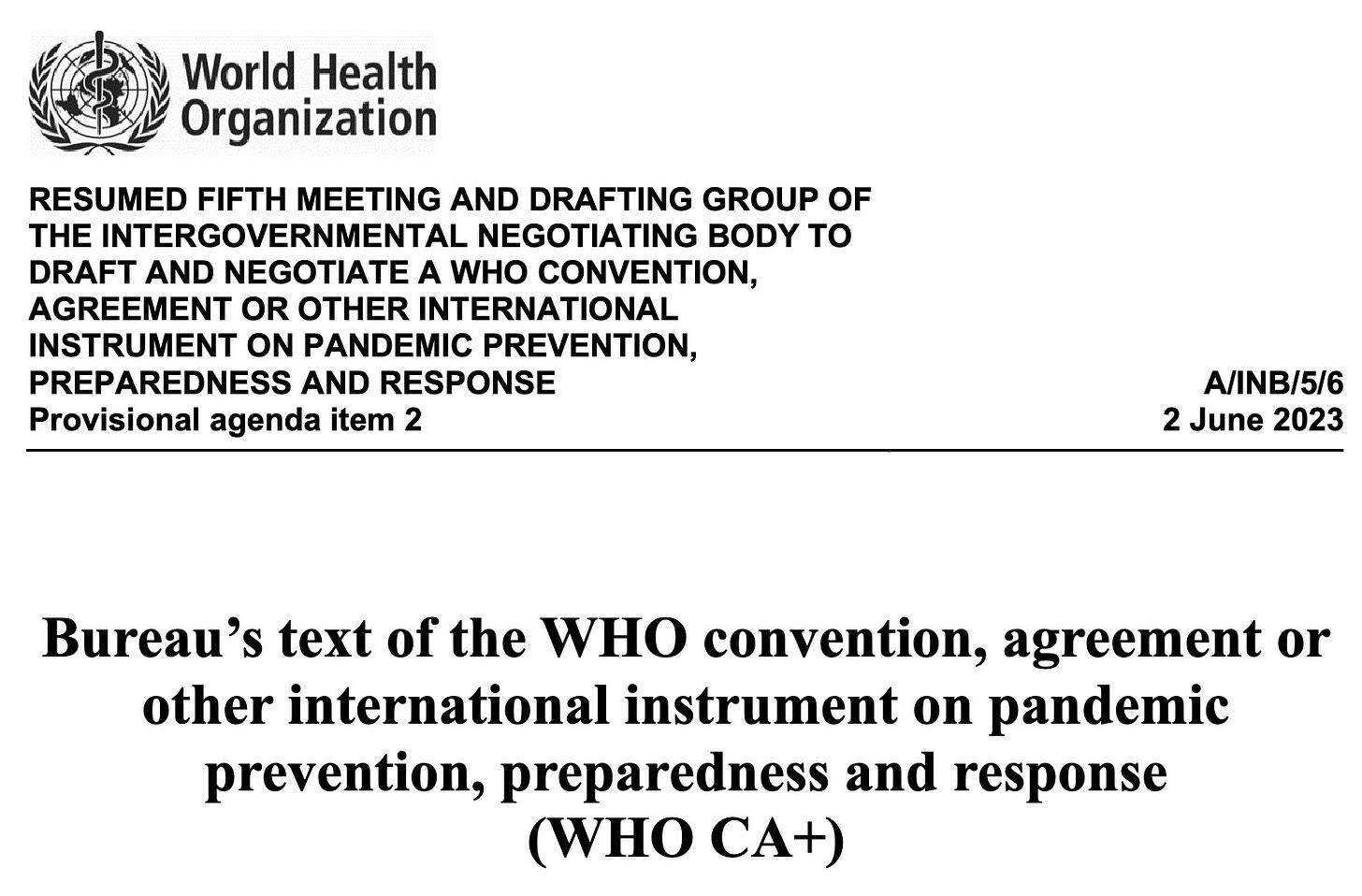
Draft pages 10 and 11:




The WHO Treaty Draft Incentivizes Gain-of-Function Research
What else is in the Treaty? Gain-of-Function research (designed to make microorganisms more transmissible or more pathogenic) is explicitly incentivized by the treaty. The treaty demands that administrative hurdles to such research must be minimized, while unintended consequences (aka pandemics) should be prevented. But of course, when you perform this type of research, leaks and losses of agents can’t always be prevented. The joint CDC-USDA Federal Select Agent Program (FSAP) which keeps track of research on potential pandemic pathogens collects reports of about 200 accidents or escapes yearly from labs situated in the US. The FSAP annual report for 2021 notes:
“In 2021, FSAP received 8 reports of losses, 177 reports of releases, and no reports of thefts.”
Research on deadly pathogens cannot be performed without risks both to the researchers and the outside world.
Draft page 14:

Vaccines Will be Rolled Out Speedily Under Abbreviated Future Testing Protocols
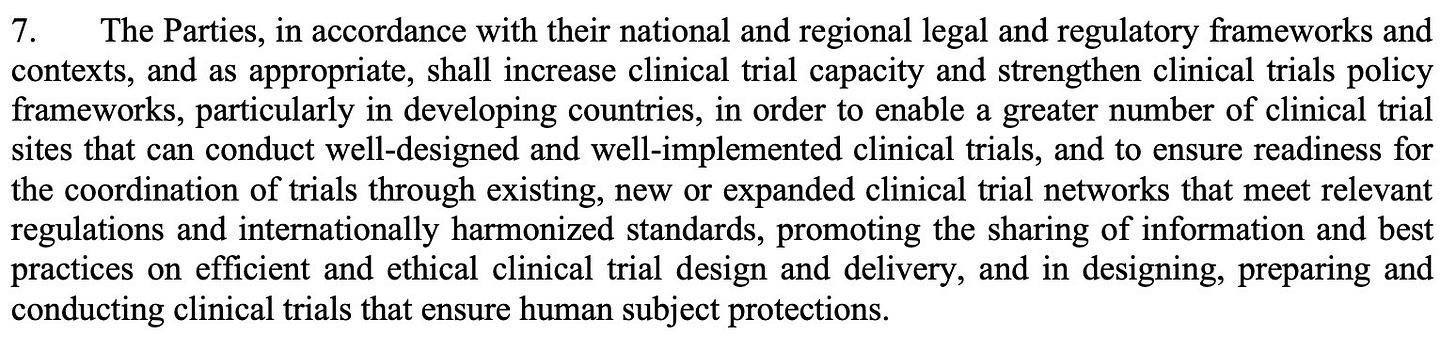
Vaccines normally take 10-15 years to be developed. In case you thought the COVID vaccines took too long to be rolled out (326 days from availability of the viral sequence to authorization of the first US COVID vaccine) the WHO treaty draft has plans to shorten testing. There will be new clinical trial platforms. Nations must increase clinical trial capacity. (Might that mean mandating people to be human subjects in out-of-the-way places like Africa, for example?) And there will be new “mechanisms to facilitate the rapid interpretation of data from clinical trials” as well as “strategies for managing liability risks.”
Draft page 14:
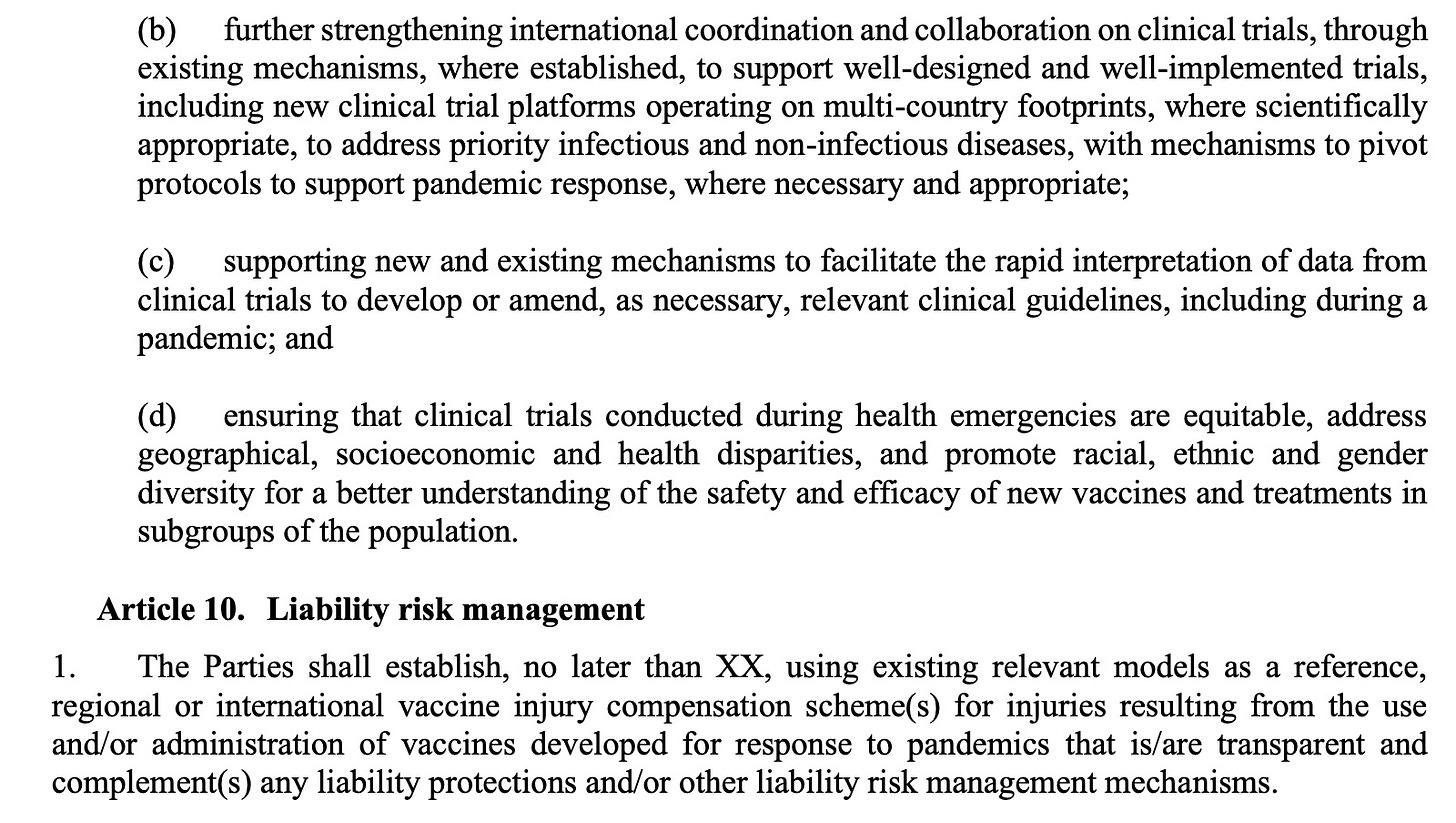
Manufacturer and Government Liability for Vaccine Injuries Must be “Managed”
Nations are supposed to use “existing relevant models” as a reference for compensation of injuries due to pandemic vaccines. Of course, most countries do not have vaccine injury compensation schemes, and when they do the benefits are usually minimal.
Is the US government’s program to be a model of what gets implemented internationally?
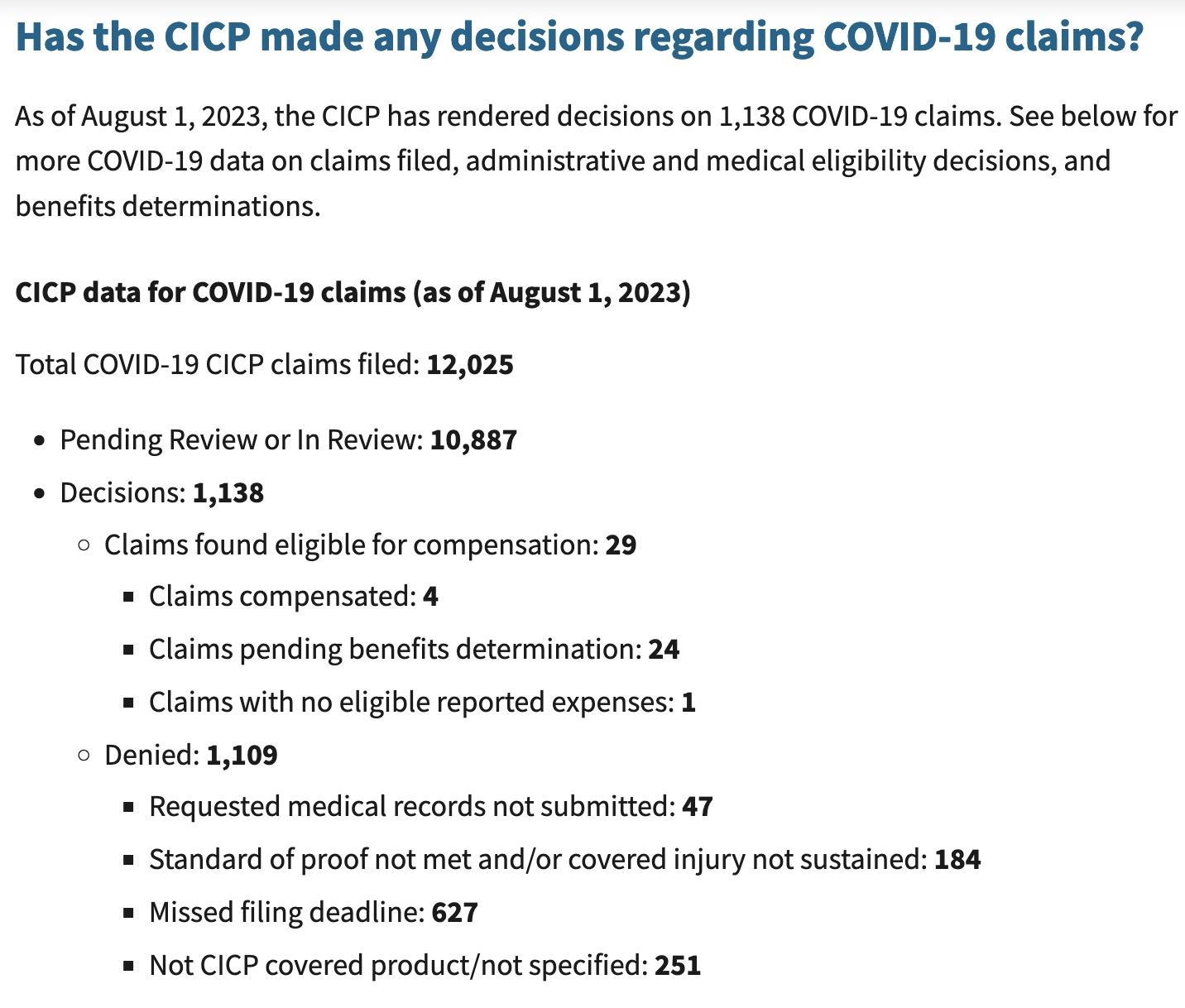
The US government scheme for injuries due to COVID pandemic products (the Countermeasures Injury Compensation Program or CICP) has compensated exactly 4 (yes, four) of the 12,000 claimants for COVID product-related injuries as of August 1, 2023. All pandemic EUA drugs and vaccines convey a liability shield to the government and manufacturers (this includes monoclonal antibodies, pre-licensure remdesivir, paxlovid, molnupiravir, some ventilators and all COVID vaccines) and the only avenue for injury compensation is through this program.
Slightly over 1,000 of the 12,000 claims have been adjudicated while 10,887 are pending review. Twenty claims were deemed eligible and await a benefits review. Benefits are only paid for uncovered medical expenses or lost income. A total of 983 people, or 98 percent of those whose claims have been adjudicated had their claims denied, many because they missed the brief one-year statute of limitations. Below are the latest data from this program:
The treaty draft also demands weakening the strict regulation of medical drugs and vaccines during emergencies, under the rubric of “Regulatory Strengthening.” As announced in the UK last week, where ‘trusted partner’ approvals will be used to speed licensure, this is moving toward a single regulatory agency approval or authorization, to be immediately adopted by other nations (p 25).
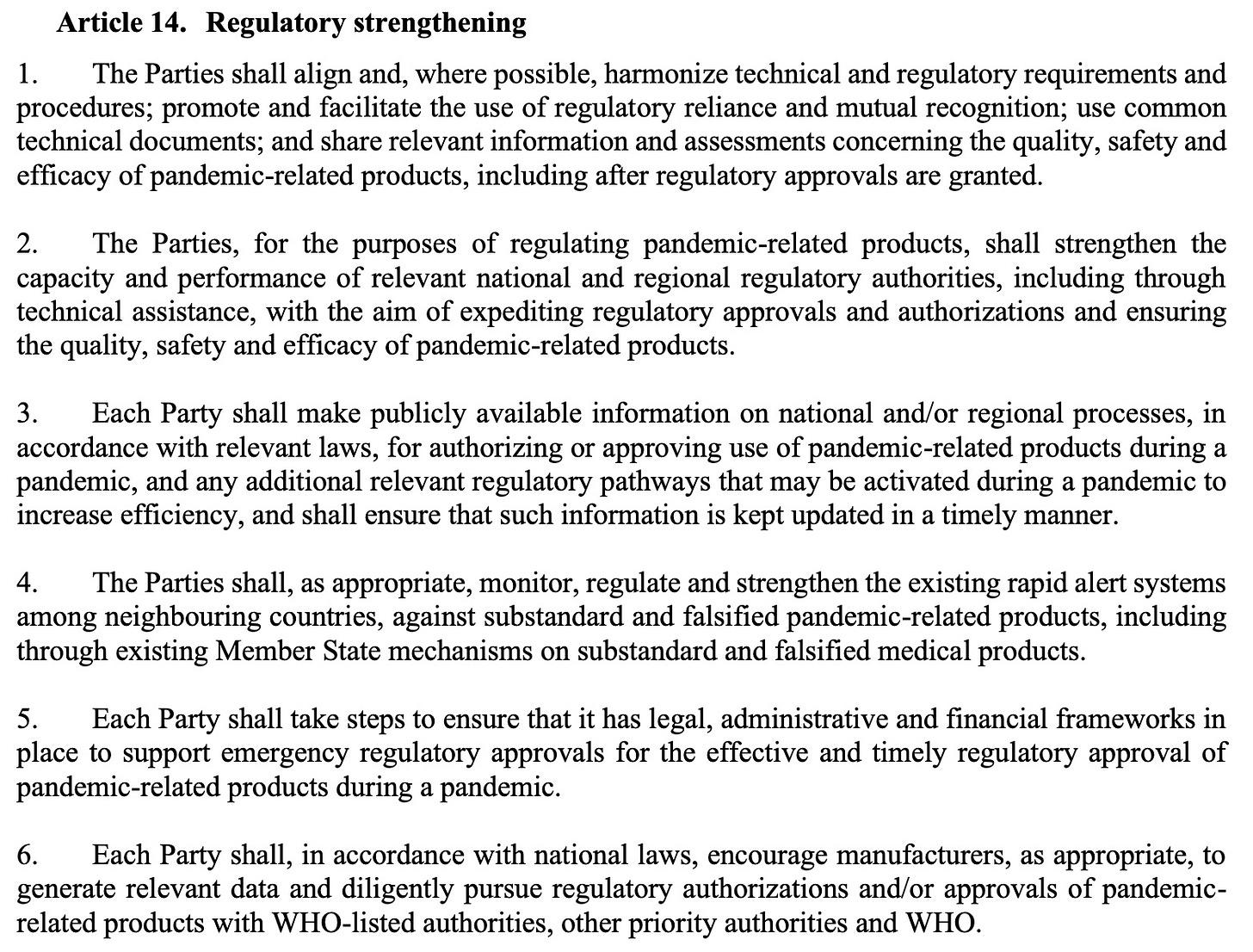
Next Up: Vaccines Developed in 100 Days
A plan to develop vaccines in 100 days and have them manufactured in 30 additional days has been widely publicized by the vaccine nonprofit CEPI, founded in 2017 by Sir Dr. Jeremy Farrar, who is now the WHO’s Chief Scientist. The plan has been echoed by the US and UK governments and received some buy-in from the G7 in 2021. This timeframe would only allow for very brief testing in humans, or would, more likely, limit testing to animals. Why would any country sign up for this? Is this what we the people want?
The plan furthermore depends on the vaccines only being tested for their ability to induce antibodies, which is termed immunogenicity, rather than being shown to actually prevent disease, at least for the initial rollout. My understanding of FDA regulation was that antibody levels were not an acceptable surrogate for immunity unless they had been demonstrated to actually correlate with protection. However, the FDA’s recent vaccine decisions have scrapped all that and vaccines are now being approved based on antibody titers alone. The FDA’s vaccine advisory committee has asked it for better indicators of efficacy than this, but the advisers have also voted to approve or authorize vaccines in the absence of any real measures showing that they work. I learned this because I watch the FDA vaccine advisory meetings and provide a live blog of them.
We all know how long it took for the public to become aware that the COVID vaccines failed to prevent transmission and only prevented cases for a period of weeks to months. The US government has still not officially admitted this, even though CDC Director Rochelle Walensky told CNN’s Wolf Blitzer the truth about transmission on August 6, 2021.
It is critical for the public to understand that safety testing can only be accomplished in human beings, as animals react differently to drugs and vaccines than humans do. Therefore, limited testing in animals would mean there was no actual safety testing. But testing vaccines in humans for only short periods is also unacceptable.
Testing vaccines during brief trials in humans (the Pfizer trials only followed a “safety subset” of trial subjects for a median of two months for safety) allowed COVID vaccines to be rolled out without the public being aware they could cause myocarditis and sudden deaths, most commonly in athletic young males in their teens and twenties, or a myriad of other conditions.
Finally, following this rapid manufacturing plan, thorough testing for potential failures in the manufacturing process could not be performed. With the current plan for far-flung, decentralized manufacturing facilities that are said to be necessary to achieve vaccine equity for all, there are nowhere near enough regulators who could inspect and approve them.
Will the WHO Respect Human Rights?
The need to respect “human rights, dignity, and freedom of persons” is embedded in the current International Health Regulations (IHR), as well as other UN treaties. However, the language guaranteeing human rights, dignity, and freedom of persons was peremptorily removed from the proposed IHR Amendments, without explanation. The removal of human rights protections did not go unnoticed, and the WHO has been widely criticized for it.
The WHO apparently is responding to these criticisms, and so the language guaranteeing human rights that was removed from the drafts of the International Health Regulations has been inserted into the newest version of the pandemic treaty.
Conclusions
As long predicted by science fiction, our bio- and cyber-scientific achievements have finally gotten away from us. We can produce vaccines in 100 days and manufacture them in 130 days–but there will be no guarantees that the products will be safe, effective, or adequately manufactured. And we can expect large profits but no consequences for the manufacturers.
Our genes can be decoded, and the fruits of personalized medicine made available to us. Or perhaps our genes will be patented and sold to the highest bidder. We might be able to select for special characteristics in our children, but at the same time, a human underclass could be created.
Our electronic communications can be completely monitored and censored, and uniform messaging can be imposed on everyone. But for whom would this be good?
New biological weapons can be engineered. They can be shared. Maybe that will speed up the development of vaccines and therapeutics. But who really benefits from this scheme? Who pays the price of accidents or deliberate use? Wouldn’t it be better to end so-called gain-of-function research entirely through restrictions on funding and other regulations, rather than encouraging its proliferation?
These are important issues for humanity, and I encourage everyone to become part of the conversation.
Dr. Meryl Nass, MD is an internal medicine specialist in Ellsworth, ME, and has over 42 years of experience in the medical field. She graduated from University of Mississippi School of Medicine in 1980.
Maui officials slammed over wildfire response
RT | August 17, 2023
Hawaiian authorities delayed the release of water to Maui residents trying to save their properties from last week’s devastating wildfires, local media revealed on Tuesday, citing four insider sources.
The Maui Department of Land and Natural Resources reportedly stalled as West Maui Land Co., which manages agricultural and residential developments on the western part of the island, requested additional water to stop the fast-moving blaze that would ultimately level the tourist town of Lahaina last Tuesday.
The agency’s deputy director for water management, M. Kaleo Manuel, allegedly wanted the company to get permission from a farm located downstream from its property. By the time Manuel finally released the water, it was too late and the fire had spread.
Maui’s Emergency Management Agency was also criticized for its response to the inferno. Agency director Herman Andaya defended the decision not to activate the island’s warning sirens, a signal network designed to work even without electricity, arguing the network was meant to be used to warn of tsunamis – not wildfires. Using it to alert residents to last week’s devastating blaze would have “sen[t] the wrong message to the public,” he said on Wednesday.
However, the island’s own website describes the sirens as an “all-hazard” system, with fires one of several natural and human-caused events the system – “the largest single integrated outdoor siren warning system for public safety in the world” – was designed for.
The decision to warn residents via cell phone alert instead likely proved fatal for many, as the electricity had been out for hours when the fires ignited and cellular reception was down in most of the area. As a result, many residents only realized they were in danger when they smelled smoke, and with roads blocked by downed power lines some had no escape route but to jump into the ocean.
The wildfire was the deadliest to strike the US in over a century, leaving at least 106 people dead with over 1,300 still missing as of Wednesday. The cause remains unknown, though some have pointed to Hawaiian Electric, whose power lines were seen sparking in the powerful winds that engulfed the island that day. The company has been criticized in the aftermath of the fire for focusing on “green energy” window-dressing to the exclusion of wildfire mitigation.
Hawaii Governor Josh Green announced on Monday that a “comprehensive review” into decisions made before and during the fire response would be conducted by the state attorney general.
Russia hosts first-ever meeting of Iran, Saudi defense officials
The Cradle | August 17, 2023
Talal al-Otaibi, an aide to the Saudi defense minister, on 16 August, met with the Deputy Chief of Staff of Iran’s armed forces, Aziz Nasirzadeh, on the sidelines of the 11th Moscow Conference on International Security.
Coming a few months after the two nations normalized ties under a Chinese-brokered agreement, this marked the first-ever meeting between Iranian and Saudi officials.
According to the Saudi defense ministry, the officials reviewed bilateral relations in the defense and security fields and ways to improve them. Iranian state-run news outlet IRNA also reported that the officials agreed to exchange military attachés “as soon as possible.”
The historic meeting occurred one day before the Iranian Foreign Minister set off on an official trip to the Saudi capital Riyadh, where he is scheduled to meet his Saudi counterpart Prince Faisal bin Farhan.
This is the first trip by Iran’s top diplomat to the kingdom since the signing of the détente in March. Iran’s new ambassador to Riyadh, Alireza Enayati, will also officially begin his mission during Amir-Abdollahian’s visit.
In June, an Iranian navy official revealed that the Islamic Republic, alongside Saudi Arabia, the UAE, Qatar, Bahrain, Iraq, Pakistan, and India, is looking to form a “naval alliance” to boost security in the northern Indian Ocean.
Two weeks after this announcement, Bin Farhan visited Tehran, where he met with Iranian officials and had this to say about the possible naval alliance, “I would like to refer to the importance of cooperation between the two countries on regional security, especially the security of maritime navigation … and the importance of cooperation among all regional countries to ensure that it is free of weapons of mass destruction.”
“Iran has never equated security with militarism but sees it as a broad concept including political, cultural, social, economic, and trade aspects,” Amir-Abdollahian said during the same news conference.
Despite the growing cooperation between Iran and Saudi Arabia, tensions have recently arisen over a disputed gas field in Gulf waters.
Furthermore, the kingdom is currently the target of a charm offensive from the US and Israel, who hope to see Saudi officials put pen to paper on a normalization agreement with Tel Aviv.
Western press fetishizes Ukrainian amputees as limb loss epidemic grows
BY KIT KLARENBERG · THE GRAYZONE · AUGUST 15, 2023
With Ukrainian forces reportedly suffering a level of amputations reminiscent of WWI, a New York Times proxy war propagandist is spinning amputees as sex symbols and painting their gruesome injuries as “magical.”
After 18 months of devastating proxy warfare, the scale of the depletion of the Ukrainian military is so extensive that even mainstream sources have been forced to concede the cruel reality. On August 1, The Wall Street Journal reported that “between 20,000 and 50,000 Ukrainians” have “lost one or more limbs since the start of the war.” What’s more, the outlet notes, “the actual figure could be higher” because “it takes time to register patients after they undergo the procedure.”
By comparison, around 67,000 Germans and 41,000 Britons underwent amputations during the entire four-year span of the First World War. The publication quotes the head of a group of former military surgeons who train Ukrainian military medics who maintained that “Western military surgeons haven’t seen injuries on this scale since World War II.”
While the implications of the Journal’s report have largely been studiously ignored by Western media, at least one mainstream journalist has displayed a keen interest in Kiev’s amputees. The New York Times’ columnist and ardent liberal interventionist Nicholas Kristof practically fetishized the mass disfigurement of Ukrainian combat veterans in the name of Washington’s war du jour.
In a July 8 op-ed titled “They’re Ready to Fight Again, on Artificial Legs,” Kristof insisted that rather than resenting being used as cannon fodder, Ukraine’s newly-disabled veterans “carry their stumps with pride.”
Citing one soldier who expressed hopes of returning to the frontline despite missing three limbs, Kristof framed such “grit and resilience” as a sure sign Kiev is winning the proxy conflict, and will inevitably emerge victorious over Russia.
The gut-wrenching homage to crippled and mangled Ukrainian soldiers even spun amputation as a means of getting laid, quoting the wife of one amputee as saying, “he’s very sexy without a leg.”
Another amputee cited in the op-ed claimed he had never dared ask his hometown crush out on a date before being hospitalized for “mortar injuries that took his leg and mangled his arms.” But after suffering irreparable and life-altering injuries, he and his sweetheart have been together ever since, the disabled soldier claimed.
Kristof quoted the soldier as follows: “It’s magical. Someone can have all his arms and legs and still not be successful in love, but an amputee can win a heart.”
Hyping Russian losses, covering up Ukraine’s
Throughout the Russian invasion of Ukraine, Western officials and journalists have taken a decidedly asymmetrical approach to reporting combat losses. Since the conflict’s first days, legacy media has dutifully repeated the vast, unverifiable figures that NATO-affiliated analysts insist Moscow suffered on the battlefield. In April 2022, the BBC even went as far as to publish the names and photos of Russian soldiers allegedly killed during the war.
But when reporting on Ukrainian casualties, major news outlets typically refer to the figure as a “closely guarded state secret.” The same senior US intelligence and defense officials who are heavily involved in assisting Kiev on military planning and strategy appear to be genuinely in the dark. On the rare occasion that these sources comment publicly on Kiev’s losses, they invariably caution that they’re merely offering an “estimate.”
From the perspective of Kiev and its foreign backers, the proxy war’s informational component is among its most impactful, and the propaganda utility of concealing losses is clear. Shielding Western audiences from the devastating human cost of the conflict makes the ever-fanciful prospect of Ukrainian victory seem more attainable, and keeps public support for the fight high, arms shipments flowing, and the profits of major weapons manufacturers soaring.

A Ukrainian veteran receiving care at the US-based Medical Center and Orthotics & Prosthetics
Ukrainian amputee centers “must be common as dentists”
As the Wall Street Journal explained in early August, Ukraine’s healthcare system “is now overwhelmed… with many patients waiting more than a year for a new limb.” In Zaporizhzhia alone, 40 to 80 wounded veterans reportedly arrive at hospitals with battlefield traumas each day, including amputees from the frontline 25 miles away.
The outlet quoted a Ukrainian medical director who insisted that facilities dedicated to treating and rehabilitating amputees are now needed “in every town across Ukraine,” and, ideally, “must be as common as dentists.”
Unlike recent US invasions of Iraq and Afghanistan, the ongoing proxy conflict in Ukraine is a high-intensity battle of attrition between two near-peers. Under such circumstances, the primary sources of amputation injuries are essentially the same as they were during the grinding trench battles of World War One — artillery, missiles, and mines.
According to a 2014 policy brief published by the Harvard Kennedy School’s Belfer Center, “the typical ratio of those wounded to those killed in conflict has historically hovered around the 3:1 mark,” though “with recent medical advances, however, the U.S. wounded-to-killed ratio today ranges anywhere from 10:1 to 17:1.”
But as the proxy war’s most vocal defenders are quick to point out, Ukrainian soldiers do not have access to the same medical technology as Americans.
Beyond the year-long wait for new limbs, a severe shortage of doctors and technicians to tend to amputees has been reported as well. And despite receiving well over $100 billion in aid from Western nations, Kiev still clearly lacks the technology, infrastructure and expert staff required to match Washington’s contemporary casualty record.
Over the course of two decades of war in Afghanistan and Iraq, around 1,650 US veterans underwent amputation, according to the most recent figures available. And though that relatively small number has often been attributed to improvements in medical technology, American troops were also fighting lopsided skirmishes against poorly equipped adversaries operating without the benefit of air cover.
A January 2008 analysis of data published by the US Army Institute of Surgical Research’s Joint Theater Trauma Registry found that as of June 2006, 423 US soldiers who fought in Iraq or Afghanistan suffered one or more “major limb amputations,” a rate of 5.2% among serious injuries overall.
Eerily, the researchers responsible for the study noted that the percentage of amputees among the Vietnam War’s roughly 96,000 seriously injured casualties was also 5.2% — the same ratio recorded in Afghanistan and Iraq decades later. The paper’s conclusions were stark:
“Amputation rates [in war] have remained at roughly 7% to 8% of major-extremity injuries for the past 50 years. This is despite increasingly rapid evacuation of casualties, dramatic improvements in surgical technique, and far forward deployment of specialist care. However, over the same period, the degree of primary tissue destruction associated with modern weaponry has also increased dramatically. Unfortunately… we believe the rate of amputation following major limb injury is likely to remain unchanged in the current combat environment.”
However, The Wall Street Journal acknowledged that deaths on the Ukrainian side dwarf those suffered by the US military in Afghanistan, Iraq, and elsewhere during recent conflicts:
“Out of 100 soldiers wounded within about three miles of the front line, 36% suffered very severe injuries, while between 5% and 10% of all deployed troops were killed, according to Ukrainian military estimates shared with a group of US military surgeons. In comparison, only 1.3% to 2% of U.S. troops deployed in recent conflicts died in action.”
A study this June by the Kyiv International Institute of Sociology which found that 78 percent of Ukrainians have had close relatives or friends injured or killed as a result of the conflict suggests the casualty figures are orders of magnitude greater than those publicly admitted by the Ukrainian military.
Mass death in “an investment trap”
Despite the best offers of liberal interventionists like the New York Times’ Nicholas Kristof, who attempted to reframe war amputees as an indicator of Ukrainian fearlessness, rather than unambiguously grim symbols of an utterly catastrophic situation, Western citizens are increasingly repelled by the deluge of pro-war propaganda.
On August 4, a CNN poll found that a majority of Americans opposed Congress authorizing more funding for Ukraine, with 51% of respondents saying Washington had “already done enough.” Markedly, there was “slim backing for US military forces to participate in combat operations” – just 17%.
With US elections rapidly approaching, and Biden administration officials openly worrying their Ukraine policy will be a decisive issue on polling day, the conflict’s conclusion could be near. Even Democratic Party loyalists like Aaron David Miller of the Carnegie Endowment (a think tank formerly directed by now-CIA director William Burns) are lamenting that the Ukraine proxy war has become a quagmire.
“It’s sad,” Miller wrote. “But [the] US is in an investment trap in Ukraine with no clear way out. Chances of a military breakthrough or a diplomatic solution are slim to none; and slim may have already left town. We’re in deep and lack the ability to do much more than react to events.”
Since publishing its grim survey of Ukraine’s amputation epidemic, The Wall Street Journal has churned out another depressing read for proxy war boosters. On August 13, the WSJ reported that Kiev’s failure to make headway in its vaunted counteroffensive has forced military planners to look ahead to Spring 2024 for another opportunity that “might” tip the balance.
Bill Kristol leads charge to make Republicans think ‘right’ on Ukraine
His $2 million campaign wants to ensure that there is only one way to support the people there — and it’s not focusing on diplomacy.
By Kelley Beaucar Vlahos | Responsible Statecraft | August 17, 2023
Notorious neoconservative Bill Kristol has just launched a $2 million campaign to prevent more Republicans from jumping off the forever war train and to remind them that true Republicans support Ukrainians by backing unfettered aid and weapons for the conflict.
That is the clarion call promoted in this Washington Post story announcing “Republicans for Ukraine,” which is designed to provide “counter-programming” to the “populist” strain that has captured the base, particularly on foreign policy. It is the latest advocacy effort by Kristol’s group, Defending Democracy Together, which has been trying desperately to maintain the hawks’ grip on the GOP since Donald Trump began questioning it during his 2016 presidential campaign.
“Supporting Ukraine is in the best interests of the United States and the best traditions of the Republican Party. Now is no time to give up the fight,” declares the Republicans for Ukraine website.
In previous years (and before the Ukraine war) DDT also pushed campaigns like “Republicans Against Putin” and “Standing with Allies” (which advocated maintaining a U.S. presence in Syria and Iraq). It has leaned in hard on the Never Trump camp, particularly with the super PAC “Republican Voters Against Trump,” which raised over $10 million in the 2020 election cycle, spending $5.6 million in support of Democrat Joe Biden, and $3.3 million against Trump, according to Open Secrets.
Critics say it has been a long time since Kristol was considered a part of the Republican or conservative movement. Aside from his opposition to Trump, it’s obvious that the populist shift in the base against the Washington war policies of the last 20 years has also driven his estrangement.
Conservatives were quick to point out on Tuesday that Kristol doesn’t speak for them or for voters who have soured on the Washington’s foreign policy playbook, particularly on Ukraine. That Kristol’s campaign, through its cultivated Republican testimonials, is unabashedly deploying the Manichean language not only of the Cold War and the Global War on Terror, but also the Domino Theory and the Messianic talk he and his friends favored in 2002, makes the gambit even more out of touch.
“Since when is it ‘conservative’ to spend the taxpayers’ money with no accountability, no strategy, no timeline, and no end game? This ad buy is a waste of money, because conservative voters know the truth: we’ve spent too much money on Ukraine at a time when we can ill afford it. But I’m also not surprised… considering how well-financed the neocon war machine in D.C. has been,” blasted Kevin Roberts, president of the Heritage Foundation, in a comment to RS.
“Conservatives have moved on from such internationalist nonsense, as evident from the combined total tally of the top three primary frontrunners,” argued Sumantra Maitra, a senior editor at the American Conservative, pointing to comments urging restraint on Ukraine by Trump (who is 40 points ahead, on average, of his GOP rivals, despite his legal troubles), Ron DeSantis, and Vivek Ramaswamy. All three, particularly Trump and Ramaswamy, have called for negotiations and a swift end to the war in Ukraine.
“This (Republicans for Ukraine) initiative ignores the vital need to pair American military support with American diplomacy,” says George Beebe, QI’s Director of Grand Strategy. “Aid without diplomacy is simply a formula for yet another forever war — or worse, an escalation into direct war with Russia.”
But to Republicans for Ukraine, that is not the American, or even moral way of talking about the war.
“We’d like to put pressure on Republicans to do the right thing on Ukraine,” said Sara Longwell, executive director of DDT.
That may be a tough slog. Recent polling shows that a strong majority of Republicans are unhappy with Biden’s Ukraine policy and wary of sending more aid to Ukraine. This has driven down overall support for the war, at least in various surveys. Sure, this doesn’t jibe with traditional party positions on Capitol Hill and among the GOP elite in Washington, which continue to see Russia as an existential threat to U.S. interests, and a military buildup of NATO and Ukraine as the best way to challenge it. This is obviously manifested in calls for bigger Pentagon budgets and even advocating for Ukraine membership in NATO.
But the party cracks may be more evident as Biden and congressional leaders attempt to push billions in more aid through a general emergency spending bill this fall.
Here’s where Kristol’s patented “you’re either with us or against us,” “for aid, or against aid,” “democracy vs. autocracy” dichotomies start to fall apart. While some members are calling for a total cut-off, others just want to see future assistance tied to a clear strategy and/or tougher oversight measures.
“When you see Marco Rubio asking why Florida disaster relief must be paired with (Ukraine aid), you know it’s not 2012 anymore,” said Jim Antle, politics editor at the Washington Examiner, pointing to recent comments by the Florida senator, usually one of the biggest foreign policy hawks on the Hill. Rubio said that Biden “owes the American people” a real Ukraine strategy, “something he’s refused to do since Putin invaded Ukraine.”
“We’ve seen incredible bravery by the Ukrainians over the last 18 months,” Rubio continued, “but we’ve also seen U.S. stockpiles dwindle, European countries slow walk critical supplies, and China grow more aggressive towards the U.S. and our national interests. We cannot give a blank check to continue the status quo.”
Conservatives Reid Smith (Stand Together) and Tyler Koteskey (Concerned Veterans of America) published this comprehensive “Blueprint for Rigorous Oversight of Ukraine aid,” in War on the Rocks this week. They acknowledged that there will likely be future aid, but “Congress should pursue a series of measures to ensure better Ukraine aid oversight and a more robust strategic dialogue about how U.S. involvement in the war impacts American interests.”
The new “Republicans for Ukraine” appear to see things through a more black-and-white prism: the only “right” way to support Ukraine is by doing “whatever it takes” unconditionally. Whoever thinks differently is wrong — they may not even be a real conservative or a patriotic American. (A similar frame and the pressures to conform to it also exist among Democrats on the left). These are the same tactics deployed by Kristol’s cadre to chill debate during the two decades of failed U.S. policies in Afghanistan and the Middle East. It is not clear they will work again.
Will Ruger, president of the American Institute for Economic Research and Trump’s nominee for Ambassador to Afghanistan, said DDT’s consternation with the direction of the Republican base on Ukraine “is actually another great sign that those of us who have been fighting neoconservatism for decades are having an impact.” But the fact that the group can easily marshal $2 million in an effort to stop it means this brand of political activism still wields influence.
“(It) shows that people who want to turn American foreign policy back to the dark days of the Bush administration have a lot of resources to try to sway Republicans,” Ruger tells RS.
“The question, though, is whether the Republican base will listen given their increased skepticism towards an idealistic approach to the world that doesn’t seem to put our national interests first.”
CIA Warned Blinken Ukraine ‘Counteroffensive’ Bound to Fail: Seymour Hersh
By Ilya Tsukanov – Sputnik – 17.08.2023
The veteran Pulitzer Prize-winning investigative journalist, who broke the story earlier this year on Washington’s role in last September’s terror attacks against the Nord Stream gas pipeline network, has now pointed to evidence of disillusionment within the Biden administration as the NATO proxy war against Russia in Ukraine grinds to a halt.
The CIA notified US Secretary of State Antony Blinken that the Ukraine counteroffensive would be unlikely to inflict a defeat on Moscow, US veteran investigative journalist Seymour Hersh reported on Thursday, citing a US intelligence official.
“The word was getting to him [Blinken] through the Agency [CIA] that the Ukrainian offens[ive] was not going to work. It was a show by Zelensky and there were some in the administration who believed his bull****,” the anonymous official was quoted as saying.
Blinken, the official claimed, has come to the realization that Washington and its Ukrainian proxies “will not win the war” against Russia, but did not “want to go down as the court jester” of the administration in relation to the Ukraine crisis.
“Blinken wanted to broker a peace deal between Russia and Ukraine as [former Secretary of State Henry] Kissinger did in Paris to end the Vietnam War,” according to the official. Instead, the secretary realized that “it was going to be a big lose,” and “found himself way over the skis.”
Ukraine launched a major counteroffensive in early June against heavily entrenched Russian positions in Donbass, Kherson, and Zaporozhye. The counteroffensive failed to make any substantive gains, and cost tens of thousands of Ukrainian lives, and hundreds of NATO-provided armored vehicles, with Ukraine’s forces unable to reach even the first major Russian defensive lines in two-and-a-half months’ time.
‘Jake Sullivan’s Baby’
The intelligence official cited by Hersh also offered new details on the Biden administration’s motivations for holding the Jeddah Peace Summit earlier this month – with the gathering flopping after Russia was curiously left off the list of invitees, but apparently planned well in advance as a victory summit.
“Jeddah was [Biden National Security Advisor Jake] Sullivan’s baby,” the official said, with Sullivan planning it to be “Biden’s equivalent” of Woodrow Wilson’s Versailles Treaty moment at the end of World War I.
“The grand alliance of the free world meeting in a victory celebration after the humiliating defeat of the hated foe to determine the shape of nations for the next generation. Fame and Glory. Promotion and re-election. The jewel in the crown was to be Zelensky’s achievement of Putin’s unconditional surrender after the lightning spring offensive. They were even planning a Nuremberg-type trial at the world court, with Jake as our representative. Just one more f***-up, but who is counting? Forty nations showed up, all but six looking for free food after the Odessa shutdown,” the official said.
Jockeying for Position
Hersh’s source also indicated that CIA Director William Burns had apparently recently “made his move to join the sinking ship” of stoking the crisis in relations with Moscow over Ukraine after signing on to the administration’s position on continued NATO expansion – which along with Kiev’s eight-year-long war against Donbass was one of the causes of the present conflict.
“Burns does not lack self-confidence and ambition,” the anonymous intelligence official said, indicating that running the CIA under Biden has effectively been a demotion compared to his previous job as deputy secretary of state under Barack Obama.
Notwithstanding growing internal concerns about the continued viability of the proxy war in Ukraine, Hersh believes that the administration will continue to promote a wishful thinking approach to the crisis to the American people, even as “the end” nears and “the assessments supplied by Biden to the public are out of a comic strip.”
Sino-Belarussian strategic alliance and Eurasian security
By Drago Bosnic | August 17, 2023
Greater Eurasia has the capacity to become the world’s most powerful geopolitical entity, particularly when it comes to the combined might of the countries in this massive region, be it in terms of economy, human and natural resources, military, population, high-tech, etc. And while there might be many diverging interests between various Eurasian powers, the effort to build a geopolitically discernible Greater Eurasia that will be more in line with the overall global power shift is well underway. Still, it’s important to note that the region needs an even more robust military cooperation framework that will be a true analog to NATO. Even separately, the most powerful Eurasian militaries are an insurmountable obstacle for the belligerent alliance, as evidenced by NATO’s inability to defeat Russia, despite a nominal “defense” budget that is several dozen times greater than Moscow’s.
On the other hand, a united Greater Eurasia would be a truly unbeatable force, one that the belligerent alliance would be unable to match even if it somehow managed to double in size, which is partially what the US-led political West is trying to accomplish by pushing NATO to global proportions. A big part of this effort is its expansion in the Asia-Pacific region, critically important for China and its ever-growing exports, the lifeline of its gigantic economy. In part to strengthen cooperation with its Eurasian partners, and in part to show the political West that it can easily reach the heart of Europe, Beijing is building even closer ties with Belarus. This is continually reciprocated by Minsk, which is also keen on greater integration with allied countries. Namely, General Li Shangfu, the Chinese National Defense Minister since March, arrived in Belarus on August 16 for a three-day official visit.
General Shangfu was greeted by his Belarussian counterpart Lieutenant General Viktor Khrenin at the Minsk National Airport. The Chinese Defense Minister flew from Russia, where he took part in the 11th Moscow Conference on International Security held in Kubinka, in the Moscow oblast (region). Although Shangfu and Khrenin already met once at the Shanghai Cooperation Organization’s Defense Ministers meeting in late April, this was the first high-profile visit related to the growing Sino-Belarussian military cooperation in the past five years. The two defense ministers are expected to map out the enhanced cooperation framework for the near future and exchange views on their respective security concerns. The visit comes on the heels of neighboring Poland’s announcement that it would significantly strengthen and expand its military presence in border areas with Belarus.
For years, Minsk has been raising concerns about the ever-growing expansion of NATO’s offensive potential on Belarus’ borders with Lithuania and Poland. And indeed, the belligerent alliance keeps conducting its crawling aggression against both Moscow and Minsk, particularly by using the pretext of supposedly “protecting” the so-called Suwalki Gap, a sparsely populated, albeit strategically important area situated on the border of Lithuania and Poland. For this reason, Belarus has significantly strengthened its armed forces. In addition (and perhaps even more importantly), Minsk has also drastically expanded its already very close cooperation with Russia, particularly since 2020, when Belarus was faced with repeated destabilization attempts, with NATO hoping to conduct yet another Maidan-like coup in the country and snatching it for “Barbarossa 2.0” purposes.
The drastically strengthened military ties with Moscow were primarily demonstrated by having multiple large air defense, tactical ballistic missile and fighter jet units redeployed from the Russian Far East to bases all across Belarus. However, by far the most important move for bolstering Minsk’s strategic security was the deployment of Moscow’s nuclear weapons in Belarus, as well as the implementation of the nuclear sharing agreement that would allow the country to use these weapons in case of a direct NATO attack. And yet, Minsk still wants to expand its cooperation with other Eurasian powers, which is why it hosted the Chinese National Defense Minister. China and Belarus established close defense cooperation in the early 1990s, as Minsk managed to not only keep most (if not all) of its Soviet-era military-industrial potential intact, but also significantly expand and modernize it.
This turned Belarus into one of the most prominent defense suppliers to Beijing, as China at the time was still working on modernizing both its own military industry and the PLA (People’s Liberation Army). This fruitful cooperation resulted in several joint projects, such as the very capable “Polonez” 300 mm MLRS (multiple launch rocket system), comparable to similar Russian long-range rocket artillery/tactical missile systems such as the legendary BM-30 “Smerch” and its recent modern iteration designated as “Tornado-S”. The development of this Sino-Belarussian MLRS also marked the very first time that Chinese rocket and missile technologies were transferred to a European country. An upgraded version called “Polonez-M” has an increased range of just under 300 km, as well as a higher share of domestic components to ease logistics and drive down costs. It can also fire the improved Chinese A-300 missiles.
Having such domestically developed capabilities is certainly a boon for a relatively small country like Belarus. It serves not only as a way to bolster the country’s security, but also its robust military industry, and thus, its economy as well. Beijing is particularly important in this regard, as it’s Minsk’s main trading partner, with Chinese goods, services and technologies being of crucial importance to allow Belarus to weather the storm of a combined Western sanctions warfare and subversion attempts.
Drago Bosnic is an independent geopolitical and military analyst.
‘A Fauci Clone’: New NIAID Director Oversaw Remdesivir Trials, Has Ties to Biosafety Lab Research

By Michael Nevradakis, Ph.D. | The Defender | August 15, 2023
When he retired in December 2022, Dr. Anthony Fauci, then-director of the National Institute of Allergy and Infectious Diseases (NIAID) was the highest-paid federal employee and the recipient of the largest federal retirement package in history.
Fauci’s successor, Dr. Jeanne M. Marrazzo, will soon take over leadership of the agency — and its $6.3 billion budget.
Fauci praised Marrazzo, telling CNN, “She’s very well-liked. She’s a really good person. I think she’s going to do a really good job.”
But some of her critics, including medical and public health experts interviewed by The Defender, questioned Marrazzo’s suitability for leading NIAID, citing her limited experience as a medical practitioner and her role in supervising clinical trials of remdesivir, a controversial drug used to treat hospitalized COVID-19 patients.
Critics also called out her steadfast support for strict restrictions and countermeasures during the pandemic, and her receipt, since 1997, of more than $20 million in grants from the National Institutes of Health (NIH) and payments from Big Pharma — including from Gilead, the manufacturer of remdesivir.
And lastly, some pointed to Marrazzo’s key administrative role in a University of Alabama (UAB) institution which houses a BSL3 (biosafety level 3) laboratory that conducts gain-of-function research.
Before being named director of the NIAID, Marrazzo was director of the Division of Infectious Diseases at the UAB at Birmingham. She will replace Dr. Hugh Auchincloss, who has served as NIAID’s acting director following Fauci’s departure.
Commenting on the appointment, Brian Hooker, Ph.D., senior director of science and research for Children’s Health Defense (CHD), said:
“It looks like Dr. Marrazzo will give us more of the same, unfortunately. Her flip-flopping, penchant for Big Pharma, and support of draconian public health (control) measures mean that she’ll take a reactionary posture to any ‘pandemic threat’ and may be as gleeful as Fauci at the prospect of new pandemics.
“I have dim hopes that she may learn some lessons while the investigations into Fauci lying to Congress play out. However, these bureaucrats don’t really believe that the law applies to them.”
The NIAID is the second largest center at the NIH. According to CNN, it “supports research to advance the understanding, diagnosis and treatment of infectious, immunologic and allergic diseases,” as well as “research at universities and research organizations around the United States and across NIAID’s 21 laboratories.”
“Marrazzo fits the mold of every public health leader so far that has led the charge during the pandemic,” Dr. Kat Lindley, president of the Global Health Project and director of the Global COVID Summit, told The Defender.
Lindley added:
“My concern with Marrazzo is actually her Big Pharma ties, her lack of clinical experience with COVID-19 in particular, and her blatant ignorance on early treatment and support for unproven, scientifically debunked measures, in particular masking.
“Any scientist or physician should understand that masking has never proven to be effective and, in the case of children, even detrimental.”
Touted remdesivir as ‘silver bullet’ for treating COVID
During her tenure at UAB, the university served as one of the clinical trial sites for remdesivir, an antiviral originally developed by Gilead Sciences as a treatment for Hepatitis C and respiratory syncytial virus (RSV).
According to the NIH, the trial was intended “to evaluate the safety and efficacy of the investigational antiviral remdesivir in hospitalized adults diagnosed with coronavirus disease 2019.” Marrazzo supervised the UAB trial site.
UAB has long served as a research site for remdesivir. A February 2021 UAB report states, “Gilead entered into collaboration with the UAB-led Antiviral Drug Development and Discovery Center … to study remdesivir against coronaviruses” in 2014.
“These earlier studies enabled remdesivir to more quickly be tested and approved for human use as a treatment for COVID-19 when the 2020 pandemic struck,” UAB stated.
The trial results, published in the New England Journal of Medicine (NEJM) in November 2020, found remdesivir shortened “the time to recovery in adults who were hospitalized with COVID-19 and had evidence of lower respiratory tract infection.”
Fauci later praised remdesivir as the “standard of care” for treating COVID-19.
However, according to investigative journalist Jordan Schachtel, studies “show that there are zero clinical benefits to injecting patients with remdesivir. Many studies show that remdesivir can severely injure vital organs such as the heart and kidneys.”
Yet, Marrazzo never disclosed a conflict of interest when publicly commenting on remdesivir, Schachtel said. She described it as a “silver bullet” in remarks shared with The Washington Post in July 2020, and in tweets praising the drug.
“Given the UAB-Gilead partnership, one would think that Dr. Marrazzo would refrain from commenting on issues through which she maintained a clear conflict of interest,” Schachtel wrote. “She did no such thing.”
According to the U.S. government’s Open Payments database, Marrazzo received seven payments from Gilead, totaling $2,474.93.
But as Marrazzo repeatedly praised remdesivir — and, according to Schachtel, has “never shown remorse” for this despite mounting evidence of the harm it has caused — she has repeatedly spoken out against hydroxychloroquine for treating COVID-19.
In June 2020, in reference to a study published in the NEJM claiming hydroxychloroquine is ineffective in protecting people from COVID-19, Marrazzo said these findings “should provide a very big nail in the coffin” for the use of this treatment.
The following month, Marrazzo called a video that went viral on social media describing hydroxychloroquine as a cure for COVID-19 “very irresponsible and despicable,” adding that she was “glad that video is hopefully not being shared very much.”
In October 2021, she said hydroxychloroquine and ivermectin hold “special appeal” to the unvaccinated.
Yet, in April 2020, prior to the conclusion of the remdesivir clinical trial, Marrazzo said, “We are using it [hydroxychloroquine] in our hospital … for a range of patients including when patients are beginning to deteriorate,” adding:
“And lots of media folks are asking what we think about hydroxychloroquine. And the reality is that we live and die by the evidence. And one issue is the argument about whether it’s even ethical to use these treatments when we don’t have the evidence.
“But I would get back to the compassionate use argument. When you have a patient who’s dying, you have to use what you can, what’s available.”
Cheerleader for COVID vaccines and Merck’s molnupiravir
Marrazzo has also praised COVID-19 vaccines and therapeutics. In May 2020, she was “hopeful” about the Moderna COVID-19 vaccine clinical trial — despite its enrollment of only eight volunteers, saying “We don’t have the luxury of time here in this case.”
In August 2021, she called the U.S. Food and Drug Administration’s approval of the Pfizer Comirnaty COVID-19 vaccine “great news,” saying, “Vaccines are our best weapon against this disease” and are “working incredibly well to prevent severe disease” and reduce hospitalizations.
In January 2022, Marrazzo said “Vaccination makes the biggest difference” in fighting COVID-19, adding that “boosters, of course, are going to augment that protection.”
And in October 2021, Marrazzo praised molnupiravir, Merck’s antiviral pill for COVID-19, stating it had “extraordinary potential.” Results of a preprint study later showed the drug may fuel the development of new and potentially deadly variants of COVID-19.
Marrazzo has received five payments from Merck, totaling $8,820.
Cardiologist Dr. Peter McCullough told The Defender Marrazzo “has been willfully blind to the failure of COVID-19 vaccines” and “appears incapable of mastering the four pillars of pandemic response to lead America through the next pandemic: 1) contagion control, 2) early treatment, 3) late treatment and 4) vaccination.”
A ‘slap in the face’ to vaccine, hospital protocol victims
During the COVID-19 pandemic, Marrazzo made frequent television appearances in which, according to a UAB statement, she “helped inform the world … sharing critical information and perspectives.” UAB touted Marrazzo as a COVID-19 expert during this period.
According to AL.com, Marrazzo was on Alabama Gov. Kay Ivey’s COVID-19 task force, supporting “emergency public health measures that closed business and mandated mask wearing.”
In March 2020, Marrazzo supported “flattening the curve,” calling on the public “to make personal sacrifices for the greater good.” In similar statements made on May 8, 2020, Marrazzo warned of a “backslide” if measures like social distancing were loosened.
In June 2020, she said masks can “change the trajectory of this epidemic.”
In a June 2020 YouTube video, “Why you should wear a mask,” Marrazzo said, “Masks have contributed to the control of this pandemic in other communities.” She called for masks for schoolchildren over age 6 and included mask-wearing in a list of “Three basic rules” along with hand washing and social distancing.
In an article she co-authored and in which she highlighted “the intersection of the COVID-19, HIV, and STI pandemics,” Marrazzo drew parallels between wearing masks and wearing condoms, writing:
“Condoms reduce transmission of HIV and bacterial STIs effectively, if used adequately and consistently, but lack of access to condoms or perhaps even personal preference limits their utility.
“As a correlate to barrier protection, masking has proven effective to reduce the expulsion of SARS-CoV-2 and other respiratory virus droplets.”
The paper also repeated claims regarding the “lack of benefit” of hydroxychloroquine, zinc and vitamins C and D in treating COVID-19. Conversely, referring to the COVID-19 vaccines, the authors stated, “There were few serious adverse events in either arm, and there were no deaths related to the vaccine.”
Blaming the unvaccinated
In May 2021, she criticized loosened Centers for Disease Control and Prevention (CDC) recommendations that the vaccinated do not need to wear masks, stating that because less than 50% were vaccinated in her community, she would still wear a mask indoors despite being fully vaccinated herself.
In July 2021 she warned of a “summer surge” that would be fueled by the unvaccinated.
In December 2021 Marrazzo again scolded the unvaccinated. “Your decision to get infected is unfortunately not just going to be affecting you,” she said. “It’s going to be serving a source of incredible infectiousness going forward.”
Dr. Scott Atlas, a member of the White House Coronavirus Task Force during the Trump administration, told KUSI News San Diego that Marrazzo “was completely wrong about COVID … Pushing pseudoscience, pushing … her belief that vaccines stopped the spread of the infection, that children have high risk, and that masks were efficacious.”
“Marrazzo represents everything that was done wrong in the handling of COVID,” said Gail Seiler, Texas chairperson, Projects and Content, for the FormerFedsGroup Freedom Foundation and a survivor of the CDC’s COVID-19 hospital protocols, including administration of remdesivir.
Seiler told The Defender that Marrazzo advocated for no early treatment until the patient “worsened to the point of hospitalization,” and at that point to give remdesivir, “a drug that she profits from.”
Seiler added:
“Because of people like Marrazzo, patients in the hospital were given no hope of survival. Because of her ignoring the evidence, over a million people died who shouldn’t have.
“Her selection to the NIAID is a slap in the face to every family whose loved ones were killed by the protocols she profited from. And it exemplifies why the general public has lost trust in agencies such as the NIAID.”
Financial ties to Big Pharma
Marrazzo received a total of $20,405,337 in NIH grants for 67 studies between 1997 and 2023, according to NIH data. These grants ranged between $6,000 and $2.82 million and averaged over $304,000 per grant.
Open Payments data show Marrazzo has received $28,761,36 across 37 “general payments” and $152,208.42 across seven payments for “associated research funding,” including $18,636.59 in consulting fees, $4,500 in honorariums, and payments from companies such as Merck, GlaxoSmithKline, Gilead, Janssen and Abbott Laboratories.
In December 2018, Marrazzo participated in a panel titled “Role of the Genital Tract Microbiome in Sexual and Reproductive Health,” during the Keystone Symposia Conference in South Africa, which was “made possible with funding from the Bill & Melinda Gates Foundation.”
Her employer, UAB, received at least two Gates Foundation grants pertaining to health-related research in recent years. This includes a June 2021 grant, “Modeling Impact of Service Delivery Redesign” totaling over $1.5 million, and a $124,921 grant in April 2020 for a project titled “COVID-19 CTA: HTS Core for screening compounds.”
UAB’s Division of Infectious Diseases boasts “an active research portfolio with approximately $39 million in external research funding.” Research specialties include “Pathogenesis of viral infections,” “Antiviral therapy,” “Travel medicine and international health” and “Host defenses and infectious diseases in immunocompromised patients.”
Big supporter of gain-of-function research
UAB also houses a BSL3 research laboratory, the Southeastern Biosafety Laboratory Alabama Birmingham (SEBLAB), funded in part by NIH. According to UAB, it is “one of a limited number of institutions,” adding that the university ranks “among the top 25 in funding from the National Institutes of Health.”
The university states that SEBLAB researchers are “able to bring their skills to bear on the SARS-CoV-2 pandemic, and other issues directly relevant to biodefense and emerging infectious disease,” with a focus on NIAID “priority pathogens” and discovery of “new treatments to prevent or combat” diseases caused by infectious agents.
These projects have also included “Testing drugs on SARS-CoV-2,” a process involving growing the virus in SEBLAB. According to UAB researcher Kevin Harrod, Ph.D.,“We grow the viruses, measure them and provide them to the BARDA [the U.S. government’s Biomedical Advanced Research and Development Authority] contractor.”
BSL3 and BSL4 laboratories across the U.S. and the world have been associated with controversial gain-of-function research, which some have said is responsible for the development and subsequent alleged leak from one such facility, the Wuhan Institute of Virology in China, leading to prominent calls to end such research.
According to Independent Institute, “Marrazzo’s views on the origin of COVID-19 are hard to find,” as are her views on gain-of-function research.
Francis Boyle, J.D., Ph.D., a professor of international law at the University of Illinois who drafted the Biological Weapons Anti-Terrorism Act of 1989, told The Defender that Marrazzo’s selection signals that the NIH and NIAID have no intention of stopping gain-of-function research at BSL3 and BSL4 facilities.
Boyle said:
“They will have her in place to deal with the next pandemic that they know is coming out of their own BSL3 and BSL4 labs, just as Fauci dealt with the COVID-19 pandemic that came out of the Wuhan BSL4 and the University of North Carolina BSL3 and that Fauci and [former NIH Director] Francis Collins funded.
“Under her auspices NIAID will continue to research, develop, manufacture and stockpile every hideous type of Nazi biological warfare weapon known to humanity … There will be no end to it and to these death scientists like her … unless and until we stop them by criminal prosecutions.”
Boyle called Marrazzo a “Fauci clone, not an original and independent thinker,” adding, “The Bidenites and the globalists and Big Pharma behind them picked her to continue the Fauci/NIAID policies and programs across the board.”
Michael Nevradakis, Ph.D., based in Athens, Greece, is a senior reporter for The Defender and part of the rotation of hosts for CHD.TV’s “Good Morning CHD.”
This article was originally published by The Defender — Children’s Health Defense’s News & Views Website under Creative Commons license CC BY-NC-ND 4.0. Please consider subscribing to The Defender or donating to Children’s Health Defense.
YouTube Greatly Expands Its Medical “Misinformation” Policies
New rules, largely determined by the WHO
By Christina Maas | Reclaim The Net | August 16, 2023
YouTube, the titan of online video content, has expanded its Covid misinformation policy to cover what it calls all forms of medical misinformation.
YouTube has also declared its plan to delist videos promoting “cancer treatments proven to be harmful or ineffective,” effectively disallowing content creators from encouraging natural cures.
The platform pledges to implement its medical misinformation policies when a topic exhibits high public health risks, is supposedly prone to misinformation, and when official guidance from health authorities is accessible to the public.
The changes also see YouTube recommitting to groups such as the WHO and other health bodies on what information is deemed to be acceptable for people to talk about on the platform – despite these institutions having recently received major blows to their credibility.
According to the policy update, YouTube will no longer host content that:
- Misinforms about prevention techniques or contradicts current health authority guidelines, including inaccuracies regarding the safety or efficacy of approved vaccines.
- Promotes treatments that local health bodies or the WHO have neither approved nor recognized as safe and effective. Moreover, it bans content that advocates for harmful substances or practices that have been scientifically proven to be detrimental.
- Denies the existence of specific health conditions.
As stated in its blog post, YouTube intends to punish content promoting not only what it believes to be overtly harmful treatments but also unproven ones that are audaciously offered as replacements for recognized alternatives.
For instance, influencers suggesting vitamin C supplements or garlic for cancer may have their content removed, the post states.
This marks a substantial escalation in the Google-owned platform’s ongoing crusade against what it believes to be the dissemination of medical misinformation, heavily catalyzed by the controversial experience of battling narratives about themes such as COVID-19 and vaccines, something YouTube was heavily criticized for as truthful content ended up being censored on the platform.
YouTube had targeted vaccine “misinformation,” such as demonetizing and deleting vaccine skepticism, thereby refining their approach in response to the global pandemic situation.
Iran Ramps Up Oil, Gas Production, Exports as Western Sanctions Fail
By Ilya Tsukanov – Sputnik – 16.08.2023
Washington’s years-long effort to bring Iran’s oil exports down “to zero” has failed to bear fruit, with fresh restrictions put in place by the Biden administration last fall to “severely restrict” the Islamic Republic’s crude sales culminating in the nation’s exports to its biggest customer hitting a decade-long high.
Iran has announced plans to further ramp up the creation and implementation of new oil and gas projects as the Middle Eastern nation projects its biggest bump in sales to energy-hungry China since 2013.
Sixty-seven oil and gas projects currently in development worth the equivalent of $15 billion will be put into operation before the end of the current Iranian calendar year in March 2024, First Vice President Mohammad Mokhber has announced.
Sixteen additional projects, worth an additional $21 billion, continue to be developed, according to Mokhber’s figures.
On Monday, Iranian Oil Minister Javad Owji indicated that Iran had completed energy projects worth over $12 billion over the past year, and that “not a single cent” of the nation’s oil revenues have been blocked by sanctions since the Raisi administration took power in 2021.
Owji said Iran’s oil production has reached 3.19 million barrels per day (bpd), with plans to increase output to 3.3 million bpd before the end of the month, with the production of gas condensates reaching the equivalent of between 700,000 and 800,000 barrels per day.
In a related development, Iranian government spokesman Ali Bahadori Jahromi said Tuesday that Phase 11 of the massive South Pars gas field owned jointly by Iran and Qatar would become operational in the near future in a ceremony to be attended by President Raisi and Oil Minister Owji. The gigantic Persian Gulf field is estimated to have up to 1,800 trillion cubic feet (51 trillion cubic meters) of gas, plus 50 billion barrels of natural gas condensate, with the energy wealth split between the two countries.
KPLR, a Houston-based commodities analytics firm, calculated this week that Chinese imports of Iranian crude have soared to their highest levels since 2013 in 2023, with the Islamic Republic estimated to export up to 1.5 million barrels per day to the Asian economic giant throughout August – up from an average of 917,000 bpd in exports reported between January and July.
Also this week, Iran’s Plan and Budget Organization chief Davoud Manzour told lawmakers that Iran’s oil revenues have increased by 42 percent since March.
Iran’s National Oil Company expects crude production to reach 3.5 million bpd per day by September – up from a low of just below 2 million bpd in late 2020, at the height of Washington’s attempts to sanction Tehran into submission and bring the country’s energy exports down “to zero.”
The Biden administration’s stated goal of reactivating the Iran nuclear deal has not stopped the White House from ramping up restrictions against the oil-rich nation, with the US Treasury moving to “severely restrict” Iranian energy exports last fall, including by targeting alleged “front companies” set up in China, India and the UAE.
But the sanctions have reportedly failed to work as planned, with energy-hungry nations around the world turning to Iran, Russia and other exporters shunned by Washington and its allies, which slapped restrictions on Russian energy in 2022, resulting in a dramatic spike in global demand and soaring prices.
The US has accompanied efforts to restrict Iranian oil sales with the deployment of additional air power, warships and 3,000 additional Marines to the Gulf in recent weeks, ostensibly in a bid to crack down on Iranian seizures of commercial vessels in neutral waters. Tehran says its crackdown has been aimed at stopping smuggling, and has called on regional nations to ensure Gulf security independently, without the interference of “outsiders” like the United States.
Featured Video

Theodore Postol: Iran’s Missiles & Drones Were Underestimated
or go to
Aletho News Archives – Video-Images
From the Archives
What is the Israeli Lobby in Australia Doing in Interfaith Dialogue?
By Ali Kazak | Dissident Voice | October 11, 2015
For years Israel and its lobby around the world have been trying to normalise their relations with Arabs and Muslims without solving the Palestine Question.
One of the methods they resorted to in the last few years is using human rights and community organizations such as interfaith dialogue and Multiculturalism to achieve this objective and to: isolate the Palestinians, marginalise the Palestine question, end Israel’s isolation, and prevent criticism of Israel, knowing that these organisations will be the first to stand against Israel’s violations, racial and religious discrimination.
The group responsible for this task in Australia is The Australia/Israel & Jewish Affairs Council (AIJAC); its Director of International & Community Affairs, Jeremy Jones is in charge of lobbying religious community organizations, specifically Muslims and Christians. Consequently he convened the Faith Communities for Reconciliation, founding participant in the Australian Partnership of Religious Organisations and the Australian National Dialogue of Christians, Muslims & Jews.
AIJAC is a private political propaganda group. It is recognised as the main Israeli lobby in Australia. It coordinates its activities and works intimately with the Israeli embassy in Canberra and different institutions in Israel. It is privately funded by some Jewish businessmen. It monitors closely Australian politicians, the media, ethnic and religious groups, (especially Arabs and Muslims), unions and academics on their stands towards Israel and the Palestine question. … continue
Blog Roll
 Aletho News
- The killing of three Indonesian soldiers in Lebanon should remind Jakarta that Israel does not want peace
- Defeated and delusional: Netanyahu’s remarks reveal $80bn war failure, says analyst
- Iran’s friends are about to make life much more difficult for Israel and the US
- The war of liberation of the Arab and Islamic peoples expands across the Gulf
- Envoy warns UN on Trump’s threat to ‘obliterate’ Iran’s civilian infrastructure
- The Larak Corridor: Iran’s Rial Gate With No US, No Israel, and No Way Around
- ‘Economic terrorism’: Steel facilities hit again in US-Israeli strike
- ‘War Crime’: Iran condemns attacks on Arak, Ardakan nuclear sites
- Two-thirds of Americans want quick end to Iran war even if goals unmet
- Trump to Give “Important Update on Iran” Wednesday in Prime-Time Speech
- If Americans Knew
- Israel wants US to bomb more of Iran’s civilian structures (113,000 is not enough) – Not a ceasefire Day 173
- Ann Coulter Rips Into Fox News for Iran War Coverage
- Joe Kent Urges Americans To Call White House and Congress To Object To Sending Troops Into Iran
- DNC Resolution to Reject AIPAC Funding Puts Democratic Leaders in the Hot Seat
- Swedish foundation to build 400 schools as over 650,000 Gaza children remain without education for 2 years
- Israeli army admits photshopping image of slain Lebanese journalist
- This is how Israel is systematically killing health workers under the cover of war in Lebanon
- Carrying life under fire: Israeli invasion of Lebanon leaves pregnant women facing deadly risks
- Champagne all around for the new death penalty (for Palestinians) law – Not a ceasefire Day 172
- Why are Palestinian books struggling to be seen on Amazon?
- No Tricks Zone
- New Study Finds Warming Saves Lives…Cold Temperatures 12 Times More Deadly Than Excess Heat
- German Science Blog Accuses PIK Climate Institute Of Hallucinating Climate Tipping Points
- Devastating Assessment Of Comirnaty Vaccine By Former Senior Pfizer Europe Toxicologist
- New Study: CO2 Is ‘Effectively Negligible’ As An Explanatory Climate Change Factor Since 2000
- Former Pfizer Toxicologist Dr. Helmut Sterz Tells Bundestag Hearing Pfizer Vaccine Should Have Never Been Approved
- Energy Expert: Germany’s Nuclear Phaseout Was A “500 Billion Euro Mistake”
- New Research: South Australia’s Mid-Holocene Sea Surface Temperatures Were 4°C Warmer Than Today
- Storing Green Energy To Last Germany 10 Days Would Require A 60-Million Tonne Battery
- New Studies: UK Sea Levels Were 4 Meters Higher Than Today During The Mid-Holocene
- Destructive Green New Deal: German Energy And Metal Group Warns Of Drastic Crisis
 Aletho News