US lying about Russia’s position on Ukraine peace talks – Moscow
RT | August 8, 2023
Russian Foreign Ministry spokeswoman Maria Zakharova lashed out at Washington over claims that Moscow has rejected peace negotiations with Kiev.
On Monday, US State Department spokesperson Matthew Miller said at a press briefing that “There are no peace negotiations going on with Russia right now, because Russia has refused to engage in meaningful peace negotiations.”
Later that day, Zakharova wrote on Telegram: “They know perfectly well that they told [Ukrainian President Vladimir] Zelensky to withdraw from peace talks in April 2022, they caused Kiev’s ban on talks with Russia, adopted in September 2022, they have been declaring all year that it’s not the right time for talks, but they still blame Russia anyway.”
Zakharova also advised Miller to read an interview of US Secretary of State Antony Blinken that he gave in April. She was apparently referring to comments Blinken gave to the Funke Media Group, in which he said he did not support the idea of beginning negotiations, while hailing Kiev’s counteroffensive.
Last week, senior officials from more than 40 countries took part in a summit in Saudi Arabia regarding the situation in Ukraine. Russia was not invited to attend, and called any negotiations without its participation “pointless.”
After the talks, Kiev said it had rejected all points of compromise and had not given up on its ‘peace formula’ – a set of ten demands amounting to unconditional surrender on the part of Russia, which Moscow sees as “a useless ultimatum” that only serves to prolong the conflict.
The Russian Defense Ministry estimated that during June and July, Ukraine sustained losses of more than 43,000 troops in its counteroffensive against Russian positions. According to the ministry’s data, over 4,900 pieces of heavy weaponry were destroyed during this period of time.
NATO aggression against Russia becomes total war
By Drago Bosnic | August 8, 2023
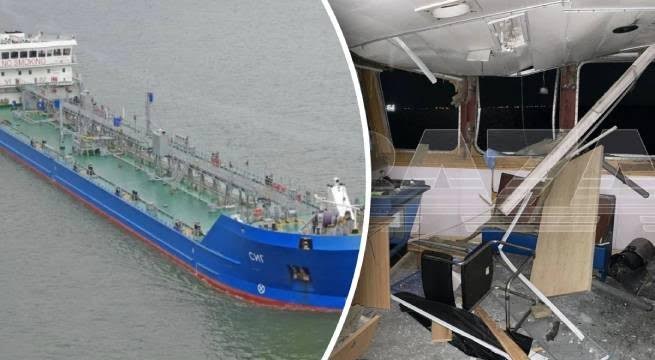
On the night of August 4, the Kiev regime launched a sea drone attack against a Russian tanker. Luckily, the resulting damage was insufficient to sink the ship or cause any casualties among the 11 crew members, but it did hinder its operation. The attack happened at about 23:20 just south of the Kerch Strait, according to a statement by Russia’s Federal Agency for Sea and Inland Water Transport. The vessel was later identified as the chemical tanker SIG. The Russian maritime agency detailed that there is a hole “near the waterline on the starboard side, presumably as a result of a sea drone attack” and confirmed there were no casualties.
It’s important to note that the SIG is sanctioned by the United States for transporting jet fuel to the Russian military in Syria, making American involvement in the attack almost a certainty, particularly at a time when Washington DC’s aggression against Damascus is escalating. The targeting information was most likely provided by US ISR (intelligence, surveillance, reconnaissance) platforms which then relayed this to the SBU or the Neo-Nazi junta forces. The move aims to hamper vital Russian logistics in Syria, particularly operations by the VKS (Russian Aerospace Forces) which is regularly intercepting US/NATO aircraft illegally entering Syrian airspace.
To further conceal direct US involvement, the Kiev regime openly boasted about the attack, which is highly unusual given the fact that it normally maintains plausible deniability in the aftermath of such actions. According to NBC, “the tanker was transporting fuel for the Russian troops,” citing sources and adding that “it was well loaded” and that “the ‘fireworks’ could be seen from afar”. They said that a surface drone and TNT had been used to carry out the attack. A video was also released and shared by several Neo-Nazi junta officials, showing a sea drone moving towards the tanker, although it cuts just before reaching the ship, suggesting the explosion followed immediately after.
“Any explosions that happen with the ships of the Russian Federation or the Crimean Bridge is an absolutely logical and effective step in relation to the enemy,” the head of the SBU Vasyl Malyuk posted on Telegram, adding: “If the Russians want the explosions to stop, they should use the only option for this — to leave the territorial waters of Ukraine.”
Several hours before the attack on SIG, another sea drone damaged the “Olenogorsky Gornyak” landing ship, just off the port of Novorossiysk, one of Russia’s major export hubs. Coupled with attacks on tankers, such actions are obviously designed to hinder Moscow’s oil sales as the so-called “price cap” turned out to be a miserable failure, with even US vassals such as Japan ignoring it. By targeting Russian tankers and major ports, the US is hoping to stop or at least hamper oil sales. This is also connected to the issue of insurance for Russian vessels, meaning there would be no compensation in case of such attacks, possibly prompting other tankers to halt transporting Russian oil.
On the other hand, drone strikes on Russian cities aim to disrupt normal economic activity and discredit Russian authorities, probably in hopes of causing unrest of some kind. On August 6, Moscow’s Vnukovo airport was forced to temporarily halt all flights due to a failed drone attack. The Russian military’s electronic warfare (EW) assets downed the drone in the Podolsk region of the Moscow suburbs. The attack could have caused untold damage had it reached the airport, jeopardizing the lives of thousands of civilians. Since major drone attacks on buildings in Moscow (including the Kremlin itself), the Russian military strengthened its air defenses in and around Moscow, including by placing “Pantsir” SAM (surface-to-air missile) systems on rooftops.
Moscow Mayor Sergey Sobyanin wrote on Telegram: “Today at around 11:00 AM, a drone attempted to break through to Moscow. It was destroyed on the approach by air defenses. Well done, military.”
Drone attacks on civilian infrastructure are absolutely irrelevant to Russian military operations in Ukraine, meaning they are either an act of desperation (as the Kiev regime’s much-touted counteroffensive has been an absolute debacle) or the United States is simply trying to launch a total war against Russia, as its economy has proved to be virtually impervious to the political West’s unrelenting sanctions warfare. Another proof that the economic siege of Russia has failed spectacularly is the fact that the Eurasian giant’s economy will grow 1.5% this year, according to an assessment by the IMF. This “unpleasant surprise” most likely prompted the political West to take “concrete action” in order to prevent such a scenario, as its own economic prospects are not looking so good.
Namely, although President Joe Biden vowed to “turn the ruble into rubble” just last year, this has proven to be nothing more than a fantasy, as the Russian economy is now outperforming those of its adversaries, the same ones enforcing the sanctions. Unable to face Moscow in a fair fight, be it militarily, economically or otherwise, the political West is left with underhanded tactics such as biological warfare, evident terrorist attacks and even covert nuclear proliferation. As previously mentioned, all this can only be described by two words – total war. And while it inevitably results in damage for Moscow on a tactical level, strategically and historically, Russia has never lost such confrontations, as evidenced by the last attempt by a certain failed painter with a peculiar mustache.
Drago Bosnic is an independent geopolitical and military analyst.
US response to Russia-China naval patrol exposes glaring hypocrisy
By Timur Fomenko | RT | August 8, 2023
Last week, the US sent a group of warships and a reconnaissance plane to waters off the coast of Alaska after Chinese and Russian vessels conducted a joint naval patrol in the area.
A former US Navy captain and analyst for right-wing think tank the Heritage Foundation described the patrol as “highly provocative.” Because the US and its allies would never, ever do something like that, right?
The US is engaged in the full-blown militarisation of the peripheries of both China and Russia in a manner that implies it has an unconditional right to do so. This behaviour has not only provoked one war, in Ukraine, but risks triggering a second one, over the Taiwan Strait, too. The reality, of course, is that neither Russia nor China poses any threat to Alaska whatsoever, because the conflict, or risk thereof, is at their own front doors, not America’s.
The US is the most militaristic and aggressive country in modern history. It has established a global military presence that spans every single continent with hundreds of military bases. In doing so, it claims it supports the freedom and self-determination of others. In reality, it provocatively encircles states that it deems rivals to its own global dominance, escalates tensions, and then when these states respond to the situation, subsequently brands them as the “aggressors,” thus affirming and even expanding its military footprint in these given regions.
With Russia, the US has pursued a relentless expansion of NATO eastwards since the Cold War, absorbing former members of the Soviet Union’s alliance system even when Russia had no will to compete with it. NATO has evolved from a unit of collective self-defence in a specific geographic region into an increasingly global ideological crusade which serves the goals of the US. The words “North Atlantic” in its name are increasingly redundant as Washington even endeavours to broaden its reach to Asia and the Pacific.
Which leads to the next point, China. The US is pushing for a full-scale military and naval encirclement around China’s eastern periphery, deliberately using the Taiwan independence issue as a wedge to ramp up tensions despite the One China Policy and giving the island region more and more arms. While doing this, it is forcing more and more countries to accept a greater American military presence. This recently included the Philippines, where the US gained access to a number of bases, as well as Papua New Guinea, where a defence cooperation agreement was recently signed. At the same time, the US constantly sails warships through the South China Sea and the Taiwan Strait, citing so-called “freedom of navigation” from a law which it does not even ratify. China’s retaliatory actions are then branded “aggressive” and threatening the peace of the region.
If this constitutes normal behaviour and a sovereign right of the US, why can China and Russia not sail patrols up to Alaskan waters? Why is one behaviour described as “freedom of navigation” but the other is labelled “highly provocative”? The reality is that because both countries are concerned about the US on their doorsteps, they have little interest in ever waging war as far afield in Alaska. The same cannot be said about US actions on their doorsteps, whereby the threat of war is very, very real and is being cranked up even higher by Washington. The US deems it has rights which other countries do not, which leads to the double standards voiced in the media regarding these seemingly equal actions.
China-Russia military cooperation is a product of the US antagonising them both, rather than so-called “provocative behaviour.” In the geographic sphere of Northeast Asia, the two countries have shared strategic interests which concern checking the expansion of US military power in Japan and the Korean Peninsula. This extends to the Northern Pacific. Neither country has any specific ambitions regarding Alaska. Neither China nor Russia is attempting to foster an independence or separatist movement there, unlike what the US is doing with Taiwan, and then groom it into a military partner hostile to Washington. Therein lies the difference between the two sets of military behaviour. China and Russia may cooperate for common strategic objectives, but they are not exerting aggression in the process. On the other hand, the US’ military presence and patrols are designed to upend a region and turn countries against other, provoke strife, and of course advance its economic goals. The irony is that media discourse presents this as entirely normal and justified, but then depicts Russia-China cooperation as a potential threat to Alaska.
US Whipping Up Tension Around Abkhazia, South Ossetia – Russian Ambassador
Sputnik – 08.08.2023
WASHINGTON – The United States is whipping up tension around Abkhazia and South Ossetia, and is not working on an agreement between Tbilisi, Sukhum and Tskhinval on the non-use of force, Russian Ambassador to Washington Anatoly Antonov said in a statement.
“If the Biden Administration is truly committed to ensuring peace in the region, then it must drop the accusations and threats of sanctions against Russia. As well as not try to disrupt the establishing of ties between our country and Georgia. It is important to focus on practical activities within the framework of the International Geneva Discussions on Security and Stability in the South Caucasus. First of all, work towards concluding a legally binding agreement of Tbilisi with Sukhum and Tskhinval on the non-use of force. It is not time to whip up tension, which is what the United States is doing now,” Antonov said.
He said the United States was deliberately turning the situation upside down, trying to put the blame on Russia, whereas the entire responsibility for the 2008 events lies with former Georgian President Mikheil Saakashvili.
“It was on his criminal order that a full-scale war was unleashed against the people of South Ossetia,” Antonov said.
“It is high time Washington admitted that this inhumane decision was also the result of a misguided policy conducted by the United States. After all, it was the West who brought to power, and then zealously supported the odious regime of Saakashvili. And still is continuing to lobby for the interests of this figure, as recently confirmed by the US Ministry of Justice,” he said.
Moscow on August 26, 2008, after Georgia’s armed aggression against Tskhinval, recognized the sovereignty of South Ossetia and Abkhazia. The leaders of Russia have repeatedly stated that the recognition of the independence of the two former Georgian autonomies reflects the existing realities and is not subject to revision. However, Tbilisi refuses to recognize the independence of the republics.
Estonian social crisis worsening
By Lucas Leiroz | August 8, 2023
Estonia is in serious trouble due to its irrational stance in the current NATO proxy conflict with Russia. Simultaneously focused on meeting Ukrainian humanitarian demands and the war plans of the Atlantic alliance, the Estonian government virtually excludes its own people from national priorities, which resulted in the aggravation of the internal crisis. Uncontrolled immigration, deindustrialization, economic instability and rising living costs are some of the problems that currently affect the country – and that will continue to do so if the government does not take a sovereign attitude.
Committed to helping solve the Ukrainian humanitarian issue, Estonia has been receiving thousands of refugees every day. Last year, the country received more than 115,000 Ukrainians – 62,000 of them planning to stay there permanently. This year, it is estimated that 300 to 400 Ukrainians are applying for Estonian asylum every week. Not all migrants are really in need of humanitarian aid due to the impact of the conflict. Many of the Ukrainian citizens in Estonia are men of military age who should be on the battlefield according to Kiev’s law, but who fled the country to escape the war.
Despite Kiev’s forced recruitment system being dictatorial and unacceptable, Estonia has no humanitarian obligation to receive people who are simply fleeing their military duties. These refugees get help from the Estonian government, and their stay in the country is subsidized by local taxpayers. So, it would be legitimate for Tallinn to have stricter guidelines on who to welcome into its territory – but it does not. In practice, any Ukrainian can enter the country, and the government remains silent, given its irrationally “humanitarian” stance, which prioritizes foreign citizens over nationals.
The Estonian state’s efforts to receive these refugees have been extremely expensive. In the first quarter of 2023 alone, Estonia spent more than 25 million euros on costs related to Ukrainian migrants. These expenses include benefits such as special protection by the Ministry of Interior’s forces, as well as Estonian language lessons provided by the Ministry of Culture.
Obviously, to finance all this, the government needs to reduce investments in other sectors. Unconcerned with the welfare of its own population and prioritizing foreign citizens, Estonia has progressively reduced its spending in the social sphere, which brings serious problems to the domestic situation. The cost of living in the country has been rising, and in 2022 an inflation rate of 19.4% was calculated. As a result, just as thousands of Ukrainians are entering Estonia, thousands of Estonians are migrating to other European countries in search of better living conditions.
In addition to the lack of control over migration, another factor contributing to Estonia’s social crisis is the country’s increasing militarization, both to meet NATO’s demands and to send assistance to Kiev. More than 1% of Estonian GDP is currently being sent in military aid to the Kiev regime, while another 3% is invested in internal militarization to meet the NATO-imposed defense spending goal. So, more money is invested in waging war than in trying to solve social problems, which obviously results in a crisis.
Furthermore, it is necessary to remember that, in the enthusiasm to meet the military interests of NATO and Kiev, Estonia has also generated many problems for its population with the expansion of training camps, affecting local agriculture. Alleging the need for improvements in its defense capacity, Estonia created the Nursipalu Training Area last year and is now trying to expand it. The main problem is that the testing area is located in an agricultural production zone, affecting the regional economy. The Estonian government has not offered local landowners sufficient money or new properties to compensate for the loss of territory from military expansion, thus discouraging agricultural production to favor the interests of NATO.
As we can see, unlimited cooperation with NATO and its proxy neo-Nazi regime has only harmed Estonia and contributed to the emergence of internal problems. In addition to migration and unnecessary militarization, there is also the issue of sanctions. The country has had many problems with decreasing cooperation with Russia in infrastructure. There was a drastic drop in cross-border rail transport, preventing Estonian industrial production from reaching the foreign market. This mainly affected the wood sector in the Võru region and metallurgical production in Põlva, which are strategically relevant points of the national economy.
In fact, all this shows how anti-strategic it is to follow NATO’s guidelines and adopt a policy of support to Kiev. Estonia is entering a serious domestic crisis just because it chose to accept the orders of the Atlantic alliance and engage in anti-Russian war plans. The best way to reverse this scenario and avoid national collapse is to take a sovereign attitude.
Lucas Leiroz, journalist, researcher at the Center for Geostrategic Studies, geopolitical consultant.
Professor John Mearsheimer on the Ukraine War
Why didn’t the West negotiate an Austrian-style neutrality deal with Russia?
By JOHN LEAKE | COURAGEOUS DISCOURSE | AUGUST 6, 2023
The Canadian writer and journalist, Aaron Maté, just published what strikes me as the most intelligent and illuminating conversation about the war in Ukraine I’ve heard thus far.
I have studied European history for forty years and lived in Austria for a total of 15. For the last 18 months I have tried in vain to answer the question: Why didn’t the United States at least try to negotiate with Russia for an Austrian-style neutrality deal for Ukraine?
Consider that if a neutrality deal was struck and the Russians subsequently violated it, THAT would be clear grounds for war. Instead, the United States government has simply and and steadfastly dismissed Russia’s view of the matter—a view that Russia has plainly and repeatedly stated since at least 2008.
Note that the arrogant and dismissive attitude of the U.S. government towards Russia since 2008 was in spite of the fact that Cold War eminences such as George Kennan urged the United States government to abandon its harebrained NATO expansion plan in 1997. As Kennan put it in a February 5, 1997 New York Times essay titled “A Fateful Error:”
Why, with all the hopeful possibilities engendered by the end of the Cold War, should East-West relations become centered on the question of who would be allied with whom and, by implication, against whom in some fanciful, totally unforeseeable and most improbable future military conflict?
[B]luntly stated… expanding NATO would be the most fateful error of American policy in the entire post-Cold War era. Such a decision may be expected to inflame the nationalistic, anti-Western and militaristic tendencies in Russian opinion; to have an adverse effect on the development of Russian democracy; to restore the atmosphere of the cold war to East-West relations, and to impel Russian foreign policy in directions decidedly not to our liking …
Several of Kennan’s fellow Cold Warriors, including Robert McNamara and Paul Nitze, agreed wholeheartedly with him, as is evidenced by their June 26, 1997 letter to President Bill Clinton.
Back to the central question of this essay: for those unfamiliar with the 1955 State Treaty and Austrian Neutrality:
The treaty forbade unification with Germany or restoration of the Habsburgs and provided safeguards for Austria’s Croat and Slovene minorities. Austrian neutrality and a ban on foreign military bases in Austria were later incorporated into the Austrian constitution by the Law of October 26, 1955. The 40,000 Soviet troops in Austria were withdrawn by late September. The small number of Western troops that remained were withdrawn by late October.
Austrian neutrality has been honored ever since and has served the Austrian people very well. The Austrian capital, Vienna, is routinely ranked as having the highest quality of life on earth. To be sure, there is a handful of incredibly stupid and venal people in Austria who claim they wish to abandon Austrian neutrality, but they merit so little attention that I almost didn’t write this sentence.
So, why didn’t the United States government negotiate with Russia for an Austrian-style neutrality for Ukraine? Professor Mearsheimer suspects that only sheer stupidity can explain it. Aaron Maté suspects cynicism.
I suspect it’s a combination of stupidity, ignorance, cynicism, greed, bloody-mindedness, narcissism, sadism, contempt, misanthropy, and recklessness—in a word, depravity. Holders of high political office who prefer to send hundreds of thousands of young men to their deaths without at least trying diplomacy are simply terrible people in every respect.
CDC, Pharma Giants Angle for Annual COVID Shots Despite ‘Unclear’ Science
By Monica Dutcher | The Defender | August 7, 2023
The U.S. House of Representatives Select Subcommittee on the Coronavirus Pandemic wants to know more about plans by the Centers for Disease Control and Prevention (CDC) to recommend annual COVID-19 vaccines.
During a July interview with Spectrum News, CDC Director Mandy Cohen said she “anticipate[s] that COVID will become similar to flu shots, where … you get your annual flu shot and you get your annual COVID shot.”
As part of the House investigation into federal COVID-19 vaccination mandates and policies, Rep. Brad Wenstrup (R-Ohio) last week sent a letter to Cohen, stating:
“It is unclear if the science supports such a recommendation. If this anticipated CDC recommendation occurs, it will mark a significant change in federal policy and guidance regarding COVID-19 vaccines and the way in which they are utilized.”
Wenstrup requested all documents and communications about any annual — “or any other time-based iteration” — recommendation for COVID-19 booster shots, including correspondence between or among the CDC, U.S. Department of Health and Human Services (also under the subcommittee’s investigation), the White House, the CDC Foundation, CDC contractors and any other CDC stakeholders.
Pfizer, Moderna and Novavax are slated in September to release new single-strain COVID-19 shots targeting the Omicron subvariant XBB.1.5. These vaccines are not yet approved by the U.S. Food and Drug Administration (FDA), but manufacturers are following the June 15 recommendations of the FDA’s Vaccines and Related Biological Products Advisory Committee (VRBPAC).
The committee of 21 independent advisers in June voted unanimously that any new vaccine should protect against just one strain of the virus — a departure from the available bivalent vaccines — and should target one of the three Omicron subvariants currently circulating, including XBB.1.5.
The XBB.1.5 variant spread globally in the first quarter of 2023, reaching dominance in North America, and other parts of the world by April, according to the FDA’s briefing document for the June meeting.
‘We really don’t know what the COVID season is’
FDA advisers in January raised concerns about shifting to a yearly schedule for COVID-19 vaccines. Unlike the flu, which thrives in the winter months, COVID-19’s spread has proved erratic, consistently mutating into new variants.
Dr. Mark Sawyer, professor of clinical pediatrics at the University of California, San Diego, told CNBC that describing COVID-19 as seasonal “could be problematic” because “we really don’t know what the COVID season is.”
Dr. Peter McCullough, author of “The Courage to Face COVID-19: Preventing Hospitalization and Death While Battling the Bio-Pharmaceutical Complex,” told The Defender :
“COVID-19 respiratory illness is now like a mild head cold. There is no seasonal pattern. The COVID-19 vaccines have failed to stop transmission or protect against hospitalization and death.
“The products on the market have theoretical efficacy of less than six months. Annual COVID-19 shots have no clinical indication, medical necessity, are not durable for 12 months and have never been tested for use on a yearly schedule.
“On Dec. 7, 2022 in a U.S. Senate panel on vaccines, I called for all COVID-19 vaccines to be removed from the market because they are not safe for human use. There has been no objection to that testimony from public health officials.”
NBC News reported that Dr. Peter Marks, the FDA’s top vaccine regulator, acknowledged during an FDA advisory committee meeting in January that “simplifying the COVID-19 vaccine schedule to be exactly like the flu may not be possible.”
Pfizer hopes otherwise. The drug company’s chief scientific officer, Dr. Mikael Dolsten, thinks an annual COVID-19 vaccine would improve vaccine sentiment, telling CNBC the public grew dissatisfied with mandates during the earlier stages of the pandemic.
He said:
“Unfortunately some people see vaccines as part of that [the mandates].
“I think of it like the introduction of seat belts for cars. People didn’t want to wear them at first, but over time they realized how much seat belts protect them. Now everyone uses them today. That’s kind of how the vaccine story needs to be reimagined.”
An annual schedule, Dolsten added, may help people view COVID-19 shots as another “very natural part” of protecting their health.
CDC director ‘very worried about parents not vaccinating kids’
In addition to the ambiguity surrounding COVID-19 vaccine scheduling, there is no consensus among medical experts on which patients would be recommended for an annual jab.
Dr. Paul Offit, a vaccine scientist, professor of pediatrics in the Division of Infectious Diseases at the Children’s Hospital of Philadelphia and a member of VRBPAC, took issue with not only the annual model but also with administering COVID-19 vaccines to low-risk groups.
Offit told CNN:
“If the goal of the vaccine is the stated goal, which is protection against severe disease, do you really need a yearly vaccine for otherwise healthy people less than 75? I mean, is this the flu model? Because I would argue it shouldn’t be.”
Health advocacy groups and doctors argue against authorizing mRNA shots in young children and babies. As of July 28 — when data were last updated in the Vaccine Adverse Event Reporting System (VAERS) — there were 6,591 reports of adverse events following COVID-19 vaccination in children under age 6.
Cohen said she is “very worried about parents not vaccinating kids,” telling Spectrum News, “There’s plenty of other things that are hard as parents that we can’t do. This is one we can do to protect our kids.”
McCullough described Cohen as “fully entrenched in the bio-pharmaceutical complex” and “on the wrong side of every pandemic public health intervention.”
Jeffrey A. Tucker, founder and president of the Brownstone Institute, said Cohen’s career has been punctuated by “heartbreaking fear-mongering, pseudo-science, and propaganda,” adding that “she passed with flying colors all three tests of compliance: closures, masking, and vaccine mandates.”
Reduced trust in vaccines and the CDC concerns Cohen, who plans to rehabilitate that trust by focusing on “transparency, execution and building relationships with the public, health leaders and politicians.”
A survey by the Harvard T.H. Chan School of Public Health published in the journal Health Affairs found that roughly a quarter of Americans have little to no trust in the CDC for health information, including 10% who do not trust the agency at all.
The CDC currently recommends the primary series of mRNA shots, or the first two doses of the updated vaccine be given weeks apart, followed months later by a booster shot. The FDA updated its guidance for these shots in August 2022 to contain a bivalent formulation targeting the original viral strain plus the BA.4 and BA.5 Omicron subvariants.
Pfizer is working on a combined flu/COVID-19 vaccine, expected to be available after 2024. Moderna is also working on a “next-gen flu-COVID combo” vaccine. Other vaccine makers are following suit.
Monica Dutcher is a Maryland-based senior reporter for The Defender.
This article was originally published by The Defender — Children’s Health Defense’s News & Views Website under Creative Commons license CC BY-NC-ND 4.0. Please consider subscribing to The Defender or donating to Children’s Health Defense.
Everything you need to know about Covid’s “Eris” Variant
By Kit Knightly | OffGuardian | August 7, 2023
The big news the last couple of days is that “Covid” is back… again. This time it’s the “Eris” variant, named after the Greek goddess of strife and discord, it supposedly is causing a spike in cases for the first time in… who cares how long.
The bulk of reporting on it is detailing how it’s supposedly related to Omicron or Arcturus or all the other names they flash in the headlines.
That, or the symptoms.
They are a runny nose and a sore throat and…well, you know. The only noteworthy thing to mention here is that the “loss of taste of smell” – so long sold as Covid’s calling card – is no longer considered a common symptom.
Yahoo even reported – without a shred of irony – that the alleged up-tick in “cases” was due to people spending more time indoors:
Bad weather encouraging people to spend more time indoors and waning immunity have been blamed for the rise
… a peculiar position to take, considering lockdown is meant to have helped, last time.
Anyway, without further ado, here is everything you really need to know about the Eris variant:
It’s bullshit.
Just like all the others.
Nothing else really needs to be said, does it?
Sure the media are setting up softballs for us to hammer over the fence, talking about the “symptoms” and “infection” rate again as if the past three years haven’t rendered all those words meaningless. But we are – or should be – well past that point of arguing against the mainstream.
We know everything we need to know about the symptoms – they are “generally mild” and “flu-like”, because Covid is nothing but re-branded endemic respiratory diseases. We know the death statistics are made up and the tests don’t work except to manufacture cases.
We know all this, even this repeating of it is unnecessary, to be honest.
The only aspect of Eris worth discussing is why it’s in the papers, and even that answer is briefer than usual.
Eris exists because the “Cerberus” heatwave is over, and July was unseasonably cold and damp in the UK. Because Autumn will be setting in soon enough and there are no more major sporting events for Just Stop Oil to disrupt for a while.
In short, Eris is what happens when people refuse to panic about climate change.
In fact, we can probably expect headlines linking Eris to the climate in the next few days.
The trouble with that is, just like climate change, people can only be scared by words for so long. The media repeated “global warming” so much the words lost their meaning, and filled the papers with so many apocalyptic predictions that never came to pass that people got numbed to it, they filter it out now even if they don’t realise they do.
The same will happen with covid; the more they bring it back for a jump scare, the less people will jump.
That’s probably why they’re laying the groundwork “the next pandemic” of “disease X”.
Massive Water and Cloud Boost From Tonga Eruption Could Explain Recent Unusual Weather Patterns
BY CHRIS MORRISON | THE DAILY SCEPTIC | AUGUST 4, 2023
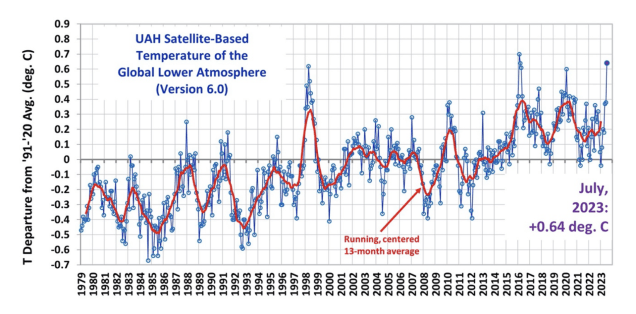
The accurate satellite record confirms that last month was an unusual weather period with higher than normal temperature recordings on both land and at sea. It was the warmest July since 1979, it tied with March 2015 for the second warmest departure from the norm and it was the warmest month for tropical land. Of course, the climate alarmists had a field day, with ‘global boiling’ now making an official UN appearance. Inexplicably missing from all the hysteria, however, was any mention that NASA scientists have recently confirmed that the Tonga volcanic eruption in January last year boosted water content in the stratosphere by a massive, and weather-changing, 10%.
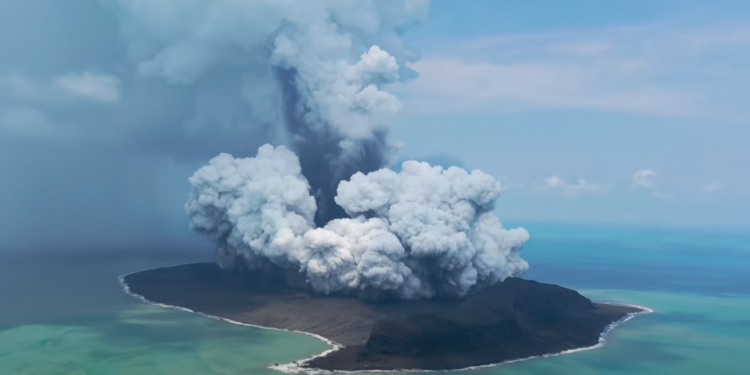
Scientists have been shocked by the dramatic increase in water vapour spread around the globe by the Hunga Tonga-Hunga Ha’apai submarine volcano. Water vapour is the most powerful of all the greenhouses gases since, unlike the others, it traps heat across a wide part of the infra-red spectrum. It accounts for about 4% of all atmospheric gases, compared to 0.04% for carbon dioxide, but its effect is relatively short-lived since it re-enters the natural hydrological cycle. Nevertheless, Tonga water vapour and its associated clouds could last in the atmosphere for a few years, and scientists suggest both temperature increases and disturbed weather patterns will continue.
A group of NASA scientists have published a paper noting Tonga’s “high impact” consequences. Unlike most volcanic eruptions, Tonga released few aerosols such as dust and ash into the atmosphere which cause temporary falls in temperature. In 1815, Mount Tambora exploded on the island of Sumbawa causing widespread cooling and a subsequent “year without a summer”. In Tonga’s case, specific geological conditions threw vast amounts of super-heated water up to 50 kilometres into the air. Such is the “unprecedented” amounts of water involved, the NASA scientists believe it could remain in the atmosphere for serval years. The scientists say they will continue to monitor volcanic gases from this eruption, along with future ones, “to better quantify their varying roles in climate”.
Not that it is likely that the spoon-fed activists in the mainstream media will be much interested. Any warming will be gratefully seized upon to promote the so-called climate emergency, and the collectivist Net Zero political solution. The scientific jury is still deliberating on the effects of the Tonga eruption, but recent unusual weather changes occurring at a time when water vapour has been given such a massive boost, must rank as a possible cause. As the Daily Sceptic has often noted, the tragedy for any commentator too afraid to challenge the prevailing narrative about the climate is that whole areas of debate around physics, chemistry and geology are off limits for fear that alternative explanations will cast doubt on the carefully constructed political narrative.
Cliff Mass is the Professor of Atmospheric Science at the University of Washington. He has long been critical of catastrophising about individual weather events. According to Mass, the golden rule of weather extremes is: “The more extreme a climate or weather record is, the greater the contribution of natural variability, and the smaller the contribution of human-caused global warming.”
Earlier work from a group of European scientists had drawn attention to the scale of the Tonga discharge. They concluded that the unique nature and magnitude of the global stratospheric perturbation caused by Hunga “ranks it among the most remarkable climatic events in the modern observation era, with a range of potential long-lasting repercussions for stratospheric composition and climate”. They also observed that Hunga was likely to have been the most explosive event of the modern observational era, while comparisons were made to the eruption of Mount Krakatoa in 1883.
The latest work from NASA analysed satellite data showing the volume of water injected into the atmosphere between 12 and 53 kms. “We’ve never seen anything like it,” commented lead author Luis Millan. “We had to carefully inspect all the measurements in the plume to make sure they were trustworthy,” he added. Volcanoes rarely inject much water into the stratosphere. In the 18 years since NASA has been taking measurements, only two others produced appreciable amounts, but these were said to be “mere blips” compared with Tonga.
It seems that the smart alarmist money is backing the Tonga warming effect, with some shorting of the once promising El Nino boost becoming apparent. Signals from the latter stable are not wholly sanguine. Sea surface temperature departures from the norm, known as anomalies, are mixed, notes the U.S. weather service NOAA. “Collectively, the coupled ocean-atmosphere system reflected a weak El Nino” it adds. Odds can change – it is after all the weather. Forecasters are said to favour continued growth of the El Nino oscillation through the fall, peaking this winter with an 81% chance of “moderate-to-strong” intensity. In forecaster-speak, this translates as we haven’t a clue.
Chris Morrison is the Daily Sceptic’s Environment Editor.
The EU is a ‘failed project’ – AfD
RT | August 7, 2023
The European Union’s migration, climate, and monetary policies have “completely failed,” according to a policy document adopted by the right-wing Alternative for Germany (AfD) party on Sunday. However, the party aims to change the EU from within rather than withdraw from the bloc.
AfD delegates adopted the document at a party conference in the eastern city of Magdeburg on Sunday. The paper describes the EU as a “failed project,” and calls for the bloc to be reformed as a “federation of European nations,” with significant sovereignty ceded back to its member states.
“The EU and the globalist elites that support it have strayed from the original idea of the founding fathers of a European community adopted many years ago,” the document states, citing the 2007 Lisbon Treaty – which gave the EU the power to act as a single legal entity and made EU law supersede national law – as the moment when the bloc became “an EU super state.”
Among a lengthy list of reforms, the AfD is proposing that the EU strengthen its external borders, lessen its military reliance on the US by following a policy of “strategic autonomy,” and protect the “diversity of cultures and traditions of the peoples of Europe” from immigration.
While a draft version of the document released in June called for the “orderly dissolution of the EU,” this language is absent from the final version.
The party also chose 35 candidates to contest next year’s European Parliament elections at the Magdeburg conference. The list is led by Maximilian Krah, who has been an MEP since 2019. The AfD currently holds nine seats in the parliament, and is the third-largest German party in the EU legislature.
At home, the AfD is currently polling at a record high of 21%, according to Politico. This figure puts the party ahead of Chancellor Olaf Scholz’s Social Democrats (SPD) and behind only former chancellor Angela Merkel’s Christian Democratic Union (CDU). However, Germany’s mainstream parties have repeatedly ruled out entering into coalition with AfD, and a government-funded watchdog group recently called for the party to be banned for its “racist and nationalist” positions.
The latest polling figures suggest a doubling in the AfD’s support since 2021, when it garnered 10.3% of votes in the parliamentary elections. This surge in popularity comes as Germany’s economy reels in the wake of Berlin’s decision to impose sanctions on Russia, which was formerly the country’s leading energy supplier. At a rally last year, AfD co-leader Tino Chrupalla accused Scholz’s government of waging an “economic war” on the German people by cutting the country off from Russian energy imports.
How long before all browsers are required by law to prevent users from opening allegedly infringing sites?
BY GLYN MOODY | WALLED CULTURE | AUGUST 4, 2023
Mozilla’s Open Policy & Advocacy blog has news about a worrying proposal from the French government:
In a well-intentioned yet dangerous move to fight online fraud, France is on the verge of forcing browsers to create a dystopian technical capability. Article 6 (para II and III) of the SREN Bill would force browser providers to create the means to mandatorily block websites present on a government provided list.
The post explains why this is an extremely dangerous approach:
A world in which browsers can be forced to incorporate a list of banned websites at the software-level that simply do not open, either in a region or globally, is a worrying prospect that raises serious concerns around freedom of expression. If it successfully passes into law, the precedent this would set would make it much harder for browsers to reject such requests from other governments.
If a capability to block any site on a government blacklist were required by law to be built in to all browsers, then repressive governments would be given an enormously powerful tool. There would be no way around that censorship, short of hacking the browser code. That might be an option for open source coders, but it certainly won’t be for the vast majority of ordinary users. As the Mozilla post points out:
Such a move will overturn decades of established content moderation norms and provide a playbook for authoritarian governments that will easily negate the existence of censorship circumvention tools.
It is even worse than that. If such a capability to block any site were built in to browsers, it’s not just authoritarian governments that would be rubbing their hands with glee: the copyright industry would doubtless push for allegedly infringing sites to be included on the block list too. We know this, because it has already done it in the past, as discussed in Walled Culture the book (free digital versions).
Not many people now remember, but in 2004, BT (British Telecom) caused something of a storm when it created CleanFeed:
British Telecom has taken the unprecedented step of blocking all illegal child pornography websites in a crackdown on abuse online. The decision by Britain’s largest high-speed internet provider will lead to the first mass censorship of the web attempted in a Western democracy.
Here’s how it worked:
Subscribers to British Telecom’s internet services such as BTYahoo and BTInternet who attempt to access illegal sites will receive an error message as if the page was unavailable. BT will register the number of attempts but will not be able to record details of those accessing the sites.
The key justification for what the Guardian called “the first mass censorship of the web attempted in a Western democracy” was that it only blocked illegal child sexual abuse material Web sites. It was therefore an extreme situation requiring an exceptional solution. But seven years later, the copyright industry were able to convince a High Court judge to ignore that justification, and to take advantage of CleanFeed to block a site, Newzbin 2, that had nothing to do with child sexual abuse material, and therefore did not require exceptional solutions:
Justice Arnold ruled that BT must use its blocking technology CleanFeed – which is currently used to prevent access to websites featuring child sexual abuse – to block Newzbin 2.
Exactly the logic used by copyright companies to subvert CleanFeed could be used to co-opt the censorship capabilities of browsers with built-in Web blocking lists. As with CleanFeed, the copyright industry would doubtless argue that since the technology already exists, why not to apply it to tackling copyright infringement too?
That very real threat is another reason to fight this pernicious, misguided French proposal. Because if it is implemented, it will be very hard to stop it becoming yet another technology that the copyright world demands should be bent to its own selfish purposes.
GLYN MOODY, journalist, blogger on openness, the commons, copyright, patents and digital rights.
Follow me @glynmoody on Mastodon.
Featured Video

Theodore Postol: Iran’s Missiles & Drones Were Underestimated
or go to
Aletho News Archives – Video-Images
From the Archives
Wars for Israel: A reminder of who’s giving the marching orders
By Damian Lataan | February 7, 2012
As the West prepares to march off to yet another war in the Middle East, we should perhaps remind ourselves of who is giving the West their marching orders.
In February 2003, just weeks before the US and their allies launched their attack on Iraq and her peoples, a delegation of US congressmen, together with the US Ambassador to the United Nations, John Bolton, a well known pro-Zionist and neoconservative war-hawk, were in Israel at the invitation of the Israeli government then led by Israeli Prime Minister Ariel Sharon.
Addressing the congressmen, Sharon told them ‘that Iran, Libya and Syria should be stripped of weapons of mass destruction after Iraq’. Later, Sharon told John Bolton ‘that Israel was concerned about the security threat posed by Iran, and stressed that it was important to deal with Iran even while American attention was focused on Iraq’. … continue
Blog Roll
 Aletho News
- The Most Important Bet You’ve Never Heard Of
- The killing of three Indonesian soldiers in Lebanon should remind Jakarta that Israel does not want peace
- Defeated and delusional: Netanyahu’s remarks reveal $80bn war failure, says analyst
- Iran’s friends are about to make life much more difficult for Israel and the US
- The war of liberation of the Arab and Islamic peoples expands across the Gulf
- Envoy warns UN on Trump’s threat to ‘obliterate’ Iran’s civilian infrastructure
- The Larak Corridor: Iran’s Rial Gate With No US, No Israel, and No Way Around
- ‘Economic terrorism’: Steel facilities hit again in US-Israeli strike
- ‘War Crime’: Iran condemns attacks on Arak, Ardakan nuclear sites
- Two-thirds of Americans want quick end to Iran war even if goals unmet
- If Americans Knew
- Gaza families reunite years after babies evacuated amid Israel’s war
- International Rescue Committee warns Gaza’s children face grave protection risks
- Iran’s Alleged 47-Year War on America: Debunking the 1,050 American Deaths Canard
- Israel wants US to bomb more of Iran’s civilian structures (113,000 is not enough) – Not a ceasefire Day 173
- Ann Coulter Rips Into Fox News for Iran War Coverage
- Joe Kent Urges Americans To Call White House and Congress To Object To Sending Troops Into Iran
- DNC Resolution to Reject AIPAC Funding Puts Democratic Leaders in the Hot Seat
- Swedish foundation to build 400 schools as over 650,000 Gaza children remain without education for 2 years
- Israeli army admits photshopping image of slain Lebanese journalist
- This is how Israel is systematically killing health workers under the cover of war in Lebanon
- No Tricks Zone
- New Study Finds Warming Saves Lives…Cold Temperatures 12 Times More Deadly Than Excess Heat
- German Science Blog Accuses PIK Climate Institute Of Hallucinating Climate Tipping Points
- Devastating Assessment Of Comirnaty Vaccine By Former Senior Pfizer Europe Toxicologist
- New Study: CO2 Is ‘Effectively Negligible’ As An Explanatory Climate Change Factor Since 2000
- Former Pfizer Toxicologist Dr. Helmut Sterz Tells Bundestag Hearing Pfizer Vaccine Should Have Never Been Approved
- Energy Expert: Germany’s Nuclear Phaseout Was A “500 Billion Euro Mistake”
- New Research: South Australia’s Mid-Holocene Sea Surface Temperatures Were 4°C Warmer Than Today
- Storing Green Energy To Last Germany 10 Days Would Require A 60-Million Tonne Battery
- New Studies: UK Sea Levels Were 4 Meters Higher Than Today During The Mid-Holocene
- Destructive Green New Deal: German Energy And Metal Group Warns Of Drastic Crisis
 Aletho News