New York urgently needs to confront the contradiction of trying to electrify everything while also eliminating fossil fuels
By Jane Menton and Francis Menton | Manhattan Contrarian | September 13, 2023
In New York, politicians are selling the public a narrative that electricity is going to be the solution to climate change. We will eliminate all CO2 emissions by banning gasoline-powered cars, banning natural gas infrastructure, banning gas heat in buildings, and banning gas for cooking. All of these are to be replaced with supposedly “green,” emissions-free, alternatives – which in practice consist of only one thing, electricity. We’ve been told that this is how we are going to protect the planet for future generations.
But there is nothing emissions-free about the way electricity is currently generated in New York. About half of our electricity comes now, as it traditionally has, from burning fossil fuels. New York has announced plans to eliminate those from electricity generation by 2030, but as of now has no realistic plan to replace them. Meanwhile, it is forcing its citizens to convert essential systems like heating to electricity, with no basis to believe that the electricity will be available to prevent people from freezing in the winter only a few years from now. This is a glaring contradiction, that needs urgently to be addressed before we suffer a self-inflicted catastrophe.
At present, fossil fuels are critical to our generation of electricity. According to the most recent data from the federal government’s Energy Information Administration, in 2021 New York got some 46% of its electricity from burning natural gas and another 1% from fuel oil, and almost all of the rest from either nuclear (25%) or hydropower (23%, most of which comes from Niagara Falls). Non-hydro “renewables” (wood, wind and solar) provided only about 6% in total, and about 2% of that was from wood. After decades of hype about their wondrous future, wind and solar provided only about 4%. And in 2021, the state closed the Indian Point nuclear plant, replacing its output almost entirely with natural gas generation, meaning that the percent of our electricity supply coming from fossil fuels is now up near 50% today.
If more electricity is needed, the options are few. New nuclear plants face vociferous opposition from environmentalists, with almost no prospect that that can be overcome. A completely finished nuclear plant called Shoreham sits idle on Long Island, having never been approved for commercial operation in the face of vigorous environmental opposition. As to hydropower, we do not have another Niagara Falls. Wind and solar produce remarkably small amounts after decades of hype and massive subsidies; and what they do produce is intermittent and often unavailable when most needed on the hottest and coldest days. The last option, natural gas – the one that is available, scalable, and actually works – is the one our politicians are pledging to eliminate without anything to replace it.
In the face of this generation picture, the State and New York City are proceeding with proposed electricity mandates that will have the effect of greatly increasing demand for the power. This will either require scaling up our electric grid to match that need or else leaving people without functioning infrastructure. Policies already in place in New York City require electrification of cars, heat, and cooking, aiming for widespread conversion by 2035, and continuing thereafter. A piece in the Daily News on June 3 includes a projection from National Grid (one of our utilities) that the State will need to increase the capacity of the grid by 57% by 2035, and 100% by 2050.
In scenarios where people’s cars, heat, cooking and more are all entirely dependent on reliable electricity, ensuring that our electricity sources are adequate and reliable is critical to the functioning of everyday life. Yet, even as our government is rapidly rolling out electrification mandates, it is simultaneously closing the biggest piece of our reliable generation.
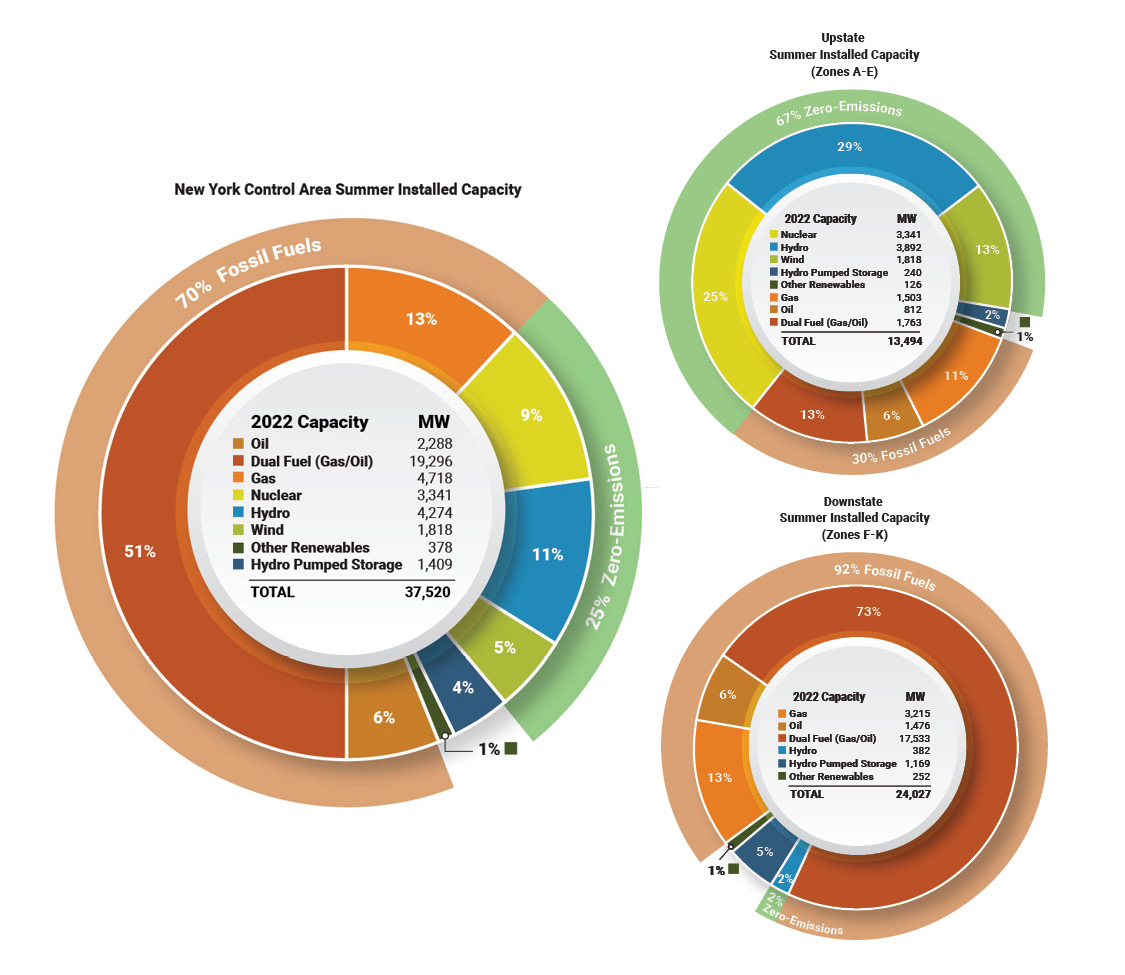
New York is Exhibit A of a current crisis-in-waiting. At the State level, Governor Hochul has committed to closing all of the State’s fossil fuel electricity plants by 2030. Current New York State summer installed capacity is 37,520 MW, or 37.5 GW. Of that, about 60%, or more than 22 GW, consists of natural gas facilities, which are capable of running nearly all the time and ramping up to maximum output when most needed. Based on National Grid’s projection of 57% increased demand by 2035, New York should be planning to have 37.5 GW x 1.57, or almost 59 GW of always-available capacity on hand by that year. Yet the only significant plans for additional capacity by 2035 consist of about 9 GW of offshore wind, and another 1.25 GW to come from a transmission line to bring hydropower from Quebec. (In recent weeks, all of the offshore wind developers have demanded major contract price increases of 50% and up, failing which they threaten to walk off the job.)
Something here does not remotely add up. If New York state succeeds by 2030 in closing its natural gas plants — the plants that account for 60% of the State’s generation capacity — that would bring our total installed capacity down from 37.5 GW to as little as 15 GW. But we need almost 60 GW to meet projected demand. And that’s 60 GW that can be called on any time as needed to meet peak usage. The 9 GW of projected offshore wind turbines wouldn’t make much of a dent even if they operated all the time and could be dispatched to meet peak demand, which they can’t. Instead, they will operate only about a third of the time, and at their own whim. At best they will provide about 3 GW on average, when what we need for this full electrification project is more like 45 GW of dispatchable power to add to our existing hydro and nuclear.
The New York Independent System Operator, which is well aware of this gigantic contradiction, talks vaguely of something they call a “dispatchable emissions-free resource” to fill the enormous gap. Other than nuclear, which is blocked, that is something that is a pure fantasy and does not exist.
Our State’s and City’s proposed plans are putting New Yorkers on a path to catastrophe, with greatly increased dependence on electricity, but without nearly enough of the stuff to function at even the current usage level. New York City got a huge lesson on dependence on electricity from Hurricane Sandy a decade ago, when a week-long blackout left people in high-rises without elevator service and without water. Now they plan to add all heat, cooking, and transportation to the things that absolutely require electricity. In that world, insufficient electricity becomes a humanitarian crisis.
It is high time for the politicians writing electricity mandates to demonstrate that it is even possible to build and scale an emission-free grid, one that is dispatchable (meaning it will work when we need it), reliable, and resilient. In today’s world, no demonstration of such a grid exists anywhere in the world.
If these mandates are allowed to go forward unabated, the real cost of will be the impoverishment of communities and destruction of quality of life. It’s up to us to realize we’re being sold a false narrative and to stop playing along.
The Biden Administration Misleads the Public on the Vast Expanses of Land Needed for ‘Net Zero’
By James Varney | RealClearInvestigations | September 12, 2023
The Biden administration is misleading the country about the amount of land that will be required to meet its ambitious renewable energy goals, RealClearInvestigations has found.
The Department of Energy’s official line – echoed by many environmental activists and academics – is that the vast array of solar panels and wind turbines required to meet Biden’s goal of “100% clean electricity” by 2035 will require “less than one-half of one percent of the contiguous U.S. land area.” This topline number translates into 15,000 of the lower 48’s roughly 3 million square miles.
However, the government report that furnished those estimates also notes that the wind farm footprint alone could require an expanse nine times as large: 134,000 square miles.
Even that figure is misleading because it does not include land for the new transmission systems that would connect the energy, created by the solar panels carpeting the ground and skyscraper-tall wind turbines filling the horizons, to American businesses and homes.
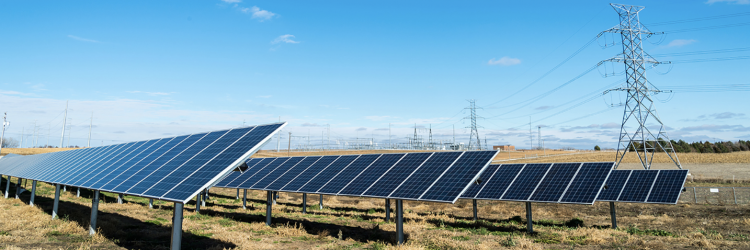
Not counted: space for new high-voltage transmission lines, key to utility-scale solar and wind projects.
Solar Energy Industries Association
“It’s hundreds of thousands of acres if not millions for transmissions alone,” said David Blackmon, an energy consultant and writer based in Texas. “The wind and solar farms will take enormous swaths of land all over the country and no one is talking about that.”
And these vast plots, along with the chains of transmission towers, do not include other aspects that would take up even more land: nationwide vehicle charging stations, mines for rare-earth minerals, maintenance space for huge propeller blades and panels, and so forth.
In addition, all projections increase substantially if the U.S. were to meet Biden’s larger goal of aligning the nation with a global plan, set by the International Energy Association and pushed by the World Economic Forum of Davos, dubbed “NetZero 2050.”
Professor Jesse Jenkins at Princeton University, whose work is often cited by renewable energy advocates, did not respond to RCI’s questions, but he detailed the scope of the challenge in the May/June issue of progressive Mother Jones magazine. He urged the U.S. to embark on a moon-shot level transformation of its energy sector, using hundreds of billions in taxpayer dollars that Biden provided for the renewable sector in the spending bill that Democrats named the Inflation Reduction Act.
“We’ll have to build as much new clean generation by 2035 as the total electricity produced by all sources today, then build the same amount again by 2050,” Jenkins wrote. “This could ultimately require utility-scale solar projects that cover the size of Massachusetts, Rhode Island, and Connecticut combined, and wind farms that span an area equal to that of Illinois, Indiana, Ohio, Kentucky and Tennessee.”

Given the ambitious goals and tight time frames Biden has committed the nation to, it seems natural to assume there would be a master plan detailing where and when this renewable infrastructure will be built and come online. Yet despite strong resistance by many communities across the country to serve as hosts for these massive projects, there has been no robust public debate about how all the necessary land will be acquired – and whether, for example, it will include the taking of private property through eminent domain or use of national park lands, an idea the government officially dismisses.
In fact, no such master plan exists. The closest thing to it, according to a spokesperson for the federal National Renewable Energy Laboratory, is a “long-term strategy” put out by Biden’s climate envoy John Kerry. The optimistic, 65-page document does not, however, address the question of land use. The White House did not respond to questions from RCI.
Experts skeptical about Biden’s goals say the land requirements are so immense and problematic that such detail would likely reveal how unworkable the entire program is.
“Of course it will never happen,” said William Smith, a professor of Earth, Environmental, and Planetary Sciences at Washington University in St. Louis and a member of the CO2 Coalition, a group of scientists who do not believe global warming is an apocalyptic development.
The “less than one-half of one percent” figure is fantasy, according to Smith.
“A lot more area is required.”
Instead of being the focus of vigorous debate regarding a crucial issue, the land requirements are routinely finessed or, most commonly, ignored by policymakers and environmentalists who promise that the radical transformation during the coming decades to the world of supposedly clean electricity will have minimal impact on people’s lives and the landscape. In reviewing government documents and speaking with experts, RCI found widespread disagreement and murkiness in part because the questions surrounding renewables are filled with so many dynamic variables and unknown factors.
The U.S. currently uses an estimated 126,562 square miles for energy production, a bit more than the combined land mass of Missouri and Florida, with by far the biggest chunk devoted to growing corn for heavily subsidized ethanol fuel. In 2021, the last year for which figures are available, the U.S. got 2.8% of its energy from solar sources and 9.2% from some 72,000 wind turbines, according to government figures.
In theory, one should be able to easily determine the nation’s future energy needs by working backward – estimating the nation’s total need for electricity in 2030 or 2050 and then determining how many wind turbines and solar panels would be required to meet that demand.
From Federal Agencies, the Rosiest Picture
There is little agreement, however, on how much electricity the U.S. will need in 2035 or 2050 – and, hence, the number of solar installations and wind turbines – because that depends on a variety of lifestyle decisions, such as the type of cars people will drive and the size of the homes they will live in. In addition, the power generation of those turbines and solar panels depends on where they are situated – which is also unknown – and their age.
These and other variables, in turn, can politicize an ostensibly scientific problem as the factors and assumptions one uses to ask key questions necessarily influence the answer.
The rosiest picture is presented by federal agencies, which rely on estimates from the National Renewable Energy Laboratory and environmental activists.
Alex Hobson, a senior vice president at the American Council on Renewable Energy (ACORE), a nonprofit that “represents all facets of the renewable energy marketplace,” echoed the Department of Energy when she told RCI that the U.S. would need “less than 1% of the land in the contiguous United States to fully transition to a clean energy economy.” All told, the U.S. could hit the Biden administration’s target of a 50% reduction in emissions by 2030 by adding 19,000 square miles of renewables, a parcel roughly equal to Maryland and Vermont, Hobson said.
Although the National Renewable Energy Laboratory’s own work includes such projections, Hobson characterized estimates putting the square mile requirements for largely carbon emissions-free energy in the hundreds of thousands as “a narrative often espoused by critics of renewable energy.”
Nevertheless, estimates by other outfits favorably disposed to Biden’s climate agenda offer larger projections. An analysis by Bloomberg News, controlled by billionaire environmental activist Michael Bloomberg, concluded that “expanding wind and solar by 10% annually until 2030 would require a chunk of land equal to the state of South Dakota.” South Dakota is roughly 77,000 square miles, or five times the “one-half of one percent” figure that federal officials like to tout.
Pushing the goal to a “NetZero” future in 2050, Bloomberg reported, would “need up to four additional South Dakotas to develop enough clean energy to run all the electric vehicles, factories and more.”
The different dates – a reduction by 2030 and “NetZero” by 2050 – are yet another set of many variables that contribute to the fuzzy math.
Spinning Turbines
Probably the greatest area of confusion surrounds the amount of land required by wind turbines. In support of its claim that the U.S. will need only 15,000 square miles of land to meet Biden’s renewable goals by 2035, a Department of Energy spokesperson told RCI that the country will need an estimated 5,800 to 11,200 square miles for solar installations and between 1,930 and 3,100 square miles for wind turbines by 2035. But those numbers account for just the physical space required by each turbine – the stake in the ground, which is small – and not the broader area required by turbines, which must be spaced far apart from one other and require huge bases made from 2,500 tons of concrete.
Those who support renewables claim that almost all of the surrounding land can still be used for farming, ranching, or other purposes. Even here, however, the numbers do not align. The Energy Department told RCI that “95% of the land” in wind farms remains untouched by the renewable energy apparatus, meaning the turbines would occupy but 5% of the land. But the National Renewable Energy Laboratory lowers that figure further, claiming only 2% of the land is removed from circulation and, in parentheses in his Mother Jones piece, Jenkins marks it down to 1%.
Those who believe the emissions goals set for 2035 and beyond are unrealistic and unnecessary say those numbers are absurdly low, and characterize as false the notion that towering turbines – plus the construction needed to store and transmit energy that relies on fickle sources like sunshine and wind – will not eat up many thousands of additional square miles.
When factors beyond sticks on the horizon are factored in – that is, the total parameters of wind farms – the plots needed get much bigger, as the National Renewable Energy Laboratory (134,000 square miles) and Jenkins (213,000 square miles) acknowledge in their studies.
Then, given that power weakens the further it must travel to the end user, a gigantic new transmission system will be needed.
Here again, RCI found widely disparate estimates. In March, a DOE study said that 47,000 new miles of high-voltage transmission wires would have to be constructed, but a National Renewable Energy Laboratory study looking at 2035 noted that the U.S. could need up to 100,000 miles of new lines during the next decade. The low end of that estimate is the distance of 10 round trips from New York to Moscow, while the high end is four times the earth’s circumference at the equator.
Again, the jumping numbers underscore how policymakers consistently highlight the lowest possible figures, which are derived using what could prove fanciful assumptions.
The renewable energy lab’s suggestion that turbines will take up only 2% of land is false, according to Smith.
“No matter how you slice it, the NREL estimate is utter rubbish, but is 100% accepted since it toes the narrative line,” he said. “It is comforting until it is proven to fall drastically short by sad experience. Ten percent of that land, at least, is useless for other purposes. No one wants to live under, near, or in the line throw from a wind turbine in northern latitudes.”
In addition, there is something disingenuous about pretending enormous windmills and high voltage transmission towers and wires are mere blips in the landscape, said Mark Mills, a senior fellow at the free-market Manhattan Institute and a faculty fellow at Northwestern University’s McCormick School of Engineering and Applied Science.
“Like all scenarios, it depends on boundary condition assumptions,” Mills said. “NREL, for example, uses the specific footprint of the concrete pad on which the wind turbine physically sits, rather than the acres of land occupied by the array of turbines. That yields a very small number of course, despite the visual scale of the array.”
Mills acknowledged wind farms do not completely rule out farming or other land uses nearby, gaps that are not available with solar panels in which “literally square miles of land are rendered useless for other purposes.”
These factors tend to be elided when enthusiasts predict smaller and smaller allotments of land being required for the transformation envisioned.
“I don’t hear any of them talk about the land footprint at all,” said H. Sterling Burnett, director of Arthur B. Robinson Center on Climate and Environmental Policy at the Heartland Institute, a conservative think-tank opposed to massive renewable energy projects. “The whole NIMBY mindset is not unique to fossil fuels. But if you’re talking about building turbines in Kansas and shipping power to New York City, or all the power lines that will be needed – nobody talks about that.”
The UN’s New Political Declaration on Pandemics
By David Bell | Brownstone Institute | September 15, 2023
On September 20th our representatives meeting at the United Nations (UN) will sign off on a ‘Declaration’ titled: “Political Declaration of the United Nations General Assembly High-level Meeting on Pandemic Prevention, Preparedness and Response.”
This was announced as a ‘silence procedure,’ meaning that States not responding will be deemed supporters of the text. The document expresses a new policy pathway for managing populations when the World Health Organization (WHO), the health arm of the UN, declares a future viral variant to be a ‘public health emergency of international concern.’
The WHO noted in 2019 that pandemics are rare, and insignificant in terms of overall mortality over the last century. Since then, it decided that the 2019 old-normal population were simply oblivious to impending annihilation. The WHO and the entire UN system now consider pandemics an existential and imminent threat. This matters, because:
- They are asking for far more money than is spent on any other international health program (your money),
- This will deliver great wealth to some people who now work closely with the WHO and the UN,
- The powers being sought from your government will reimpose the very responses that have just caused the largest growth in poverty and disease in our lifetimes, and
- Logically, pandemics will only become more frequent if someone intends to make them so (so we should wonder what is going on).
Staff who drafted this Declaration did so because it is their job. They were paid to write a text that is clearly contradictory, sometimes fallacious, and often quite meaningless. They are part of a rapidly growing industry, and the Declaration is intended to justify this growth and the centralization of power that goes with it. The document will almost certainly be agreed by your governments because, frankly, this is where the momentum and money are.
Whilst the Declaration’s thirteen pages are all over the place in terms of reality and farce, they are not atypical of recent UN output. People are trained to use trigger words, slogans, and propaganda themes (e.g., “equity,” “empowerment of all women and girls,” “access to education,” “technology transfer hubs”) that no one could oppose without risking being labeled a denier, far-right, or colonialist.
The Declaration should be read in the context of what these institutions, and their staff, have just done. It is difficult to summarize such a compendium of right-speak intended to veil reality, but it is hoped this short summary will prompt some thought. Wickedness is not a mistake but an intended deception, so we need to distinguish these clearly.
Doing Darkness Behind a Veil of Light
Put together, the following two extracts summarize the internal contradiction of the Declaration’s agenda and its staggering shamelessness and lack of empathy:
“In this regard, we:
PP3: Recognize also the need to tackle health inequities and inequalities, within and among countries, …
PP5: “Recognize that the illness, death, socio-economic disruption and devastation caused by the COVID-19 pandemic, …”
‘Recognition’ of devastation is important. SARS-COV-2 was associated with mortality predominantly within wealthy countries, where the median age of Covid-associated death was between 75 and 85 years. Nearly all of these people had significant comorbidities such as obesity and diabetes, meaning their life expectancy was already restricted. People contributing significantly to economic health were at very low risk, a profile known in early 2020.
These three years of socio-economic devastation must, therefore, be overwhelmingly due to the response. The virus did not starve people, as the Declaration’s writers would like us to believe. Deteriorating disease control was predicted by the WHO and others in early 2020, increasing malaria, tuberculosis, HIV/AIDS, and malnutrition. Economic disruption in low-income countries specifically results in more infant and child deaths.
In Western countries, adult mortality has risen as expected when screening for cancer and heart disease are reduced and poverty and stress increase. Knowing this, the WHO advised in late 2019 to ”not under any circumstances” impose the lockdown-like measures for pandemic influenza. In early 2020, under the influence of their sponsors, they advocated for them for Covid-19. The Declaration, however, carries no note of contrition or repentance.
Undeterred by incongruity, the Declaration goes on to describe Covid-19 as “one of the greatest challenges” in UN history (PP6), noting that somehow this outbreak resulted in “exacerbation of poverty in all its forms and dimensions, including extreme poverty…”. In fact, it acknowledges that this caused:
“… (a) negative impact on equity, human and economic development across all spheres of society, as well as on global humanitarian needs, gender equality and the empowerment of all women and girls, the enjoyment of human rights, livelihoods, food security and nutrition, education, its disruption to economies, supply chains, trade, societies and the environment, within and among countries, which is reversing hard-won development gains and hampering progress…” (PP6)
To restate the obvious, this does not happen due to a virus targeting sick elderly people. It occurs when children and productive adults are barred from school, work, healthcare, and participation in markets for goods and services. Economic, social, and health catastrophe inevitably results, disproportionately harming poorer people and low-income countries, conveniently far indeed from the halls of Geneva and New York.
No, we were not all in this together.
Not all were negatively impacted by this catastrophe. People and corporations who sponsor much of the WHO’s health emergency work, and that of its sister organizations such as CEPI, Gavi, and Unitaid, did very well from the policies they advocated so strongly for. Software and Pharma companies made unprecedently high profits, while this mass impoverishment played out. The international agencies have also gained; construction and recruitment are strong in Geneva. Philanthro-capitalism is good for some.
The main aim of the Declaration is to back the proposed WHO international health regulation (IHR) amendments and treaty (PP26), key to ensuring that viral outbreaks that have such a small impact can remain highly profitable. An additional $10 billion per year in new financing is requested to support this (PP29). There is a reason why most countries have laws against scams. The UN and its agencies, fortunately for its staff, are outside of any national jurisdiction.
Based on their sponsors’ assessments, the staff of these agencies are doing their job well. For the rest of humanity, their work is an unmitigated disaster. In 2019 they said never lock down, then spent 2020 defending top-down lockdowns and mandates. For three years, they theatrically pretended that decades of knowledge on immunity, disease burden, and the association of poverty with mortality did not exist.
Now they write this UN Declaration to fund their industry further through taxpayers they so recently impoverished. Once tasked to serve the world’s vast populations, particularly the poor and vulnerable, the UN vision has been consumed by public-private partnerships, the allure of Davos, and a fascination with high-net-worth individuals.
When Words are Used to Obscure Actions
While the Declaration underlines the importance of educating children during pandemics (PP23), these same organizations backed school closures for hundreds of millions of children at minimal risk from Covid-19. Among them, several million more girls are now being farmed off to nightly rape as child brides, others in child labor. Women and girls were disproportionately removed from education and from employment. They weren’t asked if they supported these policies!
The girls are being raped because the people paid to implement these policies did so. They know the contradiction, and the harm. But this is a job like many others. The only unusual aspects, from a business standpoint, are the sheer amorality and lack of empathy that must be engaged to excel in it.
To justify wrecking African children’s lives, the UN claims that the continent has “over 100 major public health emergencies annually” (OP4). Africa has a rising burden of endemic diseases that dwarfs mortality from such outbreaks – over half a million children die every year from malaria (increased through the Covid-19 lockdowns) and similar burdens from tuberculosis and HIV. By contrast, total Covid-19 deaths recorded in Africa over the past 3 years are just 256,000. The 2015 West African Ebola outbreak, the largest such recent emergency pre-Covid, killed 11,300 people. MERS and SARS1 killed less than 1,000 each globally. However, induced poverty does cause famine, raises child mortality, and wrecks health systems – is this the health emergency that the UN is referring to? Or are they simply making things up?
Through the IHR amendments, these agencies will coordinate the locking down, border closures, mandated medical examinations, and vaccination of you and your family. Their Pharma sponsors reasonably expect to make several hundred billion more dollars from these actions, so we can be confident that emergencies will be declared. By claiming 100 such events annually in Africa alone, they are signaling how these new powers will be used. We are to believe the world is such that only the abandonment of our rights and sovereignty, for the enrichment of others, can save us.
The UN and the WHO do recognize that some will question this illogic. In PP35, they characterize such skepticism as:
“health-related misinformation, disinformation, hate speech and stigmatization.”
The WHO recently publicly characterized people who discuss adverse effects of Covid vaccines and question WHO policies as “far-right,” “anti-science aggressors,” and “a killing force.” This is unhinged. It is the denigration and hate speech that fascist regimes use. The reader must decide whether such an organization should control their freedom of expression and decide what constitutes truth.
It is not helpful here to give details of all 13 pages of right-speak, contradiction, and fallacy. You will find similar rhetoric in other UN and WHO documents, particularly on pandemic preparedness. Straight talk is contrary to business requirements. However, the first paragraph in the Declaration’s ‘Call to Action’ sets the tone:
“We therefore commit to scale up our efforts to strengthen pandemic prevention, preparedness and response and further implement the following actions and express our strong resolve to:
OP1. Strengthen regional and international cooperation, multilateralism, global solidarity, coordination and governance at the highest political levels and across all relevant sectors, with the determination to overcome inequities and ensure the sustainable, affordable, fair, equitable, effective, efficient and timely access to medical countermeasures including vaccines, diagnostics, therapeutics and other health products to ensure high-level attention through a multisectoral approach to prevent, prepare for and respond to pandemics and other health emergencies, particularly in developing countries;”
There are 48 more. You paid taxes so that someone could write that!
Those millions of girls suffering at night, the hundreds of millions of children who had their futures stolen, the mothers of those malaria-killed children, and all suffering under the increasing burden of poverty and inequality unleashed by this farce are watching. The Declaration, like the WHO IHR and treaty it supports, awaits the signatures of the governments that purport to represent us.
David Bell, Senior Scholar at Brownstone Institute, is a public health physician and biotech consultant in global health. He is a former medical officer and scientist at the World Health Organization (WHO), Programme Head for malaria and febrile diseases at the Foundation for Innovative New Diagnostics (FIND) in Geneva, Switzerland, and Director of Global Health Technologies at Intellectual Ventures Global Good Fund in Bellevue, WA, USA.
Face Masks Decrease Cognitive Function and Increase Reaction Time, Study Finds
BY DR ROGER WATSON | THE DAILY SCEPTIC | SEPTEMBER 15, 2023
Prolonged wearing of a surgical face mask, made compulsory in many settings in many countries during the Covid years, reduces cognitive function and increases reaction time in addition to increasing shortness of breath and fatigue. These are the findings of a study published in Nurse Education in Practice, an international peer reviewed journal, on September 15th 2023.
The study, carried out in Turkey and titled ‘The effect of prolonged use of surgical masks during face-to-face teaching on cognitive and physiological parameters of nursing students: a cross-sectional and descriptive study’ involved 61 nursing students who volunteered to participate in the study. The sample size was determined to be adequate for the study using the statistical method of power analysis. Information was collected on cognitive fatigue and dyspnoea (shortness of breath) using a self-administered questionnaire and cognitive reaction time was measured objectively using an app. Body temperature and blood oxygen saturation were also measured.
The students were asked to complete the questionnaires and measure the above parameters at the start of a five-hour class and to repeat the process at the end. Surgical face masks were worn for the duration of the class. With the exception of blood oxygen saturation, all the remaining parameters were adversely and statistically significantly affected over the course of the class.
At the end of the class, the students reported greater shortness of breath, cognitive fatigue and had demonstrably slower reaction times. They experienced a rise in body temperature which is an established correlate of physical fatigue.
The authors of the study are careful to point out that the design of their study was a pre-test/post-test where the participants were, effectively, acting as their own controls. It is possible, therefore, that alternative explanations may exist to explain the observations. For example, we do not know if or to what extent the observed changes in parameters may have taken place anyway after five hours in class. For that reason, as recommended by the authors, further study is required of these phenomena using a parallel control group who undergo the five-hour class but who are not subjected to wearing surgical face masks for the duration. The reported study was carried out under Covid restrictions, therefore, there was no possibility of incorporating a control group.
Assuming that the outcome of the study does provide evidence for the adverse effects of face masks then further study should be conducted. Furthermore, the implications of the study could be very important if transposed to clinical practice. Prolonged wearing of surgical (and even more restrictive) face masks was compulsory during Covid restrictions. The ramifications for the ability of clinicians to make the correct decisions and to act quickly in emergency situations are surely worrying.
Declaration of interests: the author is Editor-in-Chief of Nurse Education in Practice.
Dr. Roger Watson is Academic Dean of Nursing at Southwest Medical University, China. He has a PhD in biochemistry. He writes in a personal capacity.
Biden Picking Pritzker to Oversee Ukraine’s Economic Recovery ‘Not a Good Sign’
By Oleg Burunov – Sputnik – 16.09.2023
President Joe Biden appointed Penny Pritzker – an entrepreneur and former commerce secretary – as the first-ever US special representative for Ukraine’s economic recovery.
In a statement on Thursday, POTUS said that she has been appointed to the role due to her decades of experience in business and what he described as Pritzker’s “deep familial ties to Ukraine.”
Biden added that the 64-year-old will work in “lockstep with the Ukrainian government”, as well as American “allies and partners, international financial institutions, and the private sector” to drive Washington’s efforts “to help rebuild the Ukrainian economy.”
Pritzker’s appointment for the post is “not a very good sign”, Diane Sare said in an interview with Sputnik.
“She is an Obama era appointee, and apparently she was a great supporter of his campaign. And I think that administration was largely responsible for the mess we now see, including overthrowing the legitimate elected government of Ukraine and bringing in Bandera’s sympathizers,” Sare pointed out.
Pritzker, who served as Secretary of Commerce from 2013 to 2017, is known for being one of the esteemed billionaire heirs of the prestigious Pritzker dynasty. This powerful family is renowned for their vast wealth, firmly establishing them as one of the most affluent households in the US. She’s the only one to have served in the White House, and she’s also known for being a major fundraiser for both Barack Obama and Joe Biden.
The 2024 candidate for the New York US Senate recalled that Pritzker’s great-grandfather came to the US from Ukraine, so she has Ukrainian roots.
“I don’t know what that means, good or bad. You can’t judge a whole people. But I think her background ties to the Obama and thereby Biden administrations doesn’t bode very well,” according to Sare.
When asked what in Pritzker’s personal and professional experience makes her qualified for this job from the Biden administration’s point of view, Sare said that she thinks “this administration doesn’t seem to care about anyone being qualified for anything.”
“There seems to be a great love of criminal paybacks and payouts and very little concern for the principle of the general welfare or the well-being of the population. Perhaps they think she’s qualified because she’s a billionaire and she’s a CEO and she was cooperative with the previous regime change policies in Ukraine,” the political organizer said.
On Pritzker’s duties as the US special representative for Ukraine’s economic recovery, Sare said that she would have given her thoughts on the matter if she “could understand why they [the Zelensky regime] think they’re going to have an economic recovery without entering into peace talks.”
“I don’t really know what responsibilities she could have for organizing an economic recovery when there has not been declared an end to [NATO’s proxy] war [with Russia] or any negotiations for peace. I don’t know how you can have a recovery if it’s not in the context of a broader plan for stabilization of the region. I mean, she was very much involved in the situation in Ukraine eight years ago, and the economy has only gotten worse and worse since then. So I really don’t know what their metrics are or what they’re talking about,” Sare concluded.
The Biden administration has provided the Kiev regime with over $76 billion since the start of the Russian special military operation in Ukraine. This generous support includes $46.6 billion in military aid and an additional $26.4 billion in financial assistance.
Republicans and Democrats have expressed their frustration with the financial aid that Washington has been providing to Ukraine. GOP lawmaker Marjorie Taylor Greene believes it’s high time to put an end to this financial flow, while House Speaker Kevin McCarthy is calling for stricter oversight of the money being sent.
Hungary explains what might force West to want peace in Ukraine
RT | September 16, 2023
European nations might eventually forgo their support for Kiev’s military efforts in the ongoing conflict with Russia due to their own economic hardships, Hungarian Prime Minister Viktor Orban told nationwide Kossuth Radio on Friday.
The conflict that has lasted for more than a year and a half is affecting the European economy, which “will not be like we want it to be” for as long as it goes on, Orban told the radio’s ‘Good Morning, Hungary!’ show. Yet, “war supporters are in the overwhelming majority” among EU governments, he pointed out.
If there is something that might force European capitals to reconsider their position on the conflict, it is the further deterioration of the economic situation on the continent, the prime minister believes. Most people in Europe already share Hungary’s position on the issue, which is anti-war, he claimed. Economic setbacks could force these people to “exert pressure” on their governments, he added.
“Deterioration of the economic situation in the West will force countries to stand up for peace,” Orban said.
According to the Hungarian prime minister, the outcome of next year’s US presidential elections might also heavily affect the West’s general position on the issue. “There are two possibilities: … the presidential candidates will either support the war or announce the end of the war,” he said.
Orban said he believes that a US president is fairly capable of “putting an end” to the conflict. That does not mean that Europe should just “wait for a fairy to end the war with a magic wand,” he added.
The prime minister criticized the European approach to the conflict so far by saying that “181 billion of European money” has been spent on supporting Kiev but “we have not come any closer to peace.” It is unclear if he referred to dollars or euros.
According to Ukraine Support Tracker data regularly published by Germany’s Kiel Institute for the World Economy, the EU institutions and EU nations together pledged a total of €131.9 billion ($139.8) for Ukraine between January 2022 and July 2023.
The UK, Norway and Switzerland, which are not part of the EU, together pledged an additional €23.31 billion ($24.8 billion) over the same period, bringing the total amount of European commitments to €155.21 billion ($165.66), data provided by the Kiel Institute showed.
Viktor Orban has long maintained that the West was making a mistake by pursuing military confrontation with Russia in Ukraine. He has repeatedly stated that there could be no military solution to the conflict, adding that the US and its allies need to stop arming Kiev and seek peace with Russia instead.
Ukrainian conflict a testing ground for US
By Lucas Leiroz | September 16, 2023
Once again, it seems clear that Ukraine is just one part of America’s ambitious war plans. According to Western media, American experts are “taking notes” of the reality of combat with electronic warfare in Ukraine. The objective is to make the Ukrainian battlefield a “testing ground” for electronic warfare techniques that can serve US interests in other conflicts – such as a possible confrontation with China in the future.
The story was published in an article on the Defense News outlet. Josh Koslov, leader of the US Air Force’s 350th Spectrum Warfare Wing, reported that the US is impressed with the widespread use of means of electronic warfare during hostilities in Ukraine, with both sides showing “agility” and efficiency in carrying out operations. Koslov believes that these skills will be needed by the US in the future, if the country faces a major opponent on the battlefield.
“The agility being displayed by both parties, in the way that they’re executing operations in the spectrum, is awesome (…) Both sides are doing the cat-and-mouse game very, very well (…) In the future, for us, if we do confront a peer, being agile and being rapid is the key to success in the spectrum (…) Not having control of spectrum leads to fatalities, leads to getting killed. And we’ve seen that time and time again in that conflict”, he said.
Although both sides are using this type of technology, the Russians are evidently proving to be more efficient, as can be seen in the results of the special operation. For this reason, Western analysts are evaluating Russia’s performance on the battlefield and believe that Moscow’s electronic skills are one of the main reasons for the Ukrainian failure.
In fact, electronic warfare (also called “spectrum warfare“) is one of the most important topics in contemporary military sciences, even though it is often ignored by some specialists. In current military campaigns, it is essential that the sides involved in hostilities have control over electromagnetic technologies, both for defensive and offensive use.
Given the high use of advanced technology in equipment such as computers, cellphones, radars and radios and guidance systems, a large electromagnetic environment is formed around the battlefields. The side that is most skilled in investigating enemy data through this electromagnetic environment has a huge advantage, both in direct military operations and in intelligence gathering.
Many analysts believe that Russian victories are largely due to Moscow’s high capacity to use the electromagnetic environment to its advantage. Using electronic warfare techniques, the Russian armed forces have been efficient in neutralizing most enemy attacks (mainly diverting Ukrainian drones), in addition to achieving high precision in their strikes. Russian electronic warfare technologies are also vital in destroying the communication lines of Ukrainian troops, having proven to be much more efficient than the entire technical apparatus provided by the West to Kiev.
As head of the electronic warfare wing of the American armed forces, Koslov knows his country’s weaknesses and seeks on the Ukrainian battlefield the knowledge necessary to solve US’ problems. There is a “need” on the part of the US to accelerate the modernization of its spectrum warfare capabilities because the country currently sees the possibility of engaging in direct conflicts in the near future. In this sense, the Defense News’ article reads: “U.S. [spectrum] arsenal atrophied in the years following the Cold War, but officials are reprioritizing in preparation for a fight with Russia in Europe or China in the Indo-Pacific.”
This statement helps answer a series of questions about why the US continues to foment the conflict in Ukraine, even with Kiev on the brink of collapse. In addition to trying to “wear down” the Russians and generate destabilization in the Russian strategic environment, Washington is also observing the enemy, trying to gather data on its advanced war technologies to help overcome its own military weaknesses. In other words, the Pentagon is turning Ukraine into a “testing ground” for improving its own defense forces.
The only reason the US is doing this is because American officials see the start of a new conflict as imminent. Currently, few experts believe that NATO is willing to engage in an open war against Moscow, given the catastrophic effects this would entail. However, a conflict with China seems to be more in line with American plans, as for American strategists Beijing appears to be a “weaker” target, with a greater possibility of US victory in a direct confrontation. For this reason, the US has recently promoted intense militarization of the Asia-Pacific region, increasing local tensions.
So, in practice, the Americans are noticing on the Ukrainian battlefield what they need to improve in their own forces in order to achieve victory in a war they plan to start soon – electronic warfare being one of the main points to be improved. In other words, there is no real concern about Kiev, there is only the strategic use of the conflict to serve American interests while hundreds of thousands of Ukrainians are killed on the frontlines.
Lucas Leiroz, journalist, researcher at the Center for Geostrategic Studies, geopolitical consultant.
Burkina Faso expels French defense attaché for ‘subversive activities’
Press TV – September 16, 2023
Burkina Faso has notified France of the expulsion of the embassy’s military attaché for “subversive activities,” weeks after Niger ordered the European country’s ambassador to leave.
In a letter seen by AFP on Friday, Burkina Faso’s foreign ministry warned that attaché Emmanuel Pasquier and his team had two weeks to leave the Sahel nation where military leaders last year twice toppled pro-France governments.
The ministry letter added that the French military mission in Ouagadougou would be closed.
France pulled out troops from its former colony in the face of mounting hostility after Captain Ibrahim Traore seized power in September 2022.
France’s foreign ministry rejected the accusation.
“The accusation of subversive activities is obviously fanciful,” a foreign ministry spokesperson told AFP in Paris.
After the September coup, France recalled its ambassador from Ouagadougou and has not replaced the envoy. Burkina Faso is also unlikely to let the envoy come back.
Burkina Faso’s military leaders have suspended the French TV outlets LCI and France24 as well as Radio France Internationale (RFI) and expelled the correspondents of the French newspapers Liberation and Le Monde over their “subversive activities.”
Burkina Faso’s military chief Traore last week gave an interview saying Burkina was not “the enemy of the French people” but of the policies of its government.
“We have to accept seeing each other as equals… and accept an overhaul of our entire cooperation,” he said on state television.
Anger within the armed forces led to a coup on January 24, 2022, toppling pro-France president Roch Marc Christian Kabore.
On September 30, Kabore’s nemesis, Colonel Paul-Henri Sandaogo Damiba, was himself overthrown by the 34-year-old Traore, who has promised a return to democracy with presidential elections by July 2024.
Traore in July met Russian President Vladimir Putin at the Russia-Africa summit in Saint Petersburg and followed up with talks in August with a Russian delegation on development and military cooperation.
Foreign Minister Olivia Rouamba on Monday said Burkina needed to “strengthen bilateral cooperation” with Iran and President Ebrahim Raeisi.
Meanwhile, Niger’s military leaders gave the French ambassador a 48-hour ultimatum to leave the country in August, but French President Emmanuel Macron refused to comply or to recognize the legitimacy of the military rulers.
At the end of August, the military rulers revoked the diplomatic immunity of the ambassador and ordered the police to expel him from the country.
Putin-Kim Summit: Western Hysteria Can’t Conceal Historic Failing Of Western Imperialism and Criminality
Strategic Culture Foundation | September 15, 2023
Western news media have become a parody of misreporting, misinformation and outright imperialist propaganda. Nobody of sound mind can take their claims seriously anymore. This week such media “excelled” in their deceptions and distortions with hysterical coverage of the meeting between Russian President Vladimir Putin and North Korean leader Kim Jong Un.
It is, however, instructive to analyze what motivates the Western hysteria and false narratives.
The tone of Western reporting and commentary was akin to reading reviews of a new James Bond movie. In their telling, the summit was portrayed as a tete-a-tete between the world’s most dastardly villains. The Washington Post perhaps took the laurels for hyperbole, describing the summit as having “nefarious glamor” and went on to mention Kim arriving in a bulletproof train (as if that is somehow weird) and how the two leaders met at a “remote space port” (cue the James Bond music) and dined on “duck salad and crab dumplings” (oh, how very evil!). All that was missing, it seemed, was a shark tank.
The contrived menacing tone projected by the gamut of Western media speculated on Russia cutting a deal with North Korea to supply artillery munitions for the 18-month-old conflict in Ukraine. There were also heavy inferences that Russia would help bolster its East Asian neighbor’s nuclear arsenal thereby allegedly posing a greater threat to the United States.
It was widely claimed that the summit demonstrated that Russia was isolated internationally over the Ukraine war and that President Putin was “desperate” by reaching out to “pariah state” North Korea.
As we noted above, Western media have long ago forfeited any credibility. Their narratives have become embarrassingly discredited. Anything that American or European news media pronounce on should be taken with a risible pinch of salt, if not with utter contempt.
One topical example suffices. This week saw an appalling human disaster in Libya from storm floods. Up to 20,000 people are feared dead from torrential flooding. Not one Western media outlet even remotely made the connection that this horror was made wholly possible because the North African country was destroyed and turned into a failed state by the criminal military attack on the nation in 2011 by the U.S.-led NATO alliance.
Given this total denial by Western media of the underlying cause of Libya’s ruination, one can reasonably dismiss their credibility and moral presumption to discuss any other world events. Their function is to mislead, not inform.
The summit this week between the Russian and North Korean leaders was indeed a significant marker. Their meeting occurred while the 8th Eastern Economic Forum was proceeding in Russia’s Far East city of Vladivostok. The forum brought together political and business leaders from scores of nations with a focus on investment and partnership in the Asia-Pacific. President Putin delivered a keynote address to delegates before hosting Kim Jung Un at the Vostochny Cosmodrome in the Arum region, about 1,500 kilometers from Vladivostok.
The meeting between the Russian and North Korean leaders was a cordial event involving lengthy discussions (up to six hours, according to some reports) and a lavish state dinner attended by senior dignitaries. The details of the one-on-one talks were not elaborated on in public but the general topic areas included partnership in developing space technology and military matters.
Russia and the Democratic People’s Republic of Korea have a long and honorable history, as both leaders warmly acknowledged. Putin noted how Soviet soldiers fought alongside Korean revolutionaries to defeat Japanese imperialism to help establish the DPRK in 1948. The partition of the Korean Peninsula into North and South was largely instrumented by the United States as a Cold War measure to contain the Soviet Union and China.
There is nothing sinister about the Far East Asian neighbors reaching out to each other to further develop fraternal relations for the benefit of both nations. The spirit by which Putin and Kim embraced is fully consistent with the historic emergence of a new multipolar world order.
In this new global reality, the notion of hegemonic dominance by the United States and its Western partners is rapidly becoming redundant and indeed repugnant. The arrogant and brutal imposition of unilateral sanctions by Western powers are increasingly seen for what they are – criminal vestiges of a by-gone era of Western neocolonialist self-ordained privileges.
The truly sinister aspect about the Putin-Kim summit is the glaring absence of any Western media acknowledgement that the DPRK has for decades been subjected to Western economic warfare as well as unrelenting military aggression by the United States from annual “war games” that rehearse “decapitation strikes” and an invasion of North Korea. The U.S. continues to refuse to make a formal peace settlement with the DPRK even after 70 years from the end of the Korean War in 1953. During that war, the U.S. inflicted genocidal mass aerial bombing killing up to three million civilians.
Instead of admitting historical truth and realities about the nefarious nature of American-led Western imperialism, the pathetic Western media would rather focus on “nefarious duck salad” supposedly eaten by Putin and Kim.
While the Western media go into hysterics about North Korea allegedly supplying weapons to Russia for the conflict in Ukraine, the same media are vacant in any questioning about the supply of $100 billion in weaponry by Washington and its NATO accomplices to prop up a Nazi regime in Kiev. That’s because they promote the absurd propaganda lie that the Western powers are “defending democracy” in Ukraine, in spite of the well-documented facts about the Kiev regime’s rampant corruption, repression, forced conscriptions and Nazi associations.
On the particular scare-and-smear story by Western media that Russia is desperately seeking arms supply from North Korea, it seemed to go un-noticed that the New York Times completely undermined this speculation with a separate report this week claiming that Russia is more than self-sufficient in artillery and arms production.
Anyway, even if the DPRK and Russia enter into a military supply deal, so what?
Russia has every legal right to confront the years-long aggression that NATO has embarked on in Ukraine. The United States is this week considering supplying long-range (300 km) ATACMS missiles to the Nazi regime and, according to its criminally insane Secretary of State Antony Blinken, has given the go-ahead for attacks on Russian territory.
This is the shocking and deplorable reality of Western-induced escalation of war between nuclear superpowers. And yet, according to the Western media, the sinister thing the Western public should be concerned about is a neighborly summit between Putin and Kim.
As Russia’s President Putin noted in his plenary address and in public dialogue during the Eastern Economic Forum, the Western arrogant powers have destroyed their own privileged financial system from decades of abusing the rest of the world and using their neocolonialist prerogatives to parasite off others. The West is desperately trying to conceal the reality of the historic global shift towards a multipolar world and away from self-ordained Western hegemony. Part of this denial and cover-up entails the West resorting to the old and weary game of trying to create bogeymen stories to corral the Western public behind otherwise bankrupt leaders.
The bogeymen narratives don’t work anymore. That’s because Western media are seen to be bankrupt in credibility, having been exposed over and over again as liars and con artists as seen from their apologetics for endless criminal wars – Libya is a stark case in point this week. Another reason for narrative impotency is due to the visible moral bankruptcy of Western political leaders. How can anyone take these elite charlatans seriously? Biden, Sunak, Scholz, Rutte, Macron, Trudeau, Von Der Leyen, Borrell, to name a few.
Another reason why Western bogeymen tales don’t cut it is because the harsh economic and social reality hitting most citizens in Western states is actually much scarier than any fictitious claims about foreign villains. The latter begins to seem even more absurd and disdainfully divorced from reality.
What should be – and no doubt is already – deeply troubling to Western elites and their media is that the public is realizing that their real and only enemy is within, in the form of elite rulers and their elite-serving economic system. That was always the case historically, but in former times, that reality could be diverted from with bogeymen stories about foreign enemies, “Commies and Reds”, and so on. Now, however, no amount of Western media spinning and fantasizing can conceal the dawning and dreadful reality of Western inherent corruption and failure, and the long overdue need for justice and accountability for the multiple capital crimes of Western imperialism.
OPEC rejects IEA’s forecasts about fossil fuels use
Press TV – September 14, 2023
The Organization of the Petroleum Exporting Countries (OPEC) has rejected projections by the International Energy Agency’s (IEA) suggesting that the global consumption of fossil fuels will peak in 2030 before dropping to record lows because of an increase in the use of the renewables.
OPEC Secretary General Haitham Al Ghais said in a statement issued on Thursday that the IEA’s recent forecast about the decline in the use of fossil fuels in the next decade would only worsen the situation in international energy markets.
“It would lead to energy chaos on a potentially unprecedented scale, with dire consequences for economies and billions of people across the world,” said the statement.
In an article in the Financial Times published on Tuesday, IEA Executive Director Fatih Birol said estimates by the Agency shows that the age of growth in use of fossil fuels “is set to come to an end this decade.”
“This is the first time that a peak in demand is visible for each fuel this decade — earlier than many people anticipated,” Birol said in the opinion piece, adding that demand for the three fossil fuels, namely coal, oil and natural gas, is set to hit a peak in the coming years.
However, the OPEC statement called the forecasted decline “dangerous”, saying such statements normally lead to calls to stop new oil and gas investments.
“Such narratives only set the global energy system up to fail spectacularly,” said Al Ghais, adding that some 80% of the world’s energy mix still comes from fossil fuels, the same as three decades ago.
The OPEC chief said that IEA’s estimates had failed to consider the technological progress that has taken place in the oil and gas industry to cut emissions.
Russian-North Korea cooperation and the talks outcome
By Uriel Araujo | September 16, 2023
North Korean leader Kim Jung Un unexpectedly extended his visit to Russia. Russian President Vladmir Putin and his North Korean counterpart met on September 13 to reportedly discuss bilateral cooperation and after the five-hour meeting at the Vostochny Cosmodrome, it has become clear the ongoing discussions include military and technical cooperation. For one thing, Putin has vowed to help the East Asian nation develop satellites, and accepted Kim’s invitation to visit the Democratic People’s Republic of Korea (DPRK) – Russian Foreign Minister Sergey Lavrov is also to visit the country in October, according to spokesman Dmitry Peskov. Kim in turn vowed to bring about “a new era of 100-year friendship” between the two states.
The DPRK has been struggling with heavy sanctions for a long time and suffered the impact of pandemic related border closures – which have been relaxed recently.
US State Department spokesman Matthew Miller threatened by saying the US would “not hesitate to take action” if Pyongyang provided weapons to Moscow. In response, the Kremlin said that Russian and North Korean interests mattered, “not warnings from Washington.” There are however “certain limitations” to Russian-North Korean military cooperation (to which Russia complies), as Putin himself acknowledged, probably referring to UN Security Council resolutions which Moscow voted for in the past. Even so, there are many points of cooperation to be explored – the challenge will be to navigate the aforementioned limitations.
On September 14, the national security advisers of Japan, South Korea, and the US jointly issued a warning pertaining to Russian-North Korean cooperation, thereating that there will be “clear consequences” if United Nations Security Council resolutions are breached. The White House said US National Security Advisor Jake Sullivan had talked with his South Korean and Japanese counterparts to discuss the Putin-Kim meeting.
Last year, amid the US-Japan-South Korea summit, I wrote on how frictions were escalating in the Korean peninsula, but also involved Russian-Japanese tensions. At the same time, Washington’s new stance on Taiwan added fuel to the fire. There is in fact another angle to Russian-North Korea discussions about strengthening military ties: they are about diversifying partners as much as they are also a response to US-Japanese-South Korean Pacific developments and Aukus.
Much is talked about the Quad (the “Asian NATO”) described by Lavrov as a US-led policy aimed against China. From a Russian perspective, however, this initiative – together with the overall American “Indo-Pacific” policy, also affects balance in a web of state relationships in Asia. Thus, for Russia, engaging with North Korea is arguably also about balancing US-Japanese-South Korean influence in Asia.
For example, over two years ago, I wrote on how Biden’s approach to the DPRK had been a setback – this was so largely due to the fact that Washington saw any interaction with the country as “unacceptable” nuclear negotiations – and such an approach was hardly an incentive to bring Pyongyang back to the table.
Nothing much has changed in that regard. As I wrote, in 2021, talks with the US were (and still are) very unlikely to deliver much, the nuclear issue being a true impasse – this being so, a natural path for North Korea would be to enhance its bilateral relations with Moscow, who, after all, has always been critical of the sanctions against Pyongyang: even though Russia did join the 2013 sanctions against the Asian country (in line with UN Security Council Resolution 2087), talks about setting up an advanced “development zone” in the Russian Far East and North Korea started in 2015 – this being a sphere of cooperation free of the scope of sanctions back then. Li Haidong, a International Relations of China Foreign Affairs University professor wrote, also in 2021, that the Russia-China-North Korea trilateral relationship had the potential to advance regional stability in the region.
Although there has been a common will towards stability and peace in the Korean peninsula, Biden’s administration has largely been a hindrance. In any case, engaging with North Korea and “controlling” its existing nuclear arsenal is a much more realistic goal than full denuclearization. The hard reality is that Pyongyang has achieved nuclear power and will not let it go; thus, engaging with the DPRK is the only reasonable approach. In a way, this is also what Moscow is doing right now. To sum it up, the Russian strategy for the Korean peninsula should not be seen merely in the context of the ongoing conflict in Ukraine and arms deals but should also be seen from a larger geopolitical perspective.
Featured Video

No Threat Can Force Iran’s Surrender /Trita Parsi & Lt Cl Daniel Davis
or go to
Aletho News Archives – Video-Images
From the Archives
What is the Israeli Lobby in Australia Doing in Interfaith Dialogue?
By Ali Kazak | Dissident Voice | October 11, 2015
For years Israel and its lobby around the world have been trying to normalise their relations with Arabs and Muslims without solving the Palestine Question.
One of the methods they resorted to in the last few years is using human rights and community organizations such as interfaith dialogue and Multiculturalism to achieve this objective and to: isolate the Palestinians, marginalise the Palestine question, end Israel’s isolation, and prevent criticism of Israel, knowing that these organisations will be the first to stand against Israel’s violations, racial and religious discrimination.
The group responsible for this task in Australia is The Australia/Israel & Jewish Affairs Council (AIJAC); its Director of International & Community Affairs, Jeremy Jones is in charge of lobbying religious community organizations, specifically Muslims and Christians. Consequently he convened the Faith Communities for Reconciliation, founding participant in the Australian Partnership of Religious Organisations and the Australian National Dialogue of Christians, Muslims & Jews.
AIJAC is a private political propaganda group. It is recognised as the main Israeli lobby in Australia. It coordinates its activities and works intimately with the Israeli embassy in Canberra and different institutions in Israel. It is privately funded by some Jewish businessmen. It monitors closely Australian politicians, the media, ethnic and religious groups, (especially Arabs and Muslims), unions and academics on their stands towards Israel and the Palestine question. … continue
Blog Roll
 Aletho News
- Envoy warns UN on Trump’s threat to ‘obliterate’ Iran’s civilian infrastructure
- The Larak Corridor: Iran’s Rial Gate With No US, No Israel, and No Way Around
- ‘Economic terrorism’: Steel facilities hit again in US-Israeli strike
- ‘War Crime’: Iran condemns attacks on Arak, Ardakan nuclear sites
- Two-thirds of Americans want quick end to Iran war even if goals unmet
- Trump to Give “Important Update on Iran” Wednesday in Prime-Time Speech
- Theodore Postol: Iran’s Missiles & Drones Were Underestimated
- Iran To Target Military Industrial-Tech Complex That Facilitated Gaza Genocide
- Collapsing Empire: The Resistance Disarms ‘Israel’
- Suicide Should Not Be a Government Service
- If Americans Knew
- Israel wants US to bomb more of Iran’s civilian structures (113,000 is not enough) – Not a ceasefire Day 173
- Ann Coulter Rips Into Fox News for Iran War Coverage
- Joe Kent Urges Americans To Call White House and Congress To Object To Sending Troops Into Iran
- DNC Resolution to Reject AIPAC Funding Puts Democratic Leaders in the Hot Seat
- Swedish foundation to build 400 schools as over 650,000 Gaza children remain without education for 2 years
- Israeli army admits photshopping image of slain Lebanese journalist
- This is how Israel is systematically killing health workers under the cover of war in Lebanon
- Carrying life under fire: Israeli invasion of Lebanon leaves pregnant women facing deadly risks
- Champagne all around for the new death penalty (for Palestinians) law – Not a ceasefire Day 172
- Why are Palestinian books struggling to be seen on Amazon?
- No Tricks Zone
- New Study Finds Warming Saves Lives…Cold Temperatures 12 Times More Deadly Than Excess Heat
- German Science Blog Accuses PIK Climate Institute Of Hallucinating Climate Tipping Points
- Devastating Assessment Of Comirnaty Vaccine By Former Senior Pfizer Europe Toxicologist
- New Study: CO2 Is ‘Effectively Negligible’ As An Explanatory Climate Change Factor Since 2000
- Former Pfizer Toxicologist Dr. Helmut Sterz Tells Bundestag Hearing Pfizer Vaccine Should Have Never Been Approved
- Energy Expert: Germany’s Nuclear Phaseout Was A “500 Billion Euro Mistake”
- New Research: South Australia’s Mid-Holocene Sea Surface Temperatures Were 4°C Warmer Than Today
- Storing Green Energy To Last Germany 10 Days Would Require A 60-Million Tonne Battery
- New Studies: UK Sea Levels Were 4 Meters Higher Than Today During The Mid-Holocene
- Destructive Green New Deal: German Energy And Metal Group Warns Of Drastic Crisis
 Aletho News