Blinken openly endorses Kiev regime’s attacks on Russia with US-made missiles
By Drago Bosnic | September 15, 2023
As we all know, American involvement in Ukraine is crucial. The United States initiated the war back in 2014 after decades of setting it up by financing the most radical elements of the Ukrainian society, resulting in their takeover of the unfortunate country after the Maidan coup. Since then, the US has been modernizing and training the Kiev regime forces. The culmination of this process was prevented by Russia’s counteroffensive, which forced the political West to invest enormous resources just to keep the Neo-Nazi junta afloat. Since the start of the special military operation (SMO), the political West has been doing everything in its power to keep escalating the conflict.
What started out as deliveries of various types of ATGMs (anti-tank guided missiles) and MANPADS (man-portable air defense systems) soon turned into full-blown support for the Kiev regime through massive shipments of modernized Warsaw Pact-era weapons (tanks, artillery, rockets, helicopters, fighter jets, etc). These were then complemented by NATO and US-made weapons and munitions, the deliveries of which keep escalating to ever more dangerous and longer-range missiles and other systems. All the while, Western officials are parroting meaningless “assurances” that they supposedly “don’t want escalation with Moscow”. Obviously, the exact opposite has been happening.
These schizophrenic tendencies are not subsiding in the slightest, as evidenced by recent comments made by Antony Blinken, the Secretary of State in the troubled Biden administration. During an interview with ABC News on September 10, Blinken stated that it was supposedly “up to Ukraine” whether or not it should target Russia proper with US-made long-range weapons. The idea that the Kiev regime could ever make such a decision on its own is beyond laughable, which means that it’s the belligerent thalassocracy itself that ordered the Neo-Nazi junta to target civilian and military targets within Russia. Blinken’s statement came only a day after ABC News reported that the US would provide the ATACMS to the Kiev regime.
The MGM-140 ATACMS (Army Tactical Missile System) is a US-made supersonic tactical/theater ballistic missile system with a maximum range of approximately 300 km. While its range and maximum speed of Mach 3 don’t exactly make it a revolutionary weapon (for instance, Russia’s “Iskander” has twice the range and speed), this is still enough to jeopardize Russian supply lines, as well as civilian settlements deeper within Moscow’s territory. The ATACMS can also be fired from the tracked M270 MLRS (Multiple Launch Rocket System), as well as the wheeled M142 HIMARS (High Mobility Artillery Rocket System), both of which have been delivered to the Neo-Nazi junta forces well over a year ago.
The system comes in five variants of missiles developed since the 1990s. The basic M39 (ATACMS Block I) uses INS (inertial navigation system) and carries 950 M74 APAM (anti-personnel and anti‑materiel) bomblets. Its range is up to 165 km. Production ceased in 1997.
It was replaced by the M39A1 (ATACMS Block IA) with improved GPS guidance. In part due to its smaller warhead carrying 300 M74 APAM bomblets, the range was extended to 300 km. Production ended in 2003.
The M48 (ATACMS Quick Reaction Unitary or simply QRU) GPS-guided missile carries the WDU-18/B penetrating high explosive blast fragmentation warhead found on the “Harpoon” anti-ship missile, only repackaged into the newly designed WAU-23/B warhead section. Its range is also estimated at up to 300 km. Production ceased in 2004.
The updated M57 (ATACMS TACMS 2000) GPS-guided missile of the same range also uses the WAU-23/B, but its production ended in 2013. It sports an increased accuracy of 9 m CEP (circular error probability), but was soon complemented by the enhanced M57E1.
The M57E1 (ATACMS Modification or just MOD) is also GPS-guided and is essentially an upgraded M39/M39A1 with better propulsion, updated guidance and WAU-23/B instead of the M74 APAM bomblets. It also includes a proximity sensor for airburst detonation, which is particularly deadly against infantry and civilians. Production started in 2017.
As previously mentioned, such weapons are not exactly groundbreaking for the Russian military that possesses far more potent missiles, both ground-based and air-launched, but the real issue comes from the fact that the political West is providing the necessary ISR (intelligence, surveillance, reconnaissance) data. This is a significant force multiplier that can make even a relatively mediocre weapon such as the ATACMS more dangerous. Moscow is doing its best to keep the scope of the SMO localized, but NATO continues to escalate, as evidenced by the resurgent presence of its ISR platforms around Russia’s borders, particularly in the Black Sea, which puts the Eurasian giant’s naval forces deployed there in jeopardy.
The Russian military already shot down some of NATO’s ISR platforms, resulting in several months of pause in flights close to the SMO zone. However, the belligerent alliance recently restarted this highly destabilizing practice. Moscow is perfectly aware that the political West controls the Kiev regime’s targeting, even issuing orders which Russian assets are to be attacked. The sole reason why Russia hasn’t responded by shooting down all NATO ISR platforms in relative vicinity of its forces is that it wants to avoid escalating the conflict into a world-ending thermonuclear confrontation. However, the US-led political West sees this as a weakness and an opportunity to test Russian patience, which is slowly running out.
Drago Bosnic is an independent geopolitical and military analyst.
The CIA in Ethiopia
Tales of the American Empire | September 14, 2023
In 1981, President Ronald Reagan signed a presidential “finding” under the National Security Act authorizing the CIA to conduct a nonlethal campaign to support democratic resistance to the communist Dergs and the CIA budgeted 500,000 dollars a year to help the Ethiopian People’s Democratic Alliance conduct a worldwide propaganda war against the Marxist government. This group was led by wealthy Ethiopian landowners who had fled their nation after the communists seized their property.
Reagan labeled Ethiopia a threat to the world, and was one of four nations he targeted for regime change. Reagan wanted to arm Ethiopian “freedom fighters” as part of the “Reagan Doctrine,” a concerted effort to roll back Soviet gains in the Third World, but the US Congress refused to provide funds. As a result, the CIA raised funds itself.
It is unknown if the CIA worked with its friends in Hollywood to create the 1985 “We Are the World – Live Aid” fundraiser, or just diverted the money flow. Most evidence comes from a March 3, 2010 report by Martin Plaut of the BBC that published evidence millions of dollars worth of aid for the Ethiopian famine were diverted to buy weapons by the Tigrayan People’s Liberation Front, a CIA backed group trying to overthrow the Ethiopian communist government. Rebel soldiers said they posed as grain merchants to receive cash they used to buy arms. The report cited a declassified CIA document saying aid was “almost certainly being diverted for military purposes.” One rebel leader estimated 95 of the 100 million dollars raised by the charity effort was used to buy weaponry.
____________________________
Related Tale: “The Sordid History of the CIA”;  • The Sordid History of the CIA
“Ethiopian Famine Aid Spent on Weapons”; Martin Plaut, BBC; March 3, 2010; this is the “corrected” article from months later after the BBC editorial board reacted to threats for printing the truth; http://news.bbc.co.uk/2/hi/africa/853…
Audio of the original report can be heard here: https://archive.org/details/AidForArm…
“Ethiopia’s Contras”; MERIP; March 1987; https://merip.org/1987/03/ethiopias-c…
“Ethiopian Security Police Seized, Tortured CIA Agent”; Patrick Tyler; The Washington Post; April 25, 1986; https://www.washingtonpost.com/archiv…
Related Tale: “The American Empire Invades Africa”; • The American Empire Invades Africa
Related Tale: “The Empire’s 2021 Coup in Guinea”; • The Empire’s 2021 Coup in Guinea
“Americans are WILDLY Misled About Ethiopia”; Jimmy Dore Show; January 29, 2023; • Americans Are WILDLY Misled About Eth…
“UN agency suspends food aid to Ethiopia’s Tigray amid theft”; AP; May 1, 2023; https://www.stripes.com/theaters/afri…
Related Tale: “The CIA in Angola”; • The CIA in Angola
Ansarullah officials head to Riyadh for ceasefire talks with Saudis
Press TV – September 14, 2023
Representatives of Yemen’s Ansarullah movement and members of a mediation team from Oman have left for Riyadh to negotiate a permanent ceasefire with Saudi officials, news agencies say.
“The Omani plane took off towards Riyadh carrying the Houthi [Ansarullah] delegation,” French news agency AFP reported, citing an aviation official in the Yemeni capital Sana’a on Thursday.
The talks between Saudi officials and Ansarullah envoys will reportedly focus on a full reopening of Yemeni ports and Sana’a International Airport, payment of wages for public servants from oil revenues, reconstruction efforts, and a timeline for the withdrawal of foreign forces from Yemen.
Ali al-Qahoum, a member of Ansarullah’s political bureau, said the Omani delegation and representatives from the National Salvation Government will try to complete the previous rounds of ceasefire talks. He expressed his optimism over mediation efforts, and Oman’s efforts to restore peace and stability in Yemen.
Oman, which borders Yemen, has been trying for years to bridge differences between the warring parties.
The first round of the Oman-mediated consultations between Riyadh and Sana’a, which are running in parallel to UN peace efforts, was held in April when Saudi envoys visited the Yemeni capital.
The peace initiatives have gained momentum since Saudi Arabia and Iran agreed to resume diplomatic ties back in March following a Chinese-brokered deal after a seven-year estrangement.
Saudi Arabia launched the war of aggression against Yemen in March 2015, enlisting the assistance of some of its regional allies, including the United Arab Emirates, as well as massive shipments of advanced weaponry from the US and Western Europe.
The Western governments further extended their political and logistical support to Riyadh in their failed bid to restore power in Yemen to the country’s former Saudi-installed government.
The former Yemeni government’s president, Abd Rabbuh Mansur Hadi, resigned from the presidency in late 2014 and later fled to Riyadh amid a political conflict with Ansarullah. The movement has been running Yemen’s affairs in the absence of a functioning administration.
The war further led to the killing of tens of thousands of Yemenis and turned the entire nation into the scene of the world’s worst humanitarian crisis.
On Fact-Checkerism and the Mythology of Disinformation
Thoughts on what our discourse police are even trying to do
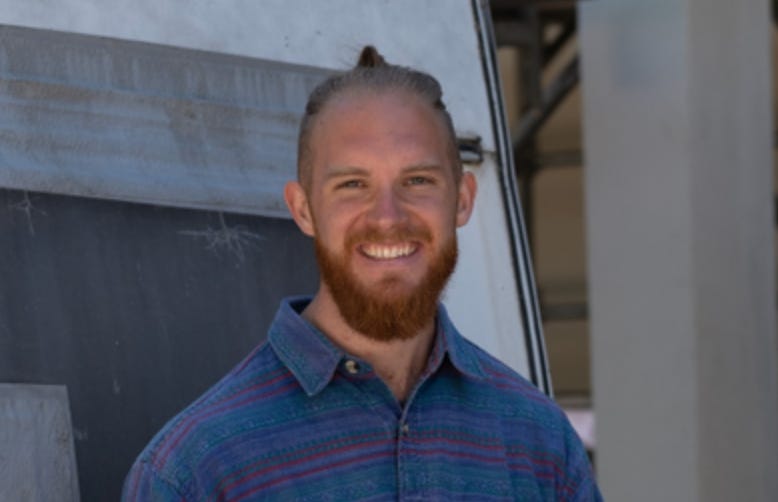
Pascal Siggelkow, state media “fact finder,” abysmal idiot.
eugyppius: a plague chronicle | September 14, 2023
Nobody in our corner of the internet could fail to notice the antics of those yapping bouncing frenetic chihuahuas who call themselves fact-checkers. Mostly they work in obscurity, misunderstanding internet jokes, recycling the vacuities of self-styled experts, debunking weird Twitter posts, and above all churning out prodigious walls of text filled with banalities that nobody reads. Occasionally, though, they manage to entertain us – as recently, when it emerged that BBC “disinformation specialist” and fact-checker-in-chief Marianna Spring had larded her very own CV with disinformation. Almost nothing is more amusing than finding oneself in the crosshairs of the fact-checkers, as has happened to me on at least one occasion.
My favourite checker of facts is the man-bun-sporting dimwit Pascal Siggelkow, who has been appointed top “fact finder” for the state media news service tagesschau. We last encountered Siggelkow when he mistook a noun for a verb in Seymour Hersh’s reporting, ultimately spending four amazing paragraphs debunking the thesis – unique to his own mind – that explosive seaweed destroyed Nord Stream. Before hunting facts at tagesschau, Siggelkow worked for Südwestrundfunk, another state media broadcaster, where he did daring undercover investigative reporting like snitching on “doctors who downplay Corona and issue unfounded mask exemptions.” This is really reporter-of-the-year material. In truth, we have before us here a whole genre of journalism conducted by an aggressively stupid tribe of Siggelkows, distinguished by their total lack of accomplishments, limited vision and minuscule persuasive capacities. That these small men should be entrusted with the project of policing our words is a strange thing indeed, and it suggests there is more going on in the world of fact-checking than we realise. Here, I propose to examine what it is that fact-checkers really do, and whether there is anything to say about them beyond the obvious fact that they are complete and utter idiots.
To explore fact-checking more concretely, I have ventured into the barren wastelands of the tagesschau “Fact Finder” page, where Siggelkow plies his trade and few before me have ever set foot. I’ve selected, mostly at random, a limited corpus of eleven recent discourse-policing items for closer analysis. I offer links to each of them below, in chronological order, providing their headlines and teasers in translation, together with sample quotations to give you an idea. This is a tiresome read indeed, so please skip ahead unless you are of particularly strong constitution.
1. Why is excess mortality so high?, by Pascal Siggelkow and Alexander Steininger
28 November 2022
In 2022, an unusually high number of people have died so far in relation to previous years. October in particular was an outlier. According to experts, this cannot be explained by Corona alone.
“As a scientist, I want to be open to all possibilities, but I just don’t see the connection [to vaccination],” [said Jonas Schöley, Research Associate in the Department of Population Health at the Max Planck Institute for Demographic Research in Rostock]. Additionally, he said, the scientific evidence evaluating vaccines is much stronger than that available in population research. “We don’t have to rely on the error-prone search for causes in population data because of the very good body of studies on the efficacy and risks of vaccination.” If the vaccines led to an increased number of deaths, this would have been proven long ago in medical and epidemiological research.
2. A flood of fake videos and pictures, by Carla Reveland and Pascal Siggelkow
3 July 2023
In connection to the riots in France, numerous pictures and videos are being shared on social media. Many of them are not from the current protests, but are disinformation.
In right-wing extremist and conspiracy-theorist Telegram channels, posts containing the term “France” have seen marked increase since the end of June … The Austrian right-wing alternative channel AUF1, for example, speaks of “ethno-riots” and a “bloody multicultural illusion.”
“Whenever there are topics that lend themselves to populist or right-wing extremist instrumentalisation, they are used,” [Pia] Lamberty, [Social Psychologist and Executive Director of the Center for Monitoring, Analysis and Strategy] says … This could be current political debates such as the topic of heat pumps, crises such as climate, Corona, economic tensions, or even riots such as in France. “Such attempts at instrumentalisation are not always successful across society as a whole, but for supporters of right-wing extremist ideologies they are often an additional confirmation of their own world views.”
3. Doubts about the significance of the AfD “Einzelfallticker” 1, by Carla Reveland and Pascal Siggelkow
3 July 2023
With their “isolated case ticker,” the AfD purports to show the alleged “true extent” of crimes committed by migrants. But a random sample shows that in half of the cases, reports do not indicate the origin of the suspect.
In response to a request from ARD-Factfinder, the AfD writes that it is “interested in transparency regarding the official figures from the police crime statistics in 2022.” Pia Lamberty, social psychologist and managing director of the Center for Monitoring, Analysis and Strategy … sees things differently. Launching a ticker with the intention of pointing out the danger posed by people considered to be non-Germans by the AfD by no means accords with the “role of an objective informer.” “This is the opposite of an open investigation and the opposite of objectivity,” says Lamberty.
4. How credible is the information on the [Ukrainian] counter-offensive?, by Pascal Siggelkow
7 July 2023
Ukraine’s counteroffensive to liberate territory occupied by Russia has been underway since June. Because Ukraine is keeping a low information profile, and the media often rely on Russian information. Experts are sceptical about this.
The fact that information on the counter-offensive comes primarily from Russia is due to the fact that Ukraine has mostly imposed a news blackout. The Russian Defence Ministry is trying to exploit this situation, says Julia Smirnova, senior researcher at the Institute for Strategic Dialogue in Germany (ISD). “This is a focus of Russian propaganda, and the numbers that are given are often massively exaggerated.” The Russian defence ministry is therefore not credible, she said.
The Dutch open source intelligence website (OSINT) Oryx wrote on Twitter of a total of six tanks abandoned in Zaporizhia oblast, including one Leopard tank, four Bradleys and one mine-clearing tank. “Left behind” howevewr is not synonymous with “destroyed.” In total, according to Oryx’s research, eight of Ukraine’s Leopard tanks have been destroyed or damaged so far since the Russian invasion began.
5. Increased agitation against queer people, by Carla Reveland and Pascal Siggelkow
17 July 2023
Whether it’s about homosexuals, drag queens or trans people: Disinformation about queer people is omnipresent in social networks. Experts believe this can have devastating consequences.
Trans people are particularly targeted by disinformation, says Kerstin Thost, press officer of the Lesbian and Gay Association in Germany (LSVD). “In the past months around the debate on the Self-Determination Act [which would make it possible for Germans to change their official gender and first names], we have seen an increased attack on trans people in particular, not only in Germany but also internationally. There has been an increased mobilisation of hatred, agitation and “demonisation against LGBTQI*.” LGBTIQ* stands for lesbian, gay, bisexual, transgender, intersex and queer people.
6. Who finances the welfare state?, by Pascal Siggelkow
26 July 2023
It’s said time and again on the internet that 15 million people keep Germany running. The references is to “net taxpayers,” who pay more taxes than they receive in benefits. Experts, however, believe that this figure is wrong.
The figure of 15 million “net taxpayers” is justified … in this way: Of the approximately 46 million employed people in Germany, 27 million paid more taxes and contributions than they received in state benefits. Of these, however, 12 million are “directly or indirectly dependent on the state,” since they are paid by taxes … for example, as state employees. Thus … 15 million “net taxpayers” keep the system running.
Stefan Bach, a researcher … the German Institute for Economic Research (DIW), believes this calculation is incomplete … “Basically, state taxes and levies are offset by services without which the modern economy cannot function either.” …
Social contributions such as unemployment insurance or health insurance should also be considered separately … The calculation holds that all pensioners are recipients of benefits [and] ignores the fact that the status of net tax payer and recipient changes … in the course of one’s life. …
7. Local weather phenomena do not refute climate change, by Carla Reveland and Pascal Siggelkow
10 August 2023
The last two weeks of July in Germany were cold and wet. Some use this fact to play down climate change. But experts believe this is wrong.
… Kevin Sieck from the Climate Service Center … believes that temporary local weather does not support arguments about climate change: “Robust statements about climate trends can only be obtained by looking at several decades,” says Sieck. “A rainy July in Germany doesn’t say anything about long-term trends.” It is therefore the long-term developments that are relevant when assessing trends in the climate.
Karsten Schwanke, meteorologist and ARD weather presenter, agrees: “There will always be very changeable summers.” But there is a clear tendency towards warmer summers with larger upward swings. “We see a tendency for heat waves to become longer. And we are currently getting heat waves that we definitely didn’t see 50 years ago. We’re also getting more droughts, especially in the summer.”
8. How China regards the Russian invasion, by Carla Reveland and Pascal Siggelkow
21 August 2023
In the Russian war of aggression against Ukraine, China is trying to position itself as a mediator. At the same time, the US and NATO are portrayed as warmongers. Is China neutral?
“China stands for peace while the US prevents the peace process”, “The actions of US-led NATO have pushed Russia-Ukraine tensions to their peak” or “Ukrainian ‘neo-Nazis’ have opened fire on Chinese students.” These are all statements made by Chinese state media or government officials in relation to the Russian war of aggression in Ukraine.
Although Beijing claims to be a neutral actor that respects the “sovereignty and territorial integrity of all nations,” China has provided “rhetorical backing” to the Kremlin, according to a study by the US-based German Marshal Fund. “Chinese officials and state media have openly supported and promoted Kremlin-friendly accounts of the war.”
9. Why the record debt is not much to write home about, by Pascal Siggelkow
7 September 2023
Germany’s national debt is at a record high, many media reported. From a purely nominal point of view, this is true, but from the point of view of experts, this is not very meaningful.
Martin Beznoska, Senior Economist for Financial and Fiscal Policy at the Institute for the German Economy (IW) points out [that] a more suitable parameter for assessing a country’s debt is … the debt-to-GDP ratio. “The debt-to-GDP ratio is a better indicator because it puts the debt in relation to the potential that the state has in terms of revenue-generating capacity,” Beznoska says.
The debt-to-GDP ratio relates government debt to nominal gross domestic product. For Germany, the debt-to-GDP ratio was 66.3 per cent in 2022. This means that the total debt was 66.3 per cent of the gross domestic product. Compared to the two previous years, the debt-to-GDP ratio in Germany has thus improved: in 2020 it was 68.7 per cent, in 2021 69.3 per cent. Before the outbreak of the Corona pandemic, however, it was still 59.6 percent.
10. Spahn’s dubious figures, by Pascal Siggelkow
1 September 2023
Vice chairman of the CDU/CSU parliamentary faction Spahn has criticised the planned increase in unemployment benefits. He said this would mean that a family of four would receive on average as much as an average-income family. But this is not true.
Planned increases to unemployment benefits next year have caused heated debeated. The CDU/CSU have complained that the changes will raise benefits higher than the wages of many employees. Vice chairman of the CDU/CSU parliamentary facation Jens Spahn said this sent the wrong signal. Even now, a family of four are entitled to an average of 2,311 Euros a month, which he said is as much as an average-income family in Germany. But this is not quite correct.
According to the Federal Statistical Office (Destatis), couples with two children had an average net household income of 5,490 euros in 2018. This is significantly more than the 2,311 Euros Spahn claimed. The gross household income was 7,435 Euros.
11. Fake videos and conspiracy claims, by Pascal Siggelkow
11 September 2023
Many false images and videos are circulating on social media about the devastating earthquake in Morocco that killed more than 2,000 people. Some of them are linked to well-known conspiracy narratives.
A look at the recent past shows that disinformation is often deliberately spread after natural disasters. In the case of the fires in Hawaii in August as well as the devastating earthquake in Turkey and Syria in February, videos were circulated that were supposed to show evidence of absurd causes.
In the case of earthquakes, the USA is often portrayed as the alleged cause – with their High Frequency Active Auroral Research Program (HAARP). HAARP is a research programme of the University of Alaska in the USA that has been in existence for decades. The aim is to research the upper atmosphere – the ionosphere – and also the propagation of radio waves. Radio waves are used for this purpose.
Now, as projects go, debunking the debunkers does not appeal to me very much, but we must get some read on Siggelkow’s accuracy and reliability. Remember that he should be almost totally right almost all of the time. After all, he or his managers choose what to debunk, so the very least we can expect of them is the judicious selection of easy targets. Alas, the only clean victory I can grant our Fact Enthusiast is 11), on the Moroccan earthquake. Few will believe this was caused by the American HAARP research programme, but it’s hard to know how many tagesschau fans needed to hear this in the first place.
Remarkably, in various of these pieces, Siggelkow doesn’t seem to be clearly debunking anything; 1) on excess mortality he tries to head off the dark conclusions of vaccine sceptics, but can only manage this very weakly, while 4) on the Ukraine offensive and 8) on China’s pro-Russia stance he merely offers helpings of reheated NATO propaganda to counter news and opinions from unapproved foreign sources. Also in this category is 5), which swipes at two pieces of allegedly anti-LGTBQ misinformation, but cannot clearly refute either of them, and beyond that offers little more than unsubstantiated hand-wringing about the violence and threats which gender minorities face.
Otherwise, we see a mix of disingenuous approaches, perhaps illustrated best by 7) on the fact that cool and rainy weather doesn’t refute climate change. While this is certainly true, the mainstream media – including tagesschau – have been confusing climate for weather deliberately in service of their environmentalist polemic for years. If hot summer days can indicate climate change, then cool summer days can contraindicate it, and if the press doesn’t like people making the latter argument, they should stop making the former one.
Number 6), on the precarious German welfare state, which allegedly depends on a mere 15 million net taxpayers to cover its liabilities, also belongs here. By selectively excluding entitlements – above all, pensions – you can make this figure more favourable, and if you want to count households instead of individuals things might look better too, but these prevarications and qualifications miss the point. As an objective matter, the German pension system faces collapse in the face of the retirement wave and demographic decline. Much the same applies to 9); it’s true that German debt is at a record high only in nominal terms, but even the preferred debt-to-GDP ratio which Siggelkow’s experts prefer paints an uncomfortable picture of government extravagance since the pandemic.
Particularly in these last two cases, we see Siggelkow reaching for a tactic that these complex cases don’t allow him to exercise fully. We might call this The Debunking of the Part to Discredit the Whole. This is the main stock-in-trade of fact checkers in general; indeed, it is baked into the very premise of their profession. It consists in leveraging a quite irrelevant but well-grounded objection for the purposes of casting a pall over broader arguments that the checkers would prefer not to assail, because the rest of the facts to be checked don’t run in their favour. Thus 2) denounces fake French riot videos on social media as a means of playing down, however implicitly, the very real violence which broke out in the wake of Nahel Merzouk’s killing, while 3) on the AfD Einzelfallticker ends up (after no little special pleading) actually confirming that migrants commit crime at higher rates than native Germans, while merely questioning migrant involvement in many of the catalogued cases. 2
Also in this category is 10): While Jens Spahn obviously understated the average income of the four-person German household, his broader argument – that in certain circumstances entitlements can exceed wages and are rising at a faster rate than income – appears to be totally correct.
You need read only a few of these exercises in ideological masturbation to find the primary explanation for fact-checker mediocrity. People like Siggelkow can afford to be stupid, because they’re not actually paid to think about anything. As a fact-checker, Siggelkow’s job consists mostly of calling up various “experts” and writing down what they tell him. Even this may overstate his agency, as very often I expect that it is the “experts” who call up Siggelkow and provide him with pre-digested material to print, but of course this is hard to prove. In those cases where Siggelkow interviews primarily midlevel academics not obviously connected to any advocacy groups, we might presume the reporting reflects his own initiative. Quite often, however, his sources hail from highly politicised think-tanks and NGOs, and in these instances I think we’re justified in suspecting he’s acting as a mere conduit.
Three of our eleven articles (2, 3 and 11) draw on the alleged expertise of the Center for Monitoring, Analysis and Strategy (CeMAS), a “non-profit extremism monitoring agency founded in 2021.” Their heavy representation in my eleven-article corpus is no accident; CeMAS and other anti-extremism NGOs are a major pillar of Siggelkow’s production. Sometimes they crop up even where you wouldn’t expect them, as in 4) on the Ukrainian counteroffensive, which features a prominent quote on “Russian propaganda” from the Institute for Strategic Dialogue – a “think and do tank” (heavens preserve us) which concerns itself with “digital regulation, disinformation, extremism and digital civic education.”
Siggelkow’s forays into economic matters are rarer, but in our exploratory corpus, the Institut der Deutschen Wirtschaft (IW) plays an outsized role. This is an old progressive liberal operation that advocates redistributive economic policies. IW experts help Siggelkow defend the welfare state in 6) and play down German national debt in 9). Curiously, when it comes time to defend NATO, Siggelkow’s bench of personal informants runs a bit thinner, perhaps reflecting the fact that the Ukraine war has ceased to be a major focus of state media coverage. Thus for 8), Siggelkow performs no expert interview, and rips instead from a piece published by the German Marshall Fund, an Atlanticist think-tank whose name he misspells. In 4) on the Ukrainian counteroffensive, his major source is somebody with a master’s degree in “East Asian Economy and Society” from the small think-tank-cum-consultancy-operation known as the Austrian Institute for European and Security Policy. This is a small den of Atlanticist Europhiles who are still awaiting the day when they will get their own Wikipedia page.
A broader survey of Siggelkow’s output, extending to the beginning of this year, reveals a split focus between the Russian war on the one hand, and identity politics and mass migration on the other. Somewhat surprisingly, climate topics have a mostly supporting role, and he thematises Covid and the vaccines only occasionally. The recent economic pieces are outliers.
The null hypothesis of the fact-checking industry would be something like this: “Threatened by the rise of alternative internet media, the establishment press have cultivated various discourse-policing operations to reclaim objectivity and reliability as their exclusive province.” In Siggelkow’s output, we certainly find much to support this view. It is the reason, for example, that he is so fond of writing about social media “misinformation” and internet “conspiracy theories.” The internet is a dangerous world of lies and disinformation, from which only the friendly tagesschau and their intrepid finders of facts can save you. This is basically his attitude, but as theses go, the null hypothesis is far too broad.
It cannot explain Siggelkow’s great selectivity, for example. There are absolute mountains of absurdity on the internet that he totally ignores, while often venturing into overtly political territory to fact-check the inconvenient arguments of the political opposition, which don’t involve internet social media at all. At the same time, the governing parties – especially the Greens – attract almost no Siggelkowian scrutiny, despite their long history of absurdly false statements. Fact-checking is clearly an enterprise devoted towards furthering a very specific political programme under the false cover of objectivity. This programme is directed primarily against “right-wing extremism,” particularly in its post-2015 incarnation. Secondary fronts on behalf of NATO, climate change sceptics, and the establishment CDU/CSU opposition emerge as the news cycle lends them relevance. Siggelkow, in other words, is quite plainly a propagandist who finds facts on behalf of the Scholz government, and in this he is funded by mandatory license fees levied from every German household.
That Siggelkow so often strays from his stated mission to correct falsehoods and publishes many pieces not clearly directed against any notional misinformation, merely reveals the tendency of the ideological mission to overwhelm tactical fact-finding entirely. Siggelkow is a conduit via which the preformulated output of regime-adjacent advocacy groups can find their way into the press and talk back to their critics even in the absence of any specific occasion for them to do so.
Siggelkow also has a broader purpose, independent of his rearguard actions on behalf of the regime. This is the construction of a mythology which binds the political right to internet ‘conspiracy theorising.’ His implicit polemic is not merely that legacy media like tagesschau have a lock on objective and reliable information, but that political views opposed to those which prevail among state media journalists arise from ignorance, disinformation and general internet insanity. The facts are on the side of the progressive liberals who steer the German state, and the only people opposed to them are online idiots who believe that secret US government programmes cause earthquakes.
While Siggelkow’s tricks are both tiresome and transparent, fact checking is anything but easy. His steady stream of but-ackshually-bro bothering depends like all other heavily politicised press reporting on the support of a dense web of NGOs, think tanks and other advocacy groups. Where these are lacking, for example in novel areas like Corona, Siggelkow really struggles. The great algal blooming of pro-Atlanticist “open-source intelligence” posters after the outbreak of war in Ukraine reflects an effort to supply the Siggelkows of the press with recycle-able content. Like everything else in our present, diffuse system of regime power and propaganda, the ideological behemoth moves slowly and struggles to react to new problems.
Ultimately, the significance of the fact-finders is obscure; it’s hard to believe Siggelkow has many readers. The lack of interest his tedious schoolmarmery attracts is probably one reason his ilk are so over-represented in state media operations, where nobody need worry about producing content that is profitable. His writing is dry and unpersuasive; at most, it is a kind of choir-preaching that reassures the the tagesschau audience that their views are grounded in facts, logic and science, and anyone who disagrees is a dangerous internet manic, or perhaps Russian.
An “Einzelfall” is an isolated case; the AfD Einzelfall-Ticker alludes to the older project “XY-Einzelfall,” which began documenting migrant crimes in Germany in 2016. The title is an ironic reference to the regime line that migrant infractions are “isolated cases.”
Because authorities often intentionally withhold the details of migrant perpetrators, whether specific cases actually involve migrants or not requires some surmising on the part of the reader. Probably whoever runs the Einzelfallticker should include only cases where migrant offenders are specifically identified or described (there is no shortage of those), but in my own less-than-casual study of the Einzelfallticker, I find that a) they’re generally clear when there’s uncertainty about the origins of the suspect, and b) in most of the unidentified cases, they’re probably right to suspect migrant perpetrators.
DHS Awards $20 Million To Program That Flags Americans As Potential “Extremists” For Their Online Speech
An overt way of policing speech?
By Cindy Harper | Reclaim The Net | September 14, 2023
The US Department of Homeland Security (DHS) has awarded 34 grants to as many organizations, worth a total of $20 million, whose role will be to undergo training in order to flag potential online “extremist” speech of Americans.
The money will be spent from the Targeted Violence and Terrorism Prevention (TVTP) grant program for fiscal year 2023, while the recipients include police, mental health providers, universities, churches and school districts.
According to DHS, this program (administered by its Center for Prevention Programs and Partnerships, CP3, and for some reason, the Federal Emergency Management Agency, FEMA) is the only federal one of its kind whose goal is “helping local communities develop and strengthen their capabilities in combating targeted violence and terrorism.”
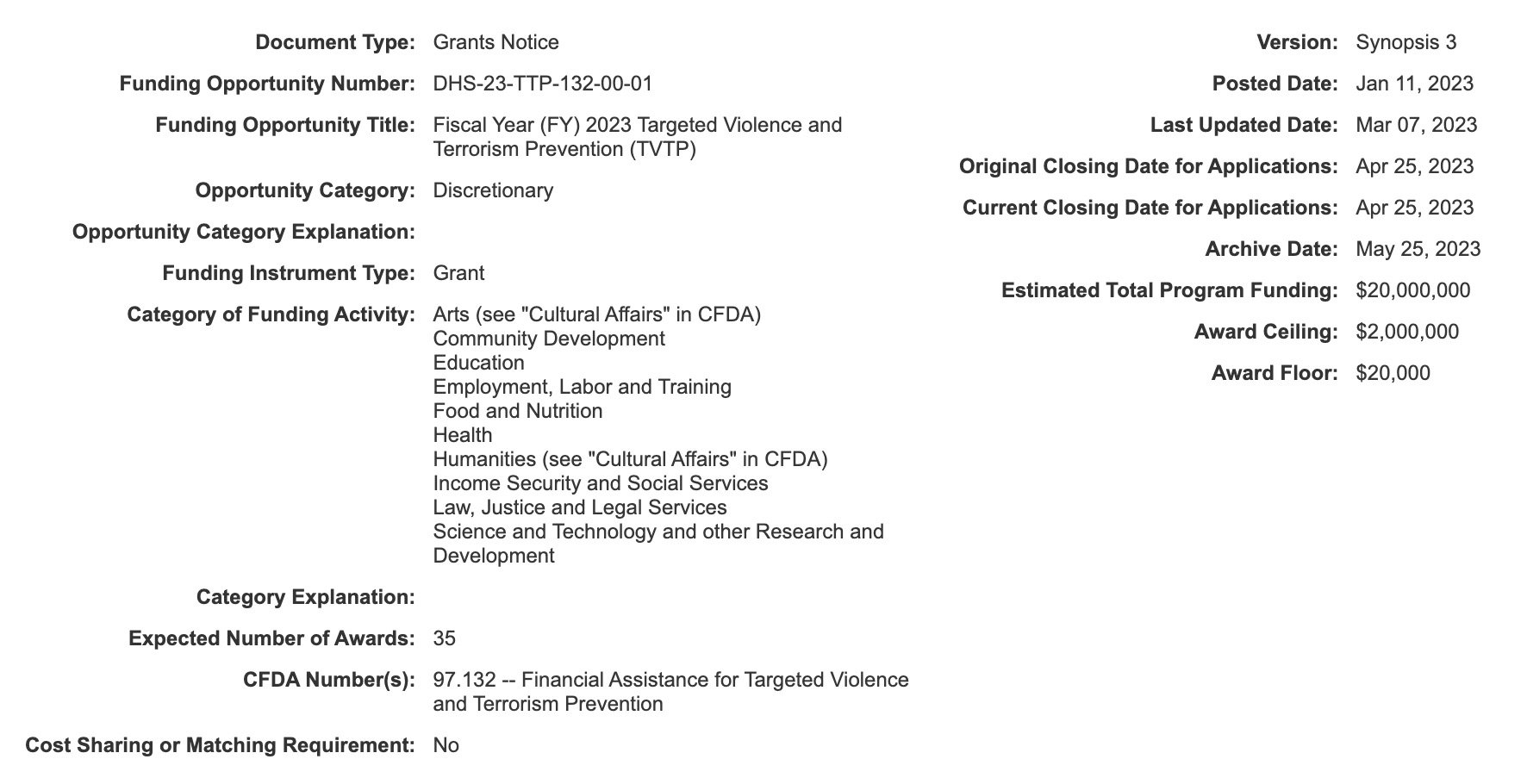
Those given the money from the grants fund are expected to develop prevention programming at the community level that would stop “targeted violence and terrorism,” as well as come up with innovative prevention ideas, and “identify prevention best practices that can be replicated in communities nationwide.”
In announcing and explaining the need for such spending, DHS Secretary Alejandro Mayorkas cited the Jacksonville shooting. As he remarked while justifying the awarding of grants, the event was racially motivated, and – “[it] made painfully clear, targeted violence and terrorism can impact any community, anywhere.”
DHS claims that the “current” environment is one of heightened – and lethal – threat, based on ideology or personal grievances of “lone offenders and small groups.”
The DHS announcement came on the anniversary of 9/11, but it showed that the focus is now on Americans rather than some foreign terrorist threat (or even foreign terrorist gangs in the habit of “invading” US soil).
And the way the terrorist threat is defined here looks more like a drive to suppress dissent to dominant narratives pushed by the government and large traditional and social media who work in concert with the federal authorities.
Specifically, what opponents of such policy single out as possible reasons to be branded a violent extremists or (domestic) terrorist could be disagreeing, and expressing that opinion online on anything from Covid, vaccines, gun rights, gender and LGBTQ policies, the war in Ukraine, or immigration.
Kiev’s trans spokesperson vows to ‘hunt down Russian propagandists’
RT | September 14, 2023
A threat to “hunt down” Russian “propagandists” which flagged an action “next week” and was made by a Ukrainian military spokesperson, should not be dismissed just because of its over-the-top presentation, a senior Russian official has argued.
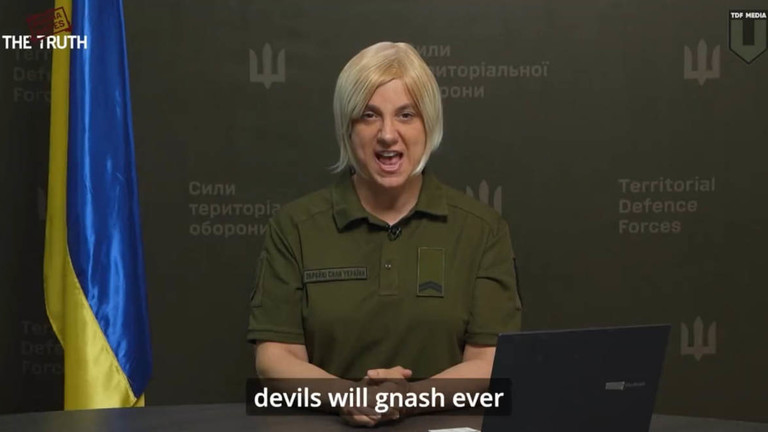
On Wednesday, Sarah Ashton-Cirillo, who leads the Ukrainian Territorial Defense Forces’ purported outreach to English-speaking audiences, made some ominous predictions regarding Russia.
“Next week, the teeth of the Russian devils will gnash ever harder, and their rabid mouths will foam in uncontrollable frenzy as the world will see a favorite Kremlin propagandist pay for their crimes,” she said.
“Russia’s war criminal propagandists will all be hunted down, and justice will be served as we in Ukraine are led on this mission by faith in God, liberty and complete liberation,” she pledged.
Ashton-Cirillo, a trans woman who made headlines in the US in 2021 with a story of her infiltration of the American right-wing group Proud Boys, was given the spokesperson position in Ukraine in early August.
Her latest statement is part of her ‘Russia Hates the Truth’ series of minute-long videos, in which she delivers scolding condemnations of Russia.
While many Russian journalists have dismissed the unspecific threat as ridiculous, Valery Fadeev, the chairman of the Russian presidential human rights council, urged national law enforcement to take it seriously. The remark appears to be “a threat of murder or serious bodily harm” and thus a crime under Russian law, he argued on Thursday.
“Considering the lamentable record of attempts on the lives of Russian journalists and public figures … Russian security services should pay attention to it,” he added.
Moscow has accused Kiev of orchestrating the murders of journalist Darya Dugina in August 2022 and of military blogger Vladlen Tatarsky in April this year. In July, the Federal Security Service reported busting a group believed to have intended to assassinate RT Editor-in-Chief Margarita Simonyan and journalist Ksenia Sobchak on Kiev’s behalf.
Republican 2024 Hopeful Ramaswamy Vows to Close Multiple US Agencies if Elected
Sputnik – 14.09.2023
WASHINGTON – Vivek Ramaswamy, a contender for the Republican Party’s presidential nomination, said he would seek to reduce the size of the US federal government by closing down five agencies if elected president in 2024.
The plan is to “reduce the size of the federal employees down by 75% by the end of the first term,” Ramaswamy told Semafor on Wednesday.
The agencies that would be closed include the FBI; the Bureau of Alcohol, Tobacco, Firearms and Explosives (ATF); the Department of Education; the Nuclear Regulatory Commission; and the Department of Agriculture’s Food and Nutrition Services, he said.
Ramaswamy pointed out he would use executive action and bypass Congress to close the agencies.
In addition, Ramaswamy said he would also execute “a revision of at least 50% of federal regulations that failed the Supreme Court’s test.”
The plan does not entail replacing the agencies, however, it does envision relocating some employees to other government units, Ramaswamy said.
For example, 15,000 of the 35,000 FBI employees would be reassigned to roles within the US Marshals Service, the Financial Crimes Enforcement Network and the Drug Enforcement Administration, Ramaswamy added.
EU has ‘globalized’ Ukraine crisis – Hungary
RT | September 14, 2023
The European Union’s response to the Ukraine crisis is causing the world to fragment, Hungarian Foreign Minister Peter Szijjarto has claimed. He added that Budapest wants to see initiatives that can unify states, such as China’s Belt and Road Initiative (BRI).
The EU “has given a very bad answer to the war in Ukraine that unfortunately seems to be ending up in a world being divided into blocs again,” the Hungarian diplomat told CNBC on the sidelines of the Belt and Road summit in Hong Kong.
Brussels “should have isolated this war, but instead of that the EU has globalized” it, he said in the interview broadcast on Wednesday.
Szijjarto argued that a lack of communication between opposing countries has led to them giving up on achieving peace, while states that benefit from good East-West relations – such as Hungary – have been hurt economically.
The minister contrasted this to how the BRI aims to bring the world together for mutual prosperity and security, which is why Hungary welcomes China’s presence.
He criticized rich Western European nations who are now talking about decoupling from the Chinese economy or “derisking” due to political concerns. Quietly, they seek Chinese investment just like small nations, Szijjarto said.
“They can be hypocritical, they can afford [it],” he argued.
Unlike those countries, Budapest states its foreign policy openly, the diplomat said, warning that if ‘decoupling’ with China were to succeed, it would “kill the European economy.”
The Hungarian government has been a vocal critic of the Western response to the Ukrainian conflict since its outset. It has called for peace talks, while speaking out against sanctioning Russia and arming Ukraine. Most EU nations, following in the US lead, have pledged to support Kiev for “as long as it takes” to defeat Moscow.
Ex-Ukrainian PM Accuses Kiev of Stealing Billions From Budget in Arms Deals
Sputnik – 14.09.2023
Ukrainian authorities siphoned off over 100 billion hryvnias ($2.7 billion) from the state budget by purchasing overpriced and poor-quality ammunition, equipment and air defense weapons, former Ukrainian Prime Minister Nikolay Azarov said on Thursday.
“According to the most modest estimates, [the Ukrainian authorities] stole more than 100 billion budget hryvnias. The representatives of ‘Servant of the People’ [ruling party] spent most of the budget money to purchase ammunition. [They] bought old poor-quality stuff at a ‘gold price’,” Azarov wrote on his Telegram channel.
The ex-prime minister said that the same corruption scheme worked in air defense procurement, citing an incident when the authorities signed a contract for four air defense missiles, while in reality there were only three of them. After Russia’s missile attacks, all of the four get written off and “someone buys a new apartment in Paris,” Azarov added.
The Ukrainian government has been rocked by a slew of dismissals linked to military procurement, the latest being Defense Minister Oleksii Reznikov. Ukrainian President Volodymyr Zelenskyy defended his government’s poor anti-corruption record in an interview with a US broadcaster on Sunday, saying lavish financial and military aid provided to Kiev by the West had not been affected.
Ukraine joining NATO ‘would not promote peace’ – ex-French president
RT | September 13, 2023
Former French President Nicolas Sarkozy has warned that Ukrainian membership of NATO and the EU “would not promote peace” and would be perceived as a “provocation” by Russia.
Speaking to French news station BFMTV on Wednesday, Sarkozy argued it is in Kiev’s best interests to remain “neutral” regarding Western blocs. The former leader also insisted that diplomacy with Moscow remains the most prudent option for Ukraine to end the current conflict.
“Bringing Ukraine into NATO would not promote peace,” said Sarkozy, who served as French president between 2007 and 2012.
NATO leaders declared at a summit in Lithuania in July that the bloc would only invite Ukraine to become a member “when allies agree and conditions are met.” NATO had already denied Kiev’s calls for a “fast-track” to full membership in September of 2022.
Moscow has frequently expressed its opposition to NATO’s eastward expansion. President Vladimir Putin cited the bloc’s involvement in Ukraine as among the key reasons when Moscow began its military operation against Kiev last year.
Ukraine has also pursued EU membership and was granted formal candidate status in 2022. In June, sources within the bloc told Reuters that Kiev currently meets two of the seven conditions required to be considered for full membership.
Rather than chasing closer ties with the West, Sarkozy told BFMTV there are “two solutions” available to Ukraine and its allies to bring an end to the hostilities. The first, he claimed, is the “annihilation” of Russia – before explaining that this is unrealistic because “we are not going to wipe out the second nuclear power in the world, or the world risks falling into total war.”
According to Sarkozy, a more achievable scenario is “diplomatic discussion.” The former president stated that his experience had given him a clear view of what can be achieved over the negotiating table. “They tell me Putin has changed and [that] we cannot have discussions with him,” Sarkozy said. “Those who say that are generally those who have never met him.”
Sarkozy reiterated to BFMTV his stance that Ukraine should pursue firm neutrality in its relationships with Russia and the West, arguing: “When you wave the muleta under the bull’s nose, you shouldn’t be surprised if he attacks.”
Sarkozy’s comments follow the backlash he received for an interview with French publication Le Figaro last month, in which he said Kiev should disregard joining NATO or the EU in favor of “an international agreement providing it with extremely strong security assurances to protect it against any risk.”
Medical chief of Ukrainian Far-Right unit admits “huge losses” on the frontline
By Ahmed Adel | September 14, 2023
The head of the medical service of the Far-Right unit Da Vinci’s Wolves of the Armed Forces of Ukraine, Alina Mykhailova, spoke about the difficult situation and, even more surprisingly, admitted to huge losses on the front.
“We are suffering great losses. There is no romance in this. What is happening at the front now is something you will not read in the news,” she said in an interview with Ukrainian media on September 12.
Mykhailova added that for the first time in her life, she was ready to give up absolutely everything and talk to anyone so that her battalion would survive. She also admitted that there is no prospect of a Ukrainian victory in the near future.
“The population is very calm with statements that today or tomorrow there will be victory. It will not happen today, nor tomorrow, nor, unfortunately, in a year,” Mykhailova, who is also a deputy in the Kiev City Council, concluded.
Since the beginning of June, the Ukrainian military has been conducting a counteroffensive in Donetsk, Artyomovsk and Zaporozhye with NATO-trained brigades and Western military equipment. However, they have achieved no success.
Although Mykhailova did not give a casualty figure, Russian President Vladimir Putin recently revealed that the counteroffensive has stalled and led to over 75,500 Ukrainian casualties – shocking for only four months of active combat. Many American and European journalists and military experts also argue that Kiev’s counteroffensive failed and noted the effectiveness of Russian defences.
US Joint Chiefs of Staff Chairman Mark Milley pointed out on September 10 that Ukraine may only have about 30-45 days of fighting left. However, despite this small timeframe left in the regular fighting season and the huge losses suffered by Kiev, the US and NATO are not fazed and continue to send more military shipments and money into the financial blackhole that Ukraine has become.
The Ukrainian military will be unable to advance any further from their already paltry gains once the season changes. Ukraine and the West have exhausted their ammunition stockpile, and they cannot get supplies quickly enough. Effectively, the Ukrainians cannot do much at this point, even if they want to.
Despite the Ukrainians not being able to do much at this point, as affirmed by Mykhailova, it did not prevent Milley from falsely claiming, “There’s still a reasonable amount of time, probably about 30 to 45 days’ worth of fighting weather left, so the Ukrainians aren’t done. There’s battles not done… they haven’t finished the fighting part of what they’re trying to accomplish.”
The West wants to see the offensive continue even though it has very evidently failed. For this reason, the US continues to increase aid even further, and the indications are that the West will continue this or at least try to sustain it.
US President Joe Biden has provided Kiev with $43.7 billion in military aid since Russia launched its special military operation in Ukraine, according to the Kiel Institute for the World Economy. Recently, the US announced a new security package worth $600 million for Ukraine, which will include ammunition and anti-aircraft equipment.
By providing such equipment, Washington hopes to coerce Kiev to continue the offensive for another 30 days, perhaps even through the winter. For this reason, there has been a huge uptick in rhetoric about Ukraine supposedly breaking Russia’s first line of defence and making slow but steady gains. None of this corresponds with reality.
In the US, most people do not support the current policy of sending more money down the drain in Ukraine. Considering the 2024 presidential election, the Biden administration is under domestic pressure from a chorus of voices calling for a focus on domestic issues. This could be part of the West’s attempt to transfer responsibility for the failure of the counteroffensive to Ukraine itself.
The US has brazenly admitted it worked with the Ukrainians to plan the offensive for months, arming and training the military. Now, the West is criticising Ukraine for its failures.
As US elections are looming and Ukraine cannot win the war, the Biden administration needs to shift the blame and is pinning it directly on the Eastern European country. This demonstrates the confused nature of US policy as, on one hand, it is encouraging Ukraine to continue fighting by sending more weapons and money, but at the same time, narratives are being concocted to explain to US voters why billions of dollars have been wasted on a lost cause. Meanwhile, as Mykhailova highlighted, “there is no romance,” nor any victory for Ukraine through this war.
Ahmed Adel is a Cairo-based geopolitics and political economy researcher.
Decrepit Britain… Schools Collapsing and Challenger Tanks Blown to Smithereens
By Finian Cunningham | Strategic Culture Foundation | September 13, 2023
Britain’s schools are not just out for summer. Autumn too, apparently. Hundreds of schools across England are being forced to close because they are in danger of falling down on the heads of children. That issue alone says a lot about the decrepit condition of Britain today.
Added to this embarrassing blow to British prestige is the reported destruction of its Challenger 2 main battlefield tank deployed with great fanfare in Ukraine earlier this year.
The supposedly invincible tank was first stopped in its tracks by a Russian mine, and then the turret was promptly blown off by an incoming Russian Kornet missile. It is thought to be first time, the Challenger 2 has been so visibly destroyed. Even the BBC’s reporting couldn’t cover up the shock from such a blow to presumed British military prowess.
In previous deployments during Britain’s criminal wars in Iraq and Afghanistan, the Challengers were up against militarily weaker opponents. They earned an overblown reputation as robust fighting machines. Now up against withering Russian firepower, the British equipment is under more testing conditions – and not faring so well.
Thus, it was a bad week alright for Britain. Schools crumbling from cheap concrete structures and then the formidable Challenger tank being pummeled like a cardboard box under Russian attack.
Interestingly, there is a bodily connection to the seemingly unrelated British misfortunes in the form of Rishi Sunak, Britain’s unelected prime minister. He took over 10 Downing Street last October after his predecessor Liz Truss was ousted due to her gaping incompetence. Truss was only in the job a matter of weeks having taken over from Boris Johnson who was forced to quit over endless corruption scandals.
Sunak, a wealthy heir of Indian heritage whose super-wealthy Indian wife doesn’t pay her taxes in Britain, was shoe-horned into the prime minister job as part of a Tory Party shake-up. He wasn’t elected by the public for his present office. That’s British democracy for you!
As prime minister, Sunak made the decision in January this year to send Challenger 2 tanks to Ukraine. The move was seen as a bold escalation and prompted other members of the NATO alliance to send heavier weapons to the Kiev regime. It was followed by Germany supplying its Leopard 2 tanks, the French donating AMX-10s, and there’s talk of the Americans eventually sending their M1 Abrams.
Sunak hailed his decision to donate 14 of Britain’s supposedly finest hardware as a game-changer that would allow Ukrainian forces to advance against Russian lines.
However, eight months later, the purported British game-changer has given the Ukrainian military no gains, neither have the German Leopard 2 tanks, nor all of the other sundry NATO “wonder weapons”.
Indeed, by nearly all accounts, the NATO-backed Ukrainian counteroffensive is rapidly turning from failure to disaster as troops and equipment get decimated by superior Russian firepower. Even former British army officers are acknowledging the disastrous defeat on the battlefield.
Under the unelected Sunak, Britain has pledged a total of £4.6 billion ($5.7 bn) in military aid to Ukraine. Britain is the second biggest sponsor of the Kiev Nazi regime after the United States, which has committed about $44 billion in military supplies to Ukraine.
Now get this. While Sunak has readily green lighted the supply of Challenger 2 tanks, as well as depleted uranium shells, Storm Shadow cruise missiles and RAF spy and fighter planes to the Black Sea, his personal neglect of school restoration projects in England has put hundreds of institutions at risk of collapsing.
Before his Tory Party appointment as prime minister, Sunak was Britain’s Chancellor of the Exchequer, which is also known as the treasury minister. By tradition, the British chancellor resides in No. 11 Downing Street. It is seen as the second-most powerful political office after the prime minister owing to the fact that the chancellor controls the budgets for all other government departments.
While he was in the chancellor job during 2020-22, Sunak slashed funding for the repair of schools by nearly 50 percent. That was in spite of warnings from educational expert committees that a crisis was looming from dilapidated concrete structures. That crisis is now manifesting with the forced closure of over 100 schools across England as the new academic year begins this month. It has become a national scandal owing to fears that pupils’ and teachers’ lives are at risk from collapsing walls and roofs.
Rich boy Rishi Sunak can directly take the blame for much of the scandal even if he tries to worm his way out of accepting responsibility.
This guy like many other Western political leaders is a charlatan and a pathetic Yes-Man for the U.S.-led proxy war against Russia in Ukraine.
Sunak likes to wear tween friendship bracelets on his wrist and he is prone to giving Hindu peace signs when in public.
Meanwhile, in reality, the ultra-privileged occupant in Downing Street signs off billions of dollars worth of weaponry to Ukraine, paid for by the British taxpayers through relentless cuts in their public services, incomes and social conditions. War and poverty go hand-in-hand in Britain.
It is estimated that to rectify Britain’s decaying schools it would cost around $1 billion, which is about a fifth of what Sunak has pledged in military aid to Ukraine. And yet this warmongering charlatan is not even accountable to British citizens.
Evidently, the unelected British prime minister views the funding of a futile, bloody overseas war – which could spiral into a nuclear world war – as more of a priority than the education and safety of British children. Dare we say that’s because he is not a democratically elected leader. He is an abject vassal of American imperialism. Many of his predecessors in Downing Street could be said to have been of the same cringemaking weakness. But the incumbent and unaccountable Sunak is absolutely shameless.
The obscene misallocation of public funds by an unelected prime minister says everything about decrepit Britain. It’s a democracy only in name and even that has become a stretch.
Featured Video
Prof. Ted Postol: Iran Already Achieved Nuclear Deterrence Against Israel
or go to
Aletho News Archives – Video-Images
From the Archives
How the occupied mentality syndrome works
Saudi Arabia on the American chessboard – Part 3
By B. J. Sabri | American Herald Tribune | June 27, 2016
Read part 2: “The occupied mentality Syndrome“
Previously I argued whether Saudi Arabia’s repeated involvements in U.S. interventions and wars stem from free national will or in response to a specific condition. For starters, in Saudi Arabia there is no national will. In Saudi Arabia, the national will is the will of the Al Saud clan. Still, when a major Arab state allies itself with a superpower that committed unspeakable crimes against humanity in almost every Arab country, then something is wrong. This fact alone should compel us to examine the U.S.-Saudi relation for one exceptional reason. As a result of the U.S.-Saudi wars, hundreds of thousands of people in Afghanistan, Iraq, Iran, Libya, Syria, Yemen, and Somalia have lost their lives. Millions became displaced in their own homelands. And millions more rendered refugees.
Attributing the Saudi policies to the bonds of “partnership” with the U.S. is frivolous. There are no bonds between these two thugs except those of business, military deals, secret plots, and wars. Proving this point, bonds such as these have no space for the American and Saudi peoples to share significant cultural or societal exchanges. If partnership is not the reason for the Saudi contribution to the U.S. strategy of empire and imperialism, then another reason must exist.
This leads to three possibilities. … continue
Blog Roll
 Aletho News
- NIAID/NIH and USDA Fund Bioengineered Chimeric Influenza Viruses Built Using Pandemic H1N1 Components: Journal ‘Science Advances’
- Hezbollah hits Israeli warship off Lebanon’s coast, sets it aflame
- Iran slams US strikes on B1 bridge, Mahshahr petrochemical plants as ‘blatant acts of state terrorism’
- In letter to UN chief, Araghchi warns of dire consequences of US-Israeli attacks on Iran’s nuclear facilities
- Why the CIA conspiracy to invade Iran with Kurdish militias failed
- Why Are Upbeat US Claims About Mission to Rescue Pilot ‘Highly Questionable’?
- Aircraft destroyed during US ‘rescue’ of downed F-15 pilot cost more than $100 million each
- Washington University removes professor who condemned US-Israeli war on Iran
- Russia Warns of Retaliation as UK Authorizes Seizure of Vessels
- Serbia thwarts plot to bomb Russia-Hungary gas pipeline – Vucic
- If Americans Knew
- In Iran, Israel-US take aim at “reason, research, and freedom of thought” – Daily Update
- US loses planes over Iran, Israel downgrades Lebanon war goals – Daily Update
- Israel Is Blocking Palestinians from Easter at Church Where Jesus Resurrected
- Plot to assassinate Palestinian activist follows harassment campaign promoted by Zionist groups and elected officials
- Prominent New York synagogue hosts presentation on why U.S. Jews should support the ethnic cleansing of Gaza
- Tapper vs. Piker: Is the CNN Anchor Auditioning for David Ellison?
- Shouldn’t Democrats Be Able to Condemn Genocide?
- Israel-US kill negotiators, destroy civilian structures, but Iran’s military capabilities still largely intact – Daily Update
- ‘War crime’: Global condemnation as Israeli ministers celebrate death penalty law targeting Palestinian prisoners
- 7 Ways Israel Is Turning Lebanon Into Gaza
- No Tricks Zone
- An Inconvenient Tree: Uncovered In Alps… Europe Much Warmer Than Today 6000 Years Ago
- New Study Reports A 60% Slowdown In Greenland’s Ice Loss Rate In The Last Decade
- Low Intensity Tornado Wrecks Major Solar Farm, Creating A Potential Toxic Dump
- New Study Finds Warming Saves Lives…Cold Temperatures 12 Times More Deadly Than Excess Heat
- German Science Blog Accuses PIK Climate Institute Of Hallucinating Climate Tipping Points
- Devastating Assessment Of Comirnaty Vaccine By Former Senior Pfizer Europe Toxicologist
- New Study: CO2 Is ‘Effectively Negligible’ As An Explanatory Climate Change Factor Since 2000
- Former Pfizer Toxicologist Dr. Helmut Sterz Tells Bundestag Hearing Pfizer Vaccine Should Have Never Been Approved
- Energy Expert: Germany’s Nuclear Phaseout Was A “500 Billion Euro Mistake”
- New Research: South Australia’s Mid-Holocene Sea Surface Temperatures Were 4°C Warmer Than Today
 Aletho News