Ukrainian leader hysterically accuses the notoriously Russophobic Polish of helping Moscow
By Rachel Marsden | RT | September 21, 2023
Ukraine and Poland’s relationship has apparently reached the throwing toys out of the pram phase. Speaking to the United Nations General Assembly this week, President Vladimir Zelensky said it was “alarming to see how some in Europe… are helping set the stage for a Moscow actor.” Who could he have been talking about?
“I hope these words are not addressed to Poland,” replied a Polish government spokesman. If you have to ask yourself the question, you probably already know the answer. Yep, Zelensky is accusing Poland of cheating – with Russia.
It seems like just yesterday that Poland was bullying its fellow European Union member states to cough up gifts of weapons for Zelensky. Back in May, it managed to get Denmark and Finland on board with sending their German Leopard tanks to Kiev and browbeat Berlin for dragging its feet on giving permission to re-export the vehicles. “Even if, eventually, we do not get this permission, we – within this small coalition – even if Germany is not in this coalition, we will hand over our tanks, together with the others, to Ukraine,” declared Polish Prime Minister Mateusz Morawiecki at the time.
Fast forward to this week. “We are no longer transferring weapons to Ukraine because we are now arming Poland with more modern weapons,” Morawiecki said. In other words, Warsaw has decided that it needs to focus on itself. Isn’t that what every exasperated partner says after spending time on a therapist’s couch and coming to their senses?
Last week, Poland withdrew – along with Hungary and Slovakia – from the EU’s platform to coordinate Ukrainian grain imports. Sources claimed that the countries feared that details from any such involvement could be used against them in a lawsuit that Kiev filed earlier this week. This was at the World Trade Organization in response to them maintaining their bans on Ukrainian grain imports despite Brussels’ decision to lift them on September 15.
Thus, Poland has gone from loudly proclaiming its love for Kiev to suddenly acting like a party to a potentially messy divorce, now taking self-preservation measures against a toxic partner. One who keeps making demands even when you say “no.” And that’s exactly what these countries did by insisting that Ukraine’s grain be banned lest it compete with their own farmers’ produce, driving its value down – and not even a month before the next Polish parliamentary election on October 15.
Instead of trying to see the situation from these countries’ perspectives, Kiev blew a gasket. “The systemic approach of Budapest and Warsaw of ignoring the position of the EU institutions in trade policy, I think that will be a problem for the EU in general because there is no unity there,” said Taras Kachka, a trade representative. Kiev is acting like it can’t understand why Brussels is backing the three while it keeps stringing Ukraine along with promises of commitment.
It’s because they’re in a binding relationship with the EU. By contrast, you’re a side piece hoping for a ring and using toxic tactics to try to manipulate everyone into getting whatever you want all the time.
The gloves have really come off now, though, with Ukraine daring to suggest that the EU isn’t united. That threatens to ruin the main theme of unelected European Commission President Ursula von der Leyen’s virtue signaling.
Kiev is now doubling down on the psycho-ex vibe by threatening that unless the unilateral bans on grain are lifted, it will go after Polish apples and onions and Hungarian cars with retaliatory restrictions. (Why do bad breakups always have to target innocent cars – whether it’s keying/scratching, smashing, or blocking?) Poland has since pushed back in a tit-for-tat. “I warn the Ukrainian authorities because if they escalate this conflict in this way, we will add more products to the ban on import into the territory of the Republic of Poland,” Prime Minister Morawiecki said on Wednesday.
Where’s the EU in all of this, you might ask? Brussels is currently busy ducking criticism from its own member states for lifting the ban on Ukrainian grain, with Hungarian Agriculture Minister Istvan Nagy underscoring, in the wake of a meeting of the bloc’s agriculture ministers, that von der Leyen consulted on this topic not with the leaders of member states, but with the Ukrainian president. He has also suggested that the EU was selling out its farmers in favor of Saudi, American, and Dutch investments in Ukrainian grain production. Not that this would be the first time that the EU screwed over itself and its people to benefit American interests, using Ukraine as a pretext. Just ask the millions of European citizens currently struggling to pay for the bloc’s decision to replace cheap Russian energy with much pricier liquified natural gas from the US.
Poland has led the way in defying Queen Ursula, with the payoff being that it isn’t having to contend with the kind of protests that Bulgarian officials are now facing, having complied with Brussels’ lifting of the grain ban. Bulgarian farmers blocked highways and border crossings earlier this week. At least so far, it seems that Brussels really doesn’t want to get too deeply involved in the crossfire as Poland and Ukraine throw their tantrums.
Kiev did suddenly acknowledge “close and constructive ties” with Warsaw on Thursday, after a phone call between their agriculture ministers and “agreed to work out an option to cooperate on export issues in near future.” Sounds like someone’s suddenly concerned what the neighbors might think and making an effort to keep up appearances.
One Western Official Finally Comes Clean About NATO Expansion
By Ted Galen Carpenter | The Libertarian Institute | September 21, 2023
NATO Secretary General Jens Stoltenberg likely surprised both factions in the ongoing debate about NATO expansion and its role in triggering the Russia-Ukraine War. He also undermined (perhaps fatally) the official cover story about the reasons for the Ukraine war. Since Russia’s February 2022 invasion, Western officials and their allies in the corporate media have insisted vehemently that the alliance’s addition of Eastern European nations after the Cold War and giving a pledge to Ukraine that it would become a member someday had nothing to do with Vladimir Putin’s decision to attack his neighbor. Indeed, anyone who argued otherwise risked being accused of echoing Russian propaganda and being “Putin’s puppet.”
Both the official explanation and the pervasive narrative regarding the war were unequivocal. Putin was power-hungry and unwilling to tolerate an independent, pro-Western Ukraine on Russia’s border. Brookings Institution Senior Fellow Steven Pifer’s interpretation was typical; “For the Kremlin, a democratic, Western-oriented, economically successful Ukraine poses a nightmare, because that Ukraine would cause Russians to question why they cannot have the same political voice and democratic rights that Ukrainians do.” Even when Pifer published his piece in July 2022, that explanation was extremely weak, given Ukraine’s own corruption and authoritarianism. Volodymyr Zelensky’s subsequent systematic assault on civil liberties makes the notion that Putin felt threatened by Ukraine as an irresistible democratic magnet patently absurd. Ukraine is not a democratic country by any reasonable definition of the term.
Nevertheless, other analysts made arguments similar to Pifer’s thesis. That Russian grievances over NATO helped spark the war “makes no sense,” wrote Rutgers professor Alexander Motyl. “NATO cannot have been the issue,” historian Timothy Snyder insists; Putin “simply wants to conquer Ukraine, and a reference to NATO was one form of rhetorical cover for his colonial venture.” Such comments matched the official positions that the U.S. and other NATO governments adopted. Interventionist opponent Caitlin Johnstone was accurate that “arguably the single most egregious display of war propaganda in the 21st century occurred last year, when the entire western political/media class began uniformly bleating the word ‘unprovoked’ in reference to Russia’s invasion of Ukraine.”
In a September 6, 2023 speech to the European Union Parliament, Secretary General Stoltenberg contradicted the entrenched official narrative, most likely inadvertently. “President Putin declared in the autumn of 2021, and actually sent a draft treaty that they wanted NATO to sign, to promise no more NATO enlargement. That was what he sent us. And was a pre-condition for not invade (sic) Ukraine. Of course we didn’t sign that.”
Stoltenberg emphasized, “He wanted us to sign that promise, never to enlarge NATO. He wanted us to remove our military infrastructure in all Allies that have joined NATO since 1997, meaning half of NATO, all the Central and Eastern Europe, we should remove NATO from that part of our Alliance, introducing some kind of B, or second class membership. We rejected that.” Consequently, “he went to war to prevent NATO, more NATO, close to his borders.” [Emphasis added]
Several scholars and former officials had warned for years that NATO’s expansion to Russia’s border would end badly, and the Russian invasion of Ukraine confirmed those predictions. George Kennan, the intellectual father of America’s containment policy during the Cold War, perceptively warned in a May 1998 New York Times interview about what the Senate’s ratification of NATO’s first round of expansion would set in motion. “I think it is the beginning of a new cold war,” Kennan stated. ”I think the Russians will gradually react quite adversely and it will affect their policies. I think it is a tragic mistake.”
NATO’s attempt to make Ukraine a full-fledged military asset was especially provocative. Kremlin leaders regarded Ukraine as not only being in Moscow’s rightful sphere of influence, but in Russia’s core security zone. Putin made that point clear on numerous occasions at least as far back as his speech to the Munich Security Conference in 2007. Instead of taking those warnings seriously, Western leaders blew through one red light after another. NATO’s leader, the United States, especially worked to forge ever-closer military ties with Ukraine. In essence, the Trump and Biden administrations began to treat Ukraine as a NATO member in all but name.
Extensive arms shipments to Kiev along with U.S. and NATO joint military exercises constituted the centerpiece of that policy. But that was not the extent of Washington’s provocations. Shortly after Russia annexed Crimea in 2014, the CIA initiated secret paramilitary training programs for Ukrainian special operations personnel in the United States and in Ukraine. Massive arms shipments to Kiev along with joint U.S. and NATO military exercises with Ukrainian forces constituted the centerpiece of that policy. Yahoo national security correspondent Dan Dorfman noted that “U.S. and Ukrainian intelligence have even participated in joint offensive cyber operations against Russian government targets, according to former officials.”
Such actions make a mockery of the argument that Russia’s invasion of Ukraine was unprovoked. That assertion is convenient propaganda, but it was always devoid of both facts and logic. Stoltenberg’s comments merely confirm what should have been obvious to both the foreign policy community and the news media from the beginning.
Polish Politician Reveals Why Warsaw Changed Its Tone on Ukraine
By Andrei Dergalin – Sputnik – 21.09.2023
Having acted as one of Ukraine’s staunchest supporters since the escalation of the conflict last year, Poland has now changed its tone in the dialogue with the Kiev regime over what appears to be a trade dispute.
Relations between Warsaw and Kiev have soured recently after Polish authorities, along with their Hungarian and Slovakian counterparts, moved to restrict imports of cheap Ukrainian grain in a bid to protect local farmers.
Kiev promptly retaliated by filing a complaint with the World Trade Organization against all three countries and even threatened to block certain agricultural imports from Poland and Hungary if the ban on Ukrainian grain was not lifted.
Many prominent Polish politicians appeared unamused by this turn of events, with Poland’s Minister of Defense Marius Blaszczak insisting that Warsaw essentially protects Polish farmers from the schemes of “Ukrainian oligarchs” who want to sell Ukrainian grain in Poland.
Polish politician and independent commentator Konrad Rekas, however, argued that Warsaw’s rhetoric is all about the upcoming parliamentary elections, “which the ruling Law and Justice party would lose by continuing to uncritically support Kiev.”
“Of course, Ukraine does not intend to make the internal games easier for its Polish allies, fully understanding that it will receive everything it demands from the next Polish government, regardless of which party forms the government,” Rekas told Sputnik.
He claimed that the spat between Ukraine and Poland is not really related to the matter of Ukrainian grain exports or Warsaw’s alleged intent to occupy certain Ukrainian territories and that it is unlikely to affect the course of the Ukrainian conflict.
“Poland will still be a hub for the Western military aid for the Kiev regime. Poles will continue to pay millions for the Ukrainian resettlement to Poland,” Rekas surmised.
Since the escalation of the Ukrainian conflict in February 2022, Poland supplied large quantities of military hardware to the regime in Kiev, including battle tanks and warplanes, and helped accommodate tens of thousands of Ukrainian refugees on Polish soil.
This week, however, Polish Prime Minister Mateusz Morawiecki announced that his country now focuses on arming itself with modern weapons and no longer transfers armaments to Kiev, while Polish government Press Secretary Piotr Muller said that Warsaw apparently has not got plans to continue supporting Ukrainian refugees in Poland next year.
These statements come ahead of the parliamentary election in Poland slated to take place on October 15, and it remains unclear whether Polish politicians are going to fulfill their promises or if it is all merely an attempt to sway voters.
Meanwhile, Slovakia, another prominent backer of the Kiev regime, may change its stance on the Ukrainian conflict after the September 30 election in the country.
Former Slovakian Prime Minister Robert Fico, whose social-democratic Smer (Direction) party dominates the recent polls, has already stated that Slovakia will no longer “send any arms or ammunition to Ukraine” should his party form part of a new government.
How Pashinyan betrayed Armenia for a US pat on the back and a Snoop Dogg concert
By Drago Bosnic | September 21, 2023
The full background of the crisis in Nagorno-Karabakh (also known as Artsakh to native Armenians) is centuries old and certainly exceeds the scope of a single opinion piece. It can be argued that it would probably require nothing short of a small library. Thus, the focus will be on the most recent tragic events unfolding in the embattled region, primarily in the last several days and weeks, along with the main events of the last five years. Namely, on September 19, Azerbaijan launched yet another full-scale attack on what was left of Artsakh following their previous invasion in 2020, when most of the Armenian-populated republic was lost, including the strategically (and historically) important city of Shushi. Azerbaijan had the full support of Turkey, which provided unmanned systems, artillery pieces, armored vehicles, ISR (intelligence, surveillance, reconnaissance) data, etc.
On the other hand, Artsakh was largely abandoned, even by Armenia itself, as the Sorosite Pashinyan regime, busy with making openly anti-Russian moves, quietly gave up on the Armenian-populated republic. Before Nikol Pashinyan came to power in 2018, after the US-backed “Velvet Revolution”, Yerevan was actively engaged in Artsakh, with local armed forces effectively integrated within the Armenian military itself, while their economies and infrastructure were also largely unified. In addition, the country was firmly allied to Russia, which provided security not only to Armenia proper, but Artsakh as well. And yet, in the aftermath of the aforementioned color revolution, the new Sorosite regime decided to completely dismantle Armenia’s previously stable foreign policy. Needless to say, the results have been an absolute disaster for the Armenian people.
Unfortunately, the role of Armenia’s diaspora living in Western countries (primarily the United States and, to an extent, France) has been instrumental in this collectively suicidal effort. Ironically, the descendants of survivors of the horrendous Turkish-perpetrated Armenian genocide that nearly wiped out all Armenians inadvertently contributed to a sort of 21st-century version of the same in Artsakh. Naively believing that the US would be able (or even willing) to get into a virtually direct confrontation with its NATO ally Turkey, Armenian Americans supported the 2018 coup, helping Pashinyan seize power. He immediately started a campaign of sweeping anti-Russian “reforms”, including the closing of Russian-language schools, suppression of pro-Russian media, as well as the openly declared intention to join the European Union and NATO.
This effectively destroyed the traditional, centuries-long Russo-Armenian alliance, turning it into a mere superficially cordial formality. Pashinyan’s blame game with Moscow for the defeat during the 2020 Azeri invasion led to further cooling in relations, with Russia slamming Armenia for not engaging in the conflict itself while demanding Moscow to launch a war against Baku, despite friendly (and much more predictable) relations between the two Caspian Sea neighbors. And yet, in 2020, Russia still deployed 2000 peacekeepers to prevent the total loss of Artsakh. For his part, Pashinyan continued with anti-Russian foreign policy and rhetoric, naively believing that the US would step in and replace Russia as Armenia’s most important security partner. Washington DC was happy to take yet another opportunity to hurt Russia’s interests in the region.
Pashinyan also allowed the massive expansion of the American Embassy in Yerevan, which is now housing over 2,000 staff members, many of whom are intelligence operatives whose activities are an obvious security hazard for Russian forces deployed in the South Caucasus. Back in January, he canceled joint military exercises with Russian troops, once again grumbling about Moscow’s unwillingness to go to war with Azerbaijan at a time when even Armenia itself refused to do so. In the meantime, the NATO-sponsored Putin indictment launched by the increasingly illegitimate ICC was supported by Pashinyan’s Sorosite allies, who openly stated that arresting Putin in Armenia and extraditing him to the ICC was supposedly “in the best interest of Yerevan“.
As if that wasn’t bad enough, Pashinyan agreed to conduct joint military exercises with US troops on Armenian soil, right in the middle of the second (and in all likelihood, final) Azeri invasion of Artsakh. Worse yet, the said exercises also involved crowd control and anti-riot training, obviously indicating that Pashinyan’s US handlers knew what to expect. Hardly surprising, given that the Pentagon kept close contact with Azeri counterparts in the months prior to the invasion. Meanwhile, the only people actually taking care of the unfortunate Armenian refugees are the Russian peacekeepers, some of whom were even killed in a supposedly “accidental” Azeri attack. Pashinyan’s only statement worth mentioning so far has been that Armenia will stay out of the conflict.
It’s quite clear that the escalation in the region is in the political West’s interest, as it aims to destabilize Moscow’s periphery in hopes of diverting Russian resources and attention away from Ukraine. At the same time, the belligerent power pole is trying to present the ongoing events as Putin’s fault, with pro-Soros Armenians protesting in front of the Russian embassy in Yerevan. Sorosites are consciously ignoring the fact that Russia kept the peace in Artsakh for nearly a quarter of a century (1994-2020). Pashinyan’s diaspora backers decided (quite bizarrely) to block a highway in Los Angeles, a place nearly 12,000 km away from their native lands. On the other hand, the majority of sane Armenians are (rightfully) enraged at Pashinyan and are demanding his resignation.
The political West will certainly try to keep him in power for as long as possible and given how beneficial he’s been to Turkey’s and Azerbaijan’s Neo-Ottoman ambitions and delusions of grandeur, it’s likely both Ankara and Baku will also want to ensure he stays. After all, who wouldn’t want an “enemy” busy with organizing a Snoop Dogg concert rather than defending his people and country? That says a lot about Pashinyan’s priorities while the Armenian people of Artsakh are subjected to yet another Turko-Azeri genocide. Their goal is to have Armenians wiped out from their multi-millennial native lands. However, things could get a lot worse, as Pashinyan’s continued pro-Western pivot could lead to the complete destruction of Armenia proper as well.
Drago Bosnic is an independent geopolitical and military analyst.
‘Definite Causal Link’ Between COVID Vaccine Rollouts and Peaks in All-Cause Mortality, New Study Finds
By Brenda Baletti, Ph.D. | The Defender | September 20, 2023
A new study of 17 countries found a “definite causal link” between peaks in all-cause mortality and the rapid rollouts of the COVID-19 vaccines and boosters.
Researchers with Canada-based Correlation Research in the Public Interest found more than half of the countries analyzed had no detectable rise in all-cause mortality after the World Health Organization declared a global pandemic on March 11, 2020 — until after the rollout of the COVID-19 vaccines and boosters.
They also found that all 17 countries, which make up 10.3% of the global population, had an unprecedented rise in all-cause mortality that corresponded directly to vaccine and booster rollouts.
Through a statistical analysis of mortality data, the authors calculated the fatal toxicity risk-per-injection increased significantly with age, but averaged 1 death per 800 injections across all ages and countries.
By that calculation, with 13.5 billion injections given up to Sept. 2, 2023, the researchers estimated there were 17 million COVID-19 vaccination deaths (± 500,000) globally following the vaccine roll-out.
“This would correspond to a mass iatrogenic event that killed 0.213 (± 0.006) % of the world population and did not measurably prevent any deaths,” the authors wrote.
This number, they noted, is 1,000 times higher than previously reported in data from clinical trials, adverse event monitoring and cause-of-death statistics gleaned from death certificates.
In other words, “The COVID-19 vaccines did not save lives and appear to be lethal toxic agents,” they wrote.
The shots were the most toxic for the most elderly across all 17 countries analyzed.
The authors concluded governments should “immediately end the baseless public health policy of prioritizing elderly residents for injection with COVID-19 vaccines, until valid risk-benefit analyses are made.”
The 180-page paper, by Denis Rancourt, Ph.D. former physics professor and lead scientist for 23 years at the University of Ottawa, Marine Baudin, Ph.D., Joseph Hickey, Ph.D. and Jérémie Mercier, Ph.D. was published Sept. 17.
Using all-cause mortality to identify deaths caused by vaccines
All-cause mortality (ACM) — a measure of the total number of deaths from all causes in a given time frame for a given population — is the most reliable data used by epidemiologists for detecting and characterizing events causing death and for evaluating the population-level impact of deaths from any cause, the authors wrote.
Unlike other measures, ACM data are not susceptible to reporting bias or to biases that may exist in subjective assessments of the cause of death. Any event, from a natural disaster like an earthquake to a wave of seasonal or pandemic illness appears in ACM data.
Using methodologies developed in their previous research on COVID-19 and vaccination in India, Australia, Israel, the U.S. and Canada, the authors used changes in all-cause mortality rates to identify deaths associated with mass vaccination.
Rancourt told The Defender that after identifying the “stunning” correlation between vaccines, boosters and rising ACM in those five countries, the authors looked for other countries that had similar data so they could repeat the analysis to determine if the same synchronicity occurred.
They tracked and statistically analyzed the temporal relationship between spikes in national all-cause mortality rates, stratified by age where data were available, and the COVID-19 pandemic period and the vaccine and booster rollouts.
In other words, they analyzed whether “excess mortality” appeared following the announcement of the COVID-19 pandemic and following the introduction of initial vaccines or booster shots relative to previous all-cause mortality rates.
Excess mortality is a term used in epidemiology and public health that refers to the number of deaths from all causes during a crisis above and beyond what we would have expected to see under ‘normal’ conditions, according to Our World in Data.
Controlling for confounding factors such as seasonality, the authors calculated the vaccine-dose fatality rate (vDFR) — the ratio of vaccine-attributable deaths to the number of vaccines given. They found it ranged from 0.02 to 5%, depending on country, age and number of shots given and that the overall, all-ages vDFR for all 17 countries averaged 0.126 ± 0.004%.
“These findings appear to confirm arguments made by biologists including Mike Yeadon and Sucharit Bhakdi that the dangers for adverse autoimmune reactions would be predicted to increase with each subsequent exposure to the transfection,” said Childrens’ Health Defense Staff Scientist J. Jay Couey.
Factors such as seasonal illnesses can complicate analysis of all-cause mortality rates, because deaths from things like respiratory illnesses tend to peak in winter.
To eliminate seasonality as a possible confounding factor, the Correlation researchers, examined all available data for countries that rolled out the vaccines but where there was no seasonal fluctuation (equatorial countries) or the vaccines/boosters were rolled out during the summer and so the effects of the rollouts could be seen most clearly.
Those countries, all located in the equatorial region or the Southern Hemisphere where the rollouts were in the summer, included Argentina, Australia, Bolivia, Brazil, Chile, Colombia, Ecuador, Malaysia, New Zealand, Paraguay, Peru, Philippines, Singapore, South Africa, Suriname, Thailand and Uruguay.
The authors are working on extending this analysis to all countries across the world where data is available, Rancourt told The Defender.
Vaccination associated with high all-cause mortality regime in all countries
In nine of 17 countries analyzed, there was “no detectable excess mortality in the year or so between when a pandemic is announced on 11 March 2020 and the starting time of the first vaccine rollout in each country,” the paper reported.
In Australia, Malaysia, New Zealand, Paragua, Philippines, Singapore, Suriname, Thailand and Uruguay, excess mortality appeared only after the vaccine rollout.
In the other eight countries — Argentina, Bolivia, Brazil, Chile, Colombia, Ecuador, Peru and South Africa — excess mortality can be seen prior to the vaccine rollout.
However, the researchers said, “In all 17 countries, vaccination is associated with a regime of high mortality, and there is no association in time between COVID-19 vaccination and proportionate reduction in ACM.”
Also, all 17 countries showed a strong correlation with higher rates of ACM in early 2021, following the initial vaccine rollout and in early 2022, when the boosters were rolled out.
The authors underscore the finding that where age-stratified data were available, there were “remarkable temporal associations” between rapid first dose and booster rollouts and immediate peaks in all-cause mortality, and the transition to what Rancourt called “a new regime in mortality, where the mortality just stayed high for a long time.”
The paper includes reporting, graphs and data analysis by a number of different methods showing the temporal relationships between the pandemic announcement, vaccines and spikes in all-cause mortality for each individual country.


Transitions between regimes of mortality — ACM by time (blue), vaccine administration by time (orange) and the average ACM by time (red). The March 11, 2020 pandemic declaration date is shown by a vertical grey line in each panel. The data sources are specified in Appendix A of the study. Credit: Rancourt, Baudin, Hickey and Mercier.
Causation, not just correlation
The authors argue the evidence collected supports a causal link between vaccines and high mortality rates.
First, they cite autopsy studies, adverse event monitoring and peer-reviewed publications, studies of vaccine-induced pathologies, analysis of adverse events in industry clinical trials and payouts from global vaccine injury compensation programs, which together they say demonstrate the COVID-19 vaccines caused many individual deaths.
Then they point to several population-level studies, including their own prior research, that demonstrated a likely causal link.
And they cite principles of immunology that explain the mechanisms from severe harm from the COVID-19 vaccines.
The authors also addressed and discounted several proposed alternative explanations for the spikes in ACM, including that those changes are due to seasonal variation, heat waves, earthquakes, conflict, COVID-19 countermeasures, underlying health conditions or the appearance of COVID-19 variants.
They argued that COVID-19 variant “waves” cannot explain the spikes, they wrote.
For that to occur, the new variants would have to cause simultaneous peaks and surges in mortality in 17 countries, “which is a statistically impossible occurrence if we accept the theories of spontaneous viral mutations and contact spreading of viral respiratory diseases; and all the resulting peaks of mortality would have the remarkable coincidence of occurring precisely when vaccine boosters were rolled out.”
The authors concluded that the strong correlation between vaccine rollouts and the new higher regimes of ACM shows causality, according to the “experiment, temporality and consistency” criteria laid out by Dr. John Ioannidis in a 2016 paper.
The same phenomenon, they write, is observed in different age and geographical settings (experiment), the rises in all-cause mortality are synchronous with the vaccine rollouts (temporality) and the phenomenon is qualitatively the same each time it occurs (consistency).
Prioritizing elderly people for vaccination was ‘reckless’
These “conclusive” findings contradict the common claims that the vaccines, despite their adverse effects, actually saved lives.
Instead, the authors write:
“We have found no evidence in our extensive research on ACM that COVID-19 vaccines had any beneficial effect. If vaccines prevented transmission, infection or serious illness, then there should be decreases in mortality following vaccine rollouts, not increases, as in every observed elderly age group subjected to rapid booster rollouts.”
To the contrary, the study confirmed the authors’ previous findings that vDFR grows exponentially with age. They found the risk of dying from the COVID-19 injection doubled with every 4-5 years of age, which is approximately half the doubling age of dying of all causes of mortality, including cancer, pneumonia and heart disease.
They found large and age-dependent values of vDFR in elderly people that included, for example, a rate of 0.55% (one death per 180 injections) for people 80 and over in Israel to 5% (one death per 20 injections) for people 90 and over in Chile and Peru.
That means, the authors said, that there is not and was never any age-stratified risk of fatality data to support the public health policies that prioritized elderly people for vaccination.
“Prioritizing elderly people for COVID-19 vaccination, in the absence of relevant data, was reckless.”
Brenda Baletti Ph.D. is a reporter for The Defender. She wrote and taught about capitalism and politics for 10 years in the writing program at Duke University. She holds a Ph.D. in human geography from the University of North Carolina at Chapel Hill and a master’s from the University of Texas at Austin.
This article was originally published by The Defender — Children’s Health Defense’s News & Views Website under Creative Commons license CC BY-NC-ND 4.0. Please consider subscribing to The Defender or donating to Children’s Health Defense.
MMR and threats to quarantine perfectly healthy children
A coercive scare story to increase vaccine uptake?
Health Advisory & Recovery Team | September 20, 2023
On 14th September BBC News reported London measles warning ‘Outbreak could hit tens of thousands’
Reading on, you discover this is based on our favourite dislocation from the real world: computer modelling.
‘Mathematical calculations suggest an outbreak could affect between 40,000 and 160,000 people… This is a theoretical risk, rather than saying we are already at the start of a huge measles outbreak. There have been 128 cases so far this year, compared with 54 in the whole of 2022.’
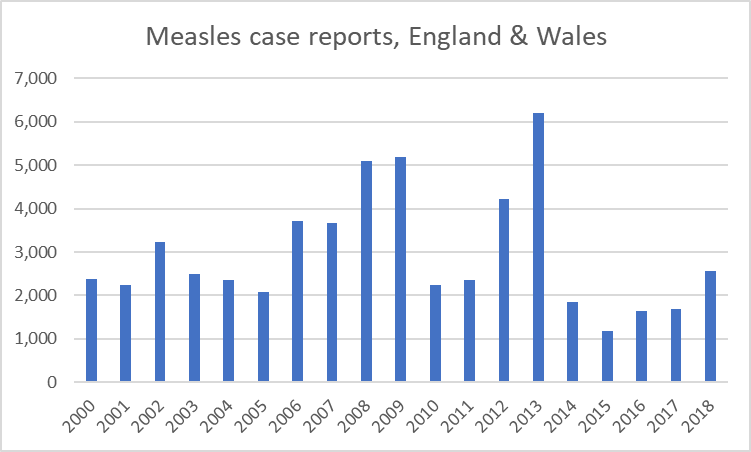
Theoretical is one word for their calculations, scare-mongering is another. Figures for the last 25 years vary widely with the highest being 2000 cases in 2012.
‘The UKHSA also says a large outbreak could put pressure on the NHS, with between 20% and 40% of infected people needing hospital care.’
Ring any PROTECT THE NHS bells?
But worse was to follow. On 15th September, it was reported:
‘Councils in London have written to households to say the capital could be facing a major outbreak unless MMR inoculation rates improve… Measles is highly contagious and severe cases can lead to disability and death… Any child identified as a close contact of a measles case without satisfactory vaccination status may be asked to self-isolate for up to 21 days.’
This threat of sending children home for a disease they don’t have, will resonate with parents whose children were repeatedly sent home for 10 days at a time, for one child with a positive covid test. As also will the inducement of:
‘Parents have been urged to check children’s health records to ensure that their vaccines are up to date.’
A ‘nudge’ technique not a million miles from the threat of vaccine passports for nightclubs, used to increase covid vaccine uptake in 18-25-year-olds but never actually implemented.
MMR vaccine uptake levels have been variable ever since its inception. Herd immunity levels of 95% are quoted as the level required to stop measles completely. But measles has never been a condition listed for total eradication. Cases fluctuate with mini outbreaks every 5-6 years and this was always the case before the availability of the measles and later the MMR vaccine. So how real is the current threat and how could it possibly justify such a discriminatory measure as excluding unvaccinated children from school?
From the headlines, parents may think that measles has a high death rate and whilst that was certainly true in the past and remains true in developing countries, improved nutrition and widespread access to health care in the UK was associated with a huge decline in measles deaths. The death rate declined from over 1,100 per million in the mid nineteenth century to a level of virtually zero by the mid-1960s.
Ninety-nine percent of the reduction in measles deaths in England & Wales occurred before the introduction of the measles vaccine in 1968 and deaths have continued to fall since then.
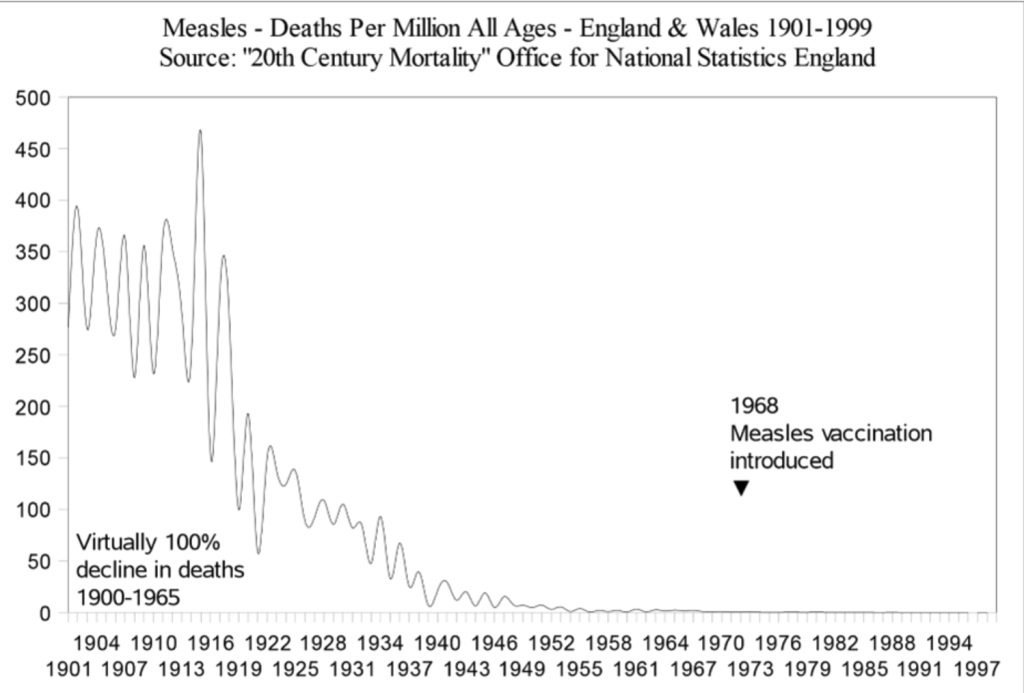
Figure 1 Twentieth Century Mortality CDROM Office for National Statistics. Measles mortality
More recent figures show case reports fluctuating widely and deaths of children from measles varying between 0 and 2 per annum. For example, in 2013 when there were over 6000 reported cases, there was 1 adult and 0 child deaths.
That is not to say that deaths cannot occur and other serious complications such as pneumonia or hearing loss. But for the vast majority of children, measles is what it was always described as, namely a ‘childhood illness’. It is noteworthy that WHO recommends
‘All children or adults with measles should receive two doses of vitamin A supplements, given 24 hours apart. This restores low vitamin A levels that occur even in well-nourished children. It can help prevent eye damage and blindness. Vitamin A supplements may also reduce the number of measles deaths.’
In a systematic review published in 2002, two doses of water based vitamin A were associated with a 81% reduction in risk of mortality (RR=0.19; 95% CI 0.02 to 0.85). Nowhere is this simple measure mentioned in UK guidance.
The parents who have chosen not to get their children vaccinated will accept the possibility of them catching measles, but sending them home for 3 weeks isn’t going to make this go away. A policy which writes in educational discrimination against unvaccinated children is hardly going to improve trust in public bodies. Moreover, the GMC Guidance on Decision making and Consent states in paragraph 48:
‘If you disagree with a patient’s choice of option: You must respect your patient’s right to decide. … you must not assume a patient lacks capacity simply because they make a decision that you consider unwise’
Introducing carrots and sticks is not compatible with NHS Constitution. The seven key principles includes the following:
1. The NHS provides a comprehensive service, available to all
4. The patient will be at the heart of everything the NHS does
Health choices should always be free from coercion and the failure to uptake whatever is on offer should never result in punitive consequences disguised as being ‘for your safety’.
Rumble Rejects UK Government’s Pressure to Demonetize Russell Brand Amidst Allegations
By Dan Frieth | Reclaim The Net | September 20, 2023
Amidst a growing controversy surrounding comedian Russell Brand, video platform Rumble has taken a stand against the UK government’s push to penalize the content creator based on recent allegations.
Last week, The Times and Channel 4’s Dispatches covered serious allegations of assault against Russell Brand. While the comedian has yet to be convicted of any wrongdoing and whether the anonymous accusers are victims is yet to be determined, several major platforms, including YouTube, Netflix, and BBC iPlayer, took swift action, either demonetizing or removing Brand’s content.
“We would be grateful if you could confirm whether Mr Brand is able to monetise his content, including his videos relating to the serious accusations against him. If so, we would like to know whether Rumble intends to join YouTube in suspending Mr Brand’s ability to earn money on the platform,” wrote Dame Caroline Dinenage, in the brazen letter.
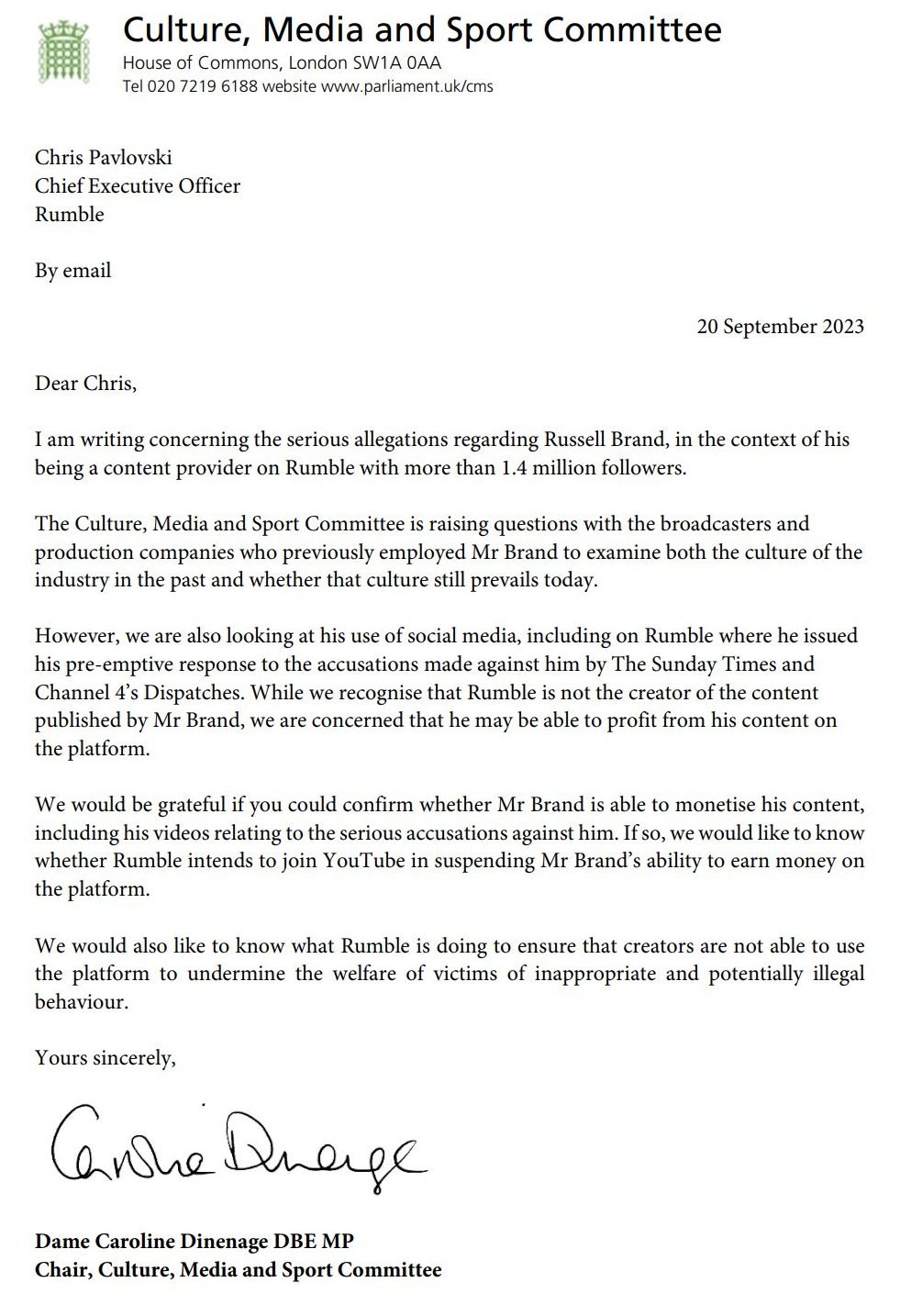
“We would also like to know what Rumble is doing to ensure that creators are not able to use the platform to undermine the welfare of victims of inappropriate and potentially illegal behaviour.”
Rumble, however, has chosen a different route from the other platforms. In response to an inquiry by the UK’s “Culture, Media and Sport Committee” regarding Brand’s monetization on the platform, Rumble CEO Chris Pavlovski issued a statement emphasizing the company’s commitment to a free internet.
In a clear stance against cancel culture and rushes to judgement, Pavlovski responded, stressing that allegations against Brand have no connection with his content on Rumble. He pointed out the importance of a free internet, “where no one arbitrarily dictates which ideas can or cannot be heard.”
From Rumble CEO Chris Pavlovski:
“Today we received an extremely disturbing letter from a committee chair in the UK Parliament. While Rumble obviously deplores sexual assault, rape, and all serious crimes, and believes that both alleged victims and the accused are entitled to a full and serious investigation, it is vital to note that recent allegations against Russell Brand have nothing to do with content on Rumble’s platform. Just yesterday, YouTube announced that, based solely on these media accusations, it was barring Mr. Brand from monetizing his video content. Rumble stands for very different values. We have devoted ourselves to the vital cause of defending a free internet – meaning an internet where no one arbitrarily dictates which ideas can or cannot be heard, or which citizens may or may not be entitled to a platform.
“We regard it as deeply inappropriate and dangerous that the UK Parliament would attempt to control who is allowed to speak on our platform or to earn a living from doing so. Singling out an individual and demanding his ban is even more disturbing given the absence of any connection between the allegations and his content on Rumble. We don’t agree with the behavior of many Rumble creators, but we refuse to penalize them for actions that have nothing to do with our platform.
“Although it may be politically and socially easier for Rumble to join a cancel culture mob, doing so would be a violation of our company’s values and mission. We emphatically reject the UK Parliament’s demands.”
While the letter from Rumble did acknowledge the seriousness of crimes like sexual assault, it underscored the importance of not penalizing creators for allegations unrelated to the platform. Pavlovski also raised concerns over the UK government’s attempt to influence who is allowed to speak or earn on Rumble, especially singling out individuals based on allegations.
The unfolding situation surrounding Russell Brand draws attention to broader discussions on cancel culture, the role of tech platforms, and the overreach in governments in regulating online content.
For now, Rumble remains committed to its principles, rejecting the call to join the growing number of platforms penalizing Brand based on accusations. As the story progresses, the debate over freedom of speech online and the impact of allegations on creators’ livelihoods is likely to intensify.
YouTube Censors Barrister’s Testimony on Vaccine Injuries at Official Covid Inquiry
But it’s for your own safety
The Naked Emperor’s Newsletter | September 20, 2023
YouTube are excelling themselves at the moment.
Yesterday they demonetised all of Russell Brand’s videos after a joint Channel 4, Times and Sunday Times investigation. For those who have not heard anything about this, Russell Brand is a UK comic with a troubled past full of sex, drugs and rock and roll. He managed to conquer Hollywood and marry pop star Katy Perry before settling down, having children and starting a great podcast.
The joint investigation accused Brand of sexual assault and rape which he strongly denies. Nobody knows what the truth is so there is no point in speculating on whether he is guilty or not. The key point is that he is innocent until proven guilty.
Unfortunately, YouTube have set this principle aside. They have dispensed with police gathering evidence and interviewing witnesses and bypassed going to court. Instead, they have decided that Brand is guilty and that his punishment is the inability to earn a living.
Who cares if he has a team to pay and a family to provide for. YouTube have listened to the mob and decided that Brand needs punishing. And of course they are able to do this because Big Tech is more powerful than most countries. Who is Brand going to complain to? The police?…they couldn’t care less. Politicians?…they are more fickle than Big Tech.
So now we are in a position where Big Tech companies have the power to decide whether you can earn a living or not. A police investigation may takes months or years. And then there will be a further wait until it goes to court. Should somebody have their wages withheld for years on end, perhaps being innocent the whole time? That’s not how innocent until proven guilty works.
Of course YouTube haven’t removed Brand’s videos, they still make a lot of money out of them, they have just stopped Russell getting a share of any of that revenue. ‘We think you’re guilty and we are morally superior so you shouldn’t be able to make a living but we are very happy to still earn money from your videos staying on our platform’.
To be honest, I’m surprised that Russell’s videos have been allowed on YouTube for so long, with so many other smaller accounts being censored over the same topics, but that is for another conversation.
Secondly, Stephen Bowie, who was injured after an adverse reaction to the AstraZeneca Covid-19 vaccine, has had one of his videos removed from YouTube. Nothing strange with that you might think, happens all the time.
What is strange and sinister, is that the video he posted was a YouTube live stream of the official UK Government Covid Inquiry. During the inquiry, Anna Morris KC, a Kings Counsel barrister, gave a testimony on vaccine related injuries. But YouTube didn’t like this.
“We reviewed your content carefully, and have confirmed that it violates our medical misinformation policy. We know this is probably disappointing news, but it’s our job to make sure that YouTube is a safe place for all”
Phew, so long as I’m safe.
Even a UK Government Inquiry can’t get past the YouTube censors if it involves a verboten subject.
The UK Passes Sweeping New Surveillance and Censorship Measures in The Online Safety Bill
By Dan Frieth | Reclaim The Net | September 20, 2023
The UK has passed its controversial online censorship act known as the Online Safety Bill. The bill, one of the widest sweeping attacks on privacy and free speech in a Western democracy will become law.
The bill seeks to shield internet users, especially youth, from the slingshots of malicious online content. But the bill goes beyond forcing platforms to remove illegal content. It calls upon social media giants to act as custodians, safeguarding users against ill-intent messages, cyberbullying, and explicit material.
Shrouded in a veil of safetyism and paying only lip service to privacy and free speech rights, we cannot cower from highlighting the bill’s overt undertone of censorship, veering into a territory where freedom of speech and privacy might be sacrificed at the altar of digital safety.
Michelle Donelan, Technology Secretary, voiced her support for the bill, branding it as an “enormous step forward in our mission to make the UK the safest place in the world to be online.” Under the proposed law, social media corporations will be forced into swift action, not just for removing violative content but also for hindering its emergence.
The implementation sword will be wielded by Ofcom, the communications regulator, with the law setting a stringent punishment pathway for non-compliers, inclusive of colossal fines and even incarceration.
The bill further pioneers new criminal offenses to its roster, like cyber-flashing and the distribution of manipulated explicit content, or deepfake pornography.
The bill imbues the government with tremendous power; the capability to demand that online services employ government-approved software to scan through user content, including photos, files, and messages, to identify illegal content. Non-compliance can result in severe penalties such as facing criminal charges.
From a free speech and anti-censorship perspective, this legislation is fundamentally disturbing. Critics argue this bill could enhance potential censorship on the pretext of safety.
The backdoor scanning system poses significant threats. It may be exploited by those with malicious intent, mishandled which could lead to false positives, resulting in unwarranted accusations of child abuse.
These alarming flaws render the online safety bill incompatible with end-to-end encryption – a staple for ensuring user privacy and security – and human rights.
The UK government has subtly conceded that it might not harness some elements of this law to their full potential. During the concluding discussion about the bill, a representative confirmed that the government would only order scans of user files when “technically feasible,” and these orders would be subject to compatibility with UK and European human rights law. This acknowledgment seems a subtle retreat from a previously aggressive stance taken by the same representative.
On the same day of these declarations, it surfaced that the UK government conceded privately that technology capable of examining end-to-end encrypted messages while observing privacy rights does not exist.
But, citizens who value their privacy shouldn’t have to rely on weak assurances from the government. The official safeguarding of privacy rights should be a priority. Rather than relying on murmurs of amendments, the government should offer comprehensive assurance through clear regulations and explicit protection policies for end-to-end encryption.
The bill, as it stands, allows the government to scan messages and photos, posing significant threats to security and privacy to internet users globally. These powers are enshrined in Clause 122 of the bill.
Several end-to-end encrypted service providers like WhatsApp, Signal, and UK-based Element have threatened to pull out their services from the UK if Ofcom demands examination of encrypted messages – an extreme but important move. This reaction is a testament to the perceived invasive nature of the Online Safety Bill.
Meet Ukrainian Military’s American Spokesman
Transgendered Sarah Ashton-Cirillo advocates free speech and killing journalists
BY JOHN LEAKE | COURAGEOUS DISCOURSE | SEPTEMBER 20, 2023
As our world gets weirder by the second, it has become ever harder to know if what we are presented with is real. Every time someone sends a report or video that is purportedly a representation of factual reality, I try to evaluate if it’s indeed real or if it’s propaganda, black propaganda, satire, or the creation of a mentally ill person.
This morning I saw a story about an American transgendered woman named Sarah Ashton-Cirillo who claims to be a soldier and an official spokesman of the Ukrainian Territorial Defense Forces. She is in the news because of a publicized spat she is having with Senator JD Vance of Ohio who has made an inquiry to determine is Sarah Ashton-Cirillo really is an official English language spokesman for the Ukrainian TDF. Spoiler Alert: She really is.
Vance became aware of Ashton-Cirillo after he saw a video of the spokesman announcing that journalists who disseminate Russian propaganda will be hunted down and killed. In this video, she proclaims:
Next week, the teeth of the Russian devils will gnash ever harder, and their rabid mouths will foam in uncontrollable frenzy as the world will see a favorite Kremlin propagandist pay for their crimes. This puppet of Putin is only the first. Russia’s war criminal propagandists will all be hunted down and justice will be served.

In response to Senator Vance’s query, Ashton-Cirillo posted yet another video in which she proclaims her support of the First Amendment, but hastens to add that reporting Russian propaganda is not protected by the First Amendment.

Who adjudicates what is Russian propaganda and what is merely critical reporting of the Ukrainian government and its U.S. government supporters?
The question touches on something I have frequently written about on this Substack—namely, the strange rise of ORTHODOXY in recent years. There are, we are told, certain major issues in which the ORTHODOX—that is, official U.S. government and MSM representations—cannot be questioned or criticized. Those who do question these orthodoxies will be censored, censured, or—if Ashton-Cirillo has her way—hunted down and killed.
The top four orthodoxies are what I call the Holy Quadripartitus of Piffle. They are:
1). COVID-19 vaccines are saving mankind. Anyone who questions the safety and efficacy of the vaccines is guilty of heresy.
2). The U.S. proxy war in Ukraine is a sacred mission and no negotiated settlement with Russia shall be countenanced. Anyone who criticizes the Ukrainian and U.S. governments, and any attempt to understand the war from the Russian point of view, is guilty of heresy.
3). Human induced climate change will soon destroy the earth if trillions aren’t spent to overhaul our entire energy policy. Anyone who questions this proposition is guilty of heresy.
4). The concept of biological sex is a mere “construct.” Skilled surgeons and endocrinologists can transform a boy into a girl or vice versa. Anyone who questions this assertion is guilty of heresy.
I reject the Holy Quadripartitus of Piffle as fanatical, obscurantist, mentally ill nonsense.
G7 believes Ukraine conflict will last until end of decade – Bloomberg
RT | September 20, 2023
The Russia-Ukraine conflict may extend for another six to seven years, according to a senior G7 official who spoke with Bloomberg. The official emphasized that Kiev’s allies will confront various challenges as they endeavor to sustain their support for Ukraine.
In an article released on Tuesday, multiple officials, speaking on the condition of anonymity, indicated that the prolonged timeline resulted from Ukraine’s much-heralded counteroffensive progressing slowly, which has led to “tempered expectations.”
Continuing to provide military and financial aid to Kiev for such a long conflict “won’t be easy,” said Czech Foreign Minister Jan Lipavsky. “It’ll put a lot of pressure on societies, on governments, through different elections in Europe,” he added, stressing that there has to be a “midterm strategy of long-term support to Ukraine.”
One top European official informed Bloomberg that even with the support provided, Ukraine will likely grapple with challenges stemming from insufficient Western weapons supplies and the escalating toll of manpower losses.
Regardless of this dire outlook, Kiev and its allies remain opposed to negotiations and are unwilling to accept any resolution that does not include the complete withdrawal of Russian troops from territories Ukraine claims as its own, the officials told the outlet.
Kiev, for its part, has consistently emphasized its unwillingness to make any territorial concessions to Russia as part of potential peace agreements. In an interview with CBS News on Sunday, Ukrainian President Vladimir Zelensky affirmed that despite the counteroffensive’s slow pace, Ukraine remains committed to it regardless of adverse weather conditions or other factors.
Ukraine initiated its offensive in June; however, territorial gains have proven elusive, with heavy casualties being the predominant outcome. According to Russian President Vladimir Putin, Ukraine has incurred substantial losses during this push, including over 71,000 troops, 543 tanks, and nearly 18,000 armored vehicles.
Last year, four former Ukrainian territories – the Donetsk and Lugansk People’s Republics and the Kherson and Zaporozhye Regions – voted to join Moscow after holding public referendums. Kiev and its allies have refused to recognize the votes, while Zelensky has signed a decree banning any negotiations with the current Russian leadership.
Moscow, meanwhile, has repeatedly said that it has not closed the door on negotiations with Kiev but has urged the Ukrainian leadership to recognize the “realities on the ground.”
Featured Video
Prof. Ted Postol: Iran Already Achieved Nuclear Deterrence Against Israel
or go to
Aletho News Archives – Video-Images
From the Archives
How the occupied mentality syndrome works
Saudi Arabia on the American chessboard – Part 3
By B. J. Sabri | American Herald Tribune | June 27, 2016
Read part 2: “The occupied mentality Syndrome“
Previously I argued whether Saudi Arabia’s repeated involvements in U.S. interventions and wars stem from free national will or in response to a specific condition. For starters, in Saudi Arabia there is no national will. In Saudi Arabia, the national will is the will of the Al Saud clan. Still, when a major Arab state allies itself with a superpower that committed unspeakable crimes against humanity in almost every Arab country, then something is wrong. This fact alone should compel us to examine the U.S.-Saudi relation for one exceptional reason. As a result of the U.S.-Saudi wars, hundreds of thousands of people in Afghanistan, Iraq, Iran, Libya, Syria, Yemen, and Somalia have lost their lives. Millions became displaced in their own homelands. And millions more rendered refugees.
Attributing the Saudi policies to the bonds of “partnership” with the U.S. is frivolous. There are no bonds between these two thugs except those of business, military deals, secret plots, and wars. Proving this point, bonds such as these have no space for the American and Saudi peoples to share significant cultural or societal exchanges. If partnership is not the reason for the Saudi contribution to the U.S. strategy of empire and imperialism, then another reason must exist.
This leads to three possibilities. … continue
Blog Roll
 Aletho News
- Al Mayadeen voices solidarity with Dr. Marandi amid death threats
- US dismantling international law in its war against Iran while claiming ‘false’ victory: Legal scholar
- One martyr, 5 injuries in US attack on Iraqi border crossing with Iran
- ‘This war is Israel’s war’: World facing ‘security breakdown’, says Qalibaf
- IRGC decries attack on US embassy in Riyadh, says executed by ‘Israel’
- Iran blasts EU hypocrisy as EU invokes international law over Hormuz
- There is no military solution to Strait of Hormuz
- NATO’s structural collapse – the outcome of deviation from reality
- Poll finds world views China better than US
- One Of America’s Leading Neo-Cons Has Turned Against The Iran War And Israel
- If Americans Knew
- US loses planes over Iran, Israel downgrades Lebanon war goals – Daily Update
- Israel Is Blocking Palestinians from Easter at Church Where Jesus Resurrected
- Plot to assassinate Palestinian activist follows harassment campaign promoted by Zionist groups and elected officials
- Prominent New York synagogue hosts presentation on why U.S. Jews should support the ethnic cleansing of Gaza
- Tapper vs. Piker: Is the CNN Anchor Auditioning for David Ellison?
- Shouldn’t Democrats Be Able to Condemn Genocide?
- Israel-US kill negotiators, destroy civilian structures, but Iran’s military capabilities still largely intact – Daily Update
- ‘War crime’: Global condemnation as Israeli ministers celebrate death penalty law targeting Palestinian prisoners
- 7 Ways Israel Is Turning Lebanon Into Gaza
- World’s Leading Football Bodies Under Fire Over Israel Policies
- No Tricks Zone
- An Inconvenient Tree: Uncovered In Alps… Europe Much Warmer Than Today 6000 Years Ago
- New Study Reports A 60% Slowdown In Greenland’s Ice Loss Rate In The Last Decade
- Low Intensity Tornado Wrecks Major Solar Farm, Creating A Potential Toxic Dump
- New Study Finds Warming Saves Lives…Cold Temperatures 12 Times More Deadly Than Excess Heat
- German Science Blog Accuses PIK Climate Institute Of Hallucinating Climate Tipping Points
- Devastating Assessment Of Comirnaty Vaccine By Former Senior Pfizer Europe Toxicologist
- New Study: CO2 Is ‘Effectively Negligible’ As An Explanatory Climate Change Factor Since 2000
- Former Pfizer Toxicologist Dr. Helmut Sterz Tells Bundestag Hearing Pfizer Vaccine Should Have Never Been Approved
- Energy Expert: Germany’s Nuclear Phaseout Was A “500 Billion Euro Mistake”
- New Research: South Australia’s Mid-Holocene Sea Surface Temperatures Were 4°C Warmer Than Today
 Aletho News