Thousands-Strong Rally Takes Place in Berlin for Negotiations on Gaza, Ukraine
Sputnik – 25.11.2023
BERLIN – A rally organized by left-wing German politician Sahra Wagenknecht took place in Thousands-Strong Rally Takes Place in Berlin for Negotiations on Gaza, Ukraineon Saturday with thousands of participants rallying against the supply of weapons to Ukraine and for a diplomatic solution to the Ukrainian and Palestinian-Israeli conflicts, a Sputnik correspondent reported.
In an opening speech, Wagenknecht accused the German government of applying double standards in its assessment of the Ukrainian conflict and the “merciless bombing” in the Gaza Strip, the correspondent reported.
The politician criticized the government’s spending on the German military production at a time when the nation faces several internal problems, such as a shortage of teachers, hospital closures and aging infrastructure. She also criticized the government’s decision to stop holding down energy and electricity prices.
“And immediately it was about cutting spending on those least able to fend for themselves,” Wagenknecht said.
In leaflets distributed to demonstrators, protest organizers called for peace talks in all the world’s conflict zones, the report read. After the speech, rally participants marched past the Bundestag and back to the original meeting point, carrying placards calling for peace and an end to Russophobia, the Sputnik correspondent reported.
On October 23, Wagenknecht, who had criticized Germany’s military aid to Kiev and sanctions against Russia, said she had left the Left Party and intended to found a new political party with several close associates that would stand for “reason and justice.” About 14% of Germans were ready to support the new party, polls showed.
Beijing’s Coal Boom Is Here to Stay

By Vijay Jayaraj | Real Clear Energy | November 20, 2023
News of record installations of so-called renewable energy electric generation in China may have kindled the hopes of those supporting the “green” agenda and hostile to fossil fuels. However, China is in no position to give up hydrocarbons, particularly coal.
During the first half of 2023, China approved 52 gigawatts (GW) of new coal power, which was more than all the approvals issued in 2021. These new approvals are in addition to the 136 GW of coal capacity that are already under construction. Together, these new plants represent more than 67% of all new approvals in the world.
Why is China doing this despite climate pledges? And what does the future hold?
Turning Away from Paris One-Step at a Time
Nearly all countries signed the historic Paris Agreement in 2015, which set aggressive goals to keep global warming below 2 degrees Celsius over pre-industrial levels. The assumption was that reducing carbon dioxide emissions from burning fossil fuels would halt future warming deemed as catastrophic.
As part of this accord, China, the largest greenhouse gas emitter in the world, agreed to reach carbon neutrality by 2060 and peak its emissions of carbon dioxide by 2030. Many praised these promises, celebrating China’s apparent acceptance of its supposed responsibility to address the climate issue.
But these promises are at odds with reality. China’s economy is mostly based on fossil fuels, which are the most affordable, abundant and dependable energy source. At 159 exajoules, China’s primary energy consumption in 2022 was the highest in the world and 40% more than that consumed the U.S. — the second largest user.
Last year, 82% of the total energy consumed by China came from coal, oil and natural gas. Wind and solar, despite significant investments by Beijing, represented just 7% of all energy consumed in 2022.
Coal remains the linchpin of China’s energy infrastructure and economic vitality. According to the National Bureau of Statistics of China, coal consumption increased by more than 4% in 2022. Coal imports in August 2023 were the highest since 2015. China is ramping up its import from Russia and Australia and continues to increase imports from Indonesia, which is its main supplier.
Tsvetana Paraskova of OilPrice.com writes, “China is mining record amounts of coal and also importing record volumes of coal as it looks to boost its energy security.” This growing appetite for coal is inevitable given the huge demand from the power sector and industry in general.
Demand from Industries to Increase Coal Demand
Over 1 billion tons of crude steel are produced in China each year, accounting for over half of global steel output. The Chinese steel industries—over 90% of them—use coal-based processes.
Despite introducing in 2021 a policy to curb emissions of carbon dioxide, Beijing has yet to announce any cap for steel production. S&P Global believes that there will “be no mandatory steel output cuts this year.” The crude steel output in 2023 is to exceed 2022 levels.
According to the Centre for Research on Energy and Clean Air, “Chinese steel firms are making significant investments in new, coal-based steelmaking capacity.” To put this in context, China’s approval of new steel capacity per year is twice that of the entire capacity of the German steel industry.
Like steelmaking, the manufacturing of cement is energy intensive, with coal accounting for up to 85% of the energy used in the process. China is the world’s largest producer and consumer of cement.
According to analysts, “China consumes as much cement every two years as the U.S. did over the entire 20th century.” Cement production is projected to increase further in coming years, and high demand will possibly last for decades.
In short, China’s security and economic growth depend on satiating the country’s colossal appetite for fossil fuels. Western politics around a non-existent climate crisis won’t change that.
Vijay Jayaraj is a Research Associate at the CO2 Coalition, Arlington, Virginia. He holds a master’s degree in environmental sciences from the University of East Anglia, U.K.
Curious Admission Surfaces Concerning MHRA Blackmailing Mainstream Media Outlet Over Adverse Event Reporting
And no one really picked up on it…
BY JJ STARKY | NOVEMBER 25, 2023
Mass consumers of news – me included – are often exposed to so much information that some of that information can be lost in all the noise.
There’s little explanation why such a bombshell revelation featured in a recent Telegraph article gained next to no attention.
On 8th November, journalist Sarah Knapton published an article, entitled, ‘In the end, the AstraZeneca vaccine just wasn’t as good as its rivals’. Knapton broke down how AstraZeneca’s (AZ) purported efficacy could not stand up to the purported efficacy of the other vaccines. The consequences of which led to its eventual abandonment.
Curiously, however, buried in the 14th paragraph, was a confession that back in March 2021 – when the Telegraph first reported on AZ’s blood clot risks – Medicines and Healthcare products Regulatory Agency (MHRA) officials effectively blackmailed them.
Knapton writes:
“On the day we published the story we received a threatening phone call from a senior official at the MHRA warning that The Telegraph would be banned from future briefings and press notices if we did not soften the news.
Another well-known Cambridge academic got in touch to complain about our “disgraceful fear-mongering headline” on the story, claiming that it would discourage vaccine uptake and cost lives.”
This was the headline of that 17th March 2021 article:
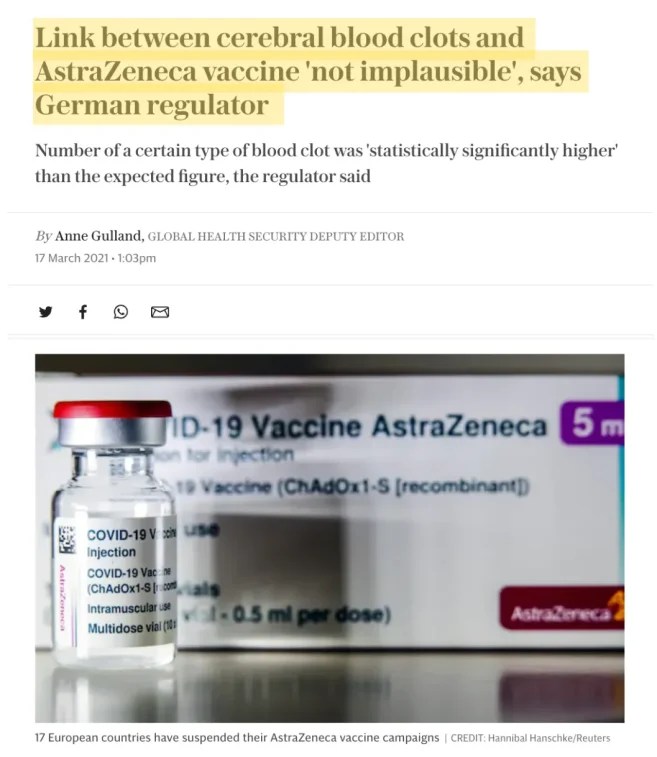
Considering the title includes a subjective opinion from a foreign medical regulator that softens the news, I’m not sure how it constitutes “disgraceful fear-mongering”.
Perhaps this remark is more reflective of the contagious petulance we witness with medical regulators. For them, negative news is not just negative news. It’s analogous to physical assault.
What seems far more “disgraceful” is how a supposedly impartial medical regulator – tasked with safeguarding citizens from potentially lethal treatments – allegedly threatened to strip away a news organisation’s access. Leaving them out in the cold as competitors would stand to benefit from their potential exclusion.
And the curious thing is, no one has seemed to pick up on the news bar The Conservative Woman and the Health Advisory & Recovery Team (HART).
A report from HART earlier in August further revealed that MHRA officials have been blocking journalists, scientists, and vaccine injured victims on social media. HART asked them why and they responded:
“Thank you for flagging your issue about Twitter. We’ve reviewed recent action taken on that platform and have identified accounts which have been blocked in error, these have now been unblocked and you should be free to interact with our content again. Please let us know if you have any further issues so we can investigate and rectify, if necessary”.
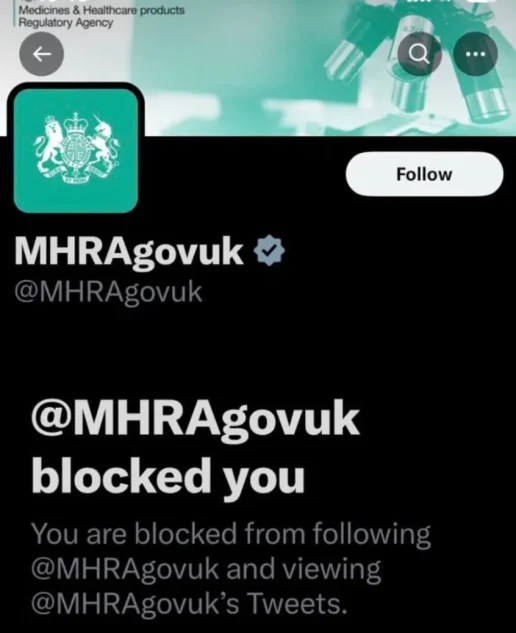
“Sorry folks, it was error. And a complete ‘coincidence’ that we primarily blocked commentators who were critical of us…”
These are the same officials who refused to answer a routine Freedom of Information Request concerning data AstraZeneca submitted in their application to licence their Covid-19 vaccine. The reason they refused? It was “vexatious”.
They wrote in their response:
“this request falls to be considered “vexatious” due to the scope of the request and the disproportionate burden that compliance would create. S14(1) of the FOIA states that “Section 1(1) does not oblige a public authority to comply with a request for information if the request is vexatious.
Downloading the dossier of the vaccine is a relatively straightforward task, although it does require time. Due to the voluminous size of the file packages, when downloading the full package of data, the database software may be more prone to freeze. However, the time required to read through the dossiers, to identify exempt information and to consider and make redactions we expect would take many weeks, if not months to complete, as the dossier encompasses gigabytes of data. To meet the request our staff: Would need to read the dossier in full, in order to identify where redactions need to be made.
We appreciate that there remains a strong public interest in COVID-19 vaccines, however, we do not feel that the public interest outweighs the resource burden required to meet your request.”
Sometimes the actions of government officials are laced with so much arrogance, incompetence, and just frank laziness that it makes one question if they’re genuinely true.
If I sat across the table from an uninitiated countryman and told him of the above, it would come as no surprise to see him raise his eyebrows in astonishment. But not because of what I was telling him, but at me, as if I was about to descend into prophetic trance about how judgement day is coming and there’s going to be some epic battle between us and the lizard people outside Matt Hancock’s house.
Put differently, the extent to which the medical regulators’ actions are so unbelievable actually benefits them. It is easier for people to dismiss it as false. Of course, if the media actually did their job, this wouldn’t be a problem.
Naturally, when MHRA threatened the Telegraph, the outlet hesitated to revisit the subject for months. The blackmail paid off.
Were covid vaccine trials misleading by design?
Data presentation was deceptive
Health Advisory & Recovery Team | November 23, 2023
In chemotherapy, the primary aim is to reduce the disease burden in patients who are already diagnosed with cancer. This is reflected in endpoints like tumour size reduction, progression-free survival, and overall survival, which are directly related to the degree of disease burden. Therefore, measuring the benefit of chemotherapy involves comparing the extent of disease burden (or its progression) at the end of the trial between those who received the chemotherapy and those who did not. This comparison provides insight into how effectively the chemotherapy mitigates the impact of the cancer.
On the other hand, vaccines are designed with the primary goal of keeping individuals healthy by preventing the onset of a specific disease. Therefore, the efficacy of vaccines is best measured by comparing the health status among participants at the end of the trial. This involves assessing how many individuals remained healthy and disease-free in the vaccinated group versus the control group. Such an approach accurately reflects the preventive nature of vaccines.
The covid vaccine trials did not focus on how many were healthy instead comparing those who developed disease. To take the Pfizer/BioNTech trial as an example, there were 8 PCR positive symptomatic people in the vaccine group and 162 in the placebo group more than a week after the second dose and after up to 2 month’s follow up. That worked out at a 94.6% efficacy when calculated as a percentage reduction.
That sounds fantastic but it is not fantastic when measured in other ways. There is more than one scenario that could result in a claim of a 94.6% relative risk reduction as shown in the table. The alternative ways of measuring show the relative change in the percentage who remained healthy and the absolute change – i.e. the percentage of the population who benefitted.

In a hypothetical trial in which 94% of the placebo group developed a disease while only 5% of the treatment group did would also have a 95% efficacy as calculated the conventional way. However, these results have a totally different meaning to a patient. In this scenario 93.7% of the individuals who received the treatment directly benefited. Furthermore there was a marked change, 91.0% in the proportion who remained healthy.
Adjusting the percentages affected shows numerous situations in which the Relative Risk Reduction as conventionally calculated are identical but the Relative Risk Reduction in the proportion remaining healthy and the proportion who directly benefited tell a very different story. The last row are the actual results.
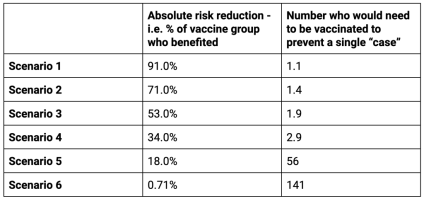
For the first two scenarios the people taking the treatment are more likely to directly benefit than not. For scenarios 3 and 4 there is still a high possibility of direct benefit. However, for the last two scenarios the chances of not directly benefiting are far higher than the chance of benefitting. It is possible in these scenarios that a longer follow up would improve the situation as more people would develop disease or be protected from it. However, the evidence of waning means that the time frame of follow up is close to the maximum possible period of benefit anyway.The important lesson here is that looking at the relative risk reduction as presented in the trials on its own is a meaningless measure. That is why the industry’s own code of practice says, “Referring only to relative risk, especially with regard to risk reduction, can make a medicine appear more effective than it actually is. In order to assess the clinical impact of an outcome, the reader also needs to know the absolute risk involved. In that regard, relative risk should never be referred to without also referring to the absolute risk.” The efficacy claims, even if we trust the results, were presented to the public in a way that could be deliberately misinterpreted.
New Report: Young People Dying of Cancer at ‘Explosive’ Rates, UK Government Data Show
By Mike Capuzzo | The Defender | November 21, 2023
Teenagers and young people in their 20s, 30s and 40s in the U.K. are dying from rapidly metastasizing and terminal cancers at an unprecedented rate since mass COVID-19 vaccination began, according to a new analysis by Edward Dowd.
The 45-page report by Dowd, a former Wall Street hedge fund manager and author of “‘Cause Unknown’: The Epidemic of Sudden Deaths in 2021 and 2022,” alarmed some oncologists who characterized it as a sharp reversal of decades of mortality data.
Dowd based his analysis on readily available government statistics from the U.K.’s Office for National Statistics.
In an interview with The Defender, Dowd said he and his research partners, who include a handful of high-level scientists, data analysts and financial experts, examined all International Classification of Diseases, 10th Revision, (ICD-10) codes for cause of death in the U.K. in the study period of 2010-2022 to investigate trends in malignant neoplasms (C00 to C99 codes).
ICD-10 codes are the international physicians’ classification of diagnosis, symptom and procedure for claim processing set by the World Health Organization (WHO). A malignant neoplasm is a cancerous tumor.
Dowd said his research team noticed a striking pattern: While almost all deaths among older people in 2021 and 2022 in Wales and England had been coded, 8% of deaths among 15- to 44-year-olds in 2021, and 30% of deaths in that age group in 2022, hadn’t yet been coded.
“When you die in a hospital, you leave a trail of life and death with indications of what led to the death,” he said. “When a young person dies at the wheel of a car, walking down the street or in their sleep, there’s an investigation” that consumes time to assign the cause of death.
Dowd said the missing codes are “indicative of the problem” of excess deaths among young people.
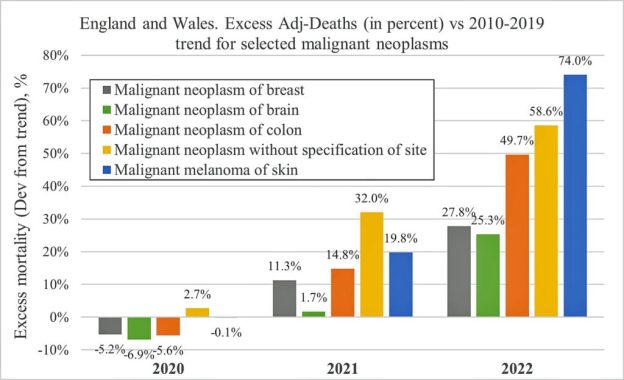
But even with the caveat of missing codes, he said, the remaining 92% of coded deaths in 2021 and 70% of coded deaths in 2022 revealed “a strong signal of cancer deaths in the young. We show a large increase in mortality due to malignant neoplasms that started in 2021 and accelerated substantially in 2022.
“The increase in excess deaths in 2022 is highly statistically significant (extreme event),” Dowd wrote in his report. “The results indicate that from late 2021 a novel phenomenon leading to increased malignant neoplasm deaths appears to be present in individuals aged 15 to 44 in the UK.”
The study’s results in the rate of cancer deaths above the historic norm in 2022 for ages 15-44 in the U.K. included:
- A 28% rise in fatal breast cancer rates in women.
- An 80% increase in pancreatic cancer deaths among women and a 60% increase among men.
- A 55% increase among men in colon cancer deaths and a 41% increase in women.
- A 120% increase in fatal melanomas among men and a 35% increase in women.
- A 35% increase in brain cancer deaths among men and a 12% rise in women.
- A 60% increase in cancer death rates among men in cancers “without site specification” and a 55% increase among women.
‘Mounting clinical evidence’ led to study
Dowd produced his report, assembled by Carlos Alegria, one of Dowd’s partners, in his Humanity Projects study of excess deaths in the U.K. and the U.S. using government and insurance industry data.
He said he started his pro bono data-driven project to help guide public policy when he saw how COVID-19 pandemic policies were destroying society’s faith in institutional experts.
Surveying the capture of national and state government regulatory agencies and corporate media by Big Pharma and other global interests, he realized, “We need independent agents to act as gatekeepers of the public interest.”
“We intend to be such agents, and to provide high-quality research to other individuals and institutions who seek similar outcomes,” he wrote.
The new report is his third in the UK Cause of Death Project, which previously examined “UK – Death and Disability Trends for Cardiovascular Diseases, Ages 15-44,” and “UK – Death Trends for the Cardiovascular System, Ages 15-44, Analysis of Individual Causes.”
The mounting clinical evidence linking burgeoning cancers in young people to the COVID-19 vaccines led Dowd to his latest study, he said.
“We focus our research on younger individuals, aged 15-44, as presently it is a topic of particular interest due to the rise in anecdotal evidence of many unexplained aggressive and unusual cancers (such as turbo cancers … ) occurring in the population, particularly in younger individuals,” he wrote in the study.
“The focus of this study is not to examine individual claims and anecdotes, but instead to provide a statistical analysis at a population level and clarify if the anecdotal evidence is abnormal or not.”
Dowd said he hopes “the relationships that we uncover in our analysis” are “a basis for a reality check for health professionals to understand underlying trends in individuals’ health.”
Dowd’s method was to analyze the number of deaths attributed to cancer in England and Wales between 2010 and 2022 in the U.K. Office for National Statistics data.
He compared excess death rates, the difference between observed deaths and the baseline for expected deaths, before and after the COVID-19 pandemic.
He established a baseline of normal cancer death rates from 2010-2020 that was remarkably consistent with few deviations, he said — until the cancer death rates rose significantly in late 2021 in the U.K. following the vaccine rollout.
Key findings from the report include:
- Breast cancer dominates in women. The most common cause of fatal cancer in women, ages 15-44, is breast cancer, representing about 25% of the total excess death rate caused by malignant tumors in women in 2022. The next most dangerous cancers for women, based on excess death rates, were colon cancer and cancer of the cervix uteri.
- While fatal cancer deaths rose dramatically among both young men and young women in 2022, young men saw a disproportionately higher rise in cancer deaths, but with no dominant cancer comparable to breast cancer in women. Brain cancer, colon cancer and stomach cancer accounted for 30.9% of the rise in fatal cancers in men in 2022.
- Cancers “without specification of site,” indicating rapid metastasis to other organs and commonly called “turbo cancers,” “exploded” in 2022, Dowd said. “These cancers saw very large rise in both women (in 2021 and 2022) and men (in 2022) and were likely metastasized already once they were identified. As the individuals refer to younger individuals who do not require early screening, these cancers were likely of rapid growth.”
- Men experienced a huge rise in skin cancer death rates of 118% in 2022. “Even though these cancers do not account for a large proportion of all cancers,” Dowd said.
- Cancers of the digestive tract “saw explosive changes in 2021 and 2022 relative to the 2010-2019 trend,” Dowd wrote. “Of particular notice are cancers of the colon (internationally coded as C18), stomach (C16) and esophagus (C15). “These cancers related to the digestive tract appear to have risen substantially in importance, and we also notice that they seem to be affecting men in a disproportionate manner.”
- Pancreatic cancer “saw a very large rise in both women (in 2022) and men (in both 2021 and 2022). Why these cancers rose so dramatically and why they rose first in men then women is one of the questions that we believe warrants investigation.”
Dowd emphasized that his research was “a first attempt to bring out some patterns that are observed in trends” in cancer post-2020.
“We hope that medical doctors and specialized researchers perform further investigations based upon these (and other) insights that our data analysis provides,” he wrote.
Link between COVID shots and rise in cancers ‘worth looking at’
Dr. Chris Flowers, an academic physician, radiologist and breast cancer specialist in England who came out of retirement to be the volunteer scientific lead of the War Room/DailyClout Pfizer Documents Analysis Project, told The Defender the U.K. data were “very, very, concerning.”
Flowers said Dowd’s research confirmed similar data on sharp cancer death increases reported by researchers, clinicians and cancer specialists in the U.S., U.K. and across the Western industrialized world since the global rollout of the experimental Pfizer and Moderna mRNA vaccine. An estimated more than 5.55 billion people, or about 72.3% of the global population, received the shots.
Flowers said he and his colleagues, including pathologists, radiologists, oncologists, internists, critical care doctors and researchers in the U.S. and U.K., have never seen anything like the severity of fatal breast cancers and other cancers in the young that exploded in 2022.
Dowd’s report confirms what Flowers and his colleagues have noticed for more than a year: “We’re seeing 2 or 3 times the normal rate of cancer.”
“We’re seeing younger people, we’re talking 20- and 30-year-old women, usually after they started menstruating and some form of growth promoter is going on normally, presenting with advanced tumors which are difficult to treat, but also they may have more than one tumor,” Flowers said. “Something that was rare is now relatively common.”
Perhaps most distressing, Flowers said, is the rise in the young of what some oncologists now call “turbo cancers,” a new term.
“Turbo cancer is a popular name that’s been coined to describe several things,” Flowers said. “It is cancers in young people just turning up, one day you’re absolutely fine, the next day you’re told you have terminal cancer and you’re dead in a week. There are many reports of that even in the mainstream media.”
“Tumors are not only faster growing but you’re getting more types of cancer occurring in the same person. It used to be very very rare. Just occasionally I’d see a very, very aggressive inflammatory cancer in young people. But now everyone has stories.”
Dr. Pierre Kory, a pulmonologist and critical care doctor who is president and medical director of the Frontline COVID-19 Critical Care Alliance (FLCCC) and treats hundreds of vaccine-injured patients in his practice, said he is “being deluged with reports and consults for help” about cancer increases from colleagues and patients.
David Wiseman, Ph.D., a pharmacist with a doctorate in experimental pathology and a pioneer, originally for Johnson & Johnson, of products to prevent post-surgery internal injuries, said he was alternatively astonished and outraged that governments and mainstream media won’t follow up on research he and Kevin McKernan, a former director of research and development at the MIT Human Genome Project, conducted showing the mRNA shots were contaminated with DNA fragments.
These fragments, Wiseman said, add to the potential damage the vaccines could cause to the human genome and open new doors to an infinite variety of problems, including cancer.
Wiseman told The Defender that the Centers for Disease Control and Prevention’s (CDC) own data show cancer concerns connected to the COVID-19 vaccines.
“We’re seeing an increase in cancers in VAERS,” the official U.S. Food and Drug Administration and CDC site for reporting vaccine injuries, Wiseman said. “The CDC did a PRR analysis, a signal analysis, that found a signal for cancer in the vaccines, which isn’t proof but it means it’s worth looking at.”
Mike Capuzzo is the managing editor of The Defender. He is a former prize-winning reporter for The Philadelphia Inquirer and The Miami Herald, a science writer, and a regional magazine founding editor and publisher who has won more than 200 journalism awards as a writer, editor and publisher.
This article was originally published by The Defender — Children’s Health Defense’s News & Views Website under Creative Commons license CC BY-NC-ND 4.0. Please consider subscribing to The Defender or donating to Children’s Health Defense.
Hamas delays release of captives over Israel’s violation of ceasefire
Press TV – November 25, 2023
The Palestinian resistance movement Hamas says it has decided to delay the release of a second batch of Israeli captives under a ceasefire in Gaza over Israel’s lack of commitment to the agreement which came into effect on Friday.
Hamas’ military wing, known as the Al-Qassam Brigades, said on Saturday it had suspended the release under the ceasefire deal with Israel while it was communicating with mediators to address the regime’s violations of the agreement.
It said Israel was not holding up its part of the deal on issues like easing the delivery of humanitarian aid and fuel to Gaza as well as halting gunfire that it said has led to more deaths and injuries among civilians.
Osama Hamdan, a senior political official of Hamas, also said that Israel had started violating the terms of the agreement on Friday and continued its violations on Saturday.
Israel denied the claims with a military spokesperson telling French television channel BFM that the regime had fully respected the truce.
Hamas and Israel agreed as part of a ceasefire deal that was mediated by Qatar earlier this week to exchange prisoners and to stop fighting for four days.
The two sides carried out a first round of prisoner swaps on the first day of the deal on Friday.
Under the deal, Hamas will release a total of 50 Israeli captives taken during a blitz into Israeli-occupied Palestine in early October in return for the release of 150 Palestinians from Israeli jails.
Hamas has said it is ready to extend the deal to put an end to an Israeli aggression that has killed nearly 15,000 people in Gaza over the past 50 days.
Silenced: Journalists in Gaza, south Lebanon killed for exposing Zionist crimes

By Humaira Ahad | Press TV | November 25, 2023
“Life will not last, hug those you love.” This was a post the 25-year-old Lebanese journalist Farah Omar had pinned on her X account, formerly Twitter, days before her killing.
Omar and her colleague Rabih al-Maamari, Beirut-based journalists, were killed in an Israeli airstrike on Tuesday while reporting from the outskirts of the town of Tayr Harfa – about 3.5 kilometers from the Lebanese border with occupied territories.
A video clip of the location where they were targeted showed bodies strewn in an open field, a camera mounted on a tripod and press vests scattered all around the place.
Omar had been working as an editor and correspondent for the Lebanon-based Al Mayadeen news network since 2021.
The intrepid journalist had covered important events for the channel, including the Turkish presidential elections in May and the Lebanese parliamentary elections in 2022.
“Farah is gone, but there will be a million more like her… What happened is an offering for the sake of Sayyed Hassan Nasrallah (the leader of the Lebanese Hezbollah resistance group), and the resistance will live on,” the grieving father said at his daughter’s funeral.
In her last tweet, the young war reporter had lauded Yemen’s Ansarallah resistance movement for seizing an Israeli ship, calling it “a heroic and honorable act.”
“Known for her bravery, Farah insisted on covering the unfolding events in southern Lebanon, conveying the truth, and giving the ultimate sacrifice in pursuit of her message,” her employers said in a statement after her tragic death.
A senior Al Mayadeen photojournalist Maamari, also killed in the attack, was working with the Beirut-based news network since 2012. Father of two children, aged 4 and 2 respectively, he was an important member of Al Mayadeen’s news team.
The 44-year-old photojournalist was in the field since October 7, covering all developments in southern Lebanon amid the Israeli regime’s indiscriminate shelling.
In its condolence message, the Lebanese resistance group Hezbollah condemned the heinous crime, extending its commiserations to the Al Mayadeen channel and the families of the two martyrs, asserting that the Israeli aggression “will not go unanswered.”
In his statement, the Lebanese caretaker prime minister, Najib Mikati said the attack “proves once again that there are no limits to Israeli crimes, and that its only goal is to silence the media that exposes its crimes.”
Al Mayadeen’s director Ghassan Bin Jeddou, in his statement, said “Every correspondent in Lebanon today feels like Farah and every cameraman in Lebanon also feels like Rabih.”
Shooting the messenger
The killing of two Lebanese journalists came amid a spate of murderous attacks by the Israeli regime on journalists in both southern Lebanon and the Gaza Strip since October 7.
As of November 25, the Committee to Protect Journalists (CPJ) says at least 53 journalists and media workers are among more than 14,000 Palestinians killed in the besieged Gaza Strip since the no-holds-barred onslaught was launched seven weeks ago.
Independent Palestinian groups have put the number of fatalities of journalists much higher.
The Palestinian Journalists Syndicate, in a statement on Saturday, said 66 journalists and media professionals have been killed in the Israeli aggression on the Gaza Strip since October 7.
A day before the killing of Omar and Maamari, a Palestinian freelance journalist Ayat Khadoura was killed along with her family members in an Israeli strike on her home in Beit Lahya, northern Gaza.
On November 6, Khadoura shared a video called “my last message to the world”, in which she said: “We had big dreams but our dream now is to be killed in one piece so they know who we are.”
On the same day that Khadoura was killed, Alaa Taher Al-Hassanat, a Palestinian journalist and presenter at AlMajedat Media Network, was also killed with her family members.
A day before their killing, on November 19, Jadallah, a prominent Palestinian journalist and director of Press House-Palestine was killed in his car in Gaza in an Israeli airstrike.
On November 18, Abdelhalim Awad, a media worker and driver for the Al-Aqsa TV was killed in an Israeli airstrike. His killing came hours after Mansour, director of the Quds News Network, and his colleague Hassouneh Salim were killed in an airstrike on the Bureij refugee camp in central Gaza.
Hassouneh Salim, a Palestinian freelance photojournalist, was also killed in the same airstrike on the Bureij refugee camp. Mostafa El Sawaf, a Gaza-based writer and analyst was also killed on the same day with his wife and two sons in an Israeli airstrike on his home in Gaza City.
Amro Salah Abu Hayah, a media worker with Al-Aqsa TV, and Ashour, a photojournalist, were also killed the same day in separate attacks. Ashour’s killing reportedly has taken place before.
Ahmed Fatima, a photojournalist for Al Qahera TV and a worker with Press House Palestine, was killed on November 13. The same day, Yaacoub Al-Barsh, a director of the Namaa Radio, succumbed to his injuries sustained in an attack a November 12.
On November 10, Ahmed Al-Qara, a photojournalist who worked for Al-Aqsa University and was a freelance journalist, was killed in an Israeli airstrike near Khan Yunis.
Three days before that, Yahya Abu Manih, a journalist with A-Aqsa radio station, was killed in a strike in Gaza City. Mohamed Abu Hassira, who worked for Wafa news agency, was also killed on the same day along with 42 members of his extended family.
Mohamed Al Jaja, a consultant at Press House Palestine, was killed in an airstrike with his wife and two daughters on November 5 in the Al-Naser neighborhood in northern Gaza.
On November 2, Mohammed Abu Hatab, a journalist and correspondent for Palestine TV was killed along with 11 members of his family in an Israeli airstrike on their home in Khan Yunis.
A day before that, Majd Fadl Arandas, a member of the Palestinian Journalists Syndicate, was killed in an airstrike on the Nuseirat refugee camp in the Gaza Strip. Iyad Matar, an Al-Aqsa TV journalist, was also killed earlier that day with his mother in the Gaza Strip.
Gaza – cemetery of journalists
It was the continuation of the killing spree of journalists in the Gaza Strip, occupied West Bank and southern Lebanon that started on October 7.
In the last seven weeks, hundreds of other journalists have also been reported missing, detained, or injured or their media offices and homes have been damaged in Israeli strikes.
The attack on Omar and Maamari was not an isolated incident in southern Lebanon. Israeli regime attacked a group of journalists there on 13 October as well, killing Essam Abdullah of Reuters and wounding three other journalists working for AFP and Al Jazeera.
CPJ President Jodie Ginsberg has dubbed the Israeli aggression since October 7 as the “deadliest period for journalists covering conflicts that CPJ has ever documented”, adding that they have been recording attacks on journalists for more than thirty years worldwide.
In a statement, an organization for journalists in the Middle East and North Africa, CPJ MENA called for an “independent investigation” into the killing of journalists and emphasized that “journalists are civilians doing important work during times of crisis and must not be targeted by warring parties.”
Describing Gaza as the “cemetery of journalists,” Reporters Without Borders (RSF) also voiced its concerns over journalism being eradicated in the Gaza Strip as a result of Israel’s aggression and a refusal to heed calls to protect media personnel.
“This rate of attrition among media workers has deeply shocked journalists the world over. No one can watch the growing tally of fallen colleagues without mounting horror,” Anthony Bellanger, the secretary-general for the International Federation of Journalists (IFJ), said in a statement on November 2.
RSF asserted that journalists were clearly identifiable by the virtue of wearing press vests and that missiles that struck them came from occupied Palestinian territories.
The Paris-based organization also submitted a complaint to the International Criminal Court (ICC) on October 31, saying the Israeli regime perpetrated war crimes against journalists in Gaza.
On Wednesday, Jonathan Dagher, the head of RSF’s West Asia desk said this is “one of the deadliest tolls in a century”, adding that “reporters there have no safe refuge and no way of leaving.”
“They are being killed one after another. Since 7 October, the Palestinian territory has been subjected to a veritable eradication of journalism,” he said.
US-German ‘Peace Talks Plot’ Shows West on Brink of Losing Ukraine
By Ekaterina Blinova – Sputnik – 25.11.2023
The two Western powers are reportedly trying to force Ukrainian President Volodymyr Zelensky into entering into talks with Russia, per German newspaper Bild. What’s behind the report and its timing?
Washington and Berlin have reportedly kicked off a plot to push Ukraine for negotiations with Russia by slashing military supplies to Kiev and leaving Volodymyr Zelensky with little if any options, according to the German publication.
According to Bild, there is also a plan B envisaging a frozen conflict that would solidify a new quasi-border between Ukraine and Russia along the contact line.
“First, [this report] should be seen in a specific temporal context,” Dmitry Evstafiev, a political scientist and High School of Economics (HSE) University professor, told Sputnik.
“This is not a statement, of course, this is a publicity stunt. It appeared in the media almost immediately after the end of the meeting of the notorious Ramstein group that has made an essential decision to create the [Ground Based] Air Defense coalition to strengthen air defense. Moreover, it is quite obvious that they will strengthen not so much the air defense of Ukraine, but the air defense of the countries bordering Ukraine. Therefore, this is a kind of first proposal that it is necessary to take certain political steps that would indicate that Ukraine is ready for negotiations.”
The second aspect is an interview given by the leader of the Servant of the People faction, Davyd Arakhamia, which is “clearly synchronized with the West.” According to Evstafiev, it is “even more indicative against the backdrop of problems at the front.”
Speaking to Western journalists, Arakhamia noted that Russia’s main condition during the March 2022 peace talks with Kiev was Ukraine’s neutrality and guarantees that the Eastern European country wouldn’t join NATO. (It was Arakhamia who headed the Ukrainian delegation during the negotiations with Russians in Belarus and Türkiye in 2022.) In addition, he debunked the Western media narrative that Russia does not want to negotiate peace with Ukraine by saying that Moscow is open to talks and it may start them when Kiev is ready.
“At the moment, [Western] support to Kiev is becoming more and more politically expensive/costly, or whatever you want to call it, for the key countries that provide assistance, these are, first of all: Germany and the United States,” said Evstafiev. “The United States has already almost halted aid [to Ukraine]. Of course, there will still be a revaluation through the Pentagon, but one can no longer expect large packages.”
“Assistance from the European Union will be largely aimed at maintaining the functionality of the public administration system and some kind of social support, but not so much for military support. Therefore, the first point is that support for Kiev has become toxic in terms of politics.
“The second point, which is absolutely clearly visible from the statements of Western sources, is that Kiev now faces the last moment when it can lay claim to more or less acceptable terms of a truce with Moscow. (…) The third point – which Westerners do not conceal – is that Russia will agree to any starting conditions for these negotiations. Arakhamia speaks about this directly, openly and without hesitation.”
West Gives Nothing Short of Ultimatum to Zelensky
Per the German newspaper, the US and Germany are going to supply Ukraine with limited amounts of weapons that would be enough to hold the line but not enough to launch a new offensive. This, the publication claims, would force Zelensky to consider a peace deal.
“This proposed manipulation appears to be quite effective,” said the academic. “Where else could Zelensky get weapons? [Weapons] that had remained on the territory of the former Ukrainian SSR, in the warehouses of the Soviet army, had already clearly been exhausted. The Ukrainian Armed Forces are increasingly fighting with Western weapons. That is, the number of Soviet and Ukrainian weapons is decreasing, and at a very rapid pace, especially in the last four to five months. The Armed Forces of Ukraine will be able to fight only with Western weapons, and (…) without logistical support from NATO, the armored forces of the Ukrainian Army would stop operations in about four to five weeks.”
Still, Evstafiev believes that the West wouldn’t waste time on convincing Zelensky to start talks. It’s more likely that they would give him an ultimatum: either he joins Russia at the negotiating table or his successor will. Zelensky is by no means indispensable in the eyes of the West, according to the professor.
The West “needs a person who is willing to buy time in exchange for territory,” said Evstafiev. Someone would stabilize the state system in Ukraine, carry out some reforms, ease the pressure on Ukrainians, “because the Zelensky regime has tightened the screws in terms of political and religious freedoms much deeper than is acceptable for the Americans and Germans,” per the expert.
When it comes to Zelensky, it would be very hard for him to reverse his months-long position on peace talks with Russia, according to Evstafiev. One should keep in mind that previously, the Ukrainian president issued a decree making bargaining with Moscow illegitimate. “This is absolutely unacceptable for Zelensky and his entourage,” the professor remarked.
The West is well aware of that and considering changing horses in midstream: “They have already indicated – it has already been openly written – that a new [Charles] de Gaulle is needed. Ukraine needs its own de Gaulle, who will abandon Ukrainian Algeria, which means the Donetsk and Lugansk People’s Republics and Crimea.” (During a major armed conflict between France and the Algerian National Liberation Front (1954-1962) then-French President Charles de Gaulle came to the conclusion that continuing to hold on to Algeria, then a French colony, would exhaust France’s resources and weaken its position in Europe. On July 5, 1962, Algeria won independence.)
Why Has West Started Pushing Ukrainian Peace Talks Narrative?
While some Western policy-makers apparently view Commander-in-Chief Gen. Valery Zaluzhny as Ukraine’s de Gaulle, the problem is that he is unlikely to give up ambitions of taking back the Zaporozhye and Kherson regions, according to Evstafiev. Both regions voted in local referendums to join Russia and officially became Russia’s new territories starting from September 2022.
Given that hardliners within the Ukrainian civil and military leadership are still strong, the West has a limited number of options. Hence plan B – a “frozen conflict” – cited by the German newspaper.
“All these negotiations are just an attempt to gain time to stabilize the internal situation in the territory now controlled by the Kiev regime. In my opinion, this needs to be paid attention to,” Evstafiev pointed out.
What’s behind the West’s attempts to stabilize the situation at all costs? The answer is clear, per the academic:
“What scares Westerners the most is not even the defeat at the front. Most of all Westerners – and I think they have an adequate idea of what is happening in [Ukraine’s] rear – are frightened by the possibility of a quick and catastrophic collapse of the public administration system [in Ukraine]. That’s why they are putting so much pressure, I might say, somewhat hysterically, to freeze the situation and try to somewhat restore the stability inside, in the rear,” Evstafiev concluded.
ANALYSIS: HOW THE UK AND US MEDIA DEHUMANISE PALESTINIANS
BY CLAIRE LAUTERBACH AND NAMIR SHABIBI | DECLASSIFIED UK | NOVEMBER 22, 2023
Nazis. Beneath animals.
This is a small sample of what Palestinians have been called by commentators speaking to Western media outlets in the last month of the Palestinian-Israeli conflict – examples of the bestiary of zoological terms natural to a coloniser’s view of the colonised.
Political philosopher Frantz Fanon wrote during France’s colonial war in Algeria of “hordes of vital statistics”, “hysterical masses”, “faces bereft of all humanity”, and “children who seem to belong to nobody”.
These are all terms that could describe how western media covers the suffering of Palestinians — “a tide of humanity… a teeming mass of Gazans”, as the BBC put it (15 October). This is all sharply in focus since Hamas’ October offensive, and Israel’s genocidal razing of the Gaza strip.
We analysed the front page coverage of Israel’s war in Gaza by five major US and UK news media — the Washington Post, the New York Times, the Guardian, the Times, and the BBC (the news landing page at 7am daily) between 7-26 October.
Over these three weeks following Hamas’ offensive, the mechanics of the Western press’ dehumanisation of Palestinians in death and life are revealed as clinical and routine.
Israelis are murdered, Palestinians die
The dehumanisation process begins (or ends) with questioning who counts in death, and how the killer and the victim are portrayed.
In the UK-US mainstream media, Israelis die actively. They are either killed or murdered by Hamas, or “after a surprise Palestinian attack”. “The Palestinians” stands in for “Hamas” for sloppy or ideological editors, for example in the Guardian on 8 October.
Palestinian civilians, by contrast, die passively – and yet it is they who have done most of the dying since 7 October; over ten times the number of Israelis killed.
Gazans aren’t killed by Israeli forces or Israeli government policies. They “dehydrate to death as clean water runs out” (Guardian, 18 October) while Israeli airstrikes “continue to pound the Palestinian territory”.
On 9 October, the BBC ran with “700 people have been killed on the Israeli side with more than 400 also dead in Gaza”, presumably succumbing to shock or an act of God.
On 8 November, the Times of London noted: “Israelis marked a month since Hamas killed 1,400 people and kidnapped 240, starting a war in which 10,300 Palestinians are said to have died”, which is of course qualified.
Palestinian deaths are natural, undifferentiated. This is only possible because the media treat Israel’s blockade of Gaza as wholly logical, proportionate and even restrained.
Violations of international law
Collective punishment, which is essentially what Israel is doing by striking civilian “targets” and totally blockading the “open prison” (in former prime minister David Cameron’s words), is also illegal. This is the view of EU foreign policy chief Josep Borrell, UN human rights chief Volker Türk and Human Rights Watch, among others.
When UN chief António Guterres noted Israel’s decades-long occupation of Palestine and called for an end to the siege, Israel’s UN representative demanded he resign. At least one of Guterres’ colleagues, the head of the New York office of the UN high commissioner for human rights, Craig Mokhiber, resigned of his own accord, protesting Israel’s “genocide unfolding before our eyes” in Palestine.
However, in none of the three weeks’ of front-page headlines and lead paragraphs for the five UK-US media analysed for this article are Israel’s serial violations of international law mentioned.
The exclusion of this important context on Israel’s crimes is important. As journalists we’re trained to account for the fact that most people don’t read beyond the headlines or first paragraphs.
Off the front page, some media published separate analysis pieces, such as the New York Times’ “Israel, Gaza and the laws of war” (12 October). This unsurprisingly goes nowhere near calling Israel’s crimes what they are: crimes.
Despite discussing at length how civilians cannot be targeted or disproportionately harmed for military purposes, the closest the New York Times gets to criticising the action of the Israel Defence Forces (IDF) is quoting the opinion of an expert on siege law.
This was that Israel’s siege is “an unusually clear-cut example of starvation of civilians as a method of warfare, which is considered a violation of international humanitarian law, a crime against humanity and a war crime” (emphasis added).
A swift qualifier follows: “Jurisdiction over some war crimes would depend on whether the conflict is considered inter-state.” So some crimes are not a crime as long as Palestine or Palestinians don’t exist, as Israeli prime minister Golda Meir asserted over 50 years ago, repeated by current Israeli politicians.
By contrast, Hamas’ actions are, to the same cited expert, “not close calls”.
Preventable deaths
Moving on from, or ignoring completely, both the illegality of Israel’s total siege of Gaza, the UK-US media portray the starvation and preventable deaths resulting directly from it in almost entirely passive, naturalistic language.
For example, the Washington Post’s print version front page: “Civilian harm in Gaza looms over Biden’s visit; Rising human toll from attacks could threaten Israel’s global backing” (harm arising of course from Israel’s battering).
On 13 October, from the New York Times : “300,000 homeless in battered Gaza as food runs low” (because Israel is blocking food from entering Gaza). It continues: “Hospitals overwhelmed and fuel scarce” (because Israel is blocking medical supplies and fuel from reaching Gaza) “as Israel strikes back at Hamas.”
That’s fine then – the reader should feel at ease since Israel’s crushing of hospitals is merely an act of “self-defence”.
The Israeli military is not much a fan of Gazan hospitals – it regularly bombs them. It ordered 23 hospitals in northern Gaza to evacuate on 13 October, and seems to have been picking them off, with patients inside, ever since.
When Israel might have gone too far, as it did in almost certainly bombing Al-Ahli Arab Hospital on 17 October, most outlets covered the strike by repeating both Israel’s and Hamas’ “he said-she said” accusations against the other.
Nevertheless, the New York Times gave the IDF’s denial more weight with “Hamas fails to make case that Israel struck hospital” (23 October, emphasis added), which is a catchier headline than “We don’t know, and don’t want to work it out ourselves”.
Meanwhile, the Times ran with “Strike kills up to 500 in Gaza”, swiftly adding that “Israel denies responsibility and blames jihadis”, with no comment from a Palestinian voice.
Mirroring the discrepancy between how Palestinians have died (passively, often with no mention of Israeli actions) and Israelis have died (actively, directly attributed to Hamas or “Palestinian” actions) is how the media describes child victims of both sides.
Discussing a prisoner exchange, a Washington Post columnist described Israel’s “children hostages” while referring to Palestinian children as “young people”. Under Military Order 1591, the Israeli government can hold minors as young as 12 without trial and potentially indefinitely in “administrative detention”, UNICEF reports.
When Gazan civilian deaths from siege and strikes against civilian infrastructure are shown as authorless natural disasters rather than as war crimes, any access Gazans get to essential goods becomes “aid” or “relief”, and every tiny amount allowed to reach them is an act of Israeli mercy.
For example, the New York Times (19 October): “Deal lays groundwork for aid to reach desperate Gazans”. Or the Washington Post (12 October): “Closed borders, falling bombs choke Gaza; thousands injured as supplies wane”, adding “humanitarian crisis in Gaza worsens” (due to Israeli siege, let’s not forget).
Also in the Washington Post is the incredible headline (16 October) “As Palestinian death toll rises, aid stuck in Egypt”, as if it couldn’t physically fit through the door, which ignores the fact that Israel prevented aid from entering Israel via Rafah, demanding proof it would not be diverted to Hamas.
The numbers
Having reduced Palestinians to numbers, the work then becomes to cast doubt on these numbers.
When Israel’s flattening of Gaza began raising international alarm, Biden said he didn’t trust that “Palestinians” (or the Hamas government, since to him the distinction is irrelevant) “are telling the truth about how many people are killed.”
His statement was the latest in a time-honoured tradition of US administrations disputing the number of deaths wreaked by their allies abroad, from Suharto’s Indonesia, to Salvadoran death squads in the 1980s and Saudi Arabia today, as historian Bradely Simpson notes.
No one seriously disputes the Gazan Ministry of Health’s numbers as too high. If anything, they are likely a serious undercount given how many bodies are trapped under rubble.
Nevertheless, the attribution of figures to the “Gaza Ministry of Health” is now almost always prefaced by “Hamas-government” or followed by “controlled by Hamas”. This would seem an odd waste of words, considering that everyone from the UN to the US State Department cites Gazan health ministry casualty data, and Gaza’s government is run by Hamas.
Dead Palestinians are simply irrelevant for some media. The first mention of Palestinian deaths in Times headlines occurred 11 days after Hamas’ assault: “Strike kills up to 500 in Gaza”. It had by then run several front page pieces about specific, named Israeli victims, including an in-depth profile (with portrait) of a kibbutz family horrifically killed by the Hamas-led offensive [or not].
Unsurprisingly, on 12 October, the Telegraph published the number of Israelis killed in factors of “9/11s” in a striking infographic which didn’t even bother to include an estimate of Palestinian deaths.
Double standards
Once a people are truly dehumanised, it becomes logical – necessary, even – to apply a wholly different standard of (in)decency to them.
UK-US media report Palestinian deaths passively, as if through apparent acts of God, often couching the deaths in language suggesting that they were mostly Hamas or Hamas-adjacent, or at least that they inconveniently stood in missiles’ way.
For still-breathing Palestinians, it is not enough to have somehow escaped being killed by the almost 6,000 bombs Israel launched in its first six days punishing the densely populated territory. This is more than the US, not usually known for its restraint, deployed in any single year of its war in Afghanistan.
A living Palestinian must justify his or her continued aliveness by disavowing Hamas. A viral example of this can be seen in BBC Newsnight’s interview of the head of the Palestinian mission to the UK, Husam Zomlot.
Presenter Kirsty Wark barely flinched upon hearing Zomlot describe in detail how members of his family had been killed by Israeli strikes in the previous days before repeatedly demanding Zomlot condemn Hamas’ actions.
To reverse this, in other words, to ask every Israeli who had lost a family member in this conflict to first begin by condemning Israel’s murders and collective punishment of civilian Gazans would be rightly seen as outrageous. Unsurprisingly, we have not seen any examples of such in the Western press.
The UK-US press also tells us that to support Palestinians is to support Hamas, in case anyone doubted the conflation.
The BBC declared London’s peaceful pro-Palestine protesters as providing “backing for Hamas.” It later retracted its “poorly phrased” comments.
Sky News did no better in using images of peaceful protesters bearing Palestinian flags to accompany its discussion of efforts by the London Metropolitan Police to “tackle extremism”.
These “slips” pale in comparison with the virulently offensive terms guests on BBC programmes have called Palestinians, completely unchallenged by their hosts.
For example, BBC Arabic hosted former Israeli intelligence veteran-turned academic, Mordechai Kedar who refused to recognise popular Israeli racism towards Palestinians, claiming that bestial comparisons of Palestinians are “denigrating to animals.”
Tellingly, the BBC Arabic host neither ejected Kedar from the interview, nor did she admonish him and demand an apology. Instead, the host pivoted away from Kedar’s genocidal language with the comment “that’s your opinion”.
Platforming Israeli justifications
UK-US media have also taken to running pieces platforming Israeli justifications for the IDF’s actions when the staggering number of dead Gazan civilians was becoming harder to write around.
“How Israelis justify scale of airstrikes” ran the New York version front page of the New York Times on 26 October. It was later rewritten as “Israel’s strikes on Gaza are some of the most intense this century”.
It is unthinkable that a Western newspaper would carry a piece platforming in the same benign-to-neutral terms Palestinian rage, or worse, justifications for Hamas’ crimes.
Another trend is to normalise Israel’s actions by focusing not on its costs in Gazan lives, but its intentions which, of course, are shown as benign. (Note: intentions don’t matter in the laws of war.)
Three days into Israel’s illegal total blockade of Gaza, the BBC asked: “Could an Israeli ground invasion of Gaza meet its aims?” (14 October). Charitably characterising Netanyahu as “risk-averse” (for Israelis, not Palestinians), the New York Times ran with “All-out war is untried ground”, comforting readers that “limited strikes in past were safe politically”.
Dissenting voices: harder to hear
Journalists at the BBC and Agence France Presse (AFP) who have been critical of their agencies’ bias against Palestinian lives and minimisation of Israeli war crimes told Declassified that there is no space to discuss editorial concerns.
Palestinian commentators have seen their segments edited out of mainstream news programmes. Palestinian Americans report their events are being cancelled while they’re called Hamas supporters.
Meanwhile, a senior editor at US publication Newsweek called for Gaza to be flattened to resemble a parking lot, apparently without censure.
Elsewhere in the media ecosystem, an official of the UK’s communications regulator OFCOM, Fadzai Madzingira, was suspended for a social media post criticising UK support for “ethnic cleansing and genocide of Palestinians” and “this vile colonial alliance”.
None of these points – that Israel may be committing genocide, that it continues to ethnically cleanse Palestinian land or that Israel was founded as a colonial project which still uses settler outposts to consolidate territorial control – is outside of reasonable analysis of historical facts.
It’s looking an awful lot like the beginning (or end, depending on your starting point) of a genocide.
The IDF has instructed all Palestinians to flee south of the Wadi Gaza area “for their safety” from Israeli strikes. Some were struck as they were evacuating, and Palestinians are still being shelled by the IDF in southern refuge areas.
Soldiers plant Israeli flags on Gazan beaches, while Israel’s intelligence agency floats the idea of permanently expelling Gazans to Egyptian Sinai as a preferred solution. Netanyahu invokes a Bible passage where God orders the Israelites “to put to death men and women, children and infants” of a rival kingdom.
Still, the New York Times uncritically presents Netanyahu as “seeking [a] permanent end to threat but not a reoccupation” (13 October).
That last bastion of dissent, gallows humour, is also at grave risk. Michael Eisen, editor of science journal eLife, was sacked for posting on Twitter an article from humour site the Onion, with the headline “Dying Gazans criticized for not using last words to condemn Hamas”.
The Guardian’s cartoonist Steve Bell’s contract was not renewed after his sketch of Netanyahu preparing to operate on his own stomach with an outline of Gaza was deemed too reminiscent of the “pound of flesh” anti-semitic trope.
Meanwhile, the Washington Post published a cartoon of a Hamas official with Gazan children and women strapped to him saying “How dare Israel attack civilians”. It’s since been deleted following racism complaints.
Yet the cartoonist is still drawing for mainstream media. Last week he published another cartoon in the Las Vegas Review showing a (fat, black) woman with a Black Lives Matter t-shirt holding up a sign saying “Terrorist Lives Matter: Blame Israel, Support Hamas”.
How dare Israel attack civilians indeed.
Claire Lauterbach is an independent investigative journalist and producer. She is the former Head of Investigations at Privacy International where she investigated the use and abuse of surveillance and military technologies, and a former Senior Investigator at Global Witness. Claire previously investigated war crimes in Goma, DR Congo for Human Rights Watch.
Namir Shabibi is an independent investigative journalist, visiting lecturer in Geopolitics at the University of Westminster, and PhD candidate researching covert paramilitary action in the ‘War on Terror’. He is a former International Committee of the Red Cross delegate investigating breaches of the Geneva Conventions in Darfur and Guantanamo Bay.
Toronto police arrest Palestine activists, should target Heather Reisman

Heather Reisman & Gerald Schwartz greeting IDF Forces
By Yves Engler | November 25, 2023
Aggressive pre-dawn police raids on homes and charging individuals with hate crimes for posting social justice messages is legal overreach at best and “thought crimes” reflecting creeping fascism at worst.
Truth is Heather Reisman, not those putting up posters, is the one who should have been charged with breaking Canadian law.
Between 4:30 and 6 am Wednesday Toronto police raided the residences of seven individuals alleged to have been involved in putting posters and fake blood on an Indigo bookstore on November 10. According to a summary of the police operation posted by World Beyond War, eight or more officers participated in each raid. Police knocked and quickly burst through doors, often without properly identifying themselves. All residents in the houses were handcuffed, including some elderly family members and parents in view of their children. Doors were broken and the police confiscated laptops and cellphones, including some provided by employers. Some of those charged were kept handcuffed in the back of police cars for hours.
This large, coordinated, police operation was a response to political messages put on an Indigo storefront downtown. The posters were photos of the book store’s high-profile CEO Heather Reisman with the statement “Funding Genocide”. Store staff removed the posters and fake blood with little difficulty.
The political stunt was a response to Reisman and her billionaire husband donating around $100 million to a charity they established to assist non-Israelis join that country’s military. Those promoting Israel’s genocide in Gaza panicked. Friends of Simon Wiesenthal Center CEO Michael Leavitt posted: “An absolutely appalling antisemitic attack in downtown Toronto, targeting Chapters Indigo and Jewish CEO Heather Reisman.” While the media largely echoed Leavitt’s perspective, a few outlets at least offered context on why Reisman was targeted.
In 2005 Reisman and her husband established the HESEG Foundation for Lone Soldiers “to recognize and honor the contribution of Lone Soldiers to Israel.” Heseg Foundation provides scholarships and other forms of support to Torontonians, New Yorkers and other non-Israelis (Lone Soldiers) who join the IDF. For the IDF high command — the Heseg board has included a handful of top military officials — “lone soldiers” are of value beyond their military capacities. Foreigners volunteering to fight for Israel are a powerful symbol to pressure/reassure Israelis weary of their country’s violent behaviour. At the first Heseg Foundation Grants Awards Ceremony in 2005 Israeli Defence Minister Shaul Mofaz said that “Encouraging and supporting young individuals from abroad” to become lone soldiers “directly supports the morale of the IDF”.
After the IDF killed 1,400 Palestinians in Gaza during operation Cast Lead in 2009 Heseg delivered $160,000 in gifts to IDF soldiers who took part in the violence.
More recently, Heseg has funded scholarships for members of the Duvdevan, an undercover commando unit known for disguising itself and blending in with Palestinians in the Occupied Territories to carry out operations. The Duvdevan scholarships are partly based on “excellence during army service”, which likely means kidnapping or killing Palestinians.
HESEG’s operations almost certainly violate Canada Revenue Agency rules for registered charities. CRA rules state that “increasing the effectiveness and efficiency of Canada’s armed forces is charitable, but supporting the armed forces of another country is not.”
Despite CRA rules, Reisman and Schwartz have received tens of millions of dollars in tax credits for donations to their charity. This abuse of the public purse is far more dubious than placing posters on a storefront to raise awareness of a wealthy individual’s assistance to a murderous foreign military.
While the social cost of taxpayers illegally subsidizing Reisman’s charity are much greater than anything people putting up posters did, at least Toronto police can rightfully claim that they don’t have jurisdiction over a matter the CRA is responsible for. But HESEG’s role in inducing Canadians to join the Israeli military may violate Canada’s Foreign Enlistment Act, which the Toronto police should enforce. According to the act, “any person who, within Canada, recruits or otherwise induces any person or body of persons to enlist or to accept any commission or engagement in the armed forces of any foreign state or other armed forces operating in that state is guilty of an offence.”
So, can we expect an upcoming early morning police raid on Heather Reisman’s Rosedale mansion handcuffing everyone, taking her personal devices and detaining her for inducing people to join a foreign military that has just killed 15,000 human beings in Gaza?
Only if Canada was indeed a state that upheld the rule of law, equally for all.
Palestine’s days of glory
By lecridespeuples | Resistance News Unfiltered | November 25, 2023
Just two months ago, no one could have predicted the earthquake of October 7, which was by no means a massacre perpetrated by Hamas, but a spectacular military operation that decimated the Gaza Brigade in less than 3 hours.
And after the deluge of iron and fire that fell on the besieged Palestinian people, in a real war of extermination waged by the fanatical, distraught and desperate Netanyahu government, eager to wash away Israel’s defeat in blood, the hideous face of the temporary usurping entity was revealed to the world: its insatiable morbid thirst, its open contempt for the most elementary morality and the rule of law displayed with the medieval blockade on drinking water, foodstuffs, electricity and fuel, its deliberate targeting of hospitals, women and children killed by the thousands, down to premature babies asphyxiated by the dozens as a result of their incubators being shut down, all part of an assumed plan to render the territory of Gaza uninhabitable and deport over two million Palestinians to the Sinai desert. Faced with such an apocalyptic scenario, who could have imagined that Hamas would be able to bring the enemy to heel in less than two months?
The prisoner exchange agreement that has just been signed is no more and no less than what Hamas proposed from the outset: a partial exchange (men for men, women for women and children for children), or a total exchange (all Palestinian prisoners for all Israeli prisoners). The people of Gaza, subjected to a savage assault unprecedented in modern history, pushed to the brink of a humanitarian catastrophe of biblical proportions, abandoned by all (with the notable exception of the Axis of Resistance, in particular Hezbollah, Yemen and the Iraqi resistance), held firm and stayed the course despite unimaginable suffering. Once again, it was Israel, “more fragile than a spider’s web” in Nasrallah’s famous words at the Liberation of southern Lebanon in 2000, that had to bend, bogged down in the sands of Gaza in the face of heroic urban guerrilla warfare, as it failed from achieving the slightest military feat: rockets have continued to reach Tel Aviv and beyond, no area of Gaza is safe for the occupying forces bled dry by constant attacks that have killed and wounded hundreds of soldiers (official Israeli casualty figures are only a fraction of the reality), no leading (or even second-tier) Resistance cadres have been killed, and the populations of Gaza evacuated to the south are returning en masse to the north, braving every danger.
This is a truly historic achievement. The tiny Gaza Strip forced the occupier to yield in less than 50 days, whereas it took two years for a prisoner exchange to be concluded between Israel and Hezbollah in 2008, and more than 5 years for Hamas to release Gilad Shalit in 2011, in exchange for more than 1,000 prisoners (including Yahya Sinwar, the current Hamas leader in Gaza).
Israel’s humiliation could not be greater. And it’s not just Netanyahu, but the whole entity: government, army and society, which are closer than ever to collapse. Zionist leaders promised never to agree to a ceasefire before they annihilate Hamas, but now they’re giving in to al-Qassam’s every whim. And, the icing on the cake, the Israeli prisoners were not being held in southern Gaza, but in the north, shelled, occupied and raked by the occupier, who was chasing the mirage of liberating its citizens by force, coercion and mass terrorism.
Since 1948, the massacres perpetrated by Israel have aimed to drive the Palestinian people to despair, division and renunciation, but they have only served to push them ever more resolutely onto the path of armed resistance. Hamas once again demonstrated the validity of this choice on October 7, and the unity of the Palestinian people and their cause despite geographical and political separation, by overexposing Gaza to come to the aid of Palestinians in the West Bank. Israel’s disproportionate reaction, motivated by rage, the quest for revenge and the will to impose collective punishment on the Palestinians in order to break them and set them against the Resistance, failed miserably and even led to the opposite result: far beyond Palestine, the monstrosity of the occupying army convinced more people than ever of the impossibility of peaceful coexistence. This prisoner exchange, snatched up in record time, will only strengthen the conviction of the Palestinian and Arab-Muslim peoples that the armed struggle is the only possible path to Liberation, and increase its appeal, strength and power tenfold.
The scenes of jubilation in Palestine, whether in Gaza or the West Bank, celebrating the release of Palestinian women and children imprisoned by Israel, will be remembered as one of the greatest days of triumph for Palestinian resistance. Only a people of indomitable character, truly a legendary people, could wrest such a victory from the occupier. In its impotent rage, Israel increased the number of raids on the homes of the families of the prisoners who were about to be released, banning the festivities and confiscating pastries and sweets, even threatening the freed children with recapture if they took part in any public gathering, but it was an effort as pitiful as it was futile. The Palestinian people are indomitable, and no threat could prevent them from celebrating this resounding victory of David over Goliath.
As for the freed Israelis, in view of the public relations disaster caused by 83-year-old Yocheved Lifshitz’s statements following her release by Hamas on humanitarian grounds, in which she praised the humanity of her captors whom she had gratefully shaken hands with, the only “festivities” planned are interrogation by the Shin Bet and a ban on speaking to the media, except to make statements pre-written by the Israeli propaganda machine. While this will be a great relief for the families of the freed captives, it is a day of mourning for Israel.
One question remains: did the release of a few hundred, or even all, of the thousands of Palestinian prisoners (for already, this outcome seems inescapable) justify all these sacrifices? More than 20,000 dead, half of them women and children, Dantean destruction, untold suffering, and a veritable programmed annihilation of the Gaza Strip? The answer lies first and foremost with the Palestinian people. And there is no doubt about it. Yes, a thousand times yes.
When a Palestinian asked Hanane Barghouti, who had just been released, what message she had for the children of Gaza, and in particular for the thousands of them killed by Israeli bombardment, she replied: “O children of Gaza, we will meet again in paradise. We will meet again in paradise. And this victory is yours.“
This has been the message of the people of Gaza since October 7. There are countless videos of men, women and children emerging from the rubble, the sole survivors of their families, finding themselves alone in the world and deprived of everything, and pledging again their loyalty to the Resistance. Even as they embrace the lifeless bodies of their children, Palestinians cry out that “As long as the Resistance is well, all is well.”
The scale of the massacres and suffering inflicted on the people of Gaza is beyond comprehension; but their patience, resilience and unwavering attachment to their cause are even greater. As Khader Adnan, the martyred prisoner who repeatedly defeated the occupation from within the gaols through his hunger strikes, put it,
“Some fight for their daily bread, but others fight for something nobler, namely our freedom, dignity and honor. Dignity can’t be bought, it can’t be sold, but it can be snatched by force, by empty stomachs. They want to break our dignity and yours, but we defend our honor and yours. Why are we abandoning Hisham [Abu Hawash, a Palestinian prisoner who spent 141 days on hunger strike before winning his case]? Who are we abandoning him to? To which dogs among the settlers? To [Naftali] Bennett? To [Benny] Gantz? When their bestiality is well known? Have we lost all dignity to let the occupation trample us like this? Have we lost all honor? Have we lost all our trump cards, to the point of letting the occupier kill our dignity by killing Hisham?”
Indeed, it’s not just a question of freeing prisoners: beyond this imperative ethical, humanitarian and national duty, it’s a question of reaffirming the dignity of an entire people, and reminding the world that its struggle is sacred and will only cease with martyrdom or victory. For rather than wait for illusory help from the international community or the Arab League, rather than let themselves be killed slowly and disappear in silence, the Palestinian people listened to Khader Adnan’s exhortations and preferred to take matters into their own hands to acquire their freedom, whatever the price.
At the end, it’s the struggle for the liberation of ALL Palestine that’s at stake. This prisoner-exchange agreement is a major milestone in this process, and has shattered all of Netanyahu’s illusions: while he dreamed of definitively liquidating the Palestinian cause, he will probably go down in history as the main gravedigger of the usurping entity.
The colonial anachronism that is Israel, created at a time when the old empires were collapsing, will not disappear without violence, because any struggle for decolonization and liberation requires immense sacrifices. In the eyes of the Palestinians, none will ever be too great for Al-Quds (Jerusalem), the Al-Aqsa mosque and the land of Palestine. Not to mention their priceless dignity.
Through their unrivalled courage, unyielding determination and heroic resistance, the Palestinian people have not only wrested their rights and dignity from Israel: they have commanded the respect and even admiration of the entire world, and put their struggle back at the forefront of international issues.
This dazzling victory is only a prelude to others, far more spectacular.
Featured Video

Theodore Postol: Iran’s Missiles & Drones Were Underestimated
or go to
Aletho News Archives – Video-Images
From the Archives
Wars for Israel: A reminder of who’s giving the marching orders
By Damian Lataan | February 7, 2012
As the West prepares to march off to yet another war in the Middle East, we should perhaps remind ourselves of who is giving the West their marching orders.
In February 2003, just weeks before the US and their allies launched their attack on Iraq and her peoples, a delegation of US congressmen, together with the US Ambassador to the United Nations, John Bolton, a well known pro-Zionist and neoconservative war-hawk, were in Israel at the invitation of the Israeli government then led by Israeli Prime Minister Ariel Sharon.
Addressing the congressmen, Sharon told them ‘that Iran, Libya and Syria should be stripped of weapons of mass destruction after Iraq’. Later, Sharon told John Bolton ‘that Israel was concerned about the security threat posed by Iran, and stressed that it was important to deal with Iran even while American attention was focused on Iraq’. … continue
Blog Roll
 Aletho News
- Wave 90: IRGC strikes US-linked industrial sites in Gulf
- Iran Says US-Israeli Claims of Its Military Strength Are Wrong
- Trump’s April Fools’ Address to the nation
- The Most Important Bet You’ve Never Heard Of
- The killing of three Indonesian soldiers in Lebanon should remind Jakarta that Israel does not want peace
- Defeated and delusional: Netanyahu’s remarks reveal $80bn war failure, says analyst
- Iran’s friends are about to make life much more difficult for Israel and the US
- The war of liberation of the Arab and Islamic peoples expands across the Gulf
- Envoy warns UN on Trump’s threat to ‘obliterate’ Iran’s civilian infrastructure
- The Larak Corridor: Iran’s Rial Gate With No US, No Israel, and No Way Around
- If Americans Knew
- Gaza families reunite years after babies evacuated amid Israel’s war
- International Rescue Committee warns Gaza’s children face grave protection risks
- Iran’s Alleged 47-Year War on America: Debunking the 1,050 American Deaths Canard
- Israel wants US to bomb more of Iran’s civilian structures (113,000 is not enough) – Not a ceasefire Day 173
- Ann Coulter Rips Into Fox News for Iran War Coverage
- Joe Kent Urges Americans To Call White House and Congress To Object To Sending Troops Into Iran
- DNC Resolution to Reject AIPAC Funding Puts Democratic Leaders in the Hot Seat
- Swedish foundation to build 400 schools as over 650,000 Gaza children remain without education for 2 years
- Israeli army admits photshopping image of slain Lebanese journalist
- This is how Israel is systematically killing health workers under the cover of war in Lebanon
- No Tricks Zone
- New Study Finds Warming Saves Lives…Cold Temperatures 12 Times More Deadly Than Excess Heat
- German Science Blog Accuses PIK Climate Institute Of Hallucinating Climate Tipping Points
- Devastating Assessment Of Comirnaty Vaccine By Former Senior Pfizer Europe Toxicologist
- New Study: CO2 Is ‘Effectively Negligible’ As An Explanatory Climate Change Factor Since 2000
- Former Pfizer Toxicologist Dr. Helmut Sterz Tells Bundestag Hearing Pfizer Vaccine Should Have Never Been Approved
- Energy Expert: Germany’s Nuclear Phaseout Was A “500 Billion Euro Mistake”
- New Research: South Australia’s Mid-Holocene Sea Surface Temperatures Were 4°C Warmer Than Today
- Storing Green Energy To Last Germany 10 Days Would Require A 60-Million Tonne Battery
- New Studies: UK Sea Levels Were 4 Meters Higher Than Today During The Mid-Holocene
- Destructive Green New Deal: German Energy And Metal Group Warns Of Drastic Crisis
 Aletho News
