Latest China-EU summit exposes Brussels’ complete lack of sovereignty
By Drago Bosnic | December 20, 2023
Earlier this month, China and the European Union concluded a bilateral summit, the first one since 2019. One usually wouldn’t expect that four years could change much, but that was precisely the case during the recent meeting. While the previous summit was largely focused on questions of economic cooperation and calls for the improvement of overall relations, this one was much more (geo)political, with the EU reiterating a near-carbon copy of American talking points. Although Brussels’ sovereignty and independence were always highly questionable, its subservience during this year’s meeting was more obvious than ever before. Beijing was faced with an implicitly hostile attitude that made it virtually impossible to accomplish any breakthroughs. Expectedly, China wasn’t the one making unreasonable demands.
As previously mentioned, the 2019 summit dealt with closer economic cooperation that also included technological cooperation (particularly in terms of 5G development), while the (geo)political side of things was limited to largely ceremonial calls for the ease of tensions in the South and East China Seas, as well as “continued support for the Minsk Accords”. However, as we all know now, the EU’s commitment to both has been patently false. Worse yet, the troubled bloc is now openly engaged in America’s so-called “China containment” strategy, while its much-touted “commitment” to the Minsk Accords is laughable at best, given that top European leaders openly admitted that this was just a ruse to give the Kiev regime enough time to prepare for war against Russia.
And yet, Chinese President Xi Jinping still tried to keep the atmosphere as friendly as possible and even stated that the EU was a “key partner”, reiterating the importance of trade and technological cooperation between Beijing and Brussels. He also said that China and the EU had no reason to consider each other “rivals”. However, Xi Jinping’s peaceful overtures were not only ignored, but openly rejected, echoing the identical behavior of the United States in recent years. Instead of dealing with its mounting problems, the troubled bloc insisted that the Asian giant should prevent the mythical “Uyghur genocide”. This was also followed by threats of tariffs for Chinese electric vehicles, while Germany, the EU’s top member, effectively banned Huawei from the development of its 5G network.
In addition, European Commission President Ursula von der Leyen complained that Brussels’ trade deficit with Beijing doubled, amounting to $390 billion in 2022. Von der Leyen accused China of economic protectionism and excess production that supposedly undercuts European manufacturers. Somewhat ironically, the EU’s complaints and blame games were almost identical to those of former president Donald Trump, when his administration kept accusing Beijing of the same practices. It should be noted that the troubled bloc heavily criticized Trump precisely for these statements (among many other things), but was now repeating exactly the same talking points. Obviously, the political West is simply ignoring the history of the development of China’s economic system.
Namely, while Beijing always had a strong production economy (more precisely, the strongest in the world since at least 2014), the likes of the US and EU have shifted their economic base to tertiary industrial sectors, severely undercutting their ability to compete with China. The Asian giant has an extremely robust economy that includes a fine balance between primary and secondary industries, while the tertiary sector is growing at an astonishing rate. Realizing that it won’t be able to compete with China fairly, the political West is now trying to find excuses to prevent or at the very least slow down Beijing’s unprecedented development. However, it should be noted that the Asian giant never had any ambitions of global domination, much unlike its Western rivals and their vassals and satellite states.
China is now faced with the prospect of having to contend with not only the US’s “containment” strategy (QUAD, AUKUS), but also with the EU’s meddling in its backyard, as well as calls for the globalization of NATO and the formation of its Asia-Pacific variant. Instead of focusing on the economic aspects of its relations with Beijing, Brussels kept insisting on (geo)political matters, including those that are outside of China’s control. Namely, von der Leyen and European Council President Charles Michel urged Xi Jinping and Chinese Premier Li Qiang to put pressure on Russia and President Vladimir Putin. As evidenced by Xi Jinping’s recent statements, this request was completely ignored, demonstrating China’s continued commitment to keeping close Russia ties.
The EU insisted that the “diplomatic solution” to the Ukrainian conflict was necessary and threatened China with “consequences” if it ever decided to sell weapons to Russia or “assist” Moscow with circumventing sanctions. Needless to say, none of these requests apply to the troubled bloc itself, as the EU is “allowed” to send weapons to the Neo-Nazi junta, as well as to steal Russian foreign exchange (forex) assets. However, this unrivaled hypocrisy (the sheer magnitude of which can hardly be described with words) didn’t stop there, as European “leaders” once again brought up the aforementioned myth of the “Uyghur genocide” and accused China of alleged “human rights abuses” in its northwestern province of Xinjiang. They also threatened consequences if Beijing intervened in Taiwan.
Xi Jinping’s and Li Qiang’s attempts to nudge the talks more toward economic topics were ignored by von der Leyen and Michel. What China even suggested was the cooperation between its Belt and Road Initiative (BRI) and the EU’s Global Gateway, a project that the troubled bloc envisioned as a rival undertaking. To call the summit a failure would be a gross understatement. Virtually every Chinese offer of cooperation was not only rejected, but was also met with completely unreasonable demands that had nothing to do with economic relations. Political considerations were the only thing the EU was interested in. All this only demonstrated and confirmed that Russia’s concerns about the political West’s crawling aggression are not unfounded and that China should be worried about the same.
Drago Bosnic is an independent geopolitical and military analyst.
No comments yet.
Featured Video
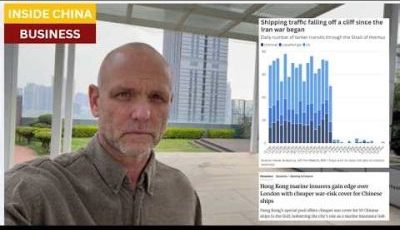
More Iran War fallout: Maritime insurance industry shifts from London to China
or go to
Aletho News Archives – Video-Images
From the Archives
Allies Don’t Need Lobbies
By Jay Knott | Dissident Voice | September 24, 2013
In a recent article on Counterpunch, Rob Urie defended the traditional Marxist analysis of US policy in the Middle East. He argues that support for Israel is driven primarily by economic interest, not the Jewish lobby.
He starts by paying tribute to the idea that Western societies are uniquely racist. He says that the “Western narrative” claims there is an “Arab character”, and that this is “antique racist blather”. He gives no definition of these terms. Further, he establishes his credentials as part of the dominant current in the American left by claiming that “over a million people in Iraq died so ‘we’ in the West can drive SUVs.”1
When he tries to criticize bourgeois economics, he makes it clear he doesn’t understand the developments it has made since Marx’s day, using the mathematical discipline known as “game theory”. He dismisses the basic abstraction of economic theory, the idea of the rational individual, on the grounds that it is “devoid of history, culture and political context”. But abstractions are always devoid of something.
He defends a more concrete economic theory, mostly Marxist, with some input from another theorist of capitalist crisis, Hyman Minsky. This concrete theory leads him to the view that US activity in the Middle East is primarily driven by rational capitalist motives, the need to secure a supply of oil.
“Taking the totality of circumstance — former oil company executives launching war on an oil rich nation on a pretext they publicly proclaimed they didn’t believe shortly before taking office — and that upon launching their war proved to be non-existent, requires a willingness to overlook the obvious — that the war on Iraq was for oil, that is difficult to support.”1
Perhaps I’ve misunderstood him, but based on what he says in the rest of the article, this convoluted sentence seems to argue that, because president Bush and vice-president Cheney attacked Iraq on false premises, and they also said it was all about oil, and they are former oil executives, and Iraq has a lot of oil, it’s difficult to deny US attacks on Iraq are all about oil.
In fact, it’s not hard at all. As Urie points out, at times Bush and co. said that attacking Iraq was “protecting the world’s supply of oil.”1 But, as he also points out, they are congenital liars. Why should we believe them when they say they are trying to “protect” the oil supply? Protect it against what? When politicians “admit” attacks on Middle Eastern countries are wars for oil, they are parroting the neo-con party line, feeding the public, both left and right, with a plausible-sounding pretext. For right-wingers, “it’s a war for oil” is a reason to support war, and for leftists, it’s a way to feel better by complaining impotently about corporate greed. Both approaches help the war drive. … continue
Blog Roll
 Aletho News
- More Iran War fallout: Maritime insurance industry shifts from London to China
- US-Israeli aggression on Iran triggers review of GCC countries’ investment pledges to Washington
- Russia slams UK plan to seize tankers suspected of carrying its oil
- Pakistan ramps up food exports to Persian Gulf nations as war deepens food insecurity
- Iran submits response to US plan, sets terms for war’s end: Tasnim
- US vs Iran: Kharg Island Talk — Bluff or Escalation? Ex-Military Officer Weighs In
- Zelensky unnecessarily involves Ukraine in the Middle East crisis
- Turkish tanker blacklisted by Ukraine hit in drone attack – media
- Canada, the U.S., and NATO: the inescapable trap
- Villains of Judea: Leonid Radvinsky
- If Americans Knew
- ‘No Innocent Children’: Far-right Israeli Lawmaker Defends Killing of Palestinian Family
- Mossad’s promises helped Netanyahu convince Trump that Iran could be toppled
- US Arms Control Official Refuses To Comment When Asked If Israel Has Nuclear Weapons
- Veterans warn US landing could be ‘more Gallipoli than Vietnam’
- Israel may be committing war crimes in Lebanon – Not a ceasefire Day 167
- In the West Bank, life is a constant battle – 3 articles
- Jacob Reses, one of the most powerful pro-Israel operatives in Trump’s Washington
- Israeli-US assaults kill or injure 87 children a day – Not a ceasefire Day 166
- ‘Forever live by the sword’: Understanding Israelis’ massive support for Iran war
- UN’s special rapporteur on human rights says Israel is systematically torturing Palestinians
- No Tricks Zone
- Devastating Assessment Of Comirnaty Vaccine By Former Senior Pfizer Europe Toxicologist
- New Study: CO2 Is ‘Effectively Negligible’ As An Explanatory Climate Change Factor Since 2000
- Former Pfizer Toxicologist Dr. Helmut Sterz Tells Bundestag Hearing Pfizer Vaccine Should Have Never Been Approved
- Energy Expert: Germany’s Nuclear Phaseout Was A “500 Billion Euro Mistake”
- New Research: South Australia’s Mid-Holocene Sea Surface Temperatures Were 4°C Warmer Than Today
- Storing Green Energy To Last Germany 10 Days Would Require A 60-Million Tonne Battery
- New Studies: UK Sea Levels Were 4 Meters Higher Than Today During The Mid-Holocene
- Destructive Green New Deal: German Energy And Metal Group Warns Of Drastic Crisis
- New Study Documents A 20-Year Pause In Arctic Sea Ice Decline – Driven By Internal Variability
- Wake-up Call: Survey Shows Majority Of Germans Now Favor Postponing Climate Targets!
 Aletho News
Leave a comment