UK to Deploy Royal Navy Warship to Ex-Colony Amid Guyana-Venezuela Dispute
By Svetlana Ekimenko – Sputnik – 24.12.2023
Guyanese President Irfaan Ali and Venezuela’s leader Nicolas Maduro met in mid-December under the aegis of the Community of Latin American and Caribbean States and the Caribbean Community to defuse tensions around the disputed region of Essequibo. The two agreed to “continue dialogue to resolve the dispute over the Essequibo territory.”
The UK has decided to re-task Royal Navy warship the HMS Trent and deploy it to Guyana after Christmas, according to British media reports.
Instead of scouring the Caribbean in search of drug smugglers, the warship will take part in joint naval exercises with the former British colony and Commonwealth member. The decision was reportedly prompted by the current flare-up of the territorial dispute between Guyana and Venezuela.
“HMS Trent will visit regional ally and Commonwealth partner Guyana later this month as part of a series of engagements in the region during her Atlantic Patrol Task deployment,” a UK Ministry of Defense spokesperson was cited as saying.
The HMS Trent is a Batch 2 River-class offshore patrol vessel, named after the River Trent. Commanded by Commander Tim D. Langford, it is designed to carry out tasks that include “counter-piracy, anti-smuggling, fishery protection, border patrol, counter terrorism, humanitarian aid, search and rescue, general patrols and defence diplomacy,” as per the Royal Navy website.
The warship will stay in Barbados, the Caribbean region of the Americas, during Christmas, after which it will be heading for Guyana. Its activities will reportedly be carried out at sea, and will not involve docking in Guyana’s capital, Georgetown.
Earlier in December, when Britain’s Foreign Office Minister for the Americas and Caribbean David Rutley visited Guyana, he was quoted as saying that the UK would work internationally “to ensure the territorial integrity of Guyana is upheld.”
The border between Guyana and Venezuela, which runs through the Guyana-Essequibo region, known for its abundant oil reserves, has been a source of territorial dispute for several decades.
Venezuela gained independence from Spain in 1845 and recognized Essequibo – a zone of 160,000 sq. km – as part of its sovereign territory. In 1899, however, the United Kingdom filed and won an arbitration claim to recognize Essequibo as part of its then-Caribbean colony of British Guiana. Independent Guyana referred the dispute to the International Court of Justice (ICJ) in 2018. This came after Venezuela’s President Nicolas Maduro objected to former Guyanese president David Granger granting oil exploration rights off the Essequibo coast to ExxonMobil, the US-French oil transnational.
Venezuela held a referendum earlier this month in which almost 96% of the population voted in favor of incorporating the Essequibo region, which makes up two-thirds of the territory controlled by Guyana, into the country. Venezuelan President Nicolas Maduro put forward a proposal to the parliament, suggesting the establishment of Venezuela’s 24th state, named Guyana-Essequibo. He also produced a new map showing the disputed region of Essequibo as part of Venezuela. Besides referring to Essequibo as a “zone of integral defense,” Venezuela’s president proposed a deadline of three months for oil companies to halt offshore operations in the area. Last Sunday, a referendum was conducted to reaffirm Caracas’s claim to Essequibo. The majority of citizens voted in favor of establishing a state on the disputed territory.
According to Venezuelan media, President Nicolas Maduro has already officially signed decrees to incorporate the western region of neighboring Guyana into Venezuela, ratifying a total of six documents. In addition, Maduro signed a decree facilitating the creation of specialized units within the state oil and gas company PDVSA — PDVSA Essequibo and the Guyana Venezuelan Corporation — CVG Essequibo. To oversee the newly formed state, Major General Alexis Rodriguez Cabello was appointed as the sole head of the 24th state.
Venezuela and Guyana have since agreed not to threaten or use force in any circumstances to settle the dispute, as per a joint statement, published by Venezuelan President Nicolas Maduro. The sides also agreed to meet in Brazil within the next three months to “consider any matter with implications for the territory in dispute” and immediately establish a joint commission on the level of foreign minister and experts to address the dispute.
Junk Science Alert: Met Office Set to Ditch Actual Temperature Data in Favour of Model Predictions
By Chris Morrison | The Daily Sceptic | December 23, 2023
The alternative climate reality that the U.K. Met Office seeks to occupy has moved a step nearer with news that a group of its top scientists has proposed adopting a radical new method of calculating climate change. The scientific method of calculating temperature trends over at least 30 years should be ditched, and replaced with 10 years of actual data merged with model projections for the next decade. The Met Office undoubtedly hopes that it can point to the passing of the 1.5°C ‘guard-rail’ in short order. This is junk science-on-stilts, and is undoubtedly driven by the desire to push the Net Zero collectivist agenda.
In a paper led by Professor Richard Betts, the Head of Climate Impacts at the Met Office, it is noted that the target of 1.5°C warming from pre-industrial levels is written into the 2016 Paris climate agreement and breaching it “will trigger questions on what needs to be done to meet the agreement’s goal”. Under current science-based understandings, the breaching of 1.5°C during anomalous warm spells of a month or two, as happened in 2016, 2017, 2019, 2020 and 2023, does not count. Even going above 1.5°C for a year in the next five years would not count. A new trend indicator is obviously needed. The Met Office proposes adding just 10 years’ past data to forecasts from a climate model programmed to produce temperature rises of up to 3.2°C during the next 80 years. By declaring an average 20-year temperature based around the current year, this ‘blend’ will provide ”an instantaneous indicator of current warming”.
It will do no such thing. In the supplementary notes to the paper, the authors disclose that they have used a computer model ‘pathway’, RCP4.5, that allows for a possible rise in temperatures of up to 3.2°C within 80 years. Given that global warming has barely risen by much more than 0.2°C over the last 25 years, this is a ludicrous stretch of the imagination. Declaring the threshold of 1.5°C, a political target set for politicians, has been passed based on these figures and using this highly politicised method would indicate that reality is rapidly departing from the Met Office station.
Using anomalous spikes in global temperature, invariably caused in the short-term by natural variations such as El Niño, is endemic throughout mainstream climate activism. ‘Joining the dots’ of individual bad weather events is now the go-to method to provoke alarm. So easily promoted and popular is the scare that an entire pseudoscience field has grown up using computer models to claim that individual weather events can be attributed to the actions of humans. ‘Weather’ and ‘climate’ have been deliberately confused. Climate trends have been shortened, and the weather somehow extended to suggest a group of individual events indicates a much longer term pattern. Meanwhile, the use of a 30-year trend dates back to the start of reliable temperature records from 1900, and was set almost 100 years ago by the International Meteorological Organisation. It is an arbitrary set period, but gives an accurate temperature trend record, smoothing out the inevitable, but distorting, anomalies.
By its latest actions, the Met Office demonstrates that the old-fashioned scientific way lacks suitability when Net Zero political work needs to be done. Trends can only be detected over time, leading to unwelcome delays in being able to point to an exact period when any threshold has been passed. Whilst accepting that an individual year of 1.5°C will not breach the Paris agreement so-called guard-rail, the Met Office claims that its instant indicator will “provide clarity” and will “reduce delays that would result from waiting until the end of the 20-year period”. The Met Office looks forward to the day when its new climate trend indicator comes with an IPCC ‘confidence’ or ‘high likelihood’ statement such as, “it is likely that the current global warming level has now reached (or exceeded) 1.5°C”. In subsequent years, this might become, “it is very likely that the current global warming level exceeded 1.5°C in year X”.
Why is this latest proposal from the state-funded Met Office junk science-on-stilts? A variety of reasons include that climate models have barely an accurate temperature forecast between them, despite 40 years of trying. Inputting opinions that the temperature of the Earth might rise by over 3°C in less than 80 years is hardly likely to improve their accuracy. There are also legitimate questions to be asked about the global temperature datasets that record past temperatures. Well-documented poor placing of measuring devices, unadjusted urban heat effects and frequent retrospective warming uplifts to the overall records do not inspire the greatest of confidence. At its HadCRUT5 global database, the Met Office has added around 30% extra warming over the last few years.
The Anglo-American War on Russia – Part Twelve (NATO Wants War)
Tales of the American Empire | December 21, 2023
The American empire is expanding to rule the world with the help of its NATO vassal states. In 2008, American President George Bush announced that NATO wanted to add Ukraine to NATO, even though most Ukrainians opposed the idea. Russia announced this would be unacceptable while Germany and France said now is not the time to add Ukraine.
NATO now has 31 members who all must approve of new members, so it’s politically impossible to add Ukraine to NATO while it fights with Russia. However, the United States had already made Ukraine de facto member and wanted a war to occur.
Ukraine never implemented the 2015 Minsk peace accords nor the 2019 Steinmeier Formula agreement and continued random tank and artillery fire into rebel held cities, killing some 14,000 ethnic Russians since 2015. On the eve of the Russian invasion of eastern Ukraine, the buildup of Russian troops on the eastern border of the Donbas was heavily reported. Unreported was the buildup of Ukrainian troops on the Donbas’ western border that preceded it. Ukraine had massed 60,000 troops along its border with Donbas rebels.
As Ukraine slowly loses its war with Russia, many fear NATO will intervene militarily. NATO Secretary General Jens Stoltenburg has spent years selling the dangerous idea of adding Ukraine to NATO. This led to disaster, yet Stoltenburg still promotes this insane idea that would lead to a world war.
_________________________________
“German agency suspends certification for NordStream 2”; DW; November 11, 2021; https://www.dw.com/en/german-agency-s…
Related Tale: “The American Colony Called Germany”; https://www.youtube.com/watch?v=adfyC…
“Germany’s Economy is in Freefall”; Remix; September 2023; https://www.bitchute.com/video/bo10lE…
“Address by the President of the Russian Federation”; Vladimir Putin; The Kremlin; February 21, 2022; http://en.kremlin.ru/events/president…
Related Tales: “The Anglo-American War on Russia”; https://www.youtube.com/playlist?list…
The Impact Of Heat Pumps On Electricity Demand
By Paul Homewood | Not A Lot Of People Know That | December 22, 2023
Following on from the post about heat pumps, I thought I would have a look at their impact on electricity demand.
My analysis reckoned on a typical household consumption of 3857 KWh with a heat pump. If we assume that they will only be used for heating for six months every year, that equates to 643 KWh a month, or 21 KWh a day.
At the coldest times of year, that average will increase substantially, so we could well be looking at 30 KWh a day then, since the heat pump will have to work much harder.
Although heat pumps are designed to provide low level heat continuously, I suspect that many will turn them off at night because it is too warm to sleep. We usually have our bedroom windows open all winter at night!
If we assume then that the heat pumps are in use for 14 hours a day, that gives average hourly electricity demand of 2.1 KWh. This assumes that the heat pump runs at a constant power rating. In practice, the system would have to work harder in the early evening as temperatures drop.
There are about 24 million homes with gas and oil boilers, so a peak demand of 2.1 KW amounts to 50 GW for the country as a whole. To that we can add demand from offices, shops etc, which currently use gas and oil.
Along with demand from EVs, the UK would need well over 100 GW of capacity to meet peak demand.
This is all twenty years or more away. But if the government’s target of 600,000 heat pumps a year is met, even within the next ten years, we will be needing at least 13 GW of extra grid capacity, at a time when dispatchable power generation is being shut down.
Israel bombs Gaza with one-tonne bombs where civilians were sent to take refuge
MEMO | December 23, 2023
Almost all Saudi nationals oppose Arab ties with Israel, poll finds
Press TV – December 23, 2023
A new survey has found that 96 percent of Saudi Arabian citizens want Arab countries to cut all types of ties with Israel in response to the occupying regime’s war on Gaza.
Conducted by the Washington Institute for Near East Policy, a pro-Israel think tank based in Washington, the survey saw almost every Saudi agreeing with the proposal “Arab countries should immediately break all diplomatic, political, economic, and any other contacts with Israel, in protest against its military action in Gaza.”
The study further found that a big majority of the Saudis (91%) believe that “despite the destruction and loss of life, this war in Gaza is a win for the Palestinians, Arabs, and Muslims.”
The majority of respondents in Jordan, Lebanon and Egypt held favorable views towards the Palestinian resistance movement Hamas, but saw a 30-point growth in its popularity in the case of Saudi Arabians, compared to August.
The survey said 87% agree with the suggestion that “recent events show that Israel is so weak and internally divided that it can be defeated someday.”
Conducted to measure the change in shift of attitudes of Saudi nationals after the bloody war broke out, the survey was conducted from November 14 to December 6.
The results of the study are a clear manifestation of the difficulties the United States is going to face as it advocates for intertwined Arab-Israeli cooperation.
Prior to the war, the US was actively working towards achieving an agreement to normalize Saudi Arabia-Israel relations.
Earlier in September, during an interview with Fox News, Saudi Crown Prince Mohammed bin Salman stated that the two countries were getting closer to such an agreement “every day.”
After the war broke out, Riyadh put a pause on normalization talks and has made its diplomatic outreach public as one that seeks “to stop the ongoing escalation.”
The Israeli genocide in Gaza has significantly suppressed support for allowing contact with Israelis.
The US and Israel face a powerful new enemy in the Middle East conflict
By Robert Inlakesh | RT | December 23, 2023
In yet another case of blowback, reflecting the failure of Western military interventionism in West Asia, Yemen’s Ansarallah (Houthi) movement has inserted itself as an active participant in the ongoing war between Israel and Gaza. First launching batches of loitering munitions, ballistic and cruise missiles towards Israel, Ansarallah then moved on to prevent the passage of Israeli-owned or operated ships through the Red Sea, before announcing a complete closure of the shipping route for any vessels destined to dock at the port of Eilat.
After the Houthis seized a number of ships, while attacking others with drone strikes, activity at Eilat has dropped some 85%. International and Israeli shipping companies have opted to take the long route, which in some cases takes an additional 12 days, to reach Israel with their cargo, a costly diversion to say the least. In opposition to this, US Defense Secretary Lloyd Austin traveled to the region and announced the formation of a multinational naval task force to be deployed in the Red Sea. Despite talk of the coalition including Saudi Arabia, Egypt, and even the United Arab Emirates, the only Arab nation that joined was Bahrain.
So, without a United Nations Security Council (UNSC) resolution to back them up, usually required to make the militarisation of a territory legal under international law, the US has launched yet another foreign intervention. This one is significant because it failed to convince any major regional players to join, demonstrating the decline in American influence, but has also elevated the status of Yemen’s Ansarallah.
Under former US President Barack Obama, Washington backed the Saudi-led coalition’s intervention in Yemen back in 2015. Since then, some 377,000 people have died, largely as a result of the deadly blockade imposed on the majority of the country’s population, while some 15,000 civilians have died due to direct conflict. The objective of the Saudi-led intervention, which received the backing of the US and UK, was to remove Ansarallah from power in the nation’s capital, Sanaa. Although the group does not enjoy international recognition as Yemen’s governing force, it rules over more than 80% of the population, has the support of two-thirds of the nation’s armed forces, and operates a government out of Sanaa.
Ansarallah came to power following a popular revolution against then-Yemeni President Abdrabbuh Mansour Hadi in 2014. Months later, Hadi resigned and fled the country after Ansarallah militants had decided to take over by force. In the midst of a seven-year war, the political, social and armed movement that is often referred to as “the Houthi rebels” operates as the de facto government of Yemen, but is yet to receive recognition at the UN, which instead recognises the ‘Presidential Leadership Council’ that was created in Riyadh, Saudi Arabia, in 2022.
The context above is crucial for understanding the capabilities of Yemen’s Ansarallah, which was downplayed as a band of “Iran-backed rebels” in Western corporate media for years. While the governments of the collective West have tried to pretend that the Yemeni group is insignificant, Washington’s recent decision to form a multi-national naval coalition to confront the Houthis is an admission that they are a major regional actor. In fact, Ansarallah is the only Arab movement that controls state assets and a standing army that is participating in the ongoing war with Israel.
The reality that the US is now confronting is something that both Saudi Arabia and the UAE came to realize early last year. Following two separate drone and missile attacks on Abu Dhabi and Dubai in January of 2022, it became apparent that the West’s current level of support could not provide sufficient security for the UAE. Up until a nationwide ceasefire was brokered in April 2022, Ansarallah had also demonstrated its developed missile and drone capabilities, striking valuable economic targets inside Saudi Arabia too.
Despite receiving a lot less attention than it deserved, Ansarallah forces strategically timed their second attack on the UAE to coincide with the arrival of Israeli President Isaac Herzog in the country. This was a clear message to the Emirati and Saudi leaderships that Western support will not provide sufficient security. It’s likely because of this threat from Yemen that Riyadh sought a security pact with the US, in order to make a normalization agreement with Israel possible. Such a security pact would have stipulated that an attack on one is an attack on all, hence dragging the Americans into a direct war against Yemen in the event that the conflict was to flare up again.
The US attempted to help topple the current government in Sanaa, but ended up creating a battle-hardened group that has domestically developed capabilities well beyond those it possessed at the start of the conflict in 2015. In his first foreign policy address after taking office in 2021, US President Joe Biden pledged to end the war in Yemen. However, instead of pursuing a Yemen-Saudi deal, the White House abandoned its pledge and sought to broker a Saudi-Israeli deal instead. That fatal decision is coming back to bite policymakers in Washington.
Backing the Israelis to the hilt in their war on Gaza, spelling out that there are no red lines as to how far the government of Benjamin Netanyahu can go, the US has allowed a Palestine-Israel war to expand into a broader regional Arab-Israeli conflict. The threat of escalation between the Israeli army and Lebanese Hezbollah is growing by the day, while Ansarallah leader Abdul-Malik al-Houthi has stated that his forces “will not stand idly by if the Americans have a tendency to escalate and commit foolishness by targeting our country.”
By every metric, US diplomatic stock has dropped internationally as a result of its handling of Israel’s war on Gaza. It has failed to convince any major regional actors in West Asia to back its escalatory agenda, all of which are standing on the same side as Russia and China in calling for a ceasefire. The world sees the hypocrisy of Washington. For the sake of comparison, the death toll in Gaza today is said to have exceeded 23,000, the majority being women and children. Israel has killed this many people in just over two months, while in the first two years of the ISIS/Daesh insurgency in Iraq, the UN estimated that the terrorist group killed some 18,800 civilians. The total number of civilians killed by ISIS in Syria is set at just over 5,000.
The level of human suffering being inflicted in Gaza is without precedent, breaking records in modern history for the tonnage of explosives dropped on such a small territory, in addition to the highest number of journalists, medical workers, and children killed in a single conflict. In reaction, the US government has repeatedly blocked ceasefire resolutions at the UNSC, gives Israel unlimited support unconditionally, and now threatens to drag a coalition of Western nations into a war on Yemen. The solution here is very simple: Ansarallah has said the blockade on ships to Israel will end when the war on Gaza ends. Washington has the ability to stop the war, but refuses to do so, while its threats against Yemen will not work to achieve any result beyond further escalation.
Robert Inlakesh is a political analyst, journalist and documentary filmmaker currently based in London, UK. He has reported from and lived in the Palestinian territories and currently works with Quds News. Director of ‘Steal of the Century: Trump’s Palestine-Israel Catastrophe’.
Rumble blocks Brazil
RT | December 22, 2023
The video sharing service Rumble announced on Friday that it would disable access to all users from Brazil pending its legal challenge of the Brazilian court order to censor certain creators.
Rumble CEO Chris Pavlovski revealed the move in a post on X (formerly Twitter), noting that the court orders clashed with the company’s mission to “restore a free and open Internet.”
“Users with unpopular views are free to access our platform on the same terms as our millions of other users,” Pavlovski wrote. “Accordingly, we have decided to disable access to Rumble for users in Brazil while we challenge the legality of the Brazilian courts’ demands.”
Brazilians who lost their access to Rumble content have only their courts to blame, he added, noting that he hoped the judges would reconsider their decision so that the service could be restored soon.
“I will not be bullied by foreign government demands to censor Rumble creators.”
In a follow-up post, Pavlovski noted that Rumble was “the only company at our scale that holds the line for free speech and American values,” and that he hoped some day other Big Tech companies would do the same. “I will continue to lead by example until that day arrives,” he added.
Journalist Glenn Greenwald, who lives in Brazil and hosts the ‘System Update’ show on Rumble, noted that the Brazilian Supreme Court is “consumed with censoring political speech,” to the point that it banned platforms such as Telegram and WhatsApp for failing to immediately obey their censorship orders.
This is the second time Rumble has suspended service in a country over a censorship row. In November 2022, Pavlovski defied France’s orders to censor certain Russian-language outlets, citing the company’s free speech mission.
Pavlovski, a Canadian tech entrepreneur, founded Rumble in 2013 after seeing YouTube giving priority to influencers after getting acquired by the search engine giant Google. The platform grew in popularity starting in 2020, after a mass purge of dissident voices by Silicon Valley, and continued in 2021 with the influx of US conservatives censored elsewhere.
How the cabal’s false narratives are used to gain their true objectives
BY MERYL NASS | DECEMBER 21, 2023
One Health issues a booklet and finally, kinda, sorta tells us what One Health is about.
“A guide to implementing the One Health Joint Plan of Action at national level”
See page 30:
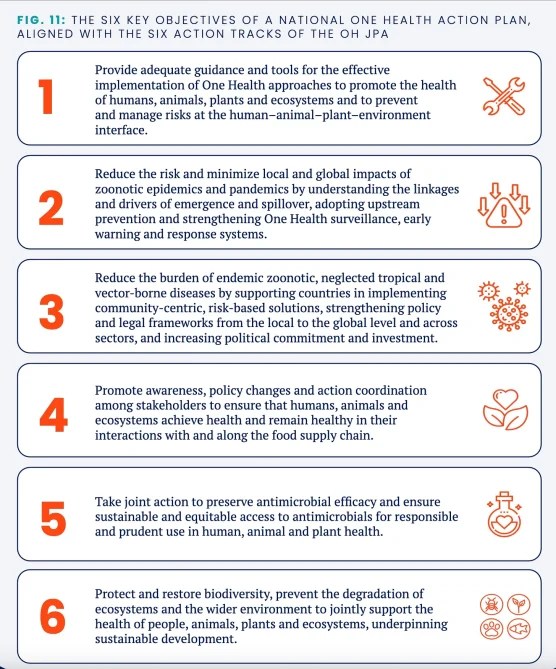
I do the decoding [italics ].
- “Provide adequate guidance and tools for the effective implementation of One Health approaches to promote the health of humans, animals, plants and ecosystems and to prevent and manage risks at the human–animal–plant–environment interface.”
This drills into the reader’s brain the idea that the human-animal or human-environment interface is a dangerous place to be, that the risks must be acknowledged, and major efforts made to manage them. Note the absence of evidence supporting the assertion that major risk exist when humans are exposed to animals and nature.
- Reduce the risk and minimize local and global impacts of zoonotic epidemics and pandemics by understanding the linkages and drivers of emergence and spillover, adopting upstream prevention and strengthening One Health surveillance, early warning and response systems.
The concept that pandemics are caused by “spillover” from animals is asserted, as is the very shaky idea that one can prevent and identify pandemics early using “surveillance” “warning and response systems”—which tellingly are never defined in any detail since no methods have ever worked.
- Reduce the burden of endemic zoonotic, neglected tropical and vector-borne diseases by supporting countries in implementing community-centric, risk-based solutions, strengthening policy and legal frameworks from the local to the global level and across sectors, and increasing political commitment and investment.
Blather about helping developing nations without saying anything specific, except that they need to strengthen “policy and legal frameworks”—such as implementing legislation for authorization of unlicensed, liability-free drugs and vaccines? They need more political commitment—commitment to what, exactly, is ominously left unsaid. And naturally more investment (and commissions) are needed.
- Promote awareness, policy changes and action coordination among stakeholders to ensure that humans, animals and ecosystems achieve health and remain healthy in their interactions with and along the food supply chain.
The ominous missing information about the policy changes and action desired should make you very nervous. Now the “food supply chain” is invoked, turning food and the methods by which it travels from farm to kitchen fair game for the purveyors of One Health.
- Take joint action to preserve antimicrobial efficacy and ensure sustainable and equitable access to antimicrobials for responsible and prudent use in human, animal and plant health.
It sounds like there is a plan to withhold antibiotics from us in the name of preserving their efficacy. Pharmacists were made to monitor azithromycin use as well as hydroxychloroquine, chloroquine and mefloquine use during the COVID time. Bacterial pneumonias were untreated until the victim’s lips turned blue. Expect more of this.
- Protect and restore biodiversity, prevent the degradation of ecosystems and the wider environment to jointly support the health of people, animals, plants and ecosystems, underpinning sustainable development.
This will be the justification to move people off the land in areas where species are said to be threatened. It may also lead to enforced changes in land use, based on my earlier readings of Daszak, Fauci and the Lancet One Health commission. And of course we must give up our simple pleasures in the name of the Sustainable Development Goals (SDGs). Who voted for them, and why are we being frog-marched into a SDG future, even though we don’t know where it is leading?
_________________

The cabal that delivered COVID and its pandemic response plan to us wants to solve the rest of the world’s problems for us, too. Will YOU let them?
Featured Video

Daniel Davis: China & Russia Will Defend Iran
or go to
Aletho News Archives – Video-Images
From the Archives
Sugar: Killing us Sweetly
Staggering Health Consequences of Sugar on Health of Americans
By Dr. Gary Null | Global Research | February 3, 2014
In September 2013, a bombshell report from Credit Suisse’s Research Institute brought into sharp focus the staggering health consequences of sugar on the health of Americans. The group revealed that approximately “30%–40% of healthcare expenditures in the USA go to help address issues that are closely tied to the excess consumption of sugar.”[1]The figures suggest that our national addiction to sugar runs us an incredible $1 trillion in healthcare costs each year. The Credit Suisse report highlighted several health conditions including coronary heart diseases, type II diabetes and metabolic syndrome, which numerous studies have linked to excessive sugar intake.[2]
Just a year earlier in 2012, a report by Dr. Sanjay Gupta appearing on 60 Minutes featured the work of Dr. Robert Lustig, an endocrinologist from California who gained national attention after a lecture he gave titled “Sugar: The Bitter Truth” went viral in 2009. Lustig’s research has investigated the connection between sugar consumption and the poor health of the American people. He has published twelve articles in peer-reviewed journals identifying sugar as a major factor in the epidemic of degenerative disease that now afflicts our country. The data compiled by Lustig clearly show how excessive sugar consumption plays a key role in the development of many types of cancer, obesity, type II diabetes, hypertension, and heart disease. His research has led him to conclude that 75% of all diseases in America today are brought on by the American lifestyle and are entirely preventable.[3]
Until the airing of this program, no one in the “official” world acknowledged anything wrong with sugar, here is a sampling of some the latest research available to them if they chose to look… continue
Blog Roll
 Aletho News
- Why Trump’s war on Iran will fail
- Lebanon: Between sovereignty and the mirage of normalization
- Ukraine Given $43Bln in Proceeds From Russian Assets Frozen by G7 Since 2024 – Estimates
- The military is babying F-35s to hide their true cost to taxpayers
- Ukrainian military analyst praises use of drones against ‘Russian-Hungarian-Slovak friendship’
- Von der Leyen warns Hungary: We have ways of making you talk
- EU manipulating polls in bid to oust Orban – German opposition leader
- Daniel Davis: China & Russia Will Defend Iran
- The US’ self-directed ‘China nuclear threat’ will only be a waste of effort: Global Times editorial
- Female Iranian academic sentenced to 4 years in prison in France over protesting Israel’s genocide in Gaza
- If Americans Knew
- Israeli leaders want to buy global legitimacy – Not a ceasefire Day 140
- Israel warns of a Ramadan escalation — while doing everything to provoke one
- Democrats Should Release Their 2024 Election Autopsy – and Stop the Gaza Denial
- Israel responsible for 2/3 of press killings worldwide – Not a ceasefire Day 139
- Are the Jews indigenous to Palestine?
- AIPAC Wants to Kill a Bill that would Ensure Israel Complies with Ceasefire
- Former Israeli PM, in Epstein Files, Dreamed of Israeli Eugenics and Pretty Converts
- Israeli settlers join ‘safari’ tour of Palestinian prisoners
- Flooding in Gaza amid rumors of war; fire in West Bank – Not a ceasefire Day 138
- Fourteen Countries Condemn Huckabee’s Support for Israel Taking Over Most of the Middle East
- No Tricks Zone
- Surprising Discovery: Sahara Is Greening…Billions Of Trees Where Once Thought To Be Barren
- New Research Reaffirms Clouds, Aerosols, And Surface Solar Radiation Are ‘Driving The Climate System’
- Germany: Electric Car Catches Fire At Charging Station, Sets Off Local “Inferno”, Widespread Damage
- New Study: Canada’s New Brunswick Was 1°C Warmer Than Today During The Medieval Warm Period
- Coal Power Back In Trend As Globe Tries To Keep Pace With Growing Demand For Power
- New Study: A 4°C Warmer Beaufort Sea Had ‘No Sea Ice’ 11,700 – 8200 Years Ago
- Unfudging The Data: Dutch Meteorological Institute Reinstates Early 20th Centruy Heat Waves It Had Erased Earlier
- German Gas Crisis…Chancellor Merz Allegedly Bans Gas Debate Ahead of Elections!
- Pollen Reconstructions Show The Last Glacial’s Warming Events Were Global, 10x Greater Than Modern
- Germany’s Natural Gas Storage Level Dwindles To Just 28%… Increasingly Critical
 Aletho News